Model Metric Co-Learning for Time Series Classification
Huanhuan Chen
School of Computer
Science, Univ. of Sci.
& Tech. of China
Hefei, Anhui, China
[email protected]
Fengzhen Tang, Peter Tino
School of Computer Science
University of Birmingham
Birmingham, B15 2TT, UK
fxt126,[email protected]
Anthony G Cohn
School of Computing
University of Leeds
Leeds, LS2 9JT, UK
[email protected]
Xin Yao
School of Computer Science
University of Birmingham
Birmingham, B15 2TT, UK
[email protected]
Abstract
We present a novel model-metric co-learning (MMCL) methodology for sequence classification which learns in the model space – each data item (sequence) is represented by a predictive model from a carefully designed model class. MMCL learning encourages sequences from the same class to be represented by ‘close’ model representations, well separated from those for different classes. Ex-isting approaches to the problem either fit a single model to all the data, or a (predominantly linear) model on each sequence. We introduce a novel hybrid approach spanning the two extremes. The model class we use is a special form of adap-tive high-dimensional non-linear state space model with a highly constrained and simple dynamic part. The dynamic part is identical for all data items and acts as a temporal filter providing a rich pool of dy-namic features that can be selectively extracted by individual (static) linear readout mappings repre-senting the sequences. Alongside learning the dy-namic part, we also learn the global metric in the model readout space. Experiments on synthetic and benchmark data sets confirm the effectiveness of the algorithm compared to a variety of alternative methods.
1
Introduction
Classification of structured data, such as time series, is an im-portant problem in many application domains [Sha and Saul, 2007; Ghanem and Ahuja, 2010]. One popular approach, termed Dynamic time warping (DTW), measures ‘similarity’ between two sequences of variable-length by ‘warping’ the time axis of one (or both) sequences to achieve a better align-ment [Berndt and Clifford, 1994]. DTWcan sometimes gen-erate unintuitive alignments (e.g. mapping a single point in one time series onto a large subsection of another time se-ries), leading to inferior results [Keogh and Pazzani, 2001]. Since theDTWsimilarity measure is not essentially positive definite it cannot be directly used in a kernel machine. A time series kernel based on global alignment, motivated by DTW, has been proposed in [Cuturiet al., 2007], with an efficient version presented in [Cuturi, 2011].
In this context, a new trend has emerged in the machine learning community, using models that are fitted on parts of data as more stable and parsimonious data representations. Learning is then performed directly in the model space, in-stead of the original data space. For example, Brodersen et al. [Brodersenet al., 2011] used a generative model of brain imaging data to represent fMRI measurements of dif-ferent subjects through subject-specific models. They subse-quently employed SVM on the models’ parameters to distin-guish aphasic patients from healthy controls.
Prior to these developments, some aspects of learning in the model space occurred in different forms in the ma-chine learning community. For example, the use of gen-erative kernels for classification (e.g. the P-kernel [Shawe-Taylor and Cristinanini, 2004] orFisherkernel [Jaakkola and Haussler, 1999]) can be viewed as a form of learning in a model induced feature space (see e.g. [Jebaraet al., 2004; Boschet al., 2008]). TheFisherkernel maps individual time series into score functions of a single generative model that is assumed to be able to ‘explain’ most of the data. The gen-erative model employed in a Fisher kernel is often a Hid-den Markov Model (HMM) with a fixed number of states. In some situations the assumption of the particular genera-tive model underlying the data can be too strong. In addition,
Fisherkernels are computationally expensive because of the calculation of metric tensor (inverse of theFisherinformation matrix) in the tangent space of the generative model mani-fold. The often used ‘practical’ Fisher kernel replaces the metric tensor with an identity matrix. This can result in a loss of valuable information in the data [Van der Maaten, 2011]. Yet another approach based on anAutoregressive kernel [Cu-turi and Doucet, 2011] uses a vector autoregressive (VAR) model of a given order to generate an infinite family of fea-tures from the time series. Each time series is represented by its likelihood profile of VAR across all possible parameter settings (under a matrix normal-inverse Wishart prior). The kernel is then defined as the dot product of the corresponding likelihoods.
or Kullback-Leibler (KL) divergence based kernels [Moreno
et al., 2004]. [Chan and Vasconcelos, 2005] proposed a probabilistic kernel based on KL divergence between spatio-temporal linear systems fitted on video sequences. [Saisan
et al., 2001], while also using linear systems to model indi-vidual image sequences, suggested three novel distances be-tween the models, in particular: principal angles bebe-tween spe-cific subspaces derived from the models, Martin and geodesic distances. Binet-Cauchy kernels [Vishwanathan and Smola, 2006] formed a general family of kernels on linear systems subsuming several existing time series kernels. Vishwanathan et al. derived explicit formulae for efficient kernel computa-tion. Staying within the linear dynamics domain, [Chan and Vasconcelos, 2007] allowed for a non-linear readout (obser-vation function) from the (hidden) states.
To the best of our knowledge, previous model-based time series kernel formulations have been based on linear dynami-cal systems, predominantly with linear observation functions. [Vishwanathan and Smola, 2006] discussed extension to non-linear dynamics, but only for the case of fully observable states. Direct extension of the previous work to non-linear dynamics may be highly non-trivial and computationally ex-pensive, perhaps requiring approximation techniques.
Existing approaches to model based sequence classifica-tion either use a single model fitted on the full data/individual classes, or fit a full linear dynamic model on each sequence. Models fitted on the full data/classes can be more complex than those fitted on individual sequences. The price is to be paid is the potential inadequacy of such a model to capture in-dividual variations among the data items. Hence on the other hand, individual sequence models have to be relatively sim-ple (e.g. with linear dynamics) to keep the model estimation stable. We propose a new hybrid approach spanning the two extremes in an attempt to keep the best of both worlds. As the core model class used to represent individual sequences we use a special form of adaptive high-dimensional non-linear state space model with a highly constrained dynamic part. The dynamic part is the same for all data items and acts as a temporal filter providing a rich pool of dynamic features that can be selectively extracted by individual (static) lin-ear readout mappings representing the sequences. Alongside learning the dynamic part, we also learn the global metric in the readout model space. The overall goal is to adapt the shared dynamical system and metric tensor on the readout maps (standing for the sequences) so that sequences from the same class are represented by ‘close’ readouts, while readouts of sequences from different classes are well-separated. We term our methodologymodel-metric co-learning(MMCL).
The MMCL framework for sequence classification builds on ideas of model based representation for sequences [Chen
et al., 2013; Chan and Vasconcelos, 2005] and discriminative learning [Brodersenet al., 2011; Van der Maaten, 2011] but differs mainly in three aspects: First, the final representation of the sequences is a linear readout mapping, but the full un-derlying model is non-linear dynamic system. In this way our methodology reduces the computational demands with-out the loss of the computational ability of non-linear models. Second, it treats the model parameters adaptation and model distance definition jointly rather than adapting the model
pa-rameters first and defining the model distance afterwards in two independent steps. Third, it has a similar motivation as other discriminative kernels [Van der Maaten, 2011], but dif-fers in its goal of utilizing models that both represent the time series well and at the same time best separate the time series classes.
The paper has the following organization: We introduce our methodology in the following section, then report the ex-perimental results and analysis. Finally, the last section dis-cusses and concludes the paper.
2
Model Metric Co-learning
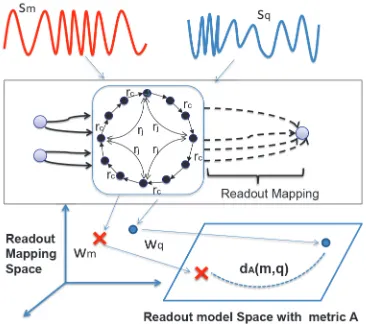
As the core model class for sequence representation we use a high-dimensional parameterized non-linear state space model rooted in Echo State Networks (ESN) with a simple deter-ministically constructed dynamic coupling structure [Rodan and Tiˇno, 2012]. As explained above, each sequence is repre-sented by the corresponding linear readout mapping acting on top of the common shared non-linear dynamical system. The difference between two sequences is measured through the distance of their linear readout weights weighted by a metric tensor. The shared dynamical system, as well as the metric tensor in the readout space are learned simultaneously.
The N-dimensional dynamical model we employ has the following form:
x(t) = tanh(Rx(t−1) +V s(t)), (1)
f(t) = Wx(t) (2) wherex(t)∈ <N,s(t) ∈ <O andf(t) ∈ <O are the state vector, input vector and output at timet, respectively;R is a(N ×N)dynamic coupling matrix; V ∈ <N×OandW ∈ <O×N are the input and output weight matrices1,
respec-tively. We refer to (1) as the state transition mapping (STM). Provided the non-autonomous dynamics (1) is able to rep-resent a rich set of features of the given time series, a par-ticular time seriesscan be represented by the linear readout mapping parameterized byW(eq. (2)) operating on reservoir activationsx, specifically fitted toson the next-item predic-tion taskf(t)∼ s(t+ 1)by minimizing the mean squared error (MSE) between the model predictionsf(t)and targets
s(t+ 1).
Recently, [Rodan and Tiˇno, 2012] proposed a highly con-strained and simple dynamic coupling (cycle reservoir with jumps - CRJ) with dynamic representational capabilities com-parable to those of the traditional randomized ESN models. Viewing (1) as a recurrent neural network, the structure ofR
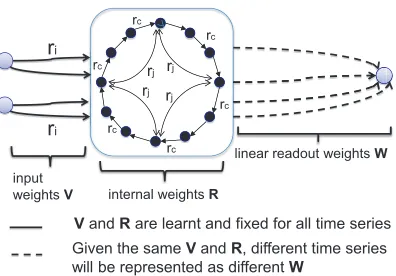
in CRJ has the following form: state units are connected in a uni-directional cycle with bi-directional shortcuts (jumps). All cyclic connections have the same weightrc > 0. Like-wise, all jumps share the same weightrj > 0. The input weight matrix is also highly constrained: the input connec-tions have the same absolute valueri > 0; the sign pattern needs to be aperiodic, see [Rodan and Tiˇno, 2011] for details. The non-linear state space model used in this paper is illus-trated in Figure 1.
1
V and R are learnt and fixed for all time series Given the same V and R, different time series will be represented as different W
rj rj
rj
rj
rc
rc
rc
rc
rc
rc
rj
r rrj
rj
r rj
r
rc
rc
rc
rc
rc
rc
rc
rc
linear readout weights W
ri
ri
internal weights R
[image:3.612.77.275.51.189.2]input weights V
Figure 1: Illustration of the parameterized state space models used in this work. The parameterized state space model has a fixed topology, i.e. a uni-directional cycle with bi-directional jumps. There are only three parameters in this model: the cyclic connection weightrc >0; the jumps weightrj >0; and the input weightri>0. The input weight matrixV only containsri, and the state transition matrixRcontainsrcand
rj.
In the original CRJ, the weightsrc, rj, riwere determined by cross-validation using grid search, which is computation-ally extensive in practice. In this contribution, given a se-quence classification task, we aim to learn these parameters (common for the whole data set) so that(1) a faithful mod-elling of individual sequences is achieved (by allowing indi-vidualized readout mappings from the common state transi-tion mapping),(2)the sequence classes in the space of read-out models are well separated. We will learn the weights (rc, rj, ri) using Real-Time Recurrent Learning [Williams and Zipser, 1989] and a metric tensor2on an appropriate cost
functional reflecting(1)and(2)above.
2.1
Cost Functional
We vectorize3parametersWof the readout mapping (eq. (2))
into the parameter vectorw. Assume we are given a set ofM
labelled sequences{sm, ym}Mm=1. Using the fixed common
state transition mapping (eq. (1)), each sequencesmwill be represented by the linear readout mapping parameterized by
wm. The readout is trained on the next item prediction onsm via ridge regression. The readout weightswmare thus deter-mined by the model parametersr = (ri, rc, rj), as well as the sequencesm. To simplify the notation, this dependence4 will not be made explicit.
Representability: A good non-linear state space model parameterized byr= (ri, rc, rj)should minimize the
repre-2This can be viewed as metric learning [Xing
et al., 2002] in the readout model space.
3
For multivariate time series with dimensionalityO, the linear readout weight matrixW is aO×Nmatrix. In this case, we vec-torize the matrixW into a column vector.
4
The readout weightwmis a function of the model parameters rand the sequencesmas the variables.
sentability cost with respect to all (i.e.M) training sequences:
Qp(r) = M
X
m=1 (
Lm−1 X
t=1
kfm(t)−sm(t+1)k2+η||Wm||2), (3)
whereLmis the length of sequencesm, andfmis the output mapping (eq. (2)) determined bywm. This equation aims to minimize the difference between actual output f(t)and desired outputs(t+ 1).
Separability:We aim to learn a global metricAsuch that sequences from the same class are close to each other in the readout model space and sequences in different classes are far away in the readout model space. Given a training sequence
sm, following [Globerson and Roweis, 2006], we introduce a conditional distribution over training sequence indexesq6= m:
pA(q|m) =
e−dA(m,q) P
k6=me−dA(m,k)
, m6=q,
where
dA(m, q) = (wm−wq)TA(wm−wq) (4) is the squared distance between readout parameterwmand wq under the (global) positive semi-definite metricA. If all readouts in the same class were mapped to a single point and infinitely far from points in different classes, we would have the ideal distribution [Globerson and Roweis, 2006]:
p0(q|m)∝
1 ifym=yq
0 ifym6=yq .
We optimize the non-linear state space model (eq. (1)) and the metricAsuch thatpA(q|m)is as close as possible top0(q|m)
with respect to KL divergence:
min
A M
X
m=1
DKL[p0(q|m)kpA(q|m)],
s.t.Ais positive semi-definite.
This results in a separability cost5Q
s(r,A)equal to
X
{(m,q):yq=ym}
dA(m, q) + M
X
m=1
log X
k6=m
e−dA(m,k). (5)
Overall cost functional:
Using the representation (3) and separation costs (5), we con-struct the cost functional to be minimized by the state space model with parametersrand metricA:
Q(r, A) =Qs(r,A) +λQp(r) (6) where parameterλ >0controls the tradeoff between the rep-resentabilityQpand theseparabilityQs.Wmis obtained by minimizingQp(r). However, sinceQp(r)is quadratic with respect to Wm, enforcing the derivatives ofQp(r)with re-spect toWmto be 0 will give an closed-form solution ofWm as presented in Eq(9).
Figure 2: Outline of the MMCL framework.
and Roweis, 2006]. The gradients ofQwith respect to STM parametersrand metric tensorAare obtained as (θstands forri,rcorrj):
∂Q ∂θ =
M
X
m,q
(p0(q|m)−pA(q|m)) (wq−wm)T (7)
· A+AT ∂w
q
∂θ − ∂wm
∂θ
+λ
M
X
m=1
Lm−1 X
t=1
2 (fm(t)−sm(t+ 1))T
∂fm(t)
∂θ
∂Q ∂A =
M
X
m,q
(p0(q|m)−pA(q|m))·
(wq−wm) (wq−wm) T
. (8)
Using ridge regression, the readout parametersWm(wm =
vec(Wm)) representing sequencesmare obtained:
Wm=s˜mXmT(XmXmT +ηI)
−1. (9)
whereXm= [xm(1),· · ·,xm(Lm−1)]is the(N×(Lm−
1))STM state matrix storing state activations obtained while processingsmas columns, ˜sm = [sm(2),· · ·,sm(Lm)]is the target matrix for the next-item prediction task andη >0
is a regularization parameter. To ease the presentation, we omit the sequence indexmin the following derivations. We have
5
assuming equally probable classes and ignoring constant terms.
∂W
∂θ = s˜ ∂XT
∂θ (XX
T+ηI)−1+s˜XT·
∂(XXT +ηI)−1 ∂θ
= s˜ ∂X
∂θ T
(XXT+ηI)−1−s˜XT
(XXT +ηI)−1∂(XX
T +ηI)
∂θ (XX
T +ηI)−1
= s˜ ∂X
∂θ T
(XXT+ηI)−1−s˜XT
(XXT +ηI)−1 ∂X ∂θX
T +X
∂X
∂θ T!
·
(XXT +ηI)−1 (10)
where
∂X ∂θ =
∂x(1) ∂θ ,
∂x(2) ∂θ , ...,
∂x(L−1) ∂θ
Adopting real time recurrent learning, we have:
∂x(t)
∂θ = sech
2(Rx(t−1) +V s(t))
.∗
∂V
∂θs(t) +R
∂x(t−1) ∂θ
, (11) where .∗ stands for element-wise matrix multiplication (MATLAB notation). Finally,
∂f(t) ∂θ =W
∂x(t) ∂θ +
∂W
∂θ x(t), (12)
and ∂W∂θ can be obtained by combining Equations (10–12). Hence, state space model learning (eq. (7)) can be obtained by combining eq. (12) and eq. (10). MMCL can be achieved by alternating between performing state space model learning (eq. (7)) and metric learning in the readout model space (eq. (8)) to obtain a tradeoff betweenrepresentabilityand separa-bility.
2.2
Sequence Classification
Having determined the appropriate STM and global metric tensor on the readout parameters, we can use any convenient distance-based classifier, e.g. k-Nearest Neighbour (kNN). The (squared) distance between two sequences sm andsq is simplydA(m, q)in eq. (4) , where, as explained above, the feature vectorwmof a sequencesmis obtained by ridge regression from the dynamical system generated using the learned parametersri,rc andrj with the task of predicting the next item of the sequence. Of course, one can also adopt a kernel classification framework (e.g. SVM) using a sequence kernel
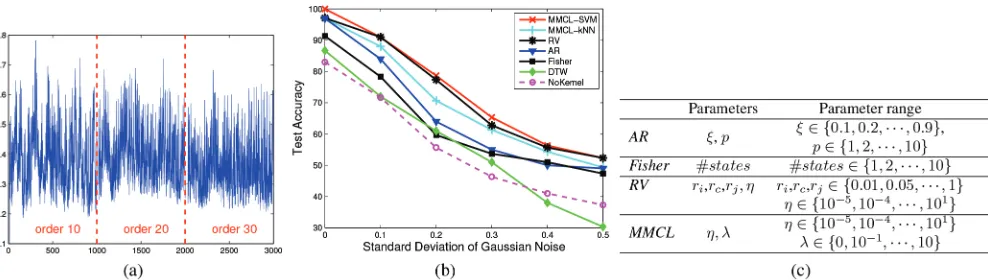
Figure 3: (a) illustration of 3 NARMA sequences. (b) the classification accuracies on the synthetic (test) data sets. (c) Parameter search ranges for methods employed in the paper.pis the order of the vector autoregressive model,ξis anARkernel parameter [Cuturi and Doucet, 2011],#statesis the number of states for HMM inFisherkernel,ηis the ridge regression regularization parameter,λis the trade-off parameter.ri,rcandrjare parameters of the deterministic state space mode used inRVkernel.
3
Experimental Studies
We compare our MMCL framework with several state-of-the-art methods for sequence classification such asDynamic time warping (DTW)[Berndt and Clifford, 1994], Autoregres-sive kernel (AR)[Cuturi and Doucet, 2011], theFisher kernel (Fisher)[Jaakkolaet al., 1999] and theReservoir kernel (RV)
of [Chenet al., 2013]. The RV kernel can be viewed essen-tially as the MMCL kernel, except for the dynamic parame-tersri, rc, rj are simply set by costly cross-validation with-out any regard for class separability and metric tensor learn-ing. The implementation of theARkernel is from Cuturi’s website6. TheFisherkernel was obtained Maaten’s website7. TheAR,Fisher,RV andDTWbased kernels were used in a SVM classifier.
In MMCL, the number of nodes was fixed toN = 50and 10 jumps (making the jump length 5). The jump length could be set by cross-validation as in [Rodan and Tiˇno, 2012], but to demonstrate the power of the framework, we simply fixed the topology for all experiments without pre-testing.
All (hyper) parameters, such as the MMCL trade-off pa-rameterλ, orderpin theARkernel, number of hidden states in the HMM basedFisher kernel, regularization parameter
η for ridge regression etc. have been set by 5-fold cross-validation on the training set. We employ a well-known, widely accepted and used implementation of SVM – LIB-SVM [Chang and Lin, 2011]. In LIBLIB-SVM, we use cross val-idation to tune the slack-weight regularization parameterC. After model selection using cross-validation on the training set, the selected model class representatives were retrained on the whole training set and were evaluated on the test set. Multi class classification is performed via the one-against-one strategy (default in LIBSVM). The SVM parameters, kernel widthγin eq. (13) andC, were tuned in the following ranges:
γ ∈ {10−6,10−5,· · ·,101}, C ∈ {10−3,10−2,· · ·,103}.
We also tested our MMCL method using ak-NN classifier wherek∈ {1,2,· · · ,10}. We refer to SVM andkNN classi-fiers built within the MMCL framework asMMCL-SVMand
6
http://www.iip.ist.i.kyoto-u.ac.jp/member/cuturi/AR.html
7
http://homepage.tudelft.nl/19j49/Software.html
MMCL-kNN, respectively. The search ranges for the param-eters are detailed in Figure 3(c).
3.1
Synthetic Data
We employed 3 NARMA time series models of orders 10, 20 and 30, given by:
st+1= 0.3st+ 0.05st
9 X
i=0
st−i+ 1.5ut−9ut+ 0.1,
st+1= tanh(0.3st+ 0.05st
19 X
i=0
st−i+ 1.5ut−19ut+ 0.01)
+ 0.2,
st+1= 0.2st+ 0.004st
29 X
i=0
st−i+ 1.5ut−29ut+ 0.201,
wherest is the output at time t, ut is the input at time t. The inputsutform an i.i.d stream generated uniformly in the interval[0,0.5). We use the same input stream for generat-ing the three long NARMA time series (60,000 items), one for each order. The time series are challenging due to non-linearity and long memory (see Figure 3(a, b)).
For each order, the series of 60,000 numbers is partitioned into 200 non-overlapping time series of length 300. The first 100 time series for each order are used as a training set, and the other 100 time series form the test set. In order to study ro-bustness of the kernels we also corrupt the time series with ad-ditive Gaussian noise (zero mean, standard derivation varies in [0.1,0.5]). Figure 3(b) shows the test set classification ac-curacy against the noise level. As a baseline, we also include results of SVM directly operating on the time series (300-dimensional inputs) - NoKernel. The MMCL based kernel methodMMCL-SVMoutperforms the baseline as well as all the other methods. Although theRVkernel achieves the sec-ond best performance in this noise data, it takes more time8
8
The size of the search grid (for four parametersri,rc,rj, andη)
[image:5.612.60.554.52.192.2]Table 1: Description of the data sets (left) and the performances (best is boldfaced). Note that in 4 out of the 7 datasets (OSULeaf, Oliveoil, Fish and Adiac) both MMCL techniques outperform others. Modelstands forMMCL-SVMwith model learning only (without metric learning) andDecouplestands forMMCL-SVMwith decoupled model and metric learning.
DATASET LENGTH CLASSES # TRAIN # TEST DTW AR Fisher RV Model Decouple MMCL-kNN MMCL-SVM
OSULEAF 427 6 200 242 74.79 56.61 54.96 69.83 70.25 77.69 88.02 85.12
OLIVEOIL 570 4 30 30 83.33 73.33 56.67 86.67 83.33 86.67 86.67 93.33
LIGHTNING2 637 2 60 61 64.10 77.05 64.10 77.05 75.41 75.41 70.49 75.41
BEEF 470 6 30 30 66.67 78.69 58.00 80.00 80.00 80.00 63.33 82.67
FISH 463 8 175 175 69.86 60.61 57.14 79.00 77.14 81.14 88.57 87.43
COFFEE 286 2 28 28 85.71 100.00 81.43 100.00 92.86 96.43 89.29 100.00
ADIAC 176 37 390 391 65.47 64.45 68.03 72.63 72.63 73.40 72.30 73.40
Table 2: Summary of multivariate (variable length) series classification problems (left) and the performances (best is boldfaced). For the handwritten and AUSLAN datasets both MMCL variants outperform others.Modelstands forMMCL-SVMwith model learning only (without metric learning) andDecouplestands forMMCL-SVMwith decoupled model/metric learning.
DATASET DIM LENGTH CLASSES #TRAIN #TEST DTW AR Fisher RV Model Decouple MMCL-kNN MMCL-SVM
Libras 2 45 15 360 585 94.02 91.79 94.93 93.25 92.82 94.19 94.19 94.87
handwritten 3 60-182 20 600 2258 88.67 73.30 87.52 89.41 89.02 90.79 91.31 91.41
AUSLAN 22 45-136 95 600 1865 97.00 76.53 94.74 96.00 96.00 96.41 97.05 97.80
to select the three parametersri,rc andrj by cross valida-tion with grid search. In MMCL, the three parameters are learned based on data instead of selecting by grid search, which may achieve better performance and save the param-eter tuning time.
3.2
Univariate Benchmark Data
We used 7 data sets from the UCR Time Series Repository [Keoghet al., 2011]. Each data set has already been split into training and test sets (see Table 1). Table 1 reports perfor-mance of the studied methodologies on the benchmark data in terms of test set classification accuracy. TheMMCL meth-ods outperform the other algorithms on most of the data sets, except for being inferior to or on a par withAR kernel and
RV kernel on Lightning2 and Coffee data sets, respectively,
MMCL-SVMis superior to the simplerMMCL-kNNon 5 data sets.
In order to investigate MMCL further, we performed model learning only (without metric learning) using SVM in Tables 1 and 2, calledmodel. We (as expected) observed similar per-formance levels to those ofRV(model parameters optimized by cross validation). RV sometimes outperforms MMCL (model learning only) because the model learning may be trapped in the local optima. In Tables 1 and 2, we have also decoupled the model and metric learning in MMCL, termed
decouple. This naturally resulted in an inferior performance. Independent learning might ignore possible coupling between the provider of dynamical features (dynamical system) and the static readout models.
As shown in Table 1, our methodology was slightly inferior to other algorithms on some datasets, e.g. Lightning2. Light-ning2 contains time series of power spectra related lightning. The classes can be characterized by pronounced low-memory features of the power spectra series such as those correspond-ing to sharp turn-on of radiation, gradual increase in power series, or sudden spikes etc. Such time series features can be naturally captured by AR models and thus we hypothesize that the AR kernels provide a strong distinguishing platform for lightning classification.
3.3
Multivariate Time Series
The data sets used so far involved univariate time series. In this section, we perform classification on three multivariate time series - Brazilian sign language (Libras), handwritten
characters and Australian language of signs (AUSLAN). Un-like the other data sets, thehandwrittencharacters and AUS-LANdata sets contain variable length time series. Following [Cuturi and Doucet, 2011] (previousARkernel study) we split the data into training and test sets (see Table 2).
Table 2 shows that the MMCL basedMMCL-SVM is su-perior on two data sets with slightly worse, but comparable performance toFisherkernel on the Libras dataset.
In terms of the learned parameters (ri, rc, rj), we have checked their values on our data sets with and without met-ric learning. Interestingly enough, in general, metmet-ric learn-ing lead to increasedri,rj. Cycle weightsrc differed by a comparatively smaller amount. The increased input loadsri force the dynamical system to operate in saturation regimes of the tanh function (see eq. (1)). This can increase class separability of state space representations of sequences from different classes. Large jump weightrjin effect broadens fre-quency spectrum of the non-autonomous dynamical system. While a cyclic coupling only [Rodan and Tiˇno, 2011] can cap-ture slow dynamical regimes, introduction of jumps leads to broadening the sensitivity of the system to faster changes in the input stream.
4
Discussion and Conclusion
Given a particular data set, we learn both the appropriate state space model and metric in the readout model space. Since we consider sequence classification, learning is guided by two criteria:representabilityandclass separabilityof the readout models.
On 11 sequence classification data sets the sequence ker-nels constructed using our methodology (and applied in SVM) were on a par or outperformed the other four studied methods -Dynamic Time Warpingbased kernels, Autoregres-sivekernel, theFisherkernel based onHidden markov model, and thereservoir kernelwithmanuallychosen state transition parameters by cross validation using grid search andwithout
metric learning in the readout space.
Since in our framework each sequence is represented as a model in the readout model space with a learnt global metric tensor, any distance based classifier can be used. As a base-line we employedkNN. Except for the Coffee, Lightning2 andLibrasdata sets,kNN achieved comparable or better per-formance than the four alternatives.
Our results may seem surprising, especially given the rather simple structure of the state transition part. We em-phasize that the STM employed does not necessarily have to provide a platform for the best sequence modelling. For that, the imposition of the same fixed STM for the whole data set may indeed be too restrictive. However, the task at hand is sequence classification and the requirements on the STM are of a different nature: allowing state space process-ing of sequences so that the correspondprocess-ing linear readouts co-incide as much as possible for sequences of the same class, while keeping the separation of the distinct classes. This, as demonstrated in our experiments, is indeed possible using a fixed STM. The optimal STM for the classification purposes is learnt alongside the metric tensor on linear readouts from the filter that enhances the within-class collapsed representa-tions and between-class separation.
The superior performance of MMCL methodology comes at a price - relatively high computational complexity. In each iteration of gradient descent in MMCL, the complexity is
O(M2d2 +dM L), where M is the number of sequences,
dis the dimensionality of the time series, andLis the length of sequences. However, this tolerable computational cost is well offset by the high classification accuracy and the saving of effort for tuning parameters in the state space model using cross validation with grid search.
Future work includes experiments using lag-pmodel, L1 norm, the computational cost and the situation to deal with imbalanced data sets for MMCL.
Acknowledgments
Huanhuan Chen is supported by the National Natural Sci-ence Foundation of China under Grants 61203292, and the One Thousand Young Talents Program. The financial as-sistance of the Royal Society under International Exchange grant IE121685 is gratefully acknowledged.
References
[Berndt and Clifford, 1994] D. Berndt and J. Clifford. Using dynamic time warping to find patterns in time series. In
KDD workshop, volume 10, pages 359–370, 1994. [Boschet al., 2008] A. Bosch, A. Zisserman, and
X. Muoz. Scene classification using a hybrid gener-ative/discriminative approach. IEEE Transactions on Pattern Analysis and Machine Intelligence, 30(4):712– 727, 2008.
[Brodersenet al., 2011] K.H. Brodersen, T.M. Schofield, A.P. Leff, C.S. Ong, E.I. Lomakina, J.M. Buhmann, and K.E. Stephan. Generative embedding for model-based classification of fMRI data.PLoS Computational Biology, 7(6):e1002079, 2011.
[Chan and Vasconcelos, 2005] A. B. Chan and N. Vasconce-los. Probabilistic kernels for the classification of auto-regressive visual process. InIEEE Computer Society Con-ference on Computer Vision and Pattern Recognition, vol-ume 1, pages 846–851, 2005.
[Chan and Vasconcelos, 2007] A. B. Chan and N. Vasconce-los. Classifying video with kernel dynamic textures. In
IEEE Conference on Computer Vision and Pattern Recog-nition, 2007.
[Chang and Lin, 2011] C.-C. Chang and C.-J. Lin. LIB-SVM: A library for support vector machines.ACM Trans-actions on Intelligent Systems and Technology, 2(3):27:1– 27:27, 2011.
[Chenet al., 2013] H. Chen, F. Tang, P. Tino, and X. Yao. Model-based kernel for efficient time series analysis. In
Proceedings of the 19th ACM SIGKDD Conference on Knowledge Discovery and Data Mining (KDD) (KDD’13), pages 392–400, Chicago, USA, 2013.
[Cuturi and Doucet, 2011] M. Cuturi and A. Doucet. Au-toregressive kernels for time series. ArXiv:1101.0673, 2011.
[Cuturiet al., 2007] M. Cuturi, J-P Vert, O. Birkenes, and T. Matsui. A kernel for time series based on global align-ments. In IEEE International Conference on Acoustics, Speech and Signal Processing, volume 2, pages 413–416, 2007.
[Cuturi, 2011] M. Cuturi. Fast global alignment kernels. In
Proceedings of the 28th International Conference on Ma-chine Learning (ICML’11), pages 929–936, 2011. [Ghanem and Ahuja, 2010] B. Ghanem and N. Ahuja.
Max-imum margin distance learning for dynamic texture recog-nition. InProceedings of the 11th European Conference on Computer Vision (ECCV’10), pages 223–236. Springer Berlin Heidelberg, 2010.
[Globerson and Roweis, 2006] A. Globerson and S. Roweis. Metric learning by collapsing classes. In Advances in neural information processing systems (NIPS), volume 18, pages 451–458, 2006.
[Jaakkola and Haussler, 1999] T.S. Jaakkola and D. Haus-sler. Exploiting generative models in discriminative classi-fiers. Advances in Neural Information Processing System (NIPS), pages 487–493, 1999.
remote protein homologies. In Proceedings of the Inter-national Conference on Intelligent Systems for Molecular Biology, pages 149–158. AAAI Press, 1999.
[Jebaraet al., 2004] T. Jebara, R. Kondor, and A. Howard. Probability product kernels. Journal of Machine Learning Research, 5:819–844, 2004.
[Keogh and Pazzani, 2001] E. J. Keogh and M. J. Pazzani. Derivative dynamic time warping. InSIAM International Conference on Data Mining (SDM), 2001.
[Keoghet al., 2011] E. Keogh, Q. Zhu, B. Hu, Y. Hao, X. Xi, L. Wei, and C. A. Ratanamahatana. The UCR time se-ries classification/clustering, 2011. http://www.cs.ucr.edu/ ∼eamonn/time series data/.
[Morenoet al., 2004] P. J. Moreno, P. P.Ho, and N. Vascon-celos. A Kullback-Leibler divergence based kernel for SVM classification in multimedia application. In Ad-vances in Neural Information Processing Systems, 2004. [Rodan and Tiˇno, 2011] A. Rodan and P. Tiˇno. Minimum
complexity echo state network. IEEE Transactions on Neural Networks, 22(1):131–144, 2011.
[Rodan and Tiˇno, 2012] A. Rodan and P. Tiˇno. Simple de-terministically constructed cycle reservoirs with regular jumps. Neural Computation, 24(7):1822–1852, 2012. [Saisanet al., 2001] P. Saisan, G. Doretto, Y. Wu, and
S. Soatto. Dynamic texture recognition. In IEEE Con-ference on Computer Vision and Pattern Recognition, vol-ume 2, pages 58–63, 2001.
[Sha and Saul, 2007] F. Sha and L. K. Saul. Large mar-gin hidden Markov models for automatic speech recogni-tion. InAdvances in neural information processing sys-tems (NIPS), 2007.
[Shawe-Taylor and Cristinanini, 2004] J. Shawe-Taylor and N. Cristinanini. Kernel methods for patten analysis. Cam-bridge University press, 2004.
[Van der Maaten, 2011] L. Van der Maaten. Learning dis-criminative Fisher kernels. InProceedings of the 28th In-ternational Conference on Machine Learning (ICML’11), pages 217–224, 2011.
[Vishwanathan and Smola, 2006] S. V. N. Vishwanathan and A. J. Smola. Binet-Cauchy kernels on dynamic systems and its application to the analysis of dynamic scenes. Inter-national Journal of Computer Vision, 73(1):95–119, 2006. [Williams and Zipser, 1989] R. J. Williams and D. Zipser. A learning algorithm for continually running fully recur-rent neural networks. Neural computation, 1(2):270–280, 1989.