0022-538X/09/$08.00⫹0 doi:10.1128/JVI.01120-09
Copyright © 2009, American Society for Microbiology. All Rights Reserved.
Impact of Cytotoxic-T-Lymphocyte Memory Induction without
Virus-Specific CD4
⫹
T-Cell Help on Control of a Simian
Immunodeficiency Virus Challenge in Rhesus Macaques
䌤
Tetsuo Tsukamoto,
1Akiko Takeda,
1Takuya Yamamoto,
2Hiroyuki Yamamoto,
1Miki Kawada,
1and Tetsuro Matano
1,3,4*
International Research Center for Infectious Diseases, The Institute of Medical Science, The University of Tokyo, Tokyo 108-8639, Japan1; Department of Immunology, National Institute of Infectious Diseases, Tokyo 162-8640, Japan2; AIDS Research Center,
National Institute of Infectious Diseases, Tokyo 162-8640, Japan3; and Tsukuba Primate Research Center,
National Institute of Biomedical Innovation, Tsukuba 305-0843, Japan4
Received 2 June 2009/Accepted 29 June 2009
Despite many efforts to develop AIDS vaccines eliciting virus-specific T-cell responses, whether induction of these memory T cells by vaccination before human immunodeficiency virus (HIV) exposure can actually contribute to effective T-cell responses postinfection remains unclear. In particular, induction of HIV-specific
memory CD4ⴙT cells may increase the target cell pool for HIV infection because the virus preferentially infects
HIV-specific CD4ⴙT cells. However, virus-specific CD4ⴙhelper T-cell responses are thought to be important
for functional CD8ⴙcytotoxic-T-lymphocyte (CTL) induction in HIV infection, and it has remained unknown
whether HIV-specific memory CD8ⴙT cells induced by vaccination without HIV-specific CD4ⴙT-cell help can
exert effective responses after virus exposure. Here we show the impact of CD8ⴙT-cell memory induction
without virus-specific CD4ⴙT-cell help on the control of a simian immunodeficiency virus (SIV) challenge in
rhesus macaques. We developed a prophylactic vaccine by using a Sendai virus (SeV) vector expressing a single
SIV Gag241-249CTL epitope fused with enhanced green fluorescent protein (EGFP). Vaccination resulted in
induction of SeV-EGFP-specific CD4ⴙ T-cell and Gag241-249-specific CD8
ⴙ T-cell responses. After a SIV
challenge, the vaccinees showed dominant Gag241-249-specific CD8
ⴙ T-cell responses with higher effector
memory frequencies in the acute phase and exhibited significantly reduced viral loads. These results
demon-strate that virus-specific memory CD8ⴙT cells induced by vaccination without virus-specific CD4ⴙT-cell help
could indeed facilitate SIV control after virus exposure, indicating the benefit of prophylactic vaccination
eliciting virus-specific CTL memory with non-virus-specific CD4ⴙT-cell responses for HIV control.
Virus-specific T-cell responses are crucial for controlling human immunodeficiency virus (HIV) and simian immunode-ficiency virus (SIV) replication (3, 4, 12, 20, 28, 36, 37). There-fore, a great deal of effort has been exerted to develop AIDS vaccines eliciting virus-specific T-cell responses (23, 27, 30, 47), but whether this approach actually results in HIV control re-mains unclear (1, 6). It is important to determine which T-cell responses need to be induced by prophylactic vaccination for HIV control after virus exposure.
Because HIV preferentially infects HIV-specific CD4⫹ T cells (5), induction of HIV-specific memory CD4⫹T cells by vaccination may increase the target cell pool for HIV infection and could enhance viral replication (42). However, CD4⫹ helper T-cell responses are important for functional CD8⫹ cytotoxic-T-lymphocyte (CTL) induction (11, 40, 43, 46), and it has remained unknown whether HIV-specific memory CD8⫹ T cells induced by vaccination with non-virus-specific CD4⫹ T-cell help (but without HIV-specific CD4⫹T-cell help) can exert effective responses after virus exposure. Indeed, the real
impact of prophylactic induction of CTL memory itself on HIV replication has not been well documented thus far.
We previously developed a prophylactic AIDS vaccine consist-ing of DNA primconsist-ing followed by boostconsist-ing with a recombinant Sendai virus (SeV) vector expressing SIVmac239 Gag (26). Eval-uation of this vaccine’s efficacy against a SIVmac239 challenge in Burmese rhesus macaques showed that some vaccinees contained SIV replication whereas unvaccinated animals developed AIDS (15, 27). In particular, vaccination consistently resulted in control of SIV replication in those animals possessing the major histo-compatibility complex class I (MHC-I) haplotype 90-120-Ia. Gag206-216(IINEEAADWDL) and Gag241-249(SSVDEQIQW) epitope-specific CD8⫹ T-cell responses were shown to be in-volved in SIV control in these vaccinated macaques (14, 16).
In the present study, focusing on CD8⫹ T-cell responses directed against one of these epitopes, we have evaluated the efficacy of a vaccine expressing the Gag241-249 epitope fused with enhanced green fluorescent protein (EGFP) against a SIVmac239 challenge in90-120-Ia-positive rhesus macaques. The animals exhibited this single-epitope-specific CD8⫹T-cell response and SeV-EGFP-specific CD4⫹T-cell responses after vaccination and showed rapid, dominant induction of potent secondary Gag241-249-specific CD8⫹ T-cell responses after a SIV challenge. Plasma viral loads in these vaccinees were sig-nificantly reduced compared to those of naive controls. These results indicate that induction of CD8⫹T-cell memory without
* Corresponding author. Mailing address: International Research Center for Infectious Diseases, The Institute of Medical Science, The University of Tokyo, 4-6-1 Shirokanedai, Minato-ku, Tokyo 108-8639, Japan. Phone: 81-3-6409-2078. Fax: 81-3-6409-2076. E-mail: matano @ims.u-tokyo.ac.jp.
䌤Published ahead of print on 8 July 2009.
9339
on November 8, 2019 by guest
http://jvi.asm.org/
virus-specific CD4⫹T-cell help by prophylactic vaccination can result in effective CD8⫹T-cell responses after virus exposure.
MATERIALS AND METHODS
Animal experiments.Burmese rhesus macaques (Macaca mulatta) possessing
the MHC-I haplotype90-120-Iawere divided into three groups: unvaccinated
group I (n⫽6), control-vaccinated group II (n⫽6), and Gag236-250-vaccinated
group III (n⫽6). The MHC-I haplotype was determined by reference
strand-mediated conformation analysis as described previously (2, 27, 44). Macaque R06-019, administered nonspecific immunoglobulin G 1 week after a SIV chal-lenge, and previously reported macaque R02-007 (15) were included in group I. pGag236-250-EGFP-N1 DNA expressing a Gag236-250-EGFP fusion protein was
constructed from pEGFP-N1 DNA (BD, Tokyo, Japan). The fusion protein was
designed to have 31 amino acids including SIVmac239 Gag236-250-sequences
(IAGTTSSVDEQIQWM) added to the amino-terminal portion of EGFP (Fig.
1A). The group III macaques received 5 mg of pGag236-250-EGFP-N1 DNA
intramuscularly and 6 weeks later received a single intranasal boost with 6⫻109
cell infectious units of F deletion-containing, replication-defective SeV (24)
expressing the Gag236-250-EGFP fusion protein (F[⫺]SeV-Gag236-250-EGFP).
The group II macaques were primed with pEGFP-N1 DNA and boosted with
F(⫺)SeV-EGFP instead. Approximately 3 months after the boost, these animals
and the unvaccinated group I animals were challenged intravenously with 1,000 50% tissue culture infective doses of SIVmac239 (17). All animals were main-tained in accordance with the guidelines for animal experiments performed at the National Institute of Infectious Diseases (32).
Analysis of virus-specific CD8ⴙT-cell responses.We measured virus-specific
CD8⫹T-cell levels by flow cytometric analysis of gamma interferon (IFN-␥)
induction after specific stimulation as described previously (15, 27). In brief, peripheral blood mononuclear cells (PBMCs) were cocultured with autolo-gous herpesvirus papio-immortalized B-lymphoblastoid cell lines pulsed with
1M SIVmac239 Gag241-249or Gag206-216peptides for Gag241-249-specific or
Gag206-216-specific stimulation. Alternatively, PBMCs were cocultured with
B-lymphoblastoid cell lines infected with vesicular stomatitis virus G protein-pseudotyped SIVGP1 for SIV-specific stimulation. The protein-pseudotyped virus was obtained by cotransfection of COS-1 cells with a vesicular stomatitis virus G
protein expression plasmid andenvandnefdeletion-containing simian-human
immunodeficiency virus molecular clone (SIVGP1) DNA (26, 41). Intracellular
IFN-␥staining was performed with a CytofixCytoperm kit (BD) and fluorescein
isothiocyanate-conjugated anti-human CD4, peridinin chlorophyll protein-con-jugated anti-human CD8, allophycocyanin (APC)-conprotein-con-jugated anti-human CD3,
and phycoerythrin (PE)-conjugated anti-human IFN-␥monoclonal antibodies
(BD). Specific T-cell levels were calculated by subtracting nonspecific IFN-␥⫹
T-cell frequencies from those after peptide-specific or SIV-specific stimulation. Specific T-cell levels lower than 100 per million PBMCs were considered nega-tive.
Analysis of Gag241-249-specific cytolytic CD8ⴙT-cell responses.We analyzed Gag241-249-specific induction of IFN-␥and CD107a in CD8⫹T cells. PBMCs
were stained with custom-made, PE-conjugated Gag241-249
epitope-Mamu-A*90120-5 tetrameric complexes, Gag241-249-A*90120-5 tetramers (Medical and
Biological Laboratories Co. Ltd., Nagoya, Japan) (45), for 15 min at 37°C and subsequently incubated with anti-human CD107a antibody (BD) for 6 h in the
absence or presence of 1M Gag241-249peptide for unstimulated controls or
Gag241-249-specific stimulation. In both cultures, human CD28 and
anti-human CD49d antibodies (5g/ml) (BD) were added for costimulation and
monensin (BD) and brefeldin A (Sigma-Aldrich, Tokyo, Japan) were used for inhibition of cytokine secretion. Immunostaining was performed with a Cytofix-Cytoperm kit and the following monoclonal antibodies: fluorescein isothiocya-nate-conjugated anti-human perforin (MABTECH), peridinin chlorophyll pro-tein-conjugated anti-human CD4 (BD), APC-conjugated anti-human granzyme B (Invitrogen, Tokyo, Japan), PE-cyanine 7 (PE-Cy7)-conjugated anti-human
IFN-␥(BD), APC-Cy7-conjugated anti-human CD3 (BD),
energy-coupled-dye-conjugated anti-human CD69 (Beckman Coulter, Tokyo, Japan), Alexa700-con-jugated anti-human CD8 (BD), and anti-human CD107a conAlexa700-con-jugated with Pacific Blue with a Zeon mouse immunoglobulin G1 labeling kit (Invitrogen). Flow cytometric analysis was performed with the FACSaria system (BD). The data were analyzed with FlowJo (version 8.2; TreeStar Inc., Ashland, OR), FACSDiva (BD), PESTLE (version 1.5.4), and SPICE (version 4.1.6) software.
Statistical analysis.Statistical analysis of plasma viral loads in the acute phase (at the peak and week 5) was performed with R version 2.7.1 (R Development Core Team; http://www.R-project.org/). Data were log transformed, and a two-tailed one-way analysis of variance, followed by the Shaffer sequentially rejective method of multiple-comparison analysis (39), was performed to estimate
differ-ences among groups I, II, and III with overall significance levels set to␣ ⫽0.05
(two tailed). Statistical analysis of set point plasma viral loads was performed by the nonparametric Kruskal-Wallis test with the sequentially rejective pairwise Mann-Whitney exact test, because we did not assume residual normality and homoscedasticity in set point viral loads, which were mostly below the lower limit of detection in group III animals. Antigen-specific T-cell frequencies were log
transformed and compared by unpaired two-tailedttest with significance levels
set atP⬍0.05, and correlation was analyzed by using Prism software version 4.03
(GraphPad Software, Inc., San Diego, CA).
RESULTS
Gag241-249-specific CD8
ⴙT-cell induction following
prophy-lactic vaccination. Eighteen Burmese rhesus macaques
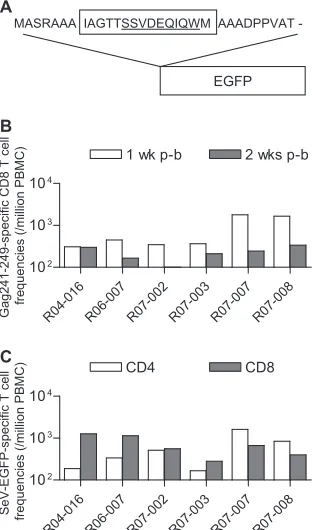
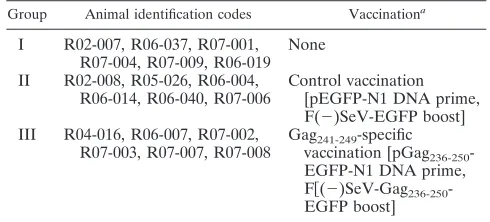
pos-sessing MHC-I haplotype 90-120-Ia were divided into three groups of six animals each (Table 1). Group I received no vaccination, group II received a control vaccine, and group III received a vaccine eliciting Gag241-249-specific CD8⫹ T-cell responses. We refer to groups I and II as naive controls in the present study. We constructed a plasmid DNA (pGag236-250 -EGFP-N1) and an F deletion-containing SeV (F[⫺ ]SeV-Gag236-250-EGFP) vector both expressing an SIVmac239 Gag236-250(IAGTTSSVDEQIQWM)-EGFP fusion protein to
be used for group III vaccination (Fig. 1A). SeV proteins and EGFP have no amino acid sequence identity with SIVmac239. These group III animals received a single intramuscular pGag236-250-EGFP DNA injection, followed by a single
intra-FIG. 1. Gag241-249-specific CD8⫹T-cell induction by prophylactic
vac-cination. (A) Schema of the cDNA construct encoding the Gag236-250
-EGFP fusion protein. A DNA fragment that encodes a 31-mer peptide including the Gag236-250sequence was introduced into the 5⬘end of the
EGFP cDNA. (B) Gag241-249-specific CD8⫹T-cell frequencies 1 (open
boxes) and 2 weeks (closed boxes) after F(⫺)SeV-Gag236-250-EGFP
boosting in group III macaques. (C) SeV-EGFP-specific CD4⫹ (open boxes) or CD8⫹(closed boxes) T-cell frequencies 2 weeks after F(⫺ )SeV-Gag236-250-EGFP boosting in group III macaques. p-b, postboost.
on November 8, 2019 by guest
http://jvi.asm.org/
[image:2.585.85.241.70.335.2]nasal boost with the F(⫺)SeV-Gag236-250-EGFP vector. Group
II animals were administered pEGFP-N1 DNA and the F(⫺)SeV-EGFP vector, both expressing EGFP instead of Gag236-250-EGFP, as a control vaccine.
We measured the antigen-specific CD8⫹T-cell responses in these macaques 1 or 2 weeks after the SeV boost by detection of specific IFN-␥ induction. All group III macaques showed efficient Gag241-249-specific CD8⫹ T-cell induction after the F(⫺)SeV-Gag236-250-EGFP boost (Fig. 1B). In these animals,
we also confirmed SeV-EGFP-specific CD8⫹and CD4⫹T-cell responses (Fig. 1C) but did not detect Gag206-216-specific
CD8⫹T-cell responses, which are dominantly induced in90
-120-Ia-positive macaques by Gag-expressing SeV vaccination (14). We have never found Gag236-250-specific CD4⫹ T-cell responses in any previously examined animals, and as ex-pected, analyses with the Gag236-250 peptide did not detect Gag236-250-specific CD4⫹T-cell responses in any of the group
III animals in the present study. In group II animals, we de-tected SeV-EGFP-specific T-cell responses but not Gag236-250
-specific T-cell responses after the F(⫺)SeV-EGFP boost (data not shown).
Control of an SIV challenge in vaccinees.Group I
(unvacci-nated), II (control-vacci(unvacci-nated), and III (Gag236-250-vaccinated)
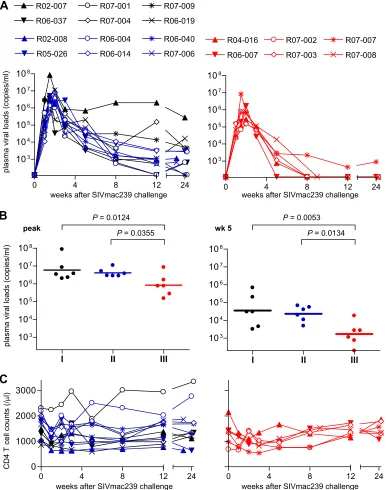
macaques were challenged intravenously with SIVmac239. Plasma viral loads in these animals were examined after the challenge (Fig. 2A). Most of the group I and II animals failed to contain SIV replication, although plasma viremia became undetectable at week 12 in one animal in group I (R06-037) and one in group II (R06-004). No significant differences were observed between groups I and II in plasma viral loads at the peak, at week 5, at week 12, or around week 24 after the challenge. In contrast, most group III animals contained SIV replication; plasma viral loads became undetectable after week 5 in five of the six animals (Fig. 2A). Plasma viral loads in these animals were significantly lower than those in unvaccinated group I and those in control-vaccinated group II at the peak, at week 5, and at the set point (Fig. 2B). Thus, the prophylactic vaccination inducing Gag241-249single-epitope-specific CD8⫹ T-cell responses resulted in a significant reduction of peak and subsequent viral loads after the SIV challenge. No significant difference in peripheral CD4⫹ T-cell counts was observed among these three groups (Fig. 2C).
Dominant Gag241-249-specific CD8
ⴙT-cell responses in
vac-cinees after a SIV challenge.We assessed virus-specific CD8⫹
T-cell responses at weeks 2 and 12 after a SIV challenge by
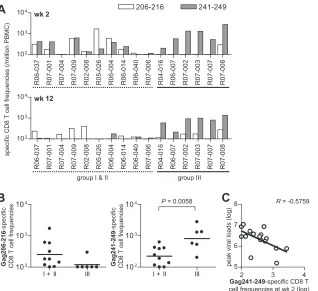
measuring antigen-specific IFN-␥ induction. Gag241-249 -spe-cific CD8⫹T-cell responses were undetectable or marginal in some naive controls (group I and II) but were efficiently in-duced in all of the group III animals (Fig. 3A). In most of the naive controls, Gag206-216-specific CD8⫹T-cell responses were induced equivalently or more efficiently than Gag241-249
-spe-cific CD8⫹ responses, whereas all of the group III animals showed dominant induction of Gag241-249-specific CD8⫹T-cell
responses. In these group III animals, Gag206-216-specific CD8⫹ T-cell responses were inefficient but frequencies of CD8⫹T cells exhibiting Gag241-249-specific IFN-␥induction were sig-nificantly higher than in naive controls at week 2 (Fig. 3B) and week 12. Gag241-249-specific CD8⫹T-cell frequencies at week 2 inversely correlated with peak viral loads (Fig. 3C).
We also tested SIV-specific CD8⫹T-cell responses in these animals (Fig. 4). We used env and nef deletion-containing simian-human immunodeficiency virus molecular clone DNA SIVGP1 containing the genes encoding SIVmac239 Gag, Pol, Vif, Vpx, and a part of Vpr and measured the frequencies of CD8⫹ T cells responding to SIVGP1-transduced cells (re-ferred to as SIV-specific CD8⫹T cells) as described previously (15). Naive controls (groups I and II) and vaccinees (group III) were found to possess similar levels of SIV-specific CD8⫹T cells at week 2 and week 12.
In our previous study (27), all of the90-120-Ia-positive ma-caques vaccinated with Gag-expressing SeV contained SIV replication with rapid selection of agagmutation (GagL216S), resulting in escape from Gag206-216-specific CD8⫹T-cell
rec-ognition at week 5, implicating Gag206-216-specific CD8⫹T-cell responses (rather than Gag241-249-specific CD8⫹ T-cell
re-sponses) in viral control. In the present study, however, five of six Gag236-250-vaccinated animals controlled SIV replication
and had undetectable set point viremia without selection ofgag
mutation over 5 weeks (data not shown). Nogagmutation was selected at week 5 in naive controls, either. These results in-dicate that in the group III macaques, dominantly induced Gag241-249-specific CD8⫹T-cell responses in the acute phase play an important role in this vaccine-based SIV control.
Higher Gag241-249-specific effector memory CD8ⴙT-cell
fre-quencies in vaccinees.We then examined Gag241-249-specific
CD8⫹T-cell frequencies in these macaques by using PE-con-jugated Gag241-249-A*90120-5 tetramers. In group III animals,
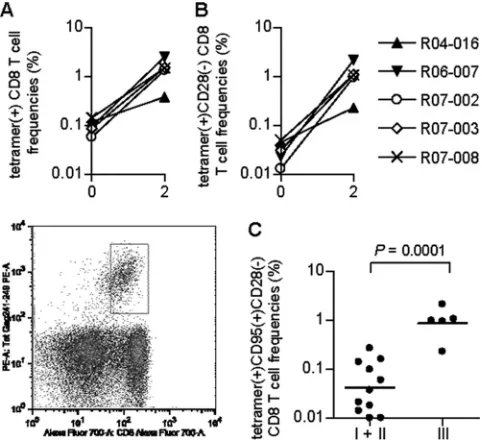
Gag241-249-specific tetramer⫹CD8⫹ T cells were still detect-able just before the SIV challenge, and their frequencies in-creased greatly after the challenge; most of the vaccinees ex-hibited a ⬎10-fold increase at week 2 compared to prechallenge levels (Fig. 5A). Increases in tetramer⫹CD28⫺ CD8⫹ T-cell frequencies after a challenge were especially marked (⬎30-fold) (Fig. 5B). Indeed, within the tetramer⫹ cells, the ratio of CD28⫺cells increased after a challenge and these cells became predominant at week 2. Analysis of an effector memory subset delineated by the CD95⫹CD28⫺ phe-notype (29, 34) revealed significantly higher frequencies of Gag241-249-specific tetramer⫹CD95⫹CD28⫺CD8⫹T cells in
group III than in naive controls (Fig. 5C). These results suggest efficient responses of Gag241-249-specific CD8⫹ T cells with
effector function in the acute phase in group III animals. Gag241-249-specific cytolytic CD8
ⴙT-cell responses in
vac-cinees.To further investigate the cytolytic quality of Gag241-249
[image:3.585.40.285.81.192.2]-specific CD8⫹T-cell responses after a challenge, we examined
TABLE 1. Macaques used in this study
Group Animal identification codes Vaccinationa
I R02-007, R06-037, R07-001, R07-004, R07-009, R06-019
None
II R02-008, R05-026, R06-004, R06-014, R06-040, R07-006
Control vaccination [pEGFP-N1 DNA prime, F(⫺)SeV-EGFP boost] III R04-016, R06-007, R07-002,
R07-003, R07-007, R07-008
Gag241-249-specific
vaccination [pGag236-250
-EGFP-N1 DNA prime, F关(⫺)SeV-Gag236-250
-EGFP boost]
aAll animals were challenged with SIVmac239.
on November 8, 2019 by guest
http://jvi.asm.org/
Gag241-249-specific induction of CD107a (a degranulation marker), which is related to cytolytic activity (21, 38), in CD8⫹ T cells at week 2. Frequencies of CD8⫹ T cells exhibiting Gag241-249-specific induction of CD107a, as well as IFN-␥,
[image:4.585.100.486.69.559.2]within the CD8⫹T-cell pool were significantly higher in group III than in naive controls (P⫽0.0249 by unpairedttest) (Fig. 6). One animal, R04-016, in group III did not show Gag241-249 -specific CD107a⫹IFN-␥⫹CD8⫹T-cell responses, but further
FIG. 2. Plasma viral loads and peripheral CD4⫹T-cell counts after a SIV challenge. (A) Changes in plasma viral loads (SIVgagRNA copies/ml plasma) in unvaccinated group I animals (black lines in the left panel), control-vaccinated group II animals (blue lines in the left panel), and Gag236-250-vaccinated group III animals (red lines in the right panel) after a SIVmac239 challenge. Plasma viral loads were determined as described
previously (27). The lower limit of detection is approximately 4⫻102copies/ml. (B) Comparisons of plasma viral loads in groups I (n⫽6), II (n⫽
6), and III (n⫽6) at the peak (left panel) and at week 5 (right panel). The bar indicates the geometric mean of each group. Viral loads at the peak and at week 5 in group III were significantly lower than in group I (P⫽0.0124 at the peak andP⫽0.0053 at week 5) and group II (P⫽ 0.0355 at the peak andP⫽0.0134 at week 5). There were no significant differences between groups I and II either at the peak or at week 5 (P⫽ 0.6047 at the peak andP⫽0.6536 at week 5). Set point viral loads in group III were significantly lower than those in group I and group II at week 12 by nonparametric analysis (P⫽0.3939 between I and II,P⫽0.0152 between I and III, andP⫽0.0152 between II and III;P⫽0.1797 between I and II,P⫽0.0260 between I and III, andP⫽0.0411 between II and III around week 24). (C) Changes in peripheral CD4⫹T-cell counts (per
l) in groups I (black lines) and II (blue lines) in the left panel and in group III (red lines) in the right panel after a SIVmac239 challenge.
on November 8, 2019 by guest
http://jvi.asm.org/
analysis revealed that this animal had Gag241-249-specific gran-zyme B⫹IFN-␥⫹CD8⫹T cells. Indeed, group III animals had significantly higher frequencies of Gag241-249-specific IFN-␥⫹
CD8⫹ T cells producing CD107a, granzyme B, or perforin (P⫽0.0076; data not shown). These results indicate efficient induction of Gag241-249-specific CD8⫹T cells with higher
cy-tolytic activity in the acute phase in group III animals.
DISCUSSION
In the present study, induction of CD8⫹T cells specific for a single Gag241-249epitope by prophylactic vaccination resulted in a significant reduction of plasma viral loads after a SIV challenge. Even if vaccines are designed to express multiple antigens, of the vaccine-induced CD8⫹T cells generated, at most one or only a few epitope-specific cells may recognize the incoming HIV because of viral diversity and host MHC poly-morphisms (10). Our finding, however, implies that even a CD8⫹T-cell memory response to a single epitope which can recognize the incoming HIV could facilitate HIV control.
Group III macaques showed more effective CD8⫹ T-cell responses than did naive controls after a SIV challenge. Our previous trial of a vaccine inducing Gag-specific T-cell re-sponses resulted in SIV control in90-120-Ia-positive macaques with rapid selection of the GagL216S mutation escaping from Gag206-216-specific CD8⫹T-cell recognition at week 5 (27). In contrast, the Gag236-250 vaccination resulted in SIV control
without gag mutation selection over 5 weeks in the present study, reflecting the fact that, rather than Gag206-216-specific
CD8⫹ T-cell responses, dominantly induced Gag241-249
-spe-cific CD8⫹T-cell responses played a central role in the
reduc-FIG. 3. Gag epitope-specific CD8⫹T-cell frequencies after a SIV challenge. (A) Frequencies of CD8⫹T cells (per million PBMCs) showing Gag206-216-specific (open boxes) or Gag241-249-specific (closed boxes) IFN-␥induction in naive controls and group III macaques at week 2 (upper
panel) and week 12 (lower panel). (B) Comparison of the Gag206-216-specific (left panel) or Gag241-249-specific (right panel) CD8⫹ T-cell
frequencies in naive controls (n⫽10) and group III animals (n⫽6) at week 2. The bar indicates the geometric mean of each group. Frequencies of Gag241-249-specific (P⫽0.0058) but not Gag206-216-specific (P⫽0.0922) CD8⫹ T cells in group III were significantly higher than in naive
controls. The Gag241-249-specific frequencies at week 12 in group III were significantly higher than those in naive controls (P⬍0.0001). (C) Analysis
of the correlation between Gag241-249-specific CD8⫹T-cell frequencies (log) at week 2 and peak plasma viral loads (log). An inverse correlation
[image:5.585.139.457.66.357.2]is shown (P⫽0.0196,R⫽ ⫺0.5759). Samples from macaques R02-007 and R06-019 in group I were unavailable for this analysis.
FIG. 4. SIV-specific CD8⫹ T-cell frequencies after a SIV chal-lenge. SIV-specific CD8⫹T-cell frequencies (per million PBMCs) in naive controls and group III macaques at week 2 (closed boxes) and week 12 (open boxes) are shown. ND, not determined.
on November 8, 2019 by guest
http://jvi.asm.org/
[image:5.585.42.283.588.688.2]tion of viral loads in the acute phase. These results suggest that this vaccination approach altered the dominance pattern of CD8⫹T-cell responses and resulted in dominant induction of effective Gag241-249-specific CD8⫹ T-cell responses in the
acute phase after a SIV challenge, facilitating a reduction in peak viral loads. Selection of vaccine epitopes for induction of CD8⫹ T-cell responses might be important for viral control because the antiviral efficacy of CD8⫹T cells could be affected by MHC-I-restricted target epitopes (10, 19, 25, 35).
Gag241-249-specific CD8⫹ T-cell induction by prophylactic vaccination resulted in higher frequencies of these T-cell re-sponses during the acute phase after the SIV challenge. The induction of Gag241-249-specific effector memory CD8⫹T cells was especially marked. We did not examine polyfunctionality, but analyses of a cytolytic marker, CD107a, indicated higher frequencies of Gag241-249-specific cytolytic CD8⫹ T-cell re-sponses, implying that these T cells originating from vaccine-induced memory may have higher cytolytic activity in the acute phase. These results suggest that group III animals with Gag241-249-specific memory CD8⫹T cells showed induction of a high magnitude of Gag241-249-specific CD8⫹ T cells with effector function after a SIV challenge, resulting in reduction of viral loads in the acute phase.
In this study, some90-120-Ia-positive unvaccinated macaques showed lower viral loads. However, in our previous studies with Burmese rhesus macaques (reference 15 and unpublished data), all unvaccinated 90-120-Ia-negative animals failed to contain a SIVmac239 challenge and animals, including vaccin-ees, that failed to control SIVmac239 replication developed AIDS in 1 to 4 years; even R-90-120 descendants possessing the MHC-I haplotype90-120-Ibbut not 90-120-Ia (both 90
-120-Ia and 90-120-Ib are derived from breeder R-90-120) showed high viral loads. Additionally,90-120-Ia-positive ani-mals failed to control the replication of SIVmac239 carrying CTL escape mutations (16). Thus, a SIVmac239 challenge of Burmese rhesus macaques mostly results in persistent viremia and progression to AIDS but some90-120-Ia-positive animals may show lower viral loads due to90-120-Ia-associated SIV-specific CTL responses. However, a previously reported 90
[image:6.585.43.284.69.289.2]-120-Ia-positive unvaccinated macaque, R02-007, developed AIDS around 3 years after a SIVmac239 challenge. Further-more, two of the90-120-Ia-positive vaccinees that controlled a SIVmac239 challenge but showed reappearance of viremia
FIG. 5. Frequencies of Gag241-249-specific CD8⫹T cells detected by
Gag241-249-Mamu-A*90120-5 tetramers after a SIV challenge. (A)
Fre-quencies of Gag241-249-Mamu-A*90120-5 tetramer⫹cells within CD8⫹
T cells in group III animals before a challenge (week 0) or at week 2 after a challenge. A representative dot plot gated on CD3⫹ lympho-cytes for determining tetramer⫹CD8⫹ T cells (x axis, CD8;yaxis, tetramer) in macaque R07-008 is shown in the lower panel. (B) Tet-ramer⫹CD28⫺cell frequencies in CD8⫹T cells in group III animals at weeks 0 and 2. Data on tetramer⫹CD95⫹CD28⫺CD8⫹ T-cell frequencies at week 0 are unavailable. (C) Tetramer⫹CD95⫹CD28⫺ CD8⫹T-cell frequencies in naive controls (groups I and II) and group III animals at week 2. The bar indicates the geometric mean of each group. The frequencies in group III were significantly higher than those in naive controls (P⫽0.0001 by unpairedttest). Samples from macaques R06-019 in group I and R07-007 in group III were unavail-able for this analysis.
FIG. 6. Gag241-249-specific cytolytic CD8⫹T-cell frequencies at week 2 after a challenge. PBMCs were cultured in the absence or the presence of
the Gag241-249peptide for unstimulated controls or Gag241-249-specific stimulation, and the frequencies of CD8⫹T cells exhibiting Gag241-249-specific
induction of both IFN-␥and CD107a in the total CD8⫹T cells were examined. The bar indicates the geometric mean of each group. The frequencies in group III were significantly higher than those in naive controls (P⫽0.0249 by unpairedttest). The right panel is a representative dot plot showing the CD107a (xaxis) and IFN-␥(yaxis) responses in CD8⫹T cells in macaque R07-008 after Gag241-249-specific stimulation. Samples from
macaques R06-019 in group I and R07-007 in group III were unavailable for this analysis.
on November 8, 2019 by guest
http://jvi.asm.org/
[image:6.585.135.449.534.668.2]around 1 year later developed AIDS (15). Thus, it is inferred that the majority of90-120-Ia-positive unvaccinated macaques develop AIDS after a SIVmac239 challenge. Several MHC-I alleles are known to be associated with lower viral loads in HIV and SIV infections, and potent CTLs directed against these MHC-I-restricted epitopes have been implicated in the sup-pression of viral replication (7, 8, 9, 10, 13, 18, 22, 31, 33, 48). The Gag241-249-specific CTL may also be naturally potent (10, 16), but the impact of memory induction of even these potent CTLs on viral control has not yet been determined. Thus, this is the first study documenting the benefit of single-epitope-specific memory CD8⫹T-cell induction by prophylactic vacci-nation for HIV/SIV control. Further analysis with a vaccine expressing a single helper epitope, as well as a CTL epitope, would contribute to evaluation of the impact of HIV/SIV-specific CD4⫹T-cell memory induction on HIV/SIV replica-tion.
Because CCR5⫹ memory CD4⫹ T cells, especially HIV-specific CD4⫹ T cells, are themselves targets of this virus, whether virus-specific CD4⫹T-cell induction by prophylactic vaccination can result in effective virus-specific CD4⫹ T-cell responses postinfection and contribute to HIV control remains unclear. On the other hand, it has been unknown whether HIV-specific memory CD8⫹T cells induced by vaccination without HIV-specific CD4⫹T-cell help can elicit effective responses after virus exposure. In the present study, the pGag236-250-EGFP/
F(⫺)SeV-Gag236-250-EGFP vaccination elicited Gag241-249 -spe-cific CD8⫹ T-cell responses without SIV-specific CD4⫹ T-cell help but possibly with EGFP-specific or SeV-specific CD4⫹T-cell help; i.e., SeV-EGFP-specific CD4⫹T cells would confer cog-nate help for Gag241-249-specific CD8⫹T-cell induction. The Gag241-249-specific memory CD8⫹T cells induced by
prophy-lactic vaccination without SIV-specific CD4⫹T-cell help but with non-SIV-specific CD4⫹T-cell responses responded effi-ciently to a SIV challenge, showing dominant Gag241-249 -spe-cific CD8⫹T-cell responses resulting in SIV control; infection-induced SIV-specific CD4⫹T-cell responses may be involved in Gag241-249-specific CD8⫹ T-cell induction postinfection.
Therefore, this study documents that prophylactic vaccination eliciting virus-specific CD8⫹T-cell memory even without virus-specific CD4⫹T-cell responses (but with cognate non-virus-specific CD4⫹T-cell responses) can facilitate SIV control after a challenge.
Taken together, the present study demonstrates that induc-tion of single-epitope-specific CD8⫹ T-cell memory without virus-specific CD4⫹T-cell help by prophylactic vaccination can result in dominant potent CD8⫹T-cell responses and control of SIV replication after a challenge. These results imply pos-sible HIV control by prophylactic vaccination eliciting virus-specific CD8⫹ T-cell memory with non-virus-specific CD4⫹ T-cell help and provide valuable insights into AIDS vaccine development.
ACKNOWLEDGMENTS
This work was supported by grants from the Ministry of Education, Culture, Sports, Science, and Technology and grants from the Ministry of Health, Labor, and Welfare in Japan. The animal experiments were conducted through the Cooperative Research Program in the Tsukuba Primate Research Center, National Institute of Biomedical Innova-tion, with the help of the Corporation for Production and Research of Laboratory Primates.
We thank H. Akari, Y. Yasutomi, F. Ono, A. Hiyaoka, K. Komat-suzaki, K. Oto, K. Ishikawa, and T. Nakasone for their assistance in animal experiments; DNAVEC Corp. for providing SeV vectors; M. Roederer for providing the PESTLE and SPICE software; and Y. Tsunetsugu-Yokota, H. Igarashi, A. Kimura, T. Naruse, M. Miyazawa, K. Mori, N. Yamamoto, A. Nomoto, and Y. Nagai for their help.
REFERENCES
1.Anonymous.2007. Cold shower for AIDS vaccines. Nat. Med.13:1389–1390. 2.Argu¨ello, J. R., A. M. Little, A. L. Pay, D. Gallardo, I. Rojas, S. G. Marsh, J. M. Goldman, and J. A. Madrigal.1998. Mutation detection and typing of polymorphic loci through double-strand conformation analysis. Nat. Genet.
18:192–194.
3.Borrow, P., H. Lewicki, B. H. Hahn, G. M. Shaw, and M. B. Oldstone.1994.
Virus-specific CD8⫹cytotoxic T-lymphocyte activity associated with control
of viremia in primary human immunodeficiency virus type 1 infection. J.
Vi-rol.68:6103–6110.
4.Brander, C., and B. D. Walker.1999. T lymphocyte responses in HIV-1
infection: implication for vaccine development. Curr. Opin. Immunol.11:
451–459.
5.Douek, D. C., J. M. Brenchley, M. R. Betts, D. R. Ambrozak, B. J. Hill, Y. Okamoto, J. P. Casazza, J. Kuruppu, K. Kunstman, S. Wolinsky, Z. Gross-man, M. Dybul, A. Oxenius, D. A. Price, M. Connors, and R. A. Koup.2002.
HIV preferentially infects HIV-specific CD4⫹T cells. Nature417:95–98.
6.Feinberg, M. B., and J. P. Moore.2002. AIDS vaccine models: challenging
challenge viruses. Nat. Med.8:207–210.
7.Friedrich, T. C., E. J. Dodds, L. J. Yant, L. Vojnov, R. Rudersdorf, C. Cullen, D. T. Evans, R. C. Desrosiers, B. R. Mothe, J. Sidney, A. Sette, K. Kunstman, S. Wolinsky, M. Piatak, J. Lifson, A. L. Hughes, N. Wilson, D. H. O’Connor, and D. I. Watkins.2004. Reversion of CTL escape-variant immunodeficiency
viruses in vivo. Nat. Med.10:275–281.
8.Goulder, P. J., M. Bunce, P. Krausa, K. McIntyre, S. Crowley, B. Morgan, A. Edwards, P. Giangrande, R. E. Phillips, and A. J. McMichael.1996. Novel, cross-restricted, conserved, and immunodominant cytotoxic T lymphocyte epitopes in slow progressors in HIV type 1 infection. AIDS Res. Hum.
Retrovir.12:1691–1698.
9.Goulder, P. J., and D. I. Watkins.2004. HIV and SIV CTL escape:
impli-cations for vaccine design. Nat. Rev. Immunol.4:630–640.
10.Goulder, P. J. R., and D. I. Watkins.2008. Impact of MHC class I diversity on immune control of immunodeficiency virus replication. Nat. Rev.
Immu-nol.8:619–630.
11.Janssen, E. M., E. E. Lemmens, T. Wolfe, U. Christen, M. G. von Herrath, and S. P. Schoenberger.2003. CD4⫹T cells are required for secondary
expansion and memory in CD8⫹T lymphocytes. Nature421:852–856.
12.Jin, X., D. E. Bauer, S. E. Tuttleton, S. Lewin, A. Gettie, J. Blanchard, C. E. Irwin, J. T. Safrit, J. Mittler, L. Weinberger, L. G. Kostrikis, L. Zhang, A. S. Perelson, and D. D. Ho.1999. Dramatic rise in plasma viremia after CD8⫹ T cell depletion in simian immunodeficiency virus-infected macaques. J. Exp.
Med.189:991–998.
13.Kaslow, R. A., M. Carrington, R. Apple, L. Park, A. Mun˜oz, A. J. Saah, J. J. Goedert, C. Winkler, S. J. O’Brien, C. Rinaldo, R. Detels, W. Blattner, J. Phair, H. Erlich, and D. L. Mann.1996. Influence of combinations of human major histocompatibility complex genes on the course of HIV-1 infection.
Nat. Med.2:405–411.
14.Kawada, M., H. Igarashi, A. Takeda, T. Tsukamoto, H. Yamamoto, S. Dohki, M. Takiguchi, and T. Matano.2006. Involvement of multiple epitope-spe-cific cytotoxic T-lymphocyte responses in vaccine-based control of simian
immunodeficiency virus replication in rhesus macaques. J. Virol.80:1949–
1958.
15.Kawada, M., T. Tsukamoto, H. Yamamoto, A. Takeda, H. Igarashi, D. I. Watkins, and T. Matano.2007. Long-term control of simian
immunodefi-ciency virus replication with central memory CD4⫹T-cell preservation after
nonsterile protection by a cytotoxic T-lymphocyte-based vaccine. J. Virol.
81:5202–5211.
16.Kawada, M., T. Tsukamoto, H. Yamamoto, N. Iwamoto, K. Kurihara, A. Takeda, C. Moriya, H. Takeuchi, H. Akari, and T. Matano.2008. Gag-specific cytotoxic T lymphocyte-based control of primary simian
immunode-ficiency virus replication in a vaccine trial. J. Virol.82:10199–10206.
17.Kestler, H. W., III, D. J. Ringler, K. Mori, D. L. Panicali, P. K. Sehgal, M. D. Daniel, and R. C. Desrosiers.1991. Importance of the nef gene for
mainte-nance of high virus loads and for development of AIDS. Cell65:651–662.
18.Kiepiela, P., A. J. Leslie, I. Honeyborne, D. Ramduth, C. Thobakgale, S. Chetty, P. Rathnavalu, C. Moore, K. J. Pfafferott, L. Hilton, P. Zimbwa, S. Moore, T. Allen, C. Brander, M. M. Addo, M. Altfeld, I. James, S. Mallal, M. Bunce, L. D. Barber, J. Szinger, C. Day, P. Klenerman, J. Mullins, B. Korber, H. M. Coovadia, B. D. Walker, and P. J. Goulder.2004. Dominant influence of HLA-B in mediating the potential co-evolution of HIV and
HLA. Nature432:769–775.
19.Kiepiela, P., K. Ngumbela, C. Thobakgale, D. Ramduth, I. Honeyborne, E. Moodley, S. Reddy, C. de Pierres, Z. Mncube, N. Mkhwanazi, K. Bishop, M. van der Stok, K. Nair, N. Khan, H. Crawford, R. Payne, A. Leslie, J. Prado,
on November 8, 2019 by guest
http://jvi.asm.org/
A. Prendergast, J. Frater, N. McCarthy, C. Brander, G. H. Learn, D. Nickle, C. Rousseau, H. Coovadia, J. I. Mullins, D. Heckerman, B. D. Walker, and P. Goulder.2007. CD8⫹T-cell responses to different HIV proteins have
discordant associations with viral load. Nat. Med.13:46–53.
20.Koup, R. A., J. T. Safrit, Y. Cao, C. A. Andrews, G. McLeod, W. Borkowsky, C. Farthing, and D. D. Ho.1994. Temporal association of cellular immune responses with the initial control of viremia in primary human
immunode-ficiency virus type 1 syndrome. J. Virol.68:4650–4655.
21.Lamoreaux, L., M. Roederer, and R. Koup.2006. Intracellular cytokine
optimization and standard operating procedure. Nat. Protoc.1:1507–1516.
22.Leslie, A. J., K. J. Pfafferott, P. Chetty, R. Draenert, M. M. Addo, M. Feeney, Y. Tang, E. C. Holmes, T. Allen, J. G. Prado, M. Altfeld, C. Brander, C. Dixon, D. Ramduth, P. Jeena, S. A. Thomas, A. St. John, T. A. Roach, B. Kupfer, G. Luzzi, A. Edwards, G. Taylor, H. Lyall, G. Tudor-Williams, V. Novelli, J. Martinez-Picado, P. Kiepiela, B. D. Walker, and P. J. Goulder.
2004. HIV evolution: CTL escape mutation and reversion after transmission.
Nat. Med.10:282–289.
23.Letvin, N. L., J. R. Mascola, Y. Sun, D. A. Gorgone, A. P. Buzby, L. Xu, Z. Y. Yang, B. Chakrabarti, S. S. Rao, J. E. Schmitz, D. C. Montefiori, B. R. Barker, F. L. Bookstein, and G. J. Nabel.2006. Preserved CD4⫹central memory T cells and survival in vaccinated SIV-challenged monkeys. Science
312:1530–1533.
24.Li, H. O., Y. F. Zhu, M. Asakawa, H. Kuma, T. Hirata, Y. Ueda, Y. S. Lee, M. Fukumura, A. Iida, A. Kato, Y. Nagai, and M. Hasegawa. 2000. A cytoplasmic RNA vector derived from nontransmissible Sendai virus with
efficient gene transfer and expression. J. Virol.74:6564–6569.
25.Loffredo, J. T., A. T. Bean, D. R. Beal, E. J. Leo´n, G. E. May, S. M. Piaskowski, J. R. Furlott, J. Reed, S. K. Musani, E. G. Rakasz, T. C. Friedrich, N. A. Wilson, D. B. Allison, and D. I. Watkins.2008. Patterns of
CD8⫹immunodominance may influence the ability of Mamu-B*08-positive
macaques to naturally control simian immunodeficiency virus SIVmac239
replication. J. Virol.82:1723–1738.
26.Matano, T., M. Kano, H. Nakamura, A. Takeda, and Y. Nagai.2001. Rapid appearance of secondary immune responses and protection from acute CD4 depletion after a highly pathogenic immunodeficiency virus challenge in macaques vaccinated with a DNA-prime/Sendai viral vector-boost regimen.
J. Virol.75:11891–11896.
27.Matano, T., M. Kobayashi, H. Igarashi, A. Takeda, H. Nakamura, M. Kano, C. Sugimoto, K. Mori, A. Iida, T. Hirata, M. Hasegawa, T. Yuasa, M. Miyazawa, Y. Takahashi, M. Yasunami, A. Kimura, D. H. O’Connor, D. I. Watkins, and Y. Nagai.2004. Cytotoxic T lymphocyte-based control of sim-ian immunodeficiency virus replication in a preclinical AIDS vaccine trial. J.
Exp. Med.199:1709–1718.
28.Matano, T., R. Shibata, C. Siemon, M. Connors, H. C. Lane, and M. A. Martin.1998. Administration of an anti-CD8 monoclonal antibody inter-feres with the clearance of chimeric simian/human immunodeficiency virus
during primary infections of rhesus macaques. J. Virol.72:164–169.
29.Mattapallil, J. J., N. L. Letvin, and M. Roederer.2004. T-cell dynamics
during acute SIV infection. AIDS18:13–23.
30.McMichael, A. J., and T. Hanke.2003. HIV vaccines 1983-2003. Nat. Med.
9:874–880.
31.Migueles, S. A., M. S. Sabbaghian, W. L. Shupert, M. P. Bettinotti, F. M. Marincola, L. Martino, C. W. Hallahan, S. M. Selig, D. Schwartz, J. Sulli-van, and M. Connors.2000. HLA B*5701 is highly associated with restriction of virus replication in a subgroup of HIV-infected long term nonprogressors.
Proc. Natl. Acad. Sci. USA97:2709–2714.
32.National Institute of Infectious Diseases.2007. Guides for animal experi-ments performed at National Institute of Infectious Diseases. National In-stitute of Infectious Diseases, Tokyo, Japan. (In Japanese.)
33.O’Connor, D. H., B. R. Mothe, J. T. Weinfurter, S. Fuenger, W. M. Rehrauer, P. Jing, R. R. Rudersdorf, M. E. Liebl, K. Krebs, J. Vasquez, E. Dodds, J. Loffredo, S. Martin, A. B. McDermott, T. M. Allen, C. Wang, G. G. Doxiadis, D. C. Montefiori, A. Hughes, D. R. Burton, D. B. Allison, S. M. Wolinsky, R. Bontrop, L. J. Picker, and D. I. Watkins.2003. Major histocompatibility complex class I alleles associated with slow simian immunodeficiency virus
disease progression bind epitopes recognized by dominant acute-phase
cy-totoxic-T-lymphocyte responses. J. Virol.77:9029–9040.
34.Pitcher, C. J., S. I. Hagen, J. M. Walker, R. Lum, B. L. Mitchell, V. C. Maino, M. K. Axthelm, and L. J. Picker.2002. Development and homeostasis of T
cell memory in rhesus macaques. J. Immunol.168:29–43.
35.Reynolds, M. R., A. M. Weiler, K. L. Weisgrau, S. M. Piaskowski, J. R. Furlott, J. T. Weinfurter, M. Kaizu, T. Soma, E. J. Leo´n, C. MacNair, D. P. Leaman, M. B. Zwick, E. Gostick, S. K. Musani, D. A. Price, T. C. Friedrich, E. G. Rakasz, N. A. Wilson, A. B. McDermott, R. Boyle, D. B. Allison, D. R. Burton, W. C. Koff, and D. I. Watkins.2008. Macaques vaccinated with live-attenuated SIV control replication of heterologous virus. J. Exp. Med.
205:2537–2550.
36.Rosenberg, E. S., J. M. Billingsley, A. M. Caliendo, S. L. Boswell, P. E. Sax, S. A. Kalams, and B. D. Walker.1997. Vigorous HIV-1-specific CD4⫹T cell
responses associated with control of viremia. Science278:1447–1450.
37.Schmitz, J. E., M. J. Kuroda, S. Santra, V. G. Sasseville, M. A. Simon, M. A. Lifton, P. Racz, K. Tenner-Racz, M. Dalesandro, B. J. Scallon, J. Ghrayeb, M. A. Forman, D. C. Montefiori, E. P. Rieber, N. L. Letvin, and K. A. Reimann.1999. Control of viremia in simian immunodeficiency virus
infec-tion by CD8⫹lymphocytes. Science283:857–860.
38.Seder, R. A., P. A. Darrah, and M. Roederer.2008. T-cell quality in memory
and protection: implications for vaccine design. Nat. Rev. Immunol.8:247–258.
39.Shaffer, J. P.1986. Modified sequentially rejective multiple test procedures.
J. Am. Stat. Assoc.81:826–831.
40.Shedlock, D. J., and H. Shen.2003. Requirement for CD4 T cell help in
generating functional CD8 T cell memory. Science300:337–339.
41.Shibata, R., F. Maldarelli, C. Siemon, T. Matano, M. Parta, G. Miller, T. Fredrickson, and M. A. Martin.1997. Infection and pathogenicity of chi-meric simian-human immunodeficiency viruses in macaques: determinants
of high virus loads and CD4 cell killing. J. Infect. Dis.176:362–373.
42.Staprans, S. I., A. P. Barry, G. Silvestri, J. T. Safrit, N. Kozyr, B. Sumpter, H. Nguyen, H. McClure, D. Montefiori, J. I. Cohen, and M. B. Feinberg.
2004. Enhanced SIV replication and accelerated progression to AIDS in macaques primed to mount a CD4 T cell response to the SIV envelope
protein. Proc. Natl. Acad. Sci. USA101:13026–13031.
43.Sun, J. C., and M. J. Bevan.2003. Defective CD8 T cell memory following
acute infection without CD4 T cell help. Science300:339–342.
44.Tanaka-Takahashi, Y., M. Yasunami, T. Naruse, K. Hinohara, T. Matano, K. Mori, M. Miysazawa, M. Honda, Y. Yasutomi, Y. Nagai, and A. Kimura.
2007. Reference strand-mediated conformation analysis (RSCA)-based typ-ing of multiple alleles in the rhesus macaque MHC class I Mamu-A and
Mamu-B loci. Electrophoresis28:918–924.
45.Tsukamoto, T., S. Dohki, T. Ueno, M. Kawada, A. Takeda, M. Yasunami, T. Naruse, A. Kimura, M. Takiguchi, and T. Matano.2008. Determination of a major histocompatibility complex class I restricting simian
immunodefi-ciency virus Gag241-249 epitope. AIDS22:993–994.
46.Vaccari, M., J. Mattapallil, K. Song, W. P. Tsai, A. Hryniewicz, D. Venzon, M. Zanetti, K. A. Reimann, M. Roederer, and G. Franchini.2008. Reduced protection from simian immunodeficiency virus SIVmac251 infection
af-forded by memory CD8⫹T cells induced by vaccination during CD4⫹T-cell
deficiency. J. Virol.82:9629–9638.
47.Wilson, N. A., J. Reed, G. S. Napoe, S. Piaskowski, A. Szymanski, J. Furlott, E. J. Gonzalez, L. J. Yant, N. J. Maness, G. E. May, T. Soma, M. R. Reynolds, E. Rakasz, R. Rudersdorf, A. B. McDermott, D. H. O’Connor, T. C. Friedrich, D. B. Allison, A. Patki, L. J. Picker, D. R. Burton, J. Lin, L. Huang, D. Patel, G. Heindecker, J. Fan, M. Citron, M. Horton, F. Wang, X. Liang, J. W. Shiver, D. R. Casimiro, and D. I. Watkins.2006. Vaccine-induced cellular immune responses reduce plasma viral concentrations after repeated low-dose challenge with pathogenic simian immunodeficiency virus
SIVmac239. J. Virol.80:5875–5885.
48.Yant, L. J., T. C. Friedrich, R. C. Johnson, G. E. May, N. J. Maness, A. M. Enz, J. D. Lifson, D. H. O’Connor, M. Carrington, and D. I. Watkins.2006. The high-frequency major histocompatibility complex class I allele Mamu-B*17 is associated with control of simian immunodeficiency virus SIVmac239
replication. J. Virol.80:5074–5077.