Citizenship Education
Longitudinal Study First
Cross-Sectional Survey 2001-2002
David Kerr, Elizabeth Cleaver, Eleanor Ireland and Sarah Blenkinsop
National Foundation for Educational Research
Research Report No 416
Citizenship Education Longitudinal Study
First Cross-Sectional Survey 2001-2002
David Kerr, Elizabeth Cleaver, Eleanor Ireland and Sarah Blenkinsop
National Foundation for Educational Research
The views expressed in this report are the authors' and do not necessarily reflect those of the Department for Education and Skills.
© National Foundation for Educational Research. Published with the permission of DfES on behalf of the Controller of Her Majesty's Stationery Office. Applications for reproduction should be made in writing to The Crown Copyright Unit, Her Majesty's Stationery Office, St Clements House, 2-16 Colegate, Norwich NR3 1BQ.
Contents
page
ACKNOWLEDGEMENTS ...I
EXECUTIVE SUMMARY...III
1. INTRODUCTION ...1
1.1 Background ...1
1.2 The Policy Context for Citizenship Education...2
1.3 The Research Context for Citizenship Education ...4
1.4 Aims of the Citizenship Education Longitudinal Study... 10
1.5 Research Design of the Citizenship Education Longitudinal Study ... 12
1.6 Analytical Framework ... 13
1.7 Structure of the Report ... 18
1.8 Summary ... 19
2. METHODOLOGY ... 21
2.1 The questionnaires ... 21
2.2 The sample... 21
2.3 Analysis ... 22
2.4 Summary ... 24
3. BACKGROUND PROFILE OF SCHOOLS, TEACHERS AND STUDENTS ... 27
3.1 Introduction... 27
3.2 The Schools and Colleges... 27
3.3 Background of Teachers and College Tutors ... 30
3.4 Background of the Students ... 32
3.5 Summary ... 36
4. SCHOOL AND TEACHER APPROACHES TO CITIZENSHIP EDUCATION ... 37
4.1 School ethos... 37
4.2 Active Citizenship in Schools... 38
4.3 Approaches to citizenship education prior to September 2002... 43
4.4 Summary ... 47
5. TEACHER AND SCHOOL PREPAREDNESS AND PLANNING FOR STATUTORY CITIZENSHIP EDUCATION... 49
5.1 Teacher Background Knowledge and Preparedness ... 49
5.2 Planning and Preparing for Citizenship Education... 52
5.3 Summary ... 54
6. ‘WHAT IS CITIZENSHIP?’ – THE VIEWS OF YOUNG PEOPLE ... 57
6.1 Conceptions of Citizenship ... 57
6.2 Community Belonging and Involvement ... 58
6.3 National, European and Global Citizenship ... 58
6.4 Political Awareness and Literacy ... 60
6.5 Social and Moral Responsibility... 61
6.8 Summary ... 63
7. STUDENTS’ POLITICAL AND CIVIC KNOWLEDGE ... 65
7.1 Students’ political and civic knowledge... 66
7.2 Background factors and civic and political knowledge... 67
7.3 Summary ... 69
8. STUDENTS’ ATTITUDES TO CONVENTIONAL AND NON-CONVENTIONAL CITIZENSHIP AND LEVELS OF TRUST ... 71
8.1 Attitudes towards the law, conventional participation and non-conventional participation ... 72
8.2 Attitudes towards human and civil rights, civil responsibilities and social justice ... 73
8.3 Governmental Responsibilities ... 75
8.4 Trust in Government and Other Civic Institutions ... 76
8.5 Trust in the Media... 78
8.6 Trust in Social Groups ... 79
8.7 Attitudes Towards the Treatment and Status of Social Groups ... 80
8.8 Summary ... 82
9. STUDENTS’ ATTITUDES TOWARDS CIVIC ENGAGEMENT AND PARTICIPATION ... 85
9.1 Attitudes towards Politics... 85
9.2 Participation in Discussion about Politics ... 86
9.3 Future Political Participation ... 87
9.4 Civic-Related Participation ... 92
9.5 Personal Benefits and Costs of Participation... 95
9.6 School Efficacy ... 96
9.7 Classroom Climate ... 98
9.8 Summary ... 99
10. CONCLUSIONS AND WAYS FORWARD ...101
10.1First Cross-Sectional Survey in Context ... 101
10.2Main Findings and Discussion ... 102
10.3Ways Forward ... 110
10.4Concluding Comments ... 113
i
ACKNOWLEDGEMENTS
The authors would like to express their thanks to the Department for Education and Skills (DfES) for the foresight in sponsoring this groundbreaking research. We would especially like to thank Sarah Maclean, Citizenship and PSHE team leader, and Laura Sukhnandan and Michele Weatherburn in Analytical Services at DfES for their support. We are deeply grateful to all the schools, teachers, and particularly, to the students who completed the questionnaire surveys. Without their help this report, and the important evidence that it contains, would not have been possible.
We gratefully acknowledge the advice, support and expertise provided by the two project consultants, Professors Patrick Seyd (University of Sheffield) and Paul Whiteley (University of Essex). We would also like to thank Professor Judith Torney-Purta (University of Maryland, USA) for her advice in building strong and effective links with the IEA Citizenship Education Study.
The authors also gratefully acknowledge the support provided by colleagues at NFER in the completion of this research. Particular thanks are extended to Sheila Stoney, for her assistance throughout the project to date, to Ihsan Fathallah-Caillau for work on Chapter 4 of the report, and to Tom Levesley and Sandie Schagen for their work in the initial stages of the first cross-sectional survey.
We would also like to thank the members of Research Data Services, for organising the collection of large quantities of data, and Tom Benton, our project statistician from the Foundation’s Statistics Research and Analysis Group, for his expert handling of the statistical analyses and help with the interpretation of the data.
EXECUTIVE SUMMARY
iii
EXECUTIVE SUMMARY
Introduction
From September 2002 Citizenship Education has become a statutory subject in England at key stages 3 and 4. The Citizenship Order sets out the anticipated learning outcomes in relation to knowledge, understanding and skills of enquiry and participation. However, methods of delivery are not prescribed, and although schools are intended to devote five per cent of teaching time to Citizenship, they may choose how to achieve this goal.
The Department for Education and Skills (DfES) has commissioned the National Foundation for Educational Research (NFER) to undertake a longitudinal study of citizenship education over eight years. This will track a cohort of young people who entered secondary school in 2002: a group which comprises some of the first students to have a continuous statutory entitlement to citizenship education. The Citizenship Education Longitudinal Study (hereafter the Study) aims to identify, measure and evaluate the extent to which ‘effective practice’ in citizenship education develops in schools so that such practice can be promoted widely.
This Research Brief focuses on the findings of the first cross-sectional survey undertaken as part of the wider Study. Data from this survey provide pre-compulsory baseline evidence of existing knowledge about, and provision of, citizenship education from a nationally representative sample of schools in England. In addition, the findings chart the attitudes and knowledge of students prior to the introduction of citizenship education as a statutory subject.
Key Findings:
Existing approaches to citizenship education prior to September 2002
♦ While almost two-thirds of school leaders (65 per cent) had an existing agreed strategy for teaching citizenship education, schools employed a diversity of approaches in its delivery. Citizenship education was most commonly reported by school leaders to be taught through citizenship-related modules in PSHE (90 per cent). Other common delivery patterns included a cross-curricular approach (with citizenship-related topics taught through religious education, English, history, and geography) and the use of extra-curricular activities and tutorials.
2001 – 2002
Planning and preparedness for statutory citizenship from September 2002
♦ Almost three-quarters of teachers (74 per cent) claimed to understand the aims and purposes of citizenship education. However, just under two fifths of teachers (38 per cent) were uncertain about the new citizenship curriculum, with over half having limited familiarity with the key curriculum documents. There was even less familiarity among college leaders and tutors in post-16 settings with over two-thirds having seen neither key curriculum nor policy documents.
♦ Delivery plans for citizenship education have largely been drawn up by school leaders with little or no consultation with teachers and students. Over three-fifths of teachers (61 per cent) reported they had not been involved in planning citizenship education in their school. Three-quarters of schools (75 per cent) had appointed a citizenship education co-ordinator and planned to use existing staff to deliver citizenship through a range of subjects and areas.
♦ The main challenges to the delivery of citizenship education, identified by over two-thirds of school and college leaders and teachers, were those relating to a lack of teacher training, a lack of curriculum time, potential difficulties in engaging and maintaining student interest and uncertainties about student assessment. The majority of teachers (71 per cent) had not received any training or development in relation to citizenship education and few schools had policies for recognising student achievement.
Students’ knowledge, attitudes and trust
♦ Not all students understand what is meant by citizenship. However those that do define it in terms similar to the three citizenship strands set out in the Crick Report (1998), with an emphasis on community involvement, national, European and global identity, political literacy and awareness, and social and moral responsibility.
♦ Students’ depth of understanding of fundamental democratic values and institutions is limited. There is evidence that understanding improves with age, but that there are still significant gaps in students’ understanding of key citizenship topics such as democracy and the functioning of democratic institutions.
EXECUTIVE SUMMARY
v
Background
Citizenship education has been at the heart of a major debate and policy review concerning its purpose, location and practice in schools and colleges in England over the past decade. This review has centred on the work of the Advisory Group on Education for Citizenship and the Teaching of Democracy in Schools, set up in 1997 and chaired by Professor (now Sir) Bernard Crick. The Citizenship Advisory Group defined ‘effective education for citizenship’ as comprising three separate but interrelated strands: social and moral responsibility; community involvement and political literacy (Crick, 1998).
In the light of this report, citizenship education has been incorporated for the first time into the school curriculum. Citizenship is now part of a non-statutory framework for personal, social and health education (PSHE) and citizenship at key stages 1 and 2 (pupils age 5 to 11) and is a new statutory foundation subject at key stages 3 and 4 (students age 11 to 16). Schools have been legally required to deliver citizenship education at key stages 3 and 4 from September 2002. There are also proposals to make citizenship education an entitlement for students in post-16 education and training.
With citizenship education moving rapidly from a policy proposal to a real school subject there is a need to identify, measure and evaluate the extent to which ‘effective practice’ in citizenship education develops in schools so that such practice can be promoted more widely. To do this, the research design of the Study employs four interrelated methods:
♦ Four nationally representative cross-sectional surveys of students, school leaders and teachers undertaken in the school years 2001-02, 2003-04, 2005-06 and 2007-08, with the first survey acting as a pre-compulsory baseline.
♦ A longitudinal tracking survey of a whole year group of students in a representative sample of 100 schools, starting in Year 7 in 2002-03, and following them up in Year 9, Year 11 and Year 13 (or equivalent when they are aged 18).
♦ Twenty longitudinal school case studies – 10 schools drawn from schools participating in each of the longitudinal and cross-sectional surveys - that will be revisited once every two years over the duration of the study. ♦ A literature review of key literature on theory, policy and practice in
citizenship education, political socialisation and youth transitions to adulthood.
2001 – 2002
Drawing on existing research, theory and practice, the study is also building an overarching analytical framework. This framework is being used to develop understanding of the myriad factors and contexts that may influence the implementation of citizenship education. The framework informs and underpins the study’s analysis of the extent to which young people are prepared to undertake roles and responsibilities in contemporary society, and the place of citizenship education in this process. It affords a means of organising and linking the data and information collected in the study’s four components.
The First Cross-sectional Survey 2001-2002
This report sets out the findings from the first cross-sectional survey. The survey was carried out in summer term of the academic year 2001-2002 and its findings are important in three respects:
♦ they offer an invaluable baseline of the attitudes of students, teachers and school and college leaders to citizenship and citizenship education prior to the formal introduction of citizenship education into schools in September 2002. The findings provide an indication of how well informed schools are about the new National Curriculum of Citizenship and the strengths and weaknesses of their preparation and planning for its introduction. ♦ they lay a strong foundation for the future conduct of the Study and help to
clarify the purpose of the cross-sectional surveys and their interrelationship with the Study’s three other components.
♦ they provide continuity with the existing research literature on citizenship education and political socialisation in England.
Three questionnaires (a student questionnaire for Year 8, Year 10 or Year 12 students, a teacher or college tutor questionnaire and a senior manager questionnaire) were sent to each school and college that agreed to take part. A nationally representative sample of schools and colleges was selected using stratified random sampling techniques and was invited to participate in the survey in January 2002. A total of 318 schools and colleges agreed to take part, 297 of which completed questionnaires between March and May 2002.
Basic frequency tables of responses for each question were created. Further analysis to investigate relationships between students’ background characteristics and their political and civic knowledge, their attitudes, and levels of trust and participation, were conducted using linear and logistic regression.1
1 Linear Regression – A method used to examine the relationship between a continuous dependent
variable (or predictor) and a number of independent variables (predictors). The method examines how the average value of the dependent variable changes with the independent variables.
EXECUTIVE SUMMARY
vii
Main Finding of the Research
Existing approaches to citizenship education in schools and colleges prior to September 2002
The survey data show that almost two thirds of school leaders (65 per cent) had developed an agreed strategy for teaching citizenship education. While a diversity of approaches were employed across the sample, the majority of school and college leaders stated that they had adopted a whole institution approach to citizenship education; an approach which encompassed school ethos and values as well as teaching and learning approaches in the classroom. They were very positive about parental support for student achievement and students’ attitudes to school, academic achievement and school property. The vast majority of school leaders (96 per cent) and teachers (98 per cent) also felt that there were good relationships between staff and students in their schools.
School leaders (90 per cent) reported that citizenship education was most commonly taught through citizenship-related modules in PSHE. Other common delivery strategies included cross-curricular approaches (with citizenship related topics taught through subjects such as religious education, English and history) and the use of extra-curricular activities and tutorials.
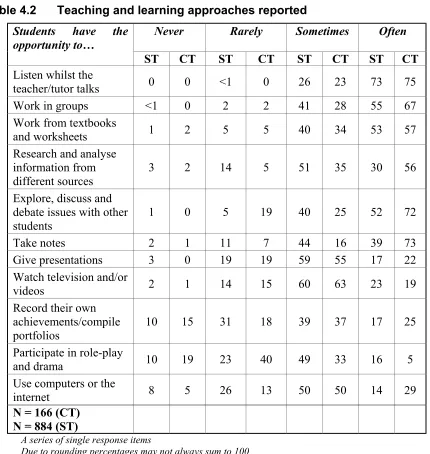
Teachers and college tutors reported that teacher-led approaches to citizenship-related topics were predominant in the classroom, with more participatory, active approaches much less commonly used. Teachers relied on their own and media sources in their planning for citizenship education and had little or no experience of assessing student outcomes. Just over four-fifths of teachers (83 per cent) and just under four-fifths of college tutors (79 per cent) said they did not assess students in citizenship education.
Active citizenship in schools and colleges prior to September 2002
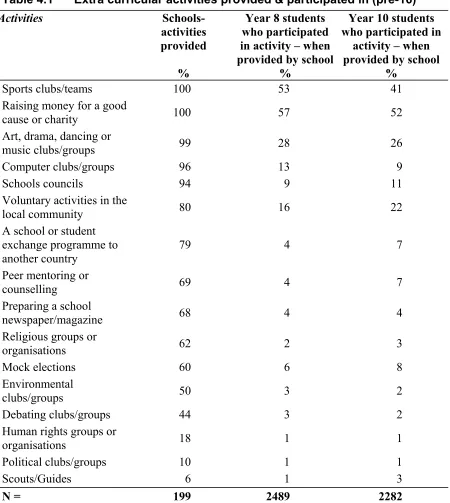
Schools provided a number of opportunities for students to be involved in active citizenship activities, such as school councils and clubs. School and college leaders were satisfied that the whole school was involved in discussion and decision making about school matters. However, only just over half the teachers surveyed (57 per cent) felt this way and less than a third of students (27 per cent) felt they were consulted about the development of school policies. This is perhaps reflected in the fact that while school councils were reported to be widely available in schools, both by school leaders and students, only one-third of students (34 per cent) reported participating in school council elections. Thus while students reported that they were given the opportunity to be involved in running their school through school councils, actual participation was low.
2001 – 2002
students participating in such activities. Student take-up rates showed signs of decreasing with age as students progressed through the school.
The majority of school leaders (96 per cent) and all college leaders felt that there were good relationships between their school and the wider community. Almost three-quarters (74 per cent) believed their school or college provided opportunities for involvement in the community and that students were encouraged to take up these opportunities.
School, college and teacher preparedness and planning for the introduction of statutory citizenship education from September 2002
While the majority of teachers (74 per cent) claimed to understand the aims and purposes of citizenship education, over one-third (38 per cent) were uncertain about the detail of the new curriculum that would be introduced in September 2002. There was limited familiarity with the key citizenship curriculum documents, such as the Curriculum Order and Qualifications and Curriculum Authority (QCA) schemes of work, and little or no familiarity with the key policy texts, notably the Crick Report and Post-16 report. College leaders and tutors were even more uncertain about the content of, and background to, the citizenship curriculum.
Schools and colleges revealed a variety of delivery plans for citizenship education. These had largely been drawn up by school leaders with little or no consultation with teachers and students. Three quarters of schools (75 per cent) had already appointed a coordinator for citizenship education. However, rather than teaching citizenship in dedicated timeslots, the majority of schools indicated that they planned to use existing expertise to deliver the curriculum through a range of subjects and areas such as RE and PSHE, and through tutorial periods. Just under half of the sample stated that all staff (48 per cent) would have some responsibility for delivering the citizenship curriculum
The majority of teachers (71 per cent) and college tutors (81 per cent) had not received any training in relation to citizenship education. In order to develop a better understanding of citizenship education, teachers favoured greater training opportunities, particularly concerning subject knowledge (89 per cent) and teaching and learning approaches (65 per cent).
Few schools had definite policies for recognising student achievement at the time of the survey (11 per cent at key stage 3 and 8 per cent at key stage 4). However, over three quarters of the sample stated that they planned to develop this in the future. Commonly used assessment strategies in those schools with assessment already underway included: written tasks and essays; student portfolios and observation and self-assessment.
Attitudes to citizenship prior to September 2002
EXECUTIVE SUMMARY
ix and global identity; political literacy and awareness and social and moral responsibility.
School leaders, teachers and college tutors recognise the importance of citizenship education for students and agree that schools have a central role to play in developing students’ citizenship dimensions. They also support citizenship as a part of the formal curriculum.
There is considerable difference between school leaders’, teachers’ and students’ attitudes to, and experiences of, citizenship education. Students were much less positive about their experiences than teachers, and teachers less positive than school leaders. This gap may be related to the extent or lack of consultation about citizenship education policies and practices in schools, with control of such development resting largely with school managers at present.
Students’ political and civic knowledge
Students’ political and civic knowledge was variable. For example, students had a good knowledge of equal opportunities and age-related rights, but were less well informed about democracy, the working of democratic institutions, the European Union (EU) and the electoral system.
There was a significant relationship between educational background and civic knowledge. Those students whose parents had degrees and who intended to go on to university themselves had higher levels of political and civic knowledge. For the Year 12 students, those doing academic courses had higher levels of political and civic knowledge.
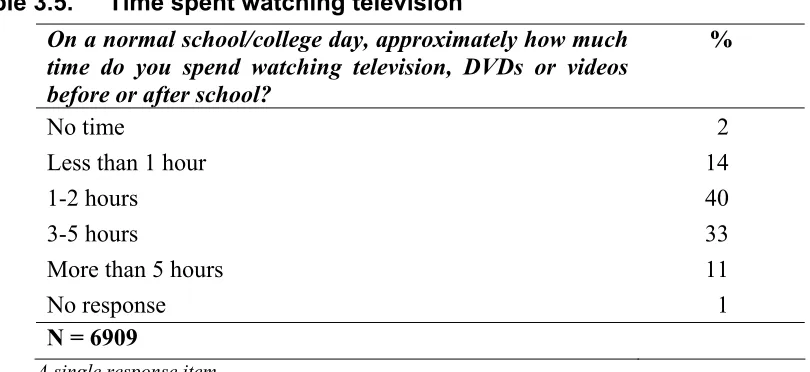
Students’ home situation was also linked to civic knowledge, with those whose parents owned their home gaining the highest scores. How students spent their free time was also linked to political and civic knowledge. Students who socialised least on week nights and were moderate television viewers gained the highest scores.
Attitudes to civic institutions and groups in society
Young people clearly felt that citizenship hinged on obeying the law and contributing towards their communities. They were, however, less likely to support conventional participation activities such as joining a political party and writing to a newspaper.
2001 – 2002
In particular, a small but significant minority of students showed support for the prioritisation of men’s working rights over women’s; an action which would breach UK and European employment laws. Male respondents and those from non-white ethnic backgrounds were more likely to support this view. This raises the issue of how schools deal with this significant minority and the circumstances which give rise to such views.
Attitudes to politics, civic engagement and participation
Students were involved in little discussion about political and topical issues in their lives, despite reporting that they received the opportunity to discuss political issues in class. This lack of discussion may reflect students’ lack of interest in politics; only a quarter of the sample agreed or strongly agreed with the statement ‘I am interested in politics’. However, there was a positive relationship between political interest and civic knowledge.
Voting in national elections was by far the most preferred intended political activity, with two-thirds of all students (66 per cent) saying they would participate. Just under two thirds of students also stated that they would collect money for charity (63 per cent) and vote in local elections (62 per cent). However, over two-thirds of students did not intend to participate in conventional political activities (other than voting), such as joining a political party or becoming involved in local politics.
The proportion of young people who reported the intention to participate in any form of protest was small, although the likelihood of students participating in peaceful protest was greater than the likelihood of them participating in violent forms of protest.
The most popular student voluntary activity was participation in sports teams and clubs. This was followed by participation in arts, drama, dancing or music clubs. Student participation in civic related organisations such as political clubs and groups, human rights organisations, environmental groups and religious groups was low, with less than one-fifth of students reporting such participation.
Concluding Comments
This report on the first cross-sectional survey marks an important milestone in terms of both the Citizenship Education Longitudinal Study, and the on-going context of policy, practice and research in citizenship education. Most importantly, it provides a unique baseline of school and college leader, teacher and student attitudes and actions just prior to the formal introduction of Citizenship into the curriculum in September 2002.
EXECUTIVE SUMMARY
xi
The Full Report
Kerr, D., Cleaver, E., Ireland, E. and Blenkinsop, S. (2003) Citizenship Education Longitudinal Study: First Cross-Sectional Survey 2001-2002. London: DfES.
References
INTRODUCTION
1
1. INTRODUCTION
1.1 Background
This report sets out the findings from the first cross-sectional survey of the Citizenship Education Longitudinal Study. The findings are based on initial analysis of the data from the students, teachers and school and college leaders2 who participated. The findings need to be seen within the context of the Longitudinal Study as a whole. The Longitudinal Study is a unique research study. The first cross-sectional survey marks the beginning of an exploration by the NFER research team, in partnership with the study’s two consultants, Professors Patrick Seyd (University of Sheffield) and Paul Whiteley (University of Essex), as to how the study’s aims and objectives can be met in practice. The conduct of the first cross-sectional survey has proved a useful exercise in this respect. The exploration is centred, in particular, on the development of an overarching analytical framework to guide the study.
However, the initial findings remain important, at this stage of the study, in three respects. Firstly, they offer a unique nationally representative baseline of the attitudes of students, teachers and school and college leaders to citizenship and education prior to the formal introduction of citizenship education into schools in September 2002. The findings provide an indication of how well informed school staff members are about the new National Curriculum subject of Citizenship and the strengths and weaknesses of their preparation, planning and readiness for its introduction.
Secondly, the findings lay a strong foundation for the future conduct of the Longitudinal Study. The first cross-sectional survey has helped to clarify the purpose of the cross-sectional component of the Longitudinal Study and its interrelationship with the other three research components: longitudinal surveys, school case studies and a literature review. It has also helped in the drawing up of an analytical framework to guide the study. Thirdly, the findings provide continuity with previous research on citizenship education and political socialisation in England, most notably from England’s participation in the International Association for the Evaluation of Educational Achievement (IEA) Citizenship Education Study (Kerr, 1999a and b; Torney-Purta et al., 2001; Kerr et al., 2001 and 2002). The report highlights where there are continuities and differences between the findings from the cross-sectional survey and those from the IEA Study. However, it should be emphasised that the Longitudinal Study is a separate study from the IEA Citizenship Education Study. Though it is useful to contrast the findings
2 The school questionnaire was completed by a variety of different respondents in schools, including
2001 – 2002
between the two studies at this early stage, the emphasis should be on what the first cross-sectional survey has found and how this can be built on in the future conduct of the Longitudinal Study.
The remainder of this opening chapter sets the Citizenship Education Longitudinal Study within the broader context of policy and research in citizenship education. It also locates the first cross-sectional survey within the aims and design of the Longitudinal Study as a whole and the study’s emergent analytical framework. Both contexts are vital for considering the implications of the findings from the first cross-sectional survey as set out in this report.
1.2 The Policy Context for Citizenship Education
The Citizenship Education Longitudinal Study must be seen within the context of recent policy developments in citizenship education in England. These policy developments underpin the commissioning of the study by the Department for Education and Skills (DfES). They have also significantly influenced the aims and overall design of the study.
Citizenship education has been at the heart of a major debate and policy review concerning its purpose, location and practice in schools and colleges in England over the past decade (Kerr, 1999a and b; Crick, 2000). The review has centred on the work of the Advisory Group on Education for Citizenship and the Teaching of Democracy in Schools, set up in 1997 and chaired by Professor (now Sir) Bernard Crick. The Citizenship Advisory Group defined ‘effective education for citizenship’ as comprising three separate but interrelated strands. The strands, outlined in more detail below, are to be developed progressively through a young person’s education and training experiences, from pre-school to adulthood (Crick, 1998, pp. 11-13):
♦ social and moral responsibility: ‘...children learning from the very
beginning self-confidence and socially and morally responsible behaviour both in and beyond the classroom, both towards those in authority and towards each other’. This strand acts as an essential pre-condition for the other two strands
♦ community involvement: ‘...learning about and becoming helpfully
involved in the life and concerns of their communities, including learning through community involvement and service to the community’. This, of course, like the other two strands, is by no means limited to children’s time in school
♦ political literacy: ‘...pupils learning about and how to make themselves
INTRODUCTION
3 The Citizenship Advisory Group sought to establish a ‘light touch’ flexible but rigorous framework, which would encourage schools and colleges to develop effective citizenship education in ways that best suited their needs, context and strengths. Within the framework the onus is on schools and colleges, in partnership with their local communities, to develop meaningful citizenship education practice and experiences for all young people.
Following the revision of the National Curriculum, citizenship education has been incorporated for the first time in the school curriculum between the ages 5 and 16. Citizenship is now part of a non-statutory framework for personal, social and health education (PSHE) and citizenship at key stages 1 and 2 and a new statutory foundation subject at key stages 3 and 4. Schools have therefore been legally required to deliver citizenship education at key stages 3 and 4 from September 2002. The new Citizenship Order at key stages 3 and 4 has programmes of study for Citizenship and an attainment target based on three elements:
♦ knowledge and understanding about becoming informed citizens; ♦ developing skills of enquiry and approach;
♦ developing skills of participation and responsible action.
Though the Citizenship Advisory Group’s remit only applied to pre-16 education, the Group recommended that ‘citizenship education should continue for all students involved in post-16 education and training regardless of their course of study, vocational or academic’ (Crick, 1998, p. 23). In order to pursue this recommendation, a separate Advisory Group on Citizenship for 16-19 year olds in Education and Training was set up in 1999, also chaired by Professor Sir Bernard Crick (FEFC, 2000).
Given that the framework and recommendations for citizenship education up to key stage 4 should be taken forward for all 16 – 19 year olds in education and training, it is not surprising that the resultant pre-16 and post-16 proposals for citizenship have a number of common features. These include:
♦ reliance on a flexible but rigorous framework
♦ focus on the development of skills alongside knowledge and understanding ♦ emphasis on developing ‘active citizenship’
♦ need for citizenship development to be responsive to the diversity of education and training contexts
♦ entitlement to citizenship for all young people.
Taken together, the policy developments identify effective citizenship education as education which enhances:
2001 – 2002
♦ political efficacy – the extent to which individuals feel that they can take effective action, broadly defined, to influence the political system
♦ voluntary action – the willingness of individuals to participate in voluntary activity in formal organisations and in informal settings
♦ social norms and values – the extent to which individuals have attitudes and values which foster participation, social integration and a willingness to co-operate with others
♦ identification with institutions – the extent to which individuals feel that the institutions of the state, such as local authorities, and those outside the state, such as political parties, are owned by them and are responsive to their needs, efficiently run and work effectively
♦ identification with communities – the extent to which people feel integrated into or excluded from their local communities and the social groups within those communities
♦ trust in other people and in government – the extent of interpersonal trust (or social capital) and political trust (or political capital) that exists in a society, both of which have been argued to play a vital role in making democracy work (see Putnam et al., 1994)
♦ a sense of rights and obligations – the extent to which individuals have knowledge of citizens’ rights and an appreciation of their entitlements from the state, as well as the extent to which they accept the citizens’ obligations which underpin these rights.
Clearly, the Citizenship Education Longitudinal Study needs to address these phenomena and include measures which can track them over time. In this way it will be possible to evaluate the extent to which the new curriculum for citizenship education is meeting its central aim of contributing to the socialisation of active citizens, particularly of young people, in England.
1.3 The Research Context for Citizenship Education
INTRODUCTION
5 What little research there has been reveals five factors concerning policy and practice in citizenship education in England over the past 30 years. These five factors provide important contextual background which needs to be taken into account when reviewing the findings from the first cross-sectional survey. Each contextual factor is considered in turn in what follows. The first factor revealed is the existence of a number of competing definitions of citizenship in England which offer different models and approaches to citizenship education in schools depending on the concept of citizenship that is espoused. These competing definitions have accrued over time. Rowe (1997) identifies eight models of citizenship education in existence in democratic societies such as Britain. These models are: the constitutional knowledge, the patriotic, the parental, the religious, the value conflict or pluralist, the empathetic, the school ethos and the community action models. Meanwhile, Scott and Lawson (2001) define these competing models as those relating to knowledge (Usher, 1996), action (Habermas, 1994), community (Etzioni, 1995), rights and responsibilities (Giddens, 1994), public and private morality (Beck, 1998), inclusivity (Lynch, 1992; Arnot, 1997; Lister, 1997) and locality (Wringe, 1999; Cogan and Derricott, 2000).
The second factor that the research base reveals is the lack of a coherent vision of citizenship and citizenship education in English society and schools. This is underlined by the existence of the competing definitions and approaches. A number of reasons have been ascribed for what Frazer (2000) has termed this ‘British exceptionalism’: the long history in Britain of avoiding explicit discussion of citizenship issues in wider society and through the curriculum. Frazer ascribes the condition to the lack of a ‘narrative of the distribution of power’, while Miller (2000) asserts that the notion of citizenship is itself ‘foreign’ and ‘unsettling’ in a British context. Meanwhile, Professor Sir Bernard Crick (2000) draws attention to the influence of the traditional British notion of a person as a ‘subject’ rather than a ‘citizen’.
The third factor suggested by the research literature is that, despite the clear three strand definition of citizenship education put forward by the Citizenship Advisory Group (Crick, 1998), there are still considerable questions to be addressed concerning the ‘definition, purposes, and intended outcomes’ of an education for citizenship (Pearce and Hallgarten, 2000). It is likely that there remains considerable confusion as to what is meant by the terms ‘citizenship’ and ‘citizenship education’ in society and in schools. Indeed reaction to the Crick Report, though largely supportive, highlights the continued support for a number of pre-1998 definitions of and approaches to citizenship education.
2001 – 2002
education (RE). It is likely that these definitions and associated subject links continue to compete for predominance in this area among practitioners, policy-makers and researchers. The definitions are of interest because they highlight differing approaches to citizenship education in terms of both emphasis and teaching and learning styles. It will be important to identify these competing models and approaches to citizenship education and gauge the extent to which they are present in the ways that schools, particularly those involved in the Study, develop citizenship education through the curriculum.
The fourth contextual factor revealed in the research literature is how little is known about the emphasis given to citizenship education in schools and how it is addressed through the curriculum. There are only a small number of research studies that investigate practices and approaches to citizenship education in schools prior to 1998. They offer a partial picture of policy and practice. However, that picture is of help in setting the findings in this report concerning the degree of planning and readiness of schools, teachers and pupils for the formal introduction of citizenship, within a broader historical context.
Crewe, Searing and Conover (1997) in a comparative research programme into aspects of citizenship in Britain and the United States discovered that for British respondents citizenship was a foreign concept and played only a peripheral part in their self-perception, and that they attached far more importance and value to their sense of Britishness than to their sense of citizenship. The study also found that nearly 80 per cent of pupils aged 15 to 16 in their British sample communities engaged in little discussion of public issues in the classroom.
Issues concerning the difficulty of defining citizenship were also uncovered by Arnot (1996) in a survey of student teachers in England at the end of their initial training course. The study found that student teachers had great difficulty defining the concept of citizenship and listing the characteristics of ‘a good citizen’. This was reinforced by the findings of a further study of student teachers’ understanding of citizenship carried out by Wilkins (1999). Arnot and Wilkins also highlighted the fact that many student teachers in England feel ill-prepared and uncomfortable at the end of their one-year initial teacher education course in addressing issues related to citizenship education in schools.
INTRODUCTION
7 A further attempt was made to replicate aspects of the earlier survey of citizenship education practices, as part of a national values education survey carried out by NFER at the same time as the setting up of the Citizenship Advisory Group (quoted in Crick Report, 1998). The 173 secondary schools who took part in the NFER survey confirmed the findings from the earlier survey about the range of subjects involved in the delivery of citizenship education in schools and the predominance of delivery through personal and social education. They also reaffirmed the breadth of extracurricular activities involving pupils. These activities included work experience, charity fund-raising, work with school councils and community activities. However, little is known about pupils’ actual experiences of such activities outside school, in their neighbourhoods and communities.
There is also a dearth of research in the studies into specific teaching and learning activities in schools which address the topics associated with citizenship education. Kerr (1996), in a survey of 144 primary schools, found that teachers felt the most effective approach to citizenship education was through active strategies, such as discussion and debate. However, this survey was never followed up in either primary or secondary schools. The lack of an established research and practice base for citizenship education in England is an important contextual factor which must be borne in mind when the Longitudinal Study moves to consider the approach of schools to policy and practice in this area.
The fifth contextual factor revealed in the research literature is the identification of common challenges that remain to be faced if the vision of the Citizenship Advisory Group for effective citizenship education for all young people is to be translated into meaningful practice and become a reality. This factor relates to literature published in the period following the publication of the Crick Report. Both those closely involved in the drawing up of the Crick Report (Kerr, 1999a and b; 2000; Crick, 2000; Potter, 2002) and those interested parties looking in from the outside (McLaughlin, 2000; Davies, 2000) identify common issues and challenges that need to be addressed as the policy initiative meets actual practice. They include the challenges of:
♦ gaining agreement on the conception or definition of citizenship. McLaughlin (2000) sees the Crick definition as ‘a controversial one which is open to challenge’.
♦ bridging the gap between policy intentions and actual practice, including the gap between the Crick Report and the statutory Curriculum Order. ♦ curriculum location for citizenship. Frazer (2000) draws attention to the
fact that ‘sheltering under the umbrella of citizenship education’ are a range of interest groups with ‘a range of differing and possibly conflicting interests and concerns’.
2001 – 2002
♦ Giving teachers sufficient training and confidence to teach sensitive and controversial issues in citizenship education through active approaches, such as discussion, debate and drama.
♦ Agreeing how citizenship education should be assessed, reported and inspected.
♦ Helping schools to successfully address the community involvement strand of citizenship education, in partnership with representatives from their local communities (Potter, 2002).
As McLaughlin (2000) notes in his conclusion to a detailed appraisal of the claims and recommendations in the Crick Report ‘the extent to which the arguments and recommendations of the Crick Report are successfully implemented remains to be seen’. This statement neatly sums up the widespread speculation in the current literature about the prospects for citizenship education.
It is important that these common challenges are understood. They offer a series of issues which require further exploration during the course of the Study, particularly in the case study visits to schools. They also provide a backdrop against which the range of policies and practices that will be developed in schools can be considered.
However, the research base for citizenship education in England has begun to improve since 1998, as a direct consequence of the current policy initiative in this area. The introduction of citizenship education in schools has encouraged researcher and government bodies, such as DfES and the Office for Standards in Education (OFSTED), to try to establish a baseline concerning the state of citizenship education and the levels of readiness of schools and others for its statutory implementation in September 2002. Research and evaluation has been carried out at a number of levels by a range of researchers and government bodies.
By far the most important of these recent studies for the Longitudinal Study is England’s participation in the IEA Civic Education Study, known in England as the IEA Citizenship Education Study (Torney-Purta et al., 2001; Kerr et al., 2001, 2002). The IEA study, sponsored by DfES, was a two-phase, cross-national study involving 28 countries, including England. The main goal was to identify and examine, in a comparative framework, the ways in which young people are prepared to undertake their roles as citizens in democracies. One focus of the study was on schools and a second was on opportunities for civic participation outside the school, especially in the community.
INTRODUCTION
9 ♦ Citizenship education is a complex enterprise involving the development of a variety of citizenship dimensions (knowledge, skills, concepts, attitudes, engagement and participation) through a range of educational approaches and opportunities for young people both in and out of school ♦ Pupils in most countries, including England, have an understanding of
fundamental democratic values and institutions, but lack depth of
understanding
♦ Young people with higher levels of civic knowledge are more likely to expect to participate in political and civic activities as adults. In all countries, including England, there is a positive correlation between civic knowledge and participation in democratic life
♦ Schools that model democratic practices and values, by encouraging pupils to discuss issues in the classroom and take an active role in the life of the school, are most effective in promoting civic knowledge and engagement
♦ Voting aside, pupils are sceptical about traditional forms of political engagement but are more open to other forms of involvement in civic life ♦ Schools and community organisations have untapped potential to
influence positively the civic preparation of young people. Schools are environments that are part of the everyday lives and experiences of young people. They throw up problems that matter to students and provide opportunities for them to take part in ‘real’ action. This sense of ‘school
efficacy’ identified in the study may be as important a factor in future
political behaviour as the broader sense of ‘political efficacy’.
However, it should be emphasised that, though these findings from the IEA Study are of interest, the Longitudinal Study marks the start of new, groundbreaking, research in citizenship education. The Longitudinal Study is unparalleled, in its aims, objectives and scope, not only in England but across the world. Indeed, the countries that participated in the IEA Study are watching the conduct of the Longitudinal Study and awaiting the findings with keen interest.
2001 – 2002
The findings from an OFSTED investigation of the implementation arrangements for citizenship education in a sample of 20 schools are also of relevance (OFSTED, 2002). Though the sample is small it revealed considerable variations in schools’ responses to the new citizenship education requirements. Over 50 per cent of the schools had made good use of the two-year lead in time for citizenship education and had decided on and built in new approaches. One-third had taken essential first steps but still had considerable work to do. However, in a small number of schools, one in ten, progress towards implementation was unsatisfactory. These findings are of interest if they are replicated across schools nationally.
The NFER research team has already made links to the experiences and outcomes of the IEA Study, in particular, and to the other studies in the framing, conduct, analysis and reporting of the first cross-sectional survey. Where relevant, these links are highlighted in the chapters that follow.
Finally, it should be noted that links have also been established between the Longitudinal Study and the Post-16 Citizenship Education Study. The Post-16 study, funded by DfES and also being undertaken by the NFER, is evaluating the new post-16 citizenship development projects with a view to informing a national roll-out of citizenship in post-16 education and training routes from 2004. The field-based findings from the post-16 evaluation are likely to be of increasing use in informing the design of the Longitudinal Study components in the coming years. The findings will contribute to the on-going literature review and will influence questionnaire design and analysis plans for the longitudinal and cross-sectional surveys, particularly in the survey sweeps after 2004. The findings will also be helpful in informing the conduct of the case-study visits to participating schools, particularly in terms of the links made between pre-16 and post-16 citizenship experiences for young people.
1.4 Aims of the Citizenship Education Longitudinal Study
The aims of the Citizenship Education Longitudinal Study are heavily influenced by the policy and research contexts in citizenship education. With citizenship education moving rapidly from a policy proposal to a real school subject there is a need to identify, measure and evaluate the extent to which ‘effective practice’ in Citizenship develops so that such practice can be promoted more widely. Accordingly, the Department for Education and Skills (DfES) has commissioned the National Foundation for Educational Research (NFER) to undertake a Longitudinal Study in citizenship education over eight years. This will track a cohort of young people who entered secondary school in 2002 and are the first students to have a continuous statutory entitlement to citizenship education.
The overarching aim of the study is to:
INTRODUCTION
11 This is to be achieved in relation to the three interrelated strands of citizenship identified by the Citizenship Advisory Group, namely the effects of citizenship education on pupils’ levels of social and moral responsibility, community involvement and political literacy.
The Study has two subsidiary aims related to the main aim, which are to:
♦ identify the different processes – in terms of school, teacher and pupil effects – that lead to differential outcomes
♦ assess changes in levels of joining and participation in voluntary bodies. The Study will also collect detailed information in order to meet a number of key research objectives. These include:
♦ Models of provision:
♦ the identification of the main ‘types’ of citizenship education being provided nationally
♦ the exploration of the influences on the main ‘types’ of citizenship education which are developed nationally.
♦ Processes/enabling factors:
♦ the assessment of the advantages and disadvantages of different types of citizenship education provision on pupil outcomes
♦ the examination of what school, teacher and pupil effects have a significant impact on pupil outcomes
♦ the assessment of whether the impact of these effects varies in relation to different types of provision
♦ the examination of how ‘types’ of citizenship education change over time and are adapted as experience accrues in schools.
♦ Impact outcomes
♦ the assessment of the impact of citizenship education on pupils’ knowledge, skills and attitudes over time.
♦ Participant views
♦ the gauging of teachers’ views of citizenship education
♦ the exploration of teachers’ views on the ways citizenship education is implemented, delivered, received and monitored
♦ the identification of teachers’ views on training in terms of availability, quality and applicability
♦ the gauging of pupils’ views of citizenship education
2001 – 2002
♦ the capture of the views of school and college leaders’, parents’ and community representatives’ involved in citizenship education, alongside those of teachers and pupils
♦ the establishment of the degree of congruence, or lack of it, between school, teacher and pupil views on citizenship education and to ascertain the reasons for this.
♦ Study outcomes
♦ an informed evidence-based discussion of potential changes for the delivery of citizenship education to improve its effectiveness.
These aims and objectives have shaped the research design and conduct of the Longitudinal Study, including the design, conduct and reporting of the first cross-sectional survey.
1.5 Research Design of the Citizenship Education
Longitudinal Study
The research design of the Longitudinal Study is based on four interrelated components:
♦ Four cross-sectional surveys of students, schools and teachers. The
first survey took place in 2001-2, the future surveys will be undertaken in school years 2003-4, 2005-6 and 2007-8, with the first survey acting as a pre-compulsory baseline. The student surveys (sent to one tutor group in Years 8, 10 and 12 in each participating school) were accompanied by questionnaires to school and college leaders and teachers in each participating school.3 These surveys, based on representative national samples, will yield a wide range of factual and attitudinal student data, as well as information about developments in citizenship education through the coming years.
♦ A longitudinal tracking survey of a whole year group of students in a
representative sample of 100 schools tracking the student cohort from Year 7, through Years 9 and 11 and 13 (or equivalent when they are aged 18). Schools and teachers will also be asked to complete questionnaires each year up to Year 11 so that links can be made between pupils’ experiences, skills, knowledge and attitudes and school characteristics and processes. These surveys will track the way that a particular cohort of students’ attitudes and knowledge change over the next eight years and at each stage may be contextualised by data obtained in the cross-sectional survey.
♦ Twenty longitudinal school case studies. Ten schools will be drawn
from the schools participating in the first cross-sectional survey and ten from the longitudinal sample population of schools. School visits will include in-depth interviews with key personnel, lesson observation and student discussion groups. Each school will be revisited once every two years over the duration of the study. The case studies will provide an
3 In the first cross-sectional survey (2001-2) a total of 7500 students and 1500 teachers were
INTRODUCTION
13 opportunity for in-depth analysis of the delivery models that schools use to implement citizenship education in a range of different contexts and how these evolve over time. They will also enable detailed follow-up with senior managers, teachers and pupils of questions raised by the survey evidence. They provide a further opportunity to investigate emerging issues and topics of interest to policy and practice.
♦ An ongoing literature review. An initial scrutiny of key literature on
policy and practice in citizenship education and political socialisation will be undertaken to inform questionnaire design and the study’s analytical framework. The literature review will be extended and updated each summer thereafter for the duration of the project.
The following schematic diagram illustrates the timing of both surveys. It shows how the first cross-sectional survey, which is the focus of this report, fits with the study’s overall research design.
1.6 Analytical
Framework
The research team has drawn up an overarching framework to guide the study. This analytical framework binds together the aims and design of the study. In particular, it provides a means of organising and linking the data and information collected in the four components of the study.
The framework provides a way of understanding the implementation of citizenship education. It not only takes into account the school, teacher and student level contexts which may influence the delivery and impact of citizenship education, but recognises the broader societal processes and contexts which may combine to influence young peoples’ experience and
7 8 9 10 11 12 13
2001/2 2002/3 2003/4 2004/5 2005/6 2006/7 2007/8 2008/9 Academic Year
Year Groups Surveyed
Longitudinal Survey Cross-sectional Survey - Year 8 Cross-sectional Survey - Year 10 Cross-sectional Survey - Year 12
2001 – 2002
development of citizenship dimensions (knowledge, skills, understanding, concepts, attitudes, engagement and participation).
At the heart of the framework is the individual student and individual school. The framework reflects the recognition that both student and school are influenced by a range of background factors. For students these include a mixture of factors that cannot necessarily be influenced by citizenship education, (such as age, sex and ethnicity)4 and those factors that may be influenced by citizenship education (such as political interest and knowledge, political efficacy and civic engagement). At the school-level the influence of institutional size, ethos, management and the attitudes and expertise of staff maybe significant. This is explored in section A.
Student and school factors come together in the context of the citizenship education experiences that students have in school. However, schools are only one of the contexts or ‘sites’ in which young people experience and develop citizenship dimensions. Other important contexts may include home, formal community networks such as religious, cultural and voluntary groups, and informal networks such as youth organisations, leisure and work places. This range of contexts therefore indicates that teachers are only one of the influences on the citizenship education experiences of young people, other potential influences include family, friends and peers and members of local and broader communities. These various factors and their interface are explored in section B.
4 While age, sex, and ethnicity cannot themselves be affected by citizenship education some of the
Citizenship Education Longitudinal Study
Analytical Framework
A B C
BACKGROUND FACTORS-STUDENT
Background factors which cannot be influenced – age, sex
class, ethnicity Background factors
which may be influenced – political
interest, knowledge
BACKGROUND FACTORS- SCHOOL/TEACHER School ethos, teacher experience etc
CITIZENSHIP EDUCATION EXPERIENCES
OUTCOMES – SCHOOL/TEACHER
Curricular, Cross-curricular,
Whole school, Community links OUTCOMES –
STUDENTS
Political literacy, Community Involvement, Social
and Moral responsibility,
Personal development
FAMILY AND
HOME FRIENDS AND PEER GROUP
COMMUNITY LINKS
FORMAL NETWORKS
INFORMAL NETWORKS
2001 – 2002
The framework also provides an indication of some of the potential outcomes of citizenship education for individual students and schools. For the purpose of this study the framework focuses on two outcomes in particular. First, how young people embrace the three strands of citizenship – social and moral responsibility, community involvement and political literacy – and secondly, how far schools develop effective citizenship education across the whole school, including links with local communities. The study is also interested to explore the extent of the linkage between individual student and school outcomes. These various outcomes and linkages are explored in section C.
The analytical framework is a composite, combining, a range of explanatory models and theoretical frameworks from citizenship education research and the political sciences, which appear to provide valuable insights for this study. In particular, the framework builds on the Octagon Model used to guide the conduct of the IEA Citizenship Education Study (Torney-Purta et al., 2001; Kerr et al., 2002), the findings of the IEA Study and theoretical frameworks developed by political scientists to explore and explain adult political socialisation and political behaviour. The current study aims to assess how far theories developed from research into adult participation can help us to understand the participation of school-aged young people. Taking this argument further, it aims to assess and measure the extent to which citizenship education may affect participation in ways over and above the participation current citizenship education models explain. Below each of these explanatory models and theoretical frameworks is explored in brief.
Student level models
♦ The democratic processes model
This model suggests that schools that model democratic practices by encouraging students to discuss issues in the classroom and take an active role in the life of the school, are most effective in promoting civic knowledge and engagement. This model results from the IEA Citizenship Education Study (Torney-Purta et al., 2001; Kerr et al., 2002).
♦ The school efficacy model
Again drawing on the findings of the IEA Study, this model suggests that the extent to which students believe that they can improve their school and have an impact on their school (school efficacy) may be an important influence on students’ sense of political efficacy and as such future political participation. (Torney-Purta et al.; 2001; Kerr et al., 2002)
♦ Civic knowledge-civic participation
INTRODUCTION
17
Adult level theories
♦ Theories of cognitive engagement
Research has found that the higher the levels of political information that individuals are exposed to, the more likely they are to take an interest in politics (Dalton, 2002). Moreover, the better-educated people are, the more likely they are to be able to read, understand and have access to this information. Those who have access to such cognitive resources are more likely to have an opinion on the political process and to participate in political life.
♦ Theories of civic voluntarism
This set of theories (see for example Parry et al., 1992; Verba et al., 1996) argues that individuals who are well-educated, middle-class, affluent and feel as though they have plenty of free time are more likely to participate if they are interested in politics, support a particular political party (partisanship) and think that what they do will make a difference (political efficacy). A further factor which can influence participation is mobilisation – the active request for participation by others.
♦ Rational actor theories
This set of theories, drawing on the work of Downs (1957), Olson (1965) and Pattie et al., (2002), argues that an individual’s choice to participate will result from a weighing up of the benefits of an action or activity in relation to the costs. If the costs are too great, or the benefits too few, they are less likely to participate.
♦ Theories of social capital
The theory of social capital (see Putnam et al., 1994) argues individuals who participate in many organisations within their communities and who are generally trusting of other people and institutions, are more likely to take an active role in political life.
♦ Theories of equity-fairness
This group of theories (see for example Runciman, 1966; Gurr, 1970; Muller, 1979) argues that members of traditionally disadvantaged groups, who feel that they are treated unfairly in comparison to other groups (relative deprivation) and that they cannot make their voice heard through conventional participation (marginalisation), are more likely to turn to protest and revolution.
2001 – 2002
presented in the current report, but will be returned to in more depth in future analysis.
1.7 Structure of the Report
The main focus of the first cross-sectional survey – an exploration of the attitudes of schools, teachers and students to citizenship and education, prior to the statutory introduction of Citizenship in September 2002 - forms a major part of this report. In addition, the report begins to address some of the key aims and objectives of the Study, and to explore and test some of the explanatory models of participation and engagement that comprise the analytical framework.
This introductory chapter is followed in Chapter 2 by a detailed account of the methods used in conducting the first cross-sectional survey in schools. Chapter 3 provides background information about the schools, teachers and students who participated in the cross-sectional study. This profile of respondents enriches the findings in the other chapters in this report. The next three chapters explore the understanding of, approaches to and preparation for citizenship education of students, schools and teachers in the summer term of 2002. They provide a fascinating national baseline snapshot of the different stages of preparedness prior to the formal introduction of citizenship in September 2002. Chapter 4 examines the ways in which citizenship was already being approached in differing school contexts prior to September 2002. It highlights the range of existing approaches to developing effective citizenship education in schools from school ethos to classroom teaching and learning. Chapter 5 flows naturally from the preceding chapter and focuses, more specifically, on teachers’ and school leaders’ familiarity with the new citizenship proposals and their levels of planning and preparedness for the formal introduction of citizenship. It highlights professional development strengths and training needs in relation to citizenship education in schools.
The following three chapters focus on the results of the student section of the survey. Chapter 6 contains a short review of students’ responses to the open-ended question ‘What is Citizenship?’, included to illustrate the range of meanings students attach to the term ‘citizenship’. Chapter 7 explores students’ political and civic knowledge in relation to a series of citizenship topics. It sets the results against a series of background factors which have been shown to influence students’ political and civic knowledge scores. In Chapter 8, students’ attitudes toward key civic institutions and groups in society are considered. Chapter 9 focuses on a discussion of students’ attitudes to civic engagement and participation in political activities. It includes students’ attitudes and experiences of citizenship education in schools and the wider community, with consideration of students’ views of opportunities for civic engagement in schools, classrooms and community organisations. Each analysis chapter ends with a summary of its key findings.
INTRODUCTION
19 initial analysis of cross-sectional survey data. These conclusions are set out in relation to the on-going policy, practice and research context of citizenship education in England. Attention is also drawn to any continuities and differences in findings from the first cross-sectional survey with recent research in this area, and, in particular with the findings from England’s involvement in the IEA Citizenship Education Study. Secondly, it reflects on the experiences gained during the implementation and analysis of the first cross-sectional survey, and considers how these will inform future progress of the Longitudinal Study. The first cross-sectional survey has played a vital role in shaping the approach to the study’s four research components – future cross-sectional and longitudinal surveys, the longitudinal case studies and the literature review – as well as the analytical framework. Potential ways forward for each of these components are considered in turn.
1.8 Summary
Citizenship Education Longitudinal Study
The Citizenship Education Longitudinal Study aims to assess the short-term and long-term effects of citizenship education on the knowledge, skills attitudes and behaviour of pupils. A key outcome of the study will be to explore, based on the views of teachers and pupils, potential changes to the delivery of the citizenship curriculum in order to improve the effectiveness of citizenship education.
Research Design
The research design for the Longitudinal Study is based on four interrelated components:
♦ Four cross-sectional surveys of students, schools and teachers undertaken in school years 2001-2, 2003-4, 2005-6 and 2007-8, with the first survey acting as a pre-compulsory baseline.
♦ A longitudinal tracking survey of a whole year group of students in a representative sample of 100 schools, starting in Year 7 in 2002-3, and following them up in Year 9, Year 11 and then in Year 13 (or equivalent when they are aged 18).
♦ Twenty longitudinal school case studies that will be revisited at least once every two years over the duration of the study. Ten of these schools will be drawn from the schools participating in the first cross-sectional survey and ten from the longitudinal sample population of schools.
♦ An ongoing literature review of key literature on policy and practice in citizenship education and political socialisation that will be extended/updated annually.
Analytical Framework
2001 – 2002
which young people are prepared to undertake roles and responsibilities in contemporary society, and the place of citizenship education in this process. The analytical framework binds together the aims and design of the study and provides a means of organising and linking the data and information collected in the four components of the study.
First Cross-sectional Survey
This report sets out the findings from the first cross-sectional survey of the Citizenship Education Longitudinal Study. The findings need to be viewed within the policy and research context of citizenship education. They also need to be seen within the conduct of the Longitudinal Study as a whole.