Ecological Macroeconomic Models: Assessing Current Developments
Lukas Hardt
a,⁎
, Daniel W. O'Neill
a,b aSustainability Research Institute, School of Earth and Environment, University of Leeds, Leeds LS2 9JT, UK b
Center for the Advancement of the Steady State Economy, 5101 S. 11th Street, Arlington, VA 22204, USA
a b s t r a c t
a r t i c l e i n f o
Article history: Received 8 March 2016
Received in revised form 12 October 2016 Accepted 21 December 2016
Available online xxxx
Our society faces a dilemma. While continued economic growth is ecologically unsustainable, low or negative rates of economic growth are accompanied by adverse social impacts. Hence there is a need for macroeconomic tools that can help identify socially sustainable post-growth pathways. The emergingfield of ecological macro-economics aims to address this need and features a number of new macroeconomic modelling approaches. This article provides (1) a review of modelling developments in ecological macroeconomics, based on the liter-ature and interviews with researchers, and (2) an analysis of how the different models incorporate policy themes from the post-growth literature. Twenty-two ecological macroeconomic models were analysed and compared to eight policy themes. It was found that environmental interactions and the monetary system were treated most comprehensively. Themes of income inequality, work patterns, indicators of well-being, and disaggregated pro-duction were addressed with less detail, while alternative business models and cross-scale interactions were hardly addressed. Overall, the combination of input-output analysis with stock-flow consistent modelling was identified as a promising avenue for developing macroeconomic models for a post-growth economy. However, due to the wide interpretation of what“the economy”entails, future research will benefit from employing a range of approaches.
© 2017 The Authors. Published by Elsevier B.V. This is an open access article under the CC BY license (http:// creativecommons.org/licenses/by/4.0/). Keywords:
Ecological macroeconomics Models
Post-growth Degrowth Policies
1. Introduction
As many authors have argued in this journal and beyond, the large-scale degradation of ecosystems requires a fundamental transformation of our economic system away from continuous economic growth (Jackson, 2009; Martínez-Alier et al., 2010; Victor, 2008).Kallis et al. (2012)distinguish between three strands of interacting literatures ar-guing this case, namely“steady-state economics”,“the new economics of prosperity”, and“degrowth”. All of these literatures aim to develop a vision for a prosperous economy that does not rely on economic growth. For simplicity they will be referred to together as“post-growth” approaches in this study.
The approaches that are collected here under the term“ post-growth”differ in their visions of what a sustainable and prosperous economy would look like and what kind of material living standards would be possible under conditions of environmental constraints. How-ever, as concluded byKallis et al. (2012), the three approaches advocate very similar policies and institutions. For the purpose of this study it is these similarities that are considered important, rather than the differ-ences, so that the grouping of the three approaches under the term of “post-growth”is considered justified.
It is important to say that the goal of these approaches is not zero (or declining) GDP growth. The goal is to reduce and then stabilise material and energy use within ecological limits (O'Neill, 2012, 2015a). Due to the high degree of coupling between resource use and economic activity (Ayres and Warr, 2009; Wiedmann et al., 2015), the result may be a stabilisation (or decline) in GDP, but this is not the goalper se. It is, how-ever, a consequence that post-growth economics needs to be able to deal with.
One of the most important challenges that all post-growth visions face is the fact that in the current system negative or low rates of eco-nomic growth are generally associated with adverse social impacts, such as large-scale unemployment (Kallis et al., 2013). This challenge is difficult to address as there is a lack of macroeconomic frameworks and modelling tools to test how proposed post-growth policies could produce a stable transition and viable alternative to economic growth (Jackson et al., 2015). There is a need to develop new macroeconomic modelling approaches or adapt existing ones to investigate potential post-growth futures.
In this context it is interesting to observe that over the past few years a new literature on“ecological macroeconomics”has emerged that is concerned with developing macroeconomic theory and models suitable for analysing sustainability challenges (e.g.Rezai et al., 2013; Røpke, 2013). While the modelling research in ecological macroeconomics is only partially driven by the challenge of modelling a post-growth econ-omy, the models that are being developed may still constitute valuable ⁎ Corresponding author.
E-mail address:[email protected](L. Hardt).
http://dx.doi.org/10.1016/j.ecolecon.2016.12.027
0921-8009/© 2017 The Authors. Published by Elsevier B.V. This is an open access article under the CC BY license (http://creativecommons.org/licenses/by/4.0/). Contents lists available atScienceDirect
Ecological Economics
tools for investigating post-growth futures. The literature on ecological macroeconomic models is growing rapidly and includes several new modelling approaches. However, there has so far been no systematic re-view and assessment of the characteristics that these new models pos-sess and the types of economic changes they are capable of modelling. This study aims tofill this gap by exploring two interlinked research questions:
1) What kind of macroeconomic models are currently being developed in the ecological macroeconomics literature?
2) What is the capacity of these models to explore and assess policies proposed for a post-growth economy?
Thefirst research question is addressed through a review of current models, based on the emerging literature and interviews with leading re-searchers. The second research question is approached by comparing the models against policy themes derived from the post-growth literature. This comparison serves to identify which aspects of the post-growth agenda are represented and how they are modelled.
A key motivation for conducting this study is the rapid development of thefield of ecological macroeconomic modelling. As there are many researchers working on many new models, a systematic review of the models that are being developed is a much needed resource for re-searchers in both the post-growth and ecological macroeconomics com-munities if they are to engage with the latest work that is being done. In addition, this study makes an important contribution to the research in bothfields by identifying important research gaps and priorities.
To focus the review, this study assesses current models against a set of themes derived from policies proposed in the post-growth literature. This frame of analysis was adopted for three reasons. First, although macroeco-nomic models seem to be a very useful tool for exploring post-growth pathways, a better understanding of the extent to which different post-growth policies can be modelled is required. Second, even though some members of the ecological macroeconomics community may not sub-scribe fully to the normative vision of the post-growth literature, under-standing how to manage an economy with stagnating or even declining GDP is becoming increasingly important as more and more economies (particularly in Europe) struggle to achieve growth. Thus many of the pol-icies proposed to manage an economy without growth, such as a reduc-tion in income inequality or reform of the monetary system, are becoming increasingly relevant to researchers in the ecological macroeco-nomics community. And third, the research communities on post-growth and ecological macroeconomics already overlap and are increasingly en-gaging with each other, as could be witnessed at both the 11th Interna-tional Conference of the European Society for Ecological Economics held at the University of Leeds in 2015, and the 5th International Degrowth Conference held in Budapest in 2016.
There are a small number of existing studies that have reviewed the field of macroeconomic modelling in relation to sustainability topics: the reviews byScrieciu et al. (2013)andPollitt et al. (2010), in particular, stand out. However, our study goes beyond previous work in two impor-tant ways. First, it focuses explicitly on the ability of models to represent post-growth policies rather than general sustainability aspects. Second, it focuses on models developed in the ecological macroeconomics litera-ture which are not fealitera-tured prominently in other reviews, especially since many of them have only been published very recently.
With this in mind, the remainder of this article is organised as follows. Section 2provides a brief review of the emergingfield of ecological mac-roeconomics to give the context in which new models are being devel-oped. This review is followed in Section 3by a description of the methods used for collecting and analysing the data on post-growth poli-cies and macroeconomic models.Section 4presents and discusses the re-sults of the analysis. It includes an overview of post-growth policies and important model elements, a review of the modelling approaches employed in ecological macroeconomics, and an assessment of how the
modelling approaches map onto the model requirements derived from post-growth policies.Section 5concludes.
2. Ecological Macroeconomics
In recent years, and in the wake of thefinancial crisis, there has been increasing interest in macroeconomic topics among ecological econo-mists, an area that has been termed by some as“ecological macroeco-nomics”(e.g.Jackson, 2009; Rezai et al., 2013). This interest is reflected in a special issue on macroeconomics recently published in this journal (Rezai and Stagl, 2016). As the term“ecological macroeconomics”has only emerged recently there is not yet a mutually agreed definition of what it entails. However, when reviewing the literature three important themes can be identified.
Thefirst theme, which has also informed the framing of this study, is the need to manage an economy without growth. Early roots of the con-cept of ecological macroeconomics can be traced back toDaly (1991)who called for a research agenda on“environmental macroeconomics”, while Jackson (2009)spoke explicitly of the need for an“ecological macroeco-nomics”. Another early work that is regularly cited as a seminal contribu-tion to ecological macroeconomics, even though it did not use the term, is the modelling study byVictor and Rosenbluth (2007). All of these authors are strongly associated with the post-growth literature, and have contrib-uted to ecological macroeconomics from the beginning. For researchers approaching ecological macroeconomics from a post-growth perspective, the emphasis is not only on developing new analytical approaches for un-derstanding the economy, but it is also about a normative redefinition of the economy's purpose. For example,Røpke (2013, p. 50)asserts a need to redefine“what is meant by a healthy national economy”and sets out several challenges that ecological macroeconomics can help address. These challenges include environmental problems, large-scale inequality, global security concerns, andfinancial instability.
However, not all of the research in the newly emergingfield of ecolog-ical macroeconomics is concerned with the aims and proposed policies of the post-growth literature. The second important theme is a wider em-phasis on developing new analytical methods and models that can repre-sent the dependence of the macroeconomy on the natural environment (Harris, 2008; Fontana and Sawyer, 2016). Important concerns include how macroeconomic processes, such as unemployment, growth and in-flation, depend on natural resources and produce wastes, and how envi-ronmental damages feed back into the macroeconomy (Dafermos et al., 2017). For example,Rezai et al. (2013)stress that environmental policies can potentially have counterintuitive macroeconomic effects, such as macroeconomic rebound effects from higher investment. Taking a sys-tems perspective,Røpke (2016)argues that ecological macroeconomics needs to go beyond studying the systems of resource extraction and waste management at the boundaries of the economic system and has to consider the social processes that indirectly drive environmental im-pacts, including economic systems of production, trade, and money.
One synergy highlighted byRezai et al. (2013)is the fact that post-Keynesian economics does not rely on the assumption of utility maximisation and is therefore compatible with the value pluralism ad-vocated in ecological economics. In addition, post-Keynesian and eco-logical economics also conceptualise production in a similar way, with both stressing the non-substitutability between inputs (Fontana and Sawyer, 2016; Kronenberg, 2010b). Other elements shared in both approaches are the important role attributed to institutions and funda-mental uncertainty (Spash and Schandl, 2009), as well as the existence of path dependency (Kronenberg, 2010b).
However, there are also differences between the two approaches. While post-Keynesian economics is mostly concerned with topics such as demand, distribution, and unemployment, while not paying much at-tention to environmental aspects (Fontana and Sawyer, 2013), ecological economics has been concerned with the ecological context of economic production, but has been weak regarding macroeconomic analysis (Spash and Schandl, 2009). A more conflicting aspect is the attitude to-wards economic growth which is now partially reflected in the different approaches to ecological macroeconomics. There is a strong tradition in ecological economics which maintains that continuous economic growth is neither possible nor desirable, which is expressed very clearly in the post-growth literature (e.g.Jackson, 2009; Victor, 2012). While more and more post-Keynesian authors recognise that economic growth is a “double-edged sword”(Fontana and Sawyer, 2016, p. 187), the idea of continued economic growth to increase prosperity is still an important feature for many post-Keynesian authors (e.g.Harris, 2008, 2010, 2013). Since it is difficult to conduct controlled experiments with national economies, mathematical models traditionally play a very important role in macroeconomic research (Antal and van den Bergh, 2013). Hence a large part of the literature in thefield of ecological macroeco-nomics is concerned with developing new modelling frameworks and tools, and a review of these models is the focus of this study. As a caveat, it is worth stressing that models are abstractions from reality and al-ways rely on simplified assumptions. They can therefore only ever be understood as tools that can help to formalise our assumptions and the-ories, to identify gaps in empirical research, to explore dynamics that might not be immediately obvious, or to explore potential future sce-narios (Epstein, 2008). While the abstraction and formality of models can make them extremely useful tools, the same abstraction and formal-ity can be problematic if models begin to dominate our perception of problems and restrict the way questions and solutions are framed.
While there is a large focus on model development it should also be noted that not all of the literature in ecological macroeconomics is concerned with modelling. Other contributions include research on working time reduction (Zwickl et al., 2016), the monetary system (Campiglio, 2016), and alternative indicators of progress (Howarth and Kennedy, 2016). These topics are not necessarily new to ecological and post-growth economists but have so far not been associated with the term“ecological macroeconomics”.
In summary, the emerging literature on ecological macroeconomics is driven by a need to develop better analytical frameworks to under-stand economy-environment interactions on a macro-scale and to pro-vide tools to manage the transition towards a sustainable economy. While the literature harbours different understandings of what such an economy would look like, there is a common understanding that macroeconomic processes, such as thefinancial system, labour markets, inflation, and income distribution, are crucial to consider in their envi-ronmental context. At the same time there is a rejection of existing mainstream approaches that have previously been used to bring togeth-er macroeconomic and environmental processes.
3. Methods
To address its two main research questions, this study proceeded in two steps. In thefirst step, data were collected and analysed from sources describing post-growth policies, to identify important themes
that might be explored using macroeconomic models (Section 3.1). In the second step, models from the ecological macroeconomics literature were analysed to provide an overview of the modelling approaches and an assessment of the models' abilities to investigate the policy themes identified in thefirst step (Section 3.2).
3.1. Analysis of Post-Growth Policies
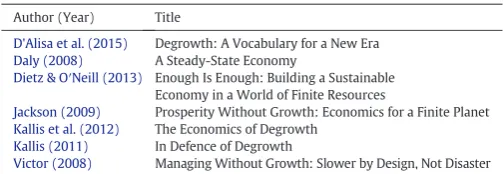
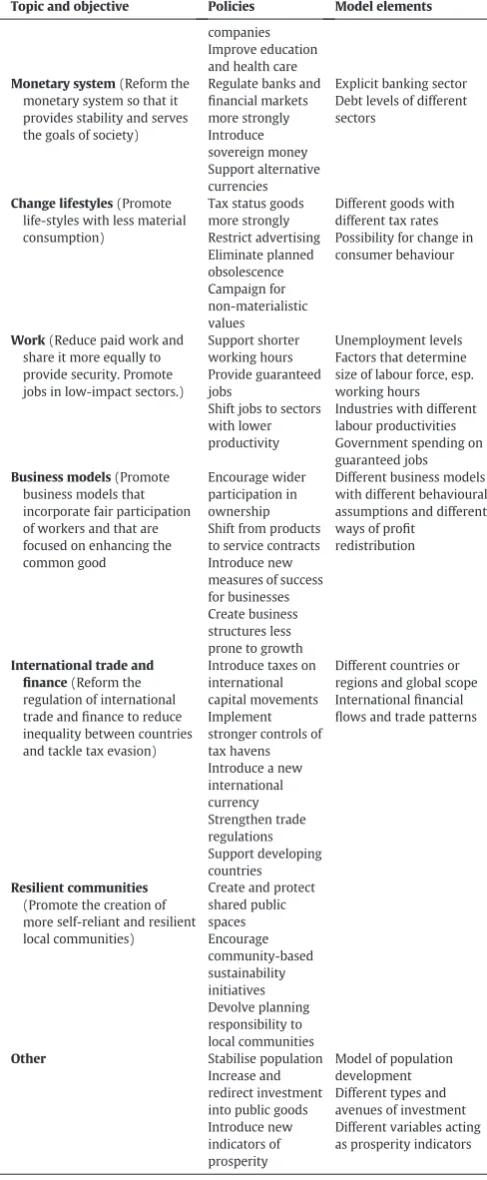
To identify important aspects of a post-growth economy, a survey of the policies proposed in the post-growth literature was conducted.“ Pol-icies”were taken to include all explicit policies that could be imple-mented top-down (e.g. sovereign money), as well as large-scale structural changes in the economy (e.g. a shift to different business models). Seven sources were chosen as the basis for the policy analysis (Table 1). As these sources include a range of well-known authors from the degrowth, steady-state economics, and new economics of prosper-ity literature, we believe they present a sufficiently comprehensive sam-ple of post-growth policies.
A list of all proposed policies was extracted from the seven sources. Subsequently policies were sorted into different topic areas, such as“ en-vironment”and“monetary system”. For each topic area the policies were consolidated by grouping similar policies under general headings, providing afinal list of policies for each topic. Thefinal list of policies was translated into model requirements by identifying the most impor-tant elements and processes that a macroeconomic model would have to contain to test the implementation of the policies. In the last step these model requirements were aggregated under common themes which were used to guide the further analysis of the models.
3.2. Analysis of Ecological Macroeconomic Models
3.2.1. Model Identification
In order to identify relevant macroeconomic models, contact details of researchers working in thefield of ecological macroeconomics were obtained both from the literature and from the organisers of the 11th In-ternational Conference of the European Society for Ecological Econom-ics (ESEE 2015), which hosted a number of workshops on ecological macroeconomics. The researchers were contacted via e-mail asking them for information on any macroeconomic models that they were working on as well as for recommendations of other researchers conducting relevant work. Any recommended researchers were similar-ly contacted via e-mail if their work was considered relevant based on prior publications.
[image:3.595.301.553.655.742.2]Relevant models were chosen based on the literature and the infor-mation obtained from the researchers. For consideration, macroeco-nomic models were required to (1) describe the total monetary economy in mathematical terms; (2) include different groups of agents or sectors, typically households,firms, and the government; and (3) ag-gregate the economy at the level of a nation-state or region. To avoid confusion the word“sector”will be employed in this study to describe different groups of actors, such asfirms or households, while the word “industries”will be used to refer to different parts of the production sys-tem, for example agriculture, mining, or retail. In afirst step, models were included that were explicitly mentioned in the ecological
Table 1
Sources used in the post-growth policy survey.
Author (Year) Title
D'Alisa et al. (2015) Degrowth: A Vocabulary for a New Era
Daly (2008) A Steady-State Economy
Dietz & O′Neill (2013) Enough Is Enough: Building a Sustainable Economy in a World of Finite Resources
Jackson (2009) Prosperity Without Growth: Economics for a Finite Planet
Kallis et al. (2012) The Economics of Degrowth
Kallis (2011) In Defence of Degrowth
macroeconomics literature or were presented at the ESEE 2015 confer-ence. In a second step, some additional models recommended by re-searchers were included if they were judged relevant by the authors.
It was decided to exclude all models that assume optimisation pro-cesses, either for the model as a whole or for the behaviour of agents. This means that none of the models reviewed provide an optimal solu-tion or development path that maximises a criterion of social welfare. The assumption of optimisation is identified byScrieciu et al. (2013) as one of the main differences between orthodox and heterodox macro-economic models. This exclusion does not necessarily imply that optimisation models do not have a role to play in ecological macroeco-nomics, but it is consistent with the trend of rejecting orthodox ap-proaches in the ecological macroeconomics literature. While the list of models identified in this study should not be considered as complete, the authors are confident that it captures the most important trends and ideas in thefield of ecological macroeconomics.
3.2.2. Model Analysis
For the majority of the models identified, descriptions were available in published journal articles or working papers. For the remaining models, conference presentations were used for the analysis. To allow for a comprehensive analysis of the modelling approaches, detailed in-formation was extracted from the literature for each model based on a list of questions. This list contained questions on general aspects of mac-roeconomic models, to allow an overall classification, and on the identi-fied post-growth policy themes, to analyse how these themes were addressed in the models. The answers to these questions for each model were recorded in a spreadsheet and subsequently coded to iden-tify commonalities and differences between different approaches.
It is worth saying that models are usually developed to answer spe-cific research questions, and thus a given model might not include cer-tain elements simply because it was not the objective of the particular research project to investigate them. The objective of this study was not to assess individual models for completeness, but to assess the over-allfield in terms of which elements of post-growth policies have been addressed in models and how.
To complement the literature-based analysis, semi-structured inter-views were conducted with researchers developing the models. Many of the models are in early stages of development and detailed published information was not available for all of them. The purpose of the inter-views was to gather additional information that could not be obtained from published sources—for example more detailed reasons why modellers chose specific approaches to represent certain policy themes. The purpose was not to provide an in-depth qualitative analysis on the subjective aspects of the modelling process, which was considered to be outside the scope of this study. Opinions voiced by the interview partic-ipants were taken at face value and have been used in quotes through-out the discussion of the results. These quotes illustrate personal opinions and raise important points for discussion, but should be interpreted with care.
Interview participants were recruited by endeavouring to contact at least one author associated with each of the models. Overall, 12 re-searchers agreed to participate in the interviews, eight of which were conducted via Skype, three in person, and one in writing. Interviews were recorded with the participant's permission and generally lasted between 30 and 90 minutes. Before each interview, participants were asked whether they would prefer to be explicitly acknowledged for their contribution to the study or whether they would prefer to be anonymised.
The questions put to the participants were divided into three parts. Thefirst part contained questions regarding the participant's general opinion on the scope of ecological macroeconomics and the purpose of macroeconomic modelling. The second part consisted of questions about the participant's reason for choosing specific modelling approaches as well as the perceived advantages and disadvantages of these ap-proaches. The third part aimed to obtain the participant's opinion on
some of the post-growth themes identified in the policy analysis. As time constraints would not have permitted the discussion of all policy themes with all participants, the third part of the interview was conduct-ed in a more exploratory fashion. It includconduct-ed the opportunity for partici-pants themselves to identify important model elements for representing a sustainable economy. Follow-up questions were chosen depending on topics that emerged during thefirst two parts of the interview.
To facilitate analysis, the interviews were transcribed from record-ings into a spreadsheet. For thefirst two parts of each interview the transcripts were analysed on a question-by-question basis. For each question the participant's answers were coded individually to identify the most important themes emerging from the responses. The themes obtained from all participants for a specific question were then com-pared to identify commonalities and differences. For the third part of the interviews, transcripts were coded according to the post-growth policy themes identified in thefirst step of the research (seeSection 3.1). The coding allowed the comparison of participant opinions and ideas on how each theme could be addressed in a macroeconomic model.
Results from the literature analysis and interviews were combined to produce (1) an overview of modelling approaches, based on a classi-fication according to modelling technique and economic theory, and (2) a summary for each policy theme, outlining how the theme was ad-dressed in different models.
4. Results and Discussion
This sectionfirst describes the post-growth policy themes identified in the literature (Section 4.1). This discussion is followed by a classifi ca-tion of the approaches used in ecological macroeconomic models (Section 4.2), and how the policy themes are addressed in the models (Section 4.3). Lastly, the overarchingfindings and limitations of this study are discussed (Section 4.4).
4.1. Policy Analysis
The post-growth literature sources revealed a large degree of agree-ment on the types of policies that are considered useful for a post-growth economy (seeAppendixfor a detailed list by topic). Eight im-portant policy themes were identified, which guided the subsequent analysis of the models (Table 2). Each of these themes captures a set of model elements needed to test one or more policies identified from the post-growth literature. Themes 1–3 mirror the challenges set out for macroeconomic models byJackson et al. (2014), namely the integra-tion of the environment, the ability to include income inequality, and a realistic representation of thefinancial system. These themes are complemented by themes 4–6, which are based on the need to capture structural changes in a post-growth economy. The themes include the need for disaggregated industries to represent changes in the composi-tion of goods produced and consumed, as well as the ability to represent changing work patterns and different business models. Themes 7 and 8 are more cross-cutting and are concerned with the dynamics between local, national, and global processes, and the need to include a broader range of well-being indicators.
4.2. Model Classification
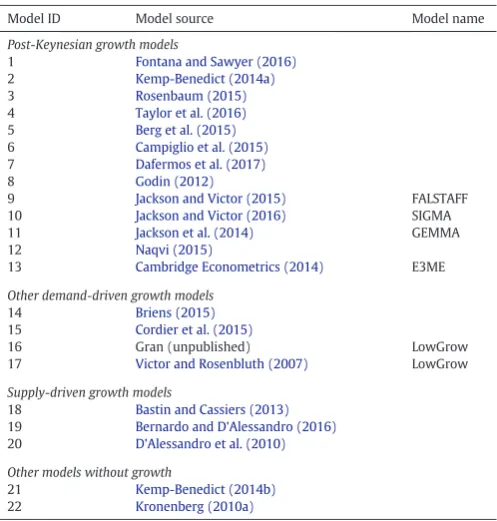
Altogether 22 models were identified (Table 3). In addition, 12 interviews were conducted with researchers working on the models (Table 4). An interestingfinding from these interviews is that all of the participants considered their work as constituting ecological macro-economics, even where this was not explicitly mentioned in the corresponding publication. Thisfinding suggests that the concept of ecological macroeconomics may have a wide appeal to researchers.
employ (Section 4.2.1) and the economic growth theory underlying them (Section 4.2.2).
4.2.1. Modelling Techniques
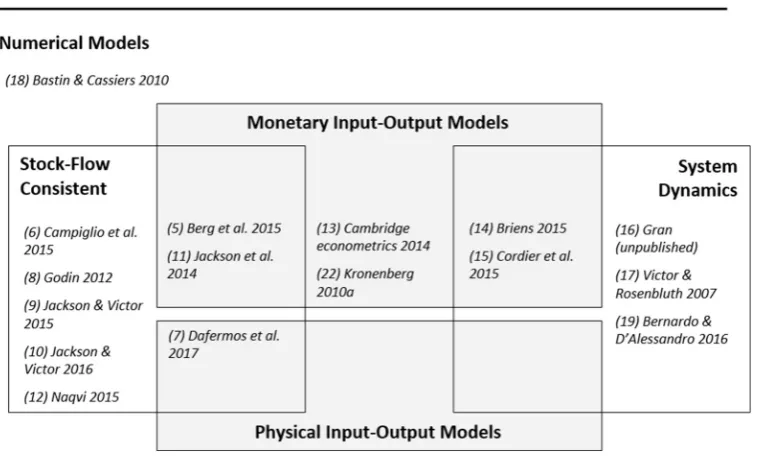
Two types of models (analytical and numerical) can immediately be distinguished (Fig. 1). Models were considered analytical if they contain few equations and can be solved using analytical methods (i.e. mathe-matical equations can be obtained that describe the relationship be-tween the development of the modelled economy and different parameters). In contrast, numerical models contain a larger number of equations and therefore rely on computer-based simulations to explore the model dynamics. This distinction is not entirely clear cut, however. For example, analytical models can be used for simulations (e.g. D'Alessandro et al., 2010) while simple stock-flow consistent models can be solved by analytical methods (e.g.Berg et al., 2015). The distinc-tion is still useful, though, as analytical and numerical models are gener-ally developed for different purposes. Analytical models abstract from the details to demonstrate fundamental relationships in the economy and use analytical methods, such as dynamic systems theory, to investi-gate general system properties. Numerical models are more detailed to allow for the analysis of specific scenarios or even predictions. There are four modelling techniques that are widely employed in the numerical models: monetary input-output analysis, physical input-output analy-sis, system dynamics, and stock-flow consistent modelling (Fig. 1).
Input-output analysis has been extensively used in ecological eco-nomics and can be conducted in a monetary or physical framework. At the heart of monetary output analysis (hereafter simply input-output analysis) lies a matrix describing the monetaryflows between different industries. This matrix can be used to investigate how changes infinal demand feedback through the economy to affect the total output of each industry. Environmentally-extended input-output analysis complements this analysis with satellite accounts specifying the envi-ronmental impacts per unit of monetary output in each industry. This extended analysis can, for example, be used for consumption-based car-bon accounting (e.g.Barrett et al., 2013; Davis and Caldeira, 2010). As input-output models are static, they are generally integrated with a dy-namic growth model in the models reviewed here. Physical input-out-put analysis, as employed byDafermos et al. (2017), relies on similar principles as monetary input-output analysis, but depicts physical stocks andflows (of resources and wastes) between industries instead of monetary ones.
System dynamics is a broader modelling approach that has been ap-plied in differentfields to study the behaviour of complex systems. It represents systems based on stock variables, indicating the system state, andflow variables, describing the changes in stocks (Elsawah et al., 2012). The magnitudes offlows are governed by mathematical equa-tions. Computer simulations can be used to follow the changes in stocks andflows over time. This approach was made particularly famous by the World3 model inThe Limits to Growthreport (Meadows et al., 1972). Stock-flow consistent modelling is a specific approach to macroeco-nomic modelling (Godley and Lavoie, 2012; Lavoie and Godley, 2001) that has proven popular in ecological macroeconomics (Fig. 1). It em-phasises the need for consistent accounting of all monetary stocks and flows as well asfinancial assets and liabilities. In short, there cannot be any“black holes”(Godley and Lavoie, 2012, p. 38). A balance sheet matrix describes the balance sheet of each aggregated sector while a transactionflow matrix captures all the monetaryflows between sec-tors. As demonstrated byJackson and Victor (2015, 2016)the stock-flow consistent approach to macroeconomic modelling lends itself well to an implementation in a system dynamics framework.
It is worth noting that input-output analysis and system dynamics are approaches that are not wedded to a specific theory of economic growth. In contrast, stock-flow consistent models generally rely on a post-Keynesian theory of growth.
4.2.2. Underlying Growth Theory
[image:5.595.34.550.77.173.2]The majority of models reviewed here, including most analytical and all stock-flow consistent models, rely on post-Keynesian theories of eco-nomic growth (Table 3). In post-Keynesian theory (Kemp-Benedict, 2014a; Lavoie, 2006; Taylor et al., 2016) aggregate demand is the main driver of economic growth. A key determinant of aggregate de-mand is investment, which is considered autonomous. Important as-sumptions in post-Keynesian theory are the constancy of the capital-output ratio and the practice offirms to keep a proportion of capacity unutilised to respond to demand changes. Investment is generally modelled as a function of capacity utilisation and the profit rate but
Table 2
Eight post-growth policy themes with a summary of the model elements needed to address these themes.
No. Theme Summary of required model elements
1 Integrating the environment Integration of the economy into the ecosystem and its interactions with environmental limits 2 Economic inequality Inclusion of different income groups with different tax levels
3 Monetary system Consistent modelling of the monetary system and debt levels 4 Disaggregated production
and consumption
Inclusion of (1) disaggregated industries to incorporate the production of different products with different environmental impacts, and (2) the ability to represent changes in consumer behaviour to allow for shifts in the consumption of these different products 5 Work patterns Representation of changing work patterns, especially fewer hours
6 Business models Inclusion of different business models with different behaviours
7 Cross-scale interactions Representation of interdependent dynamics at local, national, and regional scales 8 Indicators of well-being Consideration of various aspects of well-being
Table 3
List of models classified by underpinning economic growth theory.
Model ID Model source Model name
Post-Keynesian growth models
1 Fontana and Sawyer (2016)
2 Kemp-Benedict (2014a)
3 Rosenbaum (2015)
4 Taylor et al. (2016)
5 Berg et al. (2015)
6 Campiglio et al. (2015)
7 Dafermos et al. (2017)
8 Godin (2012)
9 Jackson and Victor (2015) FALSTAFF 10 Jackson and Victor (2016) SIGMA
11 Jackson et al. (2014) GEMMA
12 Naqvi (2015)
13 Cambridge Econometrics (2014) E3ME
Other demand-driven growth models 14 Briens (2015)
15 Cordier et al. (2015)
16 Gran (unpublished) LowGrow
17 Victor and Rosenbluth (2007) LowGrow
Supply-driven growth models
18 Bastin and Cassiers (2013)
19 Bernardo and D'Alessandro (2016)
20 D'Alessandro et al. (2010)
Other models without growth
21 Kemp-Benedict (2014b)
[image:5.595.36.285.483.744.2]this can be complemented by other factors, such as a parameter reflecting“animal spirits”(Fontana and Sawyer, 2016). By including ca-pacity utilisation in the investment function, the long-term path of cap-ital accumulation, and hence economic growth, is driven by aggregate demand. Through the inclusion of profits the path of the economy is also influenced by the income distribution, which is considered to be determined by institutional factors. Prices are generally modelled as mark-ups on costs. In contrast to the analytical post-Keynesian models, stock-flow consistent models feature not only income but also wealth. Households are considered to consume out of income and wealth and have to allocate their savings between differentfinancial assets. In addi-tion, the explicit inclusion of banks that provide loans to companies re-quires a behavioural function for the banking sector.
While the theory outlined in the previous paragraph is at the core of the models classified as post-Keynesian inTable 3, all of them include different additions to the basic framework. For example, the E3ME model is global in scope, and based on detailed econometric equations that include many variables.
The remaining models (i.e. those that are not post-Keynesian) cannot be assigned as clearly to a specific economic theory. The other demand-driven models feature some, but not all, aspects of post-Keynesian growth
theory in the sense that investment and aggregate demand are autono-mous and determine production (Briens, 2015; Cordier et al., 2015). The LowGrow model used byVictor and Rosenbluth (2007)and Gran (un-publishedfindings) is a special case as it is driven by the interplay be-tween supply (as determined by a production function) and demand (as determined from econometric equations).
In the supply-driven models listed inTable 3, growth is not driven by aggregate demand, and output is generally determined using a produc-tion funcproduc-tion. The growth path of the economy is then determined by the dynamics of the inputs into the production functions (generally cap-ital, labour, and energy). These are either given exogenously or deter-mined elsewhere in the model. Therefore the models do not rely on the assumption that optimisation and competitive markets lead to the full employment of resources. Lastly, the models byKemp-Benedict (2014b)andKronenberg (2010a)do not present growth models but static descriptions of the economy.
4.3. Comparing the Models against Policy Themes
[image:6.595.41.561.76.198.2]For most of the themes identified inTable 2there have been some attempts to incorporate relevant model elements. The ways in which
[image:6.595.117.496.500.729.2]Fig. 1.Categorisation of models by modelling technique. Numbers in parentheses indicate model IDs fromTable 3.
Table 4
List of researchers interviewed for this study.
Name Institution Model
Giovanni Bernardo University of Pisa Bernardo and D'Alessandro (2016)
François Briens Ecole des Mines Paristech Briens (2015)
Emanuele Campiglio London School of Economics and Political Science Campiglio et al. (2015)
Yannis Dafermos University of the West of England Dafermos et al. (2017)
Guilherme de Oliveira University of São Paulo de Oliveira and Lima (2015)(model later excluded) Christoph Gran Carl von Ossietzky University Gran (unpublished)
Ali Asjad Naqvi Vienna University of Economics and Business Naqvi (2015)
Hector Pollitt Cambridge Econometrics Cambridge Econometrics (2014)
Oliver Richters Carl von Ossietzky University Berg et al. (2015)
Eckehard Rosenbaum European Commission Joint Research Centre Rosenbaum (2015)
Malcolm Sawyer University of Leeds Fontana and Sawyer (2016)
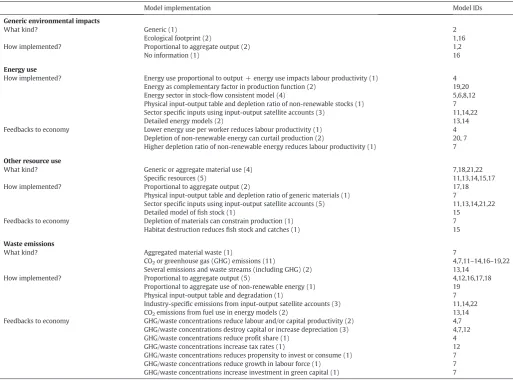
the different themes are addressed in the models are summarised in Table 5(theme 1) andTable 6(themes 2–8). Thefirst theme,“ integrat-ing the environment”, shows by far the largest diversity in terms of modelling approaches and elements (Table 5). The treatment of other themes in the models is more mixed (Table 6). Some models contain elaborate approaches for representing the monetary system and disag-gregated production and consumption. There are also at least some treatments of economic inequality, work patterns, and indicators of well-being. Alternative business models and cross-scale interactions, however, are rarely considered.
4.3.1. Integrating the Environment
The integration of environmental impacts received the most atten-tion in the models reviewed here, with only three of the models not considering environmental impacts. Overall, the models include a range of environment-economy interactions which can be categorised into generic environmental impacts, energy use, other resource use, and waste emissions (Table 5).
Most commonly, energy, resource, or wasteflows are included by setting them proportional to the total output of the economy given some intensity parameter. Input-output satellite accounts disaggregate this approach to the industry level and can therefore give a more de-tailed picture. The models based on input-output analysis were able to
provide the widest range and most detailed accounts of environmental impacts, including substances such as NOX, solid waste, and water.
Input-output models also performed particularly well because they have been used extensively to model economy-environment interac-tions, and therefore detailed datasets on several environmental impacts are available. The most serious limitation of environmentally-extended input-output analysis, as highlighted by several interview participants, is the fact that without modelling changes in the technical coefficients in the input-output tables, it can only be used to investigate short-term changes. There do exist methods to estimate changes in coeffi -cients, but they add another layer of complexity to the modelling pro-cess (cf.Barrett and Scott, 2012; Guan et al., 2008). Another important drawback of monetary input-output analysis is the assumption that the physicalflows of materials between industries are proportional to the monetaryflows.
The physical input-output approach dispenses with this assumption and directly models physicalflows between industries and is therefore potentially more comprehensive. The physical input-output framework ofDafermos et al. (2017)explicitly recognises thefirst and second laws of thermodynamics. As Yannis Dafermos put it during the interview:“In the stock-flow [consistent] models you cannot avoid an asset if you have the liability. There are no black holes, so our idea was that we need to be sure that there are no black holes when we investigate the ecosystem”.
Table 5
Overview of approaches used for integrating the environment (policy theme 1).
Model implementation Model IDs
Generic environmental impacts
What kind? Generic (1) 2
Ecological footprint (2) 1,16
How implemented? Proportional to aggregate output (2) 1,2
No information (1) 16
Energy use
How implemented? Energy use proportional to output + energy use impacts labour productivity (1) 4 Energy as complementary factor in production function (2) 19,20 Energy sector in stock-flow consistent model (4) 5,6,8,12 Physical input-output table and depletion ratio of non-renewable stocks (1) 7 Sector specific inputs using input-output satellite accounts (3) 11,14,22
Detailed energy models (2) 13,14
Feedbacks to economy Lower energy use per worker reduces labour productivity (1) 4 Depletion of non-renewable energy can curtail production (2) 20, 7 Higher depletion ratio of non-renewable energy reduces labour productivity (1) 7
Other resource use
What kind? Generic or aggregate material use (4) 7,18,21,22
Specific resources (5) 11,13,14,15,17
How implemented? Proportional to aggregate output (2) 17,18
Physical input-output table and depletion ratio of generic materials (1) 7
Sector specific inputs using input-output satellite accounts (5) 11,13,14,21,22
Detailed model offish stock (1) 15
Feedbacks to economy Depletion of materials can constrain production (1) 7 Habitat destruction reducesfish stock and catches (1) 15
Waste emissions
What kind? Aggregated material waste (1) 7
CO2or greenhouse gas (GHG) emissions (11) 4,7,11–14,16–19,22 Several emissions and waste streams (including GHG) (2) 13,14
How implemented? Proportional to aggregate output (5) 4,12,16,17,18
Proportional to aggregate use of non-renewable energy (1) 19 Physical input-output table and degradation (1) 7 Industry-specific emissions from input-output satellite accounts (3) 11,14,22 CO2emissions from fuel use in energy models (2) 13,14 Feedbacks to economy GHG/waste concentrations reduce labour and/or capital productivity (2) 4,7
GHG/waste concentrations destroy capital or increase depreciation (3) 4,7,12 GHG/waste concentrations reduce profit share (1) 4 GHG/waste concentrations increase tax rates (1) 12 GHG/waste concentrations reduces propensity to invest or consume (1) 7 GHG/waste concentrations reduce growth in labour force (1) 7 GHG/waste concentrations increase investment in green capital (1) 7
However, so far this framework is still at an early stage of development and uses a strongly simplified version of the physical input-output framework that considers only CO2emissions and aggregatedflows
(e.g. material waste, and renewable versus non-renewable energy). Two important challenges to integrating the environment into the models were identified in the analysis. Thefirst relates to the possibility of producing a comprehensive description of environmental impact that is still simple enough to model. The usefulness of aggregated physical flows, which are relatively simple to model, was questioned by some in-terview participants given that ecological consequences are often coupled to specific substances. Although this concern is certainly valid, O'Neill (2015b)argues that the use of aggregate physical indicators has an important role to play in the description of a steady-state economy—a concept based on stabilising the quantity of resource use (rather than altering its quality).
The second challenge relates to the incorporation of feedback chan-nels through which environmental changes caused by economic activi-ties (e.g. high atmospheric CO2concentrations or depletion of fossil
fuels stocks), can feed back to affect economic performance in the models. Such feedback channels are incorporated in very few models (Table 5). One potential channel is resource depletion, which has been implemented by restricting production in the case of shortages (e.g. D'Alessandro et al., 2010; Dafermos et al., 2017). In his interview, Oliver Richters stressed the need to develop economic models that can consis-tently model the interplay between supply constraints and demand-driven dynamics. He called attention to the fact that it may be difficult to solve integrated models analytically.
Another feedback channel is the macroeconomic effect of environ-mental damage from waste emissions, especially greenhouse gases. While damage functions are a common feature in many orthodox econ-omy-environment models, these functions are not as easily implement-ed in demand-driven models (Taylor et al., 2016). In the three models that include damage feedbacks (Dafermos et al., 2017; Naqvi, 2015; Taylor et al., 2016) higher concentrations of greenhouse gases lead to lower labour productivity and the destruction of capital. While damage functions are an important conceptual approach, the complex nature of environmental feedbacks makes it very challenging to parameterise
such functions. As Yannis Dafermos put it in the interview,“So you need to incorporate [damage functions] in order to show the feedback effects of the ecosystem on the macroeconomy, but at the same time it's not so easy to make good assumptions”.
However, from a post-growth perspective the inclusion of environ-mental feedback channels in the models might not be so important, as the main aim of such modelling is often the demonstration of a viable economic system that stays within important environmental bound-aries, which are determined exogenously. The inclusion of feedback channels only becomes important if the aim is to investigate economic impacts caused by crossing environmental boundaries.
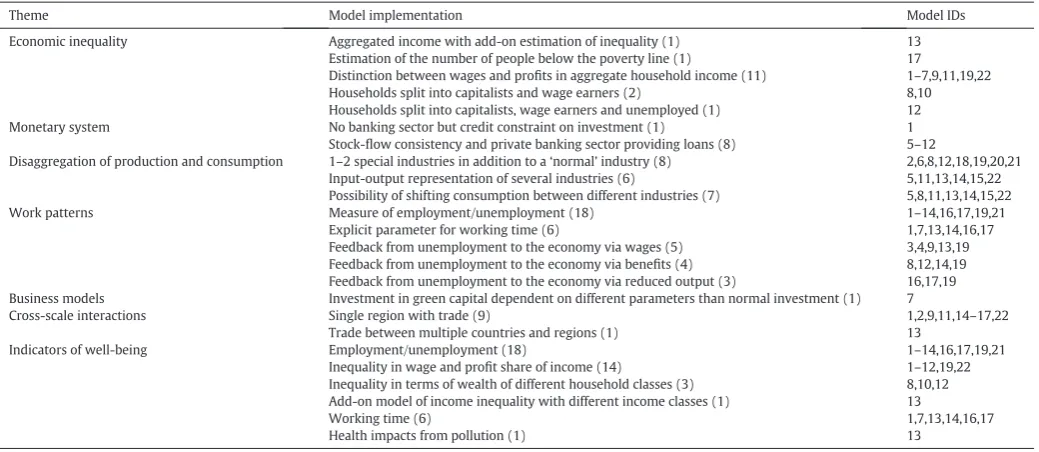
4.3.2. Economic Inequality
[image:8.595.44.564.76.302.2]The detail with which inequality was incorporated in the models var-ied between studies (Table 6). Almost a third of the models treat income as a single aggregatedflow and can therefore not account for any inequal-ities in income and wealth. The E3ME model is a partial exception as it features an add-on module that gives an estimate of the income distribu-tion derived from the total income. The LowGrow model byVictor and Rosenbluth (2007)is another partial exception as it estimates the number of people below the poverty line. However, these estimations do not feed back into the model. A common feature in the remaining models is the consideration of functional inequality between wage and profit income. This treatment is most advanced in some of the stock-flow consistent models that include separate households for capitalists and wage earners (Godin, 2012; Jackson and Victor, 2016) or an additional household for unemployed people (Naqvi, 2015). None of the models reviewed feature a description of personal income distribution using different income groups, as can be found in some more orthodox models (e.g.Kratena and Sommer, 2014). However,Dafermos and Papatheodorou (2015) demonstrate that it is possible to integrate both functional and personal income distributions into a stock-flow consistent model. In the interviews participants were very aware of this simplistic representation of ity but highlighted the large challenges associated with including inequal-ity in macroeconomic models, mostly regarding the lack of knowledge about the causes of inequality. Two interview participants suggested
Table 6
Overview of the approaches used in the models to address policy themes 2–8.
Theme Model implementation Model IDs
Economic inequality Aggregated income with add-on estimation of inequality (1) 13 Estimation of the number of people below the poverty line (1) 17
Distinction between wages and profits in aggregate household income (11) 1–7,9,11,19,22 Households split into capitalists and wage earners (2) 8,10 Households split into capitalists, wage earners and unemployed (1) 12 Monetary system No banking sector but credit constraint on investment (1) 1
Stock-flow consistency and private banking sector providing loans (8) 5–12
Disaggregation of production and consumption 1–2 special industries in addition to a‘normal’industry (8) 2,6,8,12,18,19,20,21 Input-output representation of several industries (6) 5,11,13,14,15,22 Possibility of shifting consumption between different industries (7) 5,8,11,13,14,15,22 Work patterns Measure of employment/unemployment (18) 1–14,16,17,19,21
Explicit parameter for working time (6) 1,7,13,14,16,17 Feedback from unemployment to the economy via wages (5) 3,4,9,13,19 Feedback from unemployment to the economy via benefits (4) 8,12,14,19 Feedback from unemployment to the economy via reduced output (3) 16,17,19 Business models Investment in green capital dependent on different parameters than normal investment (1) 7
Cross-scale interactions Single region with trade (9) 1,2,9,11,14–17,22 Trade between multiple countries and regions (1) 13
Indicators of well-being Employment/unemployment (18) 1–14,16,17,19,21 Inequality in wage and profit share of income (14) 1–12,19,22 Inequality in terms of wealth of different household classes (3) 8,10,12 Add-on model of income inequality with different income classes (1) 13
Working time (6) 1,7,13,14,16,17
Health impacts from pollution (1) 13
that issues of inequality are best investigated using microeconomic models. As François Briens put it:
“It's very hard on the macroscale to say: Alright, if I increase the wage how would poverty evolve? You may have households with no job in-come who would not be directly affected, others with a job who would, etc. Since people can be found in so many different kinds of life situa-tions, it's hard to have an idea about how macro changes would impact them in terms of poverty or inequality.”
That said, the challenge of modelling the different policies proposed in the post-growth literature varies. For example, a minimum income and job guarantee have actually been implemented in models by Briens (2015)andGodin (2012), respectively. More difficult, however, would be to include the effects of a maximum income or maximum pay differentials as these would impact factors such as wages andfirm behaviour. Overall, there is a need for more empirical research into the processes through which income and wealth inequality affect mac-roeconomic outcomes.
4.3.3. Monetary System
The representation of the monetary system is one of the eight themes identified where considerable progress has been achieved to date. This progress is almost entirely due to the use of stock-flow consis-tent models, which are the only class of models reviewed here that in-clude an explicit representation of the banking andfinancial system. The next-closest approach isFontana and Sawyer (2016), who include a parameter for credit constraints in their analytical model. However, the topic is considered to be of great importance. Of the six interview participants working on models without a representation of thefi nan-cial sector, all but one mentioned the missing representation of thefi -nancial sector when asked for weaknesses of their models.
All stock-flow consistent models include a banking sector that pro-videsfirms with the loans needed tofinance investment. Beyond that, however, the models vary with regard to the level of detail with which thefinancial system is represented. While banks provide loans as demanded in some studies (e.g.Godin, 2012; Jackson and Victor, 2015), they exert some kind credit constraint in others (e.g.Dafermos et al., 2017). Most models feature only a limited number of assets held by households (e.g. deposits and bonds). Some, like FALSTAFF, include a wider range of assets, such as equities and loans.
Possibly with the exception of FALSTAFF, the models used here still present relatively simple representations of thefinancial system com-pared to, for example, more advanced models presented byGodley and Lavoie (2012). Current representations are relatively simple be-cause most of the models have so far focused on demonstrating the fea-sibility of integrating ecological concerns into stock-flow consistent models. However, even though model development is still at an early stage, the models have been used for important contributions to the wider debate about how the monetary system has to be reformed. For example,Jackson and Victor (2015) demonstrate that debt-based money and positive interest rates might not inherently lead to a growth imperative, as has been proposed by some ecological economists (Farley et al., 2013; Lawn, 2010).
4.3.4. Disaggregation of Production and Consumption
Next to its reduction, a shift in consumption to products with lower environmental impacts plays an important role in the post-growth liter-ature (Table 2). To represent such a shift in macroeconomic models, the production of outputfirstly needs to be disaggregated into different product or industry categories with different environmental intensities. Secondly, the models need to be able to incorporate changes in house-hold decisions regarding the allocation of consumption.
Of the models reviewed here, the input-output models can best rep-resent the disaggregation of production industries as they can include a large number of distinct industries, the relations among these
industries, as well as the environmental impacts associated which each industry. For these reasons, François Briens considers input-output models to be indispensable for investigating post-growth scenarios on a macroeconomic level, stating that“when you have different [indus-tries], you have to use input-output”. The models that are not based on input-output analysis either represent production in a single aggre-gated“normal”industry, producing one product for consumption, or by including one or two industries in addition to the“normal”one. Ex-amples of the latter are the energy industries in some of the stock-flow consistent models (e.g.Campiglio et al., 2015; Godin, 2012) or the use of separate capital stocks in some of the analytical models (e.g.Bastin and Cassiers, 2013; Kemp-Benedict, 2014a). However, these additional in-dustries only produce intermediate outputs, so that consumption is still aggregated to a single product. The only exception is Godin (2012)where households consume output from the“normal”and the energy industry.
It is therefore only the input-output models andGodin (2012)that could represent shifts in household consumption; only in these models can households actually choose between different products. This choice requires some description of how households allocate their consump-tion and how this allocaconsump-tion might change in a post-growth context. Briens (2015)exogenously imposes consumption pathways obtained from interviews. However, many policies proposed for post-growth rely on taxation to achieve changes in consumption. Testing these poli-cies requires an endogenous representation of how consumption changes in response to changes in prices. The E3ME model andGodin (2012)implement an endogenous representation using elasticities esti-mated from past data. However, Hector Pollitt highlighted that these es-timates are based on the assumption of marginal changes and can therefore not consider non-linear responses. The approach may there-fore be questionable given the large-scale behavioural changes envisioned in the post-growth literature.
4.3.5. Work Patterns
A measure of employment is included in most of the models (Table 6). In demand-driven models this measure is usually calculated as the number of workers needed to produce the demanded quantities, given a constant or increasing labour productivity. Only six models in-clude an explicit parameter for working time. By dividing the required work among more people, a lowering of this parameter generally de-creases unemployment. However, in reality the impacts of working time reduction policies are much more complex due to interactions be-tween working time and other factors such as labour productivity and wages (Kallis et al., 2013; Zwickl et al., 2016). This complexity was recognised by interview participants, but it was felt that a more realistic integration of working time reduction was hindered by a lack of knowl-edge of the feedbacks through which working time reduction impacts the economy. According to Ali Asjad Naqvi,“People who can do models can definitely come up with a model, but I do think there is a lot more empirical stuff that needs to be done”.
While current models do not include any direct effects from changes in working time except for increased employment, several models fea-ture feedbacks from employment levels back into the economy. In these models any increase in employment from working time reduction would therefore have knock-on effects. Most commonly, higher em-ployment leads to increases in wages due to advantages for employees in wage bargaining (e.g.Bernardo and D'Alessandro, 2016; Rosenbaum, 2015). In other models, reduced unemployment affects government spending on unemployment benefits (e.g.Godin, 2012; Naqvi, 2015). In models based on production functions, higher employment leads di-rectly to higher output (e.g.Victor and Rosenbluth, 2007).
4.3.6. Business Models
generally imagined that a shift to different business models will alter business behaviour. In the models reviewed here, all businesses rely on the same functional equations. The only small exception is the treat-ment byDafermos et al. (2017). Although their model features produc-tionfirms as a single aggregated industry, this industry employs two different types of capital: conventional and green. Investment in each of the two capital stocks partially depends on different parameters (e.g. green investment is stimulated if environmental quality worsens). The stock-flow consistent framework offers someflexibility to include different forms of enterprise by changing the behavioural functions. However, several interviewees considered that there is a lack of knowledge of how businesses behave, not only with regard to alternative business models under post-growth but also with regard to the current system. As Malcolm Sawyer described it:
“In a post-Keynesian framework there are in effect various postulates that have been put forward about how corporations and people behave and what influences their decisions and so forth. I don't feel, as a whole, we know enough about that and how that then impacts the macroeconomy and in reverse, how the macroeconomy impacts on their behaviour.”
4.3.7. Cross-Scale Interactions
The proposed policies for post-growth include important changes at the global as well as the local level. The majority of models reviewed here only represent a single region or country, although some do in-clude imports and exports from that region. Only the E3ME model is truly global in scope, incorporating several regions and countries. Changes in global trade patterns could therefore be explored in this model, but better information would be needed on how trade patterns would change in a post-growth scenario. However, changes to the glob-alfinancial system, such as a new international currency, could not be represented as the model does not include an explicit representation of thefinancial system. This would require a global stock-flow consis-tent model. Hector Pollitt considered it generally possible to construct such a model but stressed the considerable challenges arising from the lack of data on internationalfinancialflows.
Due to their focus on the national scale, greater localisation of the economy is similarly difficult to introduce in macroeconomic models. Two interviewees suggested that localisation could be represented by a reduction in imports and less activity in the transport industry. How-ever, both stressed an important caveat to this approach, namely that models cannot judge whether a reduction in transport and imports would be realistic given the distribution of resources and skills. There is a need to better understand how the creation of more resilient and self-reliant local communities would impact the macroeconomy.
4.3.8. Indicators of Well-Being
There was general agreement among interview participants that macroeconomic models cannot represent well-being as a single indica-tor; they can give indications on some objective aspects of well-being, but not on subjective ones. Aspects mentioned most frequently as pos-sible to include were inequality and unemployment—but also health, education, and access to minimum physical needs. Overall, the role of macroeconomic models was seen as describing the general conditions under which well-being is pursued, while the adequacy of these condi-tions was seen as a political question. In the words of François Briens, “Well-being would be the discussion around the model, like, we know that if we produce this or that we would have this kind of impact. Do we think we could have a healthy society and all be feeling well with this kind of impact?”.
As discussed in the preceding sections, the models reviewed here in-clude at least some indicators of employment, inequality, and working time. However, indicators of health and education are rarely considered. The only model that includes a direct indicator of health is the E3ME
model, which features an add-on module that estimates the health im-pacts produced by various air pollutants.
4.4. Overarching Findings and Limitations
4.4.1. Promising Developments
As shown in this study, the models employed in ecological macro-economics have started to incorporate important elements identified in the post-growth literature. Moreover, the post-Keynesian approach to macroeconomics has proven amenable to combination with different modelling techniques, although there remain challenges, such as in-cluding environmental supply constraints in demand-driven models. But overall, thefindings of this study support the view that combining post-Keynesian and ecological economics is a promising area for further research (Kronenberg, 2010b; Rezai et al., 2013; Spash and Schandl, 2009).
Interestingly, many of the numerical modelling approaches show complementary strengths and weaknesses. While the studies employing input-output approaches score highly on their ability to rep-resent shifts in consumption-based environmental impacts, they gener-ally do not include representations of thefinancial system or inequality. In contrast, the stock-flow consistent models feature more developed representations of thefinancial system and some representation of in-equality, but less comprehensive treatment of the environment. These findings further confirm the claims byBerg et al. (2015)andJackson et al. (2014)that the combination of the two approaches (input-output and stock-flow consistent models) presents a promising avenue for modelling post-growth scenarios. However, Peter Victor highlighted that the integration of different approaches may come at the cost of their respective strengths:
“The input-output stuff is great, except its main strength is short-term impact analysis. It gets complicated when you want to somehow think about the coefficients changing over time. System dynamics is terrific for change over time, but it doesn't easily have the detail in it that you have in an input-output model. So we found a way of combining the two, but you stillfind it much easier to use a highly aggregated version of an input-output model instead of the very disaggregated ones that are now available.”
Nevertheless, for developing this avenue researchers can draw on literatures that already exist for input-output analysis (e.g.Lenzen et al., 2010; Minx et al., 2009) and stock-flow consistent modelling (e.g. Godley and Lavoie, 2012; Lavoie and Godley, 2001). Beyond these liter-atures, system dynamics has also proven to be useful for including addi-tional aspects in macroeconomic models, like thefish-stock model by Cordier et al. (2015). It can also be used to represent macroeconomic processes in new ways, as demonstrated by the Lotka-Volterra model for unemployment byBernardo and D'Alessandro (2016).
Similar to the numerical models, the analytical models have also started to address many of the post-growth policy themes. Environ-mental impacts and feedbacks, as well as aspects of economic inequali-ty, are addressed in most of the analytical models, but other aspects are also represented, such as the functioning of the monetary system (Fontana and Sawyer, 2016) or the dynamics of“green”sectors in the economy (Kemp-Benedict, 2014a). In contrast to most of the numerical models, the emphasis of the analytical models is less on specific sectors and policies and more on the fundamental dynamics that shape eco-nomic development and its relationship to the environment. Under-standing these fundamental dynamics (e.g. the process of capital accumulation or the impact of changing profit rates) is crucial for under-standing how to transition to a post-growth economy.
4.4.2. Challenges of Modelling a Post-Growth Economy
challenge of addressing post-growth policy themes in models is two-fold. Firstly, there is a need to improve our understanding of the pro-cesses through which specific policies affect the economy (e.g. how stronger workplace democracy affects firm behaviour). Secondly, these often complex dynamics then need to be simplified and integrat-ed in a meaningful way into an aggregatintegrat-ed model.
There are also open questions about how far some important aspects of a post-growth economy lend themselves to meaningful modelling at an aggregate level. For example, some interview participants voiced the opinion that distributional effects and poverty are best investigated using microeconomic approaches (and thus did not include them in their models). Other researchers, however, consider inequality to be an important feature of macroeconomic modelling for post-growth (e.g.Jackson et al., 2014).
Moreover, even with largely improved empirical knowledge, models are always simplifications of reality. The majority of models reviewed here use parameters estimated from past data. An important limitation is therefore the assumption that these parameters will be valid in the fu-ture. While this assumption applies to most models used in scientific re-search, it might be especially problematic in a post-growth context as the purpose of the model is to describe and test a very different system. Before modelling a post-growth scenario, it is therefore important to consider which parameters are likely to change, and which are likely to stay the same. The models presented here also do not incorporate in-built judgements about which scenarios might be desirable or not (they are not optimisation models). However, they are very useful tools for exploring the trade-offs that will have to be made in any tran-sition to a post-growth economy. It is our belief that the decision about these trade-offs should be made in a political decision-making process, rather than in a modelling framework.
In a more general sense the formalisation of elements and relation-ships within models, while very useful, also has important drawbacks in that the assumptions taken in the model strongly inform how prob-lems are framed and what solutions are considered possible. The under-lying assumptions and frameworks of these models should therefore be continuously re-examined and questioned to ensure that we do not fall victim to what Alfred North Whitehead referred to as the“fallacy of misplaced concreteness” —the error of treating an abstraction as if it were reality (Daly and Cobb, 1994, p. 25).
4.4.3. Defining Ecological Macroeconomics
As was discussed inSection 2, not all work in ecological macroeco-nomics shares the post-growth vision or would accept the need for the full range of policies presented inTable 2. For this reason, examining the different approaches applied in ecological macroeconomic models raises some very interesting questions about how the scope of ecologi-cal macroeconomics should be defined. For example, many of the con-tributions to ecological macroeconomics focus more on integrating the ecological dependency of the economy into existing macroeconomic frameworks, and less on redefining the scope and goals of the macroeconomy (e.g.Harris, 2010; Kemp-Benedict, 2014b; Rezai et al., 2013). For these authors, aspects such as non-monetary components of well-being might well be considered outside the scope of ecological macroeconomics. In contrast, authors such asJackson et al. (2014), who could be considered contributors to both the post-growth and eco-logical macroeconomics literature, define the scope of ecological macro-economics in a wider sense. They state that“there is a need to develop a fully consistent ecological macroeconomics in which it is possible to maintainfinancial stability, ensure high levels of employment, improve the distribution of income and wealth and yet remain within the ecolog-ical constraints and resource limits of afinite planet”(p. 6). The vision of ecological macroeconomics set out byRøpke (2013, 2016)is similarly broad and includes a wide range of topics and systems that fall under its scope.
While many conventional macroeconomic models can at least claim to represent all the important aspects of“the economy” on some
aggregated level, it is questionable whether this will ever be possible for a post-growth ecological macroeconomics, where“the economy”is conceptualised in a much broader way. The definition of a macroeco-nomic model employed in this study only incorporatesmonetary as-pects of the economy. This definition excludes many changes discussed by post-growth authors (particularly advocates of degrowth), such as the increasing importance of non-monetary economic relations, qualitative aspects of well-being, and fundamental changes in ways of living together (Kallis et al., 2015; Martínez-Alier et al., 2010).
This does not mean that it is impossible to develop ecological macro-economic models that combine many important aspects, but it is likely that ecological macroeconomics will have to include different models for different purposes. There is a need to define more clearly the ques-tions that ecological macroeconomics tries to answer, and then explore these with specific models.
While the challenges to developing comprehensive macroeconomic models could be interpreted as a need for a clearer definition of ecolog-ical macroeconomics, we believe it would be more fruitful to accept the plural nature of ecological macroeconomics and the models used within it. The systems that ecological macroeconomists are trying to under-stand are highly complex, and ecological macroeconomics could be ad-vanced by using a plurality of modelling approaches. Additional approaches could, for example, include agent-based models (Scrieciu et al., 2013), ecological econophysics approaches (Pueyo, 2014), or models from evolutionary and complexity economics (Foxon et al., 2013; Foxon, 2011).
4.4.4. Limitations of this Study
Thefindings of this study should be considered in the light of its lim-itations. Firstly, optimisation models, representing the majority of mac-roeconomic models in use, were excluded. Thus this study does not provide a comprehensive assessment of models that could be used to investigate a post-growth economy.Pollitt et al. (2010)andScrieciu et al. (2013)review a larger group of macroeconomic models in the con-text of sustainability, but they do not specifically investigate how these models could be used to explore post-growth scenarios. An as-sessment of the ability of optimisation models to explore post-growth scenarios could be a useful complement to this study, bearing in mind that there are questions about whether the assumptions of optimisation models are compatible with the tenets of ecological economics (Spash and Schandl, 2009).
Secondly, the categorisation of post-growth policies into eight high-level themes, against which the models were evaluated, was a subjec-tive process. The result is that some aspects of post-growth policies have not been explored in this study, such as population growth, or dif-ferent investment pathways. In addition, some important aspects of macroeconomic modelling, such as technical progress or differences be-tween developing and developed economies, received little attention because they did not feature prominently in the post-growth literature.
5. Conclusion
This study aimed to address two important research questions: (1) What kind of macroeconomic models are currently being developed under the banner of ecological macroeconomics? (2) What is the capac-ity of such models to explore and assess policies proposed for a post-growth economy?