R E S E A R C H A R T I C L E
Open Access
Double conditional human embryonic kidney cell
line based on FLP and
F
C31 mediated transgene
integration
Christoph Waldner
*, Olga Rempel, Fabian Schütte, Mert Yanik, Natalie Solomentsew and Gerhart U Ryffel
Abstract
Background:FLP recombinase mediated integration into a pre-integrated FRT site is routinely used to generate highly reproducible stable transgenic cell lines. In this study, we broaden the system of site specific integration by introducingFC31 integrase mediated integration into attP sites.
Results:We generated a HEK293 host cell line with a single copy FRT as well as an attP site allowing site specific integration of two distinct transgenes. To achieve conditional control, we used the tetracycline and Shld1 inducible systems. By introducing fluorescent reporters we show that integration and induction of two transgenes are completely independent. We applied this new technique to investigate the effect of HNF4aon proliferation of HEK293 cells by introducing HNF4a into each integration site. We obtained in two independent cell lines highly reproducible results that prove the usefulness of this novel HEK-attP/FRT cell line.
Conclusions:In this study we have established and applied a HEK-attP/FRT cell line that allows site specific integration of two conditional transgenes using the FLP recombinase as well as theFC31 integrase.
Background
Stable integration of inducible transgenes is widely used to analyze gene function in mammalian cells. To obtain highly reproducible results from different cell lines, site specific integration of one single transgene copy is essen-tial. Integration into a pre-determined genomic locus can be achieved by FLP recombinase mediated integration [1] and the tetracycline inducible expression system [2] is most commonly used for conditional transgene activation. The Flp-In T-REx™system (Invitrogen) uses a genomic FRT site for integration of any gene-of-interest (GOI) by FLP recombinase and is based on the Tet-repressor (TetR) that inhibits via two tetracycline operator (tetO) sequences the CMV promoter of the GOI. This system has success-fully been used to investigate factors that control cell pro-liferation [3,4] and to reproducibly identify target genes of transcription factors [5]. Recently, this system was further improved by reducing the background expression of the GOI, when no inducer is added [6].
For many experiments the independent conditional expression of two distinct transgenes would be most desirable. Thus, an additional and independent condi-tional system is required. Recently, another inducible sys-tem was developed that allows conditional protein degradation [7]. The human FK506- and rapamycin-binding protein (FKBP12) is rapidly and constitutively degraded in mammalian cells. Protein fusion of its desta-bilizing domain (DD) transfers the instability to any pro-tein-of-interest. Addition of the synthetic ligand Shld1 that binds to the destabilizing domain protects the fusion protein from rapid degradation and thus enhances abun-dance of the protein-of-interest.
An enzyme that acts completely independent of FLP and catalyses specific integration at high efficiency is the
serine integrase derived from the phage FC31. This
FC31 integrase mediates site-specific recombination
between two DNA sequences, the phage attachment site, attP, and the bacterial attachment site, attB [8]. Impor-tantly, recombining the attP and attB sites generates two hybrid sites, attL and attR, which cannot be recognized by the integrase and thus in contrast to the FLP recombi-nase, the reaction is unidirectional and much more
* Correspondence: [email protected]
Institut für Zellbiologie (Tumorforschung), Universität Duisburg-Essen, Hufelandstr. 55, D-45122 Essen, Germany
efficient. In several mammalian cell lines it has been shown that a plasmid containing the attB sequences inte-grates with different efficiency into pseudo attP sites of the genomic DNA [9]. There are about 100 distinct inte-grations sites that show different frequency of integration [10]. Sequencing of these pseudo attP sites after integra-tion showed that these recombinaintegra-tions were not comple-tely precise at the sequence level, differing slightly at the integration junction. In contrast the integration into wild-type attP sites inserted into the mammalian genome was invariable precise resulting in the expected recombi-nation event at the sequence level. This property is most valuable to design strategies to define attP site specific integrations. Comparing in the human cell line HEK293 the integration frequency between the pseudo attP sites and a wild-type attP site, about 15% of the integrations occurred at the introduced wild-type attP site. In con-trast, the most frequent pseudo attP site (phiA) was used at 5% suggesting the wild-type attP site is preferred [9]. To prevent unwanted integration at pseudo attP sites a selection is needed for specific integration at a pre-exist-ing attP dockpre-exist-ing site uspre-exist-ing correspondpre-exist-ing markers. This can best be achieved by activation of an antibiotic resis-tance gene upon proper recombination [9]. Significantly, the fusion of a nuclear localization signal (NLS) to the FC31 integrase has shown an eightfold increase in the integrase activity [11] suggesting that this is an important modification to get optimal activity in vertebrate cells.
In this study, we combine the Shld1 inducible system withFC31 integrase mediated specific integration in the background of the tetracycline inducible FLP mediated system to have two completely independent ways of transgene activation in one and the same cell. We apply this technique to introduce the cell specific transcription
factor HNF4a into a human embryonic kidney
(HEK293) cell line and investigate its effect on cell proliferation.
Results
Design of the integration systems
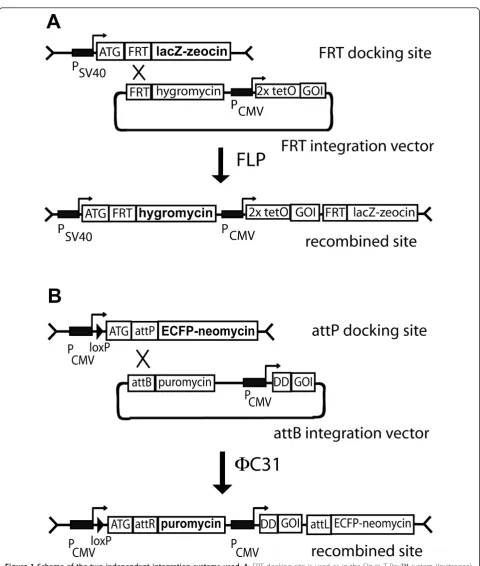
To allow site specific integration of two different trans-genes we used two independent systems. The first is based on FLP recombinase mediated recombination of FRT sites (Figure 1A). By using hygromycin resistance, recombined cell lines can be selected. Moreover, loss of lacZ reporter activity monitors specific recombination with the FRT integration vector. Conditional transcriptional control of the transgene is achieved by applying the tetracycline inducible system. This system is well established and com-mercially available (Flp-In T-Rex™, Invitrogen). As a
sec-ond and independent system we developed FC31
integrase mediated recombination of attP and attB sites (Figure 1B). To allow site directed integration of any gene-of-interest (GOI) using theFC31 integrase, we designed
the docking construct pDOCKING-Neo containing the attP recognition site. This site is linked in frame to an ECFP-neomycin resistance fusion protein as selection marker. As the attP site is placed downstream of the start codon for ECFP-Neo, this marker will be inactivated upon specific recombination with the corresponding attB sequence. The incoming attB integration vector contains the attB site fused to a promoter- and ATG-less puromy-cin resistance gene, which is thus activated upon specific recombination with the attP sequence of the docking site. The GOI is placed downstream of the puromycin resis-tance sequence. In all experiments we used the CMV pro-moter and fused the GOI to the L106P mutant of the human FKBP12 protein (destabilizing domain, DD) to reg-ulate the expression on the level of protein stability by Shld1 [7].
Generation of double docking HEK293 cell lines
The commercially available Flp-In T-Rex™ HEK293
cells contain a stably integrated single copy FRT docking site for FLP mediated integration. Using this cell line we
introduced in addition for FC31 mediated transgene
integration the newly generated attP docking site that encodes an ECFP-Neo fusion gene. After selection with G418 we selected 24 single clones with blue fluores-cence. To determine the number of integrated transgene copies we performed real-time PCR on genomic DNA and selected the three double docking cell lines 12, 16, and 19 with apparent single copy integration of the docking site for further experiments.
Independent integration of inducible fluorescent proteins into different double docking HEK293 cell lines
To test whether independent integration as well as inde-pendent conditional activation of two different GOI can be achieved in the double docking cell lines we generated two different integration vectors. The FRT integration vec-tor pcDNA5/FRT/TO-DsRed contains the red fluorescent protein DsRed as GOI (Figure 1A), whereas the attP inte-gration vector pINT-PuroDDEYFP contains as GOI the yellow fluorescent protein EYFP linked to the destabilizing domain (DD in Figure 1B). In a first round of transfection, the DsRed gene was introduced using the FLP recombi-nase. The obtained cell lines from each clone were used for a second round of transfection using the EYFP con-taining attP integration vector and theFC31 integrase. The resulting cell lines were resistant to hygromycin and puromycin and have thus potentially integrated the two transgenes.
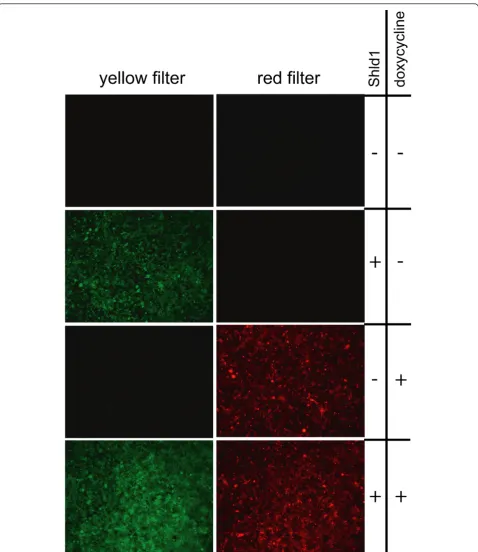
To test whether the two transgenes were present and conditionally active, we treated all cell lines with doxycy-cline, a relatively stable tetracycline derivative, or Shld1 and monitored red or yellow fluorescence (Figure 2). In all cell lines derived from double docking cell lines 12,
Waldneret al.BMC Research Notes2011,4:420 http://www.biomedcentral.com/1756-0500/4/420
Figure 2Independent integration and induction of fluorescent reporters. Cells of the cell line 19-3-1 have the Shld1 inducible DD-EYFP protein integrated into the attP docking site and the doxycycline inducible DsRed protein integrated into the FRT docking site. Cells were cultured in six well plates and incubated with 1μg/ml doxycycline or 1μM Shld1 as indicated. After 24 h fluorescence was observed and documented using a Leica MZ-FL III with appropriate filter sets as indicated.
Waldneret al.BMC Research Notes2011,4:420 http://www.biomedcentral.com/1756-0500/4/420
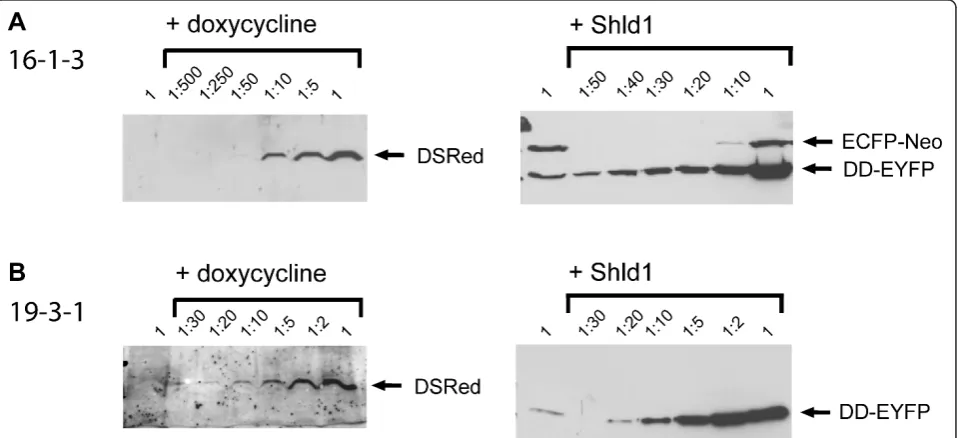
16, and 19, red fluorescence was specifically induced by doxycycline and yellow fluorescence by Shld1 in more than 90% of the cells. As an example, a cell line derived from double docking cell line 19 is shown in Figure 2. Clearly, there was no cross-reaction between the two conditional systems, and both genes can be induced in parallel. Next, we quantified the level of induction by western blot analyses. Doxycycline treatment caused an about 50-fold increased DsRed expression in the cell lines 16-1-3 (Figure 3A) and 12-1-1 (not shown), and about 20-fold induction in 19-3-1 (figure 3B). When Shld1 was given to the cells, the DD-EYFP protein was induced about 30-fold in 16-1-3 (Figure 3A), 20-fold in 12-1-1 (not shown), and 20-fold in 19-3-1 (Figure 3B). Of note, in the cell lines 16-1-3 (Figure 3A) and 12-1-1 (not shown) the ECFP-Neo fusion protein was still expressed. We assume that in these cell lines there is at least one un-recombined copy of the attP docking site present, although the transgene was integrated. In contrast, the cell line 19-3-1 lacks ECFP-Neo expression arguing for recombination at a unique attP docking site. Thus, the cell line 19, we refer to as HEK-attP/FRT cell line, is best suited to achieve stable integration of two distinct trans-genes with independent conditional activation of each transgene.
Independent integration of two inducible HNF4aproteins
To verify that this double conditional system can also be used to express genes interfering with cell cycle progres-sion we introduced the transcription factor HNF4asplice
variant 2. (HNF4a2) that has been shown to inhibit HEK293 cell multiplication [3,4] into each docking site. In a first round of transfection, the doxycycline inducible HNF4a2 sequence was introduced into the FRT site of the HEK-attP/FRT cells using the FLP recombinase. Site specific integration was verified by negative lacZ staining in three independent cell lines. One cell line 19-2 was used for a second round of transfection to integrate Shld1 inducible HNF4a2 into the attP docking site using FC31 integrase. The resulting four cell lines (2-2, 19-2-6, 19-2-4 and 19-2-5) were resistant to hygromycin and puromycin and have thus potentially integrated the two transgenes. To verify site specific integration into the attP docking site we screened for loss of ECFP-Neo expression, which is inactivated upon recombination (compare Figure 1B). This loss of ECFP-Neo expression was validated by a western blot using a monoclonal anti-GFP antibody also detecting ECFP (Figure 4A). The par-ent cell line 19-2 shows expression of the 61 kDa ECFP-Neo fusion protein, whereas no expression was detectable in the cell lines 19-2-2 and 19-2-6 arguing for specific integration of the HNF4a transgene in these cells. In contrast, the cell lines 19-2-4 and 19-2-5 expressed an about 27 kDa protein recognized by the GFP anti-body. In these two later cell lines the attP docking site was possibly rearranged by illegitimate recombination resulting in a truncated ECFP-Neo protein. We then tested by western blot analyses whether HNF4acould be induced in these cell lines by doxycycline or Shld1. As
[image:5.595.60.540.472.691.2]the doxycycline inducible HNF4atransgene contains a
myc tag, we could differentiate between the doxycycline and Shld1 inducible proteins. In all four cell lines the
myc-tagged HNF4atransgene could be induced
specifi-cally by doxycycline to a most similar level (Figure 4B, lower panel). However, when treated with Shld1 the cell lines 19-2-2 and 19-2-6 showed activation of HNF4a, whereas the cell lines 19-2-4 and 19-2-5 lacked HNF4a expression despite of puromycin resistance indicating FC31 mediated integration of the transgene. The ability to induce HNF4aby Shld1 in the cell lines 19-2-2 and 19-2-4 correlates with the loss of ECFP-Neo expression indicating specific integration in these two cell lines. In contrast, the cell lines 19-2-4 and 19-2-5 still expressing a truncated ECFP-Neo protein were not inducible by Shld1.
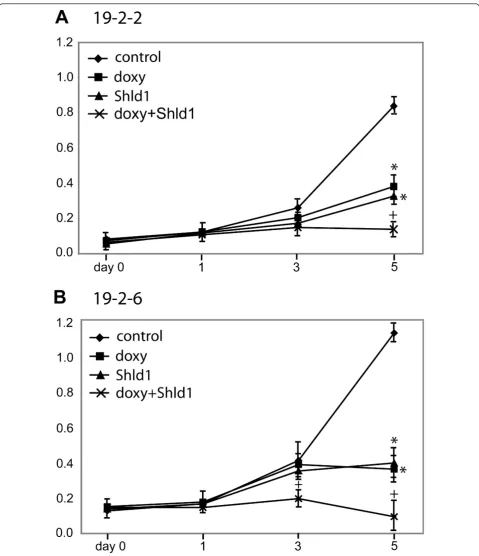
To address the effect of both HNF4atransgenes on cell cycle progression we treated the cell lines 2-2 and
19-2-6 with doxycycline and/or Shld1 and measured the cell number over five days by the MTS assay. The cell line 19-2-2 showed an about 10-fold increase of cell mass until day 5 (Figure 5A). However, when doxycycline or Shld1 was given cell multiplication was significantly reduced by 5-fold or 6-fold, respectively. Significantly, administration of doxycycline and Shld1 in parallel retained the cell number at about the starting levels pointing to an additive effect of the two independent
HNF4atransgenes. MTS assay of the 19-2-6 cell line
(Figure 5B) showed most similar results with a significant reduction of cell multiplication by either doxycycline or Shld1 treatment and a lack of cell multiplication, if doxy-cyline and Shld1 were applied simultaneously.
In summary, the two HNF4a transgenes could be
[image:6.595.53.539.90.427.2]independently activated by doxycycline or Shld1 and the observed effect on cell multiplication was highly Figure 4Independent integration of two inducible HNF4aproteins.A: Western blot analysis was performed on the 19-2 parent cell line containing the myc tagged HNF4a2 coding region in the FRT site and on the fourFC31 mediated descendent cell lines 19-2-2, 19-2-6, 19-2-4, and 19-2-5. The anti-GFP antibody recognizes ECFP.B: Western blot analysis of the cell lines 19-2-2, 19-2-6, 19-2-4, and 19-2-5 using an anti-HNF4aor anti-myc antibody. The cells were cultured in six well plates, incubated with 1μg/ml doxycycline and/or 1μM Shld1 as indicated and protein extracts prepared after 24 h. As the HNF4atransgene introduced into the FRT docking site has a myc-tag, it can be detected specifically with the anti-myc antibody. The anti-HNF4aantibody detects the myc-tagged as well as the DD-tagged HNF4aproteins that differ slightly in size (compare e.g. lanes 2 and 3).
Waldneret al.BMC Research Notes2011,4:420 http://www.biomedcentral.com/1756-0500/4/420
Figure 5Effect of HNF4aon cell proliferation. MTS proliferation assay was performed over a time span of five days in cell line 19-2-2 (A) or cell line 19-2-6 (B). Cells were treated with 1μg/ml doxycycline and/or 1μM Shld1 at day 0 as indicated and the metabolic activity was determined at the given time points. The medium was not changed during the whole period. The assay was performed in 96 well plates with n = 3 measurements. Using the student’s t-test p-values were calculated for doxycycline or Shld1 treatment compared to control: *p < 0.01. Similarly, p-values comparing double treated samples (doxycycline and Shld1) with doxycycline treated samples were computed:+p < 0.01. The
reproducible between the two distinct sites of integra-tion in two individual cell lines. Moreover, the effect of HNF4aappears to be concentration dependent, as acti-vation of the second transgene further delays cell multiplication.
Discussion
In this study we created the double conditional cell line HEK-attP/FRT to independently control the expression of two stably integrated transgenes. While stable cell lines are superior to transient transfectants to investigate long term effects, there is considerable variation between different clones as the site of integration and number of transgene copies cannot be predicted using standard transfection methods. This variation becomes even more problematic, when two potentially interacting transgenes are studied. This problem has now been overcome by using in parallel FLP andFC31 integrase mediated inte-gration into the corresponding pre-integrated recognition sites.
When searching for the optimal HEK-attP/FRT docking cell line, it turned out that two of three host cell lines still expressed the marker for the native attP docking site after integration of the fluorescent proteins. As the cells were resistant to puromycin and the fluorescent proteins could be properly induced, we conclude that there is least one additional un-recombined copy of the attP docking site present in these cells. However, the finally selected HEK-attP/FRT cell line appears useful for single copy integra-tion, as it allows recombination at a unique site resulting in loss of the attP marker gene expression (19-3-1 in Figure 3A). All experiments confirm that induction by doxycycline or Shld1 is completely independent (Figure 2, 3 and 4). This could be expected, as gene activation by doxycycline (or tetracycline, tet-On system) acts on the transcriptional level [2], while Shld1 affects protein sta-bility [7]. To have both, transcriptional and post-transla-tional control, in one cell makes this system most versatile. The fold induction was comparable between the two systems (Figure 4B), although we cannot exclude that
the myc tagged HNF4a protein and the DD-HNF4a
fusion protein, in the presence of Shld1, have distinct sta-bilities. While in theoryFC31 integrates more efficiently
than FLP [8], we did not obtain more clones byFC31
mediated integration than by FLP in our experiments. Integrating HNF4ainto the HEK-attP/FRT cell line it appeared necessary to screen for correct integration by loss of ECFP-Neo expression (Figure 4). Illegitimate recombination or integration at pseudo attP sites can probably not completely be avoided by puromycin selec-tion, but the loss of ECFP-Neo expression (cell lines 19-2-2 and 19-2-6) correlated perfectly with proper Shld1 inducibility in these two cell lines. The occurrence of unspecific integration was comparable to unspecific
recombination events observed using FLP mediated inte-gration that results in a high proportion of lacZ positive cells (own observations). The fact that doxycycline or Shld1 induced HNF4ahas nearly the same quantitative effect on cell proliferation in two independent cell lines (Figure 5) implies that the two distinct HNF4afusion proteins integrated at two distinct loci have most similar physiological properties. Of note, there was also an addi-tive effect, if the two copies were activated simulta-neously. This underlines the usefulness of the double conditional cell line HEK-attP/FRT to study the function of two potentially synergistic factors. Future applications for this novel cell line will also include the introduction of two different proteins with opposing functions allow-ing the study of any induced downstream signalallow-ing. Recently, another technique to introduce two different transgenes into two distinct sites was established using recombinase mediated cassette exchanged (RMCE) [12], but no conditional control of transgene expression was applied. While the system of multiplexing RMCE has the advantage of introducing two transgenes in one step, no specific selection markers for integration into each site were used. The integration of the transgenes in two stages as in our system is time consuming. One possibi-lity to speed up this process could be to transfect the host cells in parallel with FLP andFC31 integrase and the corresponding integration vectors in a single trans-fection. However, we did not test this ambitious option. During preparation of our manuscript a multi-integrase system involving even five distinct recombination sites has been described [13]. However, our system allows in addition the conditional expression of two independent genes integrated at well defined genomic positions.
Conclusions
In this study we have established and applied a HEK-attP/ FRT cell line that allows site specific integration of two distinct transgenes using the FLP recombinase as well as theFC31 integrase. Moreover, this approach implicates two specific conditional systems to control transgene expression.
Methods
Cell culture and transfection
All cell lines were grown in Dulbecco’s modified Eagle’s medium (DMEM, Gibco-BRL) supplemented with 10% heat inactivated fetal calf serum (FCS), penicillin/strepto-mycin (100 U/ml) and 2 mM glutamine at 37°C under 8% CO2atmosphere and a relative humidity of 95%. The cell
line Flp-In T-Rex™ 293 (Invitrogen) was cultured in
DMEM supplemented with 15 μg/ml blasticidin and
100μg/ml zeocin (InvivoGen). The HEK-attP/FRT cell
line was kept in DMEM supplemented with blasticidin, zeocin, and 500μg/ml G418 (InvivoGen). To select stable
Waldneret al.BMC Research Notes2011,4:420 http://www.biomedcentral.com/1756-0500/4/420
cell lines derived from the host cell line by FLP mediated integration into the FRT docking site, zeocin was substi-tuted with 50μg/ml hygromycin B (Invitrogen). After FC31 integrase mediated integration into the attP docking site, G418 was replaced by 1μg/ml puromycin (Invivo-Gen). Transfections were carried out using LipofectA-MINE™(Invitrogen) or FuGENE™(Roche).
Generation and induction of stable cell lines
For integration into the FRT docking site, cells were co-transfected with the FLP expression vector pCSFLPe [14] and the corresponding integration vector at a ratio of 9 to 1. As the transgenes are integrated at the same chromoso-mal site, cell lines were prepared by pooling individual colonies. Successful integration was verified by staining the cells forb-galactosidase activity. Cell lines with less than 5% blue cells were used for further experiments. For integration into the attP docking site, cells were
co-trans-fected with the FC31 integrase expression vector
pchactC31hum (Artemis) and the corresponding integra-tion vector at a ratio of 9 to 1. For condiintegra-tional expression of transgenes, cells were cultured in 1μg/ml doxycycline or 1μM Shld1. In all experiments, cells were seeded 24 h before induction. To measure the cell proliferation rate, MTS assay was performed according to the manufacturer’s instructions (CellTiter 96R Aqueous One Solution Cell Proliferation Assay, Promega).
Real-time PCR
DNA was extracted using the DNeasy Extraction Kit (Qia-gen). Real time PCR was performed using POWR-SYBR Green (Applied Biosystems) on a 7900HT Sequence Detection System (Applied Biosystems). Templates of 10 ng DNA were measured in duplicate. The number of transgene copies was determined by external calibration using theb-actin gene for normalization. Primers used
were docking1: 5’-GCAAAGACCCCAACGAGAAG-3’,
docking2: 5’-TCACGAACTCCAGCAGGACC-3’, hAC
TBf: 5’-GGTATCTCCCTCTGCAGC-3’, hACTBr: 5’
-CTATGGGCTGAGGTCTGGAT-3’.
Western blot analysis
Cell pellets were lysed in RIPA buffer (50 mM Tris-HCl pH 7.2, 150 mM NaCl, 0.1% sodium dodecylsulfate, 1% sodium deoxycholate, 1% Triton X-100) supplemented with 0.2% protease inhibitor cocktail (Sigma, P-8340). Insoluble debris were removed by centrifugation at 14,000 g for 10 min at 4°C. The protein concentration of the supernatant was determined using a Bradford assay (Bio-Rad). Equal amounts of proteins were separated on SDS-polyacrylamide gels and transferred to nitrocellulose. Membranes were blocked with blocking reagent (Amer-sham, RPN 3601). For antigen detection, monoclonal anti-myc tag antibody 9E10, anti-HNF4a(Santa Cruz, C-19),
anti-GFP (Clonetech, JL-8 632380), anti-DsRed (Clone-tech, 632496) antibodies were employed. Peroxidase-con-jugated anti-mouse IgG (Amersham), anti-rabbit IgG (Jackson ImmunoResearch) and anti-goat IgG (Sigma) were used as secondary antibodies. Immunoreactivity was detected by ECL (Amersham Biosciences).
Plasmids
pDOCKING-Neo (Addgene plasmid 31441) contains the CMV promoter driven ECFP-neomycin fusion protein containing the blue fluorescent protein ECFP (Clone-tech). A minimal attP site [15] is placed downstream and in frame of its start codon. In addition, a loxP site was integrated upstream of the start codon. The attB integra-tion vector pINT-PuroDDEYFP (Addgene plasmid 31442) contains a minimal attB site [15] fused in frame to an ATG-less puromycin resistance gene. Downstream of this sequence there is as GOI a CMV promoter driven DD-EYFP fusion protein with the L106P mutant of the human FKBP12 protein (destabilizing domain) [7] linked in frame with the yellow fluorescent protein EYFP (Clonetech). The attB integration vector
pINT-Pur-oDDHNF4a2 (Addgene plasmid 31443) contains as GOI
a CMV promoter driven DD-HNF4a2 fusion protein. In
the FRT integration vector pcDNA5/FRT/TO-DsRed the DsRed sequence (Clonetech) was introduced into the multiple cloning site of the pcDNA5/FRT/TO vector (Invitrogen) to obtain FR_DsRed2 (Addgene plasmid 31444). The FRT integration vector pcDNA5/FRT/TO-HNF4a2 has been described [3]. All constructs were made using standard molecular procedures. The com-plete sequence information of all plasmids used can be obtained on request.
Acknowledgements
We thank Tom Wandless for kind donation of plasmids containing the FKBP12 destabilizing domain and of the Shld1 substance. We thank Artemis Pharmaceuticals GmbH (Cologne, Germany) for theFC31 expression vector.
Authors’contributions
CW designed the project, performed all assays on the HNF4αconditional cells, and drafted the manuscript. OR performed assays on the EYFP/DSRed conditional cells. FS constructed plasmids. MY constructed the docking site. NS performed western blots and transfections. GUR designed and overviewed the project. All authors have read and approved the final version of the manuscript.
Competing interests
The authors declare that they have no competing interests.
Received: 10 August 2011 Accepted: 18 October 2011 Published: 18 October 2011
References
1. O’Gorman S, Fox DT, Wahl GM:Recombinase-mediated gene activation and site-specific integration in mammalian cells.Science1991,
251:1351-1355.
fusion derivatives, regulates inducible gene expression in mammalian cells.Hum Gene Ther1998,9:1939-1950.
3. Lucas B, Grigo K, Erdmann S, Lausen J, Klein-Hitpass L, Ryffel GU:
HNF4alpha reduces proliferation of kidney cells and affects genes deregulated in renal cell carcinoma.Oncogene2005,24:6418-6431. 4. Grigo K, Wirsing A, Lucas B, Klein-Hitpass L, Ryffel GU:HNF4 alpha
orchestrates a set of 14 genes to down-regulate cell proliferation in kidney cells.Biol Chem2008,389:179-187.
5. Thomas H, Senkel S, Erdmann S, Arndt T, Turan G, Klein-Hitpass L,et al:
Pattern of genes influenced by conditional expression of the transcription factors HNF6, HNF4alpha and HNF1beta in a pancreatic beta-cell line.Nucleic Acids Res2004,32:e150.
6. Senkel S, Waldner C, Ryffel GU, Thomas H:Improved conditional expression systems resulting in physiological level of HNF4alpha expression confirm HNF4alpha induced apoptosis in the pancreatic beta-cell line INS-1.BMC Res Notes2009,2:210.
7. Banaszynski LA, Chen LC, Maynard-Smith LA, Ooi AG, Wandless TJ:A rapid, reversible, and tunable method to regulate protein function in living cells using synthetic small molecules.Cell2006,126:995-1004. 8. Groth AC, Calos MP:Phage integrases: biology and applications.J Mol
Biol2004,335:667-678.
9. Thyagarajan B, Olivares EC, Hollis RP, Ginsburg DS, Calos MP:Site-specific genomic integration in mammalian cells mediated by phage phiC31 integrase.Mol Cell Biol2001,21:3926-3934.
10. Chalberg TW, Portlock JL, Olivares EC, Thyagarajan B, Kirby PJ, Hillman RT,
et al:Integration specificity of phage phiC31 integrase in the human
genome.J Mol Biol2006,357:28-48.
11. Andreas S, Schwenk F, Kuter-Luks B, Faust N, Kuhn R:Enhanced efficiency through nuclear localization signal fusion on phage PhiC31-integrase: activity comparison with Cre and FLPe recombinase in mammalian cells.
Nucleic Acids Res2002,30:2299-2306.
12. Turan S, Kuehle J, Schambach A, Baum C, Bode J:Multiplexing RMCE: versatile extensions of the Flp-recombinase-mediated cassette-exchange technology.J Mol Biol2010,402:52-69.
13. Yamaguchi S, Kazuki Y, Nakayama Y, Nanba E, Oshimura M, Ohbayashi T:A method for producing transgenic cells using a multi-integrase system on a human artificial chromosome vector.PLoS ONE2011,6(2):e17267. 14. Werdien D, Peiler G, Ryffel GU:FLP and Cre recombinase function in
Xenopus embryos.Nucleic Acids Res2001,29:E53.
15. Groth AC, Olivares EC, Thyagarajan B, Calos MP:A phage integrase directs efficient site-specific integration in human cells.Proc Natl Acad Sci USA
2000,97:5995-6000.
doi:10.1186/1756-0500-4-420
Cite this article as:Waldneret al.:Double conditional human embryonic kidney cell line based on FLP andFC31 mediated transgene
integration.BMC Research Notes20114:420.
Submit your next manuscript to BioMed Central and take full advantage of:
• Convenient online submission
• Thorough peer review
• No space constraints or color figure charges
• Immediate publication on acceptance
• Inclusion in PubMed, CAS, Scopus and Google Scholar
• Research which is freely available for redistribution
Submit your manuscript at www.biomedcentral.com/submit
Waldneret al.BMC Research Notes2011,4:420 http://www.biomedcentral.com/1756-0500/4/420