Distributed Wireless Body-Centric
Networks: Optimisation via Predictive
Analytics and Cross-Layer Designs
Samiya M. Shimly
March 2019
A thesis submitted for the degree of Doctor of Philosophy of The Australian National University
3 6 . 6 < : , . < 0 + , 3 0 5 , : 4 ( 9 * /
; / , ( < : ; 9 ( 3 0 ( 5 5 ( ; 0 6 5 ( 3 < 5 0 = , 9 : 0 ; @
;OL(5<SVNVPZHJVU[LTWVYHY` YLÅLJ[PVUVMV\YOLYP[HNL 0[JSLHYS`WYLZLU[ZV\YUHTL V\YZOPLSKHUKV\YTV[[V! -PYZ[[VSLHYU[OLUH[\YLVM[OPUNZ ;OL(5<SVNVYLTHPUZWYVWLY[`VM[OL<UP]LYZP[`;VWYLZLY]L [OLH\[OLU[PJP[`VMV\YIYHUKPKLU[P[`[OLYLHYLY\SLZ[OH[ NV]LYUOV^V\YSVNVPZ\ZLK 7YLMLYYLKSVNV ;OLWYLMLYYLKSVNVZOV\SKIL\ZLKVUH^OP[LIHJRNYV\UK ;OPZ]LYZPVUPUJS\KLZISHJR[L_[^P[O[OLJYLZ[PU+LLW.VSKPU LP[OLY74:VY*4@2 )SHJR >OLYLJVSV\YWYPU[PUNPZUV[H]HPSHISL[OLISHJRSVNVJHU IL\ZLKVUH^OP[LIHJRNYV\UK 9L]LYZL ;OLSVNVJHUIL\ZLK^OP[LYL]LYZLKV\[VMHISHJR IHJRNYV\UKVYVJJHZPVUHSS`HUL\[YHSKHYRIHJRNYV\UK 3VNVHUKHWWYV]HSZJHUILVI[HPULKMYVTIYHUK'HU\LK\H\ +LLW.VSK *4@2 9.) 74:4L[HSSPJ 74: )SHJR *4@2 9.) 74:7YVJLZZ)SHJR 7YLMLYYLKSVNV )SHJR]LYZPVU 9L]LYZLK]LYZPVU
Any application of the ANU logo on a coloured background is subject to approval by the Marketing Office. Please send to [email protected]
(5<
3VNV<ZL.\PKLSPULZ
Research School of Electrical, Energy, and Materials Engineering
College of Engineering and Computer Science
The Australian National University
i
To my beloved parents, Kamal and Hasina,
Declaration
The contents of this thesis are the results of original research and have not been submitted for a higher degree to any other university or institution. Much of this work has either been published as journal/conference papers or submitted for publications as journal papers. Following is a list of these papers:
Journal Articles
• Samiya M. Shimly, David B. Smith, and Samaneh Movassaghi:
‘Experi-mental Analysis of Cross-layer Optimization for Distributed Wireless Body-to-Body Networks’, IEEE Sensors Journal, p. 1-16, August, 2019, DOI: 10.1109/JSEN.2019.2937356.
• Samiya M. Shimly, Samaneh Movassaghi, and David B. Smith:
‘Cooper-ative communications for sleep monitoring in wireless body area networks’, IET Electronics Letters, p. 594-596, February, 2016.
• Samiya M. Shimlyand David B. Smith: ‘Multi-Objective Markov Decision
Process for Adaptive Scheduling in Wireless Body-to-Body Networks’, under review, IEEE Internet of Things Journal, March, 2019.
• Samiya M. Shimly, David B. Smith, Samaneh Movassaghi, and Leif W.
Hanlen: ‘An Empirical Study of Stationarity and Long-Range Dependence of Wireless Body-centric Channels’, under review,ACM Transactions on Sensor Networks, September, 2019.
Conference Proceedings
• Samiya M. Shimly, David B. Smith, and Samaneh Movassaghi:
‘Cross-Layer Designs for Body-to-Body Networks: Adaptive CSMA/CA with Dis-tributed Routing’, in IEEE International Conference on Communications (ICC’18), pp. 1-6, Kansas, USA, May, 2018.
• Samiya M. Shimly, David B. Smith, and Samaneh Movassaghi:
‘Wide-Sense-Stationarity of Everyday Wireless Channels for Body-to-Body Net-works’, in 2018IEEE International Conference on Communications (ICC’18), pp. 1-6, Kansas, USA, May, 2018.
• Samiya Shimly, David B. Smith, and Samaneh Movassaghi: ‘Cross-layer
optimized routing with low duty cycle TDMA across multiple wireless body area networks’, inIEEE International Conference on Communications (ICC’17), pp. 1-6, Paris, France, May, 2017.
The following articles/posters are also results from my Ph.D. study:
• Samiya Shimly, ‘everybody working together’, featured interview by
Elec-tronics Letters, IET, p-570, Apr, 2016.
• ‘Towards Smart Wireless Body-centric Networks’,poster presentation at joint 7th N2WOMEN-WICE Workshop (ICC), May, 2018.
• ‘Cross-layer optimized routing across multiple wireless body area networks’, poster presentation at Australian Communications Theory Workshop (AusCTW), Jan, 2017.
The research work presented in this thesis is my own original work, unless indicated otherwise.
Samiya Shimly
Research School of Electrical, Energy, and Materials Engineering The Australian National University
Acknowledgments
I would like to take this opportunity to acknowledge and thank each of the following people, who helped me scientifically and emotionally throughout this study:
Firstly, I would like to express my deepest appreciation and sincere gratitude to my Ph.D. supervisor, Dr. David Smith, who tremendously helped and encouraged me at each stage of the process. I am grateful for his unconditional support, patience, scholarly inputs, and invaluable guidance throughout my Ph.D. study. Without his advice, direction, and persistent help, this dissertation would not have been possible. I consider it as a great opportunity to pursue my Ph.D. under his supervision and to learn from his research expertise.
Also, I would especially like to thank my Ph.D. co-supervisors, Prof. Thushara Abhayapala and Dr. Leif Hanlen for their helpful advice and support from time to time.
The Australian National University (ANU) and CSIRO (Commonwealth Scien-tific and Industrial Research Organisation) Data61 for the Ph.D. scholarships and the Vice Chancellor’s travel grant.
Prof. Jan Rabaey, for generously welcoming me to visit his research group at the University of California, Berkeley, and providing valuable feedback on my work.
The HDR members of ANU for their timely support and making the adminis-trative works effortless.
My peers — Samaneh, Nicole, and Yizhou for their help, friendship, and en-couragement throughout this time.
I owe a special thanks to my parents and family. I will forever be grateful to my parents for their eternal love and support, for having faith in me, for their sacrifice and patience, and providing me with the opportunity to be where I am today. Also, my lovely brother, Sakib, and gorgeous sisters, Kanak and Raka, my amazing in-laws, and all my dearest friends who were greatly supportive and understanding during this period.
Abstract
In this thesis, methods for optimisation are designed and developed for wireless body-centric channels in order to best enable intelligent, self-organised, and dis-tributed human-centered networks. Due to human-body shadowing and mobility, body-centric channels change dramatically over time — with intermittent periods of longer stability — often causing unnecessary delay and energy consumption under significant radio channel attenuation. Hence, robust and efficient communications across these networks require adaptive, optimised mechanisms. Thus, we propose, and investigate the performance of various cross-layer and predictive optimisation techniques for real-life body-centric channels. Our analysis employs real-life exper-imental datasets collected from different numbers of co-located wireless body area networks (BANs), over many hours in ‘everyday’ scenarios.
We first investigate cooperative receive diversity for a BAN used to monitor a sleeping person, and we find that cooperative combining improves packet delivery ratio (PDR) and latency for these atypical slowly-varying radio channels. Then, we propose two cross-layer optimised techniques for multiple coexisting BANs, forming wireless body-to-body networks (BBNs). These techniques are shortest path rout-ing (SPR) and cooperative multi-path routrout-ing (CMR), where CMR incorporates cooperative selection combining. In CMR and SPR, the best route is periodically selected at the network layer according to channel state information from the phys-ical layer. We show that CMR reduces retransmissions and increases PDR due to an available alternate path, reducing end-to-end delay and energy consumption with respect to state-of-the-art protocols. We then add MAC layer interference mitigation using low duty cycle TDMA, for which CMR gains up to 14 dB im-provement over SPR at 10% outage probability. Moreover, we also apply CMR incorporating novel MAC layer CSMA/CA with adaptive carrier sensing, giving improvement over TDMA for both throughput and spectral efficiency.
Next, we explore the feasibility of applying predictive optimisation over
less body-centric channels (i.e., body-to-body, on-body), by studying wide-sense-stationarity (WSS) and long-range dependence (LRD) characteristics, which are crucial to predictive analysis. The results of different stationarity tests show that unlike on-body channels (which are considered non-stationary), body-to-body channels possess WSS characteristics for a range of window lengths between 0.5 s and 15 s (typically 5−8 s) depending upon on-body sensor locations and shadow-ing. Moreover, the Hurst exponent of body-centric channels is very high (around 0.9) and temporal auto-correlation decreases very slowly (a power-like decay), in-dicating LRD (i.e., long-memory) characteristics are maintained.
Then, based on the results for WSS and LRD, we apply multi-objective op-timisation for adaptive scheduling in BBNs, by using a multi-objective Markov decision process (MOMDP) to jointly optimise three separate metrics: through-put, latency, and energy consumption. The adaptive scheduling combines both TDMA and CSMA/CA schemes. From performance analysis, employing real-life channel measurements, we find an MOMDP outcome that is Pareto optimal, pro-viding a desirable trade-off between the three objectives of maximising throughput, and minimising continuous latency and energy consumption. It is also observed that WSS characteristics of the body-to-body channels have a significant effect on the outcome of such analytics.
List of Abbreviations
AAL ambient assisted living
ACF auto-correlation function
ACK acknowledgement
ANOVA analysis of variance
AODV adhoc on-demand distance vector
ARFIMA auto-regressive fractionally integrated moving average
ARMA auto-regressive moving average
B2B body-to-body
BANs wireless body area networks
BBNs wireless body-to-body networks
B–F Brown-Forsythe
BLE bluetooth low energy
CAP contention access period
CDC cooperative diversity combining
CDF cumulative distribution function
CFP contention free period
CICADA cascading information retrieval by controlling access with distributed slot assignment
CL-RRS cross-layer reliable retransmission scheme
C/M control and management
CMDP constrained Markov decision process
CMR cooperative multi-path routing
CNC cooperative network coding
COD continuous outage duration
COMR cross-layer opportunistic MAC/routing protocol
CSMA/CA carrier sense multiple access with collision avoidance
CTP collection tree protocol
DL direct link
DODAG destination oriented directed acyclic graph
DTMDP discrete-time Markov decision process
DQBAN distributed queuing body area network
EAP exclusive access phase
EC energy consumption
EDC expected duty cycle
EDR enhanced data rate
EFC electric field coupling
ETSI European telecommunications standards institute
ETX expected transmission count
FM frequency-modulated
GEV generalised extreme value
HIT hybrid indirect transmissions
HS high speed
xvii
IMD implantable medical device
IoH internet of humans
IR impulse-radio
ISM industrial, scientific, and medical
K–S Kolmogorov-Smirnov
LANs local area networks
LH left-hip
LLNs low power lossy networks
LLV log-likelihood value
LRD long-range dependence
LW left-wrist
MAC media access control
MANETs mobile ad hoc networks
MAP managed access phase
MCA multi-use channel access
MDP Markov decision process
MIMO multiple-input-multiple-output
MLE maximum likelihood estimation
MOMDP multi-objective Markov decision process
MPCS aximum-interference-power carrier-sensing
NaN not a number
NB narrowband
NET network
OR opportunistic relaying
ORPL opportunistic routing protocol
OSI open systems interconnection
OSPF open shortest path first
PAL protocol adaptation layer
PANs personal area networks
PAR packet arrival rate
PER packet error rate
PHY physical
PDR packet delivery ratio
PDF probability density function
POMDP partially observable Markov decision process
PRR packet reception rate
PSD power spectral density
QoS quality of service
RA right-upper-arm
RAP random access phase
RF radio-frequency
RH right-hip
RHT route hold time
RS receive sensitivity
RSSI receive signal strength indicator
Rx receiver
xix
SINR signal-to-interference-plus-noise ratio
SMDP semi-Markov decision process
SOR simple opportunistic routing
SPR shortest path routing
SSE sum of squared errors
STFT short time Fourier transform
SwC switch-and-examine combining
TC technical committee
TP transmit power
TDMA time division multiple access
TICOSS timezone coordinated sleep scheduling
Tx transmitter
UWB ultra-wideband
WASP wireless autonomous spanning tree
WLANs wireless local area networks
WPANs wireless personal area networks
WSNs wireless sensor networks
Notations and Symbols
The following mathematical notations and symbols are consistent throughout the thesis:
Γ(·) gamma function
Io(·) modified Bessel function of the first kind with order zero
Φ CDF of the standard normal distribution
E(·) expectation operator
Cov(·) covariance
P
summation
| · | absolute value operator
lim limit
(··) range operator
H0 null hypothesis
H1 alternative hypothesis
hE Hurst exponent
∆ total time
\ set difference
∩ intersection
≈ approximation
∅ empty set
∧ AND
∨ OR
h channel gain
τ time instant
c
(·)ξ eigenspectrum
min minimum
max maximum
(·) mean
f
(·) median
exp exponential
log logarithm
ln natural logarithm
Contents
1 Introduction 3
1.1 Background, Motivation, and Scope . . . 3 1.1.1 Wireless Body Area Networks (BANs) . . . 4 1.1.2 Wireless Body-to-Body Networks (BBNs) . . . 6 1.2 Problem Statement and Proposed Solution . . . 8 1.3 Thesis Overview and Outline . . . 10
2 Literature Review 17
2.1 Communications Architecture and Technology of Body-centric Net-works . . . 17 2.1.1 Communications Architecture . . . 17 2.1.2 Radio Technology . . . 20 2.2 Challenges of Wireless Body-centric Communications . . . 25 2.2.1 Mobility . . . 27 2.2.2 Time-varying dynamic topology . . . 27 2.2.3 Routing challenges . . . 27 2.2.4 Power Constraints . . . 28 2.2.5 QoS consideration and Context-awareness . . . 28 2.2.6 Network Scalability and Interoperability . . . 29 2.2.7 Security and Privacy Issues . . . 29 2.3 Existing Research for Optimising Body-centric Communications . . 30 2.3.1 Research on Cooperative Communications . . . 30 2.3.2 Research on Cross-layer Optimisation . . . 31 2.3.3 Research on Predictive Characteristics . . . 33
2.3.4 Research on Predictive Optimisation . . . 33 2.4 Research Gaps . . . 36 2.5 Summary . . . 38
3 Experimentally-based Two-layer Optimisation for Distributed BBNs 41
3.1 Introduction . . . 41 3.2 Cooperative Communications for monitoring a sleeping person . . . 42 3.2.1 Experimental Setup for monitoring a sleeping person . . . . 43 3.2.2 System Model . . . 45 3.2.3 Performance Analysis . . . 47 3.3 Cross-layer optimised routing across multiple BANs . . . 51 3.3.1 System model . . . 52 3.3.2 Experimentally-based Results . . . 64 3.4 Summary . . . 79 3.5 Related Publication . . . 80
4 Experimentally-based Three-layer Optimisation for Distributed
BBNs 83
4.1 Introduction . . . 83 4.2 Cross-layer optimised routing with low duty cycle TDMA across BBNs 84 4.2.1 System Model . . . 85 4.2.2 Performance Analysis with Experimental Results . . . 89 4.3 Cross-layer optimised routing with adaptive CSMA/CA across BBNs 96 4.3.1 System Model . . . 97 4.3.2 Performance Analysis . . . 99 4.4 Summary . . . 105 4.5 Related Publications . . . 106
5 Predictive Characteristics of Real-life Body-centric Channels 109
Contents xxvii
5.2.4 Dataset 4 (20 coexisting BANs) . . . 114 5.3 Test of Significance for WSS . . . 114 5.4 Experimental outcome of WSS investigation . . . 118 5.4.1 Results of Dataset 1 . . . 119 5.4.2 Results of Dataset 2 . . . 119 5.4.3 Results of Dataset 3 . . . 119 5.4.4 Results of Dataset 4 . . . 123 5.5 Long-Range Dependence or ‘Long-memory’ . . . 128 5.5.1 Decaying pattern of auto-correlation function . . . 128 5.5.2 Hurst exponent . . . 131 5.6 Modelling Body-to-Body Channels . . . 137 5.6.1 Fading Characteristics . . . 138 5.6.2 Time-dependence . . . 141 5.7 Prospective Use-cases . . . 142 5.7.1 Statistical characterisation . . . 142 5.7.2 Modelling long-range dependence . . . 143 5.7.3 Predictive control/decision-making . . . 143 5.8 Summary . . . 144 5.9 Related Publications . . . 145
6 Multi-Objective Optimisation for Real-life BBNs 147
6.6 Related Publications . . . 176
7 Conclusion and Future Work 179
7.1 Conclusion . . . 179 7.2 Future Work . . . 182
A Hypothesis Tests 185
List of Figures
1.1 The growth of connected wearable devices worldwide . . . 3
1.2 A BAN demonstrating wireless body and in-body links with on-body and implanted sensors/hub . . . 5
1.3 A BBN demonstrating body-to-body communications between on-body hubs and sensors . . . 6
1.4 BBN providing outdoor medical service . . . 7
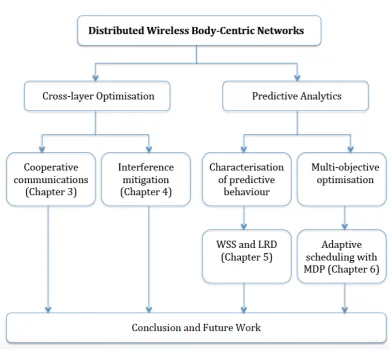
1.5 Thesis Flowchart . . . 12
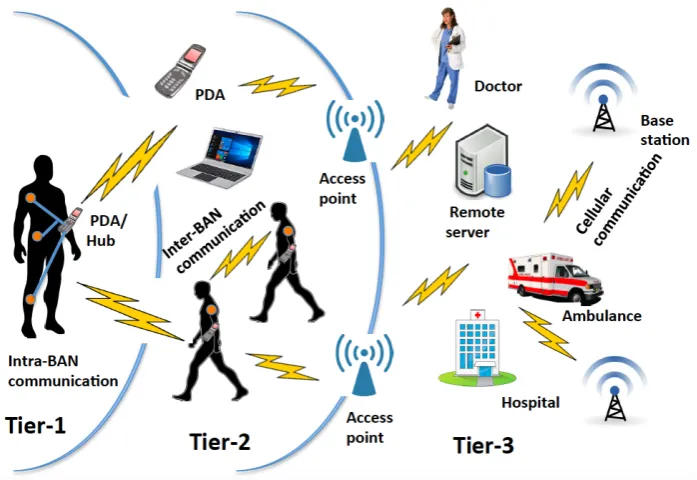
2.1 Multi-tier architecture for body-centric communications. . . 18
2.2 (a) Cluster-based and (b) Distributed architecture of coexisting BANs. 20
2.3 Some of the available bands for BAN based on RF technology [1]. . 21
3.1 An illustration of a sleeping person wearing transceivers and receivers 44
3.2 Three-branch cooperative combining: one of the branches is a direct link (hsd) and the other two are cooperative relay links (with two hops). . . 45
3.3 Outage probability as a function of receive sensitivity withTxpower of 0 dBm, for direct link (DL), selection combining (SC), and switch-and-examine combining (SwC), with on-body and off-body transceivers. 48
3.4 Percentage of continuous outage duration (at x-axis), below a given
Rx sensitivity with Tx power of 0 dBm, from agglomerate data for on-body transceiver; with direct link (DL), switch-and-examine com-bining (SwC), and selection comcom-bining (SC) . . . 50
3.5 Percentage of continuous outage duration (at x-axis), below a given
Rx sensitivity with Tx power of 0 dBm, from agglomerate data for off-body transceiver; with direct link (DL), switch-and-examine com-bining (SwC), and selection comcom-bining (SC) . . . 50 3.6 Two tiered architecture with 4 coexisting BANs (intra-BAN
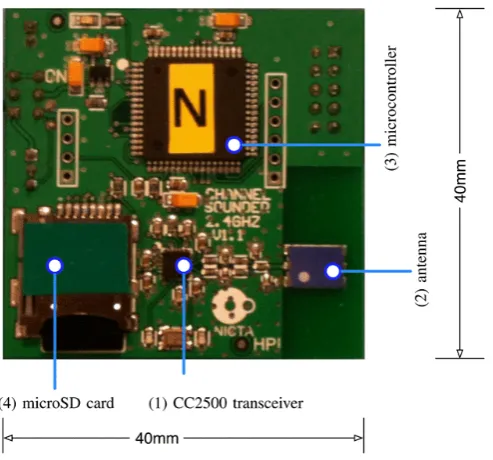
com-munications at the lower tier and inter-BAN comcom-munications at the upper tier); Hub on the hip and two sensors/relays on the left-wrist and right-upper-arm, respectively. . . 53 3.7 Cross-layer optimisation between Physical and Network layers. . . . 54 3.8 The radio-frequency testbed with major components highlighted.
Battery (disconnected) is on reverse side . . . 56 3.9 Shortest path routing (SPR), with and without hop restriction. The
path taken without hop restriction can be a longer path with the lowest cost. . . 60 3.10 Cooperative multi-path routing (CMR) with 3-branch selection
com-bining in each route hop. . . 62 3.11 Outage probability of the averaged gains (over the network with 10
BANs) found from ORPL (routing metric: EDC, k = 4), LOADng (routing metric: hop count), SPR and CMR (routing metric: ETX, hop count); transmit power 0 dBm. Black dotted curves represent the theoretical cdf (cumulative distribution function) of the corre-sponding outage probability and are well aligned. . . 67 3.12 Outage probability of the averaged gains (over the network with
10 BANs) found from SPR and CMR (routing metric: ETX, hop count); transmit power 10 dBm (at hubs) and 5 dBm (at relays). Black dotted curves represent the theoretical cdf (cumulative dis-tribution function) of the corresponding outage probability and are well aligned. . . 68 3.13 Average throughput (packets/s) for SPR, CMR, ORPL, and LOADng;
at−100 dBm receive sensitivity with transmit power 0 dBm. . . 69 3.14 Average end-to-end delay at continuous times for SPR, CMR, ORPL,
List of Figures xxxiii
3.15 Average and maximum end-to-end delay over the whole period for SPR, CMR, ORPL, and LOADng with the network consisting of 10 BANs; with transmit power 0 dBm at −100 dBm receive sensitivity. 72
3.16 Average energy consumption (per packet delivery) at continuous times for SPR, CMR, ORPL, and LOADng; at −100 dBm receive sensitivity with transmit power 0 dBm. . . 73
3.17 Average and maximum energy consumption (per packet delivery) over the whole period for SPR, CMR, ORPL, and LOADng with the network consisting of 10 BANs; with transmit power 0 dBm at −100 dBm receive sensitivity. . . 74 3.18 Percentage of hop count of routes with different protocols (SPR,
ORPL, LOADng), at −100 dBm receiver sensitivity. . . 77
3.19 The empirical probability density of combined channel gain data from SPR with a gamma distribution fit, where κ = 9.58 and θ = 0.00000334 are the shape and scale parameter, respectively. . . 78
3.20 The empirical probability density of combined channel gain data from CMR with a Rician distribution fit, where ν = 0.0000626 and
σ = 0.0000185 are the two shape parameters. . . 78
4.1 Two-tiered architecture of 4 coordinated BANs . . . 86
4.2 Cross-layer optimisation across physical-MAC-network layers . . . . 86
4.3 Average outage probability with respect to SINR threshold for SPR and CMR, with different duty cycles (dc) per node for the 4 coor-dinated BANs. Receiver sensitivity −100 dBm, transmit power 0 dBm; black dotted curves represent the theoretical cdf of SINR with corresponding duty cycles . . . 92
4.4 Average packet delivery ratio (PDR) in terms of different receive sensitivities for SPR and CMR, with different duty cycles (dc) per node for the 4 coordinated BANs, at 0 dBm transmit power . . . . 94
4.6 Average spectral efficiency with respect to −88 dBm receive sensi-tivity for SPR and CMR, with different duty cycles (dc) of 4, 5 and 6 co-ordinated BANs (coBANs) . . . 96
4.7 Percentage of continuous back-off duration of CSMA/CA links with an adaptive carrier sense threshold (CSth) and different static carrier sense thresholds (CSth), at transmit power 0 dBm, with 10 coexist-ing BANs. . . 101
4.8 Average throughput (successful packets/s) vs. packet arrival rate over 10 coexisting BANs for SPR and CMR (associated with CSMA/CA), with adaptive/static carrier sense thresholds (CSth) and TDMA with 8.3% duty cycle (dc). Transmit power 0 dBm and receiver sensitivity −90 dBm . . . 102 4.9 Average outage probability with respect to SINR thresholds for SPR
and CMR (associated with CSMA/CA), with different routing met-rics (e.g., only ETX, ETX + max. 2 hops) for 10 coexisting de-centralised BANs; Subscript a and s refers to adaptive and static carrier sensing, respectively. Receiver sensitivity −100 dBm, trans-mit power 0 dBm . . . 103 4.10 Average packet delivery ratio with respect to different receive
sen-sitivities for SPR and CMR (associated with adaptive CSMA/CA and 8.3% duty cycle TDMA), with different routing metrics (e.g., only ETX, ETX + max. 2 hops) for 10 coexisting BANs; Transmit power 0 dBm . . . 104
4.11 Average spectral efficiency for 10 coexisting BANs with respect to different receive sensitivities for SPR and CMR (associated with adaptive CSMA/CA and 8.3% duty cycle TDMA), with different routing metrics (e.g., only ETX, ETX + max. 2 hops), at transmit power 0 dBm . . . 105
List of Figures xxxv
5.2 (m−1) pairwise comparison (Pc) across two consecutive intervals (`) 116
5.3 Average probability of stationarity with (a) ANOVA, (b) B–F, and (c) K–S hypothesis tests for different body-to-body links of dataset 1, i.e., R. Hip to L. Hip (RH–LH), R. Hip to R. upper Arm (RH– RA), R. hip to R. hip (RH–RH), R. Hip to L. Wrist (RH–LW). The results for each link are averaged over (3×7) links except RH–RH link (averaged over (3×7) links). The minimum required window length to precisely investigate WSS is 1 s (indicated by black dotted vertical line). . . 120
5.4 Average probability of stationarity with (a) ANOVA, (b) B–F, and (c) K–S hypothesis tests for different body-to-body links of dataset 2, i.e., L. Hip to L. Wrist (LH–LW), L. Hip to R. upper Arm (LH– RA), L. hip to L. hip (LH–LH). The results for each link are averaged over (8×7) links from 8 subjects. The minimum required window length to precisely investigate WSS is 2.4 s (indicated by black dot-ted vertical line). . . 121
5.5 Average probability of stationarity with (a) ANOVA, (b) B–F, and (c) K–S hypothesis tests for different body-to-body links of dataset 3, i.e., L. hip to L. hip (LH–LH), L. Hip to R. upper Arm (LH–RA), L. Hip to L. Wrist (LH–LW). The results for each link are averaged over (10×9) links from 10 subjects. The minimum required window length to precisely investigate WSS is 3 s (indicated by black dotted vertical line). . . 122
5.7 (a) K–S and (b) B–F hypothesis test results for the probability of stationarity (with c` = 0.95) across different body-to-body links, i.e., left-hip-to-left-hip LH), left-hip-to-right-upper-arm (LH-RA), left-hip-to-left-wrist (LH-LW). Subscript ‘b’ and ‘w’ imply the best and worst case, respectively. . . 124
5.8 Power fit and exponential fit to averaged auto-correlation decay of different body-to-body channels, i.e., LH–LH, LH–RA, LH–LW from Dataset 3 (10 co-located BANs); SSE implies to the sum squared error of the fits. A SSE value closer to 0 indicates that the model has a smaller random error component, and that the fit will be more useful for prediction. . . 130
5.9 Power fit and exponential fit to averaged auto-correlation decay of different on-body channels, i.e., LH–RA, LH–LW from Dataset 3 (10 co-located BANs); SSE is the sum squared error of the fits . . . 132
5.10 Hurst regression from averaged R/S values for different B2B and on-body links, i.e., LH–LH, LH–RA, LH–LW from Dataset 3 (10 co-located BANs). Hurst exponent (hE) is calculated from the slopes of the red lines. The higher value (around 0.9) ofhE is indicative of having long-range dependence. . . 134
5.11 Statistical model fits to probability distribution of measured aver-aged channel gains (amplitudes) for B2B links with different sensor-location pairs — i.e., (a) LH–LH, (b) LH–RA, (c) LH–LW — of dataset 3. . . 139
6.1 Pareto optimality between two objectives in a multi-objective function.151
6.2 MDP transition probabilities from one state to another state with a given action a A. . . 152
List of Figures xxxvii
6.4 Average throughput from 168 tested channels over the whole period for the Pareto optimum (f∗) of the MOMDP and individual actions (a A). . . 164 6.5 Average PDR from 168 tested channels over the whole period for the
Pareto optimum (f∗) of the MOMDP and individual actions (a A). 164 6.6 Average throughput for different B2B channels (i.e., (a) LH–LH,
(b) LH–RA, (c) LH–LW) estimated over 56 channels for each sensor location pair, for the Pareto optimum (f∗) and for individual actions (a A). . . 165 6.7 Fraction out of the total measured time for continuous latency≥x s
(x axis values) for the Pareto optimum (f∗) and individual actions (a A) over the 168 tested channels. . . 166 6.8 Fraction out of the total measured time for continuous latency ≥
x s (x axis values) for different B2B channels, (a) LH–LH, (b) LH– RA, (c) LH–LW, for the Pareto optimum (f∗) and individual actions (a A) . . . 167 6.9 Active fraction (%) from all (168) tested channels over the whole
period for the Pareto optimum (f∗) and individual actions (a
A). . 168 6.10 Active fraction (%) for different B2B channels (i.e., (a) LH–LH, (b)
LH–RA, (c) LH–LW) over the whole period for the Pareto optimum (f∗) and individual actions (a
A) over 56 channels (for each sensor location pair). . . 169 6.11 (a) Average outcome of the MOMDP with respect to all three
objec-tives; (b) Spatial distribution of the outcome of the MOMDP with respect to all three objectives. The x-axis shows the percentage of continuous latency >125 ms over the total operating period. . . 171 6.12 (a) Linear regression fit and (b) sum squared error (SSE) of the
List of Tables
2.1 Specifications of different wireless technologies used in body-centric networks [2, 3]. . . 26
3.1 On-body and off-body sensor locations. NTBh: Next To Bed (head),
Lw: Left wrist, Hf: Hip front, Rw: Right wrist, Hb: Hip back, La:
Left ankle, NTBf: Next To Bed (foot); Tx/Rx implies to Transceiver
and Rx implies to Receiver . . . 44
3.2 Empirical result analysis for direct link (DL) and cooperatively com-bined links (with SwC/SC); RS, OP, and COD imply receive sensi-tivity, outage probability, and continuous outage duration, respectively 49
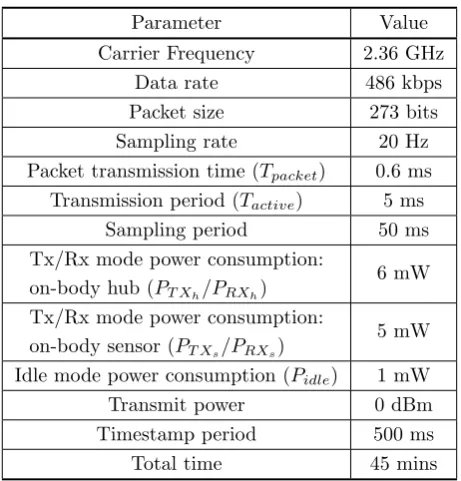
3.3 Applied Parameters . . . 55
3.4 Empirical result analysis for different protocols; OP, RS, TP, and EC imply outage probability, receive sensitivity, transmit power, and energy consumption, respectively . . . 76
4.1 Applied Parameters . . . 89
4.2 Distribution parameters of SINR values; {µ,λ} are the mean and shape parameter of the inverse Gaussian distribution; {µ,σ} are the log-mean and log-standard deviation of the lognormal distribution; {α, c, k} are the scale and two shape parameters of the burr dis-tribution; exp. and sim. imply experimental and simulated data, respectively . . . 93
5.1 The body-to-body channels with different sensor locations. ‘×’ indi-cates the B2B channels correspond to datasets with different number of coexisting BANs . . . 115 5.2 The WSS duration (in second) with 70% probability of stationarity
for various sensor location pairs of B2B links with different stationar-ity tests and confidence levels (i.e., 95%, 99%); ‘N/A’ implies to the case where the B2B channel does not satisfy the WSS assumption for minimum required window length . . . 125 5.3 Fitting parameters with SSE values for power and exponential fits
to the ACF decay of different B2B and on-body channels with 10 co-located BANs . . . 131 5.4 Log-likelihood values (LLVs) and maximum likelihood estimate (MLE)
parameters of different statistical fits to the probability distribution function (PDF) of B2B links with different sensor-location pairs of dataset 3; GEV implies to Generalised Extreme Value . . . 140 5.5 Median (med.), best-case, and worst-case coherence time for
differ-ent B2B channels (LH–LH, LH–RA, LH–LW) with 10 co-located BANs (dataset 3); for correlation coefficient, r ≥ 0.7 and r ≥ 0.5. . 142
Chapter 1
Introduction
1.1
Background, Motivation, and Scope
The advent of wearable technology has led to the communication of data from, and across sensors, worn by people in independent networks. According to a study in [4], the number of connected wearable devices worldwide is expected to jump from an estimate of 526 million in 2016 to 1.1 billion in 2022 (Fig. 1.1). This
2016 2017 2018 2019 2020 2021
Year
0 200 400 600 800 1000 1200
Connected Wearables (in millions)
325 453
593 722
835 929
Figure 1.1: The growth of connected wearable devices worldwide
demonstrates the need for ongoing research and development of body-centric com-munications, in particular the design of body-centric networks that can function
independently. Body-centric wireless communications is now accepted as an im-portant part of 4G and 5G mobile communications systems as well as a variety of personal area networks (PANs), which can take the form of human-to-human networking incorporating wearable sensors [5–7].
Wireless body-centric networks are created from the communications between different sensors placed on, in, around, and/or near the human body. Based on the placement of the wearable sensors, body-centric communications can be classified into the following types:
On-body communications: The communications between sensors that are placed
on the body (on surface of the body) or inside the body (implanted node). The end-points of these channels are on/inside the body.
Off-body communications: The communications between sensors that are placed
on the body and near the body (not on-body). One of the end point of these chan-nels is placed on the body.
Body-to-body (B2B) communications: The communications between
sen-sors that are placed on different peoples’ body. The end points of these channels are located on the body of two different subjects.
The body-centric communications described above, can particularly form two types of body-centric networks:
1.1.1
Wireless Body Area Networks (BANs)
Wireless Body Area Networks (BANs) are the latest generations of PANs where low power, short-range micro and nano technology sensors/actuators are placed on, in, around or/and near the human body, typically to monitor, or enable physiological functions (Fig. 1.2). The BAN paradigm offers a vast range of applications such as, ubiquitous healthcare, military, sports, entertainment and many other areas [2], but advanced healthcare is a unique motivator for such networks, specifically in medical rehabilitation, diagnosis and monitoring of patients.
1.1 Background, Motivation, and Scope 5
Figure 1.2: A BAN demonstrating wireless on-body and in-body links with on-body and implanted sensors/hub
healthcare facilities. In this context, the sensors incorporated in BANs may monitor numerous biometric parameters such as: body temperature; heart rate; respiration; blood pressure; and electrical parameters from the heart, muscles and brain. More-over, BANs can enable early medical detection and intervention, which can save lives and improve quality of life. In this context, as BANs provide very long contigu-ous data from a patient’s everyday environment, doctors can get a clearer picture of the patient’s condition [8]. Some further examples of very promising applications of BANs in healthcare are for rehabilitation including stroke rehabilitation, phys-ical rehabilitation after hip or knee surgeries, myocardial infarction rehabilitation and traumatic brain injury rehabilitation. Miniature, wireless, wearable technology offers a tremendous opportunity to enable and assess rehabilitation.
on-body communication body-to-body communication
Figure 1.3: A BBN demonstrating body-to-body communications between on-body hubs and sensors
emotion detection and social networking applications [2, 11]. However, the un-derlying technology is still at an early stage of deployment and typically based on very specific wireless communications technologies. Some well-known interna-tional standards for BANs are — IEEE 802.15.6 Standard [12]; Bluetooth Low Energy (BLE) [13]; ETSI SmartBAN [14]; which support low-power, short-range communications with star or multi-hop topology, to serve a variety of medical and non-medical applications. BANs may interact with the Internet and other existing wireless technologies like ZigBee [15], WSNs [16], Bluetooth [17], Wireless Local Area Networks (WLAN) [18], Wireless Personal Area Networks (WPAN) [19], video surveillance systems [20] and cellular networks [21].
1.1.2
Wireless Body-to-Body Networks (BBNs)
When multiple closely-located BANs coexist, the potential inter-network communi-cations and cooperation across BANs leads to a significant extension of the concept of wireless body area networks (BANs) [22] – known as wireless body-to-body net-works (BBNs) [23] or, more broadly, the Internet of Humans (IoH) [24] (Fig. 1.3). The main motivations behind BBNs are:
1.1 Background, Motivation, and Scope 7
Figure 1.4: BBN providing outdoor medical service
• to provide connectivity as independent or subsidiary networks when tradi-tional network connectivity is unavailable or limited, e.g., in emergency situ-ations and densely populated areas.
Importantly BBNs can provide greater radio coverage and connectivity than BANs while maintaining all the advantages of BANs. BBNs are more dynamic and po-tentially larger-scale than individual BANs, such that any BAN member can join or leave the network seamlessly, without the need for any centralised infrastruc-ture. The concept of BBNs is to send collected data, i.e., physiological information across closely located BANs via wearable sensors, to reach the intended destination in case of unavailable or out-of-range network infrastructure, e.g., in emergency in-door/outdoor scenarios. For instance, in a disaster where many people are injured and the cellular and fixed-line networks are damaged, BBNs can help in the triag-ing and monitortriag-ing of patients by relaytriag-ing information from body to body up to the access point of the on-site medical service provider (Fig. 1.4), providing timely intervention and treatment.
commu-nications; facilitating rescue/medical teams in a disaster area, and ambient assisted living (AAL) [25]. Further applications beyond health-care include: battlefield communications; precision monitoring of athletes; augmented reality [26]; perform-ing synchronised activities, e.g., interactive dancperform-ing [27]; interactive gamperform-ing [28], and better enabling communications in densely populated areas, e.g., city centres, concerts and sports venues, where the primary network service is not sufficient.
1.2
Problem Statement and Proposed Solution
As BANs are continuing to become more pervasive, their coexistence is a major concern. And, as a major application of body-centric networks is for healthcare and emergencies, reliable communications is of utmost importance. The require-ment for better coexistence and reliable communications leads to the need for body to body networks (BBNs). BBNs operate in a dynamic environment consisting of highly mobile individual BANs moving in and out of each others range, such that global coordination is typically not possible. In BBNs, radio channels experience significant shadowing due to obstructions and power absorption by nearby human bodies and body-parts due to frequent, different, movements. A simple postural change can block communications for a long period of time, resulting in decreased reliability, increased latency and increased energy consumption. In this context, body-centric channels have long coherence times, which can cause longer perfor-mance degradation when there is significant channel attenuation. Moreover, due to resource constraints of these low-power networks, providing best communications efficiency is vital in their optimisation.
Hence, in this thesis, we aim to address the following problem:
How to improve communications reliability and optimise
connectiv-ity amongst many co-located BANs or, more broadly, BBNs in order
to facilitate self-organised, efficient, and distributed body-centric
net-works?
1.2 Problem Statement and Proposed Solution 9
network layers, to improve packet delivery ratio and latency along with acceler-ated reaction/response time within the network. We implement adaptive mech-anisms based on time-varying channel condition estimated with longer coherence time of body-centric channels. We also investigate the predictive characteristics, i.e., wide sense stationarity and long-range dependence, of body-centric channels in order to build intelligent network, which can learn and self-organise. Based on the body-centric channels’ predictive characteristics, we apply multi-objective decision-making with adaptive scheduling to jointly optimise throughput, latency, and energy consumption of body-to-body channels. It is demonstrated with exper-imental analysis that the proposed methods provide the following benefits, in key performance metrics, for BBNs:
• Increased packet delivery ratio; In distributed BBNs, making use of
al-ternative/cooperative paths available through nearby BANs, enables greater network reliability. It is shown that negligible (almost 0%) packet error rate is achieved with the proposed cross-layer optimised routing techniques in a practical scenario with 10 coexisting BANs.
• Reduced latency; Longer outages can be avoided with alternative paths
through available sensors within the range of the nodes-of-interest. Also, adaptive techniques applied over such networks enable real-time delivery of critical/non-critical information. With the cross-layer methods, an acceptable amount of latency (according to the IEEE 802.15.6 BAN standard guideline [29]) is achieved for both medical (< 125 ms) and non-medical (< 250 ms) applications.
• Increased throughput; It is shown that with the increased packet delivery
ratio, throughput in terms of successfully received packets per second, also in-creases after applying the proposed methods, specifically with adaptive carrier sensing mechanism with CSMA/CA and multi-objective decision-making.
• Reduced Energy Consumption; The cross-layer optimisation used in this
there is extra energy consumption for the alternative path, the overall en-ergy consumption is reduced due to decreased packet failure rate. Also, the applied multi-objective optimisation provides a suitable trade-off between throughput, latency, and energy consumption of the channels.
In summary, the proposed solution provides improved reliability, together with op-timised and efficient connectivity, amongst many closely-located BANs (or BBNs) for large-scale and highly connected distributed real-world applications. Very im-portantly, this is validated in this thesis using many hours of empirical everyday on-body, and body-to-body, radio channel data.
1.3
Thesis Overview and Outline
This thesis provides design and analysis for optimisation of narrowband body-centric communications near the 2.4 GHz ISM band. Cross-layer and predictive techniques are applied over large-scale real-life experimental channel measurements collected from groups of mobile subjects wearing sensor radios on their body per-forming ‘everyday’ mixed activities (e.g., walking, sitting, standing, turning, talk-ing) in indoor/outdoor environments (e.g., building, office space, street, cafe/pub), for a significant amount of time — which provides a normalised outcome from many typical BBN scenarios. Throughout the thesis, we mainly focus on the per-formance analysis and optimisation of narrowband body-to-body channels between coexisting BANs, but also provide some accompanying study of the performance of narrowband on-body and off-body channels. The experimental analysis performed with extensive real-life body-centric channels in this thesis, answers the following:
• How much improvement does cooperative communications provide for direct link body-centric communications under significant shadowing?
• How can the available channels (body-to-body) between coexisting BANs be efficiently utilised, for improving the reliability of BBNs, with cooperative multi-path routing?
1.3 Thesis Overview and Outline 11
• Does cross-layer optimisation between non-adjacent layers (physical-network layers), without radio interference mitigation, provide acceptable latency and packet delivery ratio for closely located BANs?
• Are wireless body-to-body channels wide-sense-stationary (WSS) or second-order stationary?
• Do wireless body-centric channels have range dependence (LRD) or long-memory?
• What is an appropriate model to characterise the shadow fading of body-to-body channels for coexisting BANs?
• Do the predictive characteristics , i.e., WSS and LRD, of B2B channels vary for different sensor radio placements?
• How to utilise the predictive characteristics of B2B channels for multi-objective optimisation over BBNs?
The technical contributions of this thesis are detailed in four chapters (as demon-strated in Fig. 1.5), which address the questions outlined above. Chapters 3 and 4 describe cross-layer optimisation for BBNs, and chapters 5 and 6 analyse the pre-dictive behaviour of body-centric channels and apply multi-objective optimisation suited to this behaviour over body-centric channels.
The contributions of each chapter of this thesis can be summarised as:
Chapter 2: An up-to-date literature review of existing work relevant to this
thesisis provided, along with key research gaps addressed in this thesis. For body-centric networks, the general architecture and communications technologies are described, along with the typical challenges associated with practical deployment of these networks.
Chapter 3: Cooperative combining mechanisms, and cross-layer optimisation
Figure 1.5: Thesis Flowchart
very large improvements over the direct link communications of a star topology for monitoring a sleeping subject. Then we propose two different cross-layer optimised routing techniques – shortest path routing (SPR) and cooperative multi-path rout-ing (CMR) — that incorporate 3-branch cooperative selection combinrout-ing, without central coordination across multiple coexisting BANs. The best route is selected at the network layer according to channel state information from the physical layer The key findings from this chapter are:
1.3 Thesis Overview and Outline 13
outage duration, respectively.
• The proposed CMR provides up to 8 dB improvement over state-of-the-art routing protocols at 10% outage probability.
• CMR outperforms other protocols in case of throughput (packets/second) by providing 95% successful packet delivery.
• CMR produces the lowest amount of average end-to-end delay with respect to other protocols, when estimated with lower receive sensitivity, i.e., −90 dBm and −86 dBm.
• With less receive sensitivity, i.e., −90 dBm and −86 dBm, the energy con-sumption of CMR remains relatively constant, while the energy concon-sumption of other protocols increases significantly due to an increase in packet failure rate and retransmissions.
Chapter 4 This chapter analyses the performance of the SPR and CMR
tech-niques (proposed in Chapter 3) across distributed BBNs with interference mit-igation schemes, by associating the PHY-Network cross-layer optimisation with different MAC layer schemes, i.e., time division multiple access (TDMA) and novel carrier sense multiple access with collision avoidance (CSMA/CA). The key out-comes of this analysis with experimental measurements are as follows:
• CMR provides up to 14 dB improvement with 8.3% TDMA duty cycle over SPR at 10% outage probability, and up to 9 dB improvement over SPR, at 90% packet delivery ratio.
• The proposed adaptive carrier sensing mechanism provides 20% and 6% improvement, over a coordinated TDMA approach with higher duty cycle, for throughput and spectral efficiency, respectively, and provides acceptable packet delivery ratio and outage probability with respect to SINR.
Chapter 5 In order to apply predictive optimisation over body-centric channels,
body-centric channels. Hence, in this chapter, we investigate the predictive char-acteristics, i.e., wide-sense-stationarity (WSS) and long-range dependence (LRD, long-memory), of on-body and body-to-body channels. We employ different hy-pothesis tests for evaluating mean and variance stationarity, along with evaluating distribution consistency of several body-centric channels. We also examine the pat-tern of the decaying auto-correlation function and estimate the Hurst exponent for investigating the LRD characteristics. We show that
• Unlike on-body channels, which are non-stationary, body-to-body channels can possess WSS characteristics for a range of window lengths between 0.5 s to 15 s (typically 5–8 s), depending on on-body sensor locations and the amount of shadowing in the corresponding channel.
• The Hurst exponent is very high (around 0.9) for body-centric channels and the auto-correlation between data points of the channels decreases very slowly (power-like decay), which both indicate retaining LRD or long-memory char-acteristics.
Chapter 6 Influenced by the existence of WSS and LRD characteristics
(pre-sented in Chapter 5) of body-to-body channels, we apply multi-objective optimi-sation with adaptive scheduling over BBNs, by following a discrete time Markov decision process (MDP) that utilises the predictive characteristics (i.e., WSS and LRD) of B2B channels. For adaptive scheduling, time division multiple access (TDMA) and carrier sense multiple access with collision avoidance (CSMA/CA) — are combined, to utilise the advantages of both TDMA and CSMA/CA. The outcome is Pareto optimal that provides a desired trade-off between three objec-tives — maximising throughput, and minimising continuous latency and energy consumption of the B2B communications, between any two BANs (direct link) in the presence of other coexisting (interfering) BANs. We compare the Pareto opti-mum (obtained from adaptive scheduling with MDP), with the results of TDMA and CSMA/CA applied separately. From the experimental results, we find that
1.3 Thesis Overview and Outline 15
TDMA schemes have fixed duty cycles). Then again, f∗ produces a slightly (around 5%) higher amount of continuous latency than TDMA schemes for smaller intervals, and similar amount of continuous latency as TDMA for longer intervals (≥4 s).
• CSMA/CA with−70 dBm carrier sense threshold (csth) consumes around 2.3 times more energy, and has much higher continuous latency, than the Pareto optimumf∗, although it provides almost twice as much throughput than the Pareto optimum (f∗). For instance, CSMA/CA with cs
th = −70 dBm has a continuous latency of greater than or equal to 250 ms for around 46% of the total time, whereasf∗ produces the same amount of latency for less than 30% of the total time.
• The Pareto optimum has the highest packet delivery ratio (PDR > 80%), than all other individual actions.
Chapter 7 Finally, this chapter provides a summary of the results drawn from
Chapter 2
Literature Review
In wireless body-to-body networks (BBNs), communication takes place among sen-sors and hubs worn by multiple human subjects, where each subject can have an operating wireless body area network (BAN). Hence, the general architecture and technology of BANs can also be applied within BBNs. In this chapter, first we provide a description of the communication architecture and technology for body-centric networks, along with associated challenges. Then we discuss the current state-of-art for optimising body-centric communications in detail. Following these discussions we highlight research gaps. Although the main focus of our research is BBNs, which have not been investigated to nearly as a large extent as BANs, here we discuss both BAN and BBN communications research, as BAN operations provide context to BBNs.
2.1
Communications Architecture and
Technol-ogy of Body-centric Networks
2.1.1
Communications Architecture
Communications architecture in body-centric networks generally follows a multi-tier architecture, where the communications occurs in multiple hierarchical multi-tiers:
• Tier-1 (intra-BAN communications) Intra-body communications [30–
32] in tier-1 includes in-body, on-body, and off-body communications that
Figure 2.1: Multi-tier architecture for body-centric communications.
occurs in/on or around an individual BAN. In this tier, the wearable sensors send physiological information to the hub or personal device of a BAN and actuators can receive control information from the hub.
• Tier-2(inter-BAN communications)In this tier, communications occurs
between personal devices or hubs of different BANs (i.e., body-to-body com-munications or inter-BAN comcom-munications [23, 33, 34]) and possible access points (e.g., routers) [35, 36] or gateways (e.g., smartphones) [37, 38]. The hub or personal devices in tier-2 can relay the information between hubs to the nearby access point to send to tier-3 entities (e.g., servers).
• Tier-3 (beyond-BAN communications) Tier-3 communications is
be-yond BANs/BBNs, which helps to enhance the coverage area for applications of body-centric networks, e.g, remote patient monitoring [39, 40], e-health care [41], emergency medical services [42, 43], enabling authorised health care personnel (doctor/nurse) through the Internet or a cellular network.
2.1 Communications Architecture and Technology of Body-centric Networks 19
following categories:
Centralised:
The use of a centralised architecture [44–47] is the most common communications strategy in a BAN where a central hub/gateway device (placed on/in/around the body) coordinates the sensor/actuator nodes placed on different parts of the body — collects data/information from the sensor nodes and sends control information to actuators. This type of communications particularly occurs in tier-1 at small-scale (typically within a single BAN). A number of BANs in tier-1 can also be coordinated with a coordinator BAN (e.g., cluster-head) or a central access point in tier-2.
Cluster-based:
In a cluster-based architecture [48, 49], multiple clusters or groups are formed between coexisting BANs, where in each cluster there are multiple BANs (tier-1 communications). Each cluster has a cluster head or coordinator/gateway, e.g., a BAN node/hub, which further communicates with other cluster heads for inter-cluster communications and data transfer (tier-2 communications). The inter-cluster head controls the cluster, and the coverage of the cluster is usually one or two hops from the cluster head. This type of architecture is useful for dense networks, and when separate groups of BANs are performing different tasks [50–53].
Distributed:
(a) (b)
Figure 2.2: (a) Cluster-based and (b) Distributed architecture of coexisting BANs.
communications to reach the coordinator/hub in tier-1, and inter-BAN commu-nications to reach the intended access point in tier-2. Also the commucommu-nications between a BAN sensor (in tier-1) and the intended access point (in tier-2) can also be performed in a distributed manner by combining tier-1 and tier-2 communica-tions. A distributed architecture helps to establish communications in the case of multiple BANs coexistence without external coordination.
2.1.2
Radio Technology
2.1 Communications Architecture and Technology of Body-centric Networks 21
Figure 2.3: Some of the available bands for BAN based on RF technology [1].
Unlike the BAN standard (IEEE 802.15.6), there is no specific standard de-signed for BBNs. More recently, an European standard (ETSI TC SmartBAN) [14] has been developed, which can support coexistence of BANs in an IoT en-vironment to bridge between devices operating in different radio standards. The choice of a suitable technology for BBNs depends on their particular applications, as no single industrial standard has all the required specifications for large-scale BBN (due to different data rates, power consumption, coverage, and topology). Some proprietary wireless technologies have been developed for low power WSNs and healthcare applications, e.g., ANT/ANT+ [65], Sensium [66], Zarlink (now acquired by Microsemi) [67], Insteon [68], Z-Wave [69]. However, the radio tech-nologies used in BANs can be applied for BBNs as the nodes/sensors in BBN are placed on different bodies in a close proximity. The specifications of different tech-nologies used in body-centric networks are provided in Table 2.1 and the description of some technologies from literature [1–3, 70] is as follows:
IEEE 802.15.4 Standard
topology and provides the advantage of network coverage by providing multi-hop routing in both cluster and mesh topology [77].
The 802.15.4 MAC layer supports two operational modes: beacon enabled and non-beacon enabled mode. In beacon enabled mode, the coordinator initiates the channel access with a beacon packet and a superframe structure is used that is divided into an active and an inactive period. The active period consists of a con-tention access period (CAP) and a concon-tention free period (CFP). During the CAP, the channels follow a slotted CSMA/CA mechanism, whereas the CFP contains guaranteed time slots (without contention), supporting TDMA. The inactive pe-riod allows nodes to go into sleep mode or low power mode according to the specific application. In the non-beacon enabled mode, the channels only use an unslotted CSMA/CA mechanism [15].
ZigBee suffers from interference from WLAN transmissions [78] and low data rate (only up to 250 kbps) that is not adequate for large-scale deployment of con-nected BANs [70], rather ZigBee is more suitable for home automation [79] and industrial automation and control [80].
IEEE 802.15.6 Standard
The IEEE 802.15 Task Group 6 developed a standard specifically designed for BANs – namely IEEE 802.15.6 [12], which is one of the latest and well-known international standard for BANs. The aim of the IEEE 8012.5.6 standard was to describe the PHY and MAC layers so as to provide a certain quality level for low power devices in communications surrounding the human body [81]. The PHY layer defines three different communications bands:
• Narrowband (NB) PHY: The frequency bands supported in NB PHY
are as follows: 402−405 MHz, 420−450 MHz, 863−870 MHz, 902−928 MHz, 950−958 MHz, 2360−2400 MHz and 2400−2483.5 MHz. Among the three communication bands, NB PHY is best suited to a greater number of healthcare applications [82], due to its lower carrier frequency (results in less attenuation) and smaller bandwidth (1 MHz or less), hence reducing multi-path propagation and inter-symbol interference [83].
2.1 Communications Architecture and Technology of Body-centric Networks 23
are divided in to a low (3.25−4.75 GHz) and a high (6.6−10.25 GHz) band for supporting high quality, low complexity and ultra low power operations [1]. Also, UWB PHY considers two types of UWB technology: frequency-modulated FM-UWB and impulse-radio IR-UWB. As stated in [82], IR-UWB is best suited for BANs due to lower power consumption and efficient imple-mentation of non-coherent receivers [84]. Also UWB offers higher throughput with a large bandwidth – each UWB channel has a bandwidth of 499 MHz in IEEE 802.15.6 [12].
• Human-body communications (HBC) PHY: This band supports the
frequency band from 5−50 MHz and uses the human body as a commu-nication medium. HBC is the first technology to use electric field coupling (EFC) – capacitive and galvanic coupling where the transmission is over the medium of human skin by an electrode, rather than by an antenna [82].
The 802.15.6 MAC layer divides the channel into beacon periods or superframes of equal length, and provides three access modes coordinated by the hub:
• Beacon mode with superframe boundaries: In this mode, the
coordi-nator sets the time for superframes by sending a beacon packet to indicate the beginning of an active superframe period. The superframe is again di-vided into different access phases: exclusive access phase (EAP), random Access phase (RAP), contention access period (CAP), and managed access phase (MAP). The EAP is used for transmission of emergency data, both the RAP and CAP use CSMA/CA or slotted ALOHA methods. In MAP, the coordinator may schedule intervals, or poll nodes [12].
• Non-beacon mode with superframe boundaries: In this mode,
bea-cons are not sent at the beginning of the transmission, but the superframe period and phases (possibly in MAP) are defined and unscheduled frames are transmitted by the coordinator.
• Non-beacon mode without superframe boundaries: This mode also
type 2 and as a portion of EAP or RAP to employ CSMA/CA based random access schemes.
Bluetooth Low Energy
Bluetooth wireless technology [17] is a short-range, low-power, and low-cost stan-dard designed for replacing the cables connecting portable or fixed electronic de-vices in a WPAN or piconets [85, 86]. Bluetooth dede-vices operate in the 2.4 GHz ISM band with coverage ranging from 1−100 meter, and supports only star topol-ogy and a maximum data rate of 3 Mbps (with Enhanced Data Rate or EDR). Bluetooth low energy (BLE) [13] is a configuration of Bluetooth technology that includes lower power consumption and complexity with lower cost than EDR with a data rate of up to 1 Mbps, and operates with a simpler protocol stack than other Bluetooth technology and star-configured networks, which makes it suitable for some BAN applications, e.g., consumer applications [87] and regular (less critical) health parameters monitoring [88]. However, it is not suitable for critical and high data rate healthcare applications due to the low data rate short-range communica-tion that requires line-of-sight conneccommunica-tion for reliable operacommunica-tion [89]. Also, BLE is not appropriate for BBNs as it does not support multi-hop communications (only supports on-body communications with star topology), and has limited scalability, QoS, and interoperability [56].
SmartBAN
2.2 Challenges of Wireless Body-centric Communications 25
provides fast channel acquisition and easy hub-to-hub communication. In Smart-BAN MAC, the data channel is divided into inter-beacon intervals that consist of three parts: contention free scheduled access period (uses TDMA), control and management (C/M) period (uses slotted-Aloha), and an inactive period. Addi-tionally, a multi-use channel access (MCA) mode is defined that utilises scheduled, but unused, time slots for increasing channel utilisation.
Other Technology
Some other technologies used in body-centric networks are: ultra-wideband (UWB) [63], Bluetooth High Speed (HS) [90], WLAN [18,62]. Bluetooth HS supports data rate from 3−24 Mbps and includes 802.11 protocol adaptation layer (PAL) into the protocol stack [3]. Also, some commercial and proprietary technologies are used in body-centric networks, e.g., ANT/ANT+ [65], RuBee [91], Sensium [66], Zarlink (now acquired by Microsemi) [67], Insteon [68], Z-Wave [69], RFID [92], BodyLAN [93]. ANT features simpler protocol stack and lower power consumption, which has been embedded in Nike shoes and can be interfaced with iPod products [3]. Insteon and Z-Wave are used for home automation with mesh networking technologies [94,95]. RuBee and RFID are complimentary to each other in terms of frequency bands, and both are used for asset management and tracking [3]. Sensium features ultra-low power transceiver platform that is custom designed for healthcare and lifestyle management applications [56]. The communications architecture is centralised with single-hop connection. Zarlink developed an ultra-low power RF transceiver that is configured as an implantable medical device (IMD), and supports extremely low power consumption [56].
2.2
Challenges of Wireless Body-centric
Commu-nications
Table 2.1: Specifications of different wireless technologies used in body-centric networks [2, 3].
Technology Frequency Data Rate Coverage Topology
Bluetooth 2.4 GHz ISM 780 Kbps 10−150 m
(on-body) star
Bluetooth
(EDR) 2.4 GHz ISM 3 Mbps
10−100 m
(on-body) star
Bluetooth (HS)
2.4 GHz ISM
5 GHz 3−24 Mbps
10 m
(on-body) star
Bluetooth
(LE) 2.4 GHz ISM 1 Mbps
10 m
(on-body) star
IEEE 802.15.4 (ZigBee)
2.4 GHz ISM 868 MHz 915 MHz
20−250 Kbps 10−100 m
(on-body)
star, multi-hop mesh, cluster
IEEE 802.15.6
2.4 GHz ISM
401−406 MHz
902−928 MHz
1 Kbps to 10 Mbps
2−5 m
up to 10 m star, two-hop
Ultra-wideband
(UWB) 3.1−10.6 GHz 110−480 Mbps
5−10 m
(on-body) star
RFID (ISO/IEC 18000−6)
860−960 MHz 10−100 Kbps 1−100 m peer-to-peer
SmartBAN 2.4 GHz ISM
(variable) 75 Kbps to
15 Mbps
<2 m star
hub-to-hub
ANT 2.4 GHz ISM 1 Mbps 30 m
on-body
star, mesh peer-to-peer IEEE 1902.1
(RuBee) 131 KHz 9.6 Kbps 30 m peer-to-peer
Zarlink (ZL70101)
402−405 MHz
433−434 MHz
200 to
800 Kbps 2 m (in-body) peer-to-peer
Insteon 131.65 KHz
902−924 MHz 13 Kbps Home area mesh
Z-Wave 900 MHz ISM 9.6 Kbps 30 m mesh
Sensium 868 KHz
915 MHz 50 Kbps
1−5 m
2.2 Challenges of Wireless Body-centric Communications 27
2.2.1
Mobility
Since the human body is constantly moving, sensor nodes on the body have mobil-ity features. Due to the postural body movements affecting BANs/BBNs as well as their mobility, the use of networks incorporating infrastructure such as backbone routers would generally be very costly and unfeasible. Even for indoor BANs coex-istence with mobile people, while deploying a backbone router is possible to some extent, the connection between a BAN hub and the router can be blocked/shadowed by any obstacle or may go out of range because of the movement, e.g., postural changes or mobility [96]. Importantly, people having mobility issues can incur life-threatening risks, as these type of outages can be for a longer period of time with only a simple postural change.
2.2.2
Time-varying dynamic topology
Unlike wireless sensor networks, the communication channels in BANs are heav-ily attenuated from shadowing by the human body. Due to this shadowing and postural body movements, the path loss between sensor nodes in a BAN will be non-stationary and constantly changing [97–99]. BAN radio propagation typically encounters significant path loss with deep fades that can last for a long time, of the order of seconds [82]. This will cause serious topological partition problems and time-varying channel conditions where links between nodes are broken, and built, frequently. Additionally, when multiple BANs coexist in a very close proximity for any special indoor/outdoor activity, or in any emergency indoor/outdoor sit-uation, the interfering radio communications and shadowing from different bodies or BANs (including the body parts of the BAN-of-interest) make it very difficult for the BAN-of-interest to transfer the collected information to the intended access point [96].
2.2.3
Routing challenges
and real-time data transfer are required for BANs/BBNs. As stated in [100], even though the general characteristics of BANs are somewhat similar to mobile ad hoc networks (MANETs) [101] and wireless sensor networks (WSNs) [102], the stringent requirements of BANs/BBNs impose certain constraints on the design of their networking protocols that leads to novel challenges, which can not be met through typical WSN/MANET routing protocols.
For example, the frequent topological changes in highly mobile coexisting BANs particularly occur with group-based movement, rather than node-based movement in MANETs, which suggests that all nodes in BANs move with keeping their posi-tion with respect to one another, while in MANET each node moves independently from other nodes in the network [103]. In fact, the on-body sensor nodes used in BANs move relative to the coordinator node of the corresponding BAN which is used as their reference point [104]. As the user moves, the whole network moves and then may move into (and out of) the range of other networks frequently, which results in network collision [105]. It is different to the interference events of cellu-lar/sensor networks where only one or two nodes interfere, and base stations rarely interfere [96]. The random nature of BAN movement means that network collisions in BBN can be very short (e.g., people passing on the street) or very long (e.g., family members/hospital patients may remain close for hours) [105].
2.2.4
Power Constraints
The management of scarce resources, such as, low-power battery, and low transmit power considering human body reaction to electromagnetic radiation is one of the major issues to deal with in these types of networks. BANs have more strict energy constraints in terms of transmit power when compared to traditional sensor and ad hoc networks as frequent node replacements can be quite unfeasible, and might require surgery in some scenarios, for implant nodes [2].


![Table 2.1: Specifications of different wireless technologies used in body-centricnetworks [2,3].](https://thumb-us.123doks.com/thumbv2/123dok_us/8214722.263922/68.595.73.469.162.663/table-specications-dierent-wireless-technologies-used-body-centricnetworks.webp)