Abstract: In this paper, closed form solution of outage and bit error rate (BER) is evaluated for the purpose of performance analysis of the amplify and forward relaying scheme under the asymmetric fading environment. In this dual hop system, we have used Rayleigh fading along source S to relay R and Mixture Gamma fading along relay R to destination D. First, we have derived closed form solution of outage and then we have used this derived expression for getting closed form solution of bit error rate (BER) for different kinds of modulation. Since Mixture Gamma fading channel represents many fading channels as its special case, so proposed closed form solution of outage and bit error rate may be used for analysis of outage and bit error rate under various fading scenarios. Specifically, in this paper, for analysis of outage and bit error rate (BER), we have taken Nakagami-m fading as a particular case of Mixture Gamma fading and analyzed the performance of proposed system after observing effect of fading severity factor and signal to noise ratio (SNR) on outage probability and bit error rate (BER).
Keywords : Asymmetric Fading, Bit Error Rate, Mixture Gamma fading, Outage Probability, Rayleigh Fading, Signal to Noise Ratio.
I. INTRODUCTION
Wireless communication has continued to make a profound impact on our daily lives. To increase effectiveness of wireless communication systems, use of relay in a network has been proposed. This transmission strategy of using relay as intermediate nodes between transmitter and receiver is known as a relay-assisted communication.
A huge number of literatures present the modeling and analysis of relay based wireless communication system. For enhancing the performance of wireless communication system, use of full duplex relay was suggested in [1]. Performance of partial relay selection scheme and optimal relay selection scheme was analyzed in [2]. Cooperative communication has been used in [3] for getting full cooperative diversity gains along with preserving spectral and energy efficiency. For energy harvesting and information decoding, optimization of the power splitting protocol under various relaying schemes has been done in [4] and efficient algorithms has been proposed for finding the optimal solutions. In [5], for Nakagami-m fading channel, a lower reduced limit of outage probability has been evaluated. In [6], performance has been investigated for N-hop relaying
system having amplify and forward scheme and
asymptotic expression of outage probability has also been
Revised Manuscript Received on September 08, 2019.
Brijesh Kumar Singh, Department of Electronics & Communication Engineering, Birla Institute of Technology, Mesra, Ranchi, India
Email: [email protected]
Mainak Mukhopadhyay, Department of Electronics & Communication Engineering, Birla Institute of Technology, Mesra, Ranchi, India
derived. In [7], a generalized fading model based on Mixture of Gaussians (MoG) distribution was suggested. In [8], it was evaluated that during wireless transmission, communication system can have better energy efficiency when there is relay at some particular distance from source. In [9], a new channel model for relay named as Gaussian half duplex relay channel was proposed and it was found that system for this scheme is less complicated in comparison of other conventional relaying schemes.
For sharing of bandwidth using relay in cognitive radio networks, a new protocol named as two phase protocol was suggested in [10]. In this protocol, whenever transmitter and receiver of secondary user are not directly connected then in this case, relay supports both, primary user and secondary user. Using this protocol, outage probability improves in comparison of outage we get without using this protocol. Interference produced by secondary transmission is taken care by compensation obtained by use of Relay. For maximal ratio combining having dual branch, probability of link success was evaluated in [11]. it was recognized from this study that maximal ratio combining and minimum mean square error combining shows comparable results. To meet conditions of hardware requirement of practical relay-based system, this observation provide basic guidelines [12].
For Relay based system in which channel state information in known, expression of bit error rate with reduced limits was deduced in [13]. Closed form solution of CDF and PDF for signal to noise ratio, in case of cooperative dual-hop diversity schemes having non-regenerative relays, were derived in [14].
In our proposed system, we have taken Mixture Gamma fading channel along relay to destination. Here, It is worthy to mention that Mixture Gamma distribution represents almost all the fading channels till the date as its special case. So, the proposed analysis presents a generic closed form solution for outage and bit error rate (BER) of the asymmetric relaying system.
The rest of paper is structured as given below. Section II presents the system model. For proposed system, method to derive closed form solution of outage and BER are presented in section III and section IV. Numerical analysis for the outage probability and bit error rate (BER) has been discussed in section V. Finally, in section VI, we have drawn our conclusion.
II. SYSTEMMODEL
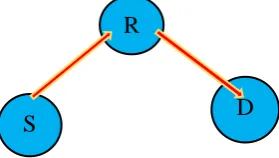
Figure 1 shows relaying system which consist of relay along with source and destination. Here, first of all, message is transmitted by source. Now, relay receives message sent by
Closed Form Solution for Outage and Average
Bit Error Rate of Asymmetric Relaying System
source and then retransmit it to destination. Such system is known as a dual hop transmission system. Furthermore, we have considered amplify and forward type of relaying system which is placed in asymmetric fading channel.
Fig. 1. Dual hop relaying system
In AF scheme, the relays act as analog repeaters. Relay R receives the signal transmitted by source S and then amplify it with some fixed gain and then retransmit it to the destination (D). Furthermore, we have considered asymmetric relaying system. In this system, fading channel along S-R and R-D are Rayleigh fading channel and Mixture Gamma fading channel respectively.
Fading channel having Rayleigh distribution is described by probability density function (PDF)
1
1 1
1 )
(
e
f
(1)
where
1 and
1 are instantaneous and average SNR for S-R link. Fading channel having Mixture Gamma distribution is described by following PDF given in equation 1 of [15].
N
i
x i i
N
i i
i i e
x x
f w x f
1 1 1
) ( )
(
,
x
0
(2)
Where
) ( )
(
1
i x i
i
i i
ix e
x f
represents standard Gamma
distribution,
(
)
is the Gamma function,i
i i i i
w
(
)
,N represents number of terms within the summation and
i,i
and
i represent the parameters corresponding to ithGamma factor. Here, 1
1
N
i i w
Mixture Gamma represents many fading channels as its particular case. When value of N is equal to 1, it gives Rayleigh fading distribution and Nakagami-𝑚 fading distribution.
III. CLOSEDFORMEXPRESSIONOFOUTAGE
PROBABILITY
Probability corresponding to outage is described as the probability for which instantaneous overall signal to noise ratio (SNR)
i declines to a value lower than a particular threshold value
th . Mathematically, probability corresponding to outage for any particular link is given by
f d
P
Poutage ( th) th ( )
0
(3)
For the proposed scenario, outage probability can be given as
))
,
(min(
1 2 thoutage
P
P
(4)Here and are instantaneous SNR along source to relay link and relay to destination link and is threshold value. Since link of S-R and link of R-D are not dependent, hence outage for the proposed system can be rewritten as
)
(
)
(
1 th 2 thoutage
P
P
P
(5) Now, we will evaluate the outage probability along source S to relay R link and relay R to destination D link separately. Finally, we will substitute the individual outage of each link in Equation (5).Using equation (1), outage for S-R link can be given as
1
1 0 1
1 1
1
)
(
d
e
P
th th
(6)This gives outage between S-R link as
11
)
(
1
th
e
P
th (7)Further, using Mixture Gamma fading distribution along relay R to destination D, outage for relay to destination link may be given as
2 1
2 2 0
1 2
2 2
)
(
d
e
P
ii
th N
i i th
(8)Here,
2 and
2 are instantaneous and average SNR along relay R to destination D link.Let
q
d
2 2dq
2
2
After using above substitution in Equation (8), we get
dq
e
q
P
qN
i i th
i i
th
10 1
2
)
2(
(9)Using [16] (Table of integrals, series, and products, 3.381, equation 1), we get
2 1
2
2
)
,
(
thi i i
N
i i th
i
P
(10)where
,
is the incomplete gamma function.Now, after using equation (7) and equation (10) into equation (5), we get the outage probability between source to destination for dual hop AF relaying system as given below.
2 1
2
,
1
1
th i i i
N
i
i outage
i
th
e
P
(11) Now, equation (11) can also be represented as
S
D
N i th i i i i th i i i i outage i i the
P
1 2 2 2 2 2 1,
,
,
1
The expression of above outage probability between S-D for dual hop AF relaying system may represent the outage under different fading scenarios because Mixture Gamma fading taken between R-D represents many fading channels as its special cases. Specifically, for
1
N
,
m mm
m
2 1
,
1
m
and2 1
m
it gives Nakagami-𝑚fading. Thus, in case of Nakagami-𝑚
fading between R-D, outage probability between S-D for dual hop AF relaying system is given as
N i th m m m th m m m outagem
m
m
m
m
e
m
m
m
m
m
P
th 1 2 2 2 2 2 2 2 2 2 2 2 1,
,
,
1
(12) Further, we will consider two special cases for asymmetric relaying system as given below.Case 1: if
1
2
x
then
N i th m m m x th m m m outagex
m
m
x
m
x
x
m
m
e
x
m
m
x
m
x
x
m
m
x
P
th 1 2 2,
,
(13)Case 2: if
1
2
2and
1
x
then2
2
x
and
N i th m m m x th m m m outagex
m
m
x
m
x
x
m
m
e
x
m
m
x
m
x
x
m
m
x
P
th 1 2 22
,
2
2
2
2
,
2
2
2
(14)IV. CLOSEDFORMEXPRESSIONFORBIT ERROR RATE(BER)
For performance analysis of this asymmetric relaying system (Rayleigh fading channel for S-R link and Mixture Gamma fading channel R-D link), we have also evaluated closed form expression of average bit error rate (ABER). Using equation 20 of [17], for various types of modulation schemes, average bit error rate (ABER) is given as
d
F
e
p
r
P
r pp
b
(
)
)
(
2
1 0
(15)
Here,
F
(
)
is cumulative distribution function.In equation (15), values of parameters r and p for binary phase shift keying (BPSK) are 1 and 0.5 respectively. For r = 0.5 and p = 0.5, equation (15) represent expression of average bit error rate (ABER) of binary frequency shift keying (BFSK).
In equation (11), when we replace
th by
, we get value of cumulative distribution functionF
as given below.
2 1 2,
1
1
i i i
N i i i
e
F
(16)Here,
,
is the incomplete gamma function.Using equation (15) and (16), we get
d
e
e
p
r
P
N i i i i i i i i i r p b i i p
1 2 2 2 2 0,
,
)
(
2
1 1(17)
Here,
,
is the incomplete gamma function.Now, from equation (17), we get
2 1
I
I
d
e
p
r
I
N i i i r i i p p i
1 2 0 2 1,
)
(
2
1(19) and
d
e
p
r
I
N i i i r i i p p i
1 2 0 1 2 2,
)
(
2
1 1(20)
After putting i
x
2
i.e.
x
i
2 andd
dx
i
2 inequation (19) and equation (20), we get following two expressions in the form of equation (21) and equation (22).
dx
x
e
x
p
r
I
N i i x r i i p i p i p i 1 0 2 2 1,
*
)
(
2
2 1
(21)and
dx
x
e
x
p
r
I
N i i x r i i p i p i p i 1 0 1 2 2 2,
*
)
(
2
2 1 1
(22)
In equation (21) and equation (22),
,
is the incomplete gamma function.From [16] (Table of integrals, series, and products, 6.455, equation 2), we know that
s
b
b
a
F
s
b
b
a
dx
x
b
x
e
sx a a b1
1
;
1
;
,
1
*
1
)
(
,
1 2 0 1
(23)After using equation (23) into equation (21) and equation (22), we get following two expressions in the form of equation (24) and (25).
i i i p i i i N i i i p i pr
p
F
r
p
p
r
I
i i
2 1 2 2 1 2 2 11
1
;
1
;
,
1
1
)
(
*
)
(
2
(24) and
i i i p i i i N i i i p i pr
p
F
r
p
p
r
I
i i
2 1 1 2 2 1 1 2 2 21
1
1
;
1
;
,
1
1
1
)
(
*
)
(
2
(25)
i i i
p
i i
i N
i
i i p
i p
b
r p
F
r p p
r
P
i i
2 1
2
2 1
2 2
1 1 ; 1 ; , 1
1 ) (
* ) ( 2
i i
i
p
i i
i N
i
i i p
i p
r p
F
r p p
r
i i
2 1 1
2
2 1 1
2 2
1 1
1 ; 1 ; , 1
1 1
) (
* ) ( 2
(26)
So, for relay based wireless communication system having asymmetric Rayleigh and Mixture Gamma fading channel, equation (11) and equation (26) represents expression of outage probability and BER respectively.
V. NUMERICALANALYSIS
Numerical analysis for outage and BER is provided in this section. MAPLE has been used for plotting closed form solution of outage and BER evaluated in section III and section IV respectively. For performance analysis of this proposed system, Rayleigh distribution in S-R link and Mixture Gamma distribution in R-D link have been taken. Mixture Gamma fading shows utility of our model because it includes various fading channel as its special cases. We have taken Nakagami-m fading as the special case of Mixture Gamma fading and for this, we have put
N
1
,
m mm
m
2
1
,
1
m
and2 1
[image:5.595.66.275.47.334.2]
m
Fig. 2. Outage probability under asymmetric Rayleigh and Mixture Gamma fading channel with
1
2
x
Here, figure 2 shows outage probability for the case 1 for
[image:5.595.329.524.227.406.2]which
1
2 has been taken i.e. signal to noise ratio along S-R link and R-D link are same. We have taken threshold value
th
10
dB
. For Nakagami-m fading channel as the special case of Mixture Gamma fading channel, different values of severity factor m have been taken. The severity factor m varies in the range of0
.
5
m
0 and amount of fading is represented by1/m. Fig. 2 shows that as the values of severity factor m is increasing, the outage probability is decreasing. Fig. 2 also describes that as the value of average SNR increases, outage probability decreases. These two observations made from Fig. 2 show perfect agreement with theory.Fig. 3. Outage probability under asymmetric Rayleigh and Mixture Gamma fading channel with
1
2
2 Here, figure 3 shows outage probability for the case 2 forwhich
1
2
2 i.e. SNR of source S to relay R link is two times of SNR of relay R to destination D link and for thisscenario also, threshold value
th
10
dB
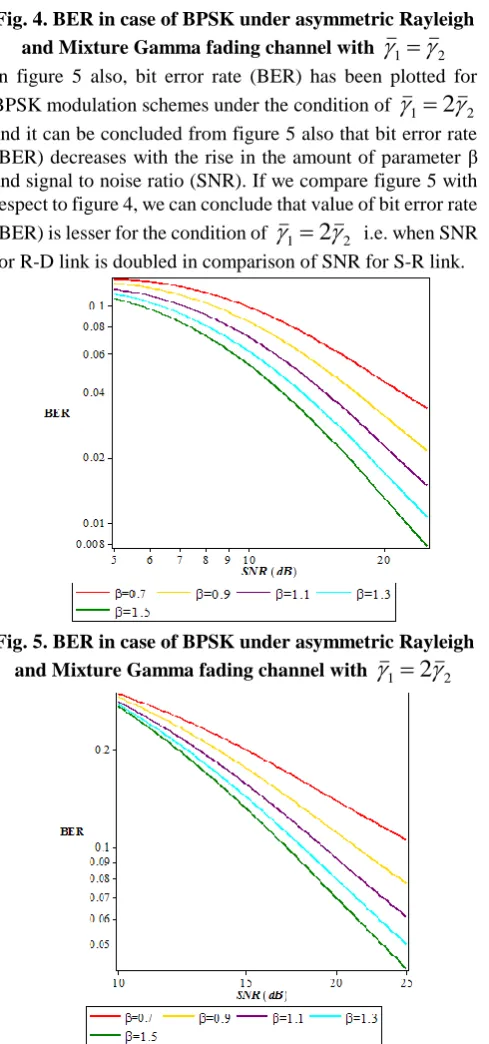
has been taken. In case 2 also, we have taken different values of fading severity factor m. It can be seen using Fig. 3 also that larger values of severity factor m give lower values of outage. This figure also describes that outage probability decrease as we increase the value of SNR. These two observations made from Fig. 3 also show perfect agreement with theory.For performance analysis of this asymmetric relaying system, bit error rate (BER) has also been plotted under the condition
[image:5.595.47.289.513.743.2]Fig. 4. BER in case of BPSK under asymmetric Rayleigh and Mixture Gamma fading channel with
1
2 In figure 5 also, bit error rate (BER) has been plotted forBPSK modulation schemes under the condition of
1
2
2 and it can be concluded from figure 5 also that bit error rate (BER) decreases with the rise in the amount of parameter β and signal to noise ratio (SNR). If we compare figure 5 with respect to figure 4, we can conclude that value of bit error rate(BER) is lesser for the condition of
1
2
2 i.e. when SNR for R-D link is doubled in comparison of SNR for S-R link. [image:6.595.321.527.207.416.2]Fig. 5. BER in case of BPSK under asymmetric Rayleigh and Mixture Gamma fading channel with
1
2
2Fig. 6. BER in case of BFSK under asymmetric Rayleigh and Mixture Gamma fading channel with
1
2In figure 6 and figure 7, bit error rate (BER) has been plotted
[image:6.595.51.296.229.752.2]for BFSK modulation scheme under the condition of
1
2 and
1
2
2. After observing figure 6 and figure 7, we can conclude that there is decline in the value of bit error rate (BER) if we increase value of parameter β and signal to noise ratio (SNR) and this observation also shows perfect agreement with theory. After comparing figure 6 and figure 7, we can observe that in case of BFSK modulation schemes also, if we have
1
2
2 then value of bit error rate (BER) is lesser in comparison of bit error rate (BER) under the condition of
1
2.Fig. 7. BER in case of BFSK under asymmetric Rayleigh and Mixture Gamma fading channel with
1
2
2VI. CONCLUSION
This paper analyses outage probability and bit error rate in case of cooperative communication system. Since Mixture Gamma fading channel taken along relay to destination can represent the many fading scenarios, so we have taken Nakagami-m fading as a particular case of Mixture Gamma fading and plotted outage and BER for performance analysis of proposed system. From the plots of outage, it is clear that as the value of SNR increases, outage probability decrease. Outage probability also declines as we increase the value of fading severity factor. We have also plotted bit error rate (BER) of proposed system for binary phase shift keying (BPSK) and binary frequency shift keying (BFSK). It can be observed from the plots of BER that for both, BPSK and BFSK, when we have high value of SNR and fading severity factor, we get lower value of bit error rate (BER). Analysis presented here may also be very useful for evaluation of outage and BER when many other fading scenarios will be considered from relay to destination along with Rayleigh fading channel from source to relay. In future, using analysis of outage and BER, capacity can also be analyzed for performance analysis of this asymmetric cooperative communication system.
[image:6.595.56.282.542.755.2]REFERENCES
1. Mafra, Samuel B., Hirley Alves, Daniel B. Costa, Richard D. Souza, Evelio MG Fernandez, and Matti Latva-aho. "On the performance of cognitive full-duplex relaying under spectrum sharing constraints." EURASIP Journal on Wireless Communications and Networking 2015, no. 1 (2015): 169.
2. Do, Nhu, Vo Bao, and Beongku An. "Outage performance analysis of relay selection schemes in wireless energy harvesting cooperative networks over non-identical rayleigh fading channels." Sensors 16, no. 3 (2016): 295.
3. Liang, Xuedong, Min Chen, Ilangko Balasingham, and Victor CM Leung. "Cooperative communications with relay selection for wireless networks: design issues and applications." Wireless Communications and Mobile Computing 13, no. 8 (2013): 745-759.
4. Liu, Yuan. "Wireless information and power transfer for multirelay-assisted cooperative communication." IEEE Communications Letters 20, no. 4 (2016): 784-787.
5. Nguyen, Khoa D., Albert Guillén i Fabregas, and Lars K. Rasmussen. "Analysis and computation of the outage probability of discrete-input lock-fading channels." In 2007 IEEE International Symposium on Information Theory, pp. 1196-1200. IEEE, 2007.
6. Mou, Weifeng, Fang Fang, Xiaoming Xu, Weiwei Yang, and Yueming Cai. "Performance analysis of multihop AF relaying systems in the presence of cochannel interferences." International Journal of Distributed Sensor Networks 11, no. 6 (2015): 508987.
7. Alhussein, Omar, Bassant Selim, Tasneem Assaf, Sami Muhaidat, Jie Liang, and George K. Karagiannidis. "A generalized mixture of Gaussians for fading channels." In 2015 IEEE 81st Vehicular Technology Conference (VTC Spring), pp. 1-6. IEEE, 2015.
8. Chandra, A., B. Ghosh, N. Biswas, G. Brante, and R. D. Souza. "Energy efficient relay placement for dual hop wireless transmission." International Journal of Electronics Letters 1, no. 4 (2013): 198-209.
9. Cardone, Martina, Daniela Tuninetti, Raymond Knopp, and Umer Salim. "On the Gaussian half-duplex relay channel." IEEE Transactions on Information Theory 60, no. 5 (2014): 2542-2562.
10. Zhao, Feng, Xiangqi Sun, Hongbin Chen, and Rongfang Bie. "Outage performance of relay-assisted primary and secondary transmissions in cognitive relay networks." EURASIP Journal on Wireless Communications and Networking 2014, no. 1 (2014): 60.
11. Tanbourgi, Ralph, Harpreet S. Dhillon, Jeffrey G. Andrews, and Friedrich K. Jondral. "Dual-branch MRC receivers under spatial interference correlation and Nakagami fading." IEEE Transactions on Communications 62, no. 6 (2014): 1830-1844.
12. Bjornson, Emil, Michail Matthaiou, and Mérouane Debbah. "A new look at dual-hop relaying: Performance limits with hardware impairments." IEEE Transactions on Communications 61, no. 11 (2013): 4512-4525.
13. Cvetković, Aleksandra, Jelena Anastasov, Stefan Panić, Mihajlo Stefanović, and Dejan Milić. "Performance of dual-hop relaying over shadowed ricean fading channels." Journal of Electrical Engineering 62, no. 4 (2011): 244-248.
14. Tsiftsis, Theodoros A., George K. Karagiannidis, P. Takis Mathiopoulos, and Stavros A. Kotsopoulos. "Nonregenerative dual-hop cooperative links with selection diversity." EURASIP Journal on Wireless Communications and Networking 2006, no. 2 (2006): 34-34. 15. Atapattu, Saman, Chintha Tellambura, and Hai Jiang. "A mixture
gamma distribution to model the SNR of wireless channels." IEEE transactions on wireless communications 10, no. 12 (2011): 4193-4203.
16. Gradshteyn, Izrail Solomonovich, and Iosif Moiseevich Ryzhik. Table of integrals, series, and products. Academic press, 2014.
17. Sharma, Nikhil, Ankur Bansal, and Parul Garg. "Decode-and-forward relaying in mixed η− μ and gamma–gamma dual hop transmission system." IET Communications 10, no. 14 (2016): 1769-1776.
AUTHORSPROFILE
Brijesh Kumar Singh received B.Tech. degree in 2003 in Electronics Engineering from IET, Lucknow, India. He is pursuing Ph.D. in Wireless Communication from Birla Institute of Technology, Mesra, India. He is currently working as an assistant professor at GLBITM, Greater Noida, India. His research interests are modeling and analysis of various impairments in Wireless Communications. He is member of GISFI, India.