UNIVERSITI TEKNIKAL MALAYSIA MELAKA
DRIVING MOTION SIMULATOR
This report submitted in accordance with requirement of the UniversitiTeknikal Malaysia Melaka (UTeM) for the Bachelor Degree In Electrical Engineering
Technology (Industrial Power) (Hons.)
by
ELDRY BIN EIRY B071410272 940804-12-5213
UNIVERSITI TEKNIKAL MALAYSIA MELAKA
BORANG PENGESAHAN STATUS LAPORAN PROJEK SARJANA MUDA
Cop Rasmi:
Tarikh: _______________________ AlamatTetap:
KAMPUNG MARUAH, TELIPOK, 88450,SABAH.
Tarikh: 18 December 2017 SULIT
Disahkanoleh: (Mengandungimaklumat TERHAD yang telahditentukanolehorganisasi/badan di manapenyelidikandijalankan)
TAJUK: DRIVING MOTION SIMULATOR
SESI PENGAJIAN: 2016/17 Semester 7
SayaELDRY BIN EIRY
mengakumembenarkanLaporan PSM inidisimpan di PerpustakaanUniversitiTeknikal Malaysia Melaka (UTeM) dengansyarat-syaratkegunaansepertiberikut:
1. Laporan PSM adalah hak milik Universiti Teknikal Malaysia Melaka dan penulis. 2. Perpustakaan Universiti Teknikal Malaysia Melaka dibenarkan membuat salinan
untuk tujuan pengajian sahaja dengan izin penulis.
3. Perpustakaan dibenarkan membuat salinan laporan PSM ini sebagai bahan pertukaran antara institusi pengajian tinggi.
4. **Silatandakan ( )
(Mengandungimaklumat yang
berdarjahkeselamatanataukepentingan Malaysia sebagaimana yang termaktubdalam AKTA RAHSIA RASMI 1972)
TERHAD
TIDAK TERHAD
** JikaLaporan PSM ini SULIT atau TERHAD,
DECLARATION
I hereby, declared this report entitled “Driving Motion Simulator” is the results of my own research except as cited in references.
Signature : ……….
Author’s Name : ELDRY BIN EIRY
Date : 18th December
APPROVAL
This report is submitted to the Faculty of Engineering Technology of UTeM as a partial fulfillment of the requirements for the degree of Bachelor of Electrical Engineering Technology (Industrial Power) with Honours. The member of the supervisory is as follow:
………
(Project Supervisor)
………
(Project Co-Supervisor)
DEDICATION
I would like to thank God for his blessing and guidance throughout this completion of the project. To my beloved family who support in term of budget and encouragement to complete this project, thank you so much. This work is dedicated to my beloved project supervisor, Madam Intan Mastura Binti Saadon and Mr Fazly. Their guidance, assistant, encouragement and support has plays a major role in completing this project. Not forgetting for the Co-supervisor, Puan Amalia Aida who also give encouragement and support in this project report completetion. I would like to dedicate my thesis to all lecturers and friends who gives me support and guidance in any situation.
ACKNOWLEDGEMENT
Firstly, I would like to express my gratitude to my family for their guidance and encouragement throughout the course. The blessing and assistance from them bring me a long way in the journey of life on which I am to embark. I would like to express my appreciation to my beloved project supervisor, Madam Intan Mastura binti Saadon and Mr. Fazly who gives a lot of guidance, encouragement, assistance and support to me in completing this project. All she had done to assist me will be remembered forever. To co-supervisor Puan Amalia Aida, thank you for the guidance and support in completing this project. Finally, I would like to thanks all my lecturer and friend who gives me support and guidance in any situation.
ABSTRAK
Projek ini mencadangkan perlaksanaan simulasi pergerakkan pemanduan. Penggunaan simulasi pemanduan telah digunakan sebagai alat untuk mengajar di pusat latihan memandu. Penambahbaikan yang dijalankkan atas simulasi pemanduan telah meningkat mengikut peredaran zaman. Penambahan simulasi pemanduan dalam kalangan pusat latihan juga semakin meningkat untuk dimasukkan dalam kurikulum. Tetapi, kebanyakkan simulasi pemanduan yang ada hanya menyediakan stering, pedal dan perisian. Penambahan pergerakan dalam simulasi pemanduan akan meningkatkan kerja lebih untuk pemandu kerana pemandu perlu fokus dan memastikan tingkah laku ketika memandu simulasi pemanduan. Pergerakkan akan dihasilkan oleh putaran motor arus terus di mana akan mengerakan rangka kerusi. Potensiometer digunakan sensor maklum balas untuk mengawal darjah untuk pusingan motor arus terus. Pengawal yang digunakan dalam projek ini adalah Arduino Uno R3 dan pemanduan untuk motor areus terus adalah Moto Monster. Simulasi yang digunakkan dalam projek ini adalah Live for Speed dan perisian untuk mengeluarkan data untuk pergerakkan adalah SimTools.
ABSTRACT
This project propose the development of driving motion simulator. Driving simulators are increasingly being used as a didactic tool in driver training and education. Because the hardware has become more affordable and the quality of the simulator has improved over the past years, more and more driving instructors have decided to add simulator training to their curriculum. However, most of the driving simulator offer virtual driving car using only steering wheel, pedal and simulator software. The presence of motion increase the workload of the driver as driving simulator with motion offers a lot more focus and improve the driver behaviour hence speed up the learning process and minimize the chances of accident as the driver has learned to control the car as in various situation during training. The motion is created by using the rotation of DC motor that actuate the frame seat. Potentiometer is used as the feedback sensor to control the angle of the DC motor driver rotation. Microcontroller used in this project is Arduino Uno R3 and the motor driver used is Moto Monster Driver which support 30 ampere of current to control both of the DC motor. The simulator used in this project is Live for Speed and the software to extract the motion data from the simulator is Simtools. This project may contributes some idea on how to build a more realistic motion simulator. In real situation, this project does increase the focus and behaviour during in driving simulator training.
TABLE OF CONTENT
Dedication iii
Acknowledgement iv
Abstrak v
Abstract vii
Table of Content vii
List of Tables xi
List of Figures xii
List Abbreviations, Symbols and Nomenclatures xiv
CHAPTER 1: INTRODUCTION 1
1.1 Background of the Study 1
1.2 Problem Statement 2
1.3 Objective of the Study 2
1.4 Work Scope of the Study 3
1.5 Contribution 3
1.6 Thesis Outlines 3
CHAPTER 2: LITERATURE REVIEW 5
2.1 Introduction 5
2.2 Related Work 6
2.2.1 Motion-Base Simulator Evaluation of an Aircraft Using an External
Vision System 6
2.2.2 Development of a Motion System for a Training Simulator Based
on Stewart Platform 6
2.2.3 A Nonlinear, MPC-Based Motion Cueing Algorithm for a
High-Performance, Nine-DOF Dynamic Simulator Platform 7 2.2.4 State of the Art and Simulation of Motion Cueing Algorithm
for a Six Degree of Freedom Driving Simulator 7
2.3 Driving Motion Simulator 8
2.3.1 Degree of Freedom 9
2.4 DC Motor Driver 10
2.4.1 Monster Motor Shield DC Motor Driver 10
2.4.2 Monster Moto Shield VNH2SP30 Pin Configuration and Pin
Description 11
2.5 Arduino Uno R3 Microcontroller 13
2.5.1 Pin Configuration 13
2.5.2 Power Pins 14
2.5.3 Input and Output 14
2.6 Software Specification 16
2.6.1 Arduino Software 17
2.6.2 Proteus 8.0 Professional 18
2.6.3 Autocad 19
2.6.4 SimTools 19
2.6.5 Simulator 20
CHAPTER 3: METHODOLOGY 21
3.1 Introduction 21
3.2 Flow Chart 21
3.3 Frame Seat Design of the Project 23
3.4 Driving Motion Simulator 25
3.5 Block Diagram of the System 27
3.6 Equipment and Material 28
3.6.1 DC Motor 28
3.6.2 Arduino Uno R3 Microcontroller 29
3.6.3 Potentiometer 30
3.6.4 Power Supply 31
3.6.5 DC Motor Driver 32
3.6.6 Gaming Steering Wheel 33
3.7 Work Implementation 34
3.7.1 DC Motor Angle Control 34
3.7.2 DC motor Coupled with Potentiometer 35
3.7.3 Power Supply 36
3.7.4 Frame Seat 37
3.7.5 SimTools Configuration 41
3.8 Conclusion 44
CHAPTER 4: RESULT AND DISCUSSION 45
4.1 Introduction 45
4.2 System Overview 45
4.3 Simulation Analysis 46
4.4 Hardware Analysis 48
4.5 Conclusion 51
CHAPTER 5: CONCLUSION 52
5.1 Introduction 52
5.2 Summary of the Project 52
53 Summary of the Research Objective 52
5.4 Summary of Methodology 53
5.5 Summary of the result 53
5.6 Recommendation 54
REFERENCES 55
APPENDICES 56
A Arduino Programming 56
B Moto Monster Motor Driver 63
C Power Supply Unit 65
D Potentiometer 67
E Arduino Uno R3 69
F Wiper DC Motor 71
LIST OF TABLES
2.4.3 Pin configuration Moto Monster Shield VNH2SP30 12
2.5.2 Arduino Uno R3 Power Pin Label 14
2.5.3 Input and output of Arduino Uno R3 14
3.3 Component Name 23
3.13 Manual Instruction for Controlling DC motor angle 35
3.24 SimTools area explain 42
LIST OF FIGURES
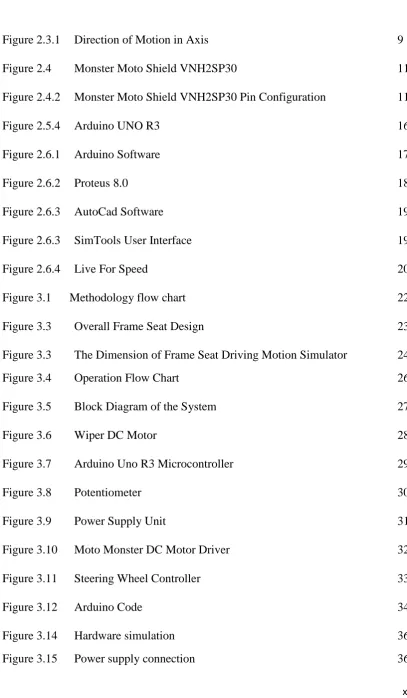
Figure 2.3.1 Direction of Motion in Axis 9
[image:14.595.111.519.94.793.2]Figure 2.4 Monster Moto Shield VNH2SP30 11
Figure 2.4.2 Monster Moto Shield VNH2SP30 Pin Configuration 11
Figure 2.5.4 Arduino UNO R3 16
Figure 2.6.1 Arduino Software 17
Figure 2.6.2 Proteus 8.0 18
Figure 2.6.3 AutoCad Software 19
Figure 2.6.3 SimTools User Interface 19
Figure 2.6.4 Live For Speed 20
Figure 3.1 Methodology flow chart 22
Figure 3.3 Overall Frame Seat Design 23
Figure 3.3 The Dimension of Frame Seat Driving Motion Simulator 24
Figure 3.4 Operation Flow Chart 26
Figure 3.5 Block Diagram of the System 27
Figure 3.6 Wiper DC Motor 28
Figure 3.7 Arduino Uno R3 Microcontroller 29
Figure 3.8 Potentiometer 30
Figure 3.9 Power Supply Unit 31
Figure 3.10 Moto Monster DC Motor Driver 32
Figure 3.11 Steering Wheel Controller 33
Figure 3.12 Arduino Code 34
Figure 3.14 Hardware simulation 36
Figure 3.15 Power supply connection 36
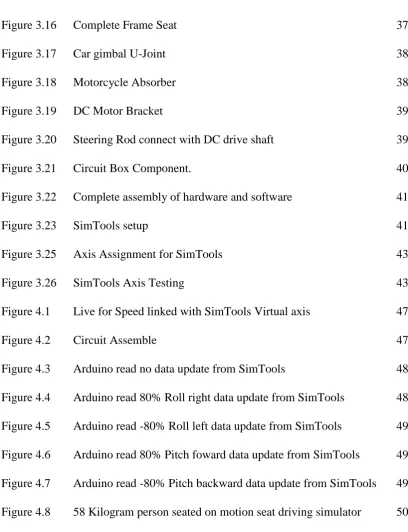
Figure 3.16 Complete Frame Seat 37
Figure 3.17 Car gimbal U-Joint 38
Figure 3.18 Motorcycle Absorber 38
Figure 3.19 DC Motor Bracket 39
Figure 3.20 Steering Rod connect with DC drive shaft 39
Figure 3.21 Circuit Box Component. 40
Figure 3.22 Complete assembly of hardware and software 41
Figure 3.23 SimTools setup 41
Figure 3.25 Axis Assignment for SimTools 43
Figure 3.26 SimTools Axis Testing 43
Figure 4.1 Live for Speed linked with SimTools Virtual axis 47
Figure 4.2 Circuit Assemble 47
Figure 4.3 Arduino read no data update from SimTools 48 Figure 4.4 Arduino read 80% Roll right data update from SimTools 48 Figure 4.5 Arduino read -80% Roll left data update from SimTools 49 Figure 4.6 Arduino read 80% Pitch foward data update from SimTools 49 Figure 4.7 Arduino read -80% Pitch backward data update from SimTools 49 Figure 4.8 58 Kilogram person seated on motion seat driving simulator 50
LIST OF ABBREVIATIONS, SYMBOLS AND
NOMENCLATURE
DC - Direct Current
PWM - Pulse Width Modulation DOF - Degree Of Freedom USB - Universal Serial Bus
I/O - Input or Output
COM - Communication
MCA - Model Cueing Algorithm MPC - Model Predictive Control
RX - Receive
TX - Transmit
CHAPTER 1
INTRODUCTION
1.1 Background of the Study
The uses of dynamical driving simulators is mutual in many diverse application fields, such as driver training, vehicle improvement, medical studies and for entertainment. The efficiency of such devices is linked to their abilities of well imitating the driving ambiances, and hence, it is vital that the motion control planscreate both realistic and practicableresponses to the stage, to make sure that it is kept within its limited procedure space.
Basically, this project aim to allow the existence of motion on seat being a driver in racing games or virtual car driving simulation by using the available market steering wheel console. SimTools is a software that provides the user on extracting data from the simulation or games. The extracted data can be manually setup from 1 degree of freedom to 6 degree of freedom. The data extracted from the software or games is a value that indicates the degree of freedom value shows on the monitor. The value from SimTools is then transmit to the Arduino Uno R3 via serial communication. The Arduino reads the data sent through serial communication port by SimTools and directs it to the potentiometer and motor driver. It perform a feedback control by reading the values of the potentiometer that are coupled to the motors shaft. The initial position of the potentiometer is compared to the set point, if the value is difference, the dc motor will rotate to the position of the new potentiometer value, therefore actuate the frame seat of the driving simulator seat. Hence, if the value of potentiometer keep update with different value of potentiometer, the dc motor will rotate as to find the updated potentiometer value. As to sum up, it will create a motion to the seat of the driving simulator.
1.2 Problem Statement
The process of training drivers for today’s complex vehicles is a fairly time-consuming and expensive task. The actual solution to this problem is creation of simulators that make learning more convenient and cheaper, and less dangerous, especially when training actions in various emergency situations. Nowadays simulators where the trainee cabin is mounted on a movable platform are wide spread.
To utilize the idea of motion simulator, a driving seat motion simulation is build. In Europe, this project have been developed. However, the driving motion simulator is in six degree of freedom. Therefore, a two degree of freedom motion simulation is designed. Two DC motor will rotate based on the value of potentiometer that deliver bySimTools to the Arduino Uno R3 microcontroller. The rotation of the dc motor will allow the existence of motion of the seat of the driving motion simulator.
1.3 Objective of the Study
The objective of this project are:
1. To control the angle of DC motor.
2. To study the SimTools interface software. 3. To design the frame of the seat.
4. To develop a driving motion simulator seat.
1.4 Work Scope of the Study
As to smoothen the flow of the project according to the project objective, several scope must be done within the project area. This project will be focused on the way to design on how to create motion on the seat. A study on the SimTools software and DC motor driver connection with the potentiometer. Moreover, programming codes for Arduino Uno R3 microcontroller should be consider to allow the motor driver and potentiometer work together to control the angle of the DC motor.
To develop a driving motion simulator, a designed seat frame is needed to integrate the motor with the seat to create motion. Then, the driving motion simulator seat are sketched and designed. By using SimTools software as an input signal to provide data and Arduino Uno R3 as a microcontroller, the driving motion simulator seat can be develop.
1.5 Contribution
As a result, a driving motion simulator seat was designed and developed. This project will contributes idea to others in developing a more than two degree of freedom driving simulator. The project shows modern and advanced technology in its system. In this project, most of the theoretical knowledge and engineering technology will be applied. Hopefully, this project will successfully achieved its goal and vision to make a motion on the driving simulator.
1.6 Thesis Outlines
This thesis consists of five chapters. The following chapters are the outline of the implementation of Driving Motion Simulator.
Chapter 1: This chapter will discusses clearly the summary of this project such as introduction, objectives, problem statement, and scope of work, methodology and thesis outlines.
Chapter 2: This chapter comprises the research and information about the project on numerous important ideas of Driving Motion Simulator, technology and tools used in the study. This chapter also includes details in software and hardware design for Driving Motion Simulator.
Chapter 3: This chapter will discuss more about methodology used to resolve the project problem. All those methodology should be conducted to get improved performance.
Chapter 4: This chapter will discuss result and analysis detailed on designing driving motion simulator model. Hardware and Software result will be discussed in this chapter. All construction circuit, analysis, observation and design are denoted in this chapter. The results presented in this thesis are based in the design procedure that has been specified before.
Chapter 5: This chapter will discuss about the discussion, problem, conclusion and suggestion of this project. Any observation or proposal can be devoted in instruction to expand the project in the future.
CHAPTER 2
LITERATURE REVIEW
This chapter contains the sum up of the previous research and information on the project related to several important concepts of driving motion simulator, technology and materials to be used in this study. As a necessary of the project, description of software and hardware also includes in detail for the motion driving simulator.
2.1 Introduction
Steering wheel gamepad is a device that allow the user to navigate the virtual car through the steering wheel controller to add a realistic experience as the user imitate to drive a real car. This project is to construct a driving motion simulator which the user simulator seat allow a more realistic sensation in driving a virtual car by creating a motion tilting on the seat.
This chapter cover the previous study of the related work based on the application of motion driving simulator.. The motion in the driving simulator are controlled based on the configuration and set-up of the hardware and software indirectly the implementation for understanding of the hardware and software is a must. This is to ensure that a more efficient and practical application toward the contribution of the study.
2.2 Related Work
2.2.1 Motion-Base Simulator Evaluation of an Aircraft Using an External Vision System
Motion-Based Simulator Evaluation of an Aircraft Using an External Vision by Lynda J. Kramer, (2015) evaluation method is quite similar with the current project which uses the motion-based platform using Cockpit Motion Facility (CMF) to create the motion of the aircraft based on the pilot desired direction. External Vision System is a combination of sensor and display technologies intended to provide an equivalent level of safety and performance to that provided by forward-facing windows in today’s aircraft. (Lynda J. Kramer, 2015)
2.2.2 Development of a Motion System for a Training Simulator Based on Stewart Platform
Another similar project by Evgeny I. Krasnov, (2015), in which the main goal for this project is to creates an illusion of the given movement for the driver. The platform consist of six identical legs. The length of each leg can vary by rotating a ball screw driven by a servo motor. Each motor operate independently, having its own position, velocity and acceleration rotation in a time unit. (Evgeny I. Krasnov, 2015)
2.2.3 A Nonlinear, MPC-Based Motion Cueing Algorithm for a High-Performance,Nine-DOF Dynamic Simulator Platform
Model predictive control (MPC) based motion cueing algorithm aim to relate to their capabilities of well reproducing the driving sensations, and hence, it is crucial that the motion control strategies generate both realistic inputs to the platform, to ensure that it is kept within its limited operation space. The Nine-DOF dynamic simulator platform architecture’s allows to obtain large travels along those directions that are particularly relevant for applications in the automotive field with reduced overall dimension. (Mattia Bruschetta,2016)
2.2.4 State of the Art and Simulation of Motion Cueing Algorithms for a Six Degree of Freedom Driving Simulator
In a meantime, a project by Konrad Stathl, (2014), algorithms for a six degree of freedom driving simulator aim to compare the classical Washout algorithm, optimal algorithm and predictive washout. The result can be used to design the simulator system and the model can be used to test other algorithm.
2.3 Driving Motion Simulator
A driving simulator is a dynamic virtual reality system which provides the ability to test many driving situations under safe conditions. Therefore, it can be used in many different areas such as for research purposes to study the behaviour of the driver or develop and evaluate the new subsystems of the vehicle, or they can be used for training of drivers or for entertainment as in video games. (Imad Al Qaisi, 2012)
The development of the driving simulator can be applied to many field such as flight simulator since the purpose of motion simulator is to develop a motion for the user to experience the surrounding environment virtually before conducting the vehicle to a real world. The process of training drivers for today’s complex vehicles is a fairly time-consuming and expensive task. The actual solution to this problem is creation of simulators that make learning more convenient and cheaper, and less dangerous, especially when training actions in various emergency situations. (Evgeny I. Krasnov, 2015)
In human factor study, the driving motion simulator are used to study the human behaviour when driving a vehicle be it in the specific state such as driving during lack of sleep, alcohol influence and many behaviour state. These simulators are an essential tool in the research of human factor related to car driving. Advantages of using a driving simulator are safety (there are no traffic accidents during driving) and simple collecting of data related to the driver's behaviour. (Lejla Banjanovic, 2016)