http://dx.doi.org/10.4236/am.2013.412219
A Theoretical Foundation for the Widely Linear Processing
of Quaternion-Valued Data
Tohru Nitta
National Institute of Advanced Industrial Science and Technology (AIST), Tsukuba, Japan Email: [email protected]
Received June 7, 2013; revised July 7, 2013; accepted July 15, 2013
Copyright © 2013 Tohru Nitta. This is an open access article distributed under the Creative Commons Attribution License, which permits unrestricted use, distribution, and reproduction in any medium, provided the original work is properly cited.
ABSTRACT
In this paper, we will give a theoretical foundation for a quaternion-valued widely linear estimation framework. The estimation error obtained with the quaternion-valued widely linear estimation method is proved to be smaller than that obtained using the usual quaternion-valued linear estimation method.
Keywords: Augmented Statistics; Complex Number; Estimation; Quaternion
1. Introduction
The widely linear (WL) estimation method has been pro- ved mathematically to be effective for estimation prob- lems using complex-valued data. Estimation using WL uses complex conjugate parameters in addition to com- plex-valued parameters [1]. It has been applied to com- munications [2,3] and adaptive filters [4], together with so-called augmented complex statistics, a concept intro- duced by Picinbono et al. Moreover, an extension of the WL method to quaternion-valued case has been pre- sented [5], which fully exploits available statistical in- formation. A quaternion, a four-dimensional number invented by W. R. Hamilton in 1843, is an extension of a complex number. Let H be a four-dimensional vector space over with an ordered basis, denoted by and where is a set of real numbers. Any quarter- nion
R 1, ,i j
k q
R
H is expressed as where . The three basis elements satisfy the relations
q a ib jckd
, ,
i j k
, ,
a b c d, R
2 2 2 1,
i j k (1)
, ,
ij ji k jk kj i ki ik j. (2)
Quaternion algebra has been used in fields such as ro- botics, computer vision, neural networks, signal pro- cessing, and communications (e.g. [6-8]).
In this paper, we present a theoretical foundation for quaternion-valued WL estimation: it is proved that the estimation error obtained using the quaternion-valued WL estimation method is smaller than that obtained us-
ing the usual quaternion-valued estimation method [9].
2. The WL Model
In this section, the complex-valued WL model and the quaternion-valued WL model are reviewed.
2.1. The Complex-Valued WL Model
Let yC be a scalar complex-valued random vari- able to be estimated in terms of an observation that is a complex-valued random vector N
x C
N
x
where is a set of complex numbers, and is a natural number. That is, is a true value and is an observed value. In complex-valued linear mean square estimation (LMSE), the problem is to find an estimate written as
C
y
ˆ H ,
L
y h x (3) where hCN, and H represents the complex conju-
gation and transposition. Then, the objective of the prob- lem is to find the parameter hCN that minimizes the
estimation error E yyˆL 2.
In the meantime, the complex-valued widely linear mean square estimation (WLMSE) problem can be stated as follows: Consider the scalar yˆ defined as
ˆ H H ,
yh xg x (4) where g h, CN, and def
v a bi is the complex con- jugate of v a bi C
,
. Then, the objective of the problem is to find parameters g hCN that minimize
Picinbono et al. gave a theoretical foundation for the complex-valued WLMSE described above: it was proved that the estimation error obtained using the complex- valued WLMSE method is smaller than that obtained using the usual complex-valued LMSE method:
2
ˆL ˆ
E yy E yy2 where the equality holds only in exceptional cases [1].
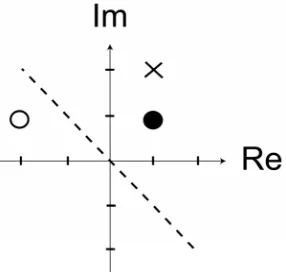
[image:2.595.101.244.573.709.2]Figures 1 and 2 demonstrate the effectiveness of com- plex-valued widely linear estimation. Samples of com- plex-valued random variable x and y are axisymmetric about the broken line: the white circle, the black circle, and the christcross in Figure 1 correspond to the white circle, the black circle, and the christcross in Figure 2, respectively, and the three marks in Figure 1 and the three marks in Figure 2 are all axisymmetric about the broken line. It is therefore difficult to estimate the three samples in Figure 1 by performing rotation, reduction, or expansion of the three samples in Figure 2 about the origin. Nevertheless, inversion of the samples about the real axis, i.e., assuming it as the samples of conjugate complex-valued random variable, allows to be estimated by rotation, reduction, and expansion about the origin. This is an intuitive explanation that the complex-valued widely linear estimation is superior to the conventional linear estimation method.
Figure 1. Three samples of a complex-valued random vari- able x.
Figure 2. Three samples of a complex-valued random vari- able y.
2.2. The Quaternion-Valued WL Model
The quaternion-valued WL model is a natural extension of the complex-valued WL model described in Section 2.1. Let yH be a scalar quaternion-valued random variable to be estimated in terms of an observation that is a quaternion-valued random vector N
x H . That is, y is a true value and x is an observed value.
In quaternion-valued linear mean square estimation (LMSE), the problem is to find an estimate written as
ˆ H ,
L
y h x (5) where hHN,
N is a natural number, and H repre- sents the quaternionic conjugation and transposition.
The quaternion-valued widely linear mean square es- timation (WLMSE) problem can be stated as follows: Consider the scalar yˆ defined as
ˆ H H ,
yh xg x (6) where g h, HN
bi cj dk
, N is a natural number, H represents the quaternionic conjugation and transposition, and def
v a bi cj dk
is the quaternionic conjugate of v a H. Then, the objective of the prob- lem is to find parameters g h, HN that minimize
2
ˆ E yy .
Took and Mandic derived an augmented quaternion least mean squares (AQLMS) algorithm for quaternion valued adaptive filters based on the quaternion-valued WL model, and confirmed its effectiveness via computer simulations [5]. Actually, the experimental results on the Lorenz attractor, real-world wind forecasting, and data fusion via quaternion spaces support the approach. Con- sequently, computer simulations proved that the quarter- nion-valued WL estimation method is superior to the usual quaternion-valued linear estimation method.
Moreover, the three perpendicular quaternion involu- tions can be introduced into the quaternion-valued WLMSE, which are given by
,
i
q iqi a ib jckd (7)
,
j
q jqj a ib jckd (8)
,
k
q kqk a ib jckd (9) where q a ib jckdH [10-12]. The quarter- nion-valued WLMSE using (6) is an initial insight. However, in order to achieve the complete description of the second order statistics in H,
ˆ y
we need to consider the involutions ((7)-(9)). Actually, the quaternion-valued widely linear mean square estimation (WLMSE) problem using the involutions has been formulated as follows [12]: Consider the scalar defined as
ˆ H H i H j H k,
yh xg x u x v x (10) where , , , N
lem is to find parameters , , , N
g h u v H that minimize
2
ˆ E yy .
However, no theoretical proof for the superiority of the quaternion-valued WL estimation method on estimation errors has been given to date, as it has been for the com- plex-valued WL estimation method. In the complex- valued setting, Picinbono et al. proved that the estimation error obtained with the complex-valued WLMSE is smaller than the error obtained using the complex-valued LMSE [1].
3. A Theoretical Foundation of the
Quaternion-Valued WL Model
In this section, we show the superiority of the quarter- nion-valued WLMSE method. The main result is as fol- lows: the estimation error obtained using the quarternion- valued WL estimation method based on (6) is smaller than that obtained using the usual quarternion-valued linear estimation method, except in rare cases. The result is obtainable in the same manner described by [1]. How- ever, the noncommutativity of the quaternion products must be considered during the analysis (xyyx for any
,
x yH). Define
def
, .
H H
X Z h x g x g hHN
Therein, X is a set of scalar quaternion-valued random variables that constitutes a linear space, and which be- comes a Hilbert subspace of the one-dimensional quarter- nion-valued Hilbert space Y
z
H with thescalar product z, defE z
z,X
. Then, for atrue value yY, an observed value N
x H , and the
estimate yˆX , the following equations hold:
yyˆ
x, (12)
yyˆ
x, (13) where means that all the components of are orthogonal to u with the scalar productuv v
,
, N
uH vH . From (12) and (13), we obtain
ˆ ,
ExyExy
s
(14)
ˆ .
Ex y Ex y (15)
Consequently, from (6), (14), (15), the following equa- tions hold (see the appendices for the detail of the deri- vation):
1 C r,
h g (16)
2 ,
H
C h g (17) where 1defE H,
xx def
T
2 E ,
x x
def
T ,
C Exx def
,
r Exy
def
. s E yx
1 H
s C
1 1
r C
Equations (16) and (17) yield
12 C 1C
1 2
H
C C
1
1
1 ,
H
r
g (18)
2s
h
1 1
(19)
where we assume that 1 and 2
1
12 1
H
C C
exist (see the appendices for the detail of the derivation). Then, the estimation error WL is calculated from (6),
(16), and (17) as follows:
def
WL
2 ˆ2 2 H T .
E y y E y r s
h g (20)
The estimation error L in the quaternion-valued
LMSE can be obtained using (5) as shown below.
def
2 2 2 1
1
ˆ H
L E y yL E y r r
. (21) Then, from (16) and (18), (20), (21), the quantity 2
can be expressed as
2 1
1
1
1 1
2 1 1 ,
H H
L WL
H H
s C r
C C s C r
def
2 2
C
(22)
which is the difference between the estimation error of the quaternion-valued LMSE and that of the quarter- nion-valued WLMSE. Equation (22) is nonnegative be- cause the matrix is positive-semidefinite (see the appendices for the proof). Furthermore, (22) is equal to zero only when one of the following conditions holds:
1
2 1
H
C
1
1 ,
H
sC r0 (23) ˆ .
y y (24) Equation (23) is an exceptional case, and (24) means that the true value y can be estimated with probability of one, which is a rare case.
4. Discussions
In the previous section, a theoretical foundation of the quaternion-valued WL model based on (6) is given, which guarantees the superiority of the quaternion-val- ued WLMSE method. It is difficult to analyze the quater- nion-value WLMSE method using (7)-(9) which contains all the necessary second order statistical information be- cause the process of the analysis is very complicated due to the three involutions if we adopt the way of proof used in [1]. To solve the problem, another approach would be needed.
5. Conclusion
ternion-valued WL estimation method. It was proved that the estimation error obtained using the quaternion-valued WL estimation method is smaller than that obtained us- ing the usual quaternion-valued linear estimation method, except in rare cases. In our future studies, we will pro- ceed with analyses of the WL estimation based on the Clifford algebra [13].
6. Acknowledgements
The author extends special thanks to Prof. B. Picinbono, the Laboratoire des Signaux et Systèmes, Supélec, Gifsur Yvette, France for help in resolving several questions, and the anonymous reviewers for valuable comments.
REFERENCES
[1] B. Picinbono and P. Chevalier, “Widely Linear Estima- tion with Complex Data,” IEEE Transactions on Signal Processing, Vol. 43, No. 8, 1995, pp. 2030-2033. http://dx.doi.org/10.1109/78.403373
[2] H. Gerstacker, R. Schober and A. Lampe, “Receivers with Widely Linear Processing for Frequency-Selective Channels,” IEEE Transactions on Communications, Vol. 51, No. 9, 2003, pp. 1512-1523.
http://dx.doi.org/10.1109/TCOMM.2003.816992
[3] R. Schober, W. H. Gerstacker and L. H.-J. Lampe, “Data- Aided and Blind Stochastic Gradient Algorithms for Widely Linear MMSE MAI Suppression for DS-CDMA,” IEEE Transactions on Signal Processing, Vol. 52, No. 3, 2004, pp. 746-756.
http://dx.doi.org/10.1109/TSP.2003.822359
[4] D. P. Mandic and V. S. L. Goh, “Complex Valued Non- linear Adaptive Filters: Noncircularity, Widely Linear and Neural Models,” John Wiley and Sons Ltd., Hobo- ken, 2009. http://dx.doi.org/10.1002/9780470742624 [5] C. C. Took and D. P. Mandic, “The Quaternion LMS
Algorithm for Adaptive Filtering of Hypercomplex Proc- esses,” IEEE Transactions on Signal Processing, Vol. 57,
No. 4, 2009, pp. 1316-1327.
http://dx.doi.org/10.1109/TSP.2008.2010600
[6] T. Nitta, “A Quaternary Version of the Back-Propagation Algorithm,” Proceedings of the IEEE International Con- ference on Neural Networks (ICNN’95), Perth, 27 No- vember-1 December, 1995, pp. 2753-2756.
[7] P. Arena, L. Fortuna, G. Muscato and M. G. Xibilia, “Neural Networks in Multidimensional Domains,” Sprin- ger, London, 1998.
[8] T. Isokawa, N. Matsui and H. Nishimura, “Quaternionic Neural Networks: Fundamental Properties and Applica- tions,” In: T. Nitta, Ed., Complex-Valued Neural Net- works: Utilizing High-Dimensional Parameters, Infor- mation Science Reference (IGI Global), Hershey, New York, 2009, pp. 411-439.
http://dx.doi.org/10.4018/978-1-60566-214-5.ch016 [9] T. Nitta, “Widely Linear Processing of Hypercomplex
Signals,” In: B.-L. Lu, L. Zhang and J. Kwok, Eds., Neu- ral Information Processing, Lecture Notes in Computer Science, Springer, Berlin, Heidelberg, 2011, pp. 519-525. [10] C. C. Took and D. P. Mandic, “A Quaternion Widely
Linear Adaptive Filter,” IEEE Transactions on Signal Processing, Vol. 58, No. 8, 2010, pp. 4427-4431.
http://dx.doi.org/10.1109/TSP.2010.2048323
[11] J. Via, D. Ramirez and I. Santamaria, “Properness and Widely Linear Processing of Quaternion Random Vec- tors,” IEEE Transactions on Information Theory, Vol. 56, No. 7, 2010, pp. 3502-3515.
http://dx.doi.org/10.1109/TIT.2010.2048440
[12] D. P. Mandic, C. Jahanchahi and C. C. Took, “A Quarter- nion Gradient Operator and its Applications,” IEEE Sig- nal Processing Letters, Vol. 18, No. 1, 2011, pp. 47-50. http://dx.doi.org/10.1109/LSP.2010.2091126
Appendices
Proof of Equations (16) and (17):
ˆ
0 from Equation 12
ˆ .
E y y E y E y
x x x
(25)So, we obtain
ˆ .
ExyExy (26)
Similarly, from Equation (13) we obtain ˆ .
Ex y Ex y (27) Here,
T
ˆ from Equation 6
.
H H
H H
H
y
h x g x
h x g x
x h x g
(28)
Note that due to the non-
commutativity of the quaternion products. Thus, from Equations (26) and (28),
T ,
H
x h h x x gT g xT
T T T , H H HE y E E
E E E E
x x x h x x g
xx h xx g
xx h xx g
(29)
which means that Equation (16) holds.
It also follows from Equations (27) and (28),
T T T 2 2 . H H H HE y E E
E E E C
x x x h x x
x x h x x g
xx h g
h g g (30)
The left hand side of Equation (30) is given as:
.Ex y E yx E yx s (31)
Equations (30) and (31) complete the proof of Equa- tion (17). ■
Proof of Equations (18) and (19):
From Equation (16), we obtain
1
1 r C .
h g
h C (32)Equations (17) and (34) lead Equation (18). And also, from Equation (17), we obtain
1
2 .
H
Cg C sC (33)
Equations (16) and (33) lead Equation (19). ■
Proof that the matrix is positive- semidefinite: 1 2 1 H C
Consider the following problem. Let N
x H and
N
y H be two random vectors such that
E x E y 0. The problem is to estimate linearly y in terms of x, which means to find the N-dimen- sional quaternion valued matrix M such that yˆMx is the best linear mean square (LMS) estimation of in terms of . The solution is given by the orthogonality principle saying that
y
x
ˆ
y y y is orthogonal to the observation x or
ˆ
H . That is,E yy x 0
yx M xx
def
H xx E
where def H and
E
yx yx
xx . Assuming that xx1 exists, the solution is obviously
1. yx xx
M
def
(34)
Here, the matrix is positive- semidefinite because for any
H
E
yy
N
u H such that u0,
2
0
H H
E
u u y u . Using the definition y y yˆ and Equation (34) yield by simple algebra
1
yy yx xx x
y
(35)
where def H
yy E
yy and . def
H
xy E
xy
Suppose now that yx . This yields yy 2,
H
yx C
, 1 1
xx
1
and . Thus we obtain from Equation (35) xy
C
1 2 CH 1C.