International Journal of Innovative Technology and Exploring Engineering (IJITEE) ISSN: 2278-3075,Volume-8 Issue-11, September 2019
Readiness of Indian Consumers Towards the
Adoption of Shared Mobility
Dipen Paul, Dharmesh K. Mishra
Abstract: Public perceptions on shared mobility has substantially altered human mindsets in current times, gaining widespread popularity, particularly in the context of emerging economies struggling with increasing population density and shrinking infrastructure resources. The purpose of this study is to examine Indian consumers’ readiness towards the adoption of such shared mobility services in metropolitan cities. An online survey questionnaire was implemented to understand consumers’ readiness to adopt, commuting habits, perceived benefits, and challenges while consuming these services. A total of n=257 usable responses received from randomly selected consumers from 5 metro cities in India were critically analyzed for statistical significances. Findings suggest that in terms of readiness to adopt the consumers are showing a willingness to use shared mode of transport, major perceived key benefits are “cost”, “convenience” and “environmentally less polluting” while prominent challenges are “quality of service” and “customer satisfaction” when consumers engage with shared mobility services. Our study results will benefit public/private transport operators, policymakers, government agencies, and shared mobility consumers towards adoption, management, harnessing, and optimizing the potential benefits achieved through shared mobility strategies. The researchers propose an empirical exploration of consumers’ readiness to include multiple perception variables encompassing users from wider geographical contexts for gaining deeper insights into shared mobility adoption patterns as future research directions.
Index Terms: congestion, constraints/challenges, consumers, commuting, emissions, India, mobility, perception, pooling, sharing, metropolitan cities
I. INTRODUCTION
People mindsets on ways to get going around within cities are dramatically changing. Shifting patterns, evolving integrated transportation services, technological advances, and changing consumer perceptions could promisingly render profound economic and social benefits. Among several disruptive innovations and rapidly changing trends in urban mobility systems across the globe, there also seems to be a paradigm shift in consumer mindsets towards “shared mobility” as a way of life. These emergent services have developed much rapidly during current times and also highly compete not only with car-pooling or old-styled car-sharing but also challenge private vehicle ownerships and public transportation systems largely in urban settings. While such trendy concepts such as shared mobility may compete and jolt several other transport mechanisms, it is yet hard to believe if changing consumer perceptions will favor increasing growth and acceptance for shared mobility services to stay for long times to come.
Revised Manuscript Received on September 05, 2019.
Dipen Paul, Assistant Professor in the Faculty of Management at the Symbiosis Institute of International Business which is a constituent of the Symbiosis International (Deemed University) Pune.
Dr Dharmesh K Mishra, Associate Professor in the Faculty of Management at the Symbiosis Institute of International Business which is a constituent of the Symbiosis International (Deemed University) Pune.
On one hand, while past consumer experiences with public and private transportation mechanisms have exhibited measurable challenges and benefits in managing costs, time, and space dimensions including consumer perceptions, on the other hand emerging concept of shared mobility strategies need to be deeply yet explored in-depth to understand concerns of sharing culture, safety enhancement, risk mitigation, cost efficiencies, consumer responsiveness, and a comprehensive package of benefits to the entire transportation systems across geographies. Presumably, other crucial dimensions in this context, such as public infrastructure, law, and order related to transportation mechanisms, alternate mass transit systems, environmental issues, social and cultural concerns, safety, and a score of such factors could drastically impinge upon the much revolutionary shared mobility consumption strategy. There could also be a diametrically tangential difference of opinion when it comes to urban versus rural settings. Such a challenging backdrop motivates us to examine the Indian consumers’ readiness to embrace shared mobility ethos while choosing to commute regularly. The objective of this study, therefore, is to understand Indian consumers’ readiness patterns in adopting such shared mobility services, and further to identify key attitudinal preferences that define the shared mobility culture among such consumers. Finally, the study enlists specific challenges, issues, and benefits of shared mobility services in contrast or comparable to traditional mobility patterns. The rationale for such a study is to explore underlying consumer perceptions, acceptance for adoption, and key benefits or challenges perceived by consumers that have a bearing on choosing shared mobility services. Three prominent research questions(RQ) that arise from the above background are: RQ1: What are the Indian consumers’ readiness patterns that
indicate acceptance of shared mobility for their
transportation requirements?
RQ2: How does the emerging concept of shared mobility promise significant benefits in comparison with traditional transportation outcomes?
RQ3: Can we propose a conceptual framework for consumer readiness to adopt shared mobility systems?
II. REVIEW OF LITERATURE
There is growing attention for shared mobility studies recently among researcher communities investigating several challenges and issues at strategic, tactical, and operational management levels. The emerging concept of ‘sharing economy’ has gained a deeper interest in context with urban and smart cities struggling alongside increased population growth and density. While shared mobility could promise to reduce traffic, pollution and congestion challenges, yet the growing popularity of the shared mobility concept itself is equally problematic while aiming for sustainability in mobility services for all [1]. As the world is moving towards achieving globalization, it is inherently becoming smaller; countries are getting connected through a revolution in transportation. The automobile industry is the pioneer for connecting the world today. The world has moved beyond two-wheelers and three-wheelers; now it’s the time of Shared, connected, and electric vehicles. With the growing consciousness of climate change and transportation sector being one of the biggest emitters, it is viable to shift to a cleaner mode of transportation [2]. Undoubtedly, the pressure upon urban transportation systems have augmented demand for newer and innovative transportation solutions for higher efficiencies, and one of the steady paradigm shifts has been towards shared mobility services, such as car or bike-sharing. The novel strategy offers convenience through door-to-door transportation sans, owning a private vehicle [3]. The world is shrinking day by day in terms of connectivity, and it is giving rise to a Shared Economy. This kind of economy allows us to share technology, resources, and hence save money. Sharing of space, transport, food, etc. has become part of a social-demographic trend shift. Shared Mobility is a part of this economy. It is a term used to express the shared use of vehicles (bikes, cars, vans, buses, autos, etc.) for transportation. It includes car-sharing, van car-sharing, bike car-sharing, on-demand car/bike services, public transit systems, etc.[4] Public transits are inhibited by permanent routes, availability of chauffeur, vehicle schedules, and a host of issues, while shared mobility provides commuters with short-duration on-demand based flexible access to various transportation modes and as a potential solution to achieve first or last-mile connectivity through public transit instead of driving alone [5]. A similar concept for shared mobility such as “ride-sourcing” services and its usage explored by [6] in San Francisco, the study compares with traditional taxi transport mechanisms for public transit and succinctly indicated that despite several similarities both these transportation choices highly differ in terms of user profiles, waiting times, and trip services. The “ride-sourcing” strategy replaced traditional taxi trips as well as other transportation modes, including personal driving and public transit choices. While positive implications are leading to some economic efficiencies, however, there are serious concerns about ethical issues of data security, privacy, and discrimination. Also, the real benefits of such shared mobility leading to energy or environmental savings and pollution effects have not been clearly
International Journal of Innovative Technology and Exploring Engineering (IJITEE) ISSN: 2278-3075,Volume-8 Issue-11, September 2019
Rapid urbanization with the rising purchasing power of the middle class, the automobile sector is looking for ways to tap on this potential. With FAME (Faster Adoption and Manufacturing of (Hybrid &) Electric Vehicles in India) and Bharat Stage 6 in action, the policies and the current scenario seems to be favorable for new technology to enter this arena. [16]. Urban mobility has changed in terms of planning, land use, travel behavior, and environmental aspect due to the rise of shared services. Over the years, there has been a significant disruption in the public transport industry. One of the reasons for this change is in the attitude of the commuters towards an innovative alternative mode of transportation.[17] Car/Bike sharing has seen tremendous growth in this decade, especially in India. As per NITI (National Institution for Transforming India) Aayog’s report on Shared Mobility, “India can save 37% of carbon emissions in 2030 by shared, electric, and connected mobility options, resulting in a reduction of 156 Mtoe (Million tons of oil equivalent) in diesel and petrol.”[18]. Currently, India has shared mobility options in terms of UberPool, Ola Share, Zoom car, Peddle, Bike Sharing, Micro- transit, Taxis, etc.; mostly prevalent in urban India. Non- app-based shared mobility is present in smaller cities and towns. With the increased demand for app-based shared mobility services, it is expected that smaller cities and towns will also adapt to the same. [19] Morgan Stanley report suggests that India will be a market leader in Shared mobility by 2030, “By 2030, Morgan Stanley expects shared miles to reach 35 percent of all the miles traveled in India, and this will further increase to 50 percent by 2040. Post-2030, it also expects this trend of shared mobility to partly replace individual car ownership while app-based taxi services will mainly replace public transport rather than personal car usage.” [20] This shift indicates that coming off age drivers will be more likely to adapt to shared mobility instead of owning a private vehicle. First-time potential car buyers in a digital India will choose from shared, self-drive rentals or subscription-based mobility options, rather than bothering with car ownership. [21] The benefits of shared mobility are many. Reduced fuel cost, no cost of ownership, no maintain cost, no Stress associated with driving/parking a car/vehicle, environmental benefits as miles will be shared, Smarter, electric vehicles will help diversify the portfolio of automobile manufacturers and Original Equipment Manufacturers (OEMs). Hence, vehicle manufacturers need to get along with this trend of shared mobility and strategize their vision for shared mobility. [22] Consequently, there is a critical concern about the objective impacts of shared mobility over the economy, ease of use, social and environmental effects, with the host of other performance indicators. Ultimately, the novel idea about shared mobility services is of grave concern to all stakeholders, and its implementations or acceptance by all these need further exploration for deeper understanding in terms of change in transportation and commuting habits, economic benefits, and finally environment management. There is a yawning gap between shared mobility as a service and its wide acceptance among several stakeholders, which can be somewhat addressed through further research explorations.
From the literature review, it can be seen that not many studies have been done on the shared mode of transport pertaining to India, which is the research gap of the study, and it is being explored.
III. RESEARCH DESIGN
A systematic review of literature is used to qualitatively explore existing knowledge on the shared mobility paradigm and its perceived challenges or benefits through data extraction techniques. The analyzed literature are distilled from globally reputable academic database indexes such as Scopus, Web of Science, along with prominent repositories such as Google Scholar to include usable articles from top journals of national/international repute for the review. Indian consumers from urban settings are surveyed through a structured questionnaire (online) to seek primary data inputs upon their readiness towards the adoption of shared mobility services to understand their perceptions about such shared culture in transportation requirements. The survey instrument was emailed to a randomly selected set of 355 urban consumer respondents, and the resultant 257 usable responses are subjected to further analysis. The questionnaire method was used to collect respondent data over five months. The questions comprised of mainly close-ended questions where the respondents were required to read each item carefully and tick the appropriate response. The questionnaire survey comprised of three sections. The first section focused on the demographic characteristics of respondents. The second section focused on the ownership and usage pattern of shared and public transportation services. In this section, all the responses were measured on a 5 point Likert scale. The third section comprised of items related to the problems associated with ownership of vehicles and reasons for using shared mobility services. Five metropolitan cities with a similar level of public transport and shared services providers were chosen to be a part of the study. The cities which comprised of the survey were Mumbai, Bangalore, Delhi, Chennai, and Kolkata.Random sampling method was used for selecting participants from five metropolitan cities in India. The cities which comprised of the survey were Mumbai, Bangalore, Delhi, Chennai, and Kolkata. The participants comprised of individuals who were in the legal age of driving. Adequate permissions were taken from participants to be a part of the study.
[image:3.595.298.546.600.842.2]IV. RESULTS AND FINDINGS
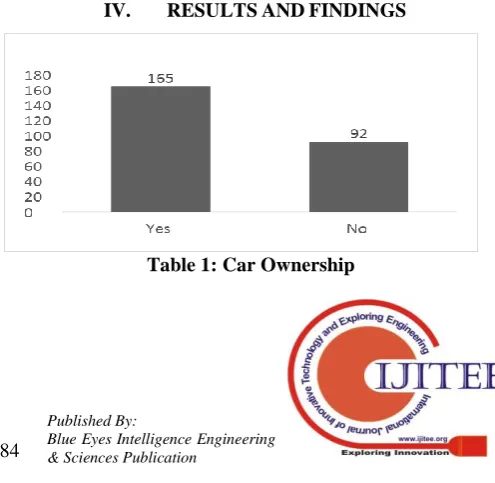
Table 1 depicts the car ownership patterns of the respondents. It was observed that 165 respondents (64%) respondents have a car of their own, and 92 respondents (35%) do not own a car. It may be concluded that car ownership has a higher preference in comparison to the usage of the shared mode of transport.
Table 2:Public Transport Usage
In a city, the public transport system provides a crucial mode of transportation for the people, especially for those who don’t own a car of their own.
[image:4.595.44.288.134.318.2]From Table 2, it is seen that out of 257 respondents; 10% respondents never use the system,56% respondents rarely use the available public transport system and 24% respondents use it just once or twice a month. Only 1% of the respondents used public transport daily for their commute.
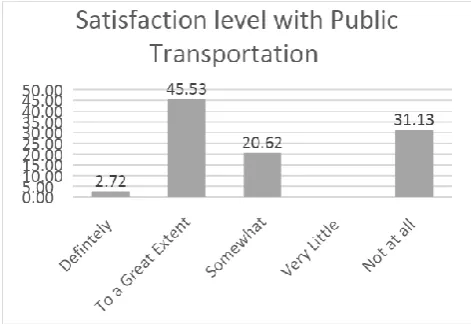
[image:4.595.314.539.250.426.2]Table 3:Satisfaction level with Public Transportation Table 3 showcases the satisfaction levels of the respondents who use the public transport for commute in the five cities. 45% respondents were satisfied to a great extent and 31 percent respondents were the least satisfied with the existing facilities of public transport.
[image:4.595.46.282.462.627.2]Table 4:Usage of Shared Mobility Services From Table 4 it can be seen that only 3 percent of respondents use shared mobility services daily in their cities. 27% of the respondents rarely use the shared mode of transport.
Table 5:Satisfaction level with Shared Mobility Services Table 5 depicts the satisfaction levels of the users who have used shared mobility services.
15% of the respondents were, to a great extent, satisfied by the usage of shared mobility services. 42% of the respondents were somewhat satisfied with the shared mobility services. Around 7 percent of the respondents were the least satisfied with this mode of transport.
[image:4.595.302.535.539.696.2]International Journal of Innovative Technology and Exploring Engineering (IJITEE) ISSN: 2278-3075,Volume-8 Issue-11, September 2019
Given a choice, 61% of respondents would be willing to stop the use of their private vehicles and use shared vehicles as a mode of commute. Only 3% of the respondents were keen on continuing to use their private vehicles. With a growing array of shared mobility providers, it may be concluded that shared mobility users will increase in the future as was being investigated in RQ1.
Table 7:Problem associated with Ownership of Private vehicles
Table 7 depicts the problems faced by respondents who were owning a private vehicle. The cost of owning a car is much higher than using a shared mode of transport. The cost factor comes out as the biggest deterrent in owning a car. The high maintenance cost of the vehicle is the second factor which adds up to the problems of owning a car. As the awareness and sensitivity of responsibility towards the environment rises, 23 % of respondents have rated pollution as a problem in owning a car. As urban spaces dwindle, finding a parking space will be a major problem in times to come. 19% of the respondents rate the factor of finding a parking space as a deterrent to ownership. Lastly, 3% of respondents see the rising fuel cost as a factor against ownership of cars.
[image:5.595.46.285.146.324.2]Table 8: Reasons for using Shared Mobility Service
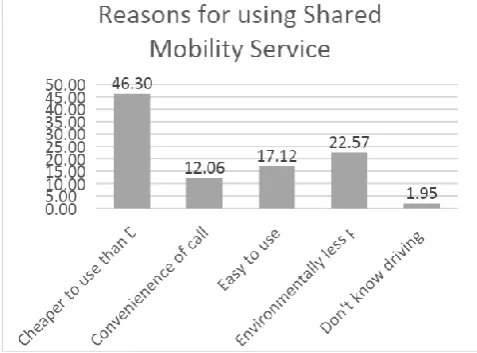
Table 8 depicts the reasons by the users who have used the shared mode of mobility service. The cost actor drives the respondent’s decision to own a vehicle or use the shared
mode of transport. 46% of respondents rate this factor as the highest when deciding to use a shared mode of transport or driving their own vehicle.
23% of respondents rate the factor of “environmentally less polluting” as one of the key reasons for using the shared mode of transport. There is a growing awareness amongst people of the need to reduce the pollution in the environment. The shared mode of transport provides the users with an option of sharing that vehicle with other commuters in that route and thus reduce the energy consumed. This may be the reason that respondents have rated this factor on the higher side.
17% of the respondents’ rate the factor of “easy to use” as one of the enables to use of the shared mode of transport. Even if the user does not know driving, he can still have the luxury of taking a cab on account of the availability of the shared mode of transport. The advent of the smartphone with smart applications has made it extremely easy for a user to use shared mobility apps. Probably these can be the reasons for the users to rate this factor on the higher side.
12% of respondents rate the convenience factor as one of their preferred reasons for owning a vehicle. The availability of shared cabs 24*7 and the higher internet penetration in cities adds to the convenience factor of calling a cab at any location. In terms of the traditional transportation method, shared mode of transport provides benefits such as convenience, lower cost, and is more environmentally friendly, which will provide significant benefit to the user which helps us answer RQ2.
V. DISCUSSION & CONCLUSION
[image:5.595.311.536.441.620.2]Based on the results, a conceptual diagram has been suggested for further research, which was the objective in RQ3.
[image:5.595.46.285.531.707.2]Finally, the preferences that an individual exercise is dependent on factors such as cost, time, convenience, satisfaction levels, quality of service, and ethical and moral consideration.
The cost factor comprises of aspects such as cost of purchase, maintenance cost, fuel cost, parking cost, and the mileage provided by the vehicle. Cost plays an important role in deciding private or shared while commuting. In a private vehicle, such costs would be on the higher side when compared to shared modes of transport. In a shared mode of transport, the customer only pays for the travel ride and the service provider company takes care of the other costs such as maintenance, fuel, etc.
Time and convenience are one of the key factors for decision making while taking a commute. Convenience can be further classified as the ability to order a cab from home, or drive one’s car, drop to the destination, time is taken to reach the route and a good ride without any hassles.
The quality of the commute determines satisfaction levels. If there is a lot of traffic on a route, then the driver experiences more stress as the traffic moves in short spurts. The time taken is also longer. On the other hand, if the commute is with less traffic than the quality of the ride improves, which results in better satisfaction. Private cab service providers also provide free internet service; tablet enabled entertainment, door picks up and drop, etc. which can also influence satisfaction levels of customers.
As more and more shared service providers enter the market, there is a race to differentiate the offerings provided to the customer. Few organizations provide training to their drivers to behave in the best manner with customers on a ride. They are also trained to handle special customer request and emergencies. Also, the range of offerings such as magazines, newspapers, internet, tablet-based pay per view channel, etc. adds to the quality of customer experience. Such factors may influence the quality of a commute.
As global warming rises, there is more sensitivity amongst the consumers to ensure that they indulge in such activities which reduce the pressure on the environment. Consumers may be willing to experiment with new ideas such as cab sharing etc. to fulfill this intrinsic need of helping the environment and reducing the energy consumed during the commute.
Further research can be undertaken to study factors such as gender preference, age preferences, education level, etc. amongst users for a shared mode of transport.
REFERENCES
1. Cohen, B., & Kietzmann, J. (2014). Ride on! Mobility business models for the sharing economy. Organization & Environment,
27(3), 279-296.
2. Chambliss, S., Miller, J., Façanha, C., Minjares, R., & Blumberg, K. (2013). The impact of stringent fuel and vehicle standards on premature mortality and emissions. The International Council on Clean Transportation, www. theicct. org/global-healthroadmap. 3. Kamargianni, M., Li, W., Matyas, M., & Schäfer, A. (2016). A
critical review of new mobility services for urban transport.
Transportation Research Procedia, 14, 3294-3303.
4. Shaheen, S., & Cohen, A. (2018). Shared ride services in North
America: definitions, impacts, and the future of pooling. Transport
Reviews. https://doi.org/10.1080/01441647.2018.1497728
5. Shaheen, S., & Chan, N. (2016). Mobility and the sharing economy: Potential to facilitate the first-and last-mile public transit connections.
Built Environment, 42(4), 573-588.
6. Rayle, L., Dai, D., Chan, N., Cervero, R., & Shaheen, S. (2016). Just a
better taxi? A survey-based comparison of taxis, transit, and ridesourcing services in San Francisco. Transport Policy, 45, 168-178 7. Jin, S. T., Kong, H., Wu, R., & Sui, D. Z. (2018). Ridesourcing, the
sharing economy, and the future of cities. Cities, 76, 96-104.
8. Clewlow, R. R. (2016). Carsharing and sustainable travel behavior:
Results from the San Francisco Bay Area. Transport Policy, 51, 158-164.
9. Kortum, K., Schönduwe, R., Stolte, B., & Bock, B. (2016).
Free-floating carsharing: City-specific growth rates and success factors.
Transportation Research Procedia, 19, 328-340.
10. Akyelken, N., Banister, D., & Givoni, M. (2018). The sustainability of
shared mobility in london: The dilemma for governance. Sustainability,
10(2), 420.
11. Meyer, G., & Shaheen, S. (2017). Disrupting Mobility. Lecture Notes in
Mobility. Cham: Springer International Publishing.
12. Sprei, F. (2018). Disrupting mobility. Energy Research & Social
Science, 37, 238-242.
13. Barann, B., Beverungen, D., & Müller, O. (2017). An open-data
approach for quantifying the potential of taxi ridesharing. Decision Support Systems, 99, 86-95.
14. Cohen, A. P., & Shaheen, S. A. (2016). Planning for shared mobility.
APA Planning Advisory Service Reports 2016-July (583), Chicago: USA.
15. Alemi, F., Circella, G., Handy, S., & Mokhtarian, P. (2018). What influences travelers to use Uber? Exploring the factors affecting the
adoption of on-demand ride services in California. Travel Behaviour
and Society, 13, 88-104.
16. Juyal, S., Singh, D. M., Singh, S., & Pal, & S. (2017). India Leaps Ahead : Transformative Mobility Solutions for All. Niti.
17. Shaheen, S., & Cohen, A. (2018). Is It Time for a Public Transit Renaissance?: Navigating Travel Behavior, Technology, and Business
Model Shifts in a Brave New World. Journal of Public Transportation.
https://doi.org/10.5038/2375-0901.21.1.8
18. Live Mint (2017) “Niti Aayog calls for electric vehicles push while discouraging petrol, diesel cars.”, published On: 12th
May.
19. Bekiaris, A., Lah, O., Loukea, M., Meyer, G., Müller, B., Shrestha, S.,
& Stagl, S. (2017). Towards a single and innovative European transport system: international assessment and action plans of the focus areas; final report.
20. Economic Times (2018), PTI, “India to be shared mobility leader by
2030””, published On: 3rd June
21. Vinay Piparsania (2018), “Shared Mobility vs. Car Ownership: A Clear
Emerging Trend for Digital India”, available at:
https://www.counterpointresearch.com/shared-mobility-vs-car-ownership-clear-emerging-trend-digital-india/, (Accessed on: 5th May
2019)
22. Lazarus, J., Shaheen, S., Young, S. E., Fagnant, D., Voege, T.,
Baumgardner, W., Fishelson, J. & Lott, J. S. (2018). Shared Automated
Mobility and Public Transport. In Road Vehicle Automation 4 (pp.
141-161). Springer, Cham.
AUTHORS PROFILE
Dipen Paul is an Assistant Professor in the Faculty of Management at the Symbiosis Institute of International Business which is a constituent of the Symbiosis International (Deemed University) Pune. He received his BE in Chemical Engineering and MTech in Energy Technology He has around 7 years of experience in the education sector and one year in the industry. His research interest areas