International Journal of Innovative Technology and Exploring Engineering (IJITEE) ISSN: 2278-3075, Volume-8 Issue-8, June 2019
Abstract: Wireless Sensor Network (WSN) is an innovation, which has unfathomable improvement for open and the shield. In Wireless sensor networks, Node course of action is a pivotal endeavor and is a multi-objective combinational issue. Degree issues are caused in light of the limited correspondence with recognizing range between sensor nodes. The extension issue tosses an eventual outcome of, how well a range is checked or pursued by sensors. A not too bad sensor sending count gives us least union of sensor's range as well as expands the overall zone sensible using sensors. Here, we recommend a self-course of action method intended for exchange node circumstance issue which is named as crossing point based ideal node situation (IPONP) calculation. Precisely, without noteworthy the degree of the ruin and the amount of portions included, the hand-off nodes be at first sent on a particular zone of the harmed zone alongside they reschedule themselves in a network arranged custom close assurance accessibility. Twofold estimations towards being available of stress here remain the amount of hand-off nodes to stay sent with their expense of improvement that should exist restricted. Also this computation gives most prominent locale verified by the sensor nodes by ousting crossing point between the sensors run. Sensors are directly off the bat sent using the fundamental co-ordinates gave and short time later new co-ordinates are made using the hidden co-ordinates to oust crossing point and get most outrageous locale scope.
Keywords: wireless sensor networks (WSN’s), network configuration, node deployment, coverage, mobile sensor network (MSN), ACO, intersection area, GTM and optimal routing.
I. INTRODUCTION
As of late utilization of wireless sensor networks (WSN's) have extended into different applications, for instance, characteristic life timberland checking, disaster organization, space examination, industry computerization, protected foundation, edge protection, and combat area perception. The enthusiasm meant for this type of submission is towards using sensors of little size. The presented sensor contraptions can remain termed as sensor nodes or fundamentally nodes whichwork uninhibitedly in an area. Every node consumes an identifying range and consumes capability for interfacing itself through the neighbor nodes as well as a base station. Sensor systems are not exactly equivalent to various remote systems owing towards the amount of obstructions such as battery control, node densities, node game plan, safety concerns, exchange speed and immense data volume, etc.
Revised Manuscript Received on June 07, 2019.
Shaik Imam Saheb, Research Scholar, Dept. of CSE, JNTUA, Ananthapuramu, India.
Dr. Khaleel-Ur-Rahman Khan, Professor & Dean Academics, ACE Engineering College, Hyderabad, India.
Dr. C. ShobaBindu, Professor, Dept. of CSE, JNTUA, Ananthapuramu, India.
WSNs employ endless sensor nodes with recognizing, taking care of and remote passing on capacities to complete the said errands in the ID region. Wireless Sensor Network (WSN) is gotten ready for observing a circumstance. The essential errand of a remote sensor node is towards identifying as well as accumulates information commencing a particular space, handle them as well as transfer it towards the sink wherever the usage lies. The essential qualities of a WSN join control utilization forces for nodes utilizing batteries or essentialness procuring, capability towards adjusting to node dissatisfactions, flexibility of nodes, active system topology, correspondence frustrations, heterogeneity of nodes, versatility to broad size of association, capability to resist cruel natural disorders, convenience, unattended activity. In any case, ensuring the prompt correspondence in the middle of a sensor as well as the sink might drive nodes to emanate their messages by means of such a great power, to the point that their advantages might remain swiftly exhausted. Thusly, the joint exertion of nodes towards ensuring that difficult to reach nodes talk using the sink remains a need. Thusly, messages are spread by widely appealing nodes so a course with different associations or hops to the sink is developed. Sharp circumstances address one of the key prospect improvement adventures into structure, utilities, mechanical, home, shipboard, and transportation system computerization. The adroit condition fundamentally depends as an issue of first significance on tactile data from this present reality. The information required by adroit conditions is given through Distributed Wireless Sensor Networks (DWSN) that remains. Remote sensor systems [1] are made out of a marvelous amount of sensor nodes thickly sent in a way to facilitate might change statistics gathering that make them an incredibly reassuring strategy for perception in military, normal checking, target following in disagreeable conditions, and traffic observing. Aremote sensor arrange (WSN) is a PC organize containing spatially circulated independent devices consuming sensors for pleasantly screen physical or natural conditions, as, temperature, sound, vibration, weight, progress or pollutions, at different territories. The headway of remote sensor systems was at first prodded by military submissions, such as, bleeding edge perception. In whichever circumstance, remote sensor systems remain by and by consumed by means of a piece of several standard resident submission districts, comprising condition as well as environment checking, human administrations submissions, home robotization, and traffic control.
An Intersection Point Based Optimal Node
Placement Algorithm for Wireless Sensor
Networks
Regardless of in any event one sensors, every single node in a sensor organize remains consistently furnished using a radio handset or distinctive remote correspondences scheme, a little microcontroller, as well as a vitality source, regularly a battery. The size a lone sensor node may change from shoebox-sized nodes down near devices the range of grain of dust. [1] The expense of sensor nodes is correspondingly factor, going from a few dollars to two or three pennies, dependent on the degree of the sensor organize as well as the versatile quality expected of distinct sensor nodes [1]. Size as well as cost necessities on sensor nodes achieve looking at confinements on resources, as, vitality, memory, and calculation speed and information transmission [1]. Sensor nodes are put almost a precise usage or amazingly adjoining it. Nodes can also self-arrange into groups of various size as well as various categories of nodes towards finishing an attempt given out from the client. These node locations are arranged in this way, they fit for certain applications. Sensor arrange consider through sweeping number of nodes remains segregated into bundles, and in a gathering there exist a couple of amount of nodes, the upside of WSN is to instead of transferring solitary data starting of each node, combined outcome commencing all of the nodes from every one of the pack be able to be sent to the base station, along these lines reducing the vitality eaten up via each node. WSN's are projected to effort on a low battery power supply considered as 100 nano joules. When the node receives a low power it stops working because of the low power but We consider it as the WSN may got physically damaged, if numerous sensors deplete their battery power source which is as far as energy. The lifetime of WSN is mainly influenced by node position, case of topology, controlling show. One of the genuine endeavor and test in WSN's is to put the remote sensor nodes in showed field of an entertainment zone. Node course of action by streamlining can upgrade the vitality utilization with a system lifetime. Nodeposition is a prime stress a related uses of WSN demands for longer life consistently.
II. RELATEDWORK
In [2], node position is deliberated by means of an imperative errand in wireless sensor network as well as remains a multi-goal combinatorial issue. In [3], to decide both areas of the sensor nodes as well as information transmission design creator find out an appreciative multivariable nonlinear programming matter. The two goals examined in the broadsheet are towards enhancing the system lifespan and towards confining the submission explicit overall charge, presented a settled amount of sensor nodes in an area using definite degree need. In [4], the association between the system lifetime and the degree issue is been analyzed. It is exhibited that controlling the thickness work, contingent upon powerful sensor nodes game plan, can upgrade in a general sense arrange lifetime. In this way a capable node circumstance estimation keeping an eye on the circumstance where the checked region thickness is identical to two is done. In [5], Algorithms for ruling least vitality displaces courses in an all-remote system be made and setup as least vitality level in coordinating strategy. Unmistakable techniques for diminishing vitality utilization in remote sensor systems have been examined in the composition. The
International Journal of Innovative Technology and Exploring Engineering (IJITEE) ISSN: 2278-3075, Volume-8 Issue-8, June 2019
III. CONVENTIONALMETHODS A. Node placement algorithm (NPA)
[image:3.595.57.290.154.294.2]To keep the nodes viable in a simulation region with the intention of maintaining the base energy as of each node so as to be scheduled for transmission of packets or data, node placement is the strategy. By transmitting the nodes unexpectedly the networks considers a communication mostly like this.
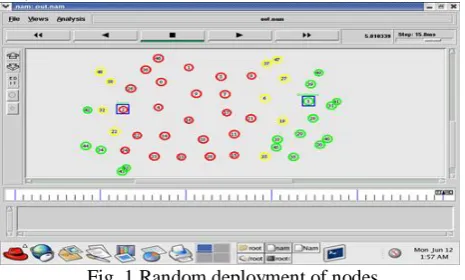
Fig. 1 Random deployment of nodes
Three issues are very important in this algorithm, they are at a specific district some of the nodes are conveyed very thickly while the other nodes are less situated and longer departures and departing the zone will not slightly stand through the single scope of node, this happens whenever nodes are transmitted arbitrarily.
Fig. 2 Circular deployment of nodes
The drawbacks of such unpredictable node arrangement is so as to nodes through thick region, where coordinating occur. All of the bobs among source as well as objective in a range of thick zone of nodes participate in coordinating provoking alternate use of vitality as of every node, though because of nodes at faraway zone, supplementary vitality once more is to remain expended in transferring the information towards neighbors to the objective arranged at far detachments. On a relative way it is difficult to manage the coordinating in a section where no nodes remain discovered driving in the entire three cases, an irregular movement of vitality source as well as node sending. Fig1 exhibits the irregular sending of sensor nodes; the node precedent is associated in Network test framework. Fig2 shows the round sending of nodes which give generally two goals. Starting one is, vigilant node situation be able to be an incredibly convincing improvement suggests for achieving thepined for plan targets, and is named static procedures. On the other hand, a couple of plans have driven powerful alteration of node zone, as the optimality of the fundamental places might wrap up evidently void in the midst of the
activity of the system dependent on the system condition as well as diverse exterior aspects, Based on the improvement is on the period of organization or while the system is operational the frameworks are sorted into static and dynamic, this technique believe spots of node estimations which are free of the system state or acknowledge a settled system task structure that stay constant all from side to side the lifetime of the system.
B. EENPA (Energy productive node placement algorithm)
The anticipated procedure consider the disadvantage of wireless sensor arrange, wherein nodes remain passed on discretionarily. In this broadsheet, the improved position of the sensor nodes also hand-off nodes remain performed using the round node organization system that is used aimed at diminishing power utilization also along these lines growing the lifespan of the WSN. Towards ensuring the extent of the system, a sensor position must fulfill the accompanying requirement. D remains the detecting district presented by, using R as the radius of the network.
(1)
(2)
For transporting 1 unit of data sensor consumes
and k=100pJ/bit/m2 for the transporting amplifier. So the energy utilization of sensor Si to be active in the system is given by,
(3)
Since the power utilization is rely upon the number of bits transmitted as well as the energy expended for a sensor node to remain active in the network when the node transmits k bits is given by,
(4) The nodes resolve the received packets at the end; but basically the obtained packets remain lesser than k. Henceforth power activated for reception packets is presented by,
(5) Where Tpis the energy because of transmission as well as Pl remains the energy lost owing to packet loss.
To transport a unit of data packet towards nearby node the energy consumed using a sensor is given by,
(6) , are denoted as the number of neighboring nodes
and remains the distance of both neighbors commencing starting node. Assume that node Si likewise relies the
[image:3.595.56.293.385.533.2](7) In EENPA (energy effective node placement algorithm), we used round arrangement of nodes and play out the guiding method. It attempts towards saving the energy of a system, wrapping most extraordinary part by augmentation inside lifespan of a system. In any case, here, the joint exertion of nodes talk with the sink is better. Thusly, messages are engendered through transitional nodes thus a course through different associations or bounces en route for the sink is set up. So we can go for multi-objective ACO based position procedure.
C. Multi-Objective Optimization
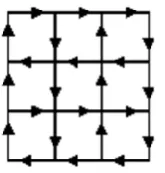
[image:4.595.133.216.288.375.2]Assume a four-sided field of N x N Euclidian units categorized into frameworks isolated using a predetermined Euclidian separation. To make the whole region of intrigue to be secured, at the crossing points of these networks the detecting nodes are placed (See Figure 3).
Fig. 3 a grid based wireless sensor network The nodes remain arranged for picking one in three working modes for instance X sense, Y sense as well as Z sense gave they remain dynamic. The nodes working in X recognizing mode have the most basic broadcast experience, nodes in Y and Z perceiving modes contain medium as well as lower transmission goes slowly. However a few social occasion based pushed procedures have been proposed [17-18], we have gotten immediate work structuring, in which the nodes working within X sense mode go about by means of bunch in-control with can chat by means of the base station (sink) by strategies for multi-skip correspondence and the get-togethers be shaped in light of the locale of sensors to the group in-control. The gathering in-control performs tries, for example, information accumulation and social occasion at discontinuous breaks including a few calculations. Thusly, X sense node force debilitates additional influence compared to the further dual modes. In multi-target improvement (MO), there are several goals to be advanced. Hereafter, there are a few strategies which are not in every way that really matters unclear, when in doubt intimated as Pareto-impeccable plans. A multi-target degradation issue using n components as well as m goals may remain figured, deprived of loss of clearing articulation, as
Where and
In this part m-ACO was exhibited for multi-target issues created by Ines Alay et al [19]. An M-ACO remains characterized via the quantity of pheromone organizations # Figure 1 depicts the conventional system of m-ACO (# ). Essentially, the calculation pursues the MAX-MIN Ant Scheme plot [20]. To start with, pheromone trails are instated to a given upper bound τ_max. At that point, at each cycle each subterranean insect builds an answer, and pheromone
trails are refreshed. Pheromone trails have been limited inside two given points of confinement τ_min and τ_max with the end goal that 〖0<τ_min<τ〗_maxfor forestalling the untimely union. When the calculation achieves greatest number of cycles then the calculation will stop the iterations.
Algorithm: m-ACO (#τ)
Begin all pheromone directs towards
repeat
forevery ant k in 1….. #Ants
Build a solution
fori in 1….#τ
update the pheromone structure trails
ifa trail is lower than then set it to
ifa trail stands superior then then fix it to
untilutmost number of cycles reached Here #τ is signifies the number of purposes.
Algorithm Solution Construction S
S ← Ɵ
← V
While ≠ Ɵ do
Choose with probability ( )
Add at the end of S
Remove from vertices that violate constraints
end while
To Build results in a construction graph G = (V, E) this algorithm is used by ants. The definition of this graph is relays upon the difficult for solving. An apex of G is selected inside the customary of Candidate vertices C at each iteration and it remains added for the solution S as well as by removing vertices which violates constraints of C set of candidate
vertices are updated. The vertex has to be added to the result S by ants of the colony. c is chosen randomly with the
probability defined as follows:
(8)
Where and commonly be the
pheromone as well as the experiential aspects of the applicant vertex . To determine the relative importance α and β two parameters are used. These two parameter’s definition depends on top of the issue to remain resolved as well as on the limitation #τ.
Let us assume is the answer of the group that lessens
the aim in place of the present cycle, and let
is the resolution which lessens above entire resolutions build by ants given that the commencement of the track (including the existing cycle). The amount of pheromone placed lying on a resolution element c aimed at
International Journal of Innovative Technology and Exploring Engineering (IJITEE) ISSN: 2278-3075, Volume-8 Issue-8, June 2019
(9)
The above algorithm, M-ACO algorithm chose which sensors ought to be dynamic, which one ought to be work as group in control and each of the staying dynamic ordinary nodes ought to have medium or low transmission go. Here it doesn't defeat the issue is, sending hand-off nodes expecting that harmed range, the quantity of segments and the area of the segments are known to a concentrated gathering. Such this system oughtensure the network availability as well as endeavor to limit the development above your head scheduled the hand-off nodes accepting that they be likewise battery worked. So we propose a distributed hand-off node situating approach, it as game hypothesis approach to address the issue of availability rebuilding in divided WSNs.
IV. PROPOSEDIPONPALGORITHM
[image:5.595.341.533.50.387.2]Our proposed system used for settling both the pleasing and non-supportive based programming building issues in various explicit circumstances. In accommodating projects, there are administrators/players which will in general act mutually towards meeting the greatest excitement of nature or the system they have a spot in light of keeping the true objective to intensify their modifications however nearby be players and procedures related to the whimsical exercises of the masters in a equivalent circumstance into non-pleasant projects. In this paper, we research the system concordance in the key relating circumstance where nodes inside each system are the developers of a supportive genuine situation. A basic assumption in this setting is that we pass on a game plan of exchange nodes to reinstate system of displace allocations. The inspiration driving this diversion is to develop the relationship surrounded by packages via varying the grades of the fragments (i.e., players). The dimension of a package remains seen when the amount of nodes that know how to stay recognized via the hand-off nodes (i.e., fractional data). The replica involves a two-mastermind program with inadequate data as into the right quantity of nodes in respective bundle is dark with estimate be looked for after in the exchange nodes.
Fig. 4 Proposed IPONP flow chart
A. Notations & description
In the model, the network game of complements is well-defined using {Par, M, {te}e}. We first anticipate that the each partition consists of the finite number of nodes such as Par = {1,2,…. s}. Innovative relay nodes random deployment take place here the environment after the formation of initial partitions, which leads to direct change of partitions degree near which the connection of fresh relay nodes resolve be made. Record with the intention of the relay system amongst the relays be there moreover remain professed as a novel divider. At this point, M = {0, 1} characterizes the customary of action and it is a closely subset of [0, 1] and it is a relocation representation or no rearrangement intended for a node.
The network that give the connection among nodes stands
signified via a matrix where we
assume for every
and
signifies that the performance of
in expressions of its policy have an impression on the
payoff of node . The (net) payoff may be
contributes us the position of neighbors of node
also the degree of node is denote by
, where and shows the
connections of node . Moreover,
defines the payoff of node i if its
profile of actions is given by .
In conclusion, the possibility dissemination P, clearly
signified by , where
is the grades of the neighbors of node i. The information arrangement employed throughout the exemplary is defined by conditional probabilistic distribution.
Within this algorithm, the explanation of a dispersed process toward renovates connectivity through the dividers in rearranging the post arranged relay nodes in the direction of the partitions. Certain that the methodology is dispersed in addition to the relay nodes to be deployed don’t have the network structure’s previous information and damage. To determine the movement direction, a probabilistic approach will be pursued.
Algorithm: Connect ()
1: Deploy relays toward the injured area aimlessly
2: for do
3
4: end for
5: for do
6: 7: end for
8: Sort
in descending arrange based on the probability function
9: for do
10:
11: find such that
is minimized
12:
13: while do
14: find such that
is minimized and
15: relocate to
16: update s and MN
17: find such that
is minimized
18:
19: check the data file for initial deployment of all nodes 20: sensors are deployed initial with (u,v) co-ordinates as centre and l as radius.
21: intersection between sensors is removed using: v2=(sqrt[(l1+l2)*(l1+l2)-(u2-u1)*(u2-u1)]+v1)
This will be repeated until removal of whole intersection 22: intersection between sensors is determined using distance formula
z=sqrt((u2-u1)*(u2-u1)+(v2-v1)*(v2-v1))
23: after remaining crossway, sensors are deployed again on the co-ordinate axis with new co-ordinates (u1, v1) and (u2, v2).
24: end while
25: end for
V. SIMULATIONANALYSIS
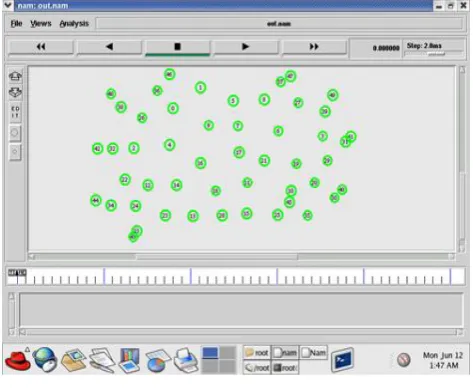
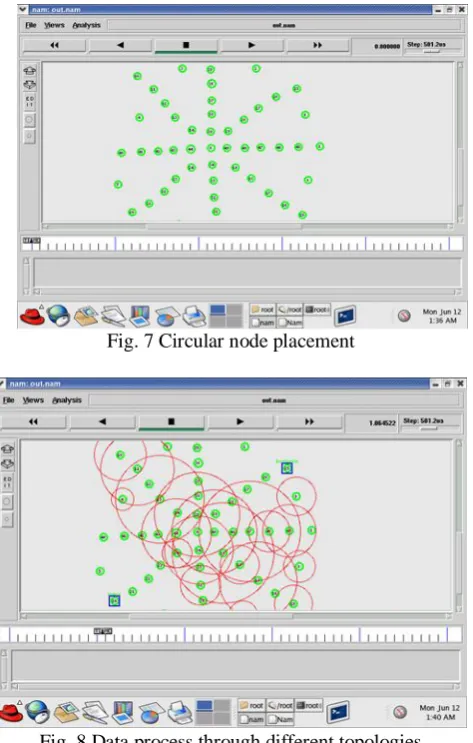
[image:6.595.55.411.362.785.2]With the objective of node placement handle Simulation analysis will be started. With the support of routing convention the network demonstrates node that how to convey in network. Through a few parameters and library documents with question records the procedure of simulation starts. The simulation completed in a network test system. The most focused convention on the node deployment method is AODV routing convention. Simulation results of Fig 5 and 6 are exhibits afterwards a limited rounds of routing packets over AODV; that distribution of nodes positively is proficient and less as contrasted and irregular sent nodes.
[image:6.595.314.551.463.658.2]International Journal of Innovative Technology and Exploring Engineering (IJITEE) ISSN: 2278-3075, Volume-8 Issue-8, June 2019
Fig. 6 Data processing of network without energy
[image:7.595.308.546.50.226.2]Fig. 7 Circular node placement
Fig. 8 Data process through different topologies
[image:7.595.304.543.252.442.2]Fig. 9 Nodes deployment based on grid network
Fig. 10 Routing performed in grid network
[image:7.595.53.290.259.631.2]Fig. 11 Self deployment node placement
[image:8.595.317.549.50.268.2]The proposed approaches have been assessed through tests reenacted in an apportioned WSN. Hand-off nodes, through a broadcast scope of 50 meters, stay conveyed arbitrarily in a deterrent permitted solicitation range of 1500x1500 meters. We contain tried a few cases below a differing quantity of sensors nodes, amount of parcels and sum of hand-off nodes as known underneath.
Fig. 12 Distance between node to node
Fig. 13 New position values of nodes
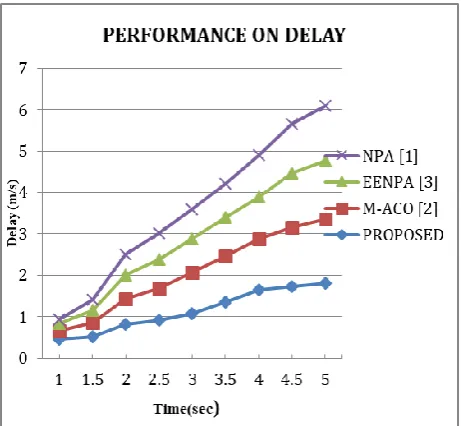
To assess the proposed move toward, three presentation measurements are measured in the analyses: 1) Throughput: add up to information transmission in view of simulation time by measuring the bit per sec process. 2) Energy consumption: Individual energy levels of node computes in light of time interim and 3) Delay: The nodes voyaging some separation in view of time usefulness.
[image:8.595.61.542.357.576.2]International Journal of Innovative Technology and Exploring Engineering (IJITEE) ISSN: 2278-3075, Volume-8 Issue-8, June 2019
[image:9.595.57.288.49.262.2]Fig. 15 Performance of delay vs time with proposed and conventional schemes
Fig. 16 Throughput performance analysis with time
[image:9.595.313.545.79.324.2]Fig. 17 Comparison of energy consumption with number of intervals
Fig. 19 delay performance analysis with number of intervals
The above diagrams show exhibitions of system process. The figure 14, 15 and 16 shows that the exhibition investigation ofvitality utilization, throughput and postponement with the ideal opportunity for ordinary and proposed calculations. Figure 17, 18 advertisement 19 demonstrates that the strategy of recreation between Numbers of rounds versus vitality utilization, postponement and throughput. These diagrams measure the proposed system execution is all the more dominant and powerful to take a gander at Node situation calculation, vitality capable node position calculation and multi-objective underground bug settlement advancement. Right when sensor nodes are passed on by the fundamental headings gave, there exists some union between the extent of the sensor nodes and package of sensors got wasted a similar number of sensors sent resources only a limited range. This constructs our expense of passing on sensor nodes. Thusly, assembly should be emptied with the goal that the given sensors can distinguish more range then the fundamental organization and the expense can in like manner be diminished and moreover wastage of sensor nodes can similarly be survived.
Table I
Simulation Parameters
PARAMETER VALUE
Application traffic CBR
Transmission rate 12 packets/sec
Radio range 250m
Packet size 1000 bytes
[image:9.595.56.291.304.540.2]Maximum speed 50m/s
Simulation time 5secs
Number of nodes 50
Area 1500x1500
Initial energy 100j
Hello traffic 243,239,232,229
VI. CONCLUSION
Here, we had proposed a new and efficient strategy of self-deployment for the issue of relay node placement i.e., IPONP algorithm. We concerned about two metrics known as deployed quantity of relay nodes as well as their price of movement that has to be minimized. We also provide the maximum coverage area by eliminating the sensors range intersection. We also compared the conventional algorithms with the proposed algorithm in standings of quality assessment like throughput delay as well as energy consumption with respect to time as well as number of interval ad finally we achieved that the best performance with the proposed algorithm over the conventional algorithms NPA, EENPA and M-ACO.
REFERENCES
1. G. J. Pottie, “Wireless sensor networks,” Information Theory Workshop, pp. 139-140, 1998.
2. Rabindra, Ku Jena, “Energy aware node placement in wireless sensor network ACO” JTAIT, Vol. 53 No. 2, July 2013.
3. Peng Cheng, Chen-Nee Chuah, Xin Liu, Energy-aware Node Placement in Wireless Sensor Networks, Globecom 2004.
4. MoezEsseghir, NizarBouabdallaht and Guy Pujolle, “A Novel Approach for Improving Wireless Sensor Network Lifetime”, 16th IEEE ISPIMRC, September 2005.
5. A. Srinivas, E. Modiano, “Minimum energy disjoint path routing in wireless ad-hoc networks,” Mobicom, 2003.
6. Xue Wang, Junjie Ma, Sheng Wang, “Collaborative Deployment Optimization and Dynamic Power Management in Wireless Sensor Networks”, Fifth International Conference on Grid and Cooperative Computing , 2006.
7. E. Lloyd and G. Xue, “Relay node placement in wireless sensor networks,” in IEEE ToC, Vol. 56, No. 1, pp. 134–138, 2007.
8. X. Han, X. Cao, E. Lloyd, and C. C. Shen, “Fault-tolerant relay node placement in heterogeneous wireless sensor networks,” 26th IEEE International Conference on Computer Communications, pp. 1667–1675, 2007.
9. J. Tang, B. Hao, and A. Sen, “Relay node placement in large scale wireless sensor networks,” Computer Communications, Vol. 29, No. 4, pp. 490 – 501, 2006.
10.S. Lee and M. Younis, “Recovery from multiple simultaneous failures in wireless sensor networks using minimum steiner tree,” J. Parallel Distrib. Comput., Vol. 70, pp. 525–536, May 2010.
11.F. Senel and M. Younis, “Relay node placement in structurally damaged wireless sensor networks via triangular steiner tree approximation,” Computer Communications, Vol. 34, No. 16, pp. 1932 – 1941, 2011. 12.F. Senel, M. Younis, and K. Akkaya, “Bio-inspired relay node
placement heuristics for repairing damaged wireless sensor networks” , IEEE Transactions on Vehicular Technology, Vol. 60, No. 4, pp. 1835 –1848, may 2011.
13.S. Lee and M. Younis, “Eqar: Effective QoS-aware relay node placement algorithm for connecting disjoint wireless sensor sub-networks,” Computers, IEEE Transactions on, vol. 60, no. 12, pp. 1772 –1787, 2011.
14.M. Younis and K. Akkaya, “Strategies and techniques for node placement in wireless sensor networks: A survey”, Elsevier Ad-Hoc Network Journal, Vol. 6, No. 4, pp. 621–655, 2008.
15. M. Sir, I. Senturk, E. Sisikoglu, and K. Akkaya, “An optimization-based approach for connecting partitioned mobile sensor/actuator networks,” 3rd International Workshop on Wireless Sensor, Actuator and Robot Networks Proceedings, April 2011.
16. A. Alfadhly, U. Baroudi, and M. Younis, “Optimal node repositioning for tolerating node failure in wireless sensor actor network,” 25th Biennial Symposium on Communications (QBSC), May 2010. 17. O. Younis, S. Fahmy, “Distributed clustering in ad-hoc sensor networks:
a hybrid, energy-efficient approach”, INFOCOM, March, 2004. 18. S. Bandyopadhyay, E.J. Coyle, “An energy efficient hierarchical
clustering algorithm for wireless sensor networks”, IEEE INFOCOM, April 2003.
19. I. Alaya, Christine Solnon, Khaled Ghedira, “Ant Colony Optimization for Multi-Objective Optimization Problems”, 19th IEEE International Conference on Tools with Artificial Intelligence, Vol. 01, 2007, p. 450-457.