Available online at: www.ijcncs.org
E-ISSN 2308-9830 (Online) / ISSN 2410-0595 (Print)
Efficient Scheduling in Cloud Networks Using Chakoos
Evolutionary Algorithm
Msc. MASOUMEH ALIPORI1, 2 and PhD. HAMID HAJ SEYYED JAVADI3
1
Department of Computer Engineering, Science and Research Branch, Islamic Azad University,
Boroujerd, Iran 2
Department of Computer Engineering, Boroujerd Branch, Islamic Azad University, Boroujerd, Iran 3
Department of Applied Mathematics, Faculty of Mathematics and Computer Science, Shahed University,
Tehran, Iran
E-mail: 1alipori.m @gmail.com, [email protected]
ABSTRACT
Since scheduling of tasks graph is a NP-hard problem, considering approaches based on undeterminisitic methods such as evolutionary processing, mostly genetic and chakoos algorithms will be effective. Therefore, an efficient algorithm has been proposed for scheduling of tasks graph to obtain an appropriate scheduling with minimum time. In this algorithm, the new approach is based on making the length of the critical path shorter and reducing cost of communication. Finally, the results obtained from implementation of the presented method show that this algorithm acts as same as other algorithms when it faces with graphs without communication cost. It performs quicker and better than some algorithms like DSC and MCP algorithms when it faces with the graphs involving communication cost.
Keywords:
Cloud Computing, Scheduling, Tasks Graph, Chakoos Algorithm.
1 INTRODUCTION
Due Nowadays, cloud processing is one of the important issues in information technology. In cloud computing environment, each user may face with hundreds of virtual resources in executing the task. Cloud computing is highly dependent on virtualization.
In fact, resources are considered as virual machines. In this regard, allocating the tasks to resources by the user is not possible (Fendelman et al, 2009). The purpose of using cloud computing systems is to minimize the cost of using the resources by service provider and to maximize the income of providing service in application programs of requesters. In order to reach the purpose, scheduling system performs two different tasks in a scheduling system in a cloud to increase the rate of task completion, utility of resources and computing power (Lee et al,2010). In fact, scheduling means allocation of resources to tasks. Hence, scheduling is an important issue in
management of resources available in a cloud. Although there are many requests, scheduling cannot be performed manually in date center.
In recent years, one of the most important and promising methods is “innovative methods inspired from the nature” in order to solve such problems and to find optimal answer for resources scheduling problem. These methods are similar to natural or social systems. Some of these methods are genetic algorithm, chakoos optimization algorithm and optimization of particles swarm. Nature-oriented algorithm is a global optimization technique based on population. Due to its simple search mechanism, computing efficiency, complexity and easy implementation, it can be widely used in most optimization fields (Houmar, 2012).
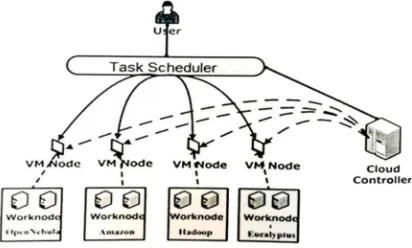
be optimal on the basis of system requirements such as minimizing time, minimizing cost, minimizing time and cost in specified proportions. In figure 1, the scheduling framework can be observed in a cloud computing system (Lee and Geo, 2010). This figure shows that after receiving the request of user by the scheduler, the scheduler assigns tasks to virtual machines by the help of a cloud controller.
Fig. 1. The framework of a scheduling system in cloud computing environment.
In economical scheduling, the purpose is to allocate the resources to tasks, so the cost of performing all tasks is minimized. Mouschaku and Caratez (2011), in their own articles, explained that the proportion of the task to resources involves three modes (equations (1-3)-(3-3)).
Each task is executed by a resource:
(j=iXi,j)=1 , where ij (1-3)
Each resource can perform more than one task:
(j=iXi,j)1, where iI (2-3)
A resource executes or does not execute a task:
Xi,j=0 or 1, (i,j)i*j (3-3)
i: the current resource j:the current task.
2 CHAKOOS OPTIMIZATION (COA)
Like other evolutionary algorithms, COA begins its work with initial population of chakoos. The population of chakoos has some eggs, and they put them in the nest of some host birds. Those eggs that are more similar to the eggs of host bird have more chance to grow and become a mature chakoos. Other eggs are detected by the host bird and die.
The number of eggs that have grown show the suitability of that area’s nests.
When more eggs can survive in an area, and they can be saved, more profit will be assigned to that area. Therefore, when most eggs are rescued, this situation is considered as a parameter whom COA is going to optimize. Chakoos search the best area to rescue maximum number of eggs. After the chickens become mature chakoos, they constitute communities and groups. Each group has its own habitat. The best habitat of all groups will be next destination of chakoos in other groups. All groups migrate toward the best current area. Each group resides in the location near to the best current location. By considering the number of chakoos eggs and the distance of chakoos from the current optimum area, laying radius is computed and formed. Then, chakoos begin to lay eggs randomly in the nests located inside the radius of laying. This process continues until reaching to the best location for laying (the area with the highest profit). The maximum number of chakoos are collected in the optimum location. Chakoos optimization algorithm is one of the strongest and newest evolutionary optimization methods that have been introduced up to now. This algorithm has been developed by Levy flying instead of simple and random is tropic hike (kokilavani and Gorj , 2011).
3 THE PROPOSED ALGORITHM
In order to solve an optimization problem, it is necessary to form the values of the problem variables in the form of an array. These arrays are determined with the names of "chromosome" and "particles position" in GA and PSO, while this array is called "habitat" in COA. In an optimization problem, next Nvar of a habitat will be an array of 1*Nvar showing the current situation of chackoos life. This array is defined as follows;
Habitat:[X1,X2,….,XNvar]
The suitability (or the value of profit) in the current habitat is obtained by evaluating function of profit (fp) in the habitat. Therefore,
Profit=fp(habitst)=fp (X1,X2,….,XNvar)
As it can be observed, COA is an algorithm maximizing the function of profit. In order to use COA to solve minimization problems, it's adequate to multiply a negative sign to the cost function. In order to initiate an optimization algorithm, a habitat matrix with the size of Npop*Nvar is created. Then, some random eggs are allocated for each of these habitats, each chakoo lays between 5-20 eggs in the nature. These numbers are used as high and low limit of dedicating an egg to each chakoo in various repetitions. Another habit of each real chakoo is that they lay eggs in a specified range (Egg Laying Radius (ELR)).
Alpha is a variable setting the maximum value of ELR. Each chakoo locates the eggs randomly in the nest of host bird located in ELR. When all chakoos lay the eggs, some eggs less similar to the eggs of host bird are detected, and they are thrown out of the nest. Therefore, after laying, p% of all eggs (usually 10%) whose function of profit is less die.
Chickens grow in host nest.
4 SEGMENTATION
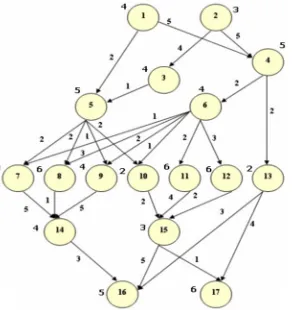
Almost, heuristic methods are used for scheduling problem on the basis of using the lists and queues. It's the basic idea for determining priority for graph nodes, and their location in a list ordered on the basis of priorities is considered in an descending order (Vack and Ahmad, 1999). Before considering scheduling algorithm, the problem is firstly explained in the form of directed acyclic graph (DAG) called tasks graph of G=(v,e) (figure 2) (Krotrachow and Louis,1984). Each node is a member of V set, and it shows a task unit of the
program. The weight of these nodes determines execution time of the related task unit.
Fig. 2. An example of tasks graph
Also, this graph involves a set of edges, t, showing prerequisite relations between task units. When there is an edge in the form of (ti, tj) , tj cannot begin it's execution until ti completes execution. These edges are also weighted, and the weight of each edge shows the cost of communications and sending the message among two task units. This cost is considered when two related task units are executed on various processors. If the processor is same, communi-cation cost will be zero.
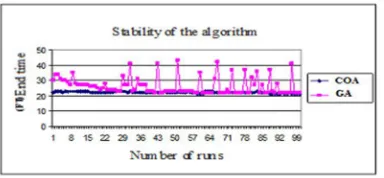
Fig. 3. learning procedure of chakoo and evolutionary route of genetic for executing it one time with too repetitions.
The results obtained from DCP, MD, DSC, MCP, genetic and chakoos algorithms have been shown in table 1 and figure 4. As it can be observed, the chakoo with 100 learning steps creates the result equal to the result of genetic in 100 generations.
Table 1: comparing the chakoo with other algorithms
Fig. 4. comparing the chakoo with other algorithms (for graph displayed in figure 15)
Total sampl es V>1 V>2 V>2.5 V>3 meth od 100(1.
2 sec) 99(0.5 sec) 95(0.43 sec) 91(0.37 sec) 82(0. 3 sec) SVM 100(1.
5 sec) 100(0.8 9 sec) 97(0.65 sec) 97(0.52 sec) 92(0. 4 sec) K-NN (k=2) 100(1. 87 sec) 99(0.92 sec) 98(0.7s ec) 97(0.4s ec) 91(0. 35 sec) NB 5 CONCLUSION
In this study, the application of cellular learning automata to extract image features and characteristics has been studied in order to be used in identification systems on the basis of iris image. One of the most important characteristics of the proposed methods is efficiency of image feature extraction operations when the image is noisy. cellular automata approach to salt pepper noise due to low sensitivity of neighboring patterns. The width of a point to detect edges and thin edges are produced. we have a few toys. Also, iris borders and eyelid lines are easily detected. Another characteristic of the proposed method is distribution, and its parallelism is possible. In addition, this method relies on local operations in each pixel neighboring, and in this way, implementation can be simply performed, feature extracted from a data set that include 100 iris image from 10 various persons we use 90% of data for train system and 10% of data for test, in continue show some of images that process by Canny and morphology method and feature extraction variance diagram.
6 REFERENCES
[1] M. Feldman, K. Lai, L. Zhang (2009)."The proportional-share allocation market for computational resources,", IEEE Transactions on Parallel and Distributed Systems 20 (8). [2] Y.C. Lee, C. Wang, A.Y. Zomaya, B.B. Zhou
(2010). ” Profit-driven service request scheduling in clouds”, Proc. IEEE/ACM Conf. Cluster, Cloud and Grid nComputing (CCGrid 2010), pp. 15–24.
[3] Humar Kahramanli (2012), “A Modified
Cuckoo Optimization Algorithm for
Engineering Optimization”, International
Journal of Future Computer and
Communication, Vol 1(2), pp 199-201.
[4] Li. Q, Guo. Y, Optimization of Resource Scheduling in Cloud Computing. 12th International Symposium on Symbolic and Numeric Algorithms for Scientific Computing, 2010.
[5] A.Moschakis and H. D. Karatza, 2011, "Performance and Cost Evalution of Gang Scheduing in a Coud Computing System With Job Migrations and Starvation Handling", in 16th IEEE Symposium on Communications (ISCC 2011), pp 418-423.
[6] Kokilavani.T and George Amalarethinam.D.I, Load Balanced Min-Min Algorithm for Static Meta-Task Scheduling in Grid Computing, The algorithm MCP DSC MD DCP GA
International Journal of Computer Applications , Vol,20,2011.
[7] Y. Kwok and I. Ahmad, “Static Scheduling Algorithms for Allocating Directed Task Graphs to Multiprocessors, ACM Computing Surveys, Vol. 31, No. 4, 1999, pp. 406-471. [8] B. Kruatrachue and T. G. Lewis, Duplication
Scheduling Heuristics (DSH): A New Precedence Task Scheduler for Parallel Processor Systems, Technical Report, Oregon State University, Corvallis, OR 97331, 1987. [9] D. E. Goldberg, Genetic Algorithms in Search,
Optimization, and Machine Learning, Addison-Wesley, 1989.
[10]M. R. Garey and D. S. Johnson, Computers and Intractability: A Guide to the Theory of NP-Completeness, W. H. Freeman and Company, 1979.
[11]M. Y. Wu and D. D. Gajski, Hyper-tool: A Programming Aid for Message-Passing Systems, IEEE Trans. on Parallel and Distributed Systems, Vol. 1, No. 3, Jul. 1990, pp. 330- 343.
[12]A. Gerasoulis and T. Yang, A Comparison of Clustering Heuristics for Scheduling DAGs on Multiprocessors, J. Parallel and Distributed Computing, Vol. 16, No. 4, Dec. 1992, pp. 276-291.
[13]Y. K. Kwok and I. Ahmad, Benchmarking and Comparison of the Task Graph Scheduling Algorithms, Department of Electrical and Electronic Engineering, University of Hong Kong, Hong Kong, March 17, 1999.
[14]B. Shirazi, M. Wang and G. Pathak, Analysis and Evaluation of Heuristic Methods for Static Scheduling, J. Parallel and Distributed Computing, No. 10, 1990, pp. 222-232. [15]E. S. H. Hou, N. Ansari, and H. Ren, A
Genetic Algorithm for Multiprocessor Scheduling, IEEE Trans. on Parallel and Distributed Computing, Vol. 5, No. 2, February 1994, pp.113-120.
[16]R. C. Correa, A. Ferreira and P. Rebreyend, Scheduling Multiprocessor Tasks with Genetic Algorithms, IEEE Trans. Parallel and Distributed Systems, Vol. 10, No. 8, 1999, pp 825-837.
[17]M. K. Dhodhi, and I. Ahmad, A
Multiprocessor Scheduling Scheme Using Problem-Space Genetic Algorithms, Proc.
IEEE Int. Conf. Evolutionary
Computation,1995.