The Academies programme:
Progress, problems and possibilities
A report for the Sutton Trust
By Andrew Curtis, Sonia Exley, Amanda Sasia, Sarah Tough and Geoff Whitty Institute of Education, University of London
Contents
Acknowledgements ……….. 3
Glossary of terms ……… 4
Executive Summary ……… 5
The Academies programme: progress, problems and possibilities Introduction ………. 12
1. Origins of the Academies programme and their performance ……… 14
2. Distinctive aspects of Academies ………. 22
3. Changes to the Academies Programme ……… 44
4. Emerging Models of Academies ……….… 50
5. Alternatives to Academies ………..… 68
6. Conclusion ………. 72
7. Policy Implications ………. 77
References ………. 79
Acknowledgements
We would like to thank the Sutton Trust for the funds which have made this project possible.
Glossary of terms
ACE Advisory Centre for Education BSF Building Schools for the Future CTC City Technology College CVA Contextual Value Added
DCSF Department for Children, Schools and Families DfES Department for Education and Skills (2001-2007) DIUS Department for Innovation, Universities and Skills FSM Free School Meals
GCSE General Certificate of Secondary Education
HMC The Headmasters‟ and Headmistresses‟ Conference ICT Information and Communication Technology ISSP Independent State School Partnerships NAO National Audit Office
NASUWT National Association of Schoolmasters Union of Women Teachers NCEE National Council for Educational Excellence
NFER National Foundation for Educational Research NUT National Union of Teachers
Ofsted Office for Standards in Education, Children's Services and Skills PAC Public Accounts Committee
PMDU Prime Minister‟s Delivery Unit PDS Professional Development Schools PwC PricewaterhouseCoopers
SSAT Specialist Schools and Academies Trust TUC Trades Union Congress
Executive Summary
One of the most prominent and controversial aspects of the New Labour government‟s education policy is undoubtedly the Academies programme. Despite criticisms of the programme, it continues to be a major plank of government education policy. Indeed, the programme‟s expansion has recently been accelerated, but there have also been significant changes to the policy. There are 130 Academies open with a total of 314 scheduled to be open by September 2010. The government‟s ultimate target is 400 Academies.
This report draws on a range of relevant literature about Academies to: evaluate the performance of Academies against the original objectives of the initiative; examine some of the significant changes that have occurred to the programme; develop a typology of different models of Academies; look at possible alternatives to Academies; and consider the future direction of the programme and related developments.
Research Findings
Original objectives of the Academies Programme
The original ultimate objectives of the Academies programme were:
1. Academies will contribute to driving up standards by raising achievement levels for their own pupils, their family of schools and the wider community by breaking the cycle of underachievement and low aspirations in areas of deprivation with historical low performance;
2. Academies will be part of local strategies to increase choice and diversity in education. They will have innovative approaches to one or more of governance, curriculum, staffing structures and pay, teaching and learning, structure of the school day and year, using ICT; and
3. Academies will be inclusive, mixed ability school[s].
This report seeks to ascertain how successful the programme has been in fulfilling each of these objectives so far. Its conclusions can be summarised as:
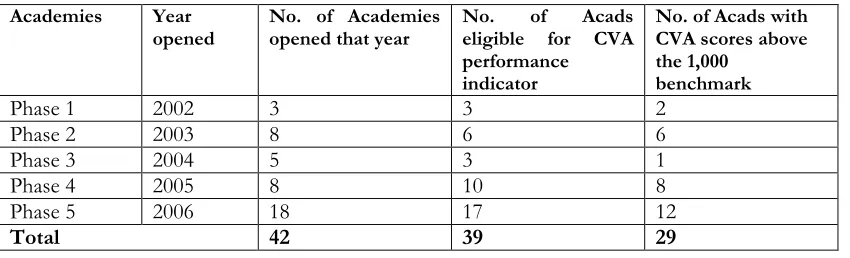
1. With regard to the first objective, the picture is mixed and the evidence not easy to interpret. The average attainment of pupils in Academies has risen but in certain cases their intakes have changed. There are continuing concerns about achievement levels in a number of Academies. The impact of Academies on the attainment of their family of schools and on the wider community has been even more difficult to gauge. While this part of the objective was perhaps too ambitious, little action seems to have been taken to address the issue. The sharing of Academies‟ facilities was hindered by VAT regulations prior to 2007.
2. Academies have increased diversity in education in the sense they are a distinctive type of state school, though arguably less distinctive now than when they were first launched. The scope for difference and innovation has potentially been curtailed by recent reforms, such as a clearer requirement to follow the core subjects of the National Curriculum.
percentage points. This suggests that Academies are becoming more inclusive in the sense that they are drawing pupils from a wider range of social backgrounds and, in some cases at least, a broader ability range. There has also been concern about the high number of exclusions in some Academies and how these might affect neighbouring schools.
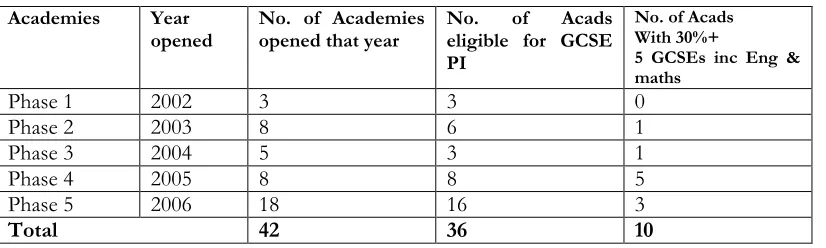
Consideration of the objectives suggests that some aspects of them may have been too ambitious (e.g. helping to raise performance in other schools) and that there has sometimes been a tension between them (e.g. the focus on areas of deprivation and the need to become „inclusive, mixed ability schools‟). In addition, the reliance on Academies in the context of other policies, such as the National Challenge, may be inappropriate. For example, in this particular initiative, there is a danger that some existing Academies will fail to reach the required target of 30% of pupils achieving at least 5 GCSEs A*-C (including English and maths) within a few years of opening.
Distinctive characteristics and performance of the Academies programme
This report looks at various distinctive aspects of Academies programme, and each are summarised below:
Independence
A distinguishing aspect of Academy schools can be seen as their independence from the local authority. This autonomy was seen as central to facilitating innovation in Academies. Yet this has led to some criticism that Academies are largely unaccountable, and damaging to neighbouring schools. Academies‟ autonomy has been, to some extent, curtailed by recent reforms. However, whilst this reduction in the autonomy of Academies has been welcomed by some, it has been criticised by others as diluting the original concept.
The freedom available to Academy principals has led to instances of visionary leadership in terms of innovation and pedagogy. However, there is a potential danger that the most talented head teachers will be drawn away from other state schools into Academies. The National Audit Office found that Academy principals are paid on average between £18,000 and £32,000 more than those in the maintained sector.
Sponsorship
Attainment
PricewaterhouseCoopers (PwC) records that GCSE attainment has tended to have improved at a greater rate in Academies than the national average and amongst similar schools. The National Audit Office and Public Accounts Committee evaluations also broadly praised the progress in GCSE attainment in Academies.
However, rises in achievement have coincided with a decline in the proportion of disadvantaged pupils in Academies and there are still considerable concerns about attainment in some Academies. The 2007 GCSE results indicate that the majority of Academies (26 out of 36 with results in 2007), including those that have been open for at least four years, still do not meet the National Challenge target of having at least 30% of pupils achieving five GCSEs A*-C (including English and maths). Furthermore, only just over half (12 out of the 20 Academies with two years of results in 2007) improved on this measure from the previous year.
Admissions and exclusions
The programme was originally designed to tackle disadvantage and educational underachievement. A report by National Foundation for Educational Research found that
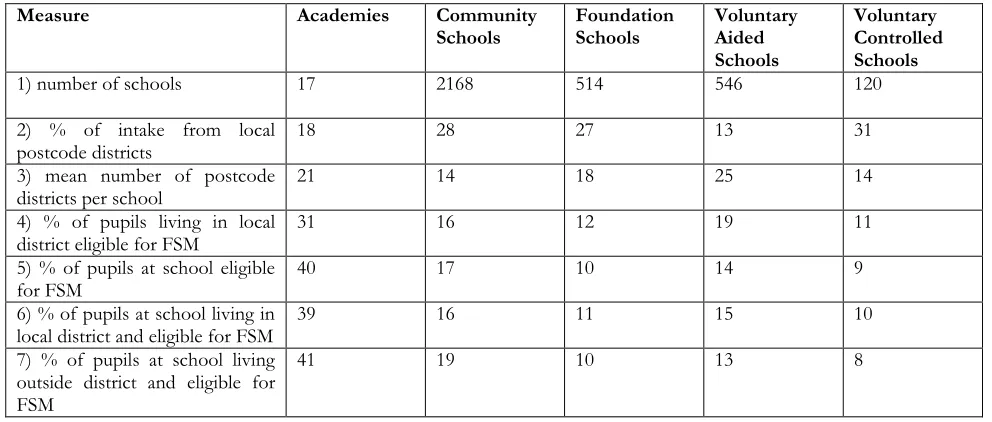
early Academies had a disproportionately high number of pupils eligible for FSM compared to their local population. However, the composition of Academies appears to have changed over time. The School Census indicates that the average proportion of pupils eligible for FSM in Academies has declined from 45.3% in 2003 to 29% in 2008. This is due to both a decline in FSM rates in older Academies and to the fact that many of the Academies that have joined the programme more recently started with lower FSM rates.
Exclusions have been quite high in some Academies, and in certain cases this has been at greater levels than in their neighbouring schools. However, new Academies will be required to participate in „behaviour partnerships‟ with other local schools, and existing Academies are also being encouraged to do so.
Effects on neighbouring schools
PwC find that the decline in FSM pupils in Academies does not appear to have had an adverse effect on the intakes of overlapping intake schools.
Buildings and costs
Many early Academies had buildings that went over budget. The Building Schools for the Future policy, with its commitment to refurbish or rebuild every secondary school by 2020, means that Academies’ distinctiveness in having a new build has, to some extent, diminished.
Specialisms
Academies’ specialisms tend to focus on a narrow range of subjects. Of the 83 Academies open by September 2007, just over half (42) had at least one of their specialisms in business and/or enterprise. However, the 47 Academies that opened in September 2008 had a more diverse range of specialisms, with only a third having a specialism in business and/or enterprise.
Changes to the Academies Programme
There have been various changes to the programme in the last few years.
These include: more involvement of local authorities; more encouragement of educational sponsors (such as universities and independent schools); and an explicit requirement to follow the National Curriculum in core subjects.
Emerging Models of Academies
There is no single model of Academies, and the proliferation of different types of Academy now means that it is becoming difficult to view Academies as a homogenous initiative. Of the many different Academies, the following types frequently occur:
an Academy replacing a „failing‟ school(s);
a new school in an area of educational underachievement;
conversions of CTCs and independent schools, and possibly grammar schools in the future;
a „failing‟ school converting to an Academy as part of the National Challenge.
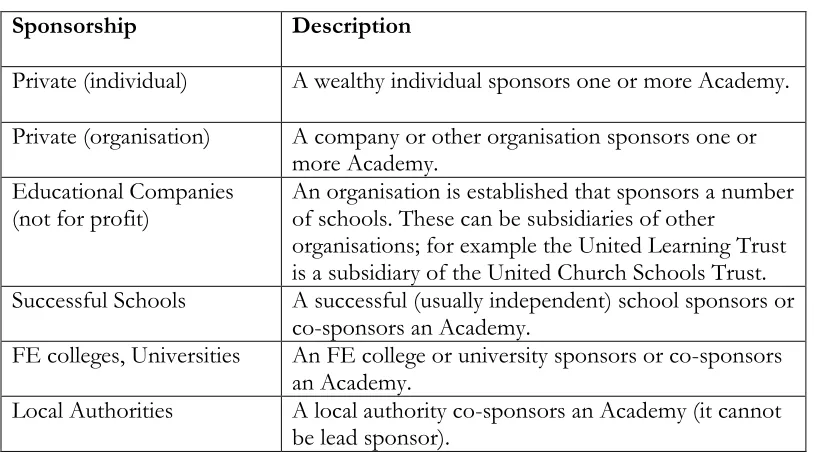
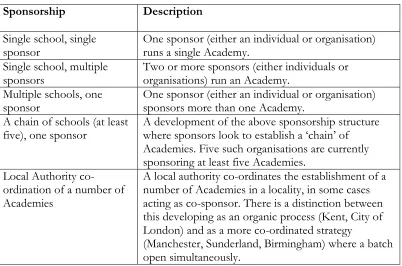
There are also different types of sponsors. While private sector sponsors were prevalent in early Academies, public and third sector organisations, such as local authorities, independent schools and universities, are becoming increasingly involved. These organisations can have the sponsorship fee waived, hence the notion of „sponsor‟ has changed. In addition, ‘Academy chains’ have emerged,
these newer types of sponsors provide Academies with different characteristics from those in the early waves.
Alternatives to Academies
It was originally argued that the unique characteristics of Academies were necessary to fulfil the mission set for them by government. A number of factors suggest that the underlying assumptions of the original policy should now be reassessed and alternatives considered. These factors include:
1. Not all Academies currently have these unique characteristics.
2. More types of school other than Academies show some of these characteristics.
3. Not all Academies have been successful, despite having these characteristics. 4. Schools which are not Academies appear to be successful in similar
circumstances, despite not having all these characteristics.
The creation of Academies is not the only way to achieve the programme’s objectives. The Building Schools for the Future programme is committed to refurbishing all schools. Trust schools are a way to work with external partners, and CTCs and Specialist Schools already have the support of sponsors. Finally, other alternative school models, such as Professional Development Schools, could play a part (a Professional Development School seeks to mix university academic expertise with practitioners in schools).
Policy implications
An early draft of this report was discussed with various stakeholders in the Academies programme at a Roundtable event in October. Some of that discussion has informed the following policy implications.
The controversies surrounding Academies may limit their effectiveness in producing system-wide improvement. If Academies are to remain an important part of the educational landscape for the foreseeable future, their role in the overall system needs to be clarified.
The government should revisit and refine the objectives of the Academies programme. Different priorities point to the need for different models of schools. It may be, for example, that existing approaches are ill-suited to improving the performance of neighbouring schools.
Academies are likely to have more influence if they co-operate with neighbouring schools in terms of admissions, exclusions and sharing their resources. The increased collaboration already required in „behaviour partnerships‟ and the provision of 14-19 diplomas could usefully be extended.
Academies’ admissions practices, along with those of all state schools, should be more closely monitored, especially in terms of the impact they might have on the intakes of their neighbouring schools.
While banding of admissions has enabled some Academies to become more inclusive, area-wide banding would ensure that this was not to the detriment of other local schools.
In founding Academies, more consultation is needed on the demand and appropriateness of a particular specialism in the locality, especially in relation to the provision already available.
It should be standard practice to have staff and parent representation on Academies’ governing bodies, and observance of this should be regularly monitored.
The emergence of Academy chains is a potentially important and valuable development. However, care needs to be taken to ensure that the benefits of school autonomy are not lost by key decisions being taken away from individual schools by the central management.
Some Academies have used their autonomy to innovate in terms of school leadership, staffing, curriculum and pedagogy. Their role in sharing good practice could be enhanced by following the model of Professional Development Schools.
The involvement of universities and successful schools as sponsors and co-sponsors is an important development. It would be advantageous to extend this type of partnership to other state schools, especially those with traditionally low rates of higher education participation.
Academies are in danger of being regarded by politicians as a panacea for a broad range of education problems. Given the variable performance of Academies to date, conversion to an Academy may not always be the best route to improvement. Care needs to be taken to ensure that Academies are the ‘best fit’ solution to the problem at hand.
Comparisons between Academies, and between Academies and other schools, should take more account of differencesin, for example:
admissions policies; pupil demographics;
performance of the predecessor school; behavioural issues;
Introduction
One of the most prominent and controversial aspects of the New Labour government‟s education policy is undoubtedly the Academies programme. First announced in 2000, there are currently 130 Academies open in England,1 set to rise to over 314 by 2010, and eventually to 400. They have been characterised in an official prospectus as „all-ability state schools with a mission to transform education.‟2 Former schools minister Lord Adonis saw Academies as a movement that could help to transform the whole education system:
If education is indeed to be an engine of accelerated social mobility, then in terms of secondary schools two things need to happen. First, we need to eradicate the long tail of underperforming schools which still exists. And second, we need steadily more secondary schools to move from being satisfactory to excellent, competing at the highest levels of attainment. Academies have a critical role to play on both fronts – the eradication of failure and the quest for excellence.3
Academies were originally developed in order to tackle disadvantage and underachievement. Sponsors contribute money and expertise and help to create innovative approaches to schooling in these Academies. These schools are also expected to instigate improvements in neighbouring schools and the wider community in their locality.
Yet the policy has often been contentious. Many of the early Academy buildings went over budget. Alleged enticement to sponsors was part of a „cash for honours‟ row in the final year of the Blair government, while particular sponsors have been accused of bringing controversial religious teaching, such as creationism, into their schools. The schools‟ independence has led some to see them as unaccountable and unnecessarily separate from local authority provision. On the other hand, the policy has been supported by various organisations, including the Conservative Party and the Liberal Democrats, and some local authorities are now actively participating in the programme.
Aim of the report
This report collates and scrutinises secondary material relating to the Academies programme. A great deal of the literature on Academies is polarised and advocates either a position for or against the programme. This report attempts to cover a wide range of literature on Academies. The objectives of the report are to:
1 This figure includes the 47 Academies that opened in September 2008 but not the four scheduled to open in
January 2009.
2 DCSF & DIUS. 2007. Academies, Trusts and Higher Education: prospectus. London: HMSO. p. 7.
3 Adonis, A. 2008. „Academies and social mobility‟, Speech to the National Academies Conference February 7th.
analyse the original aims of the programme and consider how feasible these were, how they might have changed and whether the programme is currently achieving them;
identify the characteristics of Academies and create a typology of different types of Academies;
examine the newer types of Academy sponsors (such as universities and independent schools) and consider the implications of this development for the programme;
outline what alternative initiatives could also fulfil the objectives of the programme.
1. Origins of the Academies programme
The Academies programme was first announced in March 2000 in a speech to the Social Market Foundation by the then Education Secretary, David Blunkett. This new type of school was intended either to replace an existing failing school or to provide a new school in an area of sustained educational underachievement. Blunkett outlined the key facets of the policy:
...in some of the most challenging areas, we believe a more radical approach is needed. Over the next year, we intend to launch pathfinder projects for new City Academies. These Academies, to replace seriously failing schools, will be built and managed by partnerships involving the Government, voluntary, church, and business sponsors. They will offer a real challenge and improvements in pupil performance, for example through innovative approaches to management, governance, teaching and the curriculum, including a specialist focus in at least one curriculum area.4
City Academies (the prefix „City‟ was dropped when the policy was expanded to non-urban areas) were to have a distinctive identity, and to be something of a „shock tactic‟ to improve performance. As the quotation above suggests, this was seen as a distinctive and „radical‟ approach to tackling underachievement in schools, using „innovative‟ approaches which, by implication, could seemingly not be realised by existing school types.
The size of the programme is now considerable. The first three Academies opened in 2002, and 130 are currently open. The eventual target of 400 (target date unspecified) would constitute just over 10% of all secondary schools in England.
The government has commissioned annual evaluations of the programme by PricewaterhouseCoopers (PwC). In addition, reviews of the programme have been conducted by the National Audit Office (NAO) and the Public Accounts Committee (PAC), and it has also been scrutinised periodically by (what is now) the House of Commons Children, Schools and Families Committee. Trade unions, such as the NASUWT, TUC, and NUT, and the Anti Academies Alliance, have also commissioned reviews of the programme. The major reviews will be discussed in this report.
Prior to the launch of the Academies programme, a number of other major education initiatives had been developed by Labour since their coming to power in 1997. These include Education Action Zones, Excellence in Cities, Fresh Start schools and, more recently, the
Building Schools for the Future (BSF) programme (launched in 2004).5 The BSF programme aims to rebuild every state secondary school by 2015, although this has recently been put back to 2020 (even this date may now be in doubt).6 This programme will have implications for Academies with regard to the distinctiveness of new school buildings, and this issue will be returned to later in the report.
4 Blunkett, D. 2000. Transforming Secondary Education. Speech to the Social Market Foundation March 15th.
http://www.dfes.gov.uk/speeches/media/documents/transforming_secondary_education.doc. Accessed 12/02/2008, pp. 13-4.
5 See: DfES. 2004. Building schools for the future: A new approach to capital investment. Annesley: DfES.
6 Curtis, P. 2008. „Ministers shelve £45bn plan to rebuild every state school by 2020‟, The Guardian April 10th.
Academies built explicitly upon the City Technology Colleges (CTCs) created by the Conservatives in the late 1980s and early 1990s. In fact, the statutory basis for Academies employed existing legislation used to create CTCs in the 1988 Education Reform Act.7 Further similarities with CTCs include the urban location, the specialism and the sponsor. CTCs were themselves based partly on magnet schools in the USA and, like Academies, have many similarities to the charter schools that have since developed in many parts of that country. Yet the programme of CTCs never reached the same scale as Academies. Just 15 CTCs were established with the last created in 1993, four years before the end of the Conservative government and seven years before the launch of the Academies programme. Though small in number, CTCs were referred to by Kenneth Baker (the then Education Secretary) as „islands of excellence‟ and „lights for others to follow‟, and Sir Cyril Taylor also emphasised their „beacon or lighthouse effect‟.8
In 2005, in its response to the second PwC evaluation, the then Department for Education and Skills (DfES) cited CTCs when attempting to demonstrate that Academies were „far from untried or unproven‟.9 It also stated that „[t]he CTC experience is a sound precedent for the Academies Programme, and it was decisive in persuading the government to launch the Academies Programme in 2000‟.10 Yet the DfES response also differentiated the Academies programme from CTCs by claiming that the government was „focusing the [Academies] model more specifically and rigorously on areas of deprivation and low inherited educational standards‟.11 Similar claims were made at the start of the CTC experiment but neither initiative has entirely stuck to this focus. However, the response also highlighted another key difference: „CTCs were also mostly established with opposition from Local Education Authorities (LEAs), whereas every Academy so far established enjoys the support of the relevant LEA‟.12 The extent to which local authorities have actively embraced Academies, or have done so willingly in instances where this has occurred, remains a matter of contention. A distinctive feature of the Academies programme is that the schools are outside of the control of local authorities.
There have been some significant changes in the Academies policy in recent years. This includes the majority of CTCs and a few independent schools converting to Academies. Universities, FE colleges and independent schools are being more proactively encouraged to sponsor Academies, and the requirement that sponsors provide £2 million has been waived in these cases. Significantly, local authorities have now become more actively involved in Academies, in some instances as co-sponsors. This, in particular, is seen by some as a decisive break with the notion of Academies as „independent state schools‟ offering an alternative to local authority provision. Ed Balls‟ first speech to the commons as Secretary of State for Children, Schools and Families seemed to embrace local authorities somewhat more than before: „[a]ll academies replacing local authorities proceed with local authority
7 Rogers, M. and Migniuolo, F. 2007. A New Direction: A Review of the School Academies Programme. London: Trades
Union Congress. p. 8.
8 Whitty, G., Edwards, T., and Gewirtz, S. 1993. Specialisation and choice in urban education: The city technology college
experiment. London: Routledge. pp. 127-8.
9 DfES. 2005. Department for Education and Skills Response to the Second Annual Report from the PricewaterhouseCoopers
Evaluation of the Academies Programme. Nottingham: DfES Publications. p. 7.
endorsement at the feasibility stage now, and there is already a duty to consult local authorities at the funding agreement stage.‟13
With this apparent change in emphasis, and with the continuing controversy surrounding aspects of the programme, it is important to remind ourselves of the Academies programme‟s original objectives, and which features of the programme were then considered necessary, if not sufficient, to achieve them.
1.1. Original objectives of the Academies programme
A number of texts outline the objectives of the Academies programme. The 2001 Green Paper Schools: Building on Success,defined Academies in the following way:
City Academies offer a radical option to help raise achievement in areas of historic underperformance [...] City Academies are all-ability schools with the capacity to transform the education of children in areas of disadvantage and need. They will raise standards by innovative approaches to management, governance, teaching and the curriculum, offering a broad and balanced curriculum with a specialist focus in one area.14
This description was consistent with Blunkett‟s original announcement. Academies were originally envisaged as being created in predominantly urban areas that were disadvantaged and where current schools were underperforming. There was also a clear emphasis on „innovation‟ in a number of areas. While it can be argued that Academies are no longer simply replacing underperforming schools, or even located in areas of manifest disadvantage, current discourse still emphasises these aspects.
The terms of reference for the first PwC evaluation sets out the objectives for the Academies programme more explicitly, although it is not made clear who initially indentified these and expressed them in these particular terms. Along with two „immediate‟ objectives and eight „intermediate‟ objectives, the following three „ultimate‟ objectives were cited:15
Academies will contribute to driving up standards by raising achievement levels for their own pupils, their family of schools and the wider community by breaking the cycle of underachievement and low aspirations in areas of deprivation with historical low performance;
Academies will be part of local strategies to increase choice and diversity in education. They will have innovative approaches to one or more of governance, curriculum, staffing structures and pay, teaching and learning, structure of the school day and year, using ICT [Information and Communication Technology]; and
Academies will be inclusive, mixed ability school[s].
The first objective is particularly interesting, and in many respects rather ambitious. The objective of the school improving its own results (compared to its predecessor school) is perhaps obvious. One of the intermediate objectives related to this was for Academies to
13 Hansard. 2007. House of Commons debates July 10th, Column 1329.
14 DfEE. 2001. Schools: Building on Success – Raising standards, promoting diversity, achieving results. Norwich: The
Stationary Office. p. 49.
achieve the national average for attainment (at various levels) within four years of opening, but this was perhaps far too high an expectation considering the schools‟ background. The ultimate objective of Academies contributing to improving achievement in the family of schools and wider community is also a very challenging task. This suggests that Academies are to be „beacons‟ of educational excellence in their areas. On a practical level this means sharing their facilities and expertise, especially in their specialisms. As will be demonstrated later, this has been difficult to achieve so far for various reasons. The second objective posits Academies as part of a policy to enhance the choice of schools in a given location. This objective is predicated on Academies being significantly different and in employing innovative approaches to particular aspects of schooling. The final objective requires that the schools should be inclusive and mixed ability. As will be explored in the section on admissions and exclusions, some have challenged the extent to which Academies are inclusive, while others have questioned their disproportionately high number of pupils eligible for free school meals (FSM).
The fourth PwC evaluation asserts that the factors unique to Academies are in respect of their:16
Independence; Governance; Sponsor;
Leadership model; Buildings;
Specialism.
These aspects will be examined in the next part of the report. It should be noted that, while most of the above are unusual features, they are not all „unique‟. At the time of the programme‟s inception, both CTCs and maintained Specialist Schools could have specialisms, and virtually all maintained secondary schools are now Specialist Schools. There are also active sponsors in many of these schools although, in the case of Specialist Schools, they have nothing like the kind of influence that can be wielded by sponsors of Academies.
How underachieving schools are defined and identified
The definition and identification of underachieving schools is a central issue. Rogers and Migniuolo, in a Trades Union Congress (TUC) sponsored report on Academies, use a school being in special measures as an indicator of underachievement. They go on to note that, in the period between 2004 and 2006 (when the target number of Academies doubled from 200 to 400), the number of secondary schools in special measures halved from 97 to 48.17 They argue that this has lessened the need for Academies. But precisely how poor school performance is being defined in this context is debatable. As Sammons notes, definitions of school performance under New Labour have been subject to change: „[d]ifferent uses of the term standards, and the growing numbers of indicators, targets and different bases for
16 PwC. 2007. Academies Evaluation – 4th Annual Report. Nottingham: DCSF Publications. pp. 69-81.
judgments can cause confusion because schools classed as „failing‟ in some measures may do well in others.‟18
In Blunkett‟s original speech outlining the programme, he made the following specification: „[t]o be eligible for Government support, the Academies will need to meet clear criteria. They will take over or replace schools which are either in special measures or underachieving.‟19 What constitutes „underachieving‟ at any given time is open to interpretation. In February 2008, the then schools minister Lord Adonis was more specific about how underachievement in this context could be defined:
…simply because a school is not placed in special measures by Ofsted does not make it a successful school. Parents rightly want good exam results too, and we will continue to focus on the hard results achieved by schools, and their rate of improvement, when deciding on reform options.20
The definition of underachievement he recommended was those schools where 30% of pupils were not achieving five A* - C GCSEs, including English and maths. He identified 638 schools which were not currently achieving this (compared to 1610 in 1997), and also noted that in 161 of these schools only 20% of pupils were reaching this level of attainment.21 Reaching this target became the cornerstone of the National Challenge, officially launched by Ed Balls in June 2008.22 In this initiative all schools that were not meeting the target received extra assistance and could choose to become an Academy or join a trust or federation. It remains to be seen how many additional Academies will result from the National Challenge.
Some criticisms of the Academy programme:
There have been a number of areas of criticism of the Academies programme. The following aspects have proved especially controversial:
Academies not needing to sign up to the national framework of pay and conditions; the role of the sponsors and, specifically, the suitability of certain sponsors;
overrunning costs;
admissions and exclusions practices;
Academies‟ voluntary involvement in partnership arrangements with other schools; lack of staff and parent representation on the governing body.
These criticisms are often framed by a more general unease about private sector involvement in education and, in the case of Academies, what is seen by some critics as largely unaccountable sponsors having significant influence over the direction of a publicly funded school. Ball asserts that Academies stand „as a condensate of the education policies of the
18 Sammons, P. 2008. „Zero tolerance of failure and New Labour approaches to school improvement in
England‟, Oxford Review of Education 34 (6), pp. 651-664. p. 652.
19 Blunkett, Transforming Secondary Education, p. 14. 20 Adonis, „Academies and social mobility‟, p. 13. 21 Adonis, „Academies and social mobility‟, pp. 11-12.
22 DCSF. 2008. „National Challenge strategy launched to ensure that more children get better GCSEs‟, Press
competition state‟.23 For him, Academies embody the increasing role of the private sector in education:
Academies are an experiment in and a symbol of education policy beyond the welfare state and an example and indicator of shifts taking place in governance and regulatory structures and they enact a set of metaorganisational changes. The programme signals a discursive-strategic shift towards a new kind of regulatory regime […] Innovation, inclusion and regeneration are tied together in relation to the requirements of the digital workplace. Academies indicate a re-articulation and re-scaling of the state; they are part of a new localism and a new centralism; they encompass new kinds of autonomy and new forms of control: controlled decontrol.24
Ball also highlights something that seems incongruous to those steeped in the assumptions of the traditional welfare state. The Academies programme promotes and champions private enterprise while also being concerned about disadvantage: „[Academies] involve a self-conscious attempt to promote entrepreneurism and competiveness – as well as a commitment to address social problems and inequalities‟.25 Woods et al. assert that there is a seemingly uncritical reliance on the private sector in the programme: „[i]n the academy schools programme control over what is public is being ceded to the private without due recognition of the value of the public and the problematics of the private.‟26 Yet the developments in the programme since 2007, with universities and independent schools being explicitly encouraged to become involved with Academies, have changed the character of the programme somewhat. The engagement of more public and third sector organisations, after having predominately private sponsors in the beginning, may represent a significant shift in emphasis for the programme.
There have been a number of instances which have been seen as negative examples of the programme. Capital City Academy Brent was the subject of media attention early on in the programme when it was revealed that 8 of the 13 governors would be appointed by its sponsor, Sir Frank Lowe.27 Bexley Business Academy has also attracted controversy. Its striking new building was designed by Sir Norman Foster but was not completed in time. The Academy was rated unsatisfactory overall by Ofsted in 2005, which was particularly critical of its teaching and learning,28 and it was issued with a Notice to Improve. However, when it was next inspected in 2007, it was rated satisfactory overall.29
The lack of transparency over the selection of certain Academy sponsors is currently being challenged under EU procurement laws in London (Camden), Cumbria and Stoke.30 It
23 Ball, S. J. 2007. Education PLC: Understanding Private Sector Participation in Public Sector Education. London:
Routledge. p. 171.
24 Ball, Education PLC, p. 171. 25 Ball, Education PLC, p. 171.
26 Woods, P. A., Woods, G. J., and Gunter, H. 2007. „Academy schools and entrepreneurialism in education‟,
Journal of Education Policy 22 (2), pp. 237-259. p. 252.
27 Thornton, K. 2002. „Fears grow over power of academy sponsors‟, Times Educational Supplement August 23rd.
http://www.tes.co.uk/search/story/?story_id=367581. Accessed 11/11/2007.
28 Ofsted. 2006. The Business Academy Bexley – Inspection Report. Inspection number 283099. 29 Ofsted. 2007. The Business Academy Bexley – Inspection Report. Inspection number 294655. 30 Curtis, P. 2008. „Academy expansion under threat‟, The Guardian November 5th,
should be noted that proposed bids for Academies do not always receive preference. In May 2007, for example, a proposal for a community school in Haringey was chosen over two separate proposals for an Academy (put forward by the United Learning Trust and Haberdashers‟ Aske‟s respectively) and a proposal for a Trust school (potentially sponsored by CfBT). The National Union of Teachers (NUT) report on Academies records that:
The adjudicators said, „The [community school] proposal capitalises on the promoter‟s knowledge of the borough, draws on what has been learned in recent years in improving education in the borough and emphasises the potential collaboration with other local schools.‟ This decision followed a long campaign by the [NUT Support] division with local parents, teachers and governors.31
More generally, the PAC evaluation recommends that the department should not approve Academy projects where there are less costly and better value for money alternatives.32 While it still remains to be seen whether concerns regarding the Academy programme are justified, or merely reflect the resistance of the „educational establishment‟ to new ways of confronting problems that they have consistently failed to solve, the government seems determined to push the programme ahead, and even expand it. Its approach was apparently endorsed in a review by the Prime Minister‟s Delivery Unit (PMDU) early in 2008, although the details of that review are not in the public domain. The Times Educational Supplement has made two requests for the release of the report under the Freedom of Information Act which have been refused.33
The Conservatives also support the policy, emphasising its continuation of aspects of CTCs. In a 2007 policy document the party outlined how it would create new schools, which they term „New Academies‟, along similar lines:
New Academies will be free, non-selective, and within the maintained [i.e. state] system. They will typically be smaller than comparable, existing schools; they will be set up and run by existing educational providers, charities, trusts, voluntary groups, philanthropists and co-operatives on behalf of parents and pupils; they will be not-for-profit organisations and they will compete with surrounding local authority schools, helping to exert pressure for higher standards in the surrounding schools.34
At the 2008 Conservative Party conference Michael Gove reiterated the commitment to creating such independent state schools, referring specifically to Swedish „free schools‟ as a model. Gove also feels that the changes to the Academies programme since Brown became prime minister mean that there „is a real danger that the opportunities academies promise
31 NUT. 2007. Academies.
http://www.teachers.org.uk/resources/word/CompleteAcademiesbriefing2007new1.doc. Accessed 01/02/2008. pp. 137-8.
32 Committee of Public Accounts. 2007. „The Academies Programme‟, 52nd Report 2006-07. London: The
Stationary Office. p. 6 (9).
33 Stewart, W. 2008. „Academy review findings will remain secret‟, Times Educational Supplement April 18th. p. 11. 34 Conservative Party. 2007. Raising the bar, closing the gap: An action plan for schools to raise standards, create more good
could be tragically curtailed‟ and asserts that the Conservatives would „restore to schools all the freedoms they‟ve lost‟.35
Summary
The Academies programme is a rather ambitious initiative which forms part of the government‟s ongoing attempts, within its education policy, to tackle disadvantage and raise attainment. The programme relies partly on the private sector being in partnership with the state, another key theme in New Labour policy-making. The scheme has so far been deemed successful enough to continue and indeed to accelerate its expansion towards a target of at least 400 Academies. However, there have been various criticisms of the programme, especially concerning the role of the sponsor and a potential democratic deficit arising from a lack of local authority involvement.
35 Gove, M. 2008. „Freeing good schools to help the most disadvantaged‟, speech to the Conservative Party
annual conference, September 30th,
2. Distinctive aspects of Academies and their performance
This section will examine key parts of the Academies programme: independence; sponsorship; attainment; admissions and exclusions; effects on neighbouring schools; costs and buildings; and specialisms.
These include the supposedly unique aspects of Academies, highlighted by PwC in their fourth evaluation (cited in the last chapter).
2.1. Independence
In many respects the defining characteristic of Academies is their independence from the local authority. The line of accountability is directly to the Secretary of State. Academies do not charge fees and are predominantly state funded, apart from the £2 million paid by private sponsors, which should amount to 10% of the overall cost of the school. Sponsors can select the majority of the governing body and they agree their admissions policy with the Secretary of State. Lord Adonis championed the independent aspect of Academies: „[i]ndependent management is vital to their success, generating ambitious school leadership and sponsorship - from within and beyond the existing state system - and with it a vision and ethos focused on rapid success‟.36 Academies have been referred to by Blair as „independent state schools,‟37 which echoes Thatcher‟s description of CTCs as „state-independent schools‟.38 It is important to clarify what independence means in this context and what the parameters of this freedom are.
Academies are companies limited by guarantee which have charitable status, and the governance of Academies remains a distinctive element of the programme. There is no prescription regarding the number of governors in Academies, but the number is usually around 13, the majority of whom are appointed by the sponsor. Other governors should include at least one parent, a local authority representative and the principal in an ex-offico capacity. It is not a requirement for them to have a staff representative, although many do.39 Critics40 assert that the absence of the requirement for staff governors is one of many elements that make Academies undemocratic. PwC found low levels of parent and staff representation on Academies‟ governing bodies in the earlier stages of their evaluation, despite the former being a requirement. However, they have observed an increase in staff representation in their 27 case-study Academies over time.41
36 Adonis, A. 2008. „Full steam ahead for academies‟, The Times January 9th.
http://www.timesonline.co.uk/tol/comment/columnists/guest_contributors/article3148855.ece. Accessed 05/02/2008.
37 Blair, T. 2005. Text of a speech given about the Education White paper quoted in The Guardian on October
24th, http://www.guardian.co.uk/politics/2005/oct/24/speeches.education. Accessed 12/04/2008. 38 Whitty et al., Specialisation and Choice in Urban Education, p.2.
39 See DCSF Standards Site:
http://www.standards.dcsf.gov.uk/academies/what_are_academies/organisation/?version=1#1576183 Accessed November 30th 2008.
40 For example, the Anti-Academies Alliance and teaching unions.
A key component of Academies‟ independence was being outside of local authority control. Lord Adonis outlined this in 2008:
It was eight years ago that the academy concept first emerged, as a distinctly new model of independently managed state schools outside the traditional local authority system of school control but with central and local government in a new role as commissioner, with a particular focus on areas of underperformance and disadvantage.42
He asserted that an Academy‟s uniqueness contributes to the diversity of education provision in an area, or „diversity of supply‟, as the think-tank Policy Exchange terms it.43 On more than one occasion Adonis drew parallels between the Academies programme and the old direct grant schools. In essence he saw Academies as independent non-fee charging schools:
I see this as the creation of a modern direct grant scheme, but it‟s different in that these schools aren't selective. […] One of my biggest aims is to break the link between „independent‟ schools and fee-paying, selective schools. I hope to generate the notion that there are two independent sectors: one of independent fee-paying schools and one of independent schools without fees. I don‟t see why independent management should be the preserve of the fee-paying sector.44
In the absence of the local authority shaping the school, the sponsor(s) have the defining role in how the Academy is developed. Adonis outlined sponsors‟ role in Academies as follows:
Academy sponsors have integral control of, and responsibility for, the management of their academies. They appoint a majority of the governors; they control the school estate; they have unambiguous responsibility for management and appointments; they instil their ethos and expectations; they develop – within broad parameters – their own curriculum; and their budget comes as a single block grant from the government to allocate as they think appropriate, with no intermediaries taking a slice on the way. By the standards of state-funded schools at home and abroad, this is a high degree of independence.45
Elsewhere Adonis reiterated the autonomy given to Academies, stating that it is „the first time that school managers have been granted such a degree of independence - within a framework to ensure fair admissions and funding - in the state system.‟46 He also drew parallels to Sweden with its 900 state funded independent schools, and Chicago‟s „Renaissance 2010‟ programme with 100 independently managed state schools.
42 Adonis, „Academies and social mobility‟, p. 4.
43 Sturdy, E. and Freedman. 2007. Choice? What Choice? – Supply and demand in English education. London: Policy
Exchange. p. 17.
44 Quoted in Morrison, J. „Independents go all-inclusive‟, The Independent Education and Careers section
October 4th, pp. 4-5.
45 Adonis, A. 2007. Speech to HMC Annual Conference 12th October 2007.
http://www.standards.dfes.gov.uk/academies/software/andrew_adonis_speech_1007.doc?version=1. Accessed 12/12/2007. pp. 14-5.
The independence of Academies means that their principals often feel a sense of liberation. This reflects the potential for more dynamic governance and management arrangements and greater control over the curriculum. Many contrast this favourably with the perceived restrictions imposed by local authorities on mainstream state schools.47 Jean Hickman, principal of Walsall Academy, believes that the innovation afforded by the Academies programme is important because it allows the school to focus on the specific issues in the immediate community:
It is not so much innovation against political agendas or curricula that other state schools use; the innovation that I enjoy is that of taking a systematic approach to delivering the educational services to my children in a way that suits them, not dictated to me for what would be 18 schools. Currently, there are 18 schools in the borough for which I work, and all have to do it one way. My systems are specific to my community in Walsall.48
Yet, for some, the autonomy of Academies in comparison to the perceived power of a local authority over other state schools can be overstated. Philip O‟Hear, an Academy principal, also has experience of working for a local authority and believes that Academies can work with them:
A local authority director of education doesn‟t run or manage schools. If they influence schools, they do so in partnership. A legally more independent partner should not be a threat to the leadership of a good authority, which needs to treat all its schools as self-managing. We work closely with our local authority and don‟t see it as any threat to our independence.49
The freedom available to Academy principals has led to instances of innovative leadership in terms of curricula and pedagogy. For example, at Mossbourne Community Academy curricular freedoms enabled the principal Michael Wilshaw to take certain pupils, particularly in Year 7, away from some of their mainstream subjects to focus on foundation skills and to have literary and numeracy catch-up classes. This has apparently led to great improvements in these pupils‟ Key Stage 3 results compared to their Key stage 2 results.50
The final PwC evaluation is generally positive about leadership in Academies, citing Oftsed evaluations and their own survey data.51 However, it is perhaps interestingly that one of their recommendations suggests the need for Academy principals to stay focused: „Academy principals should be discouraged from taking on extended and system leadership roles which take them outside their own Academy until such time as their Academy is in a steady state and showing consistent improvement‟.52 In addition, PwC note that there are high attrition rates of Academy principals and also find that in their 27 case-study Academies no principals
47 A number of Academy principals outline these benefits in the following volume: Astel, J. and Ryan, C. (eds)
2008. Academies and the Future of State Education. London: CentreForum.
48 House of Commons. 2008. „Diversity of schools: Academies‟, Uncorrected Oral Evidence give to the
Children, Schools, and Families Committee February 25th, HC 311-ii. Response to Q124.
49 O‟Hear quoted in Wilby, P. 2008. „From one end of the corridor to the other‟, The Guardian Education
section December 9th, p. 3.
50 Wilshaw, M. 2008. „Curriculum‟, in Astle and Ryan, Academies and the Future of State Education, pp. 32-40. pp.
32-3.
51 PwC, Academies Evaluation Fifth Annual Report, pp. 125-41.
were from Black and Minority Ethnic backgrounds and that only just under a quarter were female (compared to 36% of secondary heads in England).
There is also a potential danger that the most talented head teachers will be drawn away from other state schools into Academies. The National Audit Office found that Academy principals in 2004-05 were paid on average between £18,000 and £32,000 more than those in similar-sized schools in the maintained sector.53
Changes to schools policy generally has meant that the independence in Academies is now slightly less distinctive. All schools that are not deemed to be underperforming have been given greater management freedom, as outlined by the 2005 White paper Higher Standards, Better Schools For All.54 Yet at the same time there has also been greater emphasis on collaboration between schools in terms of 14-19 diplomas, „behaviour partnerships‟55 and the
Every Child Matters agenda.
As the sponsors can select the governors, appoint staff, and are not answerable to the local authority, the independence of Academies is considerable. Yet, as the programme expands, there may be logistical problems in so many schools (up to 400) being directly responsible to the Secretary of State. This latter point is particularly significant and it may prove impractical for a Secretary of State to oversee hundreds of different funding agreements.
2.2. Sponsorship
The 2001 White paper Schools: Achieving Success indicated that schools in general (not just Academies) would be assisted by government in building links with outside agencies:
We would anticipate that a range of partnerships would be possible. For example, successful schools might share the benefits of particularly strong subject departments, FE colleges with a vocational specialism might work with schools in that area, faith groups might help to build a school‟s ethos and the private sector could provide strong management support for schools, which are increasingly complex organisations to manage. We will not stand in the way of any arrangements which will raise standards for pupils.56
Several elements in the above should be highlighted. Firstly, it is important to ascertain what precisely the sponsors are expected to bring to schools. One suggestion is that sponsoring bodies can bring specific expertise, such as an FE college assisting with vocational specialisms. The private sector‟s potential contribution is seen in terms of its expertise in management, particularly as schools are „increasingly complex organisations to manage‟. The idea that private sponsors can bring management expertise was echoed by Lesley King, Director of Academies at the Specialist Schools and Academies Trust (SSAT), when giving evidence to the Children, Schools, and Families Committee in February 2008: „I think that they bring expertise - not necessarily in pedagogy as sponsors leave that to principals and
53 National Audit Office. 2007. The Academies Programme. London: The Stationary Office HC 254, Session
2006-07. p. 36 paragraph 3.42.
54 DfES. 2005. Higher Standards, Better Schools For All: More choice for parents and pupils. Norwich: TSO. p. 9. 55 These are officially termed: „School Partnerships for Behaviour and Attendance‟.
staff, but in running organisations. That outside look can be useful.‟57 This is indicative of a discourse on Academy sponsorship which has recently become more prominent, in which private sponsors‟ contribution is confined mainly to organisation and management, rather than pedagogy.
Sponsors are a particularly distinctive, if not unique, aspect of the Academies programme. There are sponsors in Specialist Schools and there will also be partners in Trust schools, but they have a much larger role in Academies. Recently schools minister Jim Knight stated that the DCSF carries out „rigorous checks‟ to establish the suitability of potential sponsors, who should be able to demonstrate:
transparency of business arrangements (both in the EU and overseas) and ability to account for funds (including donations from other parties);
evidence of a successful business background including evidence of consistent and sustained trading (where appropriate);
a long-term commitment to the UK education sector and the aims of the academies programme;
potential to run a successful school and to contribute towards raising standards; ability to enhance the reputation of the academies programme;
ability to promote community cohesion; and
financial status commensurate with academy sponsorship and/or evidence of ability to raise the necessary funds where appropriate.58
More recently the DCSF, in reaction to the investigation of an Academy sponsor over financial dealings, stated that someone with an existing criminal conviction could not become a sponsor. However, it was unclear if the DCSF would be able to remove a sponsor who subsequently broke the law.59
In a speech to the inaugural National Academy Conference in 2008, Lord Adonis outlined four aspects that „are at the heart of the academy movement‟: ethos, leadership, teaching, and talent development.‟60 When outlining the importance of ethos, Adonis emphasises the role of sponsor in overcoming disadvantage in the school:
The insight that a strong ethos, underpinned by positive values and aspiration, enables a school, its staff and its pupils to unite with pride behind a common sense of purpose, lies at the heart of the academies concept. Setting a mission and vision is a key role of the Academy Sponsor, essential to establishing a culture of ambition to replace the poverty of aspiration that was generally there before.61
This posits a successful sponsor as someone who can overturn a culture of under-aspiration.
57 House of Commons. „Diversity of schools: Academies‟, response to Q86. 58 Knight, J. 2008. Written Answer. Hansard September 1st, Column 1602W.
59 Marley, D. 2008. „Doubts emerge over sponsors‟, Times Educational Supplement December 12th, p. 10. 60 Adonis, „Academies and social mobility‟, p. 15.
As indicated earlier, this reflects a broader New Labour attitude to the private sector and education. In 2003, Gordon Brown, then Chancellor, stated his desire for business people to become more involved in education (not just limited to Academies):
When I went to school, no business ever came near our classrooms. I want every school pupil to be introduced to enterprise and commerce, not just enjoy a week of work experience.
I want teachers able to communicate the virtues of entrepreneurship and wealth creation. And just as business tycoons have become the pop idols of the business world, I want our local business leaders to become role models for today‟s young.62
The implication for Academies is that successful sponsors act as „role models‟, especially for pupils in areas of social and economic deprivation.
Hatcher, writing about increasing private involvement and „re-agenting‟ in education, believes that the motive of sponsors is not profit driven: „[t]hey display a range of motives. In the majority of cases they have a record of charitable donations and community activity and see their involvement in Academies in this context.‟63 Ball refers to Academy sponsors as „hero entrepreneurs‟, whose involvement in Academies is symbolic of the New Labour project: [t]hese hero entrepreneurs embody the values of New Labour: the possibilities of meritocracy, of achieving individual success from modest beginnings, and wealth creation from innovation and knowledge.‟64
There are potential dangers in the way such entrepreneurs sometimes operate in the Academy context. The PAC cautioned against sponsors contracting services out to one of their own companies: „[a] small number of academies have paid sponsors to provide services, for example for payroll management. Such services should be routinely put out to competitive tender, so that they meet existing procurement regulations and demonstrably avoid conflicts of interest.‟65 More recently the Academy chain Edutrust has become the subject of a government inquiry into alleged financial irregularities.66
Furthermore, the final PwC report asserts that there is the potential for confusion over the accounting systems in Academies:
62 Brown, 2003. „Britain‟s business to rival America‟s entrepreneurial dash‟, The Telegraph December 9th.
http://www.telegraph.co.uk/opinion/main.jhtml?xml=/opinion/2003/12/09/do0901.xml&sSheet=/portal/2 003/12/09/ixportal.html. Accessed 05/02/2008.
63 Hatcher, R. 2006. „Privatisation and sponsorship: the re-agenting of the school system in England‟, Journal of
Education Policy, 21(5), pp. 599-619. p. 612.
64 Ball, Education PLC, p. 175.
65 Committee of Public Accounts. 2007. „The Academies Programme‟, 52nd Report 2006-07. London: The
Stationary Office. p. 31. Beckett criticises the apparent reluctance of certain sponsors to pay the full £2 million sponsorship fee and the tendency for some to pay „in kind‟, as well as a few cases of a sponsor contracting services to their own company. See: Beckett, F. 2007. The Great City Academy Fraud. London: Continuum. p. 24.
66 Curtis, P. 2008. „Government launches inquiry into academy funds allegations‟, The Guardian November 28,
There is a missing link…between what the Academies are reporting in their own accounts and the reconciliation of these with the Department‟s resource accounts and against their funding agreement (in areas such as the use by some Academies of general funding to establish subsidiary companies). This missing link creates a potential risk in respect of the Department‟s Parliamentary accountability67
PwC were also unable to ascertain whether Academies financial freedoms have made a contribution to improved effectiveness and efficiency.68
Although the government itself acknowledges that there must be appropriate „safeguards‟ in terms of sponsors and accountability,69 some critics of sponsors suggest that they are largely unaccountable and „own‟ the school in perpetuity. That this was not the original intention can be seen in the 2001 Green Paper: „we intend to develop a new model which would enable an external private or voluntary sector sponsor to take responsibility for a weak or failing school against a fixed-term contract of, say, five to seven years with renewal subject to performance.‟70 Yet in practice, maintaining sponsorship does not appear to be subject to performance and sponsors‟ „performance‟ is currently not specifically monitored. For example, in Ofsted inspections of Academies, sponsors are sometimes mentioned as part of the management and governance at the school, but not always. The Ofsted inspection framework perhaps needs to take into account unique elements of Academies such as the role and performance of the sponsor. Currently the Ofsted inspections for Academies are similar to those for other state schools, although there are also additional monitoring visits soon after an Academy opens.71 In 2005, the then Education and Skills Committee questioned the general level of scrutiny in this area: „[w]e agree that the participation of an enthusiastic and committed private sponsor might benefit a school. But once again, the DfES does not seem to have set up a rigorous structure to evaluate the effects of sponsorship.‟72
Because the programme is still relatively new, it is unclear what will happen to the role of the sponsor over time. In giving evidence to the Children, Schools and Families Committee in February 2008, Margaret Tulloch, Chair of the Advisory Centre for Education (ACE) council, questioned what will become of sponsors in the long-term.73 More recently there has been the first instance of a sponsor appearing to want to withdraw from an Academy. Amey has sponsored Unity City Academy since it opened in 2002.74 It paid its £2 million sponsorship fee, so there should be no financial implications for the school, but what will happen to the current management and governance structures remains unclear. The fourth PwC evaluation also raises questions about certain aspects of sponsorship, including succession planning and possible scenarios where a sponsor loses interest in their Academy. It highlights the following three issues:
67 PwC, Academies Evaluation Fifth Annual Report, p. 80. 68 PwC, Academies Evaluation Fifth Annual Report, p. 80. 69 DfES, Schools: Achieving Success, p. 44.
70 DfEE, Schools: Building on Success, p. 49. Emphasis added.
71 Mansell, W. 2008. „Oftsed accused of academy bias‟, Times Educational Supplement December 12th, p. 8. 72 House of Commons. 2005. „Secondary Education‟, Education and Skills Committee, Fifth report of the
session 2004-05 March 9th, London: The Stationary Office. p. 16 (32). 73 House of Commons, „Diversity of schools: Academies‟, response to Q88. 74 BBC Website. 2008. „Academy sponsor seeks to withdraw‟, October 10th.