Short Communication
Closing the loop on plastic packaging materials: What is quality and how
does it affect their circularity?
John N. Hahladakis
⁎
, Eleni Iacovidou
⁎
School of Civil Engineering, University of Leeds, Woodhouse Lane, LS2 9JT Leeds, United Kingdom
H I G H L I G H T S
•Plastics recyclability is largely depen-dent on their quality.
•Technicalities define the ability of plas-tic materials to be properly recovered. •Cascaded flows of recycled plastics
should be pursued as an alternative pathway.
•Plastic packaging should be redesigned, improving sorting and reprocessing sys-tems.
•Transitioning towards a circular econ-omy requires the exploitation of all available routes.
G R A P H I C A L A B S T R A C T
a b s t r a c t
a r t i c l e i n f o
Article history: Received 3 January 2018
Received in revised form 16 February 2018 Accepted 27 February 2018
Available online xxxx
Editor: D. Barcelo
While attention on the importance of closing materials loops for achieving circular economy (CE) is raging, the technicalities of doing so are often neglected or difficult to overcome. However, these technicalities determine the ability of materials to be properly recovered and redistributed for reuse or recycling, given the material, com-ponent and product (MCP) state and functionality. Materials have different properties that make them useful for various functions and purposes. A transition, therefore, towards a CE would require the utmost exploitation of all available routes that MCPs can be diverted to, based on their design, use and recovery; ideally, enabling a perpet-ual looping of them in the economy. Yet, this is difficult to succeed. In the present short communication article, the authors explain how the quality and the way it is meant at different stages of the plastic packaging supply chain affects their potential recycling; and outlines the opportunities and constraints offered by some of the changes that are currently introduced in order to improve their circularity. The purpose of this article is to under-pin the need for research that integrates systemic thinking, with technological innovations and regulations at all stages of the supply chain, in an effort to promote sustainable practices to become established.
© 2018 Published by Elsevier B.V. Keywords:
Circular economy Plastic packaging Recycling Resource recovery Technical implications Waste
1. Introduction
With concepts such as dematerialisation, factor 4, factor 10, eco-effi -ciency and industrial ecology becoming ever increasingly attractive to
businesses, getting the accreditation of becoming more‘sustainable’
and/or‘green’requires a shift from current practices. This is what the circular economy (CE) aims to achieve of which systemic nature re-quires both the ecosystem and its individual components to change. While the governance, revised regulation and new business models be-coming increasingly popular in making the transition to a CE, the tech-nicalities (e.g. lifestyle patterns and behaviours, organisational and infrastructural barriers, and composition and functionality) of doing so
⁎ Corresponding authors.
E-mail addresses:[email protected](J.N. Hahladakis),[email protected] (E. Iacovidou).
https://doi.org/10.1016/j.scitotenv.2018.02.330 0048-9697/© 2018 Published by Elsevier B.V.
Contents lists available atScienceDirect
Science of the Total Environment
are often overlooked or not properly accounted. However, these techni-calities control to a large extent the successful transition from a linear to a circular economy; amongst them, the ability of materials, components and products (MCPs) to be properly recovered and redistributed for reuse or recycling (Fig. 1).
In the waste management industry, the quality of MCPs is the fore-most critical factor; it is a measure of ensuring consistent provision of high quality outputs to recyclers, hence meeting their specifications and maintaining credibility and reliability status in the market. For recy-clers it is a measure of gaining competence over virgin material, safeguarding consistent supply and reducing risks associated with re-source demand and price volatility. In other words, quality of recycled materials is a measure of the extent by which synergistic relationship between waste management, recyclers and (re)manufacturing indus-tries are established, promoting sustainable resource management.
Metals, paper, glass and plastics are materials considered to enable a more circular way of management (EC, 2016), due to their high recycla-bility potential. The European Commission (EC) has classified plastics amongst thefive priority areas, where progress needs to be made to-wards a more circular reality, recently launching a relative strategy (EC, 2018). Plastics due to their light weight nature,flexibility, and du-rability, are particularly effective in packaging applications, with over a third of plastic materials demand being used for plastic packaging gen-eration (PlasticsEurope, 2016). The short-lived nature of plastic packag-ing however, creates a great demand in the collection and recyclpackag-ing of this material, both for the need of recovering and redistributing it into the production chain, as well as for protecting the environment from its inappropriate disposal and leakage (Jambeck et al., 2015). Yet, only a small percentage of plastic packaging production (approx. 14%) is recycled in a global scale (Ellen MacArthur Foundation, 2017).
This briefing article aims to communicate that quality degradation of plastic packaging may occur at different stages of the plastic materials lifecycle. It also stresses the fact that quality degradation may not always be associated with changes in material properties, but changes in the way materials are collected and handled for reprocessing. This can be an important distinction, and one that raises questions in regards to how quality is perceived and dealt with by different actors at different stages of the supply chain. For that purpose, specific focus is given in
Fig. 1.The MCP lifecycle in a CE system. Adapted byIacovidou et al. (2017b). Nomenclature
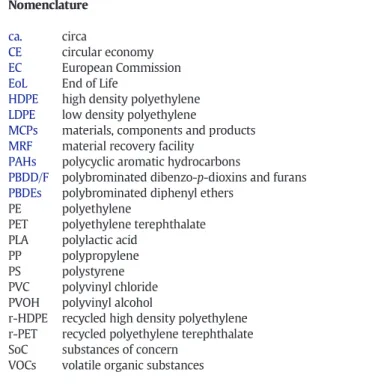
ca. circa
CE circular economy EC European Commission EoL End of Life
HDPE high density polyethylene LDPE low density polyethylene
MCPs materials, components and products MRF material recovery facility
PAHs polycyclic aromatic hydrocarbons
PBDD/F polybrominated dibenzo-p-dioxins and furans PBDEs polybrominated diphenyl ethers
PE polyethylene
PET polyethylene terephthalate PLA polylactic acid
PP polypropylene PS polystyrene PVC polyvinyl chloride PVOH polyvinyl alcohol
r-HDPE recycled high density polyethylene r-PET recycled polyethylene terephthalate SoC substances of concern
some of the most recent attempts of overcoming technical difficulties encountered in plastic packaging recycling, questioning their potential to integrate design and manufacture with waste management and re-source efficiency in the transition to circular economy.
2. Challenges and complications on recycling plastic packaging due to transformation of material quality
Plastics are composed of multiple chains (called polymers) made of small molecules (called monomers), connected with chemical bonds. Plastics can come at different structures according to what monomer is repeated in the chain, and the way chains are linked. Based on the lat-ter, a distinction can be made between thermosets, thermoplastics and elastomers. Thermoset plastics, are formed when their macromolecular chains are cross-linked together permitting no further deformation or shaping; in thermoplastics macromolecular chains are not cross-linked but held together by relatively weak chemical forces (Van der Waals), which means that they can be reversibly melted by heating, and re-solidified by cooling, without altering much their mechanical properties (American Chemistry Council, 2018;Ensiger, 2018). Elastomers, are also formed by cross-linked chains, but can be elastically deformed, and re-turn to their original shape after exposure to load (Ensiger, 2018). Ther-moplastics can be subdivided into amorphous and semi-crystalline according to whether they have a random or ordered structure, respec-tively, which affects their properties, e.g. colour, chemical resistance, solubility, thermal stability, density,firmness and strength.
Plastic packaging is generally made of thermoplastic resins, namely the polyethylene terephthalate (PET) (known as type 1); high-density polyethylene (HDPE) (known as type 2); polyvinyl chloride (PVC) (known as type 3); low-density polyethylene (LDPE) (known as type 4); polypropylene (PP) (known as type 5); polystyrene (PS) (known
as type 6); and others (known as type 7). The latter category includes multilayer and other plastics that are not generally collected for recycling. The rest of the plastic types can be collected, sorted and then mechanically or chemically reprocessed intoflakes and/or pellets that are going to be used as raw materials in the manufacture of new products (e.g. HDPE can be used in drainage and utility pipe manufac-ture storage tanks and wheelie bins, whereas PP can be used in the au-tomotive sector, as an alternative to wood tiles, and pallets).
In spite of plastics theoretically high recyclability, post-consumer plastic packaging recycling rates remain low and this is mainly associ-ated with quality aspects. But how does the post-consumer plastic pack-aging quality degrades? Making the hypothesis that quality depends on the properties of the material, its designed characteristics, use, handling, and reprocessing, it is interesting to look at how each of these affects plastic packaging recycling.
• Materials properties and design characteristics: understanding which plastic packaging properties are relevant in ensuring good quality material from their use towards their end-of-life (EoL) stage can provide confidence in utilising this secondary plastic resource when producing new products. The set of rheological, mechanical and structural properties of the plastic packaging materials may change widely depending on the type of plastic used (Hamad et al., 2013).Table 1shows the different and various characteristics of the most commonly used types of plastics; which can vary from transpar-ent to opaque, and can have varying chemical and UV radiation resis-tance, depending on their structure. Besides these properties, during the design stage of plastic packaging components, a number of addi-tives (e.g. plasticizers,flame retardants, antioxidants, acid scavengers, light and heat stabilizers, lubricants, pigments, antistatic agents, slip compounds and thermal stabilizers) are added to the polymeric struc-tures; hence contributing to plastic packagingfinal properties and
Table 1
Main characteristics of the thermoplastics mainly used for packaging. Adopted from:Ensiger (2018).
Plastic type Characteristics and properties Applications
PET Semi-crystalline, high density, very hard material that is very tough, strong, and rigid, has very good sliding friction properties, very good dimensional stability, highly stiff with brittle behaviour at temperatures below zero, with good thermal stability, minimal thermal expansion, sensitivity to hot water and steam, relatively high thermal conductivity, low electrical conductivity, good insulation properties, high chemical and wear resistance, and low moisture absorption.
Renowned for its success as a replacement for glass in beverage bottles, due to its dimensional stability, strength and resistance to chemicals; widely used in food and personal care packaging applications as it is an excellent barrier toflavors and is usually transparent.
HDPE Semi-crystalline, translucent, low density and hardness characteristics, but tough with low strength and very low rigidity properties, relatively stiff with low thermal stability and high thermal expansion, high thermal conductivity, low electrical conductivity, relatively good insulation properties, poor chemical and wear resistance, and very low moisture absorption.
Can be a poor barrier for oxygen and other gases, odors andflavors, but is normally used in consumer bags, thermoformed trays for packaging frozen food,films for a variety of uses.
PVC Amorphous, optically transparent, high density, hard, brittle material that is tough, relatively strong and rigid with very good sliding friction properties, very good dimensional stability, relatively stiff with low thermal stability, low thermal expansion, low thermal conductivity, low electrical conductivity, good insulation properties, good chemical and wear resistance, and very low moisture absorption.
The most widely used of the amorphous plastics. It is available in two forms - plasticised (flexible) or un-plasticised (hard, tough) and is used in blister packaging for pharmaceuticals and capsules.
LDPE Semi-crystalline, translucent, with low density and hardness characteristics, very tough (no breaks), but low strength and low rigidity, sensitive to temperature with low thermal stability, no thermal conductivity, high thermal expansion, low electrical conductivity, relatively good insulation properties, poor chemical and wear resistance and low moisture absorption.
Not practical for rigid containers andflexible packages, and is not recommended for oily products. Squeezable tubes and bottles, wrappers and bags, frozen food containers, coating material for bottle cartons.
PP Semi-crystalline, low density, material with better strength, hardness, rigidity, stiffness and thermal stability than PE types (HDPE-LDPE) with sensitivity at temperatures below zero, low thermal conductivity, low electrical conductivity, relatively good insulation properties, good chemical and wear resistance, and low moisture absorption.
Has the lowest density of all thermoplastics, which combined with its excellent fatigue and chemical resistance can make it attractive in many packaging applications, such as closures of all kinds, several boil-in-bag food packages and containers exposed to high levels of thermal and chemical stress
PS Amorphous, optically transparent, high density, hard, brittle material, very tough, relatively strong and rigid, low thermal stability, low thermal conductivity and electrical conductivity, excellent insulation properties, poor chemical and wear resistance to hydrocarbon solvents, good electrical insulation properties and relatively low moisture absorption.
improving their performance, functionality and ageing (Hahladakis et al., 2018). It is therefore important to look at how these properties and design attributes affect quality implications at various stages of the plastic packaging lifecycle.
• Use and handling: plastic packagings are short-lived components, and therefore environmental conditions (e.g. oxygen, humidity, UV radia-tion) have a less important role to play on their quality degradation, given they are stored properly. Defining the quality of a plastic pack-aging component that enters the waste stream however can be chal-lenging. This is because quality downstream the supply chain may not imply changes in the plastic packaging properties per se, but a change in the way the plastic packaging, particularly the high-quality plastic streams, are sorted and recovered for recycling. On the one hand, consumers are sometimes confused by the types of plastics they can segregate for recycling, and they end up mixing different ma-terials that affects the quality of high value recyclates. Plastics that may come into contact with impurities and contaminants during dis-posal, can bear the risk of diffusion of these contaminants into the polymeric bulk due to their permeable nature, and affect their recycla-bility (Hahladakis et al., 2018). On the other hand, councils may refuse to collect plastic streams that are contaminated with other materials (incl. other plastics) due to the lack of infrastructure to support sepa-rate collection of the high-quality plastic packaging. These results in plastic streams being diverted to landfill; or in cases where these may reach material sorting facilities, potential contamination of the target plastic material streams, e.g. PET and HDPE, with other poly-mers, makes it unlikely for those to be used for closed loop recycling as they are often incompatible (Hahladakis et al., 2018). Even a low level of contamination can lead to poor adhesion properties in the polymeric mixture interface and, deterioration in overall macroscopic properties (Vilaplana and Karlsson, 2008). For example, the presence of minor amounts of PVC in a PET bottle batch, can form acids that make PET brittle and yellowish in colour when recycled (Marks & Spencer, 2008). As such a contaminated batch is more likely to end up in landfill or energy recovery facilities. This results in short to me-dium term issues for reprocessors facing unanticipated high costs of contamination and further sorting of poor quality plastic packaging, especially when a strong market for products using mixed plastics does not exist.
• Processing: rheological, mechanical and structural properties of the plastic packaging material may change during reprocessing (i.e.
mechanical and or chemical). The extrusion cycle is also important in determining changes in plastic packaging characteristics, however in reality this is difficult to determine. Mechanical recycling is the most preferred and used recycling method. When plastic packaging is mechanically reprocessed a number of changes occur because of rhe-ological changes in the structure of the polymer, a few of which are outlined inTable 2(Hamad et al., 2013). For example, the structural and macroscopic properties of plastics are modified during multiple processing; chain scission is responsible for a decrease in the molecular weight of the polymeric chains, which leads to an increase in the de-gree of crystallinity in semi-crystalline polymers, a decrease in viscos-ity which increases the meltflow rate, and a deterioration of the mechanical properties (e.g. elongation, impact strength), thus resulting in a progressive embrittlement of the reprocessed material (Ronkay, 2013;Vilaplana and Karlsson, 2008). Degradation of the ma-terial that usually occurs during reprocessing, may often lead to changes in material properties. Although the degradation rate of the materials can be stabilised to a high degree through the use of additives and/or by mixing the recycled resin with virgin material to diminish the change in properties (Kartalis et al., 2000;Sokkar et al., 2013), mixing resins could create other technical constraints for the recyclers. Different resins have different melting points (seeTable 1–thermal stability), and if a batch of mixed plastics that melt at different temper-atures are mixed together, some resins may not melt at all, and others may burn, affecting as such the feedstock's appearance and perfor-mance, and preventing its use in a particular end product. For example, accidental co-melting of a batch of polyethylene packaging with poly-propylene, can result in a blend that is useless. Since the same resins may have different properties, markets could potentially ask e.g. for plastic bottles (containers with a neck smaller than the base) to be sep-arated from wide-mouthed containers. For example, HDPE milk jugs are blow-moulded, while HDPE margarine tubs are injection-moulded. These two processes require differentfluidity levels, which, if mixed together, produce afluidity level that may no longer be suitable for re-manufacturing (Waste360, 2016). The additives present in the dif-ferent types of plastics may also affect their recyclability either directly or by promoting their degradation; whereas a range of hazardous sub-stances (e.g. toxic metals, volatile organic compounds (VOCs), phthalates, polycyclic aromatic hydrocarbons (PAHs), polybrominated diphenyl ethers (PBDEs), polybrominated dibenzo-p-dioxins and fu-rans (PBDD/F)) may be released during reprocessing contributing
Table 2
Complications and perspectives during plastic packaging recovery and reprocessing.
Plastic type Mechanical recycling Results References
PET 1) Blending with HDPE using the extrusion process
1) HDPE reduces the melt viscosity of the blend indicating goodflow ability
1) (Navarro et al., 2008)
2) Adding small amounts of virgin PLA 2) Lowers the viscosity of the blend, and gives higher thermal sensitivity
2) (La Mantia et al., 2012)
HDPE 1) Reprocessing 1) Mechanical properties remain almost unaltered 1) (Vilaplana and Karlsson, 2008) 2) Blending with virgin polyamide 2) Improves the mechanical properties and thermal
stability of the blend
2) (Vallim et al., 2009)
PVC 1) Via triboelectrostatic technology 1) Recovers PVC from plastic composites (e.g. PVC/PET, PVC/PP, PVC/PE or PVC/PS). Recovery of 96–99% with the pure extract content in excess of 90%.
1) (Lee and Shin, 2002)
2) Blending with woodfiber 2) Improves recyclability-composite properties remained stable for up to 5 processing cycles
2) (Augier et al., 2007)
LDPE Subjected to extensive extrusion cycles (up to 100 cycles).
Increases the viscosity with increasing number of extrusion cycle. Its processing ability is affected after the 40th extrusion cycle.
(Jin et al., 2012;Kabdi and Belhaneche-Bensemra, 2008;Kartalis et al., 2000;Vallim et al., 2009; Waldman and De Paoli, 1998)
PP 1) Reprocessing 1) Progressive diminution of the elastic modulus 1) (Vilaplana and Karlsson, 2008) 2) Subjected to injection cycles 2) Decreases the viscosity, and leads to small losses
in material strength
2) (Aurrekoetxea et al., 2001)
PS Reprocessing cycles on PS nanocomposites containing 5 wt% organophilic clay
significantly to environmental pollution or be partially retained in the recycled plastic affecting its end-use (Hahladakis et al., 2018).
Cascading of recycled plastic packaging to lower grade products is often promoted as the optimal option for recovering packaging's value, especially when contamination and/or degradation occurs. For instance, approximately 80% of r-PET bottles are turned into polyester fibers for carpet, clothing and other non-packaging applications. Other low value applications include plastic pipes, and waste collection bags. However, if a more systematised way of capturing and handling post-consumer plastic packaging was in place we might be able to increase closed-loop recycling. As we have seen this might not be feasible for all plastic types due to their inherent properties and characteristics. However, for those that such an option is feasible, recovering their value via closed-loop recycling presents an opportunity for enabling sustainable management.
Accepting that the properties and characteristics of plastic packaging affect their recyclability, it could be possible, given the right design and technology innovations that sorting and reprocessing of plastic compo-nents can be based on a closed-loop principle. A better understanding of how these characteristics change across the component's end-of-life treatment would enable better processing to become realised. Current innovations strive to promote better sorting and recycling, as well as better design and capture. But are these set to encourage an increase in the percentage of post-consumer plastic packaging recycling? The next Section looks at some of these innovations and explores how these could potentially help to increase the recycling of post-consumer plastic packaging.
3. Existing and future improvements in the road to an efficient recovery and recycling of plastic packaging
Currently only ca. 5% of material value of plastics packaging is cap-tured after one use cycle. As such, industries are continuously investing in R&D activities and innovation to develop new technologies that can support and maximise the recovery of plastic packaging material and its embedded value. For example, in the past couple of years new inno-vations made in the recycling of PEfilms used in packaging, allow al-most 100% recycled content in clear PEfilms (also known as foils)1; completely“closing the loop”on plasticfilms (WMW, 2016). New sorting technologies (e.g. Autosort) for opaque PET, PET trays and food grade recycled PET (r-PET) are promoted to sort these respective types of plastic packaging. Yet, the market penetration of these technol-ogies at different stages of the supply chain is unknown.
Opaque PET recovery at material recovery facilities constitutes an important step towards increasing the recyclability of coloured plastics. But how many material recovery facility (MRF) operators would they invest in such technology? At present only clear, or even translucent, PET is recovered and recycled, due to its highest marketability (eco-nomic value) andflexibility to be easily recycled into new products and/or dyed (technical value). Coloured plastics are considered to have a lower market value because of their incapability to be dyed into other coloured plastics; hence can only be used to produce darker shades or black plastic that makes it hard for recyclers to compete with the virgin material market (technical and economic constraints) (Szaky, 2015). Investment in a technology that sorts coloured plastic may often not be a justified, viable solution for recyclers, given that they are unable tofind a market for this material.
Multilayer PET trays, normally used for meat products, are reportedly contaminating the PET bottles stream that MRF operators desperately
need to recover. To solve this problem a technology (i.e. Autosort) has been developed to detect and separate multi-layered PET trays from other PET products; maximising the market value of PET bottles and maintaining very high end quality levels (WMW, 2016). Although this technology seems more attractive to invest on, current manufacturing trends that focus on sustainable packaging highlight that lightweight multilayer plastics make little sense (from a sustainability perspective) to produce, as they cannot be recycled. Hence, investment in a technology that may not be needed in the future raises concerns regarding recyclers' investment decisions (PacNext, 2014).
In cases where plastics of high market value and quality are mixed with other plastics of lower quality, a sorting technology that can re-move all contaminations caused by other plastic materials and/or other contaminants, constitutes an important innovation. For example aflake sorter that is capable of identifying and sortingflakes as small as 2 mm when processing food grade r-PET, is considered to be an im-portant step towards increasing the quality of the end material and con-sequently the confidence of the manufacturing companies that would like to increase their products recycled content. Regene Atlantique (part of the SUEZ Group) that operates a PET recycling plant in Bayonne, France has trialled theflake sorting technology, which was set to re-move PVC fragments below 10 ppm, metallic (ferrous and non-ferrous) particles below 3 ppm, and other unwanted materials (incl. coloured plastic) at less than 200 ppm (WMW, 2016), and reportedly achieved the high quality levels required by some of the biggest soft drinks com-panies in the world. This indicates that this innovation, at this stage of the supply chain, is potentially one that can indeed increase the recycla-bility of plastic packaging.
Therefore, it is important when promoting innovation and invest-ment in the plastic packaging recycling industry, to methodically con-sider the strengths and needs of each key player at each stage of the supply chain, and provide the innovations that truly make a difference in the way plastic packaging is recovered and recycled. Many would argue that better sorting at MRFs would reduce the degree of contami-nation–and this may be true. However, would it make sense from an economic, environment or social perspective? This is a multifaceted as-pect that requires a multidimensional valuation, and any conclusions should only be made when sorting and recycling (downstream) is assessed in combination with similar aspects faced at the design, use, and collection stages (upstream) of the supply chain.
In the present market, designing of plastic packaging controls to a large extent the degree to which this packaging will be recycled. Hence, manufacturers are urged to make design innovations that give plastic the required properties to be used in a wide variety of packaging applications, while also offering superior recycling properties. We have briefly mentioned the implications surrounding multi-layered plastic and efforts to phase them out. However, phasing all multi-layered prod-ucts out may not always be feasible. A particularly challenging is plastic packaging used for food and beverages. This packaging is design based on strict packaging requirements with the aim to increase food shelf life while retaining quality.
For example, nylon 6, is a thermoplastic material with great recycling properties that can be‘infinitely’recycled in a closed-loop sys-tem using a chemical recycling process (Ellen MacArthur Foundation, 2015;NPG-6, 2015). Due to its poor moisture barriers, nylon 6 is used in combination with PE in multilayerfilms; hence improving its perfor-mance and use in various food packaging applications but cannot be recycled. Although, efforts have been made to design reversible adhe-sives so that the multi-material layers can be separated after use; the environmental, economic and technical aspects of such innovations are under scrutiny in order to ensure their feasibility and sustainability in the long-term. And yet, this is only one of the many innovations, e.g. bioplastics, production of polyvinyl alcohol (PVOH), removable coloured coatings, shrink sleeves to replace in-mould labels, and use of‘self-peeling’labels (WRAP, 2010), that may need to be investigated on their potential to support increased recycling of plastic packaging. 1
The case of bio-based plastics, or bioplastics, which are polymers made entirely or partially from a renewable, plant-based material, is particularly interesting. This is because as their name implies bioplastics can be considered to be biodegradable; however this is rarely the case as their ability to biodegrade varies widely with some bioplastics be com-plete consumed by microorganisms, others be decomposed into small pellets, and others be mechanically recycled. For example, bio-PE and bio-PET cannot be biodegraded, and as such they should be recycled with their conventionally produced counterparts.
Polylactic acid (PLA) made from corn is one of the most versatile bioplastics as it can by composted with other organic wastes, decomposed into small pellets, or recycled. However this type of plastic is currently neither sorted for recycling, nor composted with organic waste, and it often ends up with other plastics diverted for sorting and recycling where it contaminates the high value plastics streams (e.g. PET, HDPE). This affects the recyclability of high value streams which may end up in landfill. PLA can be mechanically separated for recycling; however, its low production rate and marketability do not justify the high investment costs for sorting it out. Alternative, its composting is a least promising option for its management, despite its highly biode-gradable nature because it adds no nutrient value to the compost. As such, a multidimensional valuation of bioplastics development use and end-of-life management is increasingly needed.
Production of PVOH also stands out, as this polymer, whichfirst ap-peared in 1924, is now promoted as a sustainable alternative to both multilayer plastic packaging and bioplastics, creating additional benefits thanks to being water soluble. Dishwasher and laundry detergent tab-lets are common applications of PVOH that reduce waste and leakage by individually wrapping portions of detergent in the water-soluble film. Other applications include, pouches andfilms for the likes of crisp packets, biscuit wrappers and meat packaging, and also to replace the plastic window in paper envelopes and bread bags (Nicholls and Baldwin, 2016).
But is this the type of innovations we would essentially like to see promoted in a sustainable society? In a study byJambeck et al. (2015) it was suggested that plastics with high after-use value are less likely to leak into our oceans, polluting the aquatic and terrestrial environ-ment and our biota (Jambeck et al., 2015). Indeed, improving the design of plastic packaging is important in making them truly bio-benign with less risk of leakage of substances of concern (SoC) (Leslie et al., 2016; Peeters et al., 2014); advanced biodegradability in aquatic environ-ments (Razza et al., 2015), avoidance of colours, inks or shapes that are typically ingested by marine species. However, enhancing their de-sign to promote after-use value seems to be a better option to support prevention of the leakage of these materials to the environment, and promote its recoverability and recyclability in the long-term.
For the latter to become realised, plastic packaging must be properly managed at source. This is where the consumers have a key role in en-abling the systems established in each region to be able to recover the multidimensional value embedded in plastic packaging (Iacovidou et al., 2017b). In Belgium, for example, municipalities have launched pilots to expand the range from PET bottles, HDPE bottles and jars to other plastic packaging such as pots, trays,films, and bags. The comprehen-sive collection of plastic packaging for recycling is also important in public spaces. For instance, one third of bottled beverages are consumed away from home. Schemes put in place by the local authorities, or even the soft drink manufacturers (e.g. Coca cola) are proved to be important in recovering plastic packaging.
4. Conclusions
It is becoming increasingly apparent that when actions on redesigning plastic packaging and improving sorting and reprocessing are considered in concerted, integrated manner, the transition to in-creasing secondary material recovery and recycling becomes more fea-sible than ever (Ellen MacArthur Foundation, 2017;Iacovidou et al.,
2017a). Exploring the synergies between the two ends of the supply chain–upstream and downstream - enables informed changes on in-creasing material efficiency and sustainability, to be made.
There is a need to address disjointed and fragmented efforts of in-creasing recycling levels between all parties involved. A multidimen-sional value assessment that provides the means of capturing materials andfinancialflows, and stakeholders interactions, becomes an important tool in uncovering where disruptions in the system should, and can, be made. This information can then be used in conjunc-tion with material properties and design characteristics, to create a level playingfield for all actors involved maximising the potential benefits of a circular plastic packaging system.
Acknowledgments
We gratefully acknowledge the UK Natural Environment Research Council (NERC) and the UK Economic and Social Research Council (ESRC) support who funded this work under the main project with title:
‘Complex-Value Optimisation for Resource Recovery’(CVORR) project (Grant No. NE/L014149/1). Both authors contributed equally to the present work and are, also, grateful to the reviewers for their construc-tive input.
References
American Chemistry Council, 2018. Platics, the basics: polymer definition and properties. https://plastics.americanchemistry.com/plastics/The-Basics/.
Augier, L., Sperone, G., Vaca-Garcia, C., Borredon, M.-E., 2007.Influence of the woodfibre filler on the internal recycling of poly(vinyl chloride)-based composites. Polym. Degrad. Stab. 92, 1169–1176.
Aurrekoetxea, J., Sarrionandia, M.A., Urrutibeascoa, I., Maspoch, M.L., 2001.Effects of recycling on the microstructure and the mechanical properties of isotactic polypro-pylene. J. Mater. Sci. 36, 2607–2613.
EC, 2016. Closing the loop. New circular economy package. Available at:.http://www. europarl.europa.eu/RegData/etudes/BRIE/2016/573899/EPRS_BRI(2016)573899_EN. pdf.
EC, 2018. A European strategy for plastics in a circular economy. Available at:.http://ec. europa.eu/environment/circular-economy/pdf/plastics-strategy.pdf.
Ellen MacArthur Foundation, 2015. Ellen MacArthur Foundation (January 2015). Availbale at:. http://www.ellenmacarthurfoundation.org/circular-economy/over-view/principles.
Ellen MacArthur Foundation, 2017. Ellen MacArthur Foundation. Available at:.https:// www.ellenmacarthurfoundation.org/assets/downloads/New-Plastics-Economy_ Catalysing-Action_13-1-17.pdf.
Ensiger, 2018. Shapes: engineering plastics - the manual, brocures.https://www. ensingerplastics.com/en/downloads.
Hahladakis, J.N., Velis, C.A., Weber, R., Iacovidou, E., Purnell, P., 2018.An overview of chemical additives present in plastics: migration, release, fate and environmental im-pact during their use, disposal and recycling. J. Hazard. Mater. 344, 179–199. Hamad, K., Kaseem, M., Deri, F., 2013.Recycling of waste from polymer materials: an
overview of the recent works. Polym. Degrad. Stab. 98, 2801–2812.
Iacovidou, E., Millward-Hopkins, J., Busch, J., Purnell, P., Velis, C.A., Hahladakis, J.N., Zwirner, O., Brown, A., 2017a.A pathway to circular economy: developing a concep-tual framework for complex value assessment of resources recovered from waste. J. Clean. Prod. 168, 1279–1288.
Iacovidou, E., Velis, C.A., Purnell, P., Zwirner, O., Brown, A., Hahladakis, J., Millward-Hopkins, J., Williams, P.T., 2017b.Metrics for optimising the multi-dimensional value of resources recovered from waste in a circular economy: a critical review. J. Clean. Prod. 166, 910–938.
Jambeck, J.R., Geyer, R., Wilcox, C., Siegler, T.R., Perryman, M., Andrady, A., Narayan, R., Law, K.L., 2015.Plastic waste inputs from land into the ocean. Science 347, 768–771. Jin, H., Gonzalez-Gutierrez, J., Oblak, P., Zupančič, B., Emri, I., 2012.The effect of extensive mechanical recycling on the properties of low density polyethylene. Polym. Degrad. Stab. 97, 2262–2272.
Kabdi, S.-A., Belhaneche-Bensemra, N., 2008.Compatibilization of regenerated low den-sity polyethylene/poly(vinyl chloride) blends. J. Appl. Polym. Sci. 110, 1750–1755. Kartalis, C.N., Papaspyrides, C.D., Pfaendner, R., 2000.Recycling of post-used PE packaging
film using the restabilization technique. Polym. Degrad. Stab. 70, 189–197. La Mantia, F.P., Botta, L., Morreale, M., Scaffaro, R., 2012.Effect of small amounts of poly
(lactic acid) on the recycling of poly(ethylene terephthalate) bottles. Polym. Degrad. Stab. 97, 21–24.
Lee, J.-K., Shin, J.-H., 2002.Triboelectrostatic separation of pvc materials from mixed plas-tics for waste plastic recycling. Korean J. Chem. Eng. 19, 267–272.
Leslie, H.A., Leonards, P.E.G., Brandsma, S.H., de Boer, J., Jonkers, N., 2016.Propelling plastics into the circular economy—weeding out the toxicsfirst. Environ. Int. 94, 230–234. Marks & Spencer, 2008.Food Packaging Charter, Plan A.
Nicholls, L., Baldwin, A., 2016. Could a‘100% recyclable’polymer drive the new plastics economy?, Edie newsroom.www.Edie.net https://www.edie.net/news/5/Aquapak-recyclable-biodegradable-polymer-reinvigorates-plastics-circular-economy/. NPG-6, 2015. Nylon-6 Promotional Group website.www.npg-6.comAvilable at:.http://
www.dsm.com/markets/packaging-graphicarts/en_US/products-brands/akulon. html.
PacNext, 2014.Top 10 Packaging Challenges for Recycling in a Material Recovery Facility. Peeters, J.R., Vanegas, P., Tange, L., Van Houwelingen, J., Duflou, J.R., 2014.Closed loop recycling of plastics containing Flame Retardants. Resour. Conserv. Recycl. 84, 35–43. PlasticsEurope, 2016. Plastics–the facts 2016 an analysis of European plastics production, demand and waste data. Available at:.http://www.plasticseurope.org/documents/ document/20161014113313-plastics_the_facts_2016_final_version.pdf.
Razza, F., Degli Innocenti, F., Dobon, A., Aliaga, C., Sanchez, C., Hortal, M., 2015. Environ-mental profile of a bio-based and biodegradable foamed packaging prototype in com-parison with the current benchmark. J. Clean. Prod. 102, 493–500.
Remili, C., Kaci, M., Benhamida, A., Bruzaud, S., Grohens, Y., 2011.The effects of reprocessing cycles on the structure and properties of polystyrene/Cloisite15A nano-composites. Polym. Degrad. Stab. 96, 1489–1496.
Ronkay, F., 2013.Effect of recycling on the rheological, mechanical and optical properties of polycarbonate. Acta Polytech. Hung. 10, 209–220.
Sokkar, T., El-Din, M.S., El-Tawargy, A., 2013.Effect of recycling on the optical, mechanical and structural properties of polypropylenefibers. Opt. Lasers Eng. 51, 994–1003.
Szaky, T., 2015. The many challenges of plastic recycling.Available at:.http://www. sustainablebrands.com/news_and_views/waste_not/tom_szaky/many_challenges_ plastic_recycling(Sustainable Brands).
Vallim, M.R., Araujo, J.R., Spinacé, M.A.S., De Paoli, M.-A., 2009.Polyamide-6/high-density polyethylene blend using recycled high-density polyethylene as compatibilizer: mor-phology, mechanical properties, and thermal stability. Polym. Eng. Sci. 49, 2005–2014.
Vilaplana, F., Karlsson, S., 2008.Quality concepts for the improved use of recycled poly-meric materials: a review. Macromol. Mater. Eng. 293, 274–297.
Waldman, W.R., De Paoli, M.A., 1998.Thermo-mechanical degradation of polypropylene, low-density polyethylene and their 1:1 blend. Polym. Degrad. Stab. 60, 301–308. Waste360, 2016. Recycling: quality control maximizes market return for plastics.
Avail-able at:.http://www.waste360.com/mag/waste_recycling_quality_control. WMW, 2016. Tackling complex plastic recycling challenges.Available at:.
https://waste-management-world.com/a/tackling-complex-plastic-recycling-challenges (01-09-2016).