A STUDY OF THE WORK AND METHODS OF HENRY BRIGGS, WITH SPECIAL REFERENCE TO THE EARLY
HISTORY OF INTERPOLATION
Andrew Waterson
A Thesis Submitted for the Degree of PhD at the
University of St Andrews
1941
Full metadata for this item is available in St Andrews Research Repository
at:
http://research-repository.st-andrews.ac.uk/
Please use this identifier to cite or link to this item: http://hdl.handle.net/10023/13760
INTERPOLATION."
being a Thesis presented
by
ANDREW WATERSON '· M.A.
I matriculated in the University of St. Andrews in October 1924, and followed a course leading to graduation in Arts (Honours Mathematical and Physical Science) until June 1928.
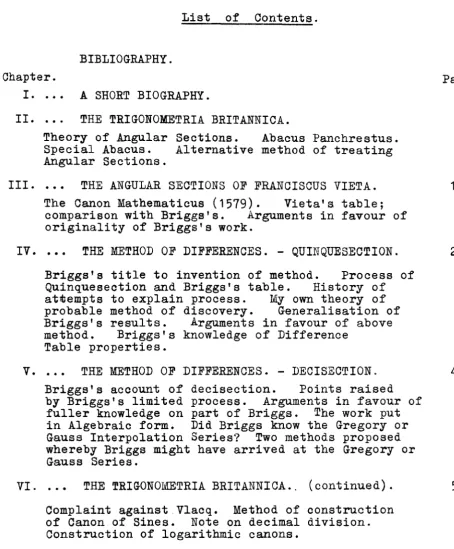
BIBLIOGRAPHY. Chapter.
I.
I I.
III.
IV.
v.
VI.
A SHORT BIOGRAPHY.
. .
.
THE TRIGONOMETRIA BRITANNICA.Theory of Angular Sections. Abacus Panchrestus.
Special Abacus. Alternative method of treating
Angular Sections.
THE ANGULAR SECTIONS OF FRANCISCUS VIETA.
The Canon Mathematicus ( 1579) . Vi eta's. table;
comparison with Briggs's. Arguments in favour of
originality of Briggs's work.
.
. .
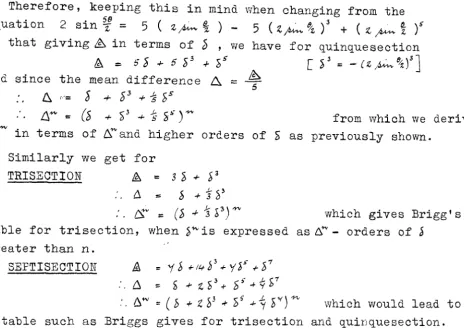
THE METHOD OF DIFFERENCES. - QUINQUESECTION.Briggs's title to invention of method. Process of
Quinquesection and Briggs's table. History of
attempts to explain process. My own theory of
probable method of discovery. Generalisation of
Briggs's results. Arguments in favour of above
method. Briggs's knowledge of Difference
Table properties.
THE METHOD OF DIFFERENCES. - DECISECTION.
Briggs's account of decisection. Points raised
by Briggs's limited process. Arguments in favour of
fuller knowledge on part of Briggs. The work put
in Algebraic form. Did Briggs know the Gregory or
Gauss Interpolation Series? Two methods proposed whereby Briggs might have arrived at the Gregory or Gauss Series.
.
.
.
THE TRIGONOMETRIA BRITANNICA .. (continued).Complaint against Vlacq. Method of construction
of Canon of Sines. Note on decimal division.
Construction of logarithmic canons.
Page. 1 •
9.
17.
22.
41.
[image:6.534.25.480.64.614.2]Chapter.
VII. LOGARITHMS.
Attempts at shorter methods - "Prosthaphaersis ''. Early history of logarithms and probable date of
invention. The Descriptio published. The invention
of decimal logarithms. The Hutton - Mark Napier controversy.
VIII .••• THE ARITHMETICA LOGARITHMICA.
Definition and properties of logarithms. First
method of calculating logarithms. The method of
continued means.
IX . . . • A DIFFERENCE METHOD FOR CALCULATING MEANS.
Briggs's description of the method. Briggs's
Page.
60.
73.
77.
curious equations. Suggested methods of construction.
Objections to first method. Second method of
construct-ion proposed by myself.
X . • • . THE ARITHMETICA LOGARITHMICA. (continued)
Calculation of logarithm of a prime number. The
logarithm of a fraction. Calculation of
proportional parts.
85.
XI • . • . THE RADIX METHOD. 89.
The method. Reply to Mark Napier's criticism
of Briggs.
XII . . • • THE BINOMIAL THEOREM.
Early history of the Arithmetical Triangle.
Briggs's statement of the Theorem. His title to
honour of invention. Mark Napier's case in favour of John Napier.
XIII •.•• THE DECIMAL NOTATION.
Early history of decimal fractions and notation.
Claims of Napier and Briggs to invention of
decimal notation.
XIV .••• MISCELLANEOUS FACTS.
Napier's Analogies. On the Law of Continuity.
94.
100.
Chapter. Page.
XV ....
CONCLUSION. 109.APPENDIX.
I. LATER DEVELOP¥ENTS. 111.
The logarithmic nature of Hyperbolic areas.
Gregory's quadrature of the rectangular hyperbola. Mercator's logarithmic Series.
II. A NEW EXPRESSION FOR
~'1'\,~,~e.
AND FOR-:2
~
9 125.III. FRANCISCUS VIETA'S ANGULAR SECTIONS. 127.
Vieta's Statement of De Moivre's Theorem.
Author.
ANDERSON, Ale:x.
AUBREY, John.
BALL,
w.
R. R.BALL,
w.
R. R.BRIGGS, Henry.
BRIGGS, Henry.
BRIGGS, Henry.
CAJORI, Florian.
HOBSON, E. W.
HUTTON, Charles.
HUTTON, Charles.
MAURICE. F.
Title of Work. Brief Title.
Ad Angulares Sectiones, contained
in Vieta's Opera Machematica. Anderson.
Lives of Eminent Men of the
XVIIth Century. 2 Vols. Aubrey.
A short Account of the History
of Mathematics. Ball.
History of Study of Mathematics at Cambridge.
Arithmetica Logarithmica. (London 1624).
Trigonometria Britannica. ( Goudae 1633).
Mathematica ab Antiquis minus cognita.
Ball. ( Camb).
Arith. Log.
Trig. Brit.
History of Mathematics.
(London 1894). Cajori.
Dictionary of National Biography. D. N. B.
Encyclopaedia Britannica,
XIth edition. Encyc. Brit.
S~uaring the Circle.
team.
1913).Mathematical Dictionary. (1815).
Introduction of Mathematical TabTes.
Library of Useful Knowledge. (Biography).
Journal of Institute of
Actuaries. Vol. 14. (1869).
Hobson.
Math. Diet.
Math. Intro.
L. U. K.
Author.
NAPIER, John.
NAPIER, Mark.
RIGAUD, S.
SCOTT, J. F.
SMITH, D. E.
TURNBULL, H. W.
VIETA,
Franciscus.
WARD, J.
WHITTAKER
&
ROB!NSON.
FRASER., D. C.
Title of Work.
Mirifici Logarithmorum Canonis
Constructio. (Translation by
W. R. Macdonald. Edin. 1889).
Napier Tercentenary Memorial
Volume. (London 1915).
Memoirs of John Napier.
Philosophical Transactions. Vol. I.
Brief Title.
Constructio.
Tercen. Vol.
Mark Napier.
Phil. Trans.
Correspondence of Scientific Men of the XVIIth Century.
(Oxford 1841). Rigaud.
The Mathematical Work of
John Wallis. (London 1938). Scott.
History of Mathematics.
(1923) 2 Vols. Smith.
James Gregory: A Study in the
Early History of Interpolation. Turnbull.
Opera Mathematica, edited by
F.
van Schooten.(Leyden 1646). Vieta.
Lives of the Professors of Gresham College.
(London 1740). Ward.
The Calculus of Observations.
(Glasgow 1926).
NEwroN's INTERPOL.ATtoN FoR.MLJL.AS.
CHAPTER I.
A Short Biography.
Henry Briggs was born at Warley \iood near Halifax, Yorkshire
in February 1560/61. There is some doubt as to the actual year
1556 being the one usually given, but it is pointed out by
D. E. Sr!li th + that the parish register shows 1560/61 anc. for that
reason that year must be taken. He attendee a grammar school in
that cou..'1ty and in 1579 he entered St. Johns College, Cambri<ige
where he became intensely interested in Mathematics. He graduated
B.A. in 1581 and M.A. in 1585, and three years later he was elected
fellow of his college. He applie<i himself chiefly to the study
of Mathematics, in which he so greatly excelled that in 1592 he
was appointed examiner and lecturer in I.lathematics at St. John's, ana soon after reader of the physical lectures foundeo by
Dr. Linacre.
It seems clear that Briggs ·began to acquire a reputation as a geometrician for on the foundation of Gresharn House ( after.mrcis College) London, he was chosen first professor of Geometry, and thus has the distinction of being the first occupant of the first
Chair of Mathematics in England. He settled down to a life of
close and severe studies carrying out the duties of his office ':Vi tll that thoroughness which became so characteristic of him, and uevoting all his leisure to mathematical pursuits.
i~avigationa=. and Astronomical problems seem to have claimeci
his attention first, for in 1602 the first result of his efforts,
"A table to find the Height of the Pole, the i1iagnetic Declination
being given11
, was published in Mr. Thomas Blunderville's
"Theoriques of the Seven Planets". l'ileanwhile he had started to
communicate with others, for there are extant six letters to him from Sir Cristopher Heydon, which are chiefly on the subject of
Comets/
Comets, and the second of which is dated 1st November 1603.
Briggs, however, had begun to think about something which no English mathematician before him had attempted, namely the
compil-ation of a canon of sines. In view of the prominent part played
by English mathematicians at a later date in the calculation of the canons of the logarithms of the trigonometrical ratios, it is rather remarkable that they had no part in the calculation of the canons of natural ratios and had made few contributions of note in the field of trigonometry since the time of Thomas Bradwardine (c. 1290 - 1349), who along with Richard of Yiallingford, John
Maudith and Simon Bredon of Winchecombe gave to Englanc the honour of having produced the earliest European writers on Trigonometry.+ Some time round about 1603 Briggs was engaged upon the study of angular sections, vvhich form the basis of such a canon, and this y,·ork led to most of the important discoveries upon which rest
Briggs~ claims to fame, and which v1ill be treated of later. This work seems to have been entirely original, and this, among other
studies, must have kept him busy for the n.ext fevl years, for he
published nothing more until 1610 when there appeared. 11Tables for
the improvement of navigation" printed in the second edition of
EC.war6. \/right's treatise entitled 11Certain errors in Navigation
detected and correctedn.
In 1609 he formed a friendship with the learned Jarnes Ussher, afterwards Archbishop of Armagh, ++\vhich continued over a period of years as is evident from two letters from Briggs, published in the
collection of Ussher's letters. In the first of these, date~
August 1610, he writes that he was engaged upon the subject of eclipses, -,-,'hich was also the substan.ce of the fourth letter from Sir Cristopl:~er Eeydon ·to Briggs dated 14th December 1609.
Although we ~~ow that Briggs's own private researches had
al-ready led him to discoveries of great mathematical importance, these discoveries remained unpublished, and it must be recor6.ed
that/
that up to 1614 he had published nothing of note in the field of
mathematics. I have taken 1614 as a milestone in his life for in
that year, like a bolt from the blue, came the publication of Napier's "Descriptio" or to give it its fuller title "Mirifici Logari thmorum Ca...'1onis descriptio", giving logarithms to the vrorl6.
for the first time. This publication at once attracted the
attention of tvw of England's most eminent mathe:r.12.ticians of that period, Edward Wright, well knovm for his works on navigation and
Henry Briggs, then professor of Geometry at Gresham College. The
former undertook its translation into English, but died in 1615 before its publication could be accomplished, the duty of so doing falling upon Samuel Vfright, the translator's son, and Henry Briggs. Briggs himself was greatly excited by Eapier's invention, ancl seems to have abandoned everything else in order to devote himself to it. In a letter dated 10th March 1615 to James Ussher he writes "Naper Lord of Karkinston hath set my head and hands at work with his new
and admirable logaritruns. I hope to see him this summer if it
please God; for I never savr a book which pleased me better and made
me more wonder. I purpose to discourse with him concerning
eclipses, for what is there which we may not hope for at his hand.s,n and further speaks of himself as being "vrholly taken up an<i employed
about the noble invention of logari thins but lately discovered. 11
He lectured on them immediately, thought of improvements,
communicated with Napier, began to calculate the:;:n, anci duly visited
IJapier in 1615, staying with him a whole month. The extent of his
regard and respect for Uapier may be deduced from the account of their meeting, recorded by Vlilliarn. Lilly, who writes "\'i1len the two great mathematicians met, almost one quarter of an hour was spent,
each beholding the oth~r, almost with admiration before one spoke
a word. At last lvlr. Briggs began I My Lord I have undertaken this
journey purposely to see your person and to know by what engine of wit or ingenuity you came first to think of this most excellent
help unto astronomy viz. the logarithms: but, my Lord, beir~g by
you found out I wonder no body else f'ou...YJ.d it out before when now known it is so easy'."
Briggs pointed out to Napier the advantages that would accrue from having 10 as a base, an improvement he had already explained
in his public lectures at Gresham College. Napier, however, seems
to have thought of this also, and suggested a further improvement to Briggs, who on his returh to London set about calculating this
new kind of logarithms. He visited Napier again in 1616 and writes
that he would gladly have paid him a third visit in 1617 had ~apier's
life been spared. Briggs set to work with a will and must have
been an exceedingly busy man, for in 1616 he published "A Descriptior of an Instrumental Table to find the part proportional, devised by
Mr. Edvvard Wright" , and then in 1617 "Logari thmoru.rn. chilias prima 11
or the logarithms of the first thousand natural numbers. This
work is the first published on decimal or common logarithms, and although it bears no author's name, place, or date, the author was
undoubtedly Briggs. The date of publication is fixed by a letter
from Sir Henry Bourchier to Ussher dated 6th Lecember 1617 in which he writes "Our kind friend ldi:'. Briggs hath lately published
a supplement to the most excellent tables of logarithms, which I
presume he has sent to you." Again, in 1619 he assisted Robert
Uapier to publish his father's "Mirifici Logarithmorum Canonis Constructio", which gave the method by which I:Japier calculated his logarithms, and to it Briggs himself contributed Lucubrationes et ~YJ.notationes in Opera posthuma J. Naperi.
In 1619 Briggs was appointed Savilian Professor of Geometry at Oxford on the foundation of the Chair in that year, and thus had the singular distinction of holding in succession the two earliest chairs of Mathematics that were founded in England, surely a fitting tribute to his abilities and an indication of the esteem in which
he was held by his contemporaries. Sir Henry Savile, the founder
of the chair must have had very definite ideas on the subject of geometry for it is recorded by John Aubrey that Bishop Seth Wood
of Sarum, told him that "Savile first sent for Mr. EdmurLd Gunter, from London, (being of Oxford University) to have been his Professor of Geometrie, so he came and brought with him his sector and
quadrant and fell to resolving of triangles and doeing a great many fine things.
"Said the grave Knight 'Doe you call this reading of Geometrie? This is shewing of tricks, man!' and so dismisst hi:w with scorne
and sent for Henry Briggs from Cambridge.n +
Briggs entered on his new duties on January 8th 1620, beginning his lectures with the ninth proposition of Eucli6_, but he continued to hold his professorship at Gresham College till 25th July 1620,
when he resigned. In this same year he published in folio
"Euclidis Elementorum VI Libri priores".
At OxforQ he settled down at Merton College, where he continued his most laborious and studious life, employed partly in the duties
of his office a~d partly in the computation of his logarithms and
other useful works. In 1622 he published "A Treatise of the North
~est Passage to the South Seas through the Continent of Virginia and by Hudson Bay", the reason leading him to this being probably that he was then a member of the company trading to Virginia, the
first English Colony in America. ++ Rcu:ld about this time Briggs
seems to have had quite an interest in commercial undertakings, for he ·became the instigator snd the advocate of a canal between the Thames and the Avon, a scheme which afterwarcs attracted among
other men John Collins. John Aubrey -vvri tes +++ at some length on
it and says "Looking one time on the mappe of England he (Briggs) observed that the two rivers, the Tha:r::1es and that Avon r1hich runnes to Bathe and so to Bristowe, were not far distant, scilicet, about
3 miles -vide the mappe. He sees •twas but about 25 miles from
Oxford: getts a horse and viewes it and found it to be a levell
ground and easie to be digged. Then he considered the charuge of
cutting between those rivers which would be of great conse~uence
for/
for cheape and safe carrying of goods between London and Bristowe, and though the boates goe slowly and with meanders, yet considering they goe day and night they would be at their journey's en6. almost as soon as the wag.::;;ons, which often are overthrcvvne and .liquors
spilt and other goods broken. Not long after this he dyed and the
civill warres brake-out. It happened by good luck that one
r.Ir. liiatthewes of Dorset had some acquaintance with this lllr. Briggs,
and had heard him discourse of it. He was an honest simple man,
and had runne out of his estate, and this project did much run in
his head. He would revive it (or els it had been lost and forgott)
and went into the country to make an ill survey of it (which he printed) about am1o ... , but with no great encouragement of the
countrey or others. Upon the restauration of King Charles II he
renewed his designe and applyed himself to the King and CJounsell.
His majestic espoused it more (he tol6. me) than any one els. In
short, for want of management and his non-ability it came to nothing, and he is now dead of old age."
His next publication was the result of his assiduous labour at
the computation of logarithms, and in 1624 appeared his great and
elaborate work, the Ari tll:tl.etica Logari thmica. The more one studies
this work and thinks of the labour and the genius it involves the more one realises how stupendous a work it is for so short a time. This is one of the two works, for which, it may confidently be stated, Briggs merits a place in Mathematical history.
The Arithmetica Logarithmica contains the logarithms of numbers
from 1 - 20,000 and from 90,000 to 100,000 (in some 101,000),
and it had been Briggs's intention to fill in the gap. In his
book he calls for volunteers to help him in his calculation, the
plans for which he had already made. That he was baulked in the
publication of the intervening chiliads without being saved the labour of their calculation is well known, and such a happening would have been a severe blow to a much younger man than Briggs,
who by this time was getting well on in years. in a letter dated October 25th 1628
-He writes to Pell +
"My desire was to have those chiliads that are wantinge
betwixt 20 and 90 calculated and printed, and I had done them all almost by my selfe, and by some frendes whom my rules had suffic-iently informed, and by agreement the business was convensuffic-iently parted amongst us: but I am eased of that charge and care by one Adrian Vlacque, an Hollander, who hath done all the whole hundred chiliads and printed them in Latin, Dutche and Frenche, 1000 bookes
in these three languages and hath solde them almost all. But he
hath cutt off 4 of my figures throughout and hath left out my
dedication, .and to the reader, and two chapters the 12th and 13th,
in the rest he hath not varied from me at all. 11
That Briggs was made of stern stuff, however, is evident from his subsequent conduct, for in spite of his advancing years and his disappointment, he set about a task nearly as laborious as his
former one, namely the calculation of canons of the logarithms of
the trigonometrical ratios. It may be recalled that about 1603 he
had already worked out the theoretical basis of a canon of natural sines, and had subsequently compiled the tables without ever
pub-lishing them. He now meditated their publication together with an
account of their construction and use, and intended to add as well
the logarithmic canons of the trigonometrical ratios. Briggs
applied himself to the job in hand, but did not live to see the
completion of his project, for when he had completed the acco1L~t of
the construction of his canons, he died on the 26th January 1630. The duty of giving an account of their use fell upon Briggs's friend Henry Gellibrand, who not only discharged it faithfully, but in
addition savv to it that the original project was carried through as
intended. He edited the work and allowed Adrian Vlacq to publish
it, which he did at his own expense at Gouda in 1633 under the title of Trigonometria Britannica.
"Thus" Ward writes++ "lived and died this celebrated
mathematician/
mathematician, inferior to none whom he left behind him."
He finished his life on January 26th 1630 in Merton College and was buried in the choir of the chapel there under the honorary
moment of Sir Henry Savil, a plain stone being laid over him, with h±s name only inscribed upon it, which has been since removed, upon the new paving of the choir.
The following account of him stands yet in the College
register:-Jan. 26, 1630. Obiit apud nos commensalis, magister Henricus Brigges, vir quidem moribus ac vita intigerrimus: quem in rebus geometricis, quarum studiis primum
Cantabrigiae in societate collegii S. Johannis sese a juventute addiperat, dein :publicus praelector Londini in collegio Greshamensi multos per annos sustinuerat,
omnium sui temporis eruditissimum D. Henricus Savilius ut primo ex fundatione sua geometriae professoris munere fungeretur, Oxonium evocavit; cuius exequias 29 die
proxime sequente, concione habita a magistro Sellar,
et oratione funebri a magistrcr Cressy, una cum primoribus academiae celebravimus."
Oughtred called him the English Archimedes,+ and "the mirrour
of the age for excellent skill in Geometry." ++ A Greek epitaph
was written on him by one Henry Jacob, +++ one of the fellows of Merton, which ends by saying that "his soul still astronomises
and his body geometrises.11
It is obvious from his achievements that he was a man of
tremendous industry, having that capacity for taking pains which
we are told is the essence of genius. He is characterised as a
man of great probity, a contemner of riches, a man contented with his own station, preferring a studious retirement to all the
splendid circumstances of life. But though his life was spent in
close and severe studies, more for the benefit of mankind than his own private interest, yet they do not seem to have affected, or had any bad influence upon his temper, for his letters not only discover an ease and sedateness of mind, but likewise an agreeable cheerfulness/
cheerfulness and pleasantry. In an age when scholars like Kepler
and Napier, though in the forefront of scientific progress and . ~
inQuiry, still clung to the scholastic ideas of the preceding ages as witnessed by their astrological beliefs, it is interesting to
note that Briggs was entirely free from them. I~1r. Thomas Gataker,
one of his students with whom he had kept up a friendship, says that desiring Briggs once to give him his judgment concerning
judicial astrology, his answer was that - "he conceived it to be a mere system of groundless conceits".+
I can think of no more fitting conclusio:n to this short history of Briggs than to quote the tribute to him by one of his successors
at Gresham College, Dr. Isaac Barrow, who in his oration on his
admission there says:- ++
11Most distinguished Briggs, I bear witness to your name,
which heads the list in our records, a name ·Nhich is beyond all praise, and is too widely known for any eulogy in erudition, skill and experience: you who have devised, not indeed by
any good fortune of yours, that most famous system of logari thins,
but, &~d this is equally deserving of praise, you have completed
it by your diligence, and freed us from (the servitude of) all
numbers. This work would perhaps have remained useless and
incomplete yet, buried in the rubbish of its own founciation, had you not applied to it the polish of a most acute intellect
and the carefulness of an indefatigable hand. You, who
gather together these hosts of numbers until you have drawn them up regularly as if in battle array, and have prepared endless models for us, have procured our leisure hours by so spending your own: by your toil you have relievec our feelings of irksomeness, and to spare our sleep you have worn yourself out with wretched wakefulness: for these reasons you would be deserving of obtaining from us incalculable thanks
anc. gratitude that cannot be reckoned, even by your logarithms. 11
CHAPTER II.
The Trigonometria Britannica.
Briggs's memory is so largely logaritt~ic that the casual
intruder into the field of mathematical history might well be excused/
excused for thinking that he had no other claims to be remembered. This estimate of him is strengthened rather than otherwise by a perfunctory perusal of his works, most of which seem to deal with logarithms, and since historians seem to have been quite content with merely scratching the surface as it were, this is the estimate
of him which has come down to us. How far wide of the mark it is
I hope to show, for in my opinion Briggs had already staked his claim to fame long before Napier's "Descriptio" was given to the
world. The only historian who seems to have championed Briggs
was Charles Hutton, who recognised in him the mathematical genius
he vms. Vv'hether, recognising his true worth, he was stirred by
the almost criminal neglect of historians before him and wished to make reparation, I do not know, but the fact remains that Hutton
seems over zealous on occasion, and leaves himself open to the
suspicion that his judgment is not entirely without bias in matters
concerning Briggs. This is especially true with regard to the
invention of decimal logarithms for he clearly misinterprets all Briggs's statements in this connection, reading them in a manner contrary to their true meaning, and it is most unfortunate, for Briggs was great enough to require only an unbiassed and impartial appreciation of his original work to have his merit made manifest. His writings were more important than numerous, and by far his two D.ost important were his "Arith.tnetica Logarithmica" published in 1624 and his "Trigonometria Britannica", for in those two works he gives the results and discoveries of his private researches, and,
as Hutton writes + - "in their construction Briggs, besides extreme
labour and application, manifests the highest power of genius and invention, as we here for the first time meet with several of the most important discoveries in mathematics, anQ what have been
considered as of much later invention." These inventions include
the Differential Method and Construction of Tables by Differences, Interpolation by Differences, Angular Sections, the Binomial
Theorem, and our Decimal Notation.
I/
I propose to examine carefully each of these works and to investigate how far his writings bear out the claims which have
been made for him. I begin with the Trigonometria Britannica, for
although it was published in 1633, three years after Briggs's
death, it contains the results of his researches made in the first
decade of the seventeen~h century or even earlier. This is borne
out by Henry Gellibrand's statement in his "address to the reader11
at the beginning of the Trigonometria Britannica, and is further confirmed by Briggs himself in a similar acdress in the Arithmetica
Logarithmica. Thus although of later publication it embodies his
earliest researches.
Theory of Angular Sections.
One does not req_uire to wait long for evidence of Briggs' s
originality of thought1 for in the first chapter, he poi~ts out
that although all previous workers iL this field had divided the degree sexagesimally into minutes and seconds, he, influenced by
the Calendarii Gregoriani of Vieta, a~id at the exhortation of
others, proposes to break with tradition and to follow his own
inclination by dividing the degree decimally into 100 primary parts
or centesme and each of these into ten parts or millesms. These
parts render calculation much easier ru1d no less sure. It is
probable that computation by this decimal division would have come into general use, had it not been for the publication of Vlacq's tables which retained the sexagesimal division previously in vogue. In many ways Briggs displayed remarkable foresight in this, for it must be remembered that at this time even decimal fractions were neither commonly used nor understood, yet he saw the many ad-vantages of decimal division and so anticipated a trend which
exists even at present, when the advantages of a decimal division in all kinds of measures are freely admitted, its adoption seen to be desirable, without its being adopted.
Briggs then proceeds to define the sine, chord, tangent,
and secant as lines in and about a circle, follo',ving the definitions with a brief description of the methods by which the Ancients
found chords, naming theorems, which in modern notation are the
Theorem of Pythagoras, viz. ~ze + ~:<- (qo"-fJ)
=
1 and Ptolemy' sTheorem on the cyclic quadrilateral, showing its use in finding the
chord of the sum and of the difference of two arcs. He next goes
on to what had been discovered in the years just prior to his time of writing, and by which the whole canon of chords, and therefore
of sines, might be calculated very easily and very accurately. The
subsequent five chapter;:;; are devoted to a geometrical treatment, from first principles, of Angular Sections, the relationship be-tween the chords of multiple and submultiple arcs being fully
investigated. He treats in detail the finding of the chord of a
triple arc in terms of that of the simple arc (Triplation), and uses the equation thus found to derive the chord of one third of
the arc from that of the given arc (Trisection); similarly dith
quintuplation ai1d quinquesection, also with septisection. In
each case of the multiple arc he finds the equation connecting the chorcJ of the multiple arc vvi th that of the simiJle arc, and then for the converse precess the same equation coru1ects the given chord '.vi th that of the submul tiple arc, so that solving this equation
gives the. chord of the submulti:ple arc. The method given is
perfectly general, quintuplation being developed from Triplation
ar..d septulation from quintuplation. For septisection he says the
method of working scarcely differs from that recorded for the chord of one-third and one-fifth parts, but the working for the multi-plication of the terms is much more laborious.
Similar equations may be found and demonstrated if any arc be divided into any odd number of equal parts, but not with the same ease as those above mentioned, for the greater the number of equal segments in the arc the greater the number of ter:r;1s in the equation, and the greater the number added to any particular term in the
solution of the equation in the converse process, so that in all
M L I( H G r= 1=- 3' c. 13 A
-@
-®
+@) +@-®
-(j) -+-@ +® -@-®
+® +(!)I I I I I I I
13 IZ 11 10 q g '1 (. 5 J;. 3
z
'11 '(~ ~b 55 J.d gb
zs
Zt 15 10 (. JHS HH-'
z
~~ .z 2,0 I b.!S u.o 8/.+ sr. 35zo
10 /.;I 't '2,0 ta&b I OOI "f/5 4'15 HO ZIO I 2.& '{0 35 15 5
6/ig t+:!.b~ 300~
z
002, t'i.JS'I "f1Z l.fiDZ Z ;iZ I Zl# !f~ Zl ~ I~ '5& /.t I 2 'Hb ioo~ 5005 3003 l"f!b Cp,J.t Jtb'l. 2,10 r~+ z~ "/jO 38'6 31~2.1+ tqt+Jt'i If I+ /.+0 &I+'H 3.432 I 'fir. yqz 330 iZO 3(, i
t'Htf'IO 'f'i'i'i'L lf3 '1 H Zl+ 3 I 0 1zg'io b4 35 3 0 0 3 l~'i"f i+'1S 1&5 /.;~- q
zpq so ,~yq&o '11. 3 yg l-l'i&ZD 2,1-1 J 10 /l/.,40 5006 zoo;(. '/15 Z,20 55 10
~ /.i t.t.l+f~ HZ 'ftb I 'd 1+'(5& q z 3 'fli 1-i 3 'f S'i I'Jf.fi+& goos ooo3 tOOl zs& {,(~ {/
3 &1+ '!8 1Z
u55 q, 13
!i&O 105 IH /.~0 IZ,O t5
1'(3S 'Hb o 81& 13& J/4
'!J04'Z1'15f 1,308'1'6'15 5311'13'5 qbq 153 i'f
51S'i5q35 '2,1/.l'f HI 80 Si-13UH 3121., ~- ~·o
/1 /.+0 I "(I 18
u&~t.gzs 1'i& zzyb· J.+f!0'/00 I~ 30 190 I'J
:azo o1s 65'f$00 I 't"i I o 0 4'1.50/.f 210 zo '/., 3 0 2 30 53130 1ot,zb I'{ 'I I Z31 21
1Zf.5o ZO:Z.t,. 2,53
zz
'1,'{& 23
300 Zt.
.3Z5 zs
351 zt,
3'{z Z'j
/+Of.. zg 1+35 zq 30
I
qt z
MS 3bl+ Hf.. 3
lOO I "'{15 J.<'i5 /.4
s
11.9'( 'fq z 41.Z (,
qz4 4&2 2,10 'f.
330 /'l,O 3& ~
1'{3f3f60 tr5 '1
30 /.<1.-1 y~-, 15o3 "'~qs
'kli+'f J.t lffO gt+3UH 31Zt. ~·t;o
t+bi&IJZ~- J5t. ZZ"t'i t.'ftoyoo ,g
Jq
/,':;'fgoo I'('( 100 t+'k501+ zo
1303 '(gqti
53130 1ot.Zb l'('fl 21
'1.14"1 /.+180 i"3&Zi'S 31Z4 !i'iO
t.6&biZ~ 15&zzy~· 47!0'{00 zozt. Z53 22.
these cases for one reason or another, the working may be more
difficult. However, in Chapter VIII, a very interesting and a
very important chapter, Briggs gives a table from which the equation for any section can be picked out, and so we have tl1e first instance of a characteristic of all Briggs' s work, viz. a penchar1t to
generalise wherever possible.
The Abacus Panchrestus.
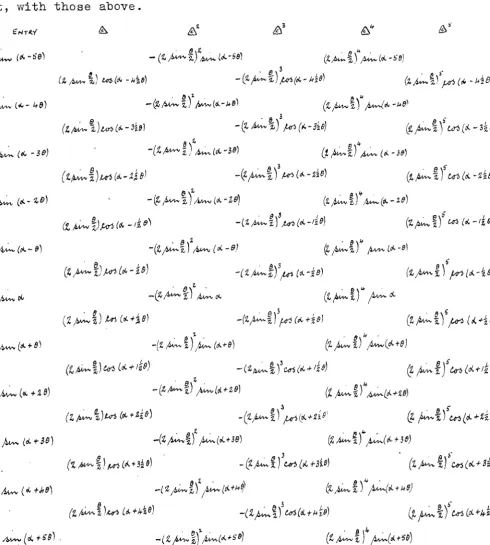
This table is as follows and is best described in the vvorc.s of
Briggs himself, who on account of its numerous and uncommo:r~ uses
was wont to call it the Abacus Fanchrestus. (The abacus good for
all work). I give it on the opposite page, vlithout comment at
:present.
"The table is separated by perpendicular lines into columns,
marked off at the top by the letters A, B, C, D,
E,
etc. and by thecbaracters of the figurate numbers or of pov,rers. Among these
numbers those are called Diagonal which are next to each other and
not in the sa~ne column. All these numbers are made by the
addition of Diagonal numbers the sum of which is always placed in the next lower place of the same column as the aiagonal number farther away from the right hand margin ...•.•. "
Another use no less important and valuable is the finding of the equations by the help of which may be obtained the chords for all sorts of division of the circumference and especially for any section in which the equal parts are given odd in number, in which case the chords themselves may be found by a single operation ..
Also from tLe same table may be had the equations of the equal
parts of the arc given even in number. True these equations do
not give by a single op~ration the chords themselves, but the
squares of the chords from which then the chords themselves are got. The powers to be placed in the separate equations are to be had
from the top of each column together with the signs of Addition or
Subtraction.
-®
I I I I I
/I+ /3 JZ )\ 10 q ~ '1 t. r 4 3
JOt. qo "1'1 &'.i 54 i-ll+ 3 :; Z'f zo 1/.f '1. !i
51-d: J.; 4'Z 352 2'(5 J.,/0 1'5& j/1., '1'1 ;o 30 tfo "f
z
~., '5 I YZ'I 1'/.g'f 'I 35 blaO t-.50 zqt.r ;gz /0 5 'i'S zs q ~oo'W 5'f • a /.tOOl. 'J., 'fi "'{ I 'f g'l., 117.2 6YZ ; 'fS i'fb qt 3/,,,
~1+'1'52. I 1.'( 1-<1-i /I 0 Jl 'fOO'f 4'l.<j0 l,)O~ I)~(, '(lt.r
n"
}~0 ~->'1 /~Hq~-2 f-1 f+';.,OO z "1'+ it. tl.l+i-15 C)l-i3'i SIJ..,'i Z (, lfO I 'J, tjf.+ 5t.O Zol+ biT 15
I 'f I. ~ 5 ~ 10'/HOb f. 3'J.,Of:. 3 5 'i 50 JC)30:i qgt.'f 1-i"/19 t,O""'f'l iZ5 z~5 'il !'f
1; 1'1'1 oo ~J.t:!>S/..;1. I:;(, I~ I, '1 zq 3o 3'(1'6-0 l""f 'iyf goo~ 3~w'l 17.10 H'5 /"00 11
')J.;Oii'fb 52.0 {,'(/, '1.'1'1131+ !iTO<fCJ'i b ~Ob¥ 3ofH I 3 013 so os /'fib '5o& IZI zl
5 I Z 'iZ Z03'ttt '-f'&'fl 1. S'-'~ (,50 (/.+/.+ t3 30'/HO I o !:;if/:, 3JY5 'il'l tilt} Z5
t'+'f~-t, 1-i~OO I0/5 19 (p Z'f
!iJ.ti+O J'J.I-/0 zz6 1.'1
ti-;ql., zsc. 31
2i'l 3S
31+5/ zo '{5 3ZJ.i. 36
'fil/3'f:i 3(.1 3'/
J/3i500 1+00 39
'1'ib31+ ;.,t.l M
3'fq~ I; fi-t 1+3
The coefficients of the powers may be had from the addition of two successive numbers in the same colunm.
The first number of each equation for the chords is the number of the section itself in column A, the second in C, the third in E, and the others in the same way alternate colwnns being omitted.
These numbers all ascend obliquely to the left. Thus when the
number of parts is odd: for trisection 30- 1@ for septisection
70- 14® + 7®- 1 (j) , which have been previously shown. For the
remaining odd sections it will be the same, both the method of demonstration used before and the finding from the table.
But in the equations for the squares of the chords, the first number is the square of the number of the section, to be sought in
column B, the second in column D, the third in F, etc. Thus for
Bisection 4®- 1 (0 , for quadrisection 16®- 20 ® + 8@- 1 ® • Nor
is this true only for even sections but also for odd, e.g.
tri-section, 9®- 6®+ 1 (f).
Special Abacus for Angular Sections.
Briggs then subjoins another table in which the addition of
successive numbers in the above is already performed. It is
con-structed in the same way as the first, by the addition of Diagonal
numbers and is given on the opposite page. This table is expressly
for the purpose of Angular Sections, and from it all the equations both for the chords and the squares can be got with less trouble
than before. Briggs carefully points out that it is much more
difficult in this table to write down a bit of it ·without the
un-broken series of numbers as he could easily do in the first, and that the first has many uses which the second has not, for which
reason he values the first much more than the second. The
positions of the numbers for any equation is the same in either table, but Vlhat was previously expressed by two numbers is here
recorded by a single number. Briggs then gives a geometrical
proof of the equation of the square of the chord in the case of bisection and the even sections got by repeated bisection.
These tables of Briggs are very remarkable indeed. His lack of
a suitable algebraic notation such as Newton later possessed, has in all probability contributed to the comparative obscurity of his results, which had perforce to be expressed arithmetically in the form of a table, the only means of generalising at his disposal.
This second table expressed in a modern notation, and usin,g
sines instead of chords, gives the following well known
expansions:-(1) For odd Sections,
z ~ ( z11-+I).
e
' ( ,., + -t ) ( . ) 1,./'-J2 ,._, . z~e
(2) For any section, odd or even,
-/':W
\ (-)-~" .. ' 24-\, ( 1"'+~)
. )
7.-1'.L
'1-'v+,.f. z__,. . ( z~ 8where
(~)
=c;
L!:_. I X --t. a general binomial coefficient.
In Chapter IX he points out that f'rom the appropriate equation the chord of the multiple arc can be found by the mere substitution of the given chord, but if the chord of the multiple arc be given that of the fractional arc is found by solving the equation for the
chord itself if the section be odd and for the square of the chord '
)
if the section be even. Then in order to avoid the taking of
square roots he gives three_theorems whereby the squares of the chords may give other chords without the necessity of finding the square roots.
These theorems may be stated as
follows:-2R + chord
e
= chord z (go"+~)chord
e
z c 8 )2R = chord (90 -
z
_z
chord ( 180".-...
ze) .
2R chore.
e
=This really ends Briggs's treatise on Angular Sections, but in
Chapter XI he unexpectedly gives an alternative method of express-ing the chord of any multiple arc in terms of that of the simple arc
Alternative method of treating ~~gular Sections.
This method differs entirely from his previous one, and it will be necessary to quote it in detail partly because of its many points
of interest and partly because of the use I wish to make of it.
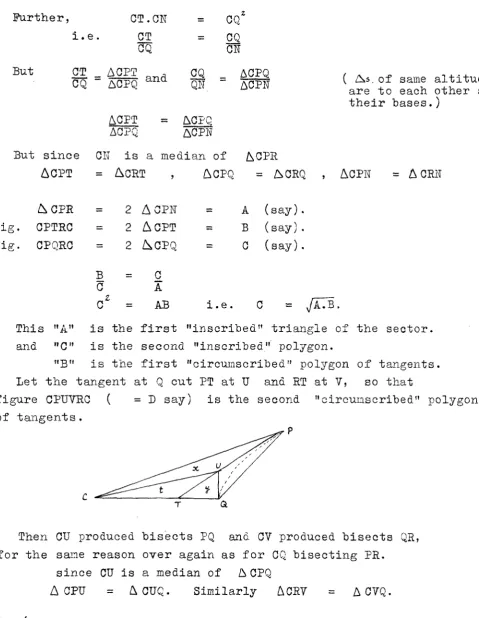
The fundamental proposition, which Briggs proves is as
follows:-"If AC bisects angle BAD at the circumference and if CE is made equal to CA, E being on BD produced, then DE equals BA".
He then proceeds
-"Let there be drawn within the circle the equal chords AB, BC, CL:, DE, EF, etc. and
let there be made
CO = AC, DV = AD
EY
=
AE, FX=
AFand AG = GR. Then by the pre-ceding proposition
DO
=
AB, EV=
AC,FY =AD, etc.
Further let there be 'a series
of continued proportionals AC the second (denoted by since
y
V
of which AB is the first (denoted by 1 CD )
1 ® ) , and AO the third ( 1 @ )
A]) = AO - O!) = AO - A/3 !@- !(})
AV = I@- I@ [ 1.· . • AV AC .
~/:iD =M=~~"£~]
PIE AV - Ye AV- AC = 1@ _ !@ _ t@ = I@- Z®.
and so on.
r=ouP.·n+
Z®
F•r-r, .. .3@ I ([)
5•~-rrl 4@ 3 ®
Se:v,~r~rH 5® b @ !C)
r::.rGHTH &G) IO@
4®
N,NTI-1 '10 IS@ 10 CID r CD
-io.Nr>i IS@ 2,/@ zo @ 5®
E.~f:VG.N'f/1 '1® Z5 (j) 35 ® '"@ t(D
1'1-i.:l-l'fH 10 ® 3&@ s& ~- 35 ® (,(g)
11-ll/I."TeGI'ITH 11@ .1+5
®
~1.(1) '10 ® 21 ® JQ)Pouf/.TF.l!:NrH /'),@ %@ IZD@ 121. (0 :i!.@ '1@
(-l~i/S.I!N/11 13@ b&@ 1/:,'/ (j) ZIO G) 1'1.& ® lS CfJ 1(!)
Sl'l'T.;:I!NTH 14@; 'IS@ zzo@ 330
®
;J.'i:L (0 9~>-® 9®Briggs points out that in all these isosceles triangles the ratio of a side to its base is the same, and thus when the side is known the base is found.
He tabulates his results in the table given on the opposite page which can be easily extended if required.
Column A gives the lines in continued proportion: columns B, D, F. H. etc. are subtracted from and C, E, Gadded to the proportionahi) E.G. the chord of ten times the arc is the tenth proportional plus 21 times the sixth and 5 times the second from which must be sub-tracted 8 times the eighth and 20 times the fourth.
In our modern notation the proportionals have first term(2 sine) ,
and second term 2 sin
z e
i.e. a common ratio (2 cos B). , so thatthe proportionals are
~ 3
(2 sin&), (2 sine. 2 cose), 2 sine (2 cose), 2 sine (2 cose),
.••.. and the table for expressing the above is equivalent to the present analytic formula for expressing sinne in terms of 2 cosB
namely,
of
CHAPTER III.
The Angular Sections of Franciscus Vieta.
The question which now arises is: Is this work of Briggs
original? If not entirely, how much did he get from other sources?
There were no English sources from which he could borrow, and of
the Continental writers the only one to whom he could have been indebted was Franciscus Vieta (1540 - 1603) one of the most capable mathematicians of the 16th century or indeed of any age, and the
first man in the West to give a systematic elaboration of the
methods of computing plane and spherical triangles by the aid of the
six trigonometric functions. He is probably best known as the
founder of analytical methods, introducing into Algebra a notation and symbolism which transformed it into a powerful tool in his hands,
and so laid the foundation of modern Analy~is.
The Canon Mathematicus, (1579)
Among his writings are many pieces on trigonometry which appear in the collection of his works published at Leyden in 1646 by Frans van Schooten, but which first appeared in 1579 in a volume of
trig-onometrical tables with their construction and use. The first
part is entitled - "Canon Mathematicus seu ad Triangula cum Appendic-ibus" and contains a great variety of tables beautifully printed,
but inaccurate as he himself testifies in a later work. The second
part, "Universalium Inspectionum ad Canonem Mathematicum Liber Singularis", is theoretical and contains the construction of the
tables among other things. It is infuis part that we are interested
for it is quite possible for Briggs to have been acquainted with it. Vieta was a wealthy man, who frequently printed his works at his own
~xpense, sen.ding copies .to other mathematicians, with the result
that his writings were rapidly circulated abroad. + In spite of
this I have not been able to trace any mention of this work of 1579 being known in England before the time of Briggs's own researches in the s&ue field, and it.would not be the least surprising if no copy did find its way thither, for England at this time had no mathe-matician of note to whom a copy was likely to be sent, and the diffusion of new knowledge by ordinary channels was a remarkably
slow process. I myself do not think there can be the slightest
doubt that the whole theory and the proofs given by Briggs are
entirely original and his own work, and am of the opinion that he
is deserving of the greatest credit for it. Gellibrand ++
definitely states that the canon of sines was derived from first
principles/
+ Encyc. Brit. vol 28 p. 8 ++ Trig. Brit.
z z"'o
3 +
"'
z 3~~.~5 !i
(, q z 4- ....
""
s
ZD'"'
tb '( + z sr~<.q Z'f 30 q
10 55 50 Z5 2 b f_H
11 1-11-f 'f'f 55
"
+12 51+ tiZ lOS 31. z. 'i'H
'i· /3 &5 15& 1&~ ql 13
11-f 'f'f Z,IO Z91+ I'Ji. t..9 2 ~'i'~
15 qo Z"{!i t+SO 3yg lttO tlj
+
'"
101+ 352 {,(,O &'I£ 33& (,1-1 z qfH./'( ll'f /.ii+Z q~5 !IZ'L '{14 201+ l'f
.,
{~ !35 St.+ I. IZ6'( l'f'dZ fH{, '51+0 ~I 2 f01'H·
!If I'J-Z t.t.6 I '(t.f/ t."'fl'i .Z50ii 12.51+ zgs 1'/ -________ ..._ __________ +
zo 1"{0 iOO '/.'J.'f5 t.&Of-1 . 4'1.90 z.&t.D ' '67.5 !00
z
principles, and I hope to show that Vieta's work does differ from
that of Briggs. The latter, it may be remembered, defines his
charas, sines, tangents and secants as lines which are drawn in anc about a circle whereas Vieta, after the manner of Rhaeticus (1514 -1567), treats them as lines representing the sides of right angled triangles, the different functions being found by taking each side
in turn to be constantly 100,000, and calculating the other two
sides, so that strictly speaking Vieta's Tables are tables of sides
of right angled triangles. He establishes geometrically the
equivalent of sin (A~
B)
and cos(A± B),
and then finds the sidesfor the multiple angle 2A, by considering it as A + A. He then
states the rule giving the sides of the right angled triangle con-taining any multiple angle in terms of the sides of that concon-taining
the simple angle. This is equivalent to expressing sinn8and
cos -rdJ in terHJ.S of both sin B and cos B , and there is no mention of this in Briggs at all.
Vieta's Table: comparison with Briggs's.
Vieta further treats Angular Sections as
follows:-"If from the end of a diameter any number of equal arcs be taken, and from the other extremity be drawn lines to the ends of the
equal arcs taken, these straight lines become the bases of triangles in which the COilli"llOn hypotenuse is the diameter, ana that particular base nearest to the diameter is understood to be the base for the single angle, the next of the double angle, and so on in order. :,:oreover let there be set up a series of lines in continued
pro-portion in which the radius is the first term and the base of the
single angle the second etc. The following will give the bases of
the others taken in regular succession" and he proceeds to give the table shown on the opposite page, with its mode of construction but without proof of the rule.
True this table achieves the same object as Briggs's table for
the chord of the multiple arc, but its mode of construction is
entirely different, Vieta's agreeing more with that given by Briggs
in his alternative treatment in Chapter XI. Charles Hutton in his
review of the two works + points out that while they achieve the
same purpose they are quite different, but does not seem to have
appreciated wherein the difference lay. Vieta's table expresses
that
,.,.,i
Z pn -w e = \ (-)" ~ . ( ""'- "") ( z ~ e)""~ z~.
L "!''l~..r ..r .
i.e. eo s 'h-e in terms of coos B whereas Briggs' s tables give sin n-8 in
terms of sine in Chapter VIII and in terms of cose in Chapter XI. Vieta himself' considered his methods original for he adds "Thus the analysis of angular sections involves geonetric and arithmetic
secrets which hitherto have been penetrated by no one. 11
Arguments in favour of originality of Briggs's work.
The 1579 edition therefore contained the rules without any proofs,
and if Briggs ever saw it he certainly made no use of it.
Further-more there was no other edition lliltil 1615 by which time Briggs had
already completed his work on Angular Sections. It was this 1615
edition which was later incorporated in the 1646 edition of his
collected Works. It was published by AlexanC1er .Anderson, a Scotsman
who was Professor of Mathematics at Paris, and vvas no mean
mathematic-ian himself. He applied himself to editing Vieta's work on
Trig-onometry, adding proofs of the rules which Vieta had merely stated, anC1 not content with this he added some theorems of his own to make
the treatise more complete. We have this on his own authority, ++
in his denial of the charge made by some persons who accused him of
passing off Vieta's work as his own, and furthermore he~lainly states
which of the theorems are his. These theorems are of the greatest
interest for one contains the figure for the fundamental theorem of Briggs's alternative treatment, and. another gives the results which
he stated there. Briggs's treatment is the more straightforward
and elegant of the two, the fundamental theorer::t being developed
geometrically/
geometrically in his case but analytically in Anderson's, who was
following the methods of Vieta. Since Anderson's results were
published before those of Briggs, it is quite possible that the latter may have seen them, and in this way he may have found a hint
in the new theorem which .Anderson gives. I scarcely think this to
be the true account, but the possibility must be admitted. Even if
Briggs did get his first hint from Anderson however, I do not think
it detracts in the slightest from the credit due to Briggs. I think
rather that the true course of events was that early in the first decace of the seventeenth century Briggs worked out his theory of A.."'1gular Sections, the work being entirely original in his hands, and compiled from it his canon of natural sines, which was certainly
under way about 1604. In. spite of this Briggs was only
contemplat-ing its publication at the time of his death, and it seems highly probable to me that, having in the interval come to know of this alternative way of finding chords either as an original discovery or from Anderson's theorem, he merely adds it to his own work as a
matter of interest, for the fact remains that although he put it in
his book he never actually used it. The evidence for this is
found in Chapter XIII where he describes how he calculated the pri-mary sines of the equidifferent arcs, which he used in the construct-ion of his canon, an<i these are O.erived from his own methods stated
in the early chapters of his book. Indeed his alternative treatment
could have been omitted without loss of unity of the volume. There
is stil~ further, though indirect, evidence that Briggs considered his Angular Sections to be original work, for in his "IIlathematica ab Antiquis rr..inus Cogrd tau he quotes the expression of the chord of the multiple arc in terms of that of the simple arc as one of the
problems whose solution was unknown to the Ancients, and ~ilhereas in
most .of the others he gives the inventor or discoverer of the new facts, in this case he does not, which would indicate that he knew
of no other before himself. This conclusion is further strengthened
by the fact that he differentiates between odd an0 even sections showing it was his own vwrk he had in mind., for if he had been
familiar with either Vi eta or Anderson at this time he would have known that their treatment makes no such differentiation necessary.
This work of Briggs mentions the invention of Logarithms by Napier
and is therefore later than 1614, so that at this late date he
seeins to have had no kno-vvledge of Vi eta, while we know his own work
to be of a much earlier date. I can only conclude therefore that
the treatise on Angular Sections was entirely original in the hands of Briggs, who must therefore have been the first Englishman to contribute anything of real note in Trigonometry.
CHAPTER IV.
The Method of Differences. - QUIH<::UESECTION.
Having shown considerable originality in his treatise on
Angular Sections, Briggs displays nothing short of genius when he
comes to the actual construction of his tables. He must have been
a man of singularly penetrating mathematical insight, for there are few things more remarkable than the way in which he divined the method. of subtabulation by central differences which he uses in
the construction of his canon of Sines and in his later Tables. In
Chapter XII he fully describes and applies the working process, which could scarcely be bettered even today without mechanical aid,
and so laid the foundation of all future work on central differences For this vvork alone he has every right to be hailed as the inventor of the Differential Method, and of Interpolation, the credit for the latter usually being assigned to James Gregory, who was Briggs's
junior by about 80 years, because his results were expressed by series in analytic notation, a thing which Briggs unfortunately
lacked. That Briggs's claim is no empty one the reader can judge
for himself.
Briggs's title to invention of Hethod.
Briggs' s title to invention of L1ethod.
Briggs gives the rules but not the slightest clue as to the
method by which he reached them. That it was one of his early
discoveries, however, is certain for he himself + and later
Gellibrand ++ fixes the date of its use round about 1600 which is
- -
'
70 years earlier than the date of Gregory's discovery. Although
invented at the time he was doir;g Angular Sections, the first pub-lication of the method is when he proposes to use it for filling in the gaps in the chiliads in.his tables of Logarithms, and for that reason he describes it very fully in the XIIIth Chapter of the
Ari thmetica Logari thmica, where he shows himself to be fully convers-.. ant with the behaviour of a difference table for equidistant
arguments where all the differences are either rational or irrational
That he was excited by his discovery can be ~nferred from the
Arithmetica Logaritllffiica, for he confesses ++to letting his
enthus-iasm carry him away, anc3. that at a time when every moment was
precious to him.
The vvhole idea of the difference table seeus to be 6ue to Briggs,
for I have carefully probed ~nd investigated the works of those who
came before him to discover if they made use of differences at al1. :~either Vi eta nor Napier seem aware of differences and histories of
Mathematics make no mention of their first use. Hutton ++++ speaks
of Briggs as the first he knows of to use a Differential method,
and I have established +++++ that in 1673 Leibnitz ~rote to
Olden-burg concerning the scheme of treating the series of cubes by a difference table finishing with zero differences, saying that John
Fell attributed the discovery to Gabriel IJouton of Lyons ( 1618-1694) This latter statement cannot be correct for this kind of treatment certainly goes back to Briggs who actually treated the fourth powers
in this way as an example demonstrating Trisection in the
Arith-metica Logari thmica, and the sixth povvers to demonstrate
Quinque-section in his Trigonometria Britannica. The only other reference
to/
+ Arith. Log.
+++ Arith. Log. eh. 13. ++++
+++++ Smith
++ T . r~g. B r~ •t .
Math, Intro. p. 65.