DECLARATION
I hereby declare that the dissertation work entitled “DEVOLOPMENT AND EVALUATION OF EXTENDED REALEASE TABLET OF ROPINIROLE” is based on original work carried out by the in Annai Veilankanni’s pharmacy College, Saidapet, Chennai and formulation at M\s.KEMWELL BIOPHARMA PVT LTD, BANGALORE under the guidance of Mr.S.Manjunatha, Head Research & Development for submission to The Tamil Nadu Dr.M.G.R.Medical University in the partial fulfillment of the requirement for the award of Degree Master of Pharmacy in Pharmaceutics. The work is original and has not been submitted in part or full for any other diploma or degree of this or any other university. The information furnished in this dissertation is genuine to the best of my knowledge.
Chennai.
requiste determination and strength to pursue and complete this course and dissertation successfully. It is my immense pleasure privilages to acknowledge the contributions, thankfully received,the blessed inspirstion and the unreserved support.I have had from the individual and institutional sources with whom I have them in association during the course of my last two years of pursuit I here buy take this opportunity to acknowledge all those who have helped me in the completion this dissertation work.
I am extremely greatful to Dr.S.Devaraj,Chairman and Dr. D. Devanand, Secretary, AnnaiVeilankanni’s College, Saidapet, Chennai-600015 for providing me the opportunity to do my project at M\s.Kemwell Biopharma Pvt Ltd, Bangalore.
It’s fact that every mission needs a spirit of work and dedication but it needs to be put on the right path to meet its destination and case this credit goes of my respected teachers, Dr.M.Senthil Kumar Prinicipal,AnnaiVeilankannis Pharmacy College.I am very much thankful to him for his inspiration, kind co-operation, caring attitude, timely help,valuable, guidance and constant encouragement during every phase of this dissertation. His patience way of sharing knowledge, our discussion support always propelled and bossted me to performed better. I would reminegreatful to him.
My sincere and heartful thanks to my guide Dr.M.SenthilKumar,Prinicipal and The Head Department of Pharmaceutics, AnnaiVeilankanni’s Pharmacy College, my teachers Mrs.S.Valarmathi and Mr.Sathish Kumar for their help and co-operation.
And at last but not least my heartiest and dearest gratitude to my lovable friends Bharathi,Ravi and Venkat for their faith, care and support.
I would like to express my deep sense of love and affection to my family members especially to my father Sri.D.Srinivasan and my mother Smt.S.Kowsalya for their strong piety and pantheism enable me to face the world without fear and with pedantic strength
S.No
TITLE
PAGENO
1
INTRODUCTION
1
2
LITERATURE REVIEW
13
3
DRUG PROFILE
23
4
POLYMER PROFILE
26
5
AIM AND OBJECTIVE OF WORK
36
6
PLAN OF WORK
37
7
MATERIALS
39
8
EQUIPMENTS
40
9
EXPERIMENTAL WORK
41
10
RESULTS AND DISCUSSION
85
11
SUMMARY AND CONCLUSION
93
NO
1 Plasma concentration-time profile 3 2 Drug delivery from a typical matrix drug delivery system 11 3 Innovator Tri layered Formulation 41 4 Geomatrix three-layer system 42
5 Roller compactor 51
6 Time v/s % Drug release (optimization of polymers) 54 7 Time v/s % Drug release (Optimization of PVPK 90) 57 8 Time v/s % Drug release(Optimization of Sodium carboxy methyl
cellulose) 60
9 Time v/s % Drug release(Optimization of functional coating formula) 63 10 Time v/s % Drug release(Optimization of Process) 65
11 In-vitrodrug release data for formulation F1-F1 (4) 74
NO
20 Percentage drug release during optimization of Sodium carboxy
methyl cellulose 60
21 Optimization of Functional Coating 62 22 Percentage drug release during optimization of Functional
Coating 63
23 Optimization of process 64 24 Percentage drug release during Optimization of Process 65 25 Final Optimized Formula 66 26 Angle of Repose as an Indication of Powder Flow Properties 68 27 Relationship between % compressibility and flow ability 68 28 Derived and flow properties of Granules of formulation 69 29 Avgwt of Tablet and %Deviation 71 30 Evaluation of Tablets of Formulation 72 31 In-vitro Drug release and Higuchi data for formulations F1- F1
(4) 73
32
Peppa’s data for Formulation F1-F1 (4) 74 33 In-vitro Drug release and Higuchi data for formulations
F1(4)(1)- F1(4)(3(3) 76
34
Peppa’s data for Formulation F1(4)(1)- F1(4)(3(3) 76 35
Percentage drug release of Finalized and Innovator Formulation 80 38 Requirements in Dissolution Medium of pH 6.8 Phosphate
buffer 81
39 Percentage drug release of Finalized v/s Innovator Formulation
in pH 6.8 Phosphate buffer 81 40
Requirements in Dissolution Medium of pH 1.2 HCl 82 41 Percentage drug release of Finalized v/s Innovator Formulation
in pH 1.2 HCl 83
42
Stability data 84
43
Observation of Drug- Excipient compatibility 86 44 Diffusion characteristics of Ropinirole Extended release tablet
formulations 89
45
Diffusion exponent drug release mechanism60 89 46
% v/v Percentage volume/volume
% Percentage
Lambda
g Microgram
max Absorption maximum
µ Micron
AUC Area under the curve HCl Hydrochloric Acid
HPLC High Performance Liquid Chromatography IP Indian Pharmacopoeia
LOD Limit of Detection LOQ Limit of Quantitation
mg Milligram
ml Milliliter
mM Millimole
ng Nonogram
HPLC Chromatography S.D Standard Deviation S.E Standard Error
USP United States Pharmacopoeia
U.S.DEA United States Drug Enforcement Administration
UV Ultraviolet
Department of Pharmceutics, Avpc
INTRODUCTION
An ultimate goal of any dosage regimen in the drug therapy of any disease is one which immediately attains the desired therapeutic concentration of drug in plasma (or at the site of action) and maintains it constant for the entire duration of treatment. This is possible through administration of a conventional dosage form in a particular dose and at a particular frequency. The frequency of administration or the dosing interval of any drug depends upon its half life or mean residence time (MRT) and its therapeutic index. Extended and controlled release represents separate drug delivery processes. Extended release (ER) constitutes any dosage form that provides medication over extended period of time. Controlled release, however, denotes that the system is able to provide some actual therapeutic control, whether this can be of temporal nature, spatial nature or both. In other words, the system attempts to control drug concentration in the target tissue. Thus there are sustained release systems that cannot be considered controlled drug delivery systems. The goal of ER1 dosage form is to maintain therapeutic blood or tissue levels of the drug for extended period which try to mimic zero-order drug release. Modified release oral dosage forms have brought new lease of life into drugs that have lost market potential due to requirement of frequent dosing, dose related toxic effects and gastro intestinal disturbances.
Department of Pharmceutics, Avpc
recognized that for many disease states, a substantial number of therapeutically effective compounds already exist.
The effectiveness of these drugs, however, is often limited by side effects or the necessity to administer the compound in a clinical setting, the goal in designing sustained or controlled delivery system is to reduce the frequency of dosing or to increase effectiveness of the drug by localization at the site of action, reducing the dose required, or providing uniform drug delivery. Sustained release constitutes any dosage form that provides medication over and extended time. Controlled release, however, denotes that the system is able to provide some actual therapeutic control, whether this is of a temporal nature, spatial nature or both.
Department of Pharmceutics, Avpc
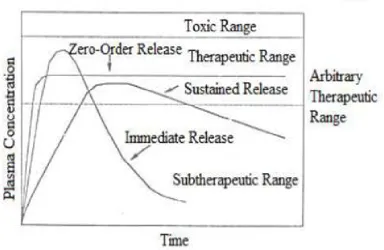
[image:17.595.118.503.230.480.2]Sustained release, sustained action, prolonged action controlled release, extended action, timed release, depot and repository dosage forms are terms used to identify drug delivery system that are designed to achieve or prolonged therapeutic effect by continuously releasing medication over an extended period of time after administration of a single dose.
Fig.1.Plasma concentration-time profile
Advantages of Extended release dosage forms 3 Ø Reduction in dosing frequency.
Ø Reduced fluctuations in circulating drug levels. Ø Increased patient compliance.
Ø Extended release allows for sustained therapeutic blood levels of the drug. Ø Sustained blood levels provide for a prolonged and consistent clinical
Department of Pharmceutics, Avpc Ø Economic benefit.
Ø Minimize toxicity, decrease adverse reactions.
Ø Drugs with very short elimination half-lives, an extended-release drug product maintains the efficacy over a longer duration.
Disadvantages of extended release dosage forms Ø Dose dumping.
Ø Reduced potential for dosage adjustment.
Ø Poor systemic availability in general. Ø If the patient suffers from an adverse drug reaction or accidentally becomes
intoxicated the removal of drug from the system is more difficult with an extended release drug product.
Ø Orally administered extended-release drug products may yield erratic or variable drug absorption as a result of various drug interactions with the contents of the GI tract and changes in the GI motility.
Modified release drug product4-5
The term modified release drug product is used to describe products that alter the timing and/or the rate of release of the drug substance.
Types of Modified release drug products
Ø Extended release dosage forms:A dosage form that allows at least a two fold reduction in dosage frequency as compared to that drug presented as an immediate release form.
Ex: Controlled release, Sustained release.
Department of Pharmceutics, Avpc
Controlled release: It includes any drug delivery system from which the drug is delivered at a predetermined rate over a long period.
Ø Delayed release dosage forms: A dosage form releases a discrete portion of drug at a time or times other than promptly after administration, although one portion may be released promptly after administration.
Ex: Enteric coated dosage forms.
Ø Targeted release dosage forms:A dosage forms that releases drug at /near the intended physiological site of action. Targeted release dosage forms may have extended release characteristics.
Design of Extended release products
Dissolution and diffusion controlled systems have classically been of primary importance in oral delivery of medication because of their relative ease of production and cost compared with other methods of sustained or controlled delivery. Most of these systems are solids, although a few liquids and suspension have been recently introduced. The classifications of such systems are as follows:
Ø Diffusion controlled systems.
Ø Dissolution controlled systems.
Ø Dissolution and Diffusion controlled systems.
Ø Osmotically controlled systems.
Department of Pharmceutics, Avpc Diffusion controlled systems6
Diffusion systems are characterized by the release rate being dependent on its diffusion through an inert membrane barrier. Usually this barrier is an insoluble polymer.
Ingeneral two types of sub classes of diffusion systems are recognized they are
a. Réservoir devises. b. Matrix devises. a. Reservoir devices
Reservoir devices are characterized by a core drug reservoir surrounded by a polymeric membrane. The nature of the membrane determines the rate of release of drug from the system.
The process of diffusion is generally described by Ficks equations,
=
Where, J = Flux (amount/area –time)
D = Diffusion co-efficient of drug in the membrane (area/time)
dc/dx= rate of exchange in concentration C, with respect to a distance X in the membrane.
b. Matrix devices
Department of Pharmceutics, Avpc =C0dh− .
Where, dm = Change in the amount of drug released per unit area.
dh= Change in the thickness of the zone of matrix that have been depleted of drug.
Co = Total amount of drug in unit volume of matrix. Cs =Saturated concentration of drug within the matrix. Dissolution controlled systems7
Drug with a slow dissolution rate will demonstrate sustaining properties, since the release of the drug will be limited by rate of dissolution. This being the case, SR preparations of drugs could be made by decreasing their dissolution rate. This includes preparing appropriate salts or derivatives, coating the drug with a slowly dissolving material, or incorporating it into a tablet with a slowly dissolving carrier. The dissolution process at steady state is described by Noyes-Whitney equation.
=K A(Cs − C) = ( )
Where,dc/dt = Dissolution rate
Ko = Diffusion co-efficient
Cs = Saturation solubility of the solid
C = Concentration of solute in bulk solution.
h = Thickness of diffusion layer.
Dissolution and diffusion controlled release system
Department of Pharmceutics, Avpc
shadow other processes enough to allow classification as either dissolution rate limited or diffusion controlled.
Osmotically controlled systems
This device is fabricated as tablet that contains water soluble osmotically active drug, of that was blended with osmotically active diluents by coating the tablet with a cellulose triacetate barrier which functions as a semi permeable membrane. A laser is used to form a precision orifice in the barrier, through which the drug is released due to development of osmotic pressure difference across the membrane.
Ion exchange Systems
These are salts of cationic or anionic exchange resins or insoluble complexes in which drug release results from exchange of bound drug ions that are normally present in GI fluids.
Factors affecting Extended release dosage forms8 Dose Size
If an oral product has a dose size greater that 0.5gm it is a poor candidate for sustained release system, Since addition of sustaining dose and possibly the sustaining mechanism will, in most cases generates a substantial volume product that unacceptably large.
Aqueous Solubility
Department of Pharmceutics, Avpc
The lower limit on solubility for such product has been reported 0.1mg/ml. drugs with great water solubility are equally difficult to incorporate in to sustained release system. pH dependent solubility, particularly in the physiological pH range, would be another problem because of the variation in pH throughout the GI tract and hence variation in dissolution rate
Partition coefficient
Partition coefficient is generally defined as the fraction of drug in an oil phase to that of an adjacent aqueous phase. Accordingly compounds with relatively high partition coefficient are predominantly lipid soluble and consequently have very low aqueous solubility. Compounds with very low partition coefficients will have difficulty in penetrating membranes resulting poor bioavailability.
pka
It is the relationship between pka of compound and absorptive environment. Presenting drug in an unchanged form is adventitious for drug permeation but solubility decrease as the drug is in unchanged form
Drug stability
Department of Pharmceutics, Avpc Molecular size and diffusivity
The ability of drug to diffuse through membranes its so called diffusivity & diffusion coefficient is function of molecular size (or molecular weight).Generally, values of diffusion coefficient for intermediate molecular weight drugs, through flexible polymer range from 10-8 to 10-9 cm2 / sec. with values on the order of 10-8 being most common for drugs with molecular weight greater than 500, the diffusion coefficient in many polymers frequently are so small that they are difficult to quantify i.e. less than 16-12 cm2/sec. Thus high molecular weight drugs and / or polymeric drugs should be expected to display very slow release kinetics in sustained release device using diffusion through polymer membrane.
Biological half Life
The usual goal of an oral sustained release product is to maintain therapeutic blood levels over an extended period. To action this, drug must enter in the circulation of approximately the same rate of which it is eliminated. The elimination rate is quantitatively described by half-life (t1/2). Therapeutic compounds with short half lives are excellent candidates for sustained release preparations. Since this can reduce dosing frequency. In general drugs with half-lives shorter than 3hrs are poor candidates of sustained release dosage forms of dose size will increase as well as compounds with long half lives, more than 8 hrs are also not used in sustained release forms because their effect is already sustained.
Absorption
Department of Pharmceutics, Avpc
is essential if the system is to be successful. It we assume that transit time of drug must in the absorptive areas of the GI tract is about 8-12 hrs. The maximum half life for absorption should be approximately 3-4 hrs. Otherwise device will pass out of potential absorption regions before drug release is complete.
Distribution
The distribution of drugs into tissues can be important factor in the overall drug elimination kinetics. Since it not only lowers the concentration of circulating drug but it also can be rate limiting in its equilibrium with blood and extra vascular tissue, consequently apparent volume of distribution assumes different values depending on time course of drug disposition. For design of sustained/ controlled release products, one must have information of disposition of drug.
Metabolism
Drugs that are significantly metabolized before absorption, either in lumen or the tissue of the intestine, can show decreased bioavailability from slower-releasing dosage forms. Most intestinal wall enzymes systems are saturable. As drug is released at a slower rate to these regions less total drug is presented to the enzymatic. Process device a specific period, allowing more complete conversion of the drug to its metabolite.
[image:25.595.248.365.610.730.2]Mechanism of drug release
Department of Pharmceutics, Avpc
Polymer and active agent have been mixed to form a homogeneous system, also referred to as a matrix system. Diffusion occurs when the drug passes from the polymer matrix into the external environment. As the release continues, its rate normally decreases with this type of system, since the active agent has a progressively longer distance to travel and therefore requires a longer diffusion time to release.
Ideal candidates for Extended release drug delivery9 Ø Molecular weight: <1000mg
Ø Solubility: 0.1 mcg/ml
Ø pka: >0.1% to 1% at pH 1 to 7.8
Ø Apparent partition coefficient: 0.5 to 2 Ø Stability: stable in GI environment
Ø Release: Release should not be influenced by pH and enzymes Ø Elimination Half Life; Preferably between 0.5 and 8hrs
Ø Total clearance: Extensively metabolised by the liver provided the rate of metabolism is slow.
Ø Intrinsic Absorption rate constant: Drug is absorbed rapidly Ø Therapeutic range: wide
Unsuitable candidate for extended release dosage forms10 Ø Shorter t1/2
Ø Longer t1/2
Ø Narrow Therapeutic index Ø Large dose
Department of Pharmceutics, Avpc
LITERATURE REVIEW
Shahrzad et al.,Explained that Hypromellose (hydroxypropyl methylcellulose,
HPMC) matrices are widely used in the formulation of sustained release dosage forms. The integrity and performance of an HPMC matrix formulation depends on rapid hydration and gel formation upon ingestion. Due to the recent alert issued by the Food and Drug Administration regarding the potential negative influence of alcoholic beverages on extended release (ER) formulations, several researchers have evaluated the potential influence of hydro alcoholic media on drug release from ER dosage forms. It has been reported that HPMC matrix formulations do not show “dose dumping” in hydro alcoholic media. The purpose of this study was a fundamental investigation on the effect of hydro alcoholic solutions (0–40% v/v ethanol) on textural and rheological properties of different viscosity grades of neat HPMC, as the functional ingredient within a hydrophilic matrix. In general, hydro alcoholic solutions had little effect on gel formation and mechanical properties of hydrated compacts, while the rheological behaviour of HPMC showed dependency on the ethanol content of such solutions.
Amelia Avachat et al.,Employedan emulsion solvent evaporation method to prepare
microspheres of ropinirole hydrochloride, a highly water soluble drug, by using
ethyl cellulose and PEG with the help of 32 full factorial design. The microspheres
were made by incorporating the drug in a polar organic solvent, which was
emulsified using liquid paraffin as an external oil phase. Effects of various process
parameters such as viscosity of the external phase, selection of the internal phase,
surfactant selection and selection of stirring speed were studied. Microspheres were
Department of Pharmceutics, Avpc
drug/ethyl cellulose ratios and PEG concentrations were assayed. In vitro dissolution
profiles showed that ethyl cellulose microspheres were able to control release of the
drug for a period of 12 h.
Juliane Weberet al., developed Two well designed, placebo- or active comparator- controlled trials examined the efficacy of ropinirole prolonged release in patients with advanced Parkinson’s disease sub optimally controlled by levodopa. In the placebo-controlled trial, 24 weeks’ therapy with ropinirole prolonged release 6–24 mg once daily reduced hours of ‘off’ time (primary endpoint) to a significantly greater extent than placebo. In active comparator-controlled trial, significantly more ropinirole prolonged-release recipients than ropinirole immediate-release recipients maintained at 20% reduction from baseline in ‘off’ time at plasma concentration week 24 (primary endpoint). This article focuses solely on the relative bioavailability of the prolonged- and immediate adjunct to levodopa in patients with advanced Parkinsons disease.
Department of Pharmceutics, Avpc
Inventory-II, PDQ-39 subscales of mobility, activities of daily living, emotional well-being, stigma and communication, and PD Sleep Scale were significantly improved at week 24 with ropinirole 24-hour. The most common adverse events (AE) with ropinirole 24-hour were dyskinesia, nausea, dizziness, somnolence, hallucinations, and orthostatic hypotension and AEs led to study withdrawal in 5% of both the active and placebo groups.
J. Goole et al., Studied the scintigraphic and pharmacokinetic studies were conducted on 10 healthy, fed volunteers. Two concepts of sustained-release floating minitablets – Levo-Form 1 (matrix) and 2 (coated) –were evaluated and compared to the marketed product Prolopa® HBS 125. All the floating forms were radio labelled with 111In in order to evaluate their gastric residence time using _-scintigraphy. It was shown that the three formulations offered almost the same mean gastric residence time, which was about 240 min. Prolopa® HBS 125 and Levo-Form 2 presented intragastric disintegration, which can lead to a more pronounced “peak & valley” effect on the plasma concentration–time profile of levodopa. In contrast, the plasma concentration–time profile of levodopa following the administration of Levo-Form 1 was more evenly distributed. Moreover, Levo-Form 1 provided the lowest variations between men and women in terms of AUC and Cmax values. Finally, when the same amount of inhibitors of extra cerebral dopa decarboxylase – carbidopa and benserazide – had been administrated, the mean AUC, Cmax and Tmax values obtained for benserazide were lower than those obtained for carbidopa.
Department of Pharmceutics, Avpc
release (C.R) products provide an advantage over conventional dosage forms by optimizing bio-pharmaceutic, pharmacokinetic and pharmacodynamic properties of drugs in such a way that it reduces dosing frequency to an extent that once daily dose is sufficient for therapeutic management through uniform plasma concentration providing maximum utility of drug with reduction in local and systemic side effects and cure or control condition in shortest possible time by smallest quantity of drug to assure greater patient compliance. This review describes the various factors influencing the design and performance of sustained/controlled release products along with suitable illustrations.
Peter Lewittet al.,described that Levodopa serves as the gold standard of
anti-parkinsonian therapy and nearly every patient with Parkinson’s disease eventually
receives this drug. To improve upon levodopa therapy, several forms of treatment
have been devised to augment its actions, and new delivery systems are under
development. This new research offers promise for improving outcomes with this
highly effective therapy.
Department of Pharmceutics, Avpc
research, vaccines and various surgical techniques available and being developed for the management of PD.
Vincenzo Bonifati et al.,reviewed that Levodopa remains the most effective drug for Parkinson’s disease (PD). However, its benefits are limited owing to extensive metabolism by catechol-O -methyltransferase (COMT), especially if levodopa is used in combination with peripheral dopa decarboxylase inhibitors. A new generation of potent, orally active, selective, and reversible COMT inhibitors has become available recently. Among these, tolcapone and entacapone have been best characterised. Preclinical and clinical studies have shown that COMT inhibitors markedly enhance levodopa availability and prolong its plasma half-life. In recent large clinical trials they proved to be able to ameliorate motor fluctuations, reduce disability, and decrease levodopa requirements in Parkinson disease patients. The tolerability profiles of entacapone and tolcapone are good. COMT inhibition promises to become an important means of extending the benefits of levodopa therapy in Parkinson disease.
Department of Pharmceutics, Avpc
be 928.07 ± 206.5 and 1055.99 ± 251.7 ng h/mL, respectively in comparison to 137.25 ± 31.3 and 467.15 ± 106.1 ng h/mL for RPG and oral tablet, respectively. The relative bioavailability of ropinirole has been enhanced more than two fold by RPTNG. Furthermore, antiparkinson activity was evaluated in terms of estimating the level of thiobarbituric acid reactive substances, glutathione antioxidant enzymes and catalase in lesioned brain of rats. Formulations were also found to be non-toxic and non-irritant by histological investigations.
Department of Pharmceutics, Avpc
Deepak Sahu et al.,developed sustained release matrix tablets of quetiapine fumarate using different polymers viz. Hydroxy propyl methyl cellulose (HPMC) and PVP K30. Varying ratios of drug and polymer like were selected for the study. After fixing the ratio of drug and polymer for control the release of drug up to desired time, the release rates were modulated by combination of two different rates controlling material and triple mixture of two different rate controlling material. After evaluation of physical properties of tablet, the in vitro release study was performed in 0.1 N HCl pH 1.2 for 2 hrs and in phosphate buffer pH 6.8 up to 12 hrs. The effect of polymer concentration and polymer blend concentration were studied. Dissolution data was analysed by Higuchi expression. Among all the formulations, formulation QFSRT/08 which contains 60% HPMC K15M and 06% of PVP K30 release the drug which follow Higuchi kinetics via, swelling, diffusion and erosion and the release profile of formulation QFSRT/08 was comparable with the prepared batch products. Stability studies (40±2ºC/75±5%RH) for 6 months indicated that quetiapine fumarate was stable in the matrix tablets. The DSC and FTIR study revealed that there was no chemical interaction between drug and excipients.
Department of Pharmceutics, Avpc
coefficient of correlation. Formulation (F10) containing HPMC (16% w/w) and Ethyl cellulose (5.4 % w/w) gave the desired release for once a day administration. The drug release was found to be diffusion controlled coupled with erosion having high correlation for Higuchi release pattern. The release pattern was close to the theoretical release profile.
Department of Pharmceutics, Avpc
DSC and FTIR study revealed that there was no chemical interaction between drug and excipients.
Yucheng Sheng et al.,Evaluated an understanding of dose proportionality is essential in drug development, and the results are of great clinical importance for predicting the effects of dose adjustments. However, little consensus exists with regard to study design and analysis. The aim of this paper was to produce a detailed profile of the information on dose proportionality studies in the last 10 years and to provide a foundation for reflection and debate on future priorities. A total of 147 publications comprising 156 studies were analyzed. The typical dose proportionality study enrolled 20 to 30 subjects and randomly allocated them into 3 to 4 dose levels to investigate pharmacokinetic behaviours within a dose ratio range of 2-6. The most common design was the crossover experiment (52.6%), and evaluating dose-adjusted pharmacokinetic parameters followed by hypothesis testing (43%) was the most frequent statistical approach. However, the alternative crossover design and equivalence criterion based on the power model represented only 4% and 8% of studies, respectively. The power model as a recommendable empirical relationship to assess dose proportionality was applied in 25 (16%) studies. This research suggests that the alternative crossover design and power model statistical method should be attracting more attention in order to obtain more information in studies with limited subjects.
Department of Pharmceutics, Avpc
Department of Pharmceutics, Avpc
DRUG PROFILE
27-30ROPINIROLE
IUPAC Name: 4-[2-(dipropylamino)ethyl]-1,3-dihydro-2H-indol-2-one
Chemical structure
Molecular formula: C16H24N2O Molecular weight: 296.84 gm/mol Therapeuic action
Anti-parkinsonism Mechanism of action28
Ropinirole is a non-ergoline dopamine agonist with high relative in vitro specificity and full intrinsic activity at the D
2 and D3 dopamine receptor subtypes, binding with higher affinity to D
Department of Pharmceutics, Avpc Pharmacokinetcs29
Route: oral Bioavailability
In clinical studies with immediate-release ropinirole, over 88% of a radiolabeled dose was recovered in urine, and the absolute bioavailability was 45% to 55%, indicating approximately 50% first-pass effect. Ropinirole displayed linear kinetics up to doses of 24 mg/day (8 mg immediate-release, 3 times a day). Relative bioavailability of REQUIP XL Extended-Release Tablets compared with immediate-release tablets was approximately 100%.
Distribution
Ropinirole is widely distributed throughout the body, with an apparent volume of distribution of 7.5 L/kg
Metabolism
Ropinirole is extensively metabolized by the liver. The major metabolic pathways are N-despropylation and hydroxylation to form the inactive N-despropyl metabolite and hydroxyl metabolites.
Elimination
Less than 10% of the administered dose is excreted as unchanged drug in urine. Adverse reactions29
The following adverse reactions are observed in ropinirole include Ø Falling asleep during activities of daily living
Ø Syncope
Department of Pharmceutics, Avpc Drug interactions
Ciprofloxacin
Co administration of ciprofloxacin, an inhibitor of CYP1A2, with ropinirole increased ropinirole AUC by 84% on average and C
max by 60% L-dopa
Oral administration of ropinirole increased mean steady-state C
max of L-dopa by 20%, but its AUC was unaffected
Estrogens
Population pharmacokinetic analysis revealed that higher doses of estrogens (usually associated with hormone replacement therapy [HRT]) reduced the oral clearance of ropinirole by approximately 35%.
Warnings and precautions30
Ø Syncope, sometimes associated with bradycardia,
Ø Symptomatic hypotension (including postural/orthostatic hypotension)
Ø Elevation of blood pressure and changes in heart rate
Ø Hallucination may occur Ø Dyskinesia may be caused or exacerbated. Decreasing the L-dopa dose may
lessen or eliminate this side effect
Department of Pharmceutics, Avpc
POLYMER PROFILE
HYDROXY PROPYL METHYL CELLULOSE31-33 Nonproprietary Names
BP: Hypromellose, JP: Hydroxypropylmethylcellulose PhEur: Hypromellosum, USP: Hypromellose
Synonyms
Hydroxyl propyl methylcellulose, HPMC; Methocel, methyl cellulose, propylene glycol ether; methyl hydroxypropylcellulose; Metolose; Tylopur.
Empirical Formula and Molecular Weight
The PhEur 2005 describes hypromellose as a partly O-methylated and O-(2 hydroxypropylated) cellulose. It is available in several grades that vary in viscosity and extent of substitution. Molecular weight is approximately 10 000–1 500 000.
Structural formula
Department of Pharmceutics, Avpc Description
Hypromellose is an odourless and tasteless, white or creamy white fibrous or granular powder.
Typical Properties Density (bulk): 0.341 g/cm3Melting point: Browns at 190–2000CMoisture content: Hypromellose absorbs moisture from the atmosphere;
Functional Category
Coating agent; film-former; rate-controlling polymer for sustained release; stabilizing agent; suspending agent; tablet binder; viscosity-increasing agent.
Applications in Pharmaceutical Formulation or Technology 33
Hypromellose is widely used in oral, ophthalmic and topical pharmaceutical formulations. In oral products, hypromellose is primarily used as a tablet binder, in film-coating, and as a matrix for use in extended-release tablet formulations. Concentrations between 2% and 5% w/w may be used as a binder in either wet- or dry-granulation processes. High-viscosity grades may be used to retard the release of drugs from a matrix at levels of 10–80% w/w in tablets and capsules.
Depending upon the viscosity grade, concentrations of 2–20% w/w are used for film-forming solutions to film-coat tablets. Hypromellose is also used as a suspending and thickening agent in topical formulations. Hypromellose at concentrations between 0.45–1.0% w/w may be added as a thickening agent to vehicles for eye drops and artificial tear solutions.
Department of Pharmceutics, Avpc
adhesive in plastic bandages, and as a wetting agent for hard contact lenses. It is also widely used in cosmetics and food products
SODIUM CARBOXY METHYL CELLULOSE Nonproprietary Names
BP: Carmellose sodium,JP: Carmellose sodium, PhEur: Carmellosum natricum, USP: Carboxymethylcellulose sodium
Synonyms
Akucell; Aquasorb; Blanose; cellulose gum; CMC sodium; E466; Finnfix; Nymcel; SCMC; sodium carboxy methyl cellulose; sodium cellulose glycolate; sodium CMC; Tylose CB.
Empirical Formula and Molecular Weight
The USP describes carboxymethylcellulose sodium as the sodium salt of polycarboxymethyl ether of cellulose. Typical molecular weight is 90 000–700 000. Structural Formula
Description
Carboxymethylcellulose sodium occurs as a white to almost white, odourless, granular powder.
Typical Properties Density (bulk): 0.52 g/cm3Density (tapped): 0.78 g/cm3Dissociation constant: pKa
Department of Pharmceutics, Avpc contains less than 10% waterSolubility: practically insoluble in acetone, ethanol (95%), ether, and toluene. Easily dispersed in water at all temperatures, forming clear, colloidal solutions.
Functional Category
Coating agent; stabilizing agent; suspending agent; tablet and capsule disintegrant; tablet binder; viscosity-increasing agent; water-absorbing agent.
Applications in Pharmaceutical Formulation or Technology 35
Carboxymethylcellulose sodium is widely used in oral and topical pharmaceutical formulations, primarily for its viscosity increasing properties. Carboxymethylcellulose sodium may also be used as a tablet binder and disintegrant, and to stabilize emulsions. Higher concentrations, usually 3–6%, of the medium viscosity grade are used to produce gels that can be used as the base for applications and pastes. Uses of carboxymethylcellulose sodium.
Table No: 1 Use and Concentration of Carboxy methyl cellulose sodium
Use Concentration (%)
Emulsifying agent 0.25–1.0
Gel-forming agent 3.0–6.0
Injections 0.05–0.75
Oral solutions 0.1–1.0
Tablet binder 1.0–6.0
POVIDONE
36 Nonproprietary NamesDepartment of Pharmceutics, Avpc Synonyms
E1201; Kollidon; Plasdone; poly[1-(2-oxo-1-pyrrolidinyl) ethylene]; polyvidone; poly vinyl pyrrolidone; PVP; 1-vinyl-2-pyrrolidinone polymer
Chemical Name 1-Ethenyl-2-pyrrolidinone homopolymer
Empirical Formula and Molecular Weight
(C6H9NO)n and 2500–3 000000
Table No: 2 Viscosity grades of Povidone
K-value Approximate molecular weight
12 2500
15 8000
17 10 000
25 30 000
30 50000
60 400000
90 1000 000
Department of Pharmceutics, Avpc Description
Povidone occurs as a fine, white to creamy-white coloured, odourless or almost odourless, hygroscopic powder.
Typical Properties
Density (bulk): 0.29–0.39 g/cm3Density (tapped): 0.39–0.54 g/cm3 Melting point: softens at 1500C.
Functional Category
Disintegrant; dissolution aid; suspending agent; tablet binder. Applications in Pharmaceutical Formulation or Technology
Although povidone is used in a variety of pharmaceutical formulations, it is primarily used in solid-dosage forms. In tableting, povidone solutions are used as binders in wet granulation processes.
Department of Pharmceutics, Avpc
Use of povidone Use Concentration (%)
Carrier for drugs 10–25
Dispersing agent Up to 5
Eye drops 2–10
Suspending agent Up to 5
Tablet binder, tablet diluent, or coating agent
0.5-5
ETHYL CELLULOSE
37Nonproprietary Names BP: Ethyl cellulose PhEur: Ethyl cellulosum USPNF: Ethyl cellulose Synonyms
Aquacoat ECD; Aqualon; E462; Ethocel; Surelease. Chemical Name
Cellulose ethyl ether
Empirical FormulaC12H23O6(C12H22O5)nC12H23O5 where n can vary to provide a wide variety of molecular weights.
Department of Pharmceutics, Avpc Description
Ethyl cellulose is a tasteless, free-flowing, and white to light tancolored powder.
Typical Properties
Density (bulk): 0.4 g/cm3 Solubility: ethyl cellulose is practically insoluble in glycerine,propylene glycol, and
water.Specific gravity: 1.12–1.15 g/cm3 Glass transition temperature: 129–1330C
Functional Category
Coating agent; flavouring fixative; tablet binder; tablet filler; viscosity-increasing agent.
Applications in Pharmaceutical Formulation or Technology
Ethyl cellulose is widely used in oral and topical pharmaceutical formulations. The main use of ethyl cellulose in oral formulations is as a hydrophobic coating agent for tablets and granules. Ethyl cellulose coatings are used to modify the release of a drug, to mask an unpleasant taste, or to improve the stability of a formulation;
Uses of ethyl cellulose
Department of Pharmceutics, Avpc
Use Concentration (%)
Microencapsulation 10.0–20.0
Sustained-release tablet coating 3.0–20.0
Tablet coating 1.0–3.0
Tablet granulation 1.0–3.0
OPADRY WHITE
Opadry white aqueous moisture barrier film coating system is available in pigmented or white form only. The polymer was specially developed for the coating of oral solid dosage forms that need to be protected from environmental moisture. It is applied in an aqueous process, to form a pH independent, water soluble film coating. On a tablet this coating will function as a barrier to mask an unpleasant taste with no effect on the release profile of the drug.
Department of Pharmceutics, Avpc
SUITABILITY OF DRUG
Ø Ropinirole, a nonergoline dopamine agonist, has been used to treat the motor symptoms of Parkinson’s disease due to stimulation of postsynaptic dopamine D2 type receptors.
Ø Ropinirole is recommended to reduce motor fluctuation in patients with advanced Parkinson’s disease and usually associated with mild side effects like nausea, sleepiness, fatigue, etc when compared to other dopaminergic agonists, ergot derivatives.
Ø Ropinirole is USFDA approved product, 1st line of drug for the treatment of Parkinson’s disease.
Department of Pharmceutics, Avpc
AIM AND OBJECTIVE OF THE WORK
The aimof the present study was to formulate and evaluate extended release tablets of ropinirole
The main objectives of the present work are
Ø To reduce Dosing frequency of drug by sustaining its release. Ø To Study Drug and Polymer interactions.
Ø To develop Stable, pharmaceutically equivalent formulation.
Ø Compare the developed formulation with that of reference formulation. Ø To develop cost effective medicine when compared to marketed products. Ø Short term stability study of the optimized formulation according to ICH
Department of Pharmceutics, Avpc
PLAN OF WORK
The present work was carried out to prepare Ropinirole Extended Release tablets, the stages involved in the plan of work are as follows.
v Literature survey based on. o Drug
o Polymers
v Characterization of innovator product v Preformulation studies
o Preformulation studies of API
o Compatibility studies with Excipient by HPLC o Finalized Selection of Excipient
v Analytical method development v Product development
o Selection of process o Formulation development o Process optimization o Finalized process o Finalized formula
v Formulation Evaluation Evaluation of Granules o Bulk and Tapped density o Angle of repose
Department of Pharmceutics, Avpc o Hausner ratio
Physico chemical Evaluation o Thickness
o Hardness o Friability
o Weight variation o Drug content
v Comparision of Test formulation with Reference product v Stability Studies
Department of Pharmceutics, Avpc
MATERIALS USED
Table No: 5 Materials used in formulation
S.no Name Manufacturers Name
1 Ropinirole HCl Dr Reddy lab: unit(2)
2 HPMC K100M FMC Biopolymer
3 HPMC K15M Colorcon
4 PVP K90 Colorcon
5 Sodium Caboxy methyl cellulose Sd fine Chemicals, Mumbai 6 Anhydrous Lactose Qualigens Fine chemicals 7 Colloidal Sio2 Sd fine Chemicals, Mumbai
8 Mg.stearate Qualigens Fine chemicals
9 Ethyl cellulose Sd fine Chemicals, Mumbai
10 Opadry white Merck private limited
11 Tri ethyl citrate Merck private limited
12 Isopropyl alcohol Dr Reddy lab
13 Dichloromethane Dr Reddy lab
Department of Pharmceutics, Avpc
EQUIPMENTS USED
Table No: 6 Instruments used in the formulation
S.no Equipment Manufacturer Name
1 Digital Balance Sagtorious
2 Electronic Balance Metler
3 Tapped density Electrolaab
4 Hardness and Thickness Varian
5 Friabilator Roche Friabilator
6 In vitro dissolution apparatus Electro lab
7 HPLC Waters-Empower
8 Granulation Roller compacter
9 Blender Double cone blender
10 Rotary Compression Machine Cadmach,10 Station Press
Department of Pharmceutics, Avpc
EXPERIMENTAL WORK
Generic drug
Generic drug is defined as "a drug product that is comparable to brand/reference listed drug product in dosage form, strength, route of administration, quality an performance characteristics, and intended use.
Innovator
GlaxoSmithKline, USA Strength
2 mg Innovator
Tri layered formulation, Central active medicament and two placebo outer layers act as barrier layers which control surface area available for drug release.
Figure.3. Innovator Tri layered Formulation
Department of Pharmceutics, Avpc Figure.4. Geomatrix three-layer system
Characterization of Innovator product
Table No: 7 Physical characterization of Innovator
S.no Description Innovator (REQUIP XL)
1 Lable claim 2.28 mg of ropinirole hydrochloride equivalent to 2 mg of ropinirole
2 Shape Biconvex, capsule-shaped
3 Hardness(kp) 12±1 kp
4 Thickness(mm) 6.6±0.2 mm
5 Weight (mg) 490 mg
6 Colour Pink
7 Embossing “GS & 3V2”
Department of Pharmceutics, Avpc Preformulation studies39
Before formulation of drug substances into a dosage form, it is essential that drug polymer should be chemically and physically characterized. Preformulation studies gives the information needed to define the nature of the drug substance and provide a framework for the drug combination with pharmaceutical excipients in the manufacture of a dosage form.
Particle size
Particle size distribution by Malvern instrument, it is based on laser diffraction technique. Principle involved is particle size is inversely proportional to diffraction that smaller particles diffract more and larger particles will diffract less from this percentage of particles within the microns is calculated.
Solubility
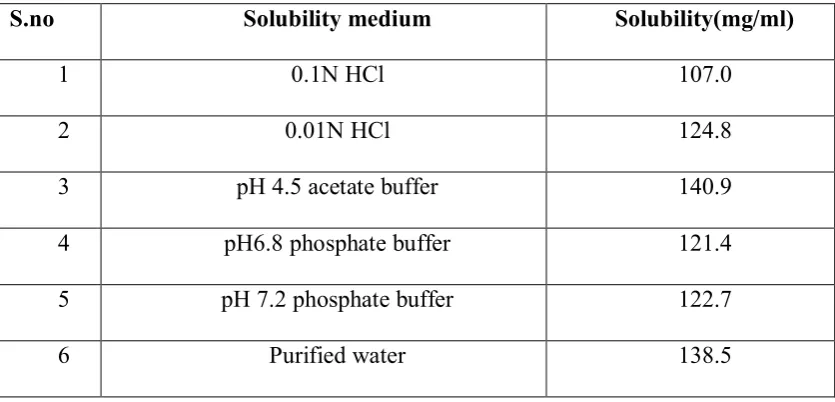
[image:65.595.96.514.519.720.2]Ropinirole HCl is soluble in water and the saturation solubility was conducted in various media such as
Table No: 8 Solubility in different Media
S.no Solubility medium Solubility(mg/ml)
1 0.1N HCl 107.0
2 0.01N HCl 124.8
3 pH 4.5 acetate buffer 140.9
4 pH6.8 phosphate buffer 121.4
5 pH 7.2 phosphate buffer 122.7
Department of Pharmceutics, Avpc Melting point
A glass capillary tube is normally used to contain the sample for a melting point determination. Therefore the tube must have one open end into which the sample can be loaded, and one sealed end so that the capillary will retain the solid sample. Use a spatula to gather the powder into a small pile. The height of solid in the capillary should be no more than 1-2 mm. The melting point of the sample can be determined till the sample gets charred.
Table No: 9 Preformulation parameters for Active pharmaceutical ingredient
Solubility Soluble in water and it is 133 mg/ml
Bulk density 0.27 ± 0.2 gm/ml
Tapped density 0.46±0.4 gm/ml
Compressibility index (%) 41.3%±0.5
Hausner Ratio 1.7±0.4
Melting point 248°C
Table No: 10 Flow properties For API+ Excipient mixed
1 Bulk density(g/ml) 0.4692±0.04
2 Tapped density(g/ml) 0.55±0.03
3 Carr’s index 14.6±0.52
4 Hausner ratio 1.17±0.03
Department of Pharmceutics, Avpc Drug Excipient Compatibility
Based on innovator composition and availability data following listed Excipients were selected. Drug and Excipients were passed through 40 mesh screen and mixed uniformly and loaded in glass vials as per the ratios given as follows40
Table No: 11 Ratios of Drug-Excipient
S.no Excipient Ratio (Drug –Excipient)
1 HPMC K100M 1:20
2 HPMC K15M 1:15
3 PVP K90 1:10
4 Ethyl cellulose 1:10
5 Magnesium stearate 1:5
6 Colloidal silicon dioxide 1:5
7 Stearic acid 1:5
8 Glyceryl stearate 1:5
9 PEG 6000 1:5
10 Citric acid 1:10
11 Triethylcitrate 1:2
12 Anhydrous Lactose 1:10
13 Opadry white 1:5
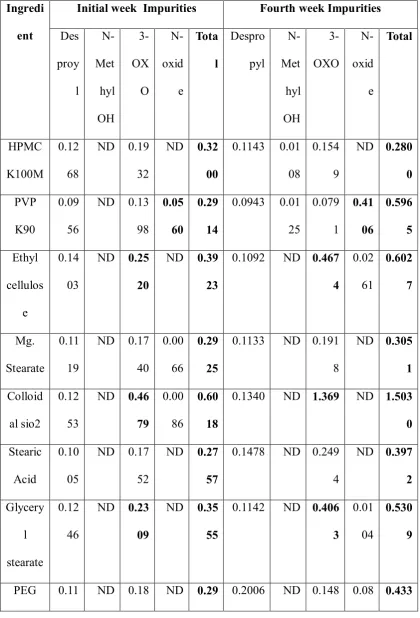
Department of Pharmceutics, Avpc Table No: 12 Impurities in Initial and Final week
Ingredi ent
Initial week Impurities Fourth week Impurities Des proy l N-Met hyl OH 3-OX O N-oxid e Tota l Despro pyl N-Met hyl OH 3-OXO N-oxid e Total HPMC K100M 0.12 68
ND 0.19 32
ND 0.32 00
0.1143 0.01 08
0.154 9
ND 0.280 0 PVP
K90
0.09 56
ND 0.13 98
0.05 60
0.29 14
0.0943 0.01 25 0.079 1 0.41 06 0.596 5 Ethyl cellulos e 0.14 03
ND 0.25 20
ND 0.39 23
0.1092 ND 0.467 4 0.02 61 0.602 7 Mg. Stearate 0.11 19
ND 0.17 40
0.00 66
0.29 25
0.1133 ND 0.191 8
ND 0.305 1 Colloid
al sio2
0.12 53
ND 0.46 79
0.00 86
0.60 18
0.1340 ND 1.369 ND 1.503 0 Stearic
Acid
0.10 05
ND 0.17 52
ND 0.27 57
0.1478 ND 0.249 4
ND 0.397 2 Glycery l stearate 0.12 46
ND 0.23 09
ND 0.35 55
0.1142 ND 0.406 3
0.01 04
0.530 9
Department of Pharmceutics, Avpc Finalized selection of Excipients
For the development of an extended release dosage form a polymer with slow gelling property like HPMCK 100M is required. Since ropinirole is absorbed through out GIT, the matrix must also possess the capability of controlling the drug release over 24hrs for which fast gelling polymers like HPMCK 15M was used for obtaining precise control over the initial phases of release of the drug. Carboxy methyl cellulose sodium provides a synergistic effect. Povidone, a release modifier was used to obtain completeness of release from the matrix. Colloidal silicon dioxide acts as glidant to improve the flow of blend. Magnesium stearate was used as lubricant
6000 30 06 36 7 46 9
Tri ethyl citrate
0.08 22
ND 0.14 15
ND 0.22 37
0.1403 ND 0.209 8
ND 0.350 1
Citric acid
0.07 49
ND 0.34 30
ND 0.41 79
0.0681 ND 14.02 03 0.04 32 14.13 16 An. Lactose 0.13 67
ND 0.20 97
ND 0.34 64
0.1263 ND 0.180 6
ND 0.306 9 Opadry
white
0.12 96
ND 0.18 95
ND 0.31 91
0.1250 ND 0.184 0 0.02 58 0.334 8 Opadry pink 0.13 15
ND 0.20 23
ND 0.33 38
0.1611 ND 0.331 1
Department of Pharmceutics, Avpc Table No: 13 Finalized Selection of Excipients
S.no Ingredient Pharmaceutical function
1 HPMC K100M Rate controlling polymer
2 HPMC K15M Rate controlling polymer
3 Sodium carboxy methyl cellulose
Rate controlling polymer
4 PVPK 90 Rate controlling polymer
5 Anhydrous Lactose Diluent
6 Colloidal Sio2 Anti-adherent
7 Mg.stearate Lubricant
Functional coating
8 Ethyl cellulose Coating agent
9 Opadry white Channel forming agent
10 Triethyl citrate Plasticizer
11 Dichloromethane Coating vehicle
12 Isopropyl alcohol Coating vehicle
Film coating
13 Opadry pink Coating agent
Department of Pharmceutics, Avpc
ANALYTICAL METHOD DEVELOPMENT
Innovator medium (pH 4 Citrate buffer)
Mix 5ml of 0.2M Citric acid and 85ml of 0.2M disodium citrate and dilute to 100ml with purified water. if required adjust pH to 4 with dil.NaOH
0.2M Citric acid
42.03gm of citric acid Monohydrate dissolved in 1000ml purified water 0.2M Disodium citrate dihydrate
58.82gm of disodium citrate dihydrate in 1000ml purified water Table No: 14 Requirements in Dissolution
Medium pH 4 Citrate buffer
Quantity 500ml
Apparatus USP Type 2(paddle)
RPM 100 rpm
Temperature 37±0.50c
DISSOLUTION BY HPLC41
Mobile phase: Buffer: Acetonitrile (70:30) Standard stock solution
Weigh accurately about 73 mg of Ropinirole HCl Reference/working standard to 200ml volumetric flask add 130 ml milliQ water sonicate and made up to the mark.
Standard Preparation
Department of Pharmceutics, Avpc Equipment - Waters type with UV detector
Column Temperature - 300c Flow Rate - 1.2ml/min Injection volume - 60µL System suitability
Calculation: Tailing not more than 243
Inject 60 µL Portion of dissolution medium of test preparation Qty of Ropinirole dissolved in nth time interval
× 200 ×100 ×5 500
×255 × 100 ×100
At -Peak Area of test preparation in nth time As –Peak Area of standard preparation
ws- Weight of Ropinirole HCl working standard taken in mg P -Potency of Ropinirole working standard
N –No. of tablets taken
L -Labelled amount of Ropinirole (2mg) PRODUCT DEVELOPMENT
Product development involves two stages; it involves Formulation and Process development.
Selection of process 44 Direct compression
Department of Pharmceutics, Avpc Wet granulation
Millingand mixing of drugs and excipients like HPMC,CMC sodium, Anhydrous lactose, prepare the povidone binder solution and is introduced in RMG granulator which contained blending material and granules is formed by impeller and chopper amperage adjustment and wet granules is formed. The formed granules are dried in fluidised bed dryer. The dried granule is placed in blender and colloidal silicon dioxide and magnesium stearate is added, then compress the tablet.
Dry granulation
Sift the material through 30 mesh and mixing of drug and excipients like HPMC, Sodium CMC, Anhydrous lactose, pass through roller compactor results in formation of ribbon shaped flakes then pass the flakes in vibratory granulator formation of granules. These granules passed through blender where colloidal silicon dioxide and magnesium stearate is added and compress the tablet.
From above issues we consider that dry granulation is preferred method and all the optimization of formula is done with dry granulation process
.
Department of Pharmceutics, Avpc Formulation development
Formulation development involves following stages of optimization of excipients.
Optimization of rate controlling polymers
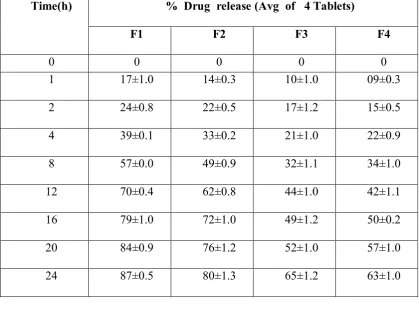
During this stage, optimization of polymers using Hydrophilic45 and Hydrophobic polymers was done. The percentage of drug release using Hydrophilic polymers is more compared to hydrophobic polymers and therefore finalised use of Hydrophilic polymers. In all these dissolution performed with H.P.L.C, and the average of 4 tablets is mentioned here.
Procedure
Ø Rinse API with Anhydrous Lactose part 1 and pass through 30 mesh screen, Sift together HPMC K100M, HPMC K15M46 Castor oil, Stearic acid in four different formulation and pass through 30 mesh screens.
Ø Sift the contents of Anhydrous Lactose part 2 with colloidal silicon dioxide and magnesium stearate of part 1 and pass through 30 mesh screen and to this PVP K90 is added.
Ø Blend the entire contents for 10 minutes and subject the material to roller compaction. The soft compacts were milled through 5mm screen with knives forward.
Ø Granules were sifted through 24 mesh, Blend the granules using colloidal silicon dioxide and Magnesium stearate of part 2.
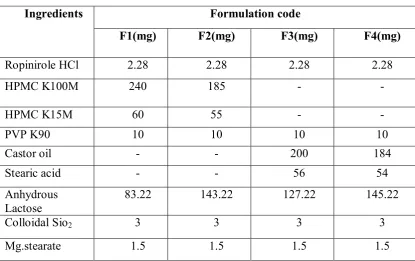
Department of Pharmceutics, Avpc Table No: 15 Optimization of Rate controlling polymers
Ingredients Formulation code
F1(mg) F2(mg) F3(mg) F4(mg)
Ropinirole HCl 2.28 2.28 2.28 2.28
HPMC K100M 240 185 - -
HPMC K15M 60 55 - -
PVP K90 10 10 10 10
Castor oil - - 200 184
Stearic acid - - 56 54
Anhydrous Lactose
83.22 143.22 127.22 145.22
Colloidal Sio2 3 3 3 3
Mg.stearate 1.5 1.5 1.5 1.5
Percentage of drug release
Department of Pharmceutics, Avpc
Table No: 16 Percentage drug release during optimization of polymers Time(h) % Drug release (Avg of 4 Tablets)
F1 F2 F3 F4
0 0 0 0 0
1 17±1.0 14±0.3 10±1.0 09±0.3
2 24±0.8 22±0.5 17±1.2 15±0.5
4 39±0.1 33±0.2 21±1.0 22±0.9
8 57±0.0 49±0.9 32±1.1 34±1.0
12 70±0.4 62±0.8 44±1.0 42±1.1
16 79±1.0 72±1.0 49±1.2 50±0.2
20 84±0.9 76±1.2 52±1.0 57±1.0
[image:76.595.129.485.479.726.2]24 87±0.5 80±1.3 65±1.2 63±1.0
Figure.6. Time v/s % Drug release (optimization of polymers) 0
20 40 60 80 100
0 4 8 12 16 20 24
%
D
ru
g
R
el
ea
se
Time(h)
Department of Pharmceutics, Avpc Optimization of PVP K90
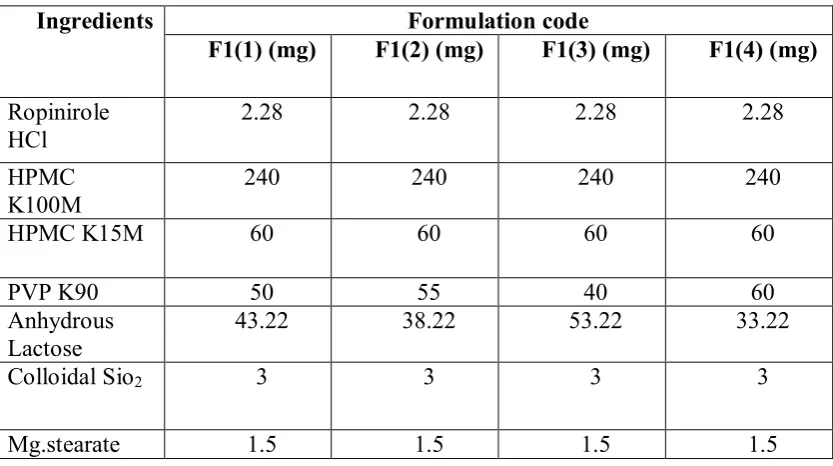
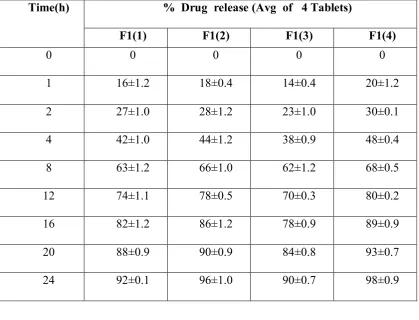
Release of the entrapped drug from a highly viscous and strong matrix is not easy. Once the matrix imbibes sufficient water, it increases in path length and blocks channeling due to which release tends to stop leading to an incomplete release. A release modifier which sufficiently modulates the rigidity of matrix and is necessary for obtaining completeness of release
Procedure
Ø Rinse API with Anhydrous Lactose part 1 and pass through 30 mesh screen, Sift together HPMC K100M and HPMC K15M and pass through 30 mesh screen.
Ø Sift the contents of Anhydrous Lactose part 2 with colloidal silicon dioxide and magnesium stearate of part 1 and pass through 30 mesh screen and to this PVP K90 is added.
Ø Blend the entire contents for 10 minutes and subject the material to roller compaction. The soft compacts were milled through 5mm screen with knives forward.
Ø Granules were sifted through 24 mesh, Blend the granules using colloidal silicon dioxide and Magnesium stearate of part 2.
Department of Pharmceutics, Avpc Table No: 17 Optimization of PVP K90
Ingredients Formulation code
F1(1) (mg) F1(2) (mg) F1(3) (mg) F1(4) (mg) Ropinirole
HCl 2.28 2.28 2.28 2.28
HPMC
K100M 240 240 240 240
HPMC K15M 60 60 60 60
PVP K90 50 55 40 60
Anhydrous Lactose
43.22 38.22 53.22 33.22
Colloidal Sio2 3 3 3 3
Mg.stearate 1.5 1.5 1.5 1.5
Percentage of drug release
Department of Pharmceutics, Avpc
Table No: 18 Percentage drug release during optimization of PVP K90
Time(h) % Drug release (Avg of 4 Tablets)
F1(1) F1(2) F1(3) F1(4)
0 0 0 0 0
1 16±1.2 18±0.4 14±0.4 20±1.2
2 27±1.0 28±1.2 23±1.0 30±0.1
4 42±1.0 44±1.2 38±0.9 48±0.4
8 63±1.2 66±1.0 62±1.2 68±0.5
12 74±1.1 78±0.5 70±0.3 80±0.2
16 82±1.2 86±1.2 78±0.9 89±0.9
20 88±0.9 90±0.9 84±0.8 93±0.7
[image:79.595.96.516.125.445.2]24 92±0.1 96±1.0 90±0.7 98±0.9
Figure.7. Time v/s % Drug release (Optimization of PVPK 90) 0
20 40 60 80 100
0 4 8 12 16 20 24
%
D
ru
g
R
el
ea
se
Time(h)
Department of Pharmceutics, Avpc Optimization of Sodium carboxy methylcellulose
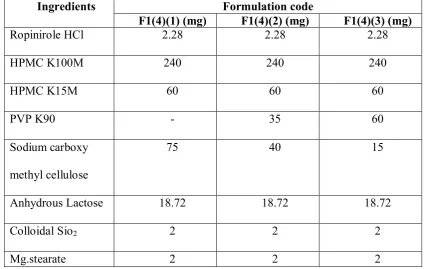
Carboxy methyl cellulose sodium was incorporated to exhibit synergistic effect along with Hypromellose in controlling the release throughout the matrix. For modulating matrix strength and rigidity, it was necessary to add a fast gelling agent like Sodium carboxy methyl cellulose.
Procedure
Ø Rinse API with Anhydrous Lactose part 1 and pass through 30 mesh screen, Sift together HPMC K100M and HPMC K15M and pass through 30 mesh screen.
Ø Sift the contents of Anhydrous Lactose part 2 with colloidal silicon dioxide and magnesium stearate of part 1 and pass through 30 mesh screen and to this PVP K90 and Sodium carboxy methyl cellulose is added.
Ø Blend the entire contents for 10 minutes and subject the material to roller compaction. The soft compacts were milled through 5mm screen with knives forward. Granules were sifted through 24 mesh, Blend the granules using colloidal silicon dioxide and Magnesium stearate of part 2.
Department of Pharmceutics, Avpc Table No: 19 Optimization of Sodium carboxy methyl cellulose
Ingredients Formulation code
F1(4)(1) (mg) F1(4)(2) (mg) F1(4)(3) (mg)
Ropinirole HCl 2.28 2.28 2.28
HPMC K100M 240 240 240
HPMC K15M 60 60 60
PVP K90 - 35 60
Sodium carboxy methyl cellulose
75 40 15
Anhydrous Lactose 18.72 18.72 18.72
Colloidal Sio2 2 2 2
Mg.stearate 2 2 2
Percentage of drug release
Department of Pharmceutics, Avpc
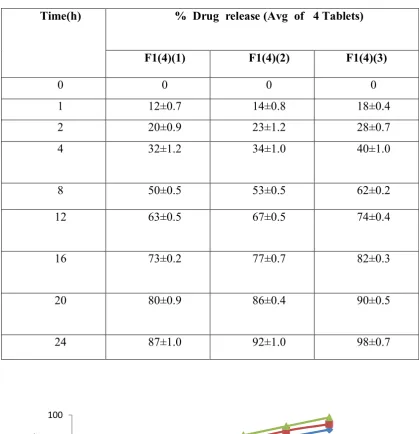
Table No: 20 Percentage drug release during optimization of Sodium carboxy methyl cellulose
Time(h) % Drug release (Avg of 4 Tablets)
F1(4)(1) F1(4)(2) F1(4)(3)
0 0 0 0
1 12±0.7 14±0.8 18±0.4
2 20±0.9 23±1.2 28±0.7
4 32±1.2 34±1.0 40±1.0
8 50±0.5 53±0.5 62±0.2
12 63±0.5 67±0.5 74±0.4
16 73±0.2 77±0.7 82±0.3
20 80±0.9 86±0.4 90±0.5
24 87±1.0 92±1.0 98±0.7
Figure.8. Time v/s % Drug release(Optimization of Sodium carboxy methyl cellulose)
0 20 40 60 80 100
0 4 8 12 16 20 24
%
D
ru
g
R
el
ea
se
Time(h)
Department of Pharmceutics, Avpc Optimization of functional coating formula
Since the drug is moisture sensitive, to protect the drug from atmosphere Hydrophobic polymer is used and to have drug release Opadry white is used which acts as channel forming agent and thereby drug release is seen.
Procedure
Ø Rinse API with Anhydrous Lactose part 1 and pass through 30 mesh screen, Sift together HPMC K100M and HPMC K15M and pass through 30 mesh screen.
Ø Sift the contents of Anhydrous Lactose part 2 with colloidal silicon dioxide and magnesium stearate of part 1 and pass through 30 mesh screen and to this PVP K90 and Sodium carboxy methyl cellulose is added.
Ø Blend the entire contents for 10 minutes and subject the material to roller compaction. The soft compacts were milled through 5mm screen with knives forward.
Ø Granules were sifted through 24 mesh, Blend the granules using colloidal silicon dioxide and Magnesium stearate of part 2.
Department of Pharmceutics, Avpc Table No: 21 Optimization of Functional Coating
Ingredients Formulation code
F1(4)(3)(1) mg
F1(4)(3)(2) mg
F1(4)(3)(3) mg
Ropinirole HCl 2.28 2.28 2.28
HPMC K100M 240 240 240
HPMC K15M 60 60 60
PVP K90 60 60 60
Sodium carboxy
methyl cellulose 15 15 15
Anhydrous Lactose 18.72 18.72 18.72
Colloidal Sio2 2 2 2
Mg.stearate 2 2 2
Total 400 400 400
Ethyl cellulose 10.78 8.62 4.31
Opadry white 10.78 12.93 17.25
Tri ethyl citrate 0.44 0.44 0.44
Isopropyl alcohol q.s q.s q.s
Dichloromethane q.s q.s q.s
Percentage of drug release
Department of Pharmceutics, Avpc
Table No: 22 Percentage drug release during optimization of Functional Coating
Time(h) % Drug release (Avg of 4 Tablets)
F1(4)(3)(1) F1(4)(3)(2) F1(4)(3)(3)
0 0 0 0
1 0 06±0.4 16±0.6
2 2±0.6 18±1.3 28±0.6
4 10±0.2 35±0.6 44±0.6
8 32±0.2 57±1.2 65±0.2
12 51±1.0 69±0.5 78±0.6
16 66±1.0 78±0.3 88±0.6
20 77±1.2 87±1.2 95±0.0
24 85±0.5 92±0.8 98±0.2
Figure.9. Time v/s % Drug release(Optimization of functional coating formula)
0 20 40 60 80 100
0 4 8 12 16 20 24
%
D
ru
g
R
el
ea
se
Time(h)
Department of Pharmceutics, Avpc Process optimization
During process Optimization the finalized formula is taken and