This is a repository copy of
Evaluation of web-sites that contain information relating to the
norovirus infection and the evaluation of generic and specific instruments deployed to
evaluate web-sites
.
White Rose Research Online URL for this paper:
http://eprints.whiterose.ac.uk/126732/
Version: Published Version
Thesis:
Ahmed, W. (Filed: 2013) Evaluation of web-sites that contain information relating to the
norovirus infection and the evaluation of generic and specific instruments deployed to
evaluate web-sites. Masters thesis, University of Sheffield.
© 2013 The Author. For reuse permissions, please contact the author.
[email protected] https://eprints.whiterose.ac.uk/
Reuse
Unless indicated otherwise, fulltext items are protected by copyright with all rights reserved. The copyright exception in section 29 of the Copyright, Designs and Patents Act 1988 allows the making of a single copy solely for the purpose of non-commercial research or private study within the limits of fair dealing. The publisher or other rights-holder may allow further reproduction and re-use of this version - refer to the White Rose Research Online record for this item. Where records identify the publisher as the copyright holder, users can verify any specific terms of use on the publisher’s website.
Takedown
If you consider content in White Rose Research Online to be in breach of UK law, please notify us by
i
Evaluation of web-sites that contain information relating to the norovirus infection and the evaluation of generic and specific instruments deployed to evaluate web-sites
A study submitted in partial fulfilment of the requirements for the
degree of Master of Science in Information Systems
at
THE UNIVERSITY OF SHEFFIELD
by
WASIM AHMED
Registration Number: 120196753
1
Abstract
Background: The internet has experienced an increase of healthcare websites and there has been a rise in searchers for healthcare information. Norovirus is a very contagious virus
which requires patients to stay at home and not visit their G.P. This raises the question of
whether the information on websites is reliable for those who are unable to see a G.P.
Many studies have assessed website quality for a variety of medical conditions. Yet, to date,
no study has assessed the information quality and readability of norovirus websites.
Aims: The study aimed to locate the most commonly searched for norovirus websites on the World Wide Web and evaluate the information quality and readability of these
websites.
Methods: T N
I T ng two generic
evaluation tools (HON and Discern), readability tests (Flesch Reading Ease and Flesch
Kincaid Grade Level), and a specific Norovirus Tool based on the perceived needs of
patients suffering from norovirus. These tools were subject to evaluation themselves in
regards to their feasibility, reliability, and validity.
Results: The results of this study differed to others as it was found the information quality of websites on norovirus was of a good standard. Only five websites achieved less then
50% with Discern, two with the HON tool, and two with the Norovirus tool. Yet, in common
with other studies this study found that the readability of the websites was poor. No
website achieved a score of 70 or higher with the reading ease, and no website scored 7 or
lower with the reading grade. This study found the HON code tool took the longest time to
use suggesting it may be less feasible, although the difference to other tools was minimal,
but still statistically significant. The tools did not appear to correlate well which suggests
they may measure different quality features of a website. The use of different tools may
therefore be recommended.
Conclusion: The World Wide Web is a good resource for healthcare information on norovirus. Yet, in regards to readability the reading tests revealed the reading levels are
too high for the generic public and attempts should be made to lower the reading levels.
Finally, due to the changing nature of the internet website evaluations may not be up to
date soon after they are published. Further research is recommended with multiple website
2
Acknowledgements
I would like to thank:
Professor Peter Bath for his continued support throughout the dissertation as my supervisor and for providing me with the initial research topic.
All of the Information School lecturers, staff, and students especially the course coordinator Dr Miguel Baptista Nunes who provided much support during my first weeks on the course.
Shiraz Ahmed, for his continued proofreading and support throughout the dissertation and course.
The rest of my family who provided motivation throughout the course and dissertation; Saima Ahmed for her support and encouragement throughout the course, Iftikhar Ahmed and Nighat Ahmed who also supported me throughout the dissertation and course.
3
Contents
ABSTRACT ... 1
ACKNOWLEDGEMENTS ... 2
CONTENTS ... 3
CHAPTER 1: BACKGROUND ... 5
1.1 Introduction ... 5
1.2: The World Wide Web ... 5
1.3 Norovirus ... 6
1.3.1 Importance of information relating to Norovirus on the World Wide Web ... 7
1.3.2 Norovirus Information needs for patients ... 8
1.4 Research Aims and Objectives ... 9
1.5 Structure of Dissertation ... 10
1.6 Summary ... 10
CHAPTER 2: LITERATURE REVIEW ... 11
2.1 Introduction ... 11
2.2 Search Strategy ... 11
2.2.1 Scope of literature review ... 11
2.3 Health Information on the Web ... 11
2.3.1 Advantages and disadvantages of using the Web for health information ... 11
2.3.2 Current methods of assessing webpages containing health information ... 13
2.3.3 Existing studies assessing healthcare information on the Web ... 14
2.3.4 Studies that employed generic tools ... 15
2.3.5 Studies that employed specific tools ... 16
2.3.6 Studies assessing Norovirus healthcare information on the web ... 17
2.3.7 Studies employing readability tests ... 18
4.Summary ... 19
CHAPTER 3: METHODOLOGY ... 20
3.1 Introduction ... 20
3.2 Research approach ... 20
3.3 Phase one selection of norovirus websites ... 20
3.4 Phase two - selection of generic evaluation tools ... 22
3.4.1 Phase two - justification of selected generic tools ... 22
3.5 Phase three - justification for a new norovirus tool ... 23
3.5.1 Phase three development of a new norovirus tool ... 23
3.6 Phase four - selection of readability test ... 24
3.7 Application of tools ... 25
3.8Summary ... 26
CHAPTER 4: RESULTS ... 27
4.1 Introduction ... 27
4.2.1 Score for Discern Tool ... 27
4.2.3 Score for Norovirus Tool ... 29
4.3 Score for readability tests ... 31
4.4 Ranking of each website against each tool ... 33
4
4.6 Reliability of evaluation tools ... 40
4.7 Feasibility of evaluation tools... 41
4.8 Validity of evaluation tools... 44
4.9 Summary ... 52
CHAPTER 5: DISCUSSION ... 53
5.1 Introduction ... 53
5.2 Evaluation of Information about Norovirus found on the Web ... 53
5.3 Validity, reliability and feasibility of tools used to assess information quality ... 54
5.3.1 Feasibility ... 54
5.2.2 Validity ... 55
5.3.3 Reliability ... 56
5.4 Summary ... 57
CHAPTER 6: CONCLUSIONS AND RECOMMENDATIONS ... 58
6.1 Introduction ... 58
6.2 Key findings ... 58
6.3 Achievement of aims and objectives ... 58
6.4 Limitations to the study ... 59
6.5 Recommendations for further research ... 60
6.6 Summary ... 60
REFERENCES ... 61
APPENDICES ... 65
Appendix 1 Discern Handbook ... 65
Appendix 2 Modified HON code ... 75
Appendix 3 Norovirus Tool ... 78
Appendix 4 Website name and corresponding URLs ... 82
Appendix 5 Raw Scores of the three tools ... 83
Appendix 6 The time taken for each tool ... 85
Appendix 7 Rotation of Tools and Scoring Method ... 87
Appendix 8 Ethics Approval ... 88
LIST OF FIGURES AND TABLES ... 89
GLOSSARY/KEY TERMS ... 91
Appendix 9 Access to Dissertation ... 92
5
Chapter 1: Background
1.1 Introduction
Norovirus is a highly contagious virus which can cause diarrhoea, vomiting, nausea, and
fever (NHS East Riding of Yorkshire 2009). The virus is a global health problem which affects
people in both developed and developing countries. Norovirus starts with a sudden onset
of projectile vomiting and is usually accompanied by diarrhoea and there is no treatment
for the virus (NHS East Riding of Yorkshire 2009). Schnirring (2013) from CIDRAP writes that
there are 21 million infections each year and as many as 800 fatal incidents. Norovirus has
the potential to be fatal as it can cause complications to the elderly and the very young, and
to patients with weakened immune systems. Norovirus is also the leading cause of
gastroenteritis in children (Schnirring 2013). Since 1999 cases and outbreaks of norovirus
have increased year on year, world wide, during the winter months. This dissertation will
evaluate the quality of websites that provide healthcare information on norovirus. The next
two sections will outline the importance of the World Wide Web; further sections will
outline the norovirus infection in more detail and the importance of high quality
information on norovirus.
1.2: The World Wide Web
The use of the internet by those living in Britain has increased and the use of the World
Wide Web to locate healthcare information has also increased. The Oxford Internet Survey
(OIS) will be used to outline this increase; although this dissertation will also outline other
Internet Surveys. OIS is a report created by the social science division at the University of
Oxford. The report was launched in 2003 by the Oxford Internet Institute and it contains
around 2057 users employing a multi national probability sample. This means it is able to
cover Britain as a whole.
There are now more people using portable devices such as smart phones. In 2003 only 85%
of British people had a phone with 11% having internet access via the device (Dutton &
Blank 2011). In 2009 97% of British people owned a phone with 24% having internet access
via the device (Dutton & Blank 2011). Yet, by 2011 the OIS report suggests that 49% of
users reported using a mobile device to access the internet.
The OIS report suggested that users now have many devices which consist of laptops,
6
of British people who used the internet had an electronic reader (Dutton & Blank 2011).
The OIS report purported that 59% of British people have access to the internet via these
portable devices; not taking into account traditional desktop computers. The OIS report
outlined the rise of multiple computers in households which stands at 42% in 2011;
allowing different family members to own their own computer desktop. 18% reported only
having one computer, and 24% reported having two computer systems, compare this to
2005 where only 15% of households had more than one computer (Dutton & Blank 2011).
In regards to health information on the internet Dutton & Blank (2011) surveyed the
seeking behavior of internet users. The report found that searches for health information
have risen over the last six years. In 2005 health information was sought at 37% whereas in
2011 it had risen to 71%. In regards to life style and internet usage it was reported by
Dutton & Blank 2011 that 57% of students accessed the internet for health information,
74% of employed people accessed the internet for health information, and 68% of
unemployed people accessed the internet for health information. Dutton & Blank (2011) in
the OIS report also reported that 48% of next generation users (advance users) reported
they found the health information online helpful, 37% of first generation users found health
information useful and 15% of ex-users found health information useful.
1.3 Norovirus
The Health Protection Agency (2013) created a patient information leaflet (PIL) which
outlines norovirus for health and social care staff; this will be employed to briefly describe
norovirus. Norovirus is also known as the small round structured virus (SRSV) and the
Norawalk-like virus (NLV). Regardless of its various names the virus is known to cause
gastro-enteritis. The Health Protection Agency in its PIL (2012) emphasises that even
just winter. The symptoms of the virus
Health Protection Agency PIL 2012). The nature of vomiting is so powerful it is
often projectile. The virus is also known to cause diarrhoea amongst some sufferers. The
Health Protection Agency (2012), states that the symptoms of the virus can last from 24 to
A
of days (Health Protection Agency PIL 2012). It is reported that norovirus is not considered
dangerous in the long term even amongst the elderly and there are no lasting effects of the
virus (Health Protection Agency PIL 2012). There is currently no treatment for norovirus;
7
also mentioned that anti-biotic treatment will have no effect on the virus and that currently
there is no over the counter treatment for norovirus, as is the case with most viruses.
Furthermore, it is stressed that the infected person rest for up to 48 hours and avoid school
or work for the following days. The PIL on Infection Prevention and Control from the
Humber NHS Foundation Trust (2011) recommends drinking plenty of water as a source of
treatment as there is an increased risk of dehydration. As with any other virus it is highly
recommended for a patient to isolate themselves in order to stop the spreading of the
virus, and by practicing good hygiene. That is, good hygiene in the sense of washing your
hands regularly and using separate towels etc. In both of the patient information leaflets it
was highly stressed that no hospital or doctor treatment is required; patients are told to
stay at home.
1.3.1 Importance of information relating to Norovirus on the World Wide Web
The United Kingdom over the last few years has experienced an increase in the norovirus
infection. Year after year hospitals have been overrun with the virus (Health Protection
Agency 2013). The 2012/2013 epidemic, at the time of writing, has been the worst
epidemic of norovirus in the UK as the BBC news (2013) reported 1.1 million cases and the
Health Protection Agency reported an increase of 72% from 2012 (Health Protection
Agency 2013) . This is due to the fact that norovirus can be spread very fast, closed
environments such as hospitals have experienced outbreaks of norovirus and it was able to
“ C
BBC N W
(BBC News 2013) have warned the public of such issues.
If patients are asked to remain at home and away from work, schools, universities, and
colleges etc. Then they will be likely to obtain information from elsewhere. If a patient
thought they may have norovirus but they were unable to visit a local G.P they would look
elsewhere for information about norovirus. One of the increasing resources of healthcare
information is the internet, in the form of webpages (Dutton & Blank 2011; Forkner-Dunn
2003). Furthermore, due to the rise in modern technology the easiest way to search for
information is via the World Wide Web. Searching the Web may not even need access to a
computer due to the rise of smart phones and tablets. In 2010 BBC NEWS Technology
“
smartphones was at 54 million. This is applied to developed countries although developing
8
different platforms to access information regarding norovirus. Yet, it is unknown whether
this information will meet the needs of the user or whether a website will fulfill the needs
of someone suffering from norovirus. Many studies looking at the Web as a potential
resource for healthcare information have highlighted the need for high quality information
on websites (Eysenbach, Powell, Kuss & Sa 2002).
1.3.2 Norovirus Information needs for patients
The previous sections outlined how patients are now using the Web to find information to
better their health. In most scenarios this information may be read before or after visiting a
qualified doctor. In the case of norovirus patients are told to remain at home and in
isolation to avoid spreading the infection. Therefore, it is important that patients gain the
same information they would from a qualified doctor. That is, information on the causes of
norovirus should be explained on any healthcare website; as a patient may be suffering
from a different condition which appears as norovirus. The symptoms would have to be
sufficient and detailed. The same can be said for the causes, treatment, prevention, and
any consequences of having norovirus. Patients would most likely want to know how they
can treat the virus as its symptoms can be discomforting. In addition if multiple people live
in the same house hold patients would want to know how to stop the spread of the virus to
others. After a patient has norovirus or has been through the symptoms they may also
want information on how to prevent norovirus. Finally, and probably most important the
consequences of spreading norovirus should be sufficiently explained due to the winter
outbreaks outlined in the previous section(BBC News 2013). In summary any healthcare
website aiming to provide a breakdown of norovirus for patients should aim to meet
information that would be provided by a doctor. The websites should not only contain this
information but they must be accessible to a wide range of people from educated to
non-educated patients. That is, patients may in general have reading difficulties or they may
9 1.4 Research Aims and Objectives
In reference to the above information the aim of this study is to assess the information
quality of websites providing healthcare information on norovirus.
In doing so, there will be several objectives of the dissertation listed as follows:
To locate the most commonly searched for norovirus websites on the internet and
capture them in an offline environment to be evaluated.
To develop an evaluation tool specific to norovirus based on the perceived needs of
the patients such as its symptoms, causes, treatment, prevention, and the
consequences of spreading norovirus. The tool will also aim to see if the
information provided is similar or sufficient to that of information provided by a
qualified doctor
To select a suitable readability test in order to find out whether websites which
contain norovirus information are suitable to read for the general public.
To select suitable generic tools which are used to evaluate healthcare websites.
To assesse norovirus websites by using generic tools, a readability test and a
specific norovirus tool, mentioned above.
To evaluate the evaluation tools in regards to their validity, reliability, and their
feasibility in determining the information quality of websites that contain
10 1.5 Structure of Dissertation
The dissertation is comprised of seven sections:
Chapter 2 will review the literature regarding norovirus evaluations on the World Wide
Web and it will provide a review on generic, specific, and readability tools to assess
websites.
Chapter 3 will describe the methodology followed in the study.
Chapter 4 will present and analyse the results of the website evaluations.
Chapter 5 will discuss the overall results of the study.
Chapter 6 will draw conclusions from the results and relate back to the original aims and
objectives of the study. This section will also outline the limitations of the current study and
provide recommendations for further studies.
1.6 Summary
This introduction and context section has looked at the statistics on how patients are
accessing the internet to find healthcare information. It was found that year on year
patients are looking to the internet to locate healthcare information which has a positive
effect on their health (Dutton & Blank 2011). The norovirus infection was outlined and it
was found that patients are being told to remain at home and not visit their doctor If
patients are being told to remain at home they will seek information from elsewhere. If the
web is being accessed via different platforms to access health information; websites should
be assessed for their quality, whether they meet the needs of patients, and for their
11
Chapter 2: Literature Review
2.1 Introduction
This section will compose of several sections. The first half of the literature review will look
at the advantages and disadvantages of healthcare information on the World Wide Web
and the tools that are used to evaluate web pages in regards to existing studies. The second
half of the literature review will look at generic, specific and readability tools used to
evaluate webpages and their advantages and disadvantages.
2.2 Search Strategy
2.2.1 Scope of literature review
The sources for the literature composed of searches in in various medical and health
bibliographic databases, alongside the Universit Star Plus library catalogue, Google
Scholar, Google, and citation analysis of relevant publications were also employed to find
literature. The following bibliographic databases were searched: Medline, CINAHL, PsycInfo,
Web of Knowledge, British Medical Journal, Medical Subject Headings, Scopus, BMJ Health
informatics series. The other resources employed included: Google Scholar, The University
“ “ G . Information on
readability, generic tools, specific tools, and previous studies were identified via such
sources. A large part of the literature review came from citation analysis, that is, finding a
reference in a journal or dissertation that is relevant to this dissertation.
2.3 Health Information on the Web
2.3.1 Advantages and disadvantages of using the Web for health information
There is a vast number of health information webpages available via the World Wide Web.
In 2012 it was reported that that up to 80% of the UK population used the internet and 67%
used a computer every day (Office for National Statistics 2012). The problem with some of
these websites is that they may be unregulated as anyone can create a webpage and
provide advice with no medical qualifications. This could possibly be dangerous as wrong
information provided on health could lead to serious consequences. Compare this to
written information, such as a patient information leaflet, which is usually proofread and
has been through various quality control mechanisms to ensure the information is correct.
12
webpages. These concerns were raised by Richards, Colman & Hollingsworth as far back as
1998. They wrote that as the internet was unregulated users could set their own websites
and they can even take on a quasi-
answering other patients e-mail medical queries without recourse to professional medical
‘ C H “
over 15 years ago and as the internet has remained unregulated such concerns have
appeared across journals relating to healthcare and the World Wide Web. This section will
firstly outline the advantages of accessing the web for health information and outline some
of the drawbacks from publications after the Richards, Colman & Hollingsworth 1998 paper.
In Chapter 1 Introduction it was mentioned that the web was being used by people to
improve their health. Therefore there are some clear advantages of using the web to locate
health information. In the Dutton & Blank (2011) study it was explained how patients were
now using multiple devices to access healthcare information. This makes healthcare
information easy to access and in some cases may act as a substitute to visiting a qualified
doctor. Yet, patients are not thought to replace information from the web from a qualified
doctor; but rather they are likely to supplement the information with advice from a
qualified doctor (McMullan 2006). McMullan (2006) writes that one of the main advantages
of the internet is that it is available widely and the example of work, the home and libraries
is given. Furthermore, this information is available 24 hours a day at home and work and it
can be accessed anonymously (Williams, Huntington, Nicholas 2003). The use of the web
for healthcare information can also help patients understand their condition more and
increase their level of self care (McMullan 2006). It can also be said that the use of the web
for healthcare information will also reduce redundant visits to the doctor and decrease the
burden on the NHS (Wanless 2002).
Yet there are also drawbacks of using the World Wide Web for healthcare information as
outlined previously. This is because anyone can upload information on the internet with no
medical qualification and it will come down to the end user to decide whether a website
will hold reliable information (Rieh 2002). There are papers that also suggest that there is a
sense of anonymity of online healthcare information which may lead to incorrect or
insensitive comments especially on healthcare forums (Bartlett & Coulson 2010, and Barak
Boniel-Nissim & Suler 2008). These papers also suggest that a lack of verbal
13
misunderstood. This may mean that the information on the internet may be overwhelming
and confusing for some (Eysenbach 2003). Eysenbach (2003) looking at cancer on the World
Wide Web reports that some patients reported that the internet confused them on what
the right course of treatment should be. In addition there were a few oncologists that
suggested that
Eysenbach 2003p. 366).
2.3.2 Current methods of assessing webpages containing health information
It can be said that even though the World Wide Web has increased patients quality of
health (Dutton & Blank 2011) there are still some drawbacks in the sense of low quality
websites which misinform patients (Bartlett & Coulson 2010, and Barak Boniel-Nissim &
Suler 2008). In order to remedy this there have been attempts to create evaluation tools.
Mentioned by Surman (2010) in 1999 there were around 29 evaluation tools (Kim, et al
1999) and in 2004 this had sharply risen to 273 tools; although many of these tools were
not complete and were inaccessible on websites (Bernstam et al. 2005). In order to regulate
websites in the last 15 years there has been an attempt to evaluate websites by using
evaluation tools. The British Medical Journal published a study which conducted a
systematic review of instruments used to rate the quality of health information online. The
journal is titled E
(Gagliardi & Jadad 2002).
This systematic review updates research from a previous review from 1998 (Jadad &
Gagliardi 1998). Gagliardi and Jadad (2002) write that during the past five years 98
instruments have been used to evaluate the quality of websites online. Yet, many
instruments that were identified in 1998 were no longer available. 51 new instruments
were identified in the new literature review. Gagliardi and Jadad (2002) identify initiatives
to organize and identify valid health information online from private organisations to
governments. Gagliardi and Jadad (2002) list the following generic tools that are used by
healthcare websites to validate the quality of their webpages: the information quality tool,
HON code of conduct, E-health Code of Ethics, Discern, E-Health Seal, Health Website
Accreditation Programme, Truste and the Council of Better Business Bureaus. Although
U‘L G
search the for-mentioned instruments exist today either as adapted or funded by a
different organisation. In searching past dissertations and relevant literature various
14
instance, made use of the HON and Discern tools. The literature HON
“PAT D J E T H“WG I
previous studies two of such generic evaluation tools were selected and then applied to
each website for example: Bouchier, (2001); Harland, (2004); Hsu, (2006); Liu, (2012).
The tools mentioned above measure the quality of websites using different methods.
Wilson (2002) categorizes five methods of assessing website quality used by evaluation
tools. These are: the codes of conduct, quality labels, user guidance tools, filtering tools and
accreditation labels. In order to qualify for accreditation or to use a filtering tool the
researcher would require extensive knowledge on the subject area, an oncologist for
assessing breast cancer, for example. Whereas the codes of conduct as employed by the
HON code can be placed on a website and it is possible to become HON certified. That is, by
stating the webpage is certified by the HON code and that it abides by the HON code
principles (Health on the Net Foundation, 2013). The Discern tool on the other hand is in
the form of a checklist allowing patients to evaluate the quality and reliability of the
website (Wilson, 2002).
2.3.3 Existing studies assessing healthcare information on the Web
Bouchier, (2001); Harland, (2004); Surman, (2010); Hsu, (2006); and Liu, (2012); to name a
few, have produced dissertations assessing healthcare information on the internet. Three of
these dissertations have been published as journal articles: Bouchier & Bath (2003);
Harland & Bath (2007); Surman & Bath (2013).
Surman (2010) investigated the quality and readability for those who have suffered a stroke
and their speech and language difficulties. In this study 51 websites were selected to be
evaluated by using two generic evaluation tools; the Discern tool and the HON code. The
time taken to evaluate each website was recorded. This provided useful as it allowed the
researched to evaluate the feasibility of the tools. The order of the tools used was also
rotated to avoid any researcher bias. Furthermore, as those who suffer from stroke will
likely to have reading difficulties the websites were tested for their readability. This was
achieved by using the Flesch Reading Ease and Flesch-Kincaid Grade Level readability tests.
Surman (2010) also created a specific evaluation tool based on reports from the needs of
patients suffering from speech and language difficulties following a stroke. The study found
that the information quality of the websites varied considerably as 59% achieved a score of
15
found to be poor with only 6% of websites scoring below the recommended grade of 7. It
was also found that the stroke tool was less feasible compared to the generic tools.
Harland (2004) looked at Multiple Sclerosis. The aims and methodology were fairly similar
to the studies above. Three generic tools: the HON code, Hi-Quality Guidelines, and the
Information Quality Tool (IQT) were selected. A specific tool for Multiple Sclerosis was also
developed. 17 websites were selected from varying search engines. In line with previous
I C A a
coefficient of internal consistency, the benchmark was set between 0.7 and 0.8. The IQ tool
had 0.842, Hi-Quality Guidelines 0.746, HON Code 0.537, and the specific Multiple Sclerosis
tool achieved a score of 0.930.
Hsu (2006) looked at breast cancer. The aims and methodology were similar to previous
studies. The HON code, Discern, and the Information Quality tools were selected. A specific
breast cancer tool was also developed. The results of this study are different to that of
H I C
Alpha the HON code achieved 0.817, IQ Tool 0.766, Discern 0.816 and the specific breast
cancer tool achieved 0.876.
Ademiluyi (2003) looked at smoking cessation and the paper was published in a peer
reviewed journal. The aims were to assess the reliability of three generic evaluation tools,
the IQT tool, QS (quality scale), and the Discern tool. A total of 89 unique websites were
evaluated from an initial sample of 370, the IQT tool is based on 21 questions, the QS tool is
based on seven questions, and the Discern tool is based on 16 questions. Ademiluyi (2003)
IQT C A , the QS was
0.413, and discern was 0.759. Overall, Ademiluyi (2003) found that each tool had correlated
significantly with each other with the exception of the IQT total score and the Discern
overall quality rating.
2.3.4 Studies that employed generic tools
The use of generic evaluation tools is widespread. The HI Quality tool has been used for
multiple sclerosis (Harland and Bath, 2007). The Jones evaluation tool, the eAccess health,
and the Health Summit Working Group tool have been used to evaluate the Alzheim
disease (Bouchier and Bath, 2003). The use of HON is extensive as a generic evaluation and
it was outlined as one of the generic tools to be used as back as 2002 (Gagliardi and Jadad
16
2010), breast cancer (Hsu, 2006), A disease (Bouchier and Bath, 2003), and
Multiple Sclerosis (Harland and Bath, 2007). Selections of these studies were outlined in the
previous section, 2.3.3. The use of Discern is extensive and it was outlined as one of the
generic tools to be used as back as 2002 (Gagliardi and Jadad 2002) and is still used today.
Discern has been used on conditions such as stroke (Surman, 2010), breast cancer (Hsu,
2006). The Information Quality Tool (IQT) has been also been used on conditions such as
stroke (Hsu, 2006, Harland and Bath 2007). Selections of these studies were outlined in the
previous section, 2.3.3.
The advantages of generic tools are that they are in most cases (Surman 2010; Harland
2004; Hsu 2006; Liu 2012) more feasible then specific tools in that they are quicker to
evaluate websites. Furthermore, generic tools allow organisations and healthcare websites
to state they meet the HON principles, or the Discern guidelines, for instance, as mentioned
by Gagliardi and Jadad (2002).There are some disadvantages of using generic tools. Surman
(2010) notes that even if the quality of the website measured by a generic tool rates is as
high the website may still not contain information that patients are seeking. Furthermore,
websites that do contain information that patients are seeking may be ranked as low
quality websites. Bouchier and Bath (2003) and Harland and Bath (2007) found similar
problems in using generic tools as it was also found that the generic tools do not measure
how well the website reflect the information needs of patients.
2.3.5 Studies that employed specific tools
The use of generic tools is usually supplemented with specific evaluation tools. This section
will briefly outline how two previous studies created a specific tool for a health condition.
Surman (2010) conducted a literature review into the information needs of parents, carers
and family of those suffering from speech and language difficulties after a stroke. The
information was then classified into two sections. The first section composing of 23
questions based on information needs on stroke and the second section based on speech
and language difficulties with 7 questions. There were 30 questions in total. It was found
that the stroke tool was less feasible and took longer to use compared to the generic
evaluation tools Discern and HON. “
17
and potentially not cover all needs, according to the subjects covered by the
Harland (2004) based the multiple sclerosis tool on the self reported information needs of
those suffering from multiple sclerosis. This was achieved by exploring previous studies,
and tools looking at multiple sclerosis. The tool contained 48 questions and it was split into
four sections. The first three sections questioned whether a piece of information was
present in the website with yes or no answers. The final sections were more objective with
Harland (2004) also found, as Surman (2010) above
did, that the specific tool was not feasible in the sense that it contained far too many
questions. It was also suggested by Harland (2004) that the questions asked by the tool may
have overlapped with the generic evaluation tools and it could have been reduced to
include only the key components. Although, Harland suggests the tool is useful if used
carefully for end user use, but may not be suitable to organisations or those working with
people who suffer from multiple sclerosis.
Potential disadvantages of specific tools, therefore, are that they can be too broad or they
may cover too many questions which may overlap with generic tools. Yet, the inclusion of a
specific tool is important as it allows a comparison between generic and specific tools.
Furthermore, as Harland (2004) mentions the inclusion of a specific tool may also allow end
users to evaluate webpages themselves. Moreover, specific tools measure the extent to
which a website reflects the information needs of patients; note that this was a
disadvantage of generic tools noted in section 2.3.4.
2.3.6 Studies assessing Norovirus healthcare information on the web
Searches were conducted on bibliographic databases, mentioned earlier, N
N N N
Yet, these searches, at the time of writing, did not yield any current studies looking at
norovirus health information quality on the internet. This affected the literature review as
other medical conditions were discussed in place of studies assessing norovirus on the
internet. Secondly, as no studies have been published on the patients information needs for
norovirus any specific tool that will be developed will suffer as the tool will be unable to
state the needs of the patient fully. It can be deduced from the above sections on generic
and specific tools that it is important to include a specific tool as generic tools may measure
18
specific tool on norovirus will focus on the perceived needs of a patient who is suffering
from norovirus. The researcher developing the tool, having suffered from norovirus, and
having the virus spread within the family both to young children and the elderly may be
able to record the information needs of a patient with a specific tool. Degerliyurt,
Gunsolley, and Laskin, (2010) gave 212 patients, aging 18 to 50, visiting an oral surgery a
questionnaire about how much information they would like about the visit. The study
found that there was a considerable difference in what information patients would want.
Therefore, any specific tool on norovirus would have to mimic a range of possible
information a qualified doctor would give that is: symptoms, causes, treatment, prevention,
consequences, and any other information that would be specific to norovirus.
2.3.7 Studies employing readability tests
There are certain studies which have evaluated the readability of a website to see if it is
accessible to patients with different reading abilities. The tool used most to conduct this
evaluation is the Flesch tool. This has been used to evaluate breast cancer health
information (Surman & Bath 2013), genetic information (Shedlodsky-Shoemaker et al
P H F
2010), social phobia (Khazaal et al 2008) and pediatric neuro-oncology (Hargrave et al.,
2006). This is mentioned in Surman (2010) who also used the Flesch tool in regards to
breast cancer the dissertation was subsequently published as a journal (Surman & Bath,
2013). The Flesch tool composes of a 'reading ease' score and a 'grade level value and it is
said to be fairly easy to use (Aleligay et al., 2008). Yet, Aleligay et al (2008) write that as the
Flesch tool may return lower scores compared to other reading tests it should be used with
some care. The SMOG reading tool is another reading tool which can be used to evaluate
healthcare websites and has been used to evaluate healthcare websites in the past
(Aleligay et al., 2008; Shedlodsky-Shoemaker et al., 2009). Aleligay et al (2008) suggests
that Fry is also a good readability tool the third most popular, yet the Flesch tool is found to
be more widely used than that of SMOG or Fry. Research (Hargrave et al., 2006; Khazaal et
al., 2008; Hulley et al., 2010; Fitzsimmons, 2010) has suggested that the majority of
healthcare websites, as mentioned by Surman (2010), are not at the reading level
recommended for the general public. The reading level of websites that contain
information on norovirus is very important as patients are asked to remain at home and in
19
from other conditions, such as speech and language difficulties, may not be able to read
and understand the information webpages provide. This may also be the case for younger
sufferers of norovirus who have access to the internet as their reading ability may be below
the required standard.
4.Summary
The literature review has further outlined the importance of norovirus healthcare
information on the internet. A review of the literature has identified current tools which
were listed above. There are many generic tools to choose from and the methodology in
the next section will outline which tools will be selected out of the above studies conducted
previously. In addition the reading ability of those seeking healthcare information was also
outlined and a reading tool will also be selected in the methodology section. Finally, the
literature review outlined some of the issues concerning the development of a specific
norovirus tool, and the general needs of patients seeking healthcare information. These
20
Chapter 3: Methodology
3.1 Introduction
The literature review in Chapter 2 has outlined current research into health information on
the internet and has outlined the importance of evaluating the quality of healthcare
websites. Several generic tools were outlined from a literature review and previous studies
alongside more disease specific tools. It was found that the generic tools supplemented
with a specific tool were important as the generic tools may not look at the content of the
websites but only the quality, whereas the specific tools would focus more on the content.
There were also issues concerning the importance of the reading level of websites and how
this may affect sufferers of norovirus. The methodology employed by Bouchier (2001)
Harland (2004) and Surman (2010) will be used in this study; with some minor changes. This
decision was taken by the researcher as the three dissertations, respectively, were
published in journals. That is, this study will make use of a selection strategy for the
websites, the selection and development of tools, and the statistical analysis of the results.
3.2 Research approach
The same approach in regards to evaluating the websites employed by Surman (2010),
Harland (2004), and Bouchier (2001) will be used. That is, the researcher will attempt to
evaluate websites containing information on norovirus from an end-user or point
of view. The researcher has suffered from norovirus, and has had norovirus spread in the
family from the young to the elderly. Yet, the researcher does not possess complete
knowledge of norovirus from a medical perspective. Therefore evaluating the websites for
the correctness of the medical information provided is not possible. This dissertation
A
the departmental ethical approval letter.
In reference to Chapter 1 Introduction there were several objectives to the study. These
objectives will be completed in the following phases:
3.3 Phase one selection of norovirus websites
The first step was to identify the top three search engines used in the United Kingdom;
Surman (2010) found Google, Bing and Yahoo to be the most widely used search engines.
This has remained the same (Soames 2012) but with Google increasing its user base. In the
21
Google, 4.19%, using Bing, and 2.94% using Yahoo (Soames 2012). Therefore, this study will
G O N
typed into the search engines N I
search produced more results. 21 websites were selected from Google, in line with the
criteria below, 13 websites were selected from Yahoo, and 11 from Bing; a total of 45
websites. The researcher found considerable overlap from the different websites therefore
websites were captured from pages 1 to 4. Research (Jansen and Spink 2005) has suggested
that users are not likely to venture past the first page of results, yet in order to have a good
sample size web results to page 4 were captured. Moreover, due to the changing nature of
page ranking a website on page 4 could appear on the first page if it gains many of views.
This could occur if many I for instance, with the page
appearing normally on page 4 appearing on page 1 and gaining more page hits (Karch
2013). The websites had to meet the following criteria:
The content had to be based on norovirus.
The website would likely be clicked on by people looking for information on
norovirus i.e. it would contain or pertain to claim it contains information on the
norovirus infection.
The website would be in English as the research is mainly aimed at the UK
population but more so because the researcher is not multi-lingual.
The website would not require registration or a password and could be accessed by
anyone.
The websites chosen would not only be healthcare websites for example the NHS
website, or information provided by organisations, for example a website by
Imodium. Instead the searches would select a range of websites ranging from
organisational advice, healthcare websites, and charity funded organisations.
After the websites were selected they were captured offline due to the changing nature of
the internet. The websites were then evaluated on using an offline Google Chrome browser
22 3.4 Phase two - selection of generic evaluation tools
In the literature review a variety of tools developed by various organisations were
identified to assess the quality of information on websites. Furthermore, generic tools used
to assess healthcare information in previous studies were also identified. These tools have
been used to assess healthcare information by various bodies, for instance, the Discern tool
by the NHS (Gagliardi & Jadad 2002). Although, they are still known as generic tools as they
seek to assess the general information quality on a website and not on its content. Specific
tools are those which look at the information quality for a specific condition. The stroke
tool Surman (2010), for instance, aimed to look at patients needs and investigate the
information quality provided on stroke.
In pervious studies identified in the literature review three generic tools alongside a specific
tool were used to evaluate healthcare websites, for instance, Harland (2004). Yet, this study
has chosen to select two generic evaluation tools, a specific tool, and a readability test due
to the word limit. Overall four tools will be used in this study; two generic tools, a specific
norovirus tool and a readability test.
3.4.1 Phase two - justification of selected generic tools
The Discern tool has been selected as it has been used successfully in the past to evaluate
healthcare websites, for instance, Surman and Bath (2013), Harland and Bath (2007) and
Bouchier and Bath (2003). The HON code was selected for the same reason as it has also
been used successfully, but more so, as it has been used previously in combination with the
Discern tool. That is, the HON code and Discern tool have been used by Hsu (2006) who
used this combination to investigate breast cancer websites, Surman 2010 used this to
investigate stroke websites, and Liu (2012) used this to investigate anemia websites. The
Discern tool and HON code are clearly established and have been freely available as far
back as 2002 (Gagliardi & Jadad 2002). The Discern tool is composed of 16 questions, 8
based on the reliability of the information on the website, 7 on the quality of the websites
treatment information and one final question which questions the overall rating of the
website. The Discern handbook questionnaire can be located in Appendix 1. The questions
L N Y and 2, 3 and 4 are
considered as partly or not sure. This allows the end user who is evaluating a website who
23
website must adhere to. Yet, the HON code has previously been modified in studies such as
Surman (2010), Harland (2004), and Hsu (2006). Due to time constraints the models used in
such studies “ HON questionnaire was selected and further
modified to fit a 1 to 5 Likert scale to match that of the Discern tool. The modified HON
code is composed of 15 questions and the questions ensure that the 8 principles of the
HON code are covered. The adapted HON code used in this study can be found in Appendix
2.
3.5 Phase three - justification for a new norovirus tool
The literature review found that generic tools would evaluate the webpages quality but not
its information content as found by Bouchier and Bath (2003), Harland and Bath (2007), and
Surman (2010). Therefore all of the studies outlined in the literature review used a specific
tool to also look at the specific information quality for a disease, for instance, Surman
(2010) developed a stroke tool. The stroke evaluation tool was developed by looking at the
needs of people who have suffered stroke and their family and carers, and drawing on
previous research on stroke. This tool provided to be important as it allowed discussion
between generic and specific tools, and allowed the researcher to measure websites that
had high quality stroke information but were rated low by the generic tools. Therefore, it is
important to include a specific tool when evaluating webpages for health information. Yet,
in the case of norovirus it was found in the literature review that there have been no
previous studies evaluating websites that contain information related to norovirus. It was
also found that the information needs of patients who suffer from norovirus were
nonexistent on the internet. Henceforth any new norovirus tool would need to outline the
perceived needs of patients who suffer from norovirus. The development of the tool can be
found below.
3.5.1 Phase three development of a new norovirus tool
The norovirus tool went through several drafts until it was decided that it was sufficient for
this study. In previous studies it was found that a specific tool was considered not to be
feasible as it asked far too many questions which overlapped with the generic tools. That is,
Harland (2004) and Surman (2010) found that the specific tool was not feasible in the sense
that it contained far too many questions. It was also suggested by Harland (2004) that the
questions asked by the tool may have overlapped with the generic evaluation tools and it
24
will consist of six sections with 23 questions mainly based on the perceived diagnosis of a
qualified doctor; this perceived diagnoses will be based on other infections a doctor may
diagnose. The six sections include: symptoms, causes, treatment, prevention, consequences
of spreading the virus, and an overall section specific to norovirus. The overall section, for
example, will ask questions such as whether the website has sufficiently informed the
patient not to visit their local G.P or a qualified doctor. The full norovirus tool can be found
within Appendix 3.
3.6 Phase four - selection of readability test
In the literature review it was outlined how patients who are suffering from norovirus or
think they may have caught the infection are told to remain in doors. If one of the
increasing ways to access health information is the World Wide Web then the readability
level of these websites must be at a suitable level. This is because patients with reading
difficulties such as disabilities that affect their reading or younger patients may have
difficulties reading the webpage. Readability tests were identified in the literature review,
for instance, the SMOG test, the Fry test, and the Flesch test which is comprised of the
Flesch Reading Ease and the Flesch Kincaid Level (Aleligay et al 2008). The Flesch test was
selected in this study due to its ease of use and simple formulae calculation. The Flesch test
has worked well in previous studies; it has been used to evaluate stroke health information
(Surman & Bath 2013), genetic information (Shedlodsky-“ P
disease (Hulley et al 2010), geriatric health information (Fitzsimmons, 2010), social phobia
(Khazaal et al 2008) and pediatric neuro-oncology (Hargrave et al 2006). Furthermore,
Surman (2010) used the Flesch tool citing its ease of use and the dissertation was
subsequently published as a journal (Surman & Bath 2013). The Flesch Reading Ease and
the Flesch Kincaid Level can be found via the Spelling and Grammar function in Microsoft
Word 2010. This means the tests are extensively available; this formed a reason for
selecting the Flesch test. After the document has been checked for its spelling and grammar
Microsoft Word calculates a value for both the Reading Ease and Grade level. This means
that the calculation required for each reading test does not have to be completed manually.
The score for the Reading Ease is based on a 100 point scale where the higher the score the
easier it is to understand (Microsoft Office 2010). The score between 60 and 70 is
considered to be the standard for most documents (Microsoft Office, 2010). The
Flesch-Kincaid Grade Level rates the text on a U.S. school grade system (Microsoft Office 2010).
25
could understand it and for the UK this would equal 8 years of education. The ideal score
for most documents for the Kincaid Grade Level is between 7.0 and 8.0 (Microsoft Office
2010). Surman (2010) references Hargrave et al (2006) as recommending that healthcare
information should have a maximum of 6.0 score. The first 500 to 599 words of each
website will be evaluated using the tests. The reasoning behind this is that if the patient
reads the opening paragraphs of a website and finds them too difficult they may stop
reading and search for another webpage. It has also been found that using too many words
in the text can skew the results and a sample size of 3 to 4 paragraphs which is around 200
to 500 words is a suitable sample size (Readability Formulas 2013).
3.7 Application of tools
The 40 websites were evaluated by the researcher using the tools once. The researcher
evaluated one website at a time via an offline browser, as the websites had been
downloaded and captured. The websites were evaluated using the two generic tools, the
norovirus tool, and the readability test. It was mentioned by Surman (2010) and Hsu (2006)
that using tools in the same order when evaluating websites would not be fair Surman
(2010). The problem highlighted by Hsu (2006) is that if the researcher uses the Discern tool
first to evaluate a website and uses the HON code next, after reviewing question 1 from the
Discern tool the researcher may already know the answer. This would allow the researcher
to answer the first question of HON by using the answer from the Discern tool. The
researcher therefore may not fully evaluate the website using Discern; but refer to answers
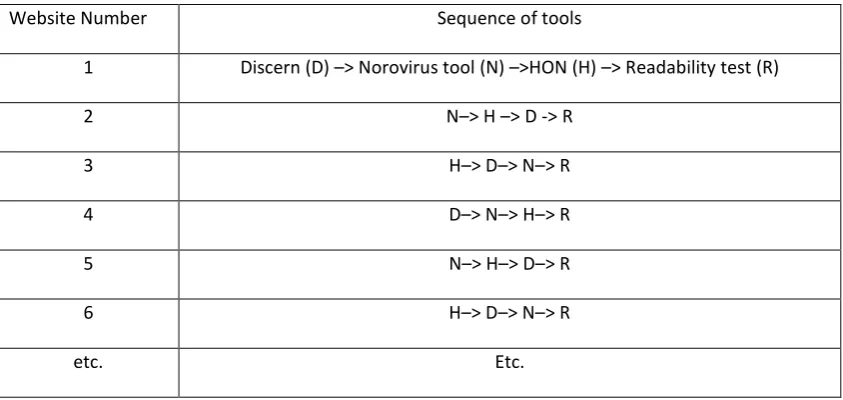
from the HON code. Therefore the tools will be rotated for each website to overcome any
[image:27.595.109.531.558.758.2]researcher bias, the sequence applied can be found within table 1.
Table 1: Rotation of tools
Website Number Sequence of tools
1 Discern (D) > Norovirus tool (N) >HON (H) > Readability test (R)
2 N > H > D -> R
3 H > D > N > R
4 D > N > H > R
5 N > H > D > R
6 H > D > N > R
26
The scoring method for each tool can be found in Appendices 1, 2, and 3. The responses to
each question for each tool were recorded in Microsoft Excel. In line with Surman (2010)
the time taken to evaluate each website with the generic and specific tools was also
recorded by using a stop watch; this will allow the tools to be compared for feasibility later
in the study. This was achieved by recording the time from the start of the evaluation of
the page until it had been completed; this was recorded to the nearest second. The scoring
method for each tool can be found within Appendix
3.8Summary
This section has outlined the choice of generic tools; the Discern tool and HON code, the
specific norovirus tool, and a Flesch reading test. The section outlined how the four tools
combined and rotated on each website will result in a through evaluation on websites that
contain information on norovirus. The next sections Chapter 4: Results 1 evaluation of
norovirus website quality and Chapter 5: Results 2 analysis of evaluation tools will present
the results of the website evaluations and will analyse the performance of the evaluation
27
Chapter 4: Results
4.1 Introduction
This section will present the results from the website evaluations in the method outlined in
Chapter 3 Methodology. The results of the evaluations will be outlined below in detail
employing statistical tests where necessary. The overall rank of the websites will also be
provided for each website alongside each tool. The validity, reliability, and feasibility of
each of the tools will also be discussed.
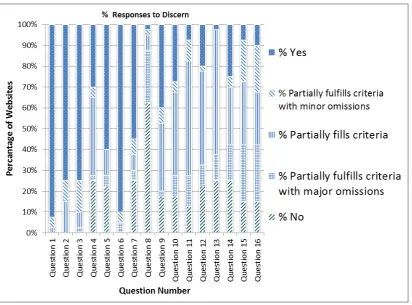
4.2.1 Score for Discern Tool
The Discern tool, as mentioned in the methodology, largely assesses a websites reliability
and treatment information. Figure 2.1 below displays the responses to the 16 questions of
Discern for each website.
Figure 2.1: “ D T
Appendix 1 contains the Discern tool which was used in this dissertation. The tool is
compromised of 16 questions, question 1 to 8 concern the reliability of the website
[image:29.595.115.528.365.670.2]28
question is an overall rating on treatment choice. It can be deduced from the figure above
Y
response. Yet, in regards to the treatment choices the results vary significantly with more
P
4.2.2 Score for HON Code
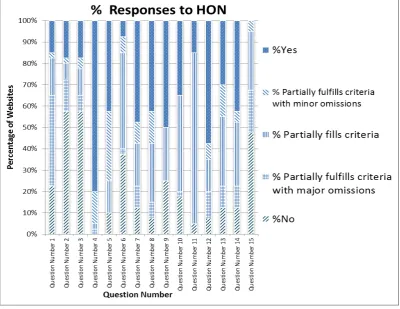
The HON Code tool, Appendix 2, is based on a set of eight principles which aim to help web
[image:30.595.114.515.274.583.2]developers create websites which are of high information quality.
Figure 2.2: Scores for HON tool
The results of the HON code vary greatly with only questions 4 and 12 standing out
suggesting many websites stated the purpose of the website (q4) and provided contact
details of a webmaster (q12). The variety of response for the other questions may be due to
the nature of the questions as each question focuses on different aspects of a website. That
is, the 8 principles are split into 13 questions:
A questions 1, 2, and 3.
29
P C questions 7 and 8.
I questions 9, and 10.
J question 11.
W question 12.
D question 13.
Advertising policy
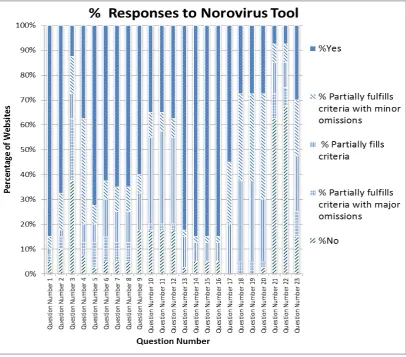
4.2.3 Score for Norovirus Tool
The Norovirus tool, Appendix 3, was a specific tool designed to look at the information
contents of each webpage. This was deemed necessary as a website may be of high quality
in regards to HON and the first section of Discern but contain little or no knowledge on
norovirus. The Norovirus tool was based on 6 sections: symptoms, causes, treatment,
[image:31.595.116.523.376.733.2]prevention, consequence of spreading norovirus, and an overall section.
30
T Y
fe N Y
This suggests that the majority of websites did contain basic information on norovirus and
the websites with the higher scores contained more information on norovirus, for instance,
the depth of treatment choices or possible consequences for the elderly, or those with
compromised immune systems.
4.2.4 Results of information quality across the three tools
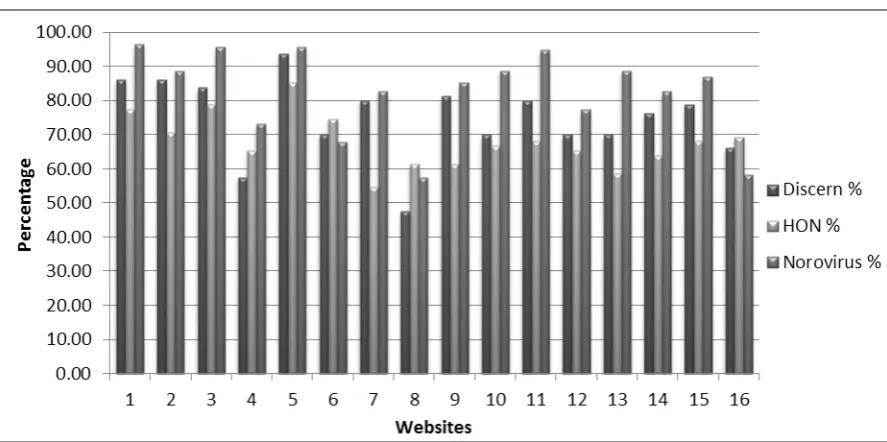
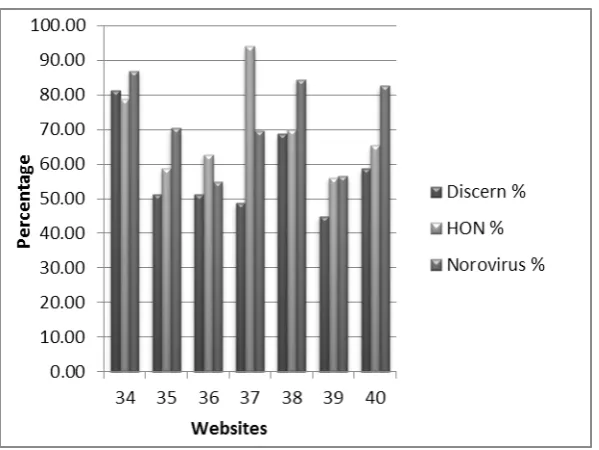
The three figures below display the standardised percentage scores based on the raw score,
[image:32.595.115.559.309.530.2]as outlined in the Methodology, of each website against the three tools:
31
Figure 3.1.2: Results of information quality evaluation using 3 tools Sites 17-33
Figure 3.1.3: Results of information quality evaluation using 3 tools Sites 34-40
4.3 Score for readability tests
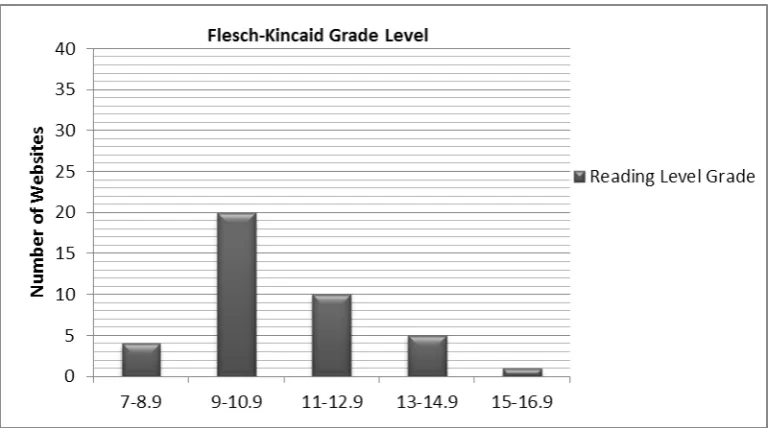
The Flesch reading test produced two results: The Flesch Reading Ease score and the
Flesch-Kincaid Reading Level. Figures 4.1 and 4.2 below summarise the results of the
[image:33.595.114.414.391.616.2]32
Figure 4.1: Flesch Reading Ease Score
Figure 4.2: Flesch-Kincaid Grade
The first figure suggests that almost all the websites have a low level of reading ease with
no website achieving a score of 70 or higher, which is known to be of a good reading score
(Surman 2010). In regards to the reading grade level almost all websites were above grade
[image:34.595.114.502.420.634.2]33
reading tests suggest that norovirus websites are difficult to read. This may be due to the
complex nature of norovirus and the complex terminology used.
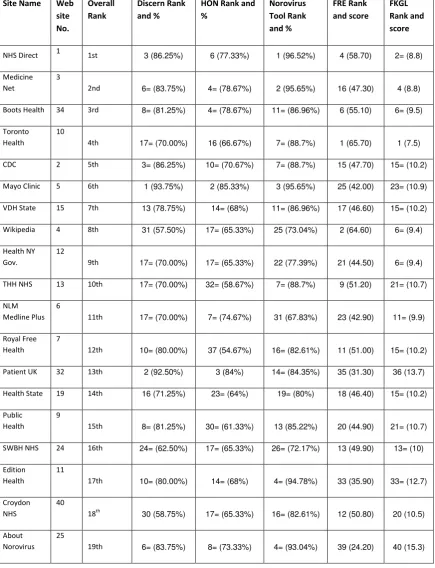
[image:35.595.116.552.191.760.2]4.4 Ranking of each website against each tool
Table 5: Ranking of each website against each tool and percentage score with each website evaluation tool and raw scores with reading tests
Site Name Web site No. Overall Rank Discern Rank and %
HON Rank and % Norovirus Tool Rank and % FRE Rank and score FKGL Rank and score
NHS Direct 1 1st 3 (86.25%) 6 (77.33%) 1 (96.52%) 4 (58.70) 2= (8.8)
Medicine Net
3
2nd 6= (83.75%) 4= (78.67%) 2 (95.65%) 16 (47.30) 4 (8.8)
Boots Health 34 3rd 8= (81.25%) 4= (78.67%) 11= (86.96%) 6 (55.10) 6= (9.5)
Toronto Health
10
4th 17= (70.00%) 16 (66.67%) 7= (88.7%) 1 (65.70) 1 (7.5)
CDC 2 5th 3= (86.25%) 10= (70.67%) 7= (88.7%) 15 (47.70) 15= (10.2)
Mayo Clinic 5 6th 1 (93.75%) 2 (85.33%) 3 (95.65%) 25 (42.00) 23= (10.9)
VDH State 15 7th 13 (78.75%) 14= (68%) 11= (86.96%) 17 (46.60) 15= (10.2)
Wikipedia 4 8th 31 (57.50%) 17= (65.33%) 25 (73.04%) 2 (64.60) 6= (9.4)
Health NY Gov.
12
9th 17= (70.00%) 17= (65.33%) 22 (77.39%) 21 (44.50) 6= (9.4)
THH NHS 13 10th 17= (70.00%) 32= (58.67%) 7= (88.7%) 9 (51.20) 21= (10.7)
NLM Medline Plus
6
11th 17= (70.00%) 7= (74.67%) 31 (67.83%) 23 (42.90) 11= (9.9)
Royal Free Health
7
12th 10= (80.00%) 37 (54.67%) 16= (82.61%) 11 (51.00) 15= (10.2)
Patient UK 32 13th 2 (92.50%) 3 (84%) 14= (84.35%) 35 (31.30) 36 (13.7)
Health State 19 14th 16 (71.25%) 23= (64%) 19= (80%) 18 (46.40) 15= (10.2)
Public Health
9
15th 8= (81.25%) 30= (61.33%) 13 (85.22%) 20 (44.90) 21= (10.7)
SWBH NHS 24 16th 24= (62.50%) 17= (65.33%) 26= (72.17%) 13 (49.90) 13= (10)
Edition Health
11
17th 10= (80.00%) 14= (68%) 4= (94.78%) 33 (35.90) 33= (12.7)
Croydon NHS
40
18th 30 (58.75%) 17= (65.33%) 16= (82.61%) 12 (50.80) 20 (10.5) About
Norovirus 25
34 Waht NHS 22 20th 32 (55.00%) 28= (62.67%) 34 (59.13%) 3 (58.90) 2= (8.6)
Health Tap 16 21st 23 (66.25%) 13 (69.33%) 58.(26 35%) 19 (45.50) 11= (9.9)
Infectious Diseases
28
22nd 10= (80.00%) 10= (70.67%) 21 (79.13%) 29 (38.90) 31 (38.90)
Dudley NHS 21 23rd 24= (62.50%) 35 (56%) 33 (65.22%) 5 (55.60) 5 (9)
Fox News 17 24th 22 (67.50%) 17= (65.33%) (24 75.65%) 14 (48.80) 25= (11.2)
Medical Dictionary
18
25th 5 (85.00%) 23= (64%) 4= (93.04%) 37 (27.80) 35 (13.3)
U Texas 14 26th 15 (76.25%) 23= (64%) 16= (82.61%) 27 (39.70) 23= (10.9)
Asquith Nurseries
38
27th 21 (68.75%) 12 (70%) 14= (84.35%) 30 (38.70) 30 (11.6)
HPA 37 28th 36 (48.75%) 1 (94%) 30 (69.57%) 22 (43.60) 19 (10.3)
Wales NHS 29 29th 27= (60.00%) 8= (73.33% ) 23 (76.52%) 26 (41.20) 27 (11.3)
King Country GOV
36
30th 33= (51.25%) 28=(62.67%) 38 54.78% 7 (53.00) 6= (9.4)
David Darling Encyclopedia
26
31st 27= (60.00%) 23= (64%) 19= (80%) 24 (42.30) 25= (11.2)
Medical News
31
32nd 14 (77.50%) 23= (64%) 7= (88.7%) 40 (23.70) 39 (14.9)
Infection Control
33
33rd 40 (38.75%) 40 (32%) 32 (66.09%) 8 (51.40) 10 (9.6)
Fit for Travel Advice
20
34th 24= (62.50%) 17=( 65.33%) 26= (72.17%) 34 (34.30) 32 (12.1)
Imodium 23 35th 35 (50.00%) 38 (52%) 39 (48.7%) 10 (51.10) 13= (10)
CHP HK GOV 35 36th 33= (51.25%) 32= (58.67%) 29 (70.43%) 31 (37.30) 29 (11.6)
Norovirus Org
30
37th 27= (60.00%) 39 (34.67%) 28 (71.3%) 32 (36.60) 28 (11.4)
Somerset NHS
39
38th 38 (45.00%) 35 (56%) 37 (56.52%) 28 (39.60) 33= (12.7)
Europa Health
8
39th 37 (47.50%) 30= (61.33%) 36 (57.39%) 38 (26.00) 38 (14.1)
Health Tips Blog
27
40th 39 (41.25%) 34 (57.33%) 40 (28.7%) 36 (27.90) 37 (13.8)
The top three websites according to the four tools taken together are NHS Direct, Medicine
Net, and Boots Health. The deciding factor in the ranking is the readability of the website as
35
specific norovirus tool. The = symbol indicates where two or more websites achieved the
same score with the same tool.
4.5 Selection of statistical methods
Inferential statistics will be applied to analyse the results in more detail. Surman (2010)
citing Vaughan (2001) writes that four assumptions based on the data must be achieved in
order to use parametric tests; if these assumptions are not met non parametric tests should
be employed. Vaughan (2001) writes the assumptions as follows:
- The samples are randomly selected
- The sample data are of the interval ratio type
- The two populations are approximately normally distributed
- The standard deviations of the two samples must be fairly similar
(p. 122)
The first assumption is not met as the data was not randomly selected as stated in the
methodology. The second assumption is not met as the data used in this study is ordinal
based on a 1 to 5 scale. Surman (2010) drawing on Bowling (2009) writes that
non-parametric tests can be used with nominal, ordinal, and interval data. In order to see
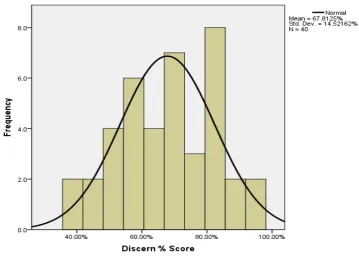
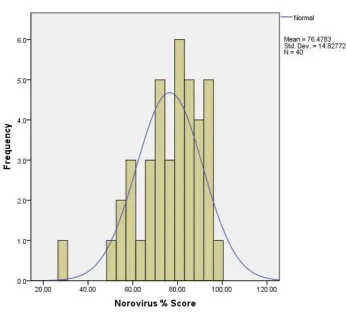
whether the data meets the third and fourth assumptions histograms with distribution
curves and the Kolmogorov-Smirnov test was applied to the data (figure 6.1 to table 6.6
below). This will decide whether to accept the following null hypothesis:
H0 = The data is normally distributed.
36
Figure 6.1: Distribution of scores using discern
[image:38.595.122.477.376.645.2]37
Figure 6.3: Distribution of scores using Norovirus
Figure 6.4: Distribution of scores using Flesch Reading Ease
[image:39.595.123.455.431.722.2]38
Figure 6.5: Distribution of scores using Flesch-Kincaid Grade Level
Table 6.6: Kolmogorov-Smirnov Test
Discern % score
HON % Score
Norovirus % Score
Flesch Reading Ease
Flesch Kincaid Level Score
N 40 40 40 40 40
Normal Parametersa,b Mean 67.8125 65.5667 76.4783 44.0650 10.933
Std. Deviation 14.52162 11.45640 14.82772 10.37864 1.7812
Most Extreme Differences
Absolute .099 .131 .110 .065 .114
Positive .073 .108 .088 .065 .114
Negative -.099 -.131 -.110 -.053 -.070
Kolmogorov-Smirnov Z .628 .828 .698 .413 .719
[image:40.595.48.561.465.733.2]