RESEARCH
Protection induced by malaria virus-like
particles containing codon-optimized AMA-1
of
Plasmodium berghei
Dong‑Hun Lee
1, Ki‑Back Chu
1, Hae‑Ji Kang
1, Su‑Hwa Lee
1, Manika Chopra
2, Hyo‑Jick Choi
2, Eun‑Kyung Moon
3,
Kyung‑Soo Inn
4and Fu‑Shi Quan
3,5*Abstract
Background: Despite the extensive endeavours, developing an effective malaria vaccine remains as a great chal‑ lenge. Apical membrane antigen 1 (AMA‑1) located on the merozoite surface of parasites belonging to the genus
Plasmodium is involved in red blood cell invasion.
Methods: Influenza virus‑like particle (VLP) vaccines containing codon‑optimized or native (non‑codon optimized) AMA‑1 from Plasmodium berghei were generated. VLP‑induced protective immunity was evaluated in a mouse model. Results: Mice immunized with VLP vaccine containing the codon‑optimized AMA‑1 elicited higher levels of P. berghei‑specific IgG and IgG2a antibody responses compared to VLPs containing non‑codon optimized AMA‑1 before and after challenge infection. Codon‑optimized AMA‑1 VLP vaccination induced higher levels of CD4+ T cells, CD8+ T cells, B cells, and germinal centre cell responses compared to non‑codon optimized AMA‑1 VLPs. Importantly, the codon‑optimized AMA‑1 VLP vaccination showed lower body weight loss, longer survival and a significant decrease in parasitaemia compared to non‑codon optimized VLP vaccination.
Conclusion: Overall, VLP vaccine expressing codon‑optimized AMA‑1 induced better protective efficacy than VLPs expressing the non‑codon optimized AMA‑1. Current findings highlight the importance of codon‑optimization for vaccine use and its potential involvement in future malaria vaccine design strategies.
Keywords: Plasmodium berghei, Apical membrane antigen 1 (AMA‑1), Virus‑like particles, Codon‑optimized, Vaccine
© The Author(s) 2019. This article is distributed under the terms of the Creative Commons Attribution 4.0 International License (http://creat iveco mmons .org/licen ses/by/4.0/), which permits unrestricted use, distribution, and reproduction in any medium, provided you give appropriate credit to the original author(s) and the source, provide a link to the Creative Commons license, and indicate if changes were made. The Creative Commons Public Domain Dedication waiver (http://creativecommons.org/ publicdomain/zero/1.0/) applies to the data made available in this article, unless otherwise stated.
Background
Malaria is a disease caused by Plasmodium parasites that may be transmitted to people by female Anopheles mos-quitoes. An estimated 219 million cases of malaria have been reported in 87 countries in 2017 [1]. The World Health Organization (WHO) estimates over one million deaths by malaria infection each year, which is a severe public health problem [2]. Anti-malarial drugs for human use, indoor spraying with residual insecticides, and the use of insecticide-treated mosquito nets can prevent and reduce malaria transmission. However, 68 countries
have reported mosquito resistance to at least one class of insecticide from 2010 to 2017, including 57 reported resistances to 2 or more insecticide classes.
In spite of much effort devoted to develop vaccine against malaria infection, RTS,S/AS01 (RTS,S) is the only vaccine that has shown a protection rate of 26–50%, pre-venting approximately 4 in 10 cases of malaria [3]. Thus, it is critical to develop more effective vaccines. Malaria vaccines can be aimed to the various stages of anti-gens of the parasite life cycle, especially the stage that involves host red blood cells (RBCs) [4, 5]. Currently, there are several malaria vaccines under development, with the most promising of them being apical mem-brane antigen 1 (AMA-1) derived from asexual blood-stage antigens found on the merozoite surface. AMA-1 is a protein of apicomplexan parasites that is essential for
Open Access
*Correspondence: [email protected]
3 Department of Medical Zoology, Kyung Hee University School of Medicine, Seoul, Republic of Korea
host cell invasion [6]. Antibodies against ectodomain of AMA-1 have been shown to prevent RBC invasion and become an important target against Plasmodium falci-parum blood stage [4]. Although P. falciparum AMA-1 polymorphisms remain a major challenge for vaccine development, the authors hypothesized that a virus-like particle (VLP) vaccine expressing AMA-1 would prevent merozoite entry into RBCs and thus play an important role in protection against malaria infection.
The high level of protein expression in heterologous hosts is one of the major bases of modern biotechnol-ogy [7]. Multiple strategies regulate and influence gene expression levels, and GenScript OptimumGeneTM algorithm takes into consideration as many of them as possible, producing the single gene that can reach the highest possible level of expression. Codon-optimization includes strategies involving gene design engineering, which has a significant impact on gene expression levels and protein folding [7]. Improved expression of the gene could enhance the vaccine efficacy from recombinant protein vaccine. It has also been reported that there is a difference between codon-optimized and native codon in inducing in vitro transfection and T cells expression levels [8]. Although codon-optimization has been shown to improve the expression of human genes in Escheri-chia coli [9], the effect of gene sequence optimization on protein expression using insect cell remains unre-ported to date. Thus, in the current study, Plasmodium berghei AMA-1 sequence was optimized and protective immunity induced by VLPs expressing codon-optimized AMA-1 [AMA-1 (G)] with VLPs expressing the non-codon optimized AMA-1 [AMA-1 (O)] were compared.
In this study, the vaccine efficacies in mice immunized with VLPs containing codon-optimized or non-opti-mized AMA-1 were evaluated. Immunized mice were challenge-infected with P. berghei and protective immu-nity was assessed. Malaria-specific IgG and IgG2a anti-body responses, as well as T cell and B cell responses were induced to a higher extent in the codon-optimized VLPs than the non-codon optimized VLPs. Compared to non-codon optimized VLPs, codon-optimized VLPs also showed less body weight reduction and increased survival rate, as well as significant reduction in parasitaemia in the blood.
Methods
Ethics statement
All experimental procedures and animal experiments in this study were reviewed, approved, supervised, and per-formed in accordance with the guidelines of the Kyung Hee University IACUC (Permission Number: KHUASP (SE)-17-066). Isoflurane anesthesia was used to minimize animal suffering during sacrifice.
Animal purchase, parasite maintenance and antibodies Female BALB/c mice were purchased from KOAT-ECH (Pyeongtaek, Gyeonggi-do, Korea), and P. berghei (ANKA strain) was maintained in mice by serial intra-peritoneal passage. Spodoptera frugiperda SF9 cells were maintained in suspension in serum-free SF9 II medium (Invitrogen, Carlsbad, CA, USA) at 27 °C in Erlenmeyer flasks in an incubator set at 120–130 rpm. Plasmodium berghei-infected sera from mice were col-lected through retro-orbital plexus puncture. Horse-radish peroxidase (HRP)-conjugated goat anti-mouse immunoglobulins IgG, IgG1, IgG2a and IgG2b were purchased from Southern Biotech (Birmingham, AL, USA). Monoclonal mouse anti-M1 antibody was pur-chased from Abcam (Cambridge, UK).
Cloning of Plasmodium berghei AMA‑1 and influenza M1
genes
For plasmid constructions, AMA-1 gene from the original sequence (accession number: XM_672965.2, 1671 bp) and influenza matrix protein 1 (M1) gene (accession number: EF467824, 1027 bp) were cloned into baculovirus vector pFastBacTM, as described previously [10, 11]. Plasmid containing codon-optimized AMA-1 was synthesized and provided by GenScript (NJ, USA).
Generation of recombinant baculovirus (rBV)
Recombinant baculoviruses (rBVs) expressing codon-optimized AMA-1, non-codon codon-optimized AMA-1, or influenza M1 were generated as described previously [10, 11]. To generate VLPs, Sf9 cells were co-infected with either the rBV expressing codon-optimized AMA-1 or non-codon optimized AMA-1, together with rBV expressing influenza M1 as a core protein, as conducted previously [8, 12]. Sf9 cell size and proliferation were observed at 5 different areas and photographed under 200× magnification (Leica DMi8). Ten cells from each area were measured for statistical analysis. The produced VLPs were separated from SF9 cells by centrifugation at 4 °C and 6000 rpm for 30 min. Then, VLPs were ultra-centrifuged at 4 °C and 30,000 rpm for 50 min. Pelleted VLPs were purified by a sucrose gradient method by cen-trifugation at 4 °C and 30,000 rpm for 1 h, and the puri-fied VLPs were pelleted at 4 °C and 30,000 rpm for 1 h as well [10, 11]. VLPs were incubated with phosphate buffered saline (PBS) overnight at 4 °C and protein con-centrations were measured using the BCA Assay Kit (Thermo Fisher Scientific, Waltham, Mass., USA). VLPs were stored at − 70 °C until use.
Characterization of VLPs
on transmission electron microscopy (TEM) (JEOL 2100, JEOL USA, Inc., Peabody, MA, USA) [13]. West-ern blots were probed with a primary antibody (anti-P. berghei polyclonal antibody) and then a secondary antibody (HRP-conjugated anti-mouse IgG). The M1 protein was detected by a monoclonal mouse anti-M1 antibody. The intensity of AMA-1 in VLPs was calcu-lated by ImageJ.
Mice immunization and challenge
Seven-week old female BALB/c mice were divided into four groups (n = 10 per group) for non-codon and codon-optimized VLPs comparison experiments. The mice were immunized twice via intramuscular (IM) injections of 100 μg VLPs per mouse. Four weeks after the sec-ond immunization, the mice were infected with 1 × 10⁵ of P. berghei (ANKA) intraperitoneally (IP). On day 10 post infection, half of the mice in each group (n = 5 per group) were sacrificed and mouse blood and spleen sam-ples were collected. The remaining mice were observed daily for changes in body weight and survival rate, and mice that lost 20% of their body weight were humanely euthanized.
Plasmodium berghei‑specific antibody responses
Mice sera were collected from all groups after prime and boost immunization. Plasmodium berghei-specific IgG antibodies were determined by enzyme-linked immu-nosorbent assay (ELISA), and P. berghei antigens were prepared as previously described [10, 14]. Blood infected with 25% or more malaria was centrifuged at 6000 rpm at 4 °C for 10 min to separate only RBCs, which was then dissolved in 0.15% saponin at room temperature (RT), and the isolated parasites were washed three times with PBS. The precipitated parasites were sonicated three times at 40 Hz for 30 s and used as an antigen for ELISA. Briefly, a 96-well immunoplate was coated with 2 μg/ mL of P. berghei antigen and incubated overnight at 4 °C. Then, 100 μL of the serum samples (diluted 1:100, 1:200, 1:200, 1:400, 1:800, 1:1600, 1:3200, 1:6400 in PBST) were added to each well and incubated at 37 °C for 2 h as a primary antibody response. HRP-conjugated goat anti-mouse IgG in PBST (100 μL/well, diluted 1:2000 in PBST) were used to determine P. berghei-specific IgG response.
T cells, B cells, and germinal centre responses by flow cytometry
The population of T cells (CD4+ and CD8+), B cells, and germinal centres from the splenocytes of mice, 10 days after challenge infection, were analysed by flow cytom-etry. Briefly, splenocytes (1 × 10⁶ cell/mL) in a staining buffer were incubated for 30 min at 4 °C with Fc Block
(clone 2.4G2; BD Biosciences, CA, USA). For surface staining, the surface antibodies (CD3e-PE-Cy5, CD4-FITC, CD8a-PE, B220-CD4-FITC, CD19-PE-Cy7, GL7-PE; BD Biosciences, CA, USA) were incubated with the cells for 30 min at 4 °C. The spleen cells were washed with a stain-ing buffer at 4 °C and fixed in ice with 4% paraformalde-hyde for 30 min. Then, by using the BD Accuri C6 Flow Cytometer (BD Biosciences, CA, USA), the data was analysed.
Parasitaemia
To stain infected RBCs, 2 μL of RBCs from the blood of P. berghei-infected mice were collected in a tube con-taining 500 U/mL heparin in PBS. RBCs from P. berghei -infected mice were stained using 1 μL SYBR Green I (10,000 × concentrate in DMSO, Cat. No. S9430; Thermo Fisher Scientific, MA, Waltham, USA) [15]. The samples were incubated in the dark at 37 °C for 30 min, and then flow cytometry was performed.
Statistics
The data was analysed statistically using the One-way ANOVA with Tukey’s post hoc test or student t-test using PC-SAS 9.4 (SAS Institute, Cary, North Carolina, USA). A P value < 0.05 was considered to be significant.
Results
Generation of recombinant constructs
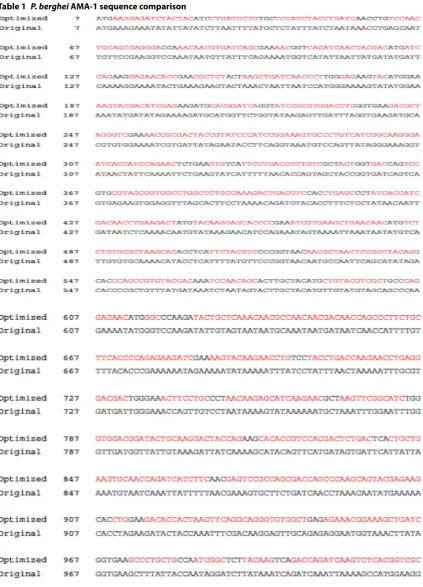
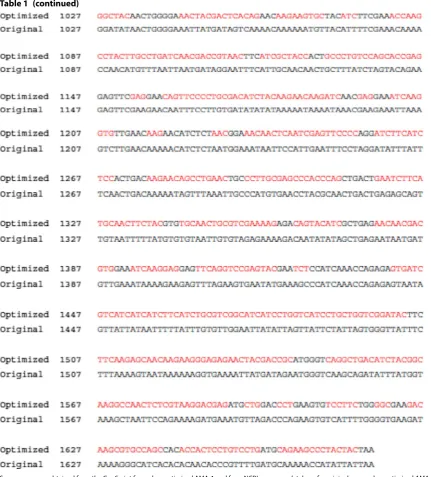
As shown in Fig. 1a, b, plasmids pFastBac1™ contain-ing the original AMA1 of P. berghei and influenza M1 were PCR-amplified and cloned into pFastBac1™ vec-tors. As seen in Table 1, codon-optimized AMA-1 was constructed by GenScript, and codon-optimization of a single gene resulted in higher level of protein expression compared to the original AMA-1 (Fig. 2c, d). To deter-mine Sf9 cells infected by baculovirus, Sf9 cells and pro-liferation were observed under 200× magnification. As seen in Fig. 1c, d, recombinant baculoviruses expressing original, codon-optimized, or influenza M1 in SF9 cells were generated. Baculovirus infected Sf9 cells were found to be significantly larger on day 4 than on day 0, whereas in the naïve control, SF9 cells appeared to maintain the original size and were more highly proliferated on day 4 than those at day 0.
Generation and characterization of VLPs
a spherical shape with spikes on the surface (Fig. 2b, c). Original AMA-1 containing VLPs and codon-optimized VLPs co-infected with M1 were identified by Western blot using P. berghei polyclonal antibody and M1 monoclonal antibody. As shown in Fig. 2d, e, codon-optimized VLPs exhibited better protein expres-sion (1.5 times) than original AMA1 VLPs. Proteolytic cleavage has occurred, causing fragmentation of the AMA-1 protein (46 kDa). The full-length AMA-1 pro-teins at 63 kDa were detected to lesser extent than its fragmented form.
VLPs immunization elicits Plasmodium berghei‑specific
antibody responses
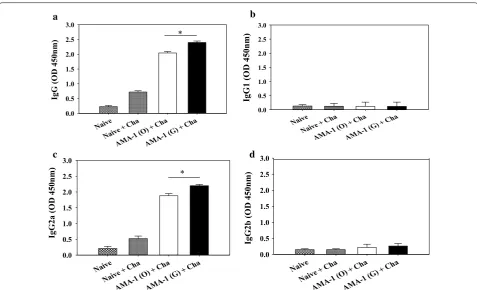
Mice were immunized with VLPs vaccine and antibody responses were determined. Mice immunized with AMA1 (G) VLPs showed significantly higher levels of P. berghei-specific IgG and IgG2a antibody responses in after prime and boost compared to mice immu-nized with non-codon optimization VLPs (Fig. 3a, b, d; *P < 0.05). However, IgG1 and IgG2b antibody responses were not detected (Fig. 3c, e). Upon challenge infection, codon-optimized VLPs-immunized mice also
M O
0.5 kb 5 kb
1.5 kb
pFastBac1TM
AMA1 G
a
1kb
M 1
5kb pFastBac1TM
M1
b
c Control cell / Sf9 (D-0)
200X
M1 (D-0)
200X
AMA1 (O: D-0)
200X
AMA1 (G: D-0)
200X
200X Control cell / Sf9 (D-4)
200X M1 (D-4)
d AMA1 (O: D-4)
200X
AMA1 (G: D-4)
200X
showed significantly higher levels of P. berghei-specific IgG and IgG2a antibody responses than mice immu-nized with non-codon optimized VLPs (Fig. 4a, c). In
[image:5.595.59.483.86.674.2]VLPs immunization induces T and B cells responses
CD4+ T cells and CD8+ T cells responses, indicators for assessing immunity induced by VLPs immuniza-tion, were determined as scheduled after sacrifice. As shown in Fig. 5, the CD4+ T cells (34% and 27%; Fig. 5a, *P < 0.05) and CD8+ T cells (29% and 23%; Fig. 5b, *P < 0.05) responses in mice immunized with codon-optimized VLPs and non-codon codon-optimized VLPs were observed. These results indicate that mice immunized with the codon-optimized AMA1 VLPs induced higher T cell responses compared to the original AMA1 VLPs.
Similarly, as illustrated in Fig. 5c, d, codon-optimized AMA1 VLPs induced higher levels of B cells responses and germinal centre cell responses compared to origi-nal AMA1 VLPs (*P < 0.05). These results indicate that codon-optimized AMA1 induced better humoral immu-nity than original AMA1 VLPs.
VLPs immunization induces protection against Plasmodium
berghei challenge infection
Parasitaemia in the blood following challenge infection is the most important indicator to assess VLPs vaccine Table 1 (continued)
[image:6.595.57.489.89.567.2]efficacy. Immunized mice and naïve mice were challenge-infected with 1 × 10⁵P. berghei as scheduled (Fig. 6a–d). As seen in Fig. 6e, the immunized mice group signifi-cantly reduced parasitaemia in the blood when P. berghei infection was attempted. More specifically, the group of mice immunized with codon-optimized VLPs showed the lowest parasitaemia in all groups (Fig. 6d, e, *P < 0.05).
Immunization with VLPs can increase survival rates
against Plasmodium berghei challenge infection
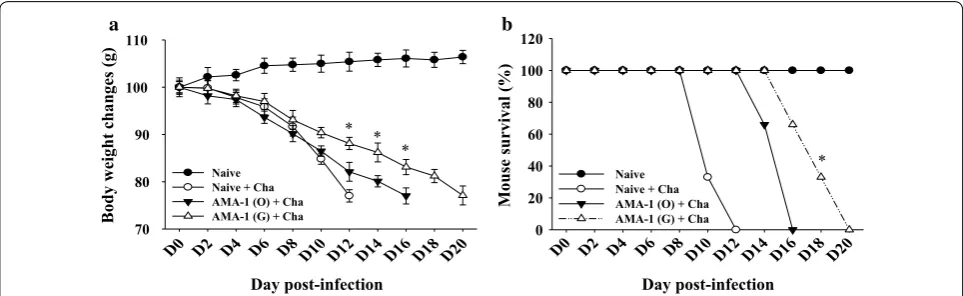
Body weight and survival changes were also determined after challenge infections. As shown in Fig. 7, mice immunized with codon-optimized VLPs had a lower weight loss rate than mice immunized with non-codon optimized VLPs (Fig. 7a). Immunized mice with codon-optimized VLPs also survived 4 days longer than those with the original AMA1 VLPs immunization (Fig. 7b), indicating codon-optimized AMA1 VLPs provided better protection than original AMA1 VLPs.
Discussion
The malaria parasite has a multistage life cycle in which merozoites can invade RBCs, initiating the blood-stage infection of its life cycle. The present study focused on the AMA-1 protein which plays an important role in the merozoite entry into erythrocytes during the blood-stage. This is based on the authors’ hypothesis that immunity by vaccination against AMA-1 could prevent merozoite infection. For this purpose, VLPs were generated using
the baculovirus expression system, in which rBV con-structs included codon-optimized or non-optimized AMA-1 genes. It was found that the AMA-1 codon-opti-mized VLPs vaccine significantly reduced parasitaemia than the non-codon optimized VLPs vaccine. This reduc-tion may be attributed to the inhibireduc-tion of the asexual reproduction of merozoites at the blood stage by induc-ing higher malaria-specific antibody responses, T cells and B cells responses. These results provide important information on a vaccine design strategy against merozo-ites in the blood stage by the use of a codon-optimized gene.
Malaria DNA vaccine plasmids, encoded with codon-optimizations of gene fragments of P. falciparum mero-zoite proteins, have been shown to enhance protein expression and immunogenicity in mice [16]. The genes used were malaria EBA-175 RII and MSP-142, in which one in three nucleotides were replaced by different nucleotides to optimize the sequences, and the G+C content was raised by approximately 26–56% in the opti-mized sequences [16]. It is well-known that the native gene employs tandem rare codons that can reduce the efficiency of translation. In the current study, the codon usage bias has been changed in the insect by upgrading the CAI from 0.64 to 0.96. GC content and unfavorable peaks were optimized from the original AMA-1 gene by GenScript (NJ, USA). After optimization, GC con-tent of AMA-1 reached 53% and the exact same protein sequences were observed in the optimized and origi-nal ones. Findings from the current study revealed that
a Diagram of AMA1 VLPs b AMA1 (O) c AMA1 (G)
AMA-1 (O)
M1 100㎍ 50㎍ 25㎍
46 kDa
28 kDa
d
46 kDa
100㎍ 50㎍ 25㎍
AMA-1 (G)
M1
28 kDa
e
50 nm 50 nm
AMA1
M1
[image:7.595.60.539.88.282.2]AMA-1 (G) VLPs vaccine showed increased immuno-genicity and/or vaccine efficacy compared to AMA-1 (O) VLPs, which can be attributed to enhanced AMA-1 expression resulting from codon-optimization. In addi-tion, immunogenicity may have been influenced by dif-ferences in the conformation of AMA-1 present in AMA-1 (G) VLPs vs. AMA-1 (O) VLPs. As expected, codon-optimized VLP vaccination enhanced protein expression, resulting in better vaccine efficacy compared to non-codon optimized VLPs.
Antibodies are known to play an important role in controlling blood-stage infections [17, 18]. Mice defi-cient in mature B cells have shown chronic relapsing par-asitaemia, indicating the need for antibodies to control
malaria [18, 19]. In the current study, codon-optimized VLP vaccination induced (i) significantly higher levels of mature B cells and germinal centre responses, and IgG and IgG2a antibody responses, and (ii) reduction in par-asitaemia when compared to the non-codon optimized VLPs vaccination. These results indicate that antibody response is a critical factor in resisting malaria infection.
As an anti-malarial antibody, IgG2a isotype plays a dominant role in modulating Plasmodium yoelii para-sitaemia [20]. Murine immunoglobulin IgG1 has been reported not to play a role in the protection against P. berghei transgenic model [21]. Consistent with these findings, in the current study, parasite-specific IgG2a antibody responses were detected while no IgG1
Naive
AMA-1 (O) pri
me
AMA-1 (O) boo
st
AMA-1 (G) pri
me
AMA-1 (G) boo
st Ig G2 b (O D 450n m) 0.0 0.5 1.0 1.5 2.0 Prime Day 0 Boost Day 30 Challenge Day 60
Bleed & Sacrifice Day 70
1st-bleed 2nd-bleed
Day 25 Day 55
a
b
Naive
AMA-1 (O) pri
me
AMA-1 (O) boo
st
AMA-1 (G) pri
me
AMA-1 (G) boo
st Ig G (O D 450 nm ) 0.0 0.5 1.0 1.5 2.0 Naive AMA-1 (O) pri
me
AMA-1 (O) boo
st
AMA-1 (G) pri
me
AMA-1 (G) boo
st Ig G1 (O D 450 nm ) 0.0 0.5 1.0 1.5 2.0 c Naive AMA-1 (O) pri
me
AMA-1 (O) boo
st
AMA-1 (G) pri
me
AMA-1 (G) boo
st Ig G2 a (O D 450n m) 0.0 0.5 1.0 1.5 2.0 d e * ** * ** * *
[image:8.595.58.537.87.479.2]antibody responses were found, indicating IgG2a anti-body mainly contributes to the significant reduction of parasitaemia.
Malaria infection reveals the exhaustion of parasite-specific CD4+ and CD8+ T cells, which are medi-ated by the programmed cell death-1 (PD-1) pathway. Specifically, T cells exhaustion indicates the absence of sterile immunity against blood stage malaria dur-ing malaria infection [18]. In this study, unimmu-nized control mice reduced the CD4+ and CD8+ T cells responses, whereas VLP vaccination significantly increased CD4+ and CD8+ T cells responses under both P. berghei antigen-stimulated and non-stimulated conditions, indicating better vaccine efficacy induced by VLP immunization. Therefore, the codon-opti-mized VLP vaccination displayed better protection
against malaria by inducing higher levels of CD4+ and CD8+ T cells responses than the non-codon optimized VLP vaccination.
Conclusions
Vaccine efficacies were assessed in mice immunized by malaria virus-like particles containing P. berghei AMA-1, in which the nucleotide sequence of AMA-1 was codon-optimized or non-codon codon-optimized. Codon-codon-optimized VLP vaccine induced higher levels of parasite specific IgG and IgG2a antibodies, T cells, B cells and germinal centre responses than the non-codon optimized VLPs vaccine. Thus, the codon-optimized VLP vaccine sig-nificantly reduced parasitaemia in the blood, showed less body weight loss, and increased the survival rate of mice compared to non-codon optimized VLPs. These
Naive Naive + Cha
AMA-1 (O) + Cha
AMA-1 (G) + Cha
IgG2b (OD 450nm)
0.0 0.5 1.0 1.5 2.0 2.5 3.0
Naive Naive + Ch
a AMA-1 (O) + Ch
a AMA-1 (G) + Ch
a
IgG (OD 450nm)
0.0 0.5 1.0 1.5 2.0 2.5 3.0
a
*
Naive Naive + Cha
AMA-1 (O) + Ch a
AMA-1 (G) + Ch a
IgG1 (OD 450nm)
0.0 0.5 1.0 1.5 2.0 2.5 3.0
b
Naive Naive + Cha
AMA-1 (O) + Ch a
AMA-1 (G) + Cha
IgG2a (OD 450nm)
0.0 0.5 1.0 1.5 2.0 2.5 3.0
c
*
d
[image:9.595.59.537.86.376.2]Naive Naive + Cha
AMA-1 (O) + Cha AMA-1 (G) + Ch
a
Germinal cente
r
[CD45+ GL7+ (%)]
0 5 10 15 20
a
Naive Naive + Ch
a
AMA-1 (O) + Ch a
AMA-1 (G) + Cha
T cell [CD4+ (%)]
0 10 20 30 40 50
* *
Naive Naive + Cha
AMA-1 (O) + ChaAMA-1 (G ) + Cha
T cell [CD8+ (%)]
0 10 20 30 40
*
b
*
Naive Naive + Ch
a
AMA-1 (O) + Ch a
AMA-1 (G) + Cha
B cell [CD19+ CD23+ (%)] 0
6 12 18 24 30
*
c
* *
d
*
Fig. 5 T cells, B cells and germinal centre cell response. Immunized mice were challenge‑infected and sacrificed 4 weeks post‑challenge as scheduled. CD4+ T cells (a *P < 0.05) and CD8+ T cells (b *P < 0.05) populations in the spleen were determined. Mature B cells and germinal centre population were determined in the spleen (c, d *P < 0.05). Data are expressed as mean ± SD
Naive
a b Naive + Cha c AMA-1(O) + Cha d AMA-1(G) + Cha
e
Naive Naive + Ch
a
AMA-1(O) + Ch a
AMA-1(G) + Cha
Parasitemia (%)
0 10 20 30
* *
[image:10.595.58.539.86.373.2] [image:10.595.61.539.430.676.2]results indicate that the codon-optimized VLP vaccine is a promising strategy for the development of an effective vaccine to control the spread of malaria infection.
Acknowledgements
Not applicable.
Authors’ contributions
DL drafted the manuscript, analysed the data and interpreted the findings. KC contributed to data acquisition and edited the manuscript. HK, SL, MC, and HC contributed to data acquisition. EM and KI revised the entire manuscript and checked for errors. FQ conceptualized the study, interpreted the findings, critically reviewed and edited the manuscript. All authors read and approved the final manuscript.
Funding
This work was supported by grants from the Cooperative Research Program for Agriculture Science & Technology Development, Rural Development Administration, Republic of Korea (PJ01320501), and the National Research Foundation of Korea (NRF) (2018R1A2B6003535, 2018R1A6A1A03025124).
Availability of data and materials
Not applicable.
Ethics approval and consent to participate
Ethics approval for animal experiment was acquired from the Kyung Hee University Institutional Animal Care and Use Committee (IACUC).
Consent for publication
Not applicable.
Competing interests
The authors declare that they have no competing interests.
Author details
1 Department of Biomedical Science, Graduate School, Kyung Hee University, Seoul, Korea. 2 Department of Chemical and Materials Engineering, University of Alberta, Edmonton, AB T6G 1H9, Canada. 3 Department of Medical Zoology, Kyung Hee University School of Medicine, Seoul, Republic of Korea. 4 Depart‑ ment of Pharmaceutical Science, College of Pharmacy, Kyung Hee University, Seoul 02447, Republic of Korea. 5 Medical Research Center for Bioreaction to Reactive Oxygen Species and Biomedical Science Institute, School of Medi‑ cine, Graduate School, Kyung Hee University, Seoul, Republic of Korea.
Received: 10 July 2019 Accepted: 20 November 2019
References
1. WHO. Malaria. Geneva: World Health Organization; 2019. https ://www. who.int/malar ia/en/. Accessed 4 Apr 2019.
2. WHO. Water‑related diseases. Geneva: World Health Organization; 2019. https ://www.who.int/water _sanit ation _healt h/disea ses‑risks /disea ses/ malar ia/en/. Accessed 5 Dec 2018.
3. RTS,S Clinical Trials Pratnership. Efficacy and safety of RTS, S/AS01 malaria vaccine with or without a booster dose in infants and children in Africa: final results of a phase 3, individually randomised, controlled trial. Lancet. 2015;386:31–45.
4. Yam XY, Preiser PR. Host immune evasion strategies of malaria blood stage parasite. Mol BioSyst. 2017;13:2498–508.
5. Siciliano G, Alano P. Enlightening the malaria parasite life cycle: biolu‑ minescent Plasmodium in fundamental and applied research. Front Microbiol. 2015;6:391.
6. Remarque EJ, Faber BW, Kocken CH, Thomas AW. Apical membrane antigen 1: a malaria vaccine candidate in review. Trends Parasitol. 2008;24:74–84.
7. Elena C, Ravasi P, Castelli ME, Peiru S, Menzella HG. Expression of codon optimized genes in microbial systems: current industrial applications and perspectives. Front Microbiol. 2014;5:21.
8. Lee DH, Kim AR, Lee SH, Quan FS. Virus‑like particles vaccine containing
Clonorchis sinensis tegumental protein induces partial protection against
Clonorchis sinensis infection. Parasit Vectors. 2017;10:626.
9. Burgess‑Brown NA, Sharma S, Sobott F, Loenarz C, Oppermann U, Gileadi O. Codon optimization can improve expression of human genes in
Escherichia coli: a multi‑gene study. Protein Expr Purif. 2008;59:94–102. 10. Lee DH, Lee SH, Kim AR, Quan FS. Virus‑like nanoparticle vaccine confers
protection against Toxoplasma gondii. PLoS ONE. 2016;11:e0161231. 11. Lee SH, Kim AR, Lee DH, Rubino I, Choi HJ, Quan FS. Protection induced
by virus‑like particles containing Toxoplasma gondii microneme protein 8 against highly virulent RH strain of Toxoplasma gondii infection. PLoS ONE. 2017;12:e0175644.
12. Lee DH, Kim AR, Lee SH, Quan FS. Cross‑protection induced by Toxo-plasma gondii virus‑like particle vaccine upon intraperitoneal route challenge. Acta Trop. 2016;164:77–83.
13. Choi HJ, Yoo DG, Bondy BJ, Quan FS, Compans RW, Kang SM, Prausnitz MR. Stability of influenza vaccine coated onto microneedles. Biomaterials. 2012;33:3756–69.
Day post-infection
D0 D2 D4 D6 D8 D10 D12 D14 D16 D18 D20
Body weight changes (g) 70 80 90 100 110
a b
Naive Naive + Cha AMA-1 (O) + Cha AMA-1 (G) + Cha
Day post-infection
D0 D2 D4 D6 D8 D10 D12 D14 D16 D18 D20
Mouse survival (%)
0 20 40 60 80 100 120
Naive Naive + Cha AMA-1 (O) + Cha AMA-1 (G) + Cha *
* *
*
[image:11.595.57.539.88.236.2]•fast, convenient online submission
•
thorough peer review by experienced researchers in your field
• rapid publication on acceptance
• support for research data, including large and complex data types
•
gold Open Access which fosters wider collaboration and increased citations maximum visibility for your research: over 100M website views per year
•
At BMC, research is always in progress.
Learn more biomedcentral.com/submissions
Ready to submit your research? Choose BMC and benefit from:
14. Fairlie‑Clarke KJ, Lamb TJ, Langhorne J, Graham AL, Allen JE. Antibody iso‑ type analysis of malaria‑nematode co‑infection: problems and solutions associated with cross‑reactivity. BMC Immunol. 2010;11:6.
15. Somsak V, Srichairatanakool S, Yuthavong Y, Kamchonwongpai‑ san S, Uthaipibull C. Flow cytometric enumeration of Plasmodium berghei‑infected red blood cells stained with SYBR Green I. Acta Trop. 2012;122:113–8.
16. Peixoto L, Fernandez V, Musto H. The effect of expression levels on codon usage in Plasmodium falciparum. Parasitology. 2004;128:245–51. 17. Cohen S, McGregor I, Carrington S. Gamma‑globulin and acquired immu‑
nity to human malaria. Nature. 1961;192:733–7.
18. Wykes MN, Horne‑Debets JM, Leow CY, Karunarathne DS. Malaria drives T cells to exhaustion. Front Microbiol. 2014;5:249.
19. von der Weid T, Honarvar N, Langhorne J. Gene‑targeted mice lacking B cells are unable to eliminate a blood stage malaria infection. J Immunol. 1996;156:2510–6.
20. White WI, Evans CB, Taylor DW. Antimalarial antibodies of the immu‑ noglobulin G2a isotype modulate parasitemias in mice infected with
Plasmodium yoelii. Infect Immun. 1991;59:3547–54.
21. Adame‑Gallegos JR, Shi J, McIntosh RS, Pleass RJ. The generation and evaluation of two panels of epitope‑matched mouse IgG1, IgG2a, IgG2b and IgG3 antibodies specific for Plasmodium falciparum and Plasmo-dium yoelii merozoite surface protein 1‑19 (MSP1(19)). Exp Parasitol. 2012;130:384–93.
Publisher’s Note