REALISING INTELLIGENT VIRTUAL DESIGN
R.I. WHITFIELD, A.H.B. DUFFY, Z. WU
University of Strathclyde, James Weir Building, 75 Montrose Street, Glasgow, G11XJ, UK.
Abstract. This paper presents a vision and focus for the CAD Centre research: the Intelligent Design Assistant (IDA). The vision is based upon the assumption that the human and computer can operate symbiotically, with the computer providing support for the human within the design process. Recently however the focus has been towards the development of integrated design platforms that provide general support irrespective of the domain, to a number of distributed collaborative designers. This is illustrated within the successfully completed Virtual Reality Ship (VRS) virtual platform, and the challenges are discussed further within the NECTISE, SAFEDOR and VIRTUE projects.
1. Introduction
Despite being faced with a situation where computers were generally being used for the processing of data, Mann and Coons (1965) identified the possibility of using computers as “partners in the creative process” to facilitate the hypothesis exploration process and consequently produce an escalation of “scientific creativity”. They stated:
To achieve Mann and Coons’ vision requires a fundamental understanding of the creative process as well as being able to develop computer tools to attain human and computer symbiosis.
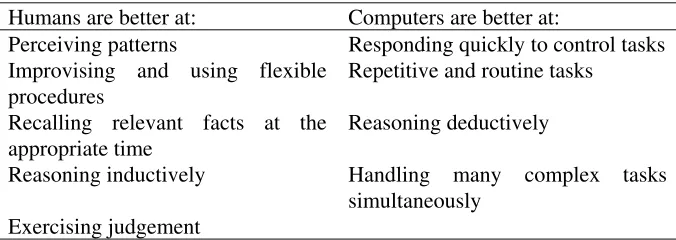
[image:2.595.129.467.274.394.2]Cummings (2004) discussed the degree to which automation (provided by intelligent decision support systems) could be introduced within the decision process. Cummings cites Fitts’ list - Chapanis et al. (1951) as representing the respective strengths of humans and computers within the decision making process.
TABLE 1. Strengths of humans and computers in decision-making.
Humans are better at: Computers are better at:
Perceiving patterns Responding quickly to control tasks
Improvising and using flexible procedures
Repetitive and routine tasks
Recalling relevant facts at the appropriate time
Reasoning deductively
Reasoning inductively Handling many complex tasks
simultaneously Exercising judgement
Despite not being included within Fitts’ list, Cummings acknowledges an increasing need for the use of computational decision support to help humans navigate complex decision problems.
The CAD Centre was established in 1986 as a research and postgraduate unit within the Department of Design Manufacture and Engineering Management at the University of Strathclyde. The aims of the Centre are to develop the computing technology to support a creative design partnership between man and machine, and to deliver the underlying technology, techniques and approaches to industry. To achieve these aims, the CAD Centre has evolved research education and technology transfer programmes.
applicable to any domain. Comparisons are drawn between the VRS virtual platform, and a number of ongoing projects that aim to provide different types of support within the context of virtual design environments within Section 4. The main challenges of these projects are identified.
2. The Intelligent Design Assistant philosophy
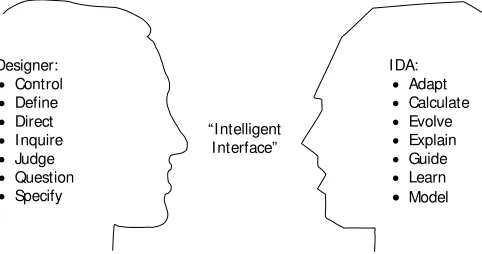
A characterisation of Mann and Coons’ design assistance philosophy is that of the Intelligent Design Assistant. Figure 1 illustrates some key complementary roles that a designer and an IDA are proposed to play within the scenario of intelligent CAD.
In this scenario, designers are initiators of a discourse, they retain authority and control over the progress of the interaction with the IDA, and have ultimate responsibility for the correctness of results. They are able to express the nature of the problem, to describe concepts to be explored, and to justify their judgements. In addition, they hypothesise, refer to past experience, and apply a range of modelling tools. In contrast, the IDA is the active partner to the designer. It is a source of design expertise and past experience that complements a designer’s memory. It is able to develop an understanding of a problem and description of concepts, assess the feasibility of concepts, identify the implications of concept changes, suggest possible solution paths, and can assume much of the burden of mundane and repetitive analysis tasks.
Designer:
• Control
• Define
• Direct
• Inquire
• Judge
• Question
• Specify
IDA:
• Adapt
• Calculate
• Evolve
• Explain
• Guide
• Learn
• Model
[image:3.595.178.419.450.577.2]“Intelligent Interface”
Figure 1. Intelligent Design Assistant.
3. The VRS virtual design environment.
This section provides an overview of the VRS virtual design environment developed within the European Commission funded VRShips-ROPAX (VRS) project and successfully completed within 2005. The project was a major collaboration of 37 industrial, regulatory, consultancy and academic partners with the objective of producing two novel platforms: a physical platform representing a scale model of a novel ROPAX vessel (combining the functionality of a roll-on-roll-off cargo vessel and a passenger ferry); and a virtual platform to integrate knowledge and tools to facilitate distributed collaborative design across Europe. The aim of the virtual platform was to demonstrate that vessels could be designed to meet demanding criteria (2000 passengers, 400 cabins, 2000 nautical mile range, 38 knots service speed), which were not previously possible using individual tools and conventional design approaches. To achieve this objective required the integration of design and simulation tools representing concept, embodiment, detail, production, and operation life-phases into the virtual platform, enabling distributed design activity to be undertaken. Integrating the knowledge and tools in this manner enabled course-grained synthesis of life-phase design and simulation systems which in turn enabled the results from damage stability and evacuation analyses for example to impact the distributed design of the vessel. Whilst the focus of the VRS virtual platform was to facilitate the design of ROPAX vessels, the components within the platform are entirely generic and may therefore be applied to the distributed design of any type of vessel, or other complex made-to-order products.
The approach adopted within the design of the virtual platform was to carry out an iterative process of development, test, implementation and evaluation within and across the work packages leading towards the production of a complete virtual platform.
3.1 VRS VIRTUAL PLATFORM COMPONENTS
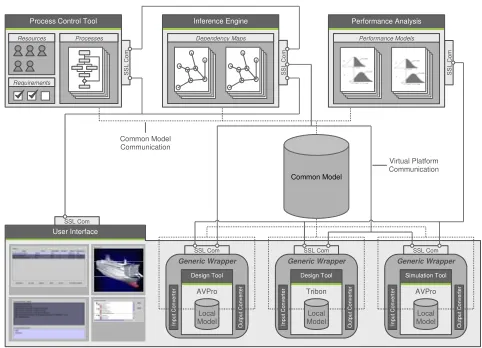
The VRS virtual platform consisted of a number of components that were responsible for providing management and guidance of the distributed design process and can be seen within Figure 2.
required for wrapping - the only requirement for wrapping the tool was the production of data converters between the generic format of the common model and the native format of the tool. A range of different management options were available within the wrapper that resulted with a generic wrapping process, and could be configured for any design or simulation tool irrespective of the platform or programming language.
A “common model” was developed to store the ship product data shared between the wrapped design and simulation tools. An XML database was used to “host” the common model, with schemas defining the content and structure of the ship product data. This content was defined through two approaches. Initially, a top-down consideration was made of the life-phase requirements of the processes and activities that would be covered. For instance it was known that safety aspects would be considered within an operational phase requiring management of evacuation and damage stability data for example. In addition, a bottom-up investigation of the types of tools being integrated was made when defining the content, to determine the common data that the tools shared with the aim of minimizing the amount of data contained within the common model (complete ship product models can be tens of Gigabytes). These top-down and bottom-up approaches to common model content definition ensured that coverage was made across the various life-phases being considered, as well as across the tools being wrapped. Later results demonstrated the flexibility of the approach, with the integration of new tools, and design of different vessels without modification to the content or structure of the common model.
The application of life-phase process knowledge/approaches upon the virtual model was enabled through the development of a process control tool, which provided a means to control the “behaviour” of the integrated platform and provide support for the life-phases of a ship. The process control tool provided the process level co-ordination within the platform:
• User management: remotely logging onto the platform; configuring and undertaking activities, and communicating with other users.
• Process management: creating life-phase process models consisting of a series of interdependent activities; enacting the processes, and allocating the activities to appropriate designers on the basis of their capabilities.
• Requirements management: Defining product-based
requirements; mapping requirements to sequences of activities, and managing process iteration.
In addition to providing process co-ordination, the VRS virtual platform managed the co-ordination of data through an inference engine. Part of the tool configuration process involved communication with both the process control tool to indicate that a user had registered a tool to be used for performing a particular activity, as well as with the inference engine to notify of a relationship between the input and output data (corresponding to common model data) for the tool. This information was used by the inference engine to build a map of dependencies between data within the common model in order to enable the correct propagation of change through the model, as well as enabling the identification and notification of possible conflicting design situations where multiple users are operating on the same or dependent information.
User Interface Common Model Generic Wrapper Simulation Tool AVPro Local Model Input C o n v ert er O u tpu t C onv ert er SSL Com Generic Wrapper Design Tool Tribon Local Model Input C o n v ert er O u tpu t C onv ert er SSL Com Generic Wrapper Design Tool AVPro Local Model Input C o n v ert er O u tpu t C onv ert er SSL Com Process Control Tool
[image:6.595.183.424.308.482.2]Resources Requirements Processes SS L Co m SSL Com Inference Engine Dependency Maps SS L Co m Performance Analysis Performance Models SSL Co m Common Model Communication Virtual Platform Communication
Figure 2. Relationships between VRS virtual platform components.
Designers interacted with the platform remotely via the virtual environment user interface, which aimed to provide real time, virtual interaction. The user interface enabled tools to be configured via the generic wrapper – automatically mapping the functionality of a tool to an activity within a process (of the process controller). During process enactment the activity would be allocated to the user via their interface, and the associated tool would be automatically started and presented to the user for use. The user interface also had functionality to enable communication with other users logged onto the platform, to visualize processes, data dependency maps, and the contents of the common model.
analysis and life-phase support to be undertaken irrespective of the application domain or ship type.
3.2 VRS VIRTUAL PLATFORM USE
A number of evaluation scenarios were created to test the VRS virtual platform during development. One of the later scenarios co-ordinated the activities of users distributed within France, Greece, Sweden, and the UK. These users connected to the platform and undertook their activities to demonstrate the design of a vessel, from a hull-form concept, through to the detail design of the hull including hull-fairing, generation of the general arrangement of the decks within the hull using the hull-form profiles at various sections, and finally generating a simulation of the performance of the vessel with respect to the evacuation of 2000 passengers. The focus of these demonstration scenarios was not on the actual design, but on the operation and performance of the VRS virtual platform in supporting the design.
During the development of the VRS virtual platform a number of difficult IT issues were addressed including the integration, data management and co-ordination approaches. These development difficulties were further compounded by the complexities associated with the product being designed. The selection of two key technologies aided the success of the platform: Java for the development of all of the virtual platform components; and XML as the underlying language of the communication between the components, the contents of the common model, and the individual models of the inference engine and process control tool.
A number of issues still require further consideration however, including dynamic process creation, decision support, version control and integrated optimization. Internet security was an issue that did not require consideration at project conception. However the number of high-profile malicious attacks using the Internet has had a detrimental effect on the approaches used for communication within the VRS platform, and further consideration is required to produce an approach that is flexible, secure, extensible and distributed.
4. NECTISE, SAFEDOR and VIRTUE
collaborative endeavour, with the number of partners varying from 11, to over 70. The main challenges of these projects with respect to the virtual design environments being developed are discussed here.
4.1 NECTISE
The NECTISE project aims to provide through-life systems support for network enabled capability within the defence industry. The NECTISE project has contributions from ten Universities in the UK, and is structured to include a range of Topic Groups, each covering a key element necessary for effective network enabling. One of these, with which the authors are particularly involved, is Decision Support. This topic aims to develop an Integrated Decision Support Environment (IDSE) that will provide through-life decision support. The IDSE will enable changes to an NEC system to be evaluated as well as enabling more radical solutions to be explored to achieve a step change in efficiency or capability. Different types of decision-making will be considered (systematic, naturalistic) and mapped to the differing requirements of the life-phases being considered. Where the VRS platform aimed to provide life-phase process management, it did not distinguish between the individual requirements of the different life-phases – each life-phase process was modelled as a sequence of activities. Within NECTISE however it is expected that the processes will vary considerably across life-phases in terms of the activities (types, duration, interaction between, resource allocation), the decision support (systematic/probabilistic, decision statement definition, information required), and resources (types, agent/human, capabilities). The main challenges for the provision of decision support within the NECTISE project therefore include: the production of a more rigorous definition of resources in terms of their decision making and task performance capabilities, the relationship with other resources, and the hierarchical status; mapping decision support technologies to the differing demands of the life phases considered and capturing the design rationale; predicting the impact of potential change to provide the decision maker with a more detailed description of the decision alternative space; enabling multiple decision makers to collaborate within the decision making process, and integrating these elements into a complete decision support solution within the context of an integrated design environment.
4.2 SAFEDOR
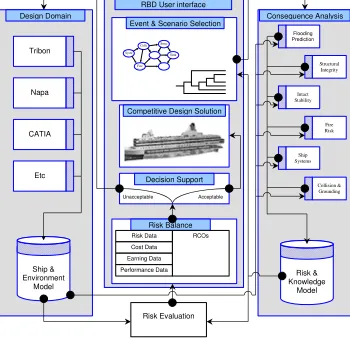
Whilst this framework may seem to be conceptually similar to both the VRS platform and to VIRTUE (discussed below), the focus from an integration viewpoint is more towards the efficient and effective co-ordination of data, due to the less formalised nature of the risk-based design process. Design as well as Performance, Earnings, Risk and Cost (PERC) analysis tools will be wrapped in a similar approach to that adopted within the VRS platform, however the focus will be towards ensuring propagation of change and consistency between the design data model and the PERC analysis.
The challenges for the SAFEDOR integrated environment include the development of a probability analysis to identify and rank hazards, a consequence analysis (similar to the change prediction of NECTISE) to consider different “what if” scenarios, and the identification and evaluation of Risk Control Options (RCOs) that may be applied to reduce any unsatisfactory risk to an acceptable level whilst accounting for other design constraints.
Design Domain
Tribon
Ship & Environment
Model Napa
CATIA
Etc
RBD User interface
Event & Scenario Selection
Struc tl Syste
Colli i Fire El
Sink
Consequence Analysis
Risk & Knowledge
Model
Flooding Prediction
Structural Integrity Intact Stability
Fire Risk Ship Systems
Collision & Grounding
Risk Evaluation Risk Balance
Risk Data RCOs
Cost Data
Earning Data
Performance Data Decision Support
Acceptable Unacceptable
[image:9.595.217.392.352.521.2]Competitive Design Solution
Figure 3. SAFEDOR RBD integrated platform.
4.3 VIRTUE
able to optimise the design in a time effective manner. When optimisers rely on the evaluation of typically thousands of concepts (depending upon the technique and problem complexity), using CFD codes for evaluation is not appropriate. Where possible VIRTUE uses approximate methods such as strip theory, generating results of lesser accuracy than CFD, but in a fraction of the time. Once an approximate optimum solution is found, the CFD codes may be used for refinement. It is anticipated that the amount of data generated for the optimisation using approximate methods, and refinement using CFD, will be several orders of magnitude greater than managed within the VRS virtual platform. An alternative approach to data management is being developed within VIRTUE that utilises an XML database to contain meta-data only, using techniques similar to Uniform Resource Locators to point to the data that is subsequently stored at some place within the network. This approach removes the limitations of many XML databases with respect to the size of the files that can be stored and also removes the need to translate into a neutral format. The shortcoming however is that each tool to be integrated may require a number of import and export utilities to be produced rather than simply to and from the neutral format. The trade-off with this approach is the added flexibility to be able to manage different data structures, files, and types (as opposed to the single XML schema), against the additional effort required to enable a new tool to be integrated (a potential combinatorial explosion in the number of import and export methods if an agreed format such as the Standard for the Exchange of Product Model Data (STEP) or the Initial Graphics Exchange Specification (IGES) is not used).
An extension is also required to the process-level co-ordination: the process control tool was previously only capable of managing a single project, consisting of multiple processes, users and requirements. VIRTUE will manage multiple different projects consisting of either the same, similar or different processes, with multiple users working across projects. The management of multiple projects adds another layer of complexity to the co-ordination within the process control tool. However the resulting need to be able to manage multiple different versions of the design being considered within these different projects adds an additional layer of complexity to both the process and data co-ordination and is where the main challenge lies.
6. Future developments and challenges
ad-hoc basis where required. In addition, support will be provided to processes, tasks and activities irrespective of the life-phase that they represent, with minimal cognitive impact on the user.
One of the shortcomings of VRShips resulted from the way that process models were managed – with the allocation of an activity to a resource (on a one to one basis) that has registered the ability to be able to undertake it. Whilst this approach enabled process planning and design to be undertaken within a formalised manner, activities could only be enacted once the activities that they were dependent upon were complete. Multiple activities could be undertaken in parallel, however no support for overlapping dependent activities was provided.
The consequences of providing this support are however significant and could form the basis for future developments. Assuming that two dependent activities are completely overlapped, and are therefore running in parallel, the two resources performing the activities will be required to be made continuously aware of the actions and outcomes of each other. Changes made to the design for example therefore require continuous broadcast to all the resources that are affected by the change. Similarities may be drawn and techniques adopted within the computer gaming industry whereby servers run environments that contain many users interacting with the environment and with each other. The changes that are made to the environment are continuous and don’t rely on a user completing their activities before being broadcast to other users.
Where the VRShips platform was generalized in every aspect other than the data contained within the common model, providing continuous activity support rather than discrete would require a large amount of domain specific knowledge to be supplied to the user. The tools that the user normally operates would require wrapping of source code to enable the dynamic transfer of data during operation to other users. A task or activity level co-ordination layer would still be necessary to avoid chaotic behaviour, but would provide support for dynamically created processes and would respond to as well as guide the users actions in both a planned and ad-hoc manner. This activity level co-ordination layer would therefore require domain specific knowledge to be gathered regarding the users actions, to be used as a basis for establishing a new course of action.
5. Conclusion
design management support within a EU funded collaborative project called VRShips-ROPAX with the development of the VRS virtual platform. Whilst this platform successfully demonstrated the concept of enabling collaborative design within a domain that is notoriously difficult to manage, a number of issues remain to be covered. The CAD Centre is currently involved in a number of other projects that individually cover the issues: NECTISE, SAFEDOR and VIRTUE. The challenges for each of these projects are discussed. A vision for the future development, continuing from where NECTISE, SAFEDOR and VIRTUE will finish is provided.
Acknowledgements
The authors would like to acknowledge the funding received to enable this research to be undertaken. The VRShips-ROPAX project was funded by the European Commission (grant number G3RD-CT-2001-00506), which is part of the Fifth Framework Programme for Research, Technological Development and Demonstration. The NECTISE project was jointly funded by BAE Systems and the Engineering and Physical Science Research Council under grant number EP/D505461/1. Both the SAFEDOR and VIRTUE projects were partially funded by the European Commission (contract numbers FP6-516278 and FP6-516201 respectively), within the Sixth Framework Programme. The opinions expressed are those of the authors and should not be construed to represent the views of either the NECTISE, SAFEDOR or VIRTUE partnerships.
References
Chapanis A, Frick FC, Garner WR, Gebhard JW, Grether WF, Henneman RH, Kappaif WE,
Newman EB and Williams AC: 1951, Human Engineering for an Effective Air
Navigation and Traffic Control System, ed. P.M. Fitts, Washington DC: National
Research Council.
Cummings ML: 2004, Automation bias in intelligent time critical decision support systems, AIAA 1st Intelligent Systems Technical Conference.
Guan X, Duffy AHB and Maccallum KJ: 1997, Prototype system for supporting the incremental modelling of vague geometric configurations, AI EDAM special issue on Geometric Representation and Reasoning in Design, 11, 287-310.
Manfaat D, Duffy AHB and Lee BS: 1998, SPIDA - Abstracting and generalising layout design cases, Int. Journal on Artificial Intelligence for Engineering Design, Analysis and Manufacture (AI EDAM), Special issue on Machine Learning in Design, 12, 2, pp141-159.
Mann RW and Coons SA: 1965, Computer-aided design, in McGraw-Hill Yearbook Science and Technology, New York, McGraw-Hill, pp. 1-9.
Yan, XT, Rehman, F and Borg, J: 2002, Foreseeing design solution consequences using design context information, IFIP Working Group 5.2, Fifth Workshop, Malta, July 2002. Zhang, Y, Maccallum, KJ and Duffy AHB: 1997, Product knowledge modelling and