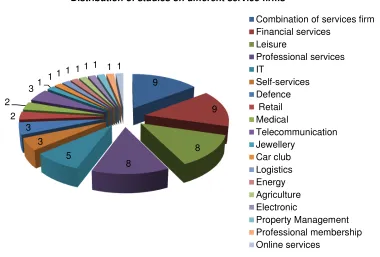
A Framework for Service Solution Provision
in Professional Service Firms: Transforming
Brand Oriented People and Knowledge
Oriented Processes into Superior
Service Solution and
Brand Equity
By
Vida Siahtiri
Tasmanian School of Business & Economics
Submitted in fulfilment of the requirements for the Doctor of Philosophy
University of Tasmania
I
Declaration of Originality
This thesis contains no material which has been accepted for a degree or diploma by the University or any other institution, except by way of background information and duly acknowledged in the thesis, and to the best of my knowledge and belief no material previously published or written by another person except where due acknowledgement is made in the text of the thesis, nor does the thesis contain any material that infringes copyright.
Signed
II
Authority of Access Statement
This thesis may be made available for loan. Copying of any part of this thesis is prohibited for two years from the date this statement was signed; after that time limited copying and communication is permitted in accordance with the Copyright Act 1968.
Signed
III
Statement of Ethical Conduct
The research associated with this thesis abides by the National Statement on Ethical Conduct in Human Research and the rulings of safety and Ethics of the Human Research Ethics Committee of the University of Tasmania.
Signed
IV
Acknowledgement
Now that the journey of PhD with all its ups and down is about at its end, I am using this opportunity to express my gratitude to everyone who supported me throughout the course of my journey toward my PhD. I am thankful for their inspiring guidance, invaluable constructive criticism and friendly advice during the PhD project. I am sincerely grateful to them for sharing their truthful and illuminating views on the issues I shared with them throughout my PhD journey.
Above all, this thesis would not have been possible without the help, support and patience, not to mention his advice and unsurpassed knowledge of marketing of my principal supervisor, Professor Aron O’Cass,. His good advice, support and friendship has been invaluable on both an academic and a personal level, for which I am extremely grateful. I would also like to thank my co-supervisor, Dr. Nima Heirati from the University of Newcastle, UK, for guiding and helping me to develop my research skill. I would like to acknowledge that he was there when I needed him. I am grateful for all his support when needed.
I would like to acknowledge the financial and academic support of the University of Tasmania, particularly for providing me with a scholarship that provided the necessary financial support for my living and studying. I would like to sincerely appreciate my old friend Hamid Mansouri, who without his support and generosity I never could be where I am and who I am now. I would like to thank my fellow postgraduate students for encouragement and emotional support, especially Hormoz, Sophie and Thomas. Last, but by no means least, I would like to thank my family, especially my mother Mohtaraam Mahrooee and my father Mohammad Siahtiri. There are no words to express my gratitude to my parents’ unconditional love, unlimited support, and generous encouragement. I am sure if I did not have my parents’ sincere blessing I never could have been successful.
I dedicate this thesis to all who helped me and generously supported me to complete my PhD. Without their support, I would clearly not be successful. For any errors or inadequacies that may remain in this work, of course, the responsibility is entirely my own.
Signed
V
Table of Contents
Declration of Originality I
Authority of Access Statement II
Statement of Ethical Conduct III
Acknowledgements IV
Table of Contents V
Table of Tables XIII
Table of Figures XV
Abstract XVII
Chapter One: Introduction
1.1. Introduction and background to the research 1
1.2. Research gap, question, and contributions 3
1.2.1. Research gap 3
1.2.2. Research question 6
1.2.3. Key contributions 7
1.3. Justification for the research 10
1.3.1. Justification of the context 11
1.3.2. Justification of the topics/themes 12
1.4. Definitions of key constructs 14
1.5. Methodology 15
1.6. Outline of the report 15
1.7. Delimitations of scope 17
1.8. Conclusion 17
Chapter Two: Content Analysis of Customer Cooperation in
Service Provision
2.1. Introduction 19
VI process
2.3. Methodology for the classification 22
2.4. The content analysis results 23
2.4.1. Number of CCSP articles and their distribution 24
2.4.2. Categorisation of research based on market, industry, and topics on CCSP
26
2.4.3 Research topics and design 28
2.4.4. Type of respondents and method of data collection 29
2.4.5. Terms used in defining CCSP 32
2.4.6. Research streams in CCSP 35
2.4.7. Definitions of terms applied in CCSP 37
2.4.8. Similarities and differences between definitions of terms applied in CCSP
46
2.4.9. Measurement used to determine CCSP 48
2.4.9.1. Measurements applied to examine CCSP from consumer
perspective
49
2.4.9.2. Measurement of CCSP with the focus on firm 57
2.4.10. Antecedents and consequences of CCSP 61
2.4.10.1. The antecedents and consequences of CCSP from customer perspective
61
2.4.10.2. The antecedents and consequences of CCSP from the service firm perspective
63
2.5. Discussion and conclusion 69
Chapter Three: Literature Review
3.1. Introduction 74
3.2. Background and origin of the concept of service solution 75
3.3. Conceptualisation of solution 77
VII
3.4.1. Relational based research on solution 81
3.4.2. Antecedent and consequences of superior solution 84
3.4.2.1. Consequences of superior solution 84
3.4.2.2. Antecedents of solution provision 85
3.5. Branding and brand equity 89
3.5.1. Service branding 94
3.5.2. The role of leadership and employees in developing service brand 97
3.5.2.1. Transformational leadership 98
3.5.2.2. Employees behaviour 101
3.6. Conclusion 105
Chapter Four: Theory Development and Hypotheses
4.1. Introduction 107
4.2. Model development 108
4.2.1. Model development, Stage 1: Definition of service solutions 109
4.2.2. Model development, Stage 2 - Hypotheses 1 to 3: The role of people processes in the service solution provision process
112
4.2.2.1. Hypothesis1: BSTFL and employee brand building behaviour 115
4.2.2.2. Hypothesis2: Employee brand building behaviour and CCSP 117
4.2.2.3. Hypothesis3: CCSP and service solution superiority 119
4.2.3. Model development, Stage 3: Hypotheses 4 to 6: The role of knowledge processes to provide service solutions
121
4.2.3.1. Technical knowledge and service solution superiority 123
4.2.3.1.1. Hypothesis 4a: Deep technical knowledge and service solution superiority
124
4.2.3.1.2. Hypothesis 4b: Broad technical knowledge and service solution superiority
126
4.2.3.2. Customer knowledge and CCSP 128
VIII
4.2.3.2.2. Hypothesis 5b: Broad customer knowledge and CCSP 130
4.2.3.3. Moderation role of knowledge assimilation 131
4.2.3.3.1. Hypotheses 6a: Moderation role of knowledge assimilation on the relationship between broad and deep technical knowledge and service solution superiority
132
4.2.3.3.2. Hypotheses 6B: Moderation role of knowledge assimilation on the relationship between broad and deep customer knowledge and CCSP
134
4.2.4. Model development, Stage 4: Hypotheses 7 a, b, and c: Service
solution superiority and brand equity
135
4.2.4.1. Hypotheses 7a: Service solutions and customer commitment 136
4.2.4.2. Hypotheses 7b: Service solutions and market effectiveness 138
4.2.4. Hypotheses 7c: Service solutions and profitability 138
4.3. Summary of the overall model 139
4.4. Conclusion 141
Chapter Five: Research Design
5.1. Introduction 143
5.2. Process of research 143
5.3. Stage One: The preliminary planning stage 146
5.3.1. Problem identification and the development of research question 146
5.3.2. Conceptual model development 149
5.4. Stage Two: Research design stage 149
5.4.1. Research paradigm 150
5.4.1.1. The research approach: Quantitative research 150
5.4.1.2. Data collection method 151
5.4.2. The research tactics 153
5.4.2.1. Measurement development 153
IX
5.4.2.1.1.1. Step 1: Defining constructs 155
5.4.2.1.1.2. Step 2: Generation of items 157
5.4.2.1.1.3. Step 3: Scale poles 163
5.4.2.1.1.4. Step 4: Draft pool of item 165
5.4.2.1.1.5. Phase two: Item refinement 166
5.4.2.1.1.6. Step 1: Expert-judge of face validity 167
5.4.2.1.1.7. Step 2: Decision rules for removing and/or keeping preventative items
168
5.4.2.1.1.8. Step 3: Pretesting 170
5.4.2.1.1.9. Step 4: Final surveys 170
5.4.2.2 Design of sampling plan 172
5.5. Analysis procedure 174
5.6. Conclusion 175
Chapter Six: Data Analysis
6.1. Introduction 177
6.2. Preliminary data analysis 178
6.2.1. Profiles of the sample 178
6.2.2. Descriptive statistic results 182
6.3. Partial least squares (PLS) 188
6.4. Outer measurement model results 189
6.4.1. Knowledge assimilation (Survey A) 190
6.4.2. Employee brand building behaviour (Survey A) 191
6.4.3. Deep and broad technical knowledge (Survey B) 192
6.4.4. Deep and broad customer knowledge (Survey B) 192
6.4.5. CCSP (Survey B) 193
6.4.6. Service solution superiority (Survey B) 194
X
6.4.8. Profitability (Survey B) 195
6.4.9. Customer based brand equity (Survey C) 195
6.4.10. Brand specific transformational leadership (Survey C) 196
6.4.11. Control variables (Survey A) 196
6.5. Validity assessment 197
6.5.1. Convergent validity 198
6.5.2. Discriminant validity 198
6.6. Common method bias 201
6.7. Inner structural model results 202
6.7.1. Hypotheses with direct relationships (H1, H2, H5a&b, and H7 a, b & c) 203
6.7.2. Hypotheses for U-shaped relationships (H3, H4a, and H4b) 204
6.7.3. Hypotheses for moderation relationships (H6a and H6b) 206
6.8. The model fit of inner-structural models 207
6.9. Summary of hypotheses results 209
6.10 Conclusion 210
Chapter Seven: Discussion and Conclusions
7.1. Introduction 211
7.2. Overview and background of the thesis 211
7.3. Discussion of results 213
7.3.1. Discussion of service solution superiority 217
7.3.2. Results for RQ1 218
7.3.2.1. Discussion of hypothesis 1 219
7.3.2.2. Discussion of hypothesis 2 220
7.3.2.3. Discussion of hypothesis 3 221
7.3.3. Summary of answers for RQ1 222
7.3.4. Result for RQ2 222
XI
7.3.4.2. Discussion of hypothesis 4b 225
7.3.4.3. Discussion of hypothesis 5a 226
7.3.4.4. Discussion of hypothesis 5b 228
7.3.4.5. Discussion of hypothesis 6a 229
7.3.4..6 Discussion of hypothesis 6b 231
7.3.5 Summary of answer to RQ2 232
7.3.6. Results for RQ3 232
7.3.6.1. Discussion of hypothesis 7a 233
7.3.6.2. Discussion of hypothesis 7b and 7c 235
7.3.7 Summary of answer to RQ3 235
7.4. Toward a theory of B2B professional service firms service solution model: Implications for theory and practice
236
7.4.1 Theoretical implications 237
7.4.1.1. Theoretical implications: Service solution 237
7.4.1.2. Theoretical implications for: People management processes block 239
7.4.1.3. Theoretical implications for: Knowledge management processes block
245
7.4.1.4. Theoretical implications: Brand equity block 248
7.4.2. Summary of theoretical implications 249
7.4.3. Managerial implications for professional service firms 253
7.4.3.1. Managerial implications: Service solution superiority 253
7.4.3.2. Managerial implications: People management processes block 253
7.4.3.3. Managerial implications: Knowledge management processes
block
255
7.4.3.4. Managerial implications: Brand equity block 256
7.4.4. Summary of managerial implications 257
7.5. Limitations and future research 257
XII
Appendices
Appendix I Information Sheet 262
Appendix II Questionnaire A 265
Appendix III Questionnaire B 268
Appendix IV Questionnaire C 271
XIII
Table of Tables
Chapter One: Introduction
1.1 Construct definitions 14
Chapter Two: Content Analysis of Customer Cooperation in
Service Provision
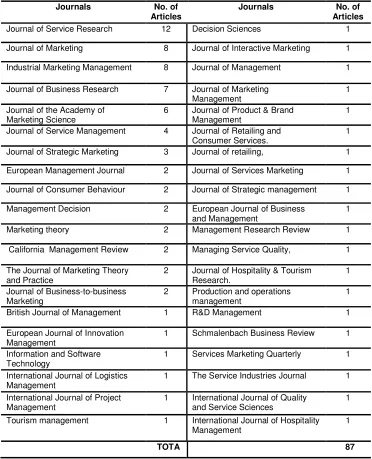
2.1 The publication and number of studies published in each journal during the
research period 2000-2013 26
2.2 The focus of research: Topic CCSP 29
2.3 Analytical techniques reported 32
2.4 Streams of research on CCSP 36
2.5 Definition of terms in CCSP 41
2.6 Measurements applied to examine CCSP in consumer research 52
2.7 CCSP measure from firm perspective 59
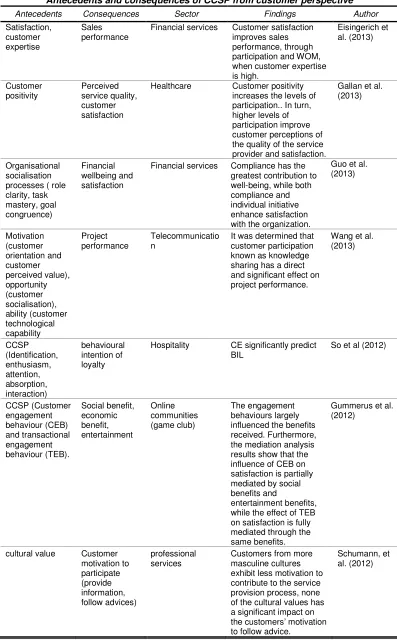
2.8 Antecedents and consequences of CCSP from customer perspective 65
Chapter Three: Literature Review
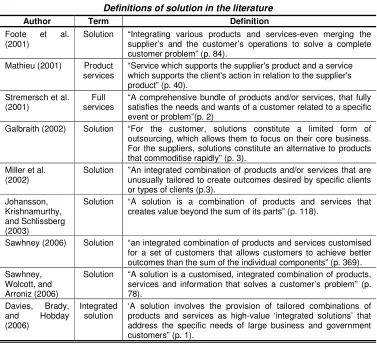
3.1 Definitions of solution in the literature 79
Chapter Four: Theory Development and Hypotheses
Chapter Five: Research Design
5.1 Summary of survey methods 152
5.2 Definitions of constructs 156
5.3 The anchor poles for all constructs 165
5.4 Initial pool: constructs and numbers of corresponding items 166
5.5 Refined item pool and demographic items 169
Chapter Six: Data Analysis
6.1 Profile of sample - PSF characteristics 179
XIV
6.3 Results of descriptive statistics - Survey A 184
6.4 Results of descriptive statistics - Survey B 185
6.5 Results of descriptive statistics - Survey C 187
6.6 Descriptive statistic result of respondent’s knowledge and confidence 188
6.7 Results of outer-measurement model of knowledge assimilation 191
6.8 Results of outer-measurement model of employee brand building behaviour
191
6.9 Results of outer-measurement model of broad and deep technical knowledge
192
6.10 Results of outer-measurement model of broad and deep customer knowledge
193
6.11 Results of outer-measurement model of CCSP 193
6.12 Results of outer-measurement model of service solution superiority 194
6.13 Results of outer-measurement model of market effectiveness 195
6.14 Results of outer-measurement model of profitability 195
6.15 Results of outer-measurement model of customer based brand equity 196 6.16 Results of outer-measurement model of brand specific transformational
leadership
196
6.17 Results of outer-measurement model of environment turbulence 197
6.18 Results for evidence of discriminant validity for the constructs 200
6.19 Results of direct effect relationships tests 204
6.20 Results for U-shaped relationships tests 205
6.21 Results of moderation effect tests 206
6.22 Results for adequacy of the inner structural model results 208
6.23 Summary of hypotheses results 209
Chapter Seven: Discussion and Conclusions
XV
Table of Figures
Chapter One: Introduction
1.1 B2B Professional service firms service solution model 10
1.2 Share of service sector in GDP and employment 2012 11
Chapter Two: Content Analysis of Customer Cooperation in
Service Provision
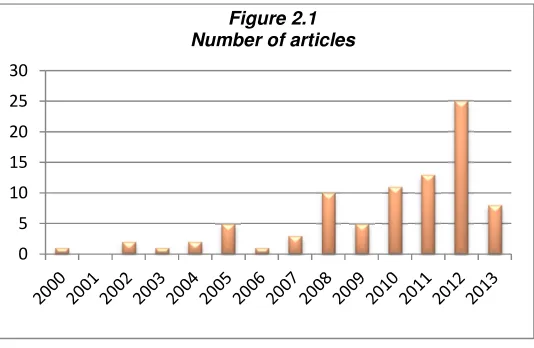
2.1 Number of articles 25
2.2 Distribution of studies on different service firms 28
2.3 Method of data collection 30
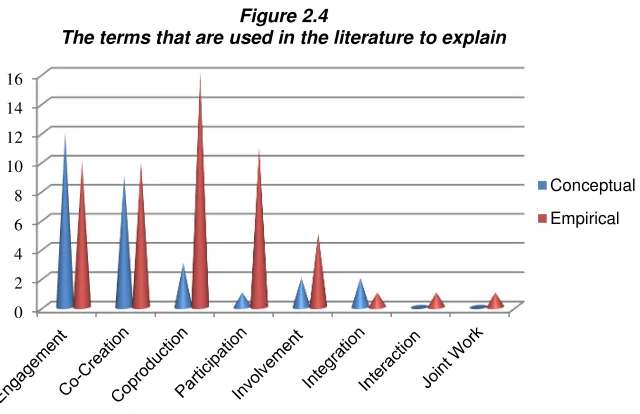
2.4 The terms that are used in the literature to explain CCSP 34
2.5 Comparison of research from qualitative and quantitative perspective 34
2.6 Distributions of measurements of terms in CCSP 48
Chapter Three: Literature Review
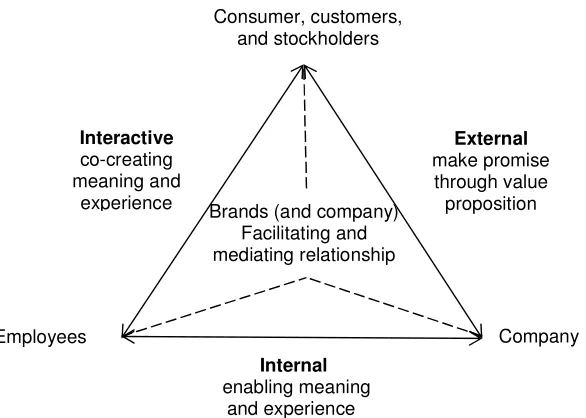
3.1 The service brand- relationship-value triangle (Brodie et al. 2006) 96
Chapter Four: Theory Development and Hypotheses
4.1 Model development: Stage 1 112
4.2 Model development: Stage 2 113
4.3 Model development: Stage 3 122
4.4 Model development: Stage 4 136
4.5 B2B Professional service firms service solutions model 140
Chapter Five: Research Design
5.1 The research design process 145
5.2 Hierarchy of concept in research question design 148
5.3 The measurement development procedure 154
Chapter Six: Data Analysis
6.1 Distribution of gender across three surveys 180
XVI
6.3 Distribution of positions across three surveys 181
6.4 Distribution of age across three surveys 182
Chapter Seven: Discussion and Conclusions
XVII
Abstract
Facing high velocity markets and increasingly dynamic and powerful environmental forces, many businesses across diverse industries are increasingly trying to solve their business problems by using the services of professional service firms (PSFs) whose primary offering is the application and delivery of specialised and intensive knowledge in the form of service solutions (Jaakkola and Hakanen 2013; Kapletia and Probert 2010; Williams and Nersessian 2007). These market changes have created both opportunities and challenges for PSFs, who are providers of service solutions to industrial and business customers. To contribute to the development of theory focusing on PSFs, this study takes the view that providing superior service solutions is the critical path to enhance brand equity and to position PSFs in their markets. A superior service solution is manifested through the interplay of processes underpinned by employee-leader and customer actions, which in this study encompass people-management processes and processes underpinned by the generation and use of knowledge, which here are seen as knowledge-management processes. Focusing on how PSFs provide superior service solutions and enhance their brand equity opens up opportunities to develop unique theory addressing critical issues facing PSFs.
This study develops a theoretical framework underpinned by the solution literature and adopts literature from relationship marketing theory with a specific focus on customer cooperation in service provision process (CCSP) to develop its theory in the context of PSFs. Further, this study adopts leadership literature with the specific focus on brand specific transformational leadership theory, employee brand building behaviour theorising, and brand equity to investigate the people - and knowledge - management processes in PSFs that assist in providing superior service solution - which is quality and innovative- and create greater returns to the PSF in the form of brand equity. With its theoretical focus on people and knowledge management processes and branding this study makes a number of contributions to the service and branding literature, specifically in the context of PSFs.
XVIII
Schmidt (2010), Leek and Christodoulides (2011), and Santos-Vijande et al (2013) who believe identifying internal organisational processes that generate consistent brand perceptions amongst employees is required. Fourth, this study responds to the recent call for further research by Chae (2012) on the effects of broad knowledge in knowledge intensive firms, specifically PSFs. This study contributes to the literature by examining the effect of deep and broad technical and customer knowledge on the superiority of service solutions and CCSP. Finally, this study contributes to the literature by examining and showing the effect of knowledge assimilation on different types of knowledge in knowledge intensive firms such as PSFs differs. This study extends the work of Zhou and Li (2012) by examining the differential effects of knowledge assimilation on deep and broad knowledge.
This study employed a quantitative research methodology to examine and test the theoretical framework using an online survey protocol to collect the data. In particular, three surveys were designed and administrated following a multiple-informant design (De Luca and Atuahene-Gima 2007) to a sample of PSFs operating in B2B markets in Taiwan, resulting in data being collected from 150 PSFs. To analyse the data, a three-phase analytical strategy was adopted, with the first phase focusing on descriptive, the second phase focusing on preliminary analysis, and the third phase is hypothesis testing. SPSS was used for descriptive means and Partial Least Squares (PLS) were used for preliminary analysis and hypothesis testing.
1
Chapter One
Introduction
PSFs are different from many organizations from which much current organizational theory was (and still is) derived
Greenwood et al. 2006, p.5
1.1.Introduction and background to the research
Faced with intensifying competition, businesses across diverse industries are increasingly trying to solve their business problems by engaging the services of professional service firms whose core asset is their specialised and intensive knowledge (Global Services Forum 2013; Jaakkola and Hakanen 2013; Kapletia and Probert 2010). The trend to access external expertise and knowledge by business customers has resulted in a growing role and increasing importance of business to business (B2B) professional service firms (PSFs) whose main service offering is service solutions (Global Services Forum 2013; Jaakkola and Halinen 2013). The growing demand for business-to-business (B2B) service solutions has led to an increasingly competitive market and a range of challenges for PSFs (Amonini et al. 2010). Some of these challenges emanate from the specific organisational characteristics of PSF and their offerings (Guzak and Rasheed 2013; Greenwood et al. 2005; Lowendahl 2000; Maister 1993; Malhotra et al. 2006).
2
Pettigrew 2006; Maister 1993). Facing these challenges will be fundamental to creating and maintaining their competitive market position (Amonini et al. 2010).
Maintaining a strong competitive market position has become a challenge for many firms including B2B PSFs, as a result of increasing complexity and velocity of markets (Kumar and Christodoulopoulou 2014; Engelen et al. 2014; O’Cass and Sok 2013; Probert et al. 2013; Day 2011). This challenge is especially more evident in PSFs, because of the intangibility of the service and customer difficulty in evaluating the quality of the service, even after consumption (Von Nordenflycht 2010; Jennings et al. 2006; Greenwood et al. 2005; Maister 1993). These challenges and issues bring attention to PSFs in relation to providing superior service solutions and building brand equity as two key strategic weapons for supporting the development of a competitive market position. For example, KPMG a major accounting company was offered a small contract by IBM. KPMG performed so well in providing the solution, that IBM immediately offered them a new contract. Based on their continued superior performance in solution provision KPMG has been identified by IBM as a preferred service provider (see, KPMG website, case studies for further information).
Investing in brand equity seems an appropriate approach to maintain competitive market position (Marquardt et al. 2011; Rust et al. 2004). The underlying reason is that the credibility of the service brand is a critical factor that contributes to customers’ evaluation of the quality of the service and purchase decision-making (Santos-Vijande et al. 2013; Jennings et al. 2006; Brodie et al. 2006). Further, service solutions are characterised by the application of complex knowledge, and are interactively designed and customised by the PSF in cooperation with the customer (Jaakkola and Hakanen 2013; Aarikka-Stenroos and Jaakkola 2012; Greenwood et al. 2006; Maister 1993). As such, managing CCSP (Greenwood et al. 2006; Maister 1993) and developing an appropriate knowledge base may be a fundamental challenge PSFs need to face (Chae 2012). While environmental changes are driving PSFs to be more customer focused (Fenton and Pettigrew 2003), they need a leadership style that is congruent with their core market offerings, dynamic nature, and the competitive market conditions they face (Fenton and Pettigrew 2006; Amonini et al. 2010). This leadership style should assist them to enhance the credibility of their brand in the market by focusing on customers and providing a superior service solution. The positive outcomes of overcoming these challenges will manifest in providing superior service solutions, which in turn enables PSFs to enhance their brand equity and distinguish themselves in the marketplace (Amonini et al. 2010).
3
as there are calls by scholars to develop theory that suits PSFs and their special characteristics.
1.2. Research gaps, questions , and contributions
Providing superior service solutions has become a source of increasing revenues and improving market share for both manufacturers (Fang et al. 2008; Reinartz and Ulaga 2008) and PSFs (Amonini et al. 2010). As the relevance of manufacturers providing service solutions to increase their competitiveness continues to grow, research on service solutions has to-date predominantly been couched in the context of manufacturers transitioning from providing goods to providing a combination of goods and services (Ulaga and Reinartz 2011; Fang et al. 2008; Reinartz and Ulaga 2008; Jacob and Ulaga 2008; Jacob 2006).
Given the increasing role and the importance of providing service solutions to solve business problems, studying the antecedents and consequences of providing superior service solutions in PSFs is paramount. However, except for the work of Jaakkola and Hakanen (2013), Aarikka-Stenroos and Jaakkola (2012), and Gummesson (1987), little attention has been given to identify the antecedents and consequences of superior service solutions in the context of B2B PSFs. The research focusing on service solutions provided by PSFs has largely concentrated on identifying the processes where the PSF and the customer work together during the service solution provision process (Tuli et al. 2007) or has sought to identify resources that each party brings into the service solution provision process (Aarikka-Stenroos and Jaakkola 2012). There are gaps in the current literature about how B2B PSFs overcome the challenge of providing consistently superior service solutions to their customers and achieve superior brand equity (e.g., customer based brand equity (CBBE) and firm based brand equity (FBBE)). In this study, seven key gaps are identified related to the challenges of providing superior service solutions and enhancing B2B PSFs’ brand equity.
1.2.1. Research gaps
4
O’Cass (2013) identify that service quality mediates the relationship between CCSP and financial performance. In service innovation literature, Melton and Hartline (2010) suggest marketability of a new service moderates the relationship between the CCSP in service innovation and the service firms’ financial performance. Finally, in the project development literature where it is identified that CCSP is a prerequisite of project success, Peled and Dvir (2012) suggest characteristics of the project are determinants of the effect of CCSP on project performance. Thus, it is important to develop a deeper understanding about other possible factors that have the capacity to help explain the relationship between CCSP and PSFs brand equity.
The second gap also relates to the level of CCSP required in the service solutions provision process that ensures the provision of a superior service solution to a customer. Many scholars point out that CCSP is important to ensure solution quality and superiority (Aarikka-Stenroos and Jaakkola 2012; Töllner et al. 2011; Nordin and Kowalkowski 2010; Kapletia and Probert 2010; Brax and Jonsson 2009; Davies et al. 2007; Tuli et al. 2007; Helander and Moller 2007). On the other hand, some argue that excessive CCSP decreases the quality of the service (Ngo and O’Cass 2013; Chase 1987). Thus, it is important to identify and understand at what level CCSP results in service solution superiority and at what level CCSP has a negative effect on the superiority of service solutions. Given that CCSP is a key component of providing service solutions, it is surprising that to date no research has identified the extent that CCSP is actually beneficial in the service solution provision process.
The third gap is linked to the second gap and relates to the extent that the PSF’s CCSP is facilitated by specific organisational mechanisms. Given the changing role of leaders in PSFs from controlling to promoting changes (Fenton and Pettigrew 2006), there is a gap in the current literature on identifying the effect of leadership, especially leadership that supports brand values, on the PSF’s CCSP and provide superior service solutions. The credibility of the brand and the brand’s values are important factors in developing relationships with customers (Amonini et al. 2010; King and Grace 2009) and CCSP is a platform where the customer has the opportunity to experience the brand’s values. Given the relational nature of CCSP, it is important to understand whether a leadership style that promotes brand values affects a PSF’s CCSP that in turns helps provide superior service solutions.
5
literature, the role of employees in implementing leadership philosophy is well documented (Yoshida et al. 2013; Punjaisri et al. 2013; Liao and Chuang 2007; Vallaster and Chematony 2006; Bono and Judge 2003). Yet little is known about whether a leader who supports specific brand values can affect employees’ behaviour and guide them to consistently behave in accordance with the brand’s values. Further, there is no evidence in the literature to show whether employees brand building behaviour improves the PSFs’ CCSP. Given that employees are the service firm in the customer’s eyes (Lovelock and Wirtz 2011), it is important to understand what types of employee behaviour improves the PSFs’ CCSP to actualise the brand promises and how these types of employee behaviour can be encouraged across the PSF.
The fifth gap is related to the application of different types of knowledge by a PSF to provide superior service solutions and improve CCSP. The literature supports the view that deep customer knowledge is necessary to understand what solution should be prepared for the customer (Miller et al. 2002, Empson 2001). Further, deep technical knowledge is necessary to understand how the service solution should be provided to solve business customer’s problem (Jaakkola and Halinen 2006; Greenwood et al. 2005; Maister 1993). However, at the present there is no empirical evidence that addresses whether broad technical and customer knowledge helps or hinders a PSF’s ability to provide customised service solutions, or improve the PSF’s CCSP. Given the identified disadvantages of deep knowledge, such as lack of idea creation or inertia (Zhou and Li 2012; Katila and Ahuja 2002), it is important to understand the extent that broad knowledge is applicable in the PSF context that are well known for possessing deep and intensive knowledge.
6
understanding diverse knowledge and casting it across the PSF to apply in the PSF’s service solution provision process.
The seventh gap is related to the contribution of service solution superiority to the PSFs’ performance. The literature has mainly focused on solutions in the context of manufacturing firms who transition from a product offering to combination of goods and services. There are a very small number of studies focusing on the relationship between service solutions and firm performance (Eggert et al. 2014). However, this body of work has largely viewed service solutions as different types of industrial services (e.g., customer service support and product service support) that mainly focused on three areas. The first area is the effect of industrial services on (1) growth and profitability of the firm (Eggert et al. 2014 and 2011), (2) the product sales volume (Antioco et al. 2008), and (3) the firm value (Fang et al. 2008). However, this small body of work has not addressed the effect of service solutions on brand equity, particularly in the form of both customer based brand equity (e.g., customer commitment) and firm based brand equity (e.g., market effectiveness). Brand equity is recognised as one of the most important intangible assets (Santos-Vijande et al 2013; Rust et al. 2004); especially in service firms (Brodie et al. 2006). Given the importance of the brand, especially for B2B service firms, it is important to understand whether service solutions that address business customers’ needs improve brand equity.
1.2.2. Research questions
The gaps identified above fit within three broad areas encompassing: people management processes (leadership style, employee brand building behaviours, and CCSP), knowledge management processes (deep and broad technical knowledge, deep and broad customer knowledge, knowledge assimilation), and the outcomes which are related to brand equity (customer based brand equity and firm based equity). Based on the classification of gaps as people processes, knowledge processes, and brand equity three main research questions are identified:
RQ1- To what extent do people management processes impact service solution
superiority in PSFs?
RQ2- To what extent do knowledge management processes impact service
solution superiority in PSFs?
RQ3- To what extent does service solution superiority impact brand equity in
7
To address these broad research questions, the following sub-research questions are advanced for each category (people management processes, knowledge management process, and brand equity).
Sub-questions for people management process:
RQ1a. To what extent does brand specific transformational leadership influence
employee brand building behaviour in PSFs?
RQ1b. To what extent does employee brand building behaviour influence CCSP in
the PSFs?
RQ1c. To what extent does CCSP improve service solution superiority in the
PSFs?
Sub-questions for knowledge management process:
RQ2a. To what extent do the levels of broad and deep technical knowledge
influence service solution superiority in PSFs?
RQ2b. To what extent does the broad and deep customer knowledge influence
CCSP in PSFs?
RQ2c. To what extent does knowledge assimilation affect the strength of the
relationship between technical knowledge and service solution superiority in PSFs?
RQ2d. To what extent does knowledge assimilation affect the strength of the
relationship between customer knowledge and CCSP in PSFs?
Sub-questions for brand equity output:
RQ3a. To what extent does service solution superiority contribute to the
development of customer based brand equity in PSFs?
RQ3b. To what extent does service solution superiority contribute to the
development of firm based brand equity in PSFs?
1.2.3. Key contributions
8
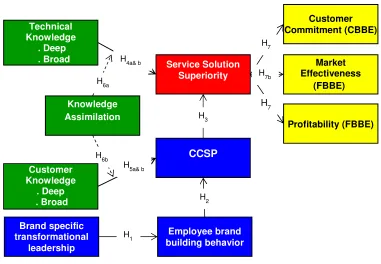
(Rust et al. 2004; Keller 2003). The theoretical development of research model is undertaken comprehensively in Chapter Four and also outlined briefly below in Figure 1.1. Overall, in addressing the research questions and contributing to closing the identified research gaps, this study makes six contributions to the literature.
First, this study contributes to the literature by examining the extent that CCSP drives a PSF’s brand equity in the form of customer-based brand equity and firm based brand equity for the PSF through the service solution superiority. The focus here is on the extent that the service solution superiority mediates the effect of CCSP on brand equity (customer based and firm based brand equity). However, the premise here is that the effect of CCSP on service solution superiority is more complicated than explained in the literature. A non-linear relationship is argued to exist between CCSP and service solution superiority. Thus, this study advances the understanding on identifying the optimum level of CCSP that maximises the service solution superiority. This contribution is critical, because it provides insight into the dilemma faced by high contact service firms on the extent of CCSP by identifying how much cooperation with the customer is beneficial.
Second, this study contributes to the literature by examining the effect of leadership style, specifically transformational leadership on injecting brand values into CCSP to provide superior service solution. This research advances the arguments raised by Storbacka et al. (2013), Fenton and Pettigrew (2006), and Galbraith (2002) that the [service] solution is dynamic in nature, and therefore; requires a transformational leadership style. This study contributes to the literature by showing how a transformational leader who supports the brand and brand values in all inter firm processes can improve the PSFs’ CCSP by actualising brand promises and providing superior service solutions. This contribution is important, because it will provide a better understanding of how PSFs can consistently represent and support brand values.
9
processes, such as CCSP in PSFs to actualise brand values and provide superior service solutions.
Fourth, this study contributes to the literature by examining the effect of deep and broad technical and customer knowledge on the service solution superiority and CCSP. This study responds to the recent call for further research by Chae (2012) on the effects of broad knowledge in knowledge intensive firms, specifically PSFs. This study advances the understanding about if broad knowledge in PSFs assists them to provide superior service solutions and develop CCSP. This contribution is important, because it will provide a better understanding of different effect of different types of knowledge on service solution superiority and CCSP in PSFs.
Fifth, this study contributes to the literature by examining the effect of knowledge assimilation on different types of knowledge in knowledge intensive service firms such as PSFs differs. This study extends the work of Zhou and Li (2012) by examining different effects of knowledge assimilation on deep and broad knowledge. This study advances the understanding about whether knowledge assimilation is more beneficial on the relationship between broad knowledge and CCSP/ service solution superiority or deep knowledge and CCSP/ service solution superiority. This contribution is important, because it will provide a better understanding of how knowledge should be assimilated to take the most advantage of the acquired knowledge in PSFs.
Taking on board the research questions and contributions, this study underpins these by developing a theoretical model labelled as the “B2B Professional service firms service solution model” presented in Figure 1.1. This model is developed fully in Chapter Four and provides the central focus for the thesis in an effort to articulate the relationship between PSFs’ knowledge and CCSP using specific branding activities in order to provide superior service solutions and maintain competitive market position.
10
1.3. Justification for the research
[image:29.612.113.494.95.359.2]During the past few years, research on services and service marketing has been considered as a high priority research area by a number of scholars, research institutes, and government bodies, such as European Research Council (ERC). For example, scholar such as, Baron et al. (2013), Kunz and Hogreve (2011) and Ostrom et al. (2010) and research institutes such as Marketing Science Institute (MSI), and ERC have all highlighted various aspects of services and services marketing as high priority areas in need of research. Given the economic importance of services, particularly service solutions offered by PSFs, research on this area is justified as it has significant practical and theoretical grounds to services marketing literature. In particular, this study is justified because of two broad reasons. The first broad reason focuses on the context (e.g., services, PSFs and Taiwan) and the second broad reason focuses on topics/themes of research (e.g., collaborative organisational structure, service solutions, service branding).
Figure 1.1
B2B Professional service firms service solution model
H4a& b
H5a& b H6b
H3 H6a
Customer Knowledge
. Deep . Broad
Knowledge Assimilation
Service Solution Superiority
CCSP
Source: developed for this research Note: blue boxes represent people management processes Green boxes represent knowledge management processes Yellow boxes represent brand equity
Brand specific transformational
leadership
Employee brand building behavior H1
H2
Customer Commitment (CBBE)
Market Effectiveness
(FBBE)
Profitability (FBBE) H7
H7b H7 Technical
11
1.3.1. Justification of the context
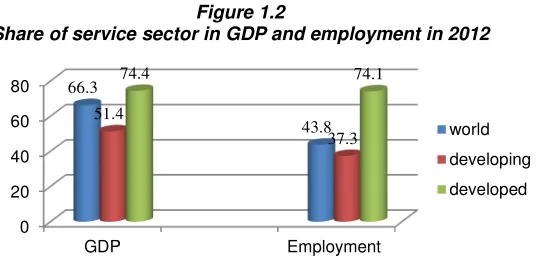
First, the service industry is increasingly identified as contributing to worldwide business growth (Global Economy Watch 2013; Javalgi et al. 2011; Ostrom et al. 2010) and is seen as a critical source of employment in the global economy (Global Services Forum 2013; Javalgi et al. 2011). The global output of the service industry is around 40 trillion USD (accounting for around 2/3rds of the world output), providing employment for 1.4 billion people, which is slightly less than half of the world employment (Global Services Forum 2013). Figure 1.2 shows the share of the service industry to GDP and employment at three different levels. The blue column in Figure 1.2 shows the share of service industry in GDP and employment at the global level, while the red and green columns show the same features in developing and developed countries during 2011 respectively. As shown in Figure 1.2, 66.3% of the total global GDP is the output of service industry activities. Figure 1.2 indicates the contribution of services to many economies (both developed and developing) is around 74% and 51.4% of the total GDP for developed and developing economies respectively. Figure 1.2 illustrates that the service industry is crucial to employment worldwide, as 43.8% of total world employment is the result of economic activity in service industries. The share of employment for developed and developing economies is 74.1% and 37.3%, respectively (Global Services Forum 2013). Given the important contribution of the service industry to employment and GDP in many economies, studying how service firms such as PSFs can achieve superior brand equity, and enhance their contribution to not only individual economy, but the world economy is a priority and justifies this study.
Second, one of the main reasons for the growth in service industry output and the ability to contribute to employment is the increasing demands for service solutions offered by PSFs (Global Services Forum 2013; Corrocher et al. 2013; Williams and
0 20 40 60 80
GDP Employment
66.3
43.8 51.4
37.3
74.4 74.1
[image:30.612.199.467.486.616.2]world developing developed Figure 1.2
Share of service sector in GDP and employment in 2012
12
Nersessian 2007). The professional services industry includes accounting, advertising and marketing, architecture, management consulting, engineering, IT, legal and scientific research services and others. In the literature, PSFs are known by key features related to their extensive interaction with customers, highly educated employees, highly customised knowledge based service, and high credence quality (Jaakkola and Halinen 2006; Løwendahl 2005; Gummesson 1978). Economic indicators show that PSFs are ‘one of the fastest growth sectors in many economies and a primary source of growth for both developed and developing countries (Global Services Forum 2013; Corrocher et al. 2013; McKinsey Global Institute 2012; Javalgi et al. 2011; Amonini et al. 2010; United Nations, 2004). Given the increasing importance of PSFs, studying PSFs is justified.
Third, the context of study is justified because it focuses on Taiwan. Reports published by a range of international institutes on Taiwan show that the business environment, economic situation, and contribution of service firms in the Taiwanese economy is significant (Forbes 2014; The World Factbook 2013; ADB 2012). Further, Taiwan has a very comprehensive and modern professional service sector (Foreign Commercial Service, U.S 2013), which justifies examining the research model using data from Taiwanese PSFs.
1.3.2. Justification of the topics/themes
First, a recent research priority announced by MSI (Marketing Science Institute, 2012-2014) focuses on understanding the effect of organisational structure and marketing capabilities on business performance. In this sense, the focus of research proposed by MSI is designing optimal collaborative structures. This study addresses the collaborative organisational structure issue by scrutinising the optimised effect of CCSP on service performance and knowledge assimilation, which works through service solution superiority. Further, this study addresses the development of internal brand equity, as a marketing capability with the focus on branding leadership philosophy and employee brand building behaviour to develop collaborative process in the service solution context. Thus, this research is justified as it addresses one of the research priorities announced by MSI during the period of 2012-2014.
13
Christodoulides 2012; Coleman et al. 2011; Backhaus et al. 2011; Juntunen et al. 2011; Baumgarth and Schmidt 2010; Ballantyne and Aitken 2007). Leek and Christodoulides (2011) following a review of the branding literature in the B2B context, provide a future research agenda and research directions. The agenda they introduce focuses on internal company processes to generate consistent brand perceptions amongst employees, as well as the role of the brand in improving relationships between B2B firms and their customers. This study addresses the research directions proposed by Leek and Christodoulides (2011) by identifying mechanisms that contributes to improving internal branding and developing CCSP as a relational process. Thus, this study is justified as it addresses a research need in B2B branding.
Third, beneficial cooperation between the service firm and the customer is a key research agenda proposed by Ostrom et al. (2010). This study looks at service solution superiority and brand equity as a benefit the customer and the PSF can obtain from their cooperation. Therefore, this study is justified as it addresses a major research agenda that has been the focus of attention in recent years on the cooperative process between customer and the service firm.
14
1.4. Definitions of key constructs
Given the literature is replete with diverse definitions of the key constructs of this research (e.g., service solution, CCSP, and customer based brand equity), it is important to ensure the key definitions pertaining to specific constructs of interest are presented clearly early on in the study. Table 1.1 identifies the key constructs employed in the research model, with only definitions that are specifically developed for this research. The key constructs of interest that are developed for this research are: deep and broad technical knowledge, superior service solution, CCSP, and customer based brand equity. Definitions for these constructs are developed here for several reasons. First, there are no specific definitions for the key constructs in the context of PSFs (e.g., service solution). Second, there are different definitions for the same construct in the literature that need more clarification to suit in this study (e.g., CCSP process, deep technical knowledge and customer based brand equity). The foundation and development of the definitions of the key constructs employed in the research model presented in Table 1.1 are fully discussed in Chapter Four, where theory and hypotheses are developed.
Table 1.1
Construct definitions
Deep technical knowledge
is the degree of detail and complexity of a PSF’s expert knowledge of the technical and expertise field of operation.
Broad technical knowledge
is the degree of heterogeneity and dissimilarity of a PSF’s expert knowledge of the technical field of operation.
Service solutions
is a customised service to meet customer’s non-standardised needs.
Service solution superiority
is the level of quality and innovativeness of customised service solution provided to customers to meet customer’s non-standardised needs.
CCSP is the extent the PSF works with customers during the design, development, and delivery of service solutions
Customer based brand equity
15
1.5. Methodology
To examine the relationships between the constructs of interest in Figure 1.1 and test the hypotheses (see Chapter 4), this study employed a quantitative research methodology and used survey protocol as the means of data collection. In particular, three surveys were developed and administrated following a multiple-informant design (De Luca and Atuahene-Gima 2007) to a sample of PSFs operating in B2B markets in Taiwan. Using a multiple-informant design decreases the effect of common method bias and ensures a more accurate and higher quality data (O'Cass et al. 2014; Damanpour et al. 2009). Quantitative research is an appropriate research methodology to test the hypotheses that underpin the theoretical framework developed in this study (Neuman 2012). To collect the data, an online administration method was chosen allowing respondents to complete the survey at their convenience. The use of online surveys is acknowledged in the literature for their relative low cost and fast response rates (Van Selm and Jankowski 2006).
The surveys were designed by using and modifying existing measures in the literature. For constructs that have not been measured in the current literature yet, new measures were developed following a two phase process. First, item generation and the second, item refinement (reduction) (Burne 2008; Churchill 1979) was undertaken. The purpose of item generation was identifying all potential items that tap dimensions of the definition of the construct (Burns et al. 2008). The refinement stage involved examination of face validity of measures, which was undertaken by asking experts in the field to access the generated items. Following this process, the surveys were pre-tested to obtain the final version of surveys.
To analyse the data, a three-phase analytical strategy was adopted, with the first phase focusing on descriptive, the second phase focusing on preliminary analysis, and the third phase is hypotheses testing. SPSS is used for descriptive means and Partial Least Squares (PLS) was used for preliminary analysis and hypothesis testing. In particular, Smart-PLS v.2 was used to examine the adequacy of outer measurement models for the preliminary analysis stage and the predictive relevance of the inner structural model for the hypotheses testing stage.
1.6. Outline of the report
16
This chapter, Chapter One, is the introduction chapter and serves as an overview of the study. Chapter One provides the background of the study and offers contribution and justification for the study. Further, it identifies the methodological and analytical approaches adopted to implement the research. Furthermore, the structure of the study is outlined, constructs and terms are introduced and defined, and delimitations of the study are discussed.
Chapter Two, specifically reviews the literature on CCSP in service firms. As the extent of CCSP in service solution provision is one of the core concepts of the research, it was deemed necessary to review the related literature to gain a detailed understanding of the state of the literature on CCSP, measurement, and the research methodology previous researchers employed. Previous research on CCSP process provides foundation to develop theory in Chapter Four.
Chapter Three, underpins the literature review on the other core concepts of the research, which is service solutions. Chapter Three specifically focuses on the solution and service branding literature and discusses brand specific transformational leadership, and employee brand building behaviour in the service branding literature. The literature review in Chapter Three is used as the foundation to develop the theory and hypothesis presented in Chapter Four.
Chapter Four presents the development of the theory and the relationships between constructs to arrive to the research model called “B2B Professional service firms service solution model”and hypotheses. Theory development and hypotheses are based on the literature review undertaken in Chapters Two and Three. The predicted paths are theoretically justified and helped answer the research questions.
Chapter Five covers the research design, serving as a detailed blueprint that guides the implementation of the research. Chapter Five discusses in detail the adoption of the research paradigm, data collection method, and data analysis techniques. Further, it describes the process of measurement development and sampling plan. Research tactics are adopted from the research design process outlined by Aaker, Kumar and Day (2004) and Neuman (2011).
Chapter Six presents the results of the analyses of the data in three phases. The first phase, presents results of descriptive analysis, the second phase presents the preliminary analysis in terms of the psychometric properties of the measures. The third phase, describes the results testing the theoretical model and hypotheses.
17
implication for future research in the domain. Finally, the study concludes with the appendices and a list of references.
1.7.Delimitations of scope
Although this study provides valuable insights, some potential delimitation should be considered. These delimitations explicitly define the boundaries of the research, which limit the generalisability of the findings. These boundaries are outlined below:
First, this study focuses on CCSP in B2B PSFs from the firm perspective. Therefore, the findings may not be applicable to CCSP from customer perspective and in product setting or in B2C services. Second, the study was conducted in Taiwan, which is a developed economy and service centred. The findings of the research should be applied in other developed economies with care and developing countries with caution. The findings should be applied in those developed countries that are culturally different from Taiwan with caution. The dominant culture in Taiwan is a collectivist culture (Chiou and Chang 2009), thus it might not be applicable in countries with individualism as a dominant aspect of culture. Further, developing economies may not have the same infrastructure or service priority as Taiwan. Third, the study is limited as it was designed as a cross-sectional survey, while building brand equity can be a lengthy process.
1.8.Conclusion
With increasingly high velocity markets (Kumar and Christodoulopoulou 2014; Engelen et al. 2014; O’Cass and Sok 2013; Probert et al. 2013; Day 2011) and with environmental forces driving many industrial and B2B firms to purchase service solutions (Jaakkola and Hakanen 2013), PSFs face both opportunities and challenges. As firms whose sole focus is the provision of service solutions to industrial and B2B customers understanding how to face the challenges and take hold of the opportunities is a critical issue. Facing an increasingly challenging environment and constantly evolving business markets some scholars have argued that PSFs are different from other types of organisations because of their uniqueness setting and focus, thus they require new theory or revision of existing theories to suit their unique nature (Fenton and Pettigrew 2006; Greenwood et al. 2005).
18
especially related to the domain focusing on the interplay and convergence of CCSP, service solutions and the foundational processes embedded in people, knowledge, and brand equity. This domain, however, seems an appealing starting point to develop theory focusing on PSF and the delivery of service solutions. To add to the ongoing discussion this study picks up on the point made by Fenton and Pettigrew (2006, p. 102), that “Professional services belong to a unique subset of organisations…, which require
special theories of their own”. While the contribution of past research is acknowledged,
19
Chapter Two
Content Analysis of
Customer Cooperation in Service Provision
Content analysis is an observational research method that is used to systematically evaluate the symbolic content of all forms of recorded communications. These communications can also be analyzed at many levels (image, word, roles, etc.), thereby creating a realm of research opportunities.
Kolbe and Burnett, 1991, p. 2432
2.1. Introduction
The role of the customer in the service provision process has been the focus of considerable attention among service business practitioners and services marketing academics (Chathothet al. 2014; Wirtz et al. 2013; Peled and Dvir 2012; Brodie et al. 2011; Kumar et al. 2010; Van Doorn et al. 2010; Payne et al. 2008). The service provision process refers to the sequence of activities through which a service is designed and delivered to the customer (Lovelock and Wirtz 2011). To explore and identify the customers’ role and responsibility in service provision, researchers have conducted studies using a range of theoretical platforms and methods, and applied a range of terms to describe customers and service firms’ role in the service provision process. Despite the fact that some researchers have sought to use specific terms to define the customers’ role in the service provision process, there is still debate in the literature about the roles customers’ play in the service provision process. There is a high degree of divergence at best, and ambiguity at worst in many of the terms, definitions and measures used in this area (Brodie et al. 2011; Kumar et al. 2010).
20
the process of working or acting together to maximise the mutual benefit of the parties (Morgan and Hunt 1994; Larson 1994; Landeros and Monczka 1989). Further, in the services marketing literature, many researchers who examine the role of the customer in service provision, focus on the extent that service provider and customer working together to obtain some desired outcome for both parties (e.g., Menon et al. 2005). Moreover, in B2B relationship settings, Morgan and Hunt (1994) specifically use customer cooperation to represent the supplier and customer working together in business relationships.
The content analysis here focuses on identifying and categorising specific characteristics of the literature related to customer cooperation at several levels. The results of the content analysis help present a detailed assessment of the state of the literature, as well as identifying new realms of research opportunities (Athanasopoulou 2009; Arnould and Thompson 2005; Kolbe and Burnett 1991). This content analysis specifically evaluates issues such as the number of studies published, outlets where studies have been published, methodological and analytical characteristics, and the focus of empirical and theoretical work. Through the content analysis, specific streams of research in CCSP are identified and the domain of the literature is surveyed and discussed.
2.2. The Importance of customer cooperation in service provision process
21
Customer cooperation in the service provision process is argued by some researchers to be important, because they contend it affects both the service quality and customer satisfaction, which in turn drive the service firms’ market and financial based performance (Grönroos and Voima 2012; O’Cass and Ngo 2011; Bendapudi and Leone 2003; Bettencourt et al, 2002). Moreover, it is argued that customer cooperation in the service provision process assists service firms to increase their productivity (Grönroos and Voima 2012; Lovelock and Young 1979). For instance, according to some researchers superior market and financial performance stemming from customer satisfaction with the service, may guarantee long-term success of the service firm (e.g.,
Grönroos and Voima 2012; Payne et al. 2008). In this sense, customer cooperation in the service provision process results better outcomes for service firms (e.g., customer based brand equity) (Grönroos and Voima 2012; Payne et al. 2008).
The growing importance of CCSP process has motivated some researchers to provide an overview of the literature on CCSP. These works have sought to identify and review a range of issues, including the dimensions of CCSP, the terms used to explain CCSP, and explore the extent and role of the customer in CCSP. For example, Bendapudi and Leone (2003) classify research from 1979 to 2000, with a singular focus on co-production. Others such as, Athanasopoulou (2009), analyse the literature on relationship quality without considering customer cooperation in the service provision process. More recently, Brodie et al. (2011) provide a comprehensive review of the literature, focusing on the conceptualisation of the customer engagement. The most recent systematic review of the literature on CCSP focuses on the outcome of customer cooperation (Mustack et al. 2013). However, in this area work examining the extent of CCSP and the overlap among the various terms applied by researchers has not been the focus of detailed analysis.
22
2.3. Methodology for the classification
In this section, the literature is analysed and classified to gain a perspective on empirical research and theoretical developments relevant to the work focusing on CCSP. To provide an in-depth perspective of this body of work a content analysis is a useful tool to provide a foundation for research for a number of reasons. Kolbe and Burnet (1991) argue that a content analysis provides two contributions. First, it provides an empirical starting point for initiating new research investigating the characteristics and consequences of specific communications. Second, it has the potential to provide a foundation comparing research methods to intensify the validity of the results obtained in the literature.
The content analysis performed here, is based on the classification of research following the suggestions provided by Kassarjian (1977). Following Kassarjian, a database (e.g., a list of relevant research) was developed using specific reputable academic databases such as ScienceDirect, Ebsco, Wiley online library, Emerald, Google Scholar by focusing on research on CCSP between the years of 2000-2013. The main reason for selecting this timeframe is that over this period, marketing researchers have paid more attention to integrating customers in the service provision process. Further, in this period, researchers increasingly focused on capturing customers’ resources (such as their knowledge and skills) to improve the quality and the acceptability of the offering the service firms provide (see also Brodie et al, 2011; Gronroos 2011; Payne et al. 2008; Prahalad and Ramaswamy 2004; Bendapudi and Leone 2003).
Further, Bendapudi and Leone (2003) analyse published research on customer participation in service production across the period of 1979-2000. Their analysis shows most studies were largely conceptual, with only three empirical studies being published in that period. The content analysis conducted by Bendapudi and Leone (2003) provides insights into the development of theory and research in the area of CCSP over the previous decade and as such, it was decided to focus on the period subsequent to their work.
To create the database, a range of search terms was applied focusing on terms identified in published work used to explain or capture the broad domain or the notion of CCSP. Terms such as, customer involvement, customer participation, customer
integration, customer engagement, customer co-production, and customer co-creation
were applied in the search. Other terms such as “joint work” (Menon et al. 2005) and
“interactive services” (Bolton and Saxena-Iyer 2009) were also identified through the