City, University of London Institutional Repository
Citation
:
Lawrenson, J. (2014). Development of a web-based interactive tool for the assessment of clinical decision-making skills. Learning at City Journal, 4(1), pp. 27-40.This is the unspecified version of the paper.
This version of the publication may differ from the final published
version.
Permanent repository link: http://openaccess.city.ac.uk/3248/
Link to published version
:
Copyright and reuse:
City Research Online aims to make research
outputs of City, University of London available to a wider audience.
Copyright and Moral Rights remain with the author(s) and/or copyright
holders. URLs from City Research Online may be freely distributed and
linked to.
City Research Online: http://openaccess.city.ac.uk/ [email protected]
Development of a web-based interactive tool for the assessment of clinical decision-making skills
Professor John Lawrenson and Professor David Edgar
Division of Optometry, School of Health Sciences, City University London
1. Introduction and overview of project
Clinical decision-making by healthcare professionals is a complex higher level cognitive process, which involves the integration of multiple sources of information to establish a diagnosis and to determine the likely benefits, risks, and consequences of the possible management options. The development of reliable and objective assessment of clinical decision-making skills has been a long-term goal in the training and accreditation of doctors and other healthcare professionals. One particular challenge is to enable healthcare professionals in training to develop their decision-making skills and to assess their competence without compromising patient safety. Many organizations have focused their efforts on ‘‘authentic’’ assessments of competency using clinical scenarios. One commonly used method is the objective structured clinical examination (OSCE), which uses simulated patients or actors. Although broadly accepted as a valid and reliable form of assessment, OSCEs can be costly and students often have limited opportunities for practice or formative assessment. Feedback on performance is essential for student learning and it is particularly important for the ongoing development of learners in healthcare settings at all stages of their careers.
Clinical vignettes are an alternative method of assessing clinical decision-making that overcomes many of these limitations. Vignettes are written or computerized simulations of fictitious patients that reflect authentic clinical scenarios. Although vignettes are not the same as actual clinical practice, they have been validated in two prospective studies for the assessment of clinical decision-making against the ‘gold standard’ of unannounced standardized patients (Peabody et al 2000, Peabody et al 2004). This ‘virtual’ approach also allows students to develop their decision-making skills in a safe environment where decisions can be rehearsed and explored before application in practice.
1.1 Objectives
To develop an online computerized vignette-based interactive assessment tool for undergraduate optometry students
To develop a scoring system for formative and summative assessment
To conduct a pilot assessment on a cohort of undergraduate students
To use the findings from the pilot to inform further development of the vignettes before fully integrating them into the undergraduate optometry curriculum
To disseminate results to colleagues within the School of Health Sciences to explore how the assessment tool could be adapted for the needs of nurses, radiographers and language and speech therapists
2. Activities undertaken for project
2.1 Method
Creation of the interactive vignettes required the development of two main elements. The first was the generation of the clinical material comprising the vignettes, which required selection of appropriate clinical cases, locating suitable high quality clinical images, generating possible diagnosis and management options, allocating a “time to complete the test” for each clinical test that might be chosen etc. Although a challenge, these were tasks with which the authors were familiar. However, the second element was the computer programming expertise required to bring the vignettes to life, and this was and remains largely a mystery to the authors! Computing input was required to write the software and provide ongoing software support, to set up a secure online administrative system for student registration, to create the automatic scoring of the vignettes, to produce a structured feedback template, to provide a user guide, to house the vignettes on a secure third party server etc. All the generous funding provided by the LDC for this project was allocated for the computing element. Nevertheless, everyone involved in the project underestimated the amount of computing input required and without the dedication and skill of Mr Beju Shah, our computer wizard, we would never have achieved our objectives.
2.1.1 City Vignettes
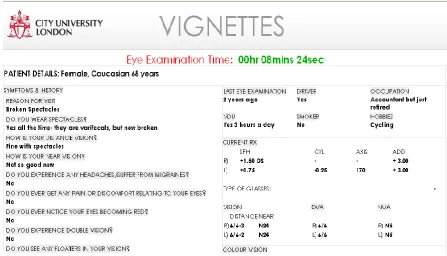
Figure 1. Part of the ‘City Vignettes’ record card showing the examination timer.
The project was divided into two phases:
Phase 1: program development and piloting of City Vignettes using a group of undergraduate optometry students
Phase 2: development of 3 further vignettes and the inclusion of a vignette scoring/feedback system to the program
2.1.1. Development of a clinical scenario (Vignette 1) describing a ‘patient’ presenting with ocular hypertension
Ocular Hypertension (OHT) is a condition commonly encountered in community optometric practice and one that presents tricky diagnostic and management decisions.
To summarise: Ocular Hypertension:
Characterised by high intra-ocular pressure, but with:
o Normal optic nerve head (optic disc)
o Normal field of vision
Differential diagnoses
o “Normal” patient
o Open Angle Glaucoma
Requires
o Suitable test selection and interpretation of results
o Appropriate diagnosis and management
2.1.2. Vignette 1 - Choice of investigative tests
Guidance from the College of Optometrists (CoO 2013) states that when examining patients at risk of glaucoma optometrists “have a duty of care to carry out the appropriate tests to determine the likelihood of the condition being present.
The eye examination for these patients should normally include:
o Assessment of the optic nerve head
o Measurement of intra-ocular pressure (IOP)
The examination may also include:
o Central visual field assessment”
So for our City Vignettes patient with ocular hypertension we would include:
the results of an assessment of the optic nerve head, which would be presented to the student if they selected to carry out this test
the intra-ocular pressures for each eye, presented to the student if they selected to do this test. The student could choose from two methods of taking intra-ocular pressures
visual field plots for each eye, presented to the student if they selected to carry out a visual field test. Again the student had a choice of instrument so we supplied field plots for each instrument.
2.1.3. Appropriate diagnosis and management
The preferred management for the case we developed was for the patient to be monitored by the optometrist rather than referred to the hospital eye service for an outpatient appointment in the glaucoma clinic. But both options, plus several others could be selected.
2.1.4. Piloting Vignette 1
History taking
Patient examination and interpretation of clinical findings
Diagnosis
Patient management
Students were invited to give their feedback on the online tool in an online survey and there was 100% response.
2.1.5. Registered optometrists
At this point we added an additional feature to our original proposal. As part of our involvement in another project the authors were seeking the views of registered UK optometrists and this provided us with the opportunity to invite registered UK optometrists to attempt the vignette. In total 100 experienced optometrists also attempted the vignette.
2.1.6.. Development of 3 further clinical vignettes and a system for vignette scoring and feedback.
The second phase of the project involved the development of the following 3 vignettes:
Vignette 2: patient with normal tension glaucoma.
Patients with normal tension glaucoma have normal eye pressures and present a diagnostic challenge. The student needs to be able to recognise glaucomatous changes in the optic nerve head and/or perform and interpret a
visual field plot to make the correct diagnosis.
Vignette 3: patient with age-related macular degeneration (AMD).
AMD is a common cause of visual impairment in the elderly population. The neovascular (otherwise known as ‘wet’) form of the disease is amenable to treatment, however there is a very narrow treatment window following the onset of symptoms. This vignette presents a patient with symptoms of visual disturbance. The student needs to be able to recognise the signs and symptoms of AMD in order to make a correct diagnosis and select the appropriate management option.
Vignette 4: normal patient.
It is important that students are able to recognise ‘normal’ patients and so this scenario was included to reflect that fact that most of the patients seen by optometrists do not have ocular disease.
History taking
Patient examination and interpretation of clinical findings
Diagnosis
Patient management
2.2 Results
2.2.1 Selection of key tests for detection of ocular hypertension
Results for the three key tests (ophthalmoscopy to assess the optic nerve head, measurement of the intra-ocular pressure, and visual fields) for patients at risk of glaucoma are shown in Table 1. Both groups showed consistently high percentages attempting all 3 tests, with no statistically significant difference between the proportions of each group attempting any of the tests (p > 0.5 in each case). Furthermore, there were no significant differences between students and experienced practitioners as regards the percentages of each group choosing to grade the optic nerve head (see below) and choosing the reference standard test for intra-ocular pressure measurement (p > 0.5).
TEST Students
(n = 18)
Experienced Optometrists
(n= 100)
Ophthalmoscopy
(% grading the optic nerve head)
94.4%
94.4%
98%
86%
Intraocular pressure (% using reference standard test)
100%
77.7%
100%
75%
[image:7.595.164.341.625.808.2]Visual fields 94.4% 97%
Table 1. Percentages of students and optometrists attempting the 3 key tests for patients at risk of glaucoma (including those with ocular hypertension).
2.2.2 Grading of the optic nerve head.
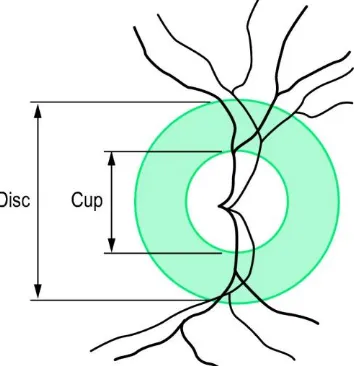
Figure 2. A schematic representation of the optic nerve head (optic disc) showing the vertical cup height and the vertical disc height.
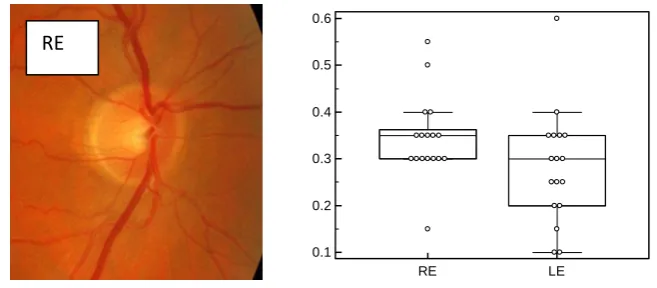
In Vignette 1 we presented the student/registered practitioner with the optic nerve head (optic disc) images for this virtual patient and they could choose to grade the C/D ratio and record their results. The disc images and results of the grading are presented in Figure 3. No significant differences between either the means or the medians for the CD ratios were found between students and registered practitioners for either eye. For the right eye p=0.35 (means), 0.28 (medians), for the left eye p= 0.74 (means), 0.66 (medians) using the t-test for independent samples, and Mann-Whitney test for independent samples.
RE: Median = 0.35, Mean = 0.34 ±0.9 LE: Median= 0.3, Mean = 0.28±0.1
Student data: n = 17
RE
C
D
R
a
ti
o
0.1 0.2 0.3 0.4 0.5 0.6
RE: Median = 0.3, Mean = 0.33 ±0.7 LE: Median = 0.25, Mean = 0.27 ±0.09
[image:9.595.115.468.83.227.2]Registered practitioner data: n = 86
Figure 3. Disc images and box and whisker plots showing estimates of C/D ratios by both students and registered optometrists. Red triangles indicate outliers.
2.2.3 Diagnosis
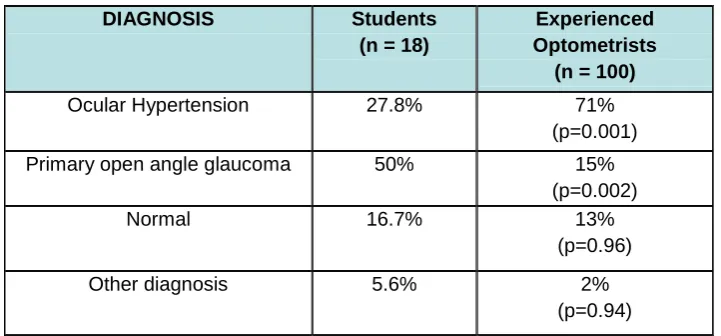
Results for the diagnosis selected for this patient with ocular hypertension are shown in Table 2. Experienced optometrists were much more likely to opt for the correct diagnosis (71%) than the students (27.8%) and this difference in proportions was statistically significant (p = 0.001). Students were much more likely to choose a diagnosis of primary open angle glaucoma (50%) than the registered optometrists (15%). There was no significant difference between the proportions of the two groups choosing the “normal” diagnosis (p = 0.96) or opting for another diagnosis entirely (p = 0.94).
DIAGNOSIS Students
(n = 18)
Experienced Optometrists
(n = 100)
Ocular Hypertension 27.8% 71%
(p=0.001)
Primary open angle glaucoma 50% 15%
(p=0.002)
Normal 16.7% 13%
(p=0.96)
Other diagnosis 5.6% 2%
(p=0.94)
Table 2. Percentages of students and registered optometrists opting for each possible diagnosis of this patient with ocular hypertension.
LE
C
D
R
a
tio
0.1 0.2 0.3 0.4 0.5 0.6 0.7
[image:9.595.118.479.506.674.2]2.2.4 Patient Management
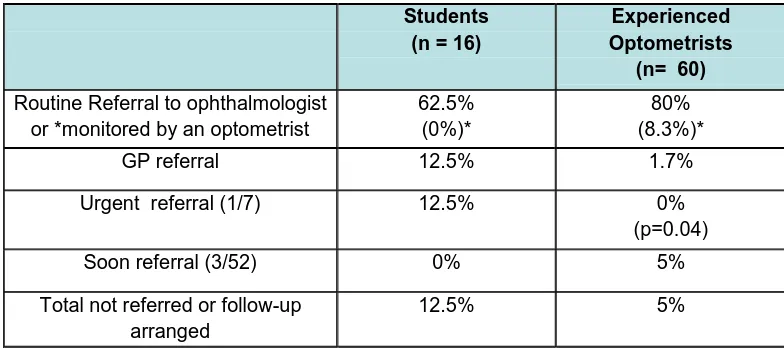
Results for the management selected for this patient with ocular hypertension are shown in Table 3. There was no significant difference between the proportions of students (62.5%) and experienced optometrists (80%) who routinely referred the patient to either an ophthalmologist or another optometrist (p > 0.05). The percentages opting for the “correct” option of not referring the patient but instead choosing the original optometrist to continue to monitor the patient were low (0% and 8.3% for students and experienced optometrists respectively) and there was no significant difference between the groups (p> 0.05). Two students (12.5%) opted for an urgent referral for the patient, which is an inappropriate speed of referral, compared with none of the experienced optometrists. This difference was statistically significant (p = 0.04) but the numbers are so low that this result should be interpreted with caution.
Students
(n = 16)
Experienced Optometrists
(n= 60)
Routine Referral to ophthalmologist or *monitored by an optometrist
62.5% (0%)*
[image:10.595.100.492.245.419.2]80% (8.3%)*
GP referral 12.5% 1.7%
Urgent referral (1/7) 12.5% 0%
(p=0.04)
Soon referral (3/52) 0% 5%
Total not referred or follow-up arranged
12.5% 5%
Table 3. Percentages of students and registered optometrists opting for each of the possible management options for this patient with ocular hypertension.
2.2.5 Feedback
Each student was sent a detailed breakdown of the scenario in the form of a pdf file containing information on appropriate investigation, grading of images, diagnosis and optimal
management, plus suggestions for further reading. The students were then invited to repeat the scenario.
2.2.6 Student evaluation
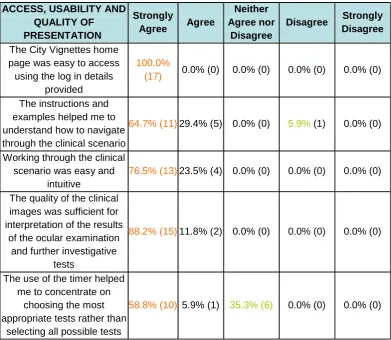
Each student completed an online evaluation questionnaire covering the following features of City Vignettes and the results are summarised in Tables 4 to 8:
Access, usability and quality of presentation (Table 4)
Content and relevance (Table 5)
Form and quality of feedback (Table 6)
Likely impact on future practice (Table 7)
ACCESS, USABILITY AND QUALITY OF PRESENTATION
Strongly
Agree Agree
Neither Agree nor
Disagree
Disagree Strongly Disagree
The City Vignettes home page was easy to access using the log in details
provided
100.0%
(17) 0.0% (0) 0.0% (0) 0.0% (0) 0.0% (0)
The instructions and examples helped me to understand how to navigate through the clinical scenario
64.7% (11) 29.4% (5) 0.0% (0) 5.9% (1) 0.0% (0)
Working through the clinical scenario was easy and
intuitive
76.5% (13) 23.5% (4) 0.0% (0) 0.0% (0) 0.0% (0) The quality of the clinical
images was sufficient for interpretation of the results
of the ocular examination and further investigative
tests
88.2% (15) 11.8% (2) 0.0% (0) 0.0% (0) 0.0% (0)
The use of the timer helped me to concentrate on
choosing the most appropriate tests rather than
selecting all possible tests
[image:11.595.102.494.70.410.2]58.8% (10) 5.9% (1) 35.3% (6) 0.0% (0) 0.0% (0)
Table 4. Responses of students to survey questions relating to access, usability and quality of presentation of City Vignettes.
It is notable that 100% of respondents strongly agreed that it was easy to gain online access to the vignettes. Two thirds strongly agreed that instructions for City Vignettes were easy to understand. The one respondent who “disagreed” had concerns with the timer, which kept a running total of the time spent on this virtual examination. This is a theme that recurs in the student feedback, with 35% of students neither agreeing nor disagreeing that the use of the timer helped them to concentrate on choosing the most appropriate tests.
We gave respondents the opportunity to enter free text comments at each stage of the survey. Typical comments are below:
“Clear, easy to use layout which allows you to choose exactly what tests and information you require.”
CONTENT AND RELEVANCE Strongly Agree Agree Neither Agree nor Disagree Disagree Strongly Disagree
The clinical scenario was set at an appropriate level for a final year undergraduate
student
100.0%
(17) 0.0% (0) 0.0% (0) 0.0% (0) 0.0% (0)
The clinical scenario provided an appropriate
simulation of a ‘real world’ patient episode
94.1% (16) 5.9% (1) 0.0% (0) 0.0% (0) 0.0% (0)
The scenario has enhanced my clinical decision making skills
[image:12.595.112.487.71.275.2]88.2% (15) 11.8% (2) 0.0% (0) 0.0% (0) 0.0% (0)
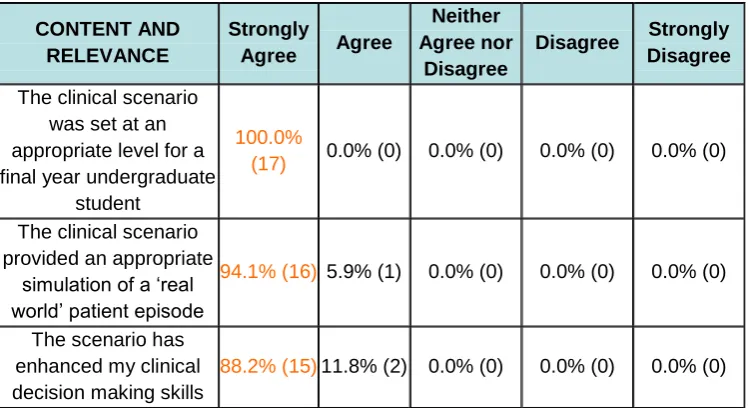
Table 5. Responses of students to survey questions relating to content and relevance of City Vignettes.
Content and relevance scored well in the survey and this was reflected in the free text comments, of which a typical comment is below:
“Everything was relevant and actually made you think how you would assess this patient in practise and how you would manage them, without the risk of missing something in a real patient in real life!”
We received some suggestions from student feedback which we have incorporated into the latest version of City Vignettes, notably:
“An additional component could be added to show a referral letter and what details you would choose to include.”
This is an excellent suggestion and we now incorporate the option for students to submit a draft referral letter when they choose to refer a patient via City Vignettes.
FORM AND QUALITY OF FEEDBACK Strongly Agree Agree Neither Agree nor Disagree Disagree Strongly Disagree
The form of the feedback was appropriate and easy to
understand
94.1% (16) 5.9% (1) 0.0% (0) 0.0% (0) 0.0% (0)
The quality of the feedback was sufficient
to further develop my clinical decision making
skills
100.0%
(17) 0.0% (0) 0.0% (0) 0.0% (0) 0.0% (0)
[image:12.595.110.488.523.686.2]Our feedback on the vignette was very well received, with a typical comment being:
Very detailed feedback which really explains the reasoning behind the diagnosis and relevance of the test results as well as further management. I definitely learnt a lot from it.”
Another theme to emerge from the student survey was that the generic nature of the feedback, although very useful, would have been improved if it had been more personalised to each participant. One student commented:
“It was a very informative feedback sheet. However it didn't feel personalised to my answers.”
It was always our intention to personalise feedback to students but this feature was not available when the first vignette was piloted. However, personalised feedback has been incorporated into the latest version.
LIKELY IMPACT ON FUTURE PRACTICE
Strongly
Agree Agree
Neither Agree nor
Disagree
Disagree Strongly Disagree
Clinical vignettes would be a useful learning tool
during the pre-registration period to further develop clinical
decision making skills
100.0%
(17) 0.0% (0) 0.0% (0) 0.0% (0) 0.0% (0)
Clinical vignettes would be valuable for ongoing continuing professional
development post-qualification
[image:13.595.108.487.261.450.2]88.2% (15) 11.8% (2) 0.0% (0) 0.0% (0) 0.0% (0)
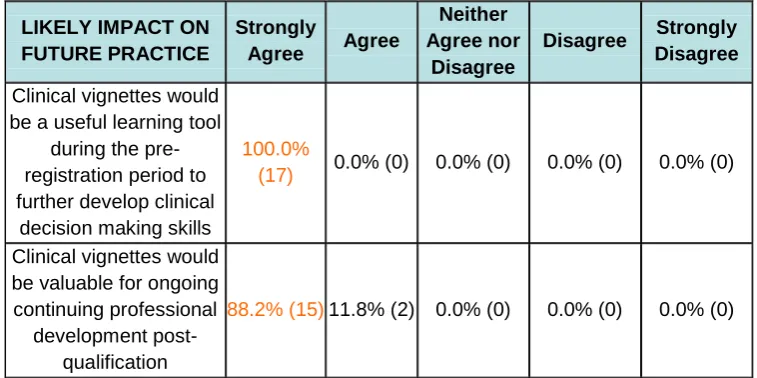
Table 7. Responses of students to survey questions relating to the likely impact of City Vignettes on their future practice as optometrists.
Optometry students do not have placements during their BSc Optometry course, but they undertake a pre-registration period (of at least one year) in practice after they leave university before registration. These questions were designed to establish if City Vignettes would be useful for training in the pre-registration period and/or for continuing professional
development post-registration. The responses were very encouraging, suggesting that City Vignettes could be extended beyond undergraduate training. Typical comments from respondents were:
“This programme is ideal for the pre-registration period especially since students have to independently revise content outside of the university environment.”
OVERALL RATING Excellent Very
Good Good Acceptable Poor
How would you rate City
[image:14.595.113.486.73.131.2]Vignettes overall? 94.1% (16) 5.9% (1) 0.0% (0) 0.0% (0) 0.0% (0)
Table 8. Overall rating by students for City Vignettes.
We were encouraged that 16 of the 17 students who answered this question rated City Vignettes as excellent overall.
2.3 Scoring of vignettes
As part of the second phase of vignette development a scoring system was added to the program. The ‘score’ is based on the proportion of best practice choices made by the student. For example when taking a history, the key questions can be highlighted and appropriately weighted (Figure 4). Once the vignette is completed a report is generated which provides an overall score and a breakdown of the score based on performance in each component of the examination:
History taking
Patient examination and interpretation of clinical findings
Diagnosis
Patient management
[image:14.595.70.504.440.667.2]In addition to the % score, feedback is provided on the optimal choices for each examination component.
2.4 Summary
A vignette-based online tool is an effective method for the teaching and of clinical decision-making
The vignettes were well received by students and they felt that vignettes would be useful in both the pre-registration period and post-registration
Comparison of final year BSc Optometry students with experienced optometrists in practice demonstrated that although students selected appropriate clinical tests and graded eye features accurately they were understandably less accurate with their diagnostic and management decision making
3. Any recommendations/future work
We will continue to test and develop systems for personalised feedback and scoring for assessment purposes.
City Vignettes will be incorporated into BSc Optometry undergraduate teaching in 2013/14
We presented City Vignettes and our results as a workshop at the Learning at City Conference 2013. Those present were most complimentary regarding the system and its generalisability to other professions within the School of Health Sciences. With the assistance of the LDC we would be enthusiastic to pursue this.
The view at the workshop was that there were possible peer reviewed publications that could emerge from this work.
Extend the use of City Vignettes to pre-registration and/or post-registration training of optometrists.
Acknowledgements
"We are most grateful to Beju Shah who programmed the vignettes, to the student and experienced optometrist volunteers who participated in the project, and to the Learning Development Centre for funding this project."
References
http://www.college-optometrists.org - Code of ethics and clinical guidelines - examining patients at risk from glaucoma D3. Accessed 07.09.2013
Peabody JW, Luck J, Glassman P, Dresselhaus TR, Lee M. Comparison of vignettes, standardized patients, and chart abstraction: a prospective validation study of 3 methods for measuring quality. Journal of the American Medical Association 2000;283:1715-22.