Ames Laboratory Publications
Ames Laboratory
8-14-2000
Superparamagnetic magnetization equation in two
dimensions
David C. Jiles
Iowa State University, [email protected]
S. J. Lee
Iowa State University
J. M. Kenkel
Iowa State University
K. L. Metlov
Academy of Sciences of the Czech Republic
Follow this and additional works at:
http://lib.dr.iastate.edu/ameslab_pubs
Part of the
Electromagnetics and Photonics Commons
, and the
Engineering Physics Commons
The complete bibliographic information for this item can be found at
http://lib.dr.iastate.edu/
ameslab_pubs/153
. For information on how to cite this item, please visit
http://lib.dr.iastate.edu/
howtocite.html
.
Superparamagnetic magnetization equation in two dimensions
Abstract
An equation for the dependence of magnetization on magnetic field in the case of two-dimensional (base
plane) anisotropy has been derived. The resulting equation is expressed as an infinite series of modified Bessel
functions, unlike the elementary function expressions that are applicable to the one-dimensional (axially
anisotropic) and three-dimensional (isotropic) cases. Nevertheless, in the low-field limit, the series can be
effectively truncated to give an approximate solution, while, in the high-field limit, an alternative expression
has been derived which represents the limiting function as the field strength tends to infinity. The resulting
expressions can be used to describe the superparamagnetic magnetization and susceptibility as a function of
magnetic field in situations where the magnetic moments are constrained to lie in a plane, with no preferred
direction within the plane. This can therefore be applied to two-dimensional structures, such as magnetic thin
films, where magnetostatic energy confines the moments to the plane of the film, or to three-dimensional
structures with planar magnetocrystalline anisotropy.
Keywords
Magnetic anisotropy, Thin film structure, Magnetic fields, Magnetic films, Superparamagnetism
Disciplines
Electromagnetics and Photonics | Engineering Physics
Comments
The following article appeared in
Applied Physics Letters
77 (2000): 1029 and may be found at
http://dx.doi.org/10.1063/1.1288677
.
Rights
Copyright 2000 American Institute of Physics. This article may be downloaded for personal use only. Any
other use requires prior permission of the author and the American Institute of Physics.
Superparamagnetic magnetization equation in two dimensions
D. C. Jiles, S. J. Lee, J. Kenkel, and K. L. MetlovCitation: Applied Physics Letters 77, 1029 (2000); doi: 10.1063/1.1288677
View online: http://dx.doi.org/10.1063/1.1288677
View Table of Contents: http://scitation.aip.org/content/aip/journal/apl/77/7?ver=pdfcov
Published by the AIP Publishing
Articles you may be interested in
Competing magnetic interactions in nickel ferrite nanoparticle clusters: Role of magnetic interactions
J. Appl. Phys. 104, 064317 (2008); 10.1063/1.2982278
Characterization of superparamagnetic nanoparticles by analyzing the magnetization and relaxation dynamics using fluxgate magnetometers
J. Appl. Phys. 101, 113909 (2007); 10.1063/1.2738416
Magnetic and transport properties controlled by structural disorder in La 0.7 Ca 0.3 MnO 3 films
Low Temp. Phys. 30, 705 (2004); 10.1063/1.1802954
Moment determination of magnetic force microscope tips by imaging superparamagnetic films
Appl. Phys. Lett. 84, 1156 (2004); 10.1063/1.1645988
Magnetization process of noninteracting ferromagnetic cobalt nanoparticles in the superparamagnetic regime: Deviation from Langevin law
J. Appl. Phys. 86, 556 (1999); 10.1063/1.370765
Superparamagnetic magnetization equation in two dimensions
D. C. Jiles, S. J. Lee, and J. Kenkel
Ames Laboratory, Iowa State University, Ames, Iowa 50011
K. L. Metlov
Department of Magnetism, Institute of Physics, Academy of Sciences of the Czech Republic, Prague CZ-18040, Czech Republic
共Received 5 January 2000; accepted for publication 19 June 2000兲
An equation for the dependence of magnetization on magnetic field in the case of two-dimensional
共base plane兲anisotropy has been derived. The resulting equation is expressed as an infinite series of modified Bessel functions, unlike the elementary function expressions that are applicable to the one-dimensional共axially anisotropic兲and three-dimensional共isotropic兲cases. Nevertheless, in the low-field limit, the series can be effectively truncated to give an approximate solution, while, in the high-field limit, an alternative expression has been derived which represents the limiting function as the field strength tends to infinity. The resulting expressions can be used to describe the superparamagnetic magnetization and susceptibility as a function of magnetic field in situations where the magnetic moments are constrained to lie in a plane, with no preferred direction within the plane. This can therefore be applied to two-dimensional structures, such as magnetic thin films, where magnetostatic energy confines the moments to the plane of the film, or to three-dimensional structures with planar magnetocrystalline anisotropy. © 2000 American Institute of Physics.
关S0003-6951共00兲01433-9兴
The equations describing magnetization of an uncoupled paramagnetic array of magnetic moments or an exchange coupled superparamagnetic array of magnetic moments us-ing statistical thermodynamics have been well known for some time. In the isotropic three dimensional case,1which is equivalent to assuming all directions are equally probable, the equation is the Weiss modification to the classical Lange-vin expression
M⫽Ms关coth共x兲⫺1/x兴, 共1兲
where x⫽(0mH˜ )/(kBT) , 0 is the permeability of free space, M is the average projection of magnetization in the direction of external field H, H˜⫽H⫹␣M is the effective
field, Msis saturation magnetization, m is magnetic moment,
kB is Boltzmann’s constant, T is temperature, and ␣ is the
self coupling coefficient. In the one dimensional case,2which is equivalent to axial anisotropy, the equation is
M⫽Mstanh共x兲. 共2兲
As discussed recently by Kodama3 the forms of these equations can be used to describe superparamagnetism of nanoparticles, where m is the magnetic moment of the par-ticle; or the classical treatment of paramagnetism (␣⫽0) or ferromagnetism (␣⬎0), where m is the magnetic moment of the individual atoms. The latter equation also applies to quantized magnetic moments with spin 1/2 constrained to lie in one of two possible states, ‘‘spin up’’ and ‘‘spin down.’’ However, in cases where the magnetic moments are con-strained to lie in a plane, no closed form equation similar to
共1兲 and 共2兲 exists. This problem has become of significant technological interest with the development of magnetic structures such as thin films and multilayers for magnetore-sistive devices.
This situation arises in thin film magnetic structures where magnetostatic energy confines the moments to the plane of the film. It also arises in three-dimensional struc-tures with strong planar magnetocrystalline anisotropy, so that the moments are precluded from lying along the unique axis by magnetocrystalline anisotropy but the magnetic mo-ments can rotate within a plane in which all directions are equivalent. Such a situation arises approximately in some materials with hexagonal crystal structures for example.
In this letter we show the derivation of an equation for the two-dimensional case and show how this can be used in the low-field limit. This equation cannot be expresssed in terms of the elementary functions, but can be expressed through modified Bessel functions or by using an infinite series. More precisely, the solution is the quotient of two infinite series, in which the numerator is the derivative of the denominator. Both these series diverge as x, and hence the ratio H/T, becomes large. However, the high-field limit of their ratio can be determined and an asymptotic expression will be derived for it in this letter by making use of l’Hopital’s rule.
The first step in deriving the superparamagnetic equation for the two-dimensional case is from statistical thermody-namics. The energy of a magnetic moment m in a field H is given by E()⫽⫺0mH˜ cos. The probability of occu-pancy is P⬃exp关⫺E()/(kBT)兴. Considering all possible ori-entations of magnetic moments in the plane, the following integral is obtained for the statistical sum Z:
Z⫽
冕
02
exp共x cos兲d⫽2I0共x兲, 共3兲
which normalizes the thermodynamical probability of the
APPLIED PHYSICS LETTERS VOLUME 77, NUMBER 7 14 AUGUST 2000
1029
0003-6951/2000/77(7)/1029/3/$17.00 © 2000 American Institute of Physics
corresponding system. To evaluate the integral in 共3兲 Sonine’s4 expansion for the modified Bessel function was used where
exp共x cos兲⫽I0共x兲⫹2
兺
p⫽1 ⬁
Ip共x兲cos共p兲. 共4兲
The average projection of the magnetization is then
M⫽kBT 0
d
dH˜
log Z⫽MsI0
⬘
共x兲 I0共x兲, 共5兲
where
I0共x兲⫽
兺
s⫽0
⬁ 1
共s!兲2
冉
x2
冊
2s
共6兲
and
I0
⬘
共x兲⫽兺
s⫽1 ⬁
s
共s!兲2
冉
x2
冊
2s⫺1
. 共7兲
The numerical solution of the equation requires that only a finite number of terms of the series in the numerator and denominator be used. As an example the equation with five terms is
I0
⬘
共x兲I0共x兲 ⬇ x
共1!兲22⫹ 2x3 共2!兲223⫹
3x5 共3!兲225⫹
4x7 共4!兲227⫹
5x9 共5!兲229⫹. . .
1⫹ x
2
共1!兲222⫹
x4
共2!兲224⫹
x6
共3!兲226⫹
x8
共4!兲228⫹
x10
共5!兲2210⫹. . .
. 共8兲
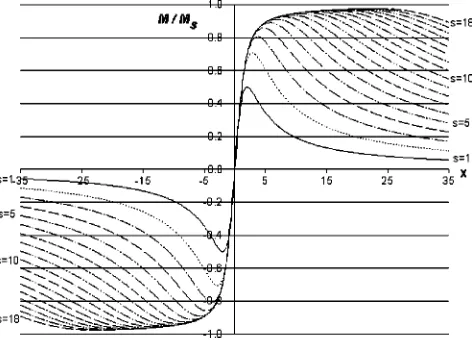
Solutions of Eq.共8兲with different numbers of terms in the series are shown in Fig. 1. From this it is clear that irrespective of how many terms are included in the series there will always be a high x 共and, hence, high field兲region for which the finite series approximation is not a valid physi-cal solution.
The solutions of the equations for the one-, two-, and three-dimensional cases are shown for comparison in Fig. 2. The one-dimensional case has the highest initial differential susceptibility
⬘
⫽d M /dH and therefore approachessatura-tion fastest as the field H is increased. The three-dimensional case has the lowest initial differential susceptibility, since in this case the magnetic moments have the greatest freedom of choice of direction. The two-dimensional case is intermedi-ate. The values of the initial differential susceptibility are
⬘
⫽0m Ms/(nkBT⫺␣0m Ms), where n is the dimension 共1,2,3兲.Since divergence of the series solution is a problem as H
becomes large, different approximations can be used for the low- and high-field regions. The solution must approach
M / Ms⫽⫹1 as H approaches infinity and ⫺1 as H
ap-proaches minus infinity. For large values of x the finite series solution M / Ms converges to 0 instead of 1, with the exact
rate depending on the number of terms used. Using 18 terms, the curve can be separated into three regions: one from x
⫽⫺⬁ to ⫺19, the second from about x⫽⫺19 to 19关over which the series solution given in Eqs. 共5兲, 共6兲, and 共7兲 is valid兴, and the third from x⫽19 to⫹⬁. The valid range for the series solution is expanded and shifted further from the origin as more terms are added to the series approximation. A solution for high values of兩x兩can be obtained by defining a new variable y , which is equal to 1/x, in the series in Eq.
[image:5.612.319.557.543.725.2]共8兲. Taking the limit as x approaches plus or minus infinity is equivalent to letting y tend to zero and using l’Hopitals rule for the limit of a quotient. The following approximations
FIG. 1. Solutions of the two-dimensional Eq.共8兲. This shows magnetization M / Msvs the variable x with different numbers ‘‘s’’ of terms in the series.
With more terms in the series, the numerical approximation is valid over a larger range of x.
FIG. 2. Calculated initial magnetization curves M / Ms vs x for the one 共solid兲, two共dashed兲and three 共dotted兲dimensional cases. The one- and three-dimensional solutions are exact. The two-dimensional solution in the low-field range was obtained with 18 terms in each of the series in Eq.共8兲. This solution is adequate for⬍19. For兩x兩⬎19, Eq.共9兲was used.
1030 Appl. Phys. Lett., Vol. 77, No. 7, 14 August 2000 Jileset al.
[image:5.612.57.293.562.732.2]were found to be accurate to within a fractional error of 0.05% for values of兩x兩⬎19.
For x⬎19
M⫽Ms
冋
1⫺I0
⬘
共y兲I0共y兲
册
⫽Ms冋
1⫺1/共2x兲⫹1/共16x3兲
1⫹1/共4x2兲⫹1/共64x4兲
册
. 共9a兲For x⬍⫺19
M⫽Ms
冋
⫺1⫺I0
⬘
共y兲I0共y兲
册
⫽Ms
冋
⫺1⫺1/共2x兲⫹1/共16x3兲
1⫹1/共4x2兲⫹1/共64x4兲
册
. 共9b兲This approximation can be used with only two terms (s
⫽2). More terms do not greatly improve the numerical pre-cision of the solution. A simpler expression for magnetiza-tion at large values of x can be obtained using the zeroth order asymptotic expansion for I0(x)⬃exp(x)/冑x which leads
to
M⫽Ms
冉
x
兩x兩⫺
1
2x
冊
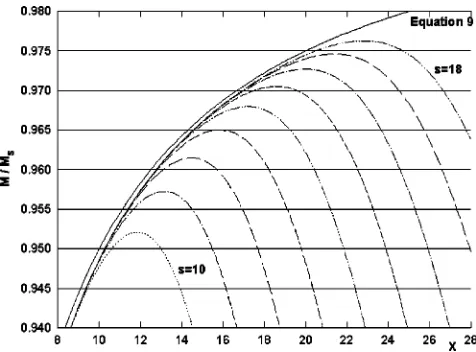
. 共10兲A comparison of the high- and low-field solutions is shown in Fig. 3. Using 18 terms in Eq. 共8兲 the curves are nearly coincident at x⫽19. Even though the two lines do not inter-sect, the fractional error between the 2 is less than 0.05%. If more terms are included in the series in Eq.共8兲the difference becomes even less.
This letter has shown the development of a model equa-tion for magnetizaequa-tion of a two-dimensional array of mag-netic moments. It has also shown how the magnetization depends on magnetic field, temperature, magnetic moment, saturation magnetization, and self-coupling. It has been found that a single equation for this two-dimensional anhys-teretic or superparamagnetic magnetization curve can be ob-tained. The exact solution consists of a quotient of two infi-nite series. The magnetization curve for this two-dimensional case lies between the one-dimensional and three-dimensional cases, both of which have exact closed form solutions.
At low values of the variable x the series solution can be calculated with a finite number of terms. For example we have shown the solution with 18 terms in each series. As the value of the variable x increases, the number of terms needed for convergence increases. Consequently for a given number of terms in the series it was found that the approximate共 fi-nite series兲solution started to diverge from the correct solu-tion. Therefore, at high values of x we have obtained an approximate solution, in which we have invoked l’Hopital’s theorem for the limit of a quotient of two variables. A suit-able combination of the low x and high x solutions can be used to obtain a magnetization curve over the entire range of values of x to within a chosen level of accuracy.
The solution on the M ,x plane is always single valued as shown in Fig. 2. In coupled systems, for which␣is nonzero, the variation of magnetization M with magnetic field H can have a different form. This arises because H is then no longer a linear function of x. This can result in elementary hysteresis loops on the M ,H plane. Such behavior has been seen before.5 The transition from linear to hysteretic M ,H behavior occurs at values of ␣⫽kBT/0m Ms,
2kBT/0m Ms, and 3kBT/0m Ms, respectively, in the
one-, two-, and three-dimensional cases.
This work was supported by the US Department of En-ergy, Office of Basic Energy Sciences, under Contract No. W-7405-Eng-82, by the National Science Foundation under Grant No. INT-9732135, and by the Grant Agency of the Czech Republic under projects 202/99/P052 and 101/99/ 1662.
1
D. C. Jiles, Introduction to Magnetism and Magnetic Materials, 2nd ed.
共Chapman & Hall, London, 1998兲, p. 227.
2G. Bertotti, Hysteresis in Magnetism 共Academic, San Diego, 1998兲, p.
132.
3
R. H. Kodama, J. Magn. Magn. Mater. 200, 359共1999兲.
4
A. Gray, G. B. Mathews, and T. M. Macrobert, A Treatise on Bessel
Functions and Their Applications to Physics共Macmillan, London, 1952兲, p. 36.
[image:6.612.55.293.51.227.2]5D. C. Jiles and D. L. Atherton, J. Magn. Magn. Mater. 61, 48共1986兲.
FIG. 3. Expanded view of the region of Fig. 1 in which the low-field solu-tion关Eqs.共5兲,共6兲, and共7兲with more terms of the series from s⫽10 to s
⫽18兴and the high-field solution关Eq.共9兲with two terms兴are shown. The fractional error between the two curves ( M / Msvs x) is less than 0.22% at
x⫽9 with ten terms, while the fractional error is less than 0.05% at x⫽19 with 18 terms.
1031
Appl. Phys. Lett., Vol. 77, No. 7, 14 August 2000 Jileset al.