Abstract: This paper work consolidates the outcomes from the effective implementation of padlet ICT tool for two subjects namely 14ME360 Geometric Modeling and 15UIT503 Graphics and Multimedia for undergraduate engineering, III semester Mechanical Engineering and V semester Information Technology students. It was observed that most of the students are welcoming the use of ICT tools in teaching when compared to conventional method of “chalk-and-talk”. This is due to development of digital technologies for class room discussions. Out of many ICT tools, here padlet features are used to customize for teaching learning process and the same was implemented. Now-a-days the most of students are driven by technology. One of the important aspects of padlet wall is the availability of “Android App” for mobile use. Also, the usage of this padlet wall is more simple and effective. We have observed that while implementing ICT tools for teaching learning activities; it should be simple and less numbers of hyperlinks. During the initial phase of this padlet implementation, the students are more reluctant to use this tool. But, within two years, most of the students are used this padlet wall because its simplicity. The different features of padlet and its customization process are given in detail. Finally, the effectiveness of this tool was observed with two different branches of engineering students. The corresponding findings are reported in spite of room for improvements due to the qualitative nature of teaching learning process.
Index Terms: Engineering Education, ICT tools, Padlet, Teaching Learning Process
I. INTRODUCTION
It highlights with different section that we want to entitle with a certain Information and Communication Tools (ICT) in teaching learning process in engineering subjects. They are faster one of the faster reach tools to the learners when compared to conventional chalk-and-talk method due to the development of computer software and hardware especially for pedagogy. This technical article deals with the effective implementation of “Padlet ICT tools” for Engineering Education. There are many ICT tools like Moodle, MOOCs Canvas etc. The 21st century Students dislikes the conventional chalk-and-talk method of teaching due to Teacher centric mode, time consuming, sometimes boring and wisdom oriented. Hence the new avatar of teaching learning
Revised Manuscript Received on June 12, 2019
Dr.M. Malathi, Computer Science and Engineering, Sethu Institute of Technology, Madurai
Dr.C. Paramasivam, Mechanical Engineering, Thiagarajar College of Engineering, Madurai
Ms.S. Sangeetha, Computer Science and Engineering, Sethu Institute
of Technology, Madurai
Ms.S. Gospeline Christiana, Computer Science and Engineering, Sethu Institute of Technology, Madurai
Ms. K. Nagalakshmi, Computer Science and Engineering, Sethu
Institute of Technology, Madurai
process is the need of the hours. In order to realise this, one of the ICT tool Padlet is customised and implemented in our Engineering students.
II. RELATEDWORKS
Lakshmi Dhandabani and Rajeev Sukumaran (2014) have investigated experimentally the use of digital blended learning approach for engineering pedagogical process. It describes the virtual learning approach with an aim of motivating the student attention in learning technical subjects. Further, they have clearly described the effectiveness with suitable statistical simulation. Finally, it reviews the way of ICT tools implemented to build new teaching learning environment to the engineering students.
Nina Tvenge and Kristian Martisen (2016) proposed an ICT tool for teaching-learning activities. The actor-network theory is implemented with three principles namely generalized symmetry, illustrating process and translation of process. The result shows the focus on controlling of students in a better way.
Munirah Haris, Melor Md. Yunus and Jamaludin Hj Badusah (2017) proposed a multimodal production tool to support teaching and learning. It investigates the effectiveness of using Padlet for English grammar. The data was collected by through pre-post tests and questionnaire and same was analysed with descriptive and inferential analysis. The pre-post-tests show the significant increase of student performance. Also, it reveals the high preference and positive attitude towards using ICT tools as a means for learning.
Edriss Ahmed Ali (2013) explored the challenges behind the implementation of ICT facilities in engineering educational system. They include content delivery, the need for hands-on experience in laboratories, inadequate training of faculty in pedagogical tool usage in engineering education, and the lack of clear policies to choose what type of content delivery mode can be most benefitted. ICT facilities are implemented by the wide availability of free sophisticated simulation software, high speed internet access and general ICT tools known among the younger generations of both students and instructors. In order to utilise the advantages of these opportunities and tackle the many challenges facing full utilization of ICT tools in education, engineering education policy makers have to plan ahead and make long-term strategic plans. The result shows that among the different modes of educational content delivery available, the blended learning mode which combines face to face with online learning is suitable for engineering educational content delivery.
Amanjot Kaur Gill and Sandeep Singh Gill (2015) developed the system to
Effective Implementation of Padlet ICT Tool
for Engineering Education
study the effect of E-learning and ICT on teaching learning process and up gradation of faculty skills. It analyses about the adequacy and usefulness of ICT infrastructure and resources are available for faculty and students. The major challenges to the implementation of E-learning and ICT
include work overload on the teachers,
resistance/sluggishness against change, lack of proper training to some of the teachers as well as limited computing skills. Continuous up gradation and removal of obsolescence in E-infrastructure is another big challenge facing the college.
Namita Saxena (2017) reviewed the benefits of Information Communication Technology use in education. It highlights the use of ICT for teacher training and broadening the availability of quality education materials in India. Some of the initiatives taken by the Government of India for creating digital repositories and learning objects are listed as follows.
1. NPTEL- National Program of Technology Enhanced Learning.
2. MERLOT - Multimedia Educational Resource for Learning and Online Teaching.
III. FEATURESOFPADLET
The Padlet is one of the widely used ICT tools among academician with student due to easy customisation and quick review. The Padlet has required features like uploading of text, ppt, audio, video, linking with other Unified Resource Locator like YouTube, linking of Maps, Screen recording, Doodle draw, linking with other padlet files and video instructions. Similarly downloading is also possible. Any authorised student can interact directly with faculty through the customised wall of the concerned subject. The answer for the queries raised by the students may be answered by the respective faculty and all the other students monitor this interaction and they can participate for more clarity.
The content available on the wall of the Padlet can be transferred with share feature in terms of QR code, PDF and excel formats for future study purpose. Using “invite people” option of Padlet the other faculty not only with in the college but also faculty from other Institutions handling the same subject can be linked for discussion in order to have better teaching learning environment. In general, the learning materials, assignment, tutorial questions and feedback from students are possible.
IV. CUSTOMIZATIONOFPADLETWALL
In order to customize the requirements for the student interaction has been completed using different features of Padlet. Here two subjects were customized namely 15UIT503- Graphics and Multimedia in computer science Engineering and 14ME360 – Geometric Modelling in Mechanical Engineering. In this trial study two different branches were considered to review the Padlet usage in student perspective.
A. Customization for 14ME360 – Geometric Modeling
The Geometric Modelling subject deals with the generation of curve, surface and solid geometries using appropriate parametric equation. Further, it deals with transformation and graphic standards. This subject is being offered for B.E, Mechanical Engineering students as core subject.
Here, a padlet wall has been created to accommodate the learning materials, questions for assignment & tutorial and students feedback with the help of different features of padlet.
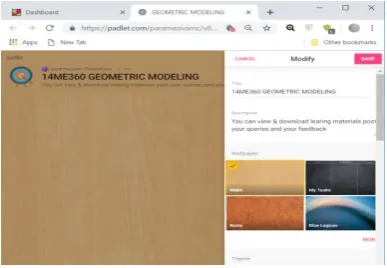
It starts with making of padlet wall using “make” option by giving the name of the subject, in this case, “14ME330
Geometric Modeling” along with its description to
understand the usage of this padlet wall by all students using
“Description” option. For this subject the following
description “You can view & download learning materials
post your queries and your feedback” is provided for quick
understanding of this wall by all students. The initial screen is shown in fig 1. The web like address is also modified suitably for this subject like “geometric modelling” in order to access this wall easily by the students and its screen shot shown in fig 2.
[image:2.595.337.531.332.466.2]Fig 1: Front page of padlet wall
Fig 2: Web address for padlet wall
The presentation materials of this subject are prepared in the form of PPT and the same was uploaded in the padlet wall.
The link URL for this padlet wall is
https://padlet.com/paramasivamc/geometricmodeling. The students who have been authorised can access all the learning materials, post any questions with the help of “click here to
post” option available in the wall. It is very easy and as simple
Fig 3: Screen shot of the completed padlet wall for 14ME360 subject
B. Customization for 15UIT503- Graphics and
Multimedia
Similar to Geometric Modelling subject, the padlet wall has been created for Graphics and Multimedia subject also with the help of different features of padlet ICT tool. This subject was offered for V semester B.E.-Information Technology students. The fully customised sample screen shoot for the 15UIT503 subject is shown in fig 4.
Fig 4: Sample screen for 15UIT503 subject Learning Materials
All the presentation materials of 15UIT503 subject are prepared in the form of PPT and the same was uploaded in the padlet wall. The link URL for this padlet wall is https://padlet.com/mmcse1979/graphicsandmultimedia. The students who have been authorised can access all the learning materials, post any questions with the help of “click here to
post” option available in the wall
V. OBSERVATIONSONLEARNINGPROCESS
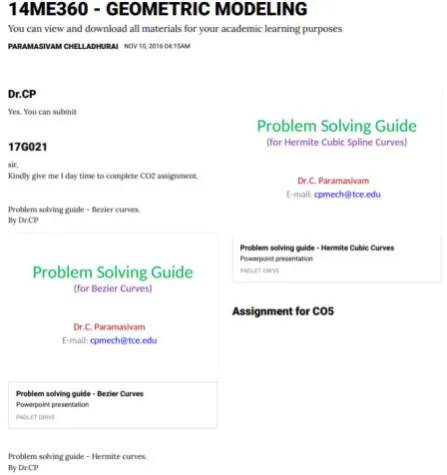
The faculty can monitor the student’s understanding with respect to any subject created in this padlet ICT tool. Typically all the students in a class can be monitored and their feedback can be observed. A sample screen shot of student discussion with faculty for 14ME360 subject is shown in fig 5. And the corresponding pdf version of padlet wall
[image:3.595.315.522.86.246.2]information can be obtained using the “Export” option and a sample pdf report is shown in fig 6
Fig 5: Sample padlet screen of student interaction
Fig 6: Sample Padlet Report of 14ME360
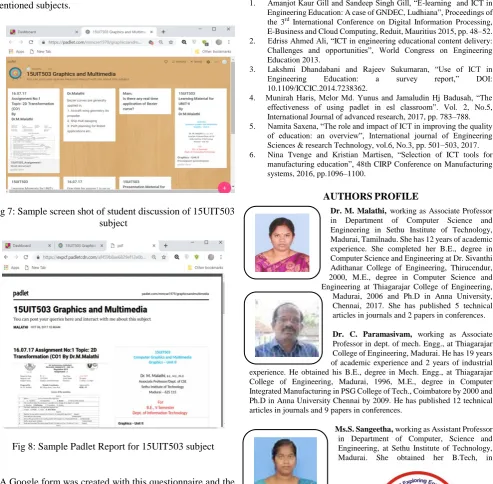
Similarly, the sample student interaction for 15UIT503 subject and its corresponding padlet report in pdf version are shown in fig 7 and 8 respectively.
A. Effectiveness on padlet wall usage
The utilisation of this padlet wall for this subject was continuously monitored for consecutively 2 times. Many modifications are made on this wall based on the student requirements. The students are no need to take notes during the class discussion unlike convention class room “Chalk-and-Talk” mode. The students are advised to carefully listen the class discussion and participate the activities conducted by faculty without wasting time and concentration just by writing notes. All
[image:3.595.320.544.302.540.2] [image:3.595.60.276.388.555.2]uploaded in the customised padlet wall.
Initially, the students are more reluctant to use the padlet for this subject. Subsequently, they understood the easiness and effectiveness of the wall, and then more students are started using this padlet wall.
Mobile application version of this padlet tool for Android Operating System is also available. So, more students are willing to use for class room discussion. The concept of “Flipped-class” is also conducted few times for the selected topics. Since, all the presentation materials are already available in the wall. Before coming for the class, most of the students will read the content. Hence, we can achieve effective teaching-learning process.
B. Students feed back
An exclusive feedback survey questionnaire was prepared to get the actual utilisation of padlet wall for the above mentioned subjects.
[image:4.595.55.549.275.759.2]Fig 7: Sample screen shot of student discussion of 15UIT503 subject
Fig 8: Sample Padlet Report for 15UIT503 subject
. A Google form was created with this questionnaire and the corresponding URL is linked with this padlet wall. The most of the students were given feedback regarding usage of padlet.
Few modifications are made based on the student feedback during subsequent year on the same padlet wall for better utilisation of padlet ICT by the students.
VI. CONCLUSION
The 21st century students are more driven by technology and gadgets. Hence, it is inevitable to incorporate the usage of technology and few gadgets during teaching learning process. Students will grasp the technical contents more quickly and easily, when the faculty use the ICT tools like padlet in their class activities. This paper work is an outcome of the trial implementation of padlet for about two consecutive academic years.
REFERENCES
1. Amanjot Kaur Gill and Sandeep Singh Gill, “E-learning and ICT in Engineering Education: A case of GNDEC, Ludhiana”, Proceedings of the 3rd International Conference on Digital Information Processing, E-Business and Cloud Computing, Reduit, Mauritius 2015, pp. 48–52. 2. Edriss Ahmed Ali, “ICT in engineering educational content delivery: Challenges and opportunities”, World Congress on Engineering Education 2013.
3. Lakshmi Dhandabani and Rajeev Sukumaran, “Use of ICT in Engineering Education: a survey report,” DOI: 10.1109/ICCIC.2014.7238362.
4. Munirah Haris, Melor Md. Yunus and Jamaludin Hj Badusah, “The effectiveness of using padlet in esl classroom”. Vol. 2, No.5, International Journal of advanced research, 2017, pp. 783–788. 5. Namita Saxena, “The role and impact of ICT in improving the quality
of education: an overview”, International journal of Engineering Sciences & research Technology, vol.6, No.3, pp. 501–503, 2017. 6. Nina Tvenge and Kristian Martisen, “Selection of ICT tools for
manufacturing education”, 48th CIRP Conference on Manufacturing systems, 2016, pp.1096–1100.
AUTHORSPROFILE
Dr.M. Malathi, working as Associate Professor
in Department of Computer Science and Engineering in Sethu Institute of Technology, Madurai, Tamilnadu. She has 12 years of academic experience. She completed her B.E., degree in Computer Science and Engineering at Dr. Sivanthi Adithanar College of Engineering, Thirucendur, 2000, M.E., degree in Computer Science and Engineering at Thiagarajar College of Engineering, Madurai, 2006 and Ph.D in Anna University, Chennai, 2017. She has published 5 technical articles in journals and 2 papers in conferences.
Dr. C. Paramasivam, working as Associate
Professor in dept. of mech. Engg., at Thiagarajar College of Engineering, Madurai. He has 19 years of academic experience and 2 years of industrial experience. He obtained his B.E., degree in Mech. Engg., at Thiagarajar College of Engineering, Madurai, 1996, M.E., degree in Computer Integrated Manufacturing in PSG College of Tech., Coimbatore by 2000 and Ph.D in Anna University Chennai by 2009. He has published 12 technical articles in journals and 9 papers in conferences.
Ms.S. Sangeetha, working as Assistant Professor
Information Technology in P.T.R College of Engineering and Technology, Madurai and M.Tech., in Computer Science and Engineering in
Karunya University Coimbatore. She has published 2 articles in journals and 1 paper in conference.
Ms.S. Gospeline Christiana, working as
Assistant Professor in Department of Computer Science and Engineering, at Sethu Institute of Technology, Madurai. She completed her B.E., degree in Computer Science & Engineering in Dr.G.U. POPE College of Engg., Tuticorin and M.E., in Computer Science & Engineering in National College of Engineering, Tirunelveli. She has published one research article in journal and 7 articles in conferences.
Ms.K. Nagalakshmi, working as a Assistant