Preparation and Characterization of Gel Polymer
Electrolyte Based on PAN- NH
4
CF
3
SO
4
and Nano
ZrO
2
Filler –Application as an Electrochemical cell
Hari Prasad Dara, Narasimha Rao Maragani, K.Vijayakumar, K.Sunil Babu
Abstract: In the present investigation, the Nano Composite Gel Polymer Electrolyte (NCGPEs) based on nano fillers ZrO2,
Polyacrylonitrile (PAN), and Ammonium Triflate (NH4CF3SO4)
doped at various wt% ratios prepared with the help of solution cast technique. The better amorphous nature observed for the 70PAN:30NH4CF3SO4 composition with addition of 1-4 wt% of
ZrO2 nano fillers and structural, complexation studies of
NCGPEs were confirmed by XRD technique. The micro structural studies and particle size can be revealed by SEM technique. DC Conductivity studies reveal the ionic conductivity performance on effect of temperature and composition wt% of nano powder. The ionic conductivity studies observed for 70PAN:30NH4CF3SO4 with nano powder ZrO2 concentration
ranging from 1-4 wt%. The sample containing 3wt% of ZrO2
exhibits the highest conductivity order of 4.20x10⁻⁴ S cm-1 at room temperature (303K) and 4.65x 10⁻³ S cm-1 at 373K. The cell parameters like Open Circuit Voltage, Short Circuit Current, energy density and power density were perfectly determined which were useful to explain electrochemical cell behaviour.
Keywords: NCGPEs; Surface morphology, Discharge parameters; Electrochemical Cell Applications.
I. INTRODUCTION
Now a day’s a tremendous role play in technical applications of electrochemical energy storage devices therefore Most of the research is devoted to identify the materials which are suitable to computers, communication devices, industrial controls, electric vehicles, space chips etc [1]. Batteries are crucial components of such devices; they must meet certain standards of reliability, weight, size, shape. NCGPEs based batteries were improved to satisfy these requirements. This gel polymer electrolyte material in electrochemical cell system has two different functions such as an electrolyte and as a separator between anode and cathode. Nano composite Gel Polymer electrolytes exhibits better ionic conductivity and dimensional stability. To improve electro chemical performance and thermal stability of GPEs nano ceramic fillers can be added. This is the better way for getting good ionic conductivity and hence proved by experimental [2-5].
This study describes the preparation of a series of Gel polymer PAN based nano composite electrolytes that incorporate ZrO2 nano powders and revealed changes of
structural, electrical properties, discharge characteristics perfectly.
Revised Manuscript Received on August 05, 2019.
Dr. Hariprasad , Associate Professor in Department of Chemistry, ANRK and Kodad, Suryapet, India.
Dr. Narasimha Rao Maragani, Professor in Department of Physics, PRIW, and Khammam, India.
Dr. K.Vijaya Kumar, Professor and HOD of Physics in Dayananda Sagar Academy of Technology and Management, Bangalore.
Dr. KARRI SUNIL BABU, Associate Professor in Department of Physics, Chaitanya Engineering College, vizag, India.
II. MATERIALS
PAN (Mw.150, 000) was received from Aldrich (USA),
Ammonium Triflate (NH4CF3SO4), Ethylene Carbonate
(EC) and dimethyl formamide (DMF) were obtained from Merck chemicals Co.(Nottingham, United Kingdom).
A. Preparation of gel PAN/ NH4CF3SO4-ZrO2 nano
composite electrolytes:
The molar ratio of polymer Polyacrylonitrile (PAN) doped with plasticizers like EC and DMF stirred continuously then after getting homogeneous solution. Now the dopant salt NH4CF3SO4 added to that obtained solution. After that nano
sized ceramic powder ZrO2 with different ratios like (1, 2, 3,
4 wt %) added to the formed solution and stirred for several hours for getting transparent solutions by using solution cast method. The prepared gel solution taken into Petri dishes for drying and finally the transparent and flexible films of thickness ranging from 100-118 µm have been obtained.
III. CHARACTERIZATION
XRD diffractometer (Xpert Pro) was equipped with Cu target and Ni filter and operated at a scanning rate of 10 min analyzed prepared samples for determining the structural properties and determine the chemical composition. In the present investigation, the surface morphology of newly synthesized PAN based on NCGPEs measured with the help of SEM [model: JEOL-JXA 8100]. By applying dc potential directly on to sample using four probe process the ionic conductivity was measured in between 300-373K. The fraction of current is carried out by ions mobility hence to determine transport numbers Wagner’s polarization technique can be used [6-7]. The GPEs film 70PAN:30NaF:3 wt% of ZrO2 taken between the positive
and negative electrodes. After that constant load 100kῼ applied to measure the parameters of cell like OCV, SCC and Discharge time.
IV. RESULTS AND DISCUSSIONS
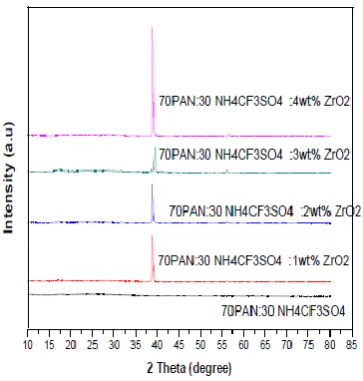
Fig. 1: XRD of 70:30 (PAN: NH4CF3SO4)complexed
films with wt % of ZrO2.
The plots of XRD for 70PAN:30 NH4CF3SO4 , 70PAN:30
NH4CF3SO4 :1wt% ZrO2 , 70PAN:30 NH4CF3SO4 :2wt%
ZrO2 , 70PAN:30 NH4CF3SO4 :3wt% ZrO2 , and 70PAN:30
NH4CF3SO4 :4 wt% ZrO2 systems are shown in Fig.1.From
these spectra a sharp peak identified at 2 θ =370 which corresponds to orthorhombic PAN (110) reflection [8-10]. The sharp peak at 2θ values around 37o is less intense in complexed PAN films compared to those in 70PAN:30 NH4CF3SO4 film. Degree of crystallinity of the 70PAN:30
NH4CF3SO4 complexes decreased with addition of ZrO2
nano ceramic fillers. The broad peak shifted to a lower or higher value by addition of ZrO2 nano powder .Therefore, it
may be due to internal adjustment in the amorphous nature, indicates that high ionic conductivity [11]. The relative intensity of 70PAN:30 NH4CF3SO4 decreased with the
increasing in ZrO2 nano powder concentration. XRD pattern
indicates that enhancement of the amorphous nature of the gel polymer electrolyte and confirms the complexation of nano powder with polymer-salt matrix.
[image:2.595.310.545.52.396.2]C. SEM Studies:
Fig.2. SEM Photographs of (a) 70 PAN: 30 NH4CF3SO4 (b)
70PAN+30 NH4CF3SO4+ 1wt% ZrO2 (c) 70PAN+30
NH4CF3SO4+ 2wt% ZrO2 (d) 70PAN+30 NH4CF3SO4+ 3
wt%ZrO2 (e) 70PAN+30 NH4CF3SO4+ 4wt%ZrO2
SEM Studies of 70PAN:30 NH4CF3SO4 , 70PAN:30
NH4CF3SO4 :1wt% ZrO2 , 70PAN:30 NH4CF3SO4 :2wt%
ZrO2 , 70PAN:30 NH4CF3SO4 :3wt% ZrO2 , and 70PAN:30
NH4CF3SO4 :4 wt% ZrO2 systems are shown in Fig.2.From
these spectra particle grain size and perception of phase separations revealed. These results affects on structural properties and conductivity properties i.e phase segregation of prepared samples. With the addition of nano powder ZrO2
to the polymer-salt matrix the particle grain size varied and it can be represented in SEM photographs. The surface morphology also explained by SEM photographs.
D.Ionic conductivity based on Temperature:
2.7 2.8 2.9 3.0 3.1 3.2 3.3 3.4
-5.0 -4.5 -4.0 -3.5 -3.0 -2.5 -2.0
Log
S/
Cm
)
1000/T (K-1)
Filler free 1 wt% zro2
2 wt% zro2
4 wt% zro2
[image:2.595.60.278.522.732.2]3 wt% zro2
for 70PAN:30 NH4CF3SO4 GPEs with different wt% of
nanofiller ZrO2.
70PAN:30NH4CF3SO4: (1-4) wt% ZrO2 structured films
conductivity with respect of temperature represented in Fig.3. The obtained graph follows the Arrhenius relation. The activation energy values measured from this relation for all compositions. In addition of nanofiller ZrO2 the ionic
conductivity enhanced up to 3 wt% which indicates that ionic conductivity depends upon no of charge carriers in polymeric electrolyte substances [12]. The ionic conductivity and Ea values for prepared nanocomposite
membranes were taken from Arrhenius plots drawn between the ionic conductivity versus Temperature and illustrated in Table 1. ZrO2 nano filler doped Gel Polymer membranes
[image:3.595.336.507.68.220.2]exhibit higher ionic conductivity when compared to filler-free electrolytes due to the mobility of charge carriers getting more velocity and exhibiting greater conductivity.
Table I. D.C Conductivity, Ea, various compositions
of 70PAN + 30 NH4CF3SO4+ wt% ZrO2 GPEs
systems
E. Ionic conductivity based on nano filler
Composition:
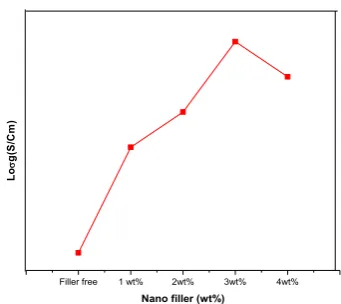
Fig.4 explores that the modifications of ionic conductivity with adding of nano ceramic filler ZrO2 composition It was
cleared that the ionic conductivity increased from 1-3 wt% ZrO2 and for 4 wt% decreased..These results explain that
with an addition of nanofillers up to 3 wt% the no of free charge carriers increased i.e. the better ionic conductivity obtained for 3 wt% of ZrO2 .The ionic conductivity values
noted in Table 1. The highest ionic conductivity obtained
for 3 wt% of ZrO2 was 4.65 × 10⁻³ S/cm at 373K.
Filler free 1 wt% 2wt% 3wt% 4wt%
Nano filler (wt%)
Lo
g
(S
/C
m
)
Fig.4. Composition dependence of conductivity in 70PAN +30 NaF+wt% ZrO2 System
F. Transference number measurement:
70PAN:30 NH4CF3SO4 based ZrO2 nanofiller doped
Transference number measured by using ion transport phenomena. Fig.5 illustrates that change of polarization current vs time .From these graph the polarization current can be reduced while increasing time. The presence of predominantly ions the polarization current decreased [13-18]. The transference numbers for 1- 4 wt% of ZrO2 0.910,
[image:3.595.56.285.287.667.2]0.915, 0.936 and 0.921.were given in Table 2
[image:3.595.320.536.377.553.2]Table II: Ea, Ionic Transference numbers various
compositions of 70PAN: 30 NH4CF3SO4 films at
different wt % ZrO2.
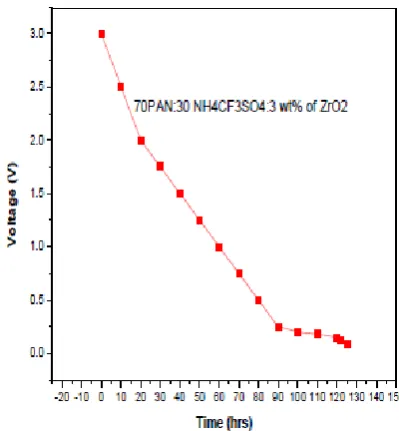
Fig.6. Discharged curve of solid-state cell configuration of Na/70PAN: 30 NH4CF3SO4:3wt% ZrO2 /( I2+C+Electrolyte
) at load 100kῼ.
G. Discharge Characteristics:
In previous studies 70PAN:30 NH4CF3SO4 based GPEs
exhibiting maximum conductivity. For getting more conductivity the ceramic filler ZrO2 doped with host
polymer matrix. From Fig.6 the 3 wt%ZrO2 having
maximum conductivity when compared to other compositions. The sharpness of initially decreased in terms voltage of the cell due to polarization effect [19-22]. Hence proton type battery using this composition films constructed to study the discharge characteristics. The cell configuration such as anode material taken as Na and mixture of iodine, graphite and a small piece with the ratio of 5:5:1 considered as a cathode material. The GPEs film 70PAN:30
NH4CF3SO4:3 wt% of ZrO2 taken between the positive
electrode and negative electrode. After that constant load 100kῼ applied to measure the parameters of cell like OCV, SCC and Discharge time. The cell parameters of these nanocomposite gel polymer electrolyte film illustrated in Table 3. The OCV of cell was 3.02V.
V. CONCLUSIONS
Blending of different concentration of NH4CF3SO4 with
pure PAN with doping of nano powder ZrO2 using solution
casting procedure nano composite GPEs were fabricated. The characterization techniques like XRD, SEM and DC Conductivity studies were studied. The polymeric blends exhibit Semi crystalline nature. Further, the doping of nano powder to polymer salt complexed film has been performed better ionic conductivity. With the help of 70 PAN: 30NH4CF3SO4 Gel polymer electrolyte system hybrid solid
–state battery configuration with (Na/PAN: NH4CF3SO4
(70:30) +3 wt% ZrO2 +EC+DMF/ (I2+C+Electrolyte)) has
been fabricated and their discharge characteristics are studied and these results are found to be comparable with existing results.
ACKNOWLEDGEMENT
Author Narasimharao Maragani gratefully acknowledges support of Management and Principal of Priyadarshini Women’s Engineering College for their utmost assistance.
REFERENCES
1. Kumudu Perera, K.P. Vidanapathirana, M.A.K.L. Dissanayake“ Effect of the polymer host, Polyacrylonitrile on the performance of Li rechargeable cells”, K. Perera et al. /Sri Lankan Journal of Physics, Vol 12, 2011, pp. 25-31 .
2. Beck F, and Ruetschi, P. Rechargeable batteries with aqueous electrolytes, Electrochim. Acta., 45 , 2000, pp.2467–2482.
[image:4.595.66.266.408.624.2]4. ChithraM.Mathew, K. Kesavan, and S. Rajendran, “Structural and Electrochemical Analysis of PMMA Based Gel Electrolyte Membranes,” Hindawi Publishing Corporation International Journal of Electrochemistry Volume 2015, pp. 1-7.
5. Ramesh Babu,K.Vijaya Kumar, “Studies on Structural and Electrical Properties of NaHCO3 Doped PVA Films for Electrochemical Cell
Applications”- International Journal of ChemTech ResearchCODEN (USA): IJCRGG ISSN: 0974-4290Vol.7, No.1, 2014-2015, pp 171-180.
6. I.Blaszczyk-Lezak, V.Desmaret,C.Mijangos, “Electrically conducting polymer nanostructures confined in anodized aluminum oxide templates (AAO),” eXPRESS Polymer Letters Vol.10, No.3 ,2016, pp . 259–272
7. N.Ammakutti @ Sridevi, P.M.Shyly, X.Sahaya Shajan, “Mechanical and ionic conductivity studies on polymer electrolytes incorporated with chitin nano fiber for rechargeable magnesium ion batteries,” International Journal of Science, Technology & Management Volume No 04, Special Issue No. 01, March 2015.pp.23-28.
8. S. Sarojini and C. Anjali, “Synthesis and Structural Characterization Studies on Solid Polymer Electrolyte System with Magnesium Triflate as Host Salt, EC as Plasticizer and MgO as Nanofiller,” Chemical Science Transactions, ISSN:2278-3458, 2016,pp.345-352. 9. Alamgir M., Abraham K.M., “Room temperature rechargeable
polymer electrolyte batteries,” Journal of Power sources, 1995, pp.40-45.
10. Slane S., Salomon M., “Composite gel electrolyte for rechargeable lithium batteries,” Journal of power sources, 1995, pp.7-10. 11. Yoon H., Chung W., Jo aN., “Study on ionic transport mechanism and
interactions between salt and polymer chain in PAN based solid polymer electrolytes containing LiCF3SO3,” Electrochemica Acta, 2004, pp.289-293.
12. Wang Z., Huang B., Huang H., Chen L., Xue R., Wang F., “Infrared spectroscopic study of the interaction between lithium salt LiClO4 and
the plasticizer ethylene carbonate in the poly acrylonitrile based electrolyte,” Solid state ionics, 1996, vol.143-148.
13. Narasimha Rao Maragani, N.Krishna jyothi, K.Vijaya kumar, “Ion Transport and Spectroscopic Studies of Poly acrylonitrle complexed with Ammonium trifluoro methane sulfonate (NH4CF3SO4) Gel
polymer electrolyte system,” Int.J.Chem.Sci:14(2), 2016, pp.789-802. 14. Huang B., Wang Z., Chen L., Xue R., Wang F., “The mechanism of lithium ion transport in poly acrylonitrile based polymer electrolytes,” Solid state ionics, 1996, pp. 279-284.
15. Girish Kumar G., Sampath S., “Spectroscopic characterization of a gel polymer electrolyte of zinc triflate and polyacrylonitrile,” Polymer, 2004, pp.2889-2895.
16. Narasimha Rao Maragani, N.Krishna jyothi, K.Vijaya kumar, “Structural, Thermal and Battery Characteristic Properties of NH4CF3SO4 Doped PAN films for Electrochemical Cell
Applications,” International Journal of ChemTech ResearchCODEN (USA): IJCRGG ISSN: 0974-4290 Vol.9, No.5, 2016, pp 432-438. 17. Xianguo Ma, Xinglan Huang, JiandongGao, Shu Zhang, ZulingPeng,
Zhenghua Deng, JishuanSuo,Anionic polymer electrolyte with enhanced electrochemical performance based on surface-charged latex nanoparticles for flexible lithium-ion batteries,” J. Power sources, 2014; pp.259-266.
18. R.F Bhajantri, V.Ravichandary, A.Harsha Vincent crasta, suresh P Nayak, Bojapoojary, “Micro structural studies on Bacl2 doped PVA polymer. Polymer, 2006, pp.3591-3598.
19. N.Krishna Jyothi, K.Vijaya Kumar, P.Narayana Murthy, ”FTIR, XRD and DC Conductivity Studies of Proton Conducting Gel Polymer
Electrolytes Based on Polyacrylonitrile (PAN),”
Int.J.Chem.Tech.Res.,69(13),2014,pp.5214-5219.
20. Dr. Narasimha Rao Maragani, M.Gnana Kiran, “AC conductivity and
Dielectric studies of PVA based solid polymer
electrolytes,”.J.Indian.Chem.society, vol 96, January 2019 pp 76-77. 21. Maragani Narasimharao, Vijayakumar K. “Effect of Al2O3 ceramic
filler on PAN-based composite Gel polymer electrolytes for Electrochemical Cell Applications.” Vol. 15, No. 4, Iranian Journal of Material Science and Engineering, 2018,pp 132-140.
22. Maragani Narasimharao, Vijayakumar K. “Structural and ionic conductivity studies on Plasticized PAN- Sodium Fluoride Polymer Electrolytes for Electro chemical cell Applications.” Iranian Journal of Material Science and Engineering. 14(4), 2017, pp.1-10.
AUTHORS PROFILE
Dr. Hariprasad was born in Vissannapeta, Krishna (Dist), and Andhra Pradesh, India in 1979. He obtained M.Sc. degree in Chemistry from Andhra University, Kakinada, A.P., and India in 2003. He was awarded his Doctorate in Chemistry at the Kakatiya University, Warangal in 2015. Presently, he is working as an Associate Professor in Department of Chemistry, ANRK and Kodad, Suryapet, India. His research interests mainly on Synthesis and Characterization of Nanomaterials and Polymer Electrolytes for energy storage device Applications. Mr. Hariprasad has published more than 3 research papers in referred journals.
Dr. Narasimha Rao Maragani was born in Painampalli, Khammam, and Telangana, India in 1984. He obtained M.Sc. degree in physics from Acharya Nagarjuna University, Guntur, A.P., and India in 2007. He was awarded his Doctorate in Physics at the KLEF University, Guntur in 2019. Presently, he is working as an Associate Professor in Department of Physics, PRIW, and Khammam, India. His research interests mainly on Synthesis and Characterization of Nanomaterials and Polymer Electrolytes for energy storage device Applications. Mr. Narasimha Rao has published more than 10 research papers in referred journals and has been author or co-author of over 05 International and national conference papers.
Dr. K.Vijaya Kumar Born in 10th Dec.1964 at Nellore Dist. Andhra Pradesh. He did his Post graduation in Physics with Transducer Electronics in the year 1987 from Sri Krishna Devaraya University, Anantapur, A.P and M.Phil, in Thin films in the year 1990 from Sri Venkateswara University, Tirupathi, A.P. Likewise he received Ph.D. in Materials Science (Ion Conducting polymer electrolytes and their Applications as an Electrochemical cells& Fuel Cells) during the year 2004 from Osmania University, Hyderabad-A.P. He is having 30 years of Academic experience in different reputed Institutions and Universities. Presently he is working as Professor and HOD of Physics in Dayananda Sagar Academy of Technology and Management, Bangalore.