1
A Comparative Study of Human Teacher and Computer Teacher
MEHRYAR NOORIAFSHAR
University of Southern Queensland, Toowoomba, Australia
Abstract
This ongoing research project investigates learners' preferences and perceptions with regard to human and computer teachers. In this study, a human teacher is defined as the experienced, knowledgeable and patient teacher giving the traditional face to face lesson/lecture. The computer teacher is the educational computer software, multimedia and/or various learning resources on the Internet. Survey results and analysis have indicated that the majority of the respondents believe in the use of the latest computer technologies in education but they have a preference for a human teacher.
This research also paves the way for further work and development in adopting the latest technologies in tablet computing in education. In particular, the more human-like interface features, offered by Apple’s iPad and other touch devices is being investigated for educational development.
Key words: Technology, Tablet, Education
Evolution to Tablet Commuting
Even the early versions of computers were recognized as ideal tools for educational purposes. That is due, mainly, to abilities to store and process large amounts of information. Their real potential for learning and teaching was identified in the 1980s when personal computers with multimedia features became more readily available. For instance, an old favourite was Commodore 64 (C64). When back in the 1980s, this personal computer entered the homers of several hundred thousands of people in different parts of the world; it revolutionized how one should work with and use computers. That is whenever and to a certain extent wherever one wishes. In other words, computers were not restricted to only computer labs of learning and industrial organizations. The other significant contribution to computer aided learning was the multimedia features of these relatively inexpensive home computers.
2
The progress in the technology, its capabilities and educational applications have
continued and enhanced exponentially over the recent years. The latest developments focus on the web based learning systems for the purposes of better understanding. For further information, see Chau (2007). Although the Internet based learning play a major role in education and its delivery, the latest hardware features promise exciting developments. These features include a different and more natural way of interface. For instance Apple's tap, pinch and draw capabilities using fingers on iPod Touch and iPhone are good examples. These features have enabled the application developers create very interesting and useful educational apps. These apps are readily available at reasonably modest prices on the App Store accessible via Apple's iTunes and devices such as iPhone. These apps cover numerous fields such as languages, arts, music, science, mathematics and statistics. The list is
continually growing. With the recent release of iPad, the Touch technology will have even more serious implications for education. Just before the formal launch of iPad in the US, Fry S (2010) had the following comment after interviewing Steve Jobs (Apple’s CEO) and reviewing the product for Time Magazine:
“When I eventually got my hands on one, I discovered that one doesn’t relate to it as “tool”; the experience is closer to one’s relationship with a person or an animal.”
According to Fry (2010), Tracy Futhey, of Duke University, was quite optimistic about iPad’s potential in education and commented that:
“The iPad is going to herald a revolution in mashing up text, video, course materials, students input …We are very excited.”
3
Figure 1 – Finger Painting of an Australian Farm and Toowoomba’s Japanese Garden (Queensland, Australia) on iPhone
Another innovative technology which certainly has a place in the modern approaches to learning is the Amazon Kindle. Kindle is a specially developed hardware and software packaged into a very compact and attractive tablet. Kindle has free international electronic book, magazine or document download capabilities via 3G. Kindle with its whispenet synchronization between the user’s different devices, is a very good example of seamless technology for learning. For further information on seamless learning, see Looi (2010). Hence the user can download numerous items of interest from the Amazon's Kindle Store. In addition to its very useful features such as an active dictionary and free 3G access to Wikipedia, it is equipped with an experimental text to speech function. When switched on, this function allows the reader to listen to the text on the page. The author has experimented with this feature for the purposes of speed reading training. This experiment was carried out by setting the speech pace to fast and the text on the screen was scanned at the same speed by the author. It was observed that the need for sub-vocalization was removed from the process. Although sub-vocalization is an important factor in comprehension, it is also an inhibitor in achieving higher speeds. The author has comfortably achieved speeds above 250 words per minute with a close to full comprehension outcome.
4
converter and image cropping. The next sections presents the methodology and results for this ongoing work.
Human Teacher versus Computer Teacher
The participants of this investigation were people who were either directly involved in some form of learning for themselves or closely related to others such as their children or spouses. Adults of both genders from totally different walks of life and backgrounds were selected and contacted for the survey and data collection in this study. These people
included college and university students, professionals such as nurses, dentists, technicians and teachers. The study included respondents with varying cultural, linguistic and
geographical characteristics too. The following questions are those which have been analyzed in this paper:
1.
How do you rate the learning effectiveness with a Human Teacher?
1 (Low)
2
3
4
5 (High)
2.
How do you rate the learning effectiveness with a Computer Teacher?
1 (Low)
2
3
4
5 (High)
3.
How do you rate your interaction in terms of enjoyment with a Human
Teacher?
1 (Low)
2
3
4
5 (High)
4.
How do you rate your interaction in terms of enjoyment with a Computer
Teacher?
1 (Low)
2
3
4
5 (High)
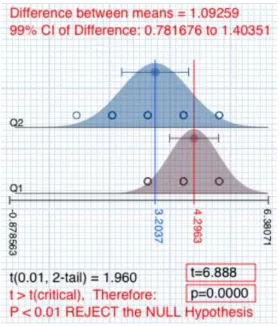
An initial analysis of the data for the difference between the perceptions of the learning process effectiveness indicates a preference for the human teacher. The difference in the means of the responses is slightly over 1.
5
Figure 2 – Difference between the Means of the responses for Question 1 and Question 2
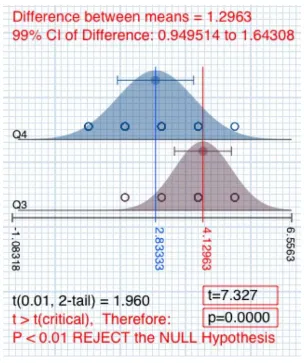
Another aspect of this investigation was to study and compare the levels of interaction-enjoyment for both computer and human teacher. The respondents were asked to rate their perception of the level of enjoyment on a 1 to 5 scale. An intitial analysis of the responses determined that the interaction in terms of enjoyment for human teacher has a much larger mean (4.1) than computer teacher (2.8). As Normal Distributions curves in Figure 3 show, the standard deviation for human teacher is also smaller than computer teacher and the respondents appear to have preferences very close to 4(3 and 5).
6
Figure 3 – Difference between the Means of the responses for Question 3 and Question 4
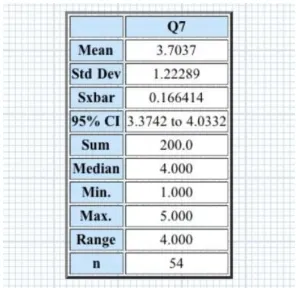
This finding is rather interesting because the respondents would perceive a computer teacher to have a place in the future education. Their very positive response (Figure 4) to the following question (7) is demonstrative of their belief in future technologies for learning and teaching.
Please rate the effectiveness of the following scenario which may take place in the future:
You buy/borrow a book on a topic of your choice, take it home and open it. You then ask the book in your language of choice some questions. The book starts talking and explaining to you by showing you 3 dimensional images. It then invites you to physically (but virtually) interact with them. So, it helps you to learn your topic (e.g. a craft or a skill) by letting you experiment; and it gives you feedback all the time!
7
Figure 4 – Question 7 Parameters
Conclusions
Although an overwhelming majority of the respondents believe in the future of
computers in learning and teaching, they still have a preference for having a human teacher. The respondents' preferences regarding the effectiveness and level of enjoyment with an actual teacher support this finding. The respondents, however, are certainly in favour of an advanced and intelligent system which can respond to learners' needs.
This study is an on-going project and additional data is being continually collected. One of the aims of any future investigation is to undertake a comparative study between different cultural backgrounds. It is also planned to investigate new and emerging applications of tablet computers such as iPad in education.
References
Chau, K. (2007). Web-Based Interactive Computer-Aided Learning Package on Open-Channel Flow: Innovations, Challenges, and Experiences. Journal of Professional Issues in Engineering Education & Practice, 133(1), 9-17.
8
Fry, S. (2010, April 12). On the Mothership. Time, No Pages.
Looi, C., Seow, P., Zhang, B., So, H., Chen, W., & Wong, L. (2010). Leveraging mobile technology for sustainable seamless learning: a research agenda. British Journal of Educational Technology, 41(2), 154-169. doi:10.1111/j.1467-8535.2008.00912.x.
Schembri, T., & Boisseau, O. (2001). Commodore 64. Retrieved 4 12, 2010, from www.old-cpmputers.com/museum/computer.asp?c=98
Stewart, B., Hutchins, H., Ezell, S., De Martino, D., & Bobba, A. (2010). Mitigating challenges of using virtual reality in online courses: a case study. Innovations in
Education & Teaching International, 47(1), 103-113. doi:10.1080/14703290903525937.
Acknowledgements