Harnessing Technology Schools Survey 2009
Analysis report
July 2009
Peter Rudd, David Teeman, Helen Marshall, Ellie Mundy, Karen White, Yin Lin, Jo Morrison, Tilaye Yeshanew and Vani Cardozo
Table of contents
Introduction ... 3
Strategic context... 3
Survey respondents ... 5
Report structure ... 9
Enabling infrastructure and processes ... 10
Improved personalised learning experiences ... 14
Confident system leadership and innovation ... 17
Technology confident effective providers ... 21
Engaged and empowered learners ... 24
Introduction
Strategic context
The year 2008–09 has, in many ways, been significant in terms of the provision, use and impacts of new technologies in schools. There has been a real drive in this period, from various sources, but especially from Becta and its partners, to support, enhance and develop schools’, teachers’ and learners’ uses of new technologies. This has manifested itself in a number of ways. For example: in the numbers of schools equipping themselves with learning platforms, which provide opportunities for integrating the use of technology across all school stakeholders and dedicated online learning spaces; in the push to improve digital inclusion by providing learners with greater home access to computers; and in growing public and professional (and media) interest in topics such as e-safety.
The uses and impacts of new technologies, and the problems associated with them, often tend to be discussed anecdotally, and there is sometimes a lack of evidence about what is happening in practice as teachers and learners attempt to make the most of these technologies. This report aims to provide this evidence. It sets out the main findings from the Harnessing Technology Schools Survey 2009 – national surveys of the use of ICT in primary, secondary and special schools in England. These findings provide both a clear picture of the uses of new technologies for teaching and learning, and a solid evidence base which Becta and others can draw from in order to plan progress in this area.
The National Foundation for Educational Research (NFER), on behalf of Becta, carried out the individual surveys within the Harnessing Technology Schools Survey in December 2008 and January 2009. These annual representative surveys are intended to assess the state of the nation in terms of the uptake and impact of educational technologies in maintained schools across England. The surveys covered school leaders, ICT co-ordinators and teachers in three school sectors – primary, secondary and special schools.
Nationally representative data on ICT in schools have been collected annually since 1998 through the ICT in Schools Survey (1998–2004), the evaluation of Curriculum Online (2002, 2003 and 2005), the Harnessing Technology Schools Survey 20071 and by the NFER through the Harnessing Technology Schools Survey in 2008.2 Comparisons with the findings from previous surveys, where practicable and relevant, are provided throughout this report.
1
Kitchen, S., Finch, S. and Sinclair, R. (2007). Harnessing Technology Schools Survey 2007. Coventry: Becta.
2
The original Harnessing Technology strategy set out, in March 2005, a five-year plan for a system-wide approach to the application of ICT in education, skills and
children’s services. In order to address new system challenges, in 2008 Becta revised the strategy in a document entitled Harnessing Technology: Next generation learning 2008–14 with a focus on achieving greater value for learners from
technology. The revised strategy sets out a commitment to ensuring that every school, college, university and training provider is ‘technology confident’. It aims to achieve this through engagement with learners and parents, and the professional development of teachers and trainers.
In March 2009, Becta published an implementation plan for the revised Harnessing Technology strategy.3 This sets out the core goals of the strategy, the objectives supporting these goals, and key priorities and action points. The plan also outlines how £600 million of funding will be distributed for technology-related capital
expenditure up to 2011 by means of the Harnessing Technology Grant.
It is worth emphasising that schools are dealing with many other policies and
strategies apart from those relating to technologies. Until recently, the policy agenda within education consistently focused on school improvement and learner
achievement. More recently, however, there have been additional emphases on issues such as school leadership, extended provision, professional development, the development of a children’s workforce, and behaviour.
This developing policy agenda has resulted in significant change for schools, transferring choice and responsibility to individual schools, within a broad needs-based framework of co-ordinated provision for the child, witnessed by the Children Act (2004) in England and Wales, Every Child Matters (HM Government, 2004) and, ultimately, The Children’s Plan (DCSF, 2007). Individual government policy initiatives include:
• delivering on the Every Child Matters agenda
• the development of an integrated children’s service, with each local authority having a director of children’s services
• the development of a children’s workforce (and within this a schools’ workforce)
• school workforce remodelling and professional development, underpinned by new professional standards for teachers and occupational standards for support staff
• attuning learning better to the needs of pupils, underpinned by the
personalisation of learning (which includes learning to learn, self-directed
3
learning, Assessment for Learning, and pupil and parental voice and choice)
• developing and fully rolling out the Extended Schools programme • wide-ranging and broad integration of schools with other schools, other
public services providers, and their local communities.
Further, the current (and future) economic situation has implications for schools, parents and their wider communities. Hence the economic context needs to be considered when planning for schools’ ICT provision and use, so that schools are best placed to continue to help address goals to ‘narrow the gap’.
In January 2008, in recognition of the broader developing policy context, the schools minister asked Becta to “factor in the recommendations of the Children’s Plan into the next stage of our e-strategy, building on what we have achieved already”.4 The unifying theme of the Children’s Plan is a partnership between schools and parents, and in this respect certain elements of the Harnessing Technology strategy, such as school–parent communications and learners’ access to computers and the internet at home, have taken on an even greater importance in 2009.
One of the key objectives of the 2009 schools survey was to collect information that will assist Becta with assessing progress towards the aims and outcomes of the revised Harnessing Technology strategy and the Children’s Plan, and to make future strategic decisions based on the latest developments in ICT related to schools. All three survey questionnaires were informed by the Harnessing Technology strategy (and by inputs from key Becta personnel) and included questions on specific
elements of the strategy, such as home access, learning platforms, e-safety and the uses of technology for teaching and learning.
Survey respondents
When each school was approached with an invitation to participate in the survey, it was sent one questionnaire for a school leader, one for the ICT co-ordinator (or equivalent) and either three (in primary or special schools) or six (in secondary schools) for teachers. A total of 831 schools returned at least one questionnaire; the sample of 2,862 teachers, which is slightly higher than the 2008 survey figure of 2,744, provides robust numbers for the analyses presented in this report.
When considering these findings, however, it is important to bear in mind the nature of the survey: three sub-samples (school leaders, ICT co-ordinators and teachers) across three school sectors. Most of the analysis in this report is by school sector.
4
Knight, J. (2008). ‘Technology will be key in delivering the Children’s Plan’. Speech at the BETT conference, London, 9 January. Available at:
Table 1 below gives details of the numbers of respondents in the various sub-groups.
Table 1: Numbers of survey respondents by role and school sector
School sector School leaders ICT co-ordinators Teachers N
Primary 222 229 519 970
Secondary 157 201 695 1053
Special 170 227 442 839
N 549 657 1656 2862
The sample was checked against the population of schools in England, and
weightings were applied to ensure that the samples represent the national picture.5 The characteristics identified for respondents in all three samples include gender, years of professional experience, and current role in school. For teachers,
information was also requested on the main subject(s) and the key stage(s) taught.
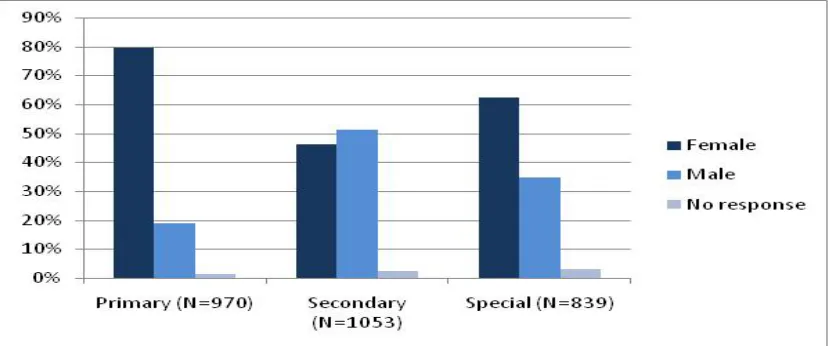
In terms of gender, as can be seen from Figure 1 below, female respondents outnumber male respondents in the primary school sector by four to one. There is also a higher proportion of female respondents in the special school sector.
[image:6.595.74.488.469.642.2]Responses from secondary schools, however, are more evenly split by male and female.
Figure 1: Gender of respondents by school sector
5
The special school sample was representative; however the primary school sample was found not to be representative of achievement, and the secondary school sample was found not to be
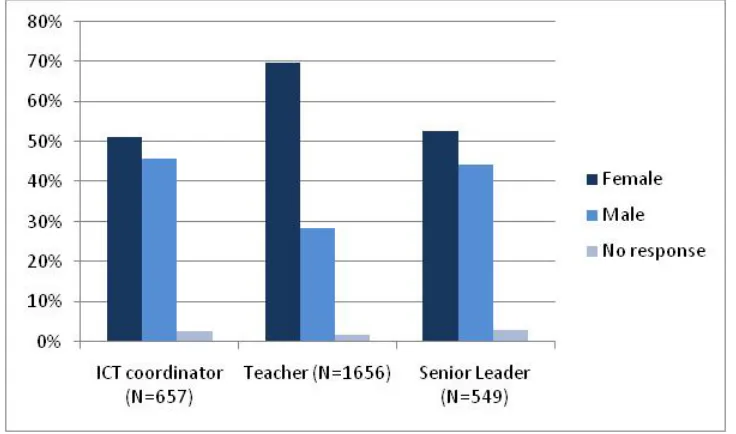
When considered by respondent type, twice as many of the respondents who completed the teacher questionnaire are female than male (Figure 2). A slightly higher proportion of female than male respondents completed the senior leader and ICT co-ordinator questionnaires. Analysis revealed no significant change in the gender profile of ICT co-ordinator respondents or teachers from 2008 to 2009.
Figure 2: Gender of respondents by respondent type
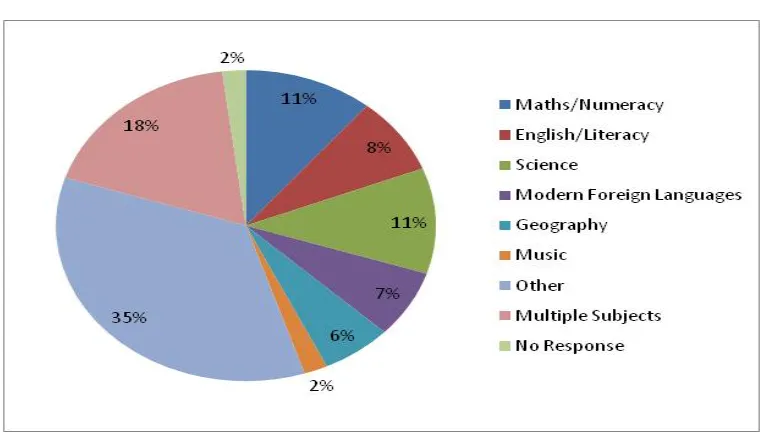
In all three sectors, large proportions of teachers indicated that they teach multiple subjects: approximately two-thirds of teachers in the primary (68 per cent; see Figure 3) and special school sectors (59 per cent), and almost one-fifth (18 per cent) of secondary school teachers (see Figure 4) teach multiple subjects. The distribution of the remaining teachers across the subjects reflects the context of individual school sectors, with a good balance of respondents from each subject area. The distribution of teachers by subjects taught in special schools is similar to that observed in
Due to rounding, percentages may not sum to 100.
[image:8.595.71.418.92.321.2]Source: NFER Harnessing Technology teachers survey 2009.
Figure 3: Subjects taught – primary
Due to rounding, percentages may not sum to 100.
Source: NFERHarnessing Technology teachers survey 2009.
Figure 4: Subjects taught – secondary
[image:8.595.71.454.384.603.2]Report structure
This analysis report presents the main findings and analyses from the 2009 Harnessing Technology Schools Survey, and summarises and discusses the implications of these findings.
A companion report, the data report,6 presents the data collected from the surveys in a more comprehensive and systematic fashion, and provides a data reference
document. In the data report, the findings from every question in each of the three surveys are set out in tabular form, and the findings are also set out by school sector – by primary, secondary and special school sub-samples.
The analysis presented here directly addresses the key areas and aims of
Harnessing Technology: Next generation learning 2008–14 as they relate to schools, and considers how much progress has been made against these areas. The report presents key survey findings according to the five system outcomes against which impact of the strategy will be measured. The system outcomes are:
• Enabling infrastructure and processes • Improved personalised learning experiences • Confident system leadership and innovation • Technology confident effective providers • Engaged and empowered learners.
This analysis report uses the system outcomes as an organising framework for assessing the evidence collected in the Harnessing Technology Schools Survey. Hence the following sections summarise the evidence in relation to progress to date towards each of the broad desired outcomes. Any areas of development that Becta may need to consider in the context of future strategic decisions based on the latest developments in ICT related to schools are also indicated.
A final overview section then identifies a number of key and cross-cutting issues.
6
Marshall, H., Teeman, D., Mundy, E., et al. (2009). Harnessing Technology Schools Survey 2009: Data report – Part 1, descriptive analysis. Coventry: Becta.
Part 2 of the data report presents explanations of, and the findings derived from, the following types of analysis: factor analyses, change over time, cross-tabulation, ANOVAs, correlations and regression analyses.
Enabling infrastructure and processes
This section corresponds with Becta’s aim to support the development of enabling infrastructure and processes.
Key survey findings about infrastructure and processes include:
• Compared with the findings from previous surveys, there was an increase in both numbers of computers per school (in each school sector) and in numbers of computers available for learners’ and teachers’ use. The 2009 findings, when compared with those of previous surveys, also indicate that, in general, the average number of learners per computer is falling. • A separate statistical analysis was carried out for Becta in order to
establish the pupil–computer ratio for primary schools, based on the Harnessing Technology Schools Survey 2009 data. The headline figure produced was a median pupil–computer ratio of six – in other words, the average primary school has one computer for every six pupils.
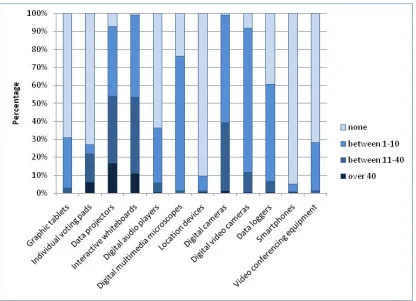
Source: NFER Harnessing Technology school ICT co-ordinators survey 2009.
Figure 5: Number of devices available at schools for teaching and learning
• Around half of the ICT co-ordinators (52 per cent) reported that their schools use a learning platform. (The equivalent figure last year, in 2008, was around 40 per cent.) Learning platforms are much more common in secondary schools, with around three-quarters of secondary school ICT co-ordinators reporting that their schools use a learning platform,
compared with 40 per cent in primary schools and 41 per cent in special schools.
• The predominance of display technologies in daily use in classrooms is, once again, confirmed by teachers’ responses; primary teachers have overtaken their secondary colleagues in this respect. Over eight out of 10 primary school teachers and over seven out of 10 secondary and special school teachers said that they use display technologies at least once a day.
Web 2.0 technologies and learners’ own devices such as mobile phones are used only infrequently in classrooms – there may be scope to further develop their use.
highly, but were less certain about the benefits of more interactive
features, including those that may enhance communication with parents.
Developments in infrastructure provision, therefore, have been the most successful strand of the Harnessing Technology strategy to date. One area related to
infrastructure may need strategic attention, however: use of learning platforms. A key finding is that around half of ICT co-ordinators reported that their school uses a learning platform. This is an improvement on 2008, when the equivalent figure was around 40 per cent, but progress is perhaps slower than anticipated and there are variations by school sector. It may be difficult to reach the target for all schools to be making full use of learning platforms by 2010.
The survey findings also indicated that reasonably large proportions of teachers do not have a full awareness of learning platforms and their potential for supporting teaching and learning. It seems that, even where learning platforms have been installed in school networks, there is sometimes a need to promote awareness of what a learning platform is and what it can do. This is, in some respects, a change management issue. The technology needs to be supported with face-to-face guidance, encouragement, support, and possibly training. Teachers and learners need to be fully informed about how they can make optimal use of the various dimensions of learning platforms.
In all other respects, infrastructure provision appears to be very good. There is
strong evidence that the various school staff who completed the surveys are satisfied – or indeed, in some respects, more than satisfied – with the infrastructure, including the hardware and software at their disposal, for teaching and learning. The large majority of teachers reported having the access that they need to networked desktop and laptop computers. Also, ICT co-ordinators are happy with their schools’ networks in terms of the type of network and the network’s speed and performance.
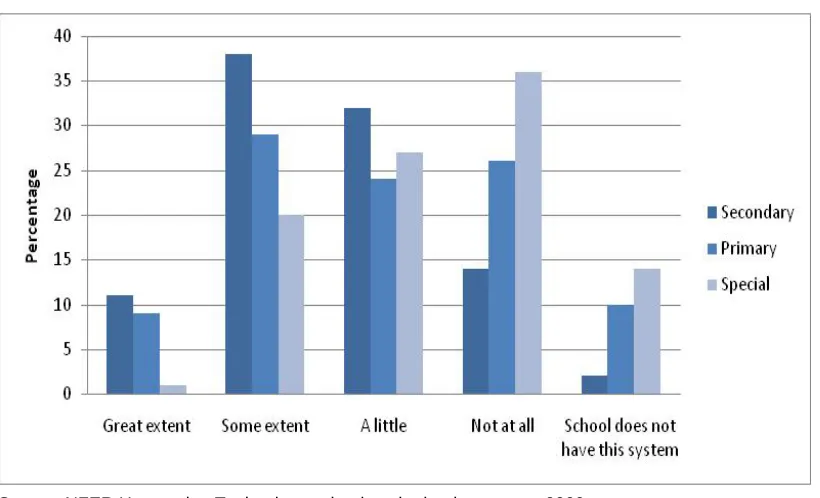
Source: NFER Harnessing Technology school ICT co-ordinators survey 2009.
Figure 6: Extent of remote access to school resources
ents,
k in n which to support and develop technology for learning into 2010 and beyond.
It can be argued that both the physical infrastructure and the cultural requirem in the form of positive attitudes about the benefits of ICT, are in place for the transformations of teaching and learning that are being sought through the
Improved personalised learning experiences
The theme of personalising learning runs through the Harnessing Technology
strategy and can be linked with the need for every child to benefit from ICT. The use of learning platforms and movement towards providing learners with e-portfolios, for example in the new 14–19 Diplomas, are central parts of the use of ICT in
personalising learning. Other key aspects of the personalisation of learning are the provision of access to an electronic learning space for all learners, and the
enhancement of support networks, including communication with parents.
Key findings from the surveys include:
• For many schools, the use of technology to support personalising learning is a key priority for the future: over half of senior leaders and ICT co-ordinators rate this as a high priority (see Figure 7). In addition, two-thirds of teachers either strongly agreed or agreed that ICT helps them to
personalise learning.
[image:14.595.69.471.342.580.2]Source: NFER Harnessing Technology senior leaders and school ICT co-ordinators surveys 2009.
Figure 7: Percentage of respondents reporting that the use of ICT for personalising learning is a high priority in their schools over the next three years
• Learners’ use of e-portfolios appears to be an important element of personalising learning. In the 2009 survey, ICT co-ordinators were asked whether all, some or none of the learners in their schools are encouraged to use e-portfolios. About a fifth stated that all learners are encouraged to use e-portfolios, while around a third said that some learners are
prevalent in secondary schools than in the other sectors. About three-quarters of ICT co-ordinators in secondary schools stated that some or all of the learners in their schools are encouraged to use e-portfolios,
compared with two-fifths of their counterparts in both the primary and special school sectors.
• According to the estimates of senior leaders and ICT co-ordinators, about a quarter of pupils across all the three school sectors do not have access to a computer at home. This compares with an estimated 30 per cent of pupils who did not have access at the time of the 2008 survey. There are variations by school sector.
• Ten per cent of ICT co-ordinators reported that their schools have a specific home access scheme in place.
A higher proportion of teachers from schools with a home access scheme more often set homework requiring the use of a computer or the internet than do those in schools without such a scheme.
Source: NFER Harnessing Technology school senior leaders survey 2009.
Figure 8: Extent to which schools use an electronic system for communicating with parents
From the survey findings, it seems that personalising learning as a general concept, and considerations of the specific means of supporting this through the use of new technologies, feature prominently in the thinking of school staff. It is noticeable that two-thirds of teachers either strongly agree or agree that ICT helps them to
personalise learning (although it should be noted that the survey provided no specific definition of personalised learning, so respondents effectively defined this term for themselves).
Continuing improvements in infrastructure in schools, as well as in home access to computers for learners, are contributing to ‘anywhere, any time’ learning. As more schools acquire and make full use of learning platforms, flexibility is likely to
increase. To build upon the progress already made in using technologies to support personalising learning, it seems that future strategic attention should be focused on supporting and encouraging the optimum utilisation of learning platforms and
Confident system leadership and innovation
This section corresponds with Becta’s aim to support the use of ICT to help develop confident system leadership and innovation. Key findings include:
• Around nine out of 10 school senior leaders reported that their school has a written ICT strategy or improvement plan.
Within these plans, the most frequently identified item is the replacement of equipment, with three-quarters of senior leaders mentioning this. Other elements frequently mentioned by senior leaders are continuing
professional development for teachers, investments in the school ICT infrastructure, use of the learning platform, e-safety, and the acceptable use policy.
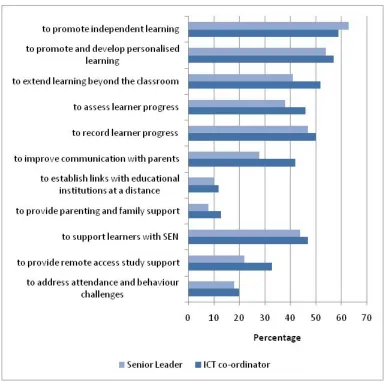
Schools in all sectors intend to give a high priority to developing the use of new technologies for personalising learning over the next three years (Figure 9).
Source: NFER Harnessing Technology senior leaders and school ICT co-ordinators surveys 2009.
Figure 9: Proportion of ICT co-ordinators and senior leaders who rated different ways of using technology to support learning as a high priority within their school over the next three years
• The use of ICT for management and monitoring within schools is well developed. Electronic systems are used to a great extent for managing information (ie a management information system – MIS), for recording learners’ attendance and for recording learners’ attainment. Senior leaders less frequently reported the use of electronic systems for recording
behaviour issues; this may at least in part be due to the confidential nature of information about behaviour.
• Overall, most respondents (86 per cent) said that their schools have a website.
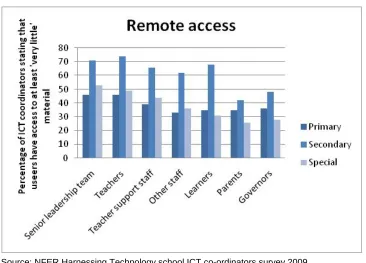
the school community; in turn, support staff and learners seem to enjoy proportionately greater access than do parents, other staff or governors. Remote access for staff (and learners) is significantly more likely in schools that have a home access scheme in place.
• Most schools reported that 5 per cent or less of the school budget will be spent on ICT in the current financial year (2008–09). Secondary schools allocate slightly more of their budgets to ICT (mean of 5.8 per cent)
compared with special schools (4.9 per cent) and primary schools (4.8 per cent).
• The analyses revealed that, since 2008, the number of ‘other independent sources’ used to purchase hardware has increased, and local authority and ICT supplier or reseller purchasing has decreased. This suggests that schools, especially larger schools, have become more autonomous and less dependent upon local authorities in their purchasing decisions.
In summary, the surveys provide plenty of evidence of confident school leadership. A large majority of school senior leaders report having written ICT strategies in place, and the priorities identified for the next year suggest that these leaders are very much in touch with current ICT initiatives and policies. School leaders are also clear about their priorities for ICT expenditure and seem satisfied that they have the resources to deliver effective teaching and learning through the use of technology (though, as always, the replacement of equipment is an ongoing consideration). In addition, the use of ICT for management and monitoring within schools generally appears to be well developed.
There is less evidence from the surveys about the degree of confidence in system leadership. If systems are taken to be inter-school, area or community networks – as seems reasonable in the context of extended service provision and the Children’s Plan – then there appears to be scope for further developing system
communications and system leadership. Collaboration with other schools and with the local community over technology-related matters is somewhat limited. This is perhaps understandable as schools concentrate on ensuring that intra-school
communications are efficient first, and then turn their attention to external partners. It may be useful for Becta to consider how schools could best be supported and
encouraged as they extend their ‘hierarchy’ of electronic communications – for example by means of learning platforms – to learners, parents and the community more generally.
Technology confident effective providers
This section presents the key survey findings that relate to Becta’s aim of using ICT to support the development of technology confident providers. Key findings relating to practitioners include:
• The majority of teachers, across all sectors, are enthusiastic about using ICT. The substantial majority of teachers agree that ICT is useful in helping to support diverse learning needs and that ICT makes learning more effective. Similarly, over three-quarters of ICT co-ordinators reported that nearly all or most teachers in their schools are enthusiastic towards using ICT in delivering the school curriculum.
• Some very encouraging findings from the 2009 surveys are that:
o teachers’ levels of enthusiasm for ICT are increasing
o teachers are more positive about the impact of ICT in terms of engaging most groups of learners
o compared with responses from the 2008 survey, significantly more teachers in all three sectors agree that ICT can have a positive impact on attainment for most groups of learners.
• Over half of teachers think they are effective in using ICT for a range of tasks, except for communicating with parents. In particular, teachers think they are effective at using ICT for lesson planning and lesson delivery. Moreover, the substantial majority of ICT co-ordinator respondents (88 per cent) reported that teachers in their schools are either very or quite
confident in using ICT to deliver the school curriculum.
• Teachers’ views about their effectiveness are supported by findings that relate to reported time-savings through the use of ICT. Responses from the 2008 and 2009 surveys with respect to the time saved each week by using ICT for a number of tasks were compared. Among secondary
respondents, more time is now saved by using ICT when planning lessons, marking or assessing work, writing reports and communicating with
learners. For primary respondents, more time is now saved when writing reports and communicating with parents.
• Teachers also appear to be becoming more adept at creating and sharing digital learning resources (see Figure 10). Around three-quarters of
Source: NFER Harnessing Technology teachers survey 2009.
Figure 10: Frequency of uploading and storing digital learning resources on school’s network, learning platform or repository
• Findings indicate that encouraging the use of social software is still uncommon. Well over half of all respondents stated that use of social software is not encouraged at all, while many stated that learners are discouraged from using it.
The applications that were reported by ICT co-ordinators to be encouraged most frequently (to a great extent or to some extent) are podcasts (37 per cent), wikis (30 per cent), blogs (26 per cent), online discussion groups (25 per cent) and media-sharing sites (25 per cent). Some teachers, however, are still completely unfamiliar with these types of software, particularly wikis, with 12 per cent stating that they have not heard of these.
These findings will be somewhat disappointing to those who advocate the importance of the learning potential of social software and social media. • With respect to training and support, informal, in-school ICT support from
colleagues clearly emerges as the form of training rated most positively by teachers. Most teachers have accessed this form of support, and over half of them said it is useful.
learners, carried out at the same time as the Harnessing Technology Schools
Survey, found that learners have very positive attitudes towards using technology for learning: 90 per cent of primary learners reported that they like using computers at school, and only 2 per cent agreed with the statement that computers are boring; the comparable figures for secondary learners are 85 and 5 per cent.7 There is therefore a solid bedrock of beliefs about the efficacy and the effectiveness of new
technologies for helping learning, and this provides an excellent foundation for future developments in technology in education.
One area where confidence in the use of technology could possibly be improved, however, is in the use of technology for assessment and related purposes. When teachers were asked how often they use technology for assessment, the majority, around four-fifths, reported using technology for the various forms of learner assessment only a few times a month or rarely/never. This is perhaps surprising given the potential importance of e-assessment. The findings of the 2009 survey also point, for a second year running, to the need to develop better awareness of the educational potential of social software among the teaching community.
Although teachers’ confidence and effectiveness with ICT continue to improve, there are some indications that teachers would appreciate further support and, more specifically, additional continuing professional development in this area: over a half of teacher respondents said that they would like at least a little more continuing professional development support for a number of ICT activities, including using learning platforms.
7
Engaged and empowered learners
This section corresponds with Becta’s aim to support the development of the use of ICT to help engage and empower learners. In some respects, the Harnessing Technology surveys, because they were aimed at school staff, could address learners’ perspectives only indirectly. Many findings from these surveys, however, point to encouraging developments in terms of engaging and empowering learners:
• The survey findings show that schools have taken on board e-safety issues, responding with policy, guidance and information for learners. However, schools are more likely to include detail in their policies about rules for the use of ICT and the consequences of breaking these rules than referring to wider issues such as data security.
About two-thirds of respondents said that their schools are monitoring the impact of their e-safety policies.
Overall, the most frequently mentioned sources of e-safety advice are local authorities, followed by Becta, the Local Safeguarding Children’s Board, the Child Exploitation and Online Protection Centre (CEOP) and Childnet.
• According to the estimates of senior leaders and ICT co-ordinators, about a quarter of learners across all the three school sectors do not have access to a computer at home. This compares with an estimated 30 per cent of learners not having access at the time of the 2008 survey. There are variations by school sector.
• Ten per cent of ICT co-ordinators reported that their school has a specific home access scheme in place.
A higher proportion of teachers from schools with a home access scheme set homework requiring the use of a computer or the internet more often than is the case for those in schools without such a scheme.
• Overall, most respondents (86 per cent) said that their schools have a website.
• The survey findings indicate that secondary schools offer the greatest degree of remote access to their school networks, learning platforms or repositories, and that there is a kind of hierarchy: teachers and senior school staff are provided with remote access to more material than are other members of the school community; in turn, support staff and learners seem to enjoy proportionately greater access than do parents, other staff or governors. Remote access for learners (and staff) is significantly more likely in schools that have a home access scheme in place.
• The teacher and learner surveys show that the technology available is used for doing homework and coursework and obtaining information from the internet. The use of e-portfolios is increasing, especially in secondary schools. Although some learners use technology for social networking or games, learning activities tend to predominate.
Overall, it is clear that learners’ access to technology is improving, both at school and at home. The learner–computer ratio continues to improve, especially in relation to laptops. Access to computers during the school day but outside lesson times is often readily available to learners, and a reasonable proportion of learners also have remote access. About three-quarters of learners across all the three school sectors now have access to a computer at home; access to a home computer is clearly not universal, but it is an improvement on the 2008 survey figure of 70 per cent of learners having access.
The importance of engaging parents as well as learners is mentioned in both the Harnessing Technology strategy and the Children’s Plan. Although there are some positive developments – large proportions of respondents think that the use of ICT has improved parental engagement in a number of ways – there is considerable scope for further development. When teachers were asked to rate the benefit of certain features on the school’s website, many rated one-way information benefits highly, but were less certain about the benefits of including more interactive features, including those that may enhance communication with parents.
Overview
It is apparent from the Harnessing Technology Schools Survey findings that much progress is being made with respect to Becta’s five system outcomes. The evidence suggests that there has been a great deal of progress, for example in the provision of enabling infrastructure. Teachers, school leaders and ICT co-ordinators are broadly happy with the ICT resources that that they have, both for their own needs and for the purposes of supporting and facilitating learning. There is also good evidence that new technologies are being effectively used to enhance personalised learning and to support technology confident providers.
Perhaps the strongest single theme across the surveys is the finding that school staff have increasing levels of confidence in using new technologies, and are developing positive beliefs about the benefits of these technologies for learners. The findings – for example that in some respects new technologies can save time for teachers, and that greater proportions of school staff than previously believe that new technologies improve learner engagement and attainment – could be important ‘threshold’
findings. These kinds of developing beliefs may play a role in convincing techno-sceptics and technology champions about the power of the new technologies to assist and improve learning on a day-to-day basis.