This is a repository copy of Green virtual network embedding in optical OFDM cloud
networks.
White Rose Research Online URL for this paper:
http://eprints.whiterose.ac.uk/82543/
Version: Accepted Version
Proceedings Paper:
Nonde, L, Elgorashi, TEH and Elmirghani, JMH (2014) Green virtual network embedding in
optical OFDM cloud networks. In: IEEE, , (ed.) Transparent Optical Networks (ICTON).
16th IEEE International Conference on Transparent Optical Networks (ICTON), 6-10 July
2014, Graz, Austria. Institute of Electrical and Electronics Engineers , 1 - 5.
https://doi.org/10.1109/ICTON.2014.6876422
[email protected] https://eprints.whiterose.ac.uk/
Reuse
Unless indicated otherwise, fulltext items are protected by copyright with all rights reserved. The copyright exception in section 29 of the Copyright, Designs and Patents Act 1988 allows the making of a single copy solely for the purpose of non-commercial research or private study within the limits of fair dealing. The publisher or other rights-holder may allow further reproduction and re-use of this version - refer to the White Rose Research Online record for this item. Where records identify the publisher as the copyright holder, users can verify any specific terms of use on the publisher’s website.
Takedown
If you consider content in White Rose Research Online to be in breach of UK law, please notify us by
Green Virtual Network Embedding in Optical OFDM Cloud
Networks
Leonard Nonde1, Taisir E.H. Elgorashi1, Jaafar M.H. Elmirgahni1,2Senior Member, IEEE
School of Electronic & Electrical Engineering, University of Leeds, LS2 9JT, United Kingdom1
Dept. of Electrical & Computer Engineering, King Abdulaziz University, Jeddah, Kingdom of Saudi Arabia2
ABSTRACT
Network virtualization has been identified as the mainstay of the current and future success of cloud computing networks. In this work, we study Virtual Network Embedding (VNE) over Optical Orthogonal Frequency Division Multiplexing (O-OFDM) networks as a means of allocating resources in a cloud computing network environment. We investigate two approaches to embed virtual networks in IP over O-OFDM networks: power minimized O-OFDM networks and spectrum minimized O-OFDM networks. The results show that the virtual network embedding in both power and spectrum minimized IP over O-OFDM networks outperform VNE in a 100 Gb/s IP over WDM network with average power savings of 63% and 17%, respectively.
Keywords: Cloud Networks, Virtualization, Virtual Network Embedding, OFDM, WDM, Energy Efficiency.
1.INTRODUCTION
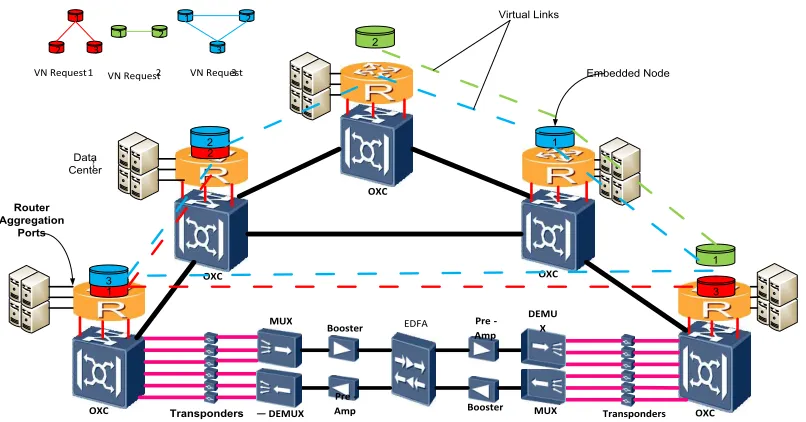
The ever growing uptake of cloud computing with its different models, such as software as a service (SaaS), platform as a service (PaaS) and infrastructure as a service (IaaS) [1], as a widely accepted computing paradigm calls for novel approaches to the design of the network architecture that support these services. The authors in [2] have stated that the current and future success of cloud computing networks will greatly depend on network virtualization. Network virtualization allows multiple heterogeneous virtual network architectures to coexist on a shared physical platform, therefore providing scalability, customised and on demand allocation of resources and the promise of the efficient use of network resources [3]. Network virtualization will fulfil the requirements of future cloud networks where clients are expected to be able to specify bandwidth and processing requirements for hosted applications [4]. The shared physical platform where virtual networks are embedded is called the substrate network. The embedding is done using a class of algorithms commonly known as ÒVirtual Network Embedding (VNE)Ó algorithms. The VNE problem has been extensively investigated in literature from different perspectives such as load balancing in infrastructure networks [5, 6], improving network resilience [7] and energy efficiency through node consolidation [8-10]. Fig.1 shows the embedding of virtual network requests in an IP over WDM network.
Wavelength division multiplexing (WDM) has been the preferred optical transport technology for core networks in the last decade [11-14]. However, the rigid nature of WDM and its coarse granularity has created a bandwidth mismatch between the application layer with bandwidth requirements varying from several to hundreds of Gb/s, and the wavelength channels with data rates of 10 Gb/s and beyond, resulting in inefficient utilization of the network resources. Elastic spectrum allocation, where connection requests are allocated the minimum spectral resources required, has been proposed as a promising solution to support fine granularity.
Recently, orthogonal frequency-division multiplexing (OFDM) has been proposed as an enabling technique for elastic optical networks [15, 16]. Optical OFDM (O-OFDM) based networks provide flexible bandwidth by
supporting the allocation of a variable number of subcarriers and adapting the modulation format of subcarriers, resulting in significant reduction in the power consumption of the network compared to conventional WDM
networks. In [15, 16] we studied the energy efficiency of O-OFDM based networks. We developed a mixed integer linear programming model to minimise the total power consumption of O-OFDM networks. We considered in addition to flexible allocation of subcarriers, distance-adaptive spectrum allocation where the
modulation format of subcarriers is adapted according to OSNR, which is mostly associated with the transmission distance [17]. The flexibility of O-OFDM based networks in allocating spectrum resources according to the network requirements makes them a suitable technology for virtualization in cloud computing networks.
OXC OXC OXC OXC OXC Transponders EDFA MUX DEMUX Booster Pre ‐ Amp Booster Pre ‐ Amp DEMU X MUX 1 2 3 1 2 1 3 2
VN Request 1 VN Request 2 VN Request 3
[image:3.595.100.503.72.283.2]1 3 2 3 1 2 2 1 Router Aggregation Ports Transponders { Data Center Virtual Links Embedded Node
Fig. 1: Virtual Network Embedding in an IP over WDM Network
The remainder of this paper is organized as follows: In Section 2, we present VNE in O-OFDM cloud networks. In Section 3, we present the results of the model and analyse them and we finally conclude the paper in Section 4.
2.VNE IN O-OFDM CLOUD NETWORKS
In this section we extend the MILP model for energy efficient VNE in IP over WDM networks developed in [10] to consider embedding in an IP over O-OFDM substrate network. The extended model minimizes the power consumption associated with the embedding of virtual network requests and optimizes the location of data centres while meeting the embedding demands. We only consider the power consumption in data centres that is attributed to the embedding of virtual machines which is a function of the number of CPU cores embedded and the power consumption per core. The data center power consumption in this case cannot be reduced through consolidation as the power consumption of data centers is a function of the number of embedded CPU cores and not the number of activated data centers. Therefore we only consider minimizing the network power consumption in our objective. In addition to the objective of minimizing the power consumption, we considered VNE in IP over O-OFDM networks that minimize the utilization of the optical spectrum in the network. The O-OFDM substrate network is modelled under similar scenarios to those considered in [15], where the maximum modulation format supported by a link is OSNR dependent, the maximum number of subcarriers an OFDM transponder can process is limited, and no grooming in the IP layer is required as the flexibility of OFDM can provide each traffic demand with the data rate needed.
In modelling the power consumption of the network, we consider the three most power consuming components in the network; IP Router ports, Transponders and Erbium Doped Fibre Amplifiers (EDFAs). To enable bandwidth flexible transmissions, the fixed-bandwidth components used in WDM networks need to be
replaced with network components that can work at flexible rates. In [15] we studied the power consumption of
these components in an optical OFDM-based network and compared it with the power consumption of similar components in IP over WDM networks. We assumed an adaptive line rate (ALR) power profile for the IP ports to calculate the power consumption of router ports. EDFAs can be used in OFDM-based optical networks as they can simultaneously amplify many data channels at different wavelengths within its gain region [20]. The power consumption of the OFDM transponder mainly depends on the electronic processing, modulation level used and the number of supported subcarriers. Therefore, a transponder using the highest modulation level with a maximal number of subcarriers (maximum rate) would have the highest power consumption. We assumed an ALR power profile to estimate the power consumption of transponders working at lower rates [21].
3.RESULTS
the embedding of 45 virtual network requests of enterprise clients. The number of virtual machines per virtual network request is uniformly distributed between 1 and 5 and the CPU cores and link bandwidth are uniformly distributed according to the loads in Table I. These loads depict applications whose networking requirements vary in proportion to CPU processing requirements. Examples include online video gaming and augmented reality applications for live video streaming of sports. We have limited the capacity of the network links to 32 wavelengths, however the data centres are un-capacitated to emphasise the differences between embedding in IP over WDM networks and embedding in IP over O-OFDM networks.
The concentration of enterprise clients at a substrate node is based on the population of the states where the cities (nodes) of the NSFNET network are located (see Fig. 2). In the case of California where we have two cities in one state (nodes 1 and 3), we have evenly distributed the population of the state between the cities. We consider a node consolidation factor (α) of !, which means that we are allowing collocation of virtual machines
belonging to the same request.
Table I
CPU Cores and Link Bandwidth Distribution
Load CPU Cores Distribution
Link Bandwidth Distribution 1 1 - 5 10Gb/s Ð 40Gb/s
2 3 - 7 20Gb/s Ð 50Gb/s
3 5 - 9 30Gb/s Ð 60Gb/s
4 7 - 11 40Gb/s Ð 70Gb/s 5 9 - 13 50Gb/s Ð 80Gb/s
6 11 - 15 60Gb/s Ð 90Gb/s
7 13 - 17 70Gb/s Ð 100Gb/s
8 14 - 19 80Gb/s Ð 110Gb/s
Fig. 2: NSFNET Network with normalized population distribution
Similar to our work in [16], we have considered both conventional WDM and O-OFDM networks to have a channel bandwidth of 50GHz. The maximum number of subcarriers for each OFDM channel is 10, each of 5GHz where two of the channels are used as guard bands. In conventional IP over WDM networks, the available capacity is limited by the worst-case optical path. We assumed a 100 Gb/s line rate per WDM channel. As discussed in [15], BPSK (1 bit/symbol) is used to modulate subcarriers over the largest transmission distance in NSFNET (2000 km). The modulation format increases by 1 bit/symbol as the transmission distance decreases to half. So, for the optical OFDM-based network at 1000 km, QPSK (2 bits/symbol) can be used and at 500 km 8QAM (3 bits/symbol) can be used. With 8QAM, the highest modulation level for optical OFDM, the maximum line rate for an OFDM transponder ��!∀# is: 5(GHz)!3(Bits/Hz)!8=120Gb/s.
profile is considered to estimate the power consumption of router ports working at different rates given the power consumption 25W per Gb/s [15].
TABLE II NETWORK PARAMETERS
Distance between two neighboring EDFAs 80 (km)
Power consumption of a 100Gb/s WDM transponder
135 (W)
Power Consumption of an OFDM transponder at Maximum Line Rate ��!∀#
200 (W)
Power consumption per Gb/s of an IP router port
25W/Gb/s
Power consumption of an EDFA 8 (W)
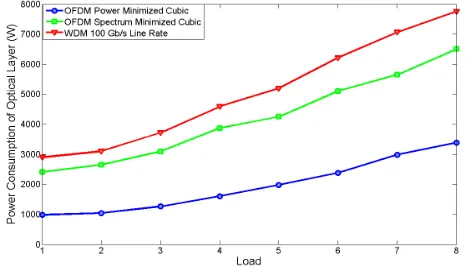
[image:5.595.178.419.123.249.2]We compare the VNE in the power minimized and the spectrum minimized IP over O-OFDM cloud network based networks to VNE in conventional IP over WDM networks in terms of energy efficiency considering the lightpath bypass approach. All the models have selected the most populous nodes (1, 3, 6, 8, 9, 11 and 12) to locate data centres to serve demands locally as much as possible so the used network resources are minimized.
Fig. 3: Power Consumption Considering Power Minimized O-OFDM based Network and Conventional WDM
The power consumption in the optical layer in Fig. 3 shows that VNE over both the power and spectrum minimized IP over O-OFDM based networks has outperformed VNE in IP over WDM networks by average power savings of 63% and 17%, respectively. The power minimized O-OFDM network selects the route and the modulation format that will result in the minimum power consumption while the spectrum minimized O-OFDM network selects the route that can support highest modulation format to minimize the used spectrum. However, since the capacity of the links is limited, the two models might consume the same amount of power to embed some of the virtual network requests at high loads under two scenarios; The first scenario is when the number of available subcarriers on the only available route is limited so the two models have to adopt the maximum modulation format to create enough capacity to embed the bandwidth requirement. The second scenario is when the bandwidth requirement has to be embedded over a longer route that can only support the lowest modulation format so the two models will have to adopt the lowest modulation format.
4.CONCLUSIONS
[image:5.595.180.415.327.461.2]ACKNOWLEDGEMENTS
The authors would like to acknowledge funding from the Engineering and Physical Sciences Research Council (EPSRC), INTERNET (EP/H040536/1) and STAR (EP/K016873/1), funding from King Abdulaziz University Deanship of Scientific Research (DSR), Gr/9/33 and the Commonwealth Scholarship Commission funded by the UK government.
REFERENCES
[1] Mell, P. and T. Grance, The NIST definition of cloud computing. National Institute of Standards and Technology, 2009. 53(6): p. 50.
[2] Jain, R. and S. Paul, Network virtualization and software defined networking for cloud computing: a
survey. Communications Magazine, IEEE, 2013. 51(11): p. 24-31.
[3] Chowdhury, N.M.M.K. and R. Boutaba, Network virtualization: state of the art and research
challenges. Communications Magazine, IEEE, 2009. 47(7): p. 20-26.
[4] Azodolmolky, S., P. Wieder, and R. Yahyapour, Cloud computing networking: challenges and
opportunities for innovations. Communications Magazine, IEEE, 2013. 51(7): p. 54-62.
[5] Houidi, I., W. Louati, and D. Zeghlache. A Distributed Virtual Network Mapping Algorithm. in Communications, 2008. ICC '08. IEEE International Conference on. 2008.
[6] Chowdhury, M., M.R. Rahman, and R. Boutaba, ViNEYard: Virtual Network Embedding Algorithms
With Coordinated Node and Link Mapping. Networking, IEEE/ACM Transactions on, 2012. 20(1): p.
206-219.
[7] Yang, C., et al. Resilient Virtual Network Service Provision in Network Virtualization Environments. in Parallel and Distributed Systems (ICPADS), 2010 IEEE 16th International Conference on. 2010. [8] Bin, W., et al. Reducing power consumption in embedding virtual infrastructures. in Globecom
Workshops (GC Wkshps), 2012 IEEE. 2012.
[9] Botero, J.F., et al., Energy Efficient Virtual Network Embedding. Communications Letters, IEEE, 2012.
16(5): p. 756-759.
[10] Nonde, L., El-Gorashi, T. E. H. and Jaafar M. H. Elmirghani, Energy Efficient Virtualization in IP over WDM Cloud Networks. Journal of Lightwave Technology, 2014. (To be submitted)
[11] Dong, X., T. El-Gorashi, and J.M.H. Elmirghani, IP Over WDM Networks Employing Renewable
Energy Sources. Lightwave Technology, Journal of, 2011. 29(1): p. 3-14.
[12] Dong, X., T. El-Gorashi, and J.M.H. Elmirghani, Green IP Over WDM Networks With Data Centers. Lightwave Technology, Journal of, 2011. 29(12): p. 1861-1880.
[13] Dong, X., T.E.H. El-Gorashi, and J.M.H. Elmirghani, On the Energy Efficiency of Physical Topology
Design for IP Over WDM Networks. Lightwave Technology, Journal of, 2012. 30(12): p. 1931-1942.
[14] Lawey, A.Q., T.E.H. El-Gorashi, and J.M.H. Elmirghani, Distributed Energy Efficient Clouds Over
Core Networks. Lightwave Technology, Journal of, 2014. 32(7): p. 1261-1281.
[15] El-Gorashi, T.E.H., X. Dong, and J.M.H. Elmirghani Green optical orthogonal frequency-division
multiplexing networks. IET Optoelectronics, 2014. 8, 137-148.
[16] Dong, X., T.E.H. El-Gorashi, and J.M.H. Elmirghani. Energy efficiency of optical OFDM-based networks. in Communications (ICC), 2013 IEEE International Conference on. 2013.
[17] Bocoi, A., et al., Reach-dependent capacity in optical networks enabled by OFDM. OFC (OMQ4), 2009.
[18] Long, G. and Z. Zuqing, Virtual Optical Network Embedding (VONE) Over Elastic Optical Networks. Lightwave Technology, Journal of, 2014. 32(3): p. 450-460.
[19] Shuping, P., R. Nejabati, and D. Simeonidou, Role of optical network virtualization in cloud computing
[invited]. Optical Communications and Networking, IEEE/OSA Journal of, 2013. 5(10): p. A162-A170.
[20] Mahad, F.D., M. SupaÕat, and A. Sahmah, EDFA gain optimization for WDM system. Elektrika, 2009.
11(1): p. 34-37.