This is a repository copy of PIV Measurements and CFD Simulation of the Performance and Flow Physics and of a Small-Scale Vertical Axis Wind Turbine..
White Rose Research Online URL for this paper: http://eprints.whiterose.ac.uk/80444/
Article:
Edwards, J.M., Danao, L.A. and Howell, R.J. (2013) PIV Measurements and CFD
Simulation of the Performance and Flow Physics and of a Small-Scale Vertical Axis Wind Turbine. Wind Energy. Published online 17 Dec 2013. ISSN 1095-4244,
https://doi.org/10.1002/we.1690
[email protected] https://eprints.whiterose.ac.uk/
Reuse
Unless indicated otherwise, fulltext items are protected by copyright with all rights reserved. The copyright exception in section 29 of the Copyright, Designs and Patents Act 1988 allows the making of a single copy solely for the purpose of non-commercial research or private study within the limits of fair dealing. The publisher or other rights-holder may allow further reproduction and re-use of this version - refer to the White Rose Research Online record for this item. Where records identify the publisher as the copyright holder, users can verify any specific terms of use on the publisher’s website.
Takedown
If you consider content in White Rose Research Online to be in breach of UK law, please notify us by
1. Research Associate, Department of Civil and Structural Engineering, University of Sheffield, Sheffield, United Kingdom. [email protected]
2. Assistant Professor, Department of Mechanical Engineering, University of the Philippines, Quezon City, Philippines. [email protected]
3. Senior Lecturer in Experimental Aerodynamics, Department of Mechanical Engineering, University of Sheffield, Sheffield, United Kingdom. [email protected]
PIV Measurements and ωFD Simulation of the Performance and
Flow Physics and of a Small
-
Scale Vertical Axis Wind Turbine.
Jonathan M Edwards1, Louis Angelo Danao2, Robert J Howell3
Abstract
The aerodynamics generated by a small small-scale vertical axis wind turbine (VAWT) are
illustrated in detail as a NACA0022 rotor blade carries out a complete rotation at three tip
speed ratios. These aerodynamic details are then linked to the wind turbine performance. This
is achieved by using detailed experimental measurements of performance and near blade PIV
and also using a 2D RANS based CFD model. Uniquely therefore, the CFD model is
validated against both PIV visualisations and performance measurements.
At low tip speed ratios ( = 2), the flow field is dominated by large scale stalling
behaviour as shown in both the experimental results and simulations. The onset of stall
appears to be different between the experiment and simulation, with the simulation showing a
gradual separation progressing forwards from the trailing edge, while the experiment shows a
more sudden leading edge roll-up. Overall, similar scales of vortices are shed at a similar rate
in both. The most significant CFD-PIV differences are observed in predicting flow
reattachment. At a higher tip speed ratio ( = 3), the flow separates slightly later than in the
previous condition and as occurs in the lower tip speed ratio, the main differences between
the experiment and the simulation are in the flow reattachment process, specifically that the
simulations predicts a delay in the process. At a tip speed ratio of 4, smaller predicted flow
separation in the latter stages of the upwind part of the rotation is the main difference in
Nomenclature
1
Introduction
In recent years, interest in the VAWT design has been boosted by an increasing desire for the
integration of wind energy into the built environment, where the VAWT presents several
potential advantages over the more common HAWT (horizontal axis wind turbine): the
VAWT avoids the requirement for yaw (turn to face the wind), may have lower sound
emission (due lower tip speed ratio operation, [1]), and shows increased performance in
skewed flow [2] - a likely flow scenario over a roof-top. However, while the HAWT is highly
developed and is currently used for all large-scale wind farms and numerous small-scale
applications in rural locations, the VAWT concept is considerably less-developed.
Simple consideration of the vectors of the blade velocity due to rotation, VB (=R ) and
the freestream velocity, V∞, yield a skewed-sinusoidal variation of the angle of attack, , with
c blade chord length (m)
Cp power coefficient
Cp-blade power coefficient, blades only
Cp-max maximum power coefficient
L blade length (m)
N number of blades
R rotor radius (m)
T net rotor torque (Nm)
TB blade torque (Nm)
Tres resistive torque (Nm)
VB blade velocity (m/s)
V∞ blade velocity (m/s)
angle of attack rads or deg
c local corrected angle of attack rads or deg
tip speed ratio
azimuth position rads or deg
rotor solidity
changing azimuthal position, . The tip speed ratio, (=VB / V∞), dictates the range in
experienced by the VAWT blade. At a given , the overall performance is the time-averaged
result of the continuously varying aerodynamic forces on the rotor blade within a rotation.
Previous work by the authors [3] has shown that the actual local variation is affected by the
rotor impedance, which increases with tip speed ratio and with increased energy extraction
(higher power coefficient, Cp). Blades in the downstream region also operate in the wake of
the upstream blade passes and the wake of the central drive shaft. Understanding the
operation of a VAWT blade is a very complex problem which requires detailed inspection of
the flow physics. CFD is well-placed to aid the understanding of the VAWT flow physics;
however, the current state of model development is not sufficient to replace experiments [4],
[5], [6], [7].
Much of the knowledge of the stalling process on VAWTs has been developed from lift
and drag polars obtained from pitching aerofoil studies and simulations, Lee [8], [9], [10] and
[11]. This is due to the difficulty of carrying out complex experiments on a rotating turbine.
While aerofoil studies have increased the understanding of stalling behaviour, they are still
limited in their application because they do not reproduce the same flow conditions as found
on VAWTs (lack of wake-wake and wake-support interaction, and a lack of flow induction).
The only other directly relevant studies are due to [12], [13] who also conducted PIV
experiments. Fujisawa and Shiubya [13] conducted experiments at extremely low Reynolds
numbers but described the successive shedding of two pairs of stall vortices from the blade.
The mechanism of dynamic stall was shown to be due to the successive generation of a
separation on the inner surface of the blade followed by the formation of roll-up vortices
from the outer surface. The work by [12] was on a larger VAWT at Re = 5 × 10⁵ and 7 × 10⁵ and = 2, 3, and 4. Although the convection of the shed vortices away from the blade was
not shown, the roll up and magnitude of the vortices was clearly shown to be effected by ,
with large separations shown at =3 and =2. The flow remained almost completely attached
for the =4 case. Both [12] and [13] showed no corresponding performance measurements so
relation of the dynamic stalling behaviour to performance could not be made.
It is interesting to note that while the fundamentals of the stalling behaviour is not yet
fully understood, some researchers have gone on to develop control methods for the stalling
process, using either synthetic jets [14], or plasma actuators [15] which do show
It remains a fact that, to date, there is simply very little information about the stalling
processes on VAWTs that comes with experimental validation from which the modelling
accuracy can be assessed. This study aims to tackle these pertinent issues. In the following
sections, the development of the CFD model is detailed, as well as the experimental
methodologies. Following this, the aerodynamic and performance measurements are
validated against both experimental PIV visualisations and performance measurements,
which importantly allow the quality of the performance prediction to be assessed with respect
to the simulated flow physics.
2
Methods
2.1
Performance Measurements
2.1.1 Wind Tunnel Facility
All experimental testing was conducted using The University of Sheffield, Department of
Mechanical Engineering’s Low-Speed Wind Tunnel (commissioned in 2011) which is an
open circuit suction tunnel with the flow driven by an axial fan located at the outlet. The
working section is 1.2m wide, 1.2m high and 3m long. The inlet has a two-dimensional
contraction with a ratio of 6.25:1, resulting in a maximum test section velocity of 25m/s and a
turbulence intensity of 0.3% or below over the working region. For these experiments a
turbulence grid was placed at the start of the working section which raised the turbulence
intensity at the turbine to 1%, with approximately 0.01m maximum length scale. This
turbulence intensity was chosen because it allows the turbine to generate both positive
performance at high TSR as well as very well defined vortices and stalling behaviour at low
TSR. Too low turbulence intensity (0.3%) causes negative performance (CP) all throughout
the range of TSR tested, whereas higher turbulence intensity (2.6%) suppressed the formation
of a leading edge separation bubble that would eventually form into the dynamic stall vortex.
2.1.2 Turbine Model
The straight-bladed VAWT rotor (Figure 1) features three NACA0022-profiled blades
each having a chord length, c, of 40mm, and a blade length, L, of 600mm, giving a blade
aspect ratio of 15. Each blade was mounted on two low-drag support arms at the 1/4 and 3/4
blade span positions at a radius, R=0.35m, leading to a solidity, , of 0.34 based on the
conventional definition ( = Nc/R). An optical encoder monitored the rotational speed of the
rotor, which was also fitted with a Magtrol hysteresis brake to provide a known braking
has conflicting suggestions of whether this is significant or not in terms of Cp measurement
[12], [17], [18]. The wind tunnel model is intended to address fundamental understanding of
VAWT performance, and the Cp stated is not intended to represent any particular full-scale
free-operating device. Absolute levels of performance were not important; only relative
values of performance were needed as the paper’s aim is to elucidate the flow physics present
[image:6.595.202.392.217.435.2]for comparison to an identical computational model.
Figure 1. Wind tunnel arrangement showing the VAWT and PIV system.
The measurement equipment designed by the authors to measure torque was
calibrated giving a maximum error 0.01Nm and corresponds to a maximum error of 5% in
the maximum Cp value determined for tests at 7m/s. The error in measurement of turbine
rotational speed was negligible. The pressure difference measured by the Pitot-static probe
(and a Furness Controls Micromanometer model FC0510) gave an accuracy of the wind
speed measurement estimated at 1.25%. The combined potential maximum error in the Cp
measurement is therefore 7.25%. It should be noted that this is exceptionally accurate for a
system of this scale.
2.1.3 Power Curve Measurement
When testing small wind turbine models, a number of practical problems may be encountered
size. The apparatus, being required to withstand such loading, may give system resistances
which prevent the turbine from ‘cutting-in’. Typically, a VAWT will have a band of for
which positive net torque, T, occurs. Outside of this band, T will be negative and a small
turbine must be driven in order to maintain rotation. Only parts of the T- curve with
negative gradient can be measured without a control system to sense rotational speed and
adjust opposing torque accordingly [17], [19].
The turbine performance is first measured by allowing the rotor to spin down from a high
rotational speed and the deceleration rate monitored using the optical encoder attached to the
hysteresis brake. To fully determine the performance of the rotor blades, two spin down tests
are required for each test condition. The first involves the spin down of the rotor system
without the rotor blades but including the support arms. This is necessary to determine the
system resistance (the drag induced by the support arms, as well as resistance of the bearings
and hysteresis brake etc). It has been determined that the system resistance is independent of
wind speed over the range tested here, i.e. the resistive torque curves from different spin
down tests conducted at different wind speeds are identical [3]. The second spin down test is
conducted with the rotor blades fitted and so measures the full turbine performance. For both
spin down tests, the instantaneous torque is computed by multiplying the instantaneous
rotational deceleration () by the turbine’s rotational moment of inertia (Irig). The rotor blade
torque is then the difference between the rotor torque (TB) and the system resistance (Tres),
see Equation 1. Instantaneous blade power is derived via Eq. 2. This system is used to
determine the performance of the VAWT when it cannot self-sustain itself, i.e. the system
resistance (due to bearing friction, and support arm drag) is greater than the torque developed
by the rotor blades.
B res app rig
T +T +T =I (Eq. 1)
B B
P =T (Eq. 2)
Usefully, this method allows TB to be measured so that the rotor blade performance alone can
be evaluated, see Equation 2 which allows a direct comparison to be made to the 2D CFD
where only the blades are simulated. A detailed assessment of the method can be found in [3].
2.2
PIV Measurements
The flow in the wind tunnel was seeded at the inlet with olive oil droplets approximately 2 m
a Litron Nano L 65-15 Nd:YAG laser (65mJ/pulse) located outside of the tunnel (Figure 1)
on an adjustable height platform. A CCD camera of 1600 x 1600 pixels was used together
with a narrowband greenpass filter to cut-out interference from other sources of light. To
minimise laser light reflection, the blade surface was treated with a Rhodamine 6G-based
paint (produced by the authors). To avoid the support arm obscuring a portion of the field of
view (FOV), the laser sheet was positioned approximately 3c away from the blade tip, and
1.5c away from the support arm. It was confirmed through tests at various positions along the
span that this position was a good representation of the flow along the majority of the blade
length, [19]. For each test, the blade was centered in the reference FOV which was
approximately 140mm x 140mm and the integration area used was 32 x 32 pixels, or 2.8mm
x 2.8mm. The time interval between exposures was set to yield an approximately eight pixel
displacement assuming V= 4 V∞ based on similar tests carried out by Ferreira et al [12]. 100 ensembles were acquired for each condition tested. The measurements concentrated on three
tip speed ratios which were chosen to cover the important and distinct regions of the Cp-blade
curve (Figure 20, discussed later in Section 3.2):
1) = 2 is near the minimum Cp-blade,
2) = 3 is on the part of the curve where the Cp-blade is rapidly increasing,
3) = 4 is near the maximum Cp-blade.
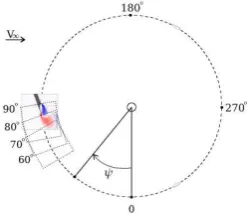
Measurements were taken at 10°intervals in , following one of the rotor blades, for the first
[image:8.595.235.360.507.615.2]time, through an entire rotation, as illustrated in Figure 2.
Figure 2. PIV results at different positions showing the rotor blade and FOV.
2.3
CFD Model
The commercial CFD code Ansys Fluent 12.1 was used for all of the simulations detailed in
this study. The Ansys Fluent 12.1 documentation [21] provides details concerning the
otherwise, the recommended values were used for solver settings and model coefficients. The
pressure-based solver was used with absolute velocity and second order implicit transient
formulation. The coupled pressure-velocity scheme was used, and a second order upwind
discretisation was used for all solution variables.
2.3.1 Mesh
Earlier studies [4], [19], [22] have shown that the main flow characteristics of the VAWT can
be represented using a two-dimensional CFD model. Such a model is unable to account for
the effects of the support arms or the blade tip losses on performance; however, this study is
concerned with the dominant flow physics of the VAWT, those are secondary effects. The
computation time for a three-dimensional simulation would be excessive for a study of this
detail.
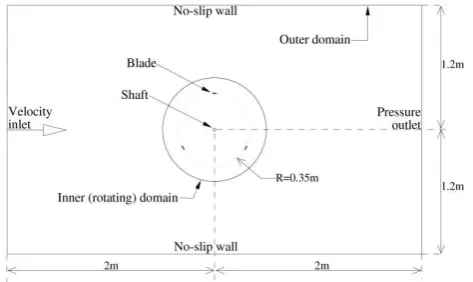
[image:9.595.191.428.511.652.2]The model domain consisted of two mesh zones: an inner rotor zone and an outer zone
(Figure 3). The mesh of the inner rotor zone rotates together with the blades and the central
shaft. The outer domain is fixed and has a rectangular outer boundary (representing the wind
tunnel) and a hole in the centre which accommodates the inner rotor zone. At each time step,
the solution is interpolated across the sliding interface boundary. The geometry represented a
mid-blade slice of the wind tunnel rotor. The simulation of a simple 2D-slice of the wind
tunnel set-up would result in a significant over-estimation of blockage. A closer blockage
approximation was achieved by matching the ratio of the rotor and wind tunnel widths in the
CFD model to that of the rotor and wind tunnel cross-sectional areas in the experiment.
Figure 3. Construction of the overall two-dimensional computational domain.
A wider refinement of the wake region is necessary to resolve important flow structures,
which arise due to the wide range in . This was most easily accomplished using a structured
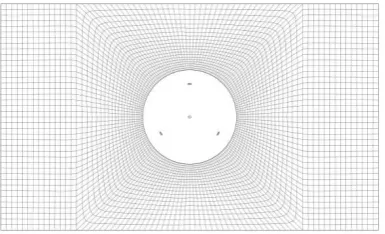
towards the inner zone boundaries (Figure 5). The outer domain was meshed with a simple
[image:10.595.201.404.104.575.2]structured mesh (Figure 6).
[image:10.595.206.413.110.302.2]Figure 4. The blade ‘O’ type mesh.
Figure 5. One third of the inner rotor mesh.
Figure 6. Outer domain mesh.
A mesh sensitivity study was conducted to establish the appropriate node density on the
blade surface. Clustering of grid points on the leading edge and trailing edge regions was
implemented to provide enough spatial resolution on these key areas. Wall normal spatial
resolution was fixed starting with a first cell height small enough to result in acceptable y+
levels between 1 to 5 and all solutions were found to have a y+ of below 2.2 [21]. Growth
[image:10.595.213.406.468.585.2]to be fine enough to provide the required number of layers for boundary layer modelling.
Beyond the near-blade mesh, maximum cell edge length within the central region bounded by
the blade path was studied. It was concluded that the maximum edge length should be limited
to less than half the blade chord to minimise unnecessary dissipation of wake and turbulence
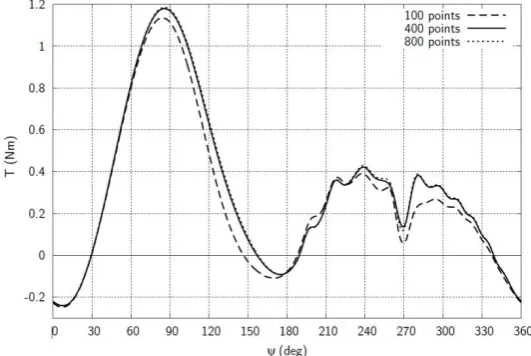
generated by the upwind pass of the blades. Blade torque was monitored for the sensitivity
study. It was found that 400 points around each blade provided the required node density for
accuracy without compromising computational time. A difference of less than 1% in
instantaneous blade torque all around a rotation as can be seen in Figure 7.
.
2.3.2 Turbulence Model Selection
The turbulence model selection was initially carried out by attempting to match flowfield
visualisations and force measurements of a pitching aerofoil study, conducted by [22]. The
range in tested results in the aerofoil undergoing dynamic stall and reattachment, which is
also characteristic of the VAWT and the study therefore represents a simplified test case. It
will be shown later that the excellent matching of the flow physics between the experiment
and the simulations vindicates this approach. Obtaining force data (lift and drag) from a small
VAWT rotor blade is extremely difficult and subject to significant errors [16] so data sets
from pitching aerofoil studies are a useful source for validation. The lift and drag predictions
of the three most suitable models are shown in Figures 7 and 8. Other models were tested
(standard k- , k- , and a laminar solution) but the quality of prediction was found to be poor
[image:11.595.165.431.535.713.2]and so, for brevity, the results are not presented here.
Figure 8. Lift coefficient results for the turbulence model selection process shown compared
to measurements of a pitching aerofoil study from [8]
Figure 9. Drag coefficient results for the turbulence model selection process shown compared
to measurements of a pitching aerofoil study from [8]
The results of the study showed that the SST k- model gave a the best prediction for the
region of enhanced lift (Figure 8) which occurs due to the roll-up of the leading edge vortex
which is then convected over the aerofoil surface. The early post-stall lift behaviour was also
well-matched for the initial drop in lift occurring as the vortex begins to leave the surface.
While the region of reduced lift and delayed reattachment was over-predicted by all of the
models, the SST k- model was again the closest to the experimental data. Drag prediction
was also well-matched for the increasing region of the pitching motion (Figure 9). Again, all
of the models struggled to accurately simulate the curve hysteresis, with the SST k- model
giving the closest match, particularly in the = 15° to -5° region. It is interesting to note that
[image:12.595.185.414.292.480.2]better performing that in this case indicating that, perhaps, the pitching blade is an even more
challenging test case.
Plots of the experimental and simulated vorticity flowfields were compared to further
establish the suitability of the SST k- model (Figure 10). Vorticity is plotted here and in
figures which follow because it is a vector field that describes the local spinning motion of a
fluid and is ideal for bringing out details of stalled flow and shear layers.
Figure 10. A plot showing the stream lines for different angles of attack from [8].
Simulations are from the SST k- model showing contours of vorticity.
The complete cycle of the development and shedding of the dynamic stall vortex was
shown to be well-predicted by the model which correctly showed the flow reversal at the
trailing edge, and the subsequent formation of a separation bubble at the leading edge which
rapidly grew and eventually evolved into the dynamic stall vortex that was convected
downstream and finally detached from the aerofoil surface.
Overall, the results of the pitching aerofoil study indicated that the SST k- model is the
best choice for the prediction of the VAWT blade stalling process and it was chosen for all of
the subsequently detailed simulations. This decision is further validated by the closeness with
[image:13.595.151.469.198.440.2]2.3.3 Time Step and Convergence
The unsteady simulation was stepped forward in time, with up to 50 iterations carried out at
each time step to achieve convergence. The chosen size of the time step and the number of
iterations were a compromise between solution accuracy and computation time. The
rotational position has the most significant influence on the VAWT blade flow physics, and
so the solution was stepped forward using a time interval corresponding to a particular
azimuthal increment angle. A sensitivity study using simulations with different azithumal
angle steps indicated similar torque histories were achieved for time steps which
corresponded to increments of less than 2°. A time step corresponding to an azimuthal
displacement of 0.5°, at the particular being simulated, was therefore chosen as the best
compromise between solution accuracy and computation time, this value was used for all of
the simulations presented in this study. Differences in torque output were less than 1%
between time step corresponding to 0.5 and 1.
The solution was initiated using the inlet velocity value, with a turbulent intensity of 1%
and a length scale of 0.01m defined in order to match the wind tunnel case. A large starting
vortex resulted from the onset of the rotation of the VAWT and a number of rotations needed
[image:14.595.134.457.448.619.2]to be completed before the initial transients were convected out of the domain.
Figure 11. Torque generated with iteration showing periodic convergence.
The torque curve history for a complete solution shows that convergence of the forces
occurs in around 5 to 10 rotations depending on , see Figure 11. At higher , a higher
number of rotations were completed before periodic convergence was achieved. The solution
residuals were also checked to ensure that they were reduced by 6 orders of magnitude at the
The aim of this study is to show what is possible by using a current commercial CFD
package which is likely to be available to many current design engineers working on VAWT
development. More importantly, this study aims to more fully explain the dynamics of the
flow than has been achieved before and this is necessary for the progression of VAWT flow
understanding and therefore future development.
3
Results
In this section, the results of the CFD simulation with the previously selected turbulence
model are compared against both PIV visualisations and performance measurements. It is the
aerodynamic physics that dictates the turbine performance so it is vital that the two are
understood together. This is the first time this has been carried out in such detail and for a full
rotor revolution over three TSRs. In the first subsection, the simulated and experimental
flowfield is discussed in detail. Contours of vorticity are used to visualise the near-blade
wake, (with the same contour levels maintained for all images). Following this, the
performance of the turbine is analysed in relation to the flow field aerodynamics of both the
simulation and experimental measurement. Differences between the experimental and
computational Cp are also explained.
It should be noted that this paper details significant new results which build upon the
only comparable previous study by Ferreira et al. [12] in which the flow field development
around an entire rotor blade revolution is discussed at a small number of selected locations in
[12]. Differences are expected due to the different solidity and profile the current study uses
the NACA0022, whereas [12] uses the NACA015. The overall blockage between the studies
is very close; currently 29% and 32% in [8].
3.1
Correlation of Experimental and Simulated Flowfields
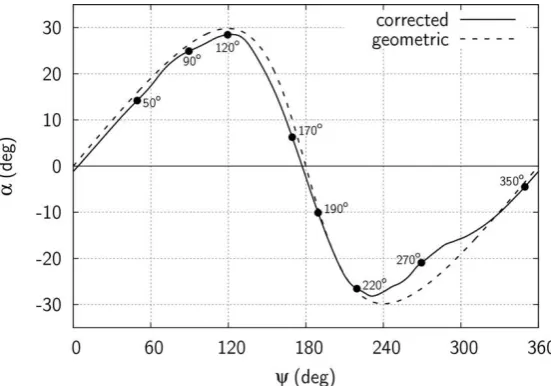
The geometrically derived value of becomes increasingly erroneous as increases due to
the greater impedance which is presented to the flow by the rotor. The rotor exerts a force on
the incoming flow, slowing it down and forcing the streamtube to expand around the turbine,
in order to conserve mass flow rate. To account for this, the discussion of the flow physics
are discussed relative to a corrected angle of attack, c, which has been obtained from the
CFD solution via the method detailed in [3]. For comparison and completeness, the
3.1.1 Flowfield Analysis, = 2
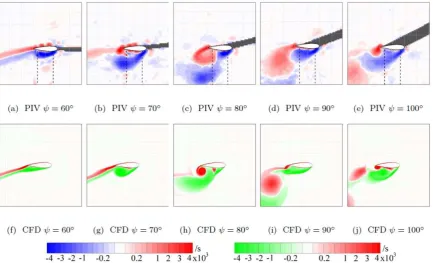
At the = 2 condition, the experimental PIV visualisations shows the onset of stall occurring
around = 60° (Figure 13a), with the first leading-edge vortex leaving the surface at = 70°
where roll-up at the trailing edge is also shown (Figure 13b). The CFD simulation shows a
similar process with a very small lag behind the experiment (Figures 12f and 12g). Figure 12
shows c = 17.3° at = 60°, which is certainly above the static-stall angle. The rapid
increase in c can be thought of as a ‘pitch-up’ motion; in tests on a pitching aerofoil such a
motion is shown to increase the angle of attack at which stall occurs [8]. The simulation
shows the stall process originating from a gradual trailing edge separation; this differs from
the experiment which appears to show a more sudden separation at the leading edge. The
vortex shedding between = 80°, and = 100°, is also similar between the experiment
(Figures 13c to 13e) and the simulation (Figures 13h to 13j), with the simulation continuing
[image:16.595.158.434.341.534.2]to lag very slightly behind the experimental flowfield.
Figure 13. Plots of vorticity showing the onset of stall, as shown by the PIV measurements and as predicted using the CFD model for = 2
Towards the mid-rotation point ( = 180°), both the sets of data show a significant
delay in the flow reattachment as the angle of attack rapidly decreases. The simulation shows
quite a sudden change from the shedding of large structures to a much smaller wake (Figures
14f to 14h), whereas the PIV visualisations reveal this to be a more gradual process in the
experiment (Figures 14a to 14c). Either way, this process is likely to keep the performance of
the rotor blade lower than would be the case with a more rapid re-attachment of the flow.
Despite c dropping to 5.9°, the flow has not yet attached by = 170°. As with the
experiment, the reattachment of the flow is shown to occur at around = 190°, where c =
−10.5°. Shortly after this, the flow is shown to stall in the early stages of the downwind part of the rotation. At = 230°, where c has already reached −26.7° (Figure 12), the CFD
simulation shows the flow to be detached (Figure 14i), as did the PIV measurements (Figure
14d). The shedding process is also shown to progress at similar rate between the CFD (Figure
14j) and PIV visualisations (Figure 14e). The rapid decrease in can be thought of as a
‘pitch-down’ motion; in tests on a pitching aerofoil such a motion is shown to lead to a delayed reattachment of the flow as part of the dynamic stall process, which results in
significantly from = 260° onwards (Figure 12), the CFD shows a gradually reducing depth
of stall with the shed vortices also gradually reducing in size (Figures 15f to 15i), which
[image:18.595.114.551.138.406.2]matches the PIV measurements well (Figures 15a to 145).
Figure 15. Plots of vorticity showing the downwind post-stall vortex shedding and eventual reattachment, as shown by the PIV measurements and as predicted using the CFD model for
= 2
Understandably, the experimental flowfield varies in this region between rotations
and so the individual vortex positions cannot be matched to the simulation due to the
ensemble averaging of the 100 instantaneous experimental measurements. As a result there is
some smearing of the experimental data. The simulation shows reattachment occurring before
= 350° (Figure 15j), which is in advance of the experimental flow field (Figure 15e). This
would result in lower drag being predicted for this part of the rotation. Averaged around an
entire rotation the performance coefficient is very similar between the experiments and CFD
(Figure 22)
Summary of Simulated Flowfield at = 2
The CFD-simulated flowfield and the PIV visualisations have been shown to be very
well-matched for = 2. The position that the flow detaches from the blade surface is closely
matched for both upwind and downwind parts of the rotation, with only a small delay (<< 10°
in ) being observed for the upwind part. However, the onset of stall appears to be different
between the experiment and simulation, with the simulation showing a gradual separation
progressing forwards from the trailing edge, while the experiment shows a more sudden
leading edge roll-up. The shedding behaviour is also well-matched, with similar scales of
vortices being shed at a similar rate. The most significant CFD-PIV differences are observed
in predicting reattachment: small differences between the experiment and simulation are
observed in the first reattachment at the mid-rotation; however, the simulation predicts the
second reattachment to occur at least 10° in earlier in the rotation when compared to the
experiment.
3.1.2 Flowfield Analysis, = 3
At = 3, the experimental PIV measurements show the onset of separation and subsequent
leading-edge vortex roll-up occurring between = 80° and 90° (Figures 17a and 17b). At the
onset of stall c = 15.2° (Figure 16), which is slightly lower than for = 2 condition; a drop
in the rate of change of angle of attack would be expected to reduce the dynamic stall angle.
Relative to the experiment, the CFD simulation (Figures 17f and 17h) again show a delay in
in , which will result in incorrect lift and drag predictions for this region. Again, the
simulation shows stall beginning with a gradual separation from the trailing edge. The
post-stall vortex shedding is show in the experiments (Figures 17c to 17e) and simulations
(Figures 17h to 17j), with a similar vortex shedding rate observed, and similar reduction in
the depth of stall shown as the angle of attack reduces in this region of the rotation (Figure
[image:20.595.96.496.208.497.2]16). The 10° in phase difference is maintained for the measurements shown in Figure 17.
Figure 17. Plots of vorticity showing the onset of stall and post-stall vortex shedding, as shown by the PIV measurements and as predicted using the CFD model for = 3
As for the = 2 condition, the reattachment prediction at = 3 is reasonably
well-matched between the experiment (Figures 18a to 18e) and simulation (Figures 18f to 18j).
The gradual reduction in the scale of the shed vortices also appears to be well-matched.
Vortices shed by the upstream blade are visible in the CFD-predicted flowfield at = 190°
(Figure 18j); some trace amounts vorticity of matching sign can also be seen in the equivalent
experimental plot (Figure 18e) but the dissipation and collapse of the vortex structure in the
experiment clearly happens at a faster rate, as would be expected versus a two-dimensional
Figure 18. Plots of vorticity showing the post-stall flow recovery and mid-rotation
reattachment process, as shown by the PIV measurements and as predicted using the CFD model for = 3
Although c reaches a maximum of 16° at = 228°, the simulation predicts the onset
of stall in the downwind portion of the rotation to occur around = 240° (Figure 19f), as do
the PIV measurements (Figure 19a); however, the experimentally observed thicker wake
(relative to attached flow at other positions) indicates partially-separated flow. The extent of
the wake shown in the experiment at = 250° (Figure 19b) further suggests that full
reattachment does not occur around the mid-rotation point. The simulation differs (Figure
19g), instead showing a sudden separation to stall from a fully-attached condition, as was
observed in the upwind part of the rotation (around = 90°). As the angle of attack reduces
significantly beyond = 270° (Figure 16), the simulation shows a gradually reducing depth
of stall with the shed vortices also gradually reducing in size (Figures 19h to 19j), which
matches the experimental measurements well (Figures 19c to 19e). The reattachment of the
flow in the simulation again precedes that which is shown by PIV in the experiment by
Figure 19. Plots of vorticity showing the downwind onset of stall, vortex shedding, and eventual reattachment as shown by the PIV measurements and as predicted using the CFD model for = 3
Summary of Simulated Flowfield at = 3
For the = 3 condition, the position that the flow detaches from the blade surface is slightly
delayed, more so than for the = 2 condition, in both the upwind and downwind parts of the
rotation. The shedding behaviour is again well-matched between CFD and PIV, with similar
scales of vortices being shed at a similar rate. The most significant CFD-PIV differences are
once again observed in predicting the reattachment process: only small differences are
observed in the first reattachment at the mid-rotation point, a much earlier second
reattachment is observed in the downwind part of the rotation, with the simulation showing
earlier reattachment by around 20° in . With a slightly delayed stall and earlier
reattachment, the simulation is likely to over predict the performance measured in the
experiment, this is indeed the case as shown later in Section 3.2.
3.1.3 Flowfield Analysis, = 4
At this condition, the turbine is generating power so more attached flow is likely to be seen in
both the simulations and experimental data. Later detachment of the flow is seen now, from
between = 110° and = 120° where the CFD simulation shows a gradual detachment
experiment (Figures 21a and 21b). However, as the angle of attack reduces beyond as the
rotor reaches = 130°, the simulation (Figures 21h and 21i) does not show the same vortex
shedding as is shown in the experimental flowfield observations (Figures 21c and 21d).
Figure 20 shows that c has already peaked = 105° however, at = 130° c is beginning to
drop rapidly and, in the experiment, a large vortex rolls up in the already separated flow as
the ‘pitch-down’ motion occurs. In the experiment, the stalled flow eventually reattaches around = 180° (Figure 21e), but no large separation is shown in the CFD and the separation
point simply retreats back toward the trailing edge as the angle of attack reduces (Figures 21d
to 21e). As a result, the simulated drag between = 130° and 180° will be significantly
higher than the experimental case, and the lift significantly lower. This is shown in the
performance results at this TSR (see Figure 22) although the performance difference is also
due to 3 dimensional effects not present in the CFD. Due to the significantly reduced relative
velocity in the downwind part of the rotation, the range in is greatly reduced (Figure 20),
[image:24.595.91.501.377.673.2]and attached flow is shown for all of the downwind part of the rotation.
Figure 21. Plots of vorticity showing the onset of stall, brief vortex shedding, and subsequent flow recovery as shown by the PIV measurements and as predicted using the CFD model for
= 4
Summary of Simulated Flowfield at = 4
The lack of a flow separation in the latter stages of the upwind part of the rotation is the only
main point to note when comparing the flowfields of the simulation and experiment for the
= 4 condition. The performance in this region of the rotation would certainly be very different
between the CFD simulation and the experiment, with the simulation very likely to be
predicting lower drag and higher lift than would be actually be experienced by the blade in
the wind tunnel experiment. For the rest of the rotation, the flow is attached in both the
simulation and experiment due to the lowered angle of attack.
3.2
Linking Experimental and Simulated Performance
Comparison of the CFD-simulated flowfield with the experimental observations by PIV has
revealed a good match between the two, showing that it is possible to simulate the basic
VAWT blade flow physics, which includes dynamic stall and reattachment. A good
representation of the general flow physics is an important step towards a useful CFD VAWT
model; however, a correct Cp prediction is likely to be the ultimate goal for most future
experiment is made by adding Cp values from additional simulations to map-out the full
curve.
Results of the CFD-predicted performance are shown alongside the experimental
measurements in Figure 22. The first, and most obvious observation is that the maximum Cp
is over-predicted in the simulation by a significant margin, but this is expected as the 2D
simulation does not include all of the losses that exist in the experiment (which is of course
3D) such as those due to blade tip effects and the interaction between the blades and the
supporting structure. The simulation predicts Cp−max=0.36, whereas the experiment has measured Cp−max = 0.14, clearly the predicted blade forces are quite different between the two cases. However, it should be noted that from the perspective of this study the shape curve
shape is well represented and that is most important: from = 1 the Cp drops to form a
negative trough in the performance curve just above = 2, and from here performance
rapidly improves with increasing with both CFD and experiment crossing to positive Cp at
similar until a maximum Cp is encountered in both cases at around = 4 after which, with
further increases in , a steep drop in performance in experienced.
Figure 22. Cp−blade vs as predicted by the CFD simulation and as measured in the
experiment
The simulated Cp matches the experiment closely for low tip speed ratios, and the
flowfield has previously been shown to compare well compared for = 2. However, the
[image:26.595.134.463.403.620.2]increased. Increased stall delay and earlier flow reattachment were observed at =3, and
understandably the CFD predicts higher Cp at this tip speed ratio. Most significantly, no
separation at all was predicted for =4, which would be expected to lead to a significant
over-estimation of Cp at this condition. Certainly, some differences are expected due to 3D
effects: a similar comparison between experiment and 2D CFD has been shown by [7], whose
blades had a similar aspect ratio of 17. Further to this, [18] show a much improved match
between experimental results and their 3D CFD simulations while the equivalent 2D CFD
results were shown to give substantial over-prediction. However, the model turbine used by
Howell et al. had a very low aspect ratio of 4 (in this study it is 15), and so the substantial 2D
CFD versus 3D CFD differences are not surprising. Induced drag effects increase with the
square of lift, and so the wing-tip effect would be expected to become more significant as the
blade reaches an optimum and the blade spends more of the rotation at a high-lifting
condition. Results obtained by [23] have shown an increased effect of aspect ratio with ,
with a change in aspect ratio AR from 160 to 15 leading to an approximate Cp drop of 1/3 at
= 5 and only 1/5 at = 3. This may, in part, account for why the flowfield visualisations
match-up reasonably well, yet the Cp prediction does not. Further to this, a poor prediction of
zero-lift drag, which has the most influence at high [23] where the range in is lowest,
may also be the cause of differences. Additional investigations would be required to better
evaluate the model’s ability to correctly predict the viscous drag, the contribution of which is
most significant at low angle of attack.
4
ωonclusion
The comparison of the CFD-simulated and experimental flowfields have shown a good match
at the three different tip speed ratios tested. The basic process of attached flow, stall, vortex
shedding and reattachment is shown for the = 2 and 3 conditions, although the brief stall at
= 4 is missing in the simulations. A small delay in detachment and earlier reattachment is
shown in the simulation, indicating that the CFD-simulated flow is generally more inclined to
be attached to the blade surface.
Significant differences between simulated and experimental Cp is noted at higher .
However, in general, the performance curve is well-formed, with the same basic trends
observed with changing (albeit they are scaled by larger amounts) and the gradients in the
curve at each of these points are very similar. This all suggests that similar fundamental
both the simulation and the experimental case. Further work is required to assess the impact
of three-dimensional effects on VAWT performance, particularly at higher tip speed ratios,
this being crucial to correct prediction if aiming to realise any real-word device.
Based on the results and analysis in this study, the continued use of the CFD model is
well-justified, particularly where supplemented with experimental data for validation.
Acknowledgements
The authors would like to thank the workshop technicians at the Department of Mechanical
Engineering for the manufacture of the turbine and all the associated measurement
subsystems. For funding this research, Jonathan Edwards would like to thank the University
of Sheffield Studentship Program and Louis Danao would like to thank the Engineering
Research and Development for Technology Program of the Department of Science and
Technology through the University of the Philippines’ College of Engineering.
References
[1] Iida, A., Mizuno, A., and Fukudome, K., 2007, “Numerical Simulation of Unsteady Flow and Aerodynamic Performance of Vertical Axis Wind Turbines with LES,” 16th Australasian
Fluid Mechanics Conference, Gold Coast, Australia, pp.1295-1298.
[2] Mertens, S., Van Kuik, G., and Van Brussel, G. J. W., 2003, “Performance of a High Tip
Speed Ratio H-Darrieus in the Skewed Flow on a Roof,” 41st AIAA Aerospace Sciences
Meeting and Exhibit, Reno, Nevada, USA. AIAA-2003-0523.
[3] Edwards, J. M., Danao, L. A., and Howell, R., 2012, “Novel Experimental Power Curve
Determination and Computational Methods for the Performance Analysis of Vertical Axis
Wind Turbines,” Journal of Solar Energy Engineering, Volume 134, Issue 3, 2012.
[4] C J Simao Ferreira, C. J., van Brussel, G. J. W., and van Kuik, G., 2008, “2D CFD
Simulation of Dynamic Stall on a Vertical Axis Wind Turbine: Verification and Validation
[5] Tullis, S., Fiedler, A., McLaren, K., and Ziada, S., 2008, “Medium-Solidity Vertical Axis Wind Turbines for use in Urban Environments” 7th World Wind Energy Conference,
Kingston, Ontario, Canada.
[6] Raciti Castelli, M., Englaro, A., and E Benini, E., 2011, “The Darrieus Wind Turbineμ
Proposal for a New Performance Prediction Model Based on CFD” Energy, 36(8)μ4λ19-4934.
[7] Wang, S. Hughes, K.J., Ingham, D.B., Ma, L.a, , Pourkashanian, M. and Tao, Z. Edwards,
J.M., Howell, R.J., Danao, L.A.M., Sobotta, D., Qin N. “An experimental investigation into
the aerodynamics of a vertical axis wind turbine using PIV” Under review with the Journal of
Wind Energy and Industrial Aerodynamics.
[8] Lee, T., and Gerontakos, P., 2004, “Investigation of Flow over an Oscillating Airfoil”,
Journal of Fluid Mechanics, 512:313-341.
[9] Mccroskey, W. J., 1981, "The Phenomenon of Dynamic Stall," Technical Report No.
NASA TM-81264, Ames Research Center, Moffett Field, California.
[10] Mclaren, K., Tullis, S., and Ziada, S., 2011, "Computational Fluid Dynamics
Simulation of the Aerodynamics of a High Solidity, Small-Scale Vertical Axis Wind
Turbine," Wind Energy, 15(3), pp. 349-361.
[11] Wang, S., Ingham, D. B., Ma, L., Pourkashanian, M., and Tao, Z., 2010, "Numerical
Investigations on Dynamic Stall of Low Reynolds Number Flow around Oscillating Airfoils,"
Computers and Fluids, 39(9), pp. 1529-1541.
[12] Simao Ferreira, C. J., Van Kuik, G., Van Brussel, G. J. W., and Scarano, F., 2009,
“Visualization by PIV of Dynamic Stall on a Vertical Axis Wind Turbine,” Experiments in
Fluids, 46(1), pp. 97-108.
[13] N Fujisawa and SShibuya. Observations of Dynamic Stall on Darrieus Wind Turbine
Blades. Journal of Wind Engineering and Industrial Aerodynamics, 89(2001):201-214, 2000.
[14] Yen, J. , Ahmed, N.A., “Enhancing vertical axis wind turbine by dynamic stall control
using synthetic jets”, Journal of Wind Engineering and Industrial Aerodynamics, Volume 114, March 2013, Pages 12-17
[15] Greenblatt, D., Ben-Harav, A., Schulman, M., “Dynamic stall control on a vertical axis
wind turbine using plasma actuators ( Conference Paper ) “ 50th AIAA Aerospace Sciences Meeting Including the New Horizons Forum and Aerospace Exposition, 2012, Article
number AIAA 2012-0233
[16] J. H. Strickland, B. T. Webster and T. Nguyen. A Vortex Model of the Darrieus Turbine:
[17] Van Bussel, G. J. W., Polinder, H., and Sidler, H. F. A., 2004, “The Development of
Turby, a Small Vawt for the Built Environment,” Global Windpower 2004 Conference and
Exhibition, Chicago, IL, USA, pp. 10.
[18] Penna, P., and Bertenyi, T., 2008, “Full-Scale Wind Tunnel Testing of the QR5 Vertical
Axis Wind Turbine,” 46th AIAA Aerospaces Sciences Meeting and Exhibit, Reno, Nevada,
USA.
[19] Howell, R., Qin, N., Edwards, J., and Durrani, N., 2010, “Wind Tunnel and Numerical
Study of a Small Vertical Axis Wind Turbine,” Renewable Energy, 35(2), pp. 412-422.
[19] Edwards, J. E., “The Influence of Aerodynamic Stall on the Performance of
Vertical Axis Wind Turbines”, PhD thesis, Department of Mechanical Engineering, University of Sheffield.
[21] ANSYS Inc. Fluent 12.1 user guide and manual. Released 01/10/2009.
[22] Hamada K, Smith TC, Durrani N, Qin N, Howell R. Unsteady Flow Simulation and
Dynamic Stall Around Vertical Axis Wind Turbine Blades. 46th AIAA Aerospaces Sciences
Meeting and Exhibit. Reno, Nevada, USA 2008.
[23] McIntosh, S. C., 200λ, “Wind Energy for the Built Environment” PhD thesis,


![Figure 10. A plot showing the stream lines for different angles of attack from [8].](https://thumb-us.123doks.com/thumbv2/123dok_us/7976294.201115/13.595.151.469.198.440/figure-plot-showing-stream-lines-different-angles-attack.webp)