This is a repository copy of
Inbound Handover Interference-Based Margin for Load
Balancing in Heterogeneous Networks
.
White Rose Research Online URL for this paper:
http://eprints.whiterose.ac.uk/122374/
Version: Accepted Version
Proceedings Paper:
Alhabo, MDJ, Zhang, L and Oguejiofor, O orcid.org/0000-0002-4989-8734 (2017) Inbound
Handover Interference-Based Margin for Load Balancing in Heterogeneous Networks. In:
2017 International Symposium on Wireless Communication Systems (ISWCS). 14th
International Symposium on Wireless Communication Systems ( ISWCS 2017), 28-31 Aug
2017, Bologna, Italy. IEEE , pp. 146-151. ISBN 978-1-5386-2913-0
https://doi.org/10.1109/ISWCS.2017.8108100
© 2017 IEEE. Personal use of this material is permitted. Permission from IEEE must be
obtained for all other uses, in any current or future media, including reprinting/republishing
this material for advertising or promotional purposes, creating new collective works, for
resale or redistribution to servers or lists, or reuse of any copyrighted component of this
work in other works.
[email protected]
https://eprints.whiterose.ac.uk/
Reuse
Unless indicated otherwise, fulltext items are protected by copyright with all rights reserved. The copyright
exception in section 29 of the Copyright, Designs and Patents Act 1988 allows the making of a single copy
solely for the purpose of non-commercial research or private study within the limits of fair dealing. The
publisher or other rights-holder may allow further reproduction and re-use of this version - refer to the White
Rose Research Online record for this item. Where records identify the publisher as the copyright holder,
users can verify any specific terms of use on the publisher’s website.
Takedown
If you consider content in White Rose Research Online to be in breach of UK law, please notify us by
Inbound Handover Interference-Based Margin for Load
Balancing in Heterogeneous Networks
Mohanad Alhabo, Li Zhang, and Obinna Oguejiofor
School of Electronic and Electrical Engineering, University of Leeds, UK. E-mail: {elmdj, l.x.zhang, eloso}@leeds.ac.uk
Abstract—Inbound handover (HO) or hand-in is accomplished when the user equipment (UE) performs HO from macrocell (MC) to a small cell (SC) [1] [2]. When the UE connects to a SC with a time of stay (ToS) less than a predefined time threshold, this will result in frequent unnecessary HOs and also increase service interruption which in turn will degrade the end user quality of service (QoS). In this paper, we propose an inbound HO method for the purpose of throughput enhancement and load balancing in SC heterogeneous networks (HetNets). The impact of interference from both MC and SC tiers is considered so that the UE is offloaded from congested MC and forced to perform the HO to the SC tier that supplies a sufficient data rate by selecting a proper SC target, which has the highest signal to interference plus noise ratio (SINR), from a reduced neighbour cell list (NCL). The proposed method uses a modified A3 HO triggering condition taking into account the interference and cell load. Results show that our proposed method can perform inbound HO while keeping the throughput to the maximum level. Moreover, the proposed method has significantly minimized the unnecessary inbound HOs and radio link failures compared to the competitive methods. With different network load factors, the proposed method can significantly give a good performance which yields higher throughput for the user and the network as well.
I. INTRODUCTION
The incorporating of dense SCs to the HetNet environment has a tremendous effect on the network performance in terms of maximizing the coverage and capacity, in addition to reducing the burden of traffic on the MC by offloading the UEs from the MC tier to the SC tier. However, the SC densification introduces new problems into the network, such as interference and mobility issues [3]. In traditional homogeneous networks, the UE performs HO to the neighbour cell if its power is offset greater than that of the serving cell for a period of time known as a time to trigger (TTT). Moreover, these parameters, i.e. the offset and TTT, are identical to all cells in the network [4]. Therefore, the traditional homogeneous HO methods are not sufficient for SC heterogeneous networks. Since the MC transmits at much higher power compared to the SCs, the users will always prefer to be connected to MC rather than a SC. Hence, the proper utilization of SCs is not achieved. This will lead to a severe congestion in the MC tier and eventually ends up with a lower network throughput.
The mobility of the UE in ultra-dense SCs HetNets is a big challenge because the UE has a vast number of target cells for HO [5]. Therefore, reducing the number of possible targets for HO is an appropriate strategy to minimize the signalling overhead in the network. Different methods that deal with this issue have been conducted in the literature. In [6], the authors proposed a method to automatically adjust the HM for outbound HO from SC to MC. This method adjusts the HM according to the UE speed so that for fast moving UE the HM is decreased (avoiding late HO), and for low speed UE the HM is increased (avoiding early HO). The method has helped in avoiding late and early HOs in addition to the reduction in the radio link failures for different UE speeds. However, no mechanism for adjusting the traffic load between the SC and MC tiers is considered which may lead to a severe congestion in the MC tier, hence high call dropping rate is expected. The authors in [7] proposed a method to minimize the unnecessary HOs by reducing the number of scanned SCs. The building of the SC list is based on the downlink received power and ToS criteria which
avoid the SCs with a short time of stay. The UE performs HO to the SC with the strongest downlink received power from the list. However, the interference scenario and cell load are not taken into account in this work which may lead to throughput unaware HO strategy and radio link failures. In [8], the authors proposed a method to reduce the number of target SC NCL and minimize the probability of unnecessary HO in HetNet. The NCL is constructed using the distance between the UE and the SC in addition to the UE angle of movement. The average human walking speed is used to prevent high-speed UEs from performing HO to SCs. Results show a good performance in terms of SC NCL reduction, unnecessary HO minimization and network throughput enhancement. The authors in [9] proposed a method to minimize the probability of unnecessary HO and HO failure. An estimated ToS criteria is used to exclude SC from the target HO NCL. The HO is performed to the SC which provides the higher SINR and has enough capacity to deliver services to the UE. Results revealed that this method has minimized the unnecessary HO and HO failure.
In this paper, we proposed an inbound HO method for the purpose of throughput enhancement and load balancing in SC HetNets. Interference-based HO is considered so as to maximize the throughput. This work considers the reduction of SC NCL by incorporating the interference level, using the SINR, and ToS as HO criteria so as to increase the efficient utilization of SCs and in turn increase the end user QoS by offloading the users from MC base station to SCs. A modified A3 HO triggering condition is proposed by considering the traffic load in the serving MC base station and an equivalent SINR received from a SC within the reduced NCL, which gives a good data rate compared to the serving MC. Results prove that our proposed method yields high throughput for the end user when compared to other works in the literature. The overall network throughput is also improved under different network conditions such as load factor, and different levels of noise.
This paper is organized as follows. System model is given in section II. Section III presents the proposed method process. In section IV the performance of the proposed method and the results are analysed. Finally, section V concludes the paper.
II. SYSTEMMODEL
System model in this paper is based on two-tier HetNet which consists of SCs overlaid under the coverage area of MC base station, as depicted in Fig.1. A hexagonal MC is deployed with three sectors. SCs are deployed randomly according to uniform distribution. The MC and SCs are deployed on the same frequency. The UE mobility can be expressed using two parameters: UE velocity,���, and UE direction, ��. These two parameters can be defined as Gaussian distribution [10] and are updated accordingly by using the following equations
���=�(��, ����), (1)
��=�(��,2�−��tan(
√
���
Figure 1: Two-tier HetNet system model
model, and �(�, �) is a Gaussian distribution with mean � and standard deviation�.
According to Shannon’s capacity equation, the maximum data rate,��→���, is given as
��→���=BWlog2(1 +�
�
�→���), (3)
where BW is the carrier bandwidth, and ��
�→��� is the SINR
received at user � from base station�. The SINR from the SC �
and MC received at user can be respectively written as
�����→���=
��,��(�)�→��� ∣ℎ
(�) ���→���∣
2
��
�→���+�
�� �→���+�
, (4)
���→���=
��,�(�)→���∣ℎ
(�) �→���∣
2
���
�→���+�
, (5)
where ��
�→��� is the SINR received from MC at the user �,
�����→��� is the SINR received from SC�at the user�,
���
�→��� is the total interference power from the neighbouring
SCs,
����→���=
���
∑
�=1,�∕=�
��,��(����)→���∣ℎ
(���) ���→���∣
2
(6)
��
�→��� is the total interference power from the MC,
���→���=�
(���) �,�→���∣ℎ
(���) �→���∣
2
(7)
��,�(.)→��� and�
(.)
�,���→��� are respectively the transmitting power
of MC and SC�on a user�,ℎ(�.)→��� is the channel gain between
the UE and MC, ℎ(��.)�→��� is the channel gain between the UE
and SC �, � is the noise power, (�) denotes a desired link, (���) denotes an interferer link, and finally��� is a set representing the total number of SCs in the network.
Taking into account the heterogeneous network architecture, the propagation model between the MC and the user is defined as in [11] by
��→���= 128.1 + 37.6 log10(��→���) +��→���, (8)
where��→��� is the distance between the user and the MC base
station in kilometres, and � is a Gaussian distribution random variable with zero mean and 12 dB standard deviation [12]. For outdoor SC, the path loss is defined as in [13] by
����→���= 38 + 30 log10(����→���) +����→���, (9)
[image:3.595.77.257.66.252.2]where����→���is the distance between the user and SC�in metres.
Figure 2: UE ToS measurement
Figure 3: Handover point
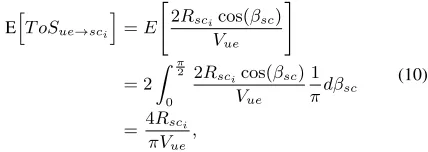
Given that the UE time of stay can be expressed using the velocity, ���, and the expected distance that the user will spend inside the base station coverage area as shown in Fig.2. The angle
��� can be represented as a random variable which is uniformly distributed and restricted to interval [−2�, �2]. This random variable has a constant density over the interval i.e. has a probability density function (PDF)����(���). Thus, we can define the mean ToS a user
will stay in SC as
E [
� ����→���
] =�
[
2����cos(���)
���
]
= 2 ∫ �
2
0
2����cos(���)
���
1
�����
=4����
����
,
(10)
where ����, and ���, are respectively the SC radius, and the UE
angle of entry to the SC. We can have an estimate of the SC radius when the user begins to receive a minimum required signal power for service continuity, denoted as �����ℎ , from the SC [14] as
���� =
(��,��(�)
�→��� 10
�/10
��ℎ
���
)1�
, (11)
where�is a Gaussian distribution random variable with zero mean and 12 dB standard deviation [12], and� is the path loss exponent.
As shown in Fig.3, the HO is taken place at point��∗
�, which is the point at which the UE is receiving����→��� > ��→���. The
aim is to find ��∗
� ∀�= 1, ..., ���, to maximize the throughput
and load balance the traffic between MC and SC. Therefore, we can write the formula to find the HO point,��∗
�, which will offer the maximum downlink throughput, as
��∗� =argmax�
∈� ��→���, (12) where�is a set representing the total base stations in the HetNet�
= {0,1,. . .,���} where 0 represents the MC and���is the number of SCs.
[image:3.595.336.550.458.534.2]required to perform inbound HO to SC and the interference-based load-dependent margin.
A. Resource Assignment and Load Calculations
The influence of the received interference at the user side in HetNet is largely affected by the amount of resources used by the HetNet base stations i.e. SCs and MCs. Also, the power of these resources has a significant influence on interference level. Cell load factor is the amount of resource usage with respect to the available resources in the cell [13]. In other word, a UE receives varied interference levels according to a varied base station load levels. For the��ℎ MC sector, the load��� is defined as number of physical
resource blocks (PRBs) being used by all mobile users connected to the aforementioned sector divided by the total MC PRBs, that is
���=
����
��
����
, (13)
where ����
�� is the number of PRBs used by all active mobile
users connected to the MC sector�, and���� is the total number of PRBs in the MC.
The number of PRBs used by all active mobile users connected to the MC sector�, i.e.����
��, can be expressed as
������=
���� ��
∑
�=1
����,�, (14)
where����
�� is the number of UEs in the sector, and����,� is the
number of PRBs used by user�.
B. Equivalent SINR Analysis
The ��∗
�, see Fig.3, is the point at which the data rate of the SC is greater than that of the MC. In other word, it is the point at which�����→��� >�
�
�→��� for inbound HO. For a given SC�
and MC, recall equations (4) and (5). We first apply the condition (�����→��� >�
�
�→���) to the two equations
��,��(�)�→���∣ℎ
(�) ���→���∣ 2 �� �→���+� �� �→���+� > � (�)
�,�→��� ∣ℎ
(�) �→���∣ 2 ��� �→���+� . (15)
Substituting (6) and (7) in equation (15) and after some simpli-fications we get
��,��(�)�→���∣ℎ
(�) ���→���∣
2 > �
�, (16)
where A and B are
�=��,�(�)→���∣ℎ
(�) �→���∣
2(
��,�(���→)���∣ℎ
(���) �→���∣ 2 + �∗∗ �� ∑
�=1,�∕=�
��,��(����)→���∣ℎ
(���) ���→���∣
2+�)
, (17)
�=
�∗∗
��
∑
�=1,�∕=�
��,��(����)→���∣ℎ
(���) ���→���∣
2+�. (18)
The inbound HO will be initiated to the SC with the highest data rate i.e. at HO point ��∗
�. In other word, we can say that the inbound HO is triggered when the downlink received power from the SC satisfy (16). Without loss of generality, we substitute (16) in (4) to obtain the equivalent SINR����
���→���, for inbound HO from
MC to SC�, that provides at least the same data rate as the current serving MC, that is
����
���→���>
��,��(�)�→��� ∣ℎ
(�) ���→���∣ 2 �� �→���+� �� �→���+�
∴�������→��� >
�/� �� �→���+� �� �→���+� , (19)
It is worth noting that the summation of interference term, in equations (15) to (18), considers only the SCs in a reduced NCL
set�∗∗
�� (will be given in section III as defined in (25)) which will, in turn, reduce the computation complexity since we only have a reduced number of SCs in this set.
C. Inbound Handover Interference-Based Margin
To maintain mobility load balancing in general, if the serving MC is overloaded then it increases the HO margin so as to trigger the inbound HO early to the SC. However, this unplanned increase may cause radio link failure and ping-pong HO issues, and hence, poor QoS is delivered to the UE. Therefore, these parameters should be adjusted dynamically according to the cell load to maintain the mobility robustness. For this reason, we aim to force the UE to perform inbound HO to SC �, which has lower load and hence lower resource utilization. The proposed method will bias the HO point between the congested MC and SC�.
Given the conventional A3 HO triggering condition, which de-pends on a power-based margin, when the power of the neighbour SC �is offset greater than that of the serving MC for a period of TTT [3], that is
�����→���> �
�
�→���+���−���,���, (20)
where ��� is the hysteresis parameter of MC and ���,��� is
the SC�specific offset with respect to the MC (i.e. the hysteresis set by MC to HO to the SC).
Inspired by (20), we proposed to modify this criteria to facilitate an interference-based load-dependent hysteresis margin. We will consider the SINR instead of downlink received power and replace the power margin���,���with interference-based load-dependent
margin, denoted ����
�→���, namely the proposed interference-based
load-dependent margin to control the HO point between MC and SC �. For inbound HO, in order to balance the load, the HO point
��∗
� must be moved closer to the serving MC rather than being closer to the target SC �. To adjust the HO point for a UE trying to perform inbound HO from MC to SC �, we must shift ��∗
� point to the left as shown in Fig.4 i.e. the HO point will be changed from the intersection point of the two curves ��
���→���
and (���→���+��ℎ−��→���) to the intersection point of the two
curves��
���→��� and (�
���
���→���−�
���
�→���), note that�
���
���→��� is
taken from (19). In other word, the congested MC adjusts the HO parameter����
�→��� to allow the UE to perform early HO to SC �.
For Fig.4,��ℎis the outage threshold and is set to 5 dB [15],�������
is the SINR from SC �when ��
�→��� is equal to��ℎ. Based on
[3] and so as to maintain the radio link failures to a lower level, the hysteresis can be assigned according to UE speed. Therefore, we adjust the value of��→��� to 4 dB for low speed UE (���≤
20km/h), 3 dB for medium speed UE (20km/h< ���≤50km/h) and 2 dB for high speed UE (���>50km/h).
To incorporate the impact of the UE velocity on the proposed margin, we proposed to incorporate the margin��→��� into
equa-tion (21) to find the load-dependent parameter, denoted as ��� � , which will be used later to calculate the proposed margin
���� = (1−���)⋅��→��� (21)
where ���
� is the load-dependent parameter for inbound HO. Finally, the proposed interference-based load-dependent margin is calculated as
�����→��� =��→���−�
��
� , (22)
The parameter���
� depends on���: the higher the value of���
the smaller the value of���� , the higher the proposed margin, and eventually the closer the ��∗
Figure 4: Handover point for inbound HO
Now we have����
���→���, and�
���
�→���, then the modified A3 HO
triggering event can be rewritten for inbound HO as
�����→���≥�
���
���→���−�
���
�→���. (23)
[image:5.595.46.296.454.682.2]The above condition in (23) should hold for a period of TTT according to the UE speed [16] as depicted in table I.
Table I: TTT according to UE speed
UE speed (km/h) ���≤20 20< ���≤50 ���>50
TTT (ms) 1280 512 256
III. PROPOSEDMETHODPROCESS
Algorithm 1 illustrates the proposed method procedures where
� ����→���is the expected time of stay of the user in SC�coverage
area, ��ℎ is the time threshold for ToS, and ���∗ is a set which represents the total number of SCs with an SINR greater than the outage threshold.
Algorithm 1Proposed Method
1: Procedure Starts
2: Usermovesto SC coverage area 3: if ��
���→���≤��ℎ then
4: Excludethis SC from Handover target cell list�∗
��
5: end if
6: for�←1,�∗
�� do
7: Estimate� ����→���
8: if E[
� ����→���
]
> ��ℎ then
9: KeepSC�in the new Handover list�∗∗
��
10: end if
11: end for
12: Convert��
�→��� to its equivalent�
���
���→���
13: Calculate���� �→���
14: Selectthe SC with the maximum��
���→��� from�
∗∗
��
15: if ��
���→���≥�
���
���→��� -�
���
�→��� for� � � then
16: if ����
��� <1 then
17: Handoverthe user to���
18: end if
19: end if
20: end procedure
The proposed algorithm begins by eliminating the SCs that could cause degradation in the user QoS, i.e. SCs with SINR less than the outage threshold��ℎ, resulting in a candidate list���∗ which is written as
���∗ ={���∈���∣�����→���> ��ℎ}. (24)
Then, for an active mobile user�, a SC NCL is formed, denoted as
�∗∗
�� set, containing all SCs whose predicted mean UE ToS is greater
than the time threshold��ℎ. Thus, we can re-write the candidate SC list as
���∗∗={���∈���∗ ∣E
[
� ����→���
]
> ��ℎ}. (25)
The UE performs inbound HO from MC to SC�if the data rate from SC�is higher than that of the MC. This is done by converting the SINR received from the MC, i.e.��
�→���, to its equivalent SINR
received from the SC, i.e.����
���→���, which gives a higher data rate.
Then, the resulted SINR from the previous step is compared with the actual SINR received from the SC�considering the interference-based load-dependent margin ����
�→��� (i.e., applying the proposed
modified A3 event). The inbound HO is performed to SC�providing that the PRBs of this SC is sufficient to provide resources to the user. In line (16) in Algorithm 1, the condition ����
��� < 1, the
value 1 here means that the SC resources are all occupied by other users and it is not possible to perform the inbound HO to this SC.
IV. PERFORMANCEANALYSIS ANDRESULTS
The performance of our proposed method is compared against the performance of two competitive methods, namely the conven-tional method and the estimated time-of-stay-based cell selection (ETCS) method presented in [7]. In the conventional method, the UE periodically performs neighbourhood scanning, based on the downlink received power, to form the HO target cell list. This means that the UE will spend a significant time period to select the proper target. Then, the UE performs the inbound HO to the SC with the strongest downlink received power without considering the interference and load balancing scenario which means that the HO point��∗
� for this method is downlink power constrained. This will cause an UE throughput reduction and wasting the battery power of the UE due to the frequent scanning measurement especially in dense SC environment. Therefore, the HO target SC for the conventional method, denoted as ���
����, can be expressed as
�������=
{
���∈���∣ ��,��(�)�→��� ∣ℎ
(�) ���→���∣
2 >
��,�(�)→���∣ℎ
(�) �→���∣
2}
.
(26)
Whereas the ETCS method in [7], forms the HO target cell list based on the downlink received power and ToS criteria which means to avoid the SC that could cause short time of stay phenomena. Then, the UE performs the inbound HO to the cell with the strongest power from the list. Also the interference scenario and cell load balance are not considered in this method and the HO point��∗
� is based on the power difference between the serving the target cells. We can write the HO target SC,���
����, for this method as
�������=
{
���∈���∣ (E[� ����→���
]
> ��ℎ)∧
(��,��(�)�→���∣ℎ
(�) ���→��� ∣
2 > �(�)
�,�→���∣ℎ
(�) �→���∣
2)}
.
(27)
On the contrast, our proposed method forms the HO target SC list based on the ToS criteria and interference constraint. Then, the UE performs the inbound HO to the cell that gives a better data rate with load balancing considerations, providing that the PRBs are available, considering a modified A3 HO triggering condition to ensure high QoS which means that the HO point is interference based as given in (23).
0 10 20 30 40 50 60 70 0
10 20 30 40 50 60 70 80
Velocity (km/hr)
Number of Inbound Handovers
[image:6.595.73.259.69.217.2]Conv. method ETCS method Proposed method
Figure 5: Total number of inbound Handovers
Therefore, we can define the outage probability as
����=ℙ
[
(�����→���< ��ℎ ∧ �
�
�→���< ��ℎ) for� < �
��� ℎ�
∨
(���→���< ��ℎ ∧ �
�
���→���> ��ℎ ∧ ��
�� ���= 1)
for� < �ℎ����
]
,
(28)
where����
[image:6.595.326.516.69.225.2]ℎ� is the time required to complete the HO process. The simulation parameters are listed in table II [7].
Table II: Simulation Parameters
Bandwidth 10 MHz
Carrier Frequency 2.5 GHz Macrocell Transmit power 43 dBm
Macrocell Radius 800 m
Maximum Small cell Transmit power 23 dBm Number of Small cell within Macrocell sector 10 Number of UEs within Macrocell sector 40 Maximum number of UEs per Small cell 5 Minimum required signal for service continuity -70 dBm
Outage threshold 5 dB
Handover completion time 1 sec Mean velocity of the UE 3 km/h Standard deviation for UE velocity 1 km/h Period between two updates of the mobility model 1 sec Path loss exponent 3.5 Time threshold for ToS 5 sec
The total number of inbound HOs is depicted in Fig.5. The conventional method has the higher rate of increase in the number of inbound HOs. In fact, for both ETCS method and our proposed method, the number of inbound HOs to SCs is highly minimized because of the reduction in the number of target SCs in the NCL owing to the ToS condition. Our proposed method outperformed both the conventional and ETCS methods by reducing the unneces-sary HOs for different user velocities since our method initiates the inbound HO at a point when the data rate from the target SC is good enough with the consideration of interference-based load-dependent modified A3 HO condition, unlike the conventional and ETCS methods which depend on the downlink received power to initiate the HO to the SC via traditional A3 HO condition. The proposed method reduces the unnecessary inbound HOs as ��� increases because the final HO candidate NCL only contains few number of SCs as the velocity increases, hence, the reduction happens.
Fig.6 shows the outage probability for all methods. The proposed method yields lower link failure compared to the other two meth-ods because the proposed method only initiates the inbound HOs when there is a sufficient data rate received from the target SC
10 20 30 40 50 60 70 0
0.002 0.004 0.006 0.008 0.01 0.012
Velocity (km/hr)
Outage Probability
Conv. method ETCS method Proposed method
Figure 6: Outage Probability
−10 −5 0 5 10 15 20 25 30 0.2
0.4 0.6 0.8 1 1.2 1.4 1.6
SNR (dB)
UE mean throughput (Mbps)
[image:6.595.330.515.255.409.2]Proposed method ETCS method Conv. method
Figure 7: UE mean throughput vs SNR
which means that the HO is initiated with QoS consideration by considering the interference powers from the other neighbouring cells. The conventional method has an instantaneous increase in the link failure owing to the fluctuated downlink received power due to the UE mobility in the HetNet and the level of link failure increases rapidly with the increase in UE velocity. The difference in link failure between ETCS and the proposed method starts to be distinct at a speed of 20km/h and it increases as the speed increases because, in addition to the ToS criteria, the proposed method takes the interference from adjacent cells and the availability of PRBs into account when performing the inbound HO to SC resulting in QoS HO process. This reduction in the outage probability emphasizes that the proposed load-dependent margin, ����
�→���, has properly
managed the load distribution among cells in the HeNet scenario. The performance of our proposed method, in terms of the max-imum throughput a UE can gain while moving through the network, is also compared with the other two methods. Fig.7 illustrates the UE’s mean throughput with respect to different signal to noise ratio (SNR) values. The throughput is increased with the increase in SNR accordant with common sense in all methods. The proposed method consistently supplies the UE with the highest throughput compared to the other two methods under different SNR values because the HO point for a UE trying to perform inbound HO from overloaded MC to a target SC is moved closer to the MC (i.e. the HO is triggered earlier), hence, the load is balanced between the two cells resulting in higher throughput.
[image:6.595.50.285.397.552.2]5% 10% 20% 30% 40% 50% 60% 70% 80% 90% 100% 0
0.1 0.2 0.3 0.4 0.5 0.6 0.7 0.8
Network Load Factor
UE mean throughput (Mbps)
[image:7.595.327.516.69.217.2]Proposed Method ETCS method Conv. method
Figure 8: UE mean throughput vs load factor
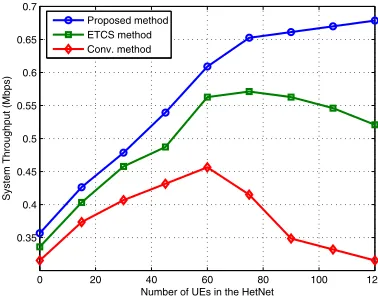
all load factors. When the load factor increases the cell congests and its radio resources reduce which in turn leads to the drop in the achieved data rate resulting in lower throughput gain. As the load factor goes towards 1 (100% load), the noise will increase which in turn will reduce the SINR resulting in lower UE mean throughput. From Fig.8 we can also notice the sudden drop in the UE mean throughput for ETCS and the conventional methods since they trigger the inbound HO to the target SC based on the downlink received power using A3 event, hence, higher dropping in calls is expected resulting in lower throughput sudden decrease. On the contrary, the drop in the UE mean throughput for our proposed method is less compared to the other two methods because the inbound HO is happened upon the occurrence of our proposed modified interference-based load-dependent A3 event where the UEs are offloaded from the congested MC to the SC by forcing the HO. Fig.9 depicts the system throughput with respect to the number of UEs moving in the network. It is obvious that the system throughput of both the proposed and the ETCS methods are always greater than that of the conventional method. Below 60 UEs in the network, the throughput of the conventional method keeps going up since the capacity of the MC is still sufficient enough to deliver resources to the incoming UEs but a sudden drop in the throughput happens after that because the MC will be overloaded and its capacity will be limited. When the number of UEs is 60, we can notice that the proposed method has 15% and 4.5% improvement in the throughput compared to the conventional and the ETCS methods respectively, and these percentages increase as the number of UEs increases. Generally, the proposed method’s throughput is significantly higher than that of other two methods because of the incorporation of the load-dependent margin which proves the proper distribution of the load between MC and SC tiers.
V. CONCLUSION
This paper presents an inbound HO method which takes into account the interference and load balancing in HetNet. The effect of interference and short ToS are used to reduce the number of SCs in the candidate NCL so that the user performs an inbound HO to the SC tier that gives a sufficient data rate and has enough resources from a reduced NCL which contains a few and appropriate HO target SCs. We proposed a modified A3 HO triggering condition considering the interference and cell load. Hence, traffic offloading from MC tier to SC tier is accomplished. Results show that our proposed method reduces the unnecessary HO and outage probab-ility compared to the other existing methods. The proposed method has also outperformed the competitive methods by delivering higher throughput as the number of UEs increase in the network. Under different network conditions, including SNR and load factor, we
0 20 40 60 80 100 120 0.35
0.4 0.45 0.5 0.55 0.6 0.65 0.7
Number of UEs in the HetNet
System Throughput (Mbps)
Proposed method ETCS method Conv. method
Figure 9: System throughput vs Number of UEs
tested and compared the proposed method against the ETCS and the conventional methods. Under all network conditions our proposed method outperformed the other two methods by providing higher throughput.
REFERENCES
[1] J.-S. Kim and T.-J. Lee, “Handover in umts networks with hybrid access femtocells,” inAdvanced Communication Technology (ICACT), 2010 The 12th International Conference on, vol. 1. IEEE, 2010, pp. 904–908.
[2] A. Ulvan, R. Bestak, and M. Ulvan, “The study of handover procedure in lte-based femtocell network,” in Wireless and Mobile Networking Conference (WMNC), 2010 Third Joint IFIP. IEEE, 2010, pp. 1–6. [3] X. Chu, D. López-Pérez, Y. Yang, and F. Gunnarsson,Heterogeneous
Cellular Networks: Theory, Simulation and Deployment. Cambridge University Press, 2013.
[4] J. Acharya, L. Gao, and S. Gaur, Heterogeneous Networks in LTE-advanced. John Wiley & Sons, 2014.
[5] J. G. Andrews, H. Claussen, M. Dohler, S. Rangan, and M. C. Reed, “Femtocells: Past, present, and future,”IEEE Journal on Selected Areas in Communications, vol. 30, no. 3, pp. 497–508, 2012.
[6] Z. Li, Z. Xiao, D. Wang, and X. Li, “Hysteresis automatic configuration for outbound handover in heterogeneous small cell networks,” inFuzzy Systems and Knowledge Discovery (FSKD), 2015 12th International Conference on. IEEE, 2015, pp. 2127–2131.
[7] C.-H. Lee and J.-H. Kim, “Time-of-stay estimation-based cell selection scheme in multitier heterogeneous mobile networks,”IEEE Communic-ations Letters, vol. 19, no. 9, pp. 1596–1599, 2015.
[8] M. Alhabo and L. Zhang, “Unnecessary handover minimization in two-tier heterogeneous networks,” inWireless On-demand Network Systems and Services (WONS), 2017 13th Annual Conference on. IEEE, 2017, pp. 160–164.
[9] M. Alhabo, L. Zhang, and N. Nawaz, “A trade-off between unne-cessary handover and handover failure for heterogeneous networks,” in European Wireless 2017; 23th European Wireless Conference; Proceedings of. VDE, 2017.
[10] J. Zhang and G. De la Roche,Femtocells: technologies and deployment. John Wiley & Sons, 2011.
[11] Q. Europe, “Hnb and hnb-macro propagation models,” 3GPP R4– 071617, Oct, 2007.
[12] G. L. Stüber,Principles of mobile communication. Springer Science & Business Media, 2011.
[13] E. U. T. R. Access, “Mobility enhancements in heterogeneous net-works,” 3GPP TR 36.839, Tech. Rep., 2012.
[14] X. Yan, N. Mani, and Y. A. Sekercioglu, “A traveling distance predic-tion based method to minimize unnecessary handovers from cellular networks to wlans,”IEEE communications letters, vol. 12, no. 1, pp. 14–16, 2008.
[15] H. Kalbkhani, S. Yousefi, and M. G. Shayesteh, “Adaptive handover algorithm in heterogeneous femtocellular networks based on received signal strength and signal-to-interference-plus-noise ratio prediction,” IET Communications, vol. 8, no. 17, pp. 3061–3071, 2014.
[image:7.595.72.261.71.218.2]