P R O C E E D I N G S
Open Access
Prevention in practice
–
a summary.
Stephen Birch
1,2, Colette Bridgman
3, Paul Brocklehurst
4, Roger Ellwood
5,6, Juliana Gomez
7, Michael Helgeson
8,
Amid Ismail
9, Richard Macey
10, Angelo Mariotti
11, Svante Twetman
12, Philip M Preshaw
13, Iain A Pretty
14*,
Helen Whelton
15From
Prevention in practice - making it happen
Cape Town, South Africa. 29 June 2014
Abstract
Background:This paper is a summary document of the Prevention in Practice Conference and Special
Supplement of BMC Oral Health. It represents the consensus view of the presenters and captures the questions, comments and suggestions of the assembled audience.
Methods:Using the prepared manuscripts for the conference, collected materials from scribes during the conference and additional resources collated in advance of the meeting, authors agreed on the summary document.
Results:The Prevention in Practice conference aimed to collate information about which diseases could be prevented in practice, how diseases could be identified early enough to facilitate prevention, what evidence based therapies and treatments were available and how, given the collective evidence, could these be introduced in general dental practice within different reimbursement models.
Conclusions:While examples of best practice were provided from both social care and insurance models it was clear that further work was required on both provider and payer side to ensure that evidence based prevention was both implemented properly but also reimbursed sufficiently. It is clear that savings can be made but these must not be overstated and that the use of effective skill mix would be key to realizing efficiencies. The evidence base for prevention of caries and periodontal disease has been available for many years, as have the tools and techniques to detect, diagnose and stage the diseases appropriately. Dentistry finds itself in a enviable position with respect to its ability to prevent, arrest and reverse much of the burden of disease, however, it is clear that the infrastructure within primary care must be changed, and practitioners and their teams appropriately supported to deliver this paradigm shift from a surgical to a medical model.
Introduction
The proceeding papers in this special edition have described the individual elements required to place pre-vention at the heart of practice. From the definition and detection of common oral disease, the historical devel-opment of prevention, through to the economics and implementation of services, models and systems to pro-mote prevention the proceeding papers provide a wealth of evidence.
Following the conference the authors and presenters wished to develop a document that distilled the infor-mation into a single collective summary. This work therefore broadly follows the outline of the conference, covering the following three main areas:
1. What is oral health and how can it be maintained? 2. How can we detect disease processes in a timely fashion so that prevention can work?
3. How can we organise dental services to support a transition from a surgical to a medical model, from care to cure.
* Correspondence: [email protected]
14
Dental Health Unit, School of Dentistry, University of Manchester, Manchester, England, UK
Full list of author information is available at the end of the article
When considering each of these three broad themes, the workshop groups were tasked with ensuring that the focus remained on what could be achieved within a community based general dental practice.
It is important to note that this summary represents a distillation of the articles provided in the supplement and also reflects on comments provided by attendees to the conference as well as discussion between the authors. References to main points are included, but the original papers contain the necessary citations to sup-port the approach.
1) What is oral health and how can it be maintained?
Definition of oral health
As a discipline, dentistry has focused on disease progres-sion and the symptoms or disease history of a patient, rather than the maintenance of their oral health. The defi-nition of oral health is difficult but will be defined as being the“absence of oral disease activity or progression with perceived well-being and without functional impairment”. Such a definition is consistent with earlier categorizations such as that of the World Health Organisation [1]. As dentistry develops new and more powerful surrogate tests to enhance our understanding of oral health and disease, this definition is likely to evolve further.
How do we maintain oral health? The importance of self-care
The primary responsibility of maintaining oral health lies with the individual, or their custodians [2][3]. This should be achieved through effective; evidence based self-care but also needs to be supported by public health policy, education, the provision of professional monitor-ing and therapeutic interventions when necessary. Self-care is most effective when individuals are oral health literate and demand a dentition that is functional and aesthetically appealing. The dental care industry has an important role to play in the provision of effective, economic and accessible products to enable self-care. Maintenance of oral health is largely achieved through tooth brushing to provide plaque control (for gingival and periodontal health) combined with fluoride tooth-paste (for caries prevention and treatment) [4]. Self-care should also be supported by a healthy diet, refraining from excessive alcohol intake or use of tobacco and regu-lar visits to a dental professional to assess any disease activity or increased risk that may indicate change is required.
Public health policy
Public Health policy supports healthy environments and access to care to provide both prevention and reparative interventions that are effectively remunerated, encou-rage oral health literacy and individual empowerment. The numerous models of provision of oral care available
whether they are free at point of delivery, insurance based or government supported may all be adapted to provide these basic prerequisites. In defining public health policy we must ensure that the benefits of oral health are understood and promoted by all, and that messages are clear, simple and above all consistent. Recent reports suggest that the profession is still unclear about simple oral hygiene measures and such variability in advice leaves patients confused about their role in securing and maintaining their oral health [5]. There may be a good case for dental organizations, such as IADR or FDI to develop and agree simple, con-sistent, evidence based guidelines for oral hygiene. Professional care - a model of medical dentistry
The role of the dental care professional is to monitor oral health and assess risk of disease progression in addition to the more widely perceived role of provision of reparative surgical interventions. The monitoring of oral health and the provision of appropriate interven-tions when evidence of risk of disease progression is identified primarily achieves this. Once disease is identi-fied this must be monitored to assess the success of any intervention through appropriate recall strategies. It is recognized that this medical model of dentistry, while promoted for many years and supported by strong research evidence, is not always at the center of dental training programmes and many dental care professionals still graduate as proficient surgeons, but lack the skills and knowledge to implement effective prevention [6]. Dominant Strategies
Given the definition of oral health provided above, and the roles and responsibilities of key stakeholders in secur-ing and maintainsecur-ing oral health what are the main evi-dence based strategies to prevent and treat disease when self-care fails? The main strategies are summarized in Table 1 together with the quality of evidence to support them. It is emphasized that the quality of evidence needs to be distinguished from the level of anticipated benefit and the strategies represent the current state of the art on disease control and prevention. The appropriate stra-tegies for the individual are dependent on the level of risk and disease activity.
Pre-requisites
are detected at a stage where medical interventions can be effectively implemented. Detecting disease at this level can be complex - and often times it may be difficult to differ-entiate from health.
2) How can we detect disease processes in a timely fashion so that prevention can work?
The previous section considered the definition of disease, the nature of the role of self and professional care and the dominant strategies available to prevent and arrest early stage oral diseases. However, in order to be able to enact these therapies effectively - diseases need to be detected, diagnosed, staged and the risk of the patient assessed. The Cape Town conference concentrated on the major oral diseases of caries and periodontal diseases, however, for completeness we have also covered, briefly, tooth surface loss and oral cancer.
Dental Caries
Dental caries is a major cause of functional impairment in humans
Dental caries is the most prevalent condition afflicting humans [7] and has significant impact on quality of life, pain, and may even lead to life-threatening infections [8]. Dental caries is a complex multifactorial disease caused by an ecological shift in the microbiome following long-term frequent exposure to sugary or carbohydrate-containing drinks, foods, or snacks, poor oral hygiene practices and preventive care. Hence, to prevent the development of new caries lesions on sound tooth surfaces (primary prevention) and to stop the progression of early or initial
caries lesions (secondary prevention), dental practitioners must first stage the caries process and assess its risk factors [9].
Staging of the caries progress is a pre-requisite to prevention
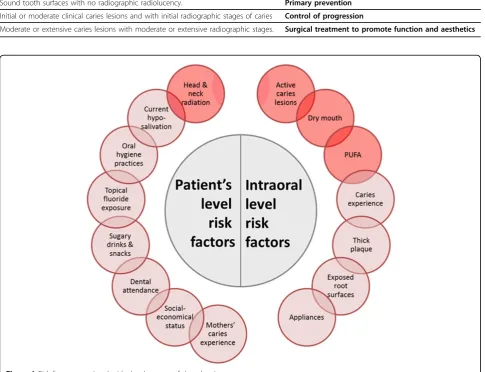
Appropriate management of dental caries requires diag-nosing non-cavitated lesions in enamel and the outer one third of dentine [10]. These lesions can be prevented from progressing through risk management and targeted sec-ondary preventive strategies [11]. Staging of caries may require both clinical and radiographic examinations. Clini-cal detection will require classification of teeth with active initial, moderate and extensive caries. Once lesions are classified an appropriate intervention can be developed. Table 2 presents this is in a simplified way - demonstrat-ing the linkage of caries stage to treatment [12][13][4][14] [15]. However the detection of lesions alone is insufficient to develop an effective preventive plan - lesions occur within patients as individuals and hence the assessment of risk factors and holistic treatment planning is essential. While a consensus on the most valid and easy to use risk assessment tool does not exist (and many are available), it is recommended, based on current evidence, that the risk factors shown in Figure 1 are considered [16][17][18][19] [20] {Ritter, 2010 #10}.
[image:3.595.56.541.101.274.2]Red-circled factors are definitely associated with high caries risk. While other factors in combination or fre-quency, can collectively increase the risk of progression. For caries management decisions on behavioral and therapeutic interventions, patients’risk status should be classified into low, medium or high. For each of these
Table 1. Preventive Strategies to restore health
Category Strategy Mode Caries Erosion Dentine Hypersensitivity Periodontal & Gingival
Fluoride Fluoride Toothpaste SC ++++ +
High Fluoride Toothpaste and gels SC/PC ++
Fluoride Varnish PC +++ +
Oral Hygiene Tooth brushing SC +
Flossing SC +
Professional Tooth Cleaning PC ++++
Sensitivity reduction Toothpaste SC +
Diet Sugar Control SC +
Acid Control +
Anti Bacterial CHX SC/PC
Triclosan SC ++++
SnF SC ++
classifications, patients will receive different intensity and combination of clinical and personal self-care recommendations. As such patient centered care is developed further enhancing the integrated care model and moving away from the “one size fits all” surgical approach. It should be recognized that the use of risk based treatment planning is already advocated in many dental health systems - often associated with RAG rat-ings (Red, Amber Green). The International Caries Clas-sification and Management System (ICCMS) is an excellent example of how this approach can operationa-lized and will provide a wealth of support material including caries management application and patient educational material [21] {Ismail, 2013 #207} {Ismail, 2007 #238}. It is also important to note that patients will, at different times, move between risk ratings - this might be due to short term changes in risk (for example pregnancy or an acute medical condition) or to longer
term impacts such as the loss of manual dexterity or cognitive impairment.
Periodontal Disease
Periodontal diseases comprise a group of highly preva-lent chronic inflammatory conditions that affect the supporting structures of the teeth. The bacterial biofilm plays a fundamental role in initiating and perpetuating an inflammatory response in the periodontal tissues. Susceptibility to disease varies widely between indivi-duals, dependent on environmental factors such as smoking, and genetic aspects of the immune and inflam-matory functioning [22] Detection and diagnosis of peri-odontal conditions should be a routine component of oral and dental assessment.
Definition of periodontal diseases amenable to prevention On the basis of our definition of oral health, the diagno-sis of periodontal diseases infers progressing disease
Table 2. The combination of clinical and radiographic stages results in the following classification of the caries stages of teeth or tooth surfaces, as appropriate:
Sound tooth surfaces with no radiographic radiolucency. Primary prevention
Initial or moderate clinical caries lesions and with initial radiographic stages of caries Control of progression
[image:4.595.57.543.115.487.2]Moderate or extensive caries lesions with moderate or extensive radiographic stages. Surgical treatment to promote function and aesthetics
with functional impairment or pain in the absence of psychological or social well-being. Functional impair-ment in its broadest sense can include impaired func-tion (e.g. chewing, speaking, socializing), pain (e.g. hypersensitivity), and/or compromised aesthetics. The periodontal conditions that will be considered include chronic periodontitis and gingivitis (i.e. plaque-induced gingivitis).
Chronic periodontitis is a bacterially induced chronic inflammation of the periodontal tissues that results in loss of attachment and alveolar bone destruction [23]. Progressing disease should be identified as part of regu-lar dental assessment. Certain patients may have evi-dence of periodontitis which is stable (i.e. no evievi-dence of progression), and that is not causing functional impairments. Gingivitis is bacterially induced inflamma-tion that is confined to the gingival tissues. Utilizing our definition of health above, it could debated whether chronic gingivitis ever presents as a functional impair-ment, and at a histological level, gingival inflammation is evident in almost every person. On the other hand, certain patients may have anxieties regarding gingivitis, such as gingival bleeding, or aesthetic concerns. Recog-nizing that gingivitis is a proxy measure of poor oral hygiene and frequently precedes destructive periodontal involvement its detection should, however, remain an important element of assessing risk.
Staging of periodontal conditions
Like dental caries, it is important to stage and categorize periodontal conditions. In simple terms, we distinguish between gingivitis and periodontitis. Gingivitis is gener-ally regarded as being reversible once inflammation reduces, and this is achieved by improved self-care and enabling professional care (often professional plaque removal). The tissue damage associated with periodonti-tis is largely irreversible, and therefore management focuses on prevention of periodontitis progression. Pri-mary prevention of gingivitis should be a key aim of den-tal professionals, to maintain non-inflamed, healthy tissues. If gingivitis is identified, treatment should be pro-vided to resolve the gingivitis, as this is a preventive strat-egy for preventing progression to periodontitis. If periodontitis is identified, management strategies should be implemented that aim to prevent further destruction of the periodontium.
Detection of disease
Initial visual inspection should be undertaken to identify evidence of gingivitis and level of oral hygiene. Period-ontal screening should be performed utilizing the CPI (Community Periodontal Index) screening system (also referred to as the Periodontal Screening Record, PSR, and the Basic Periodontal Examination, BPE). CPI should be performed at every visit, and at least annually [24,25]. See Table 3.
Assessment of periodontal status at a single point in timecannotprovide information about disease progres-sion. Therefore, assessments should be repeated over time to determine if attachment loss is progressing. How-ever, many patients present with disease without the clin-ician being able to readily identify that the condition is progressing. Such patients may have a functional limita-tion, indicating a requirement for intervention. However, even in the absence of functional limitations or of proof of disease progression, periodontal disease in newly pre-senting patients does require intervention to prevent further progression.
Risk assessment to promote periodontal health
Periodontal disease is a complex, inflammatory disease that has multiple aetiologies, but a common clinical end-point. There is wide variation in susceptibility between individuals. The bacterial challenge perpetuates the chronic inflammatory response, which itself is influ-enced by environmental risk factors, the most important being smoking [26] and diabetes [27]. Assessment of risk should form part of the assessment of all patients. Key environmental risk factors to assess that are amen-able to modification include:
•smoking behaviours: years of smoking, number of cigarettes per day, type of smoking, awareness of the impact of smoking on periodontal status, and inter-est to talk about quitting
•diabetes: level of glycaemic control (e.g. subjective assessments“good”vs.“poor”, or objective measures such as HbA1c), presence of other diabetes compli-cations, awareness of the impact of diabetes on peri-odontal status
Tooth surface loss
Tooth surface loss (TSL) may be purely physiological and occurs as a natural consequence of ageing [28]. Causative factors including erosion, abrasion and attri-tion can render tooth surface loss pathological. As a result of this, symptoms may develop and treatment may be indicated. As such TSL may contribute to a decline in oral health as defined within this work. Erosion
softened layer at the surface of the remaining tissue. Erosive factors may be either intrinsic or extrinsic. Extrinsic sources include drinks such as fresh fruit juices, carbonated drinks, alcoholic beverages; and some foods and industrial processes. Intrinsic sources include gastro-oesophageal reflux and eating disorders, amongst others [29].
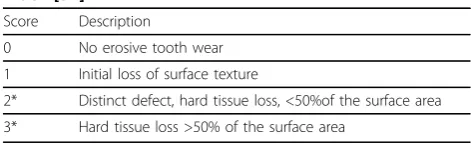
Currently erosion detection is based on visual identifi-cation [30]. Different clinical tooth surface loss indices have been used for epidemiological and clinical purposes. Recently the results of a workshop resulted in a new scoring system, the Basic Erosive Wear Examination (BEWE). This system was designed to provide a simple tool for use in general practice and to allow comparison to other more discriminative indices. It is a partial scor-ing system recordscor-ing the most severely affected surface in a sextant with a four level score (Table 4) [31].
While in the initial and moderate stages of erosion (BEWE 1), preventive or non-invasive strategies are indi-cated, in advanced stages (BEWE 2 and 3) more com-plex and invasive therapeutic strategies may be needed [32]. Determining factors for initiating therapeutics intervention are sensitivity, aesthetics and functional impairment [29].
Oral cancer and premalignant conditions
Although not a study topic in this Symposium and con-sidering the examination of preventive strategies for oral neoplasms involves extensive review that is beyond the scope of this Summary, there are several general com-ments concerning oral cancers requiring comment. Opportunistic cancer screening should be performed in every dental examination. Assessing patients for mouth cancer[29], and potentially malignant disease requires a high level of suspicion, but many other conditions may present with similar changes. The level of suspicion should be raised if the patient is a smoker or heavy alco-hol drinker, chews betel nut (areca nut) or tobacco, or is
over 40 years. More recently, the human papilloma virus (HPV), which is sexually transmitted, has been asso-ciated with cancers of the oral and oropharyngeal region. The screening for oral cancer would include detecting the presence or absence of malignant and potentially malignant lesions in the oral mucosa and dis-tinguishing these from benign conditions.
3. How can we organize practice to deliver effective prevention?
The current position
Primary care provision in dentistry has predominantly focused on the treatment of presenting oral disease in attending patients. This has largely arisen historically given the high of levels of disease present in the popula-tion over the last two to three decades. It has also been influenced by the way service reimbursement is linked to treatment interventions to serve demand [33], the way dentists are trained and how dental practices are organized to deliver treatment services [34] .
The consequences of this disease/treatment/demand focus are that:
1. attention becomes limited to dental treatment care (i.e. services are provided to meet presenting need [or demand] on an episodic basis by the dental care provider) as opposed to emphasis on self-care to prevent future disease, (i.e. the continuous atten-tion given to explaining disease processes to pro-mote healthy mouths involving daily self-care (oral hygiene, healthy diets) supported by regular periodic professional care.
2. as oral health improves, services are not being delivered in accordance with the relative needs (or relative risk of needs) or the distribution of these needs across different patient groups. Instead, the systems and processes of dentistry lock professionals into maintaining the status quo of service provision and responding to and inducing patient demands and supplier-induced demand.
3. there is incomplete coverage of the population by dental care provision beyond a stable patient base of regular attenders that not only fails to address social inequalities in oral health, but contributes to these inequalities.
[image:6.595.54.540.101.150.2]4. there is a need for policy leaders to shift the focus from a traditionally surgical model of dentistry to an
Table 3. CPI Codes in periodontal assessments
CPI code 0 No increased probing depths, no bleeding on probing. Indicates healthy periodontal tissues.
CPI code 1 Bleeding on probing, together with clinical evidence of gingival inflammation (erythema, oedema), indicates gingivitis.
CPI codes 3 and 4
Probing depths of 4mm or greater, indicative of periodontitis. In this case, detailed periodontal examination should be performed, together with radiographic assessment of alveolar bone status as indicated by the clinical situation.
Table 4. The Basic Erosive Wear Examination (BEWE) index [31]
Score Description
0 No erosive tooth wear
1 Initial loss of surface texture
2* Distinct defect, hard tissue loss, <50%of the surface area
[image:6.595.55.291.659.731.2]approach that concentrates on prevention by inte-grating mouth health with general health and social policies. Such an alliance will shift the focus in oral health from technical interventions towards social determinants of health and to greater equity and social justice.
These issues remain in many countries despite the use of different approaches to governing, delivering and funding dental care provision. This is largely due to the upstream nature of the social determinants of oral health and the downstream approaches to delivering care [35]. If untreated, dental disease can have a substantial impact on individuals’health, functioning and self-esteem whilst also giving rise to school/work absence, reductions in productivity when at school/work and adverse effects on nutrition and development, particularly in children and adolescents.
Enablers for change
So what changes must take place in order to support the development of an effective prevention strategy for oral health? In the rest of this section we briefly identify and discuss the possible elements of such a policy organizing these under three broad headings, financial incentives, human resources and governance.
Financial incentives: Although many dentists are keen to adopt a preventive model of care, the systems in which they work often lead to such models not being structurally or financially viable. Where dentists rewards are based on what is done (throughput based) ‘in the here and now’as distinct from who it is done for (popu-lation-based), the quality of care provided is naturally hampered [36] and engaging in prevention may lead to lower practice income [37]. By adopting alternative funding models that reward providers for engaging with hard to reach populations and high needs groups, we can ensure that from a provider perspective broadening the reach of their service pays appropriately [38][39].
In addition, practicing prevention has the potential to reduce service needs at both the individual patient and the population level, through a halo effect and hence reduce workloads at the practice level. This then frees up capacity to serve larger populations and further increases coverage. This virtuous circle approach must be tempered with the fact that if hard to reach groups are accessed, they may present with surgical need. Deli-vering this prior to the benefits of prevention being seen may impact on the perceived effectiveness of the approach - not least within the relatively short political cycles as compared to the relatively long disease pro-cesses of caries and periodontal conditions.
Human resources: The dentist may not be the most appropriate person to be delivering preventive care.
Dental care professionals (DCPs) can be an effective and cost effective part of the dental care team within a pre-vention model. The adoption of an efficient ‘building’ design and skill-mix within a dental team provides an opportunity to use the team in a more productive way. Examples include dental nurses with additional compe-tence and skills placing fluoride varnish and using moti-vational interviewing techniques, hygienists and therapists working to their full scope of practice to com-plete routine treatments and interim care preventive interventions in addition to screening examinations with a prevention focus in out-reach settings; enabling dentist time to be released to focus on more complex service needs and high risk/need populations [40].
The use of a wider skill mix within dental teams is in various stages of implementation globally - with some health systems readily accepting it - especially in areas where recruiting a more traditional dental workforce is problematic, but in others there has been significant push back from organized dentistry to resist the per-ceived erosion of the dentist as the center piece of oral care delivery [41]. By demonstrating the value of skill mix as an enabler for preventive care the ability for den-tists to devote more resource to complex patients may be realized.
Patient responsibilities: Understanding the importance of personal homecare and eliminating destructive beha-viors (e.g., smoking) become important factors for oral health. It is well known that both short-term improve-ment as well as long-term improveimprove-ment in oral health can be obtained in patients but this must be individua-lized to the patient, otherwise, relapse will occur to baseline levels. To ensure acceptance and compliance, a significant aspect of care that immediately affects oral health is health literacy of the patient. Oral health lit-eracy allows the patient to obtain services that are necessary for management of their oral health.
Summary
Overall the adoption of prevention in practice represents a paradigm shift in the way we think about oral health care, with the focus switching from intervention to a model that promotes health according to individual needs and risk. At a micro level changes are needed in the way that dentists approach the routine examination. There should be an assessment of individual risk and an investigation of the patient’s current self-care routine and circumstances to establish a complete understand-ing of the patient’s oral health needs and environment. This can be achieved by completing a needs assessment and creating a personalized daily self care plan for every patient.
This requires attention to be paid to the collection of data that relates to an individual’s risks (hygiene, diet, tooth brushing habits) and needs (absence of pain and discomfort, functioning, self-esteem) as a basis for tailor-ing preventive care based on individual need. Excellent communication of the daily care plan is also essential. Practitioners should be motivated by the potential for increasingly rewarding relationships with patients which encourage them to manage and take responsibility for their own oral health and prevent disease rather than being dependent on the dentist to cure problems once they occur. Again, such an approach would lead to the potential of increasing the capacity to care for the wider population who currently do not attend and where much of the burden of oral disease resides.
Preventive practice should be further encouraged through‘federated’local networks to encourage dentists to reach out into their communities and integrate with their peers. This will ensure that services are“clinically led & clinically owned”, with strong leadership forming the basis for supporting effective service planning, qual-ity improvement and engagement. This is not without its challenges. It requires a considerable shift in the cul-ture of dentists and their team to share good practice and become motivated by the need of the local popula-tion rather than simply by the demand of their stable patient base. It also requires that policy leaders facilitate supportive environments, so that patients can adopt self-care messages and behavior change advocated by dental teams; as oral health inequalities result from social inequalities in the conditions of daily life.
Conclusions
This special edition of BMC Oral Health was produced in response to a perceived“blockage” in the transfer of research into clinical practice. The evidence base has, for many years, increasingly supported the use of pro-ducts, therapies and interventions that have been shown to prevent, arrest and reverse the commonest dental dis-eases that remain an issue globally. The development of
diagnostic and staging systems and devices, combined with a recognition of the impact of risk on dynamic dis-ease process, means that the disdis-ease processes can now be identified at an appropriate stage where they are amenable to early interventions. Despite this prevention in practice does not appear to be widely implemented.
The purpose of the Cape Town Conference was to collate the evidence for all three stages of prevention -identification of disease, the evidence based therapies and the enabling factors to implementation - together in a single document. It is clear that there are examples of best practice, where prevention has been instilled within services (See Bridgman, Helgeson in this supplement) despite existing and persistent barriers, but much more work is required, at all levels within the health care sys-tem to anchor prevention at the heart of dentistry. Gov-ernments, policy makers, insurers, organized dentistry, industry, the profession and patients all have a role to play in pushing clinical practice from surgical delivery of restorative treatments into a care model of health pro-motion and prevention.
Declarations
This article has been published as part ofBMC Health Services Research
Volume 15 Supplement 1, 2015: Improved access to maternal, newborn and child health services: strengthening human resources for health. The full contents of the supplement are available online at http://www. biomedcentral.com/bmchealthservres/supplements/15/S1. Publication charges for this supplement were funded by Colgate Palmolive.
Authors’details 1
Centre for Health Economics and Policy Analysis, McMaster University, Canada.2Manchester Centre for Health Economics, University of Manchester,
UK.3Public Health England, 4th Floor, 3 Piccadilly Place, London Road Manchester, M1 3BN, England, UK.4NWORTH, Y Wern, The Normal Site,
Bangor University, Holyhead Road, Gwynedd, UK.5The Colgate Palmolive Company, Piscataway, NJ, United States.6Dental Health Unit, School of
Dentistry, University of Manchester, Manchester, England, UK.7Dental Health
Unit, School of Dentistry, University of Manchester, Manchester, England, UK.
8Apple Tree Dental, 8960 Springbrook Drive, Suite 150 Minneapolis, MN
55433, USA.9Maurice H. Kornberg School of Dentistry, Temple University, Philadelphia, USA.10School of Dentistry, University of Manchester,
Manchester, England, UK.11Division of Periodontology, College of Dentistry, The Ohio State University, Columbus, Ohio, 43210, USA.12Department of
Odontology, Faculty of Health and Medical Sciences, University of Copenhagen, Copenhagen, Denmark.13School of Dental Sciences and
Institute of Cellular Medicine, Newcastle University, Newcastle upon Tyne, NE2, 4BW, UK.14Dental Health Unit, School of Dentistry, University of
Manchester, Manchester, England, UK.15School of Dentistry, University of
Leeds, Leeds, LS2 9LU, UK.
Published: 15 September 2015
References
1. Yewe-Dyer M:The definition of oral health.Br Dent J1993,174(7):224-5. 2. Sandberg GE, Sundberg HE, Wikblad KF:A controlled study of oral
self-care and self-perceived oral health in type 2 diabetic patients.Acta Odontol Scand2001,59(1):28-33.
3. Marino R, Albala C, Sanchez H, Cea X, Fuentes A:Prevalence of diseases and conditions which impact on oral health and oral health self-care among older chilean.J Aging Health2015,27(1):3-16.
4. Walsh T, Worthington HV, Glenny AM, Appelbe P, Marinho VC, Shi X:
caries in children and adolescents.Cochrane Database Syst Rev2010, ,1:
CD007868.
5. Wainwright J, Sheiham A:An analysis of methods of toothbrushing recommended by dental associations, toothpaste and toothbrush companies and in dental texts.Br Dent J2014,217(3):E5. 6. Iacopino AM:The influence of“new science”on dental education:
current concepts, trends, and models for the future.J Dent Educ2007,
71(4):450-62.
7. Petersen PE, Bourgeois D, Ogawa H, Estupinan-Day S, Ndiaye C:The global burden of oral diseases and risks to oral health.Bull World Health Organ
2005,83(9):661-9.
8. Bagramian RA, Garcia-Godoy F, Volpe AR:The global increase in dental caries. A pending public health crisis.Am J Dent2009,22(1):3-8. 9. Frencken JE, Peters MC, Manton DJ, Leal SC, Gordan VV, Eden E:Minimal
intervention dentistry for managing dental caries - a review: report of a FDI task group.Int Dent J2012,62(5):223-43.
10. Pitts NB, Stamm JW:International Consensus Workshop on Caries Clinical Trials (ICW-CCT)–final consensus statements: agreeing where the evidence leads.J Dent Res2004,83(Spec No C):C125-8.
11. Ismail AI, Tellez M, Pitts NB, Ekstrand KR, Ricketts D, Longbottom C,et al:
Caries management pathways preserve dental tissues and promote oral health.Community Dent Oral Epidemiol2013,41(1):e12-40.
12. Marinho VC, Worthington HV, Walsh T, Clarkson JE:Fluoride varnishes for preventing dental caries in children and adolescents.Cochrane Database Syst Rev2013,7:CD002279.
13. Tellez M, Gomez J, Kaur S, Pretty IA, Ellwood R, Ismail AI:Non-surgical management methods of noncavitated carious lesions.Community Dent Oral Epidemiol2013,41(1):79-96.
14. Slot DE, Vaandrager NC, Van Loveren C, Van Palenstein Helderman WH, Van der Weijden GA:The effect of chlorhexidine varnish on root caries: a systematic review.Caries Res2011,45(2):162-73.
15. Anderson CA, Curzon ME, Van Loveren C, Tatsi C, Duggal MS:Sucrose and dental caries: a review of the evidence.Obes Rev2009,10(Suppl 1):41-54. 16. Pitts NB:How the detection, assessment, diagnosis and monitoring of
caries integrate with personalized caries management.Monogr Oral Sci
2009,21:1-14.
17. Tellez M, Gomez J, Pretty I, Ellwood R, Ismail AI:Evidence on existing caries risk assessment systems: are they predictive of future caries?
Community Dent Oral Epidemiol2013,41(1):67-78.
18. Ekstrand KR, Bruun G, Bruun M:Plaque and gingival status as indicators for caries progression on approximal surfaces.Caries Res1998,32(1):41-5. 19. Ismail AI, Sohn W, Lim S, Willem JM:Predictors of dental caries
progression in primary teeth.J Dent Res2009,88(3):270-5. 20. Leong PM, Gussy MG, Barrow SY, de Silva-Sanigorski A, Waters E:A
systematic review of risk factors during first year of life for early childhood caries.Int J Paediatr Dent2013,23(4):235-50.
21. Pitts NB, Ekstrand KR, Foundation I:International Caries Detection and Assessment System (ICDAS) and its International Caries Classification and Management System (ICCMS) - methods for staging of the caries process and enabling dentists to manage caries.Community Dent Oral Epidemiol2013,41(1):e41-52.
22. Preshaw PM, Taylor JJ:How has research into cytokine interactions and their role in driving immune responses impacted our understanding of periodontitis?J Clin Periodontol2011,38(Suppl 11):60-84.
23. Pihlstrom BL, Michalowicz BS, Johnson NW:Periodontal diseases.Lancet
2005,366(9499):1809-20.
24. Periodontology BSo, Basic Periodontal Examination. 2011.
25. Puri K, Puri N, Dodwad V, Masamatti SS:Restorative aspects of periodontal disease: an update part 1.Dent Update2014,41(6):545-8, 551-2. 26. Warnakulasuriya S, Dietrich T, Bornstein MM, Casals Peidro E, Preshaw PM,
Walter C,et al:Oral health risks of tobacco use and effects of cessation.
Int Dent J2010,60(1):7-30.
27. Preshaw PM, Alba AL, Herrera D, Jepsen S, Konstantinidis A, Makrilakis K,
et al:Periodontitis and diabetes: a two-way relationship.Diabetologia
2012,55(1):21-31.
28. Wood I, Jawad Z, Paisley C, Brunton P:Non-carious cervical tooth surface loss: a literature review.J Dent2008,36(10):759-66.
29. Lussi A, Carvalho TS:Erosive tooth wear: a multifactorial condition of growing concern and increasing knowledge.Monogr Oral Sci2014,
25:1-15.
30. Attin T, Wegehaupt FJ:Methods for assessment of dental erosion.Monogr Oral Sci2014,25:123-42.
31. Ganss C, Lussi A:Diagnosis of erosive tooth wear.Monogr Oral Sci2014,
25:22-31.
32. Schlueter N, Jaeggi T, Lussi A:Is dental erosion really a problem?
Advances in Dental Research2012,24(2):68-71.
33. Birch S:The identification of supplier-inducement in a fixed price system of health care provision. The case of dentistry in the United Kingdom.
J Health Econ1988,7(2):129-50.
34. Glick M, Monteiro da Silva O, Seeberger GK, Xu T, Pucca G, Williams DM,
et al:FDI Vision 2020: shaping the future of oral health.Int Dent J2012,
62(6):278-91.
35. Watt R, Sheiham A:Inequalities in oral health: a review of the evidence and recommendations for action.Br Dent J1999,187(1):6-12.
36. Tickle M, McDonald R, Franklin J, Aggarwal VR, Milsom K, Reeves D:Paying for the wrong kind of performance? Financial incentives and behaviour changes in National Health Service dentistry 1992-2009.Community Dent Oral Epidemiol2011,39(5):465-73.
37. Grytten J:Models for financing dental services. A review.Community Dent Health2005,22(2):75-85.
38. Birch S, Kephart G, Murphy GT, O’Brien-Pallas L, Alder R, MacKenzie A:
Health human resources planning and the production of health: development of an extended analytical framework for needs-based health human resources planning.J Public Health Manag Pract2009,15(6 Suppl):S56-61.
39. Whittaker W, Birch S:Provider incentives and access to dental care: evaluating NHS reforms in England.Soc Sci Med2012,75(12):2515-21. 40. Brocklehurst PR, Tickle M:Is skill mix profitable in the current NHS dental
contract in England?Br Dent J2011,210(7):303-8.
41. Nash DA, Friedman JW, Kardos TB, Kardos RL, Schwarz E, Satur J,et al:
Dental therapists: a global perspective.Int Dent J2008,58(2):61-70.
doi:10.1186/1472-6831-15-S1-S12
Cite this article as:Birchet al.:Prevention in practice–a summary.BMC Oral Health201515(Suppl 1):S12.
Submit your next manuscript to BioMed Central and take full advantage of:
• Convenient online submission
• Thorough peer review
• No space constraints or color figure charges
• Immediate publication on acceptance
• Inclusion in PubMed, CAS, Scopus and Google Scholar
• Research which is freely available for redistribution