0022-538X/97/$04.0010
Copyrightq1997, American Society for Microbiology
Complementation of a Primer Binding Site-Impaired Murine
Leukemia Virus-Derived Retroviral Vector by a Genetically
Engineered tRNA-Like Primer
ANDERS H. LUND,1MOGENS DUCH,1JETTE LOVMAND,2POUL JØRGENSEN,1
ANDFINN SKOU PEDERSEN1,2*
Department of Molecular and Structural Biology1and Department of Medical Microbiology and Immunology,2
University of Aarhus, DK-8000 Aarhus, Denmark
Received 2 July 1996/Accepted 17 October 1996
Reverse transcription of retroviral genomes is primed by a tRNA annealed to an 18-nucleotide primer binding site. Here, we present a primer complementation system to study molecular interaction of the replication machinery with the primer and primer binding site in vivo. Introduction of eight base substitutions into the primer binding site of a murine leukemia virus-based vector allowed efficient RNA encapsidation but resulted in severely reduced vector replication capacity. Replication was restored upon complementation with a synthetic gene designed to encode a complementary tRNA-like primer, but not with a noncomplementary tRNA-like molecule. The engineered primer was shown to be involved in both the initiation of first-strand synthesis and second-strand transfer. These results provide an in vivo demonstration that the retroviral replication machinery may recognize sequence complementarity rather than actual primer binding site and 3* primer sequences. Use of mutated primer binding site vectors replicating via engineered primers may add additional control features to retroviral gene transfer technology.
Copying of retroviral RNA into proviral DNA takes place in a nucleoprotein complex that contains catalytic and structural viral proteins. The only known host-encoded component re-quired for the process is a specific tRNA that is copackaged in the virion and serves as a primer for the viral reverse
transcrip-tase (RT). The 39end of the priming tRNA molecule is
an-nealed to the primer-binding site (PBS), a complementary
18-bp sequence near the 59 end of the viral RNA genome.
Different groups of retroviruses use different tRNA species as specific primers (19, 28, 33, 34, 37), and the tRNA primer molecule is likely to interact with both viral proteins and genomic RNA during the processes of packaging, primer an-nealing, and reverse transcription. Evidence for specific mo-lecular interactions between RT and the cognate primer mol-ecule in vitro is available for human immunodeficiency virus (HIV) (2, 3, 32) and avian leukosis virus (14, 25, 26, 29). Furthermore, the integration of the primer tRNA into a com-plex RNA secondary structure involving additional base pair-ing beyond the PBS may serve to select a spair-ingle tRNA species as replication primer (1, 15, 38). Specific recognition of tRNA sequences may also be involved in subsequent steps of
repli-cation in which 18 nucleotides at the 39 end of the tRNA
primer are reverse transcribed during plus-strand synthesis into a DNA copy that, by annealing to the minus-strand DNA copy of the PBS, serves to mediate the second template shift of reverse transcription. Recent in vivo evidence for tRNA primer specificity comes from studies of HIV and avian leukosis virus demonstrating that PBS-mutated viruses designed to use tRNA species other than the cognate primer readily revert to wild type (wt) after a few passages in cell culture (10, 17, 39, 40).
For further understanding of critical macromolecular inter-actions required for the overall process of reverse
transcrip-tion, genetic approaches may form important links between biochemical and in vivo replication studies. While genetic anal-ysis of viral RNA and proteins has already contributed valuable information, we here present the possibility of also modifying the host-derived tRNA that plays key roles in the process. We have previously shown that PBS mutations designed not to match any naturally occurring tRNA molecule result in a strong impairment of vector transduction (20). To test the feasibility of making replication dependent on a genetically altered primer, we have used single cycle replication of murine leukemia virus (MLV)-derived vectors. Relative to other groups of retroviruses, MLV may show less stringent primer specificity. MLV RT exhibits no apparent preference for its
natural tRNAPro partner in various biochemical assays (14,
25). Additional evidence of less stringent tRNA primer
spec-ificity in MLV comes from in vivo use of tRNA1,2
Gln(9, 23) or
tRNA3
Lys(18).
We here present results documenting a flexibility of primer and PBS sequences for MLV, which has allowed the engineer-ing of an extensively modified complementary PBS primer set with in vivo functions in initiation of first-strand cDNA syn-thesis and plus-strand transfer leading to a complete provirus.
MATERIALS AND METHODS
Mutagenesis and cloning.The plasmid vector pPBS-x2 was constructed from ptvAkv-neo by a two step PCR-mediated site-directed mutagenesis procedure as previously described (18). The PCR primer utilized to insert the PBS-x2 muta-tion was 59-CCTGGGCGGGGGTCTCCAAATCCCCTGCAACTGACCAAA TGAAAGAC-39. Cloning into pUC19 was facilitated by the presence of unique EcoRI and XhoI sites in linker sequences inserted in the 59U3 region and the 39 U5 region. The structure of pPBS-x2 was verified by sequencing of the PBS and by restriction analysis. The function of the neo gene was confirmed by the ability of the vector to confer kanamycin resistance in bacteria. The plasmid pRNAx2,
encoding the putative tRNA molecule, was created from synthetic oligode-oxynucleotides. Briefly, a 23-base oligodeoxynucleotide (59-GGAAAGCTTATA AAAACTTTCAG-39) was annealed to a 127-base oligodeoxynucleotide (59-CC GGAATTCGAAAACGAAGAAACAAAGTTTACATCTCAGCTGCTGGTC TAGGGGTATGATTCTCGCTTAGGGTGCGAGAGGTCAGGGGTTCAA ATCCCCTGCAGCTGAAAGTTTTTAGCTTTCC-39) containing the RNAx2
cassette and elongated with Taq polymerase. Unique EcoRI and HindIII sites
* Corresponding author. Mailing address: Department of Molecular and Structural Biology, University of Aarhus, C.F. Møllers Alle´, Bldg. 130, DK-8000 Aarhus, Denmark. Phone: 45 89422614. Fax: 45 86196500. Electronic mail address: [email protected].
1191
on November 9, 2019 by guest
http://jvi.asm.org/
facilitated cloning into pUC19. The structure of pRNAx2
was verified by se-quencing. Likewise, for the cloning of pRNAx1
, a 23-base oligodeoxynucleotide (59-GGAAAGCTTATAAAAACTTGATG-39) was annealed to a 127-base oli-godeoxynucleotide (59-CCGGAATTCGAAAACGAAGAAACAAAGTTTAC ATCTATGAATCTGGTCTAGGGGTATGATTCTCGCTTAGGGTGCGAG AGGTCTAGGGTTCAAATCCCTAGATTCATCAAGTTTTTATAAGCTT TCC-39), elongated, and cloned into pUC19. All oligodeoxynucleotides were purchased from DNA Technology ApS, Aarhus, Denmark.
Cell culture.BOSC 23 cells (27) were obtained from the American Type Culture Collection. To ensure efficient expression of the env gene, BOSC 23 packaging cells were passaged twice in HAT-DMEM selective medium (27). During the subsequent steps of transfection and virus harvesting, BOSC 23 cells were grown in Dulbecco modified Eagle medium supplemented with GlutaMAX (Life Technologies, Roskilde, Denmark), 15% fetal calf serum, 100 U of peni-cillin per ml, and 100mg of streptomycin per ml. Transfection of BOSC 23 cells (seeded at a density of 73104
cells per cm2
the day prior to transfection) and culturing of NIH 3T3 cells were performed as previously described (18). Briefly, BOSC 23 packaging cells were transfected with 2mg of vector plasmid and 18mg of supercoiled carrier DNA (pUC19) in a 2-ml transfection cocktail. For the PBS-x2 complementation analysis, either pRNAx1
or pRNAx2
was substituted for pUC19, resulting in a cotransfection with a 20-fold excess of pRNAx1
or pRNAx2
to pPBS-x2. Medium containing recombinant viral particles produced during the peak in transient expression between 48 and 72 h posttransfection was filtered through a sterile 0.45-mm filter, diluted, and transferred to recipient NIH 3T3 cells (seeded at a density of 53103
cells per cm2
the day before infection) in the presence of 6mg of Polybrene per ml. G418 selection (0.6 mg of active G418 per ml) was initiated 48 h postinfection, and G418-resistant colonies were counted after 10 to 12 days of selection.
Analysis of transduced vectors.Individual G418-resistant colonies were iso-lated and expanded. A region encompassing the PBS was analyzed by PCR amplification and direct sequencing as previously described (18) by using primers specific for the U3 region and the neo gene.
Virion RNA analysis.For RNA dot blot analysis, total RNA was purified from 531 ml of virus-containing medium by pelleting virus particles at 48C for 1 h at 13 krpm in a benchtop centrifuge followed by guanidinium thiocyanate extrac-tion. Crude RNA from NIH 3T3 cells was used as a negative control. Vector-specific RNA levels were determined by dot blot hybridizations (11) with32
P-labelled DNA probes for neo. Hybridization signals were detected with a PhosphorImager SF (Molecular Dynamics). To evaluate the presence of cellular RNA the filter was reprobed with a GAPDH-specific probe as described else-where (11). For detection of RNAx2
in virus particles, total RNA was purified from 1031 ml of virus-containing medium by pelleting virus particles for 1 h at 13 krpm in a benchtop centrifuge followed by guanidinium thiocyanate extrac-tion. A total of 1/10 of the purified total RNA was incubated for 10 min at 378C in 100 ml of PCR buffer (Stratagene) containing 0.2 mM deoxynucleoside triphosphate and 3 U of Taq polymerase, after which 25 pmol of vector-specific (59-TCCGAATCGTGGTCTCGCTGATCCTTGG-39) and biotinylated RNAx2
-specific (59-GGGAGCTCTAGACAGCTGCTGGTCTAGGGGTATG-39) primer was added. PCR amplification was performed for 30 cycles at 948C for 1.2 min and at 558C for 1.2 min. Purification and denaturation of the PCR product were performed according to the Dynabead procedure (Dynal Inc.). Direct sequenc-ing of the PCR product was performed with a Sequenase 2.0 sequencsequenc-ing kit according to the instructions of the manufacturer (U.S. Biochemicals, Inc.).
RESULTS
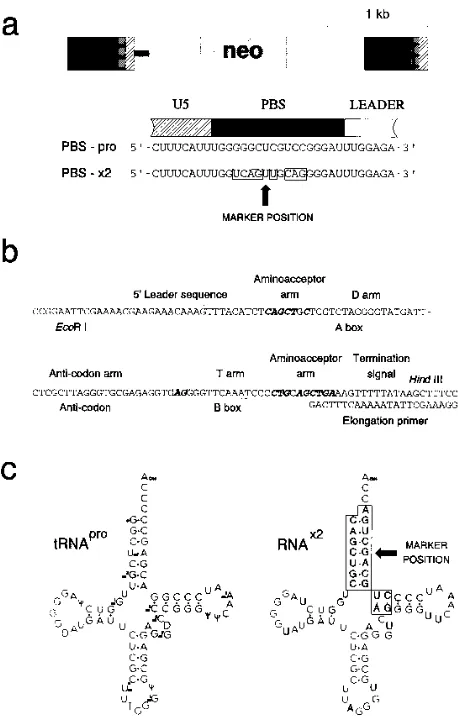
Construction of a PBS-mutated vector and a synthetic gene for a tRNA-like primer.To investigate the possibility of com-plementing the replication deficiency of a PBS-mutated retro-viral vector, a new vector, PBS-x2, carrying the selectable neo marker, was constructed. Eight nucleotide alterations were introduced into the PBS of an Akv-MLV-derived retroviral vector by PCR-mediated site-directed mutagenesis to generate the mutant vector PBS-x2 (Fig. 1a). The mutations were cho-sen on the basis of an alignment of murine tRNA molecules and murine tRNA genes (36) to give the least possible match
to any known murine tRNA. However, the 59TGG motif
cor-responding to the CCA tail of the tRNA molecule was not
modified. Likewise, the five most 39positions were not altered.
These positions correspond to one of the intragenic promoter sequence elements of the tRNA (31) (Fig. 1b).
A genetic element encoding a putative tRNA-like primer,
RNAx2, matching the PBS of PBS-x2 was constructed from
synthetic oligonucleotides (Fig. 1b). To distinguish sequences of RNA primer and PBS origin during replication, the RNA primer gene was designed to yield perfect Watson-Crick base
pairs in only 17 of 18 positions and a G-U pair in the remaining position (Fig. 1). We have previously shown that inclusion of a single non-Watson-Crick base pair in a PBS-primer hybrid may
allow efficient vector replication (18). The RNAx2 molecule
was constructed by introducing the x2 mutations into the
back-bone of the gene encoding tRNAPro(31). Since efficient RNA
polymerase III transcription of tRNA genes may be mediated from intragenic promoter regions (35), only 27 bp upstream and 12 bp downstream of the structural gene were included. Hence, given the small size of the tRNA genes, a plasmid,
pRNAx2, harboring the RNAx2gene, could be made by cloning
of a fragment made from chemically synthesized oligode-oxynucleotides.
Replication deficiency of PBS-mutated vector.The effect of altering the PBS of the PBS-x2 vector to a sequence not match-ing any known murine tRNA molecule was analyzed by retro-viral vector titer assays. The BOSC 23 cell line constitutively expressing the viral gag, pol, and env genes (27) was used to package transiently transcribed PBS-x2 vectors, and
transduc-FIG. 1. Vector and engineered primer structure. (a) Structure of the 3.4-kb Akv-MLV-derived pPBS-x2 vector, with emphasis on the PBS region. Mutations relative to the wt PBS-pro are shown in boxes. Arrow, the marker position (see text for explanation). (b) Sequence of the 127-nt oligodeoxynucleotide used for cloning the RNAx2
gene. Genetic elements of importance for transcription and segments of the subsequent RNAx2
structure are shown. Mutations relative to the tRNApro
gene (31) are indicated in bold italics. (c) Structure of the murine tRNAPro
(after Harada et al. [13]) and putative structure of the synthetic RNAx2
molecule. Mutations relative to tRNAPro
are shown in boxes. Arrow, the marker position (see text for explanation).
on November 9, 2019 by guest
http://jvi.asm.org/
[image:2.612.321.550.68.426.2]tion titers were determined by transferring virus-containing supernatant to NIH 3T3 cells followed by G418 selection. The transient titer of the Akv-neo vector carrying a wt PBS-pro
ranged between 1.2 3 105 and 9.6 3 105 CFU per ml of
supernatant. However, the replication capacity of the PBS-x2 vector was severely impaired with a titer reduction of about 5 orders of magnitude (Table 1).
Complementation of PBS-mutant replication by tRNA-like primer.The inability of PBS-x2 to replicate may be caused by
the lack of an RNA primer with a matching 39end among the
host cell tRNAs. To test if the PBS-x2 vector could replicate when provided with a properly modified tRNA-like primer,
cotransfections of pPBS-x2 and pRNAx2were performed. As
shown in Table 1, cotransfecting pPBS-x2 with pRNAx2
re-sulted in reconstitution of titer levels to an order of magnitude below wt levels, thus indicating that replication of a PBS-mutated vector can be controlled by proper modification of a
host cell-derived factor. Cotransfecting pPBS-pro with
pRNAx2did not significantly alter the replication capacity of
pPBS-pro. A second genetic element, pRNAx1, also encoding a
putative tRNA-like RNA, RNAx1, was synthesized and cloned
into pUC19 to serve as a control for primer specificity. The 39
18 nucleotides of RNAx1can potentially form only 10
Watson-Crick bp with the PBS-x2 primer binding site sequence (Fig. 2).
Cotransfection of pPBS-x2 with pRNAx1did not result in
in-creased PBS-x2 transduction efficiency, hence providing
evi-dence for the specificity of the PBS-x2–RNAx2interactions.
To further study if PBS mutations or primer annealing in-fluenced the encapsidation of vector RNA, dot blot analysis of virion RNA in the supernatants used for titration was done. We found no significant differences between samples from BOSC 23 cells carrying the vector with wt PBS, the PBS-x2
vector alone, and the PBS-x2 vector together with the pRNAx2.
Specifically, the ability of the RNAx2gene to increase
replica-tion by about 4 orders of magnitude was not equalled by an increase in the efficiency of vector RNA encapsidation.
Function of engineered primer in minus cDNA initiation.
Most likely the RNAx2 gene functioned directly as an RT
primer for minus-strand synthesis after annealing to the PBS. To test this assumption, total RNA was purified from PBS-x2–
RNAx2particles, and in vitro elongation was performed from
endogenous primer molecules. PCR amplification of the
cDNA-RNAx2complex with primers specific for the viral
ge-nome and for the synthetic RNAx2 yielded the predicted
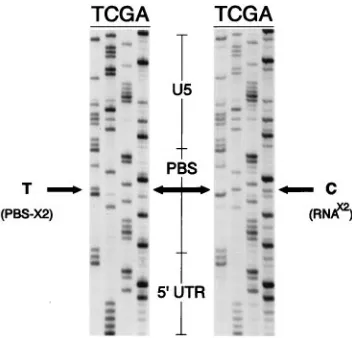
162-bp product whose structure could be confirmed by direct sequencing. Figure 3 shows the sequence extending from the
viral U5 region through PBS-x2 into the synthetic RNAx2
primer molecule. The results show that RNAx2 is packaged
into virions, anneals to the complementary PBS-x2, and func-tions correctly as a primer for first strand reverse transcription of PBS-x2. Detailed inspection of the sequencing ladders (Fig. 3) reveals a mixture of the primer and PBS complementary sequence at the marker position (Fig. 1). We assume that this mixture results from cases of RNase cleavage of the primer RNA upstream of the marker difference before priming of cDNA synthesis as previously reported (6, 12).
Function of mutant primer and PBS sequences in second-strand transfer.The mechanism of plus-strand transfer during
[image:3.612.339.519.64.385.2]replication of PBS-x2 in the presence of RNAx2was analyzed
TABLE 1. Vector transduction efficiencies
Construct
Titer (CFU/ml) Vector RNA
in virionsa
Expt 1 Expt 2
pPBS-pro1pUC19 9.63105 1.23105 100647
pPBS-pro1pRNAx2 4.63105 ND
pPBS-x21pUC19 6.53101 ,101 79617 pPBS-x21pRNAx2 3.63104 1.53104 132667
pPBS-x21pRNAx1 ,101 ,101 ND
a
Averages (6standard deviations for three samples) are given in arbitrary hybridization units of neo hybridization. ND, not determined.
FIG. 2. Potential base pairs formed between PBS-pro and tRNAPro or
RNAx2and between PBS-x2 and tRNAPro, RNAx1, or RNAx2.P, potential base
[image:3.612.60.299.82.163.2]pairings;2, possible non-Watson-Crick GzU pairings.
FIG. 3. Direct sequencing evidence for RNAx2primer usage. Virion RNA was
purified and subjected to in vitro elongation utilizing the RT activity of Taq poly-merase, and a fragment encompassing the RNAx2primer was PCR amplified and
sequenced. (a) Diagram showing the positions of the utilized PCR primers. (b) Autoradiogram showing direct dideoxysequencing of RNAx2annealed at the PBS.
on November 9, 2019 by guest
http://jvi.asm.org/
[image:3.612.74.275.561.701.2]by using the marker mutation at position 8 of PBS-x2 to
dis-tinguish RNAx2and PBS-x2-derived sequences. During reverse
transcription, the transduced PBS is generated after the second jump from a DNA copy of the vector PBS annealing to a DNA
copy of 18 39nucleotides of the primer tRNA. Hence, the PBS
sequence of a transduced provirus could originate from a copy
of the genomic PBS sequence or from copying of the 39 18
nucleotides of the utilized primer molecule. Therefore, a PBS mutation giving a single base difference from perfect primer complementarity may revert to the primer sequence (5).
To investigate the involvement of RNAx2in PBS-x2
trans-duction, we analyzed the fate of the introduced marker muta-tion. Upon analysis of PBSs transduced from the pPBS-x2–
pRNAx2complementation assay, correction of the introduced
marker mutation to match the primer sequence was demon-strated (Fig. 4). Of nine cell clones with transduced proviruses analyzed three contained the primer sequence, four the PBS-x2 sequence and two a mixture of the two, thus providing
genetic evidence for RNAx2involvement in PBS-x2
transduc-tion. We found no evidence suggesting the involvement of other primer molecules in PBS-x2 transduction in the nine cell clones analyzed. In all cases, the sequences flanking the PBS showed exact correspondence to sequences of the input vector, indicating precision in priming of first-strand synthesis and
elongations after second-strand transfer. Given the 103- to
104-fold difference in transduction efficiency between pPBS-x2
cotransfected with pUC19 and pPBS-x2 cotransfected with
pRNAx2, detecting alternative priming events might require
the analysis of a very large number of transduced clones.
DISCUSSION
During the processes of MLV reverse transcription, a tRNA derived from the former host cell constitutes the only crucial cellular factor. We have previously shown that PBS-mutated vectors derived from Akv-MLV can efficiently replicate with alternative tRNA molecules as replication primers (18); hence,
base pairing between the 39end of the tRNA and the 18 bases
of the PBS is likely to be of primary importance for MLV tRNA primer selection. However, evidence from avian viruses and HIV indicates that non-PBS interactions between the viral genomic RNA and the tRNA primer are important for efficient
primer selection (1, 15, 38). Likewise, specific interactions be-tween viral proteins of both avian viruses and HIV and their cognate tRNA molecules have been demonstrated in vitro (2, 3, 14, 25, 26, 29, 32).
In this study, we describe a complementation system for genetic manipulation of the primer used for MLV replication in vivo. Primer manipulation and subsequent in vivo testing may point to important general structures of tRNAs as well as to determinants for recognition of the cognate tRNA of a given
group of retroviruses outside the annealing 39end. The
mod-ified tRNAPro gene used here had no registered effect on
growth of the packaging cells during the period for transient production of infectious particles. A retrovirus vector, pPBS-x2, containing eight specific PBS mutations was constructed.
The mutations were devised to give a low match to the 39end
of any known murine tRNA molecule (36). In accordance with previous studies on PBS alterations (10, 17, 20, 22, 30), the PBS-x2 mutations severely diminished the replication capacity of the vector due to the pivotal functions of the PBS during retroviral replication.
To complement the replication deficiency of pPBS-x2, a gene encoding an engineered primer for reverse transcription,
pRNAx2, was designed by introduction of 17 bp changes into
the gene for mouse tRNAPro, in a way to allow normal RNA
polymerase III transcription. Cotransfections of pPBS-x2 with
pRNAx2resulted in partial reconstitution of the transduction
efficiency to 1 order below wt levels. Hence, the introduction of eight specific mutations into the PBS strongly inhibits vector replication, but the replication capacity can be restored by the introduction of a small genetic element encoding a comple-mentary primer. The specificity of the complementation was investigated with a second artificial tRNA-like primer
mole-cule, pRNAx1, which was designed not to match pPBS-x2 (Fig.
2). Cotransfection of pPBS-x2 with pRNAx1 resulted in titer
below 10 CFU per ml. In addition, cotransfection of pPBS-pro
with pRNAx2did not significantly influence pPBS-pro
trans-duction, indicating that the function of pRNAx2reside within
its capacity to base pair with pPBS-x2. Upon analysis of
parti-cles released after cotransfection of pPBS-x2 and pRNAx2, the
artificial tRNA-like primer, RNAx2, was found annealed to the
PBS and capable of initiating minus strand DNA synthesis. Although we have no direct evidence that the mutations allow the formation of a correctly transcribed and processed product, the fact that the engineered primer allows accurate initiation of
minus strand cDNA indicate appropriate processing of the 39
CCA tail. According to prevalent models for reverse
transcrip-tion, RT copies only the 18 most 39nucleotides of the tRNA
because of the 1-methyl group at the adenosine residue at
position 19 from the 39 end. The engineered primer was
de-signed to have the tRNAProsequence at and around this
aden-osine position. The precision of priming after second strand transfer was demonstrated by analyzing nine transduced PBS-x2 sequences, three of which had been corrected to
per-fectly match the RNAx2sequence. The results presented
pro-vide in vivo epro-vidence that the replication machinery recognizes
PBS primer complementarity rather than actual PBS and 39
[image:4.612.90.266.69.238.2]primer sequences. We furthermore show that packaging of the retroviral genome is independent of proper primer annealing. The ability to engineer the primer molecule should allow tests of possible roles of the tRNA primer in genomic RNA dimer-ization, in RT primer-template recognition, and in facilitating the template jumps during reverse transcription. A previously described system for genetic modification of the tRNA primer for the yeast Ty1 retrotransposon (8) relied on the use of a modified tRNA in protein synthesis as well as in reverse tran-scription.
FIG. 4. Evidence for usage of the RNAx2
sequence in second-strand transfer. Autoradiograms showing dideoxysequencing of a region of transduced PBS-x2 vec-tors encompassing the PBS sequence from two representative cell clones. (Left panel) The transduced PBS originates from a copy of the original PBS-x2 sequence. (Right panel) The transduced PBS originates from copying of the RNAx2
primer.
on November 9, 2019 by guest
http://jvi.asm.org/
The freedom to manipulate PBS and primer sequences may address two critical points in relation to the advancement of retroviral gene transfer technology and its clinical usage. Firstly, a number of current studies have shown the wt PBS of MLV proviruses to be involved in transcriptional down-regu-lation of vectors in important target cells (4, 7, 16, 24). Sec-ondly, the risk for generation of replication-competent retro-viruses has traditionally been reduced by manipulation of the viral packaging construct, by partition of the gag and pol genes and the env gene, and by the use of heterologous promoters and termination signals (21). While existing vector-containing packaging cells by definition harbor all cis elements and trans factors required for retrovirus propagation, transfer systems based on PBS-modified vectors may be completely devoid of elements with PBSs that function efficiently in normal cells. Under these conditions, regeneration of replication-competent viruses would require aberrant reverse transcription in addi-tion to recombinaaddi-tion.
ACKNOWLEDGMENTS
This work was supported by the Danish Biotechnology Programme, the Danish Cancer Society, the Novo Foundation, the Danish Natural Sciences Research Council, the Karen Elise Jensen Foundation, and contracts Biotech CT95-0100 and Biomed2 CT95-0675 of the Euro-pean Commission.
REFERENCES
1. Aiyar, A., D. Cobrinik, Z. Ge, H. J. Peters, and J. Leis. 1992. Interaction between retroviral U5 RNA and the T psi C loop of the tRNA(Trp) primer is required for efficient initiation of reverse transcription. J. Virol. 66:2464–2472. 2. Barat, C., V. Lullien, O. Schatz, G. Keith, M. T. Nugeyre, F.
Gruninger-Leitch, F. Barre-Sinoussi, S. F. LeGrice, and J. L. Darlix.1989. HIV-1 reverse transcriptase specifically interacts with the anticodon domain of its cognate primer tRNA. EMBO J. 8:3279–3285.
3. Barat, C., O. Schatz, S. LeGrice, and J. L. Darlix. 1993. Analysis of the interactions of HIV1 replication primer tRNA(Lys, 3) with nucleocapsid protein and reverse transcriptase. J. Mol. Biol. 231:185–190.
4. Baum, C., S. Hegewisch-Becker, H.-G. Eckert, C. Stocking, and W. Ostertag. 1995. Novel retroviral vectors for efficient expression of the multidrug resis-tance (mdr-1) gene in early hematopoetic cells. J. Virol. 69:7541–7547. 5. Berwin, B., and E. Barklis. 1993. Retrovirus-mediated insertion of expressed
and nonexpressed genes at identical chromosomal locations. Nucleic Acids Res. 21:2399–2407.
6. Blain, S. W., and S. P. Goff. 1993. Nuclease activities of Moloney murine leukemia virus reverse transcriptase. Mutants with altered substrate speci-ficities. J. Biol. Chem. 268:23585–23592.
7. Challita, P.-M., D. Skelton, A. el Khoueury, X. J. Yu, K. Weinberg, and D. Kohn.1995. Multiple modifications in cis elements of the long terminal repeat of retroviral vectors lead to increased expression and decreased DNA methylation in embryonic carcinoma cells. J. Virol. 69:748–755.
8. Chapman, K. B., A. S. Bystro¨m, and J. D. Boeke.1992. Initiator methionine tRNA is essential for Ty1 transposition in yeast. Proc. Natl. Acad. Sci. USA 89:3236–3240.
9. Colicelli, J., and S. P. Goff. 1987. Isolation of a recombinant murine leuke-mia virus utilizing a new primer tRNA. J. Virol. 57:37–45.
10. Das, A. T., B. Klaver, and B. Berkhout. 1995. Reduced replication of human immunodeficiency virus type 1 mutants that use reverse transcription primers other than the natural tRNA3Lys. J. Virol. 69:3090–3097.
11. Duch, M., K. Paludan, J. Lovmand, L. Pedersen, P. Jørgensen, and F. S. Pedersen.1993. A correlation between dexamethasone inducibility and basal expression levels of retroviral vector proviruses. Nucleic Acids Res. 21:4777– 4782.
12. Go¨tte, M., S. Fackler, T. Hermann, E. Perola, L. Cellai, H. J. Gross, S. F. LeGrice, and H. Heumann.1995. HIV-1 reverse transcriptase-associated RNase H cleaves RNA/RNA in arrested complexes: implications for the mechanism by which RNase H discriminates between RNA/RNA and RNA/ DNA. EMBO J. 14:833–841.
13. Harada, F., G. G. Peters, and J. E. Dahlberg. 1979. The primer tRNA for Moloney murine leukemia virus DNA synthesis. Nucleotide sequence and aminoacylation of tRNAPro. J. Biol. Chem. 254:10979–10985.
14. Haseltine, W. A., A. Panet, D. Smoler, D. Baltimore, G. Peters, F. Harada, and J. E. Dahlberg.1977. Interaction of tryptophan tRNA and avian my-eloblastosis virus reverse transcriptase: further characterization of the bind-ing reaction. Biochemistry 16:3625–3632.
15. Isel, C., C. Ehresmann, G. Keith, B. Ehresmann, and R. Marquet. 1995.
Initiation of reverse transcription of HIV-1: secondary structure of the HIV-1 RNA/tRNA(3Lys) (template/primer). J. Mol. Biol. 247:236–250. 16. Kaleko, M., J. V. Garcia, W. R. A. Osborne, and A. D. Miller. 1990.
Expres-sion of human adenosine deaminase in mice after transplantation of genet-ically-modified bone marrow. Blood 75:1733–1741.
17. Li, X., J. Mak, E. J. Arts, Z. Gu, L. Kleiman, M. A. Wainberg, and M. A. Parniak.1994. Effects of alterations of primer-binding site sequences on human immunodeficiency virus type 1 replication. J. Virol. 68:6198–6206. 18. Lund, A. H., M. Duch, J. Lovmand, P. Jørgensen, and F. S. Pedersen. 1993.
Mutated primer binding sites interacting with different tRNAs allow efficient murine leukemia replication. J. Virol. 67:7125–7130.
19. Majors, J. E., and H. E. Varmus. 1983. Nucleotide sequencing of an appar-ent proviral copy of env mRNA defines determinants of expression of the mouse mammary tumor virus env gene. J. Virol. 47:495–504.
20. Mikkelsen, J. G., A. H. Lund, K. D. Kristensen, M. Duch, M. S. Sørensen, P. Jørgensen, and F. S. Pedersen.1996. A preferred region for recombinational patch repair in the 59untranslated region of primer binding site-impaired murine leukemia virus vectors. J. Virol. 70:1439–1447.
21. Miller, A. D. 1990. Retrovirus packaging cells. Hum. Gene Ther. 1:5–14. 22. Nagashunmugan, T., A. Velpani, C. S. Goldsmith, S. R. Zaki, V. S.
Kaly-naraman, and A. Srinivasan.1992. Mutations in the primer binding site of the type 1 human immunodeficiency virus genome affects virus production and infectivity. Proc. Natl. Acad. Sci. USA 89:4114–4118.
23. Nikbakht, K. N., C. Y. Ou, L. R. Boone, P. L. Glover, and W. K. Wang. 1985. Nucleotide sequence analysis of endogenous murine leukemia virus-related proviral clones reveals primer-binding sites for glutamine tRNA. J. Virol. 54:889–893.
24. Palmer, T. D., G. J. Rosman, W. R. A. Osborne, and A. D. Miller. 1991. Genetically modified skin fibroblasts persists long after transplantation but gradually inactivate introduced genes. Proc. Natl. Acad. Sci. USA 88:1330–1334. 25. Panet, A., and H. Berliner. 1978. Binding of tRNA to reverse transcriptase
of RNA tumor viruses. J. Virol. 26:214–220.
26. Panet, A., W. A. Haseltine, D. Baltimore, G. Peters, F. Harada, and J. E. Dahlberg.1975. Specific binding of tryptophan transfer RNA to avian my-eloblastosis virus RNA-dependent DNA polymerase (reverse transcriptase). Proc. Natl. Acad. Sci. USA 72:2535–2539.
27. Pear, W. S., G. P. Nolan, M. L. Scott, and D. Baltimore. 1993. Production of high-titer helper-free retroviruses by transient transfection. Proc. Natl. Acad. Sci. USA 90:8392–8396.
28. Peters, G., F. Harada, J. E. Dahlberg, A. Panet, W. A. Haseltine, and D. Baltimore.1977. Low-molecular-weight RNAs of Moloney murine leukemia virus: identification of the primer for RNA-directed DNA synthesis. J. Virol. 21:1031–1041.
29. Peters, G. G., and J. Hu. 1980. Reverse transcriptase as the major determi-nant for selective packaging of tRNA’s into Avian sarcoma virus particles. J. Virol. 36:692–700.
30. Rhim, H., J. Park, and C. D. Morrow. 1991. Deletions in the tRNALys
primer-binding site of human immunodeficiency virus type 1 identify essen-tial regions for reverse transcription. J. Virol. 65:4555–4564.
31. Russo, T., F. Constanzo, A. Oliva, R. Ammendola, A. Duilio, F. Esposito, and F. Cimino.1986. Structure and in vitro transcription of tRNA gene clusters containing the primers of MuLV reverse transcriptase. Eur. J. Biochem. 158:437–442.
32. Sarih-Cottin, L., B. Bordier, K. Musier-Forsyth, M. L. Andreola, P. J. Barr, and S. Litvak.1992. Preferential interaction of human immunodeficiency virus reverse transcriptase with two regions of primer tRNA(Lys) as evi-denced by footprinting studies and inhibition with synthetic oligoribonucleo-tides. J. Mol. Biol. 226:1–6.
33. Sawyer, R. C., and J. E. Dahlberg. 1973. Small RNAs of Rous sarcoma virus: characteriserization by two-dimentional polyacrylamide gel electrophoresis and fingerprint analysis. J. Virol. 12:1226–1237.
34. Seiki, M., S. Hattori, Y. Hirayama, and M. Yoshida. 1983. Human adult T-cell leukemia virus: complete nucleotide sequence of the provirus genome integrated in leukemia cell DNA. Proc. Natl. Acad. Sci. USA 80:3618–3622. 35. Sprague, K. U. 1995. Transcription of eukaryotic tRNA genes, p. 31–50. In D. So¨ll and U. L. RajBhandary (ed.), tRNA: structure, biosynthesis, and function. American Society for Microbiology, Washington, D.C. 36. Steinberg, S., A. Misch, and M. Sprinzl. 1993. Compilation of tRNA
se-quences and sese-quences of tRNA genes. Nucleic Acids Res. 21:3011–3015. 37. Wain-Hobson, S., P. Sonigo, O. Danos, S. Cole, and M. Alison. 1985.
Nu-cleotide sequence of the AIDS virus, LAV. Cell 40:9–17.
38. Wakefield, J. K., S.-M. Kang, and C. D. Morrow. 1996. Construction of a type 1 human immunodeficiency virus that maintains a primer binding site complementary to tRNAHis
. J. Virol. 70:966–975.
39. Wakefield, J. K., A. G. Wolf, and C. D. Morrow. 1995. Human immunode-ficiency virus type 1 can use different tRNAs as primers for reverse tran-scription but selectively maintains a primer binding site complementary to tRNA(Lys3). J. Virol. 69:6021–6029.
40. Whitcomb, J. M., B. A. Ortiz Conde, and S. H. Hughes. 1995. Replication of avian leukosis viruses with mutations at the primer binding site: use of alternative tRNAs as primers. J. Virol. 69:6228–6238.