0022-538X/94/$04.00+0
Copyright
©D
1994,American Society for MicrobiologySequence-Specific
Binding of
the
Influenza Virus
RNA
Polymerase
to
Sequences Located
at
the
5'
Ends
of
the Viral
RNAs
LAURENCE S. TILEY, MOIRA HAGEN,JAMES T. MATTHEWS, ANDMARKKRYSTAL* Departmentof Virology, Bristol-Myers Squibb Phannaceutical Research Institute,
Princeton, NewJersey 08543 Received 8 March 1994/Accepted6May 1994
Theenzymatic activity ofrecombinant influenza virus RNA polymerase is strictly dependent ontheaddition ofatemplate RNAcontaining5' and 3'viralsequences. Herewereporttheanalysisofthebindingspecificity and physicalcharacterization of the complex by using gel shift, modificationinterference,anddensitygradient techniques. The 13S complex binds specifically to short synthetic RNAs that mimic the
partially
double stranded panhandle structuresfound atthe termini of both viral RNAand cRNA. Thepolymerase will also bind independently to the single-stranded 5' or 3' ends of viral RNA. It binds moststrongly
to specific sequences within the5' end but is unable to bind these sequences in the contextof acompletely double stranded structure. Modification interference analysis identified theshort sequence motifs atthe5' ends ofthe viral RNA and cRNA templates that are critical for binding.The influenza virus RNA polymerase is a multicomponent complex composed of three virally encoded proteins termed PB1, PB2, and PA (25). The polymerase plays two distinct transcriptional roles in the lifecycle of the virus (16). First, it is responsible for the synthesis of viral mRNA from the negative-sense genomic viral RNA(vRNA). An unusual fea-tureof this process is the utilization of the 5' termini of host cell mRNAs asprimers for the initiation oftranscription(33,
34). The 5' and 3' ends of the vRNA template have partial inverted complementarity and thus can form a panhandle structure (8,20, 35, 43). This structurein combination witha runoffive to seven uridine residues located approximately 15 to 17 nucleotides from the 5' end serves as a transcription
termination andpolyadenylation signal (15, 26, 27, 36). The second role of thepolymerase is for viral genome replication. The5'-terminal base ofvRNAandthe complementary cRNA is an ATP,which implies that initiation ofvRNAandcRNA synthesis does not require a primer (17, 50). The complete transcription of the vRNAtemplate intocRNAdemands that the termination and polyadenylation signal be ignored (17).
One function of the viral nucleoprotein (NP) may be to suppress this signal by preventing premature termination (2, 39). One of the most perplexing questions about influenza virus replication is what are the factors that determinewhich role the polymerase complex is going to play.
Several invitro systems have been established tostudy the transcriptional activity of the polymerase(18, 21, 22, 24, 28, 29,
37).Themostintensively studied of these systems derive their
polymerasefrompurified virioncoreswhich are processed ina varietyofwaystodepletethem oftheirendogenousRNAs(18, 31, 37). Results from these systems have focused attention on the conserved sequences located at the 3' end of vRNA. However, recently an in vitro system using influenza poly-merase expressed by recombinant vaccinia viruses (Vac 3P) demonstrated that active polymerase requires sequences lo-cated at the 5' and 3' ends of the viral genome (14). This system has now been used to study the interaction of the viral
*Correspondingauthor.Mailingaddress: Department ofVirology,
Bristol Myers Squibb Pharmaceutical Research Institute, P.O. Box 4000, Princeton, NJ 08543. Phone: (609) 6456. Fax: (609) 252-6058.Electronic mail address: IN%"[email protected]".
polymerase with its template RNA. Herewereporttheuseof an in vitro complex formation assay to determine the sequence and structural requirements for the specific binding of the polymerase to vRNA- and cRNA-like template RNAs.
MATERIALSANDMETHODS
Plasmid constructs. Plasmids pPH-V, pV5', pV3', pM-wt, pPHd5', and
pV-iU1OU8C5A3
have been describedpreviously(14, 31).pC5'V3'wasconstructedbyligatingthe complemen-tary oligonucleotides 5'AGCT7rlAATACGACTCACTATAA
GCAAAAGCAGGGTG'l'l'l'l'1'1'CA3' and 5'GATCTGAAA
AAACACCCTGCTTTTGCTTATAGTGAGTCGTAT
TAA3' between the HindlIl and BglII sites of the 3.0-kb fragment of plasmid pPHd5'. Plasmid pV5'C3' was con-structed by replacing theBglII-PstI fragment ofpPH-V with the corresponding 47-bp fragment from plasmid
pV-iU1o
U8C5A3
(31).Virus and cell culture. Recombinant vaccinia viruses that individually express the threeinfluenza viruspolymerase pro-teins(Vac-PB1, Vac-PB2,and Vac-PA[40])orexpresstheT7 RNApolymerase(VTF7-3 [13])werepropagatedonHeLacell monolayers and titrated on Verocells,using standard proce-dures (10). Influenza virus A/WSN/33 was propagated in MDBKcells aspreviouslydescribed (44).
Antibodies. Polyclonal rabbit antisera raised against the individual Pproteinsexpressedby usingrecombinant
baculo-viruses were a kind gift from D. Summers. The antiserum specific for the C-terminal peptideof PB1 wasprovidedbyR. Krug(9). Monoclonal antibody 10.2, reported for the first time here,wasobtained fromamouseinoculated with
baculovirus-expressedPB1andbindsto anepitopelocated between Asn-44 and Ile-69. The rabbit antipeptide antiserum specific for the PB2 protein was raised against the C-terminal peptide
CSILTDSETATKRIR, and the rabbit antiserum specific for the PA protein was raised against the C-terminal peptide
CLRDNLEPGTFDLG.
Preparation ofvirus-infected cell extracts. HeLa cells in monolayers were infected with influenza virus A/WSN/33 (multiplicity ofinfection [MOI] of-10percell) or recombi-nantvaccinia viruses which express either PB1,PB2, and PA (MOI of 3:3:3 percell)ortheT7 RNApolymerase(MOIof 10 5108
on November 9, 2019 by guest
http://jvi.asm.org/
TABLE 1. Primary sequencesof the RNA probes used in this work
Probe Sequence'
PHV.... 5'AGUAGAAACAAGGGUGUUUUUUCAGAUCUAUUAAACUUCACCCUGCUUUUGCU3'
PHC....5'AGCAAAAGCAGGGUGAAGUUUAAAUGAUAUGAAAAAACACCC.UGUUUCUACU3'
V5'C3'....5'AGUAGAAACAAGGGU GUUUUUUCAGAUCUAUUAAACUUCACCCUUGUUUCUACU3'
C5' V3....5'AGCAAAAGCAGGGUGUUUUUUCAGAU CUAUUAAACUUCACCCUGCUUUUGCU3
V5.... 5'AGUAGAAACAAGGGUGUUG UUUUC AGAUCCCCGGGUACCGAGCUCGAAUU3'
V3Y.... 5'GGGAAUUCGAGCUCGGUACCGGGGAUCUUAUUAAACUUCACCCUGCUUUUGCu3'
aUnderlined sequencescorrespondtotheterminal sequences of vRNA. Overlined sequences correspond to the terminal sequences of cRNA.
percell). The influenza virus-infected cellswereharvestedat2 to 18 h postinfection. The vaccinia virus-infected cells were harvested 16 h postinfection. Nuclear extracts were prepared aspreviously described ( 11,30).Extracts were stored at -70°C at a concentration of 10 mg/ml and were stable for several months.
In vitro synthesis, labeling, and purification of RNAs. Plasmids were linearized with eitherMboII (pPH-V, pM-wt, pC5'V3', pV5'C3', and pV3') or EcoRI (pV5') and tran-scribed by using T7 RNA polymerase to generate RNAs designated PHV, PHC, C5'V3', V5'C3', V3', and V5' respec-tively (Table 1). The transcriptswerepurified by electrophore-sis through 10% polyacrylamide gels containing8 M urea.The RNA bands were located by UV shadowing, excised, and recovered by passive elution into 1 mM EDTA. The RNAs were then ethanol precipitated and quantitated by optical densityat 260 nm. Radiolabeled RNAs wereprepared either by the incorporation of
[Ox-32P]GTP
during transcription (or[cx-32P]UTPforprobe V3' because of theinappropriate distri-bution of Gresidues), by phosphorylation of the 5' end with polynucleotide kinase and [y-32P]ATP (3,000 Ci/mmol), orby 3' end labeling with T4 RNA ligase and [5'-32P]pCp (3,000
Ci/mmol). A DNAoligonucleotidewiththe samesequence as PHV wasphosphorylated atits 5' endasdescribed above. 5'-and 3'-end-labeled probeswererepurifiedasdescribed above. Gel shift assays. RNA probes were diluted in 50 mM NaCl-0.25 mg of bovineserum albumin (BSA)perml, dena-turedby heatingto90°C for2min, and then incubatedat37°C for 10 min prior to use. Ten microliters ofbinding reaction mixtures contained 1 X 10⁴to2 x 104 cpmof RNAprobe and
2.5 ,ug of nuclear extract. The final buffer components were 20 mM N-2-hydroxyethylpiperazine-N'-2-ethanesulfonic acid
(HEPES; pH 7.6), 0.5 mM EGTA, 20 ,uM EDTA, 2 mM MgCl2, 7.5 mM NaCl, 110 mM KCl, 1.2 mM dithiothreitol, 27.5,ugof RNase-free BSAperml, 1,000UofplacentalRNase inhibitor per ml, and 12% glycerol. The binding reaction mixtureswereincubated at roomtemperaturefor 30 min, and reactionswereterminated bytheaddition ofheparin to afinal concentration of 5 mg/ml. For the competition experiments,
the probe RNAwas mixed with the competitor RNA before the nuclearextract was added to the reaction. Forsupershift experiments, the binding reaction wasallowedtoproceed for 10 min before the addition of 0.5
pL.
of antibody and then terminated with heparin 20 min later. The complexes were resolvedby native gel electrophoresis(4% 79:1 acrylamide/bis acrylamide, 50 mM Tris-HCl [pH 8.4], 50 mM glycine, 3% glycerol; 12V/cm) andvisualized byautoradiography.Modification interferenceassays. 5'- or3-end-labeledPHV and PHC RNAsweresubjectedtolimited chemical
modifica-tion underdenaturing conditions, using diethyl pyrocarbonate or anhydrous hydrazine as described previously (4, 45). A portion of each probe was set aside for later analysis (later referred to aspreshifted RNAs). Approximately 4 x 10⁵ cpm ofthe modified RNAs was incubated with 80 p.g of Vac 3P nuclearextract, sufficienttoshift-25 to40% of theRNAinto thespecific complex when analyzed by native gel electrophore-sis. The bound and free RNAs were excised from the gel, electroeluted with a Hoefer GE 200 gel elutor, phenol ex-tracted, and then ethanol precipitated. These purified RNAs and the preshifted RNAs that had been set aside were then cleaved specifically at the modified bases by treatment with anilineacetate (32). The amountof each RNArecoveredwas determinedby Cerenkov counting, and then 4,000cpmofeach RNA wasanalyzed by electrophoresis through 8 Murea-20% polyacrylamide sequencing gels.
Sucrosegradientcentrifugation. Twenty-microliterbinding reaction mixturescontaining 5 x 10⁵cpmof probe RNAand 20 p.g of nuclear extract were prepared as described above. After the addition of heparin (to 5 mg/ml), the reaction volumeswere increasedto 100 p.1 with 5% sucrosecontaining 2.5 mgof catalaseperml.The sampleswerethencentrifuged through 10to20%(wt/vol)sucrosegradientsat37,000rpmfor 18 h at3°C, usingaBeckmanSW50.1 rotor.Sucrosesolutions contained 10 mM HEPES (pH 7.6), 0.5 mM EGTA, 2 mM MgCl,, and 100 mM KCI. Fractionswere collected dropwise from the bottom of the tube. Ten-microliter aliquots of each fraction were analyzed in ascintillation counter to determine the migration of the probe RNA. Catalase activitywas deter-minedbythe peroxide decomposition assay (3).
RESULTS
Sequence-specific bindingof influenza virus polymeraseto model viral RNAtemplates. The invitroenzymatic activityof vaccinia virus-expressed recombinant influenza virus RNA polymerase (Vac 3P) shows a strict requirement for a
virus-specific template RNA (14). This has also been reported for certainpreparationsofpolymerase from influenza virions(19).
In particular, the cap-snatching, endonucleolytic activity re-quires an RNA template capable of mimicking the partially
double strandedpanhandle structureformed by the 5' and 3' ends of the virion RNAs. This implies that the Vac 3P polymerase possesses asequence-specific RNAbinding activ-ity.Tostudy thisactivity, ashort,
5'-32P-end-labeled,
syntheticRNA containing the 5' and 3' sequences of vRNA (PHV;
Table 1) was incubated with either a Vac 3P extract or a controlextractfrom cellsinfectedwithavaccinia virus recom-binant expressing the T7 RNA polymerase. Analysis of the
on November 9, 2019 by guest
http://jvi.asm.org/
A PHV PHC C5'V3 PHV(DNA)
PROBE PROBE PROBE PROBE
1 2 3 4 5 6 7 8 9 10 11 12
BOUND PROBE
FREE PROBE
a
B 1 2 3 4 5 6 7 8
BOUND
PROBE
"
*,' .:.'.' . ._FREE PROBE
VAC 3P - + - - + - - + - -+
VAC T7 + + + -+
FIG. 1. Bindingofrecombinant influenzavirus RNApolymerasetosynthetic templateRNAs.(A)RNAs thatmimic the terminalpanhandle
structuresof vRNA(PHV;lanes1to3),cRNA(PHC;lanes 4to6),ahybridof 5' cRNA and 3' vRNA(C5'V3';lanes 7to9),andaDNAversion
of vRNA [PHV(DNA); lanes 10 to 12] were synthesized in vitro and 5' end labeled by using T4 polynucleotide kinase and [-y-32P]ATP. Approximately 25 fmol (3x 10⁴cpm)ofeachprobewasincubatedwith 2.5,ugof nuclearextractfromvacciniavirus-infectedHeLacellsexpressing
the influenza viruspolymerase (Vac3P; lanes2, 5, 8, and 11)orexpressing the T7 RNApolymerase (Vac T7; lanes3, 6, 9, and 12). Probes
incubated withextractdilution buffer aloneareshowninlanes1, 4, 7,and 10. Protein-RNAcomplexeswerevisualizedby electrophoresis through
anondenaturing 4% polyacrylamide gel. (B) Binding of thePHV RNAprobetoextractspreparedfrominfluenza virus-infected cells. Lane1,no
protein; lane 2, Vac 3P; lanes 3to 6, influenza virus-infected cell extractsprepared 2, 4, 6, and 18 hpostinfection, respectively; lane 7,Vac
PB1-plus-PB2extract;lane8, Vac T7.
reactionproducts by nondenaturing gel electrophoresis dem-onstrated the formation ofa high-molecular-weight complex
thatwasuniquetotheVac 3Pextract(Fig. 1A; comparelanes
2and3).A DNAprobe ofprecisely thesamesequencedidnot form a complex, confirming the specificity for an RNA
sub-strate(lane 11).Asimilarhigh-molecular-weight complexwas
observed when a synthetic RNA containing the 5' and 3' sequencesof cRNA(PHC;Table 1)wasused(lanes4 and5). The apparent difference in the level ofbindingto the cRNA probewasduetothe lowerspecific activityof theproberather than a difference in affinity. Subsequent experiments using
probes of identical specific activity did not show this effect (datanot shown).AhybridRNAcontaining the 5' sequences
from cRNA and the3' sequencesfrom vRNA(V3'C5'; Table 1) was not bound by the polymerase (lanes 8 and 9). The duplex region of this RNA is predicted to be completely doublestranded,withnoneof thebulgespresentineither the vRNA- orcRNA-specific molecules.
The ability of the recombinant polymerase to distinguish between thesecloselyrelatedprobesstronglyindicates that the interaction isboth sequence andstructure specific. Sequence specificity was confirmed directly, by mixing increasing
amounts ofunlabeled specific(vRNA)ornonspecific(tRNA)
competitor with the vRNA probe before adding it to the binding reaction. As shown in Fig. 2, the specific RNA competed quantitatively with the probe RNA, whereas the nonspecific RNA competed minimally even at high molar
excess.
Nuclear extracts from influenza virus-infected HeLa cells andpurifiedviralcores werealsotested forbinding activity in
thisassay.Extractsmadeanywherefrom 2to18h postinfection exhibitedstrongbinding activity with thePHVprobe (Fig. 1B, lanes3to6).However,purified viralcoresdidnotexhibitany
binding activitydetectable with thisassay(datanotshown).
Analysis of the protein components of the complex. The identityof the protein component of the complexwas deter-mined byincubating thebinding reactionmixtureswith anti-sera to the individual P proteins. Binding of an antibody
SPEC IFIC NON-SPECIFIC COMPETITOR COMPETITOR
(A cn u)
U) ) U) U) U) X
-) o o ) o U) )
z E 0 E o o
z U
E)
C) E E Z LOu LO C'JBOUND _ = ... PROBE
[image:3.612.140.484.70.285.2]FREE PROBE
FIG. 2. Confirmation ofbindingspecificity by titrationwithspecific andnonspecific competitor RNAs.Approximately 30fmol(4 x 10⁴ cpm)of 5'-end-labeledPHVprobeRNA wasmixed with theindicated
amounts ofunlabeled specific (PHV RNA) or nonspecific (tRNA) competitorRNA.These mixtureswerethen incubated with 2.5 ,ugof Vac3Pextractandanalyzed by nondenaturing electrophoresis.
on November 9, 2019 by guest
http://jvi.asm.org/
[image:3.612.364.505.453.659.2]SUPER-SHIFTED PROBE
BOUND PROBE
aPB1 acPB2 aPA 1 2 3 4 5 6 78 9 10
I
FREE PROBE
FIG. 3. Supershift analysis of the Vac 3P-PHV complex. PHV probe RNA and Vac 3P extract were combined in standard 10-jil bindingreaction mixturesand incubatedat25°Cfor10min; 0.5p1lof antiserum was then added, and the incubation continued for an additional 20 min prior to analysis by nondenaturing gel electrophore-sis. Lane 1, PHVprobe alone; lanes 2 to 10, PHV probe-plus-Vac 3P extract.Lane2, no antiserum; lane 3, normal rabbit serum; lanes 4 to 6, antisera specificforPB1;lanes7 and 8, antiseraspecific forPB2; lanes 9 and10, antiseraspecific forPA.Details foreach antiserum are givenin the text.
molecule to the complex causes a decrease in its electro-phoretic mobility. Thissupershift effect was readily observed withtwodifferent antiseraraised against thePB2protein (Fig. 3, lanes7and8).One antiserum wasraised againsta carboxy-terminalpeptide, and the other was raised against a recombi-nant baculovirus-expressed protein. An antiserum raised
100000
-*-- PHVALONE
* PHV+VACT7
0 PHV+VAC3P 80000' -0- C5V3'+VAC3P
z*---CATALASE
F 60000
IC.
40000
against a carboxy-terminal peptide of PB1 also supershifted the complex (lane 5), indicating thatPB1 is also a componentof the complex. However, it should be noted that under the conditions of this assay, neitherapolyclonal antiserum raised against baculovirus-expressed PB1 nor monoclonal antibody 10.2, specific for PB1, exhibited any supershifting activity (lanes 4 and 6). Both of these antisera work in Western blot (immunoblot) and immunoprecipitation assays. Apparently, only certain antibody preparations bind to the native complex with high enough affinity to cause the supershift. This may explain why the two PA-specific antisera (raised against recom-binant baculovirus-expressed PA or a C-terminal peptide) wereunable to supershift the complex.While this may indicate thatPAis not part of the complex, it may more simply reflect the limited number of PA antisera available for testing. As shown in Fig. 1B, lane 7, PAexpression is required for the formation of thecomplex. No binding activityis detectable in the extract prepared from cells coinfected with the PB1 and PB2 vectors alone.
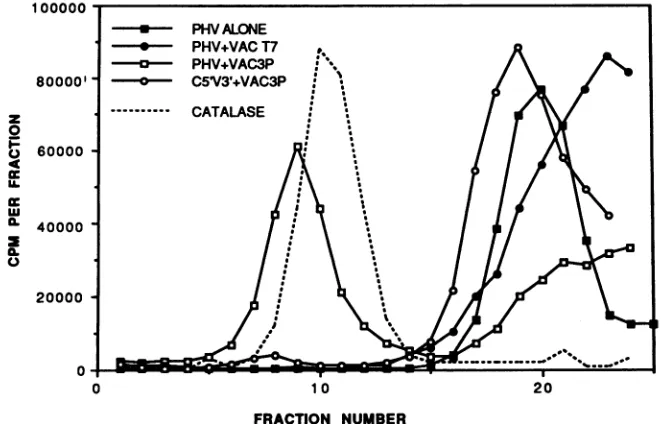
The approximate size of the protein-RNA complex was determined by sucrose density gradient centrifugation using catalaseas a reference standard. As shown in Fig. 4, the Vac 3P-PHVcomplex migrates as a discrete 13S species (approxi-mate molecular size of 280 kDa). This species was not seen with theVacT7 extract norwith the C5'V3'probe. Additional
experiments showed that the mobility of the PHC-bound complex was indistinguishable from that of PHV and that the template RNA is not required for the formation of the 3P complex. Analysis of the fractions from parallel sucrose gradi-entsof Vac 3Pextractsdemonstrated that template-dependent endonuclease activity migrated almost identically, relative to catalase, regardless of whether template RNA was present during thecentrifugation (datanotshown).
Identification of theRNAsequences critical for polymerase binding.Modification interferenceanalysishas proventobean
FRACTION NUMBER
FIG. 4. Sucrosegradientcentrifugationprofileof the Vac 3P-RNAcomplex.Bindingreaction mixturescontaining5 x 105cpm ofprobe,20 ,ug of nuclear extract, and 5 mgofheparin perml inavolume of 20,ulweredilutedto afinal volume of 100,plin5%sucrosecontaining2.5 mg of catalase per ml. The reaction mixtureswereloadedonto5-ml 10to20%sucrosegradientsandcentrifugedat37,000rpm for 18 hat3°C,using aBeckman SW50.1rotor.Fractionswerecollecteddropwisefrom the bottomof thegradient,and themigrationof theprobeRNAwasdetermined by scintillationcounting.Catalaseactivitywasmeasuredbyusingthehydrogen peroxidedecompositionassay(3). Onlythecatalasepeakfor the PHV-plus-Vac 3Pgradientis shown.
on November 9, 2019 by guest
http://jvi.asm.org/
[image:4.612.74.265.72.247.2] [image:4.612.135.467.447.659.2]5' 32p PHV
DEPC Hz
1 2 3 4 5 6
'A C
AG4
G13
G12
*All E
*A 103
*A8
A7
A4 _ 2
G2 :
3'32P PHV
DEPC Hz
7 8 9 10 11 12
A40
041 C42
046 1
U47
U48
U49
Al
U50
5'32p PHC
DEPC Hz
131415 16 17 18
A17
A16 G15 U14 G13
G12 G1l *A10
*C9
*A7
A6
*A5
*A4
0C3
G2
*A1
G51 _
... ;.:
3'32P PHC
DEPC Hz
19 20 21 22 23 24
:,.. ..8..
37-32
C38
A39
-C40 041 C42
U43 ..
U44vl
G45
a.
U46 U47
U48
C49 _.
U50
A51
C52
C52 W*
:.U
[image:5.612.130.487.70.409.2]U53
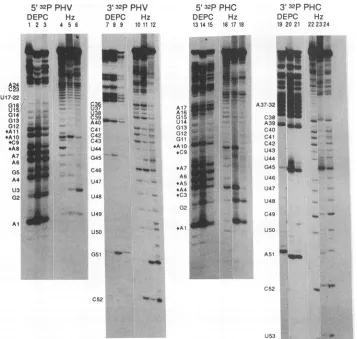
FIG. 5. Modificationinterference analysisof Vac 3Pbindingtothe PHV and PHC RNAprobes.5'-or3-end-labeledPHVRNA(lanes1to
12)and PHC RNA (lanes 13 to 24) weresubjected to limited chemical modification by diethyl pyrocarbonate (DEPC;A and Gspecific)or
hydrazine(Hz;C and Uspecific). ThemodifiedRNAswereincubatedwith sufficientVac3Pextract tobind -30% of theprobe intothecomplex. The residual free probe was then separated from thecomplexed probe bynondenaturing gel electrophoresis.The bound and free RNAswere
elutedfromthegel and then cleavedspecificallyatthemodifiedbasesbytreatmentwith aniline.Atotal of4,000cpm ofeach RNAsamplewas
then run ona7 M urea-20% polyacrylamide sequencing gel. The sequenceassignment ofeach bandcanbedetermined because of the base specificity ofthechemical cleavages. Each group of three lanescorresponds tothe threedistinctpopulationsofmodifiedRNAs present in the preshifted probe (lanes 1, 4, 7, 10, 13, 19, and21), the free probe(lanes2, 5, 8, 11, 14, 17, 20, and23),and the boundprobe(lanes 3, 6, 9, 12, 15, 18, 21, and24).Bandsconsidered as decreased or absentfromtheboundpopulationsare highlighted(*).Only 1,000cpmof RNAwasloaded in lane 9 because of low sample recoveryfromthe nativegel.
effective tool for defining the RNA sequences involved in
specific protein-RNA interactions (4, 6, 23, 45). The RNAis subjected to limited chemical modification under denaturing conditions so that on average only one base pair per RNA molecule is chemically altered (32). This generates apool of stable RNAmoleculescontaining randomly distributed, mod-ified bases. When this pool is used as substrate for a binding reaction, the RNAs containing modifications within the bind-ing site are selectively excluded from the protein-RNA com-plex. The binding site can thus be inferred by comparing the bound and free populations to identify which bases are ex-cluded. 5'- and 3'-end-labeled vRNA and cRNA panhandle RNAs were chemically modified with either diethyl pyrocar-bonate or hydrazine. Diethyl pyrocarbonate reacts with the N-7 atom of adenosine and to a lesser extent guanosine
residuesand causes the purine imidazole ring to open. Anhy-droushydrazine in the presence of 0.375 M NaCl reacts equally with the N-3 atom of cytosine and uridine and effectively removes the base. The modified RNAs were incubated with a
predeterminedamountofVac3Pextract sothat-30% of the RNA was bound by the complex. The bound probe was
separated from the residual free probe by nondenaturing
electrophoresis. The individual bound and free RNAs were extracted from thegel and treated with anilineto specifically
cleave the ribose-phosphate backboneat the site of the mod-ification. The bound and freepopulationswerethencompared
by electrophoresis through a 20% acrylamide-7 M urea
se-quencing gel.The resultsfrom thisanalysisareshowninFig.5 and are summarized in Fig. 6. Bands corresponding to the individual bases of theRNA canreadilybeassignedbecause of the sequence specificity of the chemical modifications.
Non-specific cleavages resultingfromendogenousnucleases present in the Vac 3P extract can be identified by referring to the
cleavage patterns of the preshiftedRNAthat correspondsto theinitialpoolofmodified RNAs thatwere notexposedtothe extract (Fig.5, lanes 1, 4, 7, 10, 13, 16, 19, and 22). Densito-metricanalysisof the bands in thebound,free,andpreshifted
control lanes forPHVidentified four residues(A-8, C-9, A-10,
4.AW.
on November 9, 2019 by guest
http://jvi.asm.org/
G A U c
A U
C A
U U
U U
U-A U-A U-A
U CU
G-C U-A G-C G-C G-C
1 G
A- uc
A-U A-U A-U U-G G-C ,A U53
5' 3'
PHV RNA
G U A
A U
A A
A -U
U-G
U-A U- A
G AA
A A
A A
G-C U-A G-C
G-C
G-C
U
lo® U
©-a
G-U A-U
A-U
®
uC
U53
5' 3'
PHC RNA
FIG. 6. Locations of the polymerase binding sites identified by modification interference analysis. Panhandlestructuresthat thePHV
and PHCRNAscanpotentially adoptareshown, with thepositions of
the modification-sensitive bases highlighted (0). Base pairing of positions1and 2withpositions 53 and 52 isnotpredicted bycomputer
analysisbut isincludedtoemphasizethepossible structuralsimilarities between thePHV andPHCbinding sites.
and A-11) that were decreased by 70 to 80% in the bound fraction.All fourarelocated inaproposed bulge region of the
5' side ofthe panhandle (Fig. 6). The fact that none of the bandswerecompletelyeliminated fromtheboundpopulation implies that a single-base modification of the probe is not
sufficienttocompletelyobliteratebinding.This couldindicate thepresence ofasecondbindingsite of loweraffinity. Onthe
basis ofprevious observations (12), the most likelycandidate would beatthe 3' end. However,we wereunableto reproduc-ibly detectanycritical nucleotides at the 3' end of the PHV panhandle by usingthistechnique.Analysisofthe PHCRNA identified six to eight residues as important (A-1, C-3, A-4,
A-5, C-9, A-10,andtoalesserextentA-7andG-15). Of these, C-3 andC-9were completelyexcluded fromthe bound
popu-lation, indicating that theyareabsolutely required forbinding.
Onceagain,thisanalysisdidnotidentifyany3' endsequences
involved inbinding.
Thepolymerase binds tosingle-stranded 5' and3' vRNAs. The results from the modification analysis indicated that the mostcritical sequencesforpolymerase binding arealllocated
inthe 5'half of thepanhandlestructure. Radiolabeled probes of identicalspecific activity wereprepared for the vRNAand hybridvRNA-cRNApanhandles and alsofor RNAs contain-ing only5'-or3'-endsequences (Table 1). The ability of each of theseprobes tobe boundspecifically bythe Vac 3Pextract
wasthentestedby gelshiftanalysis (Fig. 7).Aspredicted from
the interferenceanalysis,theprobe containing onlythe5'-end
sequences formed a specific complex almost as well as the
vRNA panhandle probe (Fig. 7; compare lanes 1 to 3 with lanes 4to6), indicatingthat3' sequences arenotrequired for the formation of this complex. The probe containing only
PHV V5 V3 V5C3 PROBE PROBE PROBE PROBE
1 2 3 4 5 6 7 8 9 10 11 12
BOUND PROBE
L&
&.:
FREE PROBE
VAC 3P - + - - + - - + - +
[image:6.612.336.525.70.283.2]VAC T7 - - + - - + - - + _ +
FIG. 7. Binding of the Vac 3P polymerase to single-stranded 5'- or 3'-terminalsequencesof vRNA. Internally radiolabeled RNAprobes corresponding tothe terminalpanhandle structure ofvRNA(PHV; lanes1to3), the5'endof vRNA(V5';lanes 4 to6),orthe 3' end of vRNA(V3';lanes 7 to9) and a hybrid panhandle composed of the 5' end of vRNA fused to the 3' end of cRNA(V5'C3';lanes 10 to 12) weresynthesized in vitro. Ten femtomoles of each probe was incubated with extract dilution buffer (lanes 1, 4, 7, and 10), Vac 3P extract (lanes 2,5, 8, and11),or VacT7 extract(lanes3, 6, 9, and12)andanalyzed by nondenaturingelectrophoresis.
3'-end sequences also bound specifically to the polymerase (lanes 7 to 9), confirming the previous report (12) of the presenceofaseparatepolymerasebinding site at the 3' end of the RNA.Intriguingly,thehybridpanhandlestructuresbound verypoorly.Infact, thehybrid sequence containing the 5' end of cRNA and the 3' end ofvRNAdidnotexhibit anybinding
whatsoever (Fig. 1A, lanes 7 to 9), while the hybrid RNA containing the 5' end ofvRNAand the 3' endofcRNAbound approximately 1/10aswellasthePHV RNA (Fig. 7, lanes 10 to 12). The handles of these RNAswould be expected to be perfectly double stranded. The increased stability of the duplex and the lack of RNA bulges may therefore prevent the
polymerasefromgainingaccess to itsbinding site(s).
The5'end contains the dominantbinding site.Competition experimentswereconducted to confirm the specificity of the
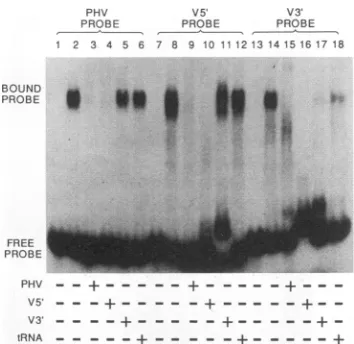
single-strandedbinding activities andtodetermine whether the 5' and3'RNAsboundtodistinctsites. Labeled PHV, V5', and V3' RNAsweremixed withanexcessof unlabeledPHV,V5', V3', or tRNA competitor RNA and assayed by gel shift
analysis.As shownpreviously, unlabeledPHV RNAeffectively abolishedbinding to the PHV probe (Fig. 8, lanes 2 and 3). Interestingly,theV5' sequence also abolishedPHVbindingto thepolymerase,whileexcessV3' ortRNAhad little effecton binding (lanes4to6). When V5'wasused as theprobe,excess PHVand V5'RNAs wereagain abletocompeteeffectivelyfor
binding (lanes7 to10).The overalllevelofbindingtotheV5' probewas notalteredby the addition ofan excessofunlabeled V3' or tRNA. However, the V3' RNA did cause some
qualitativechanges in thecomplex,whichnowmigratedas two distinct bands. The mobility of the free probe was also de-creased, indicatingthatthe V5' probe RNAhad annealed to the complementary V3' RNA. This wvould form a
on November 9, 2019 by guest
http://jvi.asm.org/
[image:6.612.98.260.74.325.2]5114 TILEY ET AL.
PHV V5' V3
PROBE PROBE PROBE
1 2 3 4 5 6 7 8 9 101112 13 14 15 16 17 18 BOUND
PROBE
.. ...
FREE PROBE
PHV
;w~~~~~~~~~~~~~~~~~~
.. :::s::
...
aig,V5 + - - - - + - - _ _+_ _ V3 + - - - - + - _ _ _+_ tRNA - - - + - - - +.- _ _ _ +
FIG. 8. Competition for polymerase binding by single-stranded5'
and3' vRNAcompetitor RNAs. Ten femtomoles of internally
radio-labeled RNA probewasmixed with 1 pmol of unlabeled competitor
RNA andthen incubated with 2.5,ug of Vac 3Pextractandanalyzed by nondenaturing gel electrophoresis. Lanes 1to6, PHV probe;lanes 7to12, V5' probe; lanes 13to18,V3'probe.Lanes2, 8,and 14,no
competitor; lanes 3, 9, and 15, PHV competitor; lanes 4, 10, and 16, V5'competitor; lanes 5, 11, and 17, V3' competitor; lanes 6, 12, and 18, tRNA competitor. Lanes 1, 7, and 13, free probe controls.
stranded structure analogous tothe PHV RNA but approxi-mately twice the size as a result of the additional
plasmid-derived sequences (Table 1). Presumably the two complexes represent the polymerase bound to either the single- or
double-strandedprobe.Adifferentpatternofcompetitionwas
observed in thereciprocal experiment usingV3' astheprobe
(lanes 13to18).In thiscase,PHV,V5',and V3' allcompeted
forbinding to the polymerase. Binding was also significantly decreasedbytRNA. Once again,thecomplementary compet-itor drove the probe RNA into a double-stranded
conforma-tion analogous to PHV (Fig. 8, lane 16). However, in the
presence ofan excess of V5' RNA, this RNA did not bind. These datasuggestthat thebindingreaction is drivenprimarily bythe 5' sequence and that bindingto the3' end is a much
weaker interaction.
DISCUSSION
In this paper, we report the physical characterization and template specificityof the influenza viruspolymerase complex expressedinarecombinant vaccinia virus system. Theinvitro systems that have predominantly been used in the past for analyzing the template specificityof the influenza virus RNA polymerasehave utilizedpolymerasefrompurifiedviralcores.
Beforetheseextractscanbe usedtostudyasynthetic template,
the endogenous viral template must be removed. This is usuallyachievedby dissociating the RNA withhighsalt orby
degradingit with micrococcal nuclease(18, 37). However,it is extremelydifficulttoremove alltracesof the vRNAorvRNA endsbythesemethods,and somepropertiesof these
prepara-tions may be attributable to these residual RNAs. Crude preparations of viral cores and the micrococcal
nuclease-treated polymerases efficientlycleavecappedRNAsubstrates in theabsence ofsyntheticRNAtemplateand can transcribe synthetic templates containingvRNA3'-endsequences(5, 14,
30, 38).Thepropertiesofthe cesiumsalt-purified polymerases
varydepending onthe salt butcan require asynthetic3' end
for the stimulation of both endonuclease and transcriptase
activities
(18,
19). Interestingly,
both forms of thepolymerase
lose the ability to
polyadenylate
theirtranscript
RNAs. The results from these two systems arelargely
in agreement,identifying
baseswithinregions
1to4and 9to12of the 3' end ascritical forbinding
(12)
andtranscriptase
activity.
The
expression
of active enzyme inmammalian cellsthrough
the use ofrecombinantvectors
provides
an alternativemeansto
study
theproperties
of the viralpolymerase.
Inthis case,thepolymerase
is notexposed
to either viral RNA or the NPprotein
and therefore mayprovide
anearly
and native formof thepolymerase, guaranteed
tobe freeof viraltemplate
RNA.Previously,
wehaveshown
that in order for thispolymerase
to cleavemRNAinvitro,
asynthetic
vRNA-liketemplate
mustbe added. This shortRNAsequencemustcontain both the 5' and 3' endsof viral RNA(14).
Theresultspresented
heredescribe data which examine an earlier step in thisactivation,
thebinding
of the vRNA to thepolymerase
complex.
This is asequence-specific
reaction which results in formation of anapproximately
280-kDacomplex,
as determinedby
sucrosegradient
centrifugation.
This isapproximately
the size of asingle
1:1:1 PB1-PB2-PAcomplex.
TheadditionofantibodiestoPB2orPB1confirmed their presence in this
complex,
asthecomplexes
aresupershifted
in nativegels
(Fig. 3). Curiously,
twodistinctantibody preparations
specific
for the PAprotein
had no effect in this
supershift
assay.However,
several anti-bodiesspecific
for the otherpolymerase
proteins
alsofailedtosupershift
thecomplex.
Thisfinding
indicates that even anti-bodies that work well in Westernblot andimmunoprecipita-tion assays donot
necessarily
workin thesupershift
assay.The limitednumber of PA antibodies thatwereavailable fortesting
prevents any firm conclusion on the presence of PA in the
complex. However,
it is clear that all three Pproteins
mustbecoexpressed
in order to form a functionalcomplex.
Extractsprepared
from cells that express the Pproteins singly
or inpairwise
combinations are not active andcannotbe reconsti-tutedby simply
adding
themissing
component(data
notshown).
Asimilar
complex
canbedetected inextractsfrominfluenza virus-infected cells(Fig.
1B).
Influenza virus-infected cells contain apool
ofnon-ribonucleoprotein
(RNP)
associatedpolymerase
complexes
(9),
andpresumably
it is thesecom-plexes
whicharebinding
the addedPHVtemplate.
However,
we have been unabletodemonstratebinding activity
for viral cores(data
notshown).
Weinterpret
thisasindicating
that all of thebinding
sites of thepolymerase
arealready
occupied by
theRNPpresentin the viralcores.This alsosuggests that the association of thepolymerase
withtheRNPissotight
that the offrateistoolowtoallow detection of freepolymerase
inthis assay.Modification interference assayswere
performed
toidentify
the nucleotides within thevRNA and cRNApanhandles
that arerequired
forbinding
tothepolymerase.
Interestingly,
all of the critical baseswerelocated in the 5' side of thepanhandles
(Fig.
6).
For PHVRNA,
acontiguous
stretch of four bases from nucleotides 9 to 12(ACAA)
was identified asvital forpolymerase
binding.
This represents theproposed bulge
region
of the
panhandle
structureand isopposite
the sequence within the 3' terminuspreviously
proposed
tobe critical fortranscrip-tion
(38).
Thebinding
siteof PHCRNAhassomefeatures in common with that of PHV but also has somesignificant
differences. Inexperiments
with PHCRNA,
six nucleotidepositions
atthe 5' endwereidentifiedasimportant
forbinding
tothe viral
polymerase.
These include base 1(A)
and bases9 and 10(CA),
which arepresumed
to be in abase-paired
conformation(Fig. 6),
aswell as bases 3 to 5(CAA),
which representabulged
region
inthepanhandle. Bulged regions
of J.VIROL.on November 9, 2019 by guest
http://jvi.asm.org/
[image:7.612.93.270.70.242.2]RNAduplex structures have been shown to be important for the binding of regulatory proteins in many other systems(1, 7, 47,49).Sequence-specificinteractions with completely double stranded RNAs are rare, presumably because the rather uniform face of the minor groove and the depth of the major groove of A-form helices mask the distinguishing features of the sequence (41, 42). This most likely explains the results obtained with the hybrid panhandle RNAs which contain all of thesequences necessary for binding, but they are in a structural context which prevents recognition by the polymerase. Not surprisingly, these RNAs that bind so poorly also fail to stimulate the endonucleolytic activity of the polymerase (13a). Although clearly important for polymerase activity (14), the panhandle structure is not absolutely required for polymerase binding. RNA probes containing only the 5' or 3' sequences of the vRNA panhandle also bound specifically to the poly-merase. By far the strongest interaction was with the 5'-end probe, asdemonstrated by the competition experiment (Fig. 8) and the data from the modification interference analysis (Fig. 5). Interestingly, when the polymerase bound to a single-stranded 5' end, it was prevented from binding to another RNA ifthat RNA was in a panhandle conformation (Fig. 8, lanes 4 and 16) but could bind another single-stranded RNA containing only 3'-end sequences (Fig. 8, lane 11).
Theobservation that the polymerase binds tightly to the 5' end of its template RNA raises the interesting question of whether the polymerase remains associated with the 5' end after the initiation of transcription, and if so, what happens when thepolymerase tries to transcribe the 5' sequences that it is bound to. Thissituation is somewhat similar to that ofQ0
minus-strand synthesis, in which case the polymerase tran-scribes from the 3' end of the plus strand while still bound to the internal M site (46, 48). In this case, the binding to the internal site does not pose any steric constraint on the ability of thepolymerase to transcribe through its binding site. However, this may not be so for the influenza virus polymerase. The
juxtaposition ofthe 5' end to the run of uridines (26, 27, 35) suggests a potential role in polyadenylation. Perhaps the stuttering addition of poly(A) occurs when the polymerase triesunsuccessfullytotranscribe the 5' end that it is bound to. Replication of a vRNA template would be carried out by a polymerase that was not bound to a 5' end or perhaps even by onebound to the 5' end of a different template.
The different binding specificities observed with the vRNA and cRNA panhandles suggest that different binding modes exist for the influenza virus polymerase, which may reflect differentfunctional states of thepolymerase(i.e., transcription versusreplication). The additional interactions identified for the cRNApanhandle may provide a means for the polymerase todistinguish between its vRNA and cRNA templates, which might explain why mRNA synthesis in vivo occurs only on a vRNAtemplate. The observations that the polymerase binds tightly to the 5' end of thevRNA and that different bases are important for binding to the vRNA or cRNA sequences may therefore be important clues to unraveling the determinants for replication, mRNAtranscription, and polyadenylation.
ACKNOWLEDGMENTS
We thank Donald Summers and Robert Krug for generously providing polymerase-specific antisera and also thank Richard Col-onno formuch-appreciatedsupport and advice.
REFERENCES
1. Bartel, D. P., M. L. Zapp, M. R. Green, and J. W. Szostak. 1991. HIV-1 Rev regulation involves recognition of non-Watson-Crick base pairs in the viral RNA. Cell 67:529-536.
2. Beaton, A. R., and R. M. Krug. 1986. Transcription antitermina-tion during influenza viral template RNA synthesis requires the protein and the absence of a 5' capped end. Proc. Natl. Acad. Sci. USA 83:6282-6286.
3. Beers, R. F., andI.W. Sizer. 1952. A spectrophotometric method for measuring the breakdown of hydrogen peroxide by catalase. J. Biol. Chem. 195:133-140.
4. Bogerd, H. P., L. S.Tiley,and B.R.Cullen. 1992. Specific binding of the human T-cell leukemia virus type I Rex protein to a short RNA sequence located within the Rex response element. J. Virol. 66:7572-7575.
5. Bouloy, M., M. A. Morgan, A. S. Shatkin, and R. M. Krug. 1979. Cap and internal nucleotides of reovirus mRNA primers are incorporated into influenza viral complementary RNA during transcription in vitro. J. Virol. 32:895-904.
6. Calnan, B. J., B. Tidor, S. Biancalana, D. Hudson, and A. D. Frankel. 1991. Arginine mediated recognition: the arginine fork. Science 252:1167-1171.
7. Carey, J., V. Cameron, P. L. de Haseth, and 0. C. Uhlenbeck. 1983. Sequence specific interaction of the R17 coat protein with its ribonucleic acid binding site. Biochemistry22:2601-2610. 8. Desselberger, U., V. R. Racaniello, J. J. Zazra, and P. Palese. 1980.
The 3' and 5' terminal sequences of influenza A, B and C virus RNA segments are highly conserved and show partial inverted complementarity. Gene 8:315-328.
9. Detjen, B. M., C. St. Angelo, M. G. Katze, and R. M. Krug. 1987. The three influenza virus polymerase proteins not associated with viral nucleocapsids in the infected cell are in the form of a complex. J. Virol. 61:16-22.
10. Earle, P. L., N. Cooper, and B. Moss. 1991. Preparation of cell cultures and vaccinia virus stocks, p. 16.16.1-16.16.7. In F. C. Ausubel, R. Brent, R.E. Kingston, D. D. Moore, J. G. Steadman, J. E. Smith, and K. Struhl (ed.), Current protocols in molecular biology. Greene Publishing and Wiley-Interscience, New York. 11. Fiering, S., J. P. Northrop, G. P. Nolan, P. S. Mattila, G. R.
Crabtree, and L. A. Herzenberg. 1990. Single cell assay of a transcription factor reveals a threshold in transcription activated by signals emanating from the T-cell antigen receptor. Genes Dev. 4:1823-1834.
12. Fodor, E., B. L. Seong, and G. G. Brownlee. 1993. Photochemical cross-linking of influenza A polymerase to its virion RNA pro-moter defines a polymerase binding site at residues 9-12 of the promoter. J. Gen. Virol. 74:1327-1333.
13. Fuerst, T. R., E. G. Niles, F. W. Studier, and B. Moss. 1986. Eukaryotic transient transfection system based on recombinant vaccinia virus that synthesizes bacteriophage T7 RNA polymerase. Proc. Natl. Acad. Sci. USA 83:8122-8126.
13a.Hagen, M. Unpublished data.
14. Hagen, M., T. D. Y. Chung, J. A. Butcher, and M. Krystal. 1994. Recombinant influenza virus polymerase: requirement for both 5' and 3' viral ends for endonuclease activity. J. Virol.68:1509-1515. 15. Hay, A. J., G. Abraham, J. J. Skehel, J. C. Smith, and P.Fellner.
1977. Influenza virus messenger RNAs are incomplete transcripts of the genome RNA. Nucleic Acids Res. 4:4197-4209.
16. Hay, A. J., B.Lomniczi, A. R. Bellamy, and J. J. Skehel. 1977. Transcription of the influenza virus genome. Virology 83:337-355. 17. Hay, A. J., J. J. Skehel, and J. McCauley. 1982. Characterization of
influenza virus complete transcripts. Virology 116:517-522. 18. Honda, A., J. Mukaigawa, A. Yokoiyama, A. Kato, S. Ueda, K.
Nagata, M.Krystal,D. Nyak, and A. Ishihama. 1990. Purification and molecular structure of RNA polymerase from influenza virus A/PR8. J. Biochem. 107:624-628.
19. Honda, A., K. Ueda, K. Nagata, and A. Ishihama. 1988. RNA polymerase of influenza virus: role of NP in RNA chain termina-tion. J. Biochem. 104:1021-1026.
20. Hsu, M., J. D. Parvin, S. Gupta, M. Krystal, and P. Palese. 1987. Genomic RNAs of influenza viruses are held in a circular confor-mation in virions and in infected cells by terminal pan-handles. Proc. Natl. Acad. Sci. USA84:8140-8144.
21. Huang, T.-S., P. Palese, and M. Krystal. 1990. Determination of influenza virus proteins required for genome replication. J. Virol. 64:5669-5673.
22. Kimura, N., M. Nishida,K.Nagata, A. Ishihama, K. Oda, and S.
on November 9, 2019 by guest
http://jvi.asm.org/
Nakada. 1992. Transcription of a recombinant influenza virus RNAin cells that can express the influenza virus RNA polymerase andnucleoprotein genes. J. Gen. Virol. 73:1321-1328.
23. Kjems, J., B.J. Calnan, A. D. Frankel, and P. A. Sharp. 1992. Specificbinding of a basic peptide from HIV-1 Rev. EMBO J. 11:1119-1129.
24. Kobyashi, M., K. Tuchiya, K. Nagata, and A. Ishihama. 1992. Reconstitution of influenza virus RNA polymerase from three subunits expressed using recombinant baculovirus system. Virus Res.22:235-245.
25. Krug, R. M., F. V.Alonso-Caplan, I. Julkunen, and M. G. Katz. 1989.Expression and replication of the influenza virus genome, p. 89-152. In R. M. Krug(ed.),The influenzaviruses. PlenumPress, NewYork.
26. Li, X.,and P. Palese. 1994. Characterization of the polyadenyla-tionsignalofinfluenzavirusRNA. J. Virol. 68:1245-1249. 27. Luo, G., W. Luytjes, M. Enami, and P. Palese. 1991. The
polyad-enylation signal of influenza virus RNA involves a stretch of uridines followedby the RNA duplexofthepanhandlestructure. J.Virol. 65:2861-2867.
28. Martin, J., C. Albo, J. Ortin, J. A. Melero, and A. Portela. 1992. In vitro reconstitution of active influenza virus ribonucleoprotein complexes using viral proteinspurifiedfrominfectedcells. J. Gen. Virol. 73:1855-1859.
29. Nagata, K., K. Takeuchi, and A.Ishihama. 1989. Invitro synthesis ofinfluenzavirus RNA: biochemical complementation assay of factorsrequiredforinfluenza virusreplication. J. Biochem. 106: 205-208.
30. Ohlsson, H., and T. Edlund. 1986. Sequencespecific interactions of nuclearfactorswith theinsulingeneenhancer. Cell 45:35-44. 31. Parvin, J. D., P. Palese, A. Honda, A. Ishihama, and M. Krystal.
1989. Promoter analysis of influenza virusRNA polymerase. J. Virol.63:5142-5152.
32. Peattie, D. A. 1979. Directchemicalmethod forsequencingRNA. Proc.Natl. Acad. Sci. USA76:1760-1764.
33. Plotch, S., M. Bouloy, and R. M. Krug. 1979. Transfer of 5' terminal cap ofglobinmRNAtoinfluenza viral complementary RNA during transcription in vitro. Proc. Natl. Acad. Sci. USA 76:1618-1622.
34. Plotch, S., M.Bouloy,I.Ulmanen, and R. M. Krug. 1981. Aunique cap(m7GpppXm)-dependent influenza virion endonuclease cleaves capped RNAs to generate the primersthat initiate viral RNAtranscription.Cell 23:847-858.
35. Robertson, J. 1979. 5' and 3'terminalnucleotide sequences of the RNA genome segments of influenza virus. Nucleic Acids Res.
6:3745-3757.
36. Robertson, J.S.,M.Schubert,andR. A.Lazzarini. 1981. Polyad-enylationsitesfor influenza virus mRNA. J. Virol. 38:157-163. 37. Seong, B. L., and G. G. Brownlee. 1992. A new method for
reconstitutinginfluenzapolymeraseand RNA in vitro: astudy of thepromoterelements for cRNA and vRNAsynthesisin vitro and viralrescueinvivo.Virology 186:247-260.
38. Seong,B.L.,andG. G. Brownlee. 1992. Nucleotides 9to11 ofthe influenza A virion promoter are crucial for activity in vitro. J. Virol. 73:3115-3124.
39. Shapiro, G. I., and R. M. Krug. 1988. Influenza virus RNA replicationinvitro: synthesisofviral templateRNAs andvirion RNAs inthe absence of addedprimer.J.Virol. 62:2285-2290. 40. Smith, G. L., J. Z. Levin, P. Palese, and B. Moss. 1987.Synthesis
and cellular location of ten influenza polypeptides individually expressedbyrecombinant vacciniavirus.Virology 160:336-345. 41. Steitz, T. A. 1990. Structural studies of protein nucleic acid
interaction: the sources of sequence-specific binding. 0. Rev. Biophys.23:205-280.
42. Stern, S., R. C. Wilson, and H. F. Noller. 1986. Localization of the binding site for protein S4 on 16 S ribosomal RNA by chemical and enzymatic probing and primer extension. J. Mol. Biol. 192: 101-110.
43. Stoeckel,M.Y.,M. W.Shaw,and P.W.Choppin. 1987. Segment-specific and common nucleotide sequences in the non-coding regionsofinfluenzaBvirusgenomicRNAs.Proc. Natl.Acad. Sci. USA 84:2703-2707.
44. Sugiura, A.,K.Tobita,and E. D.Kilbourne. 1972. Isolation and preliminary characterization of temperature-sensitive mutants of influenza virus. J. Virol. 10:639-647.
45. Tiley, L. S., M. H. Malim, H. K. Tewary, P. G. Stockley, and B. R. Cullen. 1992. Identification of ahighaffinitybinding sitefor the HIV-1 Revprotein. Proc. Natl. Acad. Sci. USA 89:758-762. 46. Weber,H., M. Billeter, S. Kahane, J. Hindley, A. Porter, and C.
Weissmann. 1972. Molecular basis for repressor activity ofQO replicase.Nature(London)NewBiol.237:166-170.
47. Weeks, K. M., and D. M. Crowthers. 1991. RNArecognitionby Tat derived peptides: interaction with the major groove? Cell 66:577-588.
48. Weissmann, C. 1974. The making of a phage. FEBS Lett. Suppl. 40:S10-S18.
49. Wu, H.-N.,and0. C. Uhlenbeck 1987.Role ofabulgedA residue inaspecificRNA-protein interaction.Biochemistry 26:8221-8227. 50. Young, R.J.,andJ. Content.1971. 5' terminusofinfluenza virus
RNA. Nature(London) 230:140-142.