R E S E A R C H A R T I C L E
Open Access
Using an action learning methodology to
develop skills of health managers:
experiences from KwaZulu-Natal, South
Africa
Zandile Masango-Muzindutsi
*, Lyn Haskins, Aurene Wilford and Christiane Horwood
Abstract
Background:Strong management skills are key to improving performance of health systems. Action learning, a technique to develop management skills, has been used successfully with health managers but not usually among lower level managers or in low and middle-income countries (LMICs).
Methods:This study uses a qualitative approach to explore experiences, successes and challenges of using an action learning approach to improve skills of managers in neonatal units in KwaZulu-Natal (KZN), South Africa. Eight action learning groups were convened with neonatal unit managers from all 39 district hospitals in KZN, each group had 4–6 participants. Meetings were conducted by a facilitator trained in action learning techniques, and groups met a minimum of ten times over a one-year period. After completion of the intervention, 14 in-depth interviews were conducted with purposively selected action learning participants. Data was transcribed and analysed using framework analysis.
Results:Neonatal unit managers found that action learning generated a sense of empowerment in their abilities, trust and confidence among participants was nurtured, problem solving and critical thinking skills were developed, and a continuous support system was created. The action learning process led to several positive changes in neonatal units, which enhanced the quality of care for patients. A number of challenges were also identified, mainly relating to administrative issues such as the provision of a skilled facilitator, permission to attend action learning meetings and logistical issues, including transport and other financial implications.
Conclusions:This paper illustrates that action learning can be an effective and practical method to support public health workers to manage their health units despite the challenges associated with the method. Time, energy and financial resources used to facilitate action learning for this cadre of health workers is rewarded by improved skills of managers and better quality of care for patients.
Keywords:Action learning, Health manager, Newborn care, Health workers, Self-efficacy, Resource limited setting, Africa, South Africa
* Correspondence:[email protected]
Centre for Rural Health, University of KwaZulu-Natal, 4th Floor, George Campbell Building, Howard College Campus, Durban 4001, South Africa
Background
Strong management skills at all levels have long been identified as key elements to improve performance of health systems, particularly in LMICs (WHO, 2009). However, many health managers are health professionals with no management experience prior to being offered a
management position [1]. Effective management and
strong leadership are associated with well-functioning facilities, and productive and motivated staff [2, 3]. For these reasons, it is essential that managers in the public health sector be equipped with skills to effectively per-form their duties. In South Africa (SA), managers in the public health sector frequently lack skills and training to manage the daily challenges experienced in health facil-ities, and this has been cited as one of the reasons for poor service delivery in the public health sector [4].
Action learning is one approach that can be used to address the challenge of improving management skills. The ethos of action learning is to‘take an attitude of en-quiry’ based on the principle that experiences generate knowledge. Action learning seeks to facilitate skill devel-opment based on integration of knowledge gained from experience and knowledge gained by formal learning, underlined by critical reflection. Action learning is thus rooted in the theory and practice of adult learning [5]. This technique is well-established and has been widely used in several sectors. Action learning can be described as a continuous group-based process of engagement, learning and reflection where a group of peers meet regularly under the guidance of a trained facilitator over an extended time period. In these action learning groups, participants bring real problems to the discussion with the aim of generating innovative and creative ways of dealing
with complex problems [6] and facilitating learning
through the development of practical solutions that are implemented with planned intent [7]. Sessions are con-ducted in a socratic manner, such that participants discuss their problems in a constant back and forth questioning and answering process that elicits critical thinking, and dialogue that encourages generation of ideas and clarifica-tion of assumpclarifica-tions [6]. Moreover, the process of action learning encourages learners to reflect on and learn from their own experiences and those of their peers [6].
People learn more and better when learning takes place practically than when passively being provided with infor-mation [8,9]. Action learning has been shown to be an ef-fective method of learning and developing leadership skills particularly for senior level managers in developed coun-tries [10]. This may be attributed to it’s less formal nature making it a practical and interactive approach that is dir-ectly related to the day-to-day problems that managers face [11]. Although the technique has been mainly used to de-velop the skills and competencies of senior managers, it is also used among other ranks [12]. Furthermore, although
the method has been successfully used in the health sector [13,14], it has also been implemented in other sectors such as construction [12,15]. The action learning technique has been shown to improve confidence, resilience, conflict reso-lution, team work [16,17], empowerment [18, 19], leader-ship skills [20], self-efficacy, critical thinking and problem solving skills [13]. All these skills are important for managers in general but more so for those who work in highly stressful environments such as the neonatal unit.
Health workers working in neonatal units in district hospitals work under extremely stressful conditions to care for critically ill infants. In the South African setting, this may be combined with daily challenges such as insuf-ficient equipment and medication, poor transport to the referral centre, as well as shortage and burn-out of staff, making it difficult for middle management to critically de-velop ways of managing all the problems encountered. Neonatal units in district hospitals are run by generalist doctors and nurses, without any on-site paediatrician, and are often geographically isolated, far from specialist care. Managers of neonatal units are faced with day-to-day problems for which solutions are required. Therefore, it is important to assess whether action learning can be an ef-fective method to improve managers’skills to address their challenges. This paper evaluates an action learning inter-vention that was employed to develop the management skills among middle level health managers with direct responsibility for day-to-day management of neonatal units in district hospitals in KZN, South Africa.
Methods
Study setting
This qualitative study was conducted in the province of KZN, South Africa. KZN has a population of approxi-mately 10.9 million people [21], with an overall HIV
prevalence of 16.9% in 2012 [22] and 40.1% of women
attending government clinics for antenatal care tested HIV positive in 2013 [23]. There are 39 district hospitals, ten regional hospitals and one tertiary hospital that provide neonatal care services in the province.
Sampling
Participants in each action learning group were purposively selected to participate in the evaluation on completion of the action learning process, based on their willingness to share their thoughts and experiences of participating in an action learning group. In-depth interviews were conducted with 14 operational managers or unit mangers of the neonatal units in district hospitals.
The action learning intervention
Facilitator training
by a facilitator with special skills and experience in ac-tion learning. The raac-tionale, principles and technique of action learning were explained and discussed in an inter-active manner. The newly trained facilitators were then mentored during their initial group meetings, until they were competent to manage the groups independently. During the training, confidentiality was emphasised as a key factor for participants to pay attention to at all times because of the sensitive nature of the challenges brought the group.
Selection of action learning participants
The participants were identified through their respective hospitals. All hospitals providing neonatal services in the province of KZN were included in the intervention and offered the opportunity for the neonatal unit manager to be included in a skills development initiative. Forty-one participants were selected by their facilities to participate in the intervention. Participants were all registered nurses and were included based on being responsible for the day-to-day management of the neonatal unit. All ac-tion learning group participants attended a one-day workshop where they were given information about ac-tion learning, and the raac-tionale for its use in their work settings, so participants gained a thorough understand-ing of the requirements expected from them durunderstand-ing their participation in the action learning group.
Action learning groups
Eight action learning groups were convened with partici-pants from all 11 districts of KZN. Each group consisted of 4–6 participants. Participants were usually from a sin-gle district but at times two or three small districts were combined to ensure sufficient participants in the group. Each group had a maximum of 10 sessions and met once per month at a convenient venue.
During the action learning session, group members took turns presenting a problem that they were experi-encing at work. The role of the other group members was to listen and critically challenge the presenter to think of their problem in a way that provided possible solutions, and to develop an action plan to implement in their health facility. At the following meeting partici-pants provided feedback on how they had implemented their action plan, and whether the selected strategy had brought about any change in terms of solving their prob-lem. If the participant had elected to implement an alter-native action plan, this was also highlighted with the outcomes of this alternative action plan being presented.
Data collection
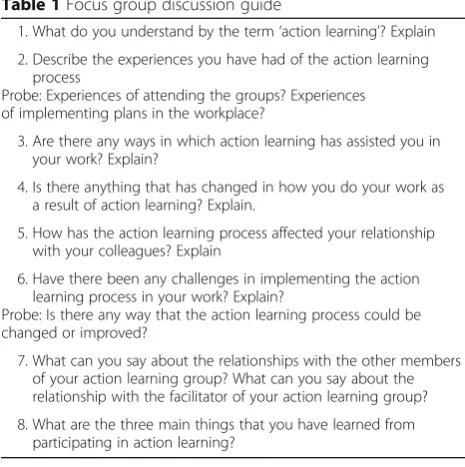
A semi-structured interview guide for the evaluation
process was developed (see Table 1). This covered
topics of interest including participants’ understanding
of action learning, how action learning assisted partici-pants in their work settings, and the changes that oc-curred in the workplace as a result of action learning, challenges in the implementation of action plans and perceptions about facilitation of the action learning process. A researcher trained in conducting in-depth interviews, interviewed the action learning participants. Interviews were conducted after the last action learning session at local conference venues, participants’ health facilities or at the researchers’ organisation. All venues used allowed for privacy to be maintained during the interview.
Data analysis
Thematic analysis was used as a method of analysis while NVivo version 11, was used to organise data for ease of reference. Braun and Clarke [24] describe thematic ana-lysis as ‘a method for identifying, analysing and reporting patterns (themes) within data’ (p. 79). It allows the researcher to organise data into codes and themes from both an inductive and deductive approach. Thematic analysis follows a series of steps including familiarising yourself with your data, generating initial codes, searching for themes, reviewing themes, defining and naming themes and producing the report [24].
[image:3.595.304.537.90.324.2]During the analysis phase, two researchers from the research study team independently coded and analysed the transcripts. The two researchers coded a subset of transcripts independently and had regular meetings to discuss any discrepancies in their coding, any differences were discussed until consensus was reached. Findings were then discussed with the research team, to ensure accurate interpretation of the data. Inter-coder reliability
Table 1Focus group discussion guide
1. What do you understand by the term‘action learning’? Explain 2. Describe the experiences you have had of the action learning
process
Probe: Experiences of attending the groups? Experiences of implementing plans in the workplace?
3. Are there any ways in which action learning has assisted you in your work? Explain?
4. Is there anything that has changed in how you do your work as a result of action learning? Explain.
5. How has the action learning process affected your relationship with your colleagues? Explain
6. Have there been any challenges in implementing the action learning process in your work? Explain?
Probe: Is there any way that the action learning process could be changed or improved?
7. What can you say about the relationships with the other members of your action learning group? What can you say about the relationship with the facilitator of your action learning group?
tests were also performed on NVivo to ensure the reliability and rigour of the analysis of data.
Results
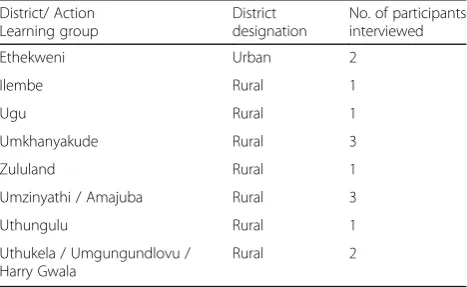
14 interviews with operational managers and unit managers were conducted between 2014 and 2015 with selected action learning group participants. All partici-pants were female and were registered (professional) nurses. Table2indicates the number of participants inter-viewed per action learning group.
A number of themes emerged from the interviews in-cluding: benefits gained from action learning within the context of their work; changes that occurred in their re-spective facilities as a result of implementing action plans; challenges they experienced; and recommendations on how the action learning sessions may be improved.
Benefits of action learning
Several participants expressed that action learning was empowering and gave them confidence, assertiveness and a sense of independence. The group meetings empowered participants to be proactive in finding solu-tions to challenges in their units and made them more confident to share ideas and mobilise other staff mem-bers to support new approaches to solving problems. Participants also stated that action learning empowered them to approach their managers with ideas on how to improve quality of care for patients within their units.
All the participants mentioned that they had developed confidence through participating in the action learning ses-sions and that they applied the competencies in their work.
No, before that I didn’t have that confidence, you know, but after I’ve started this action learning I became so grateful, you know, and have that confidence that really I’m going…Yah, I’m going to win…(Group 4, Rural District, Operational Manager, Interview 2).
Another participant also shared similar sentiments about the benefits of action learning in relation to her work.
It made me confident…assertive and confident, that process actually makes you stronger in the whole process…(Group 1, Urban District, Operational Manager, Interview 1).
Trust among the group members was another key fea-ture that was identified by participants. As a result of the similarity of the challenges experienced by partici-pants and their frequent meetings, participartici-pants learned to trust one another and developed lasting relationships that continued beyond action learning.
It’s a slow process, but you learn to develop the trust in a group and that was crucial, to have trust and confidence in a group, because we were people, although working in the same field and nursing the same people we did not know each other, so we had to develop a trust amongst ourselves first.(Group 1, Urban District, Operational Manager, Interview 1).
Action learning provided a platform for participants to develop problem-solving skills that they could then practic-ally apply to managing their work more effectively. Partici-pants also mentioned that the iterative socractic model of interrogating a challenge brought to the group, improved their critical thinking skills which were applied to their work challenges in order to develop relevant solutions. Moreover, these skills encouraged the participants to take initiative in their work because they did not rely on senior managers to propose ideas on how to tackle challenges.
The questions of what the problem statement is, what have I done, what could I have done differently, what did I do instead and what do I need to do in the future, you know–things like that, those were beneficial questions. And they are applicable to every situation, it’s made me look at each problem or challenge that we have to use the same principal for questions for resolving issues.(Group 3, Rural District, Operational Manager).
[image:4.595.57.291.588.732.2]The participants further mentioned that action learning provided a support system. The nature of participants’ work meant that they often encounter similar problems in their respective work environments, so they could use similar ideas and solutions in their own health facilities. In addition, the sense of camaraderie that developed in the groups continued after the sessions had ended and partici-pants kept in contact with one another regarding progress on their action plans. The relationships developed provided platforms for participants to communicate regarding
Table 2Participants interviewed for action learning evaluation
District/ Action Learning group
District designation
No. of participants interviewed
Ethekweni Urban 2
Ilembe Rural 1
Ugu Rural 1
Umkhanyakude Rural 3
Zululand Rural 1
Umzinyathi / Amajuba Rural 3
Uthungulu Rural 1
Uthukela / Umgungundlovu / Harry Gwala
challenges that they faced after the intervention ended. This included support with resources such as borrowing supplies when one of the facilities had challenges with ordering.
I did not even know who my colleagues were in the districtper se, we maybe met at a district meeting once a quarter or whatever, but we never met as a group where we could trust one another and pick up the phone and phone and say–I have a problem with this baby what do I do?(Group 1, Urban District, Operational Manager, Interview 1).
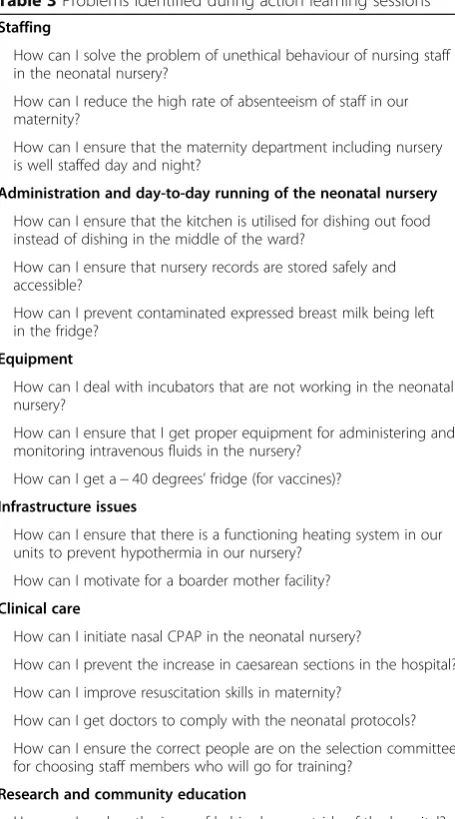
Changes that occurred as a result of action learning As part of the action learning sessions, each participant was required to present one or more problems that they experienced in their work place. Participants shared a number of problems and some of the solutions imple-mented from the ideas generated during the action learn-ing sessions. Problems ranged from stafflearn-ing issues, daily administrative functioning of units, equipment issues, clinical care, infrastructure issues and research and com-muntiy education. While some action plans were ongoing and some of the problems experienced were not entirely resolved; a number of the participants were able to successfully resolve their challenges with the assistance of action learning. A summary and examples of some of the problems identified during the action learning sessions is shown in Table3.
Additionally, some of the participants success stories of the positive changes that occurred in their units are
included as case studies in Tables 4 and 5. The case
study shown in Table4illustrates how one of the partici-pants used skills gained from action learning to take the initiative to coordinate the compilation of data in her unit. The case study also illustrates how the participant felt empowered to understand that the issue required a number of different personnel in order to be resolved, and that other responsible managers could also assist. The implementation of her action plan not only resulted in her resolving the problem of data management, but also resulted in the development of policies on data management in her unit.
Challenges of action learning
Some participants stated that they experienced challenges with the implemenatation of their action plans in their re-spective units. The challenges mentioned included not hav-ing a platform to present their ideas to senior management, going back and forth between colleagues during the imple-mentation process, and colleagues not being receptive to ideas that brought about change in their units. Ultimately, this created delays in implementations of action plans
because of the amount of time it took to get approval to implement proposed ideas.
There is no boarder mother facility. So…we found a method and a way to do that, I mean I took it back… there was just no…like way to present to
management because there was no management. So we tried other methods like approaching the quality manger and things like that, and writing letters…, for me nothing has helped with my major problem it still hanging in the air.(Group 8, Rural District,
[image:5.595.306.534.92.502.2]Operational Manager, Interview 1).
Table 3Problems identified during action learning sessions
Staffing
How can I solve the problem of unethical behaviour of nursing staff in the neonatal nursery?
How can I reduce the high rate of absenteeism of staff in our maternity?
How can I ensure that the maternity department including nursery is well staffed day and night?
Administration and day-to-day running of the neonatal nursery
How can I ensure that the kitchen is utilised for dishing out food instead of dishing in the middle of the ward?
How can I ensure that nursery records are stored safely and accessible?
How can I prevent contaminated expressed breast milk being left in the fridge?
Equipment
How can I deal with incubators that are not working in the neonatal nursery?
How can I ensure that I get proper equipment for administering and monitoring intravenous fluids in the nursery?
How can I get a−40 degrees’fridge (for vaccines)? Infrastructure issues
How can I ensure that there is a functioning heating system in our units to prevent hypothermia in our nursery?
How can I motivate for a boarder mother facility?
Clinical care
How can I initiate nasal CPAP in the neonatal nursery?
How can I prevent the increase in caesarean sections in the hospital?
How can I improve resuscitation skills in maternity?
How can I get doctors to comply with the neonatal protocols?
How can I ensure the correct people are on the selection committee for choosing staff members who will go for training?
Research and community education
How can I explore the issue of babies born outside of the hospital?
How can I influence the community and traditional healers to understand the dangers associated with the use of traditional medicines during pregnancy?
Coordination of sessions and support from management Despite the positive experiences stated by the partici-pants, they also revealed that providing coordination and support for action learning meetings was challen-ging. Obtaining permission from line managers was highlighted by some partcipants as a challenge, as man-agers did not always understand their being away from work to attend action learning sessions. Moreover, logis-tical matters including communication and transport to the meetings was a challenge mentioned by some of the participants. This was especially true for those who worked and stayed in remote areas.
We had a venue at [name of hospital], we were from different hospitals, so we could not have it in one hospital. I think the challenge for me was travelling to [name of hospital], the distance of travelling and the road, with the road works and things like that.(Group 1, Urban District, Operational Manager, Interview 1).
As part of the evaluation process, participants were also asked how action learning sessions could be im-proved or changed. The participants mentioned two main things. One was that action learning be an on-going process, where other colleagues could also join
and learn. Another was that top management be part of action learning so that they could understand the challenges that participants brought forward as well as support the need for ongoing action learning for the neonatal managers.
Table 4A lesson in data management
Participant:..It was just one problem that I had from the beginning that took a while to resolve, it had something to do with data management.
Interviewer: Yes.
Participant: So bringing that problem (to action learning), I think most of the managers told me towards the end (of the action learning meetings) that they all have…the same problem.
So with this process it was like–it was a huge task and we thought that it was just my responsibility. Data management is my responsibility but throughout the [action learning] process we realized that a very small portion of the data management was our responsibility. It was all the other key factors that were put in place to make sure that the [data] management was right, that fell off. We were able to identify these problems.
Interviewer: In the Action Learning?
Participant: Yes, in the Action Learning, with their guidance in the whole group I took it back to my institution to call theFIO (Facility Information Officer)and ask(ed) her–what happened with the data and this is the process, I developed a flow chart. It’s only when the flow chart went up that we realized ok,“these are where the problems are”, physically looking at it and seeing the problems, these were where the problems were, so we took it back, so much so that theFIOdeveloped a policy.
Interviewer: Wow!
Participant: She developed a policy on data management and, well, I had to develop one for my ward as such, which is a draft policy but hers actually went through the whole [Department of Health] system.
Interviewer: Shew!
Participant: She developed a policy on (data) management, which we did not have.
(Group 1, Urban District, Operational Manager, Interview 1)
Table 5Improving absenteeism rates
Participant: I have (had) a problem of absenteeism and eh…
Interviewer: People just not coming to their shifts? Coming to work?
Participant: Yes
Interviewer: Is that what you mean by absenteeism?
Participant: People were not coming to work, they will produce sick notes
Interviewer: Ok
Participant: Yes you find that someone has been absent from work for 8 days in a month, eh others would have (a) pattern of absenteeism. You find that if she’s working during this weekend she won’t come, then the following weekend she will be off. The next one she’s supposed to come, she won’t come again and she will end up being away for all the weekends in a month. Now in that way, the workload became more for those that are still working, coming to work. Now we had to assess this, sit down, and talk to my Assistant Manager about it. We tried to talk to the staff but it was not that helpful. By coming here (to action learning)… we discussed the problem with eh our facilitator
Interviewer: Carry on
Participant: Uh I was empowered because I had to go back[to work] and review, talk to the staff and we also looked at the doctors that were booking these people [off sick] and we realised that mostly it was the sessional doctors because they do not go to the HOS where they can be seen within the hospital
Interviewer: What is the HOS?
Participant: It’s the…OHS-Occupational Health Services
Interviewer: Oh ok
Participant: They don’t utilise that one, they go outside, then the sessional doctors will book them off. Now we were so troubled that we didn’t know how to…we tried to talk to the people but people…will continue absenting themselves until we decided to refer them to the EAP
Interviewer: What’s that?
Participant: EAP is the Employee Assistance Programme by the Employee Assistance Practitioner. We referred them there, they started to…initially they refused to go there, but because there is a form that you have to fill if you are not willing to see (the) EAP. I told them“if you are not willing, you are free not to go there but you must just sign for me that you are not interested in seeing the EAP”. Then they ended up attending EAP
Interviewer: Ok
Participant: Where they got counselling and all…had to explain what is meant by absenteeism and how…it affect(s) the quality of work; being away from work when you are expected to be there. I saw a great, great improvement after they’ve been to the EAP, eh people are coming to work now though there are those few but the majority is doing so well up to now
Interviewer: And did action learning give you the idea to do that?
Participant: The EAP, in fact the EAP is there in the hospital but it was the idea from this side (action learning group),“Have you seen the labour relations? Have you tried the EAP?”Then I said“no I didn’t”then I was empowered that you better (do that), because you have tried, you have counselled people…maybe refer them to a higher level of counselling then I refer(red) them and now the situation is much, much better
I think if I can improve action learning I can involve the top level management in this action learning programme like the CEO, the medical manager, all the top people that are involved in the management of our patients in the institution.(Group 5, Rural District, Operational Manager).
Discussion
Our findings suggest that action learning can be imple-mented successfully among middle-level health managers in challenging resource-limited settings, benefiting the in-dividual health worker and our findings suggest that this may have led to improvements in the daily functioning of the neonatal units. Health workers are trained to be com-petent clinicians, and not managers, so development of management skills is crucial when they take up manage-ment positions. Action learning participants reported that they felt empowered as a result of participating in the intervention, and that they gained practical skills to tackle their duties within the workplace. Action learning also helped to cultivate collegial relationships among the par-ticipants, who continued to seek advice and assistance from their colleagues after the groups had ended.
Action learning implementation is embedded in a cul-tural and social context, which determines how it is prac-ticed. The origins of action learning lie in western developed countries, and it is strongly based on Western ideas and assumptions. Although action learning has been implemented in a wide variety of diverse cultural settings, there could be concern about adapting this approach to an African setting with a very different pedagogical tradition. In particular, action learning techniques of challenging participants may be threatening in a context where this is not common practice. This study suggested that trust was an important element of success, which took time to build, but otherwise this approach was well received and accepted, and could be more in line with traditional community based approaches to learning [25].
One of the underlying principles of action learning is that groups should be closed, that is, participants remain the same throughout the process, and discussions con-ducted in groups should be confidential. Therefore, partici-pants need to be committed to the process by attending all meetings. All these aspects contributed to the development of a trusting environment. Such an environment is required to allow discussion of sensitive aspects of a problem, like conflict with colleagues in the workplace and allows group members to challenge each other. The same sorts of trusting relationships may not be easy to achieve using other approaches, particularly in our context where colleagues frequently work in close-knit, isolated commu-nities, making it challenging to ask for advice or to reveal a lack of skills to direct colleagues. Action learning promotes
peer learning between members which can be a powerful and accessible tool. Similarly, Leggatt et al. (2011) also found that a psychologically safe environment is key to en-abling participants to freely voice their thoughts in the ac-tion learning group.
Additionally, our findings indicated that action learning created a support network for participants such that they built relationships that encouraged peer learning [26], maintained contact and continued to support and advise one another beyond the problems addressed in the group meetings. To the authors’knowledge, this is a new and in-teresting finding within the realm of action learning and shows that this method is effective and may be sustainable with participants from different geographical settings. Al-though one of the requirements for a functional action learning group is to have a trained facilitator, sustainability could be achieved as the group becomes more familiar and confident with the action learning process so that they take over the facilitation of the group themselves. In this way, this type of learning promotes self-direction and independence rather than reliance on experts that are percieved as more knowledgeable [27].
Another critical finding from this study is that partici-pants expressed that participation in the action learning groups gave them a sense of empowerment to tackle challenges. Health workers further developed a sense of resilience and problem-solving as a result of many critical problems that were resolved.
Action learning takes on a socratic approach which involves an iterative and reflective process of one’s challenges and the possible solutions. By employing this method, action learning allowed the participants to think critically about issues and come up with solutions on their own. These are generic skills that can be applied to any work situation and can be anticipated not only to lead to changes in the work place during implementation of the action learning groups but to provide skills that will pro-mote personal development of participants, allowing them to be more effective beyond the lifetime of the group.
health system. Action learning faciltators could be trained among Department of Health staff but would have to be carefully selected to maintain the trusting relationships within the action learning groups. Implementation of action learning could contribute towards shifting some of
the practices and perceptions related to training
programmes so that these are considered an integral part of health workers’jobs rather than being regarded as exter-nal, unnecessary and time-consuming activities.
Participants expressed lack of support from senior man-agement as one of the challenges they encountered with regards to attendance of sessions, especially during the ini-tial stages of the intervention. Participants also stated that they needed the support of their managers for the prob-lems identified during action learning to be resolved. SA Nelson and RK Yeo [12] state that ‘the success of action learning programmes will depend heavily on senior man-agement support and the preparedness to commit to lon-ger term learning programmes rather than two-day“sheep dip”training sessions, which accomplish very little at great expense’(p. 305). This is essential if quality of care is to be improved in such a way that staff are competent and have the support required to provide good standards of care.
Orientation of senior management to action learning as a skills-development tool ahead of implementation could address many concerns that senior managers may have re-garding action learning and resolve some of the logistical barriers identified, like obtaining permission to attend the action learning sessions. An additional role for action learning facilitators, if trained within the Department of Health, to improve success and sustainability could be to establish the principles of action learning in each site, im-prove linkages and communication with senior managers, and advocate for support for action learning at all levels of the health system. Additionally, this could be used as an opportunity to advocate for senior managers to use action learning themselves especially considering its successful use among this group of managers [9]. Furthermore, a reporting tool could be developed in order to track
partic-ipants’ progress and for senior management to have a
good sense of action learning outcomes.
Limitations
Our study attempted to illustrate how action learning can be used as a method to develop skills among middle man-agers in resource-limited health facilities. The results of our study are not intended to be generalizable, however through rich accounts, they provide important insights into the outcomes of action learning in our context. Our intervention had limitations in terms of sustainability be-cause it was conducted by external facilitators at venues that were provided. Further research could look at ways of improving sustainability by increasing involvement of senior managers, using internal Department of Health
facilitators and promoting the eventual independence of the action learning groups.
Conclusion
This paper demonstrated that action learning is an effective and practical method for public health workers aiming to manage their health units despite the challenges they face. Health facilities require cadre with effective management skills for optimal service delivery in health care systems. Investing in training of middle managers to acquire neces-sary management skills is therefore inevitable and feasible, and accessible interventions need to be implemented to provide skills to this group of managers. Action learning could provide the solution but it requires allocation of administrative, logistical and financial resources in order for the process to yield positive outcomes for development of health workers and improvement of service delivery to public health care facility users.
Abbreviations
KINC:KwaZulu-Natal Initiative for Newborn Care; KZN: KwaZulu-Natal; LMICs: Low and middle-income countries; SA: South Africa; WHO: World Health Organization
Acknowledgements
We would like to thank the KZN Department of Health, particularly Dr. Neil McKerrow for his support and guidance during the implementation of the KwaZulu-Natal Initiative for Newborn Care (KINC). We appreciate the contribu-tion made by the operacontribu-tional managers who participated in the accontribu-tion learning groups and the evaluation interviews, and the facilitators who conducted the sessions.
Ethical approval and consent to participate
This study was approved by the University of KwaZulu-Natal’s Biomedical Research Ethics Committee (BE177/13) and the KZN Department of Health, Health Research & Knowledge Management (HRKM 085/13). Written in-formed consent was obtained from all participants before conducting the in-depth interviews. It was emphasized that participation was voluntary and that participants were not obliged to participate, and that they could with-draw at any time. The anonymity of participants was guaranteed and they were assured that their information would be treated confidentially.
Funding
This study was funded by ELMA Foundation. The study design, data collection, analysis and interpretation of the data is the authors' own work and was not influenced by ELMA Foundation.
Availability of data and materials
The data (transcripts) can be made available from the authors on reasonable request.
Authors’contributions
LH and CH conceptualized the study, designed data collection tools and oversaw study implementation. AW conducted interviews with participants. AW and ZM undertook the qualitative analysis of the data. ZM and AW wrote the initial draft of the paper and all authors contributed in reviewing manuscript drafts. All authors critically reviewed and approved the final manuscript.
Authors’information Authors qualifications:
ZM: Zandile Masango-Muzindutsi, B. Soc Sci, B Soc Sci (Hons), MA (Development Studies).
LH: Lyn Haskins, MTech (Nursing).
Consent for publication Not applicable.
Competing interests
The authors declare that they have no competing interests.
Publisher’s Note
Springer Nature remains neutral with regard to jurisdictional claims in published maps and institutional affiliations.
Received: 18 January 2018 Accepted: 8 November 2018
References
1. World Health Organization. Who are health managers: Cases from three
African countries. Geneva: World Health Organization; 2009. 2. Curtis E, O'Connell R. Essential leadership skills for motivating and
developing staff. Nurs Manag. 2011;18(5):32–5.
3. Raup GH. The impact of ED nurse manager leadership style on staff nurse turnover and patient satisfaction in academic health center hospitals. J Emerg Nurs. 2008;34(5):403–9.
4. Pillay R. The skills gap in hospital management: a comparative analysis of hospital managers in the public and private sectors in South Africa. Health Serv Manag Res. 2010;23(1):30–6.
5. Kelliher F. Just do it: action learning as a catalyst for reflective learning on an MBA programme. Procedia - Social and Behavioral Sciences. 2014;141: 1275–80.
6. McGill I, Brockbank A. Action learning handbook: Kogan Page; 2003. 7. Ashton S. Where's the action? The concept of action in action learning.
Action Learning Research and Practice. 2006;3(01):5–29.
8. Michel N, Cater JJ, Varela O. Active versus passive teaching styles: an empirical study of student learning outcomes. Hum Resour Dev Q. 2009; 20(4):397–418.
9. Raelin JA, Coghlan D. Developing managers as learners and researchers: using action learning and action research. J Manag Educ. 2006;30(5):670–89. 10. Skipton Leonard H, Lang F. Leadership development via action learning.
Adv Dev Hum Resour. 2010;12(2):225–40.
11. Choonara S, Goudge J, Nxumalo N, Eyles J. Significance of informal (on-the-job) learning and leadership development in health systems: lessons from a district finance team in South Africa. BMJ Global Health. 2017;2(1):e000138. 12. Nelson SA, Yeo RK. Action learning for middle manager development: the
case of an Australian state-based large organisation. International Journal of
Human Resources Development and Management. 2012;12(4):292–307.
13. Leggat SG, Balding C, Anderson J. Empowering health-care managers in
Australia: an action learning approach. Health Serv Manag Res. 2011;24(4): 196–202.
14. Mead M, Yearley C, Lawrence C, Rogers C. Action learning—a learning and teaching method in the preparation programme for supervisors of midwives. Action Learning: Research and Practice. 2006;3(2):175–86. 15. Davey C, Powell J, Powell J, Cooper I. Action learning in a medium-sized
construction company. Building Research & Information. 2002;30(1):5–15. 16. Blanchard CP, Carpenter B. Experiences of action learning groups for public
health sector managers in rural KwaZulu-Natal. South Africa Rural and Remote Health. 2012;12:2026.
17. Chambers N, Clark E, Smith L, Harvey G, McIver S, Benson L. Use of action learning in a higher education setting to improve the quality of health care. Journal of Management & Marketing in Healthcare. 2011;4(1):47–54.
18. Van Der Voort G, Wood L. Assisting school management teams to construct
their school improvement plans: an action learning approach. S Afr J Educ. 2014;34(3):01–7.
19. Van Der Voort G, Wood L. An action-learning model to assist circuit teams to support school management teams towards whole-school development. S Afr J Educ. 2016;36(4):1–11.
20. Marquardt M, Banks S. Theory to practice: action learning. Adv Dev Hum Resour. 2010;12(2):159–62.
21. Statistics South Africa. Mid-year population estimates: 2016. Pretoria: Statistics South Africa; 2016.
22. Shisana O, Rehle T, Simbayi L, Zuma K, Jooste S, Zungu N, Labadarios D, Onoya D. South African National HIV Prevalence, Incidence and Behaviour Survey 2012; 2014.
23. National Department of Health. South African National Antenatal Sentinel HIV Prevalence Survey. Pretoria: Department of Health; 2013.
24. Braun V, Clarke V. Using thematic analysis in psychology. Qual Res Psychol. 2006;3(2):77–101.
25. Burger U, Trehan T. Action learning in East Africa: new encounters or impossible challenges? Action learning: research and practice. 2018;15(2): 126–38.https://doi.org/10.1080/14767333.2018.1462144.
26. van Rooyen M, Reinbrech-Schütte A, Hugo J, Marcus T. Developing capability through peer-assisted learning activities among 4th-year medical students and community health workers in community settings. African Journal of Health Professions Education. 2017;9(2):73–7.