148
AP-1 = activator protein 1; ELISA = enzyme-linked immunosorbent assay; HDM2 = human double minute 2; HIF-1α= hypoxia inducible factor 1 alpha; Hsp90 = heat shock protein 90; HTS = high-throughput screening; MEK = mitogen-activated protein kinase kinase; NMR = nuclear magnetic resonance.
Introduction
This is an extremely exciting period in the history of cancer drug discovery and development. The completion of the Human Genome Project provides the basis for under-standing the role of all genes in normal biology and also in disease pathology [1,2]. The initiation of the Cancer Genome Project and related activities in cancer genomics will allow us to define the role of all cancer-causing genes over the next 5 years [3,4].
Elucidation of the biochemical functions and signalling pathways that are hijacked by cancer genes will then follow. Cataloguing the molecular pathology and deregu-lated wiring diagrams of all cancers provides the intellec-tual and practical framework for the discovery of innovative mechanism-based cancer drugs that are more effective and have fewer side effects than the conventional cyto-toxic agents of the pregenome era [5–7].
Targeting these new designer cancer drugs to the precise molecular pathology of the individual patients provides the basis for a future vision of personalised molecular thera-peutics for the treatment of all malignant diseases includ-ing breast cancer. Herceptin, Gleevec (Glivec, STI-571) and Iressa (ZD1839) represent worked examples of drugs aimed at cancer genome targets (ErbB2, Bcr-Abl and the epidermal growth factor receptor, respectively) that demonstrate promising activity in cancer patients [8]. Many more ‘postgenomic’ drugs are in late preclinical and early clinical development [5–8].
Despite the enormous promise of cancer genomics and the emerging signs of clinical benefit with the first genera-tion of designer drugs, developing effective and selective new cancer drugs remains a long, challenging, risky and expensive enterprise. Defining a new cancer gene and val-idating it as a cancer drug target is only the first step
Commentary
Finding the needle in the haystack: why high-throughput
screening is good for your health
G Wynne Aherne, Edward McDonald and Paul Workman
Cancer Research UK Centre for Cancer Therapeutics, The Institute of Cancer Research, Sutton, UK
Correspondence:Paul Workman, Cancer Research UK Centre for Cancer Therapeutics, The Institute of Cancer Research, 15 Cotswold Road, Sutton, Surrey SM2 5NG, UK. Tel: +44 (0)208 722 4301; fax: +44 (0)208 642 1140; e-mail: [email protected]
Abstract
High-throughput screening is an essential component of the toolbox of modern technologies that improve speed and efficiency in contemporary cancer drug development. This is particularly important as we seek to exploit, for maximum therapeutic benefit, the large number of new molecular targets emerging from the Human Genome Project and cancer genomics. Screening of diverse collections of low molecular weight compounds plays a key role in providing chemical starting points for iterative optimisation by medicinal chemistry. Examples of successful drug discovery programmes based on high-throughput screening are described, and these offer potential in the treatment of breast cancer and other malignancies.
Keywords:chemistry, drug discovery, high-throughput screening, new molecular targets Received: 7 March 2002
Revisions requested: 18 April 2002 Revisions received: 2 May 2002 Accepted: 9 May 2002 Published: 10 June 2002
Breast Cancer Res2002, 4:148-154
This article may contain supplementary data which can only be found online at http://breast-cancer-research.com/content/4/4/148
© 2002 BioMed Central Ltd
149 [5–7]. It has usually taken 10–15 years or more and cost
in excess of US$500 million to bring a new drug to the market. In addition to the focus on new molecular targets, a number of new technologies have been introduced over the past decade that are designed to improve the chances of discovering innovative and effective drugs, and also to shorten the discovery cycle to 5–7 years. High-throughput screening (HTS) is one of these key methodologies, together with genomics, informatics, recombinant DNA technology, combinatorial chemistry, structural biology and cassette dosing pharmacokinetics [5,6]. The present commentary examines the role of HTS in contemporary postgenomic cancer drug discovery.
HTS technology
HTS is now an integral part of the mechanism-based, small-molecule drug discovery process [9,10] (Fig. 1). Indeed, in the case of many novel targets for which struc-tural features of the active site are unknown, a screening component is vital for finding lead compounds. Such lead compounds provide the chemical starting points for medi-cinal chemistry programmes that are designed to optimise the chemical and biological properties, and to thereby create a drug molecule that can enter clinical trials (Fig. 1). This optimisation process is based on the use of a target-customised cascade of increasingly complex but informa-tive in vitro and in vivo assays and models [9]. It is essential throughout the process to utilise assays which demonstrate that the desired mechanism of action is being targeted.
HTS has evolved rapidly over the past decade into a highly efficient, integrated, robust and information-rich scientific discipline. The impetus for this has come from the following factors: the increased number of targets as a result of a greater understanding of the genetic basis of disease; the need to identify new lead compounds; the huge numbers of compounds now available, especially in corporate collections; and the medical and economic need to bring forward new drugs.
Using innovative techniques, imaginative assays and auto-mated instrumentation, it is now possible to screen com-pounds at rates that were unthinkable a decade ago. Screening rates of 10,000 compounds per day are readily achievable, even in relatively small (compared with large pharmaceutical companies) academic centres and biotech companies. The era of ultraHTS (generally defined as the capability to screen >100,000 compounds per day) is now practically feasible, but the eventual desirability of doing this is a subject of fierce debate. The argument in favour of ultraHTS, favoured by large pharmaceutical com-panies with huge compound collections, says that the like-lihood of finding attractive drug development leads is increased. Many smaller organisations, however, including biotechnology companies and academic groups such as
Figure 1
The central role of high-throughput screening (HTS) in the mechanism-based drug discovery process. The criteria for target validation are presented in Box 1 below.
Box 1. A summary of the criteria that are frequently used for validation and prioritisation of new targets for drug screening programmes • The frequency of genetic or epigenetic deregulation of the
molecular target or pathway in human cancer
– a high frequency indicates that the target or pathway is likely to be important in driving the disease
• The linkage of the deregulation to clinical outcome – a linkage strengthens the case for causal involvement • Evidence in a model system that the target pathway causes or
contributes to the malignant phenotype
– such a demonstration (e.g. by transfection) shows a direct causal role in malignancy
• Demonstration of reversal of the malignant phenotype
– such evidence (e.g. using gene knockout, dominant negative, antisense, ribozyme, RNAi, antibody, peptide or drug leads) provides greater confidence that modulation of the target by the drug will produce an anticancer effect
• Demonstration of the feasibility tractability or ‘drugability’ of the target
– for example, enzymes are generally much more drugable than are large-domain protein–protein interactions
• The availability of a robust, efficient biological test cascade to support the drug discovery programme
– the appropriate series of assays is essential to allow evaluation of lead compounds and to select a development candidate for preclinical toxicology testing and clinical trial
• The feasibility of establishing, validating and running an affordable and robust high-throughput screen
– a screening campaign can only be run if the appropriate assay is available
• The potential for a drug design approach based on structural biology
150
our own, find that less extensive compound collections, involving tens of thousands of compounds, can be ade-quate for the purpose. The use of focused chemical libraries and virtual screening approaches that utilise com-putational chemistry and ligand docking techniques [11,12] may allow the number of compounds actually screened to be reduced and the hit rates to be increased.
Virtual docking of millions of known compounds into the in silico structures of drug targets requires considerable computing power. An interesting development has been reported [13] in which 35 billion molecules were screened as potential anti-anthrax agents using the screensavers running off 1.4 million personal computers in more than 200 countries. According to the article, more than 12,000 potential agents have been provided to the US Govern-ment. A similar approach is proposed to search for new anticancer agents.
HTS and ultraHTS capability has been achieved through a remarkable degree of collaboration between scientists from many backgrounds (pharmaceutical companies and biotech firms, academic institutions, instrument manufac-turers, reagent suppliers and information technologists). The hallmarks of assays used for modern screening are miniaturisation and automation. Reducing the volume of the reaction can bring real savings in reagent costs and also conserves the supply of precious compounds, as well as increasing screening rates. This has mainly been achieved through the introduction of high-density microtitre plates. The use of standard 96-well plates (well volume, 150–300µl) has been largely superseded over the past decade by the development of assays run in plates with smaller volume wells (e.g. 384 wells with 50–70µl volume, and 1536 wells with ~10µl volume). Assays designed for even higher density formats (e.g. 9600-well plates) and microformatted chips that rely on microfluidics have been shown to be possible [14].
This miniaturisation brings with it a number of practical chal-lenges regarding reagent distribution, pipetting of small volumes and endpoint measurement. These challenges are gradually being overcome with the advent of sophisticated imaging equipment and the use of nanolitre dispensing options. Automation, either in the form of individual auto-mated workstations or involving systems that rely com-pletely on fully integrated robotics, has become an essential part of the screening environment. It has therefore been important to design new types of assay that are automation friendly (e.g. those that have eliminated the need for cen-trifugation, filtration or extensive wash steps). These so-called ‘mix and measure’ or homogeneous assays rely on technologies such as scintillation proximity counting, fluo-rescence polarisation, fluofluo-rescence energy transfer or quenching and chemiluminescence. Such assay formats have been described in more detail previously [9,10].
It is now possible to develop assays for all but the most difficult molecular target. Assays for enzymes (e.g. kinases, transferases, proteases), receptor binding, and macromolecular and immunological interactions are most commonly described. However, there has been a notice-able trend in recent years to use cell-based assays. In con-trast to cell-free biochemical assays, cell-based assays result in the discovery of compounds with activity against a signalling pathway rather than a specific protein in a pathway. The identification of the precise target (which could be a previously known or unknown component of the pathway) requires a purpose-designed deconvolution strategy [9]. Cell-based screens, by definition, have the advantage of identifying cell-permeable compounds. The types of cell-based screens used include reporter gene assays [15], assays that measure phenotypic changes using antibodies to specific post-translational modifica-tions such as phosphorylation and acetylation [16], and cell viability assays [17].
Isogenic screens have shown recent promise; for example, allowing the discovery of compounds with selectivity for tumour cells with mutant Ras [18]. The use of so-called chemical genetic [19] screens and screens for synthetic lethality are increasingly common. Profiling the activity of compounds in relation to molecular target expression in, for example, the National Cancer Institute’s panel of 60 human tumour cell lines, can provide valuable information on mechanism of action and selectivity [20].
Whatever type of assay is used for screening, it is essen-tial that it is able to identify compounds having the desired activity with a high degree of statistical certainty. A large and reproducible window, defined in a number of ways [21], between the measured signal and the assay background is therefore required. Hit rates vary (0.01–2%) with each target and with the concentration at which compounds are screened. To eliminate false-positives, hits need to be reconfirmed, relative potency determined, and the selectivity of the compounds with respect to related and unrelated enzyme activities needs to be investigated.
Compound collections and chemical follow-up
151 ‘drug-like’ properties [see later] and potential for further
optimisation) are met. Structural changes associated with improved properties in the lead are then pursued vigor-ously until a compound is found that meets the stringent criteria required of a preclinical drug candidate. It is not uncommon for projects to be abandoned because the required profile is not attained, despite synthesis and testing of many hundreds of compounds.
The main focus of effort in the early stages of a project is to improve potency, then selectivity. Lack of progress due to a poor lead is evident and, with decisive project man-agement, the waste of time and resource can be minimal. However, failure due to inadequate pharmacokinetic prop-erties and unacceptable toxicity are often encountered at a much later stage after considerable expenditure.
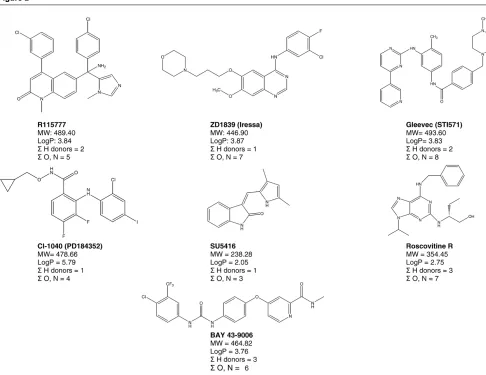
Lipinski et al. recently analysed the structural features associated with successful drugs (i.e. with good pharma-cokinetic properties) [22]. They then formulated an empiri-cal ‘Rule of 5’ that can be used to predict whether a compound would be expected to have drug-like proper-ties. The basis for the Lipinski Rule of 5 is that most suc-cessful drugs have the following features: molecular weight, < 500 Da; log P (as a measure of lipophilicity), < 5; number of hydrogen bond donors, < 5; number of oxygen plus nitrogen atoms, <10.
Some physicochemical properties relating to the Lipinski Rule of 5 are presented in Fig. 2 for several molecularly targeted compounds that have progressed to the clinic.
Using this simple Rule of 5 method, supported by experi-mental characterisation (especially for evaluation of metabolic stability), hits from HTS may be assessed before committing significant resource for chemical opti-misation. There is no reliable method for predicting toxic-ity as a function of chemical structure, but compounds with highly reactive functional groups (epoxides, quinones, etc.) that may react with DNA or proteins should generally be avoided [23]. Caution should also be extended to compounds with functional groups that have the potential to be converted into reactive species by metabolism (e.g. nitro compounds). There are clearly exceptions, however, since several successful drugs do contain those functionalities.
The collections used for screening would ideally contain only compounds that meet the criteria for good pharma-cokinetic properties and an absence of overt toxicity potential. Nevertheless, there are examples of successful drugs that do violate the Lipinski Rule of 5. On the con-trary, there can be no doubt that the overall success of a drug discovery project is increased if the compound col-lections used for HTS are heavily biased towards drug-like properties.
Examples of screening successes
The following examples are selected to illustrate how HTS is already impacting in a major way on new cancer drug development. These examples are illustrative and not exhaustive. Some of the agents described already have proven clinical utility, while others are in early or late-stage clinical development. In addition, a number of compounds with less than ideal selectivity or pharmacological proper-ties have nevertheless proved to be valuable laboratory tools to further probe the function of selected signalling pathways. Also, it is highly probable that a number of as yet undisclosed compounds have been discovered in drug discovery programmes that include HTS.
HTS has played a major role in the discovery and develop-ment of several protein kinase inhibitors. These include the 4-anilinoquinazoline ZD1839 (Iressa; Fig. 2), an ATP com-petitive inhibitor of the epidermal growth factor receptor tyrosine kinase that blocks downstream signalling path-ways involved with the proliferation and survival of cancer cells. The drug shows activity in non-small-cell lung cancer, head and neck cancer, and hormone-resistant prostate cancer, and is currently being evaluated in randomised phase III clinical trials [24]. A role in the treatment of breast cancer, including oestrogen-independent disease, might be anticipated. Iressa will probably be used extensively in combination with cytotoxic agents in various cancers.
Optimisation of the properties of kinase inhibitors identified by HTS has led to perhaps the currently best-known example of a mechanism-based, genome-targeted cancer drug. Gleevec (STI-571; Fig. 2) inhibits the constitutive kinase activity of the Bcr-Abl oncoprotein that is responsi-ble for driving malignancy in chronic myeloid leukaemia [25]. Outstanding activity has been seen, leading to rapid regulatory approval in that disease. Gleevec also shows remarkable activity in a type of sarcoma, known as gastro-intestinal stromal tumours, that are driven by c-Kitmutations. Gleevec was found to inhibit the c-Kit receptor tyrosine kinase with similar potency to its effects on Bcr-Abl. Effects on c-Kit may also lead to activity in other tumours, including small-cell lung cancer. Exploitation of the less potent inhibi-tion of the platelet-derived growth factor receptor tyrosine kinase could lead to an even broader spectrum of activity.
Additional examples of kinase inhibitors identified through screening include the vascular endothelial growth factor receptor (Flk-1/KDR) inhibitor SU5416 [26] (Fig. 2), and a number of other drugs acting on this target are now emerging.
152
promise, despite the fact that these may exert their effects by mechanisms that involve farnesylation but do not directly involve Ras. Activity has been seen with R115777 in breast cancer (see final section).
Inhibitors of c-Raf-1 and mitogen-activated protein kinase kinase (MEK) have also been identified by screening, and have subsequently been optimised into drugs that are now in clinical trials [27]. For example, BAY 43-9006 (Fig. 2), a specific inhibitor of the kinase activity of Raf-1, was selected as a clinical candidate from a compound series identified in a biochemical screen of Raf-1 kinase activity [28]. Using another approach, a biochemical cascade assay [29] identi-fied the MEK inhibitor PD-098059 that eventually led to the synthesis of the drug known as PD184352 or CI-1040 (Fig. 2) [30]. This drug showed impressive preclinical activ-ity and is currently in clinical trials. Another MEK inhibitor, U0126, was identified in a cell-based reporter screen for inhibitors of AP-1 transactivation [31]. Although unsuitable
for clinical development, this compound has proved to be extremely useful for probing the cellular consequences of Ras pathway inhibition.
[image:5.612.59.545.94.469.2]Considerable effort has been expended on the search to find compounds that modulate the activity of the tumour suppressor gene product p53. Not all validated targets for which screens can be developed have provided progress-ible leads, and the Holy Grail of ‘mutant p53 resurrection’ has proved fairly intractable. Recent studies have shown, however, that the function of mutant p53 can be restored by exposing cells to small molecule compounds identified in a novel screen that used antibodies to measure confor-mational changes to the p53 protein [32]. A range of other strategies to exploit the p53 pathway are also being pursued; for example, screening for inhibitors of the inter-action between p53 and HDM2 is a promising approach [33]. Taking a somewhat different tack, inhibitors of wild-type p53-dependent gene transcription and apoptosis
Figure 2
153 were identified using a reporter gene under the control of
a p53-responsive promoter [34]. If confirmed, such agents could be used to protect normal tissues from the side effects of cytotoxic chemotherapy.
Genome-based cell-cycle modulators are of considerable therapeutic interest, and inhibitors of cyclin-dependent kinases such as flavopiridol and R-roscovitine (CYC202; Fig. 2) are in clinical development. These could compensate for the loss of polypeptide inhibitors of cyclin-dependent kinases that is commonly seen in many tumours, including breast cancer, and could also induce tumour-selective apoptosis due to deregulated E2F [35,36]. Efforts have been made to identify drugs that would block the G2 cell-cycle checkpoint (e.g. inhibitors of Chk1 or Wee1) [37]. The therapeutic rationale for these inhibitors is that in a p53 non-functional tumour cell, radiosensitisation or chemosensitisation would occur as both the G1 and G2 checkpoints would be abrogated. In normal cells, damage due to chemotherapeutic agents or radiation would be min-imised due to the presence of a robust p53 checkpoint.
Novel mitotic inhibitors have been identified in several screens. For example, a cell-based ELISA using an antibody to a mitotic marker, phosphorylated nucleolin, was used to identify several novel inhibitors of mitosis [38]. Deconvolu-tion of the hits identified a compound, monastrol, that was shown to inhibit the motility of the kinesin Eg5 but had no direct effect on microtubules.
As a final example, a three-step invasion screen [39] was used to interrogate a natural product library. This lead to the identification of compounds that inhibit invasion and angio-genesis without being cytotoxic or affecting cellular adhesion.
Concluding remarks and applications to
breast cancer
We face the exciting prospect that every genetic lesion involved with the generation and maintenance of the malignant phenotype will soon be defined in all malignan-cies including breast cancer. This leads to the challenge of finding potent and selective drugs that can be used to reverse or control each of these molecular pathogenic events. The place of HTS in this process is ensured at least for the foreseeable future. For breast cancer, there are a number of drug development targets (or target path-ways), in addition to those already mentioned in the previ-ous section, that may have particular relevance. These include the phosphoinositide 3′-kinase signalling pathway, various cell-cycle regulation targets (in particular, the inhi-bition of cyclin D and cyclin E [40], the mitotic kinase Aurora 2 [41]), the molecular chaperone Hsp90 [42,43], the HIF-1α signalling pathway in tumour progression and angiogenesis [44,45], and enzymes involved with chro-matin modification (e.g. histone acetyltransferases and histone deacetylases) [5,46,47].
The treatment of breast cancer by a molecularly targeted, cancer genome-based strategy has already been success-fully demonstrated with the use of Herceptin, a humanised antibody to the ErbB2 receptor [48]. Clinical benefit using this agent is greater in the 20–30% of breast cancer patients that overexpress the receptor on the surface of their tumour cells. The farnesyltransferase inhibitor R115777 (see earlier) is an example of an agent, devel-oped from an HTS screening lead, that has shown activity in human breast cancer xenografts [49] and in patients with advanced breast cancer [50,51]. The ongoing dis-section of the genetics and genomics of breast cancer should bring forward a range of additional new targets for HTS and rational drug design.
Molecular mechanism-based drug discovery is well placed to provide the small-molecule drugs that, either alone or in combination with cytotoxic drugs, are required to further improve response rates and survival in individual patients with breast cancer and other malignancies. Of course, it can take a considerable length of time to fully define the role of any new mechanism-based agent in cancer treat-ment, as shown by the recent Arimidex, Tamoxifen, Alone or in Combination Trial demonstrating the value of the aro-matase inhibitor Arimidex (anastrazole) in the treatment of postmenopausal breast cancer [52].
There have been prominent criticisms of the ability of new technologies such as genomics, HTS and combinatorial chemistry to deliver the required stream of blockbusters to the pharmaceutical industry across all therapeutic areas [53]. It will be clear from the examples listed in this brief review, however, that these technologies, and most cer-tainly HTS, have already played an important role in bring-ing innovative new agents to the cancer clinic for patient benefit.
Acknowledgements
Work in the Cancer Research UK Centre for Cancer Therapeutics (http://www.icr.ac.uk/cctherap) is funded primarily by Cancer Research UK, of which PW is a Life Fellow. The authors thank their Centre col-leagues and collaborators for many valuable discussions.
References
1. International Human Genome Sequencing Consortium: Initial sequencing and analysis of the human genome. Nature 2001, 409:860-921.
2. Venter JC, Adams MD, Myers EW, Li PW, Mural RJ, Sutton GG, Smith HO, Yandell M, Evans CA, Holt RA, et al.: The sequence of the human genome. Science 2001, 291:1304-1351. 3. Futreal PA, Ksprzyk A, Birney E, Mulikin JC, Wooster R, Stratton
MR: Cancer and genomics.Nature2001, 409:850-855. 4. Ponder BA: Cancer genetics. Nature 2001, 411:336-341. 5. Workman P: Scoring a bulls-eye against cancer genome
targets. Curr Opin Pharmacol2001, 1:342-352.
6. Workman P: Changing times: developing cancer drugs in genomeland.Curr Opin Investig Drug2001, 2:1128-1135. 7. Gibbs JB: Mechanism-based target identification and drug
discovery in cancer research.Science2000, 287:1969-1973. 8. Workman P, Kaye SB: Translating basic cancer research into
154
9. Aherne GW, Garrett M, McDonald E, Workman P: Mechanism-based high throughput screening for novel anticancer drug discovery. Anti-Cancer Drug Design. Edited by Baguley BC. San Diego: Academic Press; 2002:249-267.
10. R Seethala, PB Fernandes (Eds): Drugs and pharmaceutical sciences.Handbook of Drug Screening, volume 114. New York: Marcel Dekker; 2001.
11. Leach AR, Hann MM: The in silico world of virtual libraries. Drug Discov Today2000, 5:326-337.
12. Enyedy IJ, Ling Y, Nacro K, Tomita Y, Wu X, Cao Y, Guo R, Li B, Zhu X, Huang Y, Long YQ, Roller PP, Yang D, Wang S: Discov-ery of small molecule inhibitors of Bcl-2 through structure based computer screening.J Med Chem 2001, 44:4313-4324. 13. The Times, 9 March 2002:8.
14. Sundberg SA: High-throughput and ultra-high-throughput screening: solution and cell-based approaches. Curr Opin Biotechnol 2000, 11:47-53.
15. Olesen CE, Martin CS, Mosier J, Liu B, Voyta JC, Bronstein I: Chemiluminescent reporter gene assays with 1,2-dioxetane enzyme substrates.Methods Enzymol 2000, 305:428-450. 16. Stockwell BR, Haggarty SJ, Schreiber SL: High-throughput
screening of small molecules in miniaturized mammalian cell-based assays involving post-translational modifications. Chem Biol1999, 6:71-83.
17. Dunstan HM, Ludlow C, Goehle S, Cronk M, Szanski P, Evans DRH, Simon JA, Lamb JR: Cell based assays for identification of novel double strand break inducing agents.J Natl Cancer Inst 2002, 94:88-94.
18. Torrance CJ, Agrawal V, Vogelstein B, Kinzler, KW:Use of iso-genic human cancer cells for high-throughput screening and drug discovery. Nat Biotech2001,19:940-945.
19. Alaimo PJ, Shogren-Knaak MW, Shokat KM: Chemical genetic approaches for the elucidation of signaling pathways.Curr Opin Chem Biol 2001, 5:360-367.
20. Weinstein JN, Boulamwini JK: Molecular targets in cancer drug discovery: cell based profiling.Curr Pharm Des2000, 6:373-483. 21. Zhang JH, Chung TD, Oldenburg KR:A simple statistical para-meter for use in evaluation and validation of high throughput screening assays.J Biomol Screening1999, 4:67-73.
22. Lipinski CA, Lombardo F, Dominy BW, Feeney PJ: Experimental and computational approaches to estimate solubility and per-meability in drug discovery and development setting. Adv Drug Deliv Rev 1997, 23:3-25.
23. Rishton GM: Reactive compounds and in vitrofalse positives in HTS. Drug Discov Today 1997, 2:49-58.
24. Baselga J, Averbuch SD: ZD1839 (‘Iressa’) as an anticancer agent.Drugs 2000,60(suppl 1):33-40.
25. Druker BJ: ST1571 (Gleevec) as a paradigm for cancer therapy.Trends Mol Med 2002, 8(suppl):S14-S18.
26. Fong TAT, Shawver LK, Sun L, Tang C, App H, Powell J, Kim YH, Schreck R, Wang X, Risau W, Ullrich A, Hirth KP, McMahon G: SU5416 is a potent and selective inhibitor of the vascular endothelial growth factor receptor (Flk-1/KDR) that inhibits tyrosine kinase catalysis, tumor vascularisation, and growth of multiple tumor types. Cancer Res1999,59:99-106.
27. Herrera R, Sebolt-Leopold JS: Unravelling the complexities of the Raf-MAP kinase pathway for pharmacological interven-tion.Trends Mol Med2002, 8(suppl):27-31.
28. Lyons JF, Wilheim S, Hibner B, Bollag G: Discovery of a novel Raf kinase inhibitor. Endocr Relat Cancer2001, 8:219-225. 29. Allesi DR, Cohen P, Ashworth A, Cowley S, Leevers SJ, Marshall
CJ: Assay and expression of mitogen-activated protein kinase, MAP kinase kinase and Raf.Method Enzymol 1995, 225:279-290.
30. Sebolt-Leopold JS, Dudley DT, Herrerra R, Van Becelaere K, Willand A, Gowan RC, Tecle H, Barrett SD, Bridges A, Przybra-nowski S, Leopold WR, Saltiel AR:Blockade of the MAP kinase pathway suppresses growth of colon tumours in vivo.Nat Med 1999, 5:810-815.
31. Favata MF, Kurumi YH, Manos EJ, Daulerio AJ, Stradley DA, Feeser WS, Van Dyk DE, Pitts WJ, Earl RA, Hobbs F, Copeland RA, Magolda RL, Scherle PA, Trzaskos JM:Identification of a novel inhibitor of mitogen-activated protein kinase. J Biol Chem 1998, 29:18623-18632.
32. Foster BA, Coffey HA, Morin MJ, Rastinejad F: Pharmacological rescue of mutant p53 conformation and function. Science 2001,286:2507-2510.
33. Lane DP, Lain S: Therapeutic exploration of the p53 pathway. Trends Mol Med 2002, 8:438-442.
34. Komarov PG, Komarov EA, Kondratou RV, Christou-Tselkou K, Coon JS, Chemou MV, Gudkov AV: A chemical inhibitor of p53 that protects mice from the side effects of cancer therapy. Science1999, 285:1733-1737.
35. Chen YN, Sharma SK, Ramsey TM, Jiang L, Martin MS, Baker K, Adams PD, Bair KW, Kaelin WG Jr: Selective killing of trans-formed cells by cyclin/cyclin-dependent kinase 2 antagonists. Proc Natl Acad Sci USA1999, 96:4325-4329.
36. Lee MH, Yang HY: Negative regulators of cyclin-dependent kinases and their roles in cancers. Cell Mol Life Sci2001 58:1907-1922.
37. Wang Y, Li J, Booher RN, Kraker A, Lawrence T, Leopold WR, Sun Y: Radiosensitisation of mutant cells by PD0166285, a novel G2 checkpoint abrogator.Cancer Res 2001, 61:8211-8217.
38. Mayer TU, Kapoor TM, Haggerty SJ, King RW, Scheiber SL, Mitchison TJ: Small molecule inhibitor of mitotic spindle bi-polarity identified in a phenotype-based screen. Science 1999, 286:971-974.
39. Roskelley CD, Williams DE, McHardy LM, Leong KG, Troussard A, Karsan A, Andersen RJ, Dedhar S, Roberge M:Inhibition of tumour cell invasion and angiogenesis by motuporamines. Cancer Res 2001,61:6788-6794.
40. Steg PS, Zhou Q:Cyclins and breast cancer. Breast Cancer Res Treat1998, 52:17-28.
41. Miyoshi Y, Iwao K, Egawa C, Noguchi S:Association of centro-somal kinase STK15/BTAK mRNA expression with chromo-somal instability in human breast cancers.Int J Cancer 2001, 92:370-373.
42. Maloney A, Workman P:HSP90 as a new therapeutic target for cancer therapy: the story unfolds. Expert Opin Biol Ther 2002, 2:3-24.
43. Basso AD, Solit DB, Munster PN, Rosen N: Ansamycin anti-biotics inhibit Akt activation and cyclin D expression in breast cancer cells that overexpress HER2. Oncogene 2002, 21: 1159-1166.
44. Bos R, Zhong H, Hanrahan CF, Mommers EC, Semenza GL, Pinedo HM, Abeloff MD, Simons JW, van Driest PJ, van der Wall E: Levels of hypoxia-inducible factor-1 alpha during breast carcinogenesis.J Natl Cancer Inst 2001, 93:1175-1177. 45. Semenza GL:HIF-1 and tumour progression: pathophysiology
and therapeutics.Trends Mol Med 2002, 8(suppl):S62-S67. 46. Mahlknecht U, Hoelzer D: Histone acetylation modifiers the
pathogenesis of malignant disease. Mol Med 2000, 6:623-644.
47. Turlais F, Hardcastle A, Rowlands M, Newbatt Y, Bannister A, Kouzarides T, Workman P, Aherne GW: High throughput screening for identification of small molecule inhibitors of histone acetyltransferases using scintillating microplates (flashplate).Anal Biochem 2001, 298:62-68.
48. Miles DW:Update on Her-2 as a target for cancer therapy: Herceptin in the clinical setting. Breast Cancer Res 2001,3: 380-384.
49. Kelland LR, Smith V, Valenti M, Patterson L, Clarke PA, Detre S, End H, Howes AJ, Dowsett M, Workman P, Johnston SR: Preclin-ical antitumour activity and pharmacodynamic studies with the farnesyl protein transferase inhibitor R115777 in human breast cancer. Clin Cancer Res2001, 7:3544-3550.
50. Johnston SRD:Farnesyl transferase inhibitors — a novel tar-geted therapy for breast cancer.Lancet Oncol 2000, 2:18-26. 51. Johnston SRD, Ellis PA, Houston S, Hickish T, Howes AJ, Palmer
P, Horak I: A phase II study of the farnesyl transferase inhibitor R115777 in patients with advanced breast cancer [abstract].Proc Am Assoc Clin Oncol 2000,19:83a.
52. Nichols H: Aromatase inhibitors continue their ATAC on tamoxifen. Trends Mol Med 2002, 8:S12-S13.