Rochester Institute of Technology
RIT Scholar Works
Theses
Thesis/Dissertation Collections
1997
A Practical implementation of high-speed
communication using digital subscriber line
technology
Todd Engle
Follow this and additional works at:
http://scholarworks.rit.edu/theses
This Thesis is brought to you for free and open access by the Thesis/Dissertation Collections at RIT Scholar Works. It has been accepted for inclusion in Theses by an authorized administrator of RIT Scholar Works. For more information, please [email protected].
Recommended Citation
A PRACTICAL
IMPLEMENTATION
OF HIGH-SPEED
COMMUNICATION
USING
DIGITAL
SUBSCRIBER LINE TECHNOLOGY
by
TODD R. ENGLE
THIS THESIS IS SUBMITTED IN PARTIAL FULFILLMENT OF THE REQUIREMENTS
FOR THE DEGREE OF MASTER OF SCIENCE IN INFORMATION TECHNOLOGY
ROCHESTER INSTITUTE OF TECHNOLOGY
DECEMBER 1997
Professor A'ishaAjayi,Advisor
Master of Science in Information Technology
Capstone Project/Thesis Approval Form
Student
Name:_--'-~/---:::::o....;;d;.:..c\=·_f\~.:...-...~=::;;;...:.h...l...gJ~e""",-<,----
_
Student ID#:
_
ProjectfThesis Committee:
Name
Chair
Committee member
Graduate Program Chair
revised: 4/9/97
Wallace Library
Rochester Institute of Technology
Thesis Reproduction Permission Statement
Permission From Author Required
Title of thesis:
A Practical Implementation of High-Speed Communication
using Digital Subscriber Line Technology
I, Todd
R.
Engle, prefer to be contacted each time a request for
reproduction is made.
If permission is granted, any reproduction will not
be for commercial use or profit. I can be reached at the following address:
4 Folkestone Lane
Penfield, NY 14526
Phone:
(716) 377-3995
COPYRIGHTS
Allrights reserved.Nopartofthispublicationmay bereproducedor utilizedin any form or
by
anymeans,electronic ormechanical,
including
photocopying,recordingorby
any informationstorage and retrieval system,withoutpermissionin writing fromtheauthor.
Analog
Devices is a registeredtrademarkofAnalog
Devices Corporation.Ascendis aregisteredtrademarkofAscend Corporation.
Aware isa registeredtrademarkofAware Corporation.
GTE is a registeredtrademarkofGTE Corporation.
Microsoft isa registeredtrademarkofMicrosoft Corporation.
PulsecomandWavePacerare registeredtrademarksofPulse Communications Corporation.
TeleChoice is a registeredtrademarkofTeleChoice Corporation.
Time Warnerisa registeredtrademarkofTime Warner Corporation.
3Comis aregisteredtrademarkof3Com Corporation.
U.S. Robotics is a registeredtrademarkof3Com Corporation.
Allother names andbrands arethepropertyoftheirrespective owners.
Todd R. Engle Page 2 CapstoneThesis
ACKNOWLEDGEMENTS
Iwantto thank the
faculty
and staff oftheDepartmentofInformationTechnology
atRochesterInstituteof
Technology
for makingthislearning
experiencesorewardingand enjoyable.Iwouldliketogive a specialthanks toProfessor A'isha
Ajayi,
mythesisadvisorand aninstructorforseveral ofmycourses. Professor Ajayihas alwaysbeen anextremelysupportiveteacher, andhas
providedme withtheopportunitytoachieve tomy fullestpotential.
Ialso wanttothankmy
family
andfriends fortheirhelp
and support overtheyears. I specificallywantto acknowledgemyparentsand grandparents for encouragingmetocontinuemyeducation.
Duetomy family's manyexamples,Ihave learnedthateducationisa
life-long
process.Finally,
Iwantto thankmywife,Michele,
for"being
there"
forme
during
thisentire process.She hasserved asmyeditor,proofreader, and chief supporter.Isharethisachievement with
Michele,
mywife andmy best friend.ToddR. Engle Page3 Capstone Thesis
TABLE
OF CONTENTS
1.
INTRODUCTION
91.1 DefinitionofKey Terms 11
1.2 DefinitionofHigh-Speed Communication 12
1.3 Multimedia: The FutureofCommunication 15
1.4 Requirements 16
1.4.1 High Data Transmission Rate 17
1.4.2 Global Deployment 17
1.4.3 Wide-Scale Deployment 17
1.4.4 Short-Term Deployment 18
1.4.5 Low Cost To Consumers 18
1.4.6 Low Cost To Suppliers 18
1.4.7 High Growth Potential 18
1.5 Objectives 19
2.CURRENT PROBLEMS 20
2.1 Technology Issues 20
2.1.1 Infrastructure Limitations 21
2.2 Economical Issues 22
2.2.1 Consumer Resistance 22
2.2.2 Supplier Resistance 22
2.3 Social Issues 23
3. POTENTIALSOLUTIONS 24
3.1 Integrated Services Digital Network
(ISDN)
243.1.1 Advantages ofISDN 25
3. 1.2 DisadvantagesofISDN 25
3.2 Digital Subscriber Line Technologies
(xDSL)
273.2.1 Asymmetric Digital Subscriber Line
(ADSL)
273.2.2 High Bit Rate Digital Subscriber Line
(HDSL)
273.2.3 Symmetric Digital Subscriber Line
(SDSL)
283.2.4
Very
High Bit Rate Digital Subscriber Line(VDSL)
293.2.5 Advantagesof xDSL 30
3.2.6 Disadvantagesof xDSL 30
3.3 Cable Modems 31
3.3.1 Introduction 31
3.3.2 AdvantagesofCable Modems 33
3.3.3 DisadvantagesofCable Modems 33
4.PRACTICALSOLUTION
(XDSL)
344.1 SelectionCriteria 34
4.2xDSLandCableModems 34
Todd R. Engle Page 4 CapstoneThesis
5. PRACTICAL IMPLEMENTATION OFXDSL 35
5.1DIAL-UPXDSL 37
5.1.1
Reliability
andFault Tolerance 375.1.2
Flexibility
385.1.3
Interoperability
395. 1.4 System Usage 40
5.1.5Deployment Costs 41
5.1.6EconomicsofDeployment 42
5.1.7GlobalDemographics 43
5.2 End-to-end Interoperability 43
5.2.1 Two LevelsofProviders 44
5.2.2 PPPoverATM over xDSL 45
5.3 End-User Configuration 47
5.3.1 POTS Splitter 47
5.3.2 Hybrid High-Speed Modem 49
6.CONCLUSIONS 50
6.1 xDSL: The Only Practical Solution 50
6.2 Phased Approach 51
6.3 Dial-UpxDSL 51
6.4 Standard Protocols 52
6.5 Hybrid Modem 52
6.6 POTS Splitter 53
6.7 Promotionof xDSL andHigh-Speed Communication 53
6.8 Summary 53
7.DEFINITIONS AND ABBREVIATIONS 55
8.BIBLIOGRAPHY 61
9.ENDNOTES 64
ToddR. Engle Page 5 CapstoneThesis
LIST OF TABLES
Table 1-1: ComparisonofDifferent Transmission TimesatVarious Transmission Rates 13 Table 5-1: Remote Access andInternet Access Usage Patterns 41
ToddR. Engle Page6 CapstoneThesis
LIST
OF FIGURES
Figure 1: Communication System Overview 10
Figure 2: Access Network Architecture 11
Figure 3: ISDN Architecture 24
Figure4: ADSL Architecture 27
Figure5: HDSL Architecture 28
Figure6: SDSL Architecture 29
Figure 7: VDSL Architecture 29
Figure 8: Data Over Cable Reference Architecture 31
Figure 9: Dedicated ADSL Implementation Model 35
Figure 10:
Dial-Up
xDSLArchitecture 37Figure 1 1: xDSLModemandPOTS Splitter 48
ToddR. Engle Page 7 Capstone Thesis
ABSTRACT
Thisthesiscreates a planforthepracticalimplementationofhigh-speedcommunicationfor
residences andbusinesses.
By
implementing
low-cost,
high-speedcommunicationon a globalscale, tremendousbenefits can occurinareas such asInternetcommunication,interactive
multimedia,telecommuting, anddistance learning. Despite several successfultrialsof various
high-speedcommunication technologies,many barriersremainbefore deploymentcan occurto
thegeneral public. Thisthesisproposes a plantobridgethe gap betweentheoretical teststudies
and globalimplementation.
Thisthesisevaluatesthreecommunication systems as potential solutionsforhigh-speed
communication and selects one systemasthesolution.Thethreecandidatesystems areDigital
Subscriber Linetechnologies
(collectively
referredtoasxDSL), Integrated Services DigitalNetwork
(ISDN),
and cable modem.Thechosentechnology
solution, xDSL, allowstwisted-paircopper wire(i.e. telephone
lines)
tobeusedfor high-speedcommunication. Thechoice of xDSLasthe
technology
solutionis basedonmanyfactors,
all of which correspondtopracticality. Theintentofthis thesisis notthepromotion ofxDSL; rather,theprimaryobjectiveistocreate a plan
to quicklyandglobally implementa
low-cost,
high-speedcommunicationinfrastructure forresidences andbusinesses.
Todd R. Engle Page 8 Capstone Thesis
December1997 M.S.inInformation
1.
Introduction
Throughoutthe world,businesses and residencesdependuponnetworkstoprovide
information,
education and entertainment.The popularityofthe InternetandtheWorld Wide Web has created
atremendousdemand for manynetwork-relatedservices, such asinteractivemultimedia,
telecommuting, video-conferencing,anddistance learning.
Unfortunately,
themostwidelyusedsystemforremotenetwork access analogmodems over voice-gradetelephonelines does
not providetheperformance required
by
today's users and applications.Users arebecoming
increasingly
frustratedwith veryslow accesstimes,andbusinesses arelimited intheservicesthey
cancurrentlyprovide customers.Acost-effective,high-speedcommunication systemforresidences andbusinesses capable of
globalimplementation canhavearevolutionary impactontoday'sworld (Broadband Services
Expert
Group,
1994). Just as construction oftheinterstatehighway
systeminthe 1950sfacilitatedtheexpansion oftheUnited
States,
theconstruction ofinformation highways inthe1990s will generate economic and social changes wellintothenextcentury
(3Com,
1995). Theglobalimplementation ofhigh-speedcommunication will allowindividualstointeractwithout
regardtogeographicalboundaries.
From 1995 to
1997,
several majorcorporations, such asMicrosoft,
GTE,
U.S.West,
andTimeWarner,
conductedmany datatrialsofhigh-speedcommunication(GTE,
1997). The datatrialssuccessfullydemonstratedthecapabilities of varioustechnologiesfor high-speedcommunication
tohomesandbusinesses.Whilethedatatrialsfocused primarilyonthe technical detailsof
high-Todd R. Engle Page 9 Capstone Thesis
speedcommunication, many moreissuesneedtobeaddressedand resolvedbefore
implementation
can occurto the generalpublic. Withouttheresolution oftheseissues,
theavailabilityofcost-effective,high-speed communicationto thegeneral publicmay not occur until
theyear2000orbeyond
(King,
1996). Apracticalplanneeds tobecreatedwhichfocuses onthereal-worldissuesof
deployment,
inordertopromotetheimplementationofhigh-speedcommunicationinthevery nearfuture.
Thisthesisproposes a practicalplanfor globally
implementing
acost-effective,high-speedcommunicationinfrastructure for businesses and residences.Three high-speedcommunication
technologiesareevaluated,and a singletechnology, Digital Subscriber Line
(xDSL),
ischosen asthe
technology
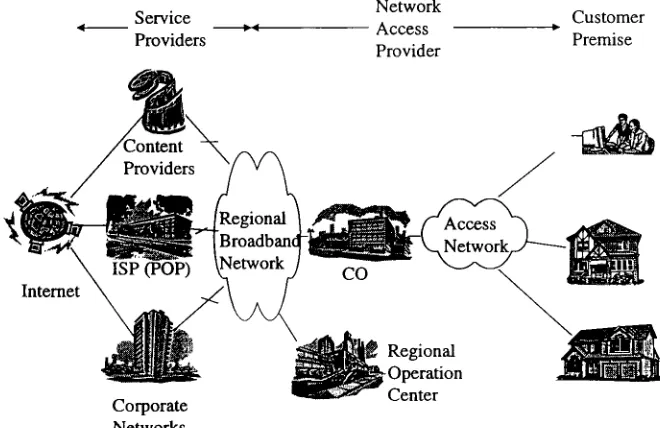
solution.Theplan specifies acomplete,end-to-end systemfor high-speedcommunication,fromthe end-user, tothenetworkaccessprovider, to the service provider:
Service
Providers
Network
Access
Provider
Corporate
Networks
Customer
[image:13.565.117.447.385.599.2]Premise
Figure 1: Communication System Overview
(U.S.Robotics, 1997)
Todd R. Engle
December1997
Page 10 Capstone Thesis
1.1
Definition
ofKey
Terms
Customerpremise, asshownin Figure
1,
includesresidences,homeoffices and smallbusinessoffices. Customer Premise Equipment
(CPE)
represents anydevice,
locatedwithin thecustomerpremise, thatispart of a communication system.Forexample, aresidence isacustomerpremise,
atelephoneis atype of customer premiseequipment, andthe telephonenetwork represents a
communication system. Forthis thesis,CPEwillinvolvemodems,personalcomputers
(PCs),
and otherdevicesnecessary for
implementing
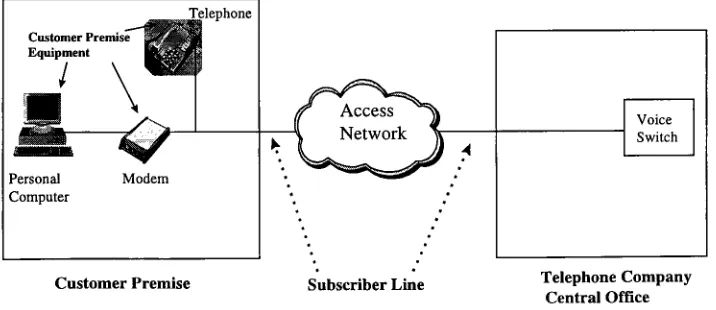
high-speedcommunication.Accessnetworkisthecommunication systembetweenthecustomer premise and an access
networkprovider,such as atelephoneor cable company.Thetelephonesystem's access network
is usuallyreferredto asthelocal
loop,
andpredominatelyconsistsoftwisted-paircopper wireconnectingthetelephonecompany'scentral office
(CO)
toa customer premise. The connectionbetweenaCOand a customerpremiseis commonlycalledthesubscriberline. Whilethis thesis
specifies acomplete end-to-endsystem,it focuses primarily ontheaccess network,customer
premiseequipment,andthesubscriberline. In Figure
2,
atypicalaccess networkisshown:CustomerPremise Equipment
Telephone
Personal
Computer
Modem
Voice
Switch
))
ACustomer Premise Subscriber Line TelephoneCompany Central Office
Figure2: AccessNetwork Architecture
ToddR. Engle December 1997
Page 11 Capstone Thesis
[image:14.565.103.461.488.643.2]Two
terms,
upstreamanddownstream,
are usedfrequently
in thisthesis.Upstreamrefers to thedirectionofdataflowfromthecustomer premisetotheaccess network provider.Downstream
refers to thedirection ofdata flow fromtheaccess network providerto thecustomer premise. In
situations wherethesubscriberline'supstreamdata flow isnot equalto thedownstream data
flow,
thesubscriberline isconsideredtobe asymmetric.Conversely,
a symmetric subscriberlinerepresents an equaldata flow for boththeupstream anddownstreampaths (i.e.channels).
As statedpreviously, theproposedimplementationplanispractical. Thedefinitionsoftheword
practical arefollowedthroughout the thesis.Theplanis
"relating
to,or manifestedinpractice oraction: nottheoretical or
ideal.1"
The details for implementation are"capableof
being
puttouseor account:
useful.2"
Finally,
theunderlyingthemeofthe thesisis "disposedtoaction as opposedto speculation or
abstraction.3"
1.2
Definition
ofHigh-Speed Communication
Sincethe term"high-speedcommunication"
isrelative,itmustbe defined inthis context.In
1987,
high-speed datacommunication(tohomesandbusinessesovertelephonelines)
wouldbedefinedas 9,600 bitspersecond(9.6 kilobitspersecond,orkbps). Thisthesisdefines high-speed
communication as millions ofbits
(megabits)
persecond (Mbps).Thereasonfordefining
amulti-megabittransmissionrate is duetothedata intensive demandsof current andfuture
network services. The
following
tablecompares differenttransmissiontimesat varioustransmissionrates, andhelps todemonstratetheenormous potential ofhigh-speed
communication:
Todd R. Engle Page 12 Capstone Thesis
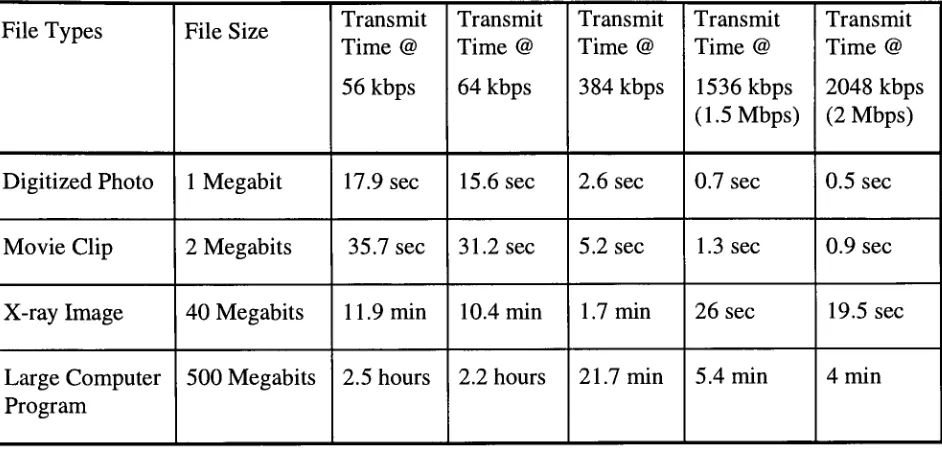
Table 1-1: Comparison ofDifferent Transmission Timesat Various Transmission Rates
File Types FileSize Transmit Time @ 56 kbps Transmit Time @ 64 kbps Transmit Time @ 384 kbps Transmit Time @ 1536 kbps (1.5
Mbps)
Transmit Time @ 2048 kbps (2Mbps)
Digitized Photo 1 Megabit 17.9 sec 15.6sec 2.6sec 0.7sec 0.5 sec
Movie
Clip
2 Megabits 35.7 sec 31.2sec 5.2 sec 1.3 sec 0.9 secX-ray
Image 40 Megabits 11.9 min 10.4min 1.7 min 26 sec 19.5 secLarge Computer
Program
500 Megabits 2.5hours 2.2hours 21.7 min 5.4min 4min
Themaximumdownstreamspeed oftoday's analogmodemsis 56,000 bitsper second(56
kilobitspersecond,or56 kbps). Asshown
by
Tablel-1,
theperformance difference between56kbpsand 1.5Mbps isextreme.Theperformancedifference between 56 kbpsand2 Mbpsiseven
greater.Whilegreater performance isalwaysdesired
by
the end-user, practicallimitationsmustbe
defined,
dueto technologicaland economical concerns.Anincrease inaccess network performance willhaveawide-ranging impact in many areas. The
possibilityexistsfortheaccess networktoactuallyexceedtheperformanceof other areas of a
communicationsystem,such as a modem's interfacetoa personal computer(U.S.
Robotics,
1997).
Additionally,
theaccessnetwork's capabilities mayalso exceedthemaximumdatarate ofa service provider'snetworks.A studyoftheInternethelpstodemonstratethis case.
ToddR. Engle
December1997
Page13 Capstone Thesis
The
Internet,
andotherIP (InternetProtocol)
systems,generally function inanAvailable Bit Rate(ABR)
mode, andarethereforegraceful aboutaccommodatingvarious andvaryingspeeds.Furthermore,
mostInternetserverstoday
operateat56kbps,
and power servers seldom operate atspeeds aboveTl (1.544
Mbps),
limiting
usefuldataratesto 1.5 Mbps forsometime(Maxwell,
1997).
Forend-usersperforming Internetcommunication,a6 Mbps transmissionrate ontheaccess
networkis notpractical, sincethemajorityoftheInternetservers operate at 1.5Mbps orless.
Since Internetcommunicationis a
key
reasonforimplementing
high-speedcommunicationtohomesand
businesses,
thecapabilities oftheInternethavegreat significancein thespecificationoftheaccess network'stransmissionrate.
Therefore,
this thesisproposes an initialimplementationofhigh-speedcommunicationwith a practicallimitof2 Mbpstransmissionrate
ontheaccess network.
Casual Internetusersmay greatlyappreciatefasterresponsetimeswithhigh-speed
communication,butsomeindividuals may havemore criticalneeds.Table 1-1 showedthe
various responsetimesinvolved in retrievinga40 Megabit
X-ray
atdifferenttransmission rates.Ifaphysician,forexample,needs toreview this
X-ray
(whichis stored at a remotehospital),
thephysicianmay beabletowait20secondsforthe
information,
buta 12minutedelay
may notbeacceptableincritical situations.
Thisexampledemonstratesonebenefitofhigh-speedcommunicationinthe area oftelemedicine,
and also showstheenormous potential of
implementing
high-speedcommunicationtothegeneral public.Withsome applications andservices,
however,
a multi-megabittransmissionrateTodd R. Engle Page 14 Capstone Thesis
isnotsimply abenefitoracritical need it isa requirement. Anexample ofthis type of service
is multimedia.
1.3
Multimedia:
The Future
ofCommunication
Multimediais avery importantandnoteworthy service which requireshigh-speed
communication. Multimediais definedasthesimultaneoususe of multipleformsof
communicationsmedia,such astext, graphics, voice, sound,and still andmoving images
(3Com,
1997). Multimediaappealsto thevariousfundamentalmechanisms ofhumancommunication,
including
observation andimitation,
spokenlanguage,
and writtencommunication, creatingamulti-dimensionalcontextfortheexchangeofinformation. Theuse of multiple communication
pathsincreases interestandsignificantly improvesretention
(3Com,
1997).Multimedia is commonlyclassified
by
thenature ofthecontent andthemethod of consumptionby
users.Thetwomain categories are stored playback and real-timeinteractivemultimedia.Anexampleof stored playback multimediais playingatape on a video cassette recorder.
By
contrast, a video conferenceis an example of real-timeinteractive multimedia.Whetherthe
information isstored or
live,
thegoal of multimediaistocommunicateinformation quickly andeffectively
(MPEG,
1997).Multimediaispart of afundamentaltrendincomputing, anditwilleventually be deployed
everywhere
(3Com,
1997). Multimedia isbeing
deployednotonly inworkgroups,butthroughoutthecorporatenetwork, andis reachingintothe
daily
livesofthegeneral population. Themultimediaapplications
being
deployedover networkstoday
rangefrom distancelearning
(e.g.Todd R. Engle Page 15 Capstone Thesis
computer-basedseminars anddegree programs) tocollaborativecomputing (e.g. video
conferencing
andtelemedicine).Torespondto thistrend, networks mustsupport multimediainallforms.Thefundamentalrequirementtosupport multimediatransmission is high-speed
communication, rangingfrom hundredsofkilobitspersecondtotensof megabits per second
(3Com,
1997).Duetothecontinuousnature ofmultimedia
data,
itrequires networkingtechnologies thatminimizeboth
delay
andlost information. Forstored-playbackmultimedia, delaysof afewseconds(betweentheissuanceof a command andthe
delivery
ofinformation)
istoleratedby
users,as
long
astheinformation is deliveredsmoothly.By
contrast,inreal-timeinteractivemultimediaapplications, video and audiotransmissionmustbereceivedina
timely
manner, oreffectivehuman interaction isnot possible. Significant delaysare not acceptable.
The MPEG
(Moving
PictureExpertsGroup)
standardsbody
is currentlydeveloping
a standardfor interactivemultimediaapplications,entitledMPEG-4. The MPEG-4standard willbecomean
InternationalStandardin
January
1999,
andit specifies adatatransmissionrate"up
to4Mb/s"(MPEG,
1997). Interactivemultimediaapplications such asvideoconferencing, videophone, andtelemedicinerequirethehighbitratemode of
MPEG-4,
andthey
demonstratetheneedfor highspeed communication.
1.4 Requirements
Thisthesiscreates a set of requirements forhigh-speedcommunication, whichismodeled after
thelistof requirementsfromtheGTE Data Trial
(GTE,
1997)
andPulsecomCorporation'sTodd R. Engle Page 16 Capstone Thesis
systemsolutionfor high-speednetworks
(Pulsecom,
1997). Theimplementationplan adheres totheserequirements,witheveryrequirement
being
metfortheimplementation plantobeconsidereduseful. The
implementation
plan alsofollows a set of goals and objectives(Pulsecom,
1997),
which areconsideredtobe both beneficialanddesirable,
butnot essentialforsuccessfulimplementation.
1.4.1 HighDataTransmissionRate
Aspreviouslynoted, theproposedsolution mustinclude a multi-megabit perseconddata
transmission rate.Aminimumlimitof one megabit per second
(Mbps)
willberequired asthetransmission rate.Atechnicalsolution with atransmissionratelessthan one megabit per second
will notbeselectedasa possible solution.
1.4.2 Global Deployment
Thesolution mustinclude deploymenttocountries and regions otherthan theUnited States. For
a communication plantobe
truly
practical,itmust recognizetheneedforworld-widecommunication.The many issues relatingtoglobaldeploymentmustbe addressed, such as
geographical
limitations,
politicalrestrictions,and economics.1.4.3 Wide-Scale Deployment
Theplan must specify immediate
implementation,
whichistobe commerciallyusedby
thegeneral public.
Todd R. Engle Page 17 Capstone Thesis
1.4.4
Short-Term
DeploymentThe solutionhas atime-to-marketrequirementof six months orless. A fiveyear plan isnot
acceptable.
1.4.5 Low Cost To Consumers
Apractical solution would notexpect consumerstoendurelargeexpense,eitherforone-time
equipmentpurchases,orforcontinuous servicefees. Themaximumlimits forconsumer costis
set at$300forone-time equipmentpurchases, and$50per month forcontinuous servicefees
(ADSL
Forum,
1997).1.4.6 Low Cost To Suppliers
Thesuppliers cannotimplement high-speedcommunication unless it is
financially
beneficial.Dueto the varyingand subjectivedegrees offinancial benefit forthevarious suppliers, this
requirement cannotbeconstrained
by
specific numbers.Therefore,
it is leftas a general guidelinefortheimplementationplantofollow.
1.4.7 HighGrowth Potential
Thesolution musthavelong-term future benefits. Itmust allowforgrowth,specifically increased
speed and new services.
Todd R. Engle Page 18 Capstone Thesis
1.5
Objectives
Thegoals and objectivesoftheplan are generallydefinedas:
1. Utilizationof
existinginfrastructure: equipment,personnel and procedures
2. Utilizationofexisting
billing
andauthentication infrastructure3. Selectionof ahighspeedservicewhich outperforms otherdatacommunicationtechnologies
4. Reductionoftraffic onPublic Switched Telephone Network
(PSTN)
voice switchesby
moving datatohigh-speed backbonenetworks
Theaforementionedrequirements and objectiveshaveone commonlink: theneeds oftheuser.
Gene Frantz
(Dunn, 1997),
business developmentmanagerfor TexasInstruments,
states:"Whenwelookatemergingmarkets, Iresorttoan
interesting
concept andtry
todecidewhatdoestheuserreallywant.And itappears thatwhathe wantsis adatarate of about 6 Mbpsor
better,
at acost of$150fortheboxat
K-mart,
and amonthly service no morethan $20fromthe telephonecompany."
To achievetheseextensive"customerrequirements"
as suggested
by
Mr.Frantz,
severalissuesmustberesolvedbefore
low-cost,
universal, high-speedcommunicationbecomesa reality.Todd R. Engle Page 19 Capstone Thesis
2.
Current
Problems
Many
current problems mustbe solvedbefore high-speedcommunication canbe implemented.Theproblemsexistin manyareas, specificallytechnology,economics,and sociology.Thearea of
sociology refersto themany issues surroundinga society'sabilitytocomprehendand utilize
technology,in additionto theimpactof
technology
onthelifestyleof an individual.Many
current approaches to theimplementationofhigh-speedcommunication are toonarrowly focused
ontechnology, anddonot addressmany other critical areas.
According
toAlbert Ankhoa(1996),
customers "carenot about embeddedplant, new plant orwhethertheirinformation and entertainment services comefromtwistedpairs, coaxialcables,
wireless, or satellitelinks. Whatconsumers wantis affordableprice and service
reliability."
While Ankhoa iscorrect on cost andreliabilityconcerns oftheconsumer,the listmustbe
expandedtoinclude
high-speed,
availability,and minimal configuration.2.1
Technology
Issues
Formost residences andmany
businesses,
datacommunication is accomplished overtelephonelinesvia voice-grade
(analog)
modems.Voicegrade modems operate atthesubscriber (i.e.customer)endof voice grade linesandtransmitsignalsthrough thecoreswitchingnetwork
withoutalteration; thenetworktreats themexactly likevoice signals.Whilethisprocessing
methodhas many
drawbacks,
italsohas beena greatbenefit. Despite relatively slowspeeds,Todd R. Engle Page20 CapstoneThesis
voice-grademodemscanbeconnected anywhere atelephonelineexists,andtherearenearly 800
million suchlocations(ADSL
Forum,
1997).Themost practicalimplementationplanofany
technology
wouldspecifytheleastamount ofnecessarywork. Foranimplementationofhigh-speedcommunication,atremendousbenefit
wouldbethe abilitytousetheexistingnetwork oftelephonelines formulti-megabit
transmission.
Unfortunately,
thecurrenttelephonenetworkhas limitationson speed.2.1.1 Infrastructure Limitations
The speedlimitationsoftelephonelines are notdueto thephysicalcharacteristics ofthe wire;
rather,thelimitationsexist withinthetelephonesystem.Thetelephonecompany has filters atthe
edge oftheaccess network which restrictthevoice channeltoonly 3.3 kilohertz
(kHz)
bandwidth
(ANSI,
1995). Withoutfilters,
copper accesslinescan passfrequencies intomegahertz
(MHz)
regions,albeit with substantial attenuation(ADSLForum,
1997). Despitetechnological
limitations,
theexisting infrastructureoftelephone lines hasthepotentialtobecomepart of ahigh-speednetwork.
Cable Television
(CATV)
alsohas significantinfrastructure limitations.Only
about5%ofCATVcompanies'
cable facilities have beenupgradedto
two-way
digitaltransmissioncapability(Ankhoa,
1996). The onlypractical plantoimplementhigh-speed datacommunication,inaveryshorttime
frame,
istoreducethetime-consuming
and expensive taskof new wireinstallations.Todd R. Engle Page 21 Capstone Thesis
2.2
Economical
Issues
Apracticalimplementationofhigh-speedcommunicationmust considertheeconomical issues. Consumerand supplier resistancetonew
technology
is discussed inthefollowing
sections.2.2.1 Consumer Resistance
Thecustomercostisacriticalissue. As farasthecustomersareconcerned,
they
havethechoicetobecouch potatoes ortointeractwiththecontents at will
(Ankhoa,
1996). Ifcustomer costistoo
high,
consumers will continuetouse analogmodemsforthenextdecade. Theentire planmustbeconstructed with customer costinmind.
2.2.2 Supplier Resistance
Suppliers are resistanttocapital expenditures without short-term return oninvestment. The
implementationplan cannotdedicate largecapitaltoinfrastructure
improvement,
becausethatisnot practicalinthecurrent economy.Forexample,thecurrenttelephonenetwork usestwisted
pair copper wiretoconnect most residences andmany businesses tothetelephonecompany's
centraloffice(CO). Thecopper wireinfrastructure is
limited,
anddoesnothavethecapabilities offiberoptic cable.However,
replacingthecurrentaccess network withfiberoptic cable(referredtoasFTTC,
or"fiberto the curb")is acostlyproposition.
Industry
experts estimatethatcreating anFTTCnetwork will cost about$1,500per currenttelephone customer
(Ankhoa,
1996). Thereplacementofthe existing800million worldwidetelephonelineswould cost morethanthree-quartersof a
Todd R. Engle Page 22 Capstone Thesis
trilliondollars
(Analog
Devices,
1997).2.3 Social Issues
Personalcomputersareseldomlocated inahomeadjacentto thetelevision ortelevisioncoaxial
cabling.Personal computers, especially ones
desiring
networkaccess,typically
sit near atelephoneline
(Ankhoa,
1996). Ifahigh-speedcommunicationtechnology
does not utilizethetelephone
line,
theresidentialcustomer will needtoeitherinstall newwiringor relocatethecomputer.Additional workforconsumersisviewedas adefinite drawbacktosuccessful
deployment.
Apractical planforhigh-speedcommunication would attempttofollowthemodel of
communication whichhasexistedfor approximately twodecades. Consumers readilyunderstand
thebasicsystem of voice-grade modems andtelephones.The simplicityofthismodelis alarge
contributing factorto thepopularityofdatacommunicationtoday.
Any
technology
solutionwhichdeviates fromthismodel wouldneedtohave significant advantagestowarrantthechange.
Ifatelevisionis used as a networkinterface device (i.e.the television screenisthecomputer
screen), major changes must occurinthe social patterns oftheend-user. Theinterruptionof
normal social patterns of consumers wouldgreatlyreducethe opportunity forsuccessful
deployment.
Todd R. Engle Page 23 Capstone Thesis
3.
Potential Solutions
3.1
Integrated
Services Digital Network
(ISDN)
IntegratedServices DigitalNetwork
(ISDN)
isan all-digitaltelecommunicationstechnology
which simultaneouslytransmitsvoice conversationsanddataoverthesame pair of copper
telephonewires.Two importantaspects ofISDN and
key
differentiators from analogtelephonelines are
flexibility
anddatatransferspeed.ISDN ispart of anevolutionaryprocess,startedinthe
1950s,
toupgradethe telephonenetworkfrom analogtodigitaltechnology. Theultimate goal of
ISDN,
designedover adecade agoby
internationalstandardsorganizations, allows usersto accessvoice,
data,
fax,
video and graphicsoverthesame phone lineandenjoytheerror-free performance ofdigitaltechnology. ISDN Basic
Rate Interface (ISDN
BRI)
operates over most ofthe telephonewiring inplacetoday:iv
0JM**
iveii
f$fc
ft***
V&BI
Figure3: ISDN Architecture
(Microsoft, 1997)
Todd R. Engle
December1997
Page24 Capstone Thesis
[image:27.564.75.484.452.613.2]ISDN bringsthe speed,
flexibility
andreliability ofdigitalcommunicationsinto homesor smallbusinesses,
delivering
the total bandwidthof a 144 kbps digital line intothreeseparate channels(Microsoft,
1997). Twoofthe channels,calledB(Bearer)
channels, operate at64 kbpsand arealways usedtocarryvoiceordatatraffic.Athird channel, theD
(Data)
channel,isa 16kbpssignalingchannelusedtocarry instructionswhichtell the telephonenetworkhowtohandleeach
oftheB channels.ThecombinedBRIisoften referredto simplyas "2B+D."
3.1.1 AdvantagesofISDN
Basedonspeedalone, ISDN is significantly betterthan analogcommunications.
Top
dataratesfor ISDNarefourtimesfasterthanthelatestmodem
technology
overanalogphonelines (28.8kbpsupstream).ISDNis nearlyninetimesfasterthanV.32bis modems,whichtransmitdataat
14.4 kbps.
3.1.2 DisadvantagesofISDN
Unlike analogtelephoneservice, ISDNserviceis notuniversallyavailable. A localtelephone
companymusthave installedthenecessary equipmentintheend-user's central office.
Additionally,
because ISDN is adigitalservice,it is very sensitivetooutsideinterference. Anend-user'sresidenceorbusinessmustbe locatedwithin alimited distance ofthe telephone
company'scentral office
(typically
18,000 feet). As aresult, eveniftheequipmentis installedatthecentraloffice, ISDN maynotbea communication optionfor manyusers.
ToddR. Engle Page 25 Capstone Thesis
From ahigh-speedcommunicationperspective, ISDNis disadvantageous forseveral reasons.
First,
ISDNBRIprovides atransmissionrate ofonly 128kbps,
whichisnot sufficientfor manydata-intensiveapplicationsofthepresent and
future,
such as multimedia.Secondly,
ISDNwillusetwochannels through thePublic Switch Telephone Network
(PSTN)
foradatacall,contributingto thecongestion ofthePSTN
(Ascend,
1996).Finally,
ISDN has inherentcomplexity, dueto theintegrationof voice anddata. Eventhoughmost usersemploy ISDN
mainly forthedataservice, the "integratedservices"
remain as partofthe system.
Conclusion: ISDN may have begunthemigrationofdigitaloverthelocal
loop,
butxDSLis thetechnology
which willeventuallyreachevery home and office(Ascend,
1996).Todd R. Engle Page 26 Capstone Thesis
3.2 Digital Subscriber Line Technologies
(xDSL)
3.2.1
Asymmetric
DigitalSubscriber Line(ADSL)
Asymmetric Digital Subscriber Line
(ADSL)
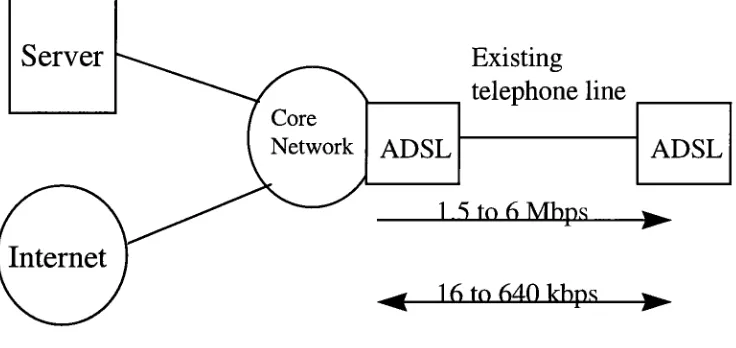
provideshigh-speedcommunicationtoalmostanyhomeorbusiness with atelephoneline. ADSL suppliesthree separate
frequency
channels overthesamephoneline.Phoneconversations are carried on onechannel,whiledata fromtheservice
providertotheuseristransferredon anotherlineat speedsranging from 16 kilobits-per-second
(kbps)
to9million-bits-per-second(Mbps). Thethirdchannel runsdataupstreamfromtheuserto theservice provider at speedsupto640kbps.
Server
/
CoreI
NetworkExisting
telephoneline
ADSL
ADSL
1 S tn f\ Mbps
^
Internet
<
ui tn640 kbpsFigure4: ADSL Architecture
3.2.2 High Bit Rate Digital Subscriber Line
(HDSL)
Using
theexistingcopperinfrastructure,
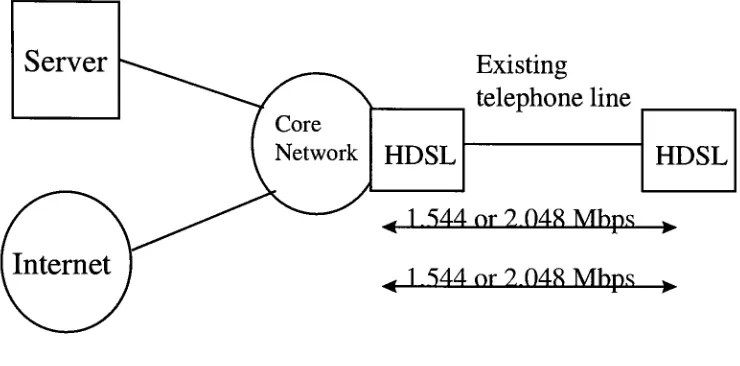
HighbitrateDigital Subscriber Line(HDSL)
providesfull duplex Tl (1.544
Mbps)
orEl (2.048Mbps)
datatransmission acrossexistingtwistedpairTodd R. Engle December 1997
Page 27 Capstone Thesis
[image:30.564.54.422.339.513.2]copper without repeaters. Not only is HDSLthefastestandleast costly solutionfor
deploying
Tl/El
lines,
italsoprovidestransmission qualitycomparabletofiber.Existing
telephoneline
544nr7 04S Mbps
[image:31.564.52.422.127.310.2]4 1 544 nr 7 04R Mbps
Figure 5: HDSL Architecture
3.2.3 Symmetric Digital Subscriber Line
(SDSL)
Symmetric Digital Subscriber Line
(SDSL)
simultaneouslyprovides symmetric(bi-directional)
high-speed,
variable rate communications andPOTS (Plain Old TelephoneService)
on a singlephoneline. Ittransmitsdataat 160 kbpsto 2.084 Mbps. This
technology
issuitableforapplicationsthatrequire a symmetricdatarate.
SDSL,
alongwithADSL,
relievesthecongestiononvoice networks. Voiceanddatawill notbetransmittedthrough thecircuit switchednetwork,
ascurrently donewithanalogmodems andISDNservices.
Instead,
telephonecompanies willroutevoiceto thecircuit-switched networks anddatato thepacket-switchednetworks.
Todd R. Engle December 1997
Page 28 Capstone Thesis
Existing
telephoneline
60 kbps tn 7 Mbps
160kbps tn 7 Mbps
Figure6: SDSL Architecture
3.2.4
Very
High Bit Rate Digital Subscriber Line(VDSL)
With
Very
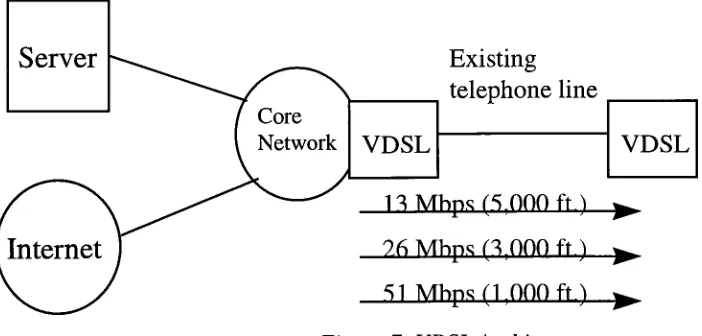
high bitrateDigitalSubscriber Line(VDSL),
thedatarateincreases asthecustomer'slocationgrows closerto thecentral office. A datarate of 13 Mbpscanbe providedtoa subscriber
5,000 feet away fromthecentraloffice,while a rate of26 Mbpscanbeprovidedtoa subscriber
3,000 feetaway. 51 Mbpscanbeachieved at adistanceof 1,000feet fromthecentral office.
Existing
telephone
line
n Mbps a oooft
)
76 Mhrs noon ft
)
51 Mbps (1 OOPft
)
Figure7: VDSL Architecture
Todd R. Engle December 1997
Page29 CapstoneThesis
[image:32.564.50.423.94.279.2] [image:32.564.54.405.477.645.2]3.2.5
Advantages
of xDSLA
key
advantageforxDSLtechnology
isthatitcan operate overexisting POTS (Plain OldTelephone
Service)
wiringwithoutaffectingthevoicetransmission, eliminatingtheneedfornewcable
installation.
ThexDSLtechnology
providesadedicatedservice over a singletelephoneline,
whichis more securethana shared medium.Also,
sincethesingletelephoneline isnotsharedwith otherusers, theavailabletransmissionrateofthelinewillbeconstant.
However,
themostsignificant advantageof xDSL istheavailabilityof800milliontelephonelinesworld-wide.
3.2.6 Disadvantagesof xDSL
Whiletheexistingcopperinfrastructureis a
key
advantageforxDSL,it may alsoprovetobealimiting
factor inimplementing
xDSL on alarge scale.Three underlyingproblemsoftheinfrastructureare noted
by
CarusoandRendleman (1996).First,
xDSL cannotbeprovisioned oncoppercircuitsequipped with loadcoils,which phone companieshave installed inthepastfor
residences far froma central office.Thisproblem affects as much as 20percent of all copper
lines.
Secondly,
xDSL'shigh frequenciespose considerableinterferencepotentialtoother copperlines inthesame cable sheath.
Finally,
length limitations onexisting local loopsmeanthatusersandcarriers will needtoadjustfor longer
loops,
particularlywithhigherspeed xDSL.Theseproblems arenotable,but
they
alsohavesolutions.Bellcore,
which claimstohaveinventedxDSL, statesthatline quality should notbea significantfactor ifequipment vendors
and providers stickto thestandard andstaywithintheguidelines of 1.5 Mbps at 18,000 feet.
Regarding
loadcoils,adigitalloop
carrier(DLC)
devicecanbe used.Copper lines connectto theDLC,
which connectsto a central office.Iftheuseris within 18,000feetoftheDLC,
theusercanstill get xDSL.
ToddR. Engle Page 30 Capstone Thesis
December1997 M.S.inInformation
3.3
Cable
Modems
3.3.1
Introduction
Acable modemisadevicewhich allowshigh-speedcommunicationthroughthecableTV
(CATV)
network. Forconsumers,a cable modem willtypically
have two connections,oneto thecable wall outlet andtheothertoa computer. Cablemodem
technology
hasthepotential toproduce a30 Mbpstransmissionrateto theconsumer(i.e.
downstream),
and a"lowMbps"
upstream rate
(Maxwell,
1997). Thefollowing
diagramrepresentsthecablemodemarchitecture,asdefined intheCable ModemtoCustomer Premises Equipment Interface Specification
(Lipoff,
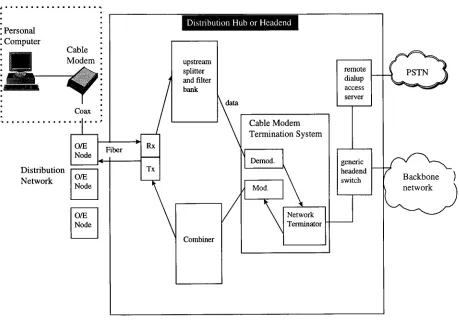
1996): ;Personal !Computer Cable Modem Coax Distribution Network O/E Node Fiber O/E Node O/E Node
Distribution HuborHeadend
upstream splitter andfilter bank .data Combiner CableModem Termination System Demod. Mod. remote dialup access server generic headend switch
Figure 8: Data Over Cable Reference Architecture (Lipoff, 1996)
Todd R. Engle
December1997
Page31 Capstone Thesis
[image:34.565.51.510.313.639.2]Cablemodemsoperateoverhybrid fiber/coaxial
(HFC)
networks, comprised offiber feeder froma
head-end,
andbranch coaxialcablesinstalledfromtheOptical Network Unit(ONU)
tocustomerlocations. In manyconfigurations,asmanyas 100usersmayshare a single cableline.
Forcommunicationtooccur overCATVnetworks via cablemodems,thecustomer'scable
modem communicateswiththecablecompany'scablemodem, whichis locatedattheONU
location.
Most CATVsystems
today
are notHFC;
ratherthey
aretree andbranchcompositions of coaxialcable, sometimesservingasmanyas 10,000customers froma singlehead-endunit, with one
wayamplifiersthatprecludeanyupstream data flow
(Maxwell,
1997). Since1993,
many CATVlines have been installedwith
two-way
amplifiers, creatingan upstream pathfrom 5to45 MHz.However,
thesheer size ofthesenetworks andthenoise and channel problems with so manysubscribers attachedtoa commonline makehigh-speedupstreamchannels unattainable after
afewsubscribershave joinedtheline
(Lipoff,
1996).Theprocess ofupgradinga coaxial systemfromunidirectionaltobi-directional may be
accomplished
by
physically replacingamplifiers. Theprocessofupgrading fromcoaxtoHFCrequires a greatdealof work:
installing
fiberopticcables,installing
ONUs,
rerouting anycoaxnot convenientto the
ONU,
andreplacingthefew remainingcoax amplifiers. Cablecompaniesareveryresistanttocapital expenditures unless ahigh ROI (returnon
investment)
exists(Maxwell,
1997).Todd R. Engle Page 32 Capstone Thesis
3.3.2
Advantages
ofCableModemsOnesignificantadvantage of cable modem
technology
for high-speedcommunicationis thattransmissionrates donotdependuponcoaxial cable
distance,
asamplifiersinthecable networkboostsignal powersufficiently
(Ankhoa,
1996). Another very importantadvantageisthepotential30 Mbpstransmissionratetotheend-user.
3.3.3 DisadvantagesofCable Modems
Several distinct disadvantagesexistfor usingcable modems as ahigh-speedcommunication
technology.
First,
variationincable modemcapacity willoccur,dependenton noiseinthelineandthenumber of simultaneous usersseekingaccessto a sharedline.
Secondly,
alimitednumber ofhomes are wiredforcable, especially homesoutside oftheUnited States.
Additionally,
very few businessesthroughouttheworld are wiredforcable(Ankhoa,
1996).Athirdand most significantdisadvantage isthe lackofbi-directionalcommunication. To
providebothupstream anddownstreamchannels,cable companieshavetwooptions: either make
major(andexpensive)enhancementsto the cable
infrastructure,
or utilize a separate connectionforupstream communication possiblythroughananalogmodem overthe telephonenetwork.
Finally,
cable modem standards are stillevolving,which willfurther limittheinteroperability
ofequipmentfrom differentvendors. Withall ofthese
disadvantages,
cable modems(andthecableinfrastructure)
cannot competewiththemanyadvantagesof xDSLtechnology
andthetelephonenetwork.
Todd R. Engle Page 33 Capstone Thesis
4.
Practical
Solution
(xDSL)
4.1
Selection
Criteria
Theselectionof xDSL asthepractical
technology
for high-speedcommunicationwasbasedonthe requirementsfrom Section 1. Dueto the800milliontelephonelines inexistenceworld-wide,
any
technology
thatcanutilizeawidelyavailableinfrastructure has adistinctadvantageoverotherformsofcommunication.
4.2
xDSL andCable Modems
800milliontelephonelinesexistintheworldtoday, with70% connectedtoresidences,andthe
balanceconnectedtobusinessesandpayphones. Despite emergingtechnologiesfornon-copper
basedsystems, theworld-wide copper
loop
plantisstill projectedtoexceed900millionlinesby
theyear2001. IntheUnited
States,
approximately 80%oftheselinescan accommodateADSL atapproximately 1.5
Mbps,
and50% can support rates of6 Mbpsor more(ADSLForum,
1997).Many
other countrieshavemorefavorablecablelength statistics.However,
some countries orregionshave veryold
loop
plants, andthepercentage of copperlinesthatare actuallyusableformegabitaccess may bewellbelow 80%
(TeleChoice,
1997). Inthesesituations,variablerateADSL (Rate-Adaptive
ADSL,
orRADSL),
with speeds slightly below 1Mbps,
mayenableconnectiontoall users.In summary: xDSListhechosen
technology
forseveralreasons, withtheprimaryreason
being
theavailabilityofthemedium.ToddR. Engle Page 34 Capstone Thesis
5. Practical Implementation
ofxDSLForsuccessfuldeploymentof xDSLtechnologies, the
industry
needsto incorporatethemostpractical implementationmethods.
Currently,
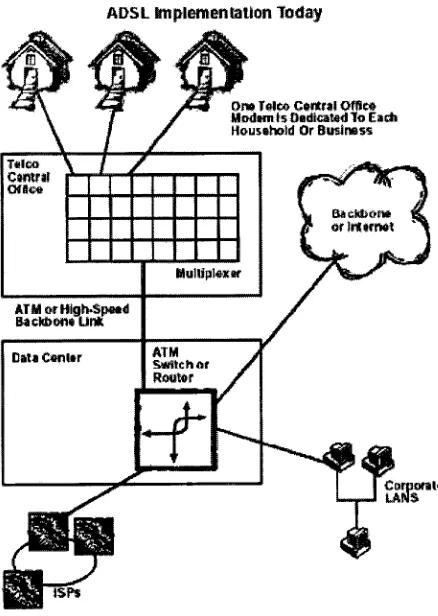
dedicatedxDSLimplementations haveone centraloffice xDSL modemdedicatedtoeach subscriber.This implementationmethodhas had negative
effects on scalability, reliability,andcost,andhaspreventedthedeploymentofhigh-speed
communicationvia xDSL. The
following
diagramrepresentstheimplementationmodel ofcurrentADSLsystems:
ADSL implementationToday
OmTele*CentralOffle*
Modamts[indicatedlo Each HouseholdOr Business
ATMrHighspeed B4cW>omUr*
DatiCsnltr
[image:38.564.186.405.301.609.2]HulU{ll**K
Figure 9:DedicatedADSLImplementationModel
(NetSpeed, 1997)
Todd R. Engle
December1997
Page35 Capstone Thesis
Thecurrentdedicatedmodel of xDSLis simplynotpractical forwide-scale
deployment,
andanother model mustbeconstructedforxDSLimplementation.
Interestingly,
thecorrectmodeltofollow isprovided
by
today's telephonesystem.Theparadigmcurrentlyused withvoice switchesand analogmodemsallowsthesedevicesto
dynamically
allocatebandwidth. Theoversubscription of portsinacentral office enables a singledeviceto serve several users.
CurrentxDSL systems are
fairly
costlytoimplement,
largely
dueto thelackof volumedeployment. Withmass-market
implementation,
service providers willbe abletoreducethecosttoconsumers.
However,
untillarge-scale deploymentoccurs, theeconomics ofdedicatedxDSLsystemsare notbeneficialtoconsumers or service providers.
Therefore,
the onlypracticalsolutionis non-dedicated,
"on-demand"
xDSLsystems, referredtoas
dial-up
xDSL.Todd R. Engle Page36 Capstone Thesis
5.1 Dial-UpxDSL
Personal Computer A Personal Computer B Fax xDSL Modem xDSL Modem relephone TelephoneCompany Central Officef^t
1&
u
Telephone Line (singlepair twistedwire) POTS Splitter
^-&
Q
Telephone Line (singlepair twistedwire) POTS Splitter POTS6
Voice Switch POTS SplitterIt
xDSL multiplexeru
' '.""T POTSSplitter XDSL multiplexer
TelephoneCompany Central Office
Figure 10:
Dial-Up
xDSLArchitecture5.1.1
Reliability
andFault ToleranceServiceproviders and customersareaccustomedto theredundancyofexistingnetworks.With
dedicatedxDSL, the one-to-one natureofxDSL connections will
likely
require manualinterventiontore-establishlinks
following
a modemfailure.By
providingaone-to-manyToddR. Engle December1997
Page 37 Capstone Thesis
[image:40.565.53.513.100.433.2]association with
dial-up
xDSL,consumers willnot sufferserviceoutages ifasingle central officemodemfails.
5.1.2
Flexibility
As previouslymentioned, themany formsof xDSL
(HDSL, ADSL, SDSL,
VDSLandRADSL)
are stillevolvingandwill drivetheneedfor flexiblesystems. Serviceproviders will not want
decisionsmade
today
tolimit futureoptions ortheabilitytoprovide newfeaturesand servicesquicklyand costeffectively.WhilexDSL modems arebuiltto support a singlelinecode, it's
unlikelythatcentral offices or even individualservice providers will
deploy
a singleformofxDSL.
However,
thealternative methodfor achieving compatibilitydesigning
dual linecodemodems is
truly
price prohibitive(TeleChoice,
1997).Fromatechnicalstandpoint,
dial-up
xDSL relies onthe transmissionof"request forservice"
tonesthatare generated
by
customer modems. Theremotemodem signalsitscentral officecounterpartthatit is readytoform abroadbandconnection.This interaction isperformed atthe
physicallayerand canbe initiated
by
softwaredrivers thatgenerate a"starttone"whendata
needstobesent.Theoff-hookdetection
by
softwareinitiatesadigital dialtone that thenformsconnectionson an as-needed
basis,
allowingseveral userstoeffectively share a pool of modemsatthecentral office.
Todd R. Engle Page 38 Capstone Thesis
5.1.3
Interoperability
Thedigitaltonescanbedesignedtosignalthespecificlinecodefromthecustomer'smodem,
enabling service providerstodetectthe
incoming
modemtypeand route ittoaline-codecompatible modem inthecentral office system.Theinitiationoftheconnection can occur
transparently
tothe user,becausetheconnectionis digital. Connections are established withoutthe
time-consuming training
sequences associatedwithtraditionalanalogmodems.Quickconnectimplementations meanthatcustomerequipment can storetheparametersto train
onthelineasopposedto
training-up
foreach connection.This implementationcan reduceconnectiontime tofractionsof asecond, allowingsubscriberlinestobe brought up anddown
transparently
totheuser(NetSpeed,
1997).Sincenetwork connections are muchfasterthanvoice-grade
(analog)
modems,itencouragesgrowth oftelecomservices
by
users.Inthe situation where an end-user wantsinformation fromthe
Internet,
thedelay
in establishingthemodem connectionto theISP(approximately
oneminute) may discouragetheuserfromevenaccessingtheservice. The abilitytohave sub-second
connectiontimewould provide afastresponsetime toanimpatientworld.
Thedynamicnature ofthecommunicationis a
key
aspect.Whennodataarepresent, thesubscriber'sphysical connection istorn
down,
butalogicalconnection (i.e.virtual circuit)remainsintact. Theresultisthattheuser never perceivesdisruption in service, and service
providers canimplementmore cost-effective strategies.Forapplications and servicesthat
Todd R. Engle Page 39 Capstone Thesis
warrant
dedicated
access,connectionscanbeconfigured tobepermanent. The dedicatedaccessarchitecturemayappealto businessesandeducational institutions.
5.1.4 System Usage
A studyofInternetusagepatternsindicatesthatmost usertransmissionsareintermittent innature
(NetSpeed,
1997). Users downloadtheitemthey
require, reviewit forsometime, andthenrequest anotherdatatransferwhen
they
areready foranotheritem.Dial-up
xDSL enables serviceprovidersto takeadvantageofthestatistical nature ofInternetaccess and gain ahigher levelof
average utilizationfromeachmodem, thus
lowering
deploymentcosts.Inprivatenetworks,remoteofficesandtelecommutersalso useWAN bandwidth sporadically
(NetSpeed,
1997). Largerofficesmay havemore constant need ofthroughputbecausea greaternumber of people areplacing demandsontheshared network resource.
Dial-up
xDSL can alsoprovidededicatedconnectionstomeettheneeds oflargercorporatelocations.
Itis
likely
thatbothresidential andbusinessusers willbeabletostatisticallyshare xDSLbandwidthsincetheirpeak usagehoursareatdifferenttimesin a givenday. Thestatistical
sharingofbandwidth worksandis demonstrated inthe
following
table:Todd R. Engle Page40 Capstone Thesis
Table 5-1: Remote AccessandInternetAccess Usage Patterns
(NetSpeed, 1997)
User
Application
Usage Pattern
Peak Usage Hours
Residential Web InternetAccess connectsforonehour Activeat night (after5
Surfer or
less,
extremelybursty
data transmissionsp.m.) and weekends
Power Internet User Internetaccesswith connectsforone or Activeat night(after5
someuse ofstreaming
less,
mixture ofbursty
p.m.) and weekendsapplications andcontinuous transmissions
Telecommuter Remote LANaccess Connects for
long
Activeduring
afew(e-mail,
filetransfer)
periods (3+hours),
weekdays eachweek,bursty
data occasionaleveningtransmissions use
Small Office/Home LAN
interconnect,
Connects for longer Activeduring
normalOffice Shared Internetaccess periods (8+
hours),
transmissions
fairly
continuous
business hours
5.1.5 DeploymentCosts
Because
dial-up
xDSL enables modempooling,it allows service providerstoreach moresubscriberswithfar fewermodems.IfprovidersconservativelyestimatethatxDSLconnections
are activeonly 50percent ofthetime,service providers can cut central office equipment costs in
half
by deploying
fewermodems.ToddR. Engle
December1997
Page41 Capstone Thesis
As
demonstrated
inthe table above, residentialusers areprimarily activeintheeveninghours,
whereasbusiness userswilluse xDSL
during
theday.Dial-up
xDSL'smodempoolingallows a single modemto pulldouble duty:Serving
oneset ofsubscribersduring
theday
andanotherintheevening. The alternative,
deploying
amodemfor everysubscriber, reducesthe scalabilityof systems anddrives costsup,reducingthebusinesscaseprofitabilityand return on investment for xDSLservices.By
utilizingtheoversubscriptionmodel enabledby dial-up
xDSL,serviceproviders can cost
justify
xDSLdeploymenteveninanearly market.5.1.6 Economics ofDeployment
Many
businesscasesforxDSLservicesaredevelopedby initially
viewingthenumber ofhomesorbusinesses
being
served.Thismodel often calculates return oninvestment(ROI)
on a per modembasis.Every
modemdeployedmustbecost-justifiedby
therevenuesthatcanberecoupedfromanindividualsubscriber
(TeleChoice,
1997).Dial-up
xDSL accelerates thexDSLbusinesscaseby
effectively enablingasingle modemto "pass"orbe
logically
deployedtomultiplelocations. This ismuch closertothebusinesscaseforstandard voiceservices, with whichlargetelephonecompanies arevery familiar. With this sharedinfrastructuremodel,service providers can expect a quicker return ontheirinvestment.
Equipmentcosts can alsobe driven down ifvolumes areforcedup. Ifthepriceis sufficiently
low,
then usingadedicatedmodemforeach xDSL customermaynotbecost prohibitive. Ifenoughservice providers launchedxDSL-basedservices, itcouldspark alarge early demandand
Todd R.Engle Page42 CapstoneThesis
allow theeconomyof scalenecessary forequipment vendors and service providerstosupport
lowprice points
(Ankhoa,
1996).In additionto
lowering
equipmentcosts,dial-up
xDSL cuts operational costs inthe areas ofspace, power, and reliability.
By
sharingmodems across subscribers, theper watt consumptionby
subscribercanbereducedby
50percent(NetSpeed,
1997). Whenoversubscriptionisofferedatthemore
likely
10: 1 ratio,the reductioninpower and costiseven moredramatic (U.S.Robotics,
1997).5.1.7 GlobalDemographics
Dial-up
xDSLtechnology
enables service providers and corporationstobring
upconnectionswhen users requirethem. Datanetworks canbe engineeredtomeet average trafficdemandsmuch
likevoice andISDNnetworks are createdtoday.
Additionally,
service providers candeploy
systemsaccordingtodemographics.
By
monitoringuseractivity fora givenservingarea,providers candesignsystemstomeettheneeds ofthecustomersinthatarea. Thecurrent
dedicatedmodel resultsin costlyover-engineering,and cannotscaleto thevaryingneeds of
world-wide subscribers.The onlypractical modelforwide-scaledeployment is
dial-up
xDSL.5.2 End-to-end
Interoperability
Acurrent problem with xDSLimplementation isthelackofaddressing. Anend-user, througha
single xDSLconnection,needs accesstomultiple services,such astheInternetor corporate
networks.AsynchronousTransferMode
(ATM)
is receivingwidespread support asthesolutionTodd R. Engle Page 43 Capstone Thesis
to xDSL'saddressingproblems
(Taylor,
1997).However,
notall service providers agree withestablishing "ATMoverxDSL"
as a standard
addressingscheme. Most Internet Service Providers
(ISP)
andcompetitive Local ExchangeCarriers
(LEC)
prefer eitherIP,
Point-to-Point Protocol(PPP)
orFrameRelay
over xDSL. Tosolvethis problem,
Microsoft, Alcatel, Cisco,
ForeSystems,
U.S. RoboticsandWestellTechnologies have joined forcestoarrive at an official standard(U.S.
Robotics,
1997). Thesevendorshave collectivelyproposed an architecturethatwould usePPPoverATMover xDSLfor
interoperability
betweenmodems,routers and access multiplexers.The
key
tosuccessful xDSLdeployment isend-to-endinteroperability
(3Com,
1997). Withinteroperability,
a competitive multi-vendor environment canexist,whichleadstomoreaffordable solutions.Throughthestandard
bodies,
significant progresshas beenmadeinestablishingphysical layerxDSL
interoperability
(ADSLForum,
1997). To facilitaterapiddeployment,
thestandardization of upper-layer protocols must also occur.The fastest solutionforachievingstandardizationistobase theentire addressingarchitecture onexistingstandards:
namely,PPPoverATMover xDSL.
5.2.1 Two LevelsofProviders
The deploymentof xDSL willclosely involvethe telephonecompany.Insome
deployments,
thetelephonecompaniesmayrestricttheiroperatingscopeto theaccess network orthebackbone
network.In suchcases,explicit agreementontheinteractions between different levelsof
providersis mandatory. Forremote corporateaccess, thedivisionofresponsibilityis equally
Todd R. Engle Page 44 Capstone Thesis
critical sincethecorporationis almostactingas a service provider.
Therefore,
it is importanttodistinguish
between an access network provider and aservicenetwork provider intheend-to-endinteroperability
model.Thenetwork modelforxDSLwill notdeviate fromthe
dial-up
model.Inthis model, connectivityis explicitlyestablished at severallevels: thecall level
(dial-up),
thelink levelandthenetworklevel. Notethatboththesetupandtherelease ofthesession at eachlayerare essentialforusage
metering and
billing by
theproviders involvedatthedifferent layers(Microsoft,
1997).5.2.2 PPP overATMoverxDSL
Theproposed xDSLend-to-end service
interoperability
modelis basedon an end-to-endATMnetworkbetweenthecustomer premise networks andthe service provider networks
(ISP,
contentprovider and corporate networks).The ATMendpoints includeallthe devices atthecustomer
premise (suchas aPC orrouter)andtheservice provider network(anaccess server or arouter)
thatterminate theend-to-endATMnetwork. The ATMover xDSL architecture preservesthe
high-speedcharacteristics inthexDSL environments withoutchangingprotocols.
With ATMoverxDSL, theresidentialandsmallbusinessofficecustomershave accessto
Internetenvironments. ATMover xDSL provides seamlessconnectionsfrom remote userstoany
ATM distributionnetwork,toany ATM
backbone,
toanycorporateintranet,
orto theInternet. Inaddition, ATMprovidesdirectconnectiontoInternet/intranetservers,such as asecurity server,
anInternetcontentcachingserver, ora video server. ThisenhancesInternet services,intermsof
performance,loadsharing,andredundancy.
Todd R. Engle Page45 Capstone Thesis
5.2.2.1
PPPoverATMOnce ATM layer connectivity isestablishedbetweenthecustomer premise andtheservice
providernetwork, thesessionsetupandrelease phases atthelink level and networklevelcanbe
establishedusing PPP. Thedefinition of astandardfor PPPoverATMwillincreasetheuse of
ATM as anaccesstechnology. Otherconnection modelsfor ATM (such asClassical IPover
ATM)
targetcampus environments andlackthesecurity, session,and auto-configurationfunctionality
thathigh-speed remote accessnetworks willdemand(Microsoft,
1997).Essentialoperationalfunctionscanbe deliveredoverATM using featureswell establishedin
PPP:
Authentication
Layer 3 addressauto-configuration
Multipleconcurrentdestinations
(i.e.,
multiplePPP sessions)Layer 3
transparency
(e.g.both IPandIPXarecurrently supported onPPP)
Encryption
Compression
Billing
and usagemeteringBy
adaptingthePPPsuiteto xDSL, thedelivery
of aninter-operableservice architecture willbeaccelerated. PPPoverATM iseven more valuablebecauseit adheresto thesame service model
used
by
theISPbusiness(3Com,
1997).Todd R. Engle Page46 Capstone Thesis
Easy
migrationfromexisting ISPAccess Infrastructure: SincexDSLis only replacingtheunderlying layerfor carryingthePPPsession, themajority oftheISPinfrastructureismaintained
(Microsoft,
1997).Multi-Protocol Support: PPPsupports multiplelayer 3 protocols.
Security:
Security
isenabledby
theconnection-orientednature ofATMplusPPP'sencryptionandauthentication mechanisms.SinceeachATMcircuitonlycarriesaPPPsession,thesecurity
provided
by
PPPappliestotheentireATMconnection.Multiple Service Classes: Multipleservice classes are enabled
by
thenature ofATMtosupportdifferentservice classes.Individual user profiles canbe definedas part ofpolicymanagementin
thenetwork.
5.3
End-User
Configuration
5.3.1 POTSSplitter
Amodem andPOTS (Plain Old Telephone
Service)
splitteris installedattheuser's premisetotransportvoice anddataoverthelocal loop. The POTS splitteris ahardware devicewhich
separates high
frequency
(xDSL)
andlowfrequency
(POTS)
signals at network end and premisesend.
The
functionality
ofthePOTS splitterisessential,becauseit directsvoice callsto thevoiceswitch andforwards datatraffic to thexDSLAccess Multiplexer
(DSLAM)
inthecentral officeTodd R. Engle Page47 Capstone Thesis
(CO). Withouttheseparation of
frequencies,
end-userswould nothavesimultaneous voice and dataservices. -Jk-Personal Computer A Faxk#
xDSL Modemn
POTS Splitter elephone Telephone Line (singlepair twisted wire) TelephoneCompany Central OfficeFigure11:xDSLModemandPOTS Splitter
Alargeobstacletowide-scaledeploymentof xDSL(andhigh-speedcommunication)isthe
installation ofthePOTSsplitter. Currentimplementationplans of xDSLrequire service
providerstoinstall aPOTS splitterina customerpremise,whichisanexpensive and
time-consumingactivity. End-userswouldpreferaninstallationprocesswhichisequivalentto today's
analogmodems.
Fortunately,
a solutionto thisproblem exists.Aware
(1997)
demonstratedthefirst "splitterless"versionofxDSL
technology
suitablefor PCmodem applications.
Delivering
downstreamspeedsofupto 1.5 MbpswithouttheneedforPOTS splitters atthecustomerpremise,
Aware'
s
technology
is animportant steppingstonebetweentheanalogmodemsavailable
today
andfull-rate ADSLat6Mbps.Todd R. Engle December 1997
Page48 CapstoneThesis
[image:51.565.49.512.117.308.2]Aware'
s modemcanbe pluggedinto anyexistingphone
jack,
andno modificationto thecustomer premise'sinternal wiringisrequired.
By
removingthe POTS splitter,implementationand acceptanceof xDSL willbe significantly accelerated.
5.3.2 Hybrid High-Speed Modem
Untilrecently,xDSLmodemshave had several
limita