M E T H O D O L O G Y
Open Access
A quantitative real time PCR method to analyze
T cell receptor Vb
subgroup expansion by
staphylococcal superantigens
Keun Seok Seo
1, Joo Youn Park
2, David S Terman
3, Gregory A Bohach
1*Abstract
Background:Staphylococcal enterotoxins (SEs), SE-like (SEl) toxins, and toxic shock syndrome toxin-1 (TSST-1), produced byStaphylococcus aureus, belong to the subgroup of microbial superantigens (SAgs). SAgs induce clonal proliferation of T cells bearing specific variable regions of the T cell receptorbchain (Vb). Quantitative real time PCR (qRT-PCR) has become widely accepted for rapid and reproducible mRNA quantification. Although the quantification of Vbsubgroups using qRT-PCR has been reported, qRT-PCR using both primers annealing to selected Vb nucleotide sequences and SYBR Green I reporter has not been applied to assess Vb-dependent expansion of T cells by SAgs.
Methods:Human peripheral blood mononuclear cells were stimulated with various SAgs or a monoclonal antibody specific to human CD3. Highly specific expansion of Vbsubgroups was assessed by qRT-PCR using SYBR Green I reporter and primers corresponding to selected Vbnucleotide sequences.
Results:qRT-PCR specificities were confirmed by sequencing amplified PCR products and melting curve analysis. To assess qRT-PCR efficiencies, standard curves were generated for each primer set. The average slope and R2 of standard curves were -3.3764 ± 0.0245 and 0.99856 ± 0.000478, respectively, demonstrating that the qRT-PCR established in this study is highly efficient. With some exceptions, SAg Vbspecificities observed in this study were similar to those reported in previous studies.
Conclusions:The qRT-PCR method established in this study produced an accurate and reproducible assessment of Vb-dependent expansion of human T cells by staphylococcal SAgs. This method could be a useful tool in the characterization T cell proliferation by newly discovered SAg and in the investigation of biological effects of SAgs linked to pathogenesis.
Background
Thea/bT cell receptor (TCR) is composed ofaandb chain heterodimers which recognize antigen-derived peptide bound to major histocompatibility complex (MHC) molecules on antigen presenting cells (APCs) [1]. During thymocyte development, the genes encoding thebchain undergo somatic recombination of variable (V), diversity (D), joining (J), and constant (C) genes. Combinatorial joining of V-J and V-D-J region gene seg-ments generates diversity within the TCRbchain com-plementarity determining region (CDR) 3 loop [2,3].
Combinatorial diversity is further increased by imprecise joining of VDJ recombination and insertion of palindro-mic nucleotides at a specific point within the VD, DJ, and VJ junctions [4]. As a result, each T cell clone expresses a unique variable region of TCRbchain (Vb) [5]. Generally, the CDR1 and CDR2 sequences within the TCR molecule, encoded by V gene segments, inter-act with the a helix of the MHC molecule [6]. TCR CDR3 sequences, encoded by V(D)J junction gene seg-ments, interact with the antigenic peptide associated with MHC, resulting in clonal T cell proliferation [6].
Staphylococcal enterotoxins (SEs), SE-like (SEl) toxins and toxic shock syndrome toxin-1 (TSST-1), produced
by Staphylococcus aureus, are prototypic microbial
superantigens (SAgs). Members of this toxin subgroup * Correspondence: [email protected]
1Department of Microbiology, Molecular Biology and Biochemistry, University
of Idaho, Moscow, ID 83844, USA
are implicated in staphylococcal food poisoning and toxic shock syndrome [7]. SEl toxins have been shown to lack emetic properties in primates or have not yet been tested [8]. For many years, five antigenically dis-tinct classic SEs (SEA, SEB, SEC, SED, and SEE) and molecular variants of SEC (SEC1, SEC2, and SEC3) were recognized [7]. Through improvements in genomic ana-lysis tools, novel SEs and SEl toxins including SEG, SElH, SEI, SElJ, SElK, SElL, SElM, SElO, SElP, SElQ, SElR, and SElU and four molecular variants (SEGv, SEIv, SElNv, and SElUv) have been discovered [7,9]. In contrast to conventional antigens, most SAgs bind out-side the peptide binding groove of MHC II, and to spe-cific Vb sequences [9]. This interaction triggers an activation of phospholipase C and phosphokinase C pathways [10], leading to a massive production of proin-flammatory cytokines including interleukin-2 and inter-feron-g [11], resulting in extensive proliferation of T cells bearing specific Vb subgroups [11]. As a result, it is possible to characterize SAgs on the basis of their Vb profiles [7].
Several approaches are used to quantify the expansion of Vb subgroups including northern blotting, semi-quantitative PCR using radioisotope conjugated probes [12], or fluorescence activated cell sorting (FACS) using monoclonal antibodies (mAbs) specific to Vbsubgroups [13,14]. Recently, quantitative real time PCR (qRT-PCR) has become widely accepted for rapid and reproducible quantification of gene expression. Most previous attempts to quantify Vb expression using qRT-PCR used one primer located at the gene encoding TCR con-stant region of b chain (Cb) and the other primer or fluorogenic probe located within the gene encoding the V region [15,16]. More importantly, previous qRT-PCR methods have been applied to samples displaying expan-sion of limited numbers of Vbsubgroups [16]. In this study, we developed a new qRT-PCR method using Vb subgroup specific primers within the gene encoding the V region to increase specificity and SYBR Green I to curtail the cost of the assay. This technique was applied to human mononuclear cell cultures stimulated with various SAgs, which have unique Vb specificities,
though overlapping so that the entire repertoire of Vb subgroups could be evaluated using this method.
Materials and methods
Toxin production and purification
SEB, SEC1 and TSST-1 were purified from cultures ofS.
aureusMNHOCH,S. aureusRN4220 (pMIN121) and S.
aureusRN4220 (pCE107), respectively, using preparative
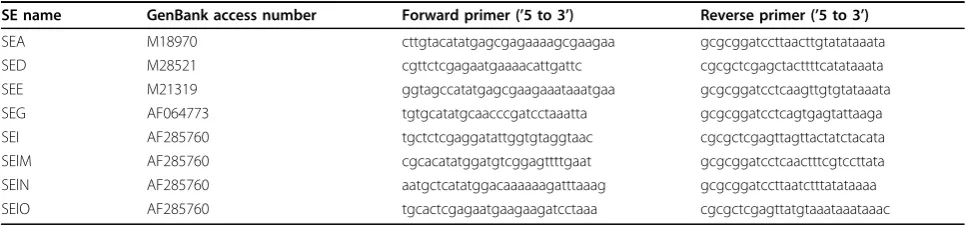
isoelectric focusing as described previously [17-19]. Other toxins used in this study were produced in recombinant form using SE genes cloned in this study as follows. A DNA fragment encoding SEA, SED, SEE, SEG, SEI, SElM, SElN, or SElO was amplified from genomic DNA derived from S. aureus FRI 913 or FRI 472 using primers listed in Table 1[20]. Amplified DNA fragments were digested withNdeIandBamHIor XhoI
andligatedinto corresponding sites is pET-15b
(Nova-gen, San Diego, California, USA). Recombinant SE pro-teins were expressed inE. coliBL21 (DE3) (pLysS) and purified using the His-Bind Purification Kit (Novagen) as suggested by the manufacturer.
Preparation and stimulation of enriched human lymphocytes
Peripheral blood mononuclear cells (PBMCs) were iso-lated from three healthy donor venous blood. Heparin-treated (14 U/ml blood) blood was fractionated by gradi-ent cgradi-entrifugation over Ficoll-Paque Plus (GE Health-care, Piscataway, New jersey, USA) as described previously [17]. The PBMCs were washed and resus-pended in RPMI 1640 medium (Life technologies, Gaithersburg, Maryland, USA) supplemented with 2% FBS, 100 U penicillin G, and 100μg/ml streptomycin. The cultures were maintained in cell culture Petri dishes (Falcon, Lincoln Park, New Jersey) overnight at 37°C and in 5% CO2. Non-adherent lymphocyte-enriched PBMCs were collected, washed, and resuspended at a final concentration of 2.5 × 10⁶ cells/ml. Each SAg (0.5
[image:2.595.56.539.618.731.2]μg/ml) or a murine mAb specific to human CD3 (33 ng/ml; Sigma, St. Louis, Missouri, USA) was added to lymphocyte enriched PBMC cultures (3 ml aliquots). Cultures were maintained for 4 days (37°C, 5% CO2).
Table 1 List of primers used to clone SE and SEl genes.
SE name GenBank access number Forward primer (’5 to 3’) Reverse primer (’5 to 3’)
Basal levels of Vbexpansion were assessed with unsti-mulated control cultures.
Quantitative RT-PCR (qRT-PCR)
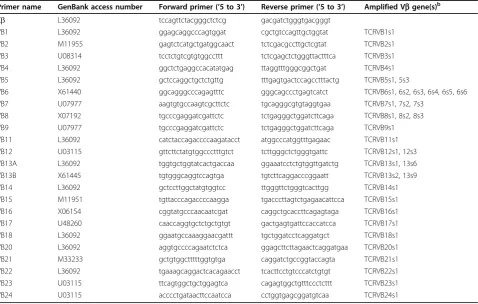
Total RNA was extracted from approximately 5 × 10⁶ cells using Trizol (Life Technologies). Superscript II reverse transcriptase (Life Technologies) was used to generate cDNA using 1μg of RNA and oligo dT primer, according to the manufacturer’s instructions. To pro-mote highly specific amplification, two primers specific for each of the various Vbsubgroups were annealed to selected Vbnucleotide sequences. All Vb specific and Cbprimers were designed using Primer Express version 2.0 (Applied Biosystems, Foster City, California, USA) and are listed in Table 2. We used the Vb subgroup nomenclature of Arden et al [21].
To verify primer specificities, melting curve analyses (below) and PCR product sequencing were performed. For sequencing, PCR reactions were conducted without SYBR Green I using cDNA generated from cultures sti-mulated CD3-specific mAb. PCR products were purified using a PCR purification kit (Qiagen, Valencia, Califor-nia, USA) and then cloned into pCR2.1 vector (Life Technologies). Transformants (10 to 25 colonies) were
randomly selected and the cloned gene fragments were sequenced using an ABI Prism 3100 Genetic Analyzer (Applied Biosystems).
Standard curves were generated for each gene to eval-uate primer efficiency and for data analysis. Concentra-tions of purified PCR products were determined by measuring the absorbance at 260 nm using a Nanodrop (Thermo Scientific, Wilmington, Delaware, USA) and expressed as the number of DNA copies/ml using stan-dard procedures [22,23]. The qRT-PCR was performed (below) on serially diluted PCR products (2.5 - 2.5 × 10⁵ copies/reaction) using ABI Prism 7500 (Applied Biosys-tems) in triplicate and was repeated in at least three separate experiments. Standard curves were generated by plotting the CT vs. the log10copies of serially diluted PCR products. The slope, intercept, and correlation coefficient (R2) were determined by linear regression analysis using Microcal OriginPro Version 7.5 (Origi-nLab, Northampton, Massachusetts, USA).
[image:3.595.60.539.409.713.2]The qRT-PCR was performed in triplicate and was repeated in at least three separate experiments using the following conditions. Reaction mixtures contained 12.5μl of SYBR Green I dye master mix (Applied Bio-systems), 2 pmoles each of forward and reverse
Table 2 List of qRT-PCR primersa and amplified Vbgene(s).
Primer name GenBank access number Forward primer (’5 to 3’) Reverse primer (’5 to 3’) Amplified Vbgene(s)b
Cb L36092 tccagttctacgggctctcg gacgatctgggtgacgggt
VB1 L36092 ggagcaggcccagtggat cgctgtccagttgctggtat TCRVB1s1 VB2 M11955 gagtctcatgctgatggcaact tctcgacgccttgctcgtat TCRVB2s1 VB3 U08314 tcctctgtcgtgtggccttt tctcgagctctgggttactttca TCRVB3s1 VB4 L36092 ggctctgaggccacatatgag ttaggtttgggcggctgat TCRVB4s1 VB5 L36092 gctccaggctgctctgttg tttgagtgactccagcctttactg TCRVB5s1, 5s3
VB6 X61440 ggcagggcccagagtttc gggcagccctgagtcatct TCRVB6s1, 6s2, 6s3, 6s4, 6s5, 6s6 VB7 U07977 aagtgtgccaagtcgcttctc tgcagggcgtgtaggtgaa TCRVB7s1, 7s2, 7s3
VB8 X07192 tgcccgaggatcgattctc tctgagggctggatcttcaga TCRVB8s1, 8s2, 8s3 VB9 U07977 tgcccgaggatcgattctc tctgagggctggatcttcaga TCRVB9s1 VB11 L36092 catctaccagaccccaagatacct atggcccatggtttgagaac TCRVB11s1 VB12 U03115 gttcttctatgtggccctttgtct tcttgggctctgggtgattc TCRVB12s1, 12s3 VB13A L36092 tggtgctggtatcactgaccaa ggaaatcctctgtggttgatctg TCRVB13s1, 13s6 VB13B X61445 tgtgggcaggtccagtga tgtcttcaggacccggaatt TCRVB13s2, 13s9 VB14 L36092 gctccttggctatgtggtcc ttgggttctgggtcacttgg TCRVB14s1 VB15 M11951 tgttacccagaccccaagga tgacccttagtctgagaacattcca TCRVB15s1 VB16 X06154 cggtatgcccaacaatcgat caggctgcaccttcagagtaga TCRVB16s1 VB17 U48260 caaccaggtgctctgctgtgt gactgagtgattccaccatcca TCRVB17s1 VB18 L36092 ggaatgccaaaggaacgattt tgctggatcctcaggatgct TCRVB18s1 VB20 L36092 aggtgccccagaatctctca ggagcttcttagaactcaggatgaa TCRVB20s1 VB21 M33233 gctgtggctttttggtgtga caggatctgccggtaccagta TCRVB21s1 VB22 L36092 tgaaagcaggactcacagaacct tcacttcctgtcccatctgtgt TCRVB22s1 VB23 U03115 ttcagtggctgctggagtca cagagtggctgtttccctcttt TCRVB23s1 VB24 U03115 acccctgataacttccaatcca cctggtgagcggatgtcaa TCRVB24s1
a
The pseudogenes (Vb10 and Vb19) were not included in this study.
b
primers, and 5μl of 100 times diluted cDNA. Thermo-cycle conditions included initial denaturation at 50°C and 95°C (10 min each), followed by 40 cycles at 95°C (15 s) and 60°C (1 min). Fluorescent data were acquired during each extension phase. After 40 cycles, a melting curve was generated by slowly increasing (0.1°C/s) the temperature from 60°C to 95°C, while the fluorescence was measured. The threshold cycle (CT) was calculated using the Sequence Detector Systems version 1.2.2 (Applied Biosystems) by determining the cycle number at which the change in the fluorescence of the reporter dye (ΔRn) crossed the threshold. To synchronize each experiment, the baseline was set automatically by the software. To rule out DNA con-tamination in the RNA preparations, the qRT-PCR controls were performed with RNA templates which did not show any amplification.
Data analysis
Calculations to determine the extent of Vb expansion were done as described by calculating the absolute copy number of each Vband Cb. Briefly, the CT for each Vb and Cb was converted into absolute copy number by extrapolation from its standard curve (above). The per-centage of each Vb(%Vb) in the culture was calculated by following equation, where n represents each Vb sub-group observed in this study. These values have to be considered as exploratory:
%V V n
C
n
100
Selective expansion of Vbs in the culture stimulated with SAgs was determined when each %Vb from the cultures stimulated with SAgs was significantly higher than the corresponding %Vb from the control cultures (without stimuli) by pairedt-test (p < 0.001) using SAS statistical software (version 9.0, SAS Institute Inc., Cary, North Carolina, USA).
Results
Sensitivity and efficiency of the qRT-PCR
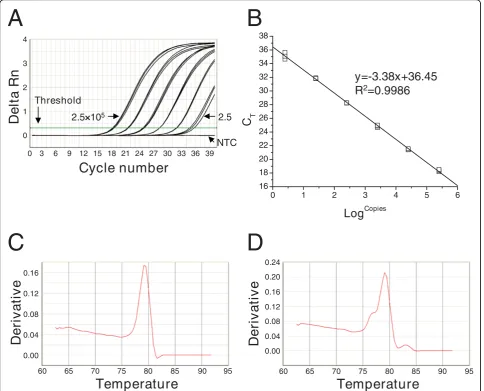
cDNA was generated from cultures stimulated with a CD3-specific mAb, amplified by PCR using primers spe-cific for Vb, Cb, and G3PDH genes. Standard curves were generated using the purified PCR products. Repre-sentative results from a Cb primer-based reaction are shown in Figure 1A. The qRT-PCR could detect ≤25 copies of CbPCR products without detectable variation among triplicate reactions (Figure 1A). The slope and correlation coefficient (R2) of standard curves are used to determine primer efficiency and standard curve valid-ity, respectively. Results obtained with the Cb reaction are representative data showing the slope for Cb
reaction was -3.38 with R2 value of 0.9986 (Figure 1B). The slope and R2 value of standard curves for other reactions are listed in Table 3.
Specificity of the qRT-PCR
qRT-PCR specificities were assessed by melting curve analysis and sequencing of amplified PCR products. Melting curves of the qRT-PCR reactions observed for Vb subgroups consisting of a single gene, as well as G3PDH and Cbgenes, showed single peak. A represen-tative result obtained for Vb1 is shown in Figure 1C. The melting curve for the Vb1 reaction contained a sin-gle peak at 78°C. Melting curves for Vbsubgroups con-sisting of multiple subgroup genes (Vb7, 12, 13A, and 17) showed multiple peaks due to the expected hetero-geneity in amplified gene fragments. Representative results for Vb17 are shown in Figure 1D. qRT-PCR for Vb17, which contains three subgroup genes produced a melting curve with three peaks as expected. However, some Vb subgroups consisting of multiple subgroup genes (Vb5, 6, 8, 13B, and 21) showed only a single peak (data not shown). To identify whether primers designed for these Vbsubgroups amplified the targeted subgroup genes, PCR products were cloned and sequenced. This revealed that, except for Vb21, the pri-mers amplified multiple Vbsubgroup genes within the targeted Vb subgroup (Table 2). No untargeted sequences were generated. We also analyzed the ampli-fied PCR products using agarose gel electrophoresis and confirmed that there was no non-specific amplification other than expected size of amplification product (data not shown).
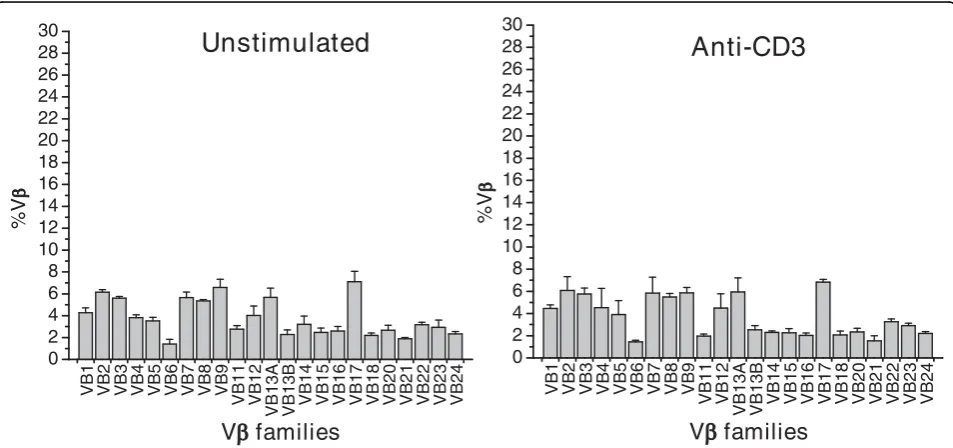
Quantification of Vbexpansion
Discussion
More than 67 different human Vb genes, of which a quarter are pseudogenes, have been have been cloned and sequenced [2,21,27]. These studies confirmed the existence of 49 functional Vbgenes within 24 different Vbsubgroups. Due to the heterogeneity, some of the 24 Vbsubgroups consist of multiple subgroup genes. In this study, we designed two primers annealing to each of 22 different Vbsubgroups (36 Vbgenes) to quantify expansion of T cell bearing specific Vbsubgroups and subgroup genes in response to SAgs.
One of the important factors that affect the validity of qRT-PCR is the efficiency of primers. The primers used in qRT-PCR should have uniform and high efficiency to achieve a valid quantification. The efficiency and linear-ity of primers could be assessed by analyzing the slope and R2 value of the standard curve, respectively. In the-ory, the slope should be close to -3.32 with an optimal efficiency when 10-fold serially diluted templates were used. The average slope and R2 of standard curves for all primers used in qRT-PCR was -3.3764 ± 0.0245 and 0.99856 ± 0.000478, respectively. This suggests that all
0 1 2 3 4 5 6
16 18 20 22 24 26 28 30 32 34 36 38
C
TLog
CopiesDel
ta
Rn
4
0 1 2 3
18 21 24 27 30 33 39 0 3 6 9 12 15 36
Cycle number
0.16
0.00 0.04 0.08
Der
iv
at
iv
e
60 65 70 75 80 85 90 95 0.12
Temperature
0.16
0.00 0.04 0.08
D
e
riva
tive
0.120.20 0.24
60 65 70 75 80 85 90 95
Temperature
A
B
C
D
y=-3.38x+36.45
R
2=0.9986
2.5 105 2.5
[image:5.595.57.542.90.481.2]NTC Threshold
Figure 1The specificity, sensitivity, and reproducibility of qRT-PCR. The qRT-PCR was performed using a ten-fold dilution series (2.5 × 10⁵ to 2.5 copies/reaction) of purified PCR product. Results shown are from a single representative experiment that was conducted three times. (A) The qRT-PCR successfully amplified the ten-fold dilution series of template (2.5 × 10⁵to 2.5 copies/reaction; from left to right). The non-template control (NTC) showed no amplification. The threshold was automatically set by Sequence Detector Systems version 1.2.2 software to synchronize among experiments. The threshold cycle (CT) was determined by the cycle number at which the change in the fluorescence of the reporter dye
(delta Rn) crossed the threshold; (B) The standard curve was generated by plotting the CTvs the number of purified PCR product copies
(Logcopies). The slope and correlation coefficient (R2) were -3.38 and 0.9986, respectively; (C) Melting curve analysis for the Vb1 subgroup consist
primers used in qRT-PCR have uniform and high effi-ciency and linearity.
[image:6.595.57.290.112.414.2]The specificity of qRT-PCR using SYBR Green I plat-form was often determined by analyzing melting curves. In this study, the specificities of each primer set were determined by analyzing melting curves and sequencing amplified PCR products. Melting curve analysis and sequencing amplified PCR products of reactions for, Cb and Vb subgroups consisting of a single subgroup showed a single peak and a single specific amplification. As expected, some Vbsubgroups comprised of multiple subgroup genes (Vb7, 12, 13A, and 17) showed a corre-sponding number of peaks. However, some Vb sub-groups comprised of multiple subgroup genes (Vb5, 6, 8, 13B, and 21) showed only a single peak. The sequence analysis of amplified PCR products for Vb5, 6, 8, 13B, and 21 subgroups revealed that multiple group genes were amplified. For example, the Vb6 sub-group, consisting of 6 functional subgroup genes with > 87.9% sequence similarity to each other, showed a single peak in melting curve analysis, though the sequence analysis of amplified PCR product showed that all 6 functional subgroup genes were amplified. The resolu-tion of these into a single peak probably due to a high level nucleotide sequence similarity among subgroup genes resulting in an identical meting temperature of amplified gene fragments. The identity of all sequenced PCR products matched with corresponding subgroups
Table 3 Standard curve slopes, Y axis intercepts and correlation coefficients (R2)
Primers Slope Y axis intercept Correlation coefficient (R2)
Cb -3.38 36.45 0.9986
VB1 -3.39 36.54 0.9977
VB2 -3.36 36.38 0.9982
VB3 -3.41 36.57 0.9987
VB4 -3.37 36.62 0.9984
VB5 -3.35 36.33 0.9976
VB6 -3.40 36.53 0.9978
VB7 -3.36 36.43 0.9983
VB8 -3.37 36.40 0.9986
VB9 -3.38 36.49 0.9985
VB11 -3.41 36.52 0.9986
VB12 -3.42 36.53 0.9972
VB13A -3.34 36.34 0.9978 VB13B -3.41 36.54 0.9974
VB14 -3.36 36.33 0.9981
VB15 -3.35 36.44 0.9976
VB16 -3.37 36.44 0.9984
VB17 -3.39 36.53 0.9982
VB18 -3.35 36.44 0.9986
VB20 -3.33 36.39 0.9973
VB21 -3.36 36.38 0.9986
VB22 -3.39 36.47 0.9981
VB23 -3.37 36.43 0.9980
VB24 -3.41 36.53 0.9984
V families
V families
Unstimulated
Anti-CD3
VB 1 VB 2 VB 3 VB 4 VB 5 VB 6 VB 7 VB 8 VB 9 VB 11 VB 12VB13A VB13B VB
14 VB 15 VB 16 VB 17 VB 18 VB 20 VB 21 VB 22 VB 23 VB 24 0 2 4 6 8 10 12 14 16 18 20 22 24 26 28 30 %V
VB1 VB2 VB3 VB4 VB5 VB6 VB7 VB8 VB9 VB11 VB12
VB13A VB13B VB14 VB15 VB16 VB17 VB18 VB20 VB21 VB22 VB23 VB24 0 2 4 6 8 10 12 14 16 18 20 22 24 26 28 30 %V
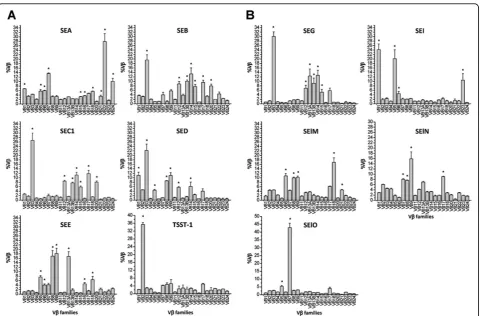
[image:6.595.59.536.443.667.2]Figure 3Distribution of %Vbin the cultures stimulated with SAgs. Non-adherent lymphocyte-enriched PBMCs were stimulated with SAgs (final concentration at 5μg/ml) for 4 days. The %Vbs were calculated and were presented as the mean ± S.E.M. Asterisks indicate a significant increase in %Vbcompared to cultures without stimuli (p < 0.05). Results shown are the means ± S.E.M. of three sets of triplicates combined from three experiments (n = 9). A) Classic SEs and TSST-1. B) Novel SEs and SEls.
Table 4 Comparison of Vbspecificity observed in this study with those in selected previous studies.
SAgs Vbspecificity observed in this study Vbspecificity observed in previous studiesa References
SEA Vb1, 5, 6, 7, 15, 16, 18, 21, 22, 24 Vb1, 5, 6, 7, 9, 16, 18, 21 [24] SEB Vb3, 12, 13Bb, 14, 15, 17, 20 Vb1, 3, 6, 12, 13.2, 15, 17, 20 [11]
SEC1 Vb3, 12, 13B, 14, 15, 17, 20 Vb3, 12, 13.2, 14, 15, 17, 20 [12] SED Vb1, 3, 5, 8, 9, 12, 14 Vb1, 5, 6, 7, 8, 12 [7,25] SEE Vb5, 6, 8, 9, 13Ac, 16, 18 Vb5, 6, 8, 13.1, 18, 21 [11,24] SEG Vb3, 12, 13A, 13B, 14, 15 Vb3, 12, 13, 14 [26]
SEI Vb1, 5, 6, 23 Vb1, 5, 6, 23 [26]
SElM Vb6, 8, 9, 18, 21 Vb6, 8, 9, 18, 21 [26]
SElN Vb7, 8, 9, 17 Vb9 [26]
SElO Vb5, 7 Vb5, 7, 22 [26]
TSST-1 Vb2 Vb2 [11]
a
Vbspecificities were results from previous studies using semi-quantitative PCR or FACS methods.
b
Vb13B corresponds to Vb13.2 in previous studies.
c
[image:7.595.57.537.507.657.2]of Vb subgroups and revealed that 36 out of 49 func-tional Vb subgroup genes were amplified. It suggests that primers used in this study were highly specific to targeted Vbsubgroup.
In this study, we used various SAgs showing similar and/or unique Vbspecificities covering the entire reper-toire of human Vb subgroups. The qRT-PCR showed that every Vbsubgroup was expanded in this study. As shown in Table 4, the Vbspecificities of SAgs observed in this study was very similar to those described in pre-vious studies with minor variation [7,11,12,24-26]. In this study, newly identified Vb specificities were observed for some SAgs such as SEA (Vb15, 22, and 24), SEB (Vb 14), SED (Vb3, 9, and 14), SEE (Vb9 and 16), SEG (Vb15), and SElN (Vb7, 8, and 17). Also, some Vb previously reported specificities were not observed for some SAgs such as SEB (Vb1 and 6), SED (Vb6 and 7), SEE (Vb21), and SElO (Vb22). These discrepancies might be explained by the differences in the repose to SAgs among humans or differences in techniques (PCR, flow cytometry), or the lack of reagents at the time of previous studies. For example, the Vb specificity of some SAgs in two previous studies was determined by semi-quantitative PCR using primers specific to Vb1 through Vb20 [11,12]. This present study incorporated primers specific to Vb21 through Vb24. However, it is noteworthy that Vb subgroups most prominently expanded by each SAg observed in this study were iden-tical to those observed in previous studies.
Conclusion
In this report, we developed an assay to quantify the expansion of human Vbsubgroups using qRT-PCR. The specificity and efficiency of the method were evaluated by generating standard curves for each primer set. The validity of the method was assessed by analyzing the Vb specificity of various SAgs which combined, interact with Vb repertoires covering all known Vbsubgroups. Our results demonstrate that the method established in this study is accurate, sensitive, and highly reproducible. This qRT-PCR method could also be used to character-ize novel SAgs, to determine complete profiles of cur-rently known SAgs, and to help understand the role of T cells bearing specific Vbs in certain diseases such as neoplastic expansion of large granular lymphocytes, T cell non-Hodgkin’s lymphoma [28,29] as well as some immune disorders associated with SAgs such as immu-nosuppression, Kawasaki disease, and atopy [30-32].
Acknowledgements
This work was supported by the grants from the National Institutes of Health Grants (P20 RR15587, P20 RR016454, and U54AI57141), the USDA NRI grant (2008-892) and the Idaho Agricultural Experimental Station.
Author details
1Department of Microbiology, Molecular Biology and Biochemistry, University
of Idaho, Moscow, ID 83844, USA.2Department of Veterinary Medicine, Washington State University, Pullman, WA 99164, USA.3Jenomic, Inc, Carmel,
CA, USA.
Authors’contributions
KSS developed the basic assay and performed most experiments including cloning, protein purification, cell preparation and stimulation, qRT-PCR, and data analysis. JYP helped to perform qRT-PCR and interpret data. DST provided some toxins and input into general experimental strategy. GAB assisted in experimental design and helped to interpret data and draft the manuscript. All authors read and approved the final manuscript.
Competing interests
The authors declare that they have no competing interests.
Received: 1 July 2009
Accepted: 13 January 2010 Published: 13 January 2010
References
1. Davis MM, Boniface JJ, Reich Z, Lyons D, Hampl J, Arden B, Chien Y:Ligand recognition by alpha beta T cell receptors.Annu Rev Immunol1998,
16:523-544.
2. Rowen L, Koop BF, Hood L:The complete 685-kilobase DNA sequence of the human beta T cell receptor locus.Science1996,272:1755-1762. 3. Davis MM, Bjorkman PJ:T-cell antigen receptor genes and T-cell
recognition.Nature1988,334:395-402.
4. Behlke MA, Spinella DG, Chou HS, Sha W, Hartl DL, Loh DY:T-cell receptor beta-chain expression: dependence on relatively few variable region genes.Science1985,229:566-570.
5. Marrack P, Kappler J:Positive selection of thymocytes bearing alpha beta T cell receptors.Curr Opin Immunol1997,9:250-255.
6. Garcia KC, Degano M, Stanfield RL, Brunmark A, Jackson MR, Peterson PA, Teyton L, Wilson IA:An alphabeta T cell receptor structure at 2.5 A and its orientation in the TCR-MHC complex.Science1996,274:209-219. 7. Seo KS, Bohach GA:Staphylcoccus aureus.Food microbiology: Fundamentals
and FrontiersWashington, DC: ASM PressDoyle MM, Beucaht LR 2007, 493-518.
8. Lina G, Bohach GA, Nair SP, Hiramatsu K, Jouvin-Marche E, Mariuzza R:
Standard nomenclature for the superantigens expressed by
Staphylococcus.J Infect Dis2004,189:2334-2336.
9. Bohach GA:Staphylococcus aureusExotoxins.Gram-Positive Pathogens
Washington, DC: ASM PressFischetti VA, Novick RP, Ferretti JJ, Portnoy DA, Rood JI 2006, 464-477.
10. Mooney NA, Ju L, Brick-Ghannam C, Charron DJ:Bacterial superantigen signaling via HLA class II on human B lymphocytes.Mol Immunol1994,
31:675-681.
11. Choi YW, Kotzin B, Herron L, Callahan J, Marrack P, Kappler J:Interaction of Staphylococcus aureus toxin“superantigens”with human T cells.Proc Natl Acad Sci USA1989,86:8941-8945.
12. Deringer JR, Ely RJ, Stauffacher CV, Bohach GA:Subtype-specific interactions of type C staphylococcal enterotoxins with the T-cell receptor.Mol Microbiol1996,22:523-534.
13. Pilch H, Hohn H, Freitag K, Neukirch C, Necker A, Haddad P, Tanner B, Knapstein PG, Maeurer MJ:Improved assessment of T-cell receptor (TCR) VB repertoire in clinical specimens: combination of TCR-CDR3 spectratyping with flow cytometry-based TCR VB frequency analysis.Clin Diagn Lab Immunol2002,9:257-266.
14. Bercovici N, Duffour MT, Agrawal S, Salcedo M, Abastado JP:New methods for assessing T-cell responses.Clin Diagn Lab Immunol2000,7:859-864. 15. Walters G, Alexander SI:T cell receptor BV repertoires using real time
PCR: a comparison of SYBR green and a dual-labelled HuTrec fluorescent probe.J Immunol Methods2004,294:43-52.
16. Ochsenreither S, Fusi A, Busse A, Nagorsen D, Schrama D, Becker J, Thiel E, Keilholz U:Relative quantification of TCR Vbeta-chain families by real time PCR for identification of clonal T-cell populations.J Transl Med2008,
6:34.
18. Li H, Llera A, Tsuchiya D, Leder L, Ysern X, Schlievert PM, Karjalainen K, Mariuzza RA:Three-dimensional structure of the complex between a T cell receptor beta chain and the superantigen staphylococcal enterotoxin B.Immunity1998,9:807-816.
19. Bohach GA, Schlievert PM:Detection of endotoxin by enhancement with toxic shock syndrome toxin-1 (TSST-1).Methods Enzymol1988,
165:302-306.
20. Monday SR, Bohach GA:Use of multiplex PCR to detect classical and newly described pyrogenic toxin genes in staphylococcal isolates.J Clin Microbiol1999,37:3411-3414.
21. Arden B, Clark SP, Kabelitz D, Mak TW:Human T-cell receptor variable gene segment families.Immunogenetics1995,42:455-500.
22. Sambrook J, Fritsch EF, Maniatis T:Concentration of DNA Solution.
Molecular Cloning: A Laboratory ManualNew York: Cold Spring Harbor Laboratory PressNolan C 1989, Appendix C1.
23. Yin JL, Shackel NA, Zekry A, McGuinness PH, Richards C, Putten KV, McCaughan GW, Eris JM, Bishop GA:Real-time reverse transcriptase-polymerase chain reaction (RT-PCR) for measurement of cytokine and growth factor mRNA expression with fluorogenic probes or SYBR Green I.Immunol Cell Biol2001,79:213-221.
24. Lamphear JG, Mollick JA, Reda KB, Rich RR:Residues near the amino and carboxyl termini of staphylococcal enterotoxin E independently mediate TCR V beta-specific interactions.J Immunol1996,156:2178-2185. 25. Kappler J, Kotzin B, Herron L, Gelfand EW, Bigler RD, Boylston A, Carrel S,
Posnett DN, Choi Y, Marrack P:V beta-specific stimulation of human T cells by staphylococcal toxins.Science1989,244:811-813.
26. Jarraud S, Peyrat MA, Lim A, Tristan A, Bes M, Mougel C, Etienne J, Vandenesch F, Bonneville M, Lina G:egc, a highly prevalent operon of enterotoxin gene, forms a putative nursery of superantigens in
Staphylococcus aureus.J Immunol2001,166:669-677.
27. Lefranc M, Lefranc G:The T cell receptorNew York: Academic Press 2001. 28. Loughran TP Jr, Starkebaum G, Aprile JA:Rearrangement and expression
of T-cell receptor genes in large granular lymphocyte leukemia.Blood
1988,71:822-824.
29. Willenbrock K, Roers A, Seidl C, Wacker HH, Kuppers R, Hansmann ML:
Analysis of T-cell subpopulations in T-cell non-Hodgkin’s lymphoma of angioimmunoblastic lymphadenopathy with dysproteinemia type by single target gene amplification of T cell receptor- beta gene rearrangements.Am J Pathol2001,158:1851-1857.
30. Seo KS, Park JY, Davis WC, Fox LK, McGuire MA, Park YH, Bohach GA:
Superantigen-mediated differentiation of bovine monocytes into dendritic cells.J Leukoc Biol2009,85(4):606-16.
31. Seo KS, Lee SU, Park YH, Davis WC, Fox LK, Bohach GA:Long-term staphylococcal enterotoxin C1 exposure induces soluble factor-mediated immunosuppression by bovine CD4+ and CD8+ T cells.Infect Immun
2007,75:260-269.
32. Yarwood JM, Leung DY, Schlievert PM:Evidence for the involvement of bacterial superantigens in psoriasis, atopic dermatitis, and Kawasaki syndrome.FEMS Microbiol Lett2000,192:1-7.
doi:10.1186/1479-5876-8-2
Cite this article as:Seoet al.:A quantitative real time PCR method to
analyze T cell receptor Vbsubgroup expansion by staphylococcal
superantigens.Journal of Translational Medicine20108:2.
Submit your next manuscript to BioMed Central and take full advantage of:
• Convenient online submission
• Thorough peer review
• No space constraints or color figure charges
• Immediate publication on acceptance
• Inclusion in PubMed, CAS, Scopus and Google Scholar
• Research which is freely available for redistribution