promoting access to White Rose research papers
Universities of Leeds, Sheffield and York
http://eprints.whiterose.ac.uk/
This is an author produced version of a paper published in Journal of Pharmaceutical Statistics.
White Rose Research Online URL for this paper: http://eprints.whiterose.ac.uk/3411/
Published paper
Bland, J. Martin and Altman, Douglas G. (2007) Agreement between methods of measurement with multiple observations per individual. Journal of
Biopharmaceutical Statistics, 17 (4). 571-582.
Post-referee version, 22 December 2006
Agreement between methods of measurement with
multiple observations per individual
J Martin Bland1* and Douglas G Altman2
1
Professor of Health Statistics
Dept. of Health Sciences
University of York
York, UK
2
Professor of Statistics in Medicine
Centre for Statistics in Medicine
Wolfson College Annexe
Linton Road
Oxford, UK
*
Correspondence to J M Bland
Professor of Health Statistics
Dept. of Health Sciences
University of York
York YO10 5DD
Abstract
Limits of agreement provide a straightforward and intuitive approach to agreement between
different methods for measuring the same quantity. When pairs of observations using the two
methods are independent, i.e. on different subjects, the calculations are very simple and
straightforward. Some authors collect repeated data, either as repeated pairs of measurements
on the same subject, whose true value of the measured quantity may be changing, or more
than one measurement by one or both methods of an unchanging underlying quantity. In this
paper we describe methods for analysing such clustered observations, both when the
underlying quantity is assumed to be changing and when it is not.
Introduction
The limits of agreement (LoA) method (Altman and Bland 1983, Bland and Altman 1986) for
assessing the agreement between two methods of medical measurement is widely used.
(Bland and Altman 1993, Ryan and Woodall 2005). We obtain the differences between
measurements by the two methods for each individual and calculate the mean and standard
deviation. We then estimate the 95% limits of agreement as the two values mean minus 1.96
standard deviations and mean plus 1.96 standard deviations. These limits are expected to
contain the difference between measurements by the two methods for 95% of pairs of future
measurements on similar individuals.
The motivating scenario for the LoA method is the case where each individual has one
measurement made by each of the methods X and Y. It is valuable, however, to obtain
replicate measurements by each method on each individual so that the repeatability of the two
methods can be compared (Bland and Altman 1999). Such data comprise a mixture of
between and within-individual information on the differences between methods. We did not
and Bland (1983) Bland and Altman (1986)], as this important requirement is not specific to
the LoA approach but rather applies to all types of statistical analyses. If each pair of X and Y
measurements is treated as if from a different individual the structure of the data is ignored
and incorrect estimates are likely; specifically, the interval between the limits of agreement
may be too narrow.
In this paper we look at how to apply the LoA method when we have repeated measurements
on each of a group of subjects. We consider separately two somewhat different situations.
Concepts
The key principle of the LoA method is to examine the average difference between the
methods, and also to consider the variability in those differences across individuals. It is an
implicit assumption that the difference between the two methods is reasonably stable across
the range of measurements, and we will assume this condition holds for the purpose of this
paper. We have discussed elsewhere possible strategies when this condition is not met,
including transformation of the data (Bland and Altman 1999).
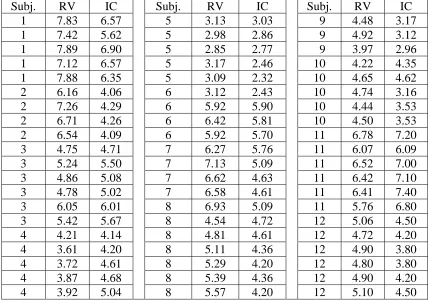
Table 1 and Figure 1 show some typical data in which pairs of measurements were made
sequentially on each of a group of subjects. Here 60 pairs of measurements of cardiac
ejection fraction by two methods were made on 12 individuals, with 3-7 replicates per
individual. First, we might ignore the replication and treat these as 60 independent pairs of
measurements and calculate the mean and standard deviation of their differences. As noted
above, these limits of agreement could be too narrow. An alternative would be to average all
the observations on the same subject. The limits of agreement calculated in this way would
be for the average of several measurements and would be too narrow for a single
measurement. This approach is appropriate only when the usual clinical measurement is the
As an extreme example, Barry et al. (1997) reported the comparison of bioimpedance and
continuous thermodilution two methods of cardiac output using 2390 observations from just 7
patients.
A somewhat different problem is shown in a study by Almén et al. (1991) who reported the
glomerular filtration rate (GFR) in the left and right kidneys of 20 patients using both a
gamma camera and computed tomography (CT). They presented the GFR of each kidney as a
percentage of the total GFR for that patient. Unfortunately, they use data from both kidneys
in their comparison of the two methods, but they have effectively analysed all the data twice
for each patient, as the difference between methods with the left kidney is minus that for the
right kidney. Their plot displays point symmetry as a consequence of plotting each point as
both (X,Y) and (100-X, 100-Y). Had they calculated limits of agreement they would have
found that the mean difference was exactly zero.
There are two different situations to consider for replicated data. We can think of the
observations for the same subject as a series of measurements of a quantity that does not vary
over the period of observation. An example is measurements of carotid artery stenosis taken
on the same day. Or we can think of them as pairs of measurements by two methods of a
changing quantity, where it is the instantaneous measurement for the subject which we want
to capture. This second situation could arise either when the quantity being measured is
unstable, such as blood pressure or daily excretion of some chemical, or when observations
are made under different conditions – e.g. before and after exercise. The distinction is
important, as it determines whether we need to consider pairing of observations by the two
methods. Indeed, for the first (constant) case we do not require equal replication of each
method for each individual, whereas this is a requirement for the second (non-constant) case.
In Bland and Altman (1986) we described how to deal with the constant case, where the true
observations for each subject is the same. In Bland and Altman (1999) we discussed the
more general case where the number of observations varies, and also the non-constant
situation where we are trying to capture the instantaneous value of a changing quantity. That
paper is quite technical and not easily accessible to many researchers, so in this paper we
describe these methods more simply and provide a worked example.
In both cases, the key to the analysis of such data is that the repeated observations by a
method on an individual will be scattered around the mean value of all the possible
observations by that method, which we might consider to be that person’s true value. There
may be both a bias, where one method tends to give consistently higher measurements than
the other, and heterogeneity, when the between method-differences vary across individuals
more than expected simply by chance. This phenomenon, which we also call a subject by
method interaction, is seen clearly in Figure 2.
In each case, we shall estimate limits for the difference between measurements by the two
different methods on the same subject. We shall begin with the non-constant case where the
true value varies, because it is rather simpler.
For both approaches we want the agreement to be the same or at least similar over the range
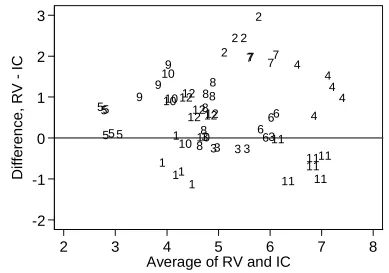
of measurement. We can check this assumption by plotting the difference against the average
of the two methods (Figure 2). We have included a zero line in Figure 2. It is clear that there
is a bias, the RV cardiac ejection fraction tending to be larger than the IC, but no obvious
variation in agreement across the range of measurements.
Method where the true value varies
Calculations for the “non-constant” situation are relatively straightforward, using the
difference between methods for each pair. We want to estimate the mean difference and the
standard deviation of differences about the mean. To do this we must estimate two different
for the differences between the averages of the two methods across subjects. The model is
that the observed difference is the sum of the mean difference (bias), a random between
subjects effect (heterogeneity) and a random error within the subject. The within-subject
variance is assumed constant and observations within the subject are independent. The
variance for single differences between pairs of measurements on different subject is found
by summing the between subjects and within subjects variances (Bland and Altman 1999).
The first variance, that within subjects, can be estimated very easily using one way analysis
of variance, using the difference in matched pairs as a response. We must assume that this
within-subject variance is the same for all subjects. We check that it is unrelated to the
subject mean as the best estimate of the magnitude of the measurement for that subject.
Figure 3 shows the standard deviation of the differences for the subject against the average
measurement for that subject. There is no suggestion that there is a relationship between the
variability of the differences and the magnitude of the ejection fraction.
The one-way analysis of variance is shown in Table 2. The estimated variance of multiple
between-method differences for the same subject is the residual mean square or mean square
error, 0.170714026. (We will retain all the decimal places until the end of the calculation,
and then round to more practical numbers.) The other component of the variance, for
differences between the average difference across subjects, can also be found from this table,
using the difference between the mean squares for subjects and the residual mean square,
4.2090856 – 0.170714026 = 4.0383716. We must divide this by a value which depends on
the numbers of observation on each subject. If the number of observations on subject i is mi,
this divisor is
(
)
∑
∑
∑
− −
i i i
m n
m m
) 1 (
where n is the number of subjects. If all the subjects have the same number of observations,
m, this factor reduces to m. For the ejection fraction data, n = 12,
∑
mi= 60 (the totalnumber of observations), and
∑
2=312. Hence im
(
)
4.9818182 60
) 1 12 (
312 60 )
1 (
2 2
2
= × −
− =
− −
∑
∑
∑
i i i
m n
m m
The estimated component of variance which represents the heterogeneity is 4.0383716
divided by 4.9818182 = 0.81062203. (In our earlier paper (Bland and Altman 1999), we
incorrectly stated that this number should be used to multiply the difference in the sum of
squares, rather than divide it.) The total variance for single differences on different subjects
is estimated by the sum of these two components: 0.170714026 + 0.81062203 = 0.98133606.
The standard deviation is the square root of this, which is 0.99062408.
The estimated bias, the mean difference, can be estimated simply from the mean of the
individual differences. This method automatically weights the observations correctly. The
average is 0.6021667. Hence the 95% limits of agreement are estimated to be 0.6021667 –
1.96 × 0.99062408 to 0.6021667 + 1.96 × 0.99062408. This gives –1.3394565 to
+2.5437899 which we can round to –1.3 to +2.5. These are the 95% limits for RV minus IC,
so we estimate the ejection fraction measured by the RV to be between 1.3 units less than IC
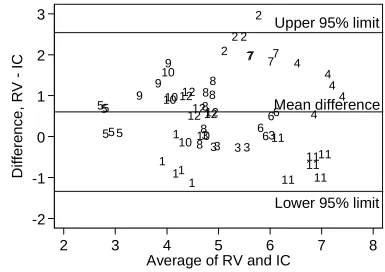
and 2.5 units greater. We can add these limits to the difference against average plot, as
shown in Figure 4. The limits appear to fit the data well.
For this analysis of variance, we must assume that the repeated differences for a single
subject are independent. This might be a rather strong assumption. For the ejection fraction
data, for example, subjects were in the operating theatre undergoing surgery and there may be
changes over time in the ejection fraction. Hence there would be autocorrelation in the
ejection fraction, which might produce autocorrelation in the differences. One visual check
Figure 5 shows such a plot, assuming that the data were supplied to us in temporal order.
There appears to be autocorrelation for some subjects and, indeed, the order by subject
interaction is highly significant. Whether this influences the estimate of the variance within
subjects is unclear, but this is certainly an area where further work is needed.
Would it matter if we ignored the subject and treated the 60 observations as if they were from
60 different subjects? Not much in this case. The mean difference would be unchanged and
the standard deviation would be 0.9610571 compared to 0.99062408. The limits of
agreement would be –1.2815052 to +2.4858386, so to one decimal place they would also be
–1.3 to 2.5. This similarity is because the number of pairs per subject is quite small and less
than the number of subjects. However, the limits are slightly narrower than they should be.
As the number of pairs per subject rises, the limits will become narrower.
Method where the true value is constant
In the “constant” case where the true value does not change any pairing of measurements
made by the two methods simultaneously will not be informative. We do not keep the link
between them and may have different numbers of measurements on a subject by the two
methods. Indeed, there may in fact not be any pairing in the first place.
For each method separately, the variability will be made up of three components: the
variability across individuals of the true quantity being measured, the variability of each
individual’s average values about overall average for that method, which we call
heterogeneity, and the variability of repeated measurements about the average for an
individual. We assume that these are independent, that observations within a subject are
independent, and that the error variances within the subject are constant.
As described in section 5 in Bland and Altman (1999), we derive the estimated standard
deviation for individual differences from the variance of the subject mean differences and an
We will use the same data to illustrate the method. We expect to get wider limits of
agreement than before because the true value may not be constant in this situation.
We first find the two measurement errors using one-way analyses of variance for each
method separately (Table 3). The within subjects variances are obtained from the mean
square for the residual, 0.107227795 for the RV method and 0.137874069 for the IC method.
We next find the mean RV and IC for each subject and the differences between them. The
mean of these average differences across the 12 subjects, RV minus IC, is 0.7092361, and
their variance is 0.91269114, which corresponds to a standard deviation of 0.9553487. For
these analyses to be valid, the within-subject standard deviation of each measurement must be
constant and unrelated to the magnitude. We can check this by plotting the individual subject
standard deviation against the individual mean, for each method separately (Figure 6). There
is no problem for IC, but there may be for RV. However, with a small sample it is hard to
judge whether there may be a problem and for this illustration we decided to accept the
standard deviation as constant.
We then increase this variance by a term that allows for it being derived from the average of
several observations. We multiply each of the separate within-subject variances found earlier
by
⎟⎟ ⎠ ⎞ ⎜⎜
⎝ ⎛
−
∑
im n
1 1 1
The mi may be different for the two methods, as it is possible to have different numbers of
observations by the two methods on a subject. If the numbers of observations on each
subjects are the same, m, this expression reduces to
⎟ ⎠ ⎞ ⎜ ⎝ ⎛ −
m
For the ejection fraction data, n = 12 and
∑
i m1 = 2.5166664, so the multiplier is
.7902778 0
2.5166664 12
1
1− × =
Hence we estimate the variance for individual differences by the variance of differences
between subject means plus the multiplier times the sum of the measurement error variances
for each of the methods:
0.91269114 + 0.7902778×0.107227795 + 0.7902778×0.137874069 = 1.1063897
The standard deviation is the square root of this value, i.e. 1.0518506.
The limits of agreement can now be found. As before, the weighted mean difference is
0.6021667, and the 95% limits of agreement are 0.6021667 – 1.96 × 1.0518506 to 0.6021667
+ 1.96 × 1.0518506, which gives –1.4594605 to 2.6637939. We could round these values to
–1.5 to +2.7.
These limits are slightly wider than those where we retained the pairing information, because
they are for agreement in measuring the average ejection fraction over a period rather than at
an instant. The variability of ejection fraction over the measurement period has been
included in the random variation. The small difference between the two sets of limits is
because in these data the ejection fraction varied only slightly over the measurement period.
These were the limits which were originally provided for Bowling et al. (1993).
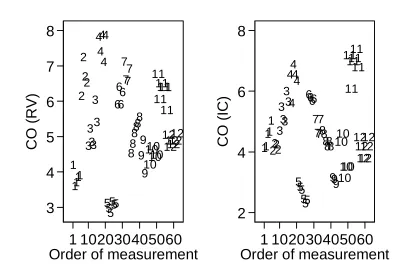
As with the case of paired data, there may be correlation within the subject. This would be
for the separate methods rather than the differences, as the method assumes no pairing. We
plot each variable separately against order (Figure 7). Although we might observe some
subjects where there are apparent trends, in fact the order by subject interactions are not
significant for either method of measurement. However, as for the paired case, this topic
Discussion
Most method comparison studies seem to use single observations by each method for each
individual. There are, however, considerable advantages in collecting replicate observations
so that the repeatability of the methods can be compared. The limits of agreement method is
most easily applied to the simple, unreplicated case. In this paper we have illustrated two
methods for analysing repeated measurements in the estimation of the agreement between
two methods of measurement. Although these have been described previously (Bland and
Altman 1999) no numerical example was given for the case when the true value of the
quantity being measured varied and also there was an error in the mathematical description.
Although a numerical example was given for the case when the true value did not vary, it was
presented in very mathematical terms. We hope that this presentation will be more useful to
researchers.
In these examples, the estimated limits are wider than those obtained if the data structure is
ignored, as we would expect, but by only a small amount. It may be that this will be the case
in many data sets. As noted above, a further possible approach is to average the repeated
measurements for each subject and use only 12 pairs of means to calculate the 95% limits.
That analysis would be expected to give limits that are too narrow. We again have the mean
difference = 0.7092361 and the standard deviation of the differences = 0.9553487. The 95%
limits of agreement become 0.7092361 – 1.96 × 0.9553487 to 0.7092361 + 1.96 × 0.9553487,
which are –1.1632474 to +2.5817196, or –1.2 to +2.6. As expected, these limits are again
narrower than the correct ones, though they are similar. There is little difference because
there is much more variation between the subjects than for the repeated observations on a
single subject. Averaging repeated observations for a subject removes only variation within
the subject. There would be much greater narrowing of the limits if the variability between
were less heterogeneity. On the other hand, ignoring the data structure altogether and treating
the observations as independent would have less effect than it does in this example if there
were less heterogeneity In the complete absence of heterogeneity the limits would be the
same as for our analyses.
It must be better to have methods of analysis which do take the structure of the data into
account and do not run the risk of producing limits of agreement which are too narrow.
Incorrectly calculated limits would lead us to think that methods of measurement agreed
more closely than they actually do, which could have adverse consequences.
Such analysis may be further improved by the development of methods to adjust for
autocorrelation.
Acknowledgements
References
Almén T, Bergquist D, Frennby B, Hellsten S, Lilja B, Nyman U, Sterner G, Törnquist C.
(1991). Use of urographic contrast media to determine glomerular filtration rate. Determining
the glomerular filtration rate of each kidney with computed tomography and scintigraphy.
Invest Radiol 26 Suppl 1:S72–S74.
Altman DG, Bland JM. (1983) Measurement in medicine: the analysis of method
comparison studies. Statistician 32:307-317.
Barry BN, Mallick A, Bodenham AR, Vucevic M. (1997). Lack of agreement between
bioimpedance and continuous thermodilution measurement of cardiac output in intensive care
unit patients. Crit Care 1:71-74.
Bland JM, Altman DG. (1986) Statistical methods for assessing agreement between two
methods of clinical measurement. Lancet i:307-310.
Bland JM, Altman DG. (1992) This week's citation classic: Comparing methods of clinical
measurement. Current Contents CM20(40) Oct 5:8.
Bland JM, Altman DG. (1999) Measuring agreement in method comparison studies. Stat
Methods Med Res 8:135-160.
Bowling LS, Sageman WS, O'Connor SM, Cole R, Amundson DE. (1993) Lack of
agreement between measurement of ejection fraction by impedance cardiography versus
radionuclide ventriculography. Crit Care Med 21:1523-1527.
Table 1. Cardiac ejection fraction (%) by two methods, radionuclide ventriculography (RV) and impedance cardiography (IC), for 12 subjects (Data provided by Dr LS Bowling REF)
Subj. RV IC Subj. RV IC Subj. RV IC
1 7.83 6.57 5 3.13 3.03 9 4.48 3.17 1 7.42 5.62 5 2.98 2.86 9 4.92 3.12 1 7.89 6.90 5 2.85 2.77 9 3.97 2.96
1 7.12 6.57 5 3.17 2.46 10 4.22 4.35
1 7.88 6.35 5 3.09 2.32 10 4.65 4.62
2 6.16 4.06 6 3.12 2.43 10 4.74 3.16
2 7.26 4.29 6 5.92 5.90 10 4.44 3.53
2 6.71 4.26 6 6.42 5.81 10 4.50 3.53
2 6.54 4.09 6 5.92 5.70 11 6.78 7.20
3 4.75 4.71 7 6.27 5.76 11 6.07 6.09
3 5.24 5.50 7 7.13 5.09 11 6.52 7.00
3 4.86 5.08 7 6.62 4.63 11 6.42 7.10
3 4.78 5.02 7 6.58 4.61 11 6.41 7.40
3 6.05 6.01 8 6.93 5.09 11 5.76 6.80
3 5.42 5.67 8 4.54 4.72 12 5.06 4.50
4 4.21 4.14 8 4.81 4.61 12 4.72 4.20
4 3.61 4.20 8 5.11 4.36 12 4.90 3.80
4 3.72 4.61 8 5.29 4.20 12 4.80 3.80
4 3.87 4.68 8 5.39 4.36 12 4.90 4.20
[image:15.595.72.460.444.516.2]4 3.92 5.04 8 5.57 4.20 12 5.10 4.50
[image:15.595.73.462.566.730.2]Table 2. Analysis of variance table as produced by Stata
Source | Partial SS df MS F Prob > F ---+--- Subject | 46.2999416 11 4.2090856 24.66 0.0000 Residual | 8.19427323 48 .170714026
---+--- Total | 54.4942149 59 .92363076
Table 3. One-way analyses of variance for RV and IC separately
RV method:
Source | Partial SS df MS F Prob > F ---+--- Subject | 99.7289076 11 9.06626433 84.55 0.0000 Residual | 5.14693415 48 0.107227795
---+--- Total | 104.875842 59 1.77755664
IC method:
Source | Partial SS df MS F Prob > F ---+--- Subject | 91.9533467 11 8.35939515 60.63 0.0000 Residual | 6.61795533 48 0.137874069
1
1 11
1 2 2 2 2 3 3 3 3 3 3 4 4 4 4 4 5 5 5 5 55 6 6 6 6 7 7 7 7 8 8 8 8 8 8 9 9 9 10 10 10 10 10 11 11
1111 11
11 12 12 12 12 12 12
3
4
5
6
7
8
E
jec
ti
o
n
f
ra
c
ti
on
(R
V
)
2
4
6
8
[image:16.595.80.467.80.351.2]Ejection fraction (IC)
Figure 1. Scatter plot of the data of Table 1 (points are represented by the subject number)
1 1 11 1 2 2 2 2 3 3 3 3 3 3 4 4 4 4 4 5 5 5 5 55 6 6 6 6 7 7 7 7 8 8 8 888 9 9 9 10 10 10 1010 11 11 11 11 11 11 12 12 12 12 1212
-2
-1
0
1
2
3
D
iffer
e
n
c
e
, R
V
IC
2
3
4
5
6
7
8
Average of RV and IC
[image:16.595.78.467.402.675.2]-3
-2
-1
0
1
2
3
D
iffer
e
n
c
e
, R
V
IC
0
2
4
6
8
[image:17.595.80.467.94.366.2]Average, RV and IC
Figure 3. Scatter plots of standard deviation of measurement pair differences against subject mean for 12 subjects. (Area of circle is proportional to number of observations.)
1 1 11 1 2 2 2 2 3 3 3
3 3 3
4 4 4 4 4 5 5 5 5 55 6 6 6 6 7 7 7 7 8 8 8 888 9 9 9 10 10 10 1010 11 11 11 11 11 11 12 12 12 12 1212
Lower 95% limit
Mean difference
Upper 95% limit
-2
-1
0
1
2
3
D
iffer
e
n
c
e
, R
V
IC
2
3
4
5
6
7
8
Average of RV and IC
[image:17.595.78.463.431.703.2]1 1 11 1 2 2 22 3 333 3 3 4 4 4 4 4 555 555 6 6 6 6 777 7 8 8 8 8889 9 9 1010 10 1010 11 11 11 11 1111 1212 1212 1212
-1
0
1
2
3
D
iffer
e
n
c
e
, R
V
IC
1
10
20
30
40
50
60
[image:18.595.79.466.80.350.2]Order in which measurements were recorded
Figure 5. Scatter plot of difference between methods against the order in which the measurements were made (points are represented by the subject number)
0 .1 .2 .3 .4 .5 .6 .7 SD CO( R V)
2 4 6 8
Mean CO(RV) 0 .1 .2 .3 .4 .5 .6 .7 S D CO (I C)
2 4 6 8
Mean CO(IC)
[image:18.595.76.484.416.629.2]1 1111 2 2 22 3 3 33 3 3 4 4 4 4 4
555555 6 6 6 6 7 777 88 888 8 9 9 910 1010 1010 11 11 111111
11
12 12121212
12
3
4
5
6
7
8
CO
(
R
V
)
1 102030405060
Order of measurement
11 11
1
2222 3 3 33 3 3 4 4 4 44 555 555 6666 7 77 7 88 8888 999 1010
101010 11 11 1111 11 11 12 12
[image:19.595.75.475.76.346.2]121212 12