A DDoS Attack Detection System
Based on Spark Framework
Dezhi Han, Kun Bi, Han Liu, and Jianxin Jia
College of Information Engineering, Shanghai Maritime University,
Shanghai 201306, China {dzhan, kunbi}@shmtu.edu.cn {jmakg23,onlyoneman}@163.com
Abstract. There are many problems in traditional Distributed Denial of Service (DDoS) attack detection such as low accuracy, low detection speed and so on, which is not suitable for the real time detecting and processing of DDoS attacks in big data environment. This paper proposed a novel DDoS attack detection system based on Spark framework including 3 main algorithms. Based on information entropy, the first one can effectively warn all kinds of DDoS attacks in advance according to the information entropy change of data stream source IP address and destination IP address; With the help of designed dynamic sampling K-Means algorithm, this new detection system improves the attack detection accuracy effectively; Through running dynamic sampling K-Means parallelization algorithm, which can quickly and effectively detect a variety of DDoS attacks in big data environment. The experi-ment results show that this system can not only early warn DDoS attacks effectively, but also can detect all kinds of DDoS attacks in real time, with low false rate.
Keywords:Distributed Denial of Service (DDoS), Early Warn, Attack Detection, Spark framework, K-Means Algorithm.
1.
Introduction
With the high-speed development of Internet, majority users has upgrade the bandwidth especially in some large cities, bandwidth of home users has reached 20M or even higher. Besides, with the popularization of 3G networks and gradual application of 4G networks, mobile internet has entered a booming stage. The rapid growth of private network band-width and continuously increasing internet users have posed enormous challenges for network security because the impact will be beyond measure once these high bandwidth network users are controlled by hackers and involved in DDoS (distributed denial of ser-vice).
[5]. During the latter half of 2015, Aliyun security team monitored a total of over 100,000 DDoS attacks, an increase of 32% as compared with that in the first half of 2015. Among them, attacks with a traffic exceeding 300Gbps amounted to 66 times, a rise of 127% than that in the first half of 2015 [7].
Network security incidents occurred frequently in the past two years. On January 21, 2014, DNSPod of Tecent got hijacked, resulting in DNS problems for a large number of domestic users. From December 20 to 21, 2014, a game company with its services deployed at Aliyun suffered DDoS attacks and the peak traffic of 453.8G/s made it the worlds biggest victim of DDoS attacks. On March 26, 2015, GitHub, a famous code host-ing site, started to suffer a large scale of DDoS attack, it caused interruption of services in certain areas, and the attack was lasted for over 80 hours. On May 11, 2015, NetEase suffered a new DDoS attack, named, LFA (Link Flooding Attack) [5] which resulted in service interruption of 9 hours and loss of RMB 15 million yuan. Consequently, it is im-portant both in theoretical significance and great economic value to research efficiently and promptly detect, warning, and manage large-traffic DDoS attacks.
In a big data background, highly efficient DDoS attack detection involves computa-tion and processing of massive data, while tradicomputa-tional method of single machine takes much time and cannot meet actual demand. The new distributed stream-oriented comput-ing framework (Spark Streamcomput-ing) adopts the memory-based parallel computcomput-ing method, which compared with the traditional computing method based on single-machine file sys-tem, significantly enhance the processing data quantity and processing data speed in unit time. Application of Spark Streaming to the real-time analysis system of big data flow network can accelerate the speed and accuracy of detection of DDoS attacks in a big data background.
In this paper, a novel DDoS attack system is proposed to detect DDoS attacks in a big data environment based on Spark framework, which includes 3 main algorithms. Based on information entropy, the first one can effectively warn all kinds of DDoS attacks in advance according to the information entropy change of data stream source IP address and destination IP address; With the help of designed dynamic sampling K-Means algorithm, this new detection system improves the attack detection accuracy effectively; Through dynamic sampling K-Means parallelization algorithm, which can quickly and effectively detect a variety of DDoS attacks in big data environment.The experimental results show that good warning results are obtained and the detection accuracy and speed are obviously superior than traditional DDoS attack detection methods.
The rest of this paper is organized as follows: Section 1 presents the working principle of Spark Streaming; Section 2 describes the DDoS attack warning algorithm design in detail. Section 3 presents the detailed design of improving K-Means parallel algorithm based on dynamics of Spark Streaming; Section 4 introduced the structure and major modules of the DDoS attack detection system. Section 5 presents the simulations and results of proposed DDoS attack detection system; Finally, we conclude this paper in Section 6.
2.
Spark Streaming Working Principle
2014. Spark offers solution for the problem of slow computation speed due to storage of intermediate results into the disc during calculation of Hadoop [4]. The ecological system of Spark includes batch processing, stream processing, machine learning, diagram calcu-lating, data analyzing, etc. Compared to Hadoop ecosystem, it is a more comprehensive and suitable distributed computing framework used for big data application scenarios.
RDD [11] (Resilient Distribute Data sets) is not only the core of Spark but also the key for Spark to realizing failure recovery and data dependency. With the simple logic of Lineage, RDD can perfectly solve the dependency between data and data, guaran-tee good fault tolerance. The RDD can also store intermediate results into the memory which significantly improves the computation speed by reducing disc read and write to the minimum. Especially in iterative computation, the speed is increased by one order of magnitude.
Different from MapReduce in Hadoop, MapReduce of Spark is well packaged into RDD. The operation can be conducted with RDD into two types: transformation and ac-tion. The Data in RDD do not exist in their original forms but incorporated in RDD in the forms of their locations; then new RDD can be obtained through different transformation of the data in RDD and we can get the final result action when we perform to start the real calculation.
Spark Streaming [10] is a framework in Spark ecological system used for real-time calculation and its core is also based on RDD. Therefore, it can realize seamless connec-tion with Spark to fuse historical data and real-time data perfectly. The features of Spark Streaming are as follows:
(1) Spark Streaming can realize complex processing logic with short simple codes. Its principle is to divide streaming data into small time intervals (e.g. several seconds), namely, to make the data discrete and transform them into data sets (RDD), then process the RDD in batches and conduct calculation on the RDD, thereby finishing the complex streaming data processing.
(2) Good fault tolerance: Spark Streaming has inherited the fault tolerance feature of RDD. If certain partitions of RDD is lost, computation can be restored based on the lineage information.
(3) Good universality: thanks to the design of RDD, Spark Streaming can realize seamless integration with other modules data of the Spark platform and combine real-time processing and batch processing.
(4) Spark Streaming has external data sources of various types which can be classified into the following two major categories: external file system data (such as HDFS data) and network system streaming data (such as streaming data collected by Kafka, ZeroMQ and Flume). The above features of Spark Streaming make it quite suitable for real-time data analysis against the background of big data.
3.
DDoS Attack Early-Warning
DDoS attack is early-warned based on abnormal changes of source IP and destination IP information entropy of network data stream.
3.1. Traffic Information Entropy Feature
Entropy is an indicator of diversity and uniformity of the microscopic state which reflects the probability distribution of the system in the microscopic state. It can be seen from the perspective of communication that random interference in a system is unavoidable. Therefore, statistical methods can be adopted to describe characteristics of the commu-nication system. To be specific, take the information source as a collection of random events whose probability of occurrence is similar to uncertainty in the microscopic state in thermodynamics; Calculating probability of occurrence in each information source in the information system to simulate the uncertainty of the system in thermodynamics, thus forming information entropy [12]. Information entropy has similar meaning to entropy in thermodynamics and it is an uncertainty indicator of the information system, which may indicate the amount of information in an information system.
Based on the network traffic information, entropy is defined as shown in Equation (1).
H(X) =E[−logpi]=− Xn
i=1pilogpi (1)
In above Equation (1), X represents an information source symbol which has n values:
X1...Xi...Xn, each value corresponding probabilities are:P1...Pi...Pn, since each source symbol appears independent of each other, so there comes to the equation:
Xn
i=1pi= 1 (2)
When DDoS attacks are launched, hundreds of bottled machines will send large streams of data packets to the target and the attacker, in order to hide its position, will randomly produce fake source IP addresses for the attacking packets or adopt more advanced reply flood DDoS attacks. In this case, the amount of requests for source IP addresses moni-tored by the server will drastically increases and the distribution will be more dispersed. Moreover, there will be a large amount of request flow flocking into certain service ports at the server side, and at the same time, the requests distribution for destination IP ad-dresses which monitored by the server and the destination ports will become concentrated increasingly. When it occurs to the DDoS attacking, the information entropy of destina-tion IP and source IP of the data flow that arrived the attacked server, which can reflect the uncertainty of system by calculating information entropy of destination IP and source IP, that also can be used for the DDoS attack warning in large-scale network traffic.
Fig. 1. Information entropy change based on the destination IP.
the uncertainty of the request change range, can be used for the early-warning of DDoS attacks.
Fig. 2. Information entropy change based on the source IP.
3.2. Design of Network Traffic Model and Early-Warning Algorithm
When DDoS attack happens, the entropy of destination IP and source IP will change largely. Based on the characteristics, the network traffic model was defined. We can anal-ysis the destination IP and sources IP feature on a given time windows based the model. So a DDoS attack early-warning algorithm that based on the information entropy is de-signed.
exceeds the early-warning threshold value, the systems may encounter DDoS attacks and send out the alarm.
Fig. 3. The flow model.
DDoS attack early-warning algorithm is as follows:
Step 1: Statistic∆ttime of all requests,nkinds of different purposes IP (source IP) recorded asX, the number of times perXappears asN.
Step 2: Calculate the probabilityPof theX emergence.
pi =
Ni Pn
j=1Nj
(3)
Step 3: Calculate∆ttime information entropyH(X).
H(X)=−Xn
i=1pilog2pi (4)
Step 4: Calculate the mean value of information entropy of the first(n−1)∆t.
A= 1
n−1
Xn−1
i=1 H(Xi) (5)
Step 5: Calculated thresholdV,kis the amplification factor, different network envi-ronmentKvalue is different, the value is greater than or equal to 1.5.
V = (Max[H(X)]−A)×k (6)
Step 6: Calculate the difference value in∆t, between information entropy and mean.
S=H(X)−A (7)
Step 7: ifS >= V, this means issue a DDoS attack alert, and the detection system will start calling DDoS detection module; ifS < V, this means the entropy change in the normal range, and the network traffic is normal.
There are two key parameters in the network traffic model and early-warning algo-rithm:
(1)∆tsettings, according to the characteristics of DDoS attacks,∆tcan be set be-tween 1–10 seconds. The smaller time requests the greater calculating amount when the attacks are detecting, and the detection and treatment effect of DDoS attacks are better;
4.
DDoS Attack Detection
Under the big data environment, traditional single-machine processing methods are not competent to solving the high-speed DDoS attacks because it will cost a great deal of time. The unique RDD internal access mechanism in Spark platform and support pro-vided from Spark Streaming modules for real-time processing will effectively solve the attacking problems caused by DDoS attacks with huge and real-time data flow. There-fore, this paper utilizes K-Means clustering algorithm belonging to category of machine learning and data mining. Besides, improvements to K-Means proposed in this paper will make it suitable for dynamic sampling and parallelization environment, and make it be able to merge sufficiently with Spark Streaming modules of Spark platform. Thus it can adapt to detecting various high-speed DDoS attacks under the big data circumstance.
4.1. Data Preprocessing and Feature Extraction
Faced with a large amount of requested data, DDoS detecting system cannot perform ma-chine learning determination. The data flow texts are produced from diverse networking protocols. However, the detecting algorithm, based on machine learning, requires enter-ing feature vectors includenter-ing fields with special meanenter-ings. Since the proper values must express features of relative requests efficiently and accurately, it is required to carry out pretreatment to request flows. In dimensions of time, space and protocol type, quantifi-cation of data flow can make machine recognize and process data. Because data flow of DDoS attack presents strong dependency, certain features describing total flow can be obtained by analyzing existing relationship between current link and before links. On the basis of the features, the thesis will adopt K-Means clustering algorithm to build detecting model of DDoS attack and design related algorithms. According to the features of data flow, the feature extract can be carried out from two parts. The first part is statistics anal-ysis of links during past period t which have the same destination host as current link; the second part is statistics analysis of links during past period t which have same services as current link.
The traffic statistics based on the time are just statistics in theT1time period of the connection, of which relationship refers to the relationship between the other connections in this period and the current connection. In the actual DDoS attack, attackers sometimes use slow attack methods to scan IP and ports.When slow attack scanning frequency is greater than t, the method of time-based traffic statistics cannot get contact between re-quests.
In this paper, we use a time window to statistics that, in the time windowN a current connection with the previousNconnection information and set connection information as a feature. According to the characteristics of the specific set of 10 characteristic variables, these characteristic value variables include as follows:
(1)x1 represents the number of the current connection withN connection with the same target host, and the value ranges from 0 to 255.
(2) x2 represents the number of the same services for the current connection and previousNconnections with the same target host, and the value ranges from 0 to 255.
(3)x3represents the ratio of the same service to the current connection and before the
(4)x4represents the ratio of the current connection to the previousNconnection with the same target host different services, and the value ranges from 0 to 1.
(5)x5represents the ratio of the current connection to the same source port of the previousNconnection with the same target host, and the value ranges from 0 to 1.
(6)x6represents the ratio of the same service to the same service as the previousN
connection, which is the same as the host, and the value ranges from 0 to 1.
(7)x7represents the ratio of SYN error in links with same as the destination host the same service between current links and the formerN links, and the value ranges from 0 to 1.
(8)x8represents the ratio of SYN error in links with same destination host between current links and the previousN links, and the value ranges from 0 to 1.
(9)x9represents the ratio of REJ error in links with same destination host between current links and the previousN links, and the value ranges from 0 to 1.
(10)x10represents the ratio of REJ error in links with same as the destination host the same service between current links and the previousN links, and the value ranges from 0 to 1. By pretreating and extracting of the characteristic value of the normal network data, it can be trained to detect K-Means clustering model and design K-Means clustering algorithms of DDoS attack detection.
4.2. K-Means Clustering
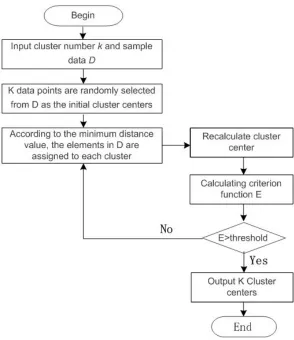
The detecting objective of DDoS attack is to distinguish normal access request flow from abnormal attack flow; in nature, it is a kind of cluster. K-Means is a classic type of ob-jective function clustering algorithm of LAN prototype, which belongs to category of unsupervised learning. In 1967, it was firstly put forward by James MacQueen and then it was popularized in various machine learning fields. The core idea of the algorithm is as follows: firstly, to select k objects at random and every initial object shows the center or average value of a cluster. After successive traversal, distances from the surplus objects to centers of all clusters will be calculated. Then by the comparison of the distances, they will be distributed to center with the smallest distance and calculations of all centers will be performed again. Next repeat the process until the convergence of clustering criterion function. The algorithm flow chart is shown in Fig. 4. The detailed description of the algorithm is as follows:
Input:K,D(Initial sample data) Output:Kclustering centers
Step1: Data setDas the initial sample, the n-dimensional of each point:dj ={x1, x2, x3, ..., xn}. Each one dimension represents a feature vector. Random selection ofKobjects as initial
cluster centers from data setD, the cluster center set is denoted asK.
Step2: Calculate the distance from each point in theD to theK cluster center, ac-cording to the minimum, assign the point to the corresponding category, cluster centers corresponding data is denoted .Using Equation (8) to calculate the Euclidean distance.
D(k, d) =
r Xn
i=1(xki−xdi) 2
, k∈K, d∈D (8)
Step3: Cluster center of updated cluster.
k= 1
n
Xn
Step 4: Calculation criterion function.
E=Xk
i=1 X
cj∈Ci
(cj−ki) 2
, ci∈C, ki∈K (10)
Step5: Meet the threshold criterion function exit, otherwise return to step 2.
4.3. Dynamic Sampling K-Means Algorithm
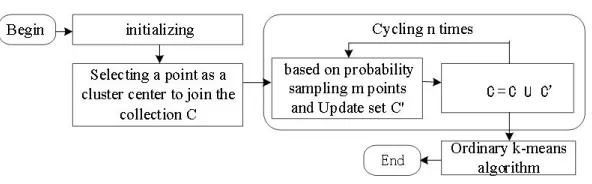
In common clustering algorithm,kpoints will be selected randomly as the center and the value of k as well as the selection of initial center will have direct influence on conse-quence of final cluster. Ifkis selected inappropriately, K-Means algorithm would con-verge on locally optimal solution, with the result that the correct result would not be obtained. In the DDoS attack detection system, K-Means requires to process a great deal of data mixing with attack flow, which leads to great difficulty to the selection of initial center. In order to solve the problem, dynamic sampling K-Means cluster will be em-ployed to improve the algorithm to meet the demands of DDoS attack detecting system. The algorithm is shown Fig.5.
The main way to improve K-Means algorithm is to select only one point in advance as clustering center to build scale function. The function represents quadratic sum of distance between data point and its clustering center. Then, the clustering results will be converged by continuous iteration of minimum function value. The main theory for the improvement of K-Means algorithm is as follows: firstly, select a point from data set as initial clustering center and add it into dynamic sampling set C, which can be calculated by scale function, then perform circulationN times; secondly, select m points during each circulation and calculate sampling probability P(X).The meaning of the probability shows that clustering center is easy to be another center when it is more far away from original center because it is relatively disperse. In other words, the selected points should be far away from current clustering center. After iteration, the function value should be calculated again and it is required to update sampling probability for the next time. Afterwards, the overlaps between central point setCof sampling cluster and original sampling setCwill act as new sampling set. After theN circulation, a new sampling set
Cwill be produced which has several data. The scale of current data set is far smaller than that of originalX and the data are relatively centralized due to the reason that they are filtered. Finally, the common K-Means algorithm ofCwill be performed and the process will be extremely fast becauseC is obtained after processing in advance. Meanwhile, the algorithm is improved in time complexity. It adopts the method of iteration replacing convergence threshold and reduces times of iteration, which is important to inspect DDoS attack under the environment of big data by machine learning method.
The specific algorithm is defined as follows:
Definition 1: The scale function V(X) is defined as the formula (11). Where the
D2(X, C)represents the square sum of the distance from the point in theXto the cluster center.
V(X) =
r Xn
i=1D
2(X, C) = r
Xn i=1
Xd
j=1(xj−xc) 2
Fig. 5.Dynamic sampling improved K-Means algorithm flow.
Definition 2: The dynamic sampling probability functionP(X)is defined as the for-mula (12).
P(X) =D
2
min(X, C)
V(X) (12)
Definition 3: initial limited scale function valueV, initial sample numberm < k. Specific algorithm is as follows:
Input: data set,K
Output:Kclustering centers
Step 1: Randomly select one point from the setXto join in the setC.
Step 2: According to formula (11) to calculate the initial limited scale function value of theC, denoted asV.
Step 3: CyclelogV =N, calculate the dynamic sampling probabilityP(X) accord-ing to equation (12), recorded asP. Take out m points from the setXin accordance with the probability ofPto join the collectionC0, calculateCS
C0and denoted byC, end of the cycle.
Step 4: Calculate the clustering center of the set C by using a common K-Means algorithm.
4.4. An Improved K-Means Algorithm for Dynamic Sampling Based on Spark
Ordinary DDoS attack detection algorithm cannot run directly on the Spark platform, according to the principle of Spark, the design of dynamic sampling and improved K-Means algorithm. The specific process is as follows:
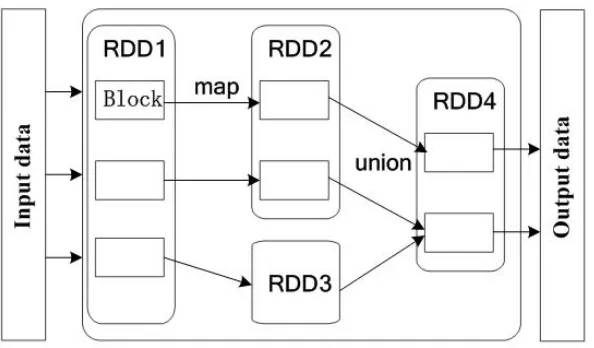
(1) Algorithm begins, Master node program obtain the initial data set from the data input source, which is a predefined interface that can obtain data through a variety of ways, such as InputStream, HDFS, local files, etc., this design is convenient for the test of the algorithm. After obtaining the data, the system will convert the data to RDD1, and call the cache method to load the RDD1 to memory, the RDD will act as the data to be processed.
use directly; the distribution of the data is calculated on each Worker node. When the map method is finished, the RDD1 generates a new RDD2.
(3) Randomly select the initial cluster centers. The program calls the takeSample method, selects one of the RDD2 as the clustering center vector, and creates the RDD3 object.
(4) Begin to enter the cycle process, the program according to the 4.3 section of the im-plementation of the specific algorithm step 3 to carry out an iterative calculation. In each cycle, according to the definition 1 and definition 2 to recalculate the current sampling probability function P, and then call the takeSample method according to the probability P select the new RDD vector as the center point. After a cycle, the sampling total vectors are1 +m, and generate RDD4. Then the system calls the union method, the RDD3 and RDD4 merged into RDD5.
(5) AfterlogV times will end the cycle, at this time, the number of vectors in the RDD5 is not more than1 +m∗logV. This amount is far less than the amount of initial data.
(6) The system will output RDD5 as a result.
The RDD conversion process of the entire sampling phase is shown in Fig.6. In Fig.6, the rounded rectangle frame represents the RDD; the straight rectangular box in the RDD represents the data fragmentation in the RDD, which is spread on a different Worker node; the direction of the arrow indicates the process of the RDD conversion.
Fig. 6.RDD conversion process of sampling phase.
5.
DDoS Attack Detection System
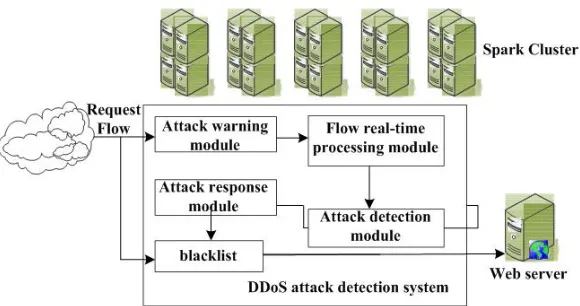
The detailed design of DDoS attack detection system is shown in Fig. 8. The whole system is running on a distributed cluster. It can not only make full use of Spark tech-nology in management of distributed computing, but also improves the reliability and the processing speed of the system.
Fig. 7.Structure of DDoS attack detection system based on Spark.
Fig. 8.Frame of DDoS attack detection system.
6.
Experimental Results and Analysis
6.1. DDoS Attack Warning Algorithm Test
The test based on DDoS alarming algorithm of information entropy in the thesis, will be implemented on an e-commerce website. The website uses 3 nodes and each machine employs 8 core CPU with16GB internal storage and 1TB hard disk drive. In terms of software configuration, Spark 1.5.2 version is used to process big data and Java 1.8 version to compile program. The website has a quite large amount of information about access behaviors of users and daily records of access behavior reach over 16 million. The warning test period lasts a week from 8:00 am to 20:00 pm. DDoS attack uses software Autocrat [1] to perform SYN, LAND, FakePing and Furious Ping attack respectively. The test result is that the average warning rate reaches 98.5% while the average error warning rate is only 1.6%. For network server being in peak period, the error warning is mainly caused by various interferences.
6.2. DDoS Attack Detection Algorithm Test
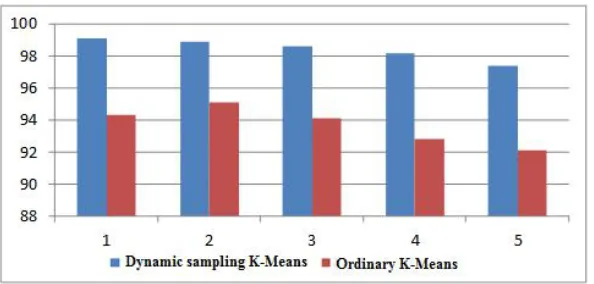
In order to test the improved K-Means algorithm for dynamic sampling, a set of contrast tests under the situation of single-machine operation is designed in the thesis. Firstly, Java language programming is used to verify K-Means algorithm. Meanwhile, the algorithm is adopted to perform clustering analysis of test data and work out the required time for cal-culation and accuracy of clustering. Secondly, Java language programming is employed to verify the improved K-Means algorithm for dynamic sampling. Besides, the same test data is used to carry out clustering calculation to count the required time and accuracy. The test data is selected from training set with intensive kddcup-99 [8] data. Whats more, the data is also filtered and eight classical properties from the original properties are se-lected as properties of test data. Totally, 5 groups of data is sese-lected and their data is respectively 10000 for group 1, 50000 for group 2, 100000 for group 3, 200000 for group 4 and 500000 group 5. Data for each group is different in figure but similar in distribution, which is used to perform a contrast test. The results of the test are shown in Fig. 9 and Fig.10.
From Fig.9 and Fig.10, we can see that when the amount of data is less, the dynamic sampling of the improved K-Means algorithm and the common K-Means algorithm is very close to the time. With the increase of the training set size, the advantage of the improved K-Means algorithm of dynamic sampling becomes increasingly distinct. In the case of 500 thousand data sets, the improved algorithm is obviously superior to the or-dinary algorithm in time complexity. In terms of accurate rates, the improved K-Means algorithm of dynamic sampling is relatively close to ordinary K-Means algorithm. And the accurate rates in different test sets fluctuate but the fluctuation maintains in a relatively stable range.
Fig. 9.Comparison of the time-consumption of two algorithms in five experiments.
Spark cluster adopts 1.5.2 Spark version for the configuration of the software, while Java 1.8 version is used for the preparation of the Spark program.
Three experimental groups are designed in the experiment with the first experimental group using a single algorithm, serial processing of data samples; second experimental group using ordinary K-Means algorithm, parallel processing of data samples and the third experimental group using the improved K-Means algorithm.
Analysis is made on the time consumption, the average time of each round of iteration, and the correct rate in the three experimental groups. The final results are shown in Fig. 11 and Fig. 12.
Fig. 11. Comparison of time-consumption for three experimental groups in five experi-ments.
Fig. 12. Comparison of accurate rates for three experimental groups in five experiments.
ac-curacy of single machine operation is relatively high, and the advantage of Spark parallel computation is not obvious. When the amount of data is greater than 1million, the time to run a single machine increases dramatically while the accuracy of the data decreases rapidly. At the same time, the advantage of Spark parallel computing is very significant. Compared to the ordinary K-Means algorithm implemented on the Spark cluster, the im-proved K-Means algorithm has better accuracy and efficiency. This experiment can better reflect the advantage of parallel computing based Spark dynamic sampling platform to achieve an improved K-Means algorithm.
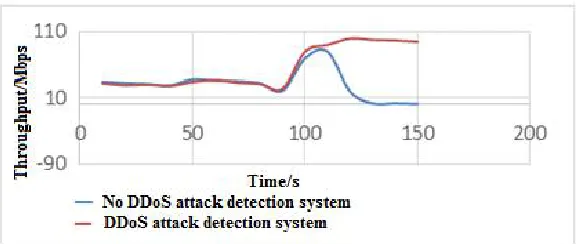
In order to test the system’s ability to deal with DDoS attacks, this article through the open source software simulates the large data traffic DDoS attack [1], and starts the detec-tion system to detect and address it. The Experimental design is to launch the attacks on the Web Service that has set up the DDoS attack detection system and the web service that did not build the DDoS attack detection system respectively. The actual impact of DDoS attacks on the server is determined by calculating the Web Service real-time throughput and CPU utilization rate. The final experimental statistics are shown in Fig. 13 and Fig. 14.
As is shown in Fig. 13 and Fig. 14, the throughput of the server increases rapidly after the DDoS attack within 100 seconds, after which, the throughput of the server in experimental group 1 without DDoS detection system falls sharply with CPU occupancy rate close to 100% whereas that of the server in experimental group 2 with DDoS detection system remains at normal level. Thus, it is proved that Web Service without detection system cannot continue to provide the normal service while the one with the detection system still can operate normally when confronted with DDoS attacks.
Fig. 13.Throughput Comparison.
6.3. Comparison with the classical DDoS detection method
Fig. 14.Occupancy rate comparison.
experiment comparison [9], namely, DDoS attack detection method based on Hurst pa-rameter(indicated by ”DC1”), DDoS attack detection method based on nonlinear network flow analysis (DC2) and Wavelet analysis method based on adaptive detection of DDoS attacks ((indicated by ”DC3”). By comparing these three classical algorithms with the dynamic improved K-Means method based on Spark in this paper (by ”DC4”) concerning the average response time, the average recognition rate, the average false rate, the results of the four methods are demonstrated in table 1. According to table 1, the method pro-posed in this paper is superior to the classical DC1, DC2 and DC3 methods in terms of average response time, average recognition rate, and average false rate.
Table 1.The performance comparison of DDoS detection algorithms.
Comparison Algorithm DC1 DC2 DC3 DC4
Average response time 6.61 2.21 1.83 0.62
Average recognition rate 87.23 Apache15 93.12 91.64 98.3
Average false rate 3.52 2.13 2.25 1.5
7.
Conclusions
In the big data environment, DDoS attacks are becoming one of the biggest threats to network security. Based on the existing researches, this paper designs a DDoS detection system based on Spark, to ensure accuracy in detection. In the meanwhile, the time for detecting DDoS attacks is reduced and the detection efficiency is improved significantly with the advantage of Spark technology.
In the future research work, the following aspects need to be improved:
(1) Spark Framework version iteration is very fast and each version will have new content and more powerful features. In the future research work, we should use the new features of the Spark framework flexibly to improve the efficiency of the system.
(3) The limitation of this research is that it does not study much on tracking attackers in the DDoS detection. In order to prevent DDoS attacks more effectively, the method of investigating the legal liability of the attacker through internet forensics will be studied.
Acknowledgments.This work has been supported by the National Natural Science Foundation of China (No. 61373028 and No. 61672338).
References
1. Ddos attack using common tools (2013), [Online]. Available: http://www.bingdun.com/news/bingdun/8576.htm
2. Incapsula.report:2014 ddos trends-botnet activity is up by 240% (2014), [Online]. Available: https://w-ww.incapsula.com/blog/ddos-threat-landscape-report-2014.html
3. Apache software foundation. apache spark-lightning-fast cluster computing (2015), [Online]. Available: http://spark.apache.org/
4. Apache software foundation. welcome to apache hadoop (2015), [Online]. Available: http://hadoop.apache.org/
5. Incapsula.ddos impact survey reveals the actual cost of ddos attacks (2015), [Online]. Avail-able: htt-ps://www.incapsula.com/blog/ddos-impact-cost-of-ddos-attack.html
6. Incapsula.lax security opens the door for mass-scale abuse of soho routers (2015), [Online]. Available: https://www.incapsula.com/blog/ddos-botnet-soho-router.html
7. Cloud shield internet ddos state and trend report in the second half of 2015 (2016), [Online]. Available: http://wenku.baidu.com/view/747d352f0c22590103029d6f
8. Hettich, S., Bay, S.D.: Kdd cup 1999 data (1999), [Online]. Available: http://kdd.ics.uci.edu/databases/kddcup-99/kddcup99.html
9. Peng, Y., Yan, L.: Approach of ddos attacks prediction and detection with heqpso-svm algo-rithm based on date center network. Journal of Chinese Computer Systems 36(1), 150–163 (2015)
10. Zaharia, M., Das, T., Li, H., Shenker, S.: Discretized streams: An efficient and fault-tolerant model for stream processing on large clusters. In: HotCloud. pp. 141–146. ACM (2012) 11. Zaharia, M.: Resilient distributed datasets: a fault-tolerant abstraction for in-memory cluster
computing. in-memory cluster computing. In: USENIX Symposium on Networked Systems Design and Implementation (NSDI), pp. 141–146 (2011)
12. Zhao, H.: DDOS anomaly detection technology research based on the information entropy clustering. Ph.D. thesis, Central South University, Changsha, China (2010)
Dezhi Han(corresponding author) received the Ph.D. degree from Huazhong University of Science and Technology. He is currently a professor of computer science and engi-neering at Shanghai Maritime University. His research interests include cloud computing, mobile networking and cloud security.
Kun Bireceived the Ph.D. degree from University of Science and Technology of China. He is currently a lecture of computer science and engineering at Shanghai Maritime Uni-versity. His research interests include network security, big data and cloud security.
Jianxin Jiareceived the M.S. degree from Shanghai Maritime University of computer science and engineering. He is currently pursuing the Ph.D. degree at Shanghai Maritime University. His main research interests include mobile networking, underwater acoustic communication technology and cloud security.