,1 ,1
*School of Biomedical Sciences, University of Liverpool, Liverpool, UK
§Department of Biological Sciences, University of Essex, Essex, UK
Two variable number tandem repeats (VNTRs) in the human serotonin transporter gene,SLC6A4(the structure is shown in Fig. 1a) have been implicated in the pathophysiology of many CNS-related disorders (reviewed in Haddley et al. 2007). The first identified was a bi-allelic 43 bp insertion/ deletion 1.2 kb upstream of the transcription start site, termed the SLC6A4gene-linked polymorphic region (LPR) (Heilset al.1996; Leschet al. 1996). The most commonly occurring LPR variants contain 14 (short,s) or 16 (long, l) copies of a 22–23 bp repeat (Fig. 1b) (Heils et al. 1997; Nakamuraet al.2000). Recent clinical studies indicated that an A/G single nucleotide polymorphism (SNP) in thel-allele of the LPR VNTR could affectSLC6A4 mRNA expression (Huet al.2005; Wendlandet al.2006). The second VNTR found in intron 2 comprises most commonly 9, 10 or 12 copies of a 16–17 bp repeat (Stin2.9, Stin2.10 and Stin2.12 VNTRs respectively) (Battersby et al. 1996; Ogilvie et al. 1996). We and others have previously demonstrated that these Stin2 VNTRs support differential gene expression in vitro(Heilset al.1996; Leschet al.1996; Lovejoyet al. 2003; Klenovaet al.2004; Robertset al. 2007) and during neural development in transgenic mice (MacKenzie and
Quinn 1999). The potential contribution of genomic variation to direct differential SLC6A4 gene expression was further supported by the identification of other SNPs in the middle of the first intron; rs16965628 and rs2020933 that showed a significant correlation with the allelic transcript ratio of SLC6A4, therefore, contributing to the differential expression of theSLC6A4gene (Martinet al.2007).
Many studies have linked these VNTRs with disorders including increased risk of developing depression (Cervilla
Received August 5, 2009; revised manuscript received September 25, 2009; accepted October 21, 2009.
Author correspondence and reprint request to Dr J. P. Quinn, School of Biomedical Sciences, University of Liverpool, Liverpool L69 3GE, UK. E-mail: [email protected]
1Both these authors contributed equally to this study.
Re-use of this article is permitted in accordance with the Terms and Conditions set out at http://www3.interscience.wiley.com/author resources/onlineopen.html
Abbreviations used: ChIP, chromatin immunoprecipitation; CTCF, CCCTC-binding factor; EMSA, electrophoretic mobility shift analysis; LPR, linked polymorphic region; PFC, prefrontal cortex; SNP, single nucleotide polymorphism; Stin2, second VNTR in intron 2; VNTR, variable number tandem repeat.
Abstract
Two distinct variable number tandem repeats (VNTRs) within the human serotonin transporter gene (SLC6A4) have been implicated as predisposing factors for CNS disorders. The linked polymorphic region in the 5¢-promoter exists as short (s) and long (l) alleles of a 22 or 23 bp elements. The sec-ond within intron 2 (Stin2) exists as three variants containing 9, 10 or 12 copies of a 16 or 17 bp element. These VNTRs, individually or in combination, supported differential reporter gene expression in rat neonate prefrontal cortical cultures. The level of reporter gene activity from the dual VNTR constructs indicated combinatorial action between the two
domains. Chromatin immunoprecipitation demonstrated that both these VNTR domains can bind the CCCTC-binding factor and this correlated with the ability of exogenously supplied CCCTC-binding factor to modulate the expression supported by these reporter gene constructs. We suggest that the potential for interaction between multiple polymor-phic domains should be incorporated into genetic association studies.
Keywords:behaviour, CCCTC-binding factor, human sero-tonin transporter, polymorphism, variable number tandem repeat.
et al. 2006), bipolar depression (Cho et al. 2005), anxiety (Lesch et al. 1996; Hariri et al. 2002), predisposition to suicide or depression following stressful life events (Caspi et al. 2003; Zalsman et al. 2006) and a predisposition to obsessive compulsive disorder (Bengel et al. 1999). How-ever, these findings were not always reproducible in inde-pendent studies (Reeset al.1997; Hoeheet al.1998). Various meta-analyses suggested no significant allelic frequency association of the Stin2 VNTRs with affective disorders but they did favour an association of the LPR VNTR with these disorders (Choet al.2005; Lasky-Suet al.2005).
We have previously shown that the transcription CCCTC-binding factor (CTCF) is a regulator of Stin2 VNTR function (Klenovaet al. 2004; Robertset al. 2007). CTCF is a DNA-binding protein with a role in transcriptional activation or silencing in a context-dependent fashion and may also act as an insulator in epigenetic remodelling (Ohlssonet al.2001; Klenovaet al.2002). There are several potential high affinity CTCF binding sites present in the LPR (Fig. 1b) and we hypothesised that, as transcriptional domains, the LPR VNTR and Stin2 VNTR can act in concert to modulateSLC6A4gene expression, and that CTCF may be one factor to coordinate such activity. To support such a hypothesis we have addressed the ability of the VNTRs to function together in modulating reporter gene activity in neuronal cultures and assessed if such function was regu-lated by CTCF.
Experimental procedures
Comprehensive details of the material and methods are given online in Appendix S1.
Generation of reporter gene constructs
The promoter LPR and Stin2 VNTR fragments were amplified by PCR using the primers: forward 5¢-GGGGTACCCCTGGCGTTG CCGCTCTGAATGC-3¢ and reverse 5¢-CCGCTCGAGCGGAGG GACTGAGCTGGACAACCAC-3¢ and forward 5¢-ATGGCGCG CCGGTACCTCACAGGCTGCGAGTAGA-3¢ and reverse 5¢-AA CGGCGCGCCTCGAGTGGCCTCTCAAGAGGA-3¢ respectively. VNTR fragments were cloned into a modified renilla luciferase reporter vector [modified phRLSV40 (Guindaliniet al.2006)], such that each individual promoter LPR fragment was placed upstream of a minimal SV40 promoter (creating phRL_long and phRL_short) and each individual Stin2 VNTR fragment was placed within a synthetic intron located upstream of therenilla luciferase coding sequences (creating phRL_Stin2.9, phRL_Stin2.10 and phRL_ Stin2.12). Dual constructs termed: L9, L10, L12, S9, S10 and S12 were created such that combinations of alleles from the two VNTRs were present at their respective positions within the plasmid (Fig. 1c).
Reverse transcription PCR
Total RNA was extracted from rat prefrontal cortical cells with Trizol reagent (Invitrogen, Paisley, UK) and reverse-transcribed
to cDNA using Reverse Transcription System (Promega, South-ampton, UK) following manufacturer’s instructions. PCR was performed to confirm SLC6A4 mRNA expression using the primers forward 5¢-TTCCTCCTGTCCGTCATTGG-3¢and reverse 5¢-GGTGGATCTGCAGGACATGG-3¢ from exons 1 and 4 respectively.
Primary cell culture, transient transfections and luciferase assays
Male Wistar albino rats (2 to 7-day old) were used to generate primary cortical cultures. All animals were culled under local and national schedule one guidelines. Reporter constructs (1lg) or modified phRLSV40 (1lg) and modified pMLuc-2 (expressing
Fireflyluciferase as an internal control) were co-transfected using ExGen500 in vitro transfection reagent following manufacturer’s guidelines (Fermentas, York, UK). For co-transfections with CTCF, cells were transfected with 1lg of reporter gene and 1lg of expression vector pCI-CTCF (Klenovaet al.2004), or to standard-ise total DNA concentration, pGL3basic (Promega). Cells were harvested and assayed using the Dual Luciferase Reporter Assay System (Promega) and luminescence was measured using a Glomax 96 microplate luminometer (Promega). Mean and SEM were calculated from the results of three independent experiments performed in triplicate.
Statistical analysis
Data were subjected to statistical analysis using one-wayANOVAand a significance level of 0.05. The Dunnett’s (two-sided)tmethod was used as apost hoctest to account for multiple comparisons.
Chromatin immunoprecipitation
DNA and protein from 107JAr cells (human placental choriocar-cinoma) were cross-linked with 1% formaldehyde and mixed thoroughly at 20C for 10 min. Chromatin immunoprecipitation (ChIP) was performed using ChIP-IT express (Active Motif, Rixensart, Belgium) (see Appendix S1) and the antibodies: mouse monoclonal anti-human CTCF (BD Transduction Laboratories, Lexington, KY, USA) and polyclonal rabbit anti-mouse IgG, as a control (Abcam, Cambridge, UK). PCR primers used for LPR amplification were forward 5¢-GGGGTACCCCTGGCGTTGCCG CTCTGAATGC-3¢ and reverse 5¢-CCGCTCGAGCGGAGGGAC TGAGCTGGACAACCAC-3¢.
Electrophorectic mobility shift assays
The human recombinant CTCF protein was purified from baculo-virus (Chernukhin et al. 2000). An oligonucleotide pair, 5¢-TCGACCCCTCGCAGTATCCCCCCTGCA-3¢ (100 ng) de-signed as overhanging complementary strands, was annealed then labelled witha-32P dATP (specific activity 6000 Ci/mM)
(Amer-sham, Buckinghamshire, UK) using DNA Polymerase I, Large (Klenow) Fragment (NEB, Hitchin, Hertfordshire, UK). Electro-phoretic mobility shift analysis (EMSA) assays were performed as previously described (Klenovaet al.2004).
Results
(a)
(b)
standard reporter gene constructs (Klenova et al. 2004; Robertset al.2007). The limitation of these studies was that such vectors did not properly reflect the genome context. To partially address this issue, we placed the SLC6A4 LPR VNTR and Stin2 VNTR variants in more appropriate locations within the reporter vector. Specifically the Stin2 alleles were cloned into an intronic site of the phRL reporter vector and the LPR VNTR variants were cloned upstream of the SV40 promoter (Fig. 1c). Although this placed the Stin2 VNTR within an intron mimicking thein vivoposition, it is important to acknowledge that these two domains are 15.5 kb apart in the human genome.
We had previously modified the phRL vector by intro-duction of a unique enzyme site into the intron and utilised this to address the function of intronic dopamine transporter VNTR variants (Guindaliniet al.2006). We also generated constructs using the same backbone but with only the LPR or Stin2 variants cloned in their respective locations. This allowed us to address not only the hypothesis that these two SLC6A4VNTR domains could actin cisbut how combined effects may differ from each independent domain alone, and if interactions or synergisms were possible between these VNTR domains that involvedtransfactors. Recently, an A/G SNP in thel-allele of the LPR VNTR was reported to affect mRNA expression levels ofSLC6A4 gene (Huet al. 2005; Wendlandet al.2006), we therefore determined by sequence analysis that the SNP in our clone was ‘A’. Functional analysis was performed in primary cultures of rat prefrontal cortex (PFC) primary culture, which were enriched for neurons, because it has been reported that these cells express the endogenous SLC6A4 gene (Fumagalli et al. 1996; Hanssonet al.1998; Lebrandet al.1998). However, because of the mixed cell population of the PFC, a proportion of non-neuronal glial cells are present even though cells were prepared on poly-D-lysine coated plates to increase the proportion of neuronal cells. Expression of the SLC6A4 mRNA in the rat PFC has been reported to peak early in postnatal development at day 10 and gradually decrease to weak expression at day 28, with no expression been recorded in adult rats (Fumagalli et al. 1996; Hansson et al. 1998; Lebrand et al. 1998). We confirmed SLC6A4 mRNA
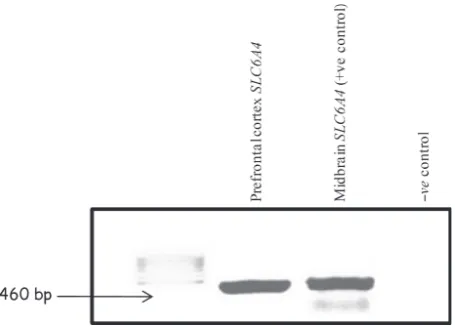
expression in our primary cultures by RT-PCR amplifying a 460 bp cDNA fragment with primers in exons 1 and 4, to eliminate the possibility of product amplified from contam-inating DNA (Fig. 2). The cDNA of midbrain sections was included in the RT-PCR as a positive control for SLC6A4 expression.
CTCF can bind to and regulate expression of both the LPR and Stin2 alleles
We have previously demonstrated that the transcription factor CTCF binds and differentially regulates the Stin2 VNTRs in clonal cell lines (Klenovaet al.2004; Robertset al. 2007). In this study, we assessed the ability of the individual LPR and Stin2 VNTRs to support reporter gene expression in rat prefrontal cortical neuronal cells (PFC).
In this cell system, thel- ands-LPR alleles demonstrated 10- and 8-fold activation, respectively, over the phRLSV40 control (Fig. 3). In contrast, the Stin2.10 and Stin2.12 (the
Fig. 2Agarose gel showing the reverse transcription PCR products of theSLC6A4gene amplified from sections of neonatal Wistar rat brain. Lane 1: Mass ruler DNA Ladder; lane 2:SLC6A4RT-PCR amplifica-tion from rat prefrontal cortex, amplifying a 460 bp cDNA fragment of the expected size; lane 3: SLC6A4RT-PCR amplification from rat midbrain; lane 4: negative control (water). Sizes of the amplified fragments are indicated.
Fig. 1Schematic representation of theSLC6A4structure. (a) Sche-matic representation of theSLC6A4structure, highlighting the 5¢-LPR and Stin2 VNTRs (white boxes); positioned relative to the transcrip-tion start site (indicated as +1). Grey boxes: coding exons and black boxes: non-coding exons. (b) The sequences of the long (l) and short (s) alleles within the linked polymorphic region (LPR) of the human serotonin transporter gene (SLC6A4) are shown on the left and right respectively. Potential CTCF binding sites within thel- ands-alleles: the best matches on the negative strand of the DNA are boxed based on the CTCF ‘consensus’ identified via a genome-wide screen (Kim
et al.2007) which is shown at the bottom of this panel. The size of each base in the consensus is indicative of the probability of its
[image:4.595.304.532.488.653.2]most common intronic variants) only weakly supported gene expression, over the phRLSV40 control (Fig. 4). However, the rare nine copy allele, supported gene expression, showing 2.5-fold activation in comparison with the control, phRLSV40 (Fig. 4).
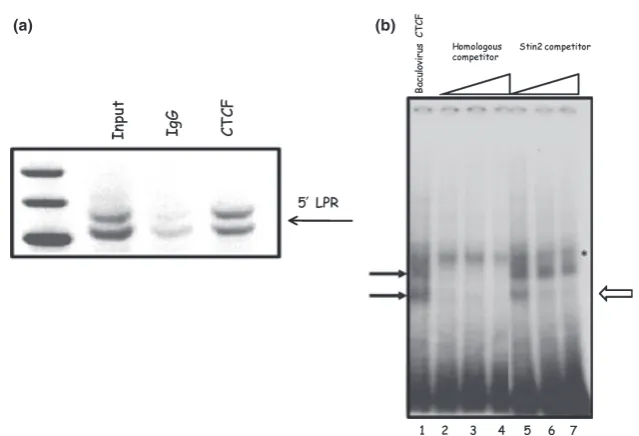
Based on the CTCF ‘consensus’ motif, we identified several potential CTCF binding sites within the LPR (Fig. 1b). To confirm CTCF binding to this region, we performed ChIP in human JAr cells, as rodents do not possess the sameSLC6A4polymorphism. In JAr cells, which express the endogenousSLC6A4gene and are heterozygous for LPR alleles and contain the 10 and 12 copy variants of the Stin2 VNTR, enrichment for CTCF binding was observed for both alleles of the LPR, compared with the IgG control (Fig. 5a).
To further confirm the binding of CTCF to the 5¢-LPR we performed EMSA using baculovirus purified CTCF (Fig. 5b). The 5¢-LPR domain is much greater than the size
usually preferred for EMSA, thus we used an oligonucleotide which corresponded to a repeat element of the VNTR sequence that contained a CTCF binding motif. Two specific complexes were observed, these were competed with homologous competitor (Fig. 5b). Interestingly, only one of these complexes was effectively competed by an oligonu-cleotide sequence corresponding to one of the Stin2 VNTR repeat elements, suggesting different affinities for CTCF binding.
We complemented the binding studies by addressing the ability of the exogenous CTCF expressed from an expression construct to modulate expression of either the LPR or Stin2 reporter gene cassettes. Co-expression of CTCF did not Fig. 4 CTCF significantly repressed the expression of the three allelic
variants of the Stin2 reporter construct in rat prefrontal cortical cells. Rat prefrontal cortical cells were transfected as described in methods with 1lg of reporter gene construct plus either 1lg of CTCF expression vector or 1lg of pGL3b, to standardise for total DNA concentration; 20 ng of pMLuc-2Fireflyluciferase was used as inter-nal control. Bars represent the fold change in normalised renillin activity supported by the VNTR compared with the phRL control under basal conditions (black bars) or following CTCF over-expression (white bars). Transfections were performed in triplicates in at least five independent experiments and the mean normalised renillin values were calculated together with the SEM represented by error bars. One-wayANOVAusing Dunnett’st(two-sided) as apost hoctest indi-cated that Stin2.10 and Stin2.12 supported no additional activity over the phRL control (p= 0.814 and 0.981 respectively), whilst Stin2.9 supported reporter gene expression,2.5-fold higher than the phRL control (*p£0.001). Stin2.9 also showed significant change in activity compared with both Stin2.10 and Stin2.12 reporter constructs
p£0.001. Stin2 variants were significantly repressed by CTCF over-expression (#p£0.05 and##p£0.001).
[image:5.595.64.293.88.283.2] [image:5.595.311.539.90.338.2]significantly affect the expression supported by either of the LPR variants (Fig. 3) but resulted in robust repression of all three Stin2 variants (Fig. 4). The reporter cassette (phRLSV40) without either VNTR, was unaffected by CTCF.
The dual LPR and Stin2 alleles support differential reporter gene expressionin cis
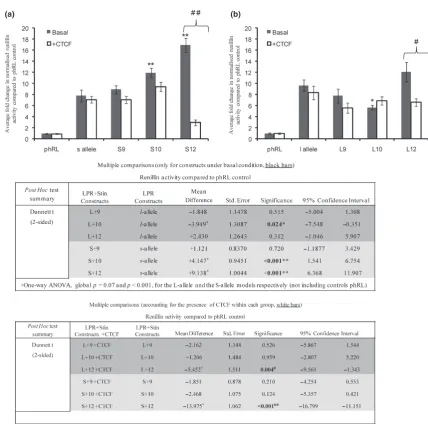
We hypothesised that as both VNTRs in the promoter and intron 2 share at least one signal transduction pathway which would be regulated by CTCF this might result in differential reporter gene expression directed by distinct combinations of the VNTRs. We therefore analysed activity supported by the dual constructs containing either the l- or s-allele in a promoter position and a Stin2 VNTR located in the intron of the reporter plasmid. These constructs demonstrated a number of distinct expression profiles based on the genotype of the VNTRs. Strikingly, the Stin2.10 and Stin2.12 variants which did not support additional activity compared with the phRLSV40 alone, when in conjunction with the s-variant (S10 and S12) were capable of directing higher activity compared withs-alone (p< 0.001) (Fig. 6a). However, the Stin2.9 in combination with the LPR s-variant (S9), displayed a similar pattern of expression tos-alone. These data suggested a combinatorial rather than an additive mechanism of gene regulation by the two VNTRs.
A complex expression pattern from the reporter was also obtained when the Stin.2 variants were combined with the
LPRl-allele (Fig. 6b). The Dunnett’spost hoctest suggested that L10 showed a significant decrease in reporter gene activity compared with l-alone, whilst neither L9 nor L12 showed significant changes in activity compared with l-alone. Our analysis also indicated that L12 significantly differed from both L10 and L9, reinforcing that the combinatorial variation cannot be predicted from the indi-vidual VNTR activity in this model.
We then tested the effects of CTCF on these constructs. The Stin2 VNTR variants alone were all repressed by over-expression of CTCF (Fig. 4), whilst CTCF had no effect on the LPR constructs (Fig. 3). We therefore addressed the potential regulation of the dual VNTR reporter gene constructs by CTCF. In response to CTCF, the dual constructs showed a variety of responses (Fig. 6). Specifi-cally, over-expression of CTCF significantly repressed the activity of L12 and S12 whilst no significant effect was observed with other dual constructs (Fig. 6). This would suggest a distinct response of Stin2.12 irrelevant of the LPR allele present. The perceived decrease in L10 over l-alone, did not reach significance in the presence of CTCF.
Discussion
Several groups including our own have demonstrated differential effects of the SLC6A4 LPR and Stin2 VNTRs on the expression of reporter genes in cell lines. Further, the
(a) (b)
Fig. 5CTCF binds the 5¢-LPR VNTR of theSLC6A4gene. (a) ChIP analysis of thein vivointeraction of CTCF with the 5¢-LPR alleles. ChIP analysis was performed as described in the methods section. IgG was included as a control for non-specific background binding. CTCF was found to bind bothl- ands-alleles of the 5¢-LPR (upper and lower bands respectively). (b) EMSA analysis of CTCF binding to a repeat element of the 5¢-LPR. EMSA analyses were performed as described in the methods section. CTCF purified from Baculovirus
[image:6.595.131.451.87.305.2]function of these VNTRs to act as a repressor or enhancer was cell type and promoter context dependent; this most likely reflected the different complement of transcription
factors in these cells that could regulate the domains (Heils et al.1996; Leschet al.1996; Mortensenet al.1999; Sakai et al. 2002; Lovejoy et al. 2003; Klenova et al. 2004;
(a) (b)
Fig. 6 TheSCL6A4VNTR dual constructs support differential levels of reporter gene expression and CTCF differentially regulates the expression of these dual constructs in rat prefrontal cortical cells. Rat prefrontal cortical cells were transfected as described in meth-ods with 1lg of reporter gene construct plus either 1lg of CTCF expression vector or 1lg of pGL3b, to standardise for total DNA concentration; 20 ng of pMLuc-2 Firefly luciferase was used as internal control. Therenillaluciferase dual reporter constructs gen-erated were a combination of either of the 5¢-LPR alleles cloned upstream of the minimal SV40 promoter with either of the Stin2 VNTR alleles located within a synthetic intron of the phRL vector. Bars represent the fold change in normalised renillin activity sup-ported by the VNTR compared with the phRL control under basal conditions (black bars) or following CTCF over-expression (white bars). Transfections were performed in triplicates in at least three
independent experiments and the mean normalised renillin values were calculated together with the SEM represented by error bars. One-way ANOVA using Dunnett’s t (two-sided) as a post hoc test indicated that (a) Both S10 and S12 were capable of directing significantly higher activity compared with s alone (p< 0.001 for both), whereas S9 did not display significant difference compared with thesconstruct alone (p= 0.72) *p£0.05 and **p£0.001. (b) L10 showed a significant decrease in reporter gene activity com-pared with l-alone (p= 0.024), whilst neither L9 nor L12 showed significant change in activity compared with l-alone (p= 0.515 and 0.312 respectively). CTCF displayed differential activity on the dual reporter constructs by significantly repressing the activity of (a) S12 and (b) L12 (##p£0.001 and#p£0.05), whilst no significant effect was observed with the other constructs as illustrated by the
[image:7.595.84.513.84.518.2]Robertset al.2007). Both these VNTRs have been clinically determined as predisposing factors for various psychiatric disorders including unipolar and bipolar depression (Cho et al.2005; Cervillaet al.2006), anxiety (Leschet al.1996; Haririet al. 2002) and predisposition to obsessive compul-sive disorder (Bengelet al.1999). However, these domains have also been disputed as susceptibility factors and meta-analysis has raised further questions (Choet al. 2005; Lasky-Suet al.2005).
To the authors’ knowledge, with the exception of Kaiser et al. (2002) and Hranilovic et al. (2004) all studies in the literature have focused on the effect of only one of the SLC6A4VNTRs, either LPR or Stin2, on expression of the SLC6A4and association with affective disorders (Leschet al. 1996; Bengel et al. 1999; Hariri et al. 2002; Cho et al. 2005). Here we demonstrate, in rat neuronal cells, which express the endogenousSLC6A4 gene that the 5¢-LPR and Stin2 VNTRs within theSLC6A4gene, are at least in part, are likely to be on the same signalling pathway regulated by CTCF. We further demonstrate that the 5¢-LPR and Stin2 VNTRs can support differential gene expression when analysed in concert using constructs designed to mimic their endogenous positions in the gene, albeit as indicated previously these two domains are 15.5 kb apart in the human genome. However, CTCF is known to mediate looping between distant DNA elements, therefore the mechanistic basis of regulation by CTCF in vivo and in the reporter system used may be similar and rely on loop formation between two CTCF sites (Phillips and Corces 2009; Zlata-nova and Caiafa 2009). However as the functional outcomes from the dual constructs containing l- and s-variants are different (Fig. 6), the properties of such hypothetical loops would be expected to vary. One possible scenario would be that CTCF may utilise different combinations of its zinc fingers at different binding sites thus releasing different surfaces for interaction with protein partners (Ohlssonet al. 2001). This, in turn, may result in the formation of distinct functional high order DNA–protein complexes leading to different functional outcomes (Wallace and Felsenfeld 2007). This will need to be investigated further.
Although the VNTRs are likely to function in the adult CNS in response to challenge we have previously demon-strated that in a transgenic mouse model the Stin2 variants supported differential reporter gene expression during devel-opment in the CNS region initially involved in serotonergic lineage (MacKenzie and Quinn 1999). Furthermore, there are also increasing suggestions that the role of the SLC6A4 polymorphisms may be more pronounced during embryo-genesis and development, thus raising the possibility that disrupting normal maturation of certain neuronal networks critical for normal adult functions, will influence behaviour and increase vulnerability to psychiatric disorders in adults (Caspiet al.2003; Ansorgeet al.2004; Parseyet al.2006). This might be relevant for our current study as we utilised rat
neonate prefrontal cortical cells which in vivo demonstrate differentialSLC6A4 expression in the rat in early postnatal period (Fumagalliet al.1996; Hanssonet al.1998; Lebrand et al. 1998), therefore the functional consequence of these VNTR polymorphisms could to be support differential expression of the SLC6A4 gene at this point based on genotype.
When the LPR variants were analysed individually, there was no differential activity between the two variants,l- and s-, on reporter gene expression levels (Fig. 3). This agrees with previous studies in COS-7, PC-12 and raphe-nucleus-derived RN46A cells which found that these VNTR variants did not support differential expression (Willeit et al. 2001; Kaiseret al.2002; Sakaiet al.2002). Others, however, have demonstrated that these alleles did support differential activity (Heils et al. 1996; Lesch et al. 1996). Similar conflicting data exist based on mRNA analyses (Leschet al. 1996; Mortensen et al. 1999; Hranilovic et al. 2004; Lim et al. 2006). Therefore, studies on the abilities of the LPR VNTR variants to support differential gene expression, like the clinical correlations themselves do not agree. These contradictory reports may arise from differences in experi-mental parameters (reviewed in Haddley et al. 2007) or demonstrate tissue-specific factors or variation in the concentration of specific transcription factors in a particular cell type. The latter is consistent with our data on manip-ulation of CTCF concentration altering reporter gene expression supported by the Stin2 VNTR in human embry-onic kidney cells, COS-7 and JAr cells (Klenovaet al.2004; Robertset al. 2007). Indeed in this study, CTCF repressed the activity driven by the Stin2 variants in the neuronal cultures, when cloned within the synthetic intron construct, which contrasted with our previous data in non-neuronal cell lines in which CTCF increased activity from the Stin2 variants when cloned upstream of the SV40 promoter (Klenovaet al.2004; Robertset al.2007). Without rigorous testing of all combinations and manipulation of transcription factor concentration we can however state that CTCF concentration will modulate VNTR function.
were tested individually (Fig. 4). However, when combined in the dual construct, a 17-fold increase over phRLSV40 was observed (Fig. 6). These analyses may explain, in part, some of the contradictory reports in the literature and indicate that the abilities of both of the VNTRs in the SLC6A4 gene to act in cis should be considered when addressing their correlation to specific neurological disor-ders, furthermore the combined genotype of an allele may mediate a response to a particular drug or stimulus. As both domains are transcriptional regulators this easily allows for a gene–environment parameter to be factored into a correlation of the VNTRs with a specific condition. It is possible that the impact of the genotype only becomes apparent following exposure to environmental factors, or in response to a particular stimulus e.g., stresses or drugs (Murphy et al. 2001). For example, various studies have demonstrated that carriers of thes-allele of the 5¢-LPR are more likely to develop an episode of major depression only following stressful life events (Bennettet al. 2002; Champ-oux et al. 2002; Barr et al. 2003; Caspi et al. 2003). Clearly such events could alter the transcription factor complement in the cell thus altering VNTR mediated expression; this could be significant both in the adult and during development. Therefore, challenges altering the function of these VNTRs could ultimately influence an individual’s vulnerability to environmental stress and ten-dency to develop psychiatric disorders by altering both the level of expression of the SLC6A4 gene or perhaps event the tissue-specific expression during development. Such parameters should be taken into consideration in the design of psychiatric genetics and association studies (Caspi et al. 2003; Parsey et al. 2006). Our data on the combinatorial potential of the VNTRs is consistent with analysis of SCL6A4 expression in lymphoblast cell lines which failed to find a correlation with the LPR VNTR, but did find evidence for a combined effect of LPR and Stin2 VNTRs (Hranilovicet al.2004). These data may encourage a better appreciation of how different variants could function in concert in vivo to allow better statistical correlations of these domains with a particular disorder by addressing multiple variants on the same allele. Indeed for SLC6A4 there may be other promoter variants that modulate the activity of the VNTRs.
An important point from our analysis is perhaps not the absolute levels of reporter gene observed, nor indeed whether they are repressed or activated by over-expression of CTCF, but rather that the potential for differential gene expression supported by combinations of the specific variants exists. The action of CTCF highlights the potential role for epigenetic modulation of expression of SLC6A4 gene via these VNTRs, which could result in long-term differences in gene expression. Recently, Philibert et al. (2007) suggested that mechanisms linking the SLC6A4 polymorphisms vulnerability to epigenetic effects should be
considered in association studies, as they demonstrated methylation of a CpG island in the 5¢-region of theSLC6A4 significantly affects expression of theSLC6A4gene and that the extent of that effect is dependent on the 5¢-LPR genotype. In this respect, the action of CTCF to modulate the activity of CpG domains might become relevant to future studies.
Acknowledgements
This work was supported by the Wellcome Trust (074955/Z/04/Z) and the BBSRC (BB/DO16754/9). The authors acknowledge Karen Collard and Iain Kirk for technical assistance.
Supporting information
Additional Supporting information may be found in the online version of this article:
Appendix S1 Experimental procedures.
As a service to our authors and readers, this journal provides supporting information supplied by the authors. Such materials are peer-reviewed and may be re-organized for online delivery, but are not copy-edited or typeset. Technical support issues arising from supporting information (other than missing files) should be addressed to the authors.
References
Ansorge M. S., Zhou M., Lira A., Hen R. and Gingrich J. A. (2004) Early-life blockade of the 5-HT transporter alters emotional behavior in adult mice.Science306, 879–881.
Barr C. S., Newman T. K., Becker M. L., Parker C. C., Champoux M., Lesch K. P., Goldman D., Suomi S. J. and Higley J. D. (2003) The utility of the non-human primate; model for studying gene by environment interactions in behavioral research. Genes Brain Behav.2, 336–340.
Battersby S., Ogilvie A. D., Smith C. A., Blackwood D. H., Muir W. J., Quinn J. P., Fink G., Goodwin G. M. and Harmar A. J. (1996) Structure of a variable number tandem repeat of the serotonin transporter gene and association with affective disorder.Psychiatr. Genet.6, 177–181.
Bengel D., Greenberg B. D., Cora-Locatelli G., Altemus M., Heils A., Li Q. and Murphy D. L. (1999) Association of the serotonin trans-porter promoter regulatory region polymorphism and obsessive-compulsive disorder.Mol. Psychiatry4, 463–466.
Bennett A. J., Lesch K. P., Heils A.et al.(2002) Early experience and serotonin transporter gene variation interact to influence primate CNS function.Mol. Psychiatry7, 118–122.
Caspi A., Sugden K., Moffitt T. E.et al.(2003) Influence of life stress on depression: moderation by a polymorphism in the 5-HTT gene.
Science301, 386–389.
Cervilla J. A., Rivera M., Molina E.et al.(2006) The 5-HTTLPR s/s genotype at the serotonin transporter gene (SLC6A4) increases the risk for depression in a large cohort of primary care attendees: the PREDICT-gene study. Am. J. Med. Genet. B Neuropsychiatr. Genet.141B, 912–917.
Champoux M., Bennett A., Shannon C., Higley J. D., Lesch K. P. and Suomi S. J. (2002) Serotonin transporter gene polymorphism, differential early rearing, and behavior in rhesus monkey neonates.
Chernukhin I. V., Shamsuddin S., Robinson A. F., Carne A. F., Paul A., El-Kady A. I., Lobanenkov V. V. and Klenova E. M. (2000) Physical and functional interaction between two pluripotent proteins, the Y-box DNA/RNA-binding factor, YB-1, and the multivalent zinc finger factor, CTCF.J. Biol. Chem.275, 29915– 29921.
Cho H. J., Meira-Lima I., Cordeiro Q., Michelon L., Sham P., Vallada H. and Collier D. A. (2005) Population-based and family-based studies on the serotonin transporter gene polymorphisms and bipolar disorder: a systematic review and meta-analysis. Mol. Psychiatry10, 771–781.
Fumagalli F., Jones S. R., Caron M. G., Seidler F. J. and Slotkin T. A. (1996) Expression of mRNA coding for the serotonin transporter in aged vs. young rat brain: differential effects of glucocorticoids.
Brain Res.719, 225–228.
Guindalini C., Howard M., Haddley K. et al. (2006) A dopamine transporter gene functional variant associated with cocaine abuse in a Brazilian sample.Proc. Natl Acad. Sci. USA103, 4552–4557. Haddley K., Vasiliou A. S., Ali F. R., Paredes U. M., Bubb V. J. and
Quinn J. P. (2007) Molecular genetics of monoamine transporters: relevance to brain disorders.Neurochem. Res.33, 652–667. Hansson S. R., Mezey E. and Hoffman B. J. (1998) Serotonin transporter
messenger RNA in the developing rat brain: early expression in serotonergic neurons and transient expression in non-serotonergic neurons.Neuroscience83, 1185–1201.
Hariri A. R., Mattay V. S., Tessitore A., Kolachana B., Fera F., Goldman D., Egan M. F. and Weinberger D. R. (2002) Serotonin transporter genetic variation and the response of the human amygdala.Science 297, 400–403.
Heils A., Teufel A., Petri S., Stober G., Riederer P., Bengel D. and Lesch K. P. (1996) Allelic variation of human serotonin transporter gene expression.J. Neurochem.66, 2621–2624.
Heils A., Mossner R. and Lesch K. P. (1997) The human serotonin transporter gene polymorphism – basic research and clinical implications.J. Neural Transm.104, 1005–1014.
Hoehe M. R., Wendel B., Grunewald I., Chiaroni P., Levy N., Morris-Rosendahl D., Macher J. P., Sander T. and Crocq M. A. (1998) Serotonin transporter (5-HTT) gene polymorphisms are not asso-ciated with susceptibility to mood disorders.Am. J. Med. Genet. 81, 1–3.
Hranilovic D., Stefulj J., Schwab S., Borrmann-Hassenbach M., Albus M., Jernej B. and Wildenauer D. (2004) Serotonin transporter promoter and intron 2 polymorphisms: relationship between allelic variants and gene expression.Biol. Psychiatry55, 1090–1094. Hu X., Oroszi G., Chun J., Smith T. L., Goldman D. and Schuckit M. A.
(2005) An expanded evaluation of the relationship of four alleles to the level of response to alcohol and the alcoholism risk.Alcohol. Clin. Exp. Res.29, 8–16.
Kaiser R., Muller-Oerlinghausen B., Filler D., Tremblay P. B., Berghofer A., Roots I. and Brockmoller J. (2002) Correlation between sero-tonin uptake in human blood platelets with the 44-bp polymor-phism and the 17-bp variable number of tandem repeat of the serotonin transporter.Am. J. Med. Genet.114, 323–328. Kim T. H., Abdullaev Z. K., Smith A. D., Ching K. A., Loukinov D. I.,
Green R. D., Zhang M. Q., Lobanenkov V. V. and Ren B. (2007) Analysis of the vertebrate insulator protein CTCF-binding sites in the human genome.Cell128, 1231–1245.
Klenova E. M., Morse H. C., Ohlsson R. and Lobanenkov V. V. (2002) The novel BORIS + CTCF gene family is uniquely involved in the epigenetics of normal biology and cancer.Semin. Cancer Biol..12, 399–414.
Klenova E., Scott A. C., Roberts J., Shamsuddin S., Lovejoy E. A., Bergmann S., Bubb V. J., Royer H. D. and Quinn J. P. (2004) YB-1 and CTCF differentially regulate the 5-HTT polymorphic intron 2
enhancer which predisposes to a variety of neurological disorders.
J. Neurosci.24, 5966–5973.
Lasky-Su J. A., Faraone S. V., Glatt S. J. and Tsuang M. T. (2005) Meta-analysis of the association between two polymorphisms in the serotonin transporter gene and affective disorders. Am. J. Med. Genet. B Neuropsychiatr. Genet.133B, 110–115.
Lebrand C., Cases O., Wehrle R., Blakely R. D., Edwards R. H. and Gaspar P. (1998) Transient developmental expression of mono-amine transporters in the rodent forebrain.J. Comp. Neurol.401, 506–524.
Lesch K. P., Bengel D., Heils A.et al.(1996) Association of anxiety-related traits with a polymorphism in the serotonin transporter gene regulatory region.Science274, 1527–1531.
Lesch K. P., Meyer J., Glatz K.et al.(1997) The 5-HT transporter gene-linked polymorphic region (5-HTTLPR) in evolutionary perspec-tive: alternative biallelic variation in rhesus monkeys. Rapid communication.J. Neural Transm.104, 1259–1266.
Lim J. E., Papp A., Pinsonneault J., Sadee W. and Saffen D. (2006) Allelic expression of serotonin transporter (SERT) mRNA in human pons: lack of correlation with the polymorphism SERTLPR.
Mol. Psychiatry11, 649–662.
Lovejoy E. A., Scott A. C., Fiskerstrand C. E., Bubb V. J. and Quinn J. P. (2003) The serotonin transporter intronic VNTR enhancer corre-lated with a predisposition to affective disorders has distinct reg-ulatory elements within the domain based on the primary DNA sequence of the repeat unit.Eur. J. Neurosci.17, 417–420. MacKenzie A. and Quinn J. (1999) A serotonin transporter gene intron 2
polymorphic region, correlated with affective disorders, has allele-dependent differential enhancer-like properties in the mouse embryo.Proc. Natl Acad. Sci. USA96, 15251–15255.
Martin J., Cleak J., Willis-Owen S. A., Flint J. and Shifman S. (2007) Mapping regulatory variants for the serotonin transporter gene based on allelic expression imbalance.Mol. Psychiatry12, 421– 422.
Mortensen O. V., Thomassen M., Larsen M. B., Whittemore S. R. and Wiborg O. (1999) Functional analysis of a novel human serotonin transporter gene promoter in immortalized raphe cells.Brain Res. Mol. Brain Res.68, 141–148.
Murphy D. L., Li Q., Engel S., Wichems C., Andrews A., Lesch K. P. and Uhl G. (2001) Genetic perspectives on the serotonin trans-porter.Brain Res. Bull.56, 487–494.
Nakamura M., Ueno S., Sano A. and Tanabe H. (2000) The human serotonin transporter gene linked polymorphism (5-HTTLPR) shows ten novel allelic variants.Mol. Psychiatry5, 32–38. Ogilvie A. D., Battersby S., Bubb V. J., Fink G., Harmar A. J., Goodwim
G. M. and Smith C. A. (1996) Polymorphism in serotonin trans-porter gene associated with susceptibility to major depression.
Lancet347, 731–733.
Ohlsson R., Renkawitz R. and Lobanenkov V. (2001) CTCF is a uniquely versatile transcription regulator linked to epigenetics and disease.Trends Genet.17, 520–527.
Parsey R. V., Hastings R. S., Oquendo M. A.et al.(2006) Effect of a triallelic functional polymorphism of the serotonin-transporter-linked promoter region on expression of serotonin transporter in the human brain.Am. J. Psychiatry163, 48–51.
Philibert R., Madan A., Andersen A., Cadoret R., Packer H. and Sandhu H. (2007) Serotonin transporter mRNA levels are associated with the methylation of an upstream CpG island.Am. J. Med. Genet. B Neuropsychiatr. Genet.144B, 101–105.
Phillips J. E. and Corces V. G. (2009) CTCF: master weaver of the genome.Cell137, 1194–1211.
Rees M., Norton N., Jones I.et al.(1997) Association studies of bipolar disorder at the human serotonin transporter gene (hSERT; 5HTT).
Roberts J., Scott A. C., Howard M. R., Breen G., Bubb V. J., Klenova E. and Quinn J. P. (2007) Differential regulation of the serotonin transporter gene by lithium is mediated by transcription factors, CCCTC binding protein and Y-box binding protein 1, through the polymorphic intron 2 variable number tandem repeat.J. Neurosci. 27, 2793–2801.
Sakai K., Nakamura M., Ueno S., Sano A., Sakai N., Shirai Y. and Saito N. (2002) The silencer activity of the novel human serotonin trans-porter linked polymorphic regions.Neurosci. Lett.327, 13–16. Wallace J. A. and Felsenfeld G. (2007) We gather together: insulators
and genome organization.Curr. Opin. Genet. Dev.17, 400–407. Wendland J. R., Martin B. J., Kruse M. R., Lesch K. P. and Murphy
D. L. (2006) Simultaneous genotyping of four functional loci of
human SLC6A4, with a reappraisal of 5-HTTLPR and rs25531.
Mol. Psychiatry11, 224–226.
Willeit M., Stastny J., Pirker W.et al.(2001) No evidence forin vivo
regulation of midbrain serotonin transporter availability by sero-tonin transporter promoter gene polymorphism. Biol. Psychiatry 50, 8–12.
Zalsman G., Huang Y. Y., Oquendo M. A., Burke A. K., Hu X. Z., Brent D. A., Ellis S. P., Goldman D. and Mann J. J. (2006) Association of a triallelic serotonin transporter gene promoter region (5-HTTLPR) polymorphism with stressful life events and severity of depression.
Am. J. Psychiatry163, 1588–1593.