Copyright © 2003, American Society for Microbiology. All Rights Reserved.
Development and Application of a Reverse Genetics System for
Japanese Encephalitis Virus
Sang-Im Yun,
1Seok-Yong Kim,
1Charles M. Rice,
2and Young-Min Lee
1*
Department of Internal Medicine, Microbiology, College of Medicine and Medical Research Institute,
Chungbuk National University, Cheongju, Korea,1andCenter for the Study of Hepatitis C,
Laboratory for Virology and Infectious Disease, The Rockefeller University,
New York, New York 10021-63992
Received 26 September 2002/Accepted 6 March 2003
Japanese encephalitis virus (JEV) is a common agent of viral encephalitis that causes high mortality and morbidity among children. Molecular genetic studies of JEV are hampered by the lack of a genetically stable full-length infectious JEV cDNA clone. We describe here the development of such a clone. A JEV isolate was fully sequenced, and then its full-length cDNA was cloned into a bacterial artificial chromosome. This was then further engineered so that transcription of the cDNA in vitro would generate synthetic RNAs with authentic 5ⴕ
and 3ⴕends. The synthetic RNAs thus produced were highly infectious in susceptible cells (>106PFU/g), and
these cells rapidly generated a high titer of synthetic viruses (>5ⴛ106PFU/ml). The recovered viruses were
indistinguishable from the parental virus in terms of plaque morphology, growth kinetics, RNA accumulation, protein expression, and cytopathogenicity. Significantly, the structural and functional integrity of the cDNA was maintained even after 180 generations of growth inEscherichia coli. A single point mutation acting as a genetic marker was introduced into the cDNA and was found in the genome of the recovered virus, indicating that the cDNA can be manipulated. Furthermore, we showed that JEV is an attractive vector for the expression of heterologous genes in a wide variety of cell types. This novel reverse genetics system for JEV will greatly facilitate research into JEV biology. It will also be useful as a heterologous gene expression vector and will aid the development of a vaccine against JEV.
Research investigating positive-sense RNA viruses has been considerably advanced by the development of the reverse netics system. Here, infectious cDNA clones of the viral ge-nome in question are constructed and become the templates for infectious RNA synthesis that generates synthetic viruses. In the classical RNA-launched approach, cells are transfected with RNA transcripts made from the infectious cDNA clones, and the synthetic viruses are then recovered from these cells (18, 29, 30, 32, 43). However, an alternative DNA-launched approach also exists. This approach was first reported for po-liovirus (27) and has been adapted for alphaviruses (34). Here, synthetic viruses are generated by directly transfecting infec-tious cDNA clones into susceptible cells. Both of these ap-proaches have been used to construct infectious cDNA clones for many positive-sense RNA virus families, including corona-viruses, which have the largest RNA genomes (2). These clones have been invaluable in addressing many questions regarding the positive-sense RNA viruses. However, the construction of a full-length infectious cDNA clone for Japanese encephalitis virus (JEV) has been hampered, largely because of the genetic instability of the cloned cDNA. Despite extensive efforts (23, 38, 39, 51), a genetically stable full-length infectious cDNA molecular clone for JEV does not exist.
JEV is a member of theFlaviviridaefamily and is transmitted by mosquitoes. It is an important human pathogen that causes
permanent neuropsychiatric sequelae and even fatal disease, especially in children (37, 40, 41). Transmission of the virus has recently been observed in the southern hemisphere, indicating that this virus could become a worldwide public health threat (12, 13, 20). From its genome structure, which is similar to that of other flaviviruses, JEV is a small-enveloped virus with a single-stranded, positive-sense RNA genome approximately 11 kb in length. The genome contains a single long open reading frame (ORF) flanked by 5⬘and 3⬘nontranslated regions (NTRs) that are importantcis-acting elements for viral replication. The RNA genome has a type I cap structure at its 5⬘terminus but lacks a poly(A) tail at its 3⬘terminus. The ORF is translated into a large polyprotein that is co- or posttranslationally pro-cessed into three structural and seven nonstructural proteins whose genes are arranged in the genome as follows: C-prM-E-NS1-NS2A-NS2B-NS3-NS4A-NS4B-NS5 (7, 19, 45). Fur-ther information, for example, on the function of the majority of the JEV gene products and the molecular mechanisms in-volved in JEV replication, neurovirulence, and pathogenesis, is limited largely because of the lack of a reliable reverse genetics system.
Here we report the JEV reverse genetics system that we have developed. We showed that in vitro transcription of the full-length cDNA produces synthetic RNAs that, when trans-fected into susceptible BHK-21 cells, have a specific infectivity exceeding 106 PFU/g. Synthetic JEVs recovered from the
culture supernatant of the transfected cells 24 h posttransfec-tion exceeded 5 ⫻ 106 PFU/ml. The recovered viruses were
similar to the parent in terms of plaque morphology, growth kinetics, RNA accumulation, protein expression, and cyto-pathogenicity. A genetic marker, a single point mutation that
* Corresponding author. Mailing address: Department of Internal Medicine, Microbiology, College of Medicine and Medical Research Institute, Chungbuk National University, 48 Gaeshin-Dong Heung-duk-Ku, Cheongju, Korea. Phone: 82 43 261 2863. Fax: 82 43 272 1603. E-mail: [email protected].
6450
on November 8, 2019 by guest
http://jvi.asm.org/
had been introduced into the infectious cDNA, was observed in the genome of the recovered virus. Most significantly, the infectious bacterial artificial chromosome (BAC) remained ge-netically stable even after 180 generations of serial growth in
Escherichia coli. Furthermore, foreign genes engineered into
the JEV cDNA were expressed as genomic RNA transcripts, indicating that JEV could be exploited as a eukaryotic expres-sion vector. Thus, we have established a reverse genetics sys-tem for JEV that will be a useful tool for many areas of biological research.
MATERIALS AND METHODS
Cell lines and viruses.BHK-21 cells were maintained in alpha minimal
essen-tial medium (MEM) supplemented with 10% fetal bovine serum, 2 mM L
-glutamine, vitamins, and antibiotics. All reagents used in cell culture were pur-chased from Gibco-BRL Life Technologies, Inc., Gaithersburg, Md. The Korean JEV strain K87P39 (8) was obtained from the Korean National Institute of Health. This isolate was isolated from wild mosquitoes in Korea in 1987 and underwent five passages in suckling mouse brains. The YF17D yellow fever virus strain was generated from the infectious cDNA pACNR/YF17D by SP6 poly-merase runoff transcription as described below.
Isolation of viruses by plaque purification.Cells infected with the JEV K87P39 strain were overlaid with MEM containing 10% fetal bovine serum and 0.5% SeaKem LE agarose (FMC BioProducts, Rockland, Maine) and incubated
for 3 to 4 days. Individual plaques were picked with sterile Pasteur pipettes and resuspended in 1 ml of medium. Viruses were eluted from the agarose at 4°C for
2 h. The eluate was amplified only once in BHK-21 cells and stored at⫺80°C
until use.
Complete nucleotide sequence analysis of JEV genomic RNA.Viral genomic
RNA was extracted from 100l of virus-containing culture fluid with 300l of
Trizol LS reagent as recommended by the manufacturer (Gibco-BRL) and then
resuspended in 20l of RNase-free water. To analyze the complete nucleotide
sequence of the viral genomic RNA, three overlapping cDNAs (JVF, JVM, and
JVR) representing the entire viral RNA genome apart from the 3⬘-terminal
sequences were amplified by long reverse transcription (RT)-PCR as illustrated in Fig. 2. Oligonucleotides used for cDNA synthesis and amplification were designed according to the consensus sequence of all 16 fully sequenced JEV RNA genomes available from the GenBank database [CH2195LA, CH2195SA, FU, GP78, HVI, JaOAr01, JaGArS982, K94P05, Vellore P20778, p3, SA(A), SA(V), SA14, SA14-14-2, TC, and TL strains] (Table 1).
For JVF amplicons (nucleotides [nt] 1 to 3865), primer J7, complementary to nt 3986 to 4003 of the JEV genome, was used for cDNA synthesis. The primers for PCR amplification were primer J8, complementary to nt 1 to 18, and primer J6, complementary to nt 3845 to 3865. For JVM amplicons (nt 3266 to 8170), primer J4, complementary to nt 8150 to 8170, was used for cDNA synthesis. The primers for PCR amplification were primer J20, complementary to nt 3266 to 3283, and primer J4. For JVR amplicons (nt 7565 to 10893), primer J1, comple-mentary to nt 10947 to 10967, was used for cDNA synthesis. The primers for PCR amplification were primer J12, complementary to nt 7565 to 7582, and primer J2, complementary to nt 10870 to 10893.
The standard RT reaction was conducted in a 20-l reaction mixture
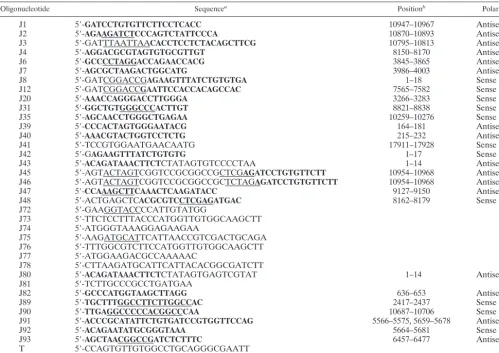
contain-TABLE 1. Oligonucleotides used for ligation, cDNA synthesis, and PCR amplification
Oligonucleotide Sequencea Positionb Polarity
J1 5⬘-GATCCTGTGTTCTTCCTCACC 10947–10967 Antisense
J2 5⬘-AGAAGATCTCCCAGTCTATTCCCA 10870–10893 Antisense
J3 5⬘-GATTTAATTAACACCTCCTCTACAGCTTCG 10795–10813 Antisense
J4 5⬘-AGGACGCGTAGTGTGCGTTGT 8150–8170 Antisense
J6 5⬘-GCCCCTAGGACCAGAACCACG 3845–3865 Antisense
J7 5⬘-AGCGCTAAGACTGGCATG 3986–4003 Antisense
J8 5⬘-GATCGGACCGAGAAGTTTATCTGTGTGA 1–18 Sense
J12 5⬘-GATCGGACCGAATTCCACCACAGCCAC 7565–7582 Sense
J20 5⬘-AAACCAGGGACCTTGGGA 3266–3283 Sense
J31 5⬘-GGCTGTGGGCCCACTTGT 8821–8838 Sense
J35 5⬘-AGCAACCTGGGCTGAGAA 10259–10276 Sense
J39 5⬘-CCCACTAGTGGGAATACG 164–181 Antisense
J40 5⬘-AAACGTACTGGTCCTCTG 215–232 Antisense
J41 5⬘-TCCGTGGAATGAACAATG 17911–17928 Sense
J42 5⬘-GAGAAGTTTATCTGTGTG 1–17 Sense
J43 5⬘-ACAGATAAACTTCTCTATAGTGTCCCCTAA 1–14 Antisense
J45 5⬘-AGTACTAGTCGGTCCGCGGCCGCTCGAGATCCTGTGTTCTT 10954–10968 Antisense
J46 5⬘-AGTACTAGTCGGTCCGCGGCCGCTCTAGAGATCCTGTGTTCTT 10954–10968 Antisense
J47 5⬘-CCAAAGCTTCAAACTCAAGATACC 9127–9150 Antisense
J48 5⬘-ACTGAGCTCACGCGTCCTCGAGATGAC 8162–8179 Sense
J72 5⬘-GAAGGTACCCCATTGTATGG
J73 5⬘-TTCTCCTTTACCCATGGTTGTGGCAAGCTT
J74 5⬘-ATGGGTAAAGGAGAAGAA
J75 5⬘-AAGATGCATTCATTAACCGTCGACTGCAGA J76 5⬘-TTTGGCGTCTTCCATGGTTGTGGCAAGCTT
J77 5⬘-ATGGAAGACGCCAAAAAC
J78 5⬘-CTTAAGATGCATTCATTACACGGCGATCTT
J80 5⬘-ACAGATAAACTTCTCTATAGTGAGTCGTAT 1–14 Antisense
J81 5⬘-TCTTGCCCGCCTGATGAA
J82 5⬘-GCCCATGGTAAGCTTAGG 636–653 Antisense
J89 5⬘-TGCTTTGGCCTTCTTGGCCAC 2417–2437 Sense
J90 5⬘-TTGAGGCCCCCACGGCCCAA 10687–10706 Sense
J91 5⬘-ACCCGCATATTCTGTGATCCGTGGTTCCAG 5566–5575, 5659–5678 Antisense
J92 5⬘-ACAGAATATGCGGGTAAA 5664–5681 Sense
J93 5⬘-AGCTAACGGCCGATCTCTTTC 6457–6477 Antisense
T 5⬘-CCAGTGTTGTGGCCTGCAGGGCGAATT
TR 5⬘-GATGAATTCGCCCTGCAGGCCACAACA
aJEV-specific sequences are shown in boldface type. Restriction enzyme recognition sites used for cDNA cloning are underlined.
bNucleotide position refers to the complete nucleotide sequence of pBACSP6/JVFLx/XbaI.
on November 8, 2019 by guest
http://jvi.asm.org/
[image:2.603.45.545.82.436.2]ing 10l of extracted viral RNA, 5 pmol of the appropriate primer, 100 U of Superscript II RT (Gibco-BRL), 40 U of RNaseOUT (Gibco-BRL), 0.1 mM dithiothreitol (DTT), 10 mM deoxynucleoside triphosphate mix, and the RT buffer supplied by the manufacturer (Gibco-BRL). The reaction mixture was
incubated at 37°C for 1 h and then heated at 70°C for 15 min. A 5-l aliquot of
the RT mixture was subsequently used for PCR amplification with Pyrobest DNA polymerase (Takara Bio Inc., Shiga, Japan) and the appropriate primer pair. The PCRs were performed with 30 cycles of denaturation at 94°C for 30 s, annealing at 60°C for 30 s, and extension at 72°C for 5 min, followed by a final extension step at 72°C for 10 min.
To sequence the 3⬘-terminal sequences, a synthetic oligodeoxyribonucleotide
T was ligated to the 3⬘end of the viral genomic RNA to provide a primer-binding
site for cDNA synthesis and PCR amplification as previously described (17). The
3⬘ end of oligonucleotide T was first modified by incorporating ddATP with
terminal deoxynucleotidyltransferase (Takara), which blocks the intramolecular
and intermolecular ligation of oligonucleotide T. The 5⬘end of oligonucleotide
T was also phosphorylated with T4 polynucleotide kinase (Takara). Thereafter,
the modified oligonucleotide T was ligated to the 3⬘end of the viral genomic
RNA by T4 RNA ligase (New England Biolabs, Inc., Beverly, Mass.). The
ligation reaction mixture (20l) contained 10 U of T4 RNA ligase, 40 U of
RNaseOUT, 10 pmol of oligonucleotide T, viral genomic RNA, and the buffer supplied by the manufacturer (NEB). After incubation at 16°C for 12 h, the ligated viral RNA was phenol extracted, precipitated with ethanol, and
resus-pended with 20l of RNase-free water.
Subsequently, half of the oligonucleotide-ligated viral RNA was used for cDNA synthesis with oligonucleotide TR, which is complementary to oligonu-cleotide T, as previously described. First-strand cDNA was amplified with primer J35, complementary to nt 10259 to 10276, and primer TR. For PCR, one quarter of the RT reaction mix was amplified with Pyrobest DNA polymerase and 30 cycles of 30 s at 94°C, 30 s at 60°C, and 1 min at 72°C, followed by a final extension of 10 min at 72°C. The PCR mixtures were as described above. cDNA
amplicons were cloned into the pRS2 vector withHindIII andEcoRI sites
incorporated in the positive-sense and negative-sense primers, respectively.
The 5⬘-terminal sequence was determined by self-ligation of viral RNA (5).
The cap structure of viral genomic RNA was first cleaved off with tobacco acid
pyrophosphatase. The cleavage reaction mixture (20 l) contained 10 U of
tobacco acid pyrophosphatase (Epicentre Technology Co., Madison, Wis.), 10l
of viral RNA, and the buffer supplied by the manufacturer (Epicentre Technol-ogy Co.). After incubation at 37°C for 1 h, the tobacco acid pyrophosphatase-treated viral RNA was subjected to phenol extraction and ethanol precipitation
and resuspended with 20l of RNase-free water. Half of the decapped viral
RNA was self-ligated in a 20-l reaction mixture with T4 RNA ligase as
de-scribed above. A quarter of the self-ligated viral RNA was used for cDNA synthesis with primer J40, complementary to nt 215 to 232. First-strand cDNA was PCR amplified with primer J39, which is complementary to nt 164 to 181,
and primer J35. cDNA amplicons were digested withApoI andSpeI and ligated
into the pRS2 vector which had been digested withApoI andXbaI, leading to
construct pRS2/JV3⬘5⬘.
Complete nucleotide sequence analysis was carried out by directly sequencing the cDNA amplicons representing the entire viral genome of JEV and the individual clones inserted into pRS2 vectors with an automatic 3700 DNA se-quencer.
Construction of full-length infectious cDNAs for JEV.Recombinant DNA techniques were used according to standard procedures (31). Three overlapping cDNA amplicons (JVF, JVM, and JVR) originally used for complete nucleotide sequence analysis were first subcloned into pBAC/SV, a derivative of the pBeloBAC11 plasmid (S.-I. Yun and Y.-M. Lee, unpublished data). The
pBAC/SV plasmid contains the 491-bpNotI-AatII (T4 DNA polymerase-treated)
fragment of pACNR/NADL (21), the 9,215-bp SacI (T4 DNA
polymerase-treated)-SspI (T4 DNA polymerase-treated) fragment of pSINrep 19 (10), and
the 6,875-bpSfiI (T4 DNA polymerase-treated)-NotI fragment of pBeloBAC11.
Thus, the 3,863-bpRsrII-AvrII fragment of the JVF amplicons, the 4,717-bpBspE
I-MluI fragment of the JVM amplicons, and the 3,326-bpRsrII-BglII fragment of
the JVR amplicons were inserted into the pBAC/SV plasmid which had been digested with the same enzymes. This led to the pBAC/JVF, pBAC/JVM, and pBAC/JVR subclone constructs, respectively. These BAC plasmids were grown inE. coliDH10B cells and sequenced. The nucleotide sequences of the cloned cDNAs were identical to that of CNU/LP2 with the exception of a point
muta-tion, T89063C (silent), within the NS5 gene in pBAC/JVR. The T89063C
substitution was corrected by recloning a 315-bpApaI-HindIII fragment
corre-sponding to nt 8827 to 9142, leading to the construct pBAC/JVRR.
To facilitate the precise adjoining of the bacteriophage SP6 promoter
tran-scription start to the 5⬘ end of the full-length JEV cDNA, pBAC/JVF was
modified. Two fragments were first isolated by PCR of pBAC/SV with primer J41 and primer J43, which incorporates the negative-sense sequence of the SP6 promoter and PCR of pBAC/JVF with primers J42 and J40. These two fragments were fused by a second round of PCR with primers J41 and J40. The resulting
amplicons were digested withPacI andPmeI and ligated with pBAC/JVF which
had been digested with the same two enzymes. This produced pBACSP6/JVF.
To generate an authentic or nearly authentic 3⬘terminus during runoff
tran-scription of plasmid linearized at the 3⬘end of the viral genome, we modified
pBAC/JVRR so that the nucleotide sequence of the authentic 3⬘terminus was
followed by a unique restriction endonuclease recognition site, eitherXhoI or
XbaI. To create the pBAC/JVRR/XhoI subclone containing a uniqueXhoI site at
the end of the viral genome, fragment I was synthesized by PCR amplification of
pRS2/JV3⬘5⬘with primer J90 and primer J45, which incorporates anXhoI site
(Table 1; underlined). The 298-bpSfiI-SpeI portion of fragment I amplicons was
ligated with pBAC/JVRR which had been digested withSfiI andNheI. To create
pBAC/JVRRx/XbaI, which has anXbaI site at the end of the viral genome, the
existingXbaI site at nt 9131 to 9136 within the NS5 gene was first inactivated by
introducing a silent point mutation (A91343T) by PCR. Here, pBAC/JVRR was
amplified with primer J31 and primer J47, which incorporated the A91343T
substitution. The 315-bpApaI-HindIII portion of the cDNA amplicons,
corre-sponding to nt 8828 to 9143, was cloned into pBAC/JVRR, leading to the
construct pBAC/JVRRx. Subsequently, pBAC/JVRRx/XbaI was constructed in
the same manner as described for pBAC/JVRR/XhoI. Thus, fragment II was
obtained by PCR amplification of pRS2/JV3⬘5⬘with primer J90 and primer J46,
which incorporated anXbaI site (Table 1; underlined). The 298-bpSfiI-SpeI
portion of the fragment II amplicons was then ligated into pBAC/JVRRx which
had been digested withSfiI andNheI. To create pBAC/JVRRx/XhoI containing
a uniqueXhoI site and the A91343T substitution, the 298-bpSfiI-SpeI portion
of fragment I amplicons was ligated into pBAC/JVRRx which had been digested
withSfiI andNheI.
Thus, we constructed five plasmids, pBACSP6/JVF, pBAC/JVM, pBAC/JVRR/
XhoI, pBAC/JVRRx/XbaI, and pBAC/JVRRx/XhoI. These contained contiguous
regions of the JEV genome and could now be used to assemble three different
full-length JEV cDNAs, as illustrated in Fig. 3. First, the pBACSP6/JVFM
sub-clone was constructed by ligating together the 4,717-bpBspEI-MluI fragment of
pBAC/JVM, the 8,970-bp BspEI-XbaI fragment of pBACSP6/JVF, and the
3,670-bp XbaI-MluI fragment of pBAC/SV. Subsequently, two fragments of
pBACSP6/JVFM (the 8,142-bpPacI-SapI fragment and the 4,801-bpPacI-BsrGI
fragment) were ligated with either (i) the 5,620-bp SapI-BsrGI fragment of
pBAC/JVRR/XhoI to generate pBACSP6/JVFL/XhoI, (ii) the 5,622-bpSap
I-BsrGI fragment of pBAC/JVRRx/XbaI to generate pBACSP6/JVFLx/XbaI, or
(iii) the 5,620-bp SapI-BsrGI fragment of pBAC/JVRRx/XhoI to generate
pBACSP6/JVFLx/XhoI.
In addition to the SP6-driven JEV cDNAs, we also constructed a set of three
T7-driven full-length cDNAs. A fragment from pBAC/NADLcIns⫺/PAC (Y.-M.
Lee and C. M. Rice, unpublished data) was first synthesized by PCR with the
primers J81 and J80. A fragment from pBACSP6/JVFLx/XbaI was also
synthe-sized with the primers J42 and J82. These two fragments were fused by a second
round of PCR with the primers J81 and J82. The 793-bpEcoRI-SpeI fragment of
the resulting amplicons was inserted into the pRS2 vector digested withEcoRI
andXbaI, leading to the construct pRS2T7/5⬘JV. The 675-bpPvuI-PmeI fragment
of pRS2T7/5⬘JV was ligated with either (i) the 18,364-bpPacI-PmeI fragment of
pBACSP6/JVFL/XhoI to create pBACT7/JVFL/XhoI, (ii) the 18,364-bp Pac
I-PmeI fragment of pBACSP6/JVFLx/XhoI to create pBACT7/JVFLx/XhoI, or (iii)
the 18,366-bpPacI-PmeI fragment of pBACSP6/JVFLx/XbaI to create pBACT7/
JVFLx/XbaI.
Mutagenesis of full-length infectious JEV cDNA and insertion of foreign genes.The point mutation A81713C (silent) was placed inside the NS5 gene in
pBACSP6/JVFLx/XbaI by PCR-based site-directed mutagenesis to generate
pBACSP6/JVFLx/gm/XbaI (see Fig. 6A). The point mutation resulted in the
acquisition of a uniqueXhoI restriction endonuclease recognition site. A
frag-ment from pBACSP6/JVFLx/XbaI was first generated by PCR with primer J48, in
which theXhoI site (Table 1; underlined) was created by the A81713C
substi-tution (Table 1; bold), and primer J3. The 665-bpMluI-ApaI fragment of the
resulting amplicons was then ligated with the 4,802-bpApaI-BsrGI and the
5,874-bp BsrGI-MluI fragments of pBACSP6/JVFLx/XbaI, resulting in the
pBACSP6/JVFLx/gm/XbaI construct.
To generate the pBACSP6/JVFLx/LUC/XbaI construct (Fig. 8A), a fragment
of pBACSP6/JVFLx/XbaI was amplified with primers J72 and J76. A fragment
was also amplified from pACNR/NADLcIn⫺/luciferase (Y.-M. Lee and C. M.
Rice, unpublished data) with primers J77 and J78. These two fragments were then fused by a second round of PCR with primers J72 and J78. The 1,801-bp
KpnI-NsiI fragment of the resulting amplicons was then ligated with the 8,011-bp
on November 8, 2019 by guest
http://jvi.asm.org/
NsiI-PacI and 11,021-bpPacI-KpnI fragments of pBACSP6/JVFLx/XbaI, leading
to pBACSP6/JVFLx/LUC/XbaI.
To create the pBACSP6/JVFLx/GFP/XbaI construct (see Fig. 8A), a fragment
from pBACSP6/JVFLx/LUC/XbaI was amplified by PCR with the primers J72
and J73. A fragment was also amplified from pRSGFP-C1 with the primers J74 and J75. These two fragments were fused by a second round of PCR with the
primers J72 and J75. The 913-bpKpnI-NsiI fragment of the resulting amplicons
was then ligated with the 8,011-bpNsiI-PacI and 11,021-bpPacI-KpnI fragments
of pBACSP6/JVFLx/LUC/XbaI, resulting in the pBACSP6/JVFLx/GFP/XbaI
con-struct.
To generate pBACSP6/JVFLx/LUCREP⫺/XbaI (see Fig. 8A), which contains
an 83-nucleotide deletion (nt 5581 to 5663) in the middle of the NS3 gene that results in premature termination of viral translation at nt 5596, a fragment of
pBACSP6/JVFLx/LUC/XbaI was amplified with primers J89 and J91. A fragment
was also amplified from pBACSP6/JVFLx/LUC/XbaI with primers J92 and J93.
These two fragments were then fused by a second round of PCR with primers J89
and J93. The 3,960-bpSfiI-EagI fragment of the resulting amplicons was then
ligated with the 6,493-bpEagI-SfiI and 10,297-bpSfiI-SfiI fragments of pBACSP6/
JVFLx/LUC/XbaI, leading to pBACSP6/JVFLx/LUCREP⫺/XbaI.
Transcriptions and transfections.RNA transcripts were synthesized by in vitro transcription. Here, 100 to 200 ng of the template DNA linearized with
XhoI orXbaI digestion and in some cases modified with mung bean nuclease was
added to a 25-l reaction mixture consisting of the buffer supplied by the
manufacturer (Gibco-BRL) plus 0.6 mM cap analog [m7G(5⬘)ppp(5⬘)A or
m7G(5⬘)ppp(5⬘)G; NEB Inc.], 0.5M [3H]UTP (1.0 mCi/ml, 50 Ci/mmol; New
England Nuclear Corp., Boston, Mass.), 10 mM DTT, 1 mM each UTP, GTP, CTP, and ATP, 40 U of RNaseOUT, and 15 U of SP6 RNA polymerase (Gibco-BRL). The reaction mixtures were incubated at 37°C for 1 h. RNAs were
quantified on the basis of [3H]UTP incorporation as measured by RNA
adsorp-tion to DE-81 (Whatman, Maidstone, United Kingdom) filter paper (31). A 1- to
1.5-l aliquot of reaction mixture was examined by agarose gel electrophoresis,
and aliquots were stored at⫺80°C until use.
For RNA transfection, cells were electroporated with synthetic RNAs with a model ECM 830 electroporator (BTX Inc., San Diego, Calif.) as recommended by the manufacturer. Briefly, subconfluent cells were trypsinized, washed three times with ice-cold RNase-free phosphate-buffered saline (PBS), and
resus-pended at a density of 2⫻107cells/ml in PBS. A 400-l aliquot of the suspension
was mixed with 2g of synthetic RNA, and the cells were immediately
electro-porated under the conditions determined previously to be optimal (980 V, 99-s
pulse length, and five pulses). The electroporated mixture was then transferred to 10 ml of fresh medium.
An infectious center assay was used to quantify the specific infectivity of the synthetic RNA. The electroporated cells were serially diluted 10-fold and plated
on monolayers of untransfected cells (5⫻105) in a six-well plate. Cells were
allowed to attach to the plate for 6 h, after which they were overlaid with 0.5% SeaKem LE agarose-containing MEM as described above. The plates were
incubated for 3 to 4 days at 37°C with 5% CO2, and infectious plaque centers
were visualized by crystal violet staining.
Western blot analysis.Cells (3⫻105) were lysed with 200l of sample loading
buffer [80 mM Tri-HCl (pH 6.8), 2.0% sodium dodecyl sulfate (SDS), 10% glycerol, 0.1 M DTT, 0.2% bromophenol blue], and one-tenth of the lysate was boiled for 5 min and fractionated on an SDS-polyacrylamide gel. Proteins were transferred electrophoretically onto a methanol-activated polyvinylidene difluo-ride membrane with a Trans-Blot SD electrophoretic transfer cell machine (Bio-Rad Laboratories Inc., Hercules, Calif.), and the membrane was blocked at room temperature for 1 h with 5% nonfat dried milk in washing solution (0.2% Tween 20 in PBS). After three washes with washing solution, membranes were incubated at room temperature for 2 h with either a monoclonal antiactin antibody (A4700) that recognizes the epitope conserved in the C terminus of all actin isoforms (Sigma, St. Louis, Mo.) or mouse hyperimmune ascites fluid specific for JEV (ATCC VR-1259AF; American Type Culture Collection). The membranes were then washed three times with washing solution and incubated at room temperature for 2 h with alkaline phosphatase-conjugated goat anti-mouse immunoglobulin G (Jackson ImmunoResearch Labs Inc., West Grove, Pa.). The membranes were washed three times with washing solution and once with PBS. Actin and JEV protein bands were visualized by incubation with the substrates 5-bromo-4-chloro-3-indolylphosphate and nitroblue tetrazolium.
Northern blot analysis.Total RNA was extracted from infected BHK-21 cells
(3⫻105) with 1 ml of Trizol reagent (Gibco-BRL). One-third of the RNA was
analyzed for JEV-specific RNA by Northern blot analysis as described elsewhere (31). Briefly, the RNA was electrophoresed in denaturing 2.2 M formalde-hyde–1% agarose gels and transferred onto nylon membranes (Amersham Bio-sciences Inc., Piscataway, N.J.). The RNA on the membranes was cross-linked by
irradiation with a 254-nm light source (Stratalinker UV cross-linker; Stratagene, La Jolla, Calif.), and the JEV-specific RNAs were detected by hybridization with
a [32P]CTP-labeled antisense riboprobe that binds to nt 9143 to 9351 of the JEV
genome. [This probe had been synthesized by in vitro transcription from the
BamHI-linearized cDNA clone pGEM3Zf(⫹)/JV9143, which was constructed by
ligating the 209-bp HindIII-SacI fragment of pBACSP6/JVFLx/XbaI with
pGEM3Zf(⫹) digested with the same enzymes. This clone was transcribed with
the T7-MEGAscript kit (Ambion, Austin, Tex.) as recommended by the
manu-facturer with a 20-l reaction mixture containing 3.12M [␣-32P]CTP (800
Ci/mmol; Amersham). After being treated with DNase I, the reaction mixture was spun in a Quick Spin G-50 Sephadex column (Boehringer Mannheim) to remove unincorporated ribonucleoside triphosphates.
The membrane was prehybridized at 55°C for 6 h in hybridization solution [5⫻
SSPE (0.9 M NaCl, 50 mM NaH2PO4, and 5 mM EDTA, pH 7.7), 5⫻Denhardt’s
reagent, 0.5% SDS, 100g of denatured salmon sperm DNA per ml, 50%
formamide] and then incubated at 55°C overnight in the hybridization solution
containing 107cpm of the labeled riboprobe. The membrane was washed three
times at 55°C for 10 min with 1⫻SSPE–0.5% SDS and once for 10 min with 0.1⫻
SSPE–0.5% SDS. Viral RNA bands were visualized by autoradiography and quantified with a Molecular Imager (Bio-Rad).
Direct immunofluorescence.To examine JEV expression in infected BHK-21
cells by confocal microscopy, cells (2⫻105) were seeded in a four-well chamber
slide, incubated for 12 h, and then mock-infected or infected at a multiplicity of infection of 1 for 18 h with either the original JEV K87P39 strain, the JEV CNU/LP2 isolate, or the YF17D strain. Immunostaining for JEV viral proteins was accomplished by first fixing the cells by incubation in PBS containing 0.37% (vol/vol) formaldehyde for 30 min at 25°C. The cells were then washed three times with PBS and permeabilized for 10 min at 37°C with PBS containing 0.2% (vol/vol) Triton X-100. Thereafter, the cells were washed four times with PBS, rehydrated in PBS for 15 min, and blocked for 1 h at 37°C with PBS containing 5% (wt/vol) bovine serum albumin. The cells were then incubated for 2 h at 25°C with 1:500-diluted mouse hyperimmune ascites fluid specific for JEV, washed three times with PBS, incubated for 2 h at 25°C with 1:500-diluted fluorescein isothiocyanate-conjugated goat anti-mouse immunoglobulin G (Jackson Immu-noResearch Labs Inc.), and washed again three times with PBS. Thereafter, the
cells were incubated for 30 min at 37°C in PBS containing 5g of propidium
iodide and 5g of RNase A per ml to localize the nuclei and mounted with 0.2
ml of 80% glycerol. Images were acquired on a Zeiss Axioskop confocal
micro-scope equipped with a 63⫻objective with a Bio-Rad MRC 1024 and LaserSharp
software.
To examine green fluorescent protein (GFP) expression, BHK-21 cells were
mock-transfected or transfected with 2 g of JVFLx/GFP/XbaIMBN RNA.
Transfected cells (105) were incubated for 30 h in a four-well chamber slide. Cells
were washed twice with PBS, fixed by incubation for 30 min at 25°C in PBS containing 0.37% (vol/vol) formaldehyde, and mounted with 0.2 ml of 80% glycerol. Cells were viewed by confocal microscopy and analyzed as described above.
Luciferase assay.For the luciferase assay, BHK-21 cells (8⫻ 106) were
mock-transfected or transfected with 2g of JVFLx/LUC/XbaIMBN RNA or
JVFLx/LUCREP⫺/XbaIMBN RNA. Cells were seeded at a concentration of 6⫻
105cells/well in a six-well plate and cultivated. At the given time points, the cells
were washed with Ca2⫹- and Mg2⫹-free PBS solution and then lysed by adding
0.2 ml of lysis buffer [25 mM Tris-phosphate (pH 7.8), 2 mM DTT, 2 mM
1,2-diaminocyclohexane-N,N,N⬘,N⬘-tetraacetic acid, 10% glycerol, 1% Triton
X-100 (vol/vol)] to each well. Cell lysates were incubated for 10 min at room temperature, and cellular debris was then removed by centrifugation. The
su-pernatants were quickly placed at⫺80°C for storage until use. To determine the
luciferase activity, 20l of the cell lysates was placed in a luminometer tube
containing 100 l of luciferase assay reagent [20 mM Tricine, 1.07 mM
(MgCO3)4Mg(OH)2䡠5H2O, 2.67 mM MgSO4, 0.1 mM EDTA, 33.3 mM DTT,
270M coenzyme A, 470M luciferin (Promega), 530M ATP]. The activity
was usually measured for 10 s. Each data point represents the results of three independent experiments.
Cloned full-length cDNA stability.The genetic structure and functional
integ-rity of the infectious JEV cDNAs were analyzed as follows.E. colistrain DH10B
was transformed with pBACSP6/JVFLx/XbaI, and two independently derived
clones were grown at 37°C overnight in 10 ml of 2xYT containing 12.5g of
chloramphenicol per ml. Cells from these primary cultures were maintained for
9 days by diluting them 106-fold every day. After the third, sixth, and ninth
passages, large-scale preparation of the infectious cDNA plasmid was made by the SDS-alkaline method and purified further by cesium chloride density gradi-ent cgradi-entrifugation (31). The genetic structure of the plasmid DNA was moni-tored by its restriction endonuclease pattern, and its functional integrity was
on November 8, 2019 by guest
http://jvi.asm.org/
assessed by measuring the specific infectivities of the synthetic RNAs transcribed
from the cDNA template, which was linearized byXbaI digestion and mung bean
nuclease treatment.
RESULTS
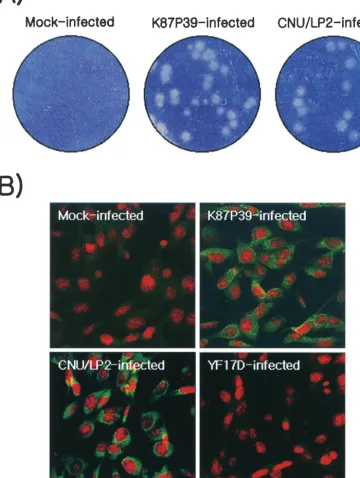
Isolation and complete nucleotide sequence analysis of JEV isolate CNU/LP2.JEV strain K87P39, which was isolated from a wild mosquito in Korea and underwent five passages in suck-ling mouse brains, was obtained from the Korean National Institute of Health (8). The viral plaque sizes of susceptible BHK-21 cells infected with K87P39 and grown as a monolayer varied, indicating that the viral population is heterogeneous (Fig. 1A, K87P39-infected). Consequently, we employed the plaque purification assay with BHK-21 cells to isolate homo-geneous populations of three large-plaque-forming variants that we named CNU/LP1, -2, and -3 (data not shown). Of these three variants, CNU/LP2 consistently maintained its large-plaque phenotype on BHK-21 cells (Fig. 1A, CNU/LP2-in-fected) or Vero cells (data not shown).
Confocal microscopy with anti-JEV hyperimmune ascites revealed that CNU/LP2-infected BHK-21 cells expressed JEV viral proteins around the perinuclear membranes (Fig. 1B, CNU/LP2-infected), similar to K87P39-infected cells (Fig. 1B, K87P39-infected). This fluorescence staining was not observed in mock-infected BHK-21 cells (Fig. 1B, mock-infected). As a negative control, BHK-21 cells infected with yellow fever virus 17D, a flavivirus closely related to JEV, did not stain with anti-JEV hyperimmune ascites, as expected (Fig. 1B, YF17D-infected). CNU/LP2 infection of a variety of animal cell lines, including the neuronal SHSY-5Y (human) and B103 (mouse) cell lines and the nonneuronal Vero (monkey) and MDCK (dog) cell lines, resulted in high virus titers (106to 107PFU/ml)
in the culture supernatants (data not shown). We thus decided to use CNU/LP2 as the parental strain for developing a reverse genetics system for JEV.
Prior to establishing the JEV reverse genetics system, we first had to determine the complete nucleotide sequence of CNU/LP2. Long RT-PCR was used to amplify the entire viral RNA genome apart from the 5⬘and 3⬘termini (Fig. 2A) and yielded three overlapping cDNA products denoted JVF (nt 1 to 3865), JVM (nt 3266 to 8170), and JVR (nt 7565 to 10893) (about 3.9, 4.9, and 3.3 kb in length, respectively). To ensure faithful cDNA synthesis and amplification, we used the RNase H-negative RT together with the low-error-ratePfuDNA poly-merase. To avoid the selection bias that can occur due to cloning, the uncloned materials of the amplified products were directly sequenced in both directions in all cases. Sequencing analysis with two independently isolated preparations of viral RNA resulted in identical sequences.
The 3⬘-terminal sequence of CNU/LP2 viral RNA was ana-lyzed after synthetic oligonucleotide T was ligated to it. Oligo-nucleotide T serves as a specific priming site for cDNA syn-thesis and PCR amplification (Fig. 2B) and has been used successfully to identify the highly conserved 3⬘terminus of the hepatitis C virus RNA genome (17). Thus, synthetic oligonu-cleotide T that had been modified by adding ddATP at its 3⬘
end to prevent intramolecular and intermolecular ligation was ligated to the 3⬘end of the viral RNA, and RT-PCR was then performed with a negative-sense primer complementary to
oli-gonucleotide T and a positive-sense primer corresponding to a sequence near the 3⬘ end of the viral genome (nt 10259 to 10276) (Fig. 2B). Agarose gel electrophoresis revealed that the amplified products migrated as two bands, a larger band of approximately 700 bp and a smaller band of about 450 bp (Fig. 2C). Both bands were purified and cloned, and 20 and 10 randomly picked clones containing the larger and the smaller bands, respectively, were sequenced. As has been documented for most of the fully sequenced JEV isolates, we found that all the clones with the larger insert terminated the viral genome with GGA TCT10968. In contrast, all the clones with the smaller
insert showed the viral genome truncated at nt 10684, resulting in a band 284 bp shorter. During assembly of the full-length JEV cDNA, we used the nucleotide sequences of the larger insert because the smaller insert did not contain 284 nucleo-tides at the 3⬘end of the viral genome.
The 5⬘-terminal sequence of CNU/LP2 viral RNA was ex-amined after the cap structure at its 5⬘end had been removed by incubation with tobacco acid pyrophosphatase (5). The re-sulting viral RNA was then self-ligated, and the 3⬘-5⬘junction was subjected to cDNA synthesis and PCR amplification with a positive-sense primer for RT-PCR complementary to a se-quence near the viral 3⬘ end (nt 10259 to nt 10276) and a negative-sense primer corresponding to a sequence near the viral 5⬘end (nt 164 to nt 181) (Fig. 2D). Agarose gel electro-phoresis revealed the amplified products as a single band of about 850 bp (Fig. 2E). The amplicons were cloned, and 12 randomly picked clones were sequenced. In all 12 clones, the GGA TCT10968of the viral 3⬘-terminal sequence (see Fig. 2B
and C) was followed by the 5⬘-terminal sequence1AGA AGT.
Identical results were also obtained by direct cycle sequencing of uncloned material.
Thus, we have determined the complete nucleotide se-quence of the CNU/LP2 isolate. The nucleotide sese-quence of CNU/LP2 was identical to that of the consensus primers used with the exception of a substitution, T38513C (Table 1,
oli-gonucleotide J6). This sequence information will soon be avail-able in the GenBank database.
Construction of cDNA encoding the JEV RNA genome as a bacterial artificial chromosome.During our initial attempts to clone the cDNA of the CNU/LP2 RNA genome, it became apparent that a particular region of the viral genome was not compatible with cloning in high-copy-number plasmids in E. coli because the cloned DNA underwent genetic rearrange-ments (data not shown). Attempts to clone this region into a low-copy-number bacterial plasmid were also unsuccessful due to genetic instability together with a low DNA yield (data not shown). These difficulties have also been reported for other flaviviruses (5, 11, 26, 29, 38, 39). We finally succeeded in cloning this cDNA by employing the bacterial artificial chro-mosome (BAC) plasmid pBeloBAC11 (22, 36, 46). This vector also later proved itself suitable for housing the full-length JEV cDNA.
Each of the three overlapping amplicons JVF, JVM, and JVR that were originally obtained for sequence analysis was subcloned into the pBeloBAC11 plasmid. The nucleotide se-quences of the cloned cDNA in all three subclones were iden-tical to that of the parental virus with the exception of a base substitution (T89063C) in the NS5 gene contained within JVR.
This substitution was translationally silent and must have
on November 8, 2019 by guest
http://jvi.asm.org/
arisen during the cloning because sequencing of eight ran-domly picked individual clones revealed a T residue at nt 8906. Although the T89063C substitution does not alter the
corre-sponding amino acid, it is possible that this change could affect viral replication (43), and thus we corrected this substitution
back to a T residue. During their manipulation and propaga-tion in theE. colistrain DH10B, all three subcloned cDNAs remained genetically stable (data not shown).
[image:6.603.110.471.95.574.2]By sequentially linking the overlapping JEV cDNA frag-ments at natural restriction sites (see Materials and Methods),
FIG. 1. Comparison of large-plaque-forming JEV isolate CNU/LP2 and original K87P39 strain. (A) Plaque morphology. BHK-21 cells were mock infected or infected with the original JEV K87P39 strain, which formed a heterogeneous mixture of viral plaque sizes. The CNU/LP2 isolate purified in this study formed a homogeneous population of large plaques (CNU/LP2-infected). (B) Levels and patterns of JEV protein expression. Naïve BHK-21 cells were mock infected or infected with K87P39, CNU/LP2, or the yellow fever virus strain YF17D; 18 h later they were fixed and stained with JEV-specific mouse hyperimmune ascites followed by fluorescein isothiocyanate-conjugated goat anti-mouse immunoglobulin G (green fluorescence) and confocal microscopy. Nuclei were visualized by staining with propidium iodide (red fluorescence) in the presence of RNase A.
on November 8, 2019 by guest
http://jvi.asm.org/
we assembled six full-length cDNA clones of CNU/LP2 (Fig. 3). Three were designated pBACSP6/JVFL/XhoI, pBACSP6/
JVFLx/XhoI, and pBACSP6/JVFLx/XbaI (Fig. 3B). These
cDNA clones all had the SP6 promoter transcription start at
the beginning of the viral genome so that synthetic RNA tran-scripts with an authentic 5⬘end would be generated. To ensure that the 3⬘end of the viral genome after runoff transcription would be close to authentic, we placed a unique restriction
FIG. 2. Strategies used to sequence genomic RNA of CNU/LP2. (A) Scheme for RT-PCR amplification of three overlapping cDNA amplicons representing the entire JEV genomic RNA apart from the 5⬘and 3⬘termini. RNA is indicated in gray, and cDNA is indicated by solid parallel lines. The top panel schematically depicts the CNU/LP2 JEV genomic RNA (10,968 bp in length). The bottom panels portray the three overlapping cDNAs, JVF (nt 1 to 3865), JVM (nt 3266 to 8170), and JVR (nt 7565 to 10893). (B) Scheme used to sequence the 3⬘end of CNU/LP2 genomic RNA. The 5⬘-phosphorylated and 3⬘-blocked oligonucleotide T (Oligo T) was ligated to the 3⬘end of JEV genomic RNA by T4 RNA ligase, and the resulting RNA was then used for cDNA synthesis and amplification with the primers indicated by an arrow. The resulting products were cloned and sequenced. (C) JEV-specific amplicons synthesized from the oligonucleotide T-ligated JEV genomic RNA described in B. First-strand cDNA was synthesized with oligonucleotide TR, complementary to oligonucleotide T, and the RT reaction was carried out in the presence (lane 1) or absence (lane 2) of Superscript II RT. The cDNA was amplified with oligonucleotide TR and primer J35, which is complementary to nt 10259 to 10276. The expected size of the PCR product is 727 bp. The products were separated on a 1.2% agarose gel and visualized by staining with ethidium bromide. (D) Scheme used to sequence the 5⬘end of CNU/LP2 genomic RNA. The cap structure of viral genomic RNA was removed with tobacco acid pyrophosphatase, and the decapped viral RNA was then self-ligated with T4 RNA ligase and used for cDNA synthesis and amplification. The resulting amplified products were cloned and sequenced. (E) JEV-specific amplicons synthesized from the self-ligated JEV genomic RNA described in D. First-strand cDNA synthesis was carried out with primer J40, which is complementary to nt 215 to 232. The RT reaction was performed in the presence (lane 1) or absence (lane 2) of Superscript II RT. The cDNA was amplified with primer J35 and primer J39, which is complementary to nt 164 to 181. The expected size of the PCR product is 890 bp. The products were analyzed on a 1.2% agarose gel as described above. Lane M, 100-bp DNA size ladder (in base pairs).
on November 8, 2019 by guest
http://jvi.asm.org/
endonuclease site, eitherXhoI orXbaI, at the end of the viral genome (Fig. 3B, underlined). Thus, pBACSP6/JVFL/XhoI
bears an XhoI site at the end of the viral genome. For the construct with an XbaI site immediately at the end of viral genome, as the viral genome already contains anXbaI site in the NS5 gene, this site had to be destroyed by introducing a silent point mutation (A91343T). This construct was
desig-nated pBACSP6/JVFLx/XbaI, where the x denotes the presence
of the silent point mutation that destroyed the originalXbaI site. The third clone, pBACSP6/JVFLx/XhoI, contains both the
XhoI site at the end of viral genome and the A91343T
substi-tution. Three other full-length cDNA clones under the control of the T7 RNA promoter were assembled in a similar manner and led to the constructs designated pBACT7/JVFL/XhoI,
pBACT7/JVFLx/XhoI, and pBACT7/JVFLx/XbaI (Fig. 3C). At
every cloning step during the assembly process, the structural integrity of the cloned cDNAs was assessed by extensive re-striction and nucleotide sequence analyses. Structural instabil-ity of the inserts leading to deletions or rearrangements was never observed (data not shown).
In vitro generation of highly infectious synthetic JEV RNAs transcribed from BAC constructs.We first examined the spe-cific infectivity of the synthetic RNAs transcribed from the three SP6-driven constructs. For runoff transcription, the con-structs were linearized by digestion withXhoI orXbaI (Fig. 3). SP6 polymerase runoff transcription of the twoXhoI-linearized plasmids in the presence of the m7G(5⬘)ppp(5⬘)A cap structure
analog yielded capped synthetic RNAs containing three nucle-otides (CGA) of virus-unrelated sequence at their 3⬘ends. This is the result of copying the 5⬘overhang left by theXhoI diges-tion (Fig. 3B). Similarly, SP6 polymerase runoff transcripdiges-tion of the XbaI-linearized pBACSP6/JVFLx/XbaI plasmid
pro-duced capped synthetic RNAs with four nucleotides (CTAG) of virus-unrelated sequence at their 3⬘ends (Fig. 3B). When susceptible BHK-21 cells were transfected with the synthetic RNAs from these constructs, all were highly infectious (Table 2). That is, the synthetic RNAs obtained from pBACSP6/JVFL/
XhoI, pBACSP6/JVFLx/XhoI, and pBACSP6/JVFLx/XbaI
trans-fected under optimal electroporation conditions had specific infectivities of 3.5 ⫻105, 4.3⫻105, and 3.4 ⫻105PFU/g,
respectively (Table 2, infectivity). Similar results were also obtained with synthetic RNAs transcribed from the T7-driven cDNA constructs by T7 polymerase runoff transcription (Table 2, infectivity).
It has been reported that for some flaviviruses, the presence of unrelated sequences at the 3⬘end of synthetic RNAs tran-scribed from infectious cDNA diminishes or abrogates their specific infectivity (48). This motivated us to generate synthetic RNAs lacking the unrelated sequences by treating the Xba I-linearized pBACSP6/JVFLx/XbaI plasmid with mung bean
nu-clease (MBN) prior to the transcription reaction, which re-moved the four excess nucleotides of CTAG. To verify mung bean nuclease activity,XbaI-linearized and mung bean nucle-ase-treated pBACSP6/JVFLx/XbaI plasmid was self-ligated, FIG. 3. Construction of full-length JEV cDNA clones in bacterial artificial chromosome pBeloBAC11. (A) Schematic diagram of the full-length JEV cDNAs constructed in this study. Viral proteins are shown with thick solid lines at both termini representing the 5⬘and 3⬘NTRs of the viral genome. The SP6 and T7 promoter transcription start sites and the unique restriction endonuclease recognition site ensuring runoff transcription are shown at the 5⬘and 3⬘ends, respectively. (B and C) 5⬘and 3⬘termini of full-length JEV cDNA clones. Nucleotide sequences of JEV genomic RNA are shown as bold italic lowercase letters. Illustrated are the 5⬘termini of four SP6-driven (B) and four T7-driven (C) full-length JEV cDNA templates. To produce SP6 and T7 RNA polymerase runoff products, the 3⬘termini of two SP6-driven (B, pBACSP6/JVFL/XhoI and pBACSP6/
JVFLx/XhoI) and two T7-driven (C, pBACT7/JVFL/XhoI and pBACT7/JVFLx/XhoI) JEV cDNA templates were linearized byXhoI digestion,
resulting in three nucleotides (CGA) of virus-unrelated sequence at the 3⬘ends. Similarly, the cutting of the 3⬘termini of an SP6-driven (B, pBACSP6/JVFLx/XbaI) and a T7-driven (C, pBACT7/JVFLx/XbaI) JEV cDNA template with XbaI resulted in four nucleotides (CTAG) of
virus-unrelated sequence at the 3⬘ends. In contrast, the authentic 3⬘end of JEV genomic RNA was present when SP6-driven (B, pBACSP6/
JVFLx/XbaIMBN) and T7-driven (C, pBACT7/JVFLx/XbaIMBN) JEV cDNA templates were linearized byXbaI digestion and then treated with
mung bean nuclease to remove the unrelated single-stranded sequences. Underlined is the restriction endonuclease recognition site introduced at the 3⬘end of the viral genome. An arrowhead indicates a cleavage site.
on November 8, 2019 by guest
http://jvi.asm.org/
and its viral 3⬘end was sequenced, demonstrating removal of the four excess nucleotides of CTAG (data not shown). RNA transcripts from XbaI-linearized and mung bean nuclease-treated pBACSP6/JVFLx/XbaI and pBACT7/JVFLx/XbaI (Fig.
3B, pBACSP6/JVFLx/XbaIMBN, and Fig. 3C, pBACT7/JVFLx/
XbaIMBN) both had increased specific infectivities compared to the untreated transcripts (Table 2, infectivity). That is, the infectivity of RNAs transcribed from pBACSP6/JVFLx/
XbaIMBN was estimated to be 3.1 ⫻ 106 PFU/g,
approxi-mately 10-fold higher than the infectivity (3.4⫻105PFU/g)
of the unmodified template (Table 2, infectivity). The RNAs derived from pBACT7/JVFLx/XbaI (3.0⫻ 105 PFU/g) also
had increased infectivity after mung bean nuclease modifica-tion (2.7⫻ 106PFU/g) (Table 2, infectivity). Thus, the
au-thentic 3⬘end of the JEV genome should be present to ensure highly infectious synthetic JEV RNA transcripts are generated. The altered specific infectivity of the RNA transcripts due to the presence of three or four virus-unrelated nucleotides at the 3⬘ end also influences the virus titers harvested from culture supernatants of the transfected BHK-21 cells. Virus titers re-leased from BHK-21 cells transfected with RNA transcripts from mung bean nuclease-untreated pBACSP6/JVFL/XhoI,
pBACSP6/JVFLx/XhoI, and pBACSP6/JVFLx/XbaI ranged
from 2.1⫻105to 4.4⫻105PFU/ml at 24 h posttransfection
(Table 2, virus titer 24 h), at which time half of the transfected cells were still attached to culture dishes showing virus-induced strong cytopathic effect. These titers increased about 10-fold to the range of 3.2⫻106to 5.2⫻106PFU/ml at 48 h
posttrans-fection (Table 2, virus titer 48 h), at which point most of the cells had died and detached from the bottom of the culture dishes. In contrast, the virus titer released from BHK-21 cells transfected with RNA transcripts from mung bean nuclease-treated pBACSP6/JVFLx/XbaIMBN had already reached 6.2⫻
106PFU/ml at 24 h posttransfection, at which time the majority
of the transfected cells had died (Table 2, virus titer 24 h). This titer decreased slightly to 1.4⫻106PFU/ml at 48 h
posttrans-fection (Table 2, virus titer 48 h). Similar patterns of virus production were seen with the T7 polymerase-driven RNA transcripts (Table 2).
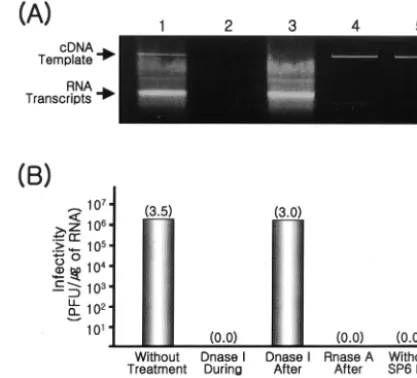
We confirmed that specific infectivity requires the transcrip-tion of RNA from the full-length JEV cDNA template by using the full-length cDNA clone pBACSP6/JVFLx/XbaIMBN (Fig.
4). The cDNA template alone was not infectious (Fig. 4A, lane 5, and B, without SP6 Pol), but the intact cDNA template was needed during the transcription reaction because DNase I treatment abolished infectivity (Fig. 4A, lane 2, and B, DNaseI during). Addition of DNase I after the transcription reaction had no effect (Fig. 4A, lane 3, and B, DNaseI after) relative to the intact reaction mixture (Fig. 4A, lane 1, and B, without treatment), but RNase A treatment abolished the infectivity of the transcribed synthetic RNAs (Fig. 4A, lane 4, and B, RNase A after).
Synthetic JEVs recovered from full-length infectious cDNAs are indistinguishable from the CNU/LP2 parental virus.We compared the synthetic JEVs recovered from full-length infec-tious cDNAs with the parental virus CNU/LP2 originally used for cDNA construction. As shown in Fig. 5A, BHK-21 cells infected with synthetic viruses recovered from pBACSP6/JVFL/
XhoI (dish 1), pBACSP6/JVFLx/XhoI (dish 2), pBACSP6/
JVFLx/XbaI (dish 3), and pBACSP6/JVFLx/XbaIMBN (dish 4)
[image:9.603.317.526.74.263.2]formed homogeneous large plaques, similar to the cells in-fected with CNU/LP2 (dish 5). The growth properties were also similar. Here, BHK-21 cells were infected with low (0.01
FIG. 4. Full-length JEV cDNA template alone is not infectious but is required for generation of infectious synthetic RNAs during in vitro transcription. pBACSP6/JVFLx/XbaI (100 to 200 ng) linearized with
XbaI and treated with mung bean nuclease was used for SP6 polymer-ase transcription in the absence (A, lane 1; B, without treatment) or presence (A, lane 2; B, DNase I during) of DNase I. After synthesis, the transcription reaction mix was treated for 30 min at 37°C with DNase I (A, lane 3; B, Dnase I after) or RNase A (A, lane 4; B, RNase A after). As a control, the reaction was carried out in the absence of SP6 RNA polymerase (A, lane 5; B, without SP6 Pol). (A) Following treatment, 5% of the reaction mixture was separated on a 0.6% aga-rose gel, and the cDNA template and RNA transcripts were visualized by staining with ethidium bromide. (B) The reaction mixtures were used to transfect BHK-21 cells, and infectious centers of plaques were estimated.
TABLE 2. Specific infectivity of in vitro RNA transcripts generated from full-length JEV cDNAs and virus titer
Template used for
transcriptiona
Infectivityb
(PFU/g
of RNA)
Virus titerc(PFU/ml)
24 h 48 h
pBACSP6/JVFL/XhoI 3.5⫻105 4.4⫻105 3.6⫻106
pBACT7/JVFL/XhoI 2.9⫻105 2.0⫻105 2.3⫻106
pBACSP6/JVFLx/XhoI 4.3⫻105 2.1⫻105 5.2⫻106
pBACT7/JVFLx/XhoI 3.8⫻105 3.3⫻105 4.1⫻106
pBACSP6/JVFLx/XbaI 3.4⫻105 3.5⫻105 3.2⫻106
pBACT7/JVFLx/XbaI 3.0⫻105 2.4⫻105 2.7⫻106
pBACSP6/JVFLx/XbaIMBN 3.1⫻106 6.2⫻106 1.4⫻106
pBACT7/JVFLx/XbaIMBN 2.7⫻106 5.6⫻106 2.4⫻106
aAll full-length JEV cDNAs were linearized with an appropriate restriction
endonuclease (XhoI orXbaI) for runoff transcription as indicated in the names
of the cDNAs. For pBACSP6/JVFLx/XbaIMBN and pBACT7/JVFLx/XbaIMBN,
these cDNA templates were prepared by linearization withXbaI digestion, which
was followed by treatment with MBN.
bAfter in vitro transcription with SP6 or T7 RNA polymerase, as indicated,
samples were used to electroporate BHK-21 cells, and infectious plaque centers were determined as described in Materials and Methods.
cVirus titers at 24 and 48 h postelectroporation.
on November 8, 2019 by guest
http://jvi.asm.org/
[image:9.603.43.283.89.226.2]FIG. 5. Comparison of synthetic JEVs with parental virus CNU/LP2. (A) Representative plaque assays of synthetic JEVs and parent CNU/LP2. BHK-21 cell s were infected with parent or synthetic viruses, overlaid with agarose, and stained 3 days later with crystal violet. (B) Growth kinetics in BHK-21 cells of synthetic JEVs and pare nt CNU/LP2 infected at multiplicities of infection of 0.01, 1, and 10. Viruses were harvested at the hour postinfection (h.p.i.) indicated, and titers were determined by plaque assays. The da ta shown represent one of two independent experiments yielding similar results. (C and D) Viral protein and RNA levels were analyzed by immunoblotting (C) and Northern blotting (D), respecti vely. BHK-21 cells were infected at a multiplicity of infection of 1 with synthetic JEVs (lanes 1 to 4) or CNU/LP2 (lane 5) or mock-infected (lane 6) and cultured for 18 h. (C) Protein extract s were prepared from approximately 3 ⫻ 10 4 cells and separated on 10% SDS –polyacrylamide gels. Viral proteins were visualized by immunoblotting with JEV-speci fic mouse hyperimmune ascites (top panel). In parallel, actin protein was detected as a loading and transfer control (bottom panel). The positions of viral protein-related cleavage intermediates and actin are indicated with arrowheads on the left. Molecular mass markers (in kilodaltons) are indicated on the right. (D) Total RNA from approximately 10 5 cells was extracted and analyzed by Northern blotting with a 32 P-labeled antisense riboprobe hybridizing to the sequence in the NS5 gene encompassing nt 9143 to 9351 (top panel). Ethidium bromide-stained 18S rRNA bands are shown as a loading con trol (bottom panel). The positions of full-length genomic viral RNA (11 kb) and 18S rRNA are indicated on the left.
on November 8, 2019 by guest
http://jvi.asm.org/
PFU/cell), medium (1 PFU/cell), and high (10 PFU/cell) mul-tiplicities of infection, after which the cell culture fluids were harvested periodically and used to determine the kinetics of infectious virus release over time. As shown in Fig. 5B, the multiplicity of infection-dependent virus titers accumulating over time were similar for the four recovered viruses and the parental virus.
The viral protein and RNA levels in BHK-21 cells infected with the four recovered viruses and the parental virus were also assessed. Anti-JEV hyperimmune ascites used in immunoblot-ting revealed that the synthetic and parental viruses produced similar amounts and identical patterns of virus-specific pro-teins (Fig. 5C, top panel). Actin protein was measured as an internal sample loading control and revealed equivalent levels of actin protein in mock-infected and infected cells (Fig. 5C, bottom panel). Viral RNA levels were also similar, as deter-mined by Northern blotting (Fig. 5D). Quantification of these blots by image analysis revealed that the ratios of viral genomic RNA (Fig. 5D, top panel) to 18S rRNA (Fig. 5D, bottom panel) did not differ significantly, demonstrating that all viral genomic RNAs were produced at similar levels.
Thus, all the synthetic viruses were indistinguishable from the parental virus in terms of plaque morphology, cytopatho-genicity, growth kinetics, protein expression, and RNA produc-tion. Furthermore, analyses of the 3⬘ end sequence did not reveal an extra three (CGA) or four (CTAG) nucleotides of virus-unrelated sequence at the 3⬘ end of the viral RNA ge-nomes derived from any of the synthetic viruses (data not shown). These results validate the use of infectious JEV cDNA clones developed in this study for future molecular genetics.
Genetic marker introduced into JEV cDNA observed in the genome of recovered virus. While the above results strongly suggest that the JEV cDNA clones can produce highly infec-tious RNA transcripts after SP6 or T7 polymerase transcrip-tion, the possibility that the transfected cultures were contam-inated with the parental virus CNU/LP2 was not formally excluded. To assess this remote possibility, we used PCR-based site-directed mutagenesis to introduce a genetic marker (gm) into the pBACSP6/JVFLx/XbaI construct. This marker is a
si-lent substitution (A81713C) that results in the gain of a unique
XhoI site in the NS5 gene (Fig. 6A). The mutagenized con-struct was designated pBACSP6/JVFLx/gm/XbaI. BHK-21 cells
transfected with RNA transcripts fromXbaI-linearized mung bean nuclease-treated pBACSP6/JVFLx/gm/XbaIMBN
pro-duced infectious virus containing the genetic marker (denoted JVFLx/gm/XbaIMBN) (Fig. 6A). The phenotypic characteris-tics of JVFLx/gm/XbaIMBN did not differ from those of the original virus JVFLx/XbaIMBN, indicating that the A81713C
substitution did not affect viral replication (data not shown). To verify that the JVFLx/gm/XbaIMBN virus had been re-covered from the cDNA template of pBACSP6/JVFLx/gm/
XbaIMBN, we serially passaged the recovered virus in BHK-21 cells at an multiplicity of infection of 0.1. The viruses resulting from each passage were incubated with RNase A and DNase I to avoid the carryover of the input transcript RNA and tem-plate plasmid cDNA (21). Viral RNAs extracted from the JVFLx/gm/XbaIMBN and JVFLx/XbaIMBN viruses released at passages 1 and 3 were used in RT-PCR to amplify a 2,580-bp product that encompassed the A81713C substitution (Fig. 6B,
lanes 1, 3, and 5). Digestion of the amplified product from
JVFLx/gm/XbaIMBN withXhoI resulted in two fragments of 1,506 and 1,074 bp (Fig. 6B, lanes 2 and 4). The JVFLx/
XbaIMBN-derived RT-PCR product did not digest withXhoI (Fig. 6B, compared lane 5 with lane 6), demonstrating that the A81713C substitution was indeed present in the JVFLx/gm/
XbaIMBN virus. Thus, the recovered virus JVFLx/gm/
XbaIMBN originated from the full-length infectious cDNA pBACSP6/JVFLx/gm/XbaIMBN.
Full-length infectious JEV cDNA as a BAC is maintained with a high degree of genetic stability in E. coli. A previous study has shown that constructs containing full-length JEV cDNA frequently acquired stabilizing nonsense mutations in the regions encoding the structural proteins prM and E (38). Since studies into the molecular genetics of JEV will indispens-ably require a reliable infectious JEV molecular clone for manipulation, we manipulated pBACSP6/pJVFLx/XbaI in
sev-eral ways and extensively investigated its genetic structure and functional integrity. We first assessed the clones of E. coli
DH10B bacteria transformed with pBACSP6/pJVFLx/XbaI and
grown on semisolid medium at 37°C. Small but homogeneous bacterial colonies appeared after 15 to 20 h, and extensive restriction analysis with 10 randomly picked clones showed no evidence of deletions or rearrangements. That is, the restric-tion endonuclease patterns of all 10 clones were identical when digested with NcoI (nine sites),BglI (nine sites), PstI (seven sites),HindIII (seven sites),SspI (six sites),BglII (six sites), and
SacI (six sites) (data not shown). SP6 polymerase transcription with each of these 10 clones as the template consistently yielded synthetic RNAs with high specific infectivities ranging from 2.7 ⫻106to 3.1 ⫻106PFU/g (Table 2 and data not
shown).
We also assessed the construct stability of two independent pBACSP6/JVFLx/XbaI-containingE. coliclones propagated for
9 days. The cells were grown in liquid medium overnight and subsequently propagated by diluting them 106-fold daily as
described previously (2). In our experimental conditions, each passage represented approximately 20 generations, which is consistent with observations made previously (2). The plasmids extracted from the two cultures at passages 0, 3, 6, and 9 were examined by restriction enzyme analysis. The restriction en-zyme patterns at passages 3, 6, and 9 did not differ visibly from those at passage 0 (data not shown). Thus, within the resolu-tion of agarose gel electrophoresis analysis, the two infectious BAC clones appeared to be structurally stable. Furthermore, the infectivity of the RNA transcripts made from the two cDNA clones did not differ between passage 0 and passage 9 (Fig. 7), confirming that the infectious JEV cDNA remained functionally stable during serial growth inE. coli.
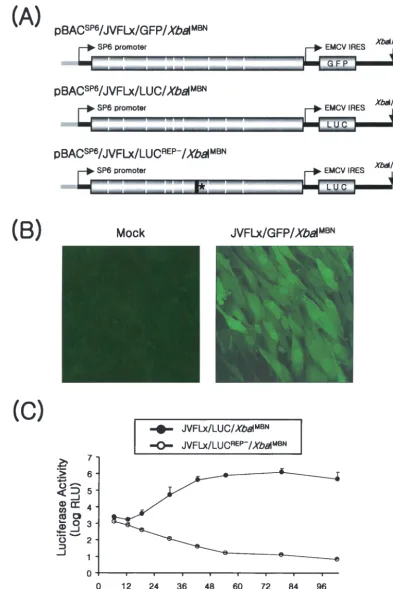
Infectious JEV cDNA as a vector for foreign gene expres-sion.As previously described (3), we found that JEV was able to replicate in a wide variety of eukaryotic cells originating from a number of species, including humans, mice, monkeys, swine, dogs, cats, and hamsters (data not shown). This suggests that JEV could be useful as a vector for the expression of heterologous genes in a variety of different cells. To test this, two commonly used reporter genes, the Aequorea victoria
green fluorescent protein (GFP) and thePhotinus pyralis lucif-erase (LUC), were inserted at the beginning of the viral 3⬘NTR of pBACSP6/JVFLx/XbaI as expression cassettes driven by the
internal ribosome entry site of encephalomyocarditis virus