Theses Thesis/Dissertation Collections
6-2017
Sensor Fusion and Deep Learning for Indoor
Agent Localization
Jacob F. Lauzon
[email protected]Follow this and additional works at:http://scholarworks.rit.edu/theses
This Thesis is brought to you for free and open access by the Thesis/Dissertation Collections at RIT Scholar Works. It has been accepted for inclusion in Theses by an authorized administrator of RIT Scholar Works. For more information, please [email protected].
Recommended Citation
for Indoor Agent Localization
By
Jacob F. Lauzon
June 2017
A Thesis Submitted in Partial Fulfillment of the Requirements for the Degree of Master of Science
in Computer Engineering
Approved by:
Dr. Raymond Ptucha, Assistant Professor Date
Thesis Advisor, Department of Computer Engineering
Dr. Roy Melton, Principal Lecturer Date
Committee Member, Department of Computer Engineering
Dr. Andres Kwasinski, Associate Professor Date
Committee Member, Department of Computer Engineering
Firstly, I would like to sincerely thank my advisor Dr. Raymond Ptucha for his
unrelenting support throughout the entire process and for always pushing me to
better my work and myself. Without him, and his mentorship, none of this would
have been possible.
I would also like to thank my committee, Dr. Roy Melton and Dr. Andres
Kwasinski for their added support and flexibility.
I also must thank the amazing team of people that I have worked with on the
Milpet project, both past and present, that has dedicated many long hours to making
the project a success. In particular I would like to thank Rasika Kangutkar for her
work on ROS, path planning, and obstacle avoidance, Alexander Synesael for his work
on the hardware systems, and Nicholas Jenis for his work on the mobile applications.
Autonomous, self-navigating agents have been rising in popularity due to a push for
a more technologically aided future. From cars to vacuum cleaners, the applications
of self-navigating agents are vast and span many different fields and aspects of life.
As the demand for these autonomous robotic agents has been increasing, so has
the demand for innovative features, robust behavior, and lower cost hardware. One
particular area with a constant demand for improvement is localization, or an agent’s
ability to determine where it is located within its environment. Whether the agent’s
environment is primarily indoor or outdoor, dense or sparse, static or dynamic, an
agent must be able to have knowledge of its location. Many different techniques
exist today for localization, each having its strengths and weaknesses. Despite the
abundance of different techniques, there is still room for improvement. This research
presents a novel indoor localization algorithm that fuses data from multiple sensors
for a relatively low cost. Inspired by recent innovations in deep learning and particle
filters, a fast, robust, and accurate autonomous localization system has been created.
Results demonstrate that the proposed system is both real-time and robust against
Acknowledgments i
Abstract ii
Table of Contents iii
List of Figures v
List of Tables viii
Acronyms ix
1 Introduction 2
2 Background 6
2.1 Localization . . . 6
2.1.1 Dead Reckoning . . . 7
2.1.2 Signal-Based Localization . . . 8
2.1.3 Sensor Networks . . . 8
2.1.4 Vision-Based Localization . . . 9
2.2 Filtering . . . 12
2.2.1 Kalman Filters . . . 12
2.2.2 Particle Filters . . . 15
2.3 Support Vector Machines . . . 18
2.4 Deep Learning . . . 21
2.4.1 Convolutional Neural Networks . . . 22
2.5 Deep Residual Networks . . . 31
3 Platform 36 3.1 Hardware . . . 36
3.2 Software . . . 47
3.2.1 Embedded PC . . . 48
3.2.2 Microcontroller . . . 55
4 Methods 65
4.1 Overview . . . 65
4.2 Testing Environment . . . 65
4.3 Data Collection . . . 67
4.3.1 Preprocessing . . . 71
4.3.2 Datasets . . . 73
4.4 Models . . . 74
4.4.1 Support Vector Machine . . . 75
4.4.2 Convolution Neural Network . . . 76
4.5 Localization Algorithm . . . 77
5 Results 87 5.1 Classification Models . . . 87
5.2 Localization Algorithm . . . 89
5.2.1 Testing Methodology . . . 89
5.3 Localization Results . . . 91
6 Conclusions and Future Work 105 6.1 Conclusion . . . 105
6.2 Future Work . . . 106
2.1 An example of an omni-vision 360◦ image. . . 11
2.2 A particle filter localization example [1]. . . 18
2.3 A basic 2D example of the separating plane created by an SVM [2]. . 19
2.4 Comparison between a standard FNN structure (left) and a CNN struc-ture (right) [3]. . . 24
2.5 Example of the receptive field in a CNN [4]. . . 24
2.6 Example of hyperparameters of a CNN and their effect on image size [5]. 27 2.7 (left) Example of image downsampling using pooling. (right) Example of max pooling operation [3]. . . 29
2.8 Example CNN architecture showing the layers and their effect on the image [3]. . . 30
2.9 Training error (left) and test error (right) on CIFAR-10 with 20-layer and 50-layer networks [6]. . . 31
2.10 Residual learning block [6]. . . 32
2.11 Example network architectures. (left) VGG-19 [7] (middle) 34-layer “plain” network (right) 34-layer residual network [6]. . . 33
2.12 Bottleneck residual block used in 50, 101, and ResNet-152 [6]. . . 34
2.13 Summary of ResNet architectures [6]. . . 35
3.1 Stock Quickie S-11 wheelchair. . . 37
3.2 Top-level hardware system diagram of Milpet. Shows how each of the main components interact with each other. . . 37
3.3 Circuit diagram for the battery system of Milpet. . . 38
3.4 Circuit diagram for the power system of Milpet. . . 39
3.5 Circuit diagram for the motor and encoder system of Milpet. . . 41
3.6 Circuit diagram for the emergency stop system of Milpet. . . 42
3.7 Circuit diagram for the microcontroller system of Milpet. . . 43
3.8 Circuit diagram for the PC system of Milpet. . . 46
3.9 Milpet - Machine Intelligence Lab Personal Electronic Transport. . . 47
3.10 Example of path planning with intermediate waypoints. . . 51
3.12 ROS diagram showing the ROS architecture for Milpet. The boxes
represent nodes and the lines represent messages passed between nodes. 54
3.13 Example output waves from a quadrature encoder. The two signals,
Ch A and Ch B, are 90◦ out of phase. . . 56
3.14 Depiction of ultrasonic range sensor locations and ranging groups. . . 63
3.15 (left) The main screen of the Android application. (right) The main screen of the iOS application. . . 63
4.1 (left) Floor plan map of first hallway tested, Hallway A. (right) Floor plan map of second hallway tested, Hallway B. . . 66
4.2 Hallway A (left) and Hallway B (right) shown in occupancy grid form where each pixel is 4×4 inches. . . 67
4.3 Hallway A (left) and Hallway B (right) divided into smaller sections to prevent dead reckoning errors. . . 69
4.4 Example of waypoint labeling in Hallway A. . . 70
4.5 Raw image output from omni-vision camera. . . 71
4.6 Omni-vision image after preprocessing. . . 72
4.7 Omni-vision image after additional preprocessing for SVM. . . 75
4.8 Hallway A initialized with 1500 particles. . . 79
4.9 Example of waypoint probability mask centered at waypoint 60. . . . 80
4.10 Example of normal centered waypoint coordinates (center) and the coordinates shifted to the left (left) and right (right). . . 83
5.1 Example of visualization of the localization algorithm. (top) Hallway A with poor estimate and (bottom) Hallway B with good estimate. . 92
5.2 Example test image taken with intense daylight. . . 93
5.3 Path comparison results for Test 1 (top) and Test 7 (bottom). . . 96
5.4 Comparison of images taken at different speeds. (left) 0.25 m/s, (cen-ter) at 0.65 m/s, and (right) taken at 1 m/s. . . 97
5.5 Path comparison results for Test 6. . . 98
5.6 Path comparison results for Test 12 (top) and Test 13 (bottom). . . . 100
5.7 Path comparison results for Test 16. . . 101
5.8 Path comparison results for Test 16 when compared to the path gen-erated by the path planning algorithm. . . 103
A.2 Diagram of LED driver used on Milpet. The R,G,B inputs are PWM
3.1 Pin Usage Diagram for Teensy 3.2 on Milpet. . . 45
4.1 Hallway A dataset breakdown. . . 73
4.2 Hallway B dataset breakdown. . . 74
4.3 Dataset sizes after augmentation. . . 74
4.4 Tunable parameters for localization algorithm. . . 86
5.1 Initial dataset size for Hallway A. . . 87
5.2 Initial dataset results for Hallway A. . . 88
5.3 Train and validation size of hallway datasets. . . 88
5.4 Hallway dataset ResNet results. . . 89
5.5 Algorithm parameters for testing. . . 91
5.6 Localization testing results. . . 94
AC
Alternating Current
ADAM
Adaptive Moment Estimation
ANNs
Artificial Neural Networks
ASIFT
Affine Scale-Invariant Feature Transform
CNN
Convolutional Neural Network
DC
Direct Current
DPDT
Double Pull, Double Throw
EKF
Extended Kalman Filter
FIR
Finite Impulse Response
FNNs
Feed-forward Neural Networks
GPIO
General Purpose Input Output
GPS
Global Positioning System
IMU
LiDAR
Light Detection and Ranging
Milpet
Machine Intelligence Lab Personal Electronic Transport
PC
Personal Computer
PID
Proportion Integral Derivative
PWM
Pulse Width Modulation
ReLU
Rectified Linear Unit
RFID
Radio Frequency Identification
ROS
Robot Operating System
RSSI
Received Signal Strength Indicator
SIFT
Scale-Invariant Feature Transform
SLAM
Simultaneous Localization and Mapping
SPST
Single Pole, Single Throw
SURF
Speeded Up Robust Features
SVM
Introduction
Localization, or a agent’s ability to determine its location, has been a topic of
re-search for decades as it is fundamental to any autonomously or semi-autonomously
navigating agent. Whether the agent is intended for indoor use, outdoor use, or both,
it must have an idea of its location if the intention is to travel from one point to
an-other. Indoor and outdoor environments each contain a unique set of challenges for
the task of localization. Outdoor environments are very large while indoor
environ-ments are more constrained. Indoor environenviron-ments face additional challenges such the
lack of access to certain technologies like Global Positioning System (GPS). These
challenges govern the implementation of localization. Qualities of the agent, such
as what sensors the agent has access to and how much processing power the agent
has, also factor into the localization implementation. No one system is perfect for
all agents and environments, but creating a system that can generalize to as many
conditions as possible is important.
Over the past years, many different techniques for localization have been
devel-oped and tested. Each method requires the agent to be equipped with at least one
sensory device that can take meaningful data from the environment and a software
algorithm that can interpret this data and make an estimation of location. The sensor
choice is heavily dependent on the environment the agent will be deployed in, while
algo-rithm choices come with trade-offs. Some sensors, like Light Detection and Ranging
(LiDAR) sensors and GPS sensors, can be very expensive. Others, such as ultrasonic
range sensors, can be too coarse to achieve high accuracy. On the other hand, sensors
like high-definition cameras can provide more data than certain agents are capable of
processing in a timely manner. The optimal solution for most localization systems is
to maximize the accuracy and speed of the location estimate, while minimizing the
required processing power and cost.
The previous work in localization spans a wide range of sensor types and
algo-rithms but can be mostly divided into three main categories: techniques that utilize
external signals, techniques that utilize sensors external to the agent, and techniques
that make use of sensors attached to the agent. Using external signals such as Wi-Fi
or Bluetooth for proximity detection or triangulation-based localization has been the
focus of much recent research [9, 10, 11]. While these methods demonstrate promising
results, they rely on specific external signals to be present in the environment. For
autonomous agents that must be able to be deployed in any environment, signal based
solutions fall short. There has also been significant research in localization techniques
that use sensors scattered throughout the environment and external to the agent to
localize the agent [12, 13]. Other techniques similar to this involve augmenting the
environment to make it easier for the agent to localize itself, such as Jeon et al. [14]
who placed magnets around the environment for the agent to drive over. While these
solutions are fairly accurate, they still rely on the agent being deployed in a specific
environment or the environment to be outfitted with sensors prior. Again, this limits
the areas an agent can travel.
The third category of localization techniques is the most appealing. By using only
sensors attached to the agent and not relying on external signals, the agent should
be able to be deployed into any environment. Within this category there are still
solution is dead reckoning, which is localization using only odometry data such as that
from wheel encoders. Dead reckoning techniques are simple but, alone, are insufficient
as they suffer from sensor and mechanical inaccuracies which, when propagated over
time, become unacceptable. Dead reckoning techniques were improved by the addition
of filtering algorithms and other sensors such as in [15, 16]. More recent approaches
to localization utilize other sensors such as ultrasonic, LiDAR, and vision to achieve
higher accuracy and build a more robust system. Fontanelli et al. [17] was able to
create an accurate localization system using just LiDAR data and a modified Random
Sample Consensus (RANSAC) algorithm. Vision based localization has become very
popular recently due to the feature rich data a camera can provide for a relatively
low cost. A significant amount of work has been done in using vision to perform
image matching for localization [18, 19, 20, 21]. These techniques involve extracting
certain features from images of key landmarks during training and then performing
a matching algorithm as the agent captures a new image.
Part of this research was to aid in developing an indoor agent to be able to test
and demonstrate the localization algorithm. The agent that was created was an
affective access wheelchair that was converted to drive and navigate autonomously
via speech or touch input. The wheelchair, termed Machine Intelligence Lab Personal
Electronic Transport (Milpet), was developed as a research platform for all aspects
of research within autonomous navigation. The wheelchair was equipped with wheel
encoders, LiDAR, an omni-vision camera, an Inertial Measurement Unit (IMU), and
ultrasonic range sensors for sensing input. In addition, localization was combined
with other algorithms for path planning, obstacle avoidance, speech recognition, and
motor control to achieve fully autonomous operation.
This thesis presents a novel approach to indoor agent localization that utilizes
data from a low-cost omni-vision camera, along with ultrasonic sensors and odometry
uses only data from these sensors and does not rely on any external sensors or signals.
The algorithm makes use of state-of-the-art filtering and deep learning techniques to
create a robust model capable of working under many indoor conditions. In addition,
the system was tested and proven on a physical agent and could be extended to any
agent with a similar sensor array.
The rest of this thesis is organized as follows: a chapter investigating previous
work in this area and important technologies utilized followed by a chapter discussing
the platform used for testing. Next, is a chapter that discusses the methodology of the
localization system followed by a examination of the testing methodology, datasets,
and results. Finally, there is a brief conclusion and a discussion on possible future
Background
2.1
Localization
Localization is defined as an agent’s ability to determine its location within an
en-vironment. It is an essential technology for most autonomous or semi-autonomous
agents to be successful. Agent localization has been a topic of research for many
years as the popularity and desire for more autonomous agents continues to grow.
Localization is required for agents in any environment, whether it be indoor or
out-door. The general principles and requirements of localization hold true for almost
all environments; however, different environments may require different
implemen-tations. For example, in most outdoor environments GPS is available, where it is
not in indoor environments. This means that an outdoor localization algorithm that
makes use of GPS would fail in most indoor environments. It is also important to
consider the agent when considering localization. Different agents are equipped with
different sensor technologies, movement mechanics, and amount of processing power;
all of which must be considering when developing an algorithm for any specific subset
2.1.1 Dead Reckoning
The earliest, and most crude form of localization is called dead-reckoning.
Dead-reckoning involves using odometry information, trigonometry, and robot kinematics
to determine how far the agent travels from its initial position. Dead reckoning is
plagued by two major issues. The first is the algorithm requires knowledge of the
agent’s initial position, and the second is over time measurement errors cause the
accuracy to decrease to an unacceptable level. Ojeda et al. [22] presented a
localiza-tion system for a humans that utilized an IMU to perform dead reckoning. While the
system was fairly accurate at detecting linear displacement over short distances, it
struggled to remain accurate with longer walks. To improve this form of localization,
error correction techniques were added to account for the accumulating sensor error.
Among the most popular techniques, Thrun et al. [23] used a probabilistic approach
known as particle filtering, and Kwon et al. [15] utilized extended Kalman Filters for
error correction. Others tried to improve dead reckoning techniques by including
ad-ditional sensor data with the odometry information. Kim et al. [16] combined dead
reckoning with data from ultrasonic sensors and used a Kalman Filter to improve
localization performance.
Dead reckoning techniques, even the more advanced ones, still suffer from the
need to know the agent’s initial position. This prevents the agent from being able to
solve, what is informally know as, the “kidnapped robot problem.” The “kidnapped
robot problem” describes randomly placing an agent into an environment and having
it be able to determine its location without any prior knowledge. This is a common
problem in robotics as most modern agents must be able to determine location without
an initial position. Modern localization techniques work to solve the “kidnapped
robot problem” by introducing different sensors to better gather information from
idea of Simultaneous Localization and Mapping (SLAM) [24, 25] where a map is built
by the agent and then the agent can localize itself within that map. One of the most
popular SLAM techniques was proposed by Montemerlo et al. [26] called FastSLAM.
FastSLAM utilizes sensor data and a particle filtering algorithm to achieve a fast and
robust SLAM algorithm.
2.1.2 Signal-Based Localization
A lot of modern research on localization has been focused on observing wireless
sig-nals within the environment The most popular sigsig-nals are Wi-Fi, Bluetooth, and
Radio Frequency Identification (RFID) [27]. Wi-Fi techniques usually utilize
Re-ceived Signal Strength Indicator (RSSI) fingerprinting with existing Wi-Fi networks
to determine agent location [9, 11, 28, 29]. Techniques based on Bluetooth and RFID
usually require the environment to be augmented with beacons or tags to create the
necessary signals to build a “radio map” [10, 30, 31]. These methods continue to be
improved and are the topic of a significant amount of recent work [32, 33, 34]. While
these methods are popular and show promising results, they require the agent to be
deployed in an environment where the signals are present or require the environment
to be curated with signal creating devices. This limits the environments these
algo-rithms can be used in, and therefore prevents them from generalizing to any agent or
situation.
2.1.3 Sensor Networks
Another popular approach to localization is to use sensors external to the agent to
track the agent within its environment. This is sometimes referred to as using a sensor
network. Sensor networks can be sensors, such as cameras, used to observe the agent
within the environment, augmentations to the environment, such as placing RFID
examples of sensor network localization. He uses a combination of RFID tags spread
throughout the environment and an external camera to monitor the agent. Bischoff et
al. [35] combined odometry data with data from an external camera using a Kalman
Filter to achieve higher accuracies than odometry alone. The camera acted as a means
to correct the odometry as time went on. Ramer et al. [13] added ceiling mounted
cameras to overcome some of the challenges with localization using basic LiDAR
and odometry data. He used the camera to aid with the initial location estimate and
updating the global map with obstacles. Jeon et al. [14] provided an example of using
only environment augmentation by scattering magnets and orange traffic cones around
and equipping the agent with sensors to observe these augmentations to determine
location. Similar to the signal based methods, sensor network localization methods
do not generalize well to many environments because sensors and artificial landmarks
have to be added to the environment prior.
2.1.4 Vision-Based Localization
The third modern approach to localization is to use only sensors attached to the agent
and use algorithms to interpret the data from these sensors. This is the most appealing
form of localization as it can generalize to many different environments and can be
applied to different agents. In outdoor environments fairly accurate localization can
be achieved with only GPS but in indoor environments where GPS is not present, the
problem is more challenging. For indoor environments LiDAR sensors [17] or vision
sensors are typically utilized with vision being the most intriguing option due to the
relatively low cost of cameras, especially when considering the amount of data they
provide. Some even took advantage of depth cameras for their ability to provide both
2.1.4.1 Image Matching
The most common approach to vision-based localization is image matching. Image
matching usually consists of two stages, an offline stage and an online stage. During
the offline stage, images are gathered from the agent’s environment in specific, known
locations. These images are used to build a database of images to be used later during
the online stage. Typically, instead of storing the raw images, certain features are
extracted from the images, such as Scale-Invariant Feature Transform (SIFT) [38]
or Speeded Up Robust Features (SURF) [39]. The online stage of image matching
consists of taking images from the environment, while traveling, and comparing them
to those already in the database. The way the images are compared, and a position
is ultimately estimated, involves a mathematical approach to determine the
similar-ity between feature maps. Both Piciarelli [20] and Guan et al. [19] implemented a
successful localization system based on image matching using SURF features. Guan
et al. [19] developed a slightly more sophisticated matching algorithm by also
deter-mining a “learning line” for each image. The learning line was a line somewhere in
the image that provided a reference coordinate system within the image. This line
could be used in the online stage to help determine the agent’s position relative to the
landmark in the image. Mostofi et al. [40] combined image matching using SURF and
an IMU to perform SLAM in an indoor environment. The image matching technique
was used to account for drift in the measurements of the IMU. Another interesting use
of image matching was introduced by Sui et al. [41]. Sui combined image matching
using Affine Scale-Invariant Feature Transform (ASIFT) [42] features with a scenario
selection algorithm that used a Convolutional Neural Network (CNN). The CNN was
trained to classify which scenario the agent was traveling through in order to limit
2.1.4.2 Omni-vision
An intriguing branch of vision-based localization is the use an vision, or
omni-directional, camera to capture the images. Omni-vision images are usually floor to
[image:22.612.216.434.205.421.2]ceiling images 360◦ around the agent. Figure 2.1 shows an example of an omni-vision image.
Figure 2.1: An example of an omni-vision 360◦ image.
Images, like the one in Figure 2.1 capture more information than conventional
camera images as they see all around an agent. For localization purposes, this extra
information can be very helpful in identifying an agent’s environment. Many have
used vision images for the purposes of localization. Hesch et al. [43] used
omni-vision images along with a Kalman filter for the purpose of SLAM, and Menegatti
et al. [44] utilized an omni-vision camera as a range finder to achieve an accurate
localization system. Most localization techniques using omni-vision images still rely
on image matching using landmark features [45, 46]. Resch et al. [47] argued that
conventional image features, such as SIFT or SURF, do not work with omni-vision
Wong et al. [1] took a different approach to omni-vision based localization by using
the captured images to train a machine learning classifier to predict where the image
was taken. This is similar to image matching, except that the classifier is essentially
performing the matching algorithm. Wong did not use any feature extraction directly
on the images; rather dimensionality reduction was used to extract a low dimension
representation of the image to train the classifier. The classifier performed with an
accuracy of around 80% which, when combined with a particle filtering algorithm,
created a successful localization system. This work is intriguing as it eliminates the
need to perform feature extraction for image matching during the offline stage of
localization. In addition, most classifiers are able to make predictions very quickly
after being trained which could be beneficial for real-time localization during the
online stage.
2.2
Filtering
Filtering techniques are mathematical algorithms designed to mitigate the effect of
noise or uncertainty from estimation or measurement tasks. This can be very
ben-eficial in localization systems as there is typically a level of uncertainty with sensor
measurements and/or pose estimation. Most localization algorithms developed in the
past have used some form of filtering, including [15, 16, 23, 35, 43, 1] to name a few.
Two of the most popular filtering algorithms used for localization are Kalman filters
and particle filters.
2.2.1 Kalman Filters
Kalman filtering is a mathematical filtering algorithm that uses a series of
measure-ments that contain measurement and process noise, to estimate unknown variables
with more accuracy than would be possible with a single measurement. In general,
the probability distribution of the unknown variables. The algorithm can run in
real-time and requires only the current input measurement and the previous state of the
system. Kalman filters were first introduced by Rudolf Kalman in 1960 [48] to solve
classical problems in control theory. They quickly became extremely popular and,
today, are heavily used in many fields including navigation, signal processing, and
robot control.
Kalman filters work by continuously estimating some output and an associated
uncertainty, based on a measurement of the value and the uncertainty of that
mea-surement, along with the previous output value and its uncertainty. The first step to
using a Kalman filter is to ensure the system follows a stochastic linear model and
to determine the parameters of this model. The equations of a typical Kalman filter
model are shown in (2.1) and (2.2).
xk =Axk−1+Buk+wk−1 (2.1)
zk=Hxk+vk (2.2)
In (2.1) and (2.2), k denotes the current iteration step. So Equation (2.1) shows
the equation for the current estimate of the unknown variable xk which is a linear
combination of the previous value of the variablexk−1, the control signal uk, and the
process noise from the previous iteration wk−1. Equation (2.2) shows the equation
for the current measurement value zk which is a linear combination of the unknown
variable and the measurement noise vk. The variables A, B, and H are generally
matrices that determine the weight given to each component of the equation. These
values are system dependent and must be determined beforehand; however, in most
systems, they can be scalar values or even have a value of one. The noise values wk−1
covariance matrix ofQandRrespectively. QandRmust be estimated beforehand, as
well, but need not be perfect as the algorithm tries to converge to correct estimators.
If the system can fit into the Kalman filter model described above, the Kalamn
filter process can be applied in the system. The process runs iteratively and consists
of two steps: the time update and the measurement update. Each step has a
set of equations that must be solved to determine the current state. The equations
for the time update step are shown in (2.3) and (2.4).
ˆ
x−k =Axˆk−1+Buk (2.3)
ˆ
Pk− =APk−1AT +Q (2.4)
Equation (2.3) shows the calculation of the prior estimate xˆ−k which is the estimate before the measurement update. This is a linear combination of the previous
prior estimate ˆxk−1 and the control signal. Equation (2.4) shows the calculation for
what is called the prior error covariance Pˆk− which is an estimation of the error before the measurement update. These prior values are used in the measurement
update shown in (2.5), (2.6), and (2.7).
Kk=Pk−HT(HPk−HT +R)−1 (2.5)
ˆ
xk = ˆx−k +Kk(zk−Hxˆ−k) (2.6)
Pk = (I−KkH) ˆPk− (2.7)
Equation (2.6) shows the equation for x at time k which is the desired output
from the Kalman filter. It requires the prior estimate, the measurement zk and the
step k. It is a hidden value that is dependent on the noise estimation and the prior
error covariance. After ˆxk is calculated, the final step of the measurement update is
to update the error covariance, Pk. The error covariance is a measure of the variance
associated with the calculated output value which is used and updated each iteration.
The two steps, the time update step and the measurement update step, are repeated
to iteratively estimate the variable value. The value may oscillate slightly in the first
few iterations but will converge quickly as the error estimate becomes more accurate.
The drawback to this algorithm is that the system must adhere to the linear
model described in (2.1) and (2.2). Many systems, however, cannot be modeled with
a linear system. To solve this, researchers introduced the Extended Kalman Filter
(EKF), an extension of Kalman filters that could be used with nonlinear systems.
The math involved with EKFs is out of scope of this research but they work by
linearizing model parameters using a Taylor approximation to fit to the linear model.
In addition to EKFs, other algorithms have been introduced for nonlinear systems
such as unscented Kalman filters [49, 50].
2.2.2 Particle Filters
Particle filters are another popular filtering technique used for localization tasks.
Particle filters are a set of algorithms that work to estimate the internal state of a
system based on repeated observations. They are a member of a more generic type of
algorithm, called Monte Carlo methods, that utilize observations over many random
samples to estimate a state. Particle filters, in their generic form, were introduced in
the 1970s by Handschin [51] but were not considered for localization tasks until the
modern form was developed by Gordon et al. [52]. Thrun et al. [25] popularized the
use of particle filters for localization by using them to perform SLAM. Particles filters
can be applied with data from almost any type of sensor, making them applicable for
a quick location estimate, while handling ambiguities in sensor data and supporting
re-localization without adding algorithm complexity.
More technically, particle filters iteratively approximate the posteriors from a
partially observable, controllable Markov Chain with discrete time [53]. The goal is
to estimate the state, xt at time t based on the previous state xt−1 which follows
some probability distribution P(xt|ut, xt−1), referred to as the motion model, where
ut is some control over the time interval. In a robotic system the state is never
known but can be measured. The measurement, zt, is an estimation of xt based on
some probability distributionP(zt|xt), usually referred to as themeasurement model.
The initial state, x0, is drawn from another distribution, P(x0), which is typically
random in nature. There can also be multiple controls, ut = u
0. . . ut, and multiple
measurements,zt =z
0. . . zt, that are factored into the motion model. The challenging
portion of solving Markov chain problems is estimating the state probability from the
measurements. In general, this can be accomplished using Bayes filters [54] in the
form of (2.8).
P(xt|zt, ut) = A×P(zt|xt)
Z
P(xt|ut, xt−1)×P(xt−1|zt−1, ut−1)dxt−1 (2.8)
Equation (2.8) shows the mathematical way to recursively compute the system
state, xt, given the current measurements, zt, and controls, ut. This equation works
under the initial conditions P(x0|z0, u0) = P(x0). This equation also has only a
closed form solution in discrete cases and some specialized continuous cases. Most
robotic systems are applied in continuous spaces that may not fit the specialized
cases, therefore (2.8) cannot be used. Particle filters are a general way to solve
for this distribution in any sample space. The idea is to estimate a distribution of
states. Algorithm 1 shows the basic form of the particle filter algorithm.
Algorithm 1 Basic Particle Filter Algorithm.
1: Initialize N particles from P(x0), denote X0
2: while Truedo
3: Generate x[ti] for each x[ti−]1 ∈Xt−1 by drawing from P(xt|ut, x
[i]
t−1), denote ¯Xt
4: Draw N particles from ¯Xt (with replacement) from P(zt|x[ti]), denote Xt
5: end while
The particles are first initialized from the distribution P(x0). Next, in a loop,
the particles from the previous time step are updated based on the motion model
and then N new particles are sampled, with replacement, from the measurement
model. In some systems, such as mobile agents, the motion model, P(xt|ut, x
[i]
t−1), is
measured, rather than sampled, from wheel encoders or other similar sensors. The
measurement model, P(zt|x[ti]), usually comes from sensor data and the uncertainty
associated with that data. This basic algorithm can generalize to many different
types of problems, such as agent localization. With localization, the particle filter
algorithm attempts to estimate location based on sensor information. The particles
are initialized at random locations within the map and iteratively resampled based
on measurement data. Algorithm 2 shows a general particle filter algorithm for agent
localization.
Algorithm 2 General Particle Filter Algorithm for Localization.
1: Initialize particles with a random location
2: while Truedo
3: Update particles based on robot movement
4: Observe sensor measurements
5: Assign weight to each particle by comparing with sensor data 6: Resample particles based on weight
7: Estimate location from particle locations and weights
8: end while
Algorithm 2 shows the general flow of how a particle filter algorithm can be used
on weight. This matches the general form of particle filters in Algorithm 1 with
the motion model coming from robot motion and the measurement model coming
from sensor measurement. Figure 2.2 shows a localization example using a similar
algorithm.
Figure 2.2: A particle filter localization example [1].
In Figure 2.2 each image shows a simulated map where white areas are free space
and black areas are obstacles. The red dots are particles, and the blue arrow shows
the actual position of the agent. As the agent is moving throughout the hallway from
(a) to (h), the particles eventually converge on the actual location.
2.3
Support Vector Machines
A Support Vector Machine (SVM) is a very popular machine learning algorithm
devel-oped for the task of classification. SVMs were first introduced in 1995 by Cortes and
Vapnik [55] and quickly became an extremely popular technique for many different
tasks including pattern recognition [56], text categorization [57], and face detection
[58]. SVMs became a pinnacle in the machine learning community as they performed
well on many different tasks. An SVM is a binary classifier that, in general, works
al-gorithm works to find the optimal hyperplane that maximizes the minimum distance
from the plane to the nearest data point of each class.
Figure 2.3: A basic 2D example of the separating plane created by an SVM [2].
Figure 2.3 shows an example of the optimal hyperplane computed by an SVM
in a simple 2D example. The hyperplane is considered optimal when the distance
from it to the nearest data points, known as the margin, is maximized. To make the
mathematics more convenient, it is said that all points on the optimal hyperplane are
equal to zero, all points on one margin are equal to one, and all points on the other
margin are equal to negative one. This allows for the equation of the hyperplane to
be written as it is in (2.9).
|wTxm+b|= 1 (2.9)
In (2.9), xm is the ground truth data of any dimension, wT is the weights of the
hyperplane andb is the intersection point of the hyperplane. To find the hyperplane,
bothwT and b need to be solved for. Solving for wT can be done with a constrained
minimization problem. Part of solving this problem is to form a Lagrange formulation
solve for the Lagrange multipliers α. min α 1 2α T
y(1)y(1)x(1)Tx(1) y(1)y(2)x(1)Tx(2) · · · y(1)y(n)x(1)Tx(n) y(2)y(1)x(2)T
x(1) y(2)y(2)x(2)T
x(2) · · · y(2)y(n)x(2)T
x(n)
..
. ... ... ...
y(n)y(1)x(n)T
x(1) y(n)y(2)x(n)T
x(2) · · · y(n)y(n)x(n)T
x(n)
α+ (−1)α (2.10)
The first step in solving forαin (2.10) is to form a matrix of each sample compared
with every other sample. Each value in this matrix is the dot product of one training
sample with another. This forms an n×n matrix of scalar values where n is the number of training samples. One of the limitations of SVMs is that if the training set
grows very large, it becomes very difficult to compute the solution. To solve forα in
(2.10) a standard convex quadratic programming package can be used. The equations
and specific operations for solving this equation are out of scope of the this research.
Once the values ofα are known, they can be plugged into (2.11) to solve for w.
w=
n
X
i=1
αiy(i)x(i) (2.11)
In (2.11),y(i) is the ground truth label of each training sample, andx(i)is the data
from each training sample. While this seems like a large summation if the number of
training samples is large, most of the values of α are zero and can be ignored in this
calculation. After w is known, the value of b can be solved using one training point
that falls on a margin, known as a support vector, with (2.12).
ysv(wTxsv+b) = 1 (2.12)
In (2.12), ysv and xsv are the ground truth label and data from a single support
test point xtest by using (2.13).
class(xtest) =sign(wTxtest+b) (2.13)
Equation (2.13) is used to classify an unseen test sample, xtest, by evaluating the
sign ofwTx
test+b. If the sign is positive,xtest belongs to the +1 class; if it is negative
it belongs to the −1 class. An SVM can be expanded to handle more than two classes by creating many one-versus-all classifiers where, for each class, a hyperplane
is created to separate that class from all other classes.
SVMs were praised for their flexibility to be used on many different classification
tasks and for being very fast at test time. While other classification methods have
become more popular, such as neural networks and deep networks, SVMs still remain
popular today for basic classification tasks, especially ones where only a small number
of training samples are available. There have been advancements to the original SVM
algorithm that have helped to keep it relevant. For example the Kernel Trick [59]
helped to handle inseparable data and higher dimensional spaces. Also, in 2001,
Chang and Lin introduced LibSVM [60], a software package for working with SVMs.
The package handles all of the complicated math behind the scenes and lets the user
focus on their classification problem. LibSVM quickly became the most popular tool
for developing with SVMs with wrappers for most programming languages, including
Java, C++, Python, and MATLAB. The introduction of this library aided in the
widespread adoption of this technique by making it easy for anybody to train and
deploy an SVM.
2.4
Deep Learning
Deep learning is a series of powerful machine learning algorithms that are used to learn
such as classification, detection, or other machine learning tasks. At a high level,
deep learning techniques utilize a cascade of nonlinear units, usually called layers,
where the output of one layer is the input to the next. This allows for a hierarchical
representation to be learned, with the first layers learning low level features and
later layers learning higher level features based on the previous layers. Like other
machine learning algorithms, deep learning algorithms can be either supervised or
unsupervised; however supervised is much more common. Deep learning techniques
have become extremely popular over the past few years due to their performance on
many different tasks. One of the first successful implementations of deep learning
was in 2012 when Krizhevsky et al. [61] won the ImageNet classification competition
by a significant margin using a deep Convolutional Neural Network. After that,
researchers began applying deep learning to increasingly more sophisticated problems
and out-performing conventional methods. In addition, a lot of effort has gone into
designing better architectures and new techniques that continue to improve deep
learning models. Today, deep learning can out-perform conventional methods on a
large number of machine learning tasks and can be used to solve new problems that
were not possible before.
2.4.1 Convolutional Neural Networks
Convolutional Neural Networks (CNNs) are one the most popular deep learning
ar-chitectures for working with structured data such as images, videos, or audio, where
the data can be easily filtered. The inspiration for CNNs comes from Artificial
Neu-ral Networks (ANNs), specifically Feed-forward NeuNeu-ral Networks (FNNs) where the
output from one layer is the input to the next layer. In typical FNNs the layers are
all fully-connected, meaning that each neuron in one layer has a connection, and an
associated weight, to each neuron in the next layer. The number of required
level. For example, if the input to such a network was from a VGA camera, meaning
640x480x3 pixels, there would be 921,600 weights between an input neuron and a
single hidden neuron. Additionally, the first hidden layer would need to consist of
thousands of neurons to handle the dimensionality of the input, leading to a model
with billions of weights that all need to be learned. It is very difficult to work with
this many weights, both in terms of memory requirements and the required
compu-tation power. CNNs mitigate this issue with the use of convolution filters instead of
fully connected layers.
2.4.1.1 CNN Architecture
Like FNNs, CNNs are made up of many layers that feed from one to the next. The
lay-ers fall into four main types: convolution laylay-ers (CONV), nonlinearity laylay-ers (RELU),
typically a Rectified Linear Unit (ReLU) is used for this, pooling layers (POOL), and
fully connected layers (FC).
2.4.1.2 Convolution Layers
CONV layers are the most important layer of a CNN as these layers are where most
of the learning occurs. The input to a CONV layer is a 3D structure with a height,
width, and depth, rather than a 1D vector as used in FNNs. CONV layers replace
the hidden neurons in standard FNNs with a family of convolution filters. Instead
of learning connection weights, a CNN learns the filter values. These filters are 3D
Finite Impulse Response (FIR) filters identical to those used in signal processing.
Each filter in the filter bank is convolved with the input to that layer to form a
filtered output. Figure 2.4 shows a comparison between a typical FNN architecture
and that of a CNN. The 1D input (shown in red) of the FNN is replaced by a 3D
Figure 2.4: Comparison between a standard FNN structure (left) and a CNN structure (right) [3].
Convolution layers introduce many hyperparameters to a CNN architecture.
Hy-perparameters are parameters of the model that must be chosen ahead of time rather
than learned. In typical FNNs the hyperparameters are parameters such as number
of layers and number of neurons per hidden layer. With CNNs the hyperparameters
have to do with the CONV layers and are usually different for each layer. The main
hyperparameters are described below.
Receptive Field
For large input sizes it is difficult to connect every neuron to all neurons in the
previous layer. Instead, neurons are connected to only certain regions of the input
structure. The spatial extent of this connection is called the receptive field and is
analogous to the convolution filter size within a CONV layer. Figure 2.5 depicts an
example of how the receptive field connects a part of the input image to a single
neuron in the next layer.
While the depth of the filter must match the depth of the input structure, the
height and width are hyperparameters. Choosing larger values will consider larger
regions of the input but also have more parameters to learn. Typically, the height
and width are chosen to be small odd numbers and equal to each other such as 7×7 or 3×3.
Number of Filters
The number of filters in a CONV layer refers to the number of separate filters that will
be learned for that layer. Each filter can learn a different structure within the input
image. For example, there may be a filter for vertical edges, another for horizontal
edges, and a third for blobs within the image. The number of filters will determine
how many different structures the layer looks for and will determine the depth of the
output structure.
Stride
The stride is how many pixels each filter is moved while sliding it through the image
structure. The stride, together with the filter size, will determine the size of the output
structure. If the stride is too large important information may be lost between layers,
and if the stride is too low, the filters may overlap and create redundancy between
layers. Typically, values of 1 or 2 are used with small filter sizes.
Zero Padding
Zero padding involves adding zeros around all sides of the input structure for filtering
purposes. The number of rows and columns of zeros to add is a hyperparameter and
is typically based on the filter size. Usually zero padding is used to preserve the input
column from the edge of the input. Adding a single row or column of zeros to each
side of the input would allow for the output structure to match the size of the input
structure.
Output Structure Size
All of the above hyperparameters will determine the size of the output structure
based on the size of the input structure. Equations (2.14), (2.15), and (2.16) show
the height, width, and depth of the output structure, Ho, Wo, and Do respectively,
based on the height, width, and depth of the input structure, Hi, Wi, and Di, the
height and width of filter, the number of filters, the stride, and zero padding, Hrf,
Wrf, K, S, and P respectively.
Ho =
Hi−Hrf + 2∗P
S + 1 (2.14)
Wo =
Wi−Wrf + 2∗P
S + 1 (2.15)
Do =K (2.16)
Figure 2.6 shows an example of a basic CNN architecture where the
hyperparam-eters of each layer are specified. The figure shows the effect of these hyperparamhyperparam-eters
on the size of the output structure from layer to layer. The input to the network is a
Figure 2.6: Example of hyperparameters of a CNN and their effect on image size [5].
2.4.1.3 Nonlinearity Layers
Each neuron in the fully connected layers of traditional FNNs contains a nonlinear
activation function to allow the network to learn complex nonlinear functions. Since
the CONV layers replace the fully connected layers, a nonlinear activation function
must be introduced to the system in the form of another layer following each CONV
layer. In most CNN architectures the ReLU activation function is used. The ReLU
function, shown in (2.17), simply computes the maximum between the input and zero.
ReLUs have become very popular as they are very easy to compute and drastically
reduce training time.
f(x) =max(0, x) (2.17)
2.4.1.4 Pooling Layers
Most CNN architectures work to reduce the spatial dimensionality when moving from
the input layer to the final output. This is desired to reduce the number of learned
parameters and to allow the model to learn many simple features in the beginning
dimensions is through pooling methods. Pooling downsamples each depth slice of the
input to produce a smaller output. The goal is to reduce the dimensionality while
maintaining structure and information.
Pooling works by sliding a window through the input and replacing the values in
the window with a single new value. The size of the window, called the receptive
field, and the stride used when sliding are both hyperparameters of the pooling
op-eration. In addition, there are a few different techniques for determining the value to
replace the receptive field with. The output height width and depth, Ho,Wo, andDo
respectively, can be determined as a function of the input height, width, and depth,
Hi, Wi, and Di, the size of the receptive field, Hrf ×Wrf, and the stride, S, using
Equations (2.18), (2.19), and (2.20).
Ho =
Hi−Hrf
S + 1 (2.18)
Wo =
Wi−Wrf
S + 1 (2.19)
Do =Di (2.20)
There are only two hyperparameter sets for pooling that are typically used. The
most common is a receptive field size of 2×2 with a stride S = 2, but a receptive field size of 3×3 with a stride S = 2 is also sometimes used. Using larger receptive field sizes often destroys too much information to be useful. There are a few common
ways to perform the pooling operation which are described below.
Max Pooling is the most common pooling technique. Max pooling simply
re-places all of the elements within the receptive field with the single maximum value
from the field. This is currently the most popular method as it is powerful while
re-maining very simple to compute. Figure 2.7 shows an example of image downsampling
Figure 2.7: (left) Example of image downsampling using pooling. (right) Example of max pooling operation [3].
Average Pooling replaces all of the values in the receptive field with the mean
value of the elements in the field. This method is no longer popular as it has been
proven that max pooling outperforms average pooling in almost all cases and is easier
to compute.
L2 Pooling replaces all values in the receptive field with the L2 norm of all of
the elements in the field. Equation (2.21) shows how the L2 norm is computed.
norm=
v u u t
n
X
k=1
x2
k (2.21)
2.4.1.5 Fully Connected Layers
Fully Connected (FC) layers are identical to those in FNNs where there is a set
of hidden neurons fully connected to the output of the previous layer. FC layers are
typically used at the end of CNNs to make the final prediction. It is possible to convert
fully connected layers to convolution layers. This can be accomplished by creating a
convolution layer where the filter size is the exact size of the input structure which
produces a 1×1 vector with a length that is equivalent to the number of neurons needed in an FC layer. This conversion is often done to reduce the number of learned
2.4.1.6 CNN Example
Figure 2.8: Example CNN architecture showing the layers and their effect on the image [3].
Figure 2.8 shows an example of a basic CNN architecture for image classification. The
input (on the left) is an RGB image and the output is predictions with associated
probabilities of what class the input image belongs to. Along the top of Figure 2.8
the types of layers are listed with CONV being convolution layers, RELU meaning
the ReLU activation function, POOL being max pooling layers, and FC being a fully
connected layer. This architecture follows the standard format of CONV, RELU,
CONV, RELU, POOL with an FC layer at the end to perform the classification. The
images in the center of Figure 2.8 show how each neuron in each layer is activated as
the image is passed through the network. The CONV layers are activated by certain
features or structures in the image, the RELU layers are simply passing the output of
the CONV layer through the ReLU function (shown in (2.17)), and the POOL layers
are downsizing the output of the RELU layers. The final FC layer has a node for each
2.5
Deep Residual Networks
There are many popular CNN model architectures that have been developed, and
proven to work for many different tasks, that researchers often use in lieu of developing
a new architecture from scratch. Among the most popular is the Deep Residual
Networks, or ResNet, developed by He et al. [6] in 2015. ResNet is a very powerful
architecture that won first place in the ILSVRC 2015 image classification challenge
as well as many other challenges.
The idea behind ResNet was to use much deeper networks than previously used.
The problem with creating deeper networks is just stacking more layers does not
always improve performance and, in fact, can have a significant negative impact
on performance. He et al. [6] performed many experiments to prove this fact and
Figure 2.9 shows the results of one of these experiments. It is shown that a normal
CNN with 20 layers performs better than one with 56 layers in both training and
testing accuracies.
Figure 2.9: Training error (left) and test error (right) on CIFAR-10 with 20-layer and 50-layer networks [6].
The problem with deeper networks is that as the network gets deeper, the accuracy
reaches a saturation point and then begins to rapidly degrade. To combat this, the
ResNet architecture introduces adeep residual learning framework into the network.
The residual framework utilizes residual learning blocks such as the one shown in
Figure 2.10: Residual learning block [6].
The residual blocks are designed based on the idea that a shallower network can
be constructed into an equal deeper network by adding additional layers that are
simply identity mappings. The residual blocks provide a means for the underlying
mapping between layers to be explicitly fit or learned. This converts the mapping
between layers, F(x), to F(x) +x where x, the residual, can be explicitly learned. Structured in this way, the network can collapse certain undesired extra layers by
forcing the residual to zero if that is the optimal solution. This residual structure can
be accomplished by using “shortcut connections” between stacks of layers as shown
in Figure 2.10.
Using this idea, He et al. [6] constructed deeper networks by adapting “plain”
networks with shortcut connections every few layers. Figure 2.11 illustrates the
ar-chitecture of deep residual networks. On the left is VGG-19 [7], the deepest network
previously used. In the middle a 34-layer “plain” network is shown that is similar to
VGG-19 with many added layers. On the right a 34-layer residual network is shown
that is identical to the “plain” network with the exception of the added shortcut
Using the same structure as in Figure 2.11 residual networks were created with
18, 34, 50, 101, and 152 layers, typically denoted as ResNet-N where N is the number
of layers. For models with more than 34 layers He et al. [6] used a “bottleneck”
design between the shortcut connections. Figure 2.12 shows the bottleneck residual
architecture. The two 3 ×3 CONV layers between the shortcut connections were replaced with three CONV layers: a 1×1 followed by a 3×3 and another 1×1. The 1×1 CONV layers were responsible for reducing and increasing the dimensions to achieve a smaller dimension for the 3×3 layer. This drastically reduced the number of learned parameters for these larger networks.
Figure 2.12: Bottleneck residual block used in ResNet-50, ResNet-101, and ResNet-152 [6].
Figure 2.13 shows a summary of the layers in each of the different depth ResNet
architectures. All of the networks utilize similar building blocks, and the depth is
determined by the number of blocks used. In every network downsizing is achieved
by using a stride of 2 in conv3 1, conv 1, and conv5 1 rather than by using pooling
layers. The last row in Figure 2.13 shows the Floating Point Operations (FLOPs) of
each network. It is interesting to note that even ResNet-152 has far fewer FLOPs
(11.3 billion) than VGG-19 (19.6 billion) due to the bottleneck architecture. The
50/101/152-layer ResNets outperform the 34-layer model by a considerable margin
on the ImageNet and CIRFAR-10 datasets, and the more layers the model had, the
better it performed. This shows that the residual networks are able to expand to
much higher depths without suffering from any degradation and that the shortcut
Platform
Part of developing a new localization system for indoor agents was to perform
real-world testing by implementing the system on an autonomous indoor agent. The
agent, created as a research platform for research on autonomous navigation and other
related fields, is an effective access wheelchair that was heavily modified to be able
to navigate and travel autonomously. The agent, termed Machine Intelligence Lab
Personal Electronic Transport (Milpet), is outfitted with many different sensors that
help it observe it’s environment including a Light Detection and Ranging (LiDAR),
an omni-vision camera, ultrasonic range sensors, and wheel encoders. Milpet can be
driven with a bluetooth joystick, by touch screen controls, or by speech commands
and is able to autonomously navigate through an indoor environment toward a goal
location. The platform was created from a mass-produced motorized wheelchair that
was mostly dismantled to allow for new hardware and software to be added.
3.1
Hardware
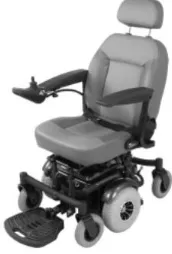
Milpet started as a Quickie S-11 motorized wheelchair shown in Figure 3.1. All of
the electronics besides the motors were removed so they could be replaced by new
components and circuitry. The goal of the redesign was to create a hardware/software
platform that could be used for many different aspects of autonomous navigation
or component needed to be added. This influenced many of the design decisions of
[image:48.612.277.363.125.252.2]the hardware platform.
Figure 3.1: Stock Quickie S-11 wheelchair.
[image:48.612.123.521.302.641.2]represents a subsystem of the hardware system, and the lines between them represent
how the systems interact. Most interactions stem from the power system as this is
the subsystem that takes in the 24V from the batteries and converts it to the voltages
required by the other subsystems. This system also provides many safety features for
both the other components and the users. Other subsystems include the embedded
Personal Computer (PC), which functions as the computation center for the entire
system, a microcontroller to handle the low-level hardware control, motors, and the
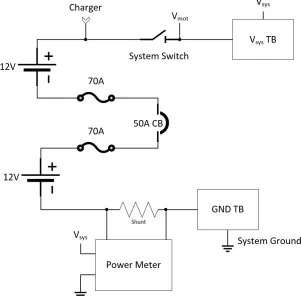
[image:49.612.171.472.273.570.2]various sensors. Figure 3.3 shows the circuit diagram for the battery system.
Figure 3.3: Circuit diagram for the battery system of Milpet.
The battery system circuitry, shown in Figure 3.3, shows how the two 12V batteries
are wired together and some of the protection circuitry. The two batteries are wired
in series to achieve the necessary 24V system voltage. Each battery has an in-line
The batteries together have a 50-amp circuit breaker as over-current protection. The
system voltage is wired through a main switch to allow the entire system to switched
on and off. Also included is a power meter that continuously displays system voltage
and the current draw, measured via a low-value shunt resistor. Figure 3.3 also shows
where the battery charger is wired, where the motor driver is wired, and that terminal
blocks (TB) were used for system voltage and system ground. This system mainly
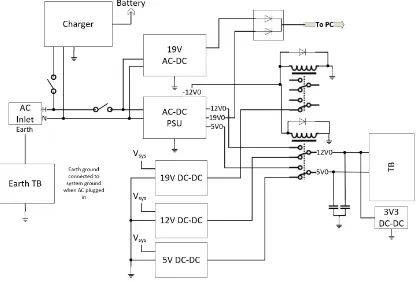
[image:50.612.118.535.247.529.2]feeds the power system seen in Figure 3.4.
Figure 3.4: Circuit diagram for the power system of Milpet.
The power subsystem, seen in Figure 3.4, handles converting the 24V Direct
Cur-rent (DC) from the batteries to all of the voltages required by other components.
This system is also responsible for charging the batteries and allowing for the agent
to be powered entirely from a standard 120V Alternating Current (AC) source. The
entire system requires four different voltages: 19V, 12V, 5V, and 3.3V for various
120-V AC source, each of the required voltages, with the exception of 3.3V, can be
generated from battery power or a standard wall outlet. To generate these voltages
from the battery three separate DC to DC regulators are used for 19V, 12V, and 5V
(shown in Figure 3.4 as “DC-DC”). To generate the required voltages from the 120V
AC source two separate power supplies are used; one to generate 19V DC (labeled
“19V AC-DC”) and one to generate 12V and 5V DC (labeled “AC-DC PSU”).
Milpet also has the ability to switch between battery power and AC while running
without interruption. For the 12V and 5V rails this is handled by a Double Pull,
Double Throw (DPDT) relay. The coil of the relay is powered by a third rail
(-12V) of the “AC-DC PSU.” This was done so that when the AC-DC power supply
is powered on, the relay will switch the 12V and 5V rails of the system to the ones
generated by the AC-DC supply rather than the ones generated from the DC-DC
supplies. Large capacitors were also added to the two rails to facilitate switching
times. The 19V rail switching is handled slightly differently due to the fact that it
is generated by a separate supply. Both the AC and battery generated 19V rails are
wired through diodes into a single line that powers the PC. This means both supplies
are connected at all times so there is no need to physically switch between them. The
diodes are used to prevent current from one supply from flowing back into the other
supply if both supplies are active. This system works by allowing current to flow from
either supply depending on which is at a higher voltage. So, current will flow from
whichever supply is powered or, if both supplies are powered, current will flow from
the AC-DC supply as it outputs a slightly higher voltage. The 3.3V rail is generated
from the 12V rail so it does not require switching as the 12V rail is already properly
switched.
Figure 3.4 also shows how the AC input to the agent is handled and how the
charger is wired. On the wheelchair there is a standard C13 inlet for 120V AC that is
all grounds in the system are unified. From there, the neutral line is wired directly to
the charger and the two AC supplies while the hot line is wired through two Single
Pole, Single Throw (SPST) switches. These switches are wired to the charger and the
two AC supplies allowing for them to switched on and off. The output of the charger
is then wired back to the batteries (shown in Figure 3.3), and the AC supplies are
wired into the switching circuitry previously mentioned.
Figure 3.5: Circuit diagram for the motor and encoder system of Milpet.
Figure 3.5 shows the circuit diagram for the motor subsystem. The system
in-cludes the motors themselves, wheel encoders, and the motor driver. The motors are
the same motors that were equipped to the wheelchair from the factory. Not much
information is provided besides that they are standard brushed DC motors. Attached
to the motor shaft are a pair of rotary encoders, specifically Omron E6B2-CWZ1X
1000 P/R. A diagram of some of the internals of the encoder is shown in Appendix
A. These encoders are industrial quadrature encoders that have 1000 pulses per
revo-lution of the encoder shaft. Since the encoders are located on the motor shaft, rather
than the wheels themselves, the 20:1 gear ratio results in 20,000 pulses per wheel
revolution. The encoders allow for the agent to accurately measure the change in
distance for shorter distances. Over time however, small errors, caused by wheel
them as a valid option for long-term localization. The two output channels of each
encoder are wired to the microcontroller which keeps track of the count. Since the
encoders have an open-collector output, pull-up resistors are needed for each output
channel.
The motor driver is a Sabertooth 2x60 by Dimension Engineering. The Sabertooth
2x60 is a dual output motor driver capable of 60 amps continuous current on each
channel which is beyond adequate for the provided motors. This particular motor
driver can be controlled using analog voltages, servo commands, or serial commands.
For this application, serial commands are used and are generated by the
microcon-troller. Serial commands provide the most flexible solution and allow for the use of
the emergency stop functionality of the Sabertooth. The outputs of the motor driver
are wired directly to the motors. The large black bars in Figure 3.5 are ferrite cores
that prevent any high frequency noise from reaching the motors. The motor driver
and motors are powered directly from the batteries as shown in Figure 3.3. The
Sabertooth contains a separate input for emergency stop functionality which is wired
to the emergency stop system of the agent shown in Figure 3.6.
Figure 3.6: Circuit diagram for the emergency stop system of Milpet.
Figure 3.6 shows the emergency stop circuitry used on the agent. The Sabertooth
motor controller has built-in emergency stop functionality (when running in serial
mode) that provides an easy way to emergency stop the motors. The stop signal on

![Figure 2.8: Example CNN architecture showing the layers and their effect on the image[3].](https://thumb-us.123doks.com/thumbv2/123dok_us/34267.2699/41.612.110.540.119.323/figure-example-cnn-architecture-showing-layers-eect-image.webp)
![Figure 2.10: Residual learning block [6].](https://thumb-us.123doks.com/thumbv2/123dok_us/34267.2699/43.612.228.424.70.182/figure-residual-learning-block.webp)
![Figure 2.11: Example network architectures. (left) VGG-19 [7] (middle) 34-layer “plain”network (right) 34-layer residual network [6].](https://thumb-us.123doks.com/thumbv2/123dok_us/34267.2699/44.612.180.466.71.693/figure-example-network-architectures-middle-network-residual-network.webp)

![Figure 3.11: Diagram depicting the basic ROS architecture [8].](https://thumb-us.123doks.com/thumbv2/123dok_us/34267.2699/63.612.159.493.254.460/figure-diagram-depicting-basic-ros-architecture.webp)