This is a repository copy of
Coupling of wideband impulses generated by granular chains
into liquids for biomedical applications
.
White Rose Research Online URL for this paper:
http://eprints.whiterose.ac.uk/110198/
Version: Accepted Version
Proceedings Paper:
Harput, S, Freear, S orcid.org/0000-0001-7858-4155, Gelat, P et al. (5 more authors)
(2016) Coupling of wideband impulses generated by granular chains into liquids for
biomedical applications. In: IEEE International Ultrasonics Symposium, IUS. 2016
International UItrasonics Symposium, 18-21 Sep 2016, Tours, France. IEEE . ISBN
9781467398978
https://doi.org/10.1109/ULTSYM.2016.7728481
© 2016, IEEE. This is an author produced version of a paper published in Ultrasonics
Symposium (IUS), 2016 IEEE International. Personal use of this material is permitted.
Permission from IEEE must be obtained for all other users, including reprinting/
republishing this material for advertising or promotional purposes, creating new collective
works for resale or redistribution to servers or lists, or reuse of any copyrighted
components of this work in other works. Uploaded in accordance with the publisher’s
self-archiving policy.
[email protected] https://eprints.whiterose.ac.uk/
Reuse
Unless indicated otherwise, fulltext items are protected by copyright with all rights reserved. The copyright exception in section 29 of the Copyright, Designs and Patents Act 1988 allows the making of a single copy solely for the purpose of non-commercial research or private study within the limits of fair dealing. The publisher or other rights-holder may allow further reproduction and re-use of this version - refer to the White Rose Research Online record for this item. Where records identify the publisher as the copyright holder, users can verify any specific terms of use on the publisher’s website.
Takedown
If you consider content in White Rose Research Online to be in breach of UK law, please notify us by
Coupling of wideband impulses generated by
granular chains into liquids for biomedical
applications
Sevan Harput, and Steven Freear
Ultrasonics and Instrumentation Group, School of Electronic and Electrical Engineering, University of Leeds, Leeds, LS2 9JT, UK E-mail: [email protected]
Pierre Gelat, and Nader Saffari
Department of Mechanical Engineering, University College London, Torrington Place, London WC1E 7JE, UK
Jia Yang, Omololu Akanji, Peter J. Thomas, and David A. Hutchins
School of Engineering, University of Warwick, Coventry CV4 7AL, UK
Abstract—An ultrasonic transducer technology to generate
wideband impulses using a one-dimensional chain of spheres was previously presented. The Hertzian contact between the spheres causes the nonlinearity of the system to increase, which trans-forms high amplitude narrowband sinusoidal input into a train of wideband impulses. Generation of short duration ultrasonic pulses is desirable both in diagnostic and therapeutic ultrasound. Nevertheless, the biggest challenge in terms of adaptation to biomedical ultrasound is the coupling of the ultrasonic energy into biological tissue.
An analytical model was created to address the coupling issue. Effect of the matching layer was modelled as a flexible thin plate clamped from the edges. Model was verified against hydrophone measurements. Different coupling materials, such as glass, aluminium, acrylic, silicon rubber, and vitreous carbon, was analysed with this model. Results showed that soft matching layers such as acrylic and rubber inhibit the generation of higher order harmonics. Between the hard matching materials, vitreous carbon achieved the best results due to its acoustic impedance.
I. INTRODUCTION
Contact dynamics between two spherical elastic objects can be explained by Hertz’s contact law with an exponential force-deformation relation. Unlike a spring mass system, where F
is proportional to deformation or displacement δ, in a system with Hertzian contact the relation between the forceFexerted on spheres and the deformation δ is nonlinear;F ∝δ1.5
. An ultrasonic transducer technology is developed to utilize this nonlinear behaviour of one-dimensional chain of spheres [1]– [4]. The aim of this technology is to transform high amplitude narrowband sinusoidal input into a train of wideband impulses. The generation of short duration ultrasonic pulses is desirable both in diagnostic and therapeutic ultrasound [5]–[7].
It has already been demonstrated by Hutchins et al. and Yanget al.that it is possible to generate wideband impulses by coupling energy to harmonics from a fundamental ultrasonic frequency of 73 kHz [8]–[10]. Donahue et al. and Harputet al.presented generation of ultrasound waves in water by using a granular chain with a matching layer [11], [12]. The aim
Ultrasonic Transducer
Matching Layer
Membrane Hydrophone
[image:2.612.335.533.292.462.2]Chain of spheres
Fig. 1. Chain of spheres is excited with an ultrasonic transducer attached to an amplifying horn. A matching layer is placed on the other side of the chain for coupling in water. Acoustic pressure generated by the chain is measured with a membrane hydrophone.
of this study is to incorporate the effect of a matching layer into an existing analytical model and an experimental setup to identify suitable materials and to obtain the optimum thickness for biomedical applications.
II. MATERIALS ANDMETHODS
A. Model
An analytical model created by Hutchinset al.was used to simulate the wave propagation through the chain. The existing model was modified as below to implement the effect of a vibrating thin plate instead of an infinite wall. The equation from [1] for the last sphere was modified as;
mx¨n=
√
2R
3 θs(δs,s+xn−1−xn)
3 2
−4 √
R
3 θm,s(δm,s+xn−xm)
3 2
+λ( ˙xn−1−x˙n)H(δs,s+xn−1−xn)
−λ( ˙xn−x˙m)H(δm,s+xn−xm),
(1)
wheremis the mass of a single sphere,xnis the displacement
of the last sphere for an-sphere chain,xmis the displacement
of the matching layer, and λ is the damping coefficient. Material properties are described with θs andθmas;
θs=
Es
1−νs
2, θm=
Em
1−νm
2 (2) 1 θm,s = 1 θm + 1 θs
= Es(1−νm
2
) +Em(1−νs
2
)
EmEs
, (3)
where Es is the Young’s modulus, and νs is the Poisson’s
ratio of the aluminium spheres. The same parameters for the matching layer are represented with Em and νm. Overlap
between two spheres,δs,s, and overlap between the last sphere
and the matching layer, δm,s, are calculated as;
δs,s=
3
F0
√
2Rθs
2 3
, δm,s=
3F0
4√Rθm,s !23
. (4)
The matching layer was modelled as a flexible thin plate clamped from the edges and the equation of motion is [16];
mm
4 x¨m=
4√R
3 θm,s(δm,s+xn−xm)
3 2
+λ( ˙xn−x˙m)H(δm,s+xn−xm)
−Kmxm,
(5)
wheremm is the mass of the matching layer, andKmis the
spring coefficient.
The mechanism of wave coupling into water was modelled as a superposition of wave propagated through the matching layer and vibrations of a thin plate. The energy of the wave transmitted from the aluminium sphere into water was decreased due to the acoustic impedance mismatch as;
T = 1−
Z2−Z1
Z2+Z1
2
(6)
˙
xs= ˙xn p
TmTwH(δm,s+xn−xm) + ˙xm (7)
where x˙s is the superposition of sphere and matching layer
velocities. The first term in Eq. (7) is the velocity of the last sphere coupled to the matching layer and then water, while the last sphere is in contact with the matching layer. The
transmitted energy is scaled by Tm into the matching layer,
and scaled byTw into the water. The second term represents
the velocity of the matching layer.
B. Experimental Setup
The system as shown in Fig. 1 was partially submerged and the output was measured in degassed and deionized water using a PVDF membrane hydrophone (Precision Acoustics Ltd., Dorchester, UK). The chain of spheres and the ultrasonic horn was fixed on an assembly with static compression force of approximately 0.1 N. Ultrasonic horn was made of steel with a density of 7833 kg/m3
, Young’s modulus 201 GPa, and Poisson’s ratio 0.3. The chain consisted of 6 aluminium spheres with a diameter of 1 mm, density of 2700 kg/m3
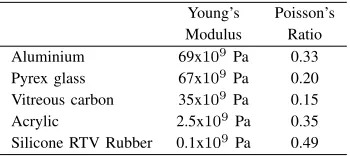
, Young’s modulus 69 GPa, and Poisson’s ratio 0.33, was placed into a plastic holder. The end of the chain was terminated with different matching layers as listed in Table I.
The chain of spheres was excited with a 25 cycle sinusoidal tone burst generated by an ultrasonic horn with a fundamental frequency of 73 kHz. The excitation signal was tapered and amplified with a Class A linear power amplifier (E&I Ltd., Rochester, NY) to reduce the level of harmonics introduced into the granular chain. This waveform generated a maximum output displacement of ±3 µm, which was measured with a Laser Vibrometer (Polytec, Germany) and used as an input into the analytical model described above.
[image:3.612.63.299.290.342.2]III. RESULTS ANDDISCUSSION
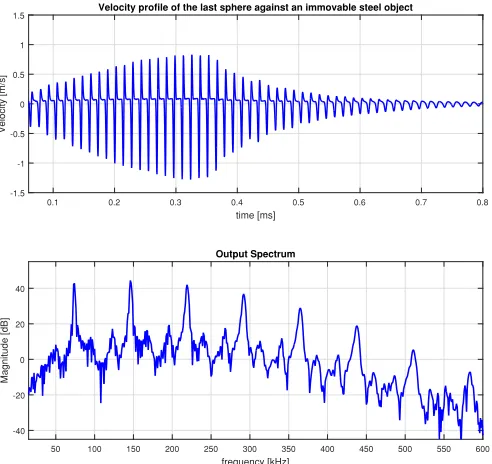
Fig. 2 shows the velocity of the last sphere for a 6-sphere granular chain terminated with an infinite steel wall. Chain of spheres between two immovable boundaries can generate periodic solitary waves with clear distinctions between high energy and low energy zones, which is visible in Fig. 2 as short duration impulses. When a non-stationary boundary is introduced, the dynamics of the chain of spheres change dramatically. The new proposed model in this study was used to simulate the effect of a thin moving boundary. Different matching materials, such as aluminium, glass, acrylic, silicon rubber, and vitreous carbon, was analysed with this model with given parameters in Table I. The damping coefficient was
λ= 0.32as explained in [2], the spring constant was between
Km= 2.2×10
3
−620×103
for the given materials with a pre-compressionF0= 0.1N.
Fig. 3 shows the estimated velocity profiles for different matching materials modelled as a circular plate with a ra-dius of 5 mm and a thickness of 0.5 mm. Model showed
TABLE I
PARAMETERS OFMATCHINGMATERIALS
Young’s Poisson’s Modulus Ratio Aluminium 69x109
Pa 0.33 Pyrex glass 67x109
Pa 0.20 Vitreous carbon 35x109Pa 0.15 Acrylic 2.5x10⁹ Pa 0.35 Silicone RTV Rubber 0.1x10⁹
[image:3.612.351.526.646.724.2]time [ms]
0.1 0.2 0.3 0.4 0.5 0.6 0.7 0.8
Velocity
[m
/s]
-1.5 -1 -0.5 0 0.5 1
1.5 Velocity profile of the last sphere against an immovable steel object
frequency [kHz]
50 100 150 200 250 300 350 400 450 500 550 600
Magni
tude
[dB]
-40 -20 0 20 40
[image:4.612.54.300.53.285.2]Output Spectrum
Fig. 2. Results achieved with the analytical model for a 6-sphere chain against an immovable steel wall.
[image:4.612.314.562.57.440.2]that soft matching layers such as acrylic and rubber inhibit the generation of higher order harmonics. Between the hard matching materials, vitreous carbon achieved the best results due to its acoustic impedance, which is closer to the optimum impedance matching between aluminium and water. Increasing the thickness of the matching material increases the output velocity profile of the last sphere, since the system approaches to an immovable boundary with increasing thickness. However due to the existence of higher harmonics and attenuation in material, thinner matching layer is preferable.
Fig. 4 shows the estimated velocity profile at the outward surface of a 0.5 mm thick vitreous carbon matching layer. Fig. 4(bottom) shows the output spectrum with higher order harmonics that extended to frequencies above 400 kHz.
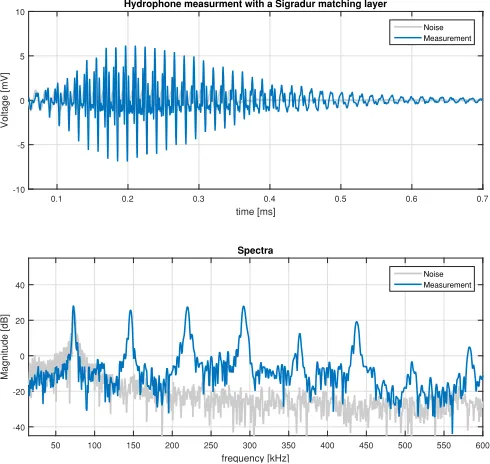
Fig. 5(top) shows the hydrophone measurements acquired with a 0.5 mm thick vitreous carbon disc at 10 mm depth. Between 0.5, 1.0, 2.0 and 2.5 mm thick vitreous carbon discs, the thinnest option resulted in the highest output pressure that can be regarded as the most efficient coupling. It was not possible to try a thinner matching layer due to unavailability. The predictions from the analytical model were consistent with the results achieved by hydrophone measurements for the system under static loading of 0.1 N for the vitreous carbon matching layer. The impulse shape and the harmonic content matches with the new model as shown in Fig. 4 and Fig. 5. However, the envelope of the waveform is different in both cases. The reason for this is the displacement at the horn tip was effected due to the static loading.
IV. CONCLUSIONS
This study achieved the aim of generating wideband im-pulses close to biomedical ultrasound frequency range. Be-tween the chosen matching layer materials, vitreous carbon
0.1 0.15 0.2 0.25 0.3 0.35 0.4 0.45 0.5 0.55 0.6
Velocity
[m
/s]
-0.5 0 0.5
Stainless steel matching layer
0.1 0.15 0.2 0.25 0.3 0.35 0.4 0.45 0.5 0.55 0.6
Velocity
[m/s]
-0.5 0 0.5
Aluminium matching layer
0.1 0.15 0.2 0.25 0.3 0.35 0.4 0.45 0.5 0.55 0.6
Velocity
[m/s]
-0.5 0 0.5
Vitreous carbon matching layer
0.1 0.15 0.2 0.25 0.3 0.35 0.4 0.45 0.5 0.55 0.6
Veloci
ty
[m
/s]
-0.5 0 0.5
Glass matching layer
0.1 0.15 0.2 0.25 0.3 0.35 0.4 0.45 0.5 0.55 0.6
Velocity
[m
/s]
-0.5 0 0.5
Acrylic matching layer
time [ms]
0.1 0.15 0.2 0.25 0.3 0.35 0.4 0.45 0.5 0.55 0.6
Velocity
[m/s]
-0.5 0 0.5
Silicone Rubber matching layer
Fig. 3. Results achieved with the analytical model for a 6-sphere chain coupled to aluminium, vitreous carbon, pyrex glass, acrylic, silicone rubber.
allowed both the generation and coupling of higher order harmonics with a -20 dB bandwidth over 350 kHz and shows the feasibility of this new technology for biomedical applications. Generation and the use of these sub- and super-harmonics in ultrasound as a diagnostic and therapeutic tool are favourable [17], [18]. The main advantage of this new technology for therapeutic applications, such as HIFU, is the ability to generate wideband impulses that minimizes the focal spot size. The output pressure on the other hand is a big disadvantage; however it can be improved by fabricating an array of granular chains.
Thickness of the matching layer is a trade-off between efficient coupling of high frequency components (i.e. a thin matching layer), and effective solitary wave generation ( i.e.
time [ms]
0.1 0.2 0.3 0.4 0.5 0.6 0.7 0.8
Velocity
[m
/s]
-0.8 -0.6 -0.4 -0.2 0 0.2 0.4 0.6
0.8 Velocity profile at the surface of the Vitreous carbon coupling layer
frequency [kHz]
50 100 150 200 250 300 350 400 450 500 550 600
Magni
tude
[dB]
-40 -20 0 20 40
[image:5.612.54.299.52.285.2]Output Spectrum
Fig. 4. Results achieved with the analytical model for a 6-sphere chain coupled to a 0.5 mm thick vitreous carbon plate. (Top) Velocity profile in time domain. (Bottom) Frequency spectrum of the velocity profile.
time [ms]
0.1 0.2 0.3 0.4 0.5 0.6 0.7
Voltage
[mV]
-10 -5 0 5
10 Hydrophone measurment with a Sigradur matching layer
Noise Measurement
frequency [kHz]
50 100 150 200 250 300 350 400 450 500 550 600
Magni
tude
[dB]
-40 -20 0 20 40
Spectra
Noise Measurement
Fig. 5. Measurements performed with a membrane hydrophone for a 6-sphere chain coupled to a 0.5 mm thick vitreous carbon plate. (Top) Acoustic pressure measured at 10 mm depth. (Bottom) Frequency spectrum of the acoustic pressure. Noise level is plotted for comparison.
multiple matching layers, finite element analysis will be used as a supplementary tool to understand the contact mechanics in a granular chain [19].
ACKNOWLEDGMENT
This work was supported by EPSRC grant (UK) EP/K029835/1.
REFERENCES
[1] D. A. Hutchins, J. Yang, O. Akanji, P. J. Thomas, L. A. J. Davis, S. Freear, S. Harput, N. Saffari, and P. Gelat, “Evolution of ultrasonic impulses in chains of spheres using resonant excitation,” EPL (Euro-physics Letters), vol. 109, no. 5, p. 54002, 2015.
[2] J. Yang, D. A. Hutchins, O. Akanji, P. J. Thomas, L. A. J. Davis, S. Harput, P. Gelat, S. Freear, and N. Saffari, “An analysis of solitary wave impulses in granular chains using ultrasonic excitation,”Phys. Rev. E, vol. 93, p. 063002, 2016.
[3] D. A. Hutchins, J. Yang, O. Akanji, P. J. Thomas, L. A. J. Davis, S. Freear, S. Harput, N. Saffari, and P. Gelat, “Ultrasonic propagation in finite-length granular chains,”Ultrasonics, vol. 215-223, p. 69, 2016. [4] O. Akanji, J. Yang, D. A. Hutchins, P. J. Thomas, L. A. J. Davis, S. Harput, S. Freear, P. Gelat, and N. Saffari, “The generation of im-pulses from narrow bandwidth signals using resonant spherical chains,”
IEEE Trans. Ultrason., Ferroelect., Freq. Control., p. In press, 2016. [5] A. Bouakaz and N. de Jong, “Native tissue imaging at superharmonic
frequencies,”IEEE Trans. Ultrason., Ferroelect., Freq. Control., vol. 50, no. 5, pp. 496–506, 2003.
[6] S. Harput, J. McLaughlan, D. M. J. Cowell, and S. Freear, “Superhar-monic imaging with chirp coded excitation: Filtering spectrally over-lapped harmonics,”IEEE Trans. Ultrason., Ferroelect., Freq. Control., vol. 61, no. 11, pp. 1802–1814, 2014.
[7] K.-W. Lin, T. Hall, R. McGough, Z. Xu, and C. Cain, “Synthesis of monopolar ultrasound pulses for therapy: The frequency-compounding transducer,”IEEE Trans. Ultrason., Ferroelect., Freq. Control., vol. 61, no. 7, pp. 1123–1136, 2014.
[8] J. Yang, O. Akanji, D. Hutchins, P. Thomas, L. Davis, S. Freear, S. Harput, N. Saffari, and P. Gelat, “Time-delay estimation and cor-relation analysis of acoustic signals in granular media using wavelet decomposition,” inIEEE Int. Ultrasonics Symposium (IUS), 2014, pp. 2529–2532.
[9] D. Hutchins, J. Yang, O. Akanji, L. Davis, P. Thomas, S. Freear, S. Harput, N. Saffari, and P. Gelat, “The study of chain-like materials for use in biomedical ultrasound,” inIEEE Int. Ultrasonics Symposium (IUS), 2014, pp. 2607–2610.
[10] D. A. Hutchins, J. Yang, O. Akanji, P. J. Thomas, L. A. J. Davis, S. Freear, S. Harput, N. Saffari, and P. Gelat, “The generation of im-pulses from narrow bandwidth signals using resonant spherical chains,” inIEEE Int. Ultrasonics Symposium (IUS), 2015.
[11] S. Harput, J. McLaughlan, S. Freear, P. Gelat, N. Saffari, J. Yang, O. Akanji, P. J. Thomas, and D. A. Hutchins, “Nonlinear generation of harmonic content within high intensity ultrasound signals using granular chains,” inIEEE Int. Ultrasonics Symposium (IUS), 2015.
[12] C. M. Donahue, P. W. J. Anzel, L. Bonanomi, T. A. Keller, and C. Daraio, “Experimental realization of a nonlinear acoustic lens with a tunable focus,”Applied Physics Letters, vol. 104, p. 014103, 2014. [13] V. F. Nesterenko, “Propagation of nonlinear compression pulses in
granular media,”J Appl Mech Tech Phys, vol. 24(5), pp. 733–743, 1983. [14] C. Coste, E. Falcon, and S. Fauve, “Solitary waves in a chain of beads
under hertz contact,”Phys. Rev. E, vol. 56, pp. 6104–6117, 1997. [15] J. Lydon, K. R. Jayaprakash, D. Ngo, Y. Starosvetsky, A. F. Vakakis,
and C. Daraio, “Frequency bands of strongly nonlinear homogeneous granular systems,”Phys. Rev. E, vol. 88, p. 012206, 2013.
[16] S. Harput, J. McLaughlan, S. Freear, P. Gelat, N. Saffari, J. Yang, O. Akanji, P. J. Thomas, and D. A. Hutchins, “Generation of wideband ultrasound pulses at clinically relevant frequencies with a granular chain of spheres,”Phys. Rev. E, In press.
[17] M. S. Canney, M. R. Bailey, L. A. Crum, V. A. Khokhlova, and O. A. Sapozhnikov, “Acoustic characterization of high intensity focused ultrasound fields: A combined measurement and modeling approach,”J Acoust Soc Am, vol. 124, no. 4, pp. 2406–2420, 2008.
[18] S. Harput, M. Arif, J. McLaughlan, D. M. J. Cowell, and S. Freear, “The effect of amplitude modulation on subharmonic imaging with chirp excitation,”IEEE Trans. Ultrason., Ferroelect., Freq. Control., vol. 60, no. 12, pp. 2532–2544, 2013.
[image:5.612.54.299.337.569.2]