This is a repository copy of A pilot case series of a brief acceptance and commitment therapy (ACT)-based guided self-help intervention for improving quality of life and mood in muscle disorders.
White Rose Research Online URL for this paper: http://eprints.whiterose.ac.uk/116813/
Version: Accepted Version
Article:
Graham, CD, Chalder, T, Rose, MR et al. (3 more authors) (2017) A pilot case series of a brief acceptance and commitment therapy (ACT)-based guided self-help intervention for improving quality of life and mood in muscle disorders. Cognitive Behaviour Therapist, 10. e2. ISSN 1754-470X
https://doi.org/10.1017/S1754470X17000022
© 2017. This article has been published in a revised form in Cognitive Behaviour Therapist [https://doi.org/10.1017/S1754470X17000022]. This version is free to view and download for private research and study only. Not for re-distribution, re-sale or use in derivative works. Uploaded in accordance with the publisher's self-archiving policy.
[email protected] https://eprints.whiterose.ac.uk/
Reuse
Unless indicated otherwise, fulltext items are protected by copyright with all rights reserved. The copyright exception in section 29 of the Copyright, Designs and Patents Act 1988 allows the making of a single copy solely for the purpose of non-commercial research or private study within the limits of fair dealing. The publisher or other rights-holder may allow further reproduction and re-use of this version - refer to the White Rose Research Online record for this item. Where records identify the publisher as the copyright holder, users can verify any specific terms of use on the publisher’s website.
Takedown
If you consider content in White Rose Research Online to be in breach of UK law, please notify us by
A pilot case series of a brief Acceptance and Commitment
Therapy (ACT)-based guided self-help intervention for
improving quality of life and mood in muscle disorders
Christopher D. Graham*1,2, Trudie Chalder3, Michael R. Rose4, Dimitri Gavriloff5,
Lance M. McCracken6, John Weinman7
1Leeds Institute of Health Sciences, University of Leeds, Leeds, UK, LS2 9LJ.
2Department of Clinical Neuropsychology, Leeds Teaching Hospitals NHS Trust, St. James Hospital, Leeds, LS9 7TF.
3Department of Psychological Medicine, Institute of Psychiatry Psychology and Neuroscience, King’s College London, Weston Education Centre, Denmark Hill, London, UK.
4Department of Neurology, King’s College Hospital, Denmark Hill, London, UK
5Oxford Institute of Clinical Psychology Training, Oxford University, Warneford Hospital, Oxford, UK, OX3 7JX
6Department of Health Psychology, Institute of Psychiatry Psychology and Neuroscience, King’s College London, Weston Education Centre, Denmark Hill, London, UK.
7Institute of Pharmaceutical Sciences, King’s College London, 5th Floor Franklin Wilkins Building, Stamford Street, London SE1, UK
Conflicts of Interest: authors report no conflicts of interest.
Ethical statement: The authors assert that all procedures contributing to this work comply with the ethical standards of the relevant national and institutional committees on human experimentation and with the Helsinki Declaration of 1975, as
revised in 2008.
Acknowledgements: This research was supported by a PhD studentship grant from the Muscular dystrophy Campaign.
*Requests for reprints should be addressed to Dr Christopher D. Graham, Leeds Institute of Health Sciences, University of Leeds, Leeds, UK, LS2 9LJ. e-mail: [email protected]
Running Head: PILOT CASE SERIES OF ACT FOR MD 2
ABSTRACT
This study aimed to demonstrate proof of concept and acceptability of a brief Acceptance and Commitment Therapy (ACT)-based guided self-help intervention for improving quality of life (QoL) and mood for people with muscle disorders (MD). A case-series with an AB design was used to assess changes in primary (QoL) and secondary (depression and anxiety) outcome variables across the period of study. Change in the psychological process targeted by ACT - psychological flexibility – was also investigated, to allow some insight into possible treatment mechanisms. Post-intervention, participants also completed a brief free-text evaluation. Relative to pre-intervention scores, four (of seven) participants showed varying degrees of improvement in all primary and secondary outcome variables and were thus considered responders. However, consistent concomitant improvements in psychological flexibility were not apparent. Participants reported a mostly positive experience of the intervention; all appeared to complete the
intervention, and no adverse events were reported. Nonetheless, there was evidence that those with compromised concentration or who report good initial QoL and low levels of distress may derive less benefit. Although several methodological weaknesses limit the strength of our conclusions, this ACT-based guided self-help intervention shows encouraging utility for improving QoL and mood in MD.
Learning objectives
• To learn about psychological research in muscle disorders.
• To learn about the participant experience of a brief guided self-help ACT intervention.
• To learn about the implementation of remote guided self-help interventions in chronic disease
The category of muscle disorders (MD) comprises genetic and acquired conditions such as facioscapulohumeral muscular dystrophy, inclusion body myositis and limb-girdle muscular dystrophy. Implicated muscle pathology generally leads to a progressive decline in mobility– often resulting in considerable functional impairment. Some MDs may also cause varying degrees of respiratory and cardiac symptoms, dysphagia, dysarthria and opthalmopariesis (Merrison & Hanna, 2009). Currently, no disease modifying treatments are available for most MDs. Thus, management is usually symptomatic, involving physiotherapy, pain and fatigue management, alongside cardio-respiratory monitoring (Merrison & Hanna, 2009).
Qualitative studies suggest that the functional impairment caused by MD can elicit difficult thoughts and emotions (Natterlund, Sjoden, & Ahlstrom, 2001), comprising challenged identity and fears about the future (Graham, 2012; Natterlund et al., 2001). Given this demanding context it is unsurprising that average quality of life (QoL; Burns, Graham, Rose, & Simmons, 2012; Graham, Rose, Grunfeld, Kyle, & Weinman, 2011) and mood (Blumen et al., 2009; Kalkman, Schillings, Zwarts, Van Engelen, & Bleijenberg, 2007) are adversely affected by MD.
Nonetheless, there is considerable variation in QoL and mood between people with MD (Graham, Rose, Hankins, Chalder, & Weinman, 2013), and some do experience excellent QoL and mood, even with high levels of disease severity. Empirical studies suggest that differential ways of responding to the challenges presented by MD helps to explain this variation. In addition to the functional impairment caused by the condition, psychological/behavioural factors,
including illness perceptions, psychological flexibility and coping methods, explain significant proportions of the variance in QoL and mood (Graham, Gouick, Ferreira, & Gillanders, 2016; Graham et al., 2011; Graham, Simmons, Stuart, & Rose, 2015; Graham et al., 2014; Rose et al., 2012; Sadjadi, Rose, & Group, 2010). Thus, an intervention that targets
Running Head: PILOT CASE SERIES OF ACT FOR MD 4
To date there has been just one published study of a psychological intervention in MD (Voet et al., 2014). This traditional CBT intervention was designed to improve fatigue in those with facioscapulohumeral MD. This intervention elicited a significant improvement in the primary outcome, fatigue. Encouragingly, it also appeared to improve secondary outcomes which overlap with mood and QoL, such as physical activity, social participation and sleep. However, there have been no trials of psychological interventions designed to primarily target broader outcomes, such as QoL and mood. Thus, we developed a psychological intervention to improve QoL and mood in MD.
Acceptance and Commitment Therapy (ACT)
There is evidence that both traditional CBT (Hofmann, Asnaani, Vonk, Sawyer, & Fang, 2012) and ACT (Graham, Gouick, Krahé, & Gillanders, 2016) are helpful for improving outcomes, such as QoL, mood and functioning, in chronic diseases. Traditional CBT may be most suitable for targeting illness perceptions, which have been shown to correlate with quality of life and mood in MD (Graham et al., 2014). ACT instead targets psychological flexibility, which was found to predict QoL and mood in a previous longitudinal study with an MD population (Graham, Gouick, Ferreira, et al., 2016). ACT has not yet been investigated in the context of MD. We thus trialled ACT as a novel approach to improving QoL and mood in MD. To improve uptake, the intervention was kept brief (three sessions). To reduce the burden of travelling for therapy, we delivered the guided self-help materials via e-mail with telephone support from a therapist.
Aims
In this study we wanted to: 1) investigate proof of concept by observing whether primary (QoL) and secondary outcomes (depression and anxiety) improved across the period of the intervention; 2) test the acceptability of the intervention via reports of adverse events, evaluation of deterioration in outcomes and feedback from patient experiences of the intervention; 3) assess whether the intervention might affect changes in outcomes via in the presumed treatment
mechanism - improvement in psychological flexibility. We thus undertook a case series
evaluation of a brief ACT-based guided self-help intervention, with seven participants. As ACT takes a salutogenic approach to well-being, in this initial study we did not select participants on the basis of pre-existing poor QoL or distress.
METHOD
Running Head: PILOT CASE SERIES OF ACT FOR MD 6
An AB case series design was utilised, with outcome and process variables measured at multiple time-points pre-, during- and post-intervention. A post-intervention free-text participant evaluation was also included.
Participants
Participants were recruited from throughout the United Kingdom via an advert placed on the Muscular Dystrophy Campaign website. This advertised for participants to trial a
psychological skills manual - to investigate whether changing some ways of living with MD could improve QoL and mood. Participants initially self-assessed themselves against the inclusion/exclusion criteria. These criteria were kept broad, in keeping with the idea that the intervention was primarily designed to enhance QoL, with a secondary impact on distress via improved psychological flexibility. Inclusion criteria were: a diagnosis of MD; duration of MD greater than six months; over the age of 18. Exclusion criteria included: a diagnosis of myotonic dystrophy, which is associated with cognitive impairment (Minnerop et al., 2011); major active co-morbidities unrelated to MD, major diagnosed active mental health co-morbidities (e.g. psychosis, obsessive compulsive disorder); current participation in other treatment intervention studies. The first seven participants who met the inclusion/exclusion criteria were recruited to the study.
Procedure
(Time-point 1). This questionnaire battery was then sent on seven more occasions: at weekly intervals for six further weeks (Time-point 2-7), with a follow-up questionnaire sent at week 10 (4 weeks post intervention; Time-point 8). The intervention began immediately following the completion of the third group of questionnaires, and continued for three weeks (between Time-point 3-6). At post-intervention, participants gave a brief evaluation of their experience of the intervention
Intervention
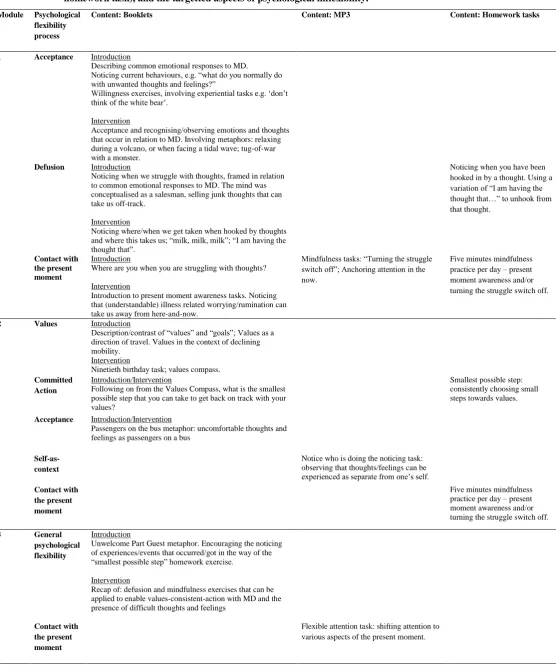
The intervention involved three weekly modules of guided self-help (Table 1). Each module comprised a pdf containing written self-help material, audio tasks (MP3 files) and homework tasks. We estimated that each module would take between 60 and 90 minutes to complete, excluding homework tasks. Each module was followed by a 15 to 30 minute telephone call with a therapist.
The written and MP3 content of the intervention was informed by several sources (Harris, 2009; Hayes, 2005; Hayes, Strosahl, & Wilson, 1999). The booklets were assessed and edited by a clinical psychologist with expertise in ACT. The therapist was a PhD student in clinical health psychology, with training in CBT, and with limited clinical experience of ACT. The therapist’s phone-calls were supervised by a CBT therapist, with experience of delivering ACT. The content of the telephone call was mostly participant-directed. Here the therapist sought to reinforce responding that was in line with psychological flexibility, as presented in the modules. Neither the modules nor the therapist behaviours were formally assessed for ACT treatment fidelity.
<Table 1.>
Running Head: PILOT CASE SERIES OF ACT FOR MD 8
Primary outcome
Visual Analogue Scale for Quality of Life (VAS QoL; de Boer et al., 2004)
The VAS QoL is a single-item QoL measure. Here participants indicate their QoL on a single-dimensional scale, ranging from 0 (‘worst possible quality of life’) to 100 (‘best possible
quality of life’). Previous psychometric assessment of the VAS QoL with chronic disease
populations has shown good reliability, validity and responsiveness (de Boer et al., 2004).
Secondary outcomes
The Hospital Anxiety and Depression Scale – depression and anxiety sub-scales (HADs;
Zigmond & Snaith, 1983)
The HADS is a validated (Bjelland, Dahl, Haug, & Neckelmann, 2002; Mykletun, Stordal, & Dahl, 2001), 14-item measure of anxiety and depression. There are two scales (anxiety, depression), which were used as independent measures of depression and anxiety. Scores range from 0 – 21 for each sub-scale, and higher scores indicate greater mood disturbance. Scores above 11 on either scale are considered to indicate the possible presence of a “mood disorder” (Zigmond & Snaith, 1983).
Measure of treatment mechanism
The Acceptance and Action Questionnaire (AAQ-II; Bond et al., 2011)
aspects of psychological flexibility - mostly experiential avoidance (Francis, Dawson, & Golijani-Moghaddam, 2016).
Brief patient evaluation/acceptability measure
A brief measure of patient experience of the intervention was developed and used to allow further insight into the acceptability of the intervention. This measure included one item, which asked participants to indicate whether the intervention had been helpful: “Did the intervention
help you?” Responses were made on a scale of 1 (No, it made things worse) to 6 (Yes, it was
extremely helpful). They were then asked to support their selection using an open-ended free text response.
Other measures
The Stanford Health Assessment Questionnaire Disability Index (HAQ-DI; Bruce & Fries,
2003b)
The HAQ-DI was used to measure each participant’s level of physical disability (excluding psycho-social or emotional functioning). We used the alternative scoring method (Bruce & Fries, 2003b), which has demonstrated sound psychometric properties (Bruce & Fries, 2003a). Here scores can range from 0 to 3, with higher scores indicating greater levels of disability. The HAQ-DI was used to describe the sample, but was not used as an outcome measure.
Analysis
Running Head: PILOT CASE SERIES OF ACT FOR MD 10
time-points are analysed to take into account the level (i.e. the mid-point across a series of data, considered horizontally), the variability in the data, and the trend (i.e. the direction of the data path, increasing or decreasing; Harrington, M., & Velicer, 2015). Inference to an intervention is made if the level and/or trend of scores in the intervention phase visually differs from the level and/or trend of the scores in the pre-intervention phase (Kazdin, 1978).
Our three pre-intervention time-points allowed for an indication of the baseline level and variability of scores, which was compared to post intervention scores. Trend across the period of the intervention was also considered. Consequently, we used the following criteria to infer an intervention-related improvement in a given variable: a) improvement in score over the intervention period (i.e. a trend demonstrating improvement); with b) improved level at post-intervention, taking into consideration; c) the variability of pre- compared to post- intervention scores, with the majority of post-intervention scores (i.e. at least two out of three) outside of the range of pre-intervention scores.
Participants were classified as responders if there was an improvement (as per the
aforementioned criteria) in all three primary and secondary outcome variables (Qol, anxiety and depression). As described, change in psychological flexibility (AAQ-II) was assessed to
investigate whether the intervention affected the processes it was designed to target; however, this variable was not used to categorise responders/non-responders.
RESULTS
There were seven participants, five men and two women, who were aged in their thirties to sixties. They had a range of MD diagnoses, including facioscapulohumeral muscular dystrophy, limb-girdle muscular dystrophy and vacuolar myopathy. They had lived with a MD diagnosis for between one year and 34 years.
Over the course of the intervention four participants showed improvements in all primary (QoL) and secondary (depression and anxiety) outcomes; these participants were considered to be responders (Figures 1-4). Three participants did not show improvement in all three outcome variables; these participants were considered non-responders (Figures 5-8). The following
sections will describe each participant’s progress across the period of study.
Responders
<Figure 1; Figure 2; Figure 3; Figure 4>
Participant 3, a man in his forties, had been recently diagnosed with a MD and had a moderate level of functional impairment (HAQ-DI = 0.55). His QoL was initially quite low, but recovered to a stable level over two further pre-intervention measurement points (Figure 1). He also reported difficulty coming to terms with his diagnosis, and presented with high anxiety and depression scores (Figures 2 and 3).
Running Head: PILOT CASE SERIES OF ACT FOR MD 12
“… The exercises can be used in everyday life and I find myself using the tools given now more
and more. They do take practice but are effective. It also helped me realise that you can have a life with this illness.”
Participant 4 was a professional man in his thirties. He had been diagnosed with MD in his teenage years, but had been minimally affected by symptoms (HAQ-DI = 0.30). At
pre-intervention time-points he reported reduced QoL and his mood scores stayed below the HADs clinical cut-off (Zigmond & Snaith, 1983)(Figures 1 -3). His initial psychological flexibility scores were at a good level (Figure 4).
There was an improvement in QoL during the intervention. This improvement was
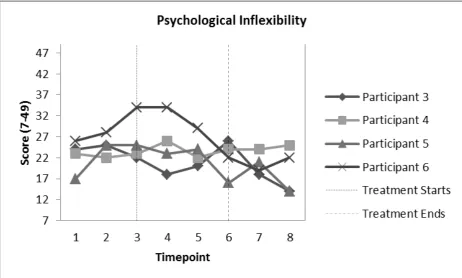
maintained post intervention (Figure 1). Mood scores also improved across the intervention period (Figures 2-3). However, psychological flexibility remained constant across measurement points (Figure 4). In his post-intervention evaluation this participant commented:
“It hasn't flicked a switch and made me super happy but it has made me confident that I can live a
fuller life if I make the effort. By constructively focussing on my life I have been able to make small changes for the better...”
“The intervention came at a time of kitchen refurbishment and major dental treatment and I think
that it may have helped me to be more 'grounded’. The intervention helped to keep me on the right
track and encouraged a progression in a good direction...”
Participant 6 was in her forties. She had been living with MD for 17 years and reported quite a high level of disability (HAQ-DI = 2.1). She reported struggling to know her purpose in life as her life circumstances had recently changed. At baseline, her QoL was low and stable, and her mood scores appeared moderately affected (Figure 1-3). Pre-intervention, her baseline
psychological flexibility was low and worsening (Figure 4). She appeared to experience a great improvement in QoL during the intervention (Figure 1), alongside a slight improvement in mood (Figures 2 and 3). These gains were maintained at follow-up time-points. Improvements in QoL and mood mirrored improvements in psychological flexibility (Figure 4). Participant 6
commented:
“It helped me look more clearly at my values, and what is important in life, and how to take small
steps to achieve them [values]…”
Non-responders
< Figure 5; Figure 6; Figure 7; Figure 8 >
Running Head: PILOT CASE SERIES OF ACT FOR MD 14
low QoL alongside significant low mood and anxiety at the beginning of the intervention. This was coupled with a good psychological flexibility score (Figure 8). Overall, there appeared to be no improvement in QoL, mood or psychological flexibility after starting the intervention. In reviewing the intervention she commented:
“I think it implied that it's my thoughts that are holding me back, which is not necessarily the
case… Tried using some of the tips and challenged myself by doing things I thought I couldn't do, (tiny things though which really don't count in the whole scheme of things)…I know what matters to me but I can't do what matters however hard I think about it…”
Participant 2 had been diagnosed with MD at a young age and was now in his forties. He reported similar levels of physical disability to Participant 1 (HAQ-DI = 1.45). However, he had a very active work and social life, and reported excellent initial QoL with little evidence of anxiety or depression (Table 2). Similar to Participant 1, his pre-intervention psychological flexibility scores were at a healthy level (see Figure 8). There were no clear changes in outcome or process variables across the period of the intervention (Figure 5-8). In his free text evaluation this participant commented:
“… It was helpful in confirming that I seem to be in a fairly positive place at the moment. I found
some bits very useful although it was reassuring that some of the techniques designed to 'de-stress' were not really required by me.”
time-points (Figures 6 and 7). Similarly, his initial psychological flexibility was the lowest of any included participant (Figure 8).
Across the period of the intervention there was a slight recovery in QoL score; however, QoL reduced to follow-up (Figure 5). Depression and anxiety, which were worsening over the three pre-intervention time-points, improved slightly over the period of the intervention and remained stable to follow-up. Psychological flexibility continued to improve throughout the intervention (Figure 8). This participant reported that high levels of pain and fatigue impeded his engagement with the intervention:
“[the intervention was] Very good, but a lot of information to take in at one time. When your pain
is high your levels and duration of concentration are greatly reduced… the lessons taught a new
and different approach, which hopefully will improve things in the coming weeks and months...”
General Acceptability
All participants completed all phone calls, and appeared to have engaged with the modules. No adverse consequences were reported, and there were no clear deteriorations in QoL or mood during the period of the intervention. On the Brief patient evaluation/acceptability measure, when
asked “Did the intervention help you?”, no participant perceived any damaging consequences
from the intervention. Here scores ranged from 3 (It was little bit helpful) to 6 (Yes, it was extremely helpful), with an average score of 4.14. With the possible exception of Participant 1’s response, all supporting statements were positive.
DISCUSSION
Running Head: PILOT CASE SERIES OF ACT FOR MD 16
magnitude, four out of seven participants appeared to experience an improvement across all three primary (QoL) and secondary (depression and anxiety) outcome measures, relative to their respective pre-intervention scores. For half of responders there was also an improvement in the presumed ACT treatment mechanism, psychological flexibility. Nonetheless, two responder’s improvements in outcomes were not mirrored by improvements in our measure of psychological flexibility. This suggests that improvement in outcomes may have occurred via processes other than psychological flexibility. However, it is also possible that improvement occurred via an aspect of psychological flexibility not captured by the AAQ-II. Indeed, the seven-item AAQ-II may not be of sufficient scope to comprehensively capture all aspects of psychological flexibility (Francis et al., 2016). Thus, more comprehensive measurement of psychological flexibility is indicated for future evaluations.
The intervention appeared generally acceptable to participants. There was no clear deterioration in outcome measures for any participant. Indeed, even for non-responders, the feedback, delivered online after exiting the study, was mostly positive. The possible exception was Participant 1, whose feedback indicated that the intervention was perceived as ineffective, or perhaps even invalidating. Clearer conceptualisation of the intervention’s purpose (i.e. acting in line with values insofar as is possible given the limitations caused by MD symptoms) within the intervention materials might improve engagement.
Limitations
First, while the visual analysis method that we used has several benefits (idiographic analysis, the inclusion of multiple baseline measurement), it also has drawbacks. For example, there can be disagreement between raters on whether change is present; therefore, inter-rater agreement often low in visual analysis (Harrington & Velicer, 2015). Also, in this study, only three pre- and three post-intervention time-points were recorded. This meant that only a limited understanding of fluctuation/stability in outcome variable scores at pre- and post- intervention periods was possible. Thus while results are encouraging, due to our pragmatic assessment methods our confidence in the findings must be limited. We did not assess reliable change (Jacobson & Truax, 1991), because, due to our inclusive entry criteria, this would have necessitated post-intervention scores at or above ceiling level for several participants.
In addition, for many reasons (e.g. placebo response, regression to the mean) these data cannot be taken as evidence of efficacy (Chambless & Hollon, 1998; Graham et al., 2016; Öst, 2008). We were also uncertain about therapist or intervention treatment fidelity as this was not assessed in any formal way. And given that we had just one therapist, there was a
condition/therapist confound (Öst, 2008). Finally, limiting our understanding of the acceptability of the recruitment procedures, we did not formally record number of participants approached or excluded.
CONCLUSION
Running Head: PILOT CASE SERIES OF ACT FOR MD 18
provide an encouraging initial evaluation of a brief guided self-help ACT intervention for people with MD. A future study will evaluate efficacy of the intervention in a randomised controlled trial.
RECOMMENDED FURTHER READING
Graham, C. D., Gouick, J., Krahé, C., & Gillanders, D. (2016). A systematic review of the use of Acceptance and Commitment Therapy (ACT) in chronic disease and long-term conditions. Clinical Psychology Review, 46, 46-58. doi:
http://dx.doi.org/10.1016/j.cpr.2016.04.009
Voet, N., Bleijenberg, G., Hendriks, J., de Groot, I., Padberg, G., van Engelen, B., & Geurts, A. (2014). Both aerobic exercise and cognitive-behavioral therapy reduce chronic fatigue in FSHD: An RCT. Neurology, 83(21), 1914-1922. doi:
10.1212/wnl.0000000000001008
REFERENCES
A-Tjak, J. G., Davis, M. L., Morina, N., Powers, M. B., Smits, J. A., & Emmelkamp, P. M. (2015). A meta-analysis of the efficacy of acceptance and commitment therapy for clinically relevant mental and physical health problems. Psychother Psychosom, 84(1), 30-36. doi: 10.1159/000365764
Bjelland, I., Dahl, A. A., Haug, T. T., & Neckelmann, D. (2002). The validity of the Hospital Anxiety and Depression Scale: An updated literature review. J Psychosom Res, 52(2), 69-77. doi: http://dx.doi.org/10.1016/S0022-3999(01)00296-3
Blumen, S. C., Bouchard, J. P., Brais, B., Carasso, R. L., Paleacu, D., Drory, V. E., . . . Braverman, I. (2009). Cognitive impairment and reduced life span of
oculopharyngeal muscular dystrophy homozygotes. Neurology, 73(8), 596-601. doi: 10.1212/WNL.0b013e3181b388a3
Bond, F. W., Hayes, S. C., Baer, R. A., Carpenter, K. M., Guenole, N., Orcutt, H. K., . . . Zettle, R. D. (2011). Preliminary psychometric properties of the Acceptance and Action Questionnaire–II: A revised measure of psychological inflexibility and experiential avoidance. Behavior therapy, 42(4), 676-688.
Bruce, B., & Fries, J. F. (2003a). The Stanford Health Assessment Questionnaire: a review of its history, issues, progress, and documentation. The Journal of Rheumatology, 30(1), 167-178.
Bruce, B., & Fries, J. F. (2003b). The Stanford health assessment questionnaire: dimensions and practical applications. Health and quality of life outcomes, 1(1), 1.
Burns, T. M., Graham, C. D., Rose, M. R., & Simmons, Z. (2012). Quality of life and measures of quality of life in patients with neuromuscular disorders. Muscle & nerve, 46(1), 9-25. doi: 10.1002/mus.23245
Chambless, D. L., & Hollon, S. D. (1998). Defining empirically supported therapies. J Consult Clin Psychol, 66(1), 7-18.
de Boer, A. G., van Lanschot, J. J., Stalmeier, P. F., van Sandick, J. W., Hulscher, J. B., de Haes, J. C., & Sprangers, M. A. (2004). Is a single-item visual analogue scale as valid, reliable and responsive as multi-item scales in measuring quality of life? Qual Life Res, 13(2), 311-320.
Francis, A. W., Dawson, D. L., & Golijani-Moghaddam, N. (2016). The development and validation of the Comprehensive assessment of Acceptance and Commitment Therapy processes (CompACT). Journal of Contextual Behavioral Science, 5(3), 134-145. doi: http://dx.doi.org/10.1016/j.jcbs.2016.05.003
Graham, C. D. (2012). Explaining and changing adverse illness perceptions in people with muscle disease: Kings College London.
Graham, C. D., Gouick, J., Ferreira, N., & Gillanders, D. (2016). The influence of psychological flexibility on life satisfaction and mood in muscle disorders. Rehabilitation Psychology, 61(2), 210-217. doi: 10.1037/rep0000092
Graham, C. D., Gouick, J., Krahé, C., & Gillanders, D. (2016). A systematic review of the use of Acceptance and Commitment Therapy (ACT) in chronic disease and long-term conditions. Clinical Psychology Review, 46, 46-58. doi:
http://dx.doi.org/10.1016/j.cpr.2016.04.009
Graham, C. D., Rose, M. R., Grunfeld, E. A., Kyle, S. D., & Weinman, J. (2011). A systematic review of quality of life in adults with muscle disease. Journal Of Neurology, 258(9), 1581-1592. doi: 10.1007/s00415-011-6062-5
Graham, C. D., Rose, M. R., Hankins, M., Chalder, T., & Weinman, J. (2013). Separating emotions from consequences in muscle disease: Comparing beneficial and unhelpful illness schemata to inform intervention development. Journal of Psychosomatic Research, 74(4), 320-326. doi: http://dx.doi.org/10.1016/j.jpsychores.2012.09.012 Graham, C. D., Simmons, Z., Stuart, S. R., & Rose, M. R. (2015). The potential of
psychological interventions to improve quality of life and mood in muscle disorders. Muscle & nerve.
Graham, C. D., Weinman, J., Sadjadi, R., Chalder, T., Petty, R., Hanna, M. G., . . . Rose, M. R. (2014). A multicentre postal survey investigating the contribution of illness perceptions, coping and optimism to quality of life and mood in adults with muscle disease. Clinical Rehabilitation, 28(5), 508-519. doi: 10.1177/0269215513511340 Harrington, M., & Velicer, W. F. (2015). Comparing Visual and Statistical Analysis in
Single-Case Studies Using Published Studies. Multivariate behavioral research, 50(2), 162-183. doi: 10.1080/00273171.2014.973989
Harris, R. (2009). ACT made simple: An easy-to-read primer on acceptance and commitment therapy: New Harbinger Publications.
Hayes, S. C. (2005). Get out of your mind and into your life: The new acceptance and commitment therapy: New Harbinger Publications.
Hayes, S. C., Luoma, J. B., Bond, F. W., Masuda, A., & Lillis, J. (2006). Acceptance and commitment therapy: Model, processes and outcomes. Behaviour Research and Therapy, 44(1), 1-25.
Hayes, S. C., Strosahl, K. D., & Wilson, K. G. (1999). Acceptance and commitment therapy: An experiential approach to behavior change: Guilford Press. Hofmann, S. G., Asnaani, A., Vonk, I. J. J., Sawyer, A. T., & Fang, A. (2012). The
Efficacy of Cognitive Behavioral Therapy: A Review of Meta-analyses. Cognitive therapy and research, 36(5), 427-440. doi: 10.1007/s10608-012-9476-1
Jacobson, N. S., & Truax, P. (1991). Clinical significance: a statistical approach to defining meaningful change in psychotherapy research. Journal of consulting and clinical psychology, 59(1), 12.
Kalkman, J. S., Schillings, M. L., Zwarts, M. J., Van Engelen, B. G. M., & Bleijenberg, G. (2007). Psychiatric disorders appear equally in patients with myotonic dystrophy, facioscapulohumeral dystrophy, and hereditary motor and sensory neuropathy type I. Acta Neurologica Scandinavica, 115(4), 265-270. doi:
10.1111/j.1600-0404.2006.00737.x
Kazdin, A. E. (1978). Methodological and interpretive problems of single-case experimental designs. Journal of consulting and clinical psychology, 46(4), 629-642. doi:
Running Head: PILOT CASE SERIES OF ACT FOR MD 20
Merrison, A. F. A., & Hanna, M. G. (2009). Muscle disease: THE BARE ESSENTIALS. Practical Neurology, 9(1), 54-65. doi: 10.1136/jnnp.2008.167171
Minnerop, M., Weber, B., Schoene-Bake, J.-C., Roeske, S., Mirbach, S., Anspach, C., . . . Kornblum, C. (2011). The brain in myotonic dystrophy 1 and 2: evidence for a predominant white matter disease. Brain, 134(12), 3530-3546. doi:
10.1093/brain/awr299
Mykletun, A., Stordal, E., & Dahl, A. A. (2001). Hospital Anxiety and Depression (HAD) scale: factor structure, item analyses and internal consistency in a large population. The British Journal of Psychiatry, 179(6), 540-544.
Natterlund, B., Sjoden, P. O., & Ahlstrom, G. (2001). The illness experience of adult persons with muscular dystrophy. Disabil Rehabil, 23(17), 788-798.
Öst, L. G. (2008). Efficacy of the third wave of behavioral therapies: A systematic review and meta-analysis. Behaviour Research and Therapy, 46(3), 296-321. doi:
10.1016/j.brat.2007.12.005
Rose, M. R., Sadjadi, R., Weinman, J., Akhtar, T., Pandya, S., Kissel, J. T., . . . the Muscle Study, G. (2012). Role of disease severity, illness perceptions, and mood on quality of life in muscle disease. Muscle & nerve, 46(3), 351-359. doi:
10.1002/mus.23320
Sadjadi, R., Rose, M. R., & Group, M. S. (2010). What determines quality of life in inclusion body myositis? Journal of Neurology, Neurosurgery & Psychiatry, 81(10), 1164-1166. doi: 10.1136/jnnp.2009.183863
Voet, N., Bleijenberg, G., Hendriks, J., de Groot, I., Padberg, G., van Engelen, B., & Geurts, A. (2014). Both aerobic exercise and cognitive-behavioral therapy reduce chronic fatigue in FSHD: An RCT. Neurology, 83(21), 1914-1922. doi:
10.1212/wnl.0000000000001008
Wolgast, M. (2014). What does the Acceptance and Action Questionnaire (AAQ-II) really measure? Behav Ther, 45(6), 831-839. doi: 10.1016/j.beth.2014.07.002
Table 1. Description of the intervention techniques used, by module, modality (booklet, MP3,
homework task), and the targetted aspects of psychological inflexibility.
Module Psychological flexibility process
Content: Booklets Content: MP3 Content: Homework tasks
1 Acceptance Introduction
Describing common emotional responses to MD.
Noticing current behaviours, e.g. “what do you normally do
with unwanted thoughts and feelings?”
Willingness exercises, involving experiential tasks e.g. ‘don’t
think of the white bear’. Intervention
Acceptance and recognising/observing emotions and thoughts that occur in relation to MD. Involving metaphors: relaxing during a volcano, or when facing a tidal wave; tug-of-war with a monster.
Defusion Introduction
Noticing when we struggle with thoughts, framed in relation to common emotional responses to MD. The mind was conceptualised as a salesman, selling junk thoughts that can take us off-track.
Intervention
Noticing where/when we get taken when hooked by thoughts
and where this takes us; “milk, milk, milk”; “I am having the thought that”.
Noticing when you have been hooked in by a thought. Using a
variation of “I am having the thought that…” to unhook from
that thought.
Contact with the present moment
Introduction
Where are you when you are struggling with thoughts?
Intervention
Introduction to present moment awareness tasks. Noticing that (understandable) illness related worrying/rumination can take us away from here-and-now.
Mindfulness tasks: “Turning the struggle switch off”; Anchoring attention in the
now.
Five minutes mindfulness practice per day – present moment awareness and/or turning the struggle switch off.
2 Values Introduction
Description/contrast of “values” and “goals”; Values as a
direction of travel. Values in the context of declining mobility.
Intervention
Ninetieth birthday task; values compass.
Committed Action
Introduction/Intervention
Following on from the Values Compass, what is the smallest possible step that you can take to get back on track with your values?
Smallest possible step: consistently choosing small steps towards values.
Acceptance Introduction/Intervention
Passengers on the bus metaphor: uncomfortable thoughts and feelings as passengers on a bus
Self-as-context
Notice who is doing the noticing task: observing that thoughts/feelings can be
experienced as separate from one’s self.
Contact with the present moment
Five minutes mindfulness practice per day – present moment awareness and/or turning the struggle switch off.
3 General psychological flexibility
Introduction
Unwelcome Part Guest metaphor. Encouraging the noticing of experiences/events that occurred/got in the way of the
“smallest possible step” homework exercise.
Intervention
Recap of: defusion and mindfulness exercises that can be applied to enable values-consistent-action with MD and the presence of difficult thoughts and feelings
Contact with the present moment
Running Head: PILOT CASE SERIES OF ACT FOR MD 22
[image:23.595.91.555.246.642.2]Figure 1. Responders’ VAS QoL scores across measured time-points
Figure 3. Responders’ depression (HADs) scores across measured time-points
[image:24.595.91.554.382.660.2]Running Head: PILOT CASE SERIES OF ACT FOR MD 24
[image:25.595.89.558.373.673.2]Figure 5. Non-responders’ VAS QoL scores across measured time-points
Figure 7. Non-responders’ depression (HADs) scores across measured time-points
Figure 8. Non-responders’ psychological inflexibility (AAQ-II) scores across measured
[image:26.595.91.556.389.675.2]