This is a repository copy of
The value of fault analysis for field development planning
.
White Rose Research Online URL for this paper:
http://eprints.whiterose.ac.uk/106864/
Version: Accepted Version
Article:
Frischbutter, AA, Fisher, QJ orcid.org/0000-0002-2881-7018, Namazova, G et al. (1 more
author) (2017) The value of fault analysis for field development planning. Petroleum
Geoscience, 23 (1). pp. 120-133. ISSN 1354-0793
https://doi.org/10.1144/petgeo2016-053
© 2016 The Author(s). Published by The Geological Society of London for GSL and EAGE.
This is an author produced version of a paper published in Petroleum Geoscience
23(1):120-133 Feb 2017; https://doi.org/10.1144/petgeo2016-053. Uploaded in accordance
with the publisher's self-archiving policy.
[email protected] https://eprints.whiterose.ac.uk/ Reuse
Unless indicated otherwise, fulltext items are protected by copyright with all rights reserved. The copyright exception in section 29 of the Copyright, Designs and Patents Act 1988 allows the making of a single copy solely for the purpose of non-commercial research or private study within the limits of fair dealing. The publisher or other rights-holder may allow further reproduction and re-use of this version - refer to the White Rose Research Online record for this item. Where records identify the publisher as the copyright holder, users can verify any specific terms of use on the publisher’s website.
Takedown
If you consider content in White Rose Research Online to be in breach of UK law, please notify us by
The value of fault analysis for field development planning
1
Andreas A.
Frischbutter
1*, Quentin J. Fisher
2, Gyunay Namazova
1& Sebastien Dufour
12
3
1Wintershall Norge AS, Laberget 28, 4020 Stavanger, Norway
4
2
School of Earth and Environment
,University of Leeds, Leeds, LS2 9JT, UK
5
*Corresponding author ([email protected])
6
7
Work carried out at Wintershall Norge AS and Center for Integrated Petroleum Geoscience,
8
University of Leeds
9
10
Abbreviated title: Fault analysis in field development planning
11
12
Abstract: Faults play an important role in reservoir compartmentalization and can have a significant impact
13
on recoverable volumes. A recent petroleum discovery in the Norwegian offshore sector, with an Upper
14
Jurassic reservoir, is currently in the development planning phase. The reservoir is divided into several
15
compartments by syn-depositional faults that have not been reactivated and do not offset the
petroleum-16
bearing sandstones completely. A comprehensive fault analysis has been conducted from core to seismic
17
scale to assess the likely influence of faults on the production performance and recoverable volumes. The
18
permeability of the small-scale faults from the core were analyzed at high confining pressures using
19
formation compatible brines. These permeability measurements provide important calibration points for the
20
fault property assessment, which was used to calculate transmissibility multipliers (TM) that were
21
incorporated into the dynamic reservoir simulation model to account for the impact of faults on fluid flow.
22
Dynamic simulation results reveal a range of more than 20% for recoverable volumes depending on the
23
fault property case applied and for a base case producer/injector well pattern. The fault properties are one
24
of the key parameters that influence the range of cumulative recoverable oil volumes and the recovery
25
efficiency.
26
27
Keywords: fault property analysis, fault permeability prediction, fault rock petrophysics, transmissibility
28
multiplier, dynamic reservoir simulation, field development planning
29
Introduction
31
A recently discovered oil field with a gas cap in the Norwegian offshore sector is currently in the
32
development planning phase. Four exploration/appraisal wells have been drilled in the field, but no
33
production data exists at this stage of the field lifecycle. Key uncertainties that impact recoverable volumes
34
and production behaviour range from reservoir distribution (i.e. sedimentologically-controlled
35
compartmentalization), reservoir properties, fault architecture and fault rock properties. In terms of the
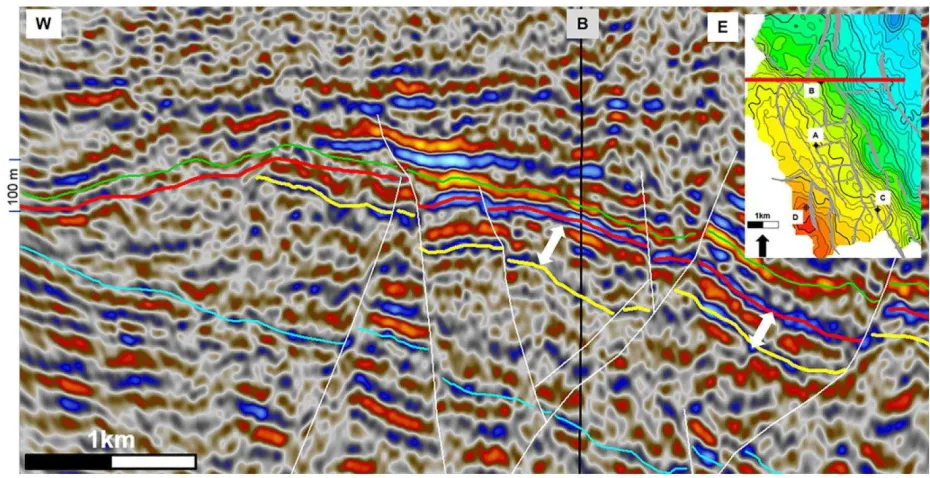
36
latter, the field is compartmentalized by numerous faults at the seismic scale, but also contains numerous
37
sub-seismic scale faults. An understanding of the fault properties and their influence on the field production
38
and recoverable volumes is essential for assessing the fields economics, planning a production strategy and
39
also influences the design of the facilities. In this paper we focus on the impact of structural pattern and
40
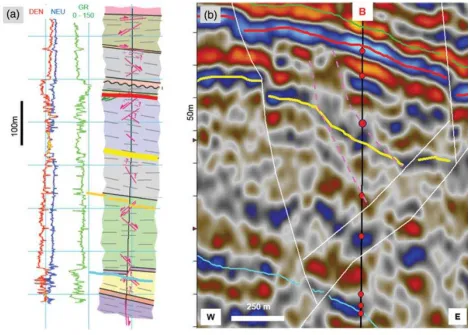
fault rock properties on the subsurface fluid flow and hence the production.
41
Workflows exist for the quantitative assessment of the impact of faults on fluid flow in petroleum
42
reservoirs and can be implemented using a range of software tools that are commonly available (see review
43
by Fisher & Jolley, 2007). In general, the workflow begins by undertaking a structural analysis using
44
seismic data. Faults identified from seismic are then incorporated into the geological model. The clay
45
distribution along the faults is then estimated using well established algorithms. In siliciclastic reservoirs,
46
the main fault seal processes are: (i) cataclasis; (ii) mixing of clays with framework grains, (iii) clay smear,
47
and (iv) post-deformation diagenesis such as quartz cementation and grain-contact quartz dissolution
48
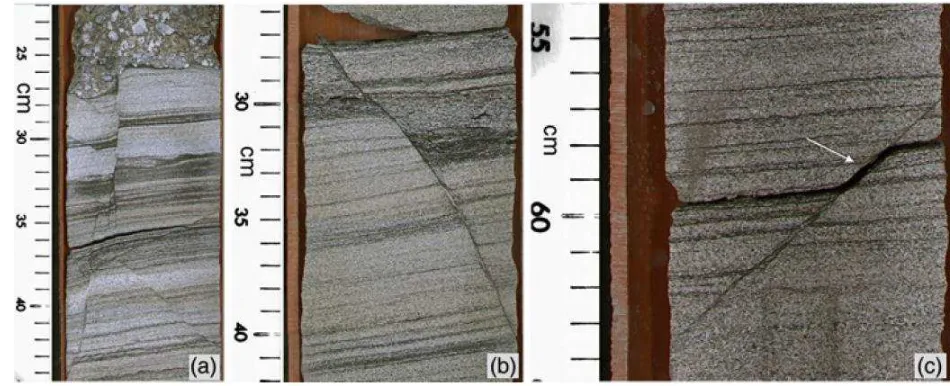
(Fisher and Knipe, 1998; 2001). The presence of clay is important for two of these mechanisms which often
49
results in correlations between fault permeability and clay content; these correlations may then be used to
50
calculate transmissibility multipliers (TM) that are incorporated into simulation models to take into account
51
the impact of faults on fluid flow. Fault rock permeability data can be obtained from global datasets.
52
However, some studies suggest that better results are obtained if fault permeability estimates are based on
53
the laboratory measurements made on fault rocks sampled from cores taken within the field being appraised
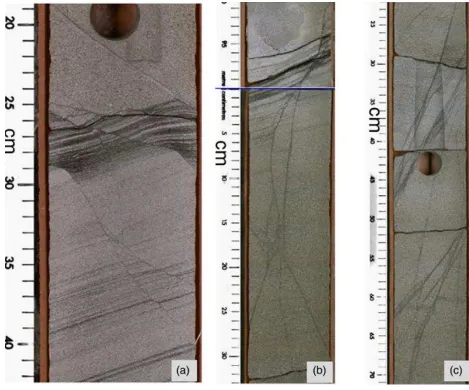
54
or from nearby analogues (Fisher & Knipe, 2001; Sperrevik et al., 2002; Jolley et al., 2007).
55
The study reported in this paper follows the general workflow described above. A key difference, however,
56
is that many fault compartmentalization studies use fault rock property data that was collected under
57
inappropriate laboratory conditions. For example, many studies use fault rock permeability data collected
58
at ambient confining pressures using brine compositions that are not compatible with the formation despite
59
a wealth of evidence to suggest that the permeability of tight rocks is very sensitive to the stress conditions
60
(e.g. Thomas and Ward, 1972) and the brine chemistry (e.g. Lever and Dawe, 1987). The current study
61
brines. The new fault rock permeability data has then been incorporated into the dynamic reservoir
63
simulation model to improve production forecasts.
64
65
Reservoir
66
The main reservoir is in Late Jurassic sandstones of the Heather Formation. The reservoir is
67
comprised of turbiditic sandstones, deposited syntectonically, during the main rifting event in the
68
Late Jurassic. The reservoir is currently located at a depth between 2400m
–
2800m, with the
69
temperature at reservoir level being slightly above 90
oC. Glacial melting during Pleistocene
70
times resulted in an uplift of approximately 300m. The reservoir thickness varies between 10m
71
and 130m (mean 60m). The N/G of the reservoir section varies between 55% and 73%. The
72
reservoir permeabilities range from 0.1
–
5 Darcy and porosities vary between 10% and 30%.
73
The reservoir experienced the precipitation of early K-feldspar overgrowths and kaolin during
74
shallow burial. Mechanical compaction was the main process for reducing porosity and
75
permeability during intermediate burial. The sandstones experienced small amounts of quartz
76
precipitation and grain contact quartz dissolution during deep burial.
77
78
Structural setting
79
The field is compartmentalized by numerous seismic scale, mainly NW-SE and NE-SW striking, normal
80
faults (Fig. 1a). East-West striking faults are present, but to a minor amount. The maximum fault throw
81
observed is around 60m with a mean around the seismic resolution of 25m. The main reservoir is
self-82
juxtaposed throughout the field (Fig. 1b), implying that the properties of the fault rocks need to be
83
considered to predict the impact of faults on fluid flow during production. It is important to note that no
84
evidence of a static fault seal over geological time exists within the main part of the field. The wells drilled
85
in the main part of the field, e.g. well A, B, D, have pressures on a common gradient, which is consistent
86
with communication through the hydrocarbon phase. However, this cannot be taken as evidence that the
87
faults will not impact flow on a production time-scale. The hydrocarbon water contact has been drilled in
88
well B, whereas the wells A and D have an oil- and gas-down-to.
89
Deposition of the reservoir happened syntectonically and the turbidites were deposited in half grabens (Figs
90
2, 3). Faulting started in the Late Triassic and continued throughout the Early and Middle Jurassic, with the
91
faults are active in the Early Cretaceous (Fig. 2). Structural restoration indicates that the faulting that
93
affected the reservoir occurred at relatively shallow depths (<1000m).
94
The main fault network only represents faults that could be mapped over a larger distance and continuously
95
on seismic sections. It shall be pointed out that the seismic quality, even after reprocessing is only fair to
96
poor in the field area, which adds uncertainties to the fault interpretation. The intensity of seismic scale
97
faulting differs around the four wells (well A = 4faults/km2, well B = 2 faults/km2, well C = 4 faults/km2,
98
well D = 1 fault/km2). Seismic attribute analysis (ant-tracking, Fig. 4) in combination with core and
99
borehole image analysis data (Fig. 5a) suggest a denser fault network (well A = 2 faults/km2, well B = 10
100
faults/km2), which is not represented by a visible offset of horizons at the current seismic resolution. Well
101
A drilled right through one of the faults identified on seismic attribute analysis (Fig. 4). Plotting fault zones
102
identified from borehole image analysis on seismic sections at the well location indicates that many small
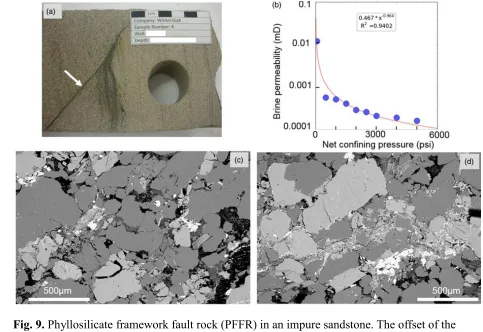
103
scale faults are only subtle or not at all visible on the seismic (Fig. 5b). Similar features as in well A are
104
also observed in well B. Very few small-scale faults are recorded in borehole image logs and cores in the
105
southern well C and D at the reservoir level, although those are also located very close to seismic scale
106
faults. No reliable results from the attribute analysis could be obtained due to the poorer quality of the
107
seismic around the two wells.
108
109
Fault rock property analysis
110
Fault rock samples
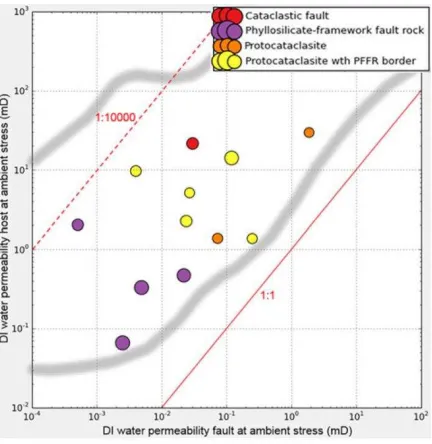
111
The complete reservoir section has been cored in the wells A and B and the samples analysed in this study
112
were taken entirely from these two cores. Two fault zones with unknown offsets are visible in well A (Fig.
113
6, see also Fig. 5a). It seems appropriate to expect similar fault styles observed in the fault rock samples
114
also at a larger scale in the reservoir-scale faults. Figure 7a shows multiple faults on a small scale, which
115
reflects the observations made on the seismic and borehole images. The fault propagates upwards,
116
nucleating at the lower left and fault splays are developed in the more shale-rich section (between 37m and
117
33cm). The fault continues with a clearly visible offset of a distinctive shale band (29cm). A small clay
118
smear is developed, resulting from the smearing of the fine clay-rich laminations within the sand-rich
119
interval. In the clean sandstones above and below the clay-rich band, the clay content of the fault rock
120
seems to be significantly lower. This is likely to represent the fault rock properties expected in the
self-121
juxtaposed cleaner sandstones section for the reservoir scale faults. A small half-graben is present towards
122
the top of Figure 7a, which is infilled with coarser material. The cored faults in more shale-rich layers often
123
sampled faults that clay smears are often discontinuous. It is occasionally observed that the fault dip flattens
125
in the more shale-rich lithologies at the seismic scale (Fig. 3). The same phenomena, caused by
126
geomechanical heterogeneities, is also observed at a small scale in the cored faults, where the dip of the
127
fault surface becomes less steep in the more clay-rich layers (Fig. 8a). Deformation bands are commonly
128
observed features and the fact that no grain fracturing has occurred during faulting indicates that they were
129
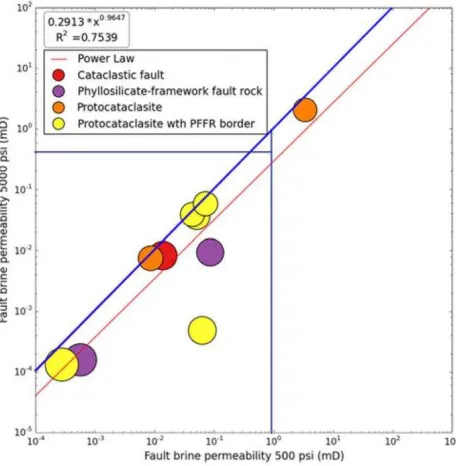
formed during shallow burial (Fig. 8b, c).
130
A bias exists for the fault rock samples. In the more heterogeneous section the sample integrity has been an
131
issue, so only faults in the more homogenous, sandier section could be sampled. This implies that faults in
132
impure sandstones and in clay-rich layers are under-represented.
133
134
Analytical procedures
135
Extensive laboratory work was undertaken on selected fault rock samples from two wells (A & B) including
136
CT-scanning, SEM-analysis, absolute permeability analysis, and quantitative XRD (QXRD). The
137
individual techniques are described in more detail below.
138
Sample preparation
139
Typically, 10 to 20 cm sections of core containing the faults were carefully wrapped and sent to the
140
laboratory for analysis. On arrival, the samples were photographed and CT scans were taken using a Picker
141
PQ 2000 medical-style scanner to identify the orientation of faults present and whether or not there were
142
obvious signs of damage generated during coring or following coring. The CT scans allowed us to identify
143
the optimal orientations to take samples for further analysis. A range of subsamples were required for
144
microstructural and petrophysical property analysis of the fault rock present and its associated undeformed
145
sandstone including:-
146
Core plugs of the host and fault rock; the latter were orientated perpendicular to the fault so that
147
fluid was forced to flow across the fault during analysis. It is generally preferred to take 25.4 or
148
38.1 mm core plugs but the core was too thin so 16 and 20 mm core plugs were taken and these
149
were analysed in purpose built core holders.
150
Cubes of fault rock and host sandstone, around 1 to 1.5 cm3, were cut for permeability analysis.
151
The sample containing the fault rock were cut and set in dental putty in an orientation that meant
152
that fluid had to flow through the fault rock during permeability analysis. The use of dental putty
153
means that it is not possible to apply high confining pressures to these samples during permeability
154
Around 1.5 x 1.5 x 0.5 cm samples containing fault rock and the associated host sandstone were
156
cut for microstructural analysis.
157
A 1cm3 sample representative of the host sandstone was then taken for QXRD analysis. This
158
analysis was not performed on the fault rocks as they were too narrow to be sampled. The fault
159
throws are very low so it was assumed that the mineralogy of the fault is the same as the host
160
sandstone, which is consistent with microstructural observations.
161
All samples were cleaned in a Soxhlet extractor using a 50:50 mixture methanol-toluene/dichloromethane
162
and then dried in a humidity controlled oven at 60oC.
163
SEM analysis
164
The blocks for microstructural analysis were impregnated with a low viscosity resin, ground flat with
165
progressively finer grades of diamond culminating in a polish using 1 m diamond paste. The samples were
166
then coated with a 10 nm thick layer of carbon before being analysed using a FEI Quanta 650 FEGESEM
167
environmental SEM with Oxford Instruments INCA 350 EDX system/80mm X-Max SDD detector, EBSD
168
and KE Centaurus EBSD system. The mineralogy and diagenetic history of the samples was determined as
169
well as the fault rock microstructure and timing of faulting relative to the diagenetic history. BSEM images
170
were stored as 8 bit TIFF files so that they could be incorporated into an image analysis package and their
171
mineralogy quantified.
172
Permeability analysis
173
Permeability measurements were made using two methods. One set of measurements were made at ambient
174
stress using distilled water as the permeant so the results could be compared to those from previous studies
175
of the permeability of fault rocks (e.g. Fisher & Knipe, 1998; 2001). In these cases, the cleaned cubes were
176
set in dental putty so that they could be confined at 70 psi confining pressure in a steady-state water
177
permeameter. The samples were saturated with distilled water, placed in the permeameter before using
178
syringe pumps to establish steady-state flow. The permeability was calculated using Darcy’s law based on
179
the flow rate, sample length and area, the upstream and downstream pressure differential and the viscosity
180
of the water. The samples containing fault rock also contained undeformed sandstone so the fault
181
permeability was deconvolved from the measurements assuming that the permeability measured was the
182
thickness weighted harmonic average of the fault rock and the host sediment.
183
The second set of measurements were made on core plugs at higher stresses using formation compatible
184
brine. Coreholders were specially constructed for the sample analysis as we could only obtain 16 and 20
185
mm diameter core plugs, which are far narrower than the 25.4 and 38.1 diameter cores normally analysed.
186
of the core plug. Formation compatible brine permeabilities were measured under stresses of 500psi, 1500
188
psi, 2000psi, 2500psi, 3000psi, 4000psi, 5000psi. These high stresses close microfractures created as core
189
samples are brought to the surface following coring. Samples with permeabilities of >0.1 mD were
190
measured using the steady-state technique whereas samples with lower permeabilities were measured using
191
the pulse-decay method. As with ambient stress measurements, core plugs containing fault rock also
192
contained undeformed sandstone so the fault permeability was deconvolved from the measurements
193
assuming that the permeability measured was the thickness weighted harmonic average of the fault rock
194
and the host sediment.
195
QXRD analysis
196
The intensity of a X-ray diffraction pattern of a mineral is proportional to the amount present within a
197
mixture (e.g. Hardy & Tucker, 1988). On this basis, XRD has frequently been used to quantify the
198
proportions of minerals present within rocks. One method to make such analyses is to construct calibration
199
curves based on the XRD analysis of mixtures containing different proportions of an internal standard such
200
as corundum. The technique requires preparation of samples with complete random orientation (Brindley,
201
1984). Sample preparation has, however, proved such a difficult task that the technique has been widely
202
regarded as semi-quantitative at best (Hillier, 1999). Recently, a spray dry technique has been developed
203
that appears to produce samples for XRD analysis without significant preferred orientation - even when
204
they contain significant proportions of clays (Hillier, 1999; 2000). The technique involves grinding the
205
sample with a standard (20 wt. % corundum) and then spraying a slurry of the mixture through an air brush
206
into a tube furnace to form ~30 µm wide spherical aggregates with random mineral orientation. The spheres
207
are then top loaded into a specimen holder and then analysed using XRD. The diffraction results obtained
208
are analysed by either reference intensity ratio (RIP) or a Rietvold method to produce mineralogical
209
analyses that are accurate at the 95% confidence level to ±X0.35, where X is the concentration in wt. %.
210
QXRD data is presented as a percentage of the rock volume (including porosity) so is consistent with
211
previous studies (e.g. Fisher and Knipe, 1998, 2001).
212
213
Microstructure, mineralogy and petrophysical property results
214
QXRD analysis indicates that the host sediments contain 54 to 73.4% quartz, 3 to 7.2% albite, 11.4 to 18.7%
215
microcline, 1.4 to 4.4% mica, 1.4 to 17% kaolin and small amounts (<1%) of pyrite. The undeformed
216
sandstones have a diagenetic history that is typical of Jurassic sandstones in the North Sea that have been
217
buried to 2800 m. In particular, they have experienced the precipitation of early K-feldspar overgrowths
218
permeability during intermediate burial. The sandstones then experienced small amounts of quartz
220
precipitation and grain contact quartz dissolution.
221
Examination of the structure of the samples in core suggested that most of fault rock samples are
222
phyllosilicate-framework fault rocks (PFFR, Fisher & Knipe, 2001). Microstructural analysis confirms that
223
PFFR are common (Fig. 9) but also indicates that protocataclasites, occasionally with a PFFR border (Fig.
224
10) and to a minor extent cataclasites were also present. In general, many of the samples had 12 to 18%
225
clay, which places them on the border between clean (<15% clay) and impure (>15% clay) sandstones. So
226
the fault rocks that they contained tend to have characteristics of those expected generally formed from
227
clean sandstones (i.e. domains with pore space that is free from clay) whilst other characteristics are typical
228
of faults formed from impure sandstones (e.g. domains with macroporosity being filled by clay as well as
229
having experienced enhanced grain-contact quartz dissolution); this makes a clear classification of the fault
230
rocks difficult. It should be noted that PFFR’s were originally defined as having flow properties that were
231
controlled by presence of a continuous phyllosilicate-rich matrix between the framework grains (Knipe et
232
al., 1997). Later a generalization was made that such fault rocks tend to occur in sandstones containing
15-233
40% clay (Fisher and Knipe, 1998, 2001). However, the clay content of 15-40% should not be viewed as
234
fixed values. Indeed, the discussion on clay mixing models presented below highlights how the sorting of
235
the sand grains, which make up the framework of fault rocks, has a major impact on their petrophysical
236
properties.
237
The ratio of the host rock and the fault rock absolute permeabilities is an important parameter that describes
238
the retardation of fluid flow by faults (Yaxley, 1987). Figure 11 shows the data measured from the field
239
and a range of data points from an in-house database from the same area that have the same stratigraphic
240
range and burial depth. Both datasets were measured under ambient stress using distilled water as the
241
permeant. The results demonstrate a permeability reduction of up to three orders of magnitude for the field
242
data. The permeability reductions experienced implies that the fault rocks could have a significant impact
243
on the single-phase flow especially when situated near to a production or injection well. The acquired data
244
from the field fit well into global range, although the permeability reduction seems to be slightly less than
245
in the global dataset. The reduction in permeability occurred as a result of a variety of processes including:
246
faulting-induced grain fracturing, faulting-induced mixing of framework grains with phyllosilicate grains
247
and enhanced grain contact quartz dissolution due to the presence of clays at grain contacts. It is apparent
248
that there is no clear relationship between the fault rock type and the permeability reduction. However, the
249
host rock permeabilties in the more impure sandstones are lower than in the clean sandstones, which is in
250
line with previous work. There does not seem to be a correlation between the clay content of the protolith
251
The brine permeability of all fault rocks showed a clear stress dependency (Fig. 9 and Fig. 10). In particular,
253
the stress sensitivity of permeability increases as samples become less permeable (Figure 12). Fault rock
254
samples with >0.1 mD permeability at ambient conditions tend experience permeability reductions of a
255
factor of ~2 when confining pressure is increased to in situ conditions. On the other hand, lower
256
permeability fault rocks often experience an order of magnitude reduction in permeability as confining
257
pressure is increased to in situ conditions. The increased stress dependency of permeability with reduced
258
permeability is consistent with permeability measurements made on other low permeability rocks such as
259
tight gas sandstones (Thomas & Ward, 1972; Wei et al., 1986; Kilmer et al., 1987). Extrapolating the
260
power-law relationship between stress and confining pressure to 70psi indicates that previous
261
measurements made at ambient stress conditions are between 2 and 20 times higher (average difference is
262
5 fold) than those made at high confining pressures. It should be emphasised that much of this stress
263
sensitivity is likely to be caused by presence of grain-scale microfractures that formed during and/or
264
following coring. The permeabilities of fault rock samples are therefore not likely to be as stress sensitive
265
in the subsurface as in the laboratory, because microfractures will not be present in the subsurface and pores
266
with low aspect ratios are not as stress sensitive unless an increase in stress results in brittle failure of the
267
faults.
268
Fault rock permeabilities not only depend on the stress applied, but also on the fluid composition used
269
during the experiments. The data shown in Figure 13 demonstrate that the permeabilities for a formation
270
compatible brine are around 5 fold higher than for a deionized water, which has been used as the permeant
271
for these type of measurements (Fisher & Knipe, 1998, 2001; Sperrevik et al., 2002).
272
An important observation made during this work, incorporating a larger fault rock data set from different
273
unpublished sources is that the effects of applying reservoir stress versus ambient stress and using brine
274
versus deionized water cancel each other almost out and almost a 1:1 relationship seem to exist (Fig. 14).
275
This implies that previously published fault rock property data (Fisher & Knipe, 1998, 2001; Sperrevik et
276
al., 2002; Jolley et al., 2007) can be still used with a certain confidence. This will be the subject of a future
277
publication but it is important for the current study as it justifies using the legacy fault rock data along with
278
the new measurement from the field to derive predictive functions for the fault rock permeability versus
279
fault rock clay content for the reservoir scale faults.
280
It has been pointed out earlier that a sample bias exists, as some faults, particularly the ones with a higher
281
clay content fault rock or with clay smear, could not be sampled, as the samples tend to break apart along
282
the faults. So the sampled fault rocks mainly resemble the low to medium clay content fraction with some
283
that show properties of phyllosilicate-framework fault rocks (Fig. 15). A relationship between the fault rock
284
orders of magnitude exist for a similar fault rock clay content are measured (Fig. 15). This observation is
286
consistent with earlier published datasets (Fisher & Knipe, 2001; Sperrevik et al., 2002; Jolley et al., 2007).
287
288
Reservoir-scale fault property prediction
289
To calculate the reservoir and small-scale (lineaments from seismic attribute analysis, see Fig. 4) fault
290
properties a structural framework and a static geomodel has been established. The basis for the model is
291
provided by 3D structural interpretation on a PreSDM dataset and a host rock Vclay model based on the
292
Vclay logs from the four exploration wells, applying an appropriate depositional model. The fault rock
293
clay content has been calculated varying the clay content of the host rock model according to the
294
uncertainties from the petrophysical evaluations. Different fault zone clay predictors, such as SGR
295
(Yielding, 2002) and ESGR (Freeman et al., 2010) were assessed. The SGR at any point of the fault is
296
given by a uniform average of the clay contents of the wall rocks that moved past this point (Yielding 2002).
297
In contrast, the ESGR applies an additional weighting function to the averaging, which assumes that clays
298
that are closer to the point of interest contribute more to the fault rocks (Freeman et al., 2010). To link the
299
fault rock permeability to the fault rock Vclay content; SGR/ESGR for reservoir scale faults; different
300
predictive functions were applied. In addition the impact of potential clay smear on the production figures
301
has been evaluated, together with changes in the relationship of fault rock thickness versus fault throw.
302
Variations in fault throw can have a significant effect on the fault rock properties and reservoir/reservoir
303
juxtaposition patterns in the field. Therefore an uncertainty on the throw of 20% has been incorporated.
304
The majority of the reservoir-scale faults fall into the PFFR domain, followed by clay smears and
305
disaggregation zones/(proto)cataclastic fault rocks (Fig. 17). No significant difference in the distribution is
306
apparent between the fault rock Vclay content when calculated using either SGR (Yielding, 2002) or ESGR
307
(Freeman et al., 2010), with a weighting factor of 1.5, as a fault rock Vclay prediction algorithm. A more
308
detailed analysis of the Vclay distribution on the fault plane reveals that the ESGR algorithm predicts a
309
more discrete distribution of Vclay, compared to the SGR algorithm (Fig. 17). The aim was to verify the
310
influence of the application of the two different algorithms on the final dynamic simulation results.
311
The fault rock property data acquired during this study are limited in terms of their statistical value as only
312
around 15 samples of small offset faults (<1 cm throw) were analysed and they do not represent the range
313
of reservoir scale fault rocks (see Fig. 16). To have a statistically valid dataset the field data were combined
314
with data from an in-house database, obtained from the same province, same stratigraphic interval and
315
similar burial depth (Fig. 18). The measurements for the additional data were done under 70psi stress and
316
distilled water appears to compensate for the impact on permeability of making the measurements at low
318
confining pressures. A cross-plot of fault rock permeability vs. clay content for this larger dataset from
319
analogue faults also has a very large amount of scatter as was the case for the measurements made during
320
this study.
321
Revil & Cathles (1999) demonstrate that the permeability of the sand/clay mixtures, which is essentially
322
what clay gouges represent, is controlled by the proportion of the host-rock sand and host-rock clay present,
323
the porosity and permeability of the sand end-member as well as the permeability of the shale end-member.
324
The porosity of the host-rock sand is controlled by grain sorting. These factors might explain the scatter of
325
the points in the Vclay versus permeability plot (Fig. 18). The objective was to represent the ranges between
326
fault rock Vclay content and fault rock permeability for the reservoir scale faults. A High-, Mid- and
Low-327
fault rock permeability predictive function has been established (Fig. 19a). The functions are based on a
328
model for the permeability of clay-sandstone mixtures ( , presented by Revil et al. (2002).
329
330
331
332
333
334
where, øsd and ksd are the porosity and permeability of the clay-free sand, ksh is the permeability of the
335
shale end-member and:
336
337
338
is the clay content of the fault rock e g SGR or ESGR for the reservoir scale faults and is the
339
permeability of the clay-filled sand at the boundary between the clayey sands and sandy shales (Revil et
340
al., 2002). The three functions were calculated by establishing three sand-clay mixing models, using the
341
parameters in Table 1. A good fit to the data for the three functions becomes apparent (Fig. 19a). The field
342
data, despite there are only few, fall clearly within the Mid- and Low-case scenario from Revil et al. (2002).
343
Comparing the Revil et al. ( 2002) High, Mid and Low fault rock permeability functions with algorithms
344
published previously by Sperrevik et al. (2002) and Jolley et al. (2007) for similar conditions (burial depth
345
<3000m) , it becomes apparent that the latter predict a higher permeability of the fault rocks than indicated
346
The final input parameter into the reservoir simulator are TMs that are applied to the faces of grid blocks
348
on either side of the fault plane to take into account the impact of faults on fluid flow. The TM calculation,
349
as described by Manzocchi et al. (1999), requires information on the permeability of the undeformed
350
reservoir in each grid block, the fault thickness and the fault permeability. The prediction of the fault rock
351
thickness is one of the most uncertain parameters. There is a significant scatter in the data, but a 1:100
352
relationship of fault thickness versus throw is commonly used. Freeman et al. (2008) suggest that a 1:66
353
relationship is more appropriate for seismic-scale faults. Both relationships were incorporated into the
354
calculation of the fault TMs.
355
An uncertainty also exists in the calculation of the Vclay content for the well logs and hence for the Vclay
356
model as such. A 10% uncertainty has been estimated, based on petrophysical analysis, for the host rock
357
Vclay content and fault rock property cases were calculated accordingly. In addition potential facies
358
variations were taken into consideration in the uncertainty modelling.
359
Many properties are linked to the fault throw, such as the reservoir juxtaposition pattern, fault rock clay
360
content prediction, the fault rock thickness and ultimately the TM, as the main input into the dynamic
361
simulation. The fault throw is influenced by three main factors, the accuracy of the seismic migration, the
362
quality and resolution of the seismic data and the structural interpretation. In this case, an uncertainty of the
363
throw of 20% has been considered, based on the above mentioned parameters. A variation of the throw in
364
the static geomodel alters the model geometry and sometimes it is difficult to carry this distorted geometry
365
forward in the dynamic simulation. In order to keep the complexity at an acceptable level, it has been
366
decided to calculate only one case for the throw variation, e.g. increase the throw by 20% (throw 120%).
367
An increase in throw is expected to result in a more disconnected reservoir, which would decrease the
368
recoverable volumes and demonstrates a potential “low case” scenario. The effective-cross fault
369
transmissibility (ECFT, Freeman et al., 2010) is used in Figure 20 to illustrate the effects of an increase in
370
throw. The ECFT, which is a normalized cross fault transmissibility, is computed using the harmonic
371
average of the permeabilities of the undeformed foot wall adjacent to the fault, the fault rock and the
372
undeformed hanging wall across the fault. This is done for a specific width of host wall rock on each side
373
of the fault and the fault rock thickness by the local displacement (Freeman et al., 2010). The lower reservoir
374
interval is the one that contributes most to the recoverable volumes. An increase in throw reduces the area
375
where the lower reservoir is self-juxtaposed (Fig. 20a & b). The fact that more zones with elevated ECFT
376
in the area where the lower reservoir in the footwall is juxtaposed against the upper reservoir in the
377
hangingwall occur (compare Fig. 20a and Fig. 20b), does not counterbalance this effect. This becomes
378
evident in the dynamic simulation.
379
381
Small scale fault property prediction
382
In addition to the seismic faults numerous small-scale faults, without a visible offset in seismic exist. These
383
faults can be observed as lineaments on seismic attribute maps (Fig. 4). It has been considered to be
384
important to include these faults into the dynamic simulation model. The faults were mapped as lineaments
385
and vertical fault planes without an offset were constructed in the dynamic model. As no offset is associated
386
with these faults, their TMs cannot be calculated in the same way as for faults with an offset. Therefore a
387
range of single TMs for the entire small scale fault surfaces was calculated, applying a range of fault throw
388
(1m, 5m, 10m, 20m) with the corresponding fault rock thicknesses using a thickness to throw relationship
389
of 1:100. A single average permeability value of 950 mD has been taken for footwall and hangingwall cells,
390
based on a range of core measurements in the reservoir sandstones. A bulk fault zone permeability has been
391
calculated using the harmonic average from the measured fault rock permeabilities from the cores, using a
392
30% salinity brine and applying a stress of 4000psi. The harmonic average was used as the permeability
393
required is that measured perpendicular to the fault. It has been concluded from applying the different
394
scenarios that bulk TMs of 0.001, 0.01 and 0.1 represent a realistic range for the small scale faults.
395
At this stage of the analysis it is important to bear in mind that no history matching data exist in the field,
396
which would allow a calibration of the results. It is important at this point in time to figure out which
397
parameters have the most significant impact on the resulting recoverable volumes. Once history matching
398
data are available this provides a good basis for a more focused analysis of the key influencing parameters.
399
A summary of the cases that were incorporated into the dynamic simulation is given in Figure 21.
400
401
Simulation modelling results
402
The scenarios discussed above were, together with other geological variables, incorporated into a fully
403
integrated, automated workflow for dynamic reservoir simulation and uncertainty modelling (200
404
iterations). The main goal was to identify which one of the many parameters, apart from the fault properties,
405
in the uncertainty model have the most impact on the recoverable volumes and the recovery efficiency. An
406
additional objective was to verify the impact of the different fault property cases on the recoverable volume
407
range. In order to ensure that the results are comparable, the producer/injector well pattern has not been
408
changed during the uncertainty simulation.
409
In Figure 22 the impact of the several calculated scenarios on the recoverable volumes is highlighted. In
410
100%. If the minimum case of recoverable volumes is valid, e.g. if low permeable seismic scale faults
412
combined with low permeable small scale faults are present, the recovery would be only 70% compared to
413
a model without faults. The dynamic simulation reveals that the clay content versus permeability
414
relationship, together with variations in fault throw, have the most significant impact on the recoverable
415
volumes (Fig. 22). Slightly tighter faults are predicted when the ESGR is used as a mixing algorithm. The
416
impact of a thickness to throw ratio of 1:66 instead of 1:100 leads to a decrease in fault transmissibility, but
417
not to a significant amount. The presence of clay smear does not lead to significantly tighter faults and
418
hence causes only a minimal reduction in recoverable volumes because continuous clay layers are not
419
predicted in the host rock model. The functions suggested by Sperrevik et al. (2002) and Jolley et al. (2007)
420
seem to predict less influence of the faults on the subsurface fluid flow for this particular case. The
421
incorporation of small-scale faults whose throw cannot be mapped can decrease the recoverable volumes
422
again by up to 10%, compared to the cases where only the larger scale faults are taken into consideration.
423
Combining the observations made on core-scale, with seismic attribute analysis strongly suggests the need
424
to incorporate the small-scale faults into the model. The dynamic simulation with several fault property
425
scenarios shows that a reduction between 10% and 30% of the recoverable volumes, compared to a model
426
without or completely open faults, is likely.
427
The impact of the faults on the recovery efficiency and cumulative production were assessed in the
428
uncertainty modelling. Apart from the fault properties, other parameters such as the variation on top and
429
base reservoir grids, residual oil and water saturation and reservoir porosity and permeability were
430
incorporated into the analysis. The properties of the faults are among the most influential parameters for
431
the oil recovery efficiency. Using fault specific TMs, generated applying the above discussed workflow,
432
versus a distribution of single TM values reduces the uncertainty by around 40% for the recovery efficiency.
433
This is a very important result as it clearly demonstrates the value of a detailed fault analysis compared to
434
just using single global values.
435
For the cumulative production the fault properties are an important, but not the most influential parameter.
436
Again, using a fault specific TM grid, based on the above described fault analysis workflow, compared to
437
applying a range of single TM reduces the uncertainty by 50%.
438
439
Discussion
440
The seismic interpretation, which is a key element that provides the basis for a quality fault analysis and
441
the translation of the interpretation into the static geomodel, has not been discussed in detail in this paper.
442
is associated with uncertainties; the same is also true for the velocity model. The possibility to run fully
444
integrated uncertainty models really helped to incorporate these different parameters and assess their
445
impact. However, a verification of effects from different interpretation concepts is not possible within this
446
workflow, but would be a subject for further analysis, once the field is in development and history
447
matching data exist, which allow a better calibration of the outcomes.
448
Similar fault styles are observed on core and seismic scale (compare Figure 2 with Figure 8). The
449
availability of numerous fault rock samples from core, together with high quality borehole images was a
450
real benefit for the work. In the first instance, these data highlight the complexity of the faulting, also
451
below seismic resolution. Secondly, the fault rock data provide the basis for the calibration of the
452
reservoir-scale fault rock permeability prediction. As demonstrated, the results from the absolute
453
permeability measurements on these samples under reservoir stress conditions, using a reservoir
454
compatible fluid are very similar to absolute permeability measurements under ambient stresses but using
455
deionized water as a permeant (Fig. 14). It shall be pointed out, that this observation does not imply that
456
the efforts for conducting measurements under realistic subsurface conditions are not necessary in the
457
future, but highlights the possibility to use previously acquired datasets with a certain confidence.
458
We find that the functions developed by Revil et al. (2002) provide an appropriate description for
sand-459
clay mixtures (fault rocks) and their related absolute permeabilities. Revil & Cathles (1999) demonstrate
460
that the permeabilities of these mixtures are not only a function of the clay content, as suggested by
461
previous authors (Fisher& Knipe 1998; Fisher & Knipe 2001). Functions that correlate the fault rock clay
462
content to the fault rock permeability suggested by Sperrevik et al. (2002) and Jolley et al. (2007) seem to
463
predict a lower impact of the faults on the subsurface fluid flow in this specific case. This can be due to
464
various factors including:
465
i. The functions suggested by Jolley et al., (2007) and Sperrevik et al., (2002), which were used in this
466
paper for comparison, are derived from regression lines through a cloud of data with a significant
467
scatter for a given depth of burial. This implies that the high- and low-side will not be fully
468
represented.
469
ii. The measurement setup, e.g. permeability measurements with deionized water at ambient stress
470
does not represent real subsurface conditions, e.g. reservoir compatible brine at subsurface stress.
471
iii. The data used by Jolley et al. (2007) and Sperrevik et al. (2002) are not from the field, so the use of
472
specific field data should provide more accurate ranges.
473
iv. The sand-clay mixing model proposed by Revil & Cathles (1999) appears to be a proper
474
It has been pointed out already that the work described in this paper lacks the calibration of the fault
476
analysis results by history matching data or even long term well tests. Once the field is under
477
development and production data exist, the exercise will have to be repeated and it is expected that the
478
uncertainties can be significantly reduced. In any case, the current study provides a good basis for future
479
work.480
481
Conclusions482
A better understanding of the fault properties by incorporating geologically sensible parameters played an
483
important role in the uncertainty assessment for the field development planning. In this context the
484
incorporation of fault rock measurements from field data, together with application of the algorithms from
485
Revil et al. (2002) for the fault rock clay content prediction increased significantly the credibility of the
486
analysis results. The fault properties are among the most critical and influential parameters especially for
487
the recovery efficiency, but also for the cumulative production. It can be demonstrated that using a fault
488
specific transmissibility multiplier grid versus a distribution of single, global transmissibility multiplier
489
values significantly reduces the uncertainties for the recovery efficiency and cumulative recovery.
490
491
Acknowledgements
492
The authors thank Wintershall Norge AS, Capricorn Norge AS, Bayerngas Norge AS, DEA Norge AS,
493
Repsol Norge As, Edison Norge AS and Explora Petroleum AS, for the permission to publish this paper.
494
We also thank Eriksfiord and the CiPEG Leeds for the permission to present data generated by them for
495
this study.496
497
References498
Brindley, G.W. (1984) Quantitative X-ray analysis of clays. Pp. 411-438 in: Crystal Structures of Clay
499
Minerals and their X-ray Identification (G.W. Brindley & G. Brown, editors). Mineralogical Society,
500
London.
501
Fisher, Q. J. & Knipe, R. J. 1998. Fault sealing processes in siliciclastic sediments. In: G. Jones, Q. Fisher
502
and R. J. Knipe (eds) Faulting and Fault Sealing in Hydrocarbon Reservoirs. Geological Society, London,
503
Special Publication, 14, 117-134.
504
Fisher, Q. J. & Knipe, R. J. 2001. The permeability of faults within siliciclastic petroleum reservoirs of
505
Fisher, Q.J. & Jolley, S.J. 2007. Treatment of faults in production simulation models. In: Jolley, S. J.,
507
Barr, D., Walsh, J. J. & Knipe, R. J. (eds) Structurally Complex Reservoirs. Geological Society, London,
508
Special Publications, 292, 219-233.
509
Freeman, S.R., Harris, S.D. & Knipe, R.J. 2008. Fault seal mapping – incorporating geometric and
510
property uncertainty. In: Robinson, A., Griffiths, P., Price, S., Hegre, J. & Muggeridge, A. (eds) The
511
Future of Geological Modelling in Hydrocarbon Development. The Geological Society, London, Special
512
Publications, 309, 5-38.
513
Freeman, S.R., Harris, S.D. & Knipe R.J. 2010. Cross-fault sealing, baffling and fluid flow in 3D
514
geological models: tools for analysis, visualization and interpretation. Geological Society, London,
515
Special Publications, 347, 257-282.
516
Hardy, R. & Tucker, M.E. 1988. X-ray diffraction. In: Tucker, M. E. (eds) Techniques in Sedimentology.
517
Blackwell, Oxford, 191-228.
518
Hillier, S. 1999. Use of an Air Brush to Spray Dry Samples for X-Ray Powder Diffraction. Clay
519
Minerals, 34, 127-135.
520
Hillier, S. 2000. Accurate quantitative analysis of clay and other minerals in sandstones by XRD:
521
comparison of a Rietveld and a reference intensity ratio (RIR) method and the importance of sample
522
preparation. Clay Minerals, 35, 291-302.
523
Jolley, S.J., Dijk, H., Lamens, J.H., Fisher, Q.J., Manzocchi, T., Eikmans, H. & Huang, Y. 2007. Faulting
524
and fault sealing in production simulation models: Brent Province, northern North Sea. Petroleum
525
Geoscience, 13, 321-340.
526
Kilmer, N.H., Morrow, N.R., and Pitman, J.K. 1987. Pressure sensitivity of low permeability sandstones.
527
Journal of Petroleum Science and Engineering, 1, 65-81.
528
Knipe, R. J., Fisher, Q. J., Jones, G. , Clennell, M. R., Farmer, A. B., Kidd, B., McAllister, E., Porter, J. R.
529
& White, E. A. 1997. Fault seal analysis, successful methodologies, application and future directions. In:
530
Møller-Pederson, P. & Koestler, A. G. (eds) Hydrocarbon Seals - Importance for Exploration and
531
Production. Norwegian Petroleum Society (NPF), Special Publication, 7, 15-37.
532
Lever A., and Dawe, R.A. 1987. Clay migration and entrapment in synthetic porous media. Marine
533
and Petroleum Geology, 4, 112-118.
534
Manzocchi, T., Walsh, J.J., Nell, P. & Yielding, G. 1999. Fault Transmissibility Multipliers for flow
535
Revil, A. & Cathles L.M. 1999. Permeability of shaly sands. Water Resources Research, 35, 651-662.
537
Revil, A.C., Grauls, D. & Brevart, O. 2002. Mechanical compaction of sand/clay mixtures, Journal of
538
Geophysical Research, 107, (B11), 2293.
539
Sperrevik, S., Gillespie, P.A., Fisher, Q.J., Halvorsen, T. & Knipe, R.J. 2002. Emperical Estimation of
540
Fault Rock Properties. In : Koestler, A. G. & Hunsdale, R. (eds) Hydrocarbon Seals Quantification.
541
Norwegian Petroleum Society (NPF), Special Publication, 11, 109-125.
542
Thomas, R.W. & Ward, D.C. 1972. Effect of Overburden Pressure and Water Saturation on Gas
543
Permeability of Tight Sandstone Cores, JPT, 120.
544
Wei, K.K., Morrow, N.R. & Brower, K.R. 1986. Effect of Fluid, Confining Pressure, and Temperature on
545
Absolute Permeabilities of Low-Permeability Sandstones, Society of Petroleum Engineers, Formation
546
Evaluation, 413.
547
Yaxley, L.M., 1987. Effect of a partially communicating fault on transient pressure behaviour. Society of
548
Petroleum Engineers, Formation Evaluation, 590–598.
549
Yielding, G. 2002. Shale gouge ratio – calibration by geohistory. In : Koestler, A. G. & Hunsdale, R.
550
(eds) Hydrocarbon Seals Quantification. Norwegian Petroleum Society (NPF), Special Publication, 11,
1-551
15.