This is a repository copy of
Shape coexistence and shape transition in self-conjugate
nucleus 72Kr and the tensor force
.
White Rose Research Online URL for this paper:
http://eprints.whiterose.ac.uk/124299/
Version: Accepted Version
Article:
Kaneko, K., Sun, Y. and Wadsworth, R. orcid.org/0000-0002-4187-3102 (2017) Shape
coexistence and shape transition in self-conjugate nucleus 72Kr and the tensor force.
Physica Scripta. 114008. ISSN 0031-8949
https://doi.org/10.1088/1402-4896/aa8fdc
[email protected] https://eprints.whiterose.ac.uk/
Reuse
Items deposited in White Rose Research Online are protected by copyright, with all rights reserved unless indicated otherwise. They may be downloaded and/or printed for private study, or other acts as permitted by national copyright laws. The publisher or other rights holders may allow further reproduction and re-use of the full text version. This is indicated by the licence information on the White Rose Research Online record for the item.
Takedown
If you consider content in White Rose Research Online to be in breach of UK law, please notify us by
Shape coexistence and shape transition in self-conjugate nucleus
72
Kr and the tensor
force
K. Kanekoa, Y. Sunb,c,d, R. Wadsworthe
aDepartment of Physics, Kyushu Sangyo University, Fukuoka 813-8503, Japan bDepartment of Physics and Astronomy, Shanghai Jiao Tong University, Shanghai 200240, China cCollaborative Innovation Center of IFSA, Shanghai Jiao Tong University, Shanghai 200240, China
dInstitute of Modern Physics, Chinese Academy of Sciences, Lanzhou 730000, China eDepartment of Physics, University of York, Heslington, York YO 5DD, United Kingdom
Abstract
Oblate-prolate shape-coexistence is well-known in theN=Z nucleus72Kr. Furthermore, recent experimental data implies that there is a rapid shape transition at very low spins in this nucleus. We reinvestigate this problem by using large-scale shell-model calculations with the monopole interactions derived from the monopole-based universal force that contains the tensor force in the Hamiltonian. We show that in72Kr, states with nucleon-quartet excitation from the p f shell to theg9/2-d5/2orbits, which favor
large prolate deformation, compete with those having thep fshell as the main configuration with oblate deformation. These shapes can coexist if the two types of states reside closely in excitation energy. In72Kr the tensor force is found to provide precisely such a coexistence condition near the ground state. As the tensor effect changes dynamically with orbital occupation when the nucleus rotates, a rapid shape transition can occur.
Keywords: Shape coexistence and transition, N = Z nuclei, Tensor force, Nucleon-quartet excitation, Large-scale shell model PACS:21.10.Sf, 21.30.Fe, 21.60.Cs, 27.50.+e
1. Introduction
The shape of a nucleus is an emergent phenomenon that re-sults from the participation of many valence particles interact-ing via strong correlations. Coexistence of different shapes near the nuclear ground state is well known in various mass regions of the periodic table [1]. In nuclei, ground states with prolate deformation are found to be much more abundant than those with oblate deformation [2]. However, at or close to theN=Z line in the mass region of 70≤A≤80, two different shapes, with a strong prolate and a weak oblate deformation, can co-exist [3]. Moreover, for proton/neutron numbers 34, 36, and 38, these shapes can change drastically as a function of spin and/or isospin [4].72Kr, with the nucleon numberN=Z=36, is believed to form an acute example of a nucleus that changes shape with increasing spin. For example, it has been suggest-ed by various theoretical calculations to have a prsuggest-edominantly oblate ground-state but with mixing of a prolate configuration at low excitation energies [4, 5, 6, 7, 8, 9, 10], and to undergo rapid shape changes with rotation. Already at spinsI=4−6, a robust prolate band was found to be developed [11, 12, 13], this occurs because when the nucleus rotates, particles in the f p shell are more easily excited to the deformation-drivingg9/2 or-bit.
One important indication for shape coexistence in even-even nuclei is the observation of a second 0+state, 0+2 at low
excita-Email address:[email protected](Y. Sun)
tion energy, which may be interpreted as the ground state of a d-ifferent shape. The 0+2 state in72Kr, with excitation energy 671 keV, was first observed [14] as a shape isomer and interpreted as the band-head of the known rotational structure with prolate deformation. Shape isomers [15] have generally very different structures from the ground state, and in the case of72Kr, it was suggested [16, 17] that its existence may have consequences for nucleosynthesis in the rapid-proton capture process [18]. Self-consistent deformed mean-field calculations have shown that shape coexistence takes place in Kr isotopes [19, 20, 21]. Lat-er, in order to improve deficiencies of the single-particle spec-tra from the earlier calculation, the tensor field was included in the mean-field calculations [22, 23, 24, 25]. Beyond-mean-field calculations [26, 27, 28] were performed to understand the de-tailed structure of the shape isomer. Very recently, a largeE2 transition rate,B(E2; 4+1 →2+1), has been observed [29], which is 3.4 times larger than the previously reportedB(E2; 2+1 →0+1)
rate [30]. This strongly suggests that the 0+1 state in72Kr does not belong to the same shape as the yrast 2+1 and 4+1 states, thereby providing an extreme example of a rapid shape transi-tion near the ground state.
tensor force acting on them. The tensor force has been known to drive the shell evolution toward the exotic neutron-rich region [32], which could bring novel effects to binding energies and to spectra. The tensor driven monopole components are known to be remarkable for neutron-rich nuclei where the last protons and neutrons occupy different orbits. In72Kr, the last protons and neutrons occupy the same f5/2orbit and the tensor driven monopole terms give rise to a large repulsive interaction. We will show that for such self-conjugate nuclei the tensor force effect is significant and that in72Kr it could play a key role in changing the nuclear shape at low spin.
2. The shell-model framework
We have recently proposed [33] a unified realistic shell-model Hamiltonian called PMMU, consisting of the pair-ing+multipole Hamiltonian and the monopole interaction ob-tained by empirical fits to the monopole-based universal force [34]. It has been shown [33] that the PMMU model can be ap-plied to thep fandp f5/2g9/2(cited asp f g) shells. In Ref. [35],
the model was systematically examined for thep f gshell nuclei by calculating various properties such as binding energies, ener-gy levels, and electromagnetic transitions. However, for heavier N∼Z nuclei toward the mass-80 region, thed5/2orbit, which
strongly couples withg9/2through large quadrupole matrix el-ements, will be important for the description of large deforma-tion [36, 37, 38]. In the present work, we carry out shell-model calculations with the PMMU Hamiltonian in an enlarged mod-el space p f5/2g9/2d5/2(cited as p f gd hereafter). The single-particle (s.p.) energies and force strengths in the present work are adopted from our previous paper [35]. The low-lying states for the odd-mass nuclei in the fpg shell are described well in the fpg shell. Apart from single-particle (s.p.) energies and strength parameters in the PMMU model [33, 35], thed5/2s.p. energy is set to be 1.55 MeV higher than theg9/2orbit so as to
reproduce the recent observed largeB(E2; 4+1 →2+1)value [29] and the two-neutron shell gaps∆ forZ =31 and 32, defined by∆=S2n(N=52)−S2n(N=50)[39]. This new s.p. energy
is close to 1.76 MeV chosen by Zuker et al. [40] so that the ground state band becomes solidly prolate. According to Ref. [40], the shell gap∆varies as a function of orbital occupantions due to the monopole interaction, and the “monopole drift” de-termines thed5/2s. p. energy to be 2−3 MeV above theg9/2 orbit. Consequently, the shell gaps∆=3.5 and 3.1 (in MeV), estimated from the experimental binding energies for Z=31 and 32, are obtained.
Shell-model calculations have been performed with the code MSHELL64 [41]. For the p f gdmodel space, however, the re-sulting dimension with exact calculation is huge. Therefore, the nucleon numbersnin theg9/2d5/2(cited asgdhereafter) mod-el space were restricted ton≤4. The spurious center-of-mass motion was not removed in the present calculation because the effects would be negligible [6].
0
1
2
3
4
0+ 72Kr
E
x
c
it
a
ti
o
n
e
n
e
rg
y
(M
e
V
)
2+ 4+ 0+ 8+ 6+exp
cal
4+ 2+ 4+4+ 44++
8 1 0 ( 1 5 0 ) 2 7 2 0 ( 5 5 0 ) 3 1 0 1 6 3 4 2 2 8 8 2 5 4 0 2 6 5 8 3 5 2 −78.9 −99.7 −107.7 −113.3 24.2 41.1 6+ 3 6 1 47.6
cal(w/o V
T)
[image:3.595.322.540.78.294.2]2+ 0+ 4+ 4+ 6+ 2+ 6+ −5.64 8.79 44.2 −100.1 −108.1 62.3 3 9 8 2 4 5 2 9 0 2 5 6 1 1 4 5 8+ −113.8 2 6 7 7 2 0 9 0 ( 7 8 0 )
Figure 1: Energy levels,B(E2)values, and spectroscopic quadrupole moments
Qsfor72Kr. TheB(E2)andQsvalues are indicated by the numbers, in units of
e2fm4andefm2, respectively. The red and blue arrows indicate theB(E2)s that
connect the states with negative and positiveQsvalues, corresponding to prolate
and oblate bands, respectively. Experimental data (left graph) are compared with the PMMU calculations with (mid graph) and without (right graph) the tensor force.
The PMMU Hamiltonian [33] is written as
H = H0+HP+HM+Hm, (1)
H0 =
∑
α
εac†αcα,
HP = −
∑
J=0,2
1 2gJ
∑
MκP†
JM1κPJM1κ
HM = −
1
2χ2
∑
M :Q†
2MQ2M:−
1
2χ3
∑
M :O† 3MO3M:
Hm =
∑
a≤b,T
Vm(ab,T)
∑
JMKA†JMT K(ab)AJMT K(ab).
It includes the J =0, 2 terms in the pairing channel and the quadrupole-quadrupole (QQ) and octupole-octupole (OO) terms in the multipole channel. We adopt the monopole matrix elementsVm(ab,T)obtained by empirical fits to the
monopole-based universal forceVMU[34], which contains the central force
of a Gaussian form and theπ+ρmeson’s exchange tensor force (denoted asVThereafter). In this way, the shell evolution is
di-rectly affected by the monopole interaction originating from the tensor force.
3. Results and discussion: Role of the tensor force
To understand the role of the tensor force, we have performed two sets of calculations for72Kr, with and withoutVT, while
all other calculation conditions remain the same. The level schemes obtained (mid and right graphs) are compared with ex-perimental data (left graph) in Fig. 1. This figure shows also
Table 1:B(E2)andQsvalues for the positive-parity yrast states and some collective states of72Kr. Experimental data are taken from Ref. [11, 29]. B(E2)[e2fm4] Qs[efm2]
Jiπ→Jπf exp cal cal(w/oVT) Jiπ cal cal(w/oVT)
2+1 →0+1 810(150) 29 398 2+1 -78.9 -5.64 4+1 →2+1 2720(550) 2288 1 2+2 24.2 8.79 6+1 →4+1 2540 1 4+1 -99.7 44.2 8+1 →6+1 2090(780) 2658 2677 4+2 41.1 -100.1 2+2 →0+1 310 17 6+1 -107.7 -108.1 2+1 →0+2 1634 3 6+2 47.6 62.3 2+2 →0+2 60 145 8+1 -113.3 -113.8 4+2 →2+2 352 17
6+2 →4+2 361 0 4+1 →2+2 61 245 6+1 →4+2 361 2561 6+2 →4+1 0 290
the B(E2)values and spectroscopic quadrupole momentsQs.
In this mass region, the same effective charges as those used in Refs. [33, 35, 38, 42] are taken asep=1.5eanden=1.1e.
We note that these effective charges reproduce well theB(E2)
values over a wide range of the f pg-shell nuclei. It can be seen from the mid graph (labeled as ‘cal’) that the PMMU calcu-lation withVT obtains correctly a 0+as the first excited state.
Furthermore, the other experimentally-known yrast states up to spinI=8 are reproduced reasonably well. The second excited 2+2 state, not identified experimentally, is predicted to lie just above the 2+1 state. On top of the 2+2 state, the calculation pre-dicts a 4+2 and a 6+2 state. The calculatedQsfor these states are
listed in Fig. 1 with either a positive or a negative value, in-dicating that they are, respectively, oblate or prolate deformed. The red and blue arrows for two different rotational bands show theB(E2)transitions, with the numerical value labeled on the arrows.
By comparing the calculations with and without the tensor force in Fig. 1 and Table 1, we see that theQs values for the
2+1 and 4+1 states and the B(E2; 4+1 →2+1) value are largely enhanced when the tensor force is switched on. Those states having large negativeQs are connected by largeB(E2)values,
corresponding to strong prolate-deformation. The calculation including the tensor force (see Fig. 1) suggests that the pro-late states become yrast starting from I=2. The calculated B(E2; 4+1 →2+1) =2288e2fm4is found to be in good agree-ment with the experiagree-mentally-determined value of 2720(550) e2fm4[29] for this transition. As can be seen from ‘cal’ in Fig.
1, the calculatedB(E2; 2+1 →0+2)is more than five times larg-er thanB(E2; 2+2 →0+1). Furthermore, the ground 0+1 state is calculated to have positiveQs value and the band built on it is
connected by weaker B(E2)’s, which means oblate deforma-tion. These results indicate that the ground 0+1 state does not belong to the same shape as the 2+1 state. The larger exper-imental valueB(E2; 2+→0+1) =810(150)e2fm4[29] may be understood by a mixture of oblate and prolate configurations re-sulting from enhanced excitations from thep f to thegdshells, which is supported by the conclusion in another recent study [10]. The limitation of our model space could be reason for
the smaller theoreticalB(E2; 2+1 →0+1)than the experimental one, while theB(E2; 4+1 →2+1)value is correctly reproduced. Thus, the present calculation for the oblate bandhead should be viewed as being qualitative rather than quantitative. All these experimental and theoretical results suggest that72Kr is a nu-cleus with oblate and prolate shapes coexisting at low excitation energy, which are mixed near the ground state.
When the tensor force is switched off in the calculation, (see in the right graph of Fig. 1 labeled as ‘cal(w/oVT)’, a
quali-tatively different picture is obtained. Comparing the mid and right graphs in this figure, we see two major differences. First, withoutVT, the calculatedQs for the two 2+states have very
small absolute values, corresponding to a near-spherical shape. There are no significantB(E2)values for gamma decays com-ing from states up to the 4+ level, suggesting that collective states characterized with certain shapes are not formed in the low spin region. This means that without the tensor force, the previously-discussed competing picture (up to 4+) by the two shapes disappears. Furthermore, although the prolate band can still be formed, it appears at a much higher excitation region, inconsistent with the experimental data. Thus the calculation without the tensor part in the monopole-based universal force VMUin (1) cannot describe the data.
We may understand the apparent differences between the ‘cal’ and ‘cal(w/oVT)’ results as follows. Since the monopole
matrix elementVm(f5/2,f5/2,T =0)derived from the tensor
force, which gives rise to the isoscalar neutron-proton pair cor-relation, is large and repulsive, the f5/2orbit is pushed up by
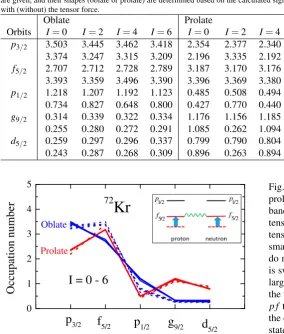
this monopole term (as schematically shown in the insert to Fig. 2), which in turn reduces the f5/2-p1/2energy gap when nucle-ons occupy the f5/2orbit. Thus, due to the tensor force, nucle-ons can be more easily excited from the f5/2orbit to the p1/2 orbit. Figure 2 shows occupation numbers for the oblate (blue) and prolate (red) bands, with (solid) and without (dashed)VTin
Table 2: Occupation numbers for72Kr, same for protons and neutrons, are displayed for the lowest four spins withI=0−6. For each spin, the lowest two states
are given, and their shapes (oblate or prolate) are determined based on the calculated sign ofQs. For each orbit, the first (second) number corresponds to the result
with (without) the tensor force.
Oblate Prolate
Orbits I=0 I=2 I=4 I=6 I=0 I=2 I=4 I=6 p3/2 3.503 3.445 3.462 3.418 2.354 2.377 2.340 2.335
3.374 3.247 3.315 3.209 2.196 3.335 2.192 2.186 f5/2 2.707 2.712 2.728 2.789 3.187 3.170 3.176 3.178 3.393 3.359 3.496 3.390 3.396 3.369 3.380 3.380 p1/2 1.218 1.207 1.192 1.123 0.485 0.508 0.494 0.496 0.734 0.827 0.648 0.800 0.427 0.770 0.440 0.442 g9/2 0.314 0.339 0.322 0.334 1.176 1.156 1.185 1.215
0.255 0.280 0.272 0.291 1.085 0.262 1.094 1.131 d5/2 0.259 0.297 0.296 0.337 0.799 0.790 0.804 0.777 0.243 0.287 0.268 0.309 0.896 0.263 0.894 0.861
0 1 2 3 4 5
I = 0 - 6
d
5/2g
9/2p
1/2f
5/2p
3/2O
cc
u
p
at
io
n
n
u
m
b
er
Oblate
Prolate
72
Kr
Figure 2: (Color online) Occupation numbers for72Kr, same for protons and
neutrons. The solid (dashed) lines indicate occupation numbers calculated with (without) the tensor force. Red and blue lines are used to distinguish occupation numbers for the prolate and oblate bands shown in Fig. 1.
to conserved isospin. We first compare the occupation number-s for oblate and prolate bandnumber-s with the tennumber-sor force. Anumber-s number-seen from the solid blue curve in Fig. 2, nucleons in the oblate band largely involvep f shell configurations with negligible occupa-tions in the gd shell. On the other hand, in the prolate band, thegdoccupation is quite large and approximately two protons and two neutrons jump into thegdshell. Thus, it is considered that the large collectivity in the prolate band originates from the simultaneous excitations of two protons and two neutrons from the p f togd shell. These quartet excitations will be discussed further in Section 4.. Such excitations have also been suggested for the interpretation of deformed bands in severalN=Znuclei [45, 46, 47, 48].
When the tensor force is switched off, we find significant d-ifferences in occupation for the oblate band. As seen in Fig. 2, withoutVT, the occupation number of the f5/2(p1/2) orbits
[image:5.595.37.322.105.440.2]increases (decreases) in the oblate band. Thus, due to the ten-sor force, the oblate band rises in energy because protons and neutrons in the f5/2orbit jump up to the p1/2orbit. The prolate band stays almost at the same energy because, as one sees from
Fig. 2, the tensor force does not influence the occupations in the prolate band very much. In other words, relative to the oblate band, the prolate band is pushed down considerably due to the tensor force effect. For the two 2+states calculated without the tensor force, however, the occupation numbers (see Table 2) are small for thegdshell. This means that the protons and neutrons do not jump up from thep f togdshell when the tensor force is switched off. As discussed above, the 2+states do not have largeQs, and are not connected by strongB(E2)values. When
the tensor force is switched on, the quartet excitations from the p f togdshell are clearly enhanced, which increases drastically the collectivity of the prolate states built on the first excited 0+ state (see Fig. 1). We thus conclude that the apparent shape changes discussed in Fig. 1 can be explained by the enhanced excitation from the f5/2to thep1/2in the oblate configurations and that this is a direct consequence of the tensor force.
4. Further discussion: Excitation of nucleon quartets
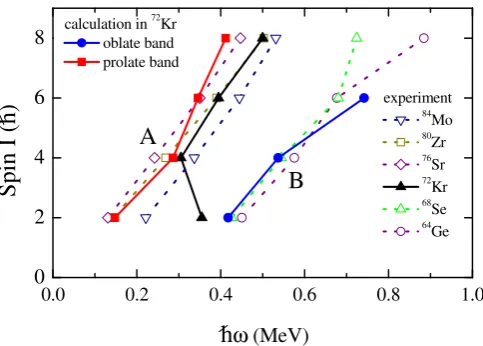
The presence of shape phase transitions [49] is well known in nuclei in the high-spin region where spin-alignment occurs [50]. As already suggested in Ref. [37] and experimentally sup-ported in Ref. [44], abrupt changes in structure happen when the proton and neutron numbers are near 35. In the present work, we further demonstrate that72Kr represents a unique ex-ample whereby the shape transition occurs within one nucleus due to excitation of nucleon quartets at very low spins. Figure 3 shows experimental data plotted in the form of spinI versus rotational frequency ¯hω= [E(I)−E(I−2)]/2 for several self-conjugate even-even nuclei fromN=Z=32 to 42. Note that for any given spin, ω is inversely proportional to moment of inertia defined asJ = (I−1/2)/¯hω. One sees a clear sepa-ration of two groups of data denoted by A (N=Z>36) and B (N=Z<36), indicating rather distinct shapes. The exist-ing data for72Kr suggest that thisN=Z=36 nucleus lies at a very special position. It is seen that the data point forI=2 of72Kr neither belongs to group A nor to group B, while those forI=4−8 fall into group A. This is consistent with the shape mixing picture of the oblate and prolate configurations near the
0 2 4 6 8
0.0 0.2 0.4 0.6 0.8 1.0
h
ω
(MeV)S
p
in
I
(
h
)
calculation in 72Kr oblate band prolate band
experiment 84
Mo 80
Zr 76
Sr 72
Kr 68
Se 64
Ge
A
B
Figure 3: (Color online) SpinIversus the rotational frequency ¯hω. The exper-imental data are plotted for the even-evenN=Znuclei withA=64−84. The calculated results for the oblate and prolate bands in72Kr, shown in Fig. 1, are
also plotted.
ground state. Our shell-model calculation for72Kr finds that the twoI=2 states fall in to the group A and B, respectively. Qual-itatively, this indicates that there may be insufficient mixing in our calculations to replicate the properties of the yrast 2+state, as already discussed earlier. However, a largerJ in the group A for the prolate band signifies a larger collectivity, which is consistent with theB(E2)andQsresults discussed in Fig. 1.
Shape coexistence in nuclei had its historical examples [1] in the neighborhood of theN=Z isotopes16O,40Ca, and 56Ni,
which are allα-particle multiplets. The high binding-energy of theα-particle could make it energetically favorable for nucle-on quartets [51] (comprising two protnucle-ons and two neutrnucle-ons) to form within the nucleus. Projected Shell Model [52] calcula-tions for theN=Znuclei48Cr [45] and36Ar [46] showed that along the yrast band, the excitation of nucleon quartets is the most favorable mode when these nuclei rotate [48]. Indepen-dently, Xuet al. [53] have recently found that such a quartet-ting wave function is dominant for theα-cluster preformation in dynamic processes of radioactiveα-decay. Remarkably, the states belonging to the group A in Fig. 3 clearly differ to those in B by excitations of nucleon quartets from thep f shell to the g9/2-d5/2orbits. In the transitional nucleus72Kr, the states with
nucleon-quartet excitation compete with those having only p f orbital occupation. The phenomenon of shape-coexistence may occur if the two types of states reside at similar energies at a given spin. Our calculations suggest that here the tensor force plays a role in setting up a shape co-existence environment near the ground state, without which the two types of states would have a greater separation energy (see Fig. 1). The tensor ef-fect changes dynamically with spin and orbital occupation. In
72Kr, the consequence of the competition shows up as a
dramat-ic shape transition atI=2 on the yrast line.
5. Summary
To summarize, the phenomenon of oblate-prolate shape-coexistence in72Kr is well known, but a deeper understanding for this problem at the interaction level has been missing. In order to learn about the physical origin, we have reinvestigat-ed this problem by performing large-scale shell-model calcu-lations using the PMMU interaction in the p f gdmodel space. The monopole interactions derived from the monopole-based universal force that contains the tensor force are explicitly in-cluded in the Hamiltonian, and the role in the shape evolution in self-conjugate nuclei can thus be discussed. By comparing the calculations with and without the tensor force, we found key differences between the two calculations in terms of the parti-cle occupations in particular orbits. We thus conclude that shell evolution can occur within the same nucleus through the com-bined effects of participating orbits and the tensor force act-ing on them. Shapes can coexist if two kinds of states, one with large prolate deformation and the other with weak oblate deformation, are found to be near the ground state. In 72Kr,
the structure difference between the two kinds of states is a nucleon-quartet excitation from the p f shell to the g9/2-d5/2 orbits. Moreover, it is the tensor force that creates a dynam-ical competition environment, in which a shape transition can happen at very low spins. However, as our employedd5/2s. p. energy (1.55 MeV above theg9/2orbit) is low compared to the value used in Ref. [40], further investigation to determine the d5/2s. p. energy in this region is desired.
A remaining question is how to understand the fact that var-ious beyond-mean-field calculations are able to describe, to a reasonable extent, the oblate-prolate shape coexistence phe-nomena in this mass region without explicit inclusion of the tensor force. We believe that this question is more fundamental, and a definite answer lies beyond the scope of the present pa-per. It is well-known that the tensor force is a key ingredient in the nucleon-nucleon bare interaction, and is explicitly included in the shell-model interaction for the Hamiltonian constructed from first principles. It has been long realized that in this mass region, the mean-field single-particle energies are very differ-ent from the data, and thus from the shell-model single-particle energies if those are taken directly from the data [54]. We thus speculate that the tensor effect must be hidden in the mean-field approaches, even though the term does not explicitly appear, so that their success in dealing with shape changes and shape coexistence can be explained. However, a derivation from the first principle is still lacking. On the other hand, the effect of the tensor field in the mean-field approaches on the deformation [21] and on Gamow-Teller transitions [55, 56] has been inves-tigated, providing examples of explicitly including this force in mean-field models to describe some particular quantities.
Acknowledgments
[image:6.595.42.284.78.251.2]and Development Program (No. 2016YFA0400501), and at Y-ork by the UK STFC under grant number ST/L005727/1.
References
[1] K. Heyde and J. L. Wood, Rev. Mod. Phys.83(2011) 1467. [2] N. Tajima and N. Suzuki, Phys. Rev. C64(2001) 037301. [3] S. M. Fischeret al., Phys. Rev. Lett.84(2000) 4064.
[4] M. Yamagami, K. Matsuyanagi, M. Matsuo, Nucl. Phys. A693(2001) 579.
[5] A. Petrovici, K. W. Schmid, and A. Faessler, Nucl. Phys. A665(2000) 333.
[6] A. Petrovici, K. W. Schmid, and A. Faessler, Nucl. Phys. A708(2002) 190.
[7] D. Almehed and N. R. Walet, Phys. Lett. B604(2004) 163. [8] T. A. War, R. Devi, and S. K. Khosa, Eur. Phys. J. A22(2004) 13. [9] M. Bender, P. Bonche, and P.-H. Heenen, Phys. Rev. C.74(2006) 024312. [10] J. A. Brizet al.Phys. Rev. C92(2015) 054326.
[11] G. de Angeliset al., Phys. Lett. B415(1997) 217. [12] N. S. Kelsallet al., Phys. Rev. C64(2001) 024309.
[13] S. M. Fischer, C. J. Lister, and D. P. Balamuth, Phys. Rev. C67(2003) 064318.
[14] E. Bouchezet al., Phys. Rev. Lett.90(2003) 082502.
[15] P. M. Walker and G. D. Dracoulis, Nature (London)399(1999) 35. [16] Y. Sun, M. Wiescher, A. Aprahamian, and J. Fisker, Nucl. Phys. A758
(2005) 765c.
[17] A. Petrovici and O. Andrei, Eur. Phys. J. A51(2015) 133. [18] H. Schatzet al., Phys. Rep.294(1998) 167.
[19] P. Sarriguren, E. Moya de Guerra, and A. Escuderos, Nucl. Phys. A658, (1999) 13.
[20] P. Sarriguren, E. Moya de Guerra, A. Escuderos, and A.C. Carrizo, Nucl. Phys. A635, (1998) 55.
[21] P. Sarriguren, E. Moya de Guerra, and A. Escuderos, Phys. Rev. C64, (2001) 064306.
[22] T. Otsuka, T. Matsuo, and D. Abe, Phys. Rev. Lett.97(2006) 162501. [23] M. Zalewski, J. Dobaczewski, W. Satula, and T. R. Werner, Phys. Rev. C
b f77, (2014) 024316.
[24] M. Zalewski, P. Olbratowski, M. Rafalski, W. Satula, T. R. Werner, and R. A. Wyss, Phys. Rev. Cb f80, (2009) 064307.
[25] M. Bender, K. Bennaceur, T. Duguet, P.-H. Heenen, T. Lesinski, and J. Meyer, Phys. Rev. C80, (2009) 064302.
[26] A. Petrovici, K. W. Schmid, A. Faessler, Prog. Part. Nucl. Phys.38(1997) 161.
[27] K. Sato and N. Hinohara, Nucl. Phys. A849(2011) 53. [28] Y. Fuet al., Phys. Rev. C87(2013) 054305.
[29] H. Iwasakiet al., Phys. Rev. Lett.112(2014) 142502. [30] A. Gade,et al., Phys. Rev. Lett.95(2005) 022502. [31] Y. Tsunodaet al., Phys. Rev. C89(2014) 031301(R). [32] T. Otsukaet al., Phys. Rev. Lett.95(2005) 232502.
[33] K. Kaneko, T. Mizusaki, Y. Sun, and S. Tazaki, Phys. Rev. C89(2014) 011302(R).
[34] T. Otsukaet al., Phys. Rev. Lett.104(2010) 012501.
[35] K. Kaneko, T. Mizusaki, Y. Sun, and S. Tazaki, Phys. Rev. C92(2015) 044331.
[36] M. Hasegawa, K. Kaneko, T. Mizusaki, and S. Tazaki, Phys. Rev. C69
(2004) 034324.
[37] M. Hasegawa, K. Kaneko, T. Mizusaki, and Y. Sun, Phys. Lett. B656
(2007) 51.
[38] K. Kaneko, Y. Sun, and G. de Angelis, Nucl. Phys. A,957(2017) 144. [39] J. Hakalaet al., Phys. Rev. Lett.101(2008) 052502.
[40] A. P. Zuker, A. Poves, F. Nowacki, and S. M. Lenzi, Phys. Rev. C92
(2015) 024320.
[41] T. Mizusaki, N. Shimizu, Y. Utsuno, and M. Honma, code MSHELL64 (unpublished).
[42] M. Honma, T. Otsuka, T. Mizusaki, and M. Hjorth-Jensen, Phys. Rev. C
80(2009) 064323.
[43] J. Ljungvallet al., Phys. Rev. Lett.100(2008) 102502. [44] A. J. Nicholset al., Phys. Lett. B733(2014) 52.
[45] K. Hara, Y. Sun, and T. Mizusaki, Phys. Rev. Lett.83(1999) 1922. [46] G.-L. Long and Y. Sun, Phys. Rev. C63(2001) 021305(R).
[47] T. Mizusaki, T. Otsuka, M. Honma, and B. A. Brown, Phys. Rev. C63
(2001) 044306.
[48] Y. Sun, Phys. Scr.91(2016) 043005.
[49] F. Iachello, N. V. Zamfir, R. F. Casten, Phys. Rev. Lett.81(1998) 1191. [50] Y. Sun, P. M. Walker, F.-R. Xu, and Y.-X. Liu, Phys. Lett. B659(2008)
165.
[51] M. Freer, Nature (London)487(2012) 309.
[52] K. Hara and Y. Sun, Int. J. Mod. Phys. E4(1995) 637. [53] C. Xuet al., Phys. Rev. C95(2017) 061306(R).
[54] Y. Sun, J.-y. Zhang, M. Guidry, J. Meng, and S. Im, Phys. Rev. C62
(2000) 021601(R).
[55] C. L. Baiet al., Phys. Rev. Lett.105(2010) 072501. [56] F. Minato and C. L. Bai, Phys. Rev. Lett.110(2013) 122501.