Resultados 1990
eurostat
ERHEBUNG ÜBER ARBEITSKRÄFTE
Ergebnisse 1990
LABOUR FORCE SURVEY
Results 1990
ENQUÊTE SUR LES FORCES DE TRAVAIL
Résultats 1990
INDAGINE SULLE FORZE DI LAVORO
Risultati 1990
/
"7
3£
eurostat
STATISTISCHES AMT DER EUROPÄISCHEN GEMEINSCHAFTEN STATISTICAL OFFICE OF THE EUROPEAN COMMUNITIES OFFICE STATISTIQUE DES COMMUNAUTÉS EUROPÉENNES
L-2920 Luxembourg - Tél. 43 01-1 - Télex: Comeur Lu 3423
B-1049 Bruxelles, bâtiment Berlaymont, rue de la Loi 200 (bureau de liaison) — Tél. 235 1 1 1 1
Eurostat hat die Aufgabe, den Informa-tionsbedarf der Kommission und aller am Aufbau des Binnenmarktes Beteilig-ten mit Hilfe des europäischen statisti-schen Systems zu decken.
Um der Öffentlichkeit die große Menge an verfügbaren Daten zugänglich zu machen und Benutzem die Orientierung zu erleichtern, werden zwei Arten von Publikationen angeboten: Statistische Dokumente und Veröffentlichungen. Statistische Dokumente sind für den Fachmann konzipiert und enthalten das ausführliche Datenmaterial: Bezugsda-ten, bei denen die Konzepte allgemein bekannt, standardisiert und wissen-schaftlich fundiert sind. Diese Daten werden in einer sehr tiefen Gliederung dargeboten. Die Statistischen Doku-mente wenden sich an Fachleute, die in der Lage sind, selbständig die benötig-ten Dabenötig-ten aus der Fülle des dargebote-nen Matehals auszuwählen. Diese Daten sind in gedruckter Form und/oder auf Diskette, Magnetband, CD-ROM verfüg-bar. Statistische Dokumente unterschei-den sich auch optisch von anderen Veröffentlichungen durch den mit einer stilisierten Graphik versehenen weißen Einband.
Die zweite Publikationsart, die Veröffent-lichungen, wenden sich an eine ganz bestimmte Zielgruppe, wie zum Beispiel an den Bildungsbereich oder an Ent-scheidungsträger in Politik und Verwal-tung. Sie enthalten ausgewählte und auf die Bedürfnisse einer Zielgruppe abge-stellte und kommentierte Informationen. Eurostat übernimmt hier also eine Art Beraterrolle.
Für einen breiteren Benutzerkreis gibt Eurostat Jahrbücher und periodische Veröffentlichungen heraus. Diese enthal-ten statistische Ergebnisse für eine erste Analyse sowie Hinweise auf weiteres Datenmaterial für vertiefende Untersu-chungen. Diese Veröffentlichungen werden in gedruckter Form und in Datenbanken angeboten, die in Menü-technik zugänglich sind.
Um Benutzem die Datensuche zu erleichtem, hat Eurostat Themenkreise, d. h. eine Untergliederung nach Sechge-bieten, eingeführt. Daneben sind sowohl die Statistischen Dokumente als auch die Veröffentlichungen in bestimmte Reihen, wie zum Beispiel „Jahrbücher", „Konjunktur", „Methoden", unterglie-dert, um den Zugriff auf die statistischen Informationen zu erleichtern.
Y. Franchet Generaldirektor
It is Eurostat's responsibility to use the European statistical system to meet the requirements of the Commission and all parties involved in the development of the single market.
To ensure that the vast quantity of accessible data is made widely avail-able, and to help each user make proper use of this information, Eurostat has set up two main categories of document: statistical documents and publications. The statistical document is aimed at specialists and provides the most com-plete sets of data: reference data where the methodology is well established, standardized, uniform and scientific. These data are presented in great detail. The statistical document is intended for experts who are capable of using their own means to seek out what they re-quire. The information is provided on paper and/or on diskette, magnetic tape, CD-ROM. The white cover sheet bears a stylized motif which distinguishes the statistical document from other publica-tions.
The publications proper tend to be com-piled for a well-defined and targeted public, such as educational circles or political and administrative decision-makers. The information in these docu-ments is selected, sorted and annotated to suit the target public. In this instance, therefore, Eurostat works in an advisory capacity.
Where the readership is wider and less well defined, Eurostat provides the infor-mation required for an initial analysis, such as yearbooks and periodicals which contain data permitting more in-depth studies. These publications are available on paper or in Videotext data-bases.
To help the user focus his research, Eurostat has created 'themes', i.e. a subject classification. The statistical documents and publications are listed by series: e.g. yearbooks, short-term trends or methodology in order to facili-tate access to the statistical data.
Y. Franchet Director-General
Pour établir, évaluer ou apprécier les différentes politiques communautaires, la Commission des Communautés euro-péennes a besoin d'informations. Eurostat a pour mission, à travers le système statistique européen, de répon-dre aux besoins de la Commission et de l'ensemble des personnes impliquées dans le développement du marché unique.
Pour mettre à la disposition de tous l'importante quantité de données acces-sibles et faire en sorte que chacun puisse s'orienter correctement dans cet ensemble, deux grandes catégories de documents ont été créées: les docu-ments statistiques et les publications. Le document statistique s'adresse aux spécialistes. Il fournit les données les plus complètes: données de référence où la méthodologie est bien connue, standardisée, normalisée et scientifique. Ces données sont présentées à un niveau très détaillé. Le document statis-tique est destiné aux experts capables de rechercher, par leurs propres moyens, les données requises. Les informations sont alors disponibles sur papier et/ou sur disquette, bande magnétique, CD-ROM. La couverture blanche ornée d'un graphisme stylisé démarque le document statistique des autres publications.
Les publications proprement dites peu-vent, elles, otre réalisées pour un public bien déterminé, ciblé, par exemple l'en-seignement ou les décideurs politiques ou administratifs. Des informations sélectionnées, triées et commentées en fonction de ce public lui sont apportées. Eurostat joue, dès lors, le rôle de con-seiller.
Dans le cas d'un public plus large, moins défini, Eurostat procure des éléments nécessaires à une première analyse, les annuaires et les périodiques, dans les-quels figurent les renseignements adé-quats pour approfondir l'étude. Ces publications sont présentées sur papier ou dans des banques de données de type vidéotex.
Pour aider l'utilisateur à s'orienter dans ses recherches, Eurostat a créé les thèmes, c'est-à-dire une classification par sujet. Les documents statistiques et les publications sont répertoriés par série — par exemple, annuaire, conjonc-ture, méthodologie — afin de faciliter l'accès aux informations statistiques.
Resultados 1990
ERHEBUNG ÜBER ARBEITSKRÄFTE
Ergebnisse 1990
LABOUR FORCE SURVEY
Results 1990
ENQUÊTE SUR LES FORCES DE TRAVAIL
Résultats 1990
INDAGINE SULLE FORZE DI LAVORO
Risultati 1990
Al final de la obra se incluye una ficha bibliográfica.
Bibliographische Daten befinden sich am Ende der Veröffentlichung. Cataloguing data can be found at the end of this publication. Une fiche bibliographique figure à la fin de l'ouvrage. Una scheda bibliografica figura alla fine del volume.
Luxembourg: Office des publications officielles des Communautés européennes, 1992
ISBN 92-826-3649-6
© CECA-CEE-CEEA, Bruxelles · Luxembourg, 1992
Reproduction autorisée, sauf à des fins commerciales, moyennant mention de la source.
según lo dispuesto en el Reglamento (CEE) n8 3044/89 del Consejo, de 6 de octubre de 1989.
A lo largo de los años, esta encuesta se ha convertido en una rica e importante fuente de datos para las estadísticas de las fuerzas de trabajo. La encuesta de las fuerzas de trabajo de la Comunidad es única en su género, debido al empleo de contenidos y definiciones comunes para todos los Estados miembros, y es objeto de una utilización intensiva con el fin de satisfacer las necesidades de estadísticas del mercado laboral que se precisan para la elaboración de las políticas comunitarias de desarrollo social y regional.
La encuesta de 1990 forma parte de la serie actual de encuestas anuales que se realizan desde 1983. En principio, el formato de dicha serie permanecerá sin modificar hasta 1991. A partir de 1992 se llevará a cabo una revisión en profundidad de la encuesta en el marco del programa estadístico de las Comu-nidades Europeas 1989-1992. La nueva serie incluirá una ampliación de los contenidos de la encuesta que permitirá satisfacer las variaciones de las necesidades de estadísticas, así como unaserie de mejoras referidas a lacalidad y la fiabilidad de los datos tanto en el ámbito regional como nacional.
La encuesta de las fuerzas de trabajo de la Comunidad se realiza teniendo en cuenta las directrices de la Oficina Internacional del Trabajo para este tipo de estadísticas, adoptadas en la 13a Conferencia Internacional de Estadísticas Laborales, celebrada en 1982. Por tanto, se ajusta a normas acordadas y aceptadas internacionalmente.
Podrá encontrarse más información sobre el contenido y las características metodológicas de los sondeos en la publicación «Encuesta de las fuerzas de trabajo: métodos y definiciones, 1988».
Expresamos nuesto agradecimiento a todos los expertos de los institutos nacio-nales de estadística que dirigieron las encuestas en cada Estado miembro y que proporcionaron a Eurostat los datos básicos de acuerdo con las necesidades de la Comunidad. La elaboración de los resultados que aquí se presentan corrió a cargo de la División «Empleo y desempleo» de la Oficina Estadística de las Comunidades Europeas.
Signos
y abreviaturas
— Cero o no disponible
No es cero pero es muy poco fiable
() Dato poco fiable debido al tamaño reducido de la muestra EUR 10 Comunidad, excluidos España y Portugal
EUR 12 Comunidad
Nota bibliográfica
Principales publicaciones de los resultados de las encuestas nacionales de 1990Belgique/België
Enquête par sondage sue les forces de travail, INS 1990 Steekproef enquête naar de beroepsbevolking, NIS 1990
Danmark
Arbejdsstyrkeundersøgelsen, Statistiske efterretninger, Danmarks Statistik
BR Deutschland
Bevölkerung und Erwerbstätigkeit, Fachserie 1, Reihe 4.1, Statistisches Bundesamt
Greece
Labour force survey, National Statistical Service of Greece
España
Encuesta de población activa
Principales resultados y resultados detallados (trimestral), Tablas anuales, INE
France
Enquête sur l'emploi 1990, les collections de l'lnsee
Ireland
Labour force survey 1990, Central Statistics Office
Itália
Rilevazione trimestrale sulle forze di lavoro, Istat Annuario statistico italiano, Istat
Luxembourg
Bulletin du Statec
Nederland
Enquête beroepsbevolking 1990, CBS
Portugal
Inquérito ao emprego 1990, INE
United Kingdom
Cuadro
Página
Notas explicativas 7
Población y actividad
01 Características principales de la actividad de la población (1 000/%) 44 02 Características principales de la actividad de los jóvenes entre 14 y 24 años (1 ΟΟΟΛ/ο) 46
03 Tasas de actividad por grupos de edad (%) 48
04 Tasas de actividad por estado civil y grupos de edad amplios (%) 50 05 Tasas de actividad por nacionalidad y grupos de edad amplios (%) 52
06 Correlación empleo/población por grupos de edad (%) 54
07 Correlación empleo/población por estado civil y grupos de edad amplios (%) 56
08 Tasas de desempleo por grupos de edad (%) 58
09 Tasas de desempleo por estado civil y grupos de edad amplios (%) 60
10 Población total por grupos de edad (1 000) 62
11 Población total por grupos de edad (%) 64
12 Población extranjera por grupos de edad amplios (1 000) 66
13 Población extranjera por grupos de edad amplios (%) 68
14 Fuerzas de trabajo por grupos de edad (1 000) 70
15 Fuerzas de trabajo por grupos de edad (%) 72
16 Fuerzas de trabajo por nacionalidad y grupos de edad amplios (1 000) 74 17 Fuerzas de trabajo por nacionalidad y grupos de edad amplios (%) 76
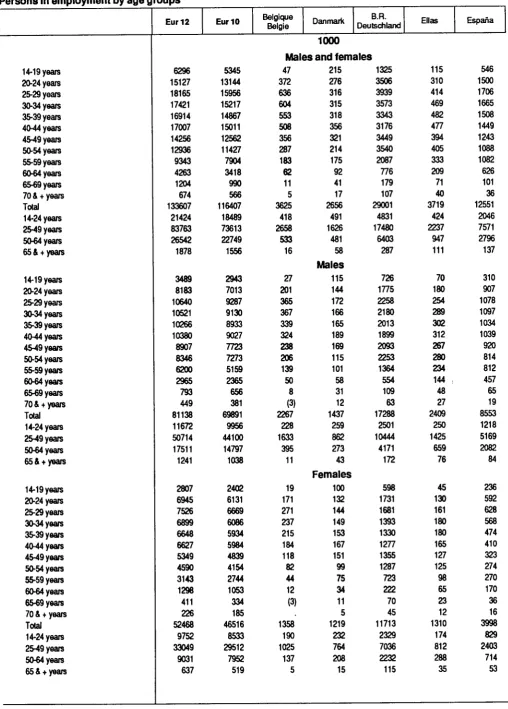
18 Personas con empleo por grupos de edad (1 000) 78
19 Personas con empleo por grupos de edad (%) 80
20 Parados por grupos de edad (1 000) 82
21 Parados por grupos de edad (%) 84
22 Población inactiva por grupos de edad (1 000) 86
23 Población inactiva por grupos de edad (%) 88
24 Jóvenes entre 14 y 24 años escolarizados por categorías principales de población y grupos de edad (1 000) 90 Empleo
25 Personas con empleo por situación profesional (1 000) 94
26 Personas con empleo por sector de actividad (1 000) 94
27 Personas con empleo por situación profesional (%) 96
28 Personas con empleo por sector de actividad (%) 96
29 Personas con empleo por situación profesional y sector de actividad (1 000) 98 30 Personas con empleo por situación profesional y sector de actividad (%) 100 31 Personas con empleo por sector de actividad y situación profesional (1 000) 102 32 Personas con empleo por sector de actividad y situación profesional (%) 104 33 Personas con empleo por situación profesional y desglose jornada completa/jornada parcial (1 000) . . . . 106 34 Personas con empleo por situación profesional y desglose jornada completa/jornada parcial (%) 108 35 Personas con empleo por sector de actividad y desglose jornada completa/jornada parcial (1 000) 110 36 Personas con empleo por sector de actividad y desglose jornada completa/jornada parcial (%) 112 37 Asalariados por sector de actividad y desglose jornada completa/jornada parcial (1 000) 114 38 Asalariados por sector de actividad y desglose jornada completa/jornada parcial (%) 116 39 Trabajadores autónomos por sector de actividad y desglose jornada completa/jornada parcial (1 000) . . . . 118 40 Trabajadores autónomos por sector de actividad y desglose jornada completa/jornada parcial (%) 120 41 Personas con empleo de jornada completa/a jornada parcial por grupos de edad amplios (1 000) 122 42 Personas con empleo de jornada completa/a jornada parcial por grupos de edad amplios (%) 124
43 Personas con empleo por actividad económica (1 000) 126
Página Cuadro
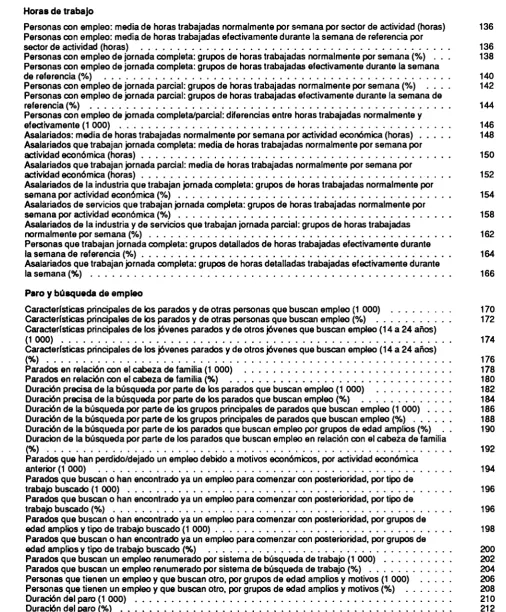
Horas de trabajo
47 Personas con empleo: media de horas trabajadas normalmente por semana por sector de actividad (horas) 136 48 Personas con empleo: media de horas trabajadas efectivamente durante la semana de referencia por
sector de actividad (horas) 136 49 Personas con empleo de jornada completa: grupos de horas trabajadas normalmente por semana (%) . . . 138
50 Personas con empleo de jornada completa: grupos de horas trabajadas efectivamente durante la semana
de referencia (%) 140 51 Personas con empleo de jornada parcial: grupos de horas trabajadas normalmente por semana (%) . . . . 142
52 Personas con empleo de jornada parcial: grupos de horas trabajadas efectivamente durante la semana de
referencia (%) 144 53 Personas con empleo de jornada completa/parcial: diferencias entre horas trabajadas normalmente y
efectivamente (1 000) 146 54 Asalariados: media de horas trabajadas normalmente por semana por actividad económica (horas) 148
55 Asalariados que trabajan jornada completa: media de horas trabajadas normalmente por semana por
actividad económica (horas) 150
56 Asalariados que trabajan jornada parcial: media de horas trabajadas normalmente por semana poractividad económica (horas) 152 57 Asalariados de la industria que trabajan jornada completa: grupos de horas trabajadas normalmente por
semana por actividad económica (%) 154 58 Asalariados de servicios que trabajan jornada completa: grupos de horas trabajadas normalmente por
semana por actividad económica (%) 158 59 Asalariados de la industria y de servicios que trabajan jornada parcial: grupos de horas trabajadas
normalmente por semana (%) 162 60 Personas que trabajan jornada completa: grupos detallados de horas trabajadas efectivamente durante
la semana de referencia (%) 164 61 Asalariados que trabajan jornada completa: grupos de horas detalladas trabajadas efectivamente durante
la semana (%) 166
Paro y búsqueda de empleo
62 Características principales de los parados y de otras personas que buscan empleo (1 000) 170 63 Características principales de los parados y de otras personas que buscan empieo (%) 172 64 Características principales de los jóvenes parados y de otros jóvenes que buscan empleo (14 a 24 años)
(1 000) 174
65 Características principales de los jóvenes parados y de otros jóvenes que buscan empleo (14 a 24 años)(%) 176
66 Parados en relación con el cabeza de familia (1 000) 17867 Parados en relación con el cabeza de familia (%) 180 68 Duración precisa de la búsqueda por parte de los parados que buscan empleo (1 000) 182
69 Duración precisa de la búsqueda por parte de los parados que buscan empleo (%) 184 70 Duración de la búsqueda por parte de los grupos principales de parados que buscan empleo (1 000) . . . . 186
71 Duración de la búsqueda por parte de los grupos principales de parados que buscan empleo (%) 188 72 Duración de la búsqueda por parte de los parados que buscan empleo por grupos de edad amplios (%) 190 73 Duración de la búsqueda por parte de los parados que buscan empleo en relación con el cabeza de familia
(%) 192 74 Parados que han perdido/dejado un empleo debido a motivos económicos, por actividad económica
anterior (1 000) 194 75 Parados que buscan o han encontrado ya un empleo para comenzar con posterioridad, por tipo de
trabajo buscado (1 000) 196 76 Parados que buscan o han encontrado ya un empleo para comenzar con posterioridad, por tipo de
trabajo buscado (%) 196 77 Parados que buscan o han encontrado ya un empleo para comenzar con posterioridad, por grupos de
edad amplios y tipo de trabajo buscado (1 000) 198 78 Parados que buscan o han encontrado ya un empleo para comenzar con posterioridad, por grupos de
edad amplios y tipo de trabajo buscado (%) 200 79 Parados que buscan un empleo renumerado por sistema de búsqueda de trabajo (1 000) 202
80 Parados que buscan un empleo renumerado por sistema de búsqueda de trabajo (%) 204 81 Personas que tienen un empleo y que buscan otro, por grupos de edad amplios y motivos (1 000) 206
82 Personas que tienen un empleo y que buscan otro, por grupos de edad amplios y motivos (%) 208
Organización de la encuesta
La Oficina Estadística de las Comunidades Europeas (Euros-tat), junto con los expertos nacionales de los Estados miem-bros, fijan el contenido de la encuesta y aportan una descripción detallada según un código común.
El artículo 4 del Reglamento (CEE) ns 3044/89 del Consejo, que constituyó la base jurídica de la encuesta 1990, incluye una presentación resumida del tipo de información que cubre la encuesta.
Los institutos nacionales de estadística se encargan de selec-cionar la muestra, preparar los cuestionarios, dirigir las en-cuestas directas a los hogares y remitir los resultados a Eurostat de acuerdo con el código normalizado.
Eurostat determina el programa de análisis de resultados y se encarga de elaborar y difundir la información remitida por los institutos nacionales.
La publicación «Encuesta de las fuerzas de trabajo: métodos y definiciones» presenta una descripción detallada de los métodos de muestreo, los procedimientos de ajuste, las defi-niciones y el código comunitario común utilizado actualmente en la encuesta de las fuerzas de trabajo.
Período de referencia
Las características individuales de todas las personas encues-tadas se refieren a su situación laboral en una semana de referencia determinada.
Por regla general, la semana de referencia debe ser una semana normal de primavera, excluyendo los días festivos. Para los países que utilizan una semana fija (como hace, por ejemplo, Italia) esta condición es de fácil cumplimiento. En algunos países, sin embargo, la semana de referencia es la precedente a la semana de la encuesta, y dado que ésta se prolonga durante un período de tiempo, se utiliza el método de la semana de referencia móvil. En este caso se puede garan-tizar que la semana de referencia represente una semana normal.
Para la encuesta de 1990, las semanas de referencia se distribuyeron dentro de los períodos siguientes:
Bélgica Dinamarca R.F. de Alemania Grecia
España Francia Irlanda Italia
abril marzo-abril abril abril-junio marzo-junio enero-marzo abril-mayo abril
Portugal Reino Unido
Campo de la encuesta
enero y abril marzo-mayo
La encuesta está proyectada para cubrir la totalidad de la población residente, es decir, todas las personas cuyo lugar habitual de residencia se encuentra en el territorio de los Estados miembros de la Comunidad.
Sin embargo, por razones técnicas y metodológicas, no es posible incluir en todos los países a la población que reside en hogares colectivos, es decir, a las personas que viven en residencias, internados, hospitales, instituciones religiosas, residencias para trabajadores, etc.
Por consiguiente, con el fin de armonizar el campo de la encuesta, ios resultados de la Comunidad se compilan única-mente sobre la base de la población en unidades domésticas privadas. Esto incluye todas las personas que residen en el hogar encuestadas durante la semana de referencia. Esta definición también incluye a los miembros ausentes del hogar por períodos cortos debido a estudios, vacaciones, enferme-dad, viajes profesionales, etc.
Los tamaños muéstrales se fijaron de acuerdo con las reco-mendaciones del artículo 3 del citado Reglamento, siendo las cifras de hogares privados que participaron en cada país en la encuesta de 1990 las siguientes:
Bélgica Dinamarca R.F. de Alemania Grecia
España Francia Irlanda Italia Luxemburgo Países Bajos Portugal Reino Unido
Flabilidad de los resultados
31 732 16 489 103 273 48 971 59 478 65 302 45 289 140 832
9 265
29 951 26 499 63 821
Error de muestreo
y la uniformidad con que ésta se distribuye entre la población. De dos estimaciones, lo más probable es que la mayor tenga un error de muestreo porcentual menor, mientras que de dos estimaciones de tamaño similar la que se refiere a una carac-terística distribuida más uniformemente en la población estará, en general, sujeta a menor variabilidad relativa de muestreo. En la presente publicación se han sustituido por «.» los resul-tados que pueden tener márgenes muy amplios de variabilidad relativa de muestreo, en tanto que otras estimaciones relativa-mente imprecisas figuran entre paréntesis.
El coeficiente de variación de una estimación puede propor-cionar un indicio del error de muestreo porcentual. Eurostat ha solicitado de los Estados miembros que calculen el coeficiente de variación de algunas variables básicas por sexo y edad (asalariados por grupo industrial amplio, parados, tasas de desempleo, tasas de población activa y de actividad). Las respuestas recibidas indican que, por lo que respecta a las variables citadas, la encuesta de las fuerzas de trabajo sumi-nistra resultados fiables a escala nacional.
Respuesta a la encuesta
Una causa importante de errores ajenos al muestreo en la encuesta de las fuerzas de trabajo es el efecto de la falta de respuesta sobre los resultados. Las tasas de falta de respuesta oscilaron por lo general entre el 5 y el 19 % aproximadamente, girando en torno al 6 % en la mayoría de los Estados m iembros. En la mayoría de los países se corrigió la falta de respuesta mediante una nueva ponderación de los resultados, aunque en algunos casos el método empleado fue la «duplicación» o «sustitución» de las unidades. Los controles cualitativos lleva-dos a cabo en diversos paises sugieren una posible subrepre-sentación de los hogares de una sola persona, ya que éstos suelen ser más difíciles de contactar que los compuestos por varias personas.
Ponderación
Los resultados de la encuesta de 1990 se ponderaron con respecto a estimaciones de población establecidas de forma independiente relativas a diversas categorías de edad, sexo, región, nacionalidad, etc. Podrá encontrarse más información sobre los procedimientos de corrección y ponderación en «Encuesta de las fuerzas de trabajo: métodos y definiciones».
Conceptos y definiciones básicas
Las personas con empleo son aquellas que durante la semana de referencia realizaban un trabajo remunerado o con benefi-cios, o que no estaban trabajando peto tenían un empleo del que se encontraban temporalmente ausentes. Se incluye a los trabajadores familiares, pero se excluye a las personas des-pedidas.
Los parados son aquellas personas que, durante el período de referencia, no tenían un empleo y:
a) estaban buscando un empleo remunerado y se hallaban disponibles para comenzar a trabajar de inmediato, o b) estaban proyectando establecer un negocio propio o
dedicarse al ejercicio de una profesión, o
c) estaban esperando ser readmitidos en un empleo del que se les habla despedido, o
d) hablan encontrado un empleo en el que iban a comenzar después de la semana de referencia.
La fuerza de trabajo se define como el conjunto de personas con empleo y parados. Es sinónimo de «población activa». Las personas inactivas son aquellas que no están clasificadas como empleadas o paradas.
Estas definiciones se refieren a la población en edad laboral (14 años o más).
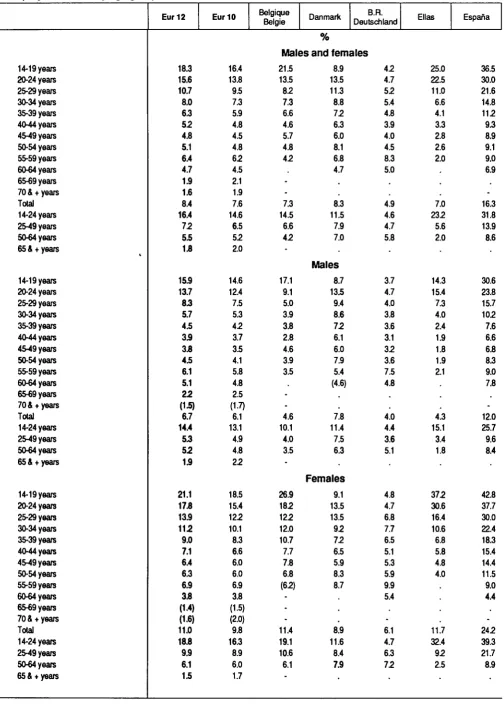
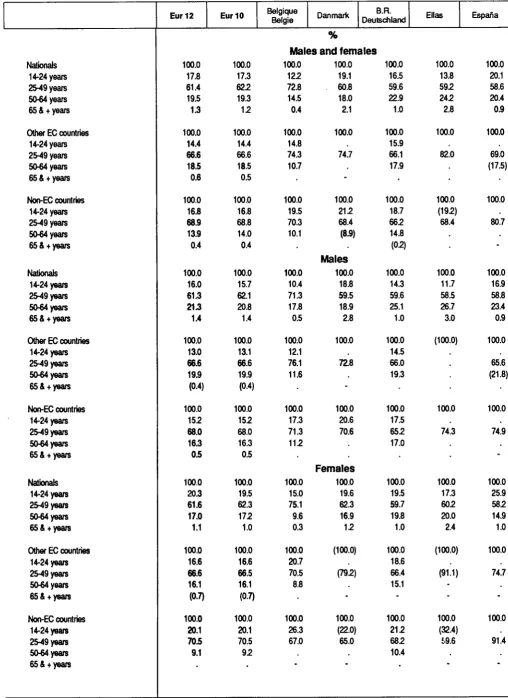
Las tasas de actividad representan el porcentaje de la fuerza de trabajo sobre la población en edad laboral que reside en hogares privados.
Las correlaciones empleo/población representan el porcentaje de las personas con empleo sobre la población en edad laboral que reside en hogares privados.
Las tasas de paro representan el porcentaje de las personas en paro sobre las fuerzas de trabajo.
Las tasas mencionadas normalmente se calculan por grupos de edad y sexo, y algunas veces se efectúan también clasifi-caciones cruzadas con respecto a otras variables demográfi-cas, tales como estado civil o nacionalidad.
Por duración del paro se entiende:
a) la duración de la búsqueda de empleo, o
b) el tiempo transcurrido desde el último empleo (en el caso de que sea un período más breve que el de la búsqueda de empleo).
Estas definiciones y conceptos se explican detalladamente en la publicación «Encuesta de las fuerzas de trabajo: métodos y definiciones».
Comparabilidad con encuestas anteriores
Los conceptos y definiciones utilizados en la serie actual de encuestas se introdujeron en 1983 y se basaban en las reco-mendaciones de la Oficina Internacional del Trabajo. Ha sido posible comparar los resultados de las encuestas anuales entre si debido a que se han seguido aplicando dichos con-ceptos. Por otra parte, existe la posibilidad de comparar los datos obtenidos con los datos referidos a los países no comu-nitarios que aplican las mismas definiciones, fruto de un acuer-do internacional. Sin embargo, tras la revisión efectuada en 1983, los resultados de las actuales encuestas de las fuerzas de trabajo de la Comunidad no podrán compararse con los obtenidos en las encuestas anteriores a 1983.
En la publicación de los resultados de la encuesta de 1983 se describen los distintos cambios de definición y se da una evaluación de los efectos cuantitativos de estos cambios entre 1981 y 1983.
Observaciones específicas sobre la encuesta de
1990
Debido a la utilización del método de selección de muestras basado en la unidad familiar, el puesto de «cabeza de familia» se asigna normalmente a la mujer, considerándose al varón como «cónyuge».
R.F. de ALEMANIA
El incremento en la población de «No nacionales» proceden-tes de países fuera de la Comunidad no incluye ninguna entrada de ciudadanos de la RDA, dado que no se distinguen por nacionalidad.
GRECIA
La cifra relativamente baja de paro registrado que se da en Grecia se debe al sistema especial de subsidio de desempleo que existe en este país.
FRANCIA
Para los resultados de Francia las ponderaciones utilizadas siguen basándose en el año 1982, como en años precedentes. Los resultados del censo de 1990 no estaban disponibles en el momento de imprimir esta publicación.
dentes en Italia.
b) El número relativamente elevado de personas que bus-can un primer empleo refleja la convención y la práctica de la estabilidad de empleo en el mercado de trabajo italiano. La contrapartida a esta cifra elevada es el núme-ro relativamente bajo de parados que buscan un trabajo tras haber perdido su empleo.
PAÍSES BAJOS
Las cifras sobre educación y formación no son comparables con las encuestas anteriores debido al cambio de cuestionario holandés.
REINO UNIDO
a) El concepto de trabajador familiar no existe en el Reino Unido.
des Rates vom 6. Oktober 1989 in der Gemeinschaft durchgeführt worden ist. Im Laufe der Jahre ist die genannte Erhebung zu einer wichtigen und umfang-reichen Quelle statistischer Daten über Arbeitskräfte entwickelt worden. Die Erhebung über Arbeitskräfte (EAK) der Gemeinschaft ¡st deshalb eine Beson-derheit, weil gemeinsame Merkmale und Definitionen für alle Mitgliedstaaten verwendet werden. Daher werden die Ergebnisse in großem Umfang genutzt, um den Bedarf hinsichtlich statistischer Daten über den Arbeitsmarkt für die soziale und regionale Entwicklungspolitik der Gemeinschaft zu decken. Die Erhebung von 1990 gehört zu der laufenden Reihe jährlich durchgeführter Erhebungen, mit der 1983 begonnen wurde. Diese Reihe soll im wesentlichen in unveränderter Form bis 1991 fortgesetzt werden. Im Rahmen des statistischen Programms der Europäischen Gemeinschaften 1989-1992 ist für 1992 eine grundlegende Überarbeitung der Erhebung vorgesehen. Bei der neuen Reihe sollen dem Wandel des Statistikbedarfs durch eine inhaltliche Erweiterung der Erhebung Rechnung getragen und die Qualität und Zuverlässigkeit der Daten sowohl auf nationaler als auch auf regionaler Ebene verbessert werden. Bei der Durchführung der Arbeitskräfteerhebung in der Gemeinschaft werden die Leitlinien des Internationalen Arbeitsamtes für die Arbeitskräftestatistik berück-sichtigt, die auf der 13. Internationalen Konferenz der Arbeitsstatistiker im Jahre 1982 angenommen wurden und die daher international vereinbarten und akzep-tierten Normen entsprechen.
Informationen über den Inhalt und die methodischen Merkmale der Erhebungen sind in der Veröffentlichung „Erhebung über Arbeitskräfte - Methodik und Defi-nitionen, 1988' enthalten.
Unser Dank gilt allen Sachverständigen der statistischen Dienste der Mitglied-staaten, die für die Durchführung der Erhebung in den einzelnen Mitgliedstaaten und für die Übermittlung der Grunddaten entsprechend den Erfordernissen der Gemeinschaft zuständig waren. Für die Aufbereitung der hier vorgelegten Er-gebnisse war die Abteilung .Beschäftigung und Arbeitslosigkeit" des Statisti-schen Amtes der EuropäiStatisti-schen Gemeinschaften verantwortlich.
Zeichen
und Abkürzungen
Null oder nicht verfügbar
Von Null abweichend, aber höchst unzuverlässig
() Daten wegen des geringen Stichprobenumfänge unzuverlässig EUR 10 Gemeinschaft ausschließlich Spaniens und Portugals
EUR 12 Gemeinschaft
Bibliographie
Hauptveröffentlichungen über die Ergebnisse einzelstaatlicherErhebungen 1990
Belgique/Bekjie
Enquête par sondage sur les forces de travail, INS 1990 Steekproef enquête naarde beroepsbevolking, NIS 1990
Danmark
Arbejdsstyrkeundersøgelsen, Statistiske efterretninger, Danmarks Statistik
BR Deutschland
Bevölkerung und Erwerbstätigkeit, Fachserie 1, Reihe 4.1, Statistisches Bundesamt
Greece
Labour force survey, National Statistical Service of Greece
España
Encuesta de población activa
Principales resultados y resultados detallados (trimestral), Tablas anuales, INE
France
Enquête sur l'emploi 1990, les collections de l'Insee
Ireland
Labour force survey 1990, Central Statistics Office
Italia
Rilevazione trimestrale sulle forze di lavoro, Istat Annuario statistico italiano, Istat
Luxembourg
Bulletin du Statec
Nederland
Enquête beroepsbevolking 1990, CBS
Portugal
Inquérito ao emprego 1990, INE
United Kingdom
Seite
Erläuterungen 15
Tabelle
Bevölkerung und Erwerbstätigkeit
01 Wichtigste Merkmale der Erwerbstätigkeit der Bevölkerung (1 000/%) 44 02 Wichtigste Merkmale der Erwerbstätigkeit von Jugendlichen-14 bis 24 Jahre (1 000/%) 46
03 Erwerbsquoten nach Altersgruppen (%) 48 04 Erwerbsquoten nach Familienstand und grob untergliederten Altersgruppen (%) 50
05 Erwerbsquoten nach Staatsangehörigkeit und grob untergliederten Altersgruppen (%) 52 06 Quote der Beschäftigten, bezogen auf die Bevölkerung nach Altersgruppen (%) 54 07 Quote der Beschäftigten, bezogen auf die Bevölkerung nach Familienstand und grob untergliederten
Altersgruppen (%) 56 08 Arbeitslosenquoten nach Altersgruppen (%) 58
09 Arbeitslosenquoten nach Familienstand und grob untergliederten Altersgruppen (%) 60
10 Gesamtbevölkerung nach Altersgruppen (1 000) 62 11 Gesamtbevölkerung nach Altersgruppen (%) 64 12 Ausländische Bevölkerung nach grab untergliederten Altersgruppen (1 000) 66
13 Ausländische Bevölkerung nach grob untergliederten Altersgruppen (%) 68
14 Arbeitskräfte nach Altersgruppen (1 000) 70 15 Arbeitskräfte nach Altersgruppen (%) 72 16 Arbeitskräfte nach Staatsangehörigkeit und grob untergliederten Altersgruppen (1 000) 74
17 Arbeitskräfte nach Staatsangehörigkeit und grob untergliederten Altersgruppen (%) 76
18 Beschäftigte Personen nach Altersgruppen (1 000) 78 19 Beschäftigte Personen nach Altersgruppen (%) 80 20 Arbeitslose nach Altersgruppen (1 000) 82 21 Arbeitslose nach Altersgruppen (%) 84 22 Nichtaktive Personen nach Altersgruppen (1 000) 86
23 Nichtaktive Personen nach Altersgruppen (%) 88 24 Personen in Ausbildung (14 bis 24 Jahre) nach Hauptbevölkerungskategorien und Altersgruppen (1 000) . . 90
Beschäftigung
25 Beschäftigte Personen nach Stellung im Beruf (1 000) 94 26 Beschäftigte Personen nach Wirtschaftsbereichen (1 000). 94 27 Beschäftigte Personen nach Stellung im Beruf (%) 96 28 Beschäftigte Personen nach Wirtschaftsbereichen (%) 96 29 Beschäftigte Personen nach Stellung im Beruf und Wirtschaftsbereichen (1 000) 98
30 Beschäftigte Personen nach Stellung im Beruf und Wirtschaftsbereichen (%) 100 31 Beschäftigte Personen nach Wirtschaftsbereichen und Stellung im Beruf (1 000) 102 32 Beschäftigte Personen nach Wirtschaftsbereichen und Stellung im Beruf (%) 104 33 Beschäftigte Personen nach Stellung im Beruf und VollzeiWTeilzeittätigkeit (1 000) 106 34 Beschäftigte Personen nach Stellung im Beruf und VollzeiWTeilzeittätigkeit (%) 108 35 Beschäftigte Personen nach Wirtschaftsbereichen und Vollzeit-/Teilzeittätigkeit (1 000) 110 36 Beschäftigte Personen nach Wirtschaftsbereichen und VollzeiWTeilzeittätigkeit (%) 112 37 Abhängig Beschäftigte nach Wirtschaftsbereichen und VollzeiWTeilzeittätigkeit (1 000) 114 38 Abhängig Beschäftigte nach Wirtschaftsbereichen und VollzeiWTeilzeittätigkeit (%) 116 39 Nichtabhängig Beschäftigte nach Wirtschaftsbereichen und Vollzeit-ZTeilzeittätigkeit (1 000) 118
40 Nichtabhängig Beschäftigte nach Wirtschaftsbereichen und VollzeiWTeilzeittätigkeit (%) 120 41 Personen mit VollzeiWTeilzeittätigkeit nach grob untergliederten Altersgruppen (1 000) 122 42 Personen mit VollzeiWTeilzeittätigkeit nach grob untergliederten Altersgruppen (%) 124
Seite Tabelle
Arbeltszelt
47 Beschäftigte Personen - Zahl der durchschnittlich pro Woche geleisteten Arbeitsstunden nach
Wirtschaftsbereichen (Std.) 136 48 Beschäftigte Personen - Zahl der tatsächlich in der Berichtswoche geleisteten Arbeitsstunden nach
Wirtschaftsbereichen (Std.) 136 49 Beschäftigte Personen mit Vollzeittätigkeit nach Größenklassen von durchschnittlich pro Woche
geleisteten Arbeitsstunden (%) 138 50 Beschäftigte Personen mit Vollzeittätigkeit nach Größenklassen von tatsächlich in der Berichtswoche
geleisteten Arbeitsstunden (%) 140 51 Beschäftigte Personen mit Teilzeittätigkeit nach Größenklassen von durchschnittlich pro Woche
geleisteten Arbeitsstunden (%) 142 52 Beschäftigte Personen mit Teilzeittätigkeit nach Größenklassen von tatsächlich in der Berichtswoche
geleisteten Arbeitsstunden (%) 144 53 Personen mit Vollzeit-/Teilzeittätigkeit nach Unterschieden zwischen den durchschnittlichen und tatsächlich
pro Woche geleisteten Arbeitsstunden (1 000) 146 54 Abhängig Beschäftigte - Zahl der durchschnittlich pro Woche geleisteten Arbeitsstunden nach
Wirtschaftszweigen (Std.) 148 55 Abhängig Beschäftigte mit Vollzeittätigkeit - Zahl der durchschnittlich pro Woche geleisteten Arbeitsstunden
nach Wirtschaftszweigen (Std.) 150 56 Abhängig Beschäftigte mit Teilzeittätigkeit - Zahl der durchschnittlich pro Woche geleisteten Arbeitsstunden
nach Wirtschaftszweigen (Std.) 152 57 In der Industrie abhängig Beschäftigte mit Vollzeittätigkeit - Größenklassen von durchschnittlich pro Woche
geleisteten Arbeitsstunden nach Wirtschaftszweigen (%) 154 58 Im Dienstleistungsbereich abhängig Beschäftigte mit Vollzeittätigkeit-Größenklassen von durchschnittlich
pro Woche geleisteten Arbeitsstunden nach Wirtschaftszweigen (%) 158 59 In der Industrie sowie im Dienstleistungsbereich abhängig Beschäftigte mit Teilzeittätigkeit - Größenklassen
von durchschnittlich pro Woche geleisteten Arbeitsstunden (%) 162 60 Beschäftigte Personen mit Vollzeittätigkeit nach feiner untergliederten Größenklassen von tatsächlich in der
Berichtswoche geleisteten Arbeitsstunden (%) 164 61 Abhängig Beschäftigte mit Vollzeittätigkeit nach feiner untergliederten Größenklassen von tatsächlich in der
Berichtswoche geleisteten Arbeitsstunden (%) 166
Arbeitslosigkeit und Arbeitsuche
62 Wichtigste Merkmale der Arbeitslosen und sonstigen Arbeitsuchenden (1 000) 170 63 Wichtigste Merkmale der Arbeitslosen und sonstigen Arbeitsuchenden (%) 172 64 Wichtigste Merkmale der jugendlichen Arbeitslosen und sonstigen jugendlichen Arbeitsuchenden 14 bis 24
Jahre (1 000) 174 65 Wichtigste Merkmale der jugendlichen Arbeitslosen und sonstigen jugendlichen Arbeitsuchenden 14 bis 24
Jahre (%) 176 66 Arbeitslose nach dem Verwandtschafts verhält nis zum Haushaltsvorstand (1 000) 178
67 Arbeitslose nach dem Verwandtschaf tsver hält n is zum Haushaltsvorstand (%) 180 68 Aufgegliederte Dauer der Arbeitsuche von arbeitslosen Arbeitsuchenden (1 000) 182 69 Aufgegliederte Dauer der Arbeitsuche von arbeitslosen Arbeitsuchenden (%) 184 70 Dauer der Arbeitsuche für die wichtigsten Gruppen von arbeitslosen Arbeitsuchenden (1 000) 186
71 Dauer der Arbeitsuche für die wichtigsten Gruppen von arbeitslosen Arbeitsuchenden (%) 188 72 Dauer der Arbeitsuche von arbeitslosen Arbeitsuchenden nach grob untergliederten Altersgruppen (%) . . . 190
73 Dauer der Arbeitsuche von arbeitslosen Arbeitsuchenden nach dem Verwandtschaftsverhältnis zum
Haushaltsvorstand (%) 192 74 Arbeitslose, die ihre Arbeit als abhängig Beschäftigte aus wirtschaftlichen Gründen verloren oder selbständig
gekündigt haben, nach vorherigem Wirtschaftszweig (1 000) 194 75 Arbeitslose, die eine Arbeit suchen oder bereits gefunden haben, die sie jedoch erst später aufnehmen,
nach Art der gesuchten Beschäftigung (1 000) 196 76 Arbeitslose, die eine Arbeit suchen oder bereits gefunden haben, die sie jedoch erst später aufnehmen,
nach Art der gesuchten Beschäftigung (%) 196 77 Arbeitslose, die eine Arbeit suchen oder bereits gefunden haben, die sie jedoch erst später aufnehmen,
nach grob untergliederten Altersgruppen und Art der gesuchten Beschäftigung (1 000) 198 78 Arbeitslose, die eine Arbeit suchen oder bereits gefunden haben, die sie jedoch erst später aufnehmen,
nach grob untergliederten Altersgruppen und Art der gesuchten Beschäftigung (%) 200 79 Arbeitslose, die eine bezahlte Beschäftigung suchen, nach Art der Arbeitsuche (1 000) 202 80 Arbeitslose, die eine bezahlte Beschäftigung suchen, nach Art der Arbeitsuche (%) 204 81 Personen, die einer Tätigkeit nachgehen und eine andere suchen, nach grob untergliederten Altersgruppen
und Gründen (1 000) 206 82 Personen, die einer Tätigkeit nachgehen und eine andere suchen, nach grob untergliederten Altersgruppen
und Gründen (%) 208 83 Dauer der Arbeitslosigkeit (1 000) 210
Organisation der Erhebung
Das Statistische Amt der Europäischen Gemeinschaften (Eu-rostat) legt in Zusammenarbeit mit den nationalen Sachver-ständigen der Mitgliedstaaten den Inhalt der Erhebung fest und gibt eine detaillierte Beschreibung in einer gemeinsamen Ko-dierung.
Artikel 4 der Verordnung (EWG) Nr. 3044/89 des Rates, die die Rechtsgrundlage für die Erhebung 1990 bildete, enthält eine kurze Beschreibung der im Rahmen der Erhebung erfragten Informationen.
Den statistischen Diensten der Mitgliedsländer fallen folgende Aufgaben zu: Auswahl der Stichprobe, Vorbereitung der Fra-gebogen, Abwicklung der direkten Befragungen von Haushal-ten sowie Übermittlung der Ergebnisse an Eurostat gemäß dem standardisierten Kodierungsschema.
Eurostat arbeitet das Programm für die Analyse der Ergebnis-se aus und ist für Verarbeitung und Verbreitung der von den einzelstaatlichen Stellen gelieferten Informationen zuständig. Eine genaue Beschreibung der bei der Stichprobenauswahl angewandten Methoden, der Anpassungsverfahren, der Defi-nitionen und der für die Erhebung über Arbeitskräfte auf Ge-meinschaftsebene verwendeten gemeinsamen Kodierung ist der Veröffentlichung Erhebung über Arbeitskräfte - Methodik und Definitbnen zu entnehmen.
Bezugszeitraum
Die Angaben zur Beschäftigungslage der einzelnen Befragten beziehen sich auf die jeweilige Situation in einer ganz bestimm-ten Bezugswoche.
Im allgemeinen sollte es sich bei der Bezugswoche um eine normale Woche im Frühjahr ohne gesetzliche Feiertage handeln. In den Ländern, die sich auf eine ganz bestimmte Woche festlegen - z. B. Italien - , läßt sich diese Forderung ohne weiteres erfüllen. In einigen Ländern gilt jedoch die Woche vor der Erhebungswoche als Bezugszeitraum, und da sich die Erhebung über eine bestimmte Zeitspanne erstreckt, wird hier unter Zugrundelegung einer beweglichen Bezugswo-che vorgegangen. In diesem Fall kann nicht gewährleistet werden, daß es sich bei der Bezugswoche um eine normale Woche handelt.
Für die Erhebung von 1990 fielen die Bezugswochen in folgen-de Zeiten:
Italien Luxemburg Niederlande Portugal
Vereinigtes Königreich
April April Januar-Mai Januar und April März-Mai
Belgien Dänemark
Bundesrepublik Deutschland Griechenland
Spanien Frankreich Irland
April März-April April April-Juni März-Juni Januar-März April-Mai
Erhebungsbereich
Die Erhebung soll alle Gebietsansässigen - d. h. alle Perso-nen, deren regulärer Wohnsitz sich auf dem Territorium der Mitgliedstaaten der Gemeinschaft befindet - erfassen. Aus technischen und methodischen Gründen ist es jedoch nicht in allen Ländern möglich, die in Anstaltshaushalten lebende Bevölkerung, zu der u. a. die in Heimen, Internaten, Krankenhäusern, kirchlichen Einrichtungen und Arbeiterhei-men wohnenden Personen gehören, mit zu erfassen. Infolged-essen werden die Gemeinschaftsergebnisse um der Harmonisierung des Erhebungsbereiches willen ausschließ-lich auf der Grundlage der in privaten Haushalten lebenden Bevölkerung zusammengestellt.
Erfaßt werden alle Personen, die in der Bezugswoche in den befragten Haushalten leben. Diese Definition schließt auch alle diejenigen ein, die kurzzeitig wegen Bildungsmaßnahmen, Urlaub, Krankheit, Geschäftsreise und ähnlichem nicht im Haushalt anwesend sind.
Der jeweilige Stichprobenumfang wurde gemäß den Leitlinien von Artikel 3 der vorgenannten Verordnung festgelegt. Die Zahl der für jedes Land in die Erhebungen von 1990 einbezo-genen Haushalte belief sich auf:
Belgien Dänemark
Bundesrepublik Deutschland Griechenland
Spanien Frankreich Irland Italien Luxemburg Niederlande Portugal
Vereinigtes Königreich
31 732 16 489 103 273 48 971 59 478 65 302 45 289 140 832 9 265 29 951 26 499 63 821
Zuverlässigkeit der Ergebnisse
Stichprobenfehler
Abweichung bezeichnet man als den Stichprobenfehler des Schätzwertes.
Die relative Größe des Stichprobenfehlers wird im wesentli-chen von zwei Faktoren bestimmt: von der Größe des Schätz-wertes und der Gleichmäßigkeit, mit der das Merkmal, auf das sich der Schätzwert bezieht, in der Bevölkerung verteilt ¡st. Von zwei Schätzwerten vergleichbarer Größe dürfte der größere prozentual den kleineren Stichprobenfehler aufweisen. Von zwei Schätzwerten vergleichbarer Größe dürfte dagegen der-jenige mit dem kleineren relativen Stichprobenfehler behaftet sein, der sich auf ein in der Bevölkerung gleichmäßig verteiltes Merkmal bezieht. In der vorliegenden Veröffentlichung werden Ergebnisse, bei denen ein sehr großer relativer Stichproben-fehler angenommen werden kann, durch das Zeichen . . " ersetzt; andere relativ ungenaue Schätzwerte sind in Klam-mern () angegeben.
Einen Anhaltspunkt für die Größenordnung des prozentualen Stichprobenfehlers bietet der Variationskoeffizient eines Schätzwertes. Eurostat hat die Mitgliedstaaten um die Berech-nung des Variationskoeffizienten für einige Grundvariablen (Beschäftigte nach Hauptindustriezweigen, Arbeitslose, Ar-beitslosenquoten, Arbeitskräfte und Erwerbsquoten), aufge-gliedert nach Geschlecht und Lebensalter, gebeten. Die eingegangenen Antworten zeigen, daß die einzelstaatlichen Ergebnisse der Arbeitskräfteerhebung für die genannten Va-riablen zuverlässig sind.
Beantwortung der Erhebung
Eine signifikante Quelle stichprobenfremder Fehler ist bei der Arbeitskräfteerhebung die Beeinflussung der Ergebnisse durch Nichtbeantwortung. Die Nichtbeantwortungsquoten liegen normalerweise zwischen etwa 5 % und 19 % und in den meisten Mitgliedstaaten bei rund 6 %. Die Bereinigung der Nichtbeantwortungen erfolgte in den meisten Ländern durch eine Gewichtung der Ergebnisse, in einigen Fällen durch .Dop-pelung" oder .Substitution" von Einheiten. In mehreren Ländern durchgeführte Qualitätsproben deuten darauf hin, daß Einpersonenhaushalte in der Stichprobe möglicherweise un-terrepräsentiert sind, da sie im allgemeinen schwerer zu errei-chen sind als Haushalte mit mehreren Personen.
Gewichtung
Die Ergebnisse der Erhebung von 1990 wurden mit unabhän-gig gehaltenen Bevölkerungsschätzungen für verschiedene Kategorien von Alter, Geschlecht, Regionen, Staatsangehörig-keiten usw. gewichtet. Nähere Angaben zu den Gewichtungs-und Bereinigungsverfahren enthält die Veröffentlichung Erhe-bung über Arbeitskräfte - Methodik und Definitionen.
Grundlegende Begriffe und Definitionen
Erwerbstätige sind Personen, die während der Bezugswoche irgendeiner beruflichen Tätigkeit nachgingen, für die sie ein Entgelt in Form von Lohn oder sonstigen Einkünften erhielten, einschließlich derjenigen, die zwar in einem Arbeitsverhältnis standen, aber vorübergehend vom Arbeitsplatz abwesend waren. Eingeschlossen sind auch mithelfende Familienange-hörige, nicht jedoch vorübergehend Entlassene (lay off). Arbeitslose sind Personen, die während der Bezugswoche in keinem Arbeitsverhältnis standen und die
a) effektiv nach einer bezahlten Beschäftigung suchten und unmittelbar für die Aufnahme einer Tätigkeit zur Verfü-gung standen;
b) sich selbständig machen wollten;
c) auf Wiedereinstellung nach vorübergehender Entlassung (lay off) warteten;
d) eine Arbeit gefunden hatten, die sie nach der Bezugswo-che aufnehmen sollten.
Unter Arbeitskräften ist die Summe der Erwerbstätigen und Arbeitslosen zu verstehen.
Nichtaktive Personen sind diejenigen, die nicht zu den Er-werbstätigen bzw. Arbeitslosen zählen.
Diese Definitionen beziehen sich auf die Bevölkerung im er-werbsfähigen Alter (ab 14 Jahren).
Erwerbsquoten stellen die Arbeitskräfte dar als prozentualen Anteil der Bevölkerung im arbeitsfähigen Alter, die in Privat-haushalten lebt.
Das Verhältnis Erwerbstätige/Bevölkerung ist die Zahl der Erwerbstätigen als Prozentsatz der in Privathaushalten leben-den Bevölkerung im erwerbsfähigen Alter.
Die Arbeitslosenquoten geben die Zahl der Arbeitslosen als Prozentsatz der Arbeitskräfte wieder.
Die oben angeführten Quoten werden normalerweise nach Geschlecht/Altersgruppen berechnet und manchmal noch zu-sätzlich nach anderen demographischen Variablen, wie z. B. Familienstand oder Staatsangehörigkeit, unterteilt.
Die Dauer der Arbeitslosigkeit ¡sì definiert als a) die Dauer der Arbeitsuche;
b) die Länge des Zeitraums seit Ausübung der letzten Tä-tigkeit (wenn dieser Zeitraum kürzer als die Dauer der Arbeitsuche ist).
Diese Definitionen und Begriffe werden in dem Band Erhebung über Arbeitskräfte - Methodik und Definitionen ausführlich erklärt.
Vergleichbarkeit mit
vorausgegangenen Erhebungen
Die für die laufende Erhebungsreihe verwendeten Konzepte und Definitionen wurden 1983 in Anlehnung an Empfehlungen des Internationalen Arbeitsamtes eingeführt. Da diese Kon-zepte seitdem konsequent angewendet wurden, sind die Erhe-bungsergebnisse eines Jahres mit denen anderer Jahre vergleichbar. Außerdem können die Daten der Gemeinschaft mit denen anderer Länder, die dieselben international verein-barten Definitionen verwenden, verglichen werden. Aufgrund der 1983 durchgeführten Überarbeitung ist es allerdings nicht möglich, die Ergebnisse der laufenden Gemeinschaftserhe-bung über Arbeitskräfte mit den Ergebnissen der vor 1983 durchgeführten Erhebungen zu vergleichen.
Eine Beschreibung der Änderungen an den Definitionen und eine Bewertung ihrer quantitativen Auswirkungen zwischen 1981 und 1983 sind in der Veröffentlichung der Erhebungser-gebnisse für 1983 enthalten.
Anmerkungen zu der Erhebung von 1990
Schwierig-und Arbeitsgesetze sowie demographische Besonderheiten und das jeweilige soziale und politische Umfeld unvermeidlich dazu, daß für bestimmte Länder einige Ausnahmen und Be-sonderheiten in Kauf genommen werden müssen.
DÄNEMARK
Da die Auswahleinheit der Stichprobe die Familie ist, wird der Status des „Haushaltsvorstandes" im allgemeinen der Frau zugeordnet, während der Mann als „Ehegatte" erfaßt wird.
BUNDESREPUBLIK DEUTSCHLAND
Der Anstieg der Zahl der NichtStaatsangehörigen aus Staaten außerhalb der Gemeinschaft ist nicht durch Bürger der Deut-schen DemokratiDeut-schen Republik bedingt, da diese nicht mehr als solche erfaßt werden.
GRIECHENLAND
Die relativ kleine Zahl eingeschriebener Arbeitsloser in Grie-chenland ist auf das besondere System der Arbeitslosenunter-stützung in diesem Land zurückzuführen.
FRANKREICH
Die Gewichtung der französischen Ergebnisse erfolgt weiter-hin, wie in früheren Jahre, auf der Grundlage der
1982er-ITALIEN
a) Daten, die sich auf in Italien lebende Ausländer beziehen, stehen nicht zur Verfügung
b) Die relativ hohe Zahl derjenigen, die einen ersten Arbeits-platz suchen, spiegelt die in diesem Land übliche Stabi-lität des Arbeitsplatzes wider. Diesen hohen Zahlen steht die verhältnismäßig niedrige Zahl Arbeitsloser gegen-über, die nach dem Verlust ihres Arbeitsplatzes nach einer neuen Erwerbstätigkeit suchen.
NIEDERLANDE
Die Daten über Bildung und Ausbildung sind wegen einer Änderung im niederländischen Fragebogen nicht mit den frü-heren Ergebnisse vergleichbar.
VEREINIGTES KÖNIGREICH
a) Der Begriff dermithelfenden Familienangehörigen wird im Vereinigten Königreich nicht angewendet.
Regulation (EEC) No 3044/89 of 6 October 1989.
Over the years this survey has been developed into a powerful and rich source of labour force statistics. The Community LFS is unique in that it employs common content and definitions for all Member States and, as such, is exten-sively used in meeting requirements with regard to labour market statistics for the Community's social and regional development policies.
The 1990 survey belongs to the current series of annual surveys which began in 1983. It is intended that this series will remain essentially unchanged in format until 1991. From 1992 a major revision of the survey is planned under the statistical programme of the European Communities 1989-92. The new series will include an enlargement in the survey content in order to meet changing statistical requirements and improvements to data quality and reliability at both national and regional levels.
The Community labour force survey is carried out taking into account the International Labour Office guidelines for labour force statistics adopted by the 13th International Conference of Labour Statisticians held in 1982, and thus conforms with internationally agreed and accepted standards.
Information on the content and methodological characteristics of the survey can be found in the publication Labour force sample survey - Methods and defini-tions, 1988.
Our thanks go to all experts of national statistical services who were responsible for running the survey in each Member State and providing Eurostat with basic data according to Community requirements. The elaboration of the results as presented here was the responsibility of the Division Employment and unemploy-ment of the Statistical Office of the European Communities.
Signs
and abbreviations
— Zero or not available
Not zero but extremely unreliable
() Unreliable data due to small size of the sample EUR 10 Community excluding Spain and Portugal EUR 12 Community
Bibliographical note
Main publications of 1990 national survey resultsBelgique/België
Enquête par sondage sur les forces de travail, INS 1990 Steekproef enquête naar de beroepsbevolking, NIS 1990
Danmark
Arbejdsstyrkeundersøgelsen, Statistiske efterretninger, Danmarks Statistik
BR Deutschland
Bevölkerung und Erwerbstätigkeit, Fachserie 1, Reihe 4.1, Statistisches Bundesamt
Greece
Labour force survey, National Statistical Service of Greece
España
Encuesta de población activa
Principales resultados y resultados detallados (trimestral), Tablas anuales, INE
France
Enquête sur l'emploi 1990, les collections de l'Insee
Ireland
Labour force survey 1990, Central Statistics Office
Italia
Rilevazione trimestrale sulle forze di lavoro, Istat Annuario statistico italiano, Istat
Luxembourg
Bulletin du Statec
Nederland
Enquête beroepsbevolking 1990, CBS
Portugal
Inquérito ao emprego 1990, INE
United Kingdom
Page
Explanatory notes 23
Table
Population and activity
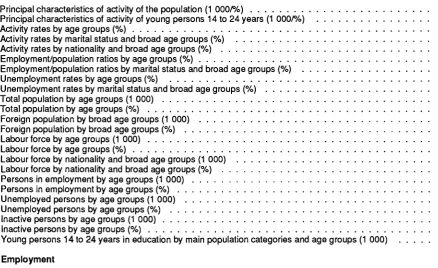
01 Principal characteristics of activity of the population (1 000/%) 44 02 Principal characteristics of activity of young persons 14 to 24 years (1 000/%) 46
03 Activity rates by age groups (%) 48 04 Activity rates by marital status and broad age groups (%) 50
05 Activity rates by nationality and broad age groups (%) 52 06 Employment/population ratios by age groups (%) 54 07 Employment/population ratios by marital status and broad age groups (%) 56
08 Unemployment rates by age groups (%) 58 09 Unemployment rates by marital status and broad age groups (%) 60
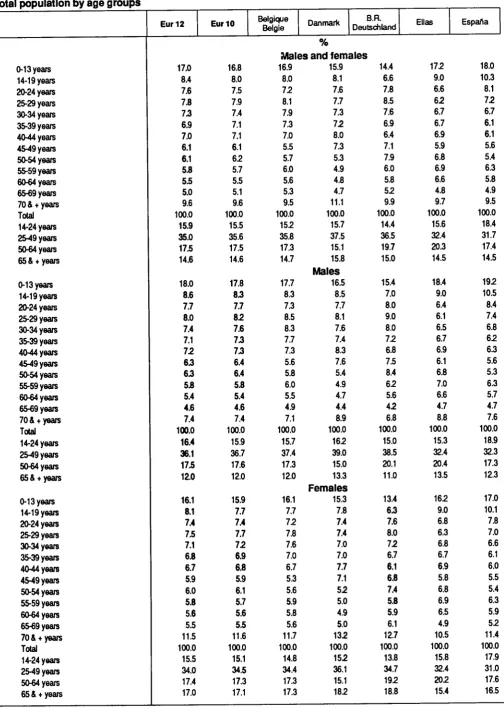
10 Total population by age groups (1 000) 62 11 Total population by age groups (%) 64 12 Foreign population by broad age groups (1 000) 66
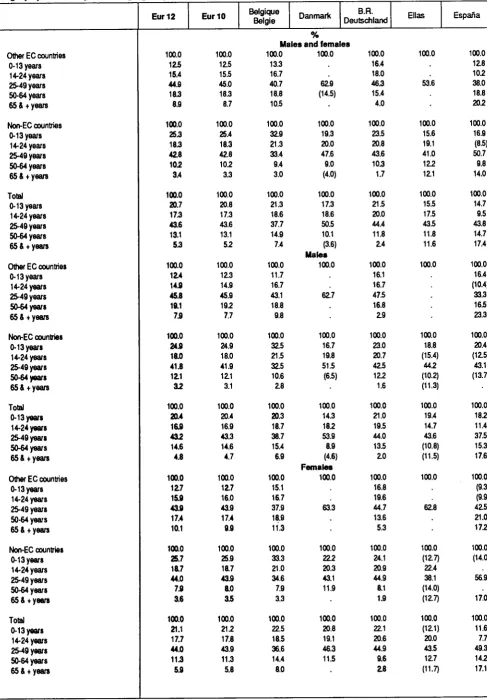
13 Foreign population by broad age groups (%) 68
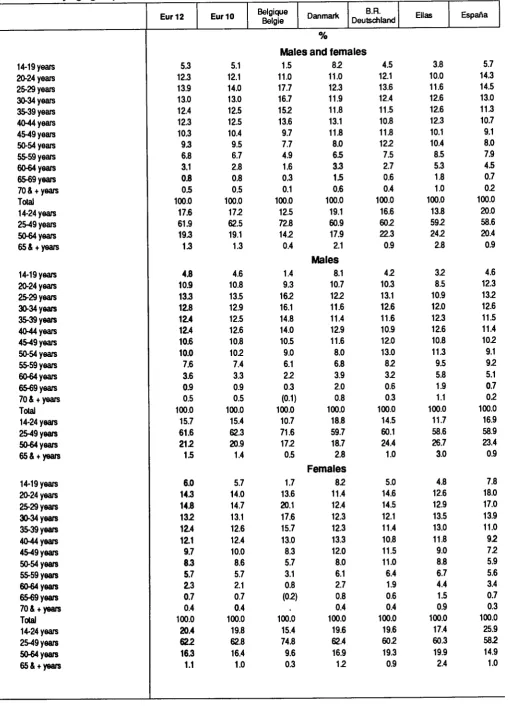
14 Labour force by age groups (1 000) 70 15 Labour force by age groups (%) 72 16 Labour force by nationality and broad age groups (1 000) 74
17 Labour force by nationality and broad age groups (%) 76 18 Persons in employment by age groups (1 000) 78 19 Persons in employment by age groups (%) 80 20 Unemployed persons by age groups (1 000) 82 21 Unemployed persons by age groups (%) 84 22 Inactive persons by age groups (1 000) 86 23 Inactive persons by age groups (%) 88 24 Young persons 14 to 24 years in education by main population categories and age groups (1 000) 90
Employment
25 Persons in employment by professional status (1 000) 94 26 Persons in employment by sector of activity (1 000) 94 27 Persons in employment by professional status (%) 96 28 Persons in employment by sector of activity (%) 96 29 Persons in employment by professional status and sector of activity (1 000) 98
30 Persons in employment by professional status and sector of activity (%) 100 31 Persons in employment by sector of activity and professional status (1 000) 102 32 Persons in employment by sector of activity and professional status (%) 104 33 Persons in employment by professional status and full-time/part-time breakdown (1 000) 106
34 Persons in employment by professional status and full-time/part-time breakdown (%) 108 35 Persons in employment by sector of activity and full-time/part-time breakdown (1 000) 110 36 Persons in employment by sector of activity and full-time/part-time breakdown (%) 112
37 Employees by sector of activity and full-time/part-time breakdown (1 000) 114 38 Employees by sector of activity and full-time/part-time breakdown (%) 116 39 Non-employees by sector of activity and full-time/part-time breakdown (1 000) 118
40 Non-employees by sector of activity and full-time/part-time breakdown (%) 120
41 Persons working full-time/part-time by broad age groups (1 000) 122 42 Persons working full-time/part-time by broad age groups (%) 124 43 Persons in employment by economic activity (1 000) 126 44 Persons in employment by economic activity (%) 128
[image:23.595.78.517.279.547.2]Page
Table
Working time
47 Persons in employment -average hours usually worked per week by sector of activity (hrs) 136 48 Persons in employment - average hours actually worked during the reference week by sector of activity (hrs) 136
49 Persons in full-time employment - groups of hours usually worked per week (%) 138 50 Persons in full-time employment - groups of hours actually worked during the reference week (%) 140
51 Persons in part-time employment - groups of hours usually worked per week (%) 142 52 Persons in part-time employment-groups of hours actually worked during the reference week (%) 144
53 Persons in full/part-time employment - differences between usual and actual hours (1 000) 146
54 Employees - average hours usually worked per week by economic activity (hrs) 148 55 Employees working full-time-average hours usually worked per week by economic activity (hrs) 150
56 Employees working part-time - average hours usually worked per week by economic activity (hrs) 152 57 Employees in industry working full-time -groups of hours usually worked per week by economic activity (%) 154
58 Employees in services working full-time -groups of hours usually worked per week by economic activity (%) 158 59 Employees in industry and services working part-time - groups of hours usually worked per week by
economic activity (%) 162 60 Persons in full-time employment - detailed groups of hours actually worked during the reference week (%) . 164
61 Employees in full-time employment - detailed groups of hours actually worked during the reference week (%) 166
Unemployment and search for work
62 Principal characteristics of the unemployed and other persons seeking employment (1 000) 170 63 Principal characteristics of the unemployed and other persons seeking employment (%) 172 64 Principal characteristics of the young unemployed and other young persons seeking employment - 14 to 24
years (1 000) 174 65 Principal characteristics of the young unemployed and other young persons seeking employment - 14 to 24
years (%) 176 66 Unemployed by relationship to head of household (1 000) 178
67 Unemployed by relationship to head of household (%) 180 68 Detailed duration of search for unemployed job-seekers (1 000) 182
69 Detailed duration of search for unemployed job-seekers (%) 184 70 Duration of search for the main groups of unemployed job-seekers (1 000) 186
71 Duration of search for the main groups of unemployed job-seekers (%) 188 72 Duration of search for unemployed job-seekers by broad age groups (%) 190 73 Duration of search for unemployed job-seekers by relationship to head of household (%) 192
74 Unemployed having lost/left job as employee due to economic reasons by previous economic activity (1 000) 194
75 Unemployed seeking or having found job to start later by type of employment sought (1 000) 196 76 Unemployed seeking or having found job to start later by type of employment sought (%) 196 77 Unemployed seeking or having found job to start later by broad age groups and type of employment sought
(1 000) 198 78 Unemployed seeking or having found job to start later by broad age groups and type of employment sought
(%) 200 79 Unemployed seeking paid employment by method of job search (1 000) 202
80 Unemployed seeking paid employment by method of job search (%) 204 81 Persons having a job and seeking another by broad age groups and reasons (1 000) 206
82 Persons having a job and seeking another by broad age groups and reasons (%) 208
Organization of the survey
The Statistical Office of the European Communities (Eurostat), together with the national experts of the Member States, deter-mines the content of the survey and provides a detailed de-scription in a common coding scheme.
A summary presentation of the type of information covered by the survey was included in Article 4 of Council Regulation (EEC) No 3044/89 which formed the legal basis for the 1990 survey.
The national statistical institutes are responsible for selecting the sample, preparing the questionnaires, conducting the di-rect interviews among households, and forwarding the results to Eurostat in accordance with the standard coding scheme. Eurostat devises the programme for analysing the results and is responsible for processing and disseminating the informa-tion forwarded by the nainforma-tional institutes.
Adetailed description of the sampling methods, the adjustment procedures, the definitions and the common Community cod-ing currently used in the labour force survey is presented in the publication Labour force sample survey - Methods and defini-tions.
Reference period
The labour force characteristics of each person interviewed refer to his situation in a particular reference week.
As a general rule the reference week should be a normal week in spring excluding bank holidays. For countries using a fixed week such as Italy, this requirement is easy to fulfil. In some countries, however, the reference week is the one preceding the week of the interview and, as the survey extends over a period of time, the mobile reference week method is used. In this case it cannot be guaranteed that the reference week represents a normal week.
For the 1990 survey, the reference weeks were distributed within the following periods:
Belgium Denmark FR of Germany Greece Spain France Ireland Italy Luxembourg Netherlands Portugal United Kingdom
April March-April April April-June March^June January-March April-May April April
January-May January and April
March-May
Field of survey
The survey is intended to cover the whole of the resident population, i.e. all persons whose usual place of residence is in the territory of the Member States of the Community. For technical and methodological reasons, however, it is not possible in all the countries to include the population living in collective households, i.e. persons living in homes, boarding schools, hospitals, religious institutions, workers' hostels, etc. Consequently, for the purposes of harmonizing the field of survey, the Community results are compiled on the basis of the population of private households only. This comprises all persons living in the households surveyed during the reference week. This definition also includes persons absent from the household for short periods due to studies, holidays, illness, business trips, etc.
Sample sizes were fixed according to the guidelines of Article 3 of the abovementioned Regulation and the number of private households for each country which participated in the 1990 survey were:
Belgium 31 732 Denmark 16 489 FR of Germany 103 273 Greece 48 971 Spain 59 478 France 65 302 Ireland 45 289 Italy 140 832 Luxembourg 9 265 Netherlands 29 951 Portugal 26 499 United Kingdom 63 821
Reliability of the results
Sampling error
In this publication results likely to have very wide margins of relative sampling variability have been replaced by a dot, while other relatively imprecise estimates are shown within brackets. An indication of the per cent sampling error can be provided by the coefficient of variation of an estimate. Eurostat has re-quested the Member States to calculate the coefficient of variation for certain basic variables (employed by broad indus-trial group, unemployed, unemployment rates, labour force and activity rates) by sex and age. The answers received indicate that for the abovementioned variables the labour force survey provides reliable results at national level.
Survey response
A significant source of non-sampling error in the labour force survey is the effect of non-response on the results. Non-re-sponse rates normally range from about 5 to 19% with most Member States around 6%. Adjustment for non-response in the majority of countries was made by reweighting the results while In some cases the method used was 'duplication' or 'substitution' of units. Quality checks carried out in various countries suggest that one-person households may be under-represented in the sample as they tend to be more difficult to contact than households containing several persons.
Weighting
The 1990 survey results were weighted up to independently derived population estimates for various age, sex, region, nationality, etc. categories. More information about weighting and adjustment procedures can be found in Labour force sample survey - Methods and definitions.
Basic concepts and definitions
Persons in employment are those who during the reference week did any work for pay or profit, or were not working but had jobs from which they were temporarily absent. Family workers are included but not persons on lay-off.
Unemployed persons are those who, during the reference week, had no employment and:
(a) were actively looking for paid employment and were immediately available to start work, or
(b) were looking to set up their own business or professional practice, or
(c) were waiting to be called back to a job from which they had been laid off, or
(d) had found a job to start after the reference week. The labour force is defined as the sum of persons in employ-ment and unemployed persons.
Inactive persons are those who are not classified as employed or unemployed.
These definitions relate to the population of working age (14 years and over).
Activity rates represent the labour force as a percentage of the population of working age living in private households. Employment/population ratios represent persons in employ-ment as a percentage of the population of working age living in private households.
Unemployment rates represent unemployed persons as a percentage of the labour force.
The above rates are usually calculated for sex/age groups and sometimes further cross-classified by other demographic vari-ables such as marital status or nationality.
Duration of unemployment is defined as: (a) the duration of search for a job, or
(b) the length of the period since the last job was held (only if this period is shorter than the duration of search for a job).
These definitions and concepts are explained in detail in the publication Labour force sample survey - Methods and defini-tions.
Comparability with previous surveys
The concepts and definitions used in the current series of the survey were introduced in 1983, being based upon recommen-dations from the International Labour Office. Since the appli-cation of these concepts has remained consistent from this time, the results of the survey are comparable from year to year. Moreover, it is possible to compare the data with those of non-Community countries which apply the same internation-ally agreed definitions. However, as a result of the 1983 revision, it is not possible to compare the results of the current Community labour force surveys with those held prior to 1983. A description of the changes in definition and an appraisal of the quantitative effects of these changes between 1981 and 1983 are shown in the publication of the 1983 survey's results.
Specific remarks relating to the 1990 survey
As the individual questionnaires are designed by the national statistical services in order to cover both Community and national requirements, the passage from national question-naires to the Community coding requires a complex conversion programme specific to each country. Although Eurostat and the Member States have endeavoured to overcome the tech-nical difficulties involved in order to reach the best possible harmonization, differences in national practices and labour legislation, combined with demographic particularities and the social and political environment, unavoidably lead to some exceptions and peculiarities in certain countries.
DENMARK
Due to the method of sample selection, which is based on the family unit, the 'head of household' is normally assigned to the female, while the male is considered as 'spouse'.
FR of GERMANY
The increase in the population of non-nationals coming from countries outside the Community does not include any influx of citizens of the former German Democratic Republic, since these were not separately identified by nationality.
GREECE
The relatively small number of registered unemployed in Greece is due to the particular system of unemployment benefit prevailing in this country.
FRANCE
The weighting values used for the French results continue to be based upon the 1982 census. Results based on the 1990 census were not available in time for this publication.
ITALY
market. The counterpart of this high number is the rela-