University of Southampton Research Repository
ePrints Soton
Copyright © and Moral Rights for this thesis are retained by the author and/or other
copyright owners. A copy can be downloaded for personal non-commercial
research or study, without prior permission or charge. This thesis cannot be
reproduced or quoted extensively from without first obtaining permission in writing
from the copyright holder/s. The content must not be changed in any way or sold
commercially in any format or medium without the formal permission of the
copyright holders.
When referring to this work, full bibliographic details including the author, title,
awarding institution and date of the thesis must be given e.g.
AUTHOR (year of submission) "Full thesis title", University of Southampton, name
of the University School or Department, PhD Thesis, pagination
Department of Electrical and Computer Engineering The University of Auckland
New Zealand
Qualitative Topological
Coverage of Unknown
Environments by Mobile Robots
Sylvia Wong
February 2006
Supervisors: Dr Bruce A. MacDonald
Dr George Coghill
A
Abstract
This thesis considers the problem of complete coverage of unknown environments by a mobile
robot. The goal of such navigation is for the robot to visit all reachable surfaces in an
envi-ronment. The task of achieving complete coverage in unknown environments can be broken
down into two smaller sub-tasks. The first is the construction of a spatial representation of the
environment with information gathered by the robot’s sensors. The second is the use of the
constructed model to plan complete coverage paths.
A topological map is used for planning coverage paths in this thesis. The landmarks in the
map are large scale features that occur naturally in the environment. Due to the qualitative
nature of topological maps, it is rather difficult to store information about what area the robot
has covered. This difficulty in storing coverage information is overcome by embedding a cell
decomposition, called slice decomposition, within the map. This is achieved using landmarks in the topological map as cell boundaries in slice decomposition. Slice decomposition is a new cell
decomposition method which uses the landmarks in the topological map as its cell boundaries. It
decomposes a given environment into non-overlapping cells, where each cell can be covered by
a robot following a zigzag pattern. A new coverage path planning algorithm, called topological
coverage algorithm, is developed to generate paths from the incomplete topological map/slice decomposition, thus allowing simultaneous exploration and coverage of the environment.
The need for different cell decompositions for coverage navigation was first recognised by
Choset. Trapezoidal decomposition, commonly used in point-to-point path planning, creates
cells that are unnecessarily small and inefficient for coverage. This is because trapezoidal
de-composition aims to create only convex cells. Thus, Choset proposed boustrophedon
decompo-sition. It introduced ideas on how to create larger cells that can be covered by a zigzag, which may not necessarily be convex. However, this work is conceptual and lacking in
implementa-tion details, especially for online creaimplementa-tion in unknown environments. It was later followed by
Morse decomposition, which addressed issues on implementation such as planning with
par-tial representation and cell boundary detection with range sensors. The work in this thesis was
developed concurrently with Morse decomposition.
ii ABSTRACT
Similar to Morse decomposition, slice decomposition also uses the concepts introduced by
boustrophedon decomposition. The main difference between Morse decomposition and slice
decomposition is in the choice of cell boundaries. Morse decomposition uses surface gradients.
As obstacles parallel to the sweep line are non-differentiable, rectilinear environments cannot
be handled by Morse decomposition. Also, wall following on all side boundaries of a cell is needed to discover connected adjacent cells. Therefore, a rectangular coverage pattern is used
instead of a zigzag. In comparison, slice decomposition uses topology changes and range sensor
thresholding as cell boundaries. Due to the use of simpler landmarks, slice decomposition can
handle a larger variety of environments, including ones with polygonal, elliptical and
rectilin-ear obstacles. Also, cell boundaries can be detected from all sides of a robot, allowing a zigzag
pattern to be used. As a result, the coverage path generated is shorter. This is because a zigzag
does not have any retracing, unlike the rectangular pattern.
The topological coverage algorithm was implemented and tested in both simulation and with a real robot. Simulation tests proved the correctness of the algorithm; while real robot tests
demonstrated its feasibility under inexact conditions with noisy sensors and actuators.
To evaluate experimental results quantitatively, two performance metrics were developed. While
there are metrics that measure the performance of coverage experiments in simulation, there are
no satisfactory ones for real robot tests. This thesis introduced techniques to measure eff
ective-ness and efficiency of real robot coverage experiments using computer vision techniques. The
two metrics were then applied to results from both simulated and real robot experiments. In simulation tests, 100% coverage was achieved for all experiments, with an average path length
of 1.08. In real robot tests, the average coverage and path length attained were 91.2% and 1.22
Acknowledgements
It has been a long time since I first arrived at the E&E department in the University of Auckland as a wide-eyed undergraduate. I am happy to have this opportunity to thank some of the people
who have helped make it an enjoyable experience.
First of all, I would like to thank my supervisor, Dr Bruce MacDonald for his support and
guidance throughout my PhD years. Without his encouragement and occasional stern looks, I
would not have been able to make it to the end.
I would also like to thank my parents. They provided much financial support, which is very
appreciated. I hope they feel proud when they see this 200 page masterpiece.
The technical staffin the department have also been of tremendous help. Lance Allen and the
workshop designed and built the wooden enclosure for the Khepera robot. Jamie Walker and
Evans Leung helped me with all sorts of computer and networking problems. Bev Painter,
Nichola Kavacevich and Grant Sargent have also been very helpful.
I greatly enjoyed the interactions with other PhD students in the department, from inspiring
technical discussions to playing age of empires. They are (in alphabetical order): GeoffBiggs,
Toby Collett, Barry Hsieh, Lee Middleton, Adrian Pais, Russell Smith, Brad Sowden, Chris
Waters, Joseph Wong and David Yuen.
Lastly, I would like to thank Jorge Cham, the creator of piled higher and deeper. His comic
strips provided me with laughter when I sorely needed it.
Contents
1 Introduction 1
1.1 Overview of problem domain . . . 1
1.2 Applications of coverage path planning . . . 3
1.3 Description of the thesis . . . 3
1.3.1 Scope of the research . . . 3
1.3.2 Overview of the thesis . . . 4
1.4 Contributions of the thesis . . . 5
2 Coverage navigation and path planning 7 2.1 Voronoi diagram . . . 8
2.2 Cell decomposition . . . 10
2.3 Grid map . . . 28
2.4 Topological map . . . 34
2.5 Reactive robots . . . 35
2.6 Coverage with multiple robots . . . 36
2.7 Coverage of 3-dimensional surfaces . . . 36
2.8 Performance metrics . . . 37
2.8.1 Simulation . . . 37
2.8.2 Real robots . . . 37
2.8.3 Complexity of coverage navigation . . . 38
2.9 Discussion . . . 39
2.10 Summary . . . 40
3 Slice decomposition 41 3.1 Slice Decomposition I . . . 42
3.1.1 Events . . . 43
3.1.2 Algorithm . . . 46
3.2 Slice Decomposition II . . . 47
3.2.1 Events . . . 47
vi Contents
3.2.2 Algorithm . . . 49
3.3 Effects of step size and sweep direction . . . 53
3.4 Tethered robots . . . 56
3.5 Discussions . . . 56
3.6 Summary . . . 57
4 Topological Coverage Algorithm 59 4.1 Finite State Machine . . . 60
4.1.1 State – Normal . . . 60
4.1.2 State – Boundary . . . 62
4.1.3 State – Travel . . . 62
4.2 Cell boundaries . . . 63
4.2.1 Event – Split . . . 64
4.2.2 Event – Merge . . . 67
4.2.3 Event – End . . . 70
4.2.4 Event – Lengthen . . . 72
4.2.5 Event – Shorten . . . 73
4.2.6 Combination of split and merge events . . . 76
4.3 Topological Map . . . 77
4.3.1 Nodes . . . 80
4.3.2 Edges . . . 80
4.3.3 Map updates . . . 81
4.4 Travel between cells . . . 90
4.5 Completeness . . . 93
4.6 Complexity . . . 95
4.7 Summary . . . 97
5 Performance metrics 99 5.1 Metrics . . . 100
5.1.1 Effectiveness: percentage coverage . . . 100
5.1.2 Efficiency: path length . . . 100
5.2 In simulation . . . 101
5.3 In real robot experiments . . . 104
5.3.1 Creating composite images . . . 104
5.3.2 Correcting perspective warp . . . 108
5.3.3 Computing percentage coverage . . . 110
5.3.4 Calculating normalised path length . . . 110
Contents vii
6 Implementation 113
6.1 Khepera robot . . . 113
6.2 Simulation . . . 115
6.3 Topological map . . . 119
6.4 Robot controller . . . 120
6.5 Summary . . . 122
7 Results and discussion 123 7.1 Landmark Detection . . . 123
7.1.1 Discontinuity on side of robot . . . 124
7.1.2 Topology changes in front of robot . . . 135
7.2 Coverage Experiments . . . 138
7.2.1 Simulation . . . 138
7.2.2 Real Robot . . . 143
7.3 Zigzag as coverage pattern . . . 143
7.4 Evaluating composite images . . . 149
7.5 Performance Metrics . . . 155
7.5.1 Simulation . . . 155
7.5.2 Real robot experiments . . . 156
7.6 Composite image for non-circular robots . . . 159
7.7 Path length L and complexity of environment . . . 159
7.8 Summary . . . 163
8 Future Work and Conclusions 165 8.1 Future work . . . 165
8.1.1 Tethered robot . . . 165
8.1.2 Simultaneous localisation and coverage (SLAC) . . . 166
8.1.3 Multi-robot coverage . . . 167
8.2 Conclusions . . . 167
A Landmark Recognition using Neural Networks 171 A.1 Pattern classification with Neural Networks . . . 171
A.2 Multilayer Perceptron (MLP) . . . 172
A.2.1 Forward propagation . . . 173
A.2.2 Error back-propagation . . . 175
A.3 Learning Vector Quantisation (LVQ) . . . 176
A.3.1 Vector Quantisation . . . 176
A.3.2 Learning the reference vectors . . . 176
viii Contents
A.4.1 Preprocessing . . . 178
A.4.2 Results . . . 179
A.5 Summary . . . 180
B Computer Vision 183 B.1 Canny Edge Detection . . . 183
B.1.1 Gaussian smoothing . . . 185
B.1.2 Sobel edge detection . . . 187
B.1.3 Non-maximal suppression . . . 188
B.1.4 Hysteresis thresholding . . . 189
New ideas pass through three periods: 1. It can’t be done. 2. It probably
can be done, but it’s not worth doing. 3. I knew it was a good idea all
along!
Arthur C. Clarke
1
Introduction
1.1
Overview of problem domain
A
recent survey released by the UN Economic Commission for Europe [1, 41] reportedthat robot orders for the first half of 2003 were the highest ever recorded. The survey
also predicts the worldwide growth rate of the robotic industry will average at 7.4%
annually for the period 2003 to 2006. Also, by the end of 2006, a tenfold increase in domestic
service robots is predicted. These statistics and predictions show that robots have moved out
of science fiction and into everyday life. Nowadays, it is already common to find industrial
robots working in hazardous environments or space rovers surveying Mars. In the foreseeable
future, domestic and service robots may also become a common sight. Examples include do-mestic robots mowing lawns and vacuuming floors autonomously, or professional service robots
assisting in surgeries and surveillance.
To be useful, a robot has to be skilled in the specific task it is designed for. For example, a lawnmowing robot needs to know how to operate the grass cutting tool it carries; or a rubbish
collecting robot needs to know how to pick up soft drink cans and cigarette butts. However,
these robots should also be equipped with more general abilities such as obstacle avoidance,
map building, path planning and localisation. These abilities enable a robot to move around its
environment to do its job efficiently and with minimum human intervention.
2 Introduction
One such general ability that is very important to all autonomous robots is path planning. Path
planning in robotics is the intelligence of finding a path in a map that leads from a start
config-uration to a goal configconfig-uration. This area of artificial intelligence has received a great deal of
attention in the robotics research literature [66, 76, 85, 91]. Path planning is an essential
com-ponent of robot manipulator controllers, as it is the the basis for describing and controlling the manipulator tip [42, 54]. It is also important for mobile robots, as it is the basis for describing
and controlling the varying robot positions in space [46, 98].
Most path planning algorithms are for point-to-point path planning. This type of algorithm
usually attempts to find the shortest or quickest path to get from one point to another. Though sometimes criteria other than path lengths are used [71]. However, in some applications, a
coverage path is needed instead. The aim of a coverage path planner is to create a path that
covers all surfaces in an environment. In other words, given an initial location, it does not
matter where the final location is, as long as the journey visits all surfaces in the environment.
Examples of robotic tasks that require a coverage path are cleaning [38], surface coating [86,
87], humanitarian demining [69] and foraging.
Coverage path planning is similar to exploration, but not the same. When exploring, a robot
sweeps its long range sensors, moving so as to sense all of its environment, often to build a
map. In a coverage application, the robot or a tool it carries must pass over all the floor surface.
Compared to point-to-point path planning, the coverage path planning problem has not received
as much attention. However, as robots move into service roles and interact with humans in
more varied environments for a wider range of tasks, coverage will become more important.
The ability to fully cover an environment will be a key capability for all mobile systems. For
example, domestic robot assistants can spend their idle time cleaning, collecting items and
storing them away.
Apart from generating different types of output, path planners also differ in their formats of
input (the map). As path planning is essentially a search on a map of the environment, the data
structure used to store this map naturally influences the operations of path planning algorithms.
Also, depending on the application domain, the environment the robot operates in maybe known
or unknown beforehand. If a map is created by a human operator and fed to the path planner,
the environment is known to the robot. If no map is provided, the environment is unknown,
and the robot has to construct a map for path planning using sensor information. There are two distinct ways to handle this situation. The first method is to carry out an exploration phase to
construct an accurate map [95, 107] before any path planning is done. The alternative is to make
assumptions concerning the unknown areas in the map in order to commence path planning, and
then update the planned path whenever new environmental information becomes available [58].
1.2 Applications of coverage path planning 3
1.2
Applications of coverage path planning
Coverage path planning is needed in a variety of mobile robot applications. The focus of this
thesis is on the coverage of flat, indoor, unknown surfaces populated with obstacles. It is also
assumed that the robot has to stay within the region. Typical applications that fit these criteria are vacuum cleaning and floor scrubbing.
Lawn mowing is very similar, but the restriction on staying within bounds is relaxed. For
example, it is perfectly acceptable to push the lawn mower over the footpath while cutting grass
on the kerb. Compared to a typical home or office, the average lawn is relatively free from
obstacles. Also, being an outdoor application, global positioning systems can be used to aid
localisation and landmark matching.
Intuitively, humanitarian demining should also allow the robot to stray outside the area to be
covered. However, since it is unknown whether the region outside is free of landmines, it is safer
and smarter to restrict movement within bounds of the environment. Also, due to the dangers of
the mines, the robot should not move into surfaces not scanned by the landmine detection tool
yet. Therefore, localisation must be very accurate. Otherwise, due to dead reckoning1error, the
robot might move into an area it believes to be covered, but is not in reality.
In window cleaning the target surface is vertical, instead of horizontal. Other than this minor
difference, the coverage requirement is essentially the same as vacuum cleaning.
In machine milling, it might be desirable to mill only in one direction (either in the spindle
direction, or against). This means the coverage path should be a sequence of, say,
right-to-left movements, instead of alternate right-to-left-to-right and right-to-right-to-left movements. This is because
milling in only one direction gives better surface quality [51].
1.3
Description of the thesis
1.3.1
Scope of the research
The purpose of this research is to develop robust coverage algorithms for mobile robots working
in unknown environments. I do not assume known environments because it can be costly and
inflexible to require a complete map of the environment the robot operates in. In certain types
of robots, for example, domestic vacuum cleaners, owners generally lack the expertise to enter
detailed maps to the robots and will therefore require professional help for such tasks. Also, the map will need to be updated whenever the owner re-arranges the furniture.
4 Introduction
Map building is a key issue in this thesis because of the requirement of unknown environments.
The robot should simultaneously construct a map with sensor information while covering the
environment at the same time. This means that the coverage path planner has to make its
decision based on a partial map of the robot’s environment. Using a separate exploration phase
for map building purposes is considered inefficient because a coverage path already requires the
robot to visit all surfaces.
An integral part of developing a robotic coverage algorithm is to measure how well the
algo-rithm performs in experiments. Performance metrics allow quantitative evaluation of
implemen-tations. They also permit comparisons between different algorithms. Despite the importance of
quantitative metrics, this is an area that has received very minimal attention. Development of suitable performance metrics is therefore another aim of this research.
1.3.2
Overview of the thesis
The thesis is divided into the following chapters:
Chapter 2 presents a literature review of algorithms for coverage using mobile robots. The
review includes algorithms for both known and unknown environments. The chapter also
dis-cusses existing performance metrics for evaluating coverage algorithms in both simulation and
real robot experiments.
Chapter 3 presents the events and algorithms for slice decomposition. Two versions of the
decomposition are presented. The first one is for known environments, and is produced using
a normal line sweep process. The second one is for unknown environments, where the sweep
line will be limited to within free space.
Chapter 4 introduces the topological coverage algorithm. The algorithm creates a slice
decom-position of any environment online, without a known map. It explains methods for detecting
landmarks used to form the decomposition. It also talks about how slice decomposition is stored
in a topological map, how the map is maintained and updated, and how to determine if the map
is completed and the environment is completely covered. It also explains why travelling
be-tween regions is robust. Completeness and complexity of the decomposition are also discussed.
Chapter 5 introduces two new performance metrics for coverage experiments. The chapter also
includes practical methods for evaluating and measuring parameters needed to calculate these
metrics.
Chapter 6 focuses on the implementation of the topological coverage algorithm. It describes the
simulation and real robot environment and platform. It also talks about the implementation of
1.4 Contributions of the thesis 5
Chapter 7 shows results from experiments in simulation and with a real robot. The metrics
introduced in Chapter 5 are used to evaluate the performance of the experiments. The results
are also discussed and compared with existing coverage algorithms.
Chapter 8 presents a list of potential future work and some conclusions drawn from the research
in this thesis.
Appendix A describes an alternative method for recognising and classifying the landmarks used
in the topological map. Two types of neural networks are trained to learn the different
land-marks. This appendix gives a brief introduction to the two neural networks, followed by results
from landmark recognition tests.
Appendix B covers the computer vision techniques used in Chapter 5 for creating composite images in greater detail. Topics discussed include Canny edge detection and Hough transforms.
1.4
Contributions of the thesis
This thesis makes several significant contributions. A study in the existing literature provides
the basis for the identification of areas where contributions can be made to the field.
First is the development of an online coverage algorithm that uses a partial qualitative
topolog-ical map for planning. Previously, qualitative maps based on simple landmarks have only been
used in point-to-point path planning. This is because nodes and edges of topological maps do not correspond to specific locations in space. This qualitative nature makes it difficult to store
coverage information. The problem is overcome by using the landmarks as cell boundaries of
slice decomposition. In other words, the topological map embeds a slice decomposition of the
environment. As a result, even though individual nodes in the map are not associated with
spe-cific areas of space, a combination of nodes now defines a cell of the decomposition. Coverage
information is then stored with cells in slice decomposition.
Second is the introduction of slice decomposition, a cell decomposition for covering unknown
environments. It can handle a larger variety of environments than existing cell decomposition
based coverage algorithms. The concept of using the split and merge of the sweep line by
obstacles as cell boundaries was first introduced in boustrophedon decomposition [30]. This
approach creates maximum sized cells that can still be covered by a simple zigzag pattern. However, boustrophedon decomposition lacks detailed algorithms or implementation details.
Slice decomposition extends the split and merge concepts in boustrophedon decomposition.
New cell boundary types are added to simplify boundary detection in online decomposition
with range sensors. Similar to slice decomposition, Morse decomposition [8] is also for
6 Introduction
decomposition and slice decomposition is in the choice cell boundaries. Morse decomposition
uses surface gradients. As obstacles parallel to the sweep line are non-differentiable, rectilinear
environments cannot be handled by Morse decomposition. In comparison, slice decomposition
uses topology changes and range sensor thresholding as cell boundaries. Due to the use of
sim-pler landmarks, it can handle environments with polygonal, elliptical and rectilinear obstacles.
Thirdly, due to the use of simple landmarks as cell boundaries, the topological coverage
algo-rithm employs a shorter navigation pattern to cover each cell in the decomposition than Morse
decomposition. Wall following on side boundaries of cells is needed in Morse decomposition
to discover connected adjacent cells. This is because cell boundaries can only be detected when
they are the closest point on the obstacle surface from the robot compared to all other points
on the obstacle surface. Therefore, a rectangular pattern that includes retracing is used to cover
each cell in the decomposition. On the other hand, due to the use simpler landmarks and a more
general technique for landmark detection, the topological coverage algorithm allows a robot to detect events in slice decomposition from all sides. As a result, a simple zigzag path that
does not include any retracing can be employed instead. Due to the use of a shorter navigation
pattern to cover individual cells, the topological coverage algorithm generates coverage paths
that are shorter and more efficient.
Lastly, new performance metrics for evaluating real robot coverage experiments are developed.
Currently, results from real robot experiments are mostly presented qualitatively, showing
pic-tures of the routes taken by the robots. The only metric available is the coverage factor [22].
However, it does not measure effectiveness or efficiency of experiments properly. The two
met-rics proposed in this thesis measure the effectiveness and efficiency of any coverage experiment
using data collected with computer vision techniques. The methods used to collect the data are
Only in our dreams are we free. The rest of the time we need wages.
Terry Pratchett, “Wyrd Sisters”
2
Coverage navigation and path planning
P
ath planning for mobile robots generally involves a search on a spatial representation(map) of the environment. Therefore mapping and path planning are two related issues
and cannot be examined in complete isolation. Robotic maps are data structures that
store information about the environment. For any given data structure, there are multiple ways
to conduct a search. For example, there are numerous search algorithms for graphs, such as A*
search and depth-first search [92]. In summary, there are many types of robotic maps, and even
more path planning algorithms.
This chapter first introduces several common robotic maps. They are Voronoi diagram
(Sec-tion 2.1), cell decomposi(Sec-tion (Sec(Sec-tion 2.2) and grid map (Sec(Sec-tion 2.3). These maps all employ
some form of space decomposition, where a complex space is repeatedly divided until simple
subregions of a particular type are created. Grid based maps are a special case of space
de-composition where the environment, both free space and obstacles, is decomposed into uniform
grid cells. Emphasis has been placed on space decomposition based maps as they are the most common data structure used in coverage path planning. This is because coverage algorithms
usually use the strategy of “divide and conquer”. Basically the environment is segmented into
simpler subregions, and each subregion is then covered in turn. Cell decomposition is favoured
by Choset, the leader in the area of robot coverage algorithms [8, 9, 11]; while grid maps are the
most common choice among researchers in mobile robot coverage [44, 97, 109].
8 Coverage navigation and path planning
Two other robotic mapping and path planning methods are also discussed. Even though they are
not based on space decomposition, they are included here because of their importance in mobile
robot navigation. The two methods are topological mapping (Section 2.4) and reactive robotics
(Section 2.5). Topological maps do not form precise geometric representations of space. Instead
the map describes spatial relationship in a qualitative way, much like the way humans describe their environments. Reactive robotics approaches the navigation problem from a non symbolic
AI perspective. As such, no maps are used and there is no planning of paths in the traditional
sense.
Section 2.8 contains a survey on the performance metrics used in simulated and real robot experiments of coverage algorithms. In also includes a brief discussion of the complexity, or
upper bound, of the length of a coverage path.
Lastly, this chapter finishes with a discussion that identifies areas where contributions can be
made.
2.1
Voronoi diagram
Perhaps the most popular space decomposition is the Voronoi diagram. It is used in a wide
range of disciplines including biology, computational geometry, crystallography and
meteorol-ogy [81].
Given a finite set of distinct points (called reference vectors) in the Euclidean plane, an ordinary Voronoi diagram is formed by associating all locations in that space with the closest member
of the point set with respect to the Euclidean distance. Thus a Voronoi diagram partitions the
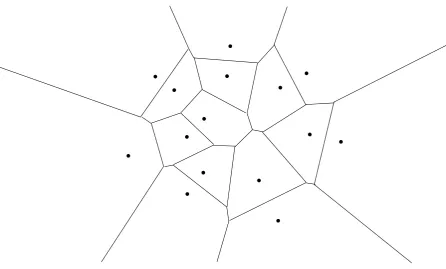
space into a set of non-overlapping regions. Figure 2.1 shows a set of reference vectors with its
Voronoi diagram.
More formally, let the set of n reference points be P = {p1, . . . ,pn} ⊂ R2, and their Cartesian coordinates be x1, . . . ,xn. Then the ordinary Voronoi region associated with reference point pi
is given by
V(pi)= {x| kx−xik ≤ kx−xjkfor i , j}
And the set given by
V={V(p1), . . . ,V(pn)}
is the ordinary Voronoi diagram of the reference point set P.
By applying a distance measure other than Euclidean distance, the ordinary Voronoi diagram
has been extended or generalised in many directions [81]. One of the most useful generalisations
2.1 Voronoi diagram 9
Figure 2.1: Voronoi diagram for a set of reference points.
of a set of n obstacles A={A1, . . . ,An}, rather than a set of points. The area Voronoi diagram is
calculated using the following equation for the shortest distance from point p to obstacle Ai:
ds(p,Ai)=min xi
{kx−xik |xi ∈Ai}
In other words, an area Voronoi diagram (or simply generalised Voronoi diagram) is formed by
associating all locations in the free space of the robot’s environment with the closest obstacle.
Figure 2.2 shows an example of a generalised Voronoi diagram for an environment with two obstacles.
In robotics, generalised Voronoi diagrams have been used in path planning [66], topological
mapping [84] and localisation with visual landmarks [106]. A feature of maps based on
gener-alised Voronoi diagrams is that they maximise clearance between robot and obstacles. A robot following the map will be staying far from obstacles. As a result, the Voronoi diagram is
unde-sirable for coverage tasks. On the other hand, this characteristic makes it perfect for exploration
navigation with long range sensors. For example, Acar, Choset and Atkar used a map based on
the generalised Voronoi diagram for a robot equipped with an extended range landmine detector
10 Coverage navigation and path planning
[image:21.595.186.382.85.288.2]
Figure 2.2: The Voronoi diagram maximises clearance between robot and obstacles. (Reproduced from page 172 of [66]).
2.2
Cell decomposition
A cell decomposition divides a complex structure S into a collection of disjoint simpler
com-ponent cells. In exact cell decomposition, the union of the comcom-ponent cells is exactly S . While
in approximate cell decomposition, the union of the component cells is approximately S . The
boundary of a cell corresponds to a criticality1of some sort. The most common example of cell
decomposition is trapezoidal decomposition [66]. It is formed by sweeping a line across the environment, and maintaining a list D of cells that intersects with the sweep line. The history
of list D, ie all the cells that have appeared in D, forms the decomposition. A cell boundary is
created whenever a vertex is encountered. Due to the use of vertices as criticality, obstacles are
limited to polygons. Also, each cell of a trapezoidal decomposition is either a trapezoid or a
triangle. The algorithm for trapezoidal decomposition is shown in Algorithm 2.1.
Figure 2.3 shows an example of trapezoidal decomposition for an environment with one
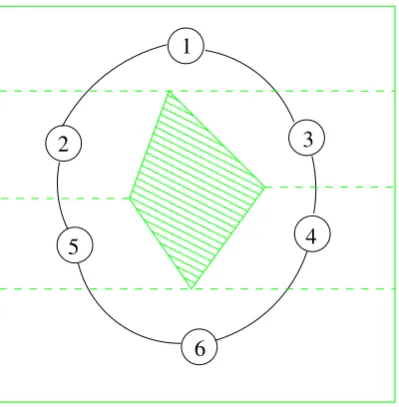
polyg-onal obstacle. Originally, the list D consists of only one cell, and thus D = (c1). At the first
vertex, cell c1 is split into two parts, and D changes to (c2,c3). For the next two vertices in the environment, cells are replaced only. The list D changes to (c2,c4) and then again to (c5,c4). Lastly, cells c4and c5are merged into one cell, and D becomes (c6).
The trapezoidal decomposition was originally proposed by Chazelle to partition a 3D
poly-hedron into a collection of convex polyhedra [29]. Other usages outside of robotics include
decomposing complex polygons in 2D computer graphics [88].
For path planning, the trapezoidal decomposition is first reduced to a connectivity graph that
1Criticalities in cell decompositions are conditions of the sweep line where, if satisfied, a new cell boundary is
2.2 Cell decomposition 11 c1
c2 c3
c4
c5
c1
c2 c3
c4
c5
c6
sweep
direction
c1 c1
c2 c3
c2 c3
c4
D=(c2,c3) D=(c2,c4)
D=(c5,c4)
D=(c6)
12 Coverage navigation and path planning Algorithm 2.1 Trapezoidal Decomposition
yL: position of sweep line
{y1, . . . ,yn}: sorted list of y coordinates of all vertices in environment
D= (. . . ,ci−2,ci−1,ci,ci+1,ci+2, . . .)
for yL =y1to yndo
if vertex splits cell ciinto two then
(ci)←(cd,cd+1)
D= (. . . ,ci−2,ci−1,cd,cd+1,ci+1,ci+2, . . .)
else if vertex merges two cells ci and ci+1then (ci,ci+1)←(ce)
D= (. . . ,ci−2,ci−1,ce,ci+2, . . .)
else if vertex replaces cell ci with a new cell then
(ci)←(cf)
D= (. . . ,ci−2,ci−1,cf,ci+1,ci+2, . . .)
end if end for
represents the adjacency relation among the cells [66]. Then this associated connectivity graph is searched to find paths between any two cells. Figure 2.4 shows the connectivity graph for the
trapezoidal decomposition formed in Figure 2.3.
Choset first recognised that trapezoidal decomposition creates cells that are unnecessarily small,
and therefore inefficient, for coverage purposes [30, 32]. Trapezoidal decomposition creates
cells that are convex polygons only. However, non-convex cells can also be covered completely
by simple coverage patterns. A decomposition that creates more cells are less efficient because
for each cell, additional motion along the cell boundary maybe required. For example, the two
cells on each side of the obstacle in Figure 2.5(a) can be merged and a simple zigzag pattern
can still cover the combined cells (Figure 2.5(b)).
Based on this concept of merging multiple cells in trapezoidal decomposition, Choset proposed the first exact cell decomposition specifically designed for coverage navigation [30]. The
result-ing decomposition is called boustrophedon2decomposition, signifying the relationship between
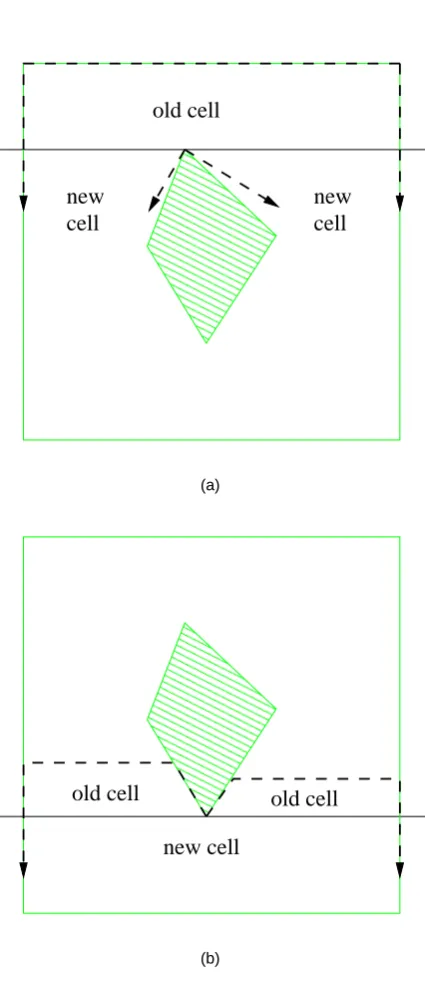
the decomposition and the zigzag. Boustrophedon decomposition introduces the idea of using
the split and merge of the sweep line by obstacles as criticality. This is explained in the example
in Figure 2.6. However, [30] does not provide a detailed algorithm for the decomposition, nor
does it define the criticality precisely. Moreover, it is unclear if, or how, concave obstacles are
handled.
Huang attempted to reduce the cost of coverage by minimising the number of turns in the
coverage path [55]. He introduced the Minimal Sum of Altitude (MSA) decomposition. The
decomposition works on known polygonal environments. The basic premise behind MSA
de-2Alternately from right to left and from left to right, like the course of the plough in successive furrows (Oxford
2.2 Cell decomposition 13
1
3 2
5 4
[image:24.595.213.413.119.323.2]6
Figure 2.4: To form the associated connectivity graph, each cell is labelled by a distinct integer and connected to its neighbouring cells.
(a)
(b)
[image:24.595.101.528.433.676.2]14 Coverage navigation and path planning
new cell old cell
new cell
(a)
new cell
old cell old cell
[image:25.595.177.390.163.657.2](b)
2.2 Cell decomposition 15
(a) (b)
Figure 2.7: Assigning different sweep directions to cells can produce coverage paths with fewer turns. (Reproduced from [55]).
composition is that cost of coverage is lower when there are fewer turns in the path. This is
because a robot must slow down to make a turn. Huang assumed that the cost of travelling
between cells in the decomposition is significantly lower than the cost of turning. By choosing
different sweep directions for different cells, the cost of a coverage path can be lowered. This is
illustrated in the example in Figure 2.7.
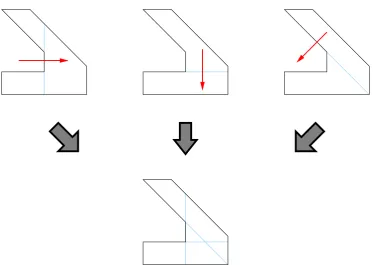
The MSA decomposition is created with a two step process – multiple line sweeps followed by dynamic programming. For each edge orientation (of both the boundary of the environment
and all obstacles), a line sweep is performed. A cell boundary is created for each vertex at split
and merge events.3 The decompositions from all edge orientations are then overlaid upon each
other. Figure 2.8 shows an example of this multiple line sweep decomposition process.
Once the initial decomposition from multiple line sweeps is formed, an adjacency graph is
created to represent the decomposition. An example of this graph is shown in Figure 2.9.
The basis of the dynamic programming step is to either split this graph in two, thus creating
two smaller subproblems; or to try to unite all cells and cover them as one large region. The minimum sum of altitudes of graph G is defined as:
S (G)=min
C(G),min
i S (G
i
1)+S (G
i
2)
(2.1)
where i iterates over all possible ways to split the graph G into two connected subgraphs G1
and G2. C(G) is the cost of covering all cells as one subregion. Figure 2.9 shows an example of
the first level of decomposing a problem. Figure 2.10 shows the final MSA decomposition for a simple environment.
3An event in a cell decomposition occurs when the sweep line encounters a criticality. Therefore, a duality
16 Coverage navigation and path planning
[image:27.595.97.473.120.385.2]Figure 2.8: The first step in creating a MSA decomposition is multiple line sweep. A line sweep is performed for each edge orientation. The decomposition of all the line sweeps are then overlaid on top of each other. (Reproduced from [55]).
2.2 Cell decomposition 17
(a)
(b)
Figure 2.10: MSA decomposition of a simple environment. (a) Initial decomposition from multiple line sweeps. (b) After dynamic programming. (Reproduced from [55]).
However, MSA decomposition is limited in the complexity of environments it can handle. This
is because of an exponential complexity for the algorithm. Firstly, each sweep direction
con-tributes a dividing line that divides many cells. This produces a large number of cells in the adjacency graph. Secondly, the dynamic programming phase must examine all connected
sub-graphs of 1 to n nodes for a graph of n nodes.
Both boustrophedon and MSA decompositions are defined only for known environments. The idea of using split and merge events of the sweep line as criticality was extended to unknown
environments in the works of Butler [22, 23] and Acar [8, 12]4.
For a cell decomposition to be used for covering unknown environments, the following issues need to be addressed. Firstly, mobile robots can only move within the free space region of
the environment. As a result, the sweep direction can no longer be from top to bottom only.
For example, the area underneath the U-shaped obstacle in Figure 2.11 can only be swept in
the reverse (bottom to top) direction. Secondly, planning of the coverage path has to be done
using a partial cell decomposition of the environment. This is because the cell decomposition
has to be created simultaneously with the coverage process. Thirdly, criticalities can occur
between sweep line positions. An example of which is shown in Figure 2.12, where the vertex
is positioned between strips of the zigzag. Lastly, the criticality chosen has to be realistically
detectable by robot sensors.
Butler et. al. proposed CCR, an exact cell decomposition for contact sensing robots5
cover-ing unknown rectilinear environments [23]. Cell boundaries are formed whenever an obstacle
boundary parallel to the sweep line is encountered. An example of CCRis shown in Figure 2.13.
4Butler and Acar were PhD students at the Robotics Institute at Carnegie Mellon University. Choset is a
professor at the same institute, and is the supervisor of Acar.
18 Coverage navigation and path planning (a) (b)
Figure 2.11: Mobile robots cannot move inside obstacle space. (a) Sweep line is limited to the current free space cell. (b) Some cells must be swept in the reverse direction.
Figure 2.12: The vertex falls between two consecutive strips of a zigzag.
Figure 2.13:CCR uses an exact cell decomposition for rectilinear environments. (Reproduced from
2.2 Cell decomposition 19
intervals
Ciw Cj
∞
Cix
tr tl
bl
br
Figure 2.14: The partial decomposition inCCRis stored as a list of cellsC={C0, . . . ,Cn}. This diagram
shows the data structure associated with an individual cellCi, which is a member ofC, ie
Ci ∈C. CellCjis a neighbour ofCiand is shown here for clarity. (Adapted from page 17
of [22]).
The partial decomposition constructed is stored as a list of cells C= {C0, . . . ,Cn}. Figure 2.14
shows the data structures associated with each cell in CCR. Cix is the maximum possible extent
of cell Ci, and is represented simply by a rectangle. Cin is the cell’s minimum known extent, and
is given by four points – two on the cell’s right boundary (tr and br), and two on the cell’s left boundary (tl and bl). When the robot begins coverage with no knowledge of the environment,
C will contain a single cell C0 in which the minimum known extent C0n has zero size and
the maximum possible extent C0x is infinite in all directions. As the robot covers this cell, its
minimum known extent C0n will increase in size, while its maximum possible extent C0x will
be limited with the discovery of each boundary. In addition to the minimum and maximum
extents of the cell, the width of the portion of the cell that has been covered by the robot is
also represented (Ciw). Associated with each of the edges of the cell is a linked list of intervals
which explicitly denote the cell’s neighbours at each point along the edge. Each interval is
represented as a line segment together with a neighbour ID. A cell is complete when its edges are at known locations, it has been covered from side to side, and all sides have been completely
explored. In addition to the cell decomposition C, CCR maintains a list H = {H0, . . . ,Hm} of
placeholders. A placeholder is an element of the boundary of any cell in C that is not a boundary
of the environment, and thus are entrances to to free space cells. Coverage of an environment is
complete when no placeholders remain.
Normally, the robot follows the U-shaped pattern in Figure 2.15 to cover individual cells.
Seg-mentsαandδare sliding movements against the side boundaries of the cell. An event
(critical-ity) occurs whenever the robot is prevented from successfully executing the U-shaped coverage
pattern. Also, all the events defined in CCR can be detected without the use of any range
20 Coverage navigation and path planning β γ δ α
Figure 2.15: U-shaped coverage pattern used inCCR and Morse decomposition. The pattern consists
of four segments, α to δ. Distances between consecutive βsegments should be small enough that no area is left uncovered when a robot follows this pattern.
by an obstacle while executing theα segment of the U-shaped pattern. In Figure 2.16(b), the
side boundary the robot follows in theαsegment disappears. In Figure 2.16(c), the robot’s path
inβis obstructed by an obstacle. Figure 2.16(d) shows an unexpected non-collision in segment
β, where the robot does not encounter the side boundary as expected. In Figure 2.16(e), the
robot loses contact with the side boundary. This is distinct from the situation in Figure 2.16(b)
in that during the αsegment the robot is outside the covered portion of the cell, while during
segmentδit is not.
When the robot encounters any of the five events, it attempts to fully explore the new cell boundary. The maneuvers used depend on the event. The intervals associated with the current
cell are updated. After the cell boundary is completely explored, the algorithm searches the list
of placeholders H for any uncovered cells. Travelling between cells is done by moving into
each cell in between, and moving first in one direction, for example x, then the other direction,
y, in order to reach the next cell.
Unlike the zigzag (Figure 2.17), the U-shaped pattern contains retracing. This retracing is
added to include wall following on both side boundaries. This is because a contact sensing
robot cannot detect obstacles except when wall following. Therefore, if the robot is following a
zigzag pattern and an opening occurs as shown in Figure 2.18, the robot will miss it.
Acar et. al. introduced Morse decomposition [8, 9] for range sensing robots covering unknown
environments. Cell boundaries in Morse decomposition are critical points of Morse functions.
The decomposition is based on a roadmap method originally proposed by Canny [26, 27]. Given
a real-valued function h : Rm → R, its differential at p ∈ Rm is dhp = [∂x∂h1(p)· · ·∂x∂hm(p)]. A
point p∈Rmis a critical point of a Morse function if ∂h
∂x1(p)= · · · =
∂h
2.2 Cell decomposition 21 (a) (b) (c) (d) (e)
22 Coverage navigation and path planning
Figure 2.17: Compared to the pattern in Figure 2.15, a zigzag includes wall following on only one side boundary.
Figure 2.18: Contact sensing robots (as used inCCR) will miss an opening in the side boundary unless
2.2 Cell decomposition 23
surface normal
Figure 2.19: A cell boundary in Morse decomposition occurs at this position because the surface nor-mal of the obstacle is perpendicular to the sweep line.
(∂x∂2h
i∂xj(p)) is non-singular. To put it more simply, a critical point occurs when the sweep line
encounters an obstacle whose surface normal is perpendicular to the sweep line. This definition
of criticality for cell decomposition is explained graphically in Figure 2.19. Figure 2.20 shows
an example of Morse decomposition.
By using surface normals as criticality, the environment is limited to differentiable functions
only. Therefore, polygons cannot be handled as their vertices are non-smooth boundary points.
To overcome this limitation in Canny’s roadmap, Acar et. al. use Clarke’s generalised
gradi-ents [33, 67] to calculate surface normals at these non-smooth boundaries [9]. The generalised
gradient of a point x is the set of vectors within the convex hull of the surface normals of the
adjacent smooth surfaces around x (see Figure 2.21). The generalised gradient can be used on
any point x that is not differentiable, given that the function is Lipschitz around x. A function
is locally Lipschitz for a bounded subset B if there exists a constant K such that
|f (x1)− f (x2)| ≤ K|x1−x2|
for all points x1and x2of B. However, since any function with a discontinuity is not Lipschitz
around the discontinuity, rectilinear environments such as those used in CCRare not covered by
Morse decomposition.
Critical points in Morse decomposition can be detected using omni-directional range sensors.
Given a robot is at point x, then the closest point on the surface of obstacle Ci to point x is c0
c0= arg min
c∈Ci
kx−ck
Now, let d(x) be the shortest distance between point x and the obstacle Ci. Then the gradient6
can be determined by
∇d(x) = x−c0
kx−c0k
24 Coverage navigation and path planning
Figure 2.20: Criticality of Morse decomposition occurs at the positions of the black dots in the diagram. The dotted lines are the cell boundaries. Three of the critical points have no cell bound-aries drawn through because free space is of zero width at those positions.
2.2 Cell decomposition 25
c0
x
∇di(x)
Figure 2.22: Detecting critical points in Morse decomposition.
This equation can be explained as follows. As c0 is a point on the surface of the obstacle Ci,
then x−c0is a vector which points from c0towards x. However, because c0is the closest point on the surface from x, it is thus normal to the obstacle surface. Division bykx−c0k turns the result into a unit vector.
The robot has detected a critical point if the gradient ∇di(x) is perpendicular to the sweep
line. Figure 2.22 explains how critical points can be detected by robots equipped with omni-directional range sensors.
The Morse decomposition is stored as a Reeb graph7, with the critical points as nodes.
Fig-ure 2.23 shows the graph corresponding to the decomposition in FigFig-ure 2.20. Note that the
edges in the graph represent the cells in the decomposition.
Similar to CCR, Morse decomposition has an associated algorithm for creating the
decomposi-tion online. It also employs the U-shaped coverage pattern in Figure 2.15. The wall following
offered by the U pattern is needed because critical points occurring on the side boundary, such
as those in Figure 2.24, cannot be detected even with unlimited range sensors except when wall
following [8]. This is because the robot can only detect critical points of Morse functions if the
critical point is closest to the robot compared to all other points on the obstacle surface.
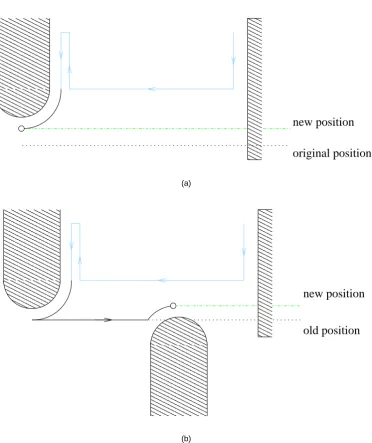
An event occurs whenever the robot encounters a critical point while following the U-shaped pattern. Figure 2.25 shows the two events defined in Morse decomposition. In Figure 2.25(a),
the robot is following the side boundary of the current cell when it encounters a critical point.
The next lap position is moved to where the critical point is. In Figure 2.25(b), the robot
encounters a critical point while moving along the length of the U-shaped pattern.
Information about uncovered cells is associated with nodes in the Reeb graph (ie the critical
points). When the robot finishes executing a U pattern which is interrupted by critical points,
26 Coverage navigation and path planning p1 p2 p3 p4 p8 p5 p6 p7
Figure 2.23: Reeb graph for the Morse decomposition in Figure 2.20.
[image:37.595.178.388.103.449.2]critical points missed
2.2 Cell decomposition 27 new position original position (a) old position new position (b)
28 Coverage navigation and path planning
it first looks for uncovered cells at the last encountered critical point. If the critical point is
associated with two uncovered cells (eg in Figure 2.25(b)), the robot picks one of the cells
associated as the next cell to cover. If there are no uncovered cells associated with the last
encountered critical point, a depth-first search is performed on the Reeb graph. To travel to
the selected uncovered cell, the robot follows the Reeb graph and plans a path that passes through cells and critical points. The environment is fully covered when no uncovered cells are
associated with any of the nodes in the Reeb graph.
Although the starting point of this thesis is to investigate coverage with landmarks in
topologi-cal maps (Section 2.4), the method proposed ultimately creates a cell decomposition similar to
the split and merge concept in boustrophedon decomposition. However, unlike boustrophedon
decomposition, this thesis deals with coverage of unknown environments. CCR is especially
designed for robots with no range sensing ability. Similar to this thesis, Morse decomposition
is for range sensing robots working in more general unknown environments. Compared with
Morse decomposition, the method proposed in this thesis can handle a larger variety of
envi-ronments (rectilinear, polygonal and non-polygonal). Moreover, wall following on both side
boundaries is not needed due to the use of more general landmarks as criticalities, or events, of the decomposition. Since retracing is eliminated from the coverage pattern, the proposed
algorithm generates shorter coverage paths.
Boustrophendon decomposition was first published in a conference in 1997 [32], and later as a
journal paper in 2000 [30]. CCR was first published in 1999 [23]. Morse decomposition was
first published in 2000 [7, 10], and thus was developed in parallel with the work in this thesis,
which was also first published in 2000 [100, 101].
2.3
Grid map
In grid maps, environments are decomposed into a collection of uniform grid cells. This uniform
grid includes both free space and obstacles. Each cell contains a value stating whether an
obstacle is present. The value can either be binary or a probability [37]. Figure 2.26 shows an
example of a grid map.
The major advantage of this type of map is the ease in creating one. It is essentially an ar-ray containing occupancy information for each cell of the map. However, grid maps require
accurate localisation to create and maintain a coherent map [28, 95]. They also suffer from
ex-ponential growth of memory usage because the resolution does not depend on the complexity
of the environment [94]. Also, they do not permit efficient planning through the use of standard
2.3 Grid map 29
Figure 2.26: A grid map. Grid cells with obstacle present are shaded.
Grid based maps are the most widely used spatial representation for coverage algorithms. This
is due to the simplicity of marking covered areas in a grid map.
Zelinsky et. al. proposed an offline coverage algorithm [108] based on the distance transform
of a known grid map [58]. Figure 2.27 shows the distance transform of a simple environment
with one obstacle. Here, S represents the initial (or starting) position of the robot, and G is the
desired finishing position. The distance transform thus represents a wavefront that propagates from the goal cell G to the initial cell S . The algorithm for calculating the distance transform
is shown in Algorithm 2.2. Lines 1 to 3 shows the initialisation needed before the execution of
the main loop in lines 4 to 11. In line 1, the distance transforms (DT) of all cells in the grid
are set to -1, which mark the cells as unprocessed. Execution starts with the goal cell G, which
has a distance transform of 0 (lines 2 and 3). In each iteration of the main loop, unmarked cells
who are neighbours of marked cells are assigned a DT one higher than their neighbours’. This
continues until all cells in the grid map are marked.
Once the distance transform for the environment is calculated, the coverage path can then be
formed by selecting the neighbouring cell with the highest DT and is unvisited, starting from the
initial cell S . If two or more unvisited neighbours have the same transform, one of them is se-lected randomly. Figure 2.28 shows the coverage path generated for the example in Figure 2.27.
The algorithm for generating the coverage path is explained in Algorithm 2.3.
Unlike other coverage algorithms, this distance transform based method requires the selection
of a goal location.
Ulrich et. al. [97] also used a grid map for their online coverage algorithm. The algorithm
starts with an exploration of the boundary of the environment. Afterwards, the robot moves
30 Coverage navigation and path planning 13 13 S 12 12 12 11 11 11 10 10 10 9 8 9 9 9 9 9 9 9 9 8 8 8 8 8 8 8 8 5 4 7 7 7
7 7 7
7 7 7 7 7 7 6 6 6 6 6 6 5 5 5 5 5 5 4 4 4 4 4 4 6 6 6
4 4 4 4
7 7 7 7
6 6 6 6 6
5 5 5 5 5
[image:41.595.122.444.102.336.2]4 4 4 4 4 4 3 3 3 3 3 3 3 3 3 3 3 3 1 1 2 2 2 1 1 G 1 2 2 1 1 1 2 2 2 2 2 2 2 2 2 2 2 3 3 3 3 3
Figure 2.27: Distance transform for the selection start position (S) and goal position (G). (Reproduced from [108]).
Algorithm 2.2 Distance Transform for a Grid Map Require: goal cell G
1: DT(all cells)← −1
2: DT(G)←0
3: n← 0
4: while there exists a cell c where DT(c)=-1 do 5: for all x such that DT(x)=n do
6: if y is a 8-neighbour or x and DT(y)=-1 then
7: DT(y)←n+1
8: end if 9: end for
10: n← n+1
11: end while
Algorithm 2.3 Coverage Path Planning using Distance Transform c←start cell
visited(all cells)←false
repeat
visited(c)←true
c←neighbouring cell with highest DT
2.3 Grid map 31
9 8 7 6 5 4 3 2 2 2 2 2 3 4
4 3 2 1 1 1 2 3 4 5 6 7 8 9
9 8 7 6 5 4 3 2 1 G 1 2 3 4
4 4 3 3 2 2 2 1 1 3 2 2 3 3 2 2 1 3 4 5 6 7 8 9 9 9 8 8 7 7 6 6 5 5 4 4 3 3
3 3 3 4
[image:42.595.155.470.89.316.2]4 5 6 7 7 6 5 4 4 5 6 7 7 6 5 4 4 5 6 7 7 6 5 6 6 7 7 7 7 8 8 8 9 9 9 10 10 10 11 11 11 12 12 12 13 13 S
Figure 2.28: Coverage path generated from the distance transform. (Reproduced from [108]).
of travel is chosen. One of the criteria for the new direction is a high number of uncovered
grid cells. The algorithm also attempts to generate a path that ends successively with mutually perpendicular walls (see Figure 2.29). This is done so the robot can alternately re-calibrate the
x and y coordinates of its odometry estimation, with values obtained from the initial exploration
phase. Since only a partial map is available, it may not be possible for the robot to reach the
target wall in the chosen direction due to the presence of unknown obstacles. In this case, the
robot updates the grid map and then selects a new direction of travel again. The path planning
used in this work is a na¨ıve approach and results in highly redundant paths, as can be seen in
Figure 2.29.
Unlike the almost random approach taken by Ulrich et. al., Gabriely and Rimon tackle the
problem of coverage path planning on a partial grid map with a systematic spiral path. This
is achieved by following a spanning tree of the partial grid map [45]. Two different sizes of
grid cells are used. The smaller grid cell is the same size as the robot. Four of these smaller
grid cells then form a mega cell. These concepts are shown in Figure 2.30. The details of this
spanning tree approach is shown in Algorithm 2.4. The two parameters to the function STC
are the current cell x and its parent cell w. The algorithm is started by executing STC(NULL,
start cell). NULL is used for the parent cell because the start cell has no parent. A mega cell is old (line 1), if at least one of its four subcells is covered; otherwise, it is new (line 2). At
each mega cell, the robot picks a new direction of travel by selecting the first uncovered free
space mega cell in an anti-clockwise direction (line 3). A spanning tree edge is also grown
from the current mega cell to the new one (line 4). The algorithm is recursive (line 6), and the
32 Coverage navigation and path planning
[image:43.595.157.412.85.317.2]start end
Figure 2.29: The robot path in the work of Ulrich et. al. is highly inefficient. The dotted line represents the path taken by the robot during boundary exploration, while the solid line represents the path taken during coverage. (Reproduced from [97]).
the robot along one side of the spanning tree (line 5) until it reaches the end of the tree (line
2), at which point it turns around to move along the other side of the tree (line 8). Figure 2.31
shows the spanning tree and the coverage path for the environment in Figure 2.30. Notice that
when coverage is completed, the robot returns to the same mega cell as the initial location.
Algorithm 2.4 Spiral spanning tree coverage STC(w,x)
1: Mark the current cell x as old
2: while x has a new obstacle-free 4-neighbour cell do
3: Scan for the first new neighbour of x in anti-clockwise order, starting with the parent
cell w. Call this neighbour y.
4: Construct a spanning-tree edge from x to y.
5: Move to a subcell of y by following the right-side of the spanning tree edges.
6: Execute STC(x,y).
7: end while
8: if x,start cell then
9: move back from x to a subcell of w along the right-side of the spanning tree edges.
10: end if
Normally, cells in a grid map are square in shape and the same size as the robot. Oh et. al. proposed the use of a grid with triangular cells in their coverage algorithm instead [80] (see
Figure 2.32). The rationale behind using a triangular grid is that it has a higher resolution
com-pared to a rectangular one with similar sized cells. The use of alternative tiling arrangements to
increase resolution is well known in image processing [74]. Oh et. al. showed that this increase
![Figure 2.2: The Voronoi diagram maximises clearance between robot and obstacles.(Reproducedfrom page 172 of [66]).](https://thumb-us.123doks.com/thumbv2/123dok_us/8506358.348914/21.595.186.382.85.288/figure-voronoi-diagram-maximises-clearance-robot-obstacles-reproducedfrom.webp)