UNIVERSITY OF SOUTHERN QUEENSLAND
USING A MULTILITERACIES APPROACH IN A MALAYSIAN POLYTECHNIC CLASSROOM: A PARTICIPATORY ACTION RESEARCH
PROJECT
A dissertation submitted by:
Fariza Puteh-Behak
For the award of
Doctor of Philosophy
ii
USING A MULTILITERACIES APPROACH IN A MALAYSIAN
POLYTECHNIC CLASSROOM: A PARTICIPATORY ACTION
RESEARCH PROJECT
This participatory action research project investigated how students in a Malaysian polytechnic classroom context, who were used to examination-based learning, negotiated learning using a multiliteracies approach (The New London Group, 2000). The study explored 12 students’ experiences in learning English as a Second Language (ESL) and drew on qualitative methods including classroom observations, informal conversations, a research journal, professional discussions and classroom artefacts. With two polytechnic lecturers involved as part of the research team, the study also investigated the research team’s experiences in engaging in a collaborative research process in two cycles of planning, action, observation and reflection.
This study was framed within Vygotsky’s (1978) socio-cultural theory that states that human learning and development is mediated by historical and cultural artefacts in the socialisation process. Guided by these principles, the study examined the ways that students’ socio-cultural perspectives and practices influenced their learning using the multiliteracies approach. In addition, the researcher investigated how the research team’s cultural perspectives and practices influenced the research processes and outcomes of the participatory action research. Data were analysed through a critical reflective analysis because of the emphasis on reflection in participatory action research. The study highlighted the consequences of implementing a Western-based teaching approach and research methodology in a Malaysian context.
iii practices can be incorporated with a multiliteracies approach to enhance the students’ negotiation of learning 21st
iv
CERTIFICATION OF DISSERTATION
I certify that the ideas, experimental work, results, analyses, software and conclusions reported in this dissertation are entirely my own effort, except where otherwise acknowledged. I also certify that the work is original and has not been previously submitted for any other award, except where otherwise acknowledged.
_____________________________ __________________
Signature of Candidate Date
ENDORSEMENT
_____________________________ ___________________
Signature of Supervisor/s Date
______________________________ ____________________
v Thank you Allah the Al-mighty for His blessings throughout my PhD journey.
I would like to thank the Malaysian Ministry of Higher Education and Islamic Sciences University of Malaysia who had given me the opportunity to pursue my study by providing scholarship. I would also thank the administrators, teachers and students of Bakti Polytechnic for their help in completing the research project.
I would like to express my deepest gratitude to Associate Professor Robyn Henderson for her endless support, guidance and kindness throughout the duration of my study. Thank you for inspiring me in so many ways throughout this journey. I would also like to thank Dr. Lindy-Anne Abawi for her understanding, support and refreshing perspectives.
I would like to thank Associate Professor Jeong Bae Son and Dr. Kathryn Young for helping me to set the ground in the early years of my PhD journey.
I am also grateful for the support and love provided by my husband, children and family members. To my dear husband, Norazmi Ismail, thank you for your sacrifice and this PhD is yours as much as mine. To my mom, dad and siblings, thank you for the constant support throughout this journey.
I would also like to extend my gratitude to friends in the PhD room who have shared the ups and downs of this journey.
vi
CHAPTER PAGE
Abstract ii
Certificate of dissertation iv
Acknowledgement v
Table of contents vi
List of tables and figures x
List of appendices xi
1 INTRODUCTION 1
A personal foreword 1
Focus of the study 4
Where the notion began 4
Where the notion expanded 12
Aims 19
Research questions 20
The multilayered property of the research process 21
Preview of the dissertation 23
Summary of this chapter 25
2 LITERATURE AND THEORETICAL FOUNDATIONS 26
Preview 26
Socio-cultural theory of learning 27
Multiliteracies and 21st century learning 31 The original notion of multiliteracies 32
Multiliteracies pedagogy 34
Extension and research on multiliteracies 37
21st century skills 44
Malaysian cultural attributes and Malaysian learning styles 47
Understanding culture 48
Malaysian cultural attributes 50
Factors influencing Malay values and cultural attributes 54 The social hierarchy of the Malay society 55
Conflicts and face concept 64
Action research 70
Participatory action research 72
Issue of power distance in participatory action research 76 Issues of empowerment and social transformations in
participatory action research
81
Reflective practice 86
Process of reflective practice 87
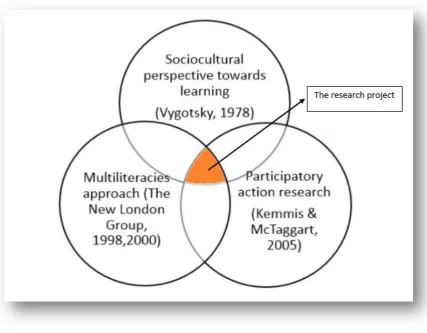
Theoretical diagram of the study 92
Summary of this chapter 93
3 METHODOLOGY 95
Context of the study 95
Site of research 95
vii
Design of the study 106
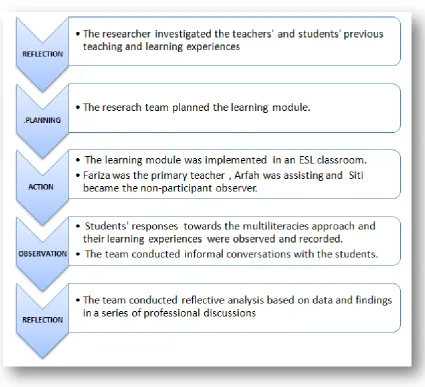
The design of the first cycle of the Multiliteracies Project 107
Reflection and planning 108
Action 111
Observation 112
Reflection 113
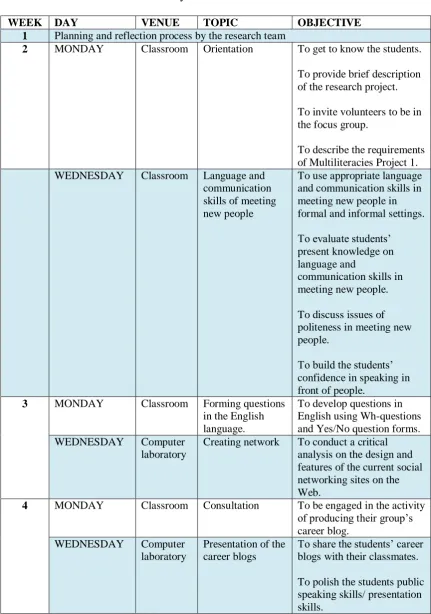
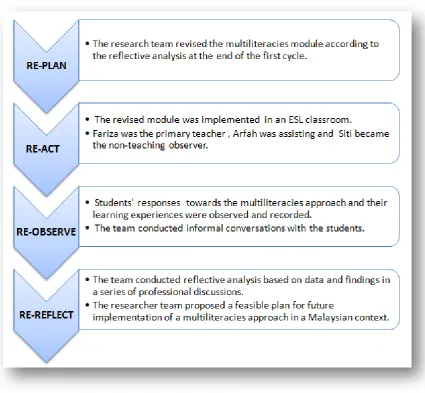
The first multiliteracies module 113 The second cycle of the Multiliteracies Project 118 The revised multiliteracies module 120 The design of the Participatory Action Research Project 127
Data collection methods 128
Observation 128
Research journal 129
Professional discussions 130
Audio and video recording 130
Informal conversations 131
Classroom artefacts 132
Semi-structured interviews 132
Data analysis method 133
Observing and noting personal reflections 135
Confronting and thinking 136
Taking action 136
Observing and noting personal reflections 137 Forming theories and thinking otherwise 137
Data analysis in Multiliteracies Project 138
Data analysis in Participatory Action Research Project 140
Transcription and translation 141
Ethics of the study 143
Summary of this chapter 143
4 THE FIRST ATTEMPT AT IMPLEMENTING A
MULTILITERACIES APPROACH IN A MALAYSIAN LEARNING CONTEXT: A FAILURE OR A TRIAL RUN
145
Preview 145
Reflecting and planning a multiliteracies classroom 146 Malaysian learning context based on the lecturers and
students’ previous learning experiences
146
The teachers’ initial concern 150
Action: Implementing the multiliteracies approach 152 Summary of the first multiliteracies module 152 Observation and reflection: Initial responses towards the
multiliteracies approach
153
Reflection and solution 158
An issue of working in teams 160
Reflection and solution 162
An issue of oral presentation 164
Reflection and solution 165
viii A question of active participation in designing their own learning 174
Reflection and solution 171
Reflecting on our first attempt in implementing a multiliteracies approach in an examination-based context: Failure versus trial-run
176
Summary of this chapter 181
5 THE SECOND ATTEMPT OF IMPLEMENTING
MULTILITERACIES APPROACH IN THE MALAYSIAN CONTEXT: FUSING MULTILITERACIES WITH
MALAYSIAN CULTURES
182
Preview 182
Planning: reflecting the analysis of the first cycle of the Multiliteracies Project
183 Action: The second multiliteracies module 186 Observation and reflections: Issues addressed 187 Learning beyond the traditional print-based resources: A time for multimodality
187 Learning with a sense of adventure: new, challenging yet fun! 194 Learning beyond the classroom walls: Linking classroom
learning to the practical knowledge
203 A shift to critical minds: A shift from copy-paste culture to
authenticity
206 A move from problematic teamwork to effective teamwork 211 An outcome of teacher-student interaction 216
An outcome of teacher-student interaction: A move from passive to expressive
218 An outcome of teacher-student interaction: Issues of
active participation still?
223 Final reflection: A fusion of a multiliteracies approach and a
Malaysian learning culture
231 Implementing a multiliteracies approach: Working within the Malaysian culture
235
Summary of this chapter 246
6 ISSUES OF CONDUCTING A PARTICIPATORY ACTION
RESEARCH PROJECT IN A MALYSIAN CULTURAL CONTEXT: A REFLECTION
247
Preview 247
An issue of power distance within the participatory action research project
248 Issues of empowerment within the participatory action research
project
260 Teachers moving from supportive research subordinate to active researchers
260
Active co-researchers 269
ix
Summary of this chapter 287
7 CONCLUSION 288
Preview 288
Summary of the study 288
Where the study started 288
Research questions 290
Methodology 291
Insights from the study 292
Teaching using a multiliteracies approach in a Malaysian setting
293 Conducting participatory action research in a Malaysian
context
298
Limitations of the study 302
Implications of the study 303
Recommendations for future research 305
Conclusion 307
REFERENCES 309
x
Table Page
Table 3.3 Summary of the first multiliteracies module 114 Table 3.6 Summary of the second multiliteracies module 122 Table 3.9 Summary of the critical reflective analysis steps in
Multiliteracies Project
139 Table 3.10 Summary of the critical reflective steps in participatory
action research project
140 Table 5.1 Focus group’s marks for Multiliteracies Project 1 and 2 232 Table 6.3. The differences of status between Fariza and Madam
Kirana
253
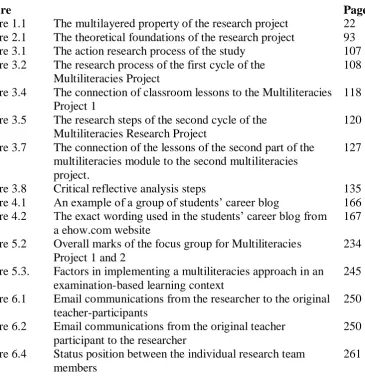
[image:10.595.136.502.330.714.2]Figures
Figure Pages
Figure 1.1 The multilayered property of the research project 22 Figure 2.1 The theoretical foundations of the research project 93 Figure 3.1 The action research process of the study 107 Figure 3.2 The research process of the first cycle of the
Multiliteracies Project
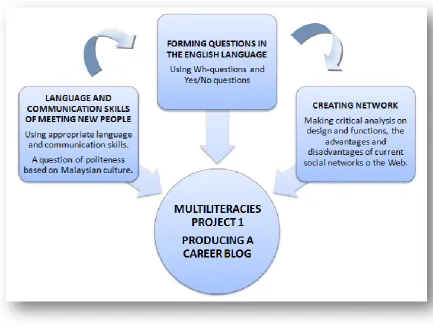
108 Figure 3.4 The connection of classroom lessons to the Multiliteracies
Project 1
118 Figure 3.5 The research steps of the second cycle of the
Multiliteracies Research Project
120 Figure 3.7 The connection of the lessons of the second part of the
multiliteracies module to the second multiliteracies project.
127
Figure 3.8 Critical reflective analysis steps 135
Figure 4.1 An example of a group of students’ career blog 166 Figure 4.2 The exact wording used in the students’ career blog from
a ehow.com website
167 Figure 5.2 Overall marks of the focus group for Multiliteracies
Project 1 and 2
234 Figure 5.3. Factors in implementing a multiliteracies approach in an
examination-based learning context
245 Figure 6.1 Email communications from the researcher to the original
teacher-participants
250 Figure 6.2 Email communications from the original teacher
participant to the researcher
250 Figure 6.4 Status position between the individual research team
members
xi
Appendix Page
A Lesson Plans for Cycle 1 322
B Description of the Multiliteracies Project 2 332
C Lesson plans for Cycle 2 335
D York- Barr et al.’s (2006) reflective practice model and Macfarlane et al.’s (2006) four-step model in developing reflective practice skills
321
E Co-researchers’ consent form 323
1
CHAPTER 1
INTRODUCTION
A PERSONAL FOREWORD
I would describe this research project as a project that was close to my heart. I began the research project with the notion of introducing an alternative pedagogy to enhance Malaysian students’ employability skills in alignment with several government policies. When I started my doctoral study, there was a debate among academia, policymakers, employers and community members on the issue of employability of Malaysian university graduates. I had been teaching English as a Second Language (ESL) in Malaysia for more than 10 years and I was determined to explore the issue of the lack of employability skills among Malaysian universities’ graduates by examining the curriculum and classroom practices in my institution to determine plausible causes. I noticed that most classrooms’ teaching and learning focused on completing activities set by the text books and answering questions based on examinations.
2 subject matter was put at the upmost importance, and less emphasis on preparing the learners for the challenges of the 21st century.
Some researchers addressed the issue by integrating the use of technologies in learning. However, I think that the use of technology such as computers and mobile phones in ESL classrooms is insufficient if the technological devices are used to learn through conventional ways of learning. For example, the use of Microsoft PowerPoint in place of overhead projectors does not necessarily symbolise a new way of learning. I think that the use of technology should be accompanied by learning a new set of knowledge.
The research project was also influenced by the socio-cultural framework that I employed. Human activities including learning are social practices as proposed by the socio-cultural theory (Vygotsky, 1978, 2005) thus it is important to consider the socio-cultural factors that influenced learning and researching. This dissertation (in Chapter 4, 5 and 6) discusses the influence of the Malaysian socio-cultural background on learning and collaborative research process.
3 reasons I preferred to remain silent at these seminars and avoided asking questions to the presenter. The issue of avoiding confrontation and appropriateness came to my mind (this will be discussed further in Chapter 2). I realized that certain things as simple as asking questions were laden with cultural values. And I could still remember the courage it took me to ask one question in a seminar of confirmation and I think it took up the whole energy that I had in me to ask that question.
Western-4 based pedagogy which is multiliteracies approach and conducting a Western-based participatory action research in a Malaysian context.
FOCUS OF THE STUDY
Where the notion began
In recent years, Malaysian educational provisions and thinking have been challenged by reports on the low employability rates of local universities’ graduates. One news report ("80 000 graduan dilatih-Skim Latihan Siswazah Menganggur diwujudkan semula," 24 March 2005) stated that more than 80,000 Malaysian graduates were unemployed. Morshidi, Chan, Shukran, Seri Rahayu and Jasvir Kaur (2012) conducted a study of employability issues among Malaysian graduates, and they reported that from 2006 to 2009, on average 27% of local graduates were still looking for jobs. A Graduate Tracer Study which was conducted by the Malaysian Ministry of Higher Education (2008) showed that in the year of 2008, 24% of local graduates were still looking for jobs. In 2009, the percentage increased to 26.7% (Malaysian Ministry of Higher Education, 2009).
5 that the current local university graduate possess low employability skills; as a result, vacancies were not filled due to the intricacy to find the right candidate. Literature (Hairuszila, Hazadiah, & Normah, 2009; Morshidi et al., 2012; Yahya, 2006) also shows that the issue of unemployment of Malaysian university graduate was associated with the low employability skills amongst graduates.
6 New policies were also introduced to improve the low employability rate of the Malaysian university graduate. In 2006, the Malaysian Ministry of Higher Education (MOHE) introduced the Malaysian Soft Skills Scale as a guideline to incorporate lifelong learning skills such as language and communication, information and technology, teamwork and entrepreneurial skills in the formal curriculum of Malaysian public universities. Soft skills were defined as “generic skills that include cognitive elements related to non-academic abilities, such as positive values, leadership, teamwork, communication and lifelong learning” (Malaysian Ministry of Higher Education, 2006, p. 9). Sulaiman, Fauziah, Wan Amin, and Nur Amiruddin (November 2008), asserted that the Malaysian Ministry of Higher Education strongly encouraged all public universities to incorporate the soft skills elements in the curriculum of all academic courses.
7 Among the factors that have been identified as contributing to the low employability rate among Malaysian universities’ graduates were English language proficiency and communication skills. The National Higher Education Research Institute of Malaysia (NAHERI, 2003) conducted a comprehensive study to investigate the patterns and reasons for unemployment problems among local universities’ graduates. They administered survey questions to 25% of local universities’ graduates who graduated in 2001 and interviewed a focus group of 63 unemployed universities’ graduates and 31 general managers and human resource managers from several organizations. One of the issues identified from interviews with employers was that they claimed that the local university graduates had issues in communicating in the English language. In addition, the study also developed psychological attributes of unemployed university graduates and one of the attributes of unemployed graduates identified was that the graduates did not possess interest to communicate using the English language. Hazita et al. (2010) interviewed Malaysian employers to determine possible causes of unemployment among local university graduates and they noted that employers claimed some of the graduates failed at the interview level because they were not able to answer interview questions that were asked in the English language. The employers asserted that some graduates requested for permission to use Bahasa Malaysia (the national language) when interviewed in the English language. Hazita et al. also asserted that the employers claimed that some graduates did not have the confidence to communicate and conduct presentations effectively.
8 order thinking. Yahya (2006) stated that among the significant employability skills needed by employers were thinking skills that include critical thinking and problem-solving. A study conducted by Fitrisehara, Ramlah, and Rahim (2009) on the employability skills among students of technical and vocational training centres in Malaysia reported that the students had only average employability skills. They reported that in terms of thinking skills, the lowest score was for reasoning skills, a skill that is “truly significant to make quick decisions logically or to interpret something and make conclusions out of them” (p.156). In addition they also reported that in terms of technological knowledge the lowest mean score was for “applying technology to tasks” (p.156). They asserted that some students had issues in applying their knowledge of technology in completing tasks.
9 competencies and language skills that will enable students to master English for academic, employment and social purposes of the 21st century.
Pandian (2010) through research under the National Higher Education Research Institute of Malaysia evaluated the curriculum of Malaysian universities’ academic programmes and argued that the curriculum should not only focus on “producing knowledgeable individuals in certain fields, but also individuals who possess soft skills such as thinking, communication, teaming, and problem solving as well as other skills which are much in demand in the 21st century workplace” (p.61). A research report produced by NAHERI (2003) stated that there was an inconsistency between skills that the graduates acquired at the university with the skills needed for work. Through interviewing employed graduates, the study showed that graduates did not have positive views towards their learning experiences in the university. They stated that the university focussed on teaching based on examinations and this caused students to think that excellent results will result in getting a good job; however, after entering the workforce they said that some skills and knowledge that were emphasized in universities were not relevant to the working environment. They also asserted that most universities’ learning environment focused on theory learning rather than practical knowledge (NAHERI, 2003).
10 and how to incorporate 21st century learning in Malaysian learning settings at the practical level. The government was urging educators in the higher education institutions to incorporate lifelong skills and soft skills in their teaching and learning process.
In thinking about the issues discussed, I suspected that a major consideration is what is happening in the classroom. What were students trained to do in the classroom and how does this contribute to preparing the students for the challenges of the 21st century? This is where the notion of this study was established, which was to look for a suitable pedagogical approach to achieve the goals of equipping Malaysian higher education learners with the necessary skills and knowledge to successfully function in the 21st century. Based on this notion, I was interested in finding an alternative pedagogical approach in generating teaching and learning processes that incorporate the elements of 21st century learning. I was interested to implement the multiliteracies pedagogy, to generate 21st century skills amongst Malaysian graduates. This pedagogy seemed useful because it emphasised the transformation of education due to the emergence of global economy and the advancement of technologies in the 21st century.
11 The New London Group, 1996). The multiliteracies approach focuses on the transformation of pedagogy to support the characteristics of new communication channels, which focus on multimodality and are changing the ways information are being conveyed and interpreted (Baguley, Pullen, & Short, 2010; Cope & Kalantzis, 2000). It is essential that the education field incorporates the use of these new communication channels in teaching and learning processes. Multiliteracies pedagogy is not only about using technological gadgets in learning but also about incorporating the skills and knowledge of the 21st century, such as analysing and synthesizing. At a basic level, learners are now required to be able to make meaning, analyse and evaluate information, and communicate ideas and messages effectively using a range of available technological inventions in a variety of situations (Gee, 2000; The New London Group, 1996, 2000).
Based on the discussions, it appears that in order to solve the low employability rate amongst Malaysian graduates, some university graduates need more training in these areas:
i. English language proficiency,
ii. information, Communication and Technology (ICT) skills, iii. communication skills, and
iv. higher-order thinking skills .
12 for rethinking the current curriculum and classroom practices through an investigation of Malaysian students learning experiences using the multiliteracies approach. Even though the pedagogy of multiliteracies has been a widely researched area, the focus of most current research was mainly on multiliteracies learning in Western learning settings. To date, there has been no major study conducted on investigating Malaysian university students’ learning experiences using a multiliteracies approach through a participatory action research methodology. In addition, research on the employability issue among Malaysian graduates seemed to concentrate on the study of the universities’ curriculum with less attention to what was happening in the classroom. This study investigated what was happening in the classroom and how the multiliteracies approach helped in achieving the national goals of producing university graduates that are compatible with the changes and transformation of the 21st century.
Where the notion expanded
13 under specific social and historical conditions, and they carry the characteristics of the culture in question. These points show that the cultural background of a society is a significant factor that influences human activities and it also shapes the society members’ interpretations of the world around them.
Each society has their own ways of making sense of the world around them; for example, different societies have different conceptions about learning. This point was also stressed by Hong (2009) when he defined culture as “networks of knowledge, consisting of learned routines of thinking, feeling and interacting with other people, as well as a corpus of substantive assertions and ideas about aspects of the world” (p. 4). His definition clearly states that culture shapes the way a particular society sees, understands and makes sense of the many aspects of the world. Jaramillo (1996) suggested that socio-cultural theory proposed that humans learn and develop through social experiences and the social experiences shape the way they think and interpret the world. Due to this point, socio-cultural tendencies of each society can differ from each other. Thus, in understanding the learning of students from a particular context, it is important to consider the ways students make meaning and make sense of the world around them.
14 consideration or knowledge of the Malay socio-cultural influence, the situation might be seen as the candidates’ inability to understand the subject of discussion or reflect the state of their critical minds or even show the candidates’ reluctance to participate in such academic practice. Being part of the group of doctoral candidates in question, I knew that the issue was caused by a more complex socio-cultural influence which will be discussed further in Chapter 2. This point was also mentioned by Rosenberg, Westling, and McLeskey (2008), where they stated that cultural tendencies impact the way students participate in learning. They asserted that lack of knowledge about the culture of the students might lead to a misunderstanding of the students’ responses or behaviour in the process of learning. They gave an example of Western students’ assertiveness in the classroom as this might be perceived as inappropriate by Eastern educators. Similarly, Eastern students’ quietness in the classroom might be perceived as passiveness by Western educators.
15 that the word request was not an accurate representation. She taught that suggestion was more appropriate. This event demonstrated the two different cultural backgrounds that we were in. With the hierarchical background that I have, I understood and interpreted the action of the Doctoral Programme Coordinator as an act of putting forward a request. This is because in my cultural setting a person with her position, which is an associate professor and a programme coordinator was more superior in the hierarchical structure than my position as a student and it was quite common for people in that position to put forward a request ( this will be discussed further in Chapter 2). As a student, it was almost mandatory for me to ask questions in the next confirmation seminar as requested by my lecturer. However, from an Australian cultural background where the teacher-student relationship is less formal, she interpreted her action as simply “giving a suggestion’’. My personal experience highlighted the influence of socio-cultural influence; they became more transparent to me. Asma (2009) argued that if a person is being posed with other values, just like myself being in two different cultural settings, that situation makes a person realizes the role of his own culture and how it shapes the way he behaves and makes sense of the world.
16 particular ways in guiding its members on how to think and behave. Hofstede was popular for his notion of national culture, where he explored similarities and differences among the cultural patterns of countries. Asma (1992, 2009) conducted extensive studies on the influence of Malaysian culture, specifically the Malay society, towards Malaysian management patterns. She argued that not taking into account the cultural influence of a society makes the implementation of any management styles, including the ones that were adopted from other cultures, a futile attempt. She depicted the Malaysian management patterns as a tree and culture was described as the roots that hold the whole tree. She signified the importance of culture in understanding the ways a group of people in a particular context negotiate the world around them.
17 the local socio-cultural factors that influenced learning. These studies showed that studying and understanding the socio-cultural patterns of a particular society is significant to understanding the distinctive ways learning and how other human activities are interpreted and negotiated.
18 laboratory, teachers’ role and students’ readiness. In terms of the teachers’ role, they noted that the teachers acted as facilitators and experts and students preferred to turn to the teachers as the source of reference, but they did not elaborate on the socio-cultural factors that might influence this tendency.
It appears that the above-mentioned studies did not elaborate on socio-cultural factors that may influence Malaysian students’ learning. This was the gap in the literature that the current research project aimed to fill. In particular, the current research project provided information on how Malaysian socio-cultural factors contributed to the students’ learning. Since the multiliteracies approach was established in a Western learning environment, the research project also explored the ways Malaysian students negotiate learning using the multiliteracies approach.
19 Therefore, it is significant to understand the ways a society’s socio-cultural attributes influence the ways a group makes meaning, understands and makes sense of the world. From the socio-cultural perspective, all human activities including learning and researching are influenced by the groups’ socio-cultural beliefs and practices. Each society makes sense of the world differently from another society and it is significant to have knowledge of these differences to provide better understanding and avoid any misconception.
In short, the focus of this study was influenced by two important notions. Firstly, this study was based on the notion of finding an alternative approach in order to address the issue of low employability rate among Malaysian universities’ graduates. This study focussed on investigating the issues and possibilities of the implementation a Western-based multiliteracies approach in a Malaysian learning setting. Secondly, the focus of the study was influenced by the socio-cultural theory that became the framework of this study as a whole. The study focussed on investigating the socio-cultural factors that influenced Malaysian students’ learning using the multiliteracies approach. Furthermore, this study also focussed on exploring a participatory action research methodology through the socio-cultural perspectives of Malaysian researchers.
AIMS
20 aimed to investigate Malaysian students’ experiences in learning using the multiliteracies approach as initially conceived by The New London Group (1996, 2000). The research project implemented a multiliteracies approach that not only stressed the use of multimodal resources but also the knowledge and skills that are crucial in the 21st century. The research project also explored the influence of the students’ cultural background towards the implementation of the multiliteracies approach. The second layer focused on investigating Malaysian teachers’ experiences when engaging in collaborative research processes. The research project investigated how the researchers’ cultural practices influenced the participatory action research processes.
RESEARCH QUESTIONS
This study sets out to answer three research questions:
1. How do Malaysian polytechnic students negotiate learning using a multiliteracies approach?
2. How did the students’ socio-cultural background influence the process and outcome of implementing a multiliteracies approach in a classroom in a Malaysian higher education institution?
21
THE MULTILAYERED PROPERTY OF THE RESEARCH
PROCESS
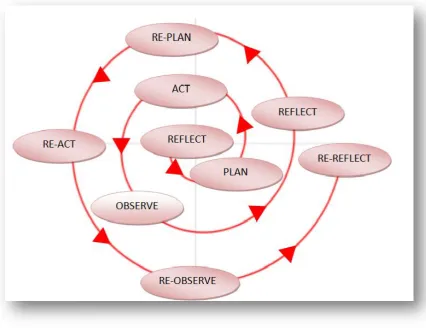
As mentioned earlier, the current research project was multilayered. The first layer was labelled as the Multiliteracies Project. At this layer, the research process was conducted collaboratively by a research team consisting of two teacher-participants and myself. At this layer, the main focus was to explore the students’ experiences in learning using the multiliteracies approach. The methodology employed was a participatory action research approach, thus it involved a cyclical process of planning, action, observation and reflection (Kemmis & McTaggart, 2005).
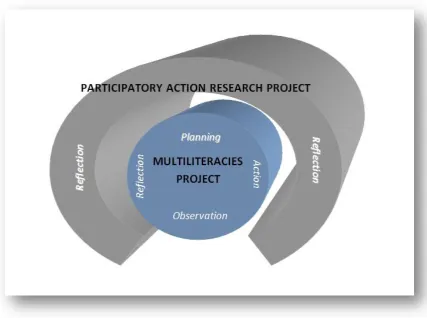
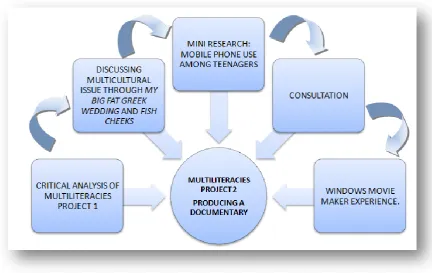
The second layer was labelled as the Participatory Action Research Project. This layer focused on exploring the research team’s experiences engaging in a participatory action research project. This was the point when I as a doctoral candidate stepped back and reflected on the whole research process that occurred at the first layer. At this layer, I was looking at and analysing the research processes of the Multiliteracies Project from an outside perspective. The multilayer property of the current research project is summarised by Figure 1.1.
22 embraced the Multiliteracies Project to enable me as a doctoral candidate to reflect on and analyse the team’s research practices as a whole.
Figure 1.1: The multilayered property of the research project
23
PREVIEW OF THE DISSERTATION
Chapter 1 introduces the research project. It provides the focus of the study, the aims and the research questions, as well as a description of the multilayered research process of the project.
Chapter 2 discusses the literatures and theoretical foundations of the study. The chapter discusses literature on learning for the 21st century, the multiliteracies approach and the socio-cultural paradigm of the current research project. It also provides the theoretical background of the cultural attributes of Malaysians with a focus on Malay ethnic culture. It then explains how cultural attributes influenced the learning styles of Malaysian students. Finally, it discusses the philosophy of participatory action research as the methodology of the study and reflective practice as the basis of analysis of data.
Chapter 3 describes the methodology used for this study. This chapter includes the description of the setting of the study which includes the location and participants. This chapter also describes the research procedures including the cyclical research process of participatory action research, data collection methods and data analysis methods of both layers of the study.
24 Chapter 5 focuses on the data collected at the second cycle of implementing multiliteracies in the Malaysian learning setting. This chapter highlights the transformations of the students’ responses towards the multiliteracies approach. This chapter also presents the research team’s formulation on the implementation of a multiliteracies approach in a Malaysian setting, in particular addressing the distinctive cultural attributes of Malaysian students.
Chapter 6 discusses findings from the second layer of the research project where I investigated the research team’s experiences in conducting in a participatory action research project. This chapter focuses on the elements of power and empowerment issues in the participatory action research process that was conducted in a Malaysian setting. It highlights the influence of the research teams’ cultural background toward the research process and outcome. This chapter also formulates the ways of implementing a participatory action research method in a Malaysian research setting.
Chapter 7 is the final chapter of the dissertation. It summarizes the findings of the research project and suggests future research projects in terms of extending the current research project. It also highlights the contribution of the current research projects towards the body of knowledge in terms of theories, philosophy and methodology.
25
SUMMARY OF THIS CHAPTER
26
CHAPTER 2
LITERATURE AND THEORETICAL FOUNDATIONS
PREVIEW
Chapter 1 provided an introduction to the research project by elaborating on the background of the study, research objectives, research questions, and rationale of the study. Chapter 1 also provided a description of the multilayered properties of the current research project and a preview of the dissertation.
27
PART A:
SOCIO-CULTURAL THEORY OF LEARNING
28 was criticized by Lev Vygotsky (1978, 2005), who argued that this theory did not acknowledge the influence of the socialization process that occurs in children’s lives.
Vygotsky argued that learning involved the process of socialisation of people with their surroundings and it is beyond a sole mental or cognitive process occurring in human brains as claimed by advocates of cognitive theories. Through this perspective, Vygotsky had led a huge paradigm shift in learning by introducing a human learning and development theory known as the socio-cultural theory. Even though he started writing in the 1920s, his works were only translated into English in the 1960s (Bigge & Shermis, 1999; Schunk, 1996) and played a significant role in informing the areas of learning and development. Socio-cultural theory suggested that learning occurred through the socialisation process of learners with the world around them; however, socio-cultural theory does not totally discard the influence of cognitive structures in learning. In contrast to cognitive theories which maintain that the social surrounding does not influence cognition, socio-cultural theory suggests that social activity is where the process of human cognition is formed (Lantolf & Johnson, 2007). According to socio-cultural theory, human learning and development is mediated through mental and semiotic tools in the social surroundings and language is seen as a crucial mental tool for human to learn and develop (Bigge & Shermis, 1999; Daniels, 2001; Jaramillo, 1996; Jarvis, 2006; Lantolf, 2000; Matsuoka & Evans, 2004; Mitchell & Myles, 2004; Pritchard, 2009; Schunk, 2012; Vygotsky, 1978).
29 person’s biological and cognitive development as claimed by cognitivist theorists. Vygotsky (1978, 2005) argued that human learning and development are mediated through language and signs and symbols in people’s environment (Daniels, 2001, 2008; Robbins, 2007). The tools for mediation are culturally and historically-determined and they include language, signs, and symbols as well as how people act. According to Turuk (2008), mediation tools are “artefacts created under specific cultural and historical conditions and as such they carry with them the characteristics of the culture in question” (p. 245).
As mentioned earlier, Vygotsky’s socio-cultural theory does not abandon the influence of cognitive structure in human learning and development; however, he argued that cognition is the result of the interaction of humans with their social environment. In his theory, he talks about the concept of internalisation and externalisation. Internalisation is the result of a person’s interrelation with his activities and the result of these activities are internalized by the person through his cognitive structure. Meanwhile the concept of externalisation is the opposite of internalisation where mental processes could be materialized through external actions and these actions could be transformed and changed.
30 32). He argued that if a child is already solving certain problems on his own, without any assistance, it indicated his actual developmental level. The second level is when a child can solve a problem with the assistance of an expert or collaboration with peers; this level is known as potential development level. The gap between these two levels is called the Zone of Proximal Development (Daniels, 2001; Guerrrero & Villamil, 2000; Pritchard, 2009; Schunk, 1996, 2012; Vygotsky, 1978). The zone of proximal development (ZPD) is a significant notion in socio-cultural theory and had become the underlying theoretical foundation of this research project. According to the socio-cultural theory, ZPD is the concept of space in which learners meet and learn from a person that is more advanced and knowledgeable such as an adult or teachers. This space was described to portray the distance or gap between the schema or a learner’s actual development with what the person can achieve through interaction with a more knowledgeable others (Bigge & Shermis, 1999; Daniels, 2001; Guerrero & Villamil, 2000; Jaramillo, 1996; Jarvis, 2006; Pritchard, 2009; Schunk, 1996, 2012; Vygotsky, 1978,2005). Vygotsky (1978, 2005) argued that previous developmental theories determined the actual development of a learner and not the potential developmental level. He maintained that determining the developmental level of a learner is just a beginning point of learning. What was important was to determine the development potential of a learner; thus he concluded that the notion of zone of proximal development would do just that. Through this notion, learning could be organized based on the learner’s development potential.
31 social environment. The concept of scaffolding had become the main reference for today’s classroom learning approaches, where teaching comes from an expert as well as interaction with the students’ environment to facilitate learning. Pritchard (2009) defined scaffolding as “a planned way in which the teacher engages groups and individuals in dialogue and supports the development of understanding” (p. 25). Through scaffolding, the teacher as expert assists learning by engaging the learners, the novices, in interactions that bridge the learners’ current learning to new learning stages. The concept of scaffolding is more than deductive teaching from the teacher but it is also about learning through peer collaboration. Through the socialisation with experts and peers, students would make sense of the world around them.
In conclusion, over the last 60 years, theories and practices of the learning have moved from a change of behaviour to a multidimensional process. Beginning with the view of learning as a response towards stimulus, the view moved to learning as a cognitive process and later to a socialisation process. Now, learning is viewed as a complex process that adopts many layers of theories. This study used socio-cultural theory to frame the research process and interpret data and findings.
MULTILITERACIES AND 21
STCENTURY LEARNING
This section will explain the original notion of multiliteracies as conceptualised by The New London Group (1996, 2000) and later explain how the notion was extended in theories and researches. I will also explain the characteristics of 21st century learning according to the literatures.
32 The original notion of multiliteracies
Socio-cultural theory suggests that learning is a product of learners’ socialisations with the surroundings and, based on this assumption, we could say that our social lives influence what we learn and the ways we learn. Thus, in designing effective pedagogical approaches, consideration should be made to issues that are happening in the socio-cultural world around us. And right now, the 21st century is going through massive transformations in many aspects of the world including social, economic, technological, communication and working culture due to globalisation.
33 referring to contemporary online activities. In people’s private lives, communication channels became diverse where the use of digital applications such as email, short messages system (sms), Skype and WhatsApp are more popular than the traditional pen and paper or even telephones. In addition, job applications are no longer carried out using traditional paper-based resumes but through an online application system. It seems that the information about almost everything from almost everywhere in the world is accessible through the Internet.
The world has changed in many areas since the beginning of the 21st century this has also impacted our educational approach. At the latter stages of the 20th century, a group of ten educators became known as The New London Group (1996) addressed the impact of these transformations and introduced the notion of multiliteracies. They contended that globalisation has transformed many aspects of our lives such as economy, work and social interactions; as a result, there were new requirements for future workers and therefore present students. Consequently, many have suggested that the approaches towards learning in the 21st century should be transformed in alignment with these transformations (Cope & Kalantzis, 2006, 2009a, 2009b; Kaur & Sidhu, 2007; Pandian & Balraj, 2010; The New London Group, 1996, 2000).
34 focused on the use of technological-based texts such as digital texts, webpages, computer software, online games, in promoting literacies in the 21st century. The New London Group (1996, 2000) described multiliteracies as having the knowledge and skills to participate actively in the globalized economics, information and social networks. The concept of multiliteracies is beyond reading and writing multiple forms of texts; it is also about having the knowledge of using and managing the current technological tools. Borsheim et al. (2008) suggested that teaching using the multiliteracies approach is beyond using technology as tools in teaching but teachers use technologies to help students to “understand how to move between and across various modes and media as well as when and why they might draw on specific technologies to achieve specific purpose” (p. 88).
Based on the descriptions above, I can formulate that the notion of multiliteracies is about having the knowledge and skills that are necessary for learners to understand, discuss, reflect and use multiple representations of texts, such as in current technological resources to participate effectively in a variety of formal situations such as economy and work, and social situations such as leisure and cultural activities.
Multiliteracies pedagogy
35 such as books, graphs, maps, newspapers and charts (Baguley et al., 2010; Charles, 2008; Iyer & Luke, 2010). But, in conjunction with the transformations in the 21st century, multiliteracies pedagogy suggested the use of multimodal resources which included printed texts, graphics, videos, images and movement that are usually represented in online articles, websites, emails and social networking websites (Charles, 2008; Cope & Kalantzis, 2009a; Iyer & Luke, 2010). These multimodal resources incorporate print, audio, visual, gestural, spatial representations (The New London Group, 1996, 2000).
According to multiliteracies pedagogy, the focus of learning is not limited to using multimodal and technological resources as semiotic tools in mediating learning. Cope and Kalantzis (2009b) stated that learning activities that use technological resources in the classroom, such as transferring printed words from books to Microsoft Powerpoint slides, but still focuses on traditional teaching approaches are not an actual indication of the learning of the 21st century. Learning in the 21st century includes having the knowledge and skills in handling, managing and transforming information and knowledge represented by the technological resources. In addition, learners should be taught to have the skills to relate those knowledge and skills in a variety of social contexts (Anstey & Bull, 2006; Cope & Kalantzis, 2009b).
36 to produce or consume texts should involve three elements which are Available Designs, Designing and The Redesigned” (New London Group, 1996, p. 12). Available Designs refers to multimodal resources, while, Designing is the “process of shaping emergent meaning” which involves “representation and recontextualization” (New London Group, 1996, p. 14). The process is not a mere replication of Available Designs but every moment of meaning making involves the transformation of several available resources of meaning. The outcome of the process of Designing is The Redesigned, a new meaning that is reproduced and transformed through the process of Designing Available Designs (New London Group, 1996, 2000). Here, through the process of Designing and Redesigning, learners practice the knowledge and skills in understanding and analysing the information obtained from multimodal resources and later transform that information and knowledge to other social settings.
37 deductive approach or direct teaching. In this component, the teacher bridges the students’ existing knowledge and skills to new information and knowledge through interactions with multimodal and technological resources. In Critical Framing, the students would be involved in learning activities that encourage critical thinking and analysis among the learners. Finally, in Transformed Practice, the students are facilitated to transform their existing knowledge and skills to new social contexts, thus creating new knowledge and skills. The components do not come in a linear hierarchy but can be found in any order and could take place simultaneously (The New London Group, 2000).
Extension and research on multiliteracies
It has been more than 16 years since the notion of multiliteracies was established, and the topic of multiliteracies is still being discussed by scholars, researchers and practitioners worldwide. The discussion ranged from the extension of the notion of multiliteracies (e.g., Cope & Kalantzis, 2006, 2009a, 2009b; Kalantzis, 2006; Kalantzis & Cope, 2004) to the implementation of the multiliteracies in various learning contexts (Ganapathy & Kaur, 2009; Kasper, 2000; Kaur & Sidhu, 2007; Pandian & Balraj, 2010; Ryu, 2011; J. P.-L. Tan & McWilliam, 2009; L. Tan & Guo, 2010) and to other practical and cultural issues related to multiliteracies (Ajayi, 2010; Chatel, 2002; Henderson, 2004; Mills, 2006a, 2006b, 2007, 2009; Rowsell, Kosnik, & Beck, 2008).
38 the practical concept of knowledge processes. They introduced Learning-by-Design pedagogy that emphasizes the point of “learners become knowledge producers and teachers become transformed professional role as designers of hybrid online and face-to-face communication” (Kalantzis & Cope, 2012a, online). The concepts of Overt Instruction, Situated Practice, Critical Framing and Transformed Practice in the multiliteracies pedagogy were simplified to knowledge processes of experiencing, conceptualising, analysing and applying (Cope & Kalantzis, 2009a; Kalantzis, 2006; Kalantzis & Cope, 2004). They argued that this concept is more recognizable and practical and easily identified by practitioners in the field of teaching (Cope & Kalantzis, 2009a). Cope and Kalantzis are also leading a global research project that invited practitioners worldwide to participate in their Learning-by-Design projects through their website newlearningonline.com.
Among other things, Cope and Kalantzis have been working on the concept of New Learning (Australian Council of Deans of Education, 2001; Cope & Kalantzis, 2009a, 2009b; Kalantzis & Cope, 2012b). They argued that one of the highlights of New Learning is that learning should incorporate the use of multimodal and technological resources as well as highlight the balance of agency between teachers and students. They argued that present cultural tools are actually encouraging a sense of agency or participation from users; however, traditional teaching means that teachers control the direction of the teaching and learning process.
39 2005; The New London Group, 1996, 2000). For example, Grabil and Hicks (2008) suggested that in writing, the students considered many factors and issues before embarking on the writing and the meaning-making process. Grabill and Hicks (2008) discussed how Information Communication Technologies (ICTs) were important in the teaching of writing. In their article they discussed that through the multiliteracies approach, the teaching of writing is not about teaching with computers but it provides opportunities for students to have “a social space to write through ICT tools” (p. 306). They asserted that, in writing, the students considered many factors and issues before embarking in the writing and the meaning-making process; therefore, they require a full set of technology options such as computers and the internet “to support how they write, share, socialize, play, and organize their lives” (p. 306).
40 technologies required more than using technologies as tools to complete particular task. Using technologies in learning provides a new ways in learning and making meaning.
A multiliteracies approach also provides opportunities for the implementation of meaningful situations for learning. Pandian and Balraj (2010) implemented a multiliteracies approach in Malaysian learning contexts. They suggested that the concepts of multiliteracies provided significant situations for learning. They investigated Malaysian secondary school science students’ experiences in learning using Kalantzis and Cope’s (2004) Learning-by-Design framework and asserted that the Malaysian educational scene was used to drawing on traditional chalk-talk approaches in teaching. Through Pandian and Balraj’s multiliteracies approach, the students were engaged in hands-on learning activities such as collecting water samples in several authentic sites in conjunction to learning about water pollutions. This study reported that the students were highly engaged in the activities, and were also able to participate in higher–order thinking activities such as evaluating and analysing. Pandian and Balraj suggested that the students were offered new environments and new technologies for learning. In addition, the students were also taught how to use technologies in sharing and presenting their ideas in the classroom.
41 approach in an English as a Second Language (ESL) classroom in Malaysia. They reported that the students were more interested to learn as the students claimed that the multiliteracies approach provided opportunities to learn in creative ways compared to the formal “English lessons that emphasised the use of textbooks and workbooks” (p. 6). The students were more motivated and interested to participate in the learning activities due to the use of technological resources where they were able to use technologies in retrieving information and completing classroom tasks.
42 could explore multimodal resources available in their community first to prepare them for the skills to learning the alphabet through transformed practice component.
The implementation of a multiliteracies approach was sometimes challenging as it may contrast certain socio-cultural attributes of certain learning contexts. L. Tan and Guo (2010) investigated the experiences of a Singaporean teacher in implementing a multiliteracies approach in a Singaporean learning context where learning was still based on print literacies. Their study showed that the teacher and students became co-designers in implementing new literacies in their learning context. The students demonstrated the ability to understand and analyse multimodal texts as well as presenting their ideas using technologies. They argued that students’ work using MediaStage (a 3D animated learning environment), to portray the themes from the study of Shakespeare’s Macbeth, displayed the students’ ability in understanding the literary work as well as demonstrated the students’ knowledge of intertextuality.
Although the students were showing evidences of new literacies learning, the teacher expressed that it was quite challenging to implement the multiliteracies approach in Singaporean learning contexts as the emphasis on multimodality contradicted the focus of the national assessment that was still based on print literacies. The teacher was interested to use a multiliteracies approach in her classroom and she also acknowledged the importance of learning 21st century skills, but she faced a dilemma because the national examination, which is highly valued by Singaporean society, was still concentrating on print literacies. She asserted that:
43 printed words. Very much of my emphasis in curriculum is still very much guided by the final assessment that they are going to take. And so when it comes to the crux, I would still choose focusing teaching or building or constructing their knowledge of the printed words (L. Tan & Guo, 2010, p. 323).
44 21st century skills
This brings us to the next important question, what knowledge and skills are considered significant in the 21st century?
It has been established that technologies have transformed the way people do things in the 21st century and it is crucial for 21st century learners to have the knowledge and skills of understanding and using technologies and multimodal representation of texts (Borsheim et al., 2008; Grabill & Hicks, 2008; The New London Group, 1996, 2000). Kist (2003) emphasized this point when he asserted that learners who are fluent in understanding, discussing and reflecting multiple codes that are required by the current multimodal texts are considered successful 21st century learners. At the same time, 21st century learners need to be able to be flexible and fluid to keep up with the fast-changing nature of the technologies. Leu et al. (2004) suggested that a multiliterate learner not only needs to be able to use technologies but also need to have the ability to use technologies to identify information, and be involved in critical thinking skills such as analysing and synthesizing. They stressed that the students should have the ability to use technology to convey the analysis to other people.
45 questions, and then communicate the answers to others (Leu et al., 2004, p. 1572).
This point was discussed by Anstey and Bull (2006) where they described a multiliterate person as someone who
is flexible and strategic and can understand and use literacy and literate practices with a range of texts and technologies; in socially responsible ways; in a socially, culturally, and linguistically diverse world; and to fully participate in life as an active and informed citizen (p. 55).
So, the use of technologies is more comprehensive than using technologies as tools. It is also about having the critical thinking skills to analyse and reflect and synthesize information that is presented through multimodal texts.
A multiliteracies approach also highlights the ability to work in teams and in a network of people (Gee, 2000, 2002; Iyer & Luke, 2010; Kist, 2003). Gee (2000) asserted that in addition to having the skills to work collaboratively, a worker is now expected to be more proactive in relation to the interest of the workplace. This means that a worker regardless of his/her level in the organization structure is required to be able to conduct critical analysis and possess multiple skills. Ultimately, the 21st century is demanding that learners or future workers be experts in a variety of fields and do not only possess a single expertise (Gee, 2000).
46 teaching and learning processes; however, they argued that in the 21st century, students should actively participate in determining their own learning processes with the teachers. They claimed that these are the times that require active participation from all level of social strata, where we are no longer viewers but active participants in most social activities. Kist (2003) stated said the learners in the 21st century should be active, engaged doers which means that students should be able to initiate and be engaged in activities that benefit their own learning. Kist further mentioned that the 21st century is not the place for passive students. It is appropriate that a multiliteracies classroom learning approach adopts a way to shift the balance of agency between teachers and students where students would be encouraged to be co-users and co-designers of their own learning. Berthelsen and Brownlee (2005) suggested that active participation from students in becoming agents of their own learning is important. In their study of children’s active participation in child care programs in Australia, they investigated how child care workers understand and recognise the rights of participation of children. One of the findings of the study showed that children and teachers worked as learning partners that signified the increasing awareness of the significance of children’s active participation in learning.
In short, based on the discussions above, the 21st century skills that will be highlighted in the current study are:
1. knowledge to use current technologies for diverse purposes;
2. critical thinking skills to identify, reflect, analyse and evaluate information presented by multimodal texts;
47 4. active participation in determining the processes of own learning.
In conclusion, the change and transformation of the global economy, the social world and the advancement of information and communication technologies require a shift from the traditional classroom pedagogical approach. Learners are now expected to be proactive, possess the ability to analyse, evaluate, and communicate information effectively using available technological innovations. A multiliteracies approach does not work on a limited concept of using technologies in learning but also emphasizes learning the skills and knowledge that are prevalent with the advent of technologies in the 21st century. The multiliteracies approach was introduced almost 16 years ago, but it has been extended and widely researched and is still relevant in the present times. Research shows that the multiliteracies approach provides meaningful learning experiences for students and recognizes the differences in the students’ socio-cultural backgrounds.
PART B:
MALAYSIAN CULTURAL ATTRIBUTES AND MALAYSIAN
LEARNING STYLE
48 (Aminuddin, Nur Syuhada, Tajularipin, & Roselan, 2010; Merriam & Mazanah, 2000).
Understanding culture
Culture in the simplest form could be defined as accepted practices in a society based on shared beliefs and values and has been passed through generation; however, most scholars presented a more comprehensive definition of the word culture. Clyde Kluckhohn in his book of Mirror for Man (1949), described culture as a total life way of people, the social legacy individual acquire from their group. The main characteristic of culture was that it is shared among people in one group and it distinguishes the group from other groups. This point was supported by the definition of culture by Hofstede (2001). He defined culture as collective mind programming that differentiates members of one group or categories from other group. It was also supported by Kaasa and Vadi (2010), who defined culture as “a pattern of shared values, beliefs, and behaviours of a group of people, be it some small group or the whole society” (p. 585).
A Malaysian researcher, Asma (2009) provided quite a comprehensive definition of culture, when she defined culture as:
1. The total patterns of beliefs, customs, practices, institutions, techniques and objects that the people of the society have invented, adopted and inherited from their forefathers and other reliable sources;
49 members to learn and transmit knowledge to succeeding generations so that they know how they are expected to behave;
3. a way of life which gives members in a society a sense of purpose, identity, meaning and well being and generates a commitment to the primary cultural values and philosophy and the vision that members believe they can promote and uphold;
4. the cumulative deposit of knowledge, experience, meanings, beliefs, values, attitudes and concepts of self, the universe (reality, harmony with nature and hierarchies of status), time, role expectations and spatial relations acquired by a large group of people in the course of generations through individuals and groups striving in order to adapt to the environment (p.4).
Vygotsky’s (1978) socio-cultural theory suggested that the socio-cultural background of a person determines how he/she makes sense or negotiates things in a particular context. Hofstede (2001) asserted that culture consist of mental software that controls a person’s response to their surroundings. Thomas (2008) also suggested a similar point when he asserted that “language, systems of government, forms of marriage, and religious system are all functioning when we are born into a society” (p. 29). It can be said that all aspects of the world including learning occurs according to the person’s socio-cultural background. Different societies will have different interpretations about the world around them including learning.
50 developing inaccurate action plans in promoting learning process. This point was discussed by Henderson (2004), when she highlighted the learning stories of three children in Australia who came from families of itinerant farm workers. The children had literacies issue but her study showed that some of the teachers attributed their literacies issues to the fact that they often moved schools and missed school so much in one year. Through her investigation, Henderson found out that the children had bilingual background, in which they spoke Tongan at home and English was their second