
Iterative Joint Channel Estimation and
Multi-User Detection for
Multiple-Antenna Aided OFDM Systems
M. Jiang,
Member
,
IEEE
, J. Akhtman,
Member
,
IEEE
, and L. Hanzo,
Fellow
,
IEEE
Abstract— Multiple-Input-Multiple-Output (MIMO) Orthog-onal Frequency Division Multiplexing (OFDM) systems have recently attracted substantial research interest. However, com-pared to Single-Input-Single-Output (SISO) systems, channel estimation in the MIMO scenario becomes more challenging, owing to the increased number of independent transmitter-receiver links to be estimated. In the context of the Bell LAyered Space-Time architecture (BLAST) or Space Division Multiple Access (SDMA) multi-user MIMO OFDM systems, none of the known channel estimation techniques allows the number of users to be higher than the number of receiver antennas, which is often referred to as a “rank-deficient” scenario, owing to the constraint imposed by the rank of the MIMO channel matrix. Against this background, in this paper we propose a new Genetic Algorithm (GA) assisted iterative Joint Channel Estimation and Multi-User Detection (GA-JCEMUD) approach for multi-user MIMO SDMA-OFDM systems, which provides an effective solution to the multi-user MIMO channel estima-tion problem in the above-menestima-tioned rank-deficient scenario. Furthermore, the GAs invoked in the data detection literature can only provide a hard-decision output for the Forward Error Correction (FEC) or channel decoder, which inevitably limits the system’s achievable performance. By contrast, our proposed GA is capable of providing “soft” outputs and hence it becomes capable of achieving an improved performance with the aid of FEC decoders. A range of simulation results are provided to demonstrate the superiority of the proposed scheme.
Index Terms— Channel estimation, genetic algorithm, multiple-input-multiple-output, multi-user detection, orthogonal frequency division multiplexing, space division multiple access.
I. INTRODUCTION
M
ULTIPLE-Input-Multiple-Output (MIMO) Orthogonal Frequency Division Multiplexing (OFDM) systems have recently attracted substantial research interest [1]–[3]. Specifically, intensive research efforts have been invested both in Bell Labs Layered Space-Time architecture (BLAST) and in Space Division Multiple Access (SDMA) based MIMO OFDM [4]. In SDMA-OFDM systems the transmitted signalsManuscript received January 25, 2006; revised October 19, 2006; accepted June 14, 2007. The associate editor coordinating the review of this paper and approving it for publication was X. Wang. The work reported in this paper has formed part of the Wireless Enablers 2.2 of the Core 3 Research Programme of the Virtual Centre of Excellence in Mobile and Personal Communications, Mobile VCE, www.mobilevce.com, whose funding support, including that of EPSRC, is gratefully acknowledged. Fully detailed technical reports on this research are available to Industrial Members of Mobile VCE.
M. Jiang was with the School of ECS, University of Southampton, Southampton, UK. He is now with Samsung Electronics Research Institute, Staines TW18 4QE, UK (email: [email protected]).
J. Akhtman and L. Hanzo are with the School of ECS, University of Southampton, Southampton, UK (email:{ya, lh}@ecs.soton.ac.uk).
Digital Object Identifier 10.1109/TWC.2007.05817.
ofL simultaneous uplink mobile users - each equipped with a single transmit antenna - are received by the P different receiver antennas of the Base Station (BS). At the BS Multi-User Detection (MUD) [5] techniques are invoked for de-tecting the different users’ transmitted signals with the aid of their unique, user-specific spatial signature constituted by their Frequency-Domain CHannel Transfer Functions (FD-CHTFs) or, equivalently, Channel Impulse Responses (CIRs). However, in these systems accurate channel estimation is required at the receiver for the sake of invoking both coherent demodulation and interference cancellation [6]. Compared to Single-Input-Single-Output (SISO) systems, channel estima-tion in the MIMO scenario becomes more challenging, since a significantly increased number of independent transmitter-receiver channel links have to be estimated simultaneously for each subcarrier. Moreover, the interfering signals of the other transmit antennas have to be suppressed.
In the literature, a number of blind channel estimation tech-niques have been proposed for MIMO-OFDM systems [7]– [12]. However, most of these approaches suffer from either a slow convergence rate or a performance degradation, ow-ing to the inherent limitations of blind search mechanisms. By contrast, the techniques benefiting from explicit training with the aid of known reference/pilot signals, are typically capable of achieving a better performance at the cost of a reduced effective system throughput. For example, Li et al. [13] proposed an approach of exploiting both transmitter diversity and the delay profile characteristics of typical mobile channels, which was further simplified and enhanced in [14], [15] and [16], respectively. Other schemes employed Mini-mum Mean Square Error (MMSE) [17], Constrained Least Squares (CLS) [18], iterative Least Squares (LS) [19], Second-Order Statistics (SOS) based SubSpace (SS) [20] estimation algorithms as well as the QR Decomposition combined with the M-algorithm (QRD-M) [21], [22] or techniques based on Time Of Arrivals (TOAs) [23], etc. Some researchers have their attention focused on designing optimum training patterns or structures [14], [24]. Furthermore, various joint approaches combining channel estimation with data symbol detection at the receiver were also proposed for Code Division Multiple Access (CDMA) [12], [21], SISO OFDM [25]–[27] and MIMO OFDM [22], [28] systems. However, in the context of BLAST or SDMA type multi-user MIMO OFDM systems, all channel estimation techniques found in the literature were developed under the assumption that the number of users L is lower than [7]–[9], [17], [20] or equal to [10], [18], [22]–
[24], [28] the number of receiver antennasP. This assumption is critical for the following reasons. When we haveL > P, which we refer to as arank-deficient scenario, the (P×L )-dimensional MIMO channel matrix representing the P ×L channel links becomes singular, thus rendering the degree of freedom of the detector insufficient. This will catastrophically degrade the performance of numerous known detection ap-proaches, such as for example the MMSE algorithm of [4], [5] and the QRD-M algorithm of [22]. Furthermore, the associated significant degradation of the MUD’s performance in this rank-deficient scenario will inevitably result in severe error propagation in decision-directed type channel estimators [4].
Against this background, in this paper we propose a new Genetic Algorithm (GA) assisted iterative Joint Channel Esti-mation and multi-user detection (GA-JCEMUD) approach for multi-user MIMO SDMA-OFDM systems, which provides an effective solution to the multi-user MIMO channel estimation problem in the above-mentioned rank-deficient scenario. Our ambitious goal of supporting a high number of users is possible, because the proposed GA-based technique dispenses with any constraints concerning the rank of the channel matrix. In the literature, only a few channel estimation schemes were proposed based on GAs. More specifically, Yen et al. [29] proposed a GA-aided multi-user CDMA single-antenna re-ceiver, which jointly estimates the transmitted symbols and fading channel coefficients of all the users. A batch blind equalization scheme based on Maximum Likelihood (ML) concatenated channel and data estimation employing a micro genetic algorithm (μGA) and the Viterbi Algorithm (VA) was proposed in [30]. In [31], GA-based approaches were used for finding optimum training sequences for channel estima-tion in OFDM systems. However, to our best knowledge, no techniques employing GAs for joint channel and data optimization can be found in the literature in the context of multi-user MIMO OFDM. Furthermore, at the time of writing the GAs invoked in the data detection literature [29], [32]– [38] can only provide a hard-decision output for the Forward Error Correction (FEC) or channel decoder, which inevitably limits the system’s achievable performance. By contrast, our proposed GA is capable of providing “soft” outputs and hence it becomes capable of achieving an improved performance with the aid of FEC decoders.
The structure of this paper is as follows. The overview of the proposed scheme is provided in Section II, followed by our detailed analysis in Section III. The numerical results are presented in Section IV, while our final conclusions are offered in Section V.
II. SYSTEMOVERVIEW
In uplink SDMA-OFDM systems, at thekth subcarrier of
the nth OFDM symbol received by the P-element receiver
antenna array we have the received complex signal vector x[n, k], which is constituted by the superposition of the faded signals associated with theL mobile users and contaminated by the Additive White Gaussian Noise (AWGN), expressed as:
x[n, k] = H[n, k]s[n, k] +n[n, k], (1)
…
…
…
User 1
GA-aided Iterative Joint
Channel Estimator and
Multi-User Detector
IFFT
SDMA MIMO Channel
(1)
s b
1
x
2
x
P x User 1
User 2
FFT
FFT
Base Station (BS)
Mod.
Geographically-separated Mobile Stations (MSs)
…
…
… … …
User 2 IFFT
IFFT Mod.
Mod. User L
…
… …
User L FFT
P-element Receiver Antenna Array FEC Encoder
FEC Decoder
FEC Decoder
FEC Decoder FEC Encoder FEC Encoder
(2)
b
( )L b
(1)
b
(1) ˆ
b
(2) ˆ
b
( ) ˆL b
(1)
s
(2)
s
( )L s (2)
s b
( )L s b
(1) ˆ
s b
(2) ˆ
s b
[image:2.567.291.542.55.233.2]( ) ˆL s b
Fig. 1. Schematic of the SDMA-OFDM uplink system employing the
proposed GA-aided iterative joint channel estimator and multi-user detector.
wheres[n, k]andn[n, k]are the transmitted and noise signal vectors, respectively, while H[n, k] is the FD-CHTF matrix. Note that the mobile users are assumed to be synchronized, whilst the fading envelope of the(P×L)user-receiver channel links are assumed to be uncorrelated. Figure 1 shows a detailed schematic of a SDMA-OFDM uplink system using the proposed iterative GA-JCEMUD. As shown in the upper half of Figure 1, the information bit blocksb(l)(l= 1,· · ·, L)
of theLmobile users are first encoded by theLindependent FEC encoders. The resultant coded bitsb(sl) are then mapped
to Quadrature Amplitude Modulation (QAM) or Phase-Shift Keying (PSK) symbols s(l), which are modulated by the
Inverse Fast Fourier Transform (IFFT) based OFDM modu-lators and transmitted over the SDMA MIMO channel. At the BS illustrated at the lower half of Figure 1, the received signal constituted by the noise-contaminated superposition of all users’ transmitted signals is OFDM-demodulated at theP receiver antenna elements and forwarded to the iterative GA-JCEMUD for joint channel estimation and symbol detection, as it will be detailed in Section III. Then the detected soft bits ˆb(l)
s are generated, which are forwarded to theLindependent
FEC decoders for channel decoding.
III. GA-ASSISTEDITERATIVEJOINTCHANNEL
ESTIMATION ANDDATADETECTION
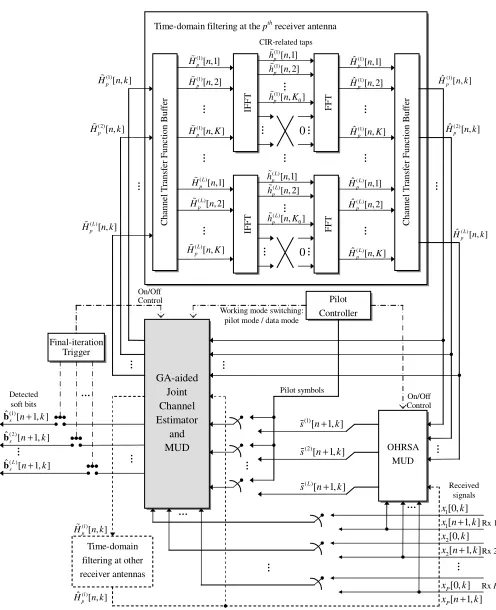
The proposed iterative GA-JCEMUD is illustrated in Fig-ure 2. We assume that each OFDM symbol consists of K subcarriers. The first transmitted OFDM symbol of all the
L users is completely filled by known pilot Quadrature Am-plitude Modulation (QAM) symbols. Within the first OFDM symbol duration (n = 0), the BS pilot controller seen in the middle of Figure 2 feeds the pilots to the GA-JCEMUD printed in grey, which simultaneously processes the received signals xp[0, k] (p = 1,· · ·, P; k = 1,· · · , K) at the P
receiver antenna elements. In order to simplify the analysis, we now focus our attention on thepthreceiver. Based on the pilots
…
…
…
Final-iteration Trigger
…
IF
FT
C
h
anne
l
T
ra
n
sf
er
F
u
n
ct
ion B
u
ff
er
GA-aided Joint Channel Estimator and
MUD OHRSA MUD
( )L[ , ] p H n k
( 2)[ , ] p H n k
(1)[ , ] p H n k
…
(1)[ , ] p H n K
(1)[ , 2] p H n
(1)[ ,1] p H n
…
…
(1) 0
[ , ]
p h n K
(1)[ , 2] p h n
(1)[ ,1] p h n
…
FF
T
… 0…
…
(1)
ˆ [ , ]p H n K
(1)
ˆ [ ,2]p H n
(1)
ˆ [ ,1]p H n
C
h
anne
l
T
ra
n
sf
er
F
u
n
ct
ion B
u
ff
er
IF
FT
…
( )L[ ,2] p H n
( )L[ ,1] p H n
…
( ) 0
[ , ]
L p h n K
( )L[ , 2] p h n
( )L[ ,1] p h n
FF
T
… 0…
…
( )
ˆL[ , ]
p H n K
( )
ˆL[ ,2]
p H n
( )
ˆL[ ,1]
p H n
…
Pilot Controller
( )
ˆL[ , ]
p
H n k
( 2)
ˆp[ , ]
H n k
(1)
ˆp[ , ]
H n k
…
…
Pilot symbols
(1)[ 1, ]
s n+ k
… …
…
(1)
ˆ [s n+1, ]k
b
(2)
ˆs[n+1, ]k
b
( )
ˆL[ 1, ]
s n+ k
b
Time-domain filtering at the pth
receiver antenna
Time-domain filtering at other receiver antennas
( )l[ , ] p H n k
( )
ˆ [ , ]l p H n k Detected soft bits
…
CIR-related taps
On/Off Control
…
…
On/Off Control
( )L[ , ] p H n K
1[0, ]
x k
1[ 1, ]
x n+ k
2[0, ]
x k
2[ 1, ]
x n+ k
[0, ]
P x k
[ 1, ]
P x n+ k Working mode switching:
pilot mode / data mode
Rx 1
Rx 2
Rx P
(2)[ 1, ]
s n+ k
( )L[ 1, ]
s n+ k Received
signals
[image:3.567.28.276.48.353.2]…
Fig. 2. Structure of the proposed GA-aided iterative joint channel
estimator and multi-user detector.
be generated, followed by the time-domain filtering invoking at thepthreceiver, as plotted on the top of Figure 2.
The time-domain filtering is conducted for each of theL users on an OFDM symbol basis. More generally, for the
lth user, the K initial FD-CHTF estimates H˜(l)
p [n, k] (k =
1,· · ·, K) associated with the current, i.e. the nth OFDM
symbol are processed by a K-length Inverse Fast Fourier Transform (IFFT), resulting in the set of K uncorrelated CIR-related taps ˜h(pl)[n, k]. Then, only the first K0 CIR tap
coefficients are retained with the rest set to zero. The value of
K0 depends on the delay profile of the channel, which is not knowna prioriat the receiver. However, in many application scenarios it is possible to appropriately over-estimateK0 on the basis of previous field experiments. Hence, in our system the value ofK0 is set to a sufficiently large number so that it significantly exceeds the actual maximum delay spread of the channel. Nonetheless, we point out that the ‘significant-tap catching’ approaches of [13] can be employed for improving the channel estimator’s performance by further removing the low-power taps within the range of[1,· · · , K0]according to a pre-defined threshold. The retained CIR-related coefficients ˜
h(l)
p [n, k] (k= 1,· · ·, K0)are then converted to the improved
a posterioriFD-CHTF estimates Hˆp(l)[n, k] (k = 1,· · ·, K)
by the Fast Fourier Transform (FFT).
If in the(n+ 1)thOFDM symbol duration a data symbol
rather than a pilot symbol was transmitted, the pilot controller will enable a first-stage MUD for generating reference sym-bol estimates. Specifically, the Optimized Hierarchy Reduced Search Algorithm (OHRSA) aided MUD of [39], [40] is
employed. With the aid of thea posterioriFD-CHTF estimates ˆ
H(l)
p [n, k] associated with the previous OFDM symbol, a
subcarrier-by-subcarrier based detection is invoked by the OHRSA MUD for generating an initial guess of theLusers’ transmitted symbols s(l)[n + 1, k] (l = 1,· · ·, L; k =
1,· · · , K). More details of the OHRSA MUD are provided in Section III-B. The resultant symbol estimatess˜(l)[n+1, k], the FD-CHTF estimates Hˆp(l)[n, k] as well as the corresponding
received signals xp[n+ 1, k] (p= 1,· · ·, P; k= 1,· · · , K)
are then forwarded to the GA-JCEMUD, where the FD-CHTFs and data symbols associated with the(n+1)thOFDM symbol are jointly optimized on a subcarrier-by-subcarrier basis, as to be discussed in Section III-C. The GA-optimized FD-CHTF estimatesH˜p(l)[n+1, k]are then forwarded to the time-domain
filters for further enhancement. Based on the improved channel estimates, the OHRSA MUD is now capable of providing a better initial guess of the transmitted symbols for the GA-JCEMUD. This decision-directed process can be invoked for a number of iterations for further performance enhancement. After the final iteration, theLusers’ detected soft bitsˆb(sl)[n+
1, k] (l = 1,· · ·, L; k = 1,· · ·, K) corresponding to the (n+ 1)thOFDM symbol are generated.
A. Pilot-aided Initial Channel Estimation
In order to obtain an initial estimate of the FD-CHTFs, each user’s pilot OFDM symbol is multiplied by a user-specific spreading code before it is transmitted. An unspread pilot OFDM symbol constituted by K identical unspread QAM subcarrier symbols can be used by all users, which is known at the receivers. Note that no spreading is applied to the data OFDM symbols. With the aid of the spread pilot OFDM symbols, an initial FD-CHTF estimate is attainable at the receivers, where the Multi-User Interference (MUI) is effec-tively reduced proportionately to the spreading factor. In our system, orthogonal Walsh-Hadamard-Transform (WHT) [4] based spreading codes of lengthL are used.
Depending on the specific performance-versus-throughput design tradeoff targeted, this process of generating initial channel estimates can be invoked at pre-defined time intervals. Here we denote the pilot overhead as , which is defined by the ratio of the number of pilot OFDM symbols to the total number of transmitted OFDM symbols. We will show in Section IV that a good performance is achievable by the proposed scheme with a small value of.
B. Generating Initial Symbol Estimates
As mentioned earlier, for each subcarrier, an initial sym-bol estimate is first obtained with the aid of the first-stage Optimized Hierarchy Reduced Search Algorithm (OHRSA) assisted MUD [39], [40], which exploits the a posteriori FD-CHTF estimates generated within the previous OFDM symbol duration. For the sake of notational convenience, in this section the index of [n, k] is omitted. However, we note that the following analysis is conducted on a subcarrier basis.
ˆsML can be obtained by minimizing the following metric:
ˆsML= arg
min
ˇs∈ML||x−Hˇs||
2
, (2)
where ˇs is an a priori candidate vector of the set ML,
which is constituted by 2mL trial-vectors, where m denotes
the number of Bits Per Symbol (BPS). More specifically,ML
is formulated as:
ML=
ˇs= (ˇs(1),sˇ(2),· · ·,ˇs(L))T
sˇ(1),sˇ(2),· · ·,ˇs(L)∈ Mc
,
(3) where Mc denotes the set containing the 2m legitimate
complex constellation points associated with the specific mod-ulation scheme employed. Furthermore, it can be shown that Equation (2) is equivalent to [39], [40]:
ˆs= arg
min
ˇs∈ML||V(ˇs−ˆsMMSE)||
2, (4)
where V is an upper-triangular matrix having positive real-valued elements on the main diagonal and satisfying
VHV=HHH+σ2
nI, (5)
while
ˆsMMSE= (HHH+σn2I)−1HHx (6)
is the unconstrained MMSE-based estimate of the transmitted signal vector s, with I and σ2n are the identity matrix and the AWGN noise variance, respectively. The superscript of (·)H denotes the Hermitian transpose. Since V is an
upper-triangular matrix, a specific cost function can be derived:
Φ(ˇs) = ||V(ˇs−ˆsMMSE)||2
= (ˇs−ˆsMMSE)HVHV(ˇs−ˆsMMSE)
=
L
i=1
L
j=i
vij(ˇs(j)−ˆs(MMSEj) )
2
= L
i=1
φi(ˇsi), (7)
whereφi(ˇsi)is a set of sub-cost functions, andˇsi represents
the sub-vectors ofˇs, formulated as:
ˇsi=
ˇ
s(i), sˇ(i+1), · · ·, sˇ(L) , i∈ {1,· · ·, L}. (8)
Note that the outputs of bothΦ(ˇs)andφi(ˇsi)are real-valued. Furthermore, we have:
φi(ˇsi) = L
j=i
vij(ˇs(j)−ˆs(MMSEj) )
2
= vii(ˇs(i)−sˆ(MMSEi) ) + L
j=i+1
vij(ˇs(j)−ˆs(MMSEj) ) 2
.
(9)
Based on Equation (9),Φ(ˇs)can be re-defined as the Cumu-lative Sub-Cost (CSC) function:
ΦL(ˇsL) = φL(ˇsL) =vLL(ˇs(L)−ˆs(MMSEL))
2, i=L (10a) Φi(ˇsi) = Φi+1(ˇsi+1) +φi(ˇsi), i=L−1,· · ·,1. (10b)
The Euclidean norm of Equation (10) can be interpreted as a weighted Euclidean distance between the candidate constel-lation point ˇs(l) and the unconstrained MMSE estimatesˆ(l)
MMSE
of the transmitted signal components(MMSEl) . Explicitly, the CSC
functions obey the property:
Φ(ˇs) = Φ1(ˇs1)>Φ2(ˇs2)>· · ·>ΦL(ˇsL)>0 (11)
for all possible combinations of ˇs∈ ML andˆs
MMSE ∈ CL,
where theL-dimensional complex spaceCL contains all
pos-sible unconstrained MMSE estimatesˆsMMSE of the transmitted
signal vector s.
Exploiting the monotonously increasing nature of the non-binary, i.e. multi-bit symbol based CSC functions of Equa-tion (11), a bit-based recursive search algorithm can be devel-oped [39], [40], where the(Lb=mL)-dimensional bit vectors ˇbconstituting theLusers’ bits, rather than the symbol vectors ˇs are used as the candidates for the CSC functions given by Equations (7) and (10). More specifically, two legitimate hypotheses of−1 and1 are stipulated at each recursive step
i of the search algorithm, concerning one of the bits of the bit-based trial vector ˇbi. This allows us now to interpret the
CSC functions as the Euclidian distance contribution of the specificˇbi, when considering a specific bit of a given symbol
of a given user. The recursive search process commences with the evaluation of the CSC function of Equation (10a), followed by the calculation of the conditioned CSC function values of Equation (10b). Moreover, for each tentatively assumed value of ˇbi a successive recursive search step (i−1) is invoked,
which is conditioned on the hypotheses made in all preceding recursive steps j = i,· · ·, Lb = mL. Upon each arrival at the indexi= 1of the recursive process, a complete bit-based candidate vectorˇbassociated with a certain symbol vectorˇsis hypothesized and the corresponding value of the cost function Φ(ˇb) formulated in Equation (7) is evaluated. Furthermore, with the aid of a carefully-designed search strategy [39], [40], the OHRSA is capable of arriving at the optimum ML estimate at a significantly reduced complexity. For more details on the OHRSA MUD, the interested reader is referred to [39], [40].
C. GA-aided Joint FD-CHTF and Data Optimization Provid-ing Soft Outputs
1) Joint Genetic Optimization: In comparison to the pure GA-based MUDs [33]–[35], [37], [38], which optimize the multi-user data symbols only, the joint optimization work requires the FD-CHTFs to be simultaneously optimized along with the data symbols, as in [29], [32].
Furthermore, concerning the MIMO channel’s structure, the GAindividuals’ representation of [29], [32] is extended to:
⎧ ⎪ ⎪ ⎪ ⎪ ⎪ ⎪ ⎪ ⎪ ⎪ ⎪ ⎪ ⎪ ⎨ ⎪ ⎪ ⎪ ⎪ ⎪ ⎪ ⎪ ⎪ ⎪ ⎪ ⎪ ⎪ ⎩
˜s(y,x )[n, k] =
˜
s(1)(y,x)[n, k], ˜s(2)(y,x)[n, k], · · ·, ˜s(L)
(y,x)[n, k]
˜
H(⎡y,x)[n, k] =
⎢ ⎢ ⎢ ⎢ ⎢ ⎣
˜
H1(1),(y,x)[n, k] ˜H1(2),(y,x)[n, k] · · · H˜(L)
1,(y,x)[n, k]
˜
H2(1),(y,x)[n, k] ˜H2(2),(y,x)[n, k] · · · H˜(L)
2,(y,x)[n, k]
..
. ... . .. ...
˜
HP,(1)(y,x)[n, k] ˜HP,(2)(y,x)[n, k] · · · H˜(L)
P,(y,x)[n, k]
⎤ ⎥ ⎥ ⎥ ⎥ ⎥ ⎦
in the context of thekthsubcarrier of thenthOFDM symbol,
where the subscript (y, x) denotes the xth (x = 1,· · ·, X)
individual at theyth(y= 1,· · · , Y)generation. Note that we
haves˜((ly,x) )[n, k] ∈ Mc andH˜p,(l)(y,x)[n, k] ∈C, respectively, where C denotes the set of all complex numbers. During the stage of initialization, the GA generates a population of
X individuals represented by Equation (12), based on the initial FD-CHTF estimates of Section III-A and the initial symbol estimates of Section III-B. More explicitly, at the
kth subcarrier in the (n+ 1)th OFDM symbol duration, the
(y, x) = (1,1)st individual is generated as:
˜
s(l)
(1,1)[n+ 1, k] = ˜s(l)[n+ 1, k]
˜
H(l)
p,(1,1)[n+ 1, k] = H˜p(l)[n, k]
,
l= 1,· · ·, L; p= 1,· · · , P, (13)
where ˜s(l)[n+ 1, k] represents the initial symbol estimates
provided by the OHRSA MUD, whileH˜p(l)[n, k] denotes the
initial FD-CHTF estimates associated with the previous, i.e. thenthOFDM symbol. The otherX−1 individuals are then created by the GA’smutationoperator [32]:
˜
s(l)
(y,x)[n+ 1, k] = MUTATE
˜
s(l)
(1,1)[n+ 1, k]
˜
Hp,(l)(y,x)[n+ 1, k] = MUTATE
˜
Hp,(l)(1,1)[n+ 1, k]
,
x= 2. . . X; y= 1. . . Y; l= 1. . . L; p= 1. . . P. (14)
After the creation of they = 1st generation, which consists
of the population of the initially generatedX individuals, the GA-based search process can be invoked for jointly optimizing the estimates of the multi-user symbols and FD-CHTFs.
The basic idea of the GA-based optimization is to find the optimum or a near-optimum solution according to a pre-defined objective function (OF). In the context of the joint detection problem in SDMA-OFDM systems, the GA’s OF can be based on the ML metric of Equation (2), formulated as:
ΩH˜[n, k], ˜s[n, k]=x[n, k]−H˜[n, k]·˜s[n, k]2, (15)
where each combination of the trial data vector˜s[n, k] and trial FD-CHTF matrix H˜[n, k] constitutes a GA individual defined in Equation (12). The output of the OF is referred to as the objective score (OS), and the individual having a lower OS is considered to have a higher fitness value. Explicitly, the GA’s ultimate aim is to find the individual that has the highest fitness value. This is achieved with the aid of the genetic operators invoked during the evolution process, such ascross-overandmutation[32], where specific elements of the different individuals are exchanged and mutated to produce the correspondingoffspring, whose fitness values are statistically improved over the consecutive generations. For space economy, the interested reader is referred to [32], [38], where more details of the GA-based MUDs can be found.
Note that since the FD-CHTFs and data symbols are jointly optimized within the same genetic process, the individuals having better FD-CHTF estimates will have a higher prob-ability of producing better symbol estimates and vice versa. From a statistical point of view, this joint optimization is a “self-adaptive” process leading towards the optimum solution, provided that the number of GA generations is sufficiently
high. Furthermore, compared to other techniques, for example that of [30], where channel estimation and symbol detection are carried out by the GA and the VA separately, the proposed joint scheme is capable of reducing the associated complexity. More specifically, the GA of [30] can only provide channel estimates, whilst the data symbols are detected by the sub-sequent VA-based detector. By contrast, thanks to the joint optimization structure, our scheme simultaneously generates both channel and symbol estimates within the same genetic process, implying that no additional complexity is required for data detection.
Moreover, it is worth pointing out that at the time of writing the GA-aided detection schemes found in the literature [29], [32]–[35], [37], [38] are only capable of providing single-individual based hard-decoded symbol estimates, which in-evitably limits the GA-aided system’s attainable performance. In Section III-C.2, we will introduce a method, which enables the GA to provide soft outputs based on the entire population. 2) Generating the GA’s Soft Outputs: For the sake of notational convenience, the index of [n, k] is omitted in this section. The soft-bit value or Log-Likelihood Ratio (LLR) associated with the (mB)th bit position of the lth (l =
1,· · · , L) user’s transmitted symbol s(l) can be formulated as:
Ll,mB = ln
P(bl,mB = 1|x,H)
P(bl,mB = 0|x,H)
. (16)
Note that the probabilityP(bl,mB =b|x,H) that the symbol transmitted by thelthuser has the(m
B)thbit value ofbl,mB=
b∈ {0,1}, is given by the sum of all the probabilities of the symbol combinations which assume that bl,mB = b. Hence, Equation (16) can be equivalently rewritten as:
Ll,mB = ln
ˇs∈ML
l,mB,1P(ˇs|x,H)
ˇs∈ML
l,mB,0P(ˇs|x,H)
, (17)
whereML
l,mB,bdenotes the specific subset associated with the
lth user, which is constituted by those specific trial vectors,
whose lth element’s (m
B)th bit has a value of b, which is
expressed as:
ML
l,mB,b=
ˇs= [ ˇs(1), ˇs(2),· · · , ˇs(L)]T
{sˇ(1), sˇ(2), · · ·, sˇ(L)∈ M
c } ∧ {bl,mB =b }
.
(18) With the aid of Bayes’ theorem, we have:
P(ˇs|x,H) =P(x|ˇs,H)P(ˇs)
P(x). (19) Upon substituting Equation (19) into Equation (17), we arrive at:
Ll,mB = ln
ˇs∈ML
l,mB,1P(x|ˇs,H)
ˇs∈ML
l,mB,0P(x|ˇs,H)
. (20)
Note that here we have assumed that the different (2m
)-ary symbol combination vectorsˇshave the same probability, namely that P(ˇs),ˇs∈ Mc is a constant. On the other hand,
distribution, where the mean vector isHs, while the(P×P )-dimensional covariance matrixRn is given by:
Rn=E{nnH}=σn2I, (21)
and the noise encountered at the P receiver antennas is as-sumed to be uncorrelated. Hence, the above-mentioned multi-variate complex Gaussian distribution can be described by [4]:
f(x|s,H) = 1
πP|Rn|exp
−(x−Hs)HR−1
n (x−Hs)
.
(22) When substituting Equation (21) into Equation (22), we have:
f(x|s,H) = 1
πPσ2 n
exp−σ12
n
||x−Hs||2. (23)
Note that f(x|s,H) =P(x|s,H)is the a priori probability that the vectorxhas been received under the condition that the vectorswas transmitted over the MIMO channel characterized by the FD-CHTF matrixH. Thus, Equation (20) can be further developed with the aid of Equation (23), yielding:
Ll,mB = ln
ˇs∈ML l,mB,1
1 πPσ2
nexp
− 1
σ2n||x−Hˇs||
2
ˇs∈ML
l,mB,0
1 πPσ2
nexp
− 1
σ2n||x−Hˇs||2 .
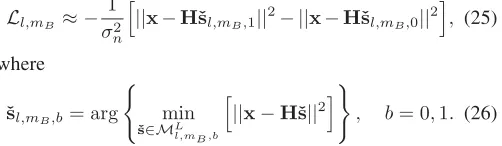
(24) In order to avoid the exponential computation imposed by Equation (24), the maximum-approximation [4] can be ap-plied, yielding:
Ll,mB ≈ − 1
σ2 n
||x−Hˇsl,mB,1||2− ||x−Hˇsl,mB,0||2
, (25)
where
ˇsl,mB,b= arg
min
ˇs∈ML l,mB,b
||x−Hˇs||2, b= 0,1. (26)
Furthermore, concerning the fact that the true FD-CHTF matrixH is unknown and using Equation (15), Equation (25) can be represented as:
Ll,mB ≈ − 1
σ2 n
Ωl,mB,1−Ωl,mB,0, (27)
where
Ωl,mB,b= minΩH˜, ˇsl,mB,b
, ω , b= 0,1, (28)
and ω = P ·L is a normalization factor. Equation (27) suggests that the LLRs can be obtained by evaluating the GA’s OF. More explicitly, in order to calculate the LLR of the (mB)th bit of the lth (l = 1,· · · , L) user at the
specific subcarrier considered, theX individuals in the GA’s final generation are divided into two groups, where the first (or second) group is constituted by those individuals that have a value of one (or zero) at the (mB)th bit of the lth
user’s estimated transmitted symbol. The resultant lowest OS calculated in each of the two groups is then compared to ω, and the smaller of the two will be used in Equation (27) for calculating the corresponding LLR, which can therefore assist the channel decoder in improving the SDMA-OFDM system’s performance.
It is worth pointing out that the proposed GA generating the above-mentioned population-based soft outputs only imposes
a modest complexity increase in comparison to the conven-tional hard-decision aided individual-based GAs [29], [32]– [35], [37], [38]. This is because the only additional operation required by the proposed scheme besides the calculation of Equation (27), is to compareω to the OSs, which are already available, since the results of the OF evaluation carried out by the conventional GAs can be readily used.
IV. SIMULATIONRESULTS
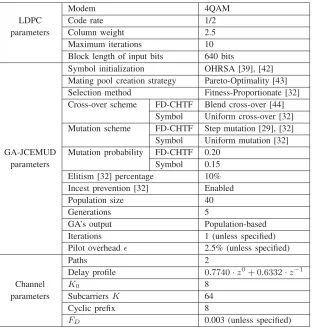
[image:6.567.29.280.385.458.2]In this section, we will quantify the performance of the MIMO SDMA-OFDM system using the proposed GA-aided iterative joint channel estimation and multi-user detection technique. Due to the space limitations, we only show the results achieved by the proposed scheme in the rank-deficient scenario, although we point out that it performs equally well in the scenarios, where the number of users Lis less than or equal to the number of receiver antenna elements P. More specifically, a rank-deficient scenario where L = 4 users were supported by P = 2 receiver antenna elements was considered. As an example, a simple two-path Rayleigh fading channel model was employed, where the associated delay profile was (0.7740·z0+ 0.6332·z−1). The value of the parameterK0 was set to82, which is potentially capable of tolerating an increase of the actual dispersion up to eight CIR taps. Each of the paths experienced independent Rayleigh fading having the same Doppler frequency of FD = fdTs normalized to the OFDM symbol rate, where fd and Ts are the maximum Doppler frequency and the OFDM symbol duration including the cyclic prefix, respectively. The channel was assumed to be OFDM symbol-invariant, implying that the CIR taps were assumed to be constant for the duration of one OFDM symbol, but they were faded at the beginning of each symbol. Each user’s associated transmit power or signal variance was assumed to be unity. Moreover, both scenarios with and without FEC coding were investigated. In the FEC-coded scenario, as an example, a half-rate binary Low Density Parity Check (LDPC) [41] code was employed. However, other FEC codes, for example Turbo Convolutional (TC) codes are also applicable to the proposed system. For the reader’s convenience, the simulation parameters are summarized in Table I. For more details on the GA’s configuration, the interested reader is referred to Section III-C.1 and [32], [37], [38].
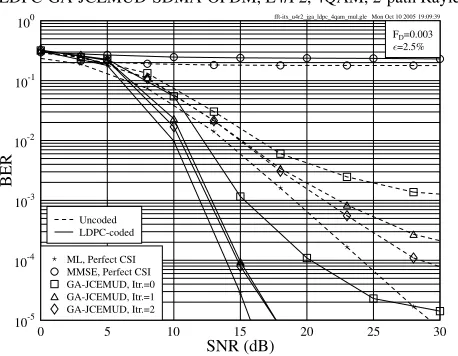
In Figure 3 we compare the Bit Error Ratio (BER) versus Signal-to-Noise Ratio (SNR) performance of both the uncoded and LDPC-coded GA-JCEMUD/SDMA-OFDM systems in conjunction with different values of the OFDM symbol nor-malized Doppler frequency FD. The performances of the systems employing the linear MMSE MUD or the optimum ML MUD are also provided as references, both assuming perfect Channel State Information (CSI). A pilot overhead of = 2.5% was assumed and the GA-JCEMUD used a single iteration. As shown in Figure 3, unsurprisingly, the performances of both the uncoded and coded GA-JCEMUD aided systems degraded, when FD was increased, since a
TABLE I
BASIC SIMULATION PARAMETERS USED INSECTIONIV.
Modem 4QAM
LDPC Code rate 1/2
parameters Column weight 2.5
Maximum iterations 10
Block length of input bits 640 bits
Symbol initialization OHRSA [39], [42]
Mating pool creation strategy Pareto-Optimality [43]
Selection method Fitness-Proportionate [32]
Cross-over scheme FD-CHTF Blend cross-over [44]
Symbol Uniform cross-over [32]
Mutation scheme FD-CHTF Step mutation [29], [32]
Symbol Uniform mutation [32]
GA-JCEMUD Mutation probability FD-CHTF 0.20
parameters Symbol 0.15
Elitism [32] percentage 10%
Incest prevention [32] Enabled
Population size 40
Generations 5
GA’s output Population-based
Iterations 1 (unless specified)
Pilot overhead 2.5% (unless specified)
Paths 2
Delay profile 0.7740·z0+ 0.6332·z−1
Channel K0 8
parameters SubcarriersK 64
Cyclic prefix 8
FD 0.003 (unless specified)
Nonetheless, with only a 2.5% pilot overhead, the proposed GA-JCEMUD/SDMA-OFDM system was capable of achiev-ing a performance close to the perfect-CSI aided optimum ML MUD atFD= 0.001. By contrast, the system employing the
MMSE MUD completely failed even with the aid of perfect CSI, owing to the insufficient degree of detection freedom experienced in rank-deficient scenarios. On the other hand, a significant iteration gain was achievable, when the GA-JCEMUD invoked more iterations, as revealed by Figure 4, where we had = 2.5% andFD = 0.003. Furthermore, the
performance of the uncoded system consistently improved as the number of iterations was increased, while in the LDPC-coded system most of the gain was attained by the first GA-JCEMUD iteration.
In Figure 5, we provide the average channel Mean Square Error (MSE) performance of the GA-JCEMUD/SDMA-OFDM system. The performance of the reference system employing = 100% pilot overhead is also provided. The average MSE is defined by:
MSE = 1
NT
NT
n=1
MSE[n], (29)
whereNT is the total number of OFDM symbols transmitted,
while MSE[n] is the average MSE associated with the
FD-CHTFs of the nthOFDM symbol, given by:
MSE[n] = 1
P LK
P
p=1
L
l=1
K
k=1
Hˆ(l)
p [n, k]−Hp(l)[n, k]
2.
(30)
[image:7.567.128.440.80.410.2]Here we point out that the MSE performance of the GA-JCEMUD is the same both with and without employing FEC coding. This is because the GA-aided joint optimization process has no direct interaction with the outer FEC code and thus it becomes independent of the codec. Observe from Figure 5 that as expected, the MSE performance was improved when the number of GA-JCEMUD iterations was increased. Moreover, when the SNR exceeded about 13dB, the GA-JCEMUD using= 2.5%pilot overhead approached the best-case performance associated with= 100%.
fdx_u4r2_jga_ldpc_4qam_mul.gle Mon Oct 10 2005 19:09:06
0 5 10 15 20 25 30 SNR (dB)
10-5 10-4 10-3 10-2 10-1 100
BER
LDPC-GA-JCEMUD-SDMA-OFDM, L4/P2, 4QAM, 2-path Rayleigh
GA-JCEMUD, FD=0.005
GA-JCEMUD, FD=0.003
GA-JCEMUD, FD=0.001
MMSE, Perfect CSI ML, Perfect CSI
=2.5% GA. Itr.=1
[image:8.567.293.519.58.239.2]LDPC-coded Uncoded
Fig. 3. BER versus SNR performances of the uncoded and
LDPC-coded iterative GA-JCEMUD assisted SDMA-OFDM systems in the
rank-deficient scenario, whereL= 4users were supported with the
aid of P = 2 receiver antenna elements, while assuming different
values of the OFDM symbol normalized Doppler frequencyFD. The
basic simulation parameters are given in Table I.
fft-itx_u4r2_jga_ldpc_4qam_mul.gle Mon Oct 10 2005 19:09:39
0 5 10 15 20 25 30 SNR (dB)
10-5 10-4 10-3 10-2 10-1 100
BER
LDPC-GA-JCEMUD-SDMA-OFDM, L4/P2, 4QAM, 2-path Rayleigh
GA-JCEMUD, Itr.=2 GA-JCEMUD, Itr.=1 GA-JCEMUD, Itr.=0 MMSE, Perfect CSI ML, Perfect CSI
=2.5% FD=0.003
LDPC-coded Uncoded
Fig. 4. BER versus SNR performances of the uncoded and
LDPC-coded iterative GA-JCEMUD assisted SDMA-OFDM systems in the
rank-deficient scenario, whereL= 4users were supported with the
aid ofP = 2 receiver antenna elements, while invoking different
numbers of GA-JCEMUD iterations. The basic simulation parameters are given in Table I.
the ring is constituted by theK = 64 spoke-like formations corresponding to the 64 OFDM subcarriers. Explicitly, the radiuses of the FD-CHTF rings associated with the four user-receiver channel links are significantly different. This is because each individual link is subjected to independent fading, and although the Doppler frequency encountered at the four links is identical, their short-term envelope fluctuation observed over the 40 OFDM symbol durations is different. However, by comparing the subfigures at the top and bottom of Figure 6, we can see that the FD-CHTF estimates closely match their true values, resulting in a similar FD-CHTF contour for each of the four channel links. This implies
mse_fft-itx_u4r2_jga_ldpc_4qam_mul.gle Sat Sep 10 2005 14:26:24
0 5 10 15 20 25 30 SNR (dB)
10-3
2 5
10-2
2 5
10-1
2 5
100
Channel
MSE
GA-JCEMUD-SDMA-OFDM, L4/P2, 4QAM, 2-path Rayleigh
[image:8.567.34.258.60.239.2]GA. Itr.=2, =2.5% GA. Itr.=2, =100% GA. Itr.=1, =2.5% GA. Itr.=1, =100% GA. Itr.=0, =2.5% GA. Itr.=0, =100% FD=0.003
Fig. 5. Channel MSE versus SNR performance of the iterative
GA-JCEMUD assisted SDMA-OFDM system in the rank-deficient
scenario, where L = 4 users were supported with the aid of
P = 2receiver antenna elements, while invoking different numbers
of iterations. The basic simulation parameters are given in Table I.
that the proposed GA-JCEMUD is capable ofsimultaneously capturing the fading envelope changes ofeachindividual user-receiver link, regardless of its instant variety of fading. Since an equally good performance was attained over all the user-receiver links, this demonstrates the global robustness of the proposed approach in MIMO scenarios.
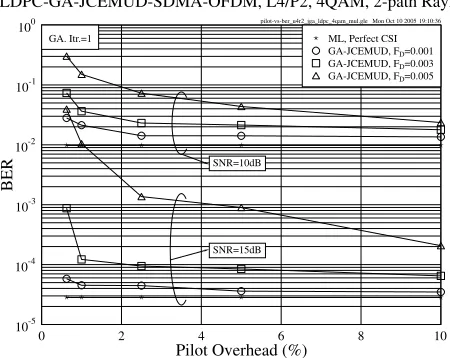
In Figure 7 the BER performance of the proposed system using different pilot overheads is investigated. In most cases, the GA-JCEMUD was capable of achieving a good perfor-mance using a pilot overhead as low as = 1.5 ∼ 2.5%. Furthermore, the increase of pilot OFDM symbol overhead brings about more substantial benefits at the higher Doppler frequencies than at the lower ones, especially in the scenarios associated with higher SNRs, where an increasing fraction of the residual detection errors was inflicted by the inaccurate channel estimation.
In order to further characterize the advantages of the proposed GA-aided joint optimization scheme, in Figure 8 we compare the performances of the GA-JCEMUD and its counterpart, referred to as the GA-based channel estimator assisted OHRSA MUD (GACE-OHRSA-MUD), where the OHRSA MUD is serially concatenated with the stand-alone GA-aided channel estimator. More specifically, in the GACE-OHRSA-MUD, channel estimation and symbol detection are separately accomplished by the GA-aided channel estimator and the OHRSA MUD, respectively. In other words, the sym-bol estimates offered by the OHRSA MUD are fixed during the GA-aided optimization process of the FD-CHTF estimates. Explicitly, in this case the effect of error propagation due to inaccurate symbol and/or channel estimates will become more severe, thus resulting in a dramatic BER performance degradation in comparison to the proposed joint optimization scheme, as evidenced in Figure 8. Furthermore, the superiority of the GA-JCEMUD becomes even more conspicuous in high-Doppler scenarios.
[image:8.567.32.261.339.517.2]compari-jga_true_chn.gle Sun Apr 15 2007 21:24:33
-2.0 -1.5 -1.0 -0.5 0.0 0.5 1.0 1.5 2.0 Real -2.0 -1.5 -1.0 -0.5 0.0 0.5 1.0 1.5 2.0 Imaginary
True Channel Transfer Functions, 2-path Rayleigh
. . . . . . . . . . . . . . . . . . . . . . ... ... . . .. .. . . .. .. . .. .. . . . . . . . . . . . . . . . . . . . . . . . . . . . . . . . . . . ... .... .. . . . .. . . .. . . .... .. .. . . . . . . . . . . . . . . . . . . . . . . . . . . . . . . . . ... .. . .. . . .. . . .. . . ... .. . . . . . . . . . . . . . . . . . . . . . . . . . . . . . . . . . .. .. ... . . .. .. . . .. . . ... .. . . . . . . . . . . . . . . . . . . . . . . . . . . . . . . . . . . . .. .. .. . . .. . .. . . .. . . .... .. .. . . . . . . . . . . . . . . . . . . . . . . . . . . . . . . . . .... . .. . . .. . .. . . .. .. . . ... . . . . . . . . . . . . . . . . . . . . . . . . . . . . . . . . . . . . .. ... . . .. . . . . .. . . .. . . . . ... .. . . . . . . . . . . . . . . . . . . . . . . . . . . . . . . . . . . .. .. .. . . .. . .. . . .. .. . . .. ... . . . . . . . . . . . . . . . . . . . . . . . . . . . . . . . . . . .. .. .. . . .. . .. . . .. .. . . .. ... . . . . . . . . . . . . . . . . . . . . . . . . . . . . . . . . . ... . .. . . .. . . .. . . ... . .. . . . . . . . . . . . . . . . . . . . . . . . . . . . . . . . . . ... . . .. . .. . . .. . . ... ... . . . . . . . . . . . . . . . . . . . . . . . . . . . . . . . . . . .. .... . . .. . .. . . .. . . ... . .. . . . . . . . . . . . . . . . . . . . . . . . . . . . . . . . . . . .... . .. . . .. . . .. . . . ... . . . . . . . . . . . . . . . . . . . . . . . . . . . . . . . . .. ... . . .. . .. . . .. .. . ... . . . . . . . . . . . . . . . . . . . . . . . . . . . . . . . . .. .... . . .. . . . . .. . . .. . . . ... . . . . . . . . . . . . . . . . . . . . . . . . . . . . . .. . . ... ... . . .. . . . . .. . . .. . . . .. ... . . . . . . . . . . . . . . . . . . . . . . . . . . . . . .. . . . ... ... . . .. . .. . . .. .. . .. .. . . . . .. . . . . . . . . . . . . . . . . . . . . . . . . .. . . . .... . .. . . . .. . . .. . . ... .. .. . .. . . . . . . . . . . . . . . . . . . . . . . . . .. . . . . .... . .. . . . .. . . .. . . . .. .... .. . . . . . . . . . . . . . . . . . . . . . . . . . .. .. .... ... . . .. . .. . . .. . . ... .. .. .. .. . . . . . . . . . . . . . . . . . . . . . . . . .. .. .... ... . . .. . .. . . .. . . ... .. .. .. .. . . . . . . . . . . . . . . . . . . . . . . . . .. .. .... ... . . .. . .. . . .. .. . .. .. .. .. .. . . . . . . . . . . . . . . . . . . . . . . . .. .. .. .... . .. . . . .. . . .. . . . .... .. .. .. . . . . . . . . . . . . . . . . . . . . . . . .. .. .... ... . . .. . .. . . .. ... .. .. .. .. . . . . . . . . . . . . . . . . . . . . . . . . . .. .. .... ... . . .. . .. . . .. . . .... .. .. .. . . . . . . . . . . . . . . . . . . . . . . . . . .. .. .... ... . . .. . .. . . .. . . .... .. .. .. . . . . . . . . . . . . . . . . . . . . . . . . .. .. .... .... . .. . .. . . .. . . . .. .... .. .. . . . . . . . . . . . . . . . . . . . . . . . .. .. .. .... . .. . . . .. . . .. . .... .. .. .. .. . . . . . . . . . . . . . . . . . . . . . . . .. .. .... ... . . .. . .. . . .. . . .... .. .. .. . . . . . . . . . . . . . . . . . . . . . . . . .. .. .. .... ... . . . .. . . .. . .. .... .. .. . . . . . . . . . . . . . . . . . . . . . . . . .. .. .... .... . .. . .. . . .. . . .... .. .. .. . . . . . . . . . . . . . . . . . . . . . . . . .. .. .. .... ... .. . .. . . .. .... .. .. .. .. . . . . . . . . . . . . . . . . . . . . . . . . .. .. .... ... . . .. . .. . . .. ... .... .. .. .. . . . . . . . . . . . . . . . . . . . . . . .. .. .. .... ... . . . .. . . .. . .... .. .. .. . . . . . . . . . . . . . . . . . . . . . . . . .. .. .... .... . .. . .. . . .. . ... .... .. .. . . . . . . . . . . . . . . . . . . . . . . . . .. .. .. .... ... .. . .. . . .. .... .. .. .. .. . . . . . . . . . . . . . . . . . . . . . . . . .. .. .... .... . .. . .. . . .. .. .... .. .. .. . . . . . . . . . . . . . . . . . . . . . . . .. .. .... .... . .. . .. . . .. .... .... .. .. . . . . . . . . . . . . . . . . . . . . . . . .. .. .. .... ... . . . .. . . .. .. .... .. .. .. . . . . . . . . . . . . . . . . . . . . . . . . .. .. .. .... ... .. . .. . . .. .... .... .. .. . . . . . . . . . . . . . . . .
FD=0.003
No. of OFDM symbols=40 User 1
User 2
User 3 User 4
jga_est_chn_it1.gle Sun Apr 15 2007 21:22:45
-2.0 -1.5 -1.0 -0.5 0.0 0.5 1.0 1.5 2.0 Real -2.0 -1.5 -1.0 -0.5 0.0 0.5 1.0 1.5 2.0 Imaginary
Estimated Channel Transfer Functions, 2-path Rayleigh
. . . . . . . .. . . . . . . . . . . ... .. . . . . .. . ... . . . . . .. . . . . . .... . . . . . .. . . . . . . . . . .. .. . . . . .. . .. .. . . . . . . . .. .. . .. .. .. ... . . . . .. .... . . . .. .. . . . . . . . . . . . . . . . . . . . .. . . . . .. . . .. . .. ... . . . .. . .. . . . . . . . . . .. . . . . . . . . . . . . .. . . . . . . . .. . . . . . .. . . . . . . . ... .. .... . . . . . . . .. . . . . . . . . . . . . . .. . .. .. . . . . . . . . . . . . . . . . . . . . . . . .. .. .. . . . . .. . . . . .. .. . .. .. . . . . . . . . . .. .. . . . . . . . . . . . .. . . . . . . . . . . . . . . . . ... .. . .... .. .. . . . . . .. .. . . . . . . .. . . .. .. . . . . . . . .. . . . .. . . . . . . .. . . .. . . .. . . .. . ... . .. . .. . . .. . . . . . . . . . . . . . . . . . . . . . . . . . . .. . . .. . . . .. . . . . . . .. ... ... .. . . .... . . .. ... . . .. .. .. . . . . . . . . . . . . . . . . . . .. .. . . . . .. . . .... . . . . ... . .... . . . ... .. . .. . .. . . . .. . . . . . .. . . . . . .. . . . . . . . . .. . . . .. . . . ... . .. . .. . . . . . . . . . . .. . . . . . . . . . . . . . . . . . . . . . . .. . . .. . .. . . .. . . .... .... . . . . . . . . .. .. . . . . . . .... . . . . . . . . . . . .. . . . . . . . . .. . . . .. . . . . . .. . . . . . . .. . . . . . . ... ... . . . . . . . .. .. . . . . . . . . . . . . . . . . . . . .. . . . . . .. . . ... . .. . . .... . . . . ..... . . .. . .. . . .. . . . . . . . . . . . . . . . . . . . . .. . . . . . . . .. . . ... . ... .. . ... . .. .. . . .. .. .. . .. . . .. . . . . .. . .. . . . . . . . . . . . . . . . .... . . ... .. . .. . .. ... . ... . . . . . . . . . .. . . . ... . . . . . . .. .. . .. .. . . . .. .. . . . .. . ... . . .. .. . . . . . . . .. . . . . . . . . . . . .. . . . ... . . . . .. . . .. . .. . .. . .. . .. .. ... .. . . ... . . . ... ... . ... . . . . .. . . . .. . . . .. .. .. . . . . .. . . ... .. . .. . . .. . .. . . .. .. . . . .... . . .. .. . .. . .. . . . . . . . . . . . . . . .. . . . . . . . .. . ... .. . . . ... . . .. . . . . . .. . .. .. ..... . . . .. . . . . . . .. . . . . . . . . . . .. . . .. . . . . . . . . .. . . . . . . . .. . . . . . . .. . . . ... .. . .. . .. . . . . . . . . . . . . . . . . . . . . . .. . . . . . .. .. ... . ... ... .. . .. .. .. . . . . . .. . . . . . . . . . . .. . . . . . . . . . . . . . . . . . . . . .. . . ... . . .. . . . . . . . .. . . .... . . . .. . .. .. . . .. . . . . . . . . . . . .. . .. .. . . . . . . ... .. .. . . . . . .. . .. . . ... . . . ... . . . . .. . . .. . . . . .. . . . . . .. . . . . . . . . .. .. . ... ... . . . .. .. . ... . . . . . . . .. . . . . .. . . .... . . . . . . . . .. . . . . . . . . . .. . . . .. . . . ... .. ... . .. .. .. . . .. ... . . . . . . .. . . . . .. . . . . . . .. . .. . . . . . . . .. .. ... .. . .. .. . .... .... . . . . . . . . . . . . . .. . . . . .. . . . . . . . .. . . . . . . .. ... .. . .. ... . . .... .. . .. . . .... .. . .. . .. . . . . . . . . . .. . . . .. . . .. . . . . . ... . ... . . . ... . . . .... . ... .. .. . .. .. . . . .. ... . . . . . . . . . . . . . .. . .. . . . ... . .. . . . . .... .. . . . . . . . .. .... . . . . ... . . . . . . . . . .. .. . . . .. . .... . . . .. .. ... .... . . . ... . .. . .... . . . . . . . . .. . . . . . . . . .. . . . . . . .. . . . . . . . . . ... . . . . .... . . . . . . .. . ... .. .. .... .. . .. . . . . . . . .. . .. .. . . . . ... . . . . .. . . . . . .. .. .. . .. ... . .. .. .. . . . . . .. .. .. ... . .. . . . . . . . .. .. . .. . . . ... .. . . . . . . .. . .. . ... . .. ... . . . . .. .. . . . . .. . .. . . . . . .. . .. . . . . . . . .. . . . . . . ... . . . . . ... . . .. .... .. . . .. . ... .. . . .. . .. .. . . ... . .. .. . .. .. . .. .... . . . . . . . ... . . .. . . . ... .. . . .... . . . .. . . .. ... . . . . . . . . . . ... . . .. .. . .. .. . . .. . .. . . . ... . .. . ... . ... .. .. . . . ... . . .. .... . . . . . . .. . . . . .. .. . .. . .. . . . . . . . . . .. .... . .... . . . . . .... . . . . .. . . .... . . . . . . . . ... . . . . . . . . .. . . . ... . ... . . . . .. . . . . . . .. . .. .. . ... . . . . . ... . . . . . .. . . . . . . . . . . .... .. .. . . . .. .. .. ... . ... . .... .. . . . .. . . . . ... .. . . .. . . .. . . . . . . . . . .. . .. .... . .. . . .. . . ... .. .. .. . .. .. . . . . . .. . .. . . .. .. . . . . . . . .. .
FD=0.003
[image:9.567.30.259.55.238.2]No. of OFDM symbols=40 GA. Itr.=1 =2.5% SNR=20dB User 1 User 2 User 3 User 4
Fig. 6. Channel estimation performance of the iterative GA-JCEMUD
assisted SDMA-OFDM system in the rank-deficient scenario, where
L= 4users were supported with the aid ofP= 2receiver antenna
elements. The estimated FD-CHTFsHˆ1(l)[n, k] (l= 1,· · ·, L; k=
1,· · ·, K) associated with n = 1,· · ·,40 consecutive OFDM
symbols at thep= 1streceiver antenna are plotted at a SNR value of
20dB, and compared with the true FD-CHTFs. The basic simulation parameters are given in Table I.
son of the GA-JCEMUD providing either the conventional individual-based hard outputs [29], [32]–[35], [37], [38] or the proposed population-based soft outputs, as shown in Figure 9. As expected, with the advent of FEC codes, the proposed soft GA is capable of significantly outperforming the conventional arrangement, especially when the channel fades more rapidly. This result implies that the proposed GA exhibited a higher robustness against fast fading channels than the conventional GAs [29], [32]–[35], [37], [38].
It is also worth pointing out that the GA-based optimization imposes a significantly lower computational complexity than that of the optimum ML-based optimization, when perfect CSI is available. Typically, the Objective Function (OF) has to be evaluated for the entire search space by the ML MUD, whilst a substantially lower number of OF evaluations is required by the GA MUD. Comprehensive complexity comparisons between the ML- and GA-based MUDs can be found in [37],
pilot-vs-ber_u4r2_jga_ldpc_4qam_mul.gle Mon Oct 10 2005 19:10:36
0 2 4 6 8 10
Pilot Overhead (%) 10-5 10-4 10-3 10-2 10-1 100 BER
LDPC-GA-JCEMUD-SDMA-OFDM, L4/P2, 4QAM, 2-path Rayleigh
GA-JCEMUD, FD=0.005
GA-JCEMUD, FD=0.003
GA-JCEMUD, FD=0.001
ML, Perfect CSI GA. Itr.=1
SNR=10dB
[image:9.567.294.519.60.239.2]SNR=15dB
Fig. 7. BER versus pilot overhead performance of the LDPC-coded
iterative GA-JCEMUD assisted SDMA-OFDM system in the
rank-deficient scenario, where L= 4users were supported with the aid
ofP= 2receiver antenna elements, while assuming different values
of the OFDM symbol normalized Doppler frequencyFD. The basic
simulation parameters are given in Table I.
joint-vs-serial_u4r2_jga_ldpc_4qam_mul.gle Mon Oct 10 2005 19:09:46
0 5 10 15 20 25 30 SNR (dB) 10-5 10-4 10-3 10-2 10-1 100 BER
LDPC-GA-JCEMUD-SDMA-OFDM, L4/P2, 4QAM, 2-path Rayleigh
GA., FD=0.005
GA., FD=0.003
GA., FD=0.001
MMSE, Perfect CSI ML, Perfect CSI
=2.5% GA. Itr.=1
GA-JCEMUD GACE-OHRSA-MUD
Fig. 8. Performance comparison of the LDPC-coded
SDMA-OFDM system using either the iterative GA-JCEMUD or the
GACE-OHRSA-MUD in the rank-deficient scenario, where L = 4 users
were supported with the aid of P = 2 receiver antenna elements,
while assuming different values of the OFDM symbol normalized
Doppler frequencyFD. The basic simulation parameters are given in
Table I.
[image:9.567.294.522.340.518.2]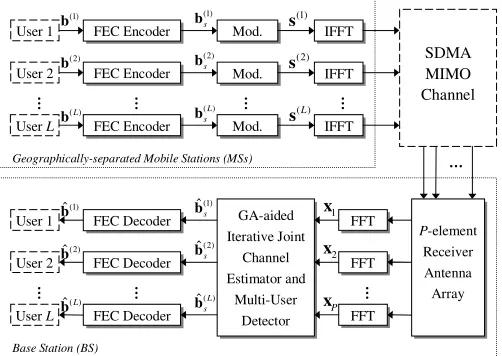
![Fig. 9.Performance comparison of the LDPC-coded SDMA-OFDM[13] Y. Li, N. Seshadri, and S](https://thumb-us.123doks.com/thumbv2/123dok_us/8493822.345343/10.567.34.260.59.240/fig-performance-comparison-ldpc-coded-sdma-ofdm-seshadri.webp)
