Branch Classification to Control Instruction Fetch
in Simultaneous Multithreaded Architectures
P.M.W. Knijnenburg
LIACS, Leiden University, the Netherlands,
[email protected]
A. Ramirez, F. Latorre, J. Larriba, M. Valero
Department d’Arquitectura de Computadors, UPC, Spain,
f
aramirez,flatorre,larri,mateo
g@ac.upc.es
Abstract
In Simultaneous Multithreaded architectures many sepa-rate threads are running concurrently, sharing processor resources, thereby realizing a high utilization rate of the available hardware. However, this also implies that threads are competing for resources and in many cases this com-petition can actually degrade overall performance. There are two major causes for this: first, instructions that, be-cause of a long latency data cache miss, be-cause dependent instructions not to proceed for many cycles thereby wast-ing space in the instruction queues, and second, execution of instructions that belong to a mispredicted path. Both of these have a harmful effect on throughput and the second moreover wastes energy.
In this paper we propose a fetch policy that avoids issu-ing instructions to the pipeline if we are not confident that the instruction belongs to the correct execution path. In this way, we avoid using resources for instructions that will not contribute to performance. This fetch policy, called agstall, is based on a dynamic branch classification mecha-nism. Branch instances are classified as either strongly bi-ased or not strongly bibi-ased. We consider all strongly bibi-ased branches as easy to predict, and we stall the thread on not strongly biased branches to avoid mispredicting them. Our results show that agstall achieves similar or better perfor-mance than icount, and reduces by up to 86% the number of wrong-path instructions executed.
This research was supported by the EC IST programme (contract HPRI-CT-1999-00071), by the Ministry of Science and Technology of Spain (contract TIC2001-0995), and by CEPBA.
1. Introduction
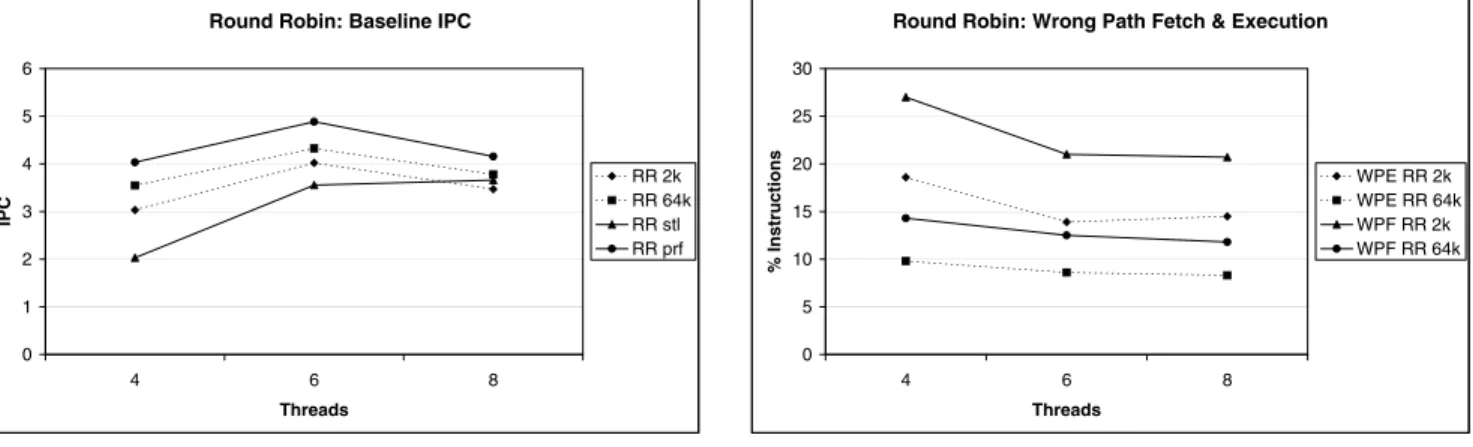
In Simultaneous Multithreaded architectures (SMTs) many separate threads are running concurrently, sharing the re-sources of a single processor, thereby realizing a high uti-lization rate of the available hardware. In this way both In-struction Level Parallelism (ILP) within a single thread, and Thread Level Parallelism (TLP) between different threads can be exploited, giving rise to low horizontal and verti-cal waste [9]. However, in an SMT architecture threads are competing for resources and in many cases this competition can actually degrade performance. This effect is illustrated in Figure 1(a) where we show, for several branch predictors, the throughput for 4, 6, and 8 threads for the processor con-figuration given in Section 3. We observe that throughput decreases for 8 threads because too many threads are com-peting for scarce resources, exept for the stall-on-branch scheme. The present SMT configuration is better suited to support 6 than 8 threads.
An important shared resource in an SMT architecture are the instruction queues where instructions are waiting to be dispatched to the functional units. We would like to prevent that these queues are polluted which can happen because of 1. chains of instructions that are dependent on a long la-tency instruction like a load that misses in the L2 cache or a divide instruction, and
2. instructions from mispredicted paths.
The most serious challenge for first objective are loads that miss in the L2 cache since this can take 100 cycles or more. Theicountinstruction fetch mechanism [16] partially deals with this problem by fetching from threads with least in-structions in the frontend, thereby enforcing short
depen-Round Robin: Baseline IPC 0 1 2 3 4 5 6 4 6 8 Threads IPC RR 2k RR 64k RR stl RR prf (a) Throughput
Round Robin: Wrong Path Fetch & Execution
0 5 10 15 20 25 30 4 6 8 Threads % Instructions WPE RR 2k WPE RR 64k WPF RR 2k WPF RR 64k
(b) Waste caused by misprediction
Figure 1. SMT performance for Round Robin instruction fetch using a 2k-entry and a 64k-entry gshare predictor (RR 2k and RR 64k, respectively), perfect branch prediction (RR prf), and stall on branch (RR stl).
dence chains in the queue. Next, adaptations of the instruc-tion fetch engine have been proposed that take into account cache behavior. Limousin et al. [8] predict whether a load gives rise to an L2 miss and subsequently restrict instruc-tion fetch from this thread. Tullsen and Brown [15] detect L2 misses and flush the frontend of instructions that are de-pendent on this load.
The second objective can obviously be tackled by stalling on a branch and fetching the next instruction when the branch is resolved. However, as can readily be seen in Fig-ure 1(a), stalling on a branch reaches far lower throughput than when a branch predictor is used for 4 and 6 threads. In these cases there is not enough parallelism available to keep all resources occupied in case we stall on branches. For 8 threads, however, there is enough parallelism and IPC for stall-on-branch is higher for 8 than for 6 threads. IPCs for 8 threads is less than IPCs for 6 threads for the other schemes because 8 threads gives too much competiton: even for per-fect branch prediction (where there are only correct path instructions) IPC for 8 threads is less than IPC for 6 threads because of too much competition. In Figure 1(b) we have plotted the waste caused by imperfect branch prediction, where we show the instructions that are fetched along a mispredicted path as a percentage of the total number of instructions fetched and the instructions executed along a wrong path, as a percentage of the total number of instruc-tions executed. Wrong path fetching of instrucinstruc-tions wastes bandwidth to the instruction cache and energy. Instructions that are executed along a wrong path waste resources, de-grading the performance, and energy.
Taken together, Figures 1(a) and (b) show a dilemma. If we do not want to execute along a mispredicted path thereby minimizing waste and using all resources for useful work,
we need to stall upon encountering a branch. Stalling, however, degrades performance to unacceptable levels and therefore we need to incorporate some kind of prediction mechanism. However, by doing this we inevitably create mispredicted paths and hence waste resources and energy. The goal of the present work is to reduce the number of wrong path instructions in the instruction queue, thereby reducing waste, without reducing performance. We achieve this by only fetching instructions past a branch when we are highly confident that the branch is predicted correctly. There are two ways to ensure that a prediction will proba-bly be correct. First, we can use aconfidence estimator[7] and stall a thread if a branch is likely to be predicted wrong. Second, we can use abranch classifierto classify branches as easy or hard to predict. It has been shown [4] that about 60% of all dynamic branches is heavily biased: they are either taken or not taken for over 95% of the times they are encountered. This observation has been exploited previ-ously to enhance branch prediction accuracy [1, 12]. Also, branches can have a low transition rate, that is, they do not change direction often. In [5] it has been shown that over 60% of the dynamic branches have a transition rate of less than 5%. Hence, branches tend to be ‘stable’ during the execution of a program and are therefore easy to predict. In order to decide between branch classification and confi-dence estimation as the mechanism to stall on branches, we conducted some initial experiments and found that branch classification outperforms confidence estimation consider-ably, both in resulting throughput and wrong path execution. The reason for this seems to be that confidence estimation is too aggressive in speculating past branches. Therefore we employ a branch classification mechanism in this paper. We call the resulting instruction fetch policyagstall.
By using theagstallbranch classifier and instruction fetch policy, we achieve the best of both worlds:
good prediction accuracy for easy branches (up to 99.2% accurate) to ensure high throughput of the entire machine and high IPC for individual threads, and a low percentage of instructions executed along a
wrong path and hence low energy waste in program execution.
We show that agstallin many cases outperforms conven-tional instruction fetch policies in terms of throughput and always outperforms them with respect to wrong path fetch and execute. We study the design space ofagstallby con-sidering two implementations, a small and a big one. More-over, we discuss the parameter that determines how sive branches are classified as easy and hence the aggres-siveness of speculation inagstall.
The paper is organized as follows. In section 2 we dis-cuss related work. In section 3 we disdis-cuss our experimental setup. In section 4 we discuss our proposed branch classi-fier and instruction fetch mechanismagstall. We present ex-perimental results in section 5 and an analysis ofagstallin section 6. Finally, we draw some conclusions in section 7.
2. Related work
It is well known that accurate branch prediction is cru-cial for harvesting high levels of Instruction Level Paral-lelism in conventional superscalar processors. In the past few decades, many proposals for branch predictors have been put forward, ranging from simple one bit last direc-tion predicdirec-tion, to sophisticated two level adaptive schemes [4, 13, 17]. An important proposal has been the gshare branch predictor by McFarling [11] in which access to the pattern history tables is hashed by XORing branch address with global branch history. Gshare is the base predictor used in this study. Hily and Seznec study branch prediction for multithreaded architectures [6].
In this paper we employ a dynamic branch classifier that classifies branches as either easy or hard. In [1, 3], dy-namic branch filter mechanisms are proposed to filter out these biased branches using simple counters and only using the dynamic predictor to predict the other branches. Alter-natively, profiling can be used to classify branches as easy or hard to predict [2, 12]. In this paper, we employ a dy-namic branch classifier resembling the classifier from [1]. The main difference is that we do not reset the classifier counters to zero when a branch does not comply with its bias, but decrement the counter instead. This introduces some slack in the classification mechanism. Furthermore,
like in [12], we use a small agree-type predictor [14] to pre-dict easy branches, rather than using their bias as predic-tion. It has been shown [12] that this arrangement improves branch prediction for easy branches significantly. However, unlike [1, 12], we do not try to predict the hard branches but stall the instruction fetch for this thread instead.
Pipeline gating [10] uses a branch prediction confidence estimator [7] to control instruction fetch: on a low confi-dence branch the pipeline is stalled. They show a slight decrease of performance together with a large decrease of wrong path instructions. This technique strongly resembles our technique. The main difference is that we propose a branch classifier that filters out biased branches instead of using confidence estimation. The main advantage is that non-biased branches do not pollute the branch predictor in our approach and a small dynamic predictor can be used with a high prediction accuracy (up to 99% accurate for 8 threads).
Instruction fetch policy is another important factor for SMT performance. In [16] it has been shown that theicountfetch policy performs best over a number of fetch policies. In this policy, priority is given to threads with few instructions in the front end of the processor. Theagstallmechanism re-sembles icountto a certain extend in that threads that are less likely to be mispredicted are favored. Ties can be bro-ken by icount, harvesting the strong points of this mech-anism. The BRCOUNT fetch mechanism from [16] that favors threads that are least likely to be on a wrong path re-semblesagstall, but it differs in that it decides this based on the number of branches in the frontend, instead of classify-ing branches as in our approach.
3. Experimental setup
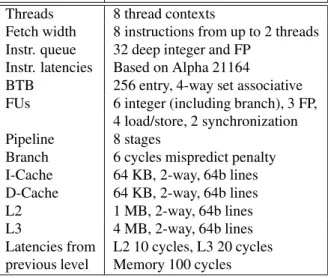
We use the SMT simulator provided by Dean Tullsen [16], called SMTSIM, which is based on the Alpha ISA. The characteristics of the simulator used are listed in Table 1. The simulator stops whenever one of the threads finishes. Since rename registers are an obvious bottleneck in this type of architecture, we have varied the number of rename reg-isters from 32 to 256 and ran a number of experiments to decide the optimal number. We found that in general IPC values were severely degraded for 32 or 64 rename regis-ters. For 192 or 256 rename registers there was a slight increase in IPC compared to 128 rename registers. How-ever, this increase is so little that we did not consider the extra cost justified. Therefore, we employed 128 rename registers for the remainder of our experiments. We use both Round Robin instruction fetch and theicountfetch policy. We use all SPECint95 benchmarks, exceptm88ksimthat did not execute properly in the original simulator. We use
Parameter Value Threads 8 thread contexts
Fetch width 8 instructions from up to 2 threads Instr. queue 32 deep integer and FP
Instr. latencies Based on Alpha 21164
BTB 256 entry, 4-way set associative FUs 6 integer (including branch), 3 FP,
4 load/store, 2 synchronization Pipeline 8 stages
Branch 6 cycles mispredict penalty I-Cache 64 KB, 2-way, 64b lines D-Cache 64 KB, 2-way, 64b lines
L2 1 MB, 2-way, 64b lines
L3 4 MB, 2-way, 64b lines
Latencies from L2 10 cycles, L3 20 cycles previous level Memory 100 cycles
Table 1. Processor configuration
the train input data, except forcompresswhere we use reference data since the train data proved to run for too few cycles. In order to be able to use 8 threads, we usevortex
twice, once with train data and one with reference data. We study the situation for 4, 6, and 8 threads. For 4 threads we useperl,vortex,li, andgcc. For 6 threads we
addijpegandcompress. For 8 threads we addgoand
the second version ofvortex. We have chosen these col-lections of benchmarks in order to have a balanced mix of benchmarks [4].
4.
agstall
instruction fetch policy
In this section we discuss theagstallbranch classifier and instruction fetch policy which is based on the AGBIAS branch predictor [12] in which branches are statically clas-sified by profiling. Inagstallwe classify branches dynam-ically as easy or hard. We predict easy branches while hard branches cause the thread to stall. If there are enough easy branches, then single thread performance will not be degraded too much by stalling on hard branches. Easy branches can be accurately predicted (up to 99.2% accu-rate) and hence the number of instructions fetched and exe-cuted along a mispredicted path will decrease. At the same time, in a simultaneous multithreaded environment, there are enough instructions from other threads available to keep the processor busy and the overall performance will not degrade by stalling. In fact, we show that in many cases performance will increase, due to improved sharing of re-sources and less destructive competition. The result is an SMT processor organization that has high throughput, but
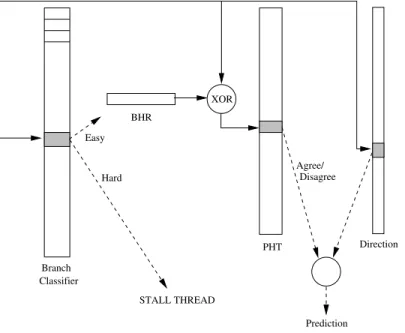
wastes less resources and hence consumes less energy. Theagstallscheme is shown in Figure 2 and consists of two structures: a branch classifier and a branch predictor.
Branch classifier consists of a direct mapped table of 8 bit counters. The most significant bit indicates the branch direction. Each time a branch is executed, the classifier is updated. If the classifier and the actual direction of a branch coincide, the counter is incremented by 1. If the counter reaches 64, the branch is classified aseasy. Hence the 7th bit in the counter indicates whether the branch is easy or not. The counters count further un-til they saturate at127. In case the classification and the actual direction of a branch do not coincide, the counter is decreased by 16.
Branch predictor For easy branches, we use an agree pre-dictor [14] to predict its outcome. The agree predic-tor consists of a gshare-type [11] Pattern Hispredic-tory Table (PHT) indexed by XORing branch address with the BHR. The PHT consists of 2 bit saturating counters that are interpreted asagreeordisagreewith a direc-tion bit from the direcdirec-tion table. The direcdirec-tion table is indexed by the branch address and the direction bit is set upon first encounter of a branch.
We employ two configurations of different size. The small implementation is slightly larger than the small gshare pre-dictor (512B), and the large implementation uses as many bits as the large gshare predictor.
agstall2k uses a 2k-entry classifier, a 2k-entry agree pre-dictor, and a 8k-entry direction table. We use an 11 bit BHR in this configuration. It uses 2KB + 512B + 1KB = 3.5 KB.
agstall8k uses a 8k-entry classifier, a 16k-entry agree pre-dictor, and a 16k-entry direction table. We use a 14 bit BHR. It uses 8KB + 4KB + 4KB = 16KB.
5. Results
In this section we present the results obtained by the
agstall instruction fetch policy and compare them to the conventional instruction fetch policies Round Robin and
icount[16].
5.1. Round Robin instruction fetch
In this subsection we show results of adding the agstall
Branch Address XOR BHR STALL THREAD Easy Hard Branch Classifier PHT Direction Prediction Disagree Agree/
Figure 2.agstallBranch Classification and Instruction Fetch Scheme agstall2k
4 threads 6 threads 8 threads
WPF 2k 59.3 62.6 72.5 WPF 64k 23.1 47.2 51.7 WPE 2k 60.2 71.2 73.8 WPE 64k 24.5 54.7 60.2 agstall8k WPF 2k 77.0 86.2 87.9 WPF 64k 56.6 76.8 78.8 WPE 2k 77.4 87.1 88.3 WPE 64k 57.1 79.1 79.5
Table 2. Relative improvement ofagstallover Round Robin 2k and 64k: Wrong Path Fetch (WPF) and Wrong Path Execution (WPE) (%).
use both a 2k-entry and a 64k-entry gshare branch predic-tor in the conventional SMT. The resulting architectures are denoted as RR 2k and RR 64k, respectively.
First, in Figure 3(a) we show the performance for all orga-nizations for 4, 6, and 8 threads. We show throughput for Round Robin with perfect branch prediction (RR prf), and stall-on-branch (RR stl). We observe that the IPC is high-est for 6 threads, outperforming 8 threads by 20%. This figure can be explained as follows. For 4 threads, there is not enough parallelism available to exploit the processor
re-sources. Hence, when going to 6 threads, IPC increases. When going further to 8 threads, IPC drops again for all or-ganizations, except for stall on branch. The competition has become too high so that even for perfect branch prediction the overall IPC drops. Only for stall on branch there is a slight increase in IPC when going from 6 to 8 threads be-cause of better exploitation of available resources. This can happen because at any given time there are several contexts stalled and hence there is less competition than for the other organizations. We also observe thatagstallreaches an IPC that is close to the IPC reached by perfect branch prediction. In particular,agstall8k outperforms perfect branch predic-tion slightly for 6 threads which is the optimal number of threads for this configuration.
In order to compare our approach to conventional ap-proaches we employ weighted speedup, a metric proposed in [15]. The reason for introducing this metric is because it is difficult to compare two policies in a multithreaded envi-ronment by using overall IPC. Any policy that gives priority to high IPC threads will boost overall IPC of a workload, but low IPC threads will not proceed in this policy. How-ever, speedup based on overall IPC is high and this obscures the fact that some threads are not running very well. There-fore, we should look at the speedup of the individual threads in the same workload for two different policies in order to give a fair comparison. For this purpose weighted speedup
Round Robin: IPC 0 1 2 3 4 5 6 4 6 8 Threads IPC RR 2k RR 64k RR stl RR prf AGSTALL 2k AGSTALL 8k
(a) IPC Values
Weighted Speedup AGSTALL over RR
0,90 1,00 1,10 1,20 1,30 1,40 1,50 4 6 8 Threads Weighted Speedup 2k/2k 2k/64k 8k/2k 8k/64k (b) Weighted Speedup Round Robin: Wrong Path Fetch
0 5 10 15 20 25 30 4 6 8 Threads % Fetched Instructions RR 2k RR 64k AGSTALL 2k AGSTALL 8k
(c) Wrong Path Fetch
Round Robin: Wrong Path Execution
0 5 10 15 20 4 6 8 Threads % Instructions RR 2k RR 64k AGSTALL 2k AGSTALL 8k
(d) Wrong Path Execution
Figure 3. Round Robin instruction fetch
(WSP) is defined as WSP = 1 jThreadsj X t2Threads IPC new (t) IPC old (t) With this definition, if the new policy slows down certain threads much compared to the old policy and favors other threads a lot, then this causes speedup terms less than 1 to appear in the summation. Hence the WSP number will be not be artificially inflated. A WSP value of 1 means that all threads run more or less at the same speed in both old and new policies. A WSP value greater than 1 means that several threads are running faster in the new policy and the other threads are not running too much slower. Therefore weighted speedup is a fair comparison of performance and the higher its value the better. In our experiments, all indi-vidual speedup values are close to 1.
We have shown the weighted speedup ofagstallover Round Robin in Figure 3(b). In this figure, the entry 2k/2k denotes the weighted speedup ofagstall2k over RR 2k, etc. We see that the weighted speedup ofagstallwith Round Robin over Round Robin alone is quite high. In particular, for the case of 6 threads where the architecture performs best,agstall2k
has an 18% and 10% speedup over a 2k-entry or a 64k-entry gshare predictor, respectively. For this situation,agstall8k has 23% and 14% speedup, respectively.
In Figure 3(c) we show the wrong path fetches. We see that
agstall has significantly less wrong path fetches than the Round Robin fetch mechanisms. In Figure 3(d) we have shown the instructions executed along a wrong path as the percentage of the total number of executed instructions. We see thatagstallimproves Round Robin considerably for all number of threads and for both branch predictors. A larger implementation ofagstallhas less wrong path fetches and executions, since the classifier and the predictor are less pol-luted by interference. In Table 2 we show relative improve-ments which increase with the number of threads, for both branch predictors in the baseline configuration.
We conclude that the agstall fetch mechanism on top of Round Robin improves on Round Robin with a gshare branch predictor considerably. We improve both on throughput and on wrong path fetch and execution. This last means thatagstallwastes considerably less energy than a conventional implementation. Since agstall2k is much smaller than 64k-entry gshare, we also reduce the energy
agstall2k
4 Threads 6 Threads 8 Threads
WPF 2k 64.2 72.7 76.6 WPF 64k 31.5 53.1 59.8 WPE 2k 63.8 73.0 74.5 WPE 64k 31.0 55.1 56.9 agstall8k WPF 2k 77.4 85.6 88.0 WPF 64k 56.7 75.2 79.4 WPE 2k 77.5 85.2 86.4 WPE 64k 57.1 75.4 76.9
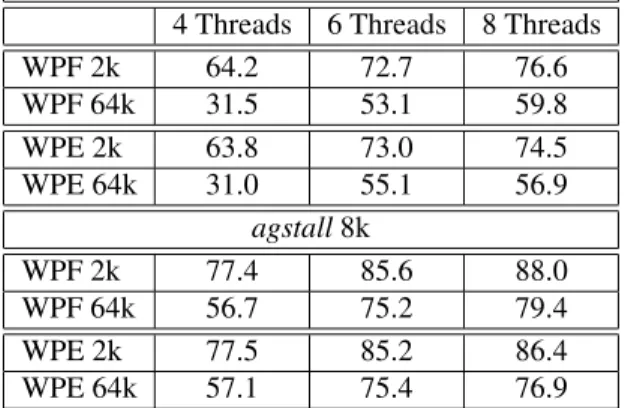
Table 3. Relative improvement ofagstallover
icount 2k and 64k: Wrong Path Fetch (WPF)
and Wrong Path Execution (WPE) (%).
spent in the branch predictor itself.
5.2.icountinstruction fetch
In this section we show the results when we use theicount
fetch mechanism proposed in [16] that gives priority to threads with least instructions in the frontend of the pro-cessor. In order to exploit the best of both worlds, we im-plementagstallon top oficount: we stall on branches that are likely to be predicted wrongly and for the threads that are likely to be predicted correctly, we prefer those threads that have few instructions in the pipeline and hence we both balance threads and give preference to threads that can be executed fast.
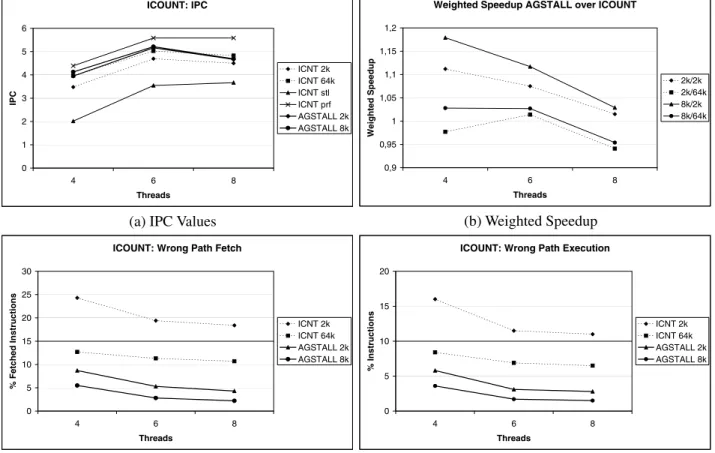
We again employ a 2k-entry and a 64k-entry gshare branch predictor foricount. The resulting architectures are denoted as icount2k and icount64k, respectively. We show the throughput for all configurations for 4, 6, and 8 threads in Figure 4(a). Moreover, we showicountwith stall-on-branch (icountstl) and perfect branch prediction (icountprf). We show the weighted speedup of agstallovericountin Fig-ure 4(b), where 2k/2k denotes the speedup of agstall 2k overicount2k, etc. Relative improvement is given in Ta-ble 3. We observe thaticount64k and both configurations ofagstallreach almost the same performance. In partic-ular, for 6 threads where the architecture reaches its high-est throughput and thus is the preferred number of threads for this configuration,agstall2k improves onicount64k by 1.4%, andagstall8k improves by 2.7%. In both other cases, there is a slight decrease in throughput. Note, however, that
agstall2k uses considerably less hardware for this purpose. Bothagstalls outperformicount2k always.
4 Threads 6 Threads 8 Threads
agstall2k 3.14 4.33 5.78
agstall8k 3.23 4.59 6.17
Table 4. Average number of running contexts.
Next, we look at wrong path fetch and wrong path execution in Figures 4(c) and 4(d), respectively. The relative improve-ments are given in Table 3. We observe thatagstallon top oficountimproves onicountalone in all cases significantly, up to 86%. Again, improvements in Wrong Path Fetch and Execution increase with for more threads.
We conclude thatagstallon top oficountis an effective way of reducing the energy consumption of an SMT architec-ture. Whenicountemploys a small branch predictor we also improve significantly on throughput. We reach a slightly higher throughput for 6 threads than the large branch predic-tor and lose only a few percent throughput for 4 or 8 threads. However, in both cases we reduce energy consumption con-siderably. Moreover, by employing only a small branch pre-diction structure foragstall2k, we also consume less energy in the branch predictor thanicount64k.
6. Analysis of
agstall
In this section we discuss a number of aspects of theagstall
sheme. First, we discuss the amount of stalling that is in-duced byagstall. We use three metrics. In Figure 5(a) we show the percentage of the total number of cycles that con-texts are stalled, as a function of number of concon-texts that are stalled per cycle foragstallon top oficountfor 6 threads. In Figure 5(b) we show the percentage of dynamic branches that are classified as hard per benchmark. In Table 4 we show the average number of contexts alive during the ex-ecution of a workload. From these results we see that the large implementation classifies less branches as hard than the small implementation, due to less interference in the classifier. Therefore, the average number of contexts alive at any given time is higher foragstall8k than foragstall2k. This holds in particular for 8 threads where much interfer-ence inagstall2k occurs. However, we see in Figure 4(a) that throughput decreases for 8 threads, showing again that increased competition may degrade overall performance. Next, we discuss branch prediction accurracy. In Table 5 we show the hit rate for the easy branches. We see that this hit rate is very high, in particular foragstall8k (99% or higher). We also see that more threads means a slightly lower hit rate, due to interference. This is less pronounced in the large predictor, as expected. This means that the easy
ICOUNT: IPC 0 1 2 3 4 5 6 4 6 8 Threads IPC ICNT 2k ICNT 64k ICNT stl ICNT prf AGSTALL 2k AGSTALL 8k
(a) IPC Values
Weighted Speedup AGSTALL over ICOUNT
0,9 0,95 1 1,05 1,1 1,15 1,2 4 6 8 Threads Weighted Speedup 2k/2k 2k/64k 8k/2k 8k/64k (b) Weighted Speedup ICOUNT: Wrong Path Fetch
0 5 10 15 20 25 30 4 6 8 Threads % Fetched Instructions ICNT 2k ICNT 64k AGSTALL 2k AGSTALL 8k
(c) Wrong Path Fetch
ICOUNT: Wrong Path Execution
0 5 10 15 20 4 6 8 Threads % Instructions ICNT 2k ICNT 64k AGSTALL 2k AGSTALL 8k
(d) Wrong Path Execution
Figure 4.icountinstruction fetch
4 Threads 6 Threads 8 Threads
agstall2k 96.0% 95.2% 94.7%
agstall8k 99.2% 99.2% 99.0%
Table 5. Hit rate easy branch prediction.
branches are very well predicted and therefore we obtain a low percentage wrong path fetches and executions. Next, in Figure 6, we show IPCs for the individual bench-marks for the four most important configurations. IPCs are generally higher for icount64k than for icount 2k as its prediction accuracy is higher. For 6 threads,agstallyields higher IPC forvortexandlithanicountdoes. In these benchmarks there are many easy branches with high pre-diction accuracy and hence these threads do not stall often. Furthermore, an important routine inijpegisidct, that has a long straightline code segment. Hence, this routine can be serviced at high speed with no stalls and ijpeg
reaches a higher IPC than for icount. Compress has a lower IPC, since most of the dynamic branches in it are hard as shown in Figure 5(b). Nevertheless,compressdoes not
suffer as much as we would expect based on this large num-ber of hard branches. This is because these branches are of-ten mispredicted inicountand hence little gain is harvested by speculation. Note that if we would leave compress
out of consideration,agstallwould give much higher IPCs thanicount. Nevertheless, forcompressbranch predic-tion and speculapredic-tion yields higher throughput than stalling on hard branches. Perl andgcchave almost the same IPC as for icount. These benchmarks have a large num-ber of hard branches that are mispredicted often inicount, causing waste in the pipeline, and are classified as hard in
agstall, causing the thread to stall. We also see that IPC val-ues for 6 threads are higher foragstall8k than foragstall
2k. However, if we look at the breakdown for 8 threads in Figure 6(b), we see that this is no longer the case. This is because in the 8k implementation more threads are alive at any given time and hence more threads are competing for the resources. The amount of resources in the current con-figuration is too small to accommodate 8 threads and hence IPCs suffer.
Finally, we analyze another dimension in the design space ofagstall, namely, how aggressive branches are classified
ICOUNT: Stalled Contexts 0 5 10 15 20 25 30 35 40 45 0 1 2 3 4 5 6 # Contexts Stalled % Total Cycles AGSTALL 2k AGSTALL 8k
(a) Percentage of time that contexts are stalled
AGSTALL: Stalled Branches
0 10 20 30 40 50 60 70 80
perl vortex li gcc ijpeg compress
Benchmark
% Dynamic Branches
AGSTALL 2k AGSTALL 8k
(b) Percentage dynamic branches stalled
Figure 5. Effects of stalling for 6 threads.
IPC Breakdown 0,0 0,2 0,4 0,6 0,8 1,0 1,2 1,4 1,6 perl vor tex li gcc ijpeg compr ess Benchmark IPC ICNT 2k ICNT 64k AGSTALL 2k AGSTALL 8k (a) 6 threads IPC Breakdown 0,0 0,2 0,4 0,6 0,8 1,0 1,2 1,4 1,6 per l vor tex li gcc ijpeg com press go vor tex2 Benchmark IPC ICNT 2k ICNT 64k AGSTALL 2k AGSTALL 8k (b) 8 threads
Figure 6. Breakdown of IPC for individual benchmarks.
as easy. This corresponds to value of the threshold, or the width of the branch classifier. At the same time, the nar-rower the classifier, the less expensive it is to build and the less energy it consumes itself. If the width is zero, all branches are classified as easy and they are predicted by the agree predictor. agstallon top of icountbehaves like
icountemploying a 16k-entry agree predictor. For the other limit, if the width is large, all branches are classified as hard, andagstallon top oficountbehaves likeicountthat stalls on branches. We have furthermore implemented classifiers of width 4, 6, 8, and 10 bit. Obviously, the more narrow the classifier, the more branches are classified as easy and the architecture speculates more aggressively. However, in-creased speculation does not necessarily give more through-put, as can be seen in Figure 7(a). IPC increases with clas-sifier width until it reaches its best value at 6 bit and de-creases for wider classifiers. Hence, decreasing the amount of speculation at first increases IPC: there are less threads alive at any given moment and hence less destructive com-petition. Then, as we decrease speculation further, there is too few parallelism available to fully exploit all resources
and IPC drops. In this paper, we use 8 bit that has a slightly lower IPC than 6 bit. On the other hand, wrong path exe-cution drops with increasing classifier width, as can be seen in Figure 7(b). This is to be expected since less specula-tion implies less wrong paths. In particular, 8 bit has lower wrong path execution than 6 bit. Hence there is a tradeoff between IPC and wrong path fetch and execution. In this paper we have chosen for lower number of wrong path in-structions and hence we have implemented an 8 bit wide classifier. Note that IPC values for 6 and 8 bit wide classi-fiers are substantially better than foricountwith 16k-entry agree predictor (0 bit) and, at the same time, there is much less waste due to wrong paths.
7. Conclusion
In this paper we have described a novel instruction fetch policy for Simultaneous Multithreaded architectures, called
agstall, with the goal of freeing the instruction queue of use-less wrong path instructions. This saves both energy and
IPC for Classifier Widths 3,4 3,6 3,8 4,0 4,2 4,4 4,6 4,8 5,0 5,2 5,4 4 6 8 Threads IPC 0 bit 4 bit 6 bit 8 bit 10 bit inf (a) Throughput
WPE for Classifier Widths
0 2 4 6 8 10 12 14 4 6 8 Threads % Instructions 0 bit 4 bit 6 bit 8 bit 10 bit inf
(b) Wrong Path Execution
Figure 7. IPC and WPE for different prediction aggression levels.
resources, and can moreover improve performance. This policy is based on branch classification: the processor stalls a thread when a hard branch is encountered and speculates on easy branches. The result is that less contexts are alive at any given moment in time, thereby improving the sharing of resources and diminishing negative competition. We have shown that employing this mechanism on top of a simple Round Robin fetch mechanism, both improves the perfor-mance (IPC) to that of perfect branch prediction, and sig-nificantly reduces the number of instructions that are exe-cuted along a mispredicted path by up to 86%. If we put
agstallon top oficount, we outperformicountslightly for 6 threads in which the current configuration performs best. However, mispredicted path execution can be reduced by up to 85%. agstallcan be implemented with little or no extra cost compared to a conventional branch predictor.
References
[1] P.-Y. Chang, M. Evers, and Y.N. Patt. Improving branch pre-diction accuracy by reducing pattern history table
interfer-ence. InProc. PACT, pages 48–57, 1996.
[2] P.-Y. Chang, E. Hao, T.-Y. Yeh, and Y.N. Patt. Branch classi-fication: A new mechanism for improving branch predictor
performance. InProc. MICRO27, pages 22–31, 1994.
[3] A.N. Eden and T. Mudge. The YAGS branch prediction
scheme. InProc. PACT, pages 69–77, 1998.
[4] M. Evers and T.-Y. Yeh. Understanding branches and design-ing branch predictors for high-performance microprocessors.
Proceedings of the IEEE, 89(11):1610–1620, 2001. [5] M. Haungs, P. Sallee, and M. Farrens. Branch transition rate:
A new metric for improved branch classification analysis. In
Proc. HPCA, pages 241–250, 2000.
[6] S. Hily and A. Seznec. Branch prediction and simultaneous multithreading. Technical Report RR-2843, INRIA, 1996.
[7] E. Jacobson, E. Rotenberg, and J.E. Smith. Assigning
confi-dence to conditional branch predictions. InProc. MICRO29,
pages 142–152, 1996.
[8] C. Limousin, J. Sebot, A. Vartanian, and N. Drach-Temam. Improving 3D geometry transformations on a simultaneous
multithreaded SIMD processor. InProc. ICS, pages 236–
245, 2001.
[9] J.L. Lo, S.J. Eggers, J.S. Emer, H.M. Levy, R.L. Stamm, and D.M. Tullsen. Converting thread-level parallelism to instruction-level parallelism via simultaneous multithread-ing. ACM Transactions on Computer Systems, 15(3):322– 354, 1997.
[10] S. Manne, A. Klauser, and D. Grunwald. Pipeline gating:
Speculation control for energy reduction. InProc. ISCA,
pages 132–141, 1998.
[11] S. McFarling. Combining branch predictors.WRL Technical
Note TN-36, 1993.
[12] A. Ramirez, J.L. Larriba-Pey, and M. Valero. Branch
predic-tion using profile data. InProc. Euro-Par, pages 386–393,
2001.
[13] J.E. Smith. A study of branch predictor strategies. InProc.
ISCA, pages 135–147, 1981.
[14] E. Sprangle, R.S. Chappell, M. Alsup, and Y.N. Patt. The agree predictor: A mechanism for reducing negative branch
history interference. InProc. ISCA, pages 284–291, 1997.
[15] D.M. Tullsen and J.A. Brown. Handling long-latency loads
in a simultaneous multithreading processor. InProc.
MI-CRO34, 2001.
[16] D.M. Tullsen, S.J. Eggers, J.S Emer, H.M. Levy, J.L. Lo, and R.L. Stamm. Exploiting choice: Instruction fetch and issue on an implementable simultaneous multithreading processor. InProc. ISCA, pages 191–202, 1996.
[17] T.-Y. Yeh and Y.N. Patt. A comparison of dynamic branch
predictors that use two levels of branch history. In Proc.